Tag: nervous system regulation

  • Why Coping Skills Fail for Emotional Regulation: The Childhood Blueprint They Can’t Reach

    Why Coping Skills Fail for Emotional Regulation: The Childhood Blueprint They Can’t Reach

    TL;DR: Coping skills fail because they target your thoughts and behaviors — but your emotions were programmed by your childhood emotional blueprint long before you could think. The Worst Day Cycle™ runs beneath every trigger, and no breathing technique or reframe can reach it. The Emotional Authenticity Method™ rewires the blueprint at the root so you stop managing symptoms and start living free.

    Coping skills for emotional regulation fail because they address symptoms — your reactions in the present moment — while your emotional responses were hardwired by a childhood emotional blueprint that operates beneath conscious thought. True emotional regulation requires rewiring the blueprint itself, not managing its output. The Emotional Authenticity Method™ created by Kenny Weiss targets the root-level programming that no coping skill, breathing exercise, or cognitive reframe can reach.

    You’ve done the work. You’ve sat in the therapist’s chair. You’ve read the books, you’ve downloaded the apps, and you’ve practiced the deep breathing exercises. You know how to reframe your negative thoughts. You can probably explain your childhood trauma better than most licensed clinicians.

    And yet… the moment your partner uses that specific tone of voice, or your boss sends that vague email, or you feel invisible in a crowded room… you’re gone. Your chest tightens, your jaw locks, and before you can catch yourself, you are either raging, people-pleasing, or completely shutting down.

    That’s you… doing everything “right” and still ending up in the same emotional wreckage by Tuesday.

    And then, the shame hits. “Why did I do that again? I know better than this. What is wrong with me?”

    If you are exhausted by your own reactions and sick of trying to “manage” your emotions, I need you to hear this: You are not broken. You are not defective. You are simply using the wrong tools.

    Most of what the personal development world teaches about “emotional regulation” and “coping skills” is essentially putting a Band-Aid over open-heart surgery. You cannot skill your way out of a childhood emotional blueprint.
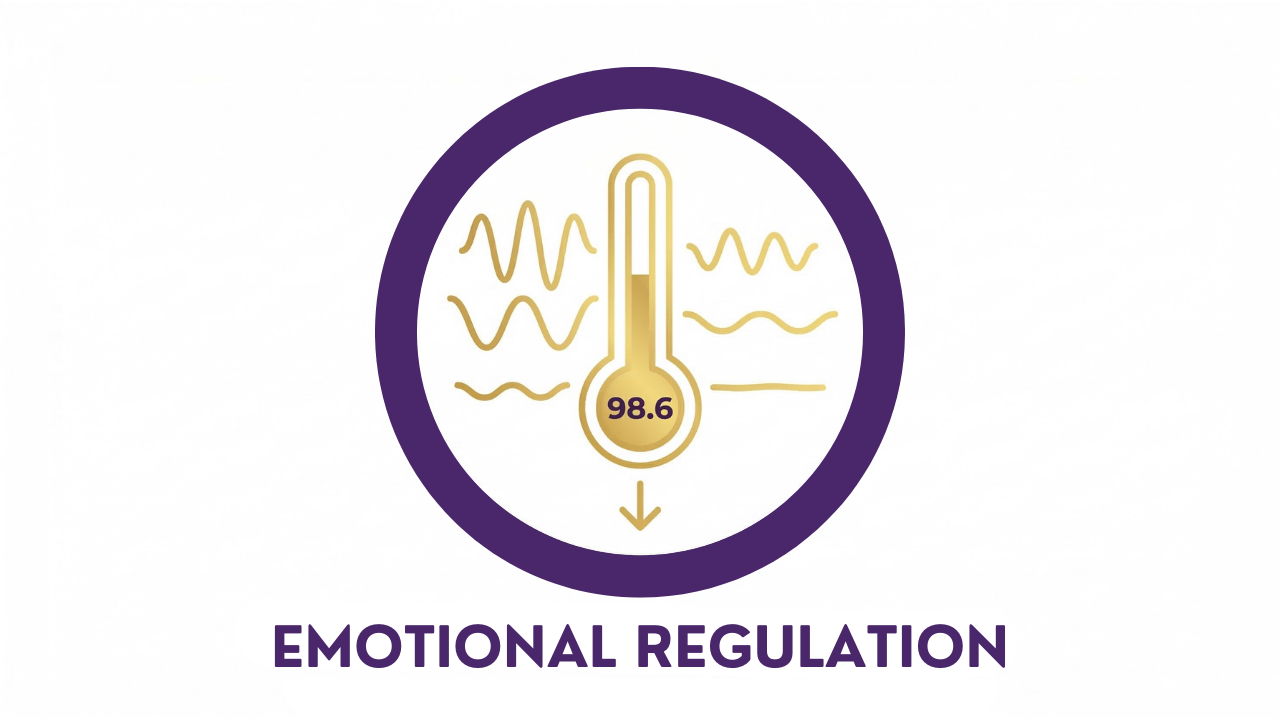
    Emotional regulation icon showing a thermometer at 98.6 degrees representing nervous system baseline — why coping skills fail to reach the childhood emotional blueprint — by Kenny Weiss

    Here is the neuroscience of why your coping skills are failing, why you aren’t actually reacting to the present moment, and how to use the Emotional Authenticity Method™ to stop managing your symptoms and start rewiring your brain at the root.

    That’s you… collecting techniques like trading cards and still getting blindsided by the same emotions every time.

    Why Do Your Emotions Control Your Thoughts Instead of the Other Way Around?

    Let’s start with a hard truth. Emotional Intelligence, Cognitive Behavioral Therapy (CBT), Dialectical Behavior Therapy (DBT), and even Internal Family Systems (IFS) operate on a massive, fundamental flaw. They assume you can think, skill, or manage your way to change. They tell you, “Just change your thoughts, use a coping skill, or talk to your fragmented parts, and you’ll change your feelings.”

    But here is the scientific proof that shatters that illusion: Your thoughts do not control your emotions. Your emotions control your thoughts.

    That’s you… sitting in therapy explaining your childhood perfectly, then walking to the parking lot and calling the same toxic ex.

    Think of your thoughts like lawyers for your emotions. Your thoughts do not care about the objective truth. Their only job is to argue whatever case your underlying emotional system hands them. If your childhood emotional blueprint says “I am unworthy” or “I am unsafe,” your thoughts will immediately build an entire logical argument to prove it.

    Dr. Lisa Feldman Barrett, one of the top neuroscientists in the world, proved that feelings actually drive your next thought and perception as predictions. You don’t react to the present; your brain categorizes your bodily sensations based on your past experiences to predict what you should do right now.

    And when you try to use logic, reframing, or “coping skills” to fix a feeling, you are using the wrong hardware. Dr. Iain McGilchrist’s neuroscience research shows that this hyper-logical approach activates the left hemisphere of your brain, which is addicted to denying the truth even when it is shown to be wrong. Trying to “think” your way out of a trigger literally detaches you from your embodied experience, which is exactly where the trauma actually lives. As he points out, knowing your emotional landscape at the root level creates the highest form of intellect.
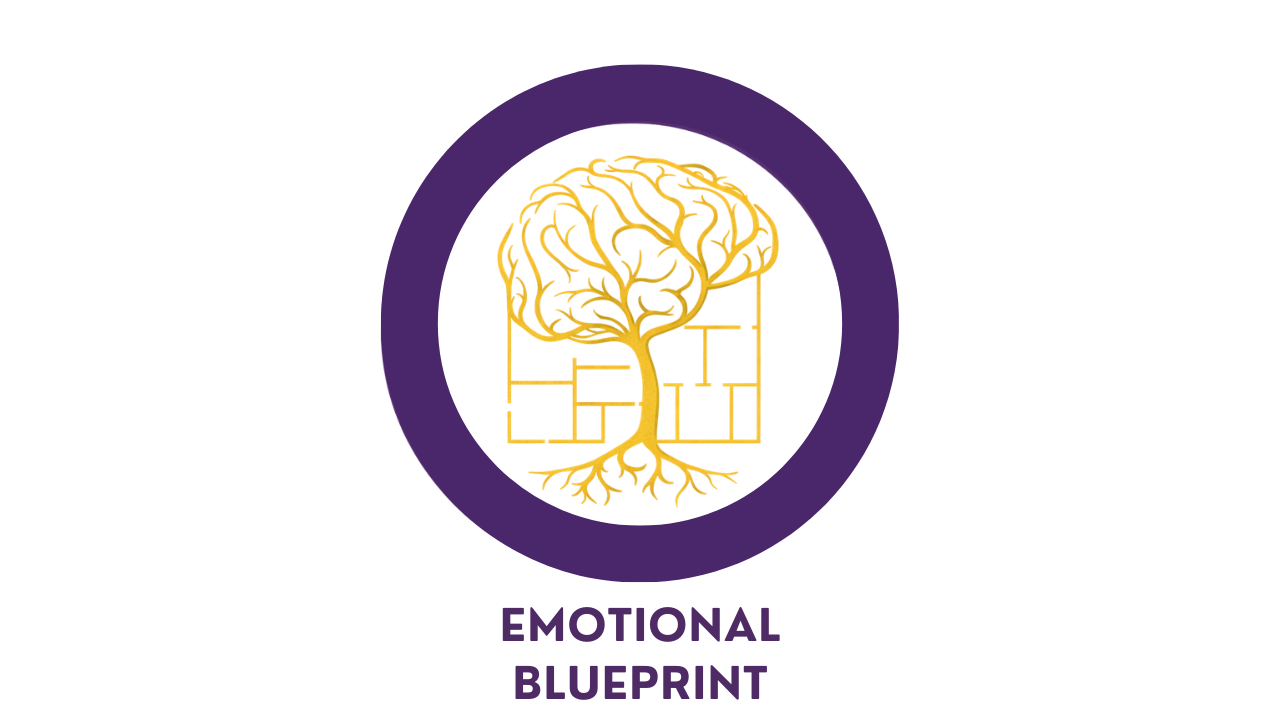
    Childhood emotional blueprint diagram showing how the brain predicts adult emotional reactions based on childhood trauma programming — why coping skills cannot reach the root — by Kenny Weiss

    This means when you get triggered, you aren’t actually reacting to your partner or your boss. Your brain is scanning the environment, recognizing a tone of voice or a facial expression, and saying, “Oh, I know this feeling. This is just like when Dad used to withdraw,” or “This is just like when Mom shamed me.” You are predicting the present based on a childhood blueprint.

    That’s you… hearing your partner say “we need to talk” and your body responds like you’re seven years old about to get screamed at.

    And when that happens, your Adult Authentic Self gets thrown in the back seat of the car, and your wounded, shame-based child grabs the steering wheel, and starts playing Grand Theft Auto with your life—crashing into trees, people, and relationships.

    You don’t need a breathing technique to calm that child down. You don’t need to break yourself into “parts.” You need to take the wheel back at the root level of the emotion, and I am going to show you how.

    That’s you… wondering why you become a completely different person the moment conflict starts.

    What Is the Worst Day Cycle™ and Why Can’t Coping Skills Break It?

    To understand why your coping skills fail and how to take the wheel back, you have to understand the invisible engine running your life. I call it the Worst Day Cycle™.
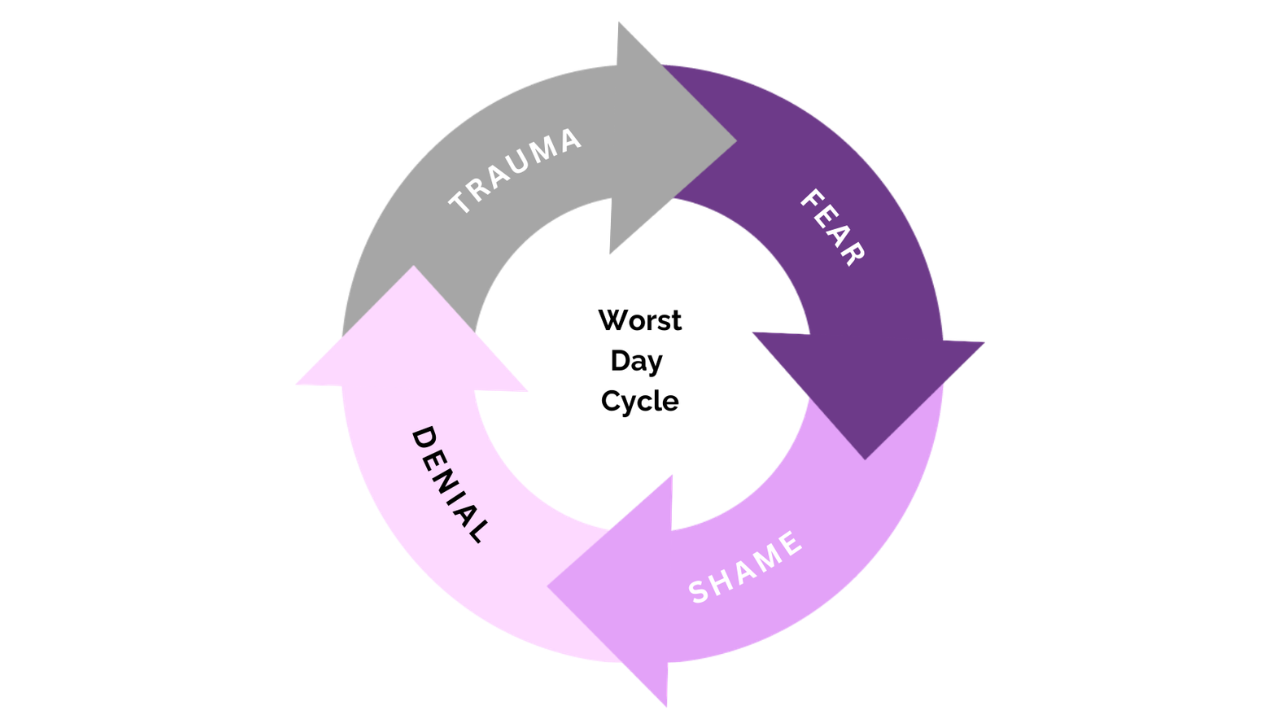
    Worst Day Cycle™ — the four-stage trauma loop of trauma, fear, shame, and denial that repeats from childhood into adult relationships — by Kenny Weiss

    Long before you had language or logic, you absorbed the emotional climate of your home. If your home was chaotic, critical, emotionally distant, or inconsistent, you experienced Trauma. Now, trauma isn’t just a horrific event. Trauma is any negative emotional event, therefore, we have all been traumatized as children.

    That trauma created Fear. Your nervous system became wired to anticipate danger, rejection, or inadequacy. But because a child cannot blame their parents—because blaming your parents threatens your survival—you blamed yourself.

    That’s you… still believing at forty-five that you’re “too much” or “not enough” — a story that was written when you were four.

    This brings us to the third stage: Shame. Shame isn’t just feeling bad; it’s an identity. It’s the deep, wordless belief that “I am the problem. I am not enough. I am unlovable.”

    But nobody can live in pure shame. It’s too painful. So, your brilliant, adaptive childhood brain created the fourth stage: Denial. You created a Survival Persona—a mask designed to protect you from ever feeling that shame again.
    Survival Persona mask showing the three types — Falsely Empowered, Disempowered, and Adapted Wounded Child — the false identity children create to avoid shame — by Kenny Weiss

    Maybe your Survival Persona is the Falsely Empowered type — the Over-Achiever who controls, dominates, and rages to prove their worth through success, because vulnerability feels like death. Maybe it’s the Disempowered type — the People-Pleaser who collapses, abandons their own needs, and loses themselves to keep the peace because abandonment feels like annihilation. Or maybe it’s the Adapted Wounded Child — oscillating between controlling and collapsing depending on the situation, never knowing which version of yourself will show up next.

    That’s you… being the unshakable leader at work and then falling apart the second your partner raises an eyebrow.

    Here is why your coping skills are failing: You are using them to keep your Survival Persona comfortable. You are using “mindset hacks” and “stress management” to stay in Denial. But the Worst Day Cycle™ doesn’t care about your coping skills because they are based on thoughts, and your cycle was created by your perfectly imperfect childhood emotional experiences. So, you will keep repeating the loop—Trauma, Fear, Shame, Denial—until you address the emotional blueprint at the root with Emotional Authenticity.

    That’s you… journaling your triggers every night and still waking up the same person every morning.
    Emotional Fitness icon representing the capacity to process emotions at the root level rather than managing symptoms with coping skills — by Kenny Weiss

    Why Does Your Childhood Emotional Blueprint Keep You Crashing Into the Same Reactions?

    Think of your emotional blueprint like a sled track on a snowy hill. As a kid, you walked up to the top of the hill and went down in the fresh powder. You did it again and again, reacting the same way to fear and shame. Eventually, you compacted the snow. You created deep, icy ruts.

    Now, as an adult, you try to steer the sled in a different direction using “coping skills” or “positive thinking.” But it doesn’t work. The ruts are too deep. Your brain loves this because it knows the path, even if the path leads to misery. That is because your brain conserves energy by replaying its earliest emotional memories and experiences.

    That’s you… knowing the relationship is toxic, knowing the job is killing you, and choosing it anyway because it feels like home.
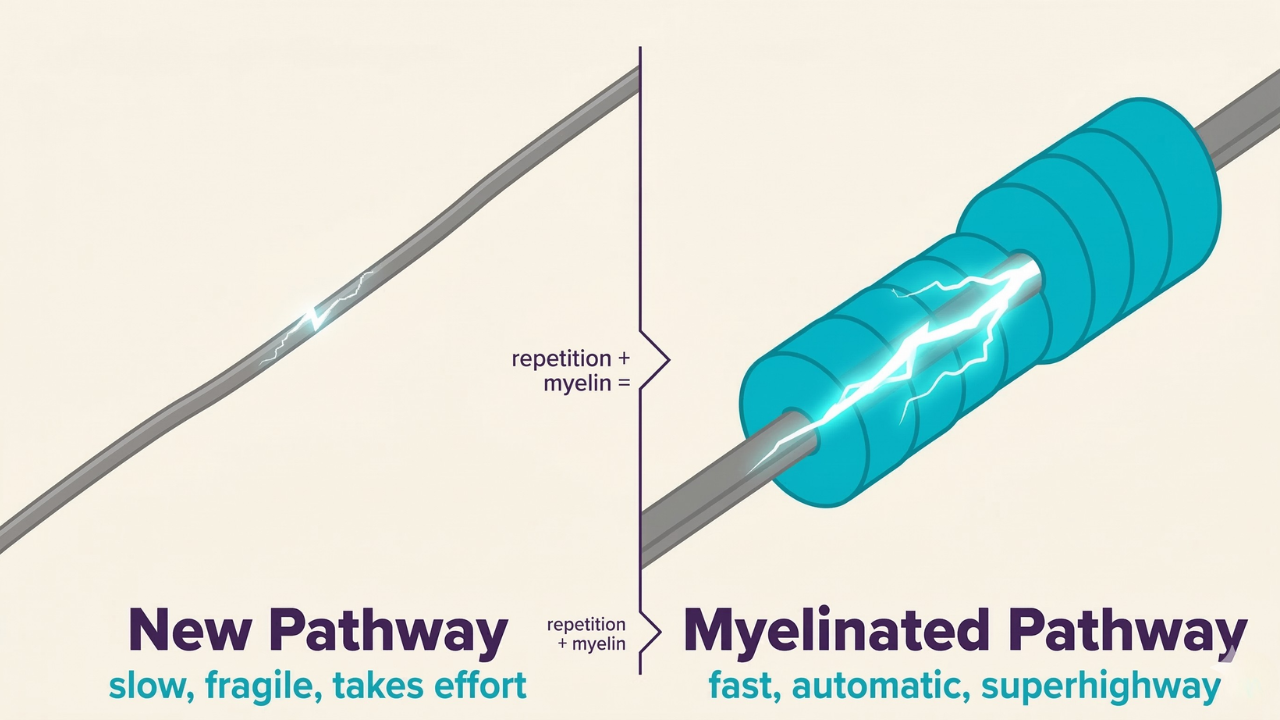
    Myelin and neural pathways icon showing how repetition in childhood creates hardwired emotional reactions that coping skills cannot override — by Kenny Weiss

    You cannot steer out of the rut halfway down the hill. You have to go back to the top of the mountain and forge a completely new track. You must address the emotion where it originated.

    So do you see? You aren’t broken or damaged; all you need is to update your emotional software programs so you can create a brand-new emotional blueprint sled path.

    How Does the Emotional Authenticity Method™ Replace Coping Skills and Rewire Your Emotional Blueprint?

    So, how do we forge a new track? How do we actually regulate our emotions at the root? We use the Emotional Authenticity Method™ to activate the anterior prefrontal cortex—the part of your brain designed for self-observation. It’s called metacognition, which is the highest form of intellect because this area of the brain sits between intellect and emotion, and Emotional Authenticity is the only process that fully achieves this.
    Emotional Authenticity Method™ diagram showing the metacognitive process that rewires the childhood emotional blueprint at the root — by Kenny Weiss

    The next time you get triggered—the next time your chest tightens, your throat closes, and you feel that surge of panic or rage—I want you to stop trying to “cope.” Stop trying to fix the other person. Stop analyzing the argument.

    Instead, activate metacognition by taking 15 to 30 seconds and focusing on everything you can hear. It could be your breath, the furnace, the noise outside… whatever it is. By focusing on what you can hear, you stop your thoughts, ground yourself somatically, and open the door to metacognition.
    Metacognition icon representing the highest form of intellect — the anterior prefrontal cortex activation that the Emotional Authenticity Method™ achieves — by Kenny Weiss

    Then, ask yourself these four deceptively simple questions:

    Number One: What am I feeling right now? Strip away the story. Don’t say, “I feel like he’s disrespecting me.” That’s a story. Name the core emotion: “I feel fear. I feel shame. I feel sadness.”

    That’s you… realizing you’ve never once asked yourself what you’re actually feeling — you’ve only ever asked what the other person did wrong.

    Number Two: Where in my body do I feel it? Get out of your head and into your somatic truth. “My throat is tight. My stomach is dropping. My chest is on fire.” This bridges the gap between your adult cognition and your nervous system.

    Number Three: What is my earliest memory of having this exact feeling and sensation? This is the question that changes everything. Because the answer almost always leads you back to childhood. It takes you back to the exact moment the sled track was formed. When you ask this, you will suddenly realize: “Oh my God. I’m not reacting to my husband forgetting the groceries. I’m reacting to the feeling of being invisible to my father when I was seven years old.” That recognition is the pause. That is the moment you take the microphone away from the terrified child inside of you and hand it back to your Adult Self.

    That’s you… finally understanding why a forgotten text message can make you feel like the world is ending.

    Number Four: What would I think and feel if I never had this negative thought or feeling ever again? Now, here is the game changer. This final question will reconnect you with your Authentic Self and who you were before your earliest painful emotional experiences. This is how you create a brand-new sled hill to form a brand-new emotional neural pathway blueprint that you can fill with new emotional meanings and predictions, so your brain fires these to change your thoughts and actions. In other words, this is the root-level solution that no other program offers you.

    Ask yourself: If this feeling could be wiped away from the face of the earth, and it wasn’t even possible to ever think or feel this again, what would be left over? What would I think and feel then?

    Do it now. Can you see it? You feel lighter. Free from the burden of the shame and pain you have been carrying for decades. You feel joy, excitement, empowerment, confidence, safety, and security.

    That’s you… catching a glimpse of who you actually are underneath all the armor.

    Congratulations. You have just written the first line of code in your new emotional blueprint software program to replace the faulty one that was installed in you as a child. You have stepped out of the Worst Day Cycle™ and into the Authentic Self Cycle™.
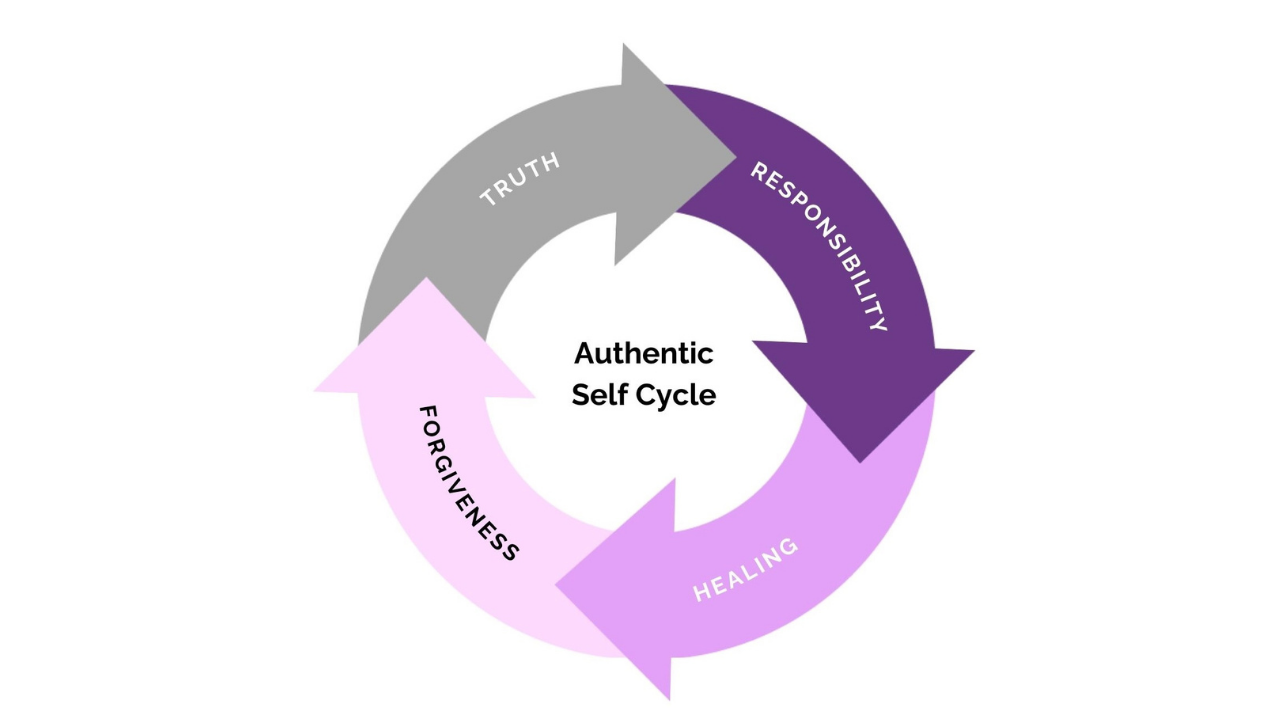
    Authentic Self Cycle™ — the four-stage healing pathway of truth, responsibility, healing, and forgiveness that replaces the Worst Day Cycle™ — by Kenny Weiss

    Now, the full rewiring process is too extensive to fit into this blog; my books, classes, and coaching are where we map it all out together.

    What Does Coping Skill Failure Look Like Across Your Entire Life?

    If you’re still wondering whether this applies to you, let me show you what coping skill failure looks like when it bleeds across every area of your life — because it always does. Your childhood emotional blueprint doesn’t stay in one lane. It drives everything.

    Family: You go home for the holidays and within thirty minutes you’re fourteen again. Your sibling makes a comment, your parent gives you that look, and suddenly all your “growth” evaporates. You cope by going quiet, over-drinking, or picking a fight — and then you spend the drive home wondering why you can’t just be “normal” around your own family.

    That’s you… spending three thousand dollars on therapy to prepare for Thanksgiving dinner and still losing it before dessert.

    Romantic Relationships: You’ve read every book on codependence recovery and communication. You know the language of healthy boundaries. But the moment your partner pulls away — even slightly — your nervous system hijacks you. You either chase, control, or shut down completely. The coping skills you learned in couples therapy worked in the therapist’s office. They don’t work at 11pm when your partner hasn’t texted back.

    That’s you… knowing exactly what a healthy relationship looks like on paper and being unable to sustain one in real life.

    Friendships: You over-give, over-accommodate, and then resent everyone for not reciprocating. Or you keep people at arm’s length because letting anyone close enough to really see you feels like handing them a loaded weapon. Your coping skill? Stay busy. Stay helpful. Stay indispensable. Never need anything from anyone.

    Work and Career: You’ve built an impressive résumé, but success feels hollow. You achieve, you perform, you exceed expectations — and you still feel like a fraud. Your Falsely Empowered survival persona got you the promotion, but it can’t get you peace. One critical email from a superior and your entire sense of self crumbles.

    That’s you… running an entire department but unable to handle a single piece of constructive feedback without spiraling for three days.

    Body and Health: Your body is keeping the score your coping skills can’t reach. Chronic tension in your jaw. Stomach issues that no doctor can explain. Insomnia that started in childhood and never left. You meditate, you exercise, you eat clean — and your nervous system still runs on high alert because the emotional enmeshment from childhood is stored in your tissues, not your thoughts.

    That’s you… getting a clean bill of health from your doctor while your body screams that something is terribly wrong.

    What Is Your Next Step to Stop Coping and Start Rewiring?

    I think you can now clearly see that emotional regulation isn’t about managing your symptoms so you can quietly endure a life you hate. It is about taking radical responsibility for your childhood programming so you can finally be free.

    That’s you… ready to stop putting Band-Aids on bullet wounds and finally pull out the bullet.

    And if you are sitting there right now, feeling overwhelmed and needing immediate guidance, I have something groundbreaking for you. Go to KennyWeiss.net and talk to my brand-new AI clone. I have uploaded my entire brain—every book, every framework, and every private coaching session—directly into this AI. It is completely free to use, and it is literally like having a one-on-one conversation with me. You can ask it about your triggers, your relationship struggles, or your Worst Day Cycle™, and it will give you the exact, root-cause feedback I would give you. Go test it out and get the help you need right now.

    While you are there, you can also take my completely free Childhood Assessment to help you identify the exact emotional origins of your Worst Day Cycle™. For those of you who are ready to map out your specific triggers and stop this loop for good, check out my books, my other classes, my emotional freedom assessments, and my private coaching, and pick the one that fits where you are in your emotional blueprint remapping journey.

    Whatever choice you make, just know that when you are ready, you now have a root-level solution, not a symptom-based topical band-aid approach, that will provide you with the root-level emotional regulation you are looking for when you are ready for it.

    And don’t forget. You are not to blame, and you are not broken. You were just programmed, and programs can be rewritten. You did the best you could with the information you had at the time. Now that you know more, you can choose to develop the knowledge, skills, and tools to do more.

    That’s you… finally understanding that there was never anything wrong with you — just faulty programming that can be updated.

    If This Article Hit Home, the Book Goes Deeper

    Everything I write about on this site — the Worst Day Cycle™, your childhood emotional blueprint, why you keep repeating the same patterns no matter how hard you try — it all started with my first book, Your Journey To Success: How to Accept the Answers You Discover Along the Way.

    This is the book readers call “the first time I found a roadmap I could actually understand and that seemed attainable.” It is the book that walks you through WHY your life hasn’t changed despite all the work you’ve done — and shows you, step by step, exactly how to break free. No fluff. No motivational hype. Just the truth about what was done to you, why it stuck, and what to do about it.

    If you’ve read this far, you already know something needs to change. This book is where that change starts.

    Get Your Journey To Success on Amazon →

    Ready to Stop Understanding the Problem and Start Rewiring It?

    The article you just read scratches the surface. My new book, Your Journey To Being Yourself: How to Overcome the Worst Day Cycle & Reclaim Your Authentic Self with Emotional Authenticity, gives you the complete system — the Worst Day Cycle™, the Authentic Self Cycle™, and the full Emotional Authenticity Method™ — all in one place, with the neuroscience behind every step.

    This is the book readers call “a genius piece of art in mastering emotion and the art of healing.” It speaks directly to the person who feels stuck, overwhelmed, and confused by the same repeating patterns — the same arguments, the same relationship breakdowns, the same shame — and is done accepting surface-level answers. Every chapter combines powerful stories, clear steps, and practical tools that show you how to rewire your emotional patterns from the inside out.

    You are not broken. You were programmed. And this book shows you exactly how to rewrite the program.

    Get Your Journey To Being Yourself on Amazon →

    Frequently Asked Questions

    Why do coping skills stop working when I’m triggered?

    Coping skills engage the cognitive, logical part of your brain — but when you’re triggered, your childhood emotional blueprint has already hijacked your nervous system before your thinking brain comes online. Dr. Lisa Feldman Barrett’s research confirms that emotions drive thoughts, not the other way around. Your brain is predicting the present based on childhood experiences, and no amount of deep breathing can override a prediction that was installed when you were four years old. The Emotional Authenticity Method™ works because it targets the emotional origin, not the cognitive symptom.

    What is the difference between coping skills and emotional regulation?

    Coping skills manage symptoms — they help you get through a triggered moment without doing damage. True emotional regulation rewires the neural pathway that causes the trigger in the first place. Think of coping skills as painkillers and emotional regulation as surgery. The Worst Day Cycle™ framework shows that triggers originate from childhood trauma, fear, and shame, and the only way to truly regulate is to address the emotional blueprint at its root using the Emotional Authenticity Method™.

    Can CBT or DBT help with emotional triggers from childhood?

    CBT and DBT can teach useful cognitive and behavioral techniques, but they operate on a fundamental flaw: they assume you can think or skill your way to emotional change. Dr. Iain McGilchrist’s neuroscience research shows that this hyper-logical approach activates the left hemisphere of the brain, which is prone to denying embodied truth. Because your triggers were created by pre-verbal emotional experiences — not thoughts — a thought-based approach cannot reach the root. The Emotional Authenticity Method™ activates the anterior prefrontal cortex through metacognition, which sits between intellect and emotion.

    Why do I keep having the same emotional reactions even after years of therapy?

    Because traditional therapy often stays at the level of insight without reaching the emotional blueprint where your reactions were programmed. You can understand your childhood perfectly and still react from it. Kenny Weiss’s Worst Day Cycle™ framework explains that insight lives in the cognitive brain, but your triggers live in the emotional and somatic systems that were wired before you had language. Until you address the original emotion — the exact childhood moment the neural pathway was formed — you will keep repeating the same loop of trauma, fear, shame, and denial.

    What is a childhood emotional blueprint and how does it affect me as an adult?

    Your childhood emotional blueprint is the set of neural pathways formed by your earliest emotional experiences — it determines what love means, what safety means, and what belonging means to your nervous system. Like a sled track carved in snow, these pathways become deep ruts that your brain automatically follows to conserve energy. As an adult, your brain predicts the present based on these childhood patterns, which is why a partner’s tone of voice can trigger a five-year-old’s panic response. The Emotional Authenticity Method™ helps you forge entirely new neural pathways.

    How is the Emotional Authenticity Method™ different from mindfulness or meditation?

    Mindfulness and meditation help you observe your thoughts and create a pause — which is valuable. But observation alone doesn’t rewire the childhood emotional blueprint that generates the thoughts in the first place. The Emotional Authenticity Method™ goes further by using metacognition to trace your current emotional reaction back to its earliest childhood origin, then creating a new emotional neural pathway from that root. It doesn’t just help you watch the Worst Day Cycle™ — it helps you step out of it entirely and into the Authentic Self Cycle™.

    The Bottom Line

    You have been fighting yourself with the wrong weapons. Every breathing technique, every journal prompt, every cognitive reframe — they were all aimed at the symptom while the real problem sat untouched in the basement of your nervous system, running the show from the shadows.

    The fact that you’ve read this far tells me something important about you. It tells me you’re not looking for another quick fix. You’re not looking for someone to pat you on the head and tell you to think positive. You’re looking for the truth — even when it’s uncomfortable. That takes courage.

    Here’s what becomes possible when you step out of the Worst Day Cycle™ and into the Authentic Self Cycle™: You stop reacting and start responding. You stop performing and start being. You stop surviving your relationships and start actually living in them. Not because you learned a new technique — but because you rewired the blueprint that was running your life without your permission.

    You are not broken. You are not defective. You are not “too sensitive” or “too much.” You were programmed — and programs can be rewritten. When you’re ready, the Emotional Authenticity Method™ will meet you exactly where you are.

    These books align with the root-cause approach to emotional regulation discussed in this article and will deepen your understanding of why coping skills fail to reach your childhood emotional blueprint:

    Lisa Feldman Barrett — How Emotions Are Made
    The neuroscience behind why your emotions are predictions based on past experience, not reactions to the present moment. Essential reading for understanding why thought-based coping skills cannot override emotional programming.

    Bessel van der Kolk — The Body Keeps the Score
    The definitive work on how trauma is stored in the body, not just the mind — and why cognitive approaches alone cannot heal it.

    Pete Walker — Complex PTSD: From Surviving to Thriving
    A practical guide to understanding the survival responses that develop in childhood and how they persist into adulthood.

    Gabor Maté — When the Body Says No
    Explores the connection between emotional suppression, childhood programming, and chronic illness — the physical cost of coping without healing.

    Take Your Next Step With Kenny Weiss

    If this article resonated with you and you’re ready to move beyond coping skills to root-level emotional regulation, explore these resources:

    Start Here:

    Emotional Blueprint Starter Course — Individual ($79) — Your individual roadmap for identifying your Worst Day Cycle™ patterns and beginning the rewiring process

    Relationship Starter Course — Couples ($79) — Map your relationship dynamics through the lens of both partners’ childhood emotional blueprints

    Go Deeper:

    Why We Can’t Stop Hurting Each Other ($479) — Understand the Worst Day Cycle™ collision between partners

    Why High Achievers Fail at Love ($479) — For the Falsely Empowered survival persona who built a career but can’t build intimacy

    The Shutdown Avoidant Partner ($479) — Root-cause work for avoidant attachment patterns

    Full Transformation:

    Tier 1: Mapping the Blueprint ($1,379) — The comprehensive program for rewiring your childhood emotional blueprint

    Download Kenny’s free Feelings Wheel to begin building emotional granularity — the foundation of the Emotional Authenticity Method™.

    Explore Kenny’s articles on signs of high self-esteem, insecurity in relationships, and 10 do’s and don’ts for a great relationship for more on how your childhood emotional blueprint shapes every area of your life.

  • Redefining Success: Why High Achievers Still Feel Empty

    Redefining Success: Why High Achievers Still Feel Empty

    Redefining success means shifting from shame-driven achievement to authentic self-worth. If you’ve accomplished everything you set out to do — yet still feel empty, exhausted, and disconnected — your success was built on a childhood emotional blueprint designed for survival, not fulfillment. The Worst Day Cycle™ explains why high achievers chase external validation while abandoning themselves, and the Emotional Authenticity Method™ provides the path back to wholeness.

    Success that’s built on self-abandonment will never feel like success inside your body. High achievers who feel empty aren’t broken — they’re living from a survival persona created in childhood. Redefining success means rewiring your emotional blueprint through the Authentic Self Cycle™, not chasing more achievements.

    Table of Contents

    What Does Redefining Success Actually Mean?

    Redefining success is the process of dismantling your childhood-programmed definition of worth — one built on performance, people-pleasing, and shame — and replacing it with an internal measure of self-loyalty, emotional honesty, and authentic connection.

    That’s you if you’ve hit every goal you set and still feel like something is missing.

    Most people think redefining success means lowering their standards or giving up ambition. It doesn’t. It means you stop using achievement as a shield against shame and start building a life that actually includes you — not just your output, your usefulness, and your image.

    Emotional authenticity redefining success for high achievers who feel empty

    That’s the difference between surviving and actually living.

    Redefining success requires what Kenny Weiss calls emotional authenticity — the willingness to tell the truth about what you feel, trace it to its origin, and make choices from your authentic self rather than your survival persona.

    Why Do High Achievers Feel Empty Despite Success?

    High achievers feel empty because their success was built on a foundation of self-abandonment. Every promotion, every achievement, every win was unconsciously designed to answer one question: “Am I enough yet?”

    That’s you if you’ve ever hit a massive goal and felt nothing — or worse, felt the pressure to immediately chase the next one.

    When your worth is tied to external metrics — income, titles, praise, productivity — your nervous system never relaxes. Because those metrics can disappear. And if they disappear, who are you?

    The emptiness high achievers feel is not ingratitude, weakness, or a character flaw. It’s the natural consequence of building your entire identity on performance while the real you — the one with feelings, needs, and pain — was left outside in the cold.

    Emotional blueprint driving high achiever emptiness and shame-based success

    That’s you if the quiet moments are the hardest — when there’s nothing to do, no one to impress, and the void just sits there.

    You chase more. Achieve more. Prove more. But the void grows. Not because you’re broken — because your current definition of success doesn’t even include you.

    How Your Childhood Emotional Blueprint Created Your Definition of Success

    Your definition of success was written long before you ever chose it. It was shaped by your childhood emotional blueprint — the environment where you learned how to be loved, how to avoid shame, how to stay safe, and who you had to be to belong.

    That’s you if success quietly became: “I never drop the ball,” “I’m always the strong one,” “I don’t need help,” or “I outwork everyone.”

    Childhood trauma — any negative emotional experience that created painful meanings about yourself — causes a massive chemical reaction in the brain and body. The hypothalamus generates chemical cocktails of cortisol, adrenaline, and misfired oxytocin. The brain becomes addicted to these emotional states because it conserves energy by repeating known patterns. It can’t tell right from wrong — only known versus unknown.

    Trauma chemistry driving shame-based success and achievement addiction in high achievers

    Since 70%+ of childhood messaging is negative and shaming, adults repeat these painful patterns in relationships, career, hobbies, health — everything. Look closer at your rules for success. Every one of them is about avoiding shame. Not about enjoying your life. Not about feeling at home inside yourself. Not about peace. Just protection.

    That’s you if you know logically that you’re successful, but your body doesn’t believe it.

    Sound familiar? That’s not success. That’s survival dressed up as ambition.

    How the Worst Day Cycle™ Drives Achievement Addiction

    The Worst Day Cycle™ is the four-stage pattern that explains why high achievers stay trapped in empty success: Trauma → Fear → Shame → Denial.

    Worst Day Cycle four stages trauma fear shame denial driving empty success

    Trauma is any childhood experience that created the meaning “I am the problem.” Fear drives repetition — the brain thinks repetition equals safety. Shame is where you lost your inherent worth and started believing you had to earn it through performance. Denial is the survival persona you created to survive the pain — brilliant in childhood, sabotaging in adulthood.

    That’s you if your drive to succeed feels less like passion and more like something you can’t turn off — even when you’re exhausted, sick, or burning out.

    Achievement addiction is the Worst Day Cycle™ in action. You work harder not because you love the work, but because slowing down triggers the same shame you felt as a child. Your brain learned: “If I’m not producing, I’m worthless.” So you keep producing. And the void keeps growing.

    That’s the cycle. And you can’t think your way out of it — because the cycle is biochemical, not intellectual.

    The Three Survival Persona Types That Fuel Empty Success

    The denial stage of the Worst Day Cycle™ creates a survival persona — a version of you that was designed to protect you from pain. There are three types, and understanding yours is the first step toward redefining success on your own terms.

    Three survival persona types falsely empowered disempowered adapted wounded child

    The Falsely Empowered Survival Persona controls, dominates, and rages. This person redefines success as being untouchable — the one who never needs anyone, never shows weakness, and runs everything. Their success looks impressive but is built on walls, not foundations.

    That’s you if people describe you as “intimidating” or “intense” and you secretly feel alone at the top.

    The Disempowered Survival Persona collapses, people-pleases, and over-gives. This person redefines success as being needed — the one everyone relies on, the fixer, the caretaker. Their success is measured by how much they sacrifice for others while abandoning themselves.

    That’s you if you feel resentful about how much you give but can’t stop giving.

    The Adapted Wounded Child oscillates between both — controlling in some situations, collapsing in others. This person’s definition of success changes depending on who they’re with, creating an exhausting cycle of performance that never feels stable.

    Adapted wounded child survival persona oscillating between control and collapse

    That’s you if you feel like a completely different person depending on whether you’re at work, with your partner, or alone.

    Signs Your Success Is Actually Survival — By Life Area

    Family: You’re the “strong one” everyone depends on. You manage everyone’s emotions. You dread holidays. You feel guilty when you set boundaries with parents or siblings. Your family role was assigned in childhood and you’ve never questioned it.

    That’s you if family gatherings leave you drained for days.

    Romantic Relationships: You attract partners who need fixing. You lose yourself in relationships. You confuse intensity with intimacy. When things get calm, you feel anxious — like something must be wrong. Your partner isn’t your parent, but your nervous system thinks they are.

    That’s you if peaceful relationships feel boring and chaotic ones feel “real.”

    Friendships: You’re the listener, never the one who shares. You keep people at arm’s length. You have many acquaintances but few people who actually know you. You cancel plans when you’re overwhelmed but never tell anyone why.

    That’s you if you feel lonely in a room full of people who say they love you.

    Work: You can’t stop. You tie your identity to your job title. Criticism feels like a personal attack. You overwork to avoid the quiet. Your inbox is your security blanket. Vacation feels more stressful than the office.

    That’s you if your body only relaxes when you’re producing.

    Body and Health: You ignore physical signals. You push through exhaustion. You use exercise as punishment, not care. You eat to numb or restrict to control. Your body is a machine, not a home.

    That’s you if you treat your body like it owes you something instead of like it’s carrying you.

    How the Emotional Authenticity Method™ Rewires Success

    The Emotional Authenticity Method™ is the five-step process that moves you from survival-based success to authentic success. You cannot change emotional patterns through thoughts alone — emotions are biochemical events, and thoughts originate from feelings.

    Emotional Authenticity Method five steps for redefining success and healing achievement addiction

    Step 1: Somatic Down-Regulation with optional Titration. Before you can think clearly, your nervous system needs to calm. This means pausing, breathing, and allowing your body to come out of fight-or-flight before making decisions about success, work, or relationships.

    Step 2: What am I feeling? Use the Feelings Wheel to develop emotional granularity. Most high achievers can only identify “fine,” “stressed,” or “frustrated.” Real healing requires naming the actual emotion — abandoned, ashamed, terrified, invisible.

    That’s you if someone asks how you feel and you answer with what you think.

    Step 3: Where in my body do I feel it? All emotional trauma is stored physically. The tightness in your chest. The knot in your stomach. The tension in your jaw. Your body has been keeping score even when your mind checked out.

    Step 4: What is my earliest memory of this feeling? This is the question that changes everything. Suddenly you realize you’re not just stressed about this moment — you’re reliving something older. Your nervous system is reacting to your past, not your present.

    That’s you if your reactions feel bigger than the situation warrants — and you can’t figure out why.

    Step 5: Who would I be if I never had this feeling again? This is the vision step that connects directly to the Authentic Self Cycle™. It moves you from pain to possibility, from survival to choice.

    The Authentic Self Cycle™: Redefining Success From the Inside Out

    The Authentic Self Cycle™ is the healing counterpart to the Worst Day Cycle™. Its four stages — Truth → Responsibility → Healing → Forgiveness — create an identity restoration system that replaces shame-driven success with authentic self-worth.

    Authentic Self Cycle four stages truth responsibility healing forgiveness for redefining success

    Truth: Name the blueprint. See “this isn’t about today.” Your drive to overwork isn’t ambition — it’s a childhood survival pattern running on autopilot.

    Responsibility: Own your emotional reactions without blame. “My partner isn’t my parent. My nervous system just thinks they are.” “My boss isn’t my critical father. My body just responds that way.”

    That’s you if you know your reactions don’t match the situation but you can’t stop them.

    Healing: Rewire the emotional blueprint so conflict becomes uncomfortable but not dangerous, rest becomes possible without guilt, and success becomes something you enjoy rather than something you survive.

    Forgiveness: Release the inherited emotional blueprint and reclaim your authentic self. This creates a NEW emotional chemical pattern that replaces fear, shame, and denial with truth, responsibility, and self-loyalty.

    The old model says: “I’ll be lovable when I achieve enough.” The new model says: “I achieve because I’m already lovable.” That’s the shift that changes everything.

    A Simple Exercise to Redefine Your Success

    Take a few minutes and answer these three questions honestly:

    1. According to your current unspoken rules, how do you know you’re successful? Be honest. Is it when nobody is mad at you? When you close the deal? When you don’t need help? When you outwork everyone? Write the real rules.

    That’s you if you’ve never consciously chosen your definition of success — it was handed to you.

    2. What has this definition cost you? Sleep? Joy? Health? Relationships? Presence with your kids? Peace in your body? Tell the truth.

    3. If your authentic self defined success, what would it include? Maybe: “I can rest without guilt.” “I don’t have to sacrifice my body.” “I can be honest without shame.” “I have time for what matters.” “I can sit still for 60 seconds and not crawl out of my skin.”

    That’s not weakness. That’s integration. That’s redefining success.

    Frequently Asked Questions About Redefining Success

    What does it mean to redefine success as a high achiever?

    Redefining success means dismantling the shame-based, performance-driven definition of worth you learned in childhood and replacing it with internal metrics — emotional honesty, self-loyalty, the ability to rest without guilt, and knowing your worth isn’t tied to your output. It doesn’t mean lowering your standards. It means your standards finally include you.

    Why do successful people still feel empty inside?

    Because their success was built on self-abandonment. The Worst Day Cycle™ explains this: childhood trauma creates shame, shame drives fear, and fear drives relentless achievement as a way to outrun the pain. The void grows because no amount of external validation can replace the internal worth that was lost in childhood.

    How is emotional authenticity different from emotional intelligence?

    Emotional intelligence teaches you to manage emotions — regulate yourself so you can function. Emotional authenticity teaches you to tell the truth about them — trace your reactions to their childhood origin, feel them fully, and let them reshape your choices. One manages symptoms. The other heals roots.

    What is the survival persona and how does it affect success?

    The survival persona is the version of you created in childhood to protect you from pain. There are three types: the Falsely Empowered (controls and dominates), the Disempowered (collapses and people-pleases), and the Adapted Wounded Child (oscillates between both). Each type creates a different flavor of “success” that ultimately feels empty because it’s driven by shame rather than authentic choice.

    Can you be ambitious and emotionally authentic at the same time?

    Absolutely. Redefining success isn’t about giving up ambition — it’s about achieving from wholeness instead of woundedness. When you achieve from your authentic self rather than your survival persona, success actually feels fulfilling instead of like a hamster wheel you can’t escape.

    What is the first step to redefining success?

    The first step is truth — specifically, Step 1 of the Emotional Authenticity Method™: somatic down-regulation. Pause. Breathe. Let your nervous system calm. Then ask: “What am I actually feeling right now?” Most high achievers haven’t asked themselves that question in years. That one pause is the beginning of a completely different relationship with success.

    The Bottom Line

    The void isn’t proof that you’re broken. It’s proof that you’ve been strong for too long — and strength without authenticity eventually collapses into emptiness.

    You built the mansion — the career, the reputation, the life. But you’ve been living outside of it. Like a Labrador puppy chained outside a $10 million house. You are lovable. Worthy. Valuable. But you haven’t let yourself inside.

    That’s you if you’re reading this and your chest just got tight. That tightness is the truth your body has been holding.

    Redefining success doesn’t mean burning your life down. It means you stop burning yourself down. You let yourself inside. You stop measuring your worth by your output and start measuring it by your honesty, your boundaries, and your willingness to stay connected to yourself while you achieve.

    You’ve spent long enough building a life that doesn’t feel like yours. Maybe it’s time to build one that does.

    That’s not weakness. That’s the bravest thing you’ll ever do.

    Perfectly imperfect self-worth beyond achievement and redefining success

    For deeper exploration of the patterns behind empty success and the path to authentic self-worth, these books complement the work of redefining success through emotional authenticity:

    Facing Codependence by Pia Mellody — The foundational work on how childhood trauma creates the survival patterns that drive self-abandonment in adulthood.

    The Myth of Normal by Gabor Maté — A groundbreaking look at how trauma shapes our biology, our relationships, and our definitions of “normal” success.

    Codependent No More by Melody Beattie — The classic guide to recognizing and releasing the people-pleasing patterns that masquerade as strength.

    The Gifts of Imperfection by Brené Brown — Essential reading on letting go of who you think you’re supposed to be and embracing who you actually are.

    Your Surviving Self by Kenny Weiss — The complete guide to the Worst Day Cycle™, the Authentic Self Cycle™, and reclaiming your authentic identity.

    Ready to Redefine Your Success?

    If this post described your life, you don’t need another achievement. You need a new relationship with yourself. Kenny Weiss offers courses designed specifically for high achievers who are ready to stop surviving and start living:

    Download the Free Feelings Wheel — The first tool in the Emotional Authenticity Method™.

    Emotional Blueprint Starter Course — Individual ($79) — Your personal roadmap to understanding your Worst Day Cycle™ and starting the Authentic Self Cycle™.

    Relationship Starter Course — Couples ($79) — See how both partners’ survival personas create conflict and learn to build authentic connection.

    Why High Achievers Fail at Love ($479) — The deep-dive course for driven people whose success hasn’t translated to fulfilling relationships.

    The Shutdown Avoidant Partner ($479) — Understand why you or your partner shuts down emotionally and how to rebuild trust.

    Tier 1: Mapping the Blueprint ($1,379) — Kenny’s most comprehensive program for rewiring your emotional blueprint and reclaiming your authentic self.

    Related: The Signs of Enmeshment | 7 Signs of Relationship Insecurity | 7 Signs of High Self-Esteem | How to Determine Your Negotiables and Non-Negotiables | 10 Do’s and Don’ts For a Great Relationship

  • How to Heal Self-Abandonment: 3 Daily Practices for High Achievers

    How to Heal Self-Abandonment: 3 Daily Practices for High Achievers

    Self-abandonment is the act of chronically ignoring your own feelings, needs, and boundaries in order to maintain connection, approval, or safety. It is one of the most common — and most invisible — patterns in high achievers. If you grew up learning that your worth depended on what you produced, how you performed, or how little you needed, you learned to abandon yourself long before you had words for it. And that pattern didn’t stop in childhood. It followed you into your career, your relationships, your body, and the quiet moments you spend alone.

    That’s you — the one who can run a company but can’t sit still for five minutes without reaching for your phone.

    This isn’t a character flaw. It’s a survival strategy that was brilliant when you were a child — and it’s destroying you now.

    Self-abandonment isn’t a single wound you fix with one breakthrough. It’s a daily pattern of ignoring your feelings, needs, and limits — built in childhood trauma. Healing requires small, repeated moments of self-loyalty using the Emotional Authenticity Method™, not more willpower or bigger achievements.

    Emotional authenticity icon representing self-abandonment healing through feeling your feelings

    What Is Self-Abandonment?

    Self-abandonment is the chronic pattern of dismissing, suppressing, or overriding your own emotional needs in favor of someone else’s comfort, approval, or expectations. It’s not a single event — it’s a way of living. Every time you say yes when your body screams no, every time you swallow your feelings to keep the peace, every time you push through exhaustion because resting feels dangerous — that is self-abandonment.

    That’s you — saying “I’m fine” when you’re falling apart inside, because showing vulnerability was never safe.

    Self-abandonment is the foundation of codependence. It’s the invisible cost of being the “strong one,” the “reliable one,” the one everyone leans on. And it starts in childhood — when the emotional environment taught you that your feelings didn’t matter, your needs were a burden, and your value was measured by what you gave, not who you were.

    Self-abandonment is the predictable outcome of childhood emotional neglect — the brain learns that suppressing your authentic self is the price of survival, and it automates that pattern for life.

    Why Do High Achievers Self-Abandon?

    High achievers are the most common self-abandoners — and the least likely to recognize it. That’s because their self-abandonment looks like discipline. It looks like drive. It looks like success.

    That’s you — working 12-hour days and calling it passion when really it’s just the only way you know how to feel safe.

    Here’s what actually happened: as a child, you learned that love, safety, or approval were conditional. They depended on your performance. On how little you needed. On how much you produced. So your brain built a survival strategy — become impressive, become indispensable, become so good that no one can reject you.

    Survival persona icon showing how high achievers use performance to mask self-abandonment

    And it worked. You built the career. You got the accolades. You became the person everyone admires.

    But underneath all of it — a quiet emptiness. A void. A hollow feeling that creeps in when the noise stops.

    That’s the void — the emotional space that exists because you’ve been abandoning yourself for decades and no amount of achievement can fill it.

    The brain conserves energy by repeating known patterns. It can’t tell right from wrong — only known from unknown. Since 70%+ of childhood messaging is negative and shaming, adults repeat these painful patterns in relationships, career, hobbies, health — everything. Your achievement isn’t healing. It’s the most socially acceptable form of self-abandonment.

    High achievers self-abandon because their childhood trauma taught them that their worth equals their output — the brain became chemically addicted to the stress-performance-validation loop, making self-abandonment feel like ambition.

    How the Worst Day Cycle™ Drives Self-Abandonment

    Self-abandonment isn’t random. It follows a predictable neurochemical pattern called the Worst Day Cycle™. Understanding this cycle is the first step to breaking free from it.

    Worst Day Cycle diagram showing trauma fear shame denial loop that drives self-abandonment

    The Worst Day Cycle™ has four stages: Trauma → Fear → Shame → Denial.

    Trauma: Any negative emotional experience in childhood that created painful meanings. It doesn’t have to be dramatic — it can be as subtle as a parent who was emotionally unavailable or a household where feelings were treated as weakness. These experiences create a massive chemical reaction in the brain and body. The hypothalamus generates chemical cocktails — cortisol, adrenaline, dopamine, oxytocin misfires — and the brain becomes addicted to these emotional states.

    That’s you — feeling most alive when you’re in crisis mode, because your nervous system was calibrated for chaos.

    Fear: Fear drives repetition. The brain thinks repetition equals safety. So you keep choosing the same relationships, the same work patterns, the same cycles of overgiving and burnout — not because you want to, but because your nervous system is terrified of the unknown.

    Shame: This is where you lost your inherent worth. “I am the problem.” Not “I made a mistake” — but “I AM the mistake.” This is the core wound underneath self-abandonment. You abandon yourself because deep down, you believe your authentic self isn’t worth keeping.

    That’s the shame talking — and it’s been running your life since before you could spell your own name.

    Denial: Denial is the survival persona you created to survive the pain. It was brilliant in childhood — absolutely necessary. But in adulthood, it sabotages everything. It keeps you performing instead of feeling. Producing instead of connecting. Running instead of resting.

    The Worst Day Cycle™ explains why self-abandonment feels automatic — your brain created a neurochemical loop in childhood that equates self-suppression with survival, and it repeats that loop thousands of times per day without your conscious awareness.

    What Are the Signs of Self-Abandonment?

    Self-abandonment is invisible because it disguises itself as virtue. It looks like being selfless, hardworking, flexible, and easygoing. But underneath those labels, your body is keeping score.

    That’s you — the person everyone describes as “so strong” while you’re silently drowning.

    Here are the signs that self-abandonment is running your life:

    You say yes when your body says no. You minimize your own feelings — “I shouldn’t be upset about this.” You consistently put others’ needs before your own, not out of generosity, but out of fear. You feel guilty for resting, for having needs, for taking up space. You numb out with food, scrolling, alcohol, work, or shopping when emotions get too big. You don’t know what you actually want — you only know what other people want from you. You feel responsible for other people’s emotions. You abandon your own plans the moment someone else has a preference.

    That’s you — knowing exactly what everyone else needs and having no idea what you need.

    Codependence icon showing the connection between self-abandonment and codependent patterns

    How Does Your Survival Persona Keep You Stuck in Self-Abandonment?

    Your survival persona is the identity you created in childhood to navigate an emotionally unsafe environment. It’s not who you are — it’s who you had to become. And it’s the engine that powers self-abandonment.

    There are three survival persona types:

    The Falsely Empowered: This persona controls, dominates, and rages. They look powerful on the outside, but their power comes from fear, not strength. They self-abandon by never allowing vulnerability — they perform strength instead of feeling anything real. They control others to avoid feeling out of control inside.

    That’s you — the CEO who can command a boardroom but can’t have a vulnerable conversation with your partner.

    Emotional fitness icon representing the work of healing survival persona patterns

    The Disempowered: This persona collapses, people-pleases, and disappears. They make themselves small to be safe. They self-abandon by making everyone else’s needs more important than their own — not out of love, but out of fear of abandonment. They believe that if they stop giving, they’ll be left.

    That’s you — the one who bends over backward for everyone and then wonders why you feel invisible.

    The Adapted Wounded Child: This persona oscillates between both — raging one moment, collapsing the next. They self-abandon by never having a stable sense of self. They flip between overperforming and shutting down, between control and submission, never landing in their authentic self.

    Adapted wounded child icon showing oscillation between falsely empowered and disempowered survival personas

    That’s you — the one who swings between “I don’t need anyone” and “please don’t leave me” and can’t figure out which one is real.

    Your survival persona is the most sophisticated form of self-abandonment because it replaces your authentic identity with a performance — and after decades, you can’t tell the difference between who you really are and who you had to become to survive.

    Why Can’t One Breakthrough Heal Self-Abandonment?

    High achievers love breakthroughs. The big realization. The life-changing seminar. The moment everything “clicks.” But here’s the truth no one tells you: you can’t heal a lifetime of self-abandonment with one breakthrough.

    That’s you — collecting insights like trophies and wondering why nothing actually changes.

    Here’s why breakthroughs fail: they target the thinking brain. They give you an intellectual understanding of your patterns. And for a few hours or days, you feel different. Hopeful. Clear.

    But self-abandonment doesn’t live in your thoughts. It lives in your nervous system. In your body. In the chemical patterns your brain has been running since childhood. And those patterns don’t care about your breakthrough. They respond to repetition, not realization.

    Trauma chemistry icon showing how childhood emotional patterns create neurochemical addiction

    Think of the second hand on a clock. It moves in tiny, almost insignificant ticks. But those ticks move the minute hand. The minutes move the hours. The hours change your entire day. Healing works the same way. It’s not dramatic. It’s repetitive. And it’s built on small moments where you choose not to abandon yourself.

    That’s the truth — you don’t need a bigger breakthrough. You need a smaller, more consistent practice.

    One breakthrough cannot heal self-abandonment because the pattern is stored in the body’s neurochemistry, not in the mind’s understanding — you cannot think your way out of a biochemical event that has been automated since childhood.

    How the Emotional Authenticity Method™ Rewires Self-Abandonment

    The Emotional Authenticity Method™ is the daily practice that actually rewires self-abandonment at the nervous system level. It works because it targets the body — where trauma lives — not just the mind.

    Emotional regulation icon representing the Emotional Authenticity Method for healing self-abandonment

    Here’s how it works:

    Step 1: Somatic Down-Regulation with optional Titration. Before you can process anything, you have to get your nervous system out of survival mode. This might mean deep breathing, grounding, or simply slowing down enough to feel your body. Titration means you go slowly — you don’t force yourself to feel everything at once.

    That’s you — learning that you don’t have to white-knuckle your way through healing.

    Step 2: What am I feeling? Most self-abandoners have no idea what they’re feeling. They’ve been disconnected from their emotions for so long that “fine” is their default answer. Using the Feelings Wheel, you develop emotional granularity — the ability to name specific emotions instead of lumping everything into “stressed” or “fine.”

    Step 3: Where in my body do I feel it? All emotional trauma is stored physically. Your chest tightens. Your stomach drops. Your jaw clenches. Locating the feeling in your body is how you move from intellectual understanding to somatic processing.

    Step 4: What is my earliest memory of this feeling? This is where the rewiring happens. You trace today’s reaction back to its childhood origin. You realize: this isn’t about today. My partner isn’t my parent. My nervous system just thinks they are.

    That’s the moment everything shifts — when you see that your reaction belongs to a five-year-old, not a forty-year-old.

    Step 5: Who would I be if I never had this feeling again? This is the vision step. It connects you to the Authentic Self Cycle™ and gives your nervous system a new destination — not more coping, but actual identity restoration.

    The Emotional Authenticity Method™ works because emotions are biochemical events — you cannot change emotional patterns through thoughts alone. Thoughts originate from feelings, not the other way around.

    3 Daily Practices That End Self-Abandonment

    These aren’t breakthroughs. They’re rewiring practices. Each one sends your nervous system a new message: “I’m not leaving you anymore.”

    Practice 1: The 60-Second Check-In. Most high achievers live from the neck up. They think their way through life. But every thought is driven by an emotion. So once a day — just once — pause for 60 seconds and ask: What am I feeling right now? What do I need in this moment? Not what should I feel. Not what do they need from me. Just you.

    That’s you — finally asking yourself the question nobody ever asked you as a child.

    You might notice anxiety, resentment, exhaustion, or numbness. And maybe what you need is water, a break, five minutes of silence, or permission to stop pushing. The goal isn’t perfection. The goal is emotional authenticity. Because the void grows when you never ask what you feel or need.

    Practice 2: The Micro-No. Many high achievers were trained to preserve connection by sacrificing themselves. The micro-no retrains your nervous system. Once a day, say no in a small way. Instead of “Yes, I’ll do it,” try “That doesn’t work for me right now.” Instead of responding immediately to every text, wait. Instead of staying three hours, stay one.

    That’s you — discovering that saying no doesn’t make people leave. It makes you arrive.

    Your body learned that saying no meant danger, rejection, disconnection. The micro-no teaches your body: “I can choose myself… and I’m still safe.” Every micro-no is one brick removed from the wall of self-abandonment.

    Practice 3: The Void Visit. This is the hardest one. Most people spend their lives avoiding silence. When it gets quiet, the void creeps in — that heavy, hollow, lonely feeling. Instead of running from it, visit it. Set a timer for 2 minutes, 1 minute, 30 seconds, or even 5 seconds — whatever you can tolerate. Sit still. No phone. No distraction. Just notice where you feel it in your body.

    That’s you — sitting with the part of yourself that’s been alone the longest, and finally saying: “I see you. And I’m not running.”

    The void isn’t punishment. It’s the part of you that’s been abandoned the longest. Visiting it is how you start rebuilding trust with yourself.

    Reparenting icon showing how daily practices rebuild self-trust and heal self-abandonment

    How the Authentic Self Cycle™ Replaces Self-Abandonment

    The Authentic Self Cycle™ is the healing counterpart to the Worst Day Cycle™. Where the Worst Day Cycle™ traps you in Trauma → Fear → Shame → Denial, the Authentic Self Cycle™ restores your identity through Truth → Responsibility → Healing → Forgiveness.

    Authentic Self Cycle diagram showing truth responsibility healing forgiveness as the path out of self-abandonment

    Truth: Name the blueprint. See that “this isn’t about today.” When your partner asks for space and your chest tightens, truth says: “This feeling is from childhood. My partner isn’t abandoning me — my nervous system just thinks they are.”

    That’s the first step out of self-abandonment — seeing the pattern instead of being trapped inside it.

    Responsibility: Own your emotional reactions without blame. “My partner isn’t my parent — my nervous system just thinks they are.” This isn’t about fault. It’s about taking back your power from a childhood that stole it.

    Healing: Rewire the emotional blueprint so conflict becomes uncomfortable but not dangerous, space isn’t abandonment, and intensity isn’t attack. This is where the three daily practices do their work — second by second, the clock ticks forward.

    Forgiveness: Release the inherited emotional blueprint and reclaim your authentic self. This creates a NEW emotional chemical pattern that replaces fear, shame, and denial with safety, worth, and connection.

    That’s you — not becoming someone new, but finally meeting who you always were underneath the survival persona.

    The Authentic Self Cycle™ is an identity restoration system — it doesn’t teach you to cope with self-abandonment, it replaces the neurochemical pattern that created it with a new blueprint built on truth, responsibility, and emotional authenticity.

    How Self-Abandonment Shows Up in Every Area of Your Life

    Family: You’re the peacekeeper. You manage everyone’s emotions. You swallow your reactions at holiday dinners. You feel responsible for your parents’ happiness — even now, as an adult. You over-function to keep the system running. And when you try to set a boundary, the guilt is so overwhelming that you cave.

    That’s you — still playing the role your family assigned you at age six.

    Romantic Relationships: You choose partners who need you more than they love you. You tolerate behavior that crosses your boundaries because leaving feels more terrifying than staying. You confuse intensity with intimacy. You abandon your needs to keep the relationship “safe” — and then feel resentful when your partner doesn’t read your mind.

    Sound familiar? The person who gives everything and then feels invisible?

    Friendships: You’re the friend everyone calls in a crisis but no one checks on. You listen for hours but never share your own struggles. You cancel your own plans when someone else needs you. You feel lonely even when surrounded by people because no one actually knows you — they know your survival persona.

    Work: You overdeliver. You say yes to every project. You check email at midnight. You take on other people’s responsibilities because if you don’t do it, no one will (or it won’t be good enough). Your worth is measured in productivity, and rest feels like laziness. You’ve been promoted for your self-abandonment — and rewarded for it.

    That’s you — getting promoted for the very pattern that’s destroying you.

    Body and Health: You ignore your body’s signals. You push through exhaustion, pain, hunger, and stress. You numb with food, alcohol, exercise, or scrolling. Your body has been trying to tell you something for years — but self-abandonment means you’ve stopped listening. Chronic pain, digestive issues, insomnia, and autoimmune conditions are often the body’s last resort when emotional signals have been ignored for decades.

    Emotional blueprint icon showing how childhood patterns create self-abandonment across all life areas

    Frequently Asked Questions About Self-Abandonment

    What is self-abandonment and how do I know if I’m doing it?

    Self-abandonment is the chronic pattern of ignoring your own feelings, needs, and boundaries to maintain connection or approval. You’re doing it if you consistently say yes when you mean no, if you don’t know what you actually want, if you feel guilty for resting, or if you make everyone else’s needs more important than your own. It usually originates in childhood emotional neglect and becomes so automatic that most people don’t realize they’re doing it.

    Can self-abandonment be healed without therapy?

    Self-abandonment can begin to heal with daily somatic practices like the Emotional Authenticity Method™ — but the depth of healing often depends on the depth of the original trauma. The three daily practices (60-Second Check-In, Micro-No, and Void Visit) create real neurological change. A skilled guide can accelerate the process, but the daily work is what creates lasting transformation.

    Why do high achievers struggle with self-abandonment more than others?

    High achievers learned in childhood that their worth was conditional on performance. Their self-abandonment got rewarded — with grades, promotions, praise, and success. So the pattern became invisible. They don’t see it as self-abandonment — they see it as discipline, drive, or work ethic. The Worst Day Cycle™ explains how childhood trauma creates a neurochemical addiction to the stress-performance-validation loop.

    What is the difference between self-care and healing self-abandonment?

    Self-care addresses symptoms — bubble baths, vacations, affirmations. Healing self-abandonment addresses the root cause — the childhood emotional blueprint that taught you to suppress your authentic self. You can practice self-care while still deeply self-abandoning. True healing means rewiring the nervous system’s relationship to your own feelings, needs, and worth using practices like the Emotional Authenticity Method™.

    How long does it take to stop self-abandoning?

    Self-abandonment patterns that have been running for 20, 30, or 40 years don’t reverse overnight. But noticeable shifts can happen within weeks of consistent daily practice. The key is repetition, not intensity. Small moments of self-loyalty — checking in with your feelings, saying a micro-no, sitting with the void — create cumulative neurological change. The Authentic Self Cycle™ provides the framework for long-term identity restoration.

    Is self-abandonment the same as codependency?

    Self-abandonment is the foundation of codependence. Codependence is the relational pattern that emerges when self-abandonment becomes your primary way of connecting with others. You abandon yourself to maintain attachment — giving too much, tolerating too much, and losing yourself in the process. Healing self-abandonment is the first step in healing codependence and building interdependence.

    The Bottom Line

    You don’t need a bigger breakthrough. You don’t need another seminar. You don’t need to try harder.

    You need to stop leaving yourself.

    Every 60-second check-in is a tiny act of self-loyalty. Every micro-no is a brick removed from the wall of self-abandonment. Every void visit is a message to the youngest part of you that says: “I see you. I’m here. And I’m not leaving.”

    Some days you’ll forget. Some days the survival persona will win. That doesn’t mean you failed — it means your brain is doing what it was trained to do. Healing is not about intensity. It’s about consistency. Tiny ticks of the clock. Truth. Responsibility. Healing. Over and over.

    That’s you — not the person who had the breakthrough. The person who showed up for themselves today. And tomorrow. And the day after that.

    The void doesn’t fill with achievement. It fills with presence. With honesty. With the willingness to finally stop running from yourself — and start running toward who you actually are.

    These books complement the frameworks in this article and can deepen your understanding of self-abandonment, codependence, and trauma recovery:

    Facing Codependence by Pia Mellody — the foundational text on how childhood trauma creates codependent patterns and self-abandonment.

    The Body Keeps the Score by Bessel van der Kolk — the science of how trauma lives in the body, not just the mind.

    When the Body Says No by Gabor Maté — how chronic self-abandonment manifests as physical illness and disease.

    Codependent No More by Melody Beattie — a practical guide to recognizing and healing codependent patterns.

    The Gifts of Imperfection by Brené Brown — how shame drives self-abandonment and how vulnerability is the path back to authenticity.

    Take the Next Step

    If you’re ready to stop self-abandoning and start building a life from your authentic self, Kenny Weiss offers courses designed for high achievers who are done performing and ready to heal:

    Emotional Blueprint Starter Course — Individual ($79) — Your personal roadmap to understanding the Worst Day Cycle™ and beginning the journey to your authentic self.

    Relationship Starter Course — Couples ($79) — For couples ready to break the cycle of reactivity and build interdependence.

    Why We Can’t Stop Hurting Each Other ($479) — Deep-dive into the Worst Day Cycle™ and how childhood trauma creates relationship pain.

    Why High Achievers Fail at Love ($479) — Built specifically for high achievers who have mastered their career but can’t figure out relationships.

    The Shutdown Avoidant Partner ($479) — Understanding avoidant attachment through the lens of trauma chemistry and survival personas.

    Tier 1: Mapping the Blueprint ($1,379) — The comprehensive program for learning and practicing the Emotional Authenticity Method™.

    Download the Feelings Wheel — the free tool used in Step 2 of the Emotional Authenticity Method™ to build emotional granularity.

    Explore more: The Signs of Enmeshment | 7 Signs of Relationship Insecurity | 7 Signs of High Self-Esteem | How to Determine Your Negotiables and Non-Negotiables | 10 Do’s and Don’ts for a Great Relationship

  • Survival Persona in High Achievers: Why Your Personality Is a Trauma Response

    Survival Persona in High Achievers: Why Your Personality Is a Trauma Response

    A survival persona is the identity your brain built in childhood to earn love, stay safe, and maintain control in an emotionally unpredictable environment — it was brilliant at age seven, but it is now the hidden engine behind burnout, emptiness, and self-sabotage in high-achieving adults. If you’ve ever been told you’re “so strong” or “so driven” and felt a quiet hollowness underneath those words, you’re not experiencing a character flaw. You’re experiencing the cost of living through a survival strategy that was never meant to run your entire life.

    That’s you — the one everyone admires from the outside while you’re silently wondering why none of it feels like enough.

    Your personality isn’t a personality. It’s an adaptation. And understanding that distinction is the first step toward reclaiming who you actually are.

    Survival persona icon showing how high achievers build a protective identity in childhood that drives performance in adulthood

    What Is a Survival Persona?

    A survival persona is the version of yourself that your brain constructed in childhood to navigate an emotionally unsafe environment. It’s not who you are — it’s who you had to become. Every high achiever who walks into a room scanning for threats, anticipating needs, and preparing to perform isn’t demonstrating strength. They’re demonstrating a pattern that was wired into their nervous system before they were old enough to choose it.

    That’s you — the one who walks into every room prepared, reads the energy, answers first, and carries the weight, because that’s what you learned survival looked like.

    You didn’t consciously create your survival persona. You built it one painful moment at a time — one critical comment, one chaotic dinner, one emotional outburst from a caregiver, one moment of feeling unseen. Each experience taught your brain a lesson: “This is what I have to do to be safe. This is who I have to be to be loved.”

    A survival persona is not a personality trait — it is a neurochemical adaptation created by childhood trauma that automates self-abandonment, overperformance, and emotional suppression so effectively that most high achievers mistake it for who they actually are.

    That’s you — believing “that’s just who I am” when really it’s just who you had to become.

    Emotional blueprint icon showing how childhood experiences wire survival persona patterns into the brain

    Why Do High Achievers Build Survival Personas?

    In the first seven years of life, the brain operates primarily in a theta brainwave state — the same frequency as hypnosis. During that time, you weren’t choosing who to be. You were absorbing everything: tension, instability, emotional inconsistency, unmet needs, unspoken rules. Your brain was downloading a blueprint for how to exist in the world.

    That’s you — running a program that was installed before you could spell your own name.

    If your childhood environment taught you that love was conditional — that it depended on your performance, your compliance, your ability to read the room and give people what they needed — your brain built a survival strategy around those conditions. Become impressive. Become indispensable. Become so good that no one can reject you, abandon you, or see the real you underneath.

    Trauma chemistry icon showing how childhood creates neurochemical addiction to the stress-performance-validation loop

    The brain conserves energy by repeating known patterns. It can’t tell right from wrong — only known from unknown. Since 70%+ of childhood messaging is negative and shaming, adults repeat these painful patterns in relationships, career, hobbies, health — everything. Your achievement isn’t ambition. It’s your brain’s most sophisticated survival strategy — running on autopilot, fueled by fear and shame, producing results that look like success but feel like emptiness.

    That’s you — performing so brilliantly that everyone applauds while you silently wonder: “If this is success, why do I feel nothing?”

    High achievers build survival personas because their childhood trauma created a neurochemical addiction to the stress-performance-validation loop — the brain became chemically dependent on the cycle of fear, overperformance, and temporary relief, making the survival persona feel like ambition rather than a trauma response.

    How the Worst Day Cycle™ Creates Your Survival Persona

    Your survival persona didn’t appear randomly. It follows a predictable neurochemical pattern called the Worst Day Cycle™. Understanding this cycle is the key to understanding why your personality might not be yours at all.

    Worst Day Cycle diagram showing how trauma fear shame denial creates and reinforces the survival persona

    The Worst Day Cycle™ has four stages: Trauma → Fear → Shame → Denial.

    Trauma: Any negative emotional experience in childhood that created painful meanings. It doesn’t have to be dramatic — it can be as subtle as a parent who was emotionally unavailable, a household where feelings were treated as weakness, or a caregiver whose love came with strings attached. These experiences create a massive chemical reaction in the brain and body. The hypothalamus generates chemical cocktails — cortisol, adrenaline, dopamine, oxytocin misfires — and the brain becomes addicted to these emotional states.

    That’s you — feeling most alive when you’re in crisis mode, because your nervous system was calibrated for chaos and the survival persona thrives there.

    Fear: Fear drives repetition. The brain thinks repetition equals safety. So you keep choosing the same patterns — the same overwork, the same people-pleasing, the same emotional suppression — not because you want to, but because your nervous system is terrified of the unknown. The survival persona IS the repetition. It’s the brain saying: “This is how we stayed safe before. Don’t change it.”

    Shame: This is where you lost your inherent worth. “I am the problem.” Not “I made a mistake” — but “I AM the mistake.” Shame is the core wound underneath every survival persona. You didn’t build the persona because you wanted to perform. You built it because deep down, you believed your authentic self wasn’t enough. Wasn’t lovable. Wasn’t safe.

    That’s the shame talking — the voice that convinced a child that who they really were would never be enough, so they’d better become someone impressive instead.

    Denial: Denial is the survival persona itself — the identity you created to survive the pain. It was brilliant in childhood — absolutely necessary. But in adulthood, it sabotages everything. It keeps you performing instead of feeling. Producing instead of connecting. Running instead of resting. And because the persona has been running for 20, 30, or 40 years, you can’t tell the difference between who you are and who you had to become.

    The Worst Day Cycle™ reveals that your survival persona is not a personality choice — it is a neurochemical loop created by childhood trauma that the brain repeats thousands of times per day, making overperformance, emotional suppression, and self-abandonment feel as natural as breathing.

    What Are the Three Survival Persona Types?

    Every survival persona falls into one of three types — or oscillates between them. Understanding which one runs your life is the first step toward reclaiming your authentic self.

    Emotional fitness icon representing the work of identifying and healing survival persona patterns in high achievers

    The Falsely Empowered: This persona controls, dominates, and rages. They look powerful on the outside — the CEO, the leader, the person who commands every room. But their power comes from fear, not strength. They control others to avoid feeling out of control inside. They perform strength instead of feeling anything real. They scan every room for problems — who’s upset? What’s broken? What needs managing? — because as children, being in charge was the only way they felt safe.

    That’s you — the fixer who scans every room for problems because as a child you learned: “If I’m not fixing it, I have no value.”

    The Disempowered: This persona collapses, people-pleases, and disappears. They make themselves small to stay safe. They grew up too fast — managing logistics, anticipating needs, picking up the slack. They say yes when their body screams no. They abandon their own needs to keep connection because they learned that if they stopped giving, they’d be left. Everyone leans on them. They’re steady, stoic, strong. But no one really knows them.

    That’s you — the responsible one who learned “If I don’t do it, nobody will. And if something goes wrong, it’s my fault” — so you became the emotional adult long before you were ready.

    The Adapted Wounded Child: This persona oscillates between both — raging one moment, collapsing the next. They overdeliver to the point of exhaustion, then shut down completely. They swing between “I don’t need anyone” and “please don’t leave me.” They never land in a stable sense of self because they never had one to begin with. Meeting expectations feels like failure, so they overprepare, overgive, and overfunction until they crash.

    Adapted wounded child icon showing oscillation between falsely empowered and disempowered survival persona types

    That’s you — the one who exhausts yourself trying to outrun invisibility, swinging between “The only way to stay safe is to be undeniably impressive” and “If I fall apart, everything falls apart.”

    The three survival persona types — falsely empowered, disempowered, and adapted wounded child — represent the brain’s three strategies for managing the shame created by childhood trauma, and every high achiever runs on one or a blend of these patterns without realizing it.

    How Your Survival Persona Shows Up in Every Area of Your Life

    Family: You’re the peacekeeper. You manage everyone’s emotions at every gathering — defusing tension, smoothing over conflicts, anticipating who’s about to blow up. You swallow your reactions at holiday dinners. You feel responsible for your parents’ happiness — even now, as an adult. And when you try to set a boundary, the guilt is so overwhelming that you cave. Your family doesn’t know you. They know your survival persona.

    That’s you — still playing the role your family assigned you at age six, wondering why family gatherings leave you feeling drained and invisible.

    Enmeshment icon showing how family systems create and reinforce survival persona patterns across generations

    Romantic Relationships: You choose partners who need you more than they love you. You tolerate behavior that crosses your boundaries because leaving feels more terrifying than staying. You confuse intensity with intimacy. You abandon your needs to keep the relationship “safe” — and then feel resentful when your partner doesn’t read your mind. The person your partner fell in love with isn’t you. It’s the persona.

    Sound familiar? The partner who gives everything and then wonders why they feel invisible — because the survival persona showed up to the relationship and left the real you at home.

    Friendships: You’re the friend everyone calls in a crisis but no one checks on. You listen for hours but never share your own struggles. You cancel your own plans when someone else needs you. You feel lonely even when surrounded by people — because no one actually knows you. They know the strong, capable, dependable version. The survival persona version.

    That’s you — surrounded by people who admire you and not one of them has ever seen you cry.

    Work: You overdeliver. You say yes to every project. You check email at midnight. You take on other people’s responsibilities because if you don’t do it, no one will — or it won’t be good enough. Your worth is measured in productivity, and rest feels like laziness. You’ve been promoted for your survival persona. Rewarded for it. Praised for the very pattern that’s destroying you.

    That’s you — getting promoted for the very survival strategy that’s keeping you disconnected from everyone who matters, including yourself.

    Body and Health: You ignore your body’s signals. You push through exhaustion, pain, hunger, and stress. You numb with food, alcohol, exercise, or scrolling. Your body has been trying to tell you something for years — but the survival persona means you’ve stopped listening. Chronic pain, digestive issues, insomnia, and autoimmune conditions are often the body’s last resort when emotional signals have been ignored for decades.

    Emotional absorption icon showing how the survival persona absorbs others' emotions while suppressing your own

    Why Do High Achievers Eventually Burn Out or Blow Up Their Lives?

    Survival personas create impressive lives. You may have a thriving career, a partner, children, status, financial success, and respect. But internally? There’s a void. That quiet, empty feeling you can’t explain. It’s not a lack of gratitude. It’s not a lack of discipline. It’s not that you need a bigger goal. It’s the grief of your authentic self being suppressed for decades.

    That’s you — the one who has everything and feels nothing, because the person everyone loves is the persona, and the real you has been hiding since childhood.

    Survival personas run on adrenaline and fear. And eventually, they run out of gas. The cycle looks like this: push, succeed, suppress, ignore, override your body, abandon yourself — until something breaks. Burnout. Infidelity. Addiction. Emotional shutdown. Explosive anger. Not because you’re weak. Because the persona was never meant to run your entire life. It was a child trying to do an adult’s job.

    That’s the truth nobody tells high achievers — your collapse isn’t a failure. It’s your authentic self finally demanding to be heard after decades of being silenced by the survival persona.

    High achievers burn out because the survival persona requires constant neurochemical fuel — cortisol, adrenaline, and shame — and the body can only sustain that chemical load for so long before it forces a collapse through burnout, illness, emotional explosion, or relationship destruction.

    Codependence icon showing how survival persona patterns create codependent relationships in high achievers

    How the Emotional Authenticity Method™ Dismantles the Survival Persona

    You don’t destroy the survival persona. You honor it — it was brilliant, it kept you safe — but you stop letting it run your emotional life. The Emotional Authenticity Method™ is the daily practice that rewires the emotional blueprint underneath the persona at the nervous system level.

    Emotional authenticity icon representing the practice of moving beyond the survival persona to your authentic self

    Step 1: Somatic Down-Regulation with optional Titration. Before you can see the survival persona clearly, you have to get your nervous system out of survival mode. Deep breathing, grounding, slowing down enough to feel your body. Titration means you go slowly — you don’t force yourself to feel everything at once. The persona has been protecting you for decades. You approach it with respect, not force.

    That’s you — learning that you don’t have to white-knuckle your way through healing the same way you white-knuckled your way through life.

    Step 2: What am I feeling? Most people living through a survival persona have no idea what they’re actually feeling. They’ve been disconnected from their emotions for so long that “fine” is their default answer. Using the Feelings Wheel, you develop emotional granularity — the ability to name specific emotions instead of lumping everything into “stressed” or “fine.”

    Step 3: Where in my body do I feel it? All emotional trauma is stored physically. Your chest tightens. Your stomach drops. Your jaw clenches. The survival persona keeps you in your head — analyzing, strategizing, controlling. This step moves you into your body, where the wound actually lives.

    Step 4: What is my earliest memory of this feeling? This is where the survival persona starts to lose its grip. You trace today’s reaction back to its childhood origin. You realize: this isn’t about today. My partner isn’t my parent. My boss isn’t my critical caregiver. My nervous system just thinks they are — and the survival persona activated to protect me the same way it did when I was five.

    That’s the moment the survival persona becomes visible — when you see that your reaction belongs to a child, not an adult, and the persona has been running a child’s program in an adult’s life.

    Step 5: Who would I be if I never had this feeling again? This is the vision step. It connects you to the Authentic Self Cycle™ and gives your nervous system a new destination — not more performance, not a better persona, but actual identity restoration. Who were you before the trauma taught you that you had to earn love?

    The Emotional Authenticity Method™ works because emotions are biochemical events — you cannot change the survival persona through thoughts alone. Thoughts originate from feelings, not the other way around. The persona was built by feelings, and it can only be dismantled by feeling what was never safe to feel as a child.

    How the Authentic Self Cycle™ Restores Your Real Identity

    The Authentic Self Cycle™ is the healing counterpart to the Worst Day Cycle™. Where the Worst Day Cycle™ traps you in Trauma → Fear → Shame → Denial, the Authentic Self Cycle™ restores your identity through Truth → Responsibility → Healing → Forgiveness.

    Authentic Self Cycle diagram showing truth responsibility healing forgiveness as the path from survival persona to authentic self

    Truth: Name the blueprint. See that “this isn’t about today.” Recognize the survival persona for what it is — a brilliant childhood adaptation, not your identity. When you walk into a room scanning for threats, truth says: “That’s the survival persona. I’m safe now. I don’t need to perform.”

    That’s the first crack in the armor — and that crack isn’t weakness. It’s the beginning of coming home to yourself.

    Responsibility: Own your emotional reactions without blame. “My partner isn’t my parent — my nervous system just thinks they are.” This isn’t about fault. It’s about taking back your power from a childhood that stole it. The survival persona runs on blame — blaming others or blaming yourself. Responsibility says: “I see the pattern, and I’m choosing differently.”

    Healing: Rewire the emotional blueprint so conflict becomes uncomfortable but not dangerous, space isn’t abandonment, and intensity isn’t attack. This is where daily practice does its work — second by second, like the ticks of a clock. The second hand moves in tiny, almost insignificant ticks. But those ticks move the minute hand. The minutes move the hours. Healing works the same way. It’s not dramatic. It’s repetitive.

    Forgiveness: Release the inherited emotional blueprint and reclaim your authentic self. This creates a NEW emotional chemical pattern that replaces fear, shame, and denial with safety, worth, and connection. Forgiveness isn’t about the people who hurt you. It’s about releasing the shame for ever needing the survival persona in the first place.

    That’s you — not becoming someone new, but finally meeting who you always were underneath the persona you had to build to survive.

    Reparenting icon showing the process of replacing the survival persona with authentic self through daily practice

    The Authentic Self Cycle™ is an identity restoration system — it doesn’t teach you to build a better survival persona, it replaces the neurochemical pattern that created the persona with a new blueprint built on truth, responsibility, and emotional authenticity.

    Three Questions to Begin Seeing Your Survival Persona

    If you suspect you’re living through a survival persona, start with these three questions. Not to analyze yourself — but to begin noticing the pattern.

    1. What would you name your survival persona? Give it a name. “The Fixer.” “The Rock.” “The Overachiever.” “The Peacekeeper.” Naming it creates separation between who you are and who you had to become. That separation is where healing begins.

    That’s you — finally putting a name on the thing that’s been running your life so you can start seeing it instead of being it.

    2. Where has it recently overridden what you actually wanted or needed? Think about the last week. Where did you say yes when you wanted to say no? Where did you swallow your truth to avoid conflict? Where did you push through exhaustion instead of resting? Those are the moments the survival persona stepped forward and said: “I’ve got this. You go away.” And your authentic self retreated.

    3. When it takes over, what happens in your body? Tension? Numbness? Wired energy? A clenched jaw? A tightness in your chest? The survival persona lives in the body. Noticing the physical signature is how you catch it in real time instead of only recognizing it in hindsight.

    That’s you — learning to read your body’s signals instead of overriding them, because awareness is the first crack in the armor.

    Metacognition icon showing the awareness practice of observing your survival persona patterns in real time
    Myelin and neural pathways icon showing how repetitive survival persona patterns become hardwired through neuroplasticity

    Frequently Asked Questions About Survival Personas

    What is a survival persona and how do I know if I have one?

    A survival persona is the identity your brain built in childhood to earn love, stay safe, and maintain control in an emotionally unpredictable environment. You likely have one if you’re a high achiever who feels empty despite success, if you scan rooms for problems, if you say yes when your body says no, or if people describe you as “strong” while you feel hollow inside. The survival persona feels like your personality — but it’s actually a trauma adaptation that the Worst Day Cycle™ keeps running on autopilot.

    What are the three types of survival personas?

    The three survival persona types are the falsely empowered (controls, dominates, rages — looks powerful but driven by fear), the disempowered (collapses, people-pleases, disappears — makes themselves small to stay safe), and the adapted wounded child (oscillates between both — overperforms then shuts down). Most high achievers run on one type or a blend. The Emotional Authenticity Method™ helps identify which pattern is running your life so you can begin rewiring it.

    Why do high achievers build survival personas instead of authentic identities?

    In the first seven years of life, the brain operates in a theta brainwave state — absorbing everything like hypnosis. If your environment taught you that love was conditional on performance, compliance, or emotional suppression, your brain built a survival strategy around those conditions. The brain can’t tell right from wrong — only known from unknown. Since most childhood messaging is negative and shaming, the brain automates the survival persona because it’s known, and known equals safe.

    Can a survival persona be healed or does it stay forever?

    The survival persona can absolutely be dismantled — but not through insight alone. Because the persona is stored in the body as a neurochemical pattern, healing requires somatic work, not just cognitive understanding. The Emotional Authenticity Method™ provides a 5-step daily practice that traces today’s survival reactions to their childhood origins and rewires the nervous system over time. The Authentic Self Cycle™ — Truth, Responsibility, Healing, Forgiveness — provides the long-term framework for identity restoration.

    How is the survival persona connected to the Worst Day Cycle™?

    The survival persona IS the denial stage of the Worst Day Cycle™. The cycle runs: Trauma → Fear → Shame → Denial. Denial is where the persona lives — it’s the identity you created to survive the pain of shame. The persona keeps the cycle running by suppressing authentic feelings, which prevents healing, which maintains the trauma response, which generates more fear and shame. Breaking the cycle requires moving into the Authentic Self Cycle™ through truth, responsibility, healing, and forgiveness.

    What is the difference between a survival persona and just having a strong personality?

    A strong personality comes from a secure emotional foundation — you’re strong because you can tolerate discomfort while staying connected to yourself. A survival persona looks strong but is driven by fear — you perform strength because vulnerability was never safe. The key difference: a strong person can rest, ask for help, say “I don’t know,” and show vulnerability without feeling like they’ll be abandoned. A survival persona can’t — because those actions trigger the childhood shame that created the persona in the first place.

    The Bottom Line

    You are not broken for becoming who you had to be. The survival persona you built was brilliant. It was necessary. It got you through a childhood that wasn’t emotionally safe. And it built an external life that looks impressive to everyone around you.

    But you don’t have to stay there.

    High achievement built your external world. Authenticity will build your internal one. And that’s the only place the void begins to soften.

    That’s you — not the persona everyone admires. The human being underneath who’s been waiting decades to finally be seen, to finally be known, to finally stop performing and start living.

    Your authentic self isn’t some perfect, enlightened version of you. It’s simply who you were before you were trained to earn love. From that place, you can say “I’m tired,” “I’m scared,” “I don’t know,” and “I need help” — without believing that makes you unlovable.

    The void doesn’t fill with achievement. It fills with truth. With feeling. With the willingness to finally stop running from yourself — and start running toward who you actually are.

    Perfectly imperfect icon showing that your authentic self doesn't need to perform to be worthy of love

    These books complement the frameworks in this article and deepen your understanding of how survival personas form and how to heal them:

    Facing Codependence by Pia Mellody — the foundational text on how childhood trauma creates the survival personas that drive overperformance and self-abandonment.

    The Body Keeps the Score by Bessel van der Kolk — the science of how trauma lives in the body, explaining why the survival persona can’t be dismantled through thought alone.

    When the Body Says No by Gabor Maté — how chronic survival persona activation manifests as physical illness and disease.

    Codependent No More by Melody Beattie — a practical guide to recognizing when your survival persona has created codependent patterns in your relationships.

    The Gifts of Imperfection by Brené Brown — how shame drives the survival persona and why vulnerability is the path back to your authentic self.

    Take the Next Step

    If you’re ready to stop living through your survival persona and start building a life from your authentic self, Kenny Weiss offers courses designed for high achievers who are done performing and ready to heal:

    Emotional Blueprint Starter Course — Individual ($79) — Your personal roadmap to identifying your survival persona and beginning the journey to your authentic self.

    Relationship Starter Course — Couples ($79) — For couples ready to see how their survival personas collide and learn to connect authentically.

    Why We Can’t Stop Hurting Each Other ($479) — Deep-dive into the Worst Day Cycle™ and how childhood trauma creates the survival personas that sabotage relationships.

    Why High Achievers Fail at Love ($479) — Built specifically for high achievers whose survival personas have mastered career but can’t figure out relationships.

    The Shutdown Avoidant Partner ($479) — Understanding avoidant attachment through the lens of trauma chemistry and survival personas.

    Tier 1: Mapping the Blueprint ($1,379) — The comprehensive program for learning and practicing the Emotional Authenticity Method™ to dismantle your survival persona.

    Download the Feelings Wheel — the free tool used in Step 2 of the Emotional Authenticity Method™ to build emotional granularity beyond the survival persona’s “I’m fine.”

    Explore more: The Signs of Enmeshment | 7 Signs of Relationship Insecurity | 7 Signs of High Self-Esteem | How to Determine Your Negotiables and Non-Negotiables | 10 Do’s and Don’ts for a Great Relationship

  • Why You Can’t Relax: The Nervous System Trap High Achievers Can’t Escape

    Why You Can’t Relax: The Nervous System Trap High Achievers Can’t Escape

    The inability to relax is not a personality trait or a lack of discipline — it is a neurochemical survival pattern built in childhood that keeps your nervous system locked in threat mode, making stillness feel dangerous even when you are completely safe. If you finally got the day off, the vacation, the quiet weekend — and your body responded with restlessness, guilt, anxiety, or an overwhelming urge to check your phone — you are not broken. Your nervous system is doing exactly what it was trained to do. And that training started long before your first job.

    That’s you — the one who can run a company but can’t sit on the couch for ten minutes without reaching for your laptop.

    This isn’t about discipline. It isn’t about gratitude. And it isn’t about “just learning to unwind.” It’s about a childhood emotional blueprint that wired your brain to equate stillness with danger — and until you address that blueprint, no vacation, meditation app, or productivity hack will ever let you truly rest.

    Emotional regulation icon showing why high achievers can't relax due to childhood nervous system patterns

    Why Can’t You Relax Even When Nothing Is Wrong?

    You finally got the break. No deadlines. No meetings. No one asking you for anything. You’ve been craving this for weeks. And then it happens — your body won’t cooperate. Your mind starts scanning for problems. Your chest tightens. Your leg bounces. You feel guilty for sitting still. So you grab your phone, open your laptop, start planning something, cleaning something, fixing something. Because doing nothing feels physically wrong.

    That’s you — craving rest with every cell in your body and then panicking the moment you actually get it.

    This isn’t a character flaw. It’s not that you “just like being busy.” Your nervous system is stuck in survival mode — and it has been since childhood. The brain has one job: keep you alive. It doesn’t care about your vision board or your work-life balance goals. It asks one question: “Am I safe right now?” And if your childhood taught it that stillness means danger — that calm means something bad is about to happen — then every quiet moment triggers an alarm.

    The inability to relax is the predictable result of a nervous system that was calibrated in childhood to treat stillness as a survival threat — the brain learned that hypervigilance and constant doing were the price of safety, and it automated that pattern for life.

    That’s you — the person whose body doesn’t know the difference between a Sunday afternoon and a childhood where quiet meant someone was about to explode.

    How Does Your Nervous System Keep You Stuck in Survival Mode?

    Your brain conserves energy by repeating known patterns. It can’t tell right from wrong — only known from unknown. If you grew up in an environment where being relaxed wasn’t safe, where having needs wasn’t welcomed, where love felt conditional, or where approval had to be earned — your nervous system learned something powerful: calm is dangerous and performance is safety.

    Trauma chemistry icon showing how childhood stress creates neurochemical addiction to urgency in high achievers who can't relax

    Since 70%+ of childhood messaging is negative and shaming, adults repeat these painful patterns in relationships, career, hobbies, health — everything. Your childhood created a massive chemical reaction in the brain and body. The hypothalamus generates chemical cocktails — cortisol, adrenaline, dopamine, oxytocin misfires — and the brain becomes addicted to these emotional states. So now, as an adult, even when your life looks stable and successful on the outside, your body still thinks it’s that kid trying not to get blindsided.

    That’s you — feeling most alive when you’re in crisis mode, because your nervous system was calibrated for chaos and quiet feels like the moment before the storm.

    That’s why when things go quiet, you don’t feel peace. You feel exposed. Your body has been running on stress hormones for so long that the absence of stress feels like something is wrong. The adrenaline, the cortisol, the rush of urgency — those stress chemicals are intense, but they’re familiar. And your brain loves familiar. It doesn’t know healthy from unhealthy. It only knows: “Have I survived this before?”

    That’s the trap — your brain keeps choosing urgency over peace, not because urgency is better, but because it’s the only thing your nervous system trusts.

    Your nervous system maintains survival mode because it became chemically addicted to the stress-performance-validation loop created in childhood — the brain treats the absence of stress as a threat signal, making genuine rest neurologically impossible without rewiring the original emotional blueprint.

    How the Worst Day Cycle™ Explains Why Calm Feels Dangerous

    The inability to relax isn’t random. It follows a predictable neurochemical pattern called the Worst Day Cycle™. Understanding this cycle is the first step to breaking free from the restlessness that runs your life.

    Worst Day Cycle diagram showing trauma fear shame denial loop that makes high achievers unable to relax

    The Worst Day Cycle™ has four stages: Trauma → Fear → Shame → Denial.

    Trauma: Any negative emotional experience in childhood that created painful meanings. It doesn’t have to be dramatic — it can be as subtle as a parent who was emotionally unavailable, a household where feelings were treated as weakness, or a caregiver whose love was conditional on performance. These experiences create a massive chemical reaction in the brain and body.

    That’s you — the one who grew up in a home where everything looked fine on the outside but your body was always bracing for impact.

    Fear: Fear drives repetition. The brain thinks repetition equals safety. So you keep choosing the same work patterns, the same relentless pace, the same cycles of overgiving and burnout — not because you want to, but because your nervous system is terrified of the unknown. Rest is unknown. Stillness is unknown. And to a trauma brain, unknown means dangerous.

    Shame: This is where you lost your inherent worth. “I am the problem.” Not “I made a mistake” — but “I AM the mistake.” This is the core wound underneath the inability to relax. You can’t rest because deep down, you believe your worth is conditional on your output. The moment you stop producing, the shame voice starts: “You’re lazy. You’re falling behind. You don’t deserve this.”

    That’s the shame talking — the voice that says you haven’t earned the right to sit down, and it’s been running your schedule since before you could spell your own name.

    Denial: Denial is the survival persona you created to survive the pain. It was brilliant in childhood — absolutely necessary. But in adulthood, it sabotages everything. It keeps you performing instead of feeling. Producing instead of resting. Running instead of being. You tell yourself: “I just have high standards.” “I’m wired this way.” “I’ll rest when I’m done.” But you’re never done — because done means feeling, and feeling means confronting the original wound.

    Emotional blueprint icon showing how childhood patterns make calm feel dangerous for high achievers

    The Worst Day Cycle™ reveals why you can’t relax — your brain created a neurochemical loop in childhood that equates stillness with danger and constant doing with survival, and it repeats that loop thousands of times per day without your conscious awareness.

    How Your Survival Persona Turns Rest Into a Threat

    Your survival persona is the identity you created in childhood to navigate an emotionally unsafe environment. It’s not who you are — it’s who you had to become. And it’s the engine that makes rest feel impossible.

    Survival persona icon showing how childhood identity adaptation prevents high achievers from relaxing

    There are three survival persona types:

    The Falsely Empowered: This persona controls, dominates, and rages. They can’t relax because relaxing means surrendering control — and control is the only thing that makes them feel safe. They fill every quiet moment with planning, strategizing, and managing. They look powerful on the outside, but their constant doing comes from fear, not strength.

    That’s you — the CEO who can command a boardroom but can’t sit through a movie without checking email, because sitting still feels like losing your grip on everything.

    The Disempowered: This persona collapses, people-pleases, and disappears. They can’t relax because resting means they’re not taking care of someone else — and if they’re not useful, they believe they’ll be abandoned. They fill every quiet moment with checking on others, anticipating needs, and staying available. Rest feels selfish. Stillness feels like the moment people will realize they don’t need you anymore.

    That’s you — the one who can’t take a vacation without bringing your laptop “just in case someone needs you,” because being needed is the only way you know how to matter.

    The Adapted Wounded Child: This persona oscillates between both — controlling one moment, collapsing the next. They can’t relax because they never have a stable sense of self. They swing between overperforming and shutting down, between filling every moment with activity and numbing out on the couch with their phone — but neither state is rest. It’s just two different forms of survival.

    Adapted wounded child icon showing oscillation between overperforming and numbing that prevents genuine rest

    That’s you — the one who swings between “I’ll sleep when I’m dead” and scrolling your phone for three hours in a fog, and neither one feels like actual rest.

    Your survival persona is the most sophisticated obstacle to genuine rest because it replaces your authentic relationship with your body with a performance — and after decades, you can’t tell the difference between productive rest and another form of self-abandonment.

    Why Are High Achievers Addicted to Urgency?

    When you live in survival mode long enough, your body gets hooked on the chemistry of it. Adrenaline. Cortisol. The rush of urgency. The “almost there” feeling. One more email. One more task. One more win. Those stress chemicals are intense — but they’re familiar. And your brain loves familiar.

    That’s you — the one who feels more comfortable in a crisis than on a beach, because chaos is the emotional weather you grew up in.

    Myelin and neural pathways icon showing how urgency addiction creates neurological grooves that prevent relaxation

    For many high achievers, productivity didn’t start as ambition. It started as adaptation. If you grew up in an environment where being relaxed wasn’t safe, where having needs wasn’t welcomed, where love felt conditional, or where approval had to be earned — your nervous system learned that calm is dangerous and performance is safety.

    So now, as an adult, you live in fight, flight, fawn, or freeze all day long — even when nothing bad is happening. Your body doesn’t know the difference between a real threat and a remembered one. Fight sounds like: “I’ll power through. I’ll outwork everyone.” Flight looks like constant busyness, over-scheduling, never sitting still. Fawn shows up as people-pleasing, over-giving, saying yes when you mean no. Freeze is numbing out — scrolling, zoning out, collapsing on the couch but not actually resting.

    That’s you — the one who collapses at 10pm and calls it rest, when really your body just ran out of cortisol and crashed into freeze mode.

    The void shows up loudest at night. After the launch. After the deadline. After everyone’s taken care of. When you finally sit down. That’s when the thoughts start racing: “What’s the point? Why do I feel alone? Why doesn’t any of this feel like enough?” Your survival system doesn’t celebrate your success. It panics in the quiet. Because it doesn’t know how to exist without scanning for what might go wrong.

    Sound familiar? The person who can’t enjoy a single evening without that hollow, restless, “something’s wrong” feeling creeping in?

    High achievers are addicted to urgency because their childhood trauma created a neurochemical dependency on stress hormones — the brain treats cortisol and adrenaline as evidence of safety through familiar repetition, making genuine rest feel like a withdrawal symptom rather than a reward.

    How the Inability to Relax Shows Up in Every Area of Your Life

    Family: You’re the one who plans every holiday, manages every conflict, and makes sure everyone else is comfortable. Even at family gatherings, you’re “on” — monitoring the room, smoothing over tension, handling logistics. You can’t sit and just be present with your family because your nervous system was trained to be the emotional manager of the household. And if you’re not managing, you feel useless.

    That’s you — still running the same emotional program your family assigned you at age six, even at the dinner table twenty years later.

    Romantic Relationships: You choose partners and then struggle to be present with them. You’re physically there but mentally elsewhere — planning, worrying, future-tripping. When your partner wants to just be together, doing nothing, you feel anxious. Intimacy requires presence, and presence requires your nervous system to feel safe. If it doesn’t, you stay in your head — and your partner feels it.

    Sound familiar? The partner who says “I love you” but can’t put the phone down, because being fully present with another human feels more vulnerable than running a business?

    Friendships: You’re the reliable one. The busy one. The one who’s hard to pin down. But your friends don’t know that your constant doing isn’t ambition — it’s a wall. If you slowed down enough to actually connect, they’d see the exhaustion, the loneliness, the person underneath the performance. And that feels terrifying.

    Work: You overdeliver. You say yes to every project. You check email at midnight. You take on other people’s responsibilities because if you don’t do it, no one will. Your worth is measured in productivity, and rest feels like laziness. You’ve been promoted for your inability to relax — and rewarded for it. The workplace celebrates your survival strategy. And every promotion makes it harder to stop.

    That’s you — getting promotions and praise for the very pattern that’s destroying your health, your relationships, and your connection to yourself.

    Body and Health: You push through exhaustion, pain, hunger, and stress. You ignore your body’s signals because stopping to listen feels dangerous. Chronic pain, digestive issues, insomnia, jaw clenching, shallow breathing — your body has been trying to get your attention for years. But your survival persona interprets body signals as weakness, not information. So you override them. Until your body forces you to stop.

    Emotional fitness icon representing the work of healing the nervous system so high achievers can finally rest

    How the Emotional Authenticity Method™ Teaches Your Body That Rest Is Safe

    The Emotional Authenticity Method™ is the daily practice that rewires your nervous system’s relationship with rest. It works because it targets the body — where the survival pattern lives — not just the mind.

    Emotional authenticity icon representing the method that teaches high achievers how to relax by rewiring the nervous system

    Step 1: Somatic Down-Regulation with optional Titration. Before you can process anything, you have to get your nervous system out of survival mode. This might mean deep breathing, grounding, or simply slowing down enough to feel your body. Titration means you go slowly — you don’t force yourself to feel everything at once. For someone who can’t relax, even 30 seconds of genuine stillness is a revolution.

    That’s you — learning that you don’t have to white-knuckle your way to calm. You just have to let your body experience safety in tiny doses.

    Step 2: What am I feeling? Most high achievers who can’t relax have no idea what they’re feeling. They’ve been disconnected from their emotions for so long that “stressed” is their default answer. Using the Feelings Wheel, you develop emotional granularity — the ability to name specific emotions instead of lumping everything into “stressed” or “fine.” When you can name the feeling underneath the restlessness — fear, guilt, shame, loneliness — the urgency begins to lose its grip.

    Step 3: Where in my body do I feel it? All emotional trauma is stored physically. The tight chest when you try to rest. The clenched jaw. The shallow breathing. The knot in your stomach. Locating the feeling in your body is how you move from intellectual understanding to somatic processing. Your inability to relax isn’t in your mind — it’s in your nervous system.

    Step 4: What is my earliest memory of this feeling? This is where the rewiring happens. You trace today’s restlessness back to its childhood origin. You realize: this isn’t about today. This isn’t laziness or a lack of discipline. My nervous system is replaying a childhood pattern where stillness meant danger. My partner isn’t my parent. My Sunday isn’t my childhood living room. My nervous system just thinks they are.

    That’s the moment everything shifts — when you see that your restlessness belongs to a seven-year-old who had to stay hypervigilant to survive, not a forty-year-old sitting on their own couch.

    Step 5: Who would I be if I never had this feeling again? This is the vision step. It connects you to the Authentic Self Cycle™ and gives your nervous system a new destination — not more coping, not “better relaxation techniques,” but actual identity restoration. Who would you be if rest felt safe? If you could sit in silence without guilt? If your worth wasn’t measured in productivity?

    The Emotional Authenticity Method™ works because emotions are biochemical events — you cannot change emotional patterns through thoughts alone. Thoughts originate from feelings, not the other way around. You can’t think your way to relaxation. You have to feel your way there.

    How the Authentic Self Cycle™ Replaces Survival Mode With Safety

    The Authentic Self Cycle™ is the healing counterpart to the Worst Day Cycle™. Where the Worst Day Cycle™ traps you in Trauma → Fear → Shame → Denial, the Authentic Self Cycle™ restores your identity through Truth → Responsibility → Healing → Forgiveness.

    Authentic Self Cycle diagram showing truth responsibility healing forgiveness pathway that replaces survival mode restlessness

    Truth: Name the blueprint. See that “this isn’t about today.” When you try to rest and your body floods with anxiety, truth says: “This feeling is from childhood. My couch isn’t a dangerous place — my nervous system just thinks it is because stillness was never safe growing up.”

    That’s the first step out of survival mode — seeing the pattern instead of being trapped inside it.

    Responsibility: Own your emotional reactions without blame. “My parents did the best they could with their own emotional blueprints — and the pattern they created in me is now mine to heal.” This isn’t about fault. It’s about taking back your power from a childhood that stole your ability to rest.

    Healing: Rewire the emotional blueprint so stillness becomes uncomfortable but not dangerous, rest isn’t laziness, and quiet isn’t the moment before the explosion. This is where the Emotional Authenticity Method™ does its daily work — second by second, like the ticks of a clock. The second hand moves in tiny, almost insignificant ticks. But those ticks move the minute hand. The minutes move the hours. Healing works the same way.

    Forgiveness: Release the inherited emotional blueprint and reclaim your authentic self. This creates a NEW emotional chemical pattern that replaces fear, shame, and denial with safety, worth, and connection. You don’t become someone new. You finally meet who you always were underneath the survival persona — someone who can achieve AND rest, produce AND be present, work AND feel worthy of stillness.

    That’s you — not the person who has to earn the right to sit down. The person who rests because they finally understand that their worth was never conditional on their output.

    Reparenting icon showing how the Authentic Self Cycle teaches the nervous system that rest is safe

    The Authentic Self Cycle™ is an identity restoration system — it doesn’t teach you relaxation techniques, it replaces the neurochemical pattern that made rest feel dangerous with a new blueprint built on truth, responsibility, and the understanding that your worth exists independent of your productivity.

    Why Willpower and Productivity Hacks Can’t Fix This

    You’ve probably tried everything. Morning routines. Meditation apps. Digital detoxes. Scheduled downtime. And maybe they worked — for a few hours. Maybe even a few days. But the restlessness always comes back. Because willpower targets the thinking brain. And your inability to relax doesn’t live in your thoughts. It lives in your nervous system.

    That’s you — the one who downloaded the meditation app, did it perfectly for a week, and then felt more anxious than before because sitting still surfaced feelings you’ve been running from for decades.

    You can’t out-optimize a survival pattern. You can’t hack your way to nervous system safety. The pattern was installed before you had language, before you had conscious memory, before you could make a choice about who to become. It was built into your body’s operating system. And it requires body-level rewiring to change — not another productivity framework.

    That’s the hardest truth for high achievers — you can’t achieve your way to rest. You can’t earn the right to relax. You have to feel your way to safety, and that means doing the one thing your survival persona was built to prevent: stopping.

    Frequently Asked Questions About Why You Can’t Relax

    Why can’t I relax even when nothing is wrong?

    Your inability to relax isn’t caused by current circumstances — it’s driven by a childhood emotional blueprint that trained your nervous system to treat stillness as a threat. The Worst Day Cycle™ explains how childhood trauma creates a neurochemical loop where the brain equates constant doing with safety. Your body doesn’t know the difference between a real threat and a remembered one, so it stays in survival mode even when you’re completely safe.

    Is the inability to relax a trauma response?

    Yes. For most high achievers, the inability to relax is a survival pattern that originated in childhood. If you grew up in an environment where love was conditional, feelings weren’t safe, or your worth depended on performance, your nervous system learned that stillness equals danger. This isn’t a personality trait — it’s an adaptation that was brilliant in childhood and sabotaging in adulthood.

    Why do high achievers feel guilty when they rest?

    Rest guilt comes from the shame stage of the Worst Day Cycle™. When your childhood blueprint taught you that your worth equals your output, resting triggers the core shame wound: “I am not enough unless I’m producing.” The guilt isn’t rational — it’s a neurochemical response from your survival persona, which believes that stopping means losing love, safety, or relevance.

    Can meditation help if you can’t relax?

    Meditation addresses symptoms — it can temporarily down-regulate your nervous system. But it doesn’t address the root cause: the childhood emotional blueprint that made stillness feel dangerous. The Emotional Authenticity Method™ goes deeper by tracing today’s restlessness to its childhood origin and rewiring the pattern at the nervous system level. Meditation manages the surface. Emotional authenticity heals the foundation.

    What is the difference between rest and freeze mode?

    Genuine rest involves a regulated nervous system that feels safe in stillness. Freeze mode is a survival response — your body collapses because it has exhausted its stress hormones, not because it feels safe. Scrolling your phone for three hours, zoning out on the couch, or sleeping twelve hours and waking up exhausted are freeze responses, not rest. The three survival persona types — falsely empowered, disempowered, and adapted wounded child — each have different freeze patterns that masquerade as relaxation.

    How long does it take to learn to genuinely relax?

    Nervous system patterns that have been running for 20, 30, or 40 years don’t reverse overnight. But noticeable shifts can happen within weeks of consistent daily practice with the Emotional Authenticity Method™. The key is repetition, not intensity. Small moments of genuine stillness — even 30 seconds — create cumulative neurological change. The Authentic Self Cycle™ provides the framework for long-term nervous system restoration.

    The Bottom Line

    Your inability to relax is not a personality trait. It is not weakness. It is not laziness. It is not proof you’re broken.

    It is proof you adapted to survive.

    Your nervous system simply never got the update that you’re not back there anymore. And because so many emotional patterns are formed between ages zero and seven — before you could even put words to them — this survival mode feels normal. It feels like “just who you are.”

    But it isn’t.

    You were not born incapable of rest. You were trained out of it. By a childhood that rewarded performance and punished stillness. By a nervous system that learned the only safe way to exist was to keep moving. By a survival persona that was brilliant at keeping you alive — and terrible at letting you live.

    That’s you — not the person who can’t relax. The person whose survival persona convinced them that rest is a privilege they haven’t earned yet. And that was never true.

    Healing doesn’t mean you stop achieving. It means you stop needing achievement to feel safe. It means rest becomes possible — not through willpower, but because your nervous system finally gets the message: you survived. You made it. You can put the armor down now.

    And once you begin to separate your survival persona from your authentic self, rest won’t feel like danger anymore. It will feel like home.

    These books complement the frameworks in this article and can deepen your understanding of why high achievers can’t relax:

    Facing Codependence by Pia Mellody — the foundational text on how childhood trauma creates the survival patterns that turn rest into a threat.

    The Body Keeps the Score by Bessel van der Kolk — the science of how trauma lives in the body and why your nervous system stays in survival mode decades after childhood ended.

    When the Body Says No by Gabor Maté — how chronic inability to rest manifests as physical illness and disease when the body’s signals are overridden for years.

    Codependent No More by Melody Beattie — a practical guide to recognizing when your inability to stop doing is actually codependent self-abandonment.

    The Gifts of Imperfection by Brené Brown — how shame drives performance-based identity and why vulnerability is the path back to genuine rest.

    Take the Next Step

    If you’re ready to teach your nervous system that rest is safe and stop running on survival mode, Kenny Weiss offers courses designed for high achievers who are done performing and ready to heal:

    Emotional Blueprint Starter Course — Individual ($79) — Your personal roadmap to understanding the Worst Day Cycle™ and beginning the journey from survival mode to genuine rest.

    Relationship Starter Course — Couples ($79) — For couples where one or both partners can’t slow down enough to be present in the relationship.

    Why We Can’t Stop Hurting Each Other ($479) — Deep-dive into the Worst Day Cycle™ and how childhood trauma creates the restlessness that destroys connection.

    Why High Achievers Fail at Love ($479) — Built specifically for high achievers who have mastered their career but can’t figure out how to be present in their relationships.

    The Shutdown Avoidant Partner ($479) — Understanding avoidant attachment through the lens of trauma chemistry and survival personas.

    Tier 1: Mapping the Blueprint ($1,379) — The comprehensive program for learning and practicing the Emotional Authenticity Method™.

    Download the Feelings Wheel — the free tool used in Step 2 of the Emotional Authenticity Method™ to build emotional granularity and finally name what’s underneath the restlessness.

    Explore more: The Signs of Enmeshment | 7 Signs of Relationship Insecurity | 7 Signs of High Self-Esteem | How to Determine Your Negotiables and Non-Negotiables | 10 Do’s and Don’ts for a Great Relationship

  • Shame Engine: Why Your Inner Critic Is a Trauma Response, Not Motivation

    Shame Engine: Why Your Inner Critic Is a Trauma Response, Not Motivation

    That critical voice telling you that you’re not good enough, not fast enough, not worthy of love or success? That’s not motivation. It’s not accountability. It’s your shame engine — and it’s been running since childhood.

    For years, you’ve believed that harsh inner critic was helping you. You thought the voice saying “You should be better” or “Why aren’t you further along?” was pushing you toward excellence. But here’s the truth: shame is never a pathway to sustainable success or healthy relationships. Shame is a survival mechanism your nervous system created when you were too young to have a choice. And like all survival mechanisms from childhood, it’s sabotaging your adult life.

    That’s you — the person grinding endlessly because you believe that if you just work hard enough, achieve enough, be perfect enough, people will finally see your worth.

    Table of Contents

    What Is the Shame Engine?

    The shame engine is the internal operating system your nervous system created to survive childhood pain. It’s not something you chose. It’s not something you “have wrong with you.” It’s a brilliant adaptation to an unbearable situation.

    But here’s the problem: the system that saved you in childhood is killing you in adulthood.

    The Emotional Authenticity system for healing the shame engine

    The shame engine operates through fear and shame. Fear tells you that if you stop working so hard, stop being perfect, stop managing everyone’s emotions, something catastrophic will happen. You’ll be abandoned. You’ll be exposed. You’ll prove that you’re actually worthless.

    Shame tells you that these fears are true — that you ARE the problem. Not your circumstances, not your upbringing, not the people who hurt you. You.

    That’s the voice that wakes you up at 3 AM obsessing over something you said two years ago.

    The shame engine is powered by your emotional blueprint — the unconscious rules about yourself, others, and the world that you absorbed before you could think critically. These rules were formed in response to childhood trauma (any negative emotional experience that created painful meanings about you). The shame engine then uses these rules to control your behavior through fear and shame, ensuring you never face whatever it is you’re protecting yourself from.

    How the Worst Day Cycle™ Creates the Shame Engine

    To understand the shame engine, you need to understand the Worst Day Cycle™ — the system that drives all self-sabotage.

    The Worst Day Cycle™ has four stages: Trauma → Fear → Shame → Denial.

    The Worst Day Cycle showing trauma, fear, shame, and denial stages

    Stage 1: Trauma (The Wound)

    Childhood trauma isn’t just abuse. It’s any negative emotional experience that created a painful meaning about you. Maybe your parent said, “Why are you so sensitive?” and you decided I’m broken. Maybe you came home excited about an achievement and got no response, so you learned My accomplishments don’t matter. Maybe you watched a parent’s rage and decided I need to control everything to stay safe.

    These moments create actual neurochemical changes in your developing brain. When you experience shame, fear, or abandonment in childhood, your brain releases a cocktail of stress hormones: cortisol floods your system, adrenaline spikes, and your brain becomes chemically addicted to these emotional states.

    How childhood trauma creates chemical addiction to fear and shame responses

    Stage 2: Fear (The Response)

    Your nervous system never forgets that wound. It learns to perceive threats everywhere — threats that look like the original pain. Now, as an adult, anything that resembles that childhood feeling triggers your threat detection system.

    A partner’s criticism triggers the same fear as a parent’s rejection. A setback at work triggers the same panic as parental disappointment. Space in a relationship triggers the same terror as childhood abandonment.

    That’s you — terrified of disappointing people because you learned that disappointment meant you were fundamentally unlovable.

    Fear drives repetition. Your brain conserves energy by repeating known patterns because it can’t tell the difference between safe and unsafe — only between known and unknown. Since 70%+ of childhood messaging is negative and shaming, your adult nervous system actually feels SAFER repeating these painful patterns in relationships, career, health, and hobbies than trying something new.

    Stage 3: Shame (The Collapse)

    Here’s where the shame engine fully activates. Instead of seeing the fear as your nervous system’s response to a childhood wound, you internalize it as truth about yourself.

    Shame is the belief: I AM the problem.

    Not “I made a mistake” (guilt — which is healthy). But “I am fundamentally broken, unworthy, unlovable.” That’s where you lose your inherent worth. That’s where the shame engine takes over.

    Stage 4: Denial (The Survival Persona)

    And then your nervous system does something brilliant to protect you: it creates a survival persona — a false identity designed to keep you safe from feeling that shame again.

    This survival persona is not lazy. It’s not selfish. It’s genius-level adaptation. But it’s also completely sabotaging your adult life.

    The Three Survival Personas and How Each Uses Shame

    Your survival persona is the “you” that emerged to survive childhood pain. There are three core types — and most people oscillate between them depending on the situation.

    The three survival personas: falsely empowered, disempowered, and adapted wounded child

    The Falsely Empowered Persona

    This person controls, dominates, and rages to avoid feeling helpless. The shame engine tells them: “If I’m in charge, if I win, if I’m perfect, people can’t hurt me or abandon me.”

    The falsely empowered persona is the high achiever, the perfectionist, the one who never asks for help. They’re driven by a deep terror of vulnerability and powerlessness. Work is their addiction, success is their medication, and failure is their nightmare.

    That’s you — the one who’d rather burn out than admit you’re exhausted, because admitting weakness feels like proof that you are fundamentally flawed.

    Their shame engine manifests as relentless self-criticism, rage when things don’t go perfectly, and deep loneliness despite external success. They’re terrified that if they slow down, everyone will see they’re a fraud.

    The Disempowered Persona

    This person collapses, people-pleases, and abandons themselves to avoid abandonment. The shame engine tells them: “If I make myself small, if I sacrifice myself, if I’m always available, people won’t leave me.”

    The disempowered persona believes their worth is conditional — based on what they do for others. They abandon their own needs, their own boundaries, their own voice. They become expert at managing other people’s emotions and completely blind to their own.

    Sound familiar — the feeling that you have to earn love through sacrifice, that saying no will cause abandonment, that your own needs are selfish?

    Their shame engine manifests as chronic resentment, depression, health issues from chronic stress, and relationships where they’re completely unvalued. They’re terrified that if they ask for anything, they’ll be seen as a burden.

    The Adapted Wounded Child

    This person oscillates between falsely empowered and disempowered depending on the context. One moment they’re raging and controlling, the next they’re collapsed and people-pleasing. They’re unpredictable even to themselves.

    The adapted wounded child survival persona oscillating between control and collapse

    The adapted wounded child learned that safety required constant vigilance. They had to be ready to control if someone got close, and ready to collapse if control failed. This person is exhausted by their own unpredictability.

    That’s you — the one who can’t understand why you blow up at your partner one moment and then become a doormat the next, wondering why you can’t just be consistent.

    All three survival personas use shame as a control mechanism. They tell you that if you step out of your survival role, if you become vulnerable, if you ask for what you need, you’ll be exposed, abandoned, or destroyed. The shame engine keeps you locked in this persona through fear and shame, ensuring you never risk the vulnerability that actual connection requires.

    How the Shame Engine Hijacks Every Area of Your Life

    The shame engine doesn’t just affect one area of your life. It’s a system that runs everything — because it’s your nervous system trying to keep you safe.

    In Family Relationships

    The shame engine keeps you enmeshed with the people who wounded you. You’re either trying to finally get their approval (falsely empowered) or you’re completely dependent on their validation (disempowered). You can’t set healthy boundaries because boundaries feel like abandonment.

    That’s the voice telling you that you should just accept the disrespect because “that’s just how they are,” or the one that says you’re selfish for wanting space from family.

    If you haven’t read about the signs of enmeshment, this is the core system running that dynamic.

    In Romantic Relationships

    The shame engine ensures you choose partners who trigger your childhood wounds. It keeps you in patterns where you’re either controlling and critical (falsely empowered) or accepting disrespect and abandonment (disempowered).

    You recreate the Worst Day Cycle™ with your partner over and over. They do something that triggers your fear, you shame yourself, you develop a coping strategy (control or collapse), and your partner reacts to your coping strategy, not the original issue.

    That’s you — unable to have a conversation about a legitimate need without either exploding or shutting down, wondering why your relationships never feel secure.

    Check out 7 signs of insecurity in relationships to see the shame engine in action in your romantic patterns.

    In Friendships

    The shame engine makes you either the friend who always has it together and secretly resents that others never check on you (falsely empowered), or the friend who abandons themselves completely and becomes bitter when others don’t reciprocate (disempowered).

    You don’t let people see you struggle. You don’t ask for support. And then you feel completely alone despite having many friends.

    That’s you — lonely in a room full of people, afraid that if you showed your real self, everyone would leave.

    In Your Career

    The falsely empowered shame engine shows up as burnout, perfectionism, and inability to delegate. The disempowered shame engine shows up as underearning, underselling yourself, and accepting terrible treatment from employers.

    Either way, you’re not working from your real motivation — you’re working from fear and shame. You’re proving something instead of creating something.

    Sound familiar — working 60+ hours a week because you believe that’s the only way you’re valuable, or staying in a job that pays you 30% less than your market value because you don’t think you deserve better?

    In Your Body and Health

    The shame engine creates disconnection from your body. You push through pain and exhaustion (falsely empowered) or you abandon self-care entirely (disempowered). Your body becomes something to fix, control, or ignore — never something to listen to.

    This disconnection keeps you from hearing the signals your nervous system is sending. You don’t know when you’re stressed until you’re burned out. You don’t know when you’re hungry until you’re starving. You don’t know when you need rest until you collapse.

    Emotional regulation as the foundation for body awareness and nervous system healing

    Why Positive Thinking Can’t Silence the Shame Engine

    Here’s what doesn’t work: affirmations. Willpower. Positive thinking. Cognitive reframing.

    You’ve probably already tried all of these. You’ve probably spent years telling yourself you’re worthy, you’re capable, you’re enough. And you probably still feel the shame.

    Here’s why: shame is not a thought — it’s a nervous system state. Your emotions are biochemical events, not intellectual ones. Thoughts originate from feelings, not the other way around. You cannot think your way out of a nervous system that’s still running the Worst Day Cycle™.

    When your nervous system is in fear, it doesn’t care what your mind says. It’s running on survival code written in childhood. That code says: “I need to either control everything or collapse completely. And if I don’t, I’ll be abandoned/destroyed/exposed.”

    Affirmations can’t reprogram that. Willpower can’t override that. Your conscious mind is no match for your nervous system’s survival patterns.

    That’s you — repeating “I am worthy” while your nervous system is screaming that you’re not, wondering why the affirmations aren’t working and then shaming yourself for not being “positive enough.”

    How the Emotional Authenticity Method™ Rewires the Shame Engine

    The only way to rewire the shame engine is to change your nervous system’s emotional blueprint. And that requires the Emotional Authenticity Method™ — a somatic, nervous-system-based approach that actually changes your neurochemistry.

    Here are the five steps:

    The five steps of the Emotional Authenticity Method for nervous system healing

    Step 1: Somatic Down-Regulation (With Optional Titration)

    Before you can do anything else, you need to get your nervous system below threat level. This isn’t meditation or deep breathing (though those can help). It’s about sending your body a signal that it’s safe enough to feel what you’re feeling.

    Somatic down-regulation might look like: movement (walking, dancing, shaking), breathwork, temperature changes (cold water on your face), bilateral stimulation (tapping alternating sides of your body), or safe touch.

    Titration is the practice of feeling a little bit of an emotion, getting regulated, then feeling a little bit more. You’re essentially teaching your nervous system that this feeling won’t destroy you — in manageable doses.

    That’s you — finally understanding why pushing through your feelings with willpower only makes things worse, and learning that sometimes “handling it” means pausing to calm your nervous system first.

    Step 2: What Am I Feeling? (Emotional Granularity)

    Most people respond to complex emotions by saying “I feel bad” or “I’m stressed.” Your nervous system needs more specificity to heal.

    Are you feeling shame, fear, grief, rage, loneliness, or something else? The Feelings Wheel is designed to help you develop emotional granularity — the ability to identify exactly what you’re experiencing beneath the surface.

    This matters because each emotion carries different information. Fear says “threat.” Shame says “I am the problem.” Grief says “I’ve lost something.” They require different responses.

    Sound familiar — naming a feeling and suddenly understanding what your nervous system has been trying to tell you, instead of just numbing it?

    Step 3: Where in My Body Do I Feel It?

    All emotional trauma is stored in your body. This is not metaphorical. Your nervous system holds the memory of every time you felt shame, fear, or abandonment in your tissues.

    When you feel an emotion, where does it live? In your chest? Your throat? Your stomach? Your limbs? The location matters because it’s where the nervous system is holding the pattern.

    As you learn to locate emotions in your body, you’re actually building the neural pathways that allow you to feel emotions instead of being controlled by them. You’re moving from “I AM anxious” to “I FEEL anxious in my chest” — and that difference is everything.

    Building myelin sheath through nervous system awareness for emotional healing

    Step 4: What Is My Earliest Memory of This Feeling?

    This is where the real magic happens. You’re going to trace this feeling back to its source — the original childhood moment when your nervous system learned this pattern.

    You might remember a specific moment. Or you might just get a sense of when you first learned that abandonment meant you were unlovable, or that vulnerability meant punishment, or that your needs would never be met.

    That’s you — suddenly understanding that your partner didn’t create this fear; your parent did. And your nervous system has just been replaying that pattern with every person you love.

    This step is where you shift from “Something is wrong with me” to “My nervous system learned something painful, and now it’s trying to protect me from that pain.” That compassion changes everything.

    Step 5: Who Would I Be If I Never Had This Feeling Again?

    This is the vision step — the place where you move from healing into building. You’re not trying to force yourself to feel different. You’re envisioning who you actually are when you’re not controlled by this fear or shame.

    What would you do? How would you show up? What would you create, ask for, risk? This isn’t about becoming someone new. It’s about accessing the authentic self that’s been hiding behind the survival persona.

    That’s the moment you realize: I could actually ask for what I need. I could actually leave. I could actually create. I could actually love myself.

    The Emotional Authenticity Method™ works because it speaks your nervous system’s language. It’s somatic, not intellectual. It honors the way emotions actually work — as biochemical patterns stored in your body. And it creates a new emotional chemical pattern (the Authentic Self Cycle™) that gradually replaces the fear/shame/denial pattern of the Worst Day Cycle™.

    How the Authentic Self Cycle™ Replaces Shame With Worth

    While the Worst Day Cycle™ is the system keeping you trapped in shame, the Authentic Self Cycle™ is the system that sets you free. It’s the healing counterpart — an identity restoration system with four stages: Truth → Responsibility → Healing → Forgiveness.

    The Authentic Self Cycle: Truth, Responsibility, Healing, and Forgiveness stages

    Stage 1: Truth (Name the Blueprint)

    Here’s where you stop blaming yourself and start seeing what actually happened. You name the blueprint — the unconscious rules about yourself and the world that you absorbed from childhood.

    “My parent’s criticism taught me that I’m never good enough.” “My parent’s unpredictability taught me that people can’t be trusted.” “My parent’s rejection taught me that my worth is conditional.”

    Truth is the moment you see: “This isn’t about today. This is about something my nervous system learned decades ago.”

    That’s you — realizing that you’re not actually defective, you’re just operating from an old emotional blueprint that made sense in childhood but is sabotaging everything now.

    Stage 2: Responsibility (Own Your Reactions Without Blame)

    Responsibility doesn’t mean blame. It means: “My partner isn’t my parent, but my nervous system thinks they are. And I need to own that.”

    This is where you stop making your partner, your boss, your friend responsible for your emotional regulation. You start recognizing: “I’m having a reaction to my blueprint, not to what they actually did.”

    Responsibility is the hardest stage because it means you can’t blame anyone else. But it’s also the most powerful, because it means you’re no longer a victim of your past — you’re the author of your future.

    Sound familiar — the relief of finally understanding that you can’t control anyone else, but you CAN rewire how you respond to them?

    Stage 3: Healing (Rewire the Emotional Blueprint)

    Once you’ve named the blueprint and owned your reactions, healing is about creating new neural pathways. It’s about teaching your nervous system that conflict can be uncomfortable without being dangerous, that space isn’t abandonment, that intensity isn’t attack.

    This happens through repeated experiences of safety. Every time you feel an emotion without your survival persona taking over, you’re building new myelin. Every time you stay present in a difficult conversation, you’re rewiring your nervous system.

    This is where the Emotional Authenticity Method™ becomes essential — because you’re not just thinking differently, you’re training your nervous system to feel differently.

    Stage 4: Forgiveness (Release the Inherited Blueprint)

    Forgiveness doesn’t mean condoning what happened or saying the harm was okay. Forgiveness means releasing the inherited emotional blueprint — letting go of the rules you learned from your parents’ pain, their unmet needs, their survival strategies.

    You’re saying: “I understand why my parents created these rules. Their parents probably created them for the same reason. But I’m breaking the cycle. I’m not passing this to the next generation.”

    Forgiveness is reclaiming your inherent worth — the worth you had before anyone told you that you weren’t enough.

    That’s you — finally understanding that you were never the problem, and that the shame your parents carried was never actually yours to carry.

    The Authentic Self Cycle™ creates a new emotional chemical pattern that gradually replaces the fear/shame/denial pattern. As this new pattern strengthens, your survival persona becomes less necessary. You can access vulnerability without terror. You can set boundaries without rage. You can ask for what you need without shame. You’re not trying to force yourself to feel different — you’re building an actual new nervous system pattern.

    FAQ: People Also Ask

    Isn’t Some Shame Healthy? Don’t We Need That Inner Critic?

    No. There’s a difference between shame and healthy accountability. Guilt is healthy — it tells you that you did something against your values. “I hurt someone I care about, and I want to make it right.” That’s functional.

    Shame is different: “I am fundamentally broken and unworthy.” That’s the shame engine, and it never leads anywhere good.

    A healthy inner voice sounds like wisdom, not punishment. It sounds like someone who actually loves you — not like your critical parent.

    Can I Heal My Shame Engine Without Therapy?

    You can make progress on your own using the Emotional Authenticity Method™. But here’s the truth: your nervous system learned these patterns in relationship, so it heals most powerfully in relationship.

    Whether that’s therapy, coaching, group work, or a skilled partner who understands this system — having someone to witness and reflect your process accelerates healing dramatically. Your nervous system needs to feel safe enough to change, and that safety most powerfully comes through connection.

    How Long Does It Take to Rewire the Shame Engine?

    This depends on how long you’ve been running the Worst Day Cycle™ and how willing you are to do the work. Most people see shifts within weeks, but real neurological rewiring takes months and years.

    The good news: you don’t have to wait for complete healing to feel better. Within weeks, you’ll notice that your reactions are less automatic. Within months, you’ll notice that shame has less power. After a year of consistent work, your baseline nervous system state will be fundamentally different.

    What If My Shame Engine Is About Trauma That Wasn’t “That Bad”?

    Your trauma is valid regardless of how it compares to someone else’s. Your nervous system’s response to your experience is real, and the shame engine doesn’t discriminate based on severity.

    A child who was ignored experiences abandonment just as powerfully as a child who was abandoned. A child who was criticized experiences shame just as deeply as a child who was abused. Your nervous system doesn’t rate experiences on a scale of “bad enough” — it just learns the patterns.

    Can I Use This Method With High-Achievers and Ambitious People?

    Yes — in fact, many high achievers are desperate for this work. The falsely empowered survival persona creates tremendous external success and tremendous internal loneliness.

    Once they understand that shame is driving them, not motivation, they often become even more effective — because they’re working from their actual values and desires, not from fear and proving. Check out signs of high self-esteem to see what real motivation looks like.

    Is the Shame Engine Just Another Name for Codependency?

    Codependency is one expression of the shame engine, but not the only one. The shame engine drives all three survival personas — the falsely empowered controller, the disempowered people-pleaser, and the adapted wounded child who oscillates between both.

    If you want to explore codependency patterns specifically, read about negotiables and non-negotiables in codependence recovery.

    The Bottom Line

    That voice in your head telling you that you’re not good enough? It’s not your motivation. It’s not accountability. It’s your nervous system’s survival pattern — the shame engine running the Worst Day Cycle™.

    And here’s what no one tells you: you don’t have to believe it. You don’t have to obey it. You don’t have to let it run your life.

    The shame engine was brilliant in childhood — it helped you survive an impossible situation. But you’re not that child anymore. You have choices now. You have power now. You have worth now that has nothing to do with your performance.

    Your authentic self is still in there — the you that knows what you want, that sets boundaries without rage, that asks for what you need without shame, that creates from inspiration instead of fear.

    That person isn’t hiding because they don’t exist. They’re hiding because your survival persona is protecting them — trying to keep you safe from the pain of being seen, rejected, or abandoned.

    And that protection was necessary once. But it’s not anymore. You’re ready to step out of denial and into truth. You’re ready to move through the Authentic Self Cycle™. You’re ready to rewire the shame engine with the Emotional Authenticity Method™.

    Not through willpower. Not through positive thinking. But through actually changing your nervous system so that your authentic self becomes your default.

    That’s where real motivation lives. That’s where sustainable success lives. That’s where love lives. Not in the shame engine. In you.

    • Pia MellodyFacing Codependence (the foundational text on childhood trauma and codependence)
    • Melody BeattieCodependent No More (the foundation for understanding the disempowered persona)
    • Gabor MatéWhen the Body Says No (the neuroscience of emotional trauma)
    • Brené BrownDaring Greatly (shame resilience and vulnerability)
    • Bessel van der KolkThe Body Keeps the Score (trauma stored in the nervous system)
    • John BradshawHealing the Shame That Binds You (foundational work on toxic shame)
    • Susan DavidEmotional Agility (building emotional awareness without judgment)

    Start Your Healing Journey

    If you’re ready to rewire the shame engine and access your authentic self, these courses will guide you through the Emotional Authenticity Method™ and the Authentic Self Cycle™:

    You can also explore 10 dos and don’ts for a great relationship — a free resource for identifying your patterns in partnership.

    And don’t forget the Feelings Wheel exercise — one of the most powerful tools for building emotional granularity and rewiring your shame engine from the inside out.

  • Why You Shut Down During Conflict: Nervous System Trauma Response

    Why You Shut Down During Conflict: Nervous System Trauma Response

    You’re in the middle of an important conversation with your partner. Things get tense. And then — nothing. Your mind goes blank. Your body feels heavy. You can’t find the words. You want to engage, to fight for the relationship, but instead you just… freeze.

    Sound familiar?

    That shutdown isn’t weakness. It’s not you being difficult or emotionally unavailable. Shutting down during conflict is a nervous system trauma response from your childhood — a brilliant survival strategy your brain learned to keep you safe when you were small and powerless. The problem is that strategy still runs the show, even though you’re now an adult in a relationship with someone who loves you.

    Here’s the neurobiological truth: your nervous system learned during childhood that conflict equals danger. When your parents fought, raised their voices, withdrew, or shamed you, your developing brain created a survival blueprint. That blueprint says: “When conflict starts, shut down. Conserve energy. Go invisible. Don’t fight back — you’ll lose and it will hurt worse.”

    Today, when your partner brings up a difficult topic or raises their voice, your nervous system doesn’t see your adult partner. It sees the threat from your childhood. Your dorsal vagal nerve activates — the ancient “freeze” response. Your body conserves energy. Your brain goes offline. You shut down.

    And then you both suffer, because you can’t connect when you’re frozen.

    This post will show you exactly why this happens, how your childhood emotional blueprint gets wired into your nervous system, and — most importantly — how to rewire it so conflict becomes uncomfortable but not dangerous.

    Table of Contents

    What Shutting Down During Conflict Actually Is (It’s Not What You Think)

    When most people talk about “shutting down,” they mean different things. Some describe it as going emotionally numb. Others say they just can’t find the words. Some describe it as physically leaving the room or mentally checking out mid-conversation.

    The common thread: your nervous system is protecting you from what it perceives as danger.

    That’s you — standing in the kitchen while your partner tries to talk about hurt feelings, and suddenly you feel like you’re underwater. Nothing they’re saying makes sense. You can’t respond. Your body feels heavy and numb.

    Here’s what’s actually happening: your dorsal vagal nerve — part of your parasympathetic nervous system — is activating your “freeze” response. This is the same response wild animals use when a predator appears. They freeze because movement draws attention. If the predator doesn’t see them, they survive.

    Your childhood brain learned the same thing: if you freeze, if you don’t respond, if you make yourself small and invisible, maybe the conflict will stop hurting. Maybe your parent will stop yelling. Maybe you’ll stay safe.

    Your adult brain knows better. Your adult brain knows your partner isn’t a threat. But your nervous system doesn’t care what your adult brain knows. Your nervous system is still running a 25-year-old program that says: “Conflict = danger. Freeze = survival.”

    nervous system regulation emotional response shutdown during conflict

    The Dorsal Vagal Nervous System: Your Freeze Response

    Your nervous system has three main gears: sympathetic (fight/flight), parasympathetic vagal (rest/digest), and dorsal vagal (freeze/collapse). Most people know about fight-or-flight. But they don’t know about the freeze response — and that’s usually where conflict-shutdown lives.

    When your sympathetic nervous system activates, you feel flooded with adrenaline. Your heart races. You want to run or fight. You’re activated. This is uncomfortable but at least you’re available — you can talk, respond, engage.

    When your dorsal vagal nerve activates, something different happens. Your body literally shuts down. Your heart rate drops. Your muscles relax into numbness. Your breath becomes shallow. Your brain conserves energy.

    That’s the shutdown — your body going into conservation mode.

    This response makes sense in true survival situations. If you’re caught by a predator and can’t escape, playing dead is your best chance. But in modern relationships, this response creates disaster. When you freeze during a conflict with your partner, they interpret it as coldness, avoidance, or not caring. They don’t see a trauma response. They see someone emotionally unavailable.

    And you feel trapped because you want to respond but you literally can’t access your nervous system. You’re stuck in freeze.

    The dorsal vagal response isn’t a choice. It’s not something you’re doing on purpose. It’s an automatic nervous system reaction that developed in childhood and now activates whenever conflict triggers the same threat-perception your brain learned long ago.

    childhood trauma nervous system chemistry cortisol adrenaline dopamine

    The Worst Day Cycle™: How Childhood Trauma Gets Wired Into Your Nervous System

    The Worst Day Cycle™ (WDC) is the four-stage loop that turns childhood trauma into adult emotional patterns. Understanding this cycle is the foundation for understanding why you shut down.

    The Four Stages: Trauma → Fear → Shame → Denial

    Stage 1: Trauma (The Blueprint Gets Created)

    When you’re a child, your parents or caregivers are your entire world. They’re not just people — they’re your nervous system’s external regulator. When they’re calm, you feel safe. When they’re chaotic, angry, withdrawn, or shaming, your developing brain registers that as existential threat.

    Let’s say your parent would yell during disagreements. Or shut down and give silent treatment. Or criticize you for having feelings. Or withdraw affection when you didn’t perform. These experiences become your emotional blueprint — the template your nervous system uses to understand what relationships are “supposed” to be.

    Your brain catalogs these moments: “When there’s conflict, bad things happen. When I speak up, I get shamed. When I have needs, I’m abandoned. The safest thing is to freeze and disappear.”

    That’s the blueprint — the invisible rules your nervous system learned about survival.

    Stage 2: Fear (Your Brain Becomes Addicted to Repetition)

    Here’s what neuroscience shows us: your brain doesn’t distinguish between danger and familiarity. Your brain’s job is to keep you alive, and it does this by learning patterns. Once your brain learns a pattern — even a painful one — it likes that pattern because it’s known.

    Unknown = potentially dangerous. Known = safe (even if it hurts).

    When conflict triggers start to happen in your adult relationships, your nervous system recognizes them as “known patterns” from childhood. Your brain actually feels safer repeating painful patterns than exploring new ones. So you unconsciously recreate dynamics from your childhood.

    Your partner raises their voice. Your nervous system says: “I’ve seen this before. I know how this ends. I need to protect myself the way I learned to protect myself then.”

    Fear drives the repetition. Your brain thinks: “If I do what I did before, maybe I’ll survive this time.”

    Stage 3: Shame (Where You Lost Your Inherent Worth)

    Shame is the deepest level of the Worst Day Cycle. While guilt says “I did something bad,” shame says “I am something bad. I am the problem.”

    When childhood conflict involved criticism, rejection, or emotional abandonment, you internalized a core message: “There’s something wrong with me.” Not with how your parents responded. Not with their unhealed trauma. With YOU.

    Research shows that over 70% of childhood messaging is negative and shaming. Parents tell children what they’re doing wrong far more often than what they’re doing right. This creates a nervous system that’s primed to see threat in conflict because conflict confirms the core shame: “I’m the problem. I’m not good enough. I’m broken.”

    That’s shame hijacking your system — the belief that you ARE the problem, not that you HAVE a problem.

    When you shut down during conflict, shame is running the program. Your nervous system is protecting you from the unbearable reality: “If I stay present during this conflict, I have to face the fact that I’m fundamentally flawed.”

    Freezing protects you from that shame. Going numb means you don’t have to feel how broken you believe yourself to be.

    Stage 4: Denial (Your Survival Persona Takes Over)

    Denial is when your nervous system creates a survival persona — a protective identity — that shields you from having to feel the truth of your trauma and shame. This persona was brilliant when you were a child. It kept you safe. It helped you survive.

    But now it’s sabotaging your adult relationships because it’s still operating from childhood rules.

    The survival persona shows up as either control and dominance (the Falsely Empowered persona), collapse and people-pleasing (the Disempowered persona), or oscillation between both (the Adapted Wounded Child). All three are brilliant survival strategies. All three destroy modern relationships.

    Worst Day Cycle trauma fear shame denial emotional blueprint

    The Three Survival Personas: Which One Are You?

    Your survival persona is the protective identity you created to handle childhood trauma. It’s not who you are. It’s who you became to survive. And while it protected you then, it’s probably destroying your relationships now.

    The Falsely Empowered Persona: Control, Dominance, and Rage

    The Falsely Empowered persona responds to childhood threat by taking control. If you can control everything — your partner, your kids, your environment, the narrative — then you can’t be hurt the way you were hurt before.

    This persona shows up as:

    • Needing to be right in every conversation
    • Controlling partner behavior or decisions
    • Raging when things don’t go as planned
    • Dominating conversations or decisions
    • Using threats or intimidation (even subtle ones)
    • Never admitting mistakes or vulnerabilities

    That’s you — in the heat of a disagreement, your voice gets louder and your need to win becomes everything. You can’t let your partner have the last word because that feels like losing.

    The Falsely Empowered persona shuts down differently than other personas. Instead of going numb, you might shut your partner down — by raging, by leaving the room, by refusing to talk. You’re shutting DOWN the conflict, not shutting DOWN yourself. But the effect is the same: no real connection happens.

    The Disempowered Persona: Collapse and People-Pleasing

    The Disempowered persona responds to childhood threat by surrendering. If you make yourself small, if you agree with everything, if you people-please and never upset anyone, maybe you’ll be safe. Maybe someone will finally stay.

    This persona shows up as:

    • Apologizing for things that aren’t your fault
    • Agreeing with your partner even when you disagree
    • Your needs always coming last
    • Difficulty setting boundaries
    • Fear of abandonment driving every decision
    • Conflict making you want to disappear

    That’s you — when conflict starts, you immediately go into protect-the-relationship mode. You’ll say whatever keeps the peace, even if it means betraying yourself.

    The Disempowered persona WILL shut down during conflict. This is the classic shutdown response — going numb, unable to speak, feeling paralyzed, wanting to disappear.

    The Adapted Wounded Child: Oscillating Between Both

    The Adapted Wounded Child is the most confusing persona because it switches between Falsely Empowered and Disempowered depending on what’s happening. Sometimes you’re the controller. Sometimes you’re the collapser. Sometimes you’re both in the same conversation.

    This persona develops when childhood trauma was unpredictable. Your parents might have been controlling one moment and withdrawn the next. Or they might have treated you harshly one day and affectionate the next. Your nervous system learned: “I need to be ready for anything. I need to be able to collapse AND dominate depending on what keeps me safe.”

    That’s you — unpredictable even to yourself. One day you’re standing up for your needs. The next day you’re collapsed and people-pleasing. Your partner never knows which version of you will show up.

    The Adapted Wounded Child often shuts down in the middle of conflict. You’ll start out defending yourself (Falsely Empowered) and then suddenly collapse into numbness and withdrawal (Disempowered). Or you’ll oscillate between both within the same conversation.

    survival persona falsely empowered disempowered adapted wounded child

    All three survival personas are brilliant. They kept you alive when you were powerless. The problem is that they still run your nervous system in situations where you’re actually safe and powerful. Healing means developing a new response: staying present during conflict even when your nervous system says it’s dangerous.

    How Shame Hijacks Your Nervous System

    Shame is the glue that holds the entire shutdown pattern in place. Understanding how shame works in your nervous system is crucial to breaking free from shutdown cycles.

    Shame isn’t just an emotion. It’s a biochemical event. When shame activates, your nervous system interprets it as threat. Your body releases cortisol and adrenaline. Your brain goes into protection mode. And protection mode looks like shutdown.

    Here’s how it works:

    1. Conflict triggers → 2. Your nervous system recognizes it as similar to childhood threat → 3. Shame activates (“I’m the problem”) → 4. Shutdown happens (your body tries to protect you from feeling that shame) → 5. Your partner interprets shutdown as coldness → 6. Conflict escalates → 7. Shame deepens

    The cycle feeds itself. Each time you shut down during conflict, you confirm the shame: “See? I can’t handle this. I’m broken. I’m not good enough for a healthy relationship.”

    That’s the shame trap — every shutdown reinforces the belief that there’s something fundamentally wrong with you.

    The neuroscience is clear: shame lives in your nervous system, not your thoughts. You can’t think your way out of shame. You can’t positive-affirm your way out of it. You have to regulate your nervous system so deeply that shame loses its grip.

    This is where most people get stuck. They try to think differently, but their nervous system is still screaming danger. They try to communicate differently, but their body is still locked in freeze. They try to be more present, but shame makes them want to disappear.

    The solution isn’t better thinking. The solution is nervous system rewiring through the Emotional Authenticity Method™.

    emotional blueprint childhood shame core beliefs attachment patterns

    Signs You’re Shutting Down (By Life Area)

    Shutdown patterns aren’t just in romantic conflict. They show up across your entire life. Here’s what to look for:

    Family Relationships

    That’s you — sitting at the holiday dinner table, smiling on the outside while your body is completely numb on the inside, because your family still triggers the same shutdown you learned at age seven.

    • Going numb when parents bring up old wounds
    • Avoiding certain family members because conflict feels unsafe
    • Not speaking up about your needs or boundaries
    • Repeating the same unresolved patterns with parents year after year
    • Feeling like a child again when around family
    • Unable to have difficult conversations without shutting down

    Romantic Relationships

    • Going silent or numb mid-argument
    • Feeling like you “can’t communicate” no matter how much you try
    • Your partner says you’re “emotionally unavailable” during conflict
    • Choosing to stay in unhealthy relationships because confrontation feels impossible
    • Unable to express needs or boundaries with romantic partners
    • After conflict, feeling disconnected and unsure how to reconnect

    Friendships

    • Disappearing from friendships when there’s disagreement
    • Difficulty having vulnerable conversations with friends
    • Friendships ending because you shut down instead of working through issues
    • People perceiving you as “cold” or “distant” after conflict
    • Unable to repair friendships after conflict without professional help

    Work Environment

    That’s you — the professional who can run a department but freezes the moment your boss gives critical feedback, because your nervous system hears your parent’s voice, not your manager’s.

    • Going silent in meetings when challenged or criticized
    • Difficulty speaking up about work needs or boundaries
    • Shutting down during performance reviews or difficult conversations with managers
    • Conflict with coworkers creating anxiety that keeps you up at night
    • Struggling to advocate for yourself professionally

    Body and Health

    Sound familiar? Your body has been keeping score of every shutdown for decades — and now it’s sending the bill.

    • Chronic tension, especially in neck, shoulders, and jaw
    • Frequent headaches or migraines triggered by stress or conflict
    • Digestive issues that worsen during relationship conflict
    • Low-grade inflammation and immune system dysfunction
    • Sleep problems, especially the night after conflict
    • Feeling physically “numb” or disconnected from your body
    • History of autoimmune conditions or chronic pain syndromes

    That’s you in all these areas — the common thread is shutdown and disconnection when conflict or high emotion shows up.

    adapted wounded child oscillating between control and collapse in relationships

    The Emotional Authenticity Method™: How to Rewire Your Response

    The Emotional Authenticity Method™ (EAM) is the five-step process for rewiring your emotional response to conflict. This isn’t about learning better communication skills. It’s about teaching your nervous system that conflict isn’t danger.

    The core principle: you cannot change emotional patterns through thoughts alone. Emotions are biochemical events. Your thoughts originate from your feelings, not the other way around. To change how you respond to conflict, you have to rewire the emotional blueprint stored in your body.

    The Five Steps of Emotional Authenticity

    Step 1: Somatic Down-Regulation (with Optional Titration)

    Before you can access your nervous system’s wisdom, you have to bring your body out of threat state. Somatic down-regulation means using your body to signal safety to your nervous system.

    This might include:

    • Box breathing (breathe in for 4, hold for 4, out for 4, hold for 4)
    • Cold water immersion on your wrists or face
    • Gentle movement like walking or stretching
    • Progressive muscle relaxation
    • Humming or singing (stimulates the vagal nerve)
    • Being near someone you trust

    Titration is a technique where you briefly touch into the emotional pain and then return to safety. You’re teaching your nervous system: “This feeling is manageable. I can be present with it.”

    That’s the first step — getting your body to a place where learning is possible.

    Step 2: What Am I Feeling? (Emotional Granularity)

    Most people shutdown because they lump all negative emotion into one bucket: “I feel bad.” This keeps emotions vague and overwhelming.

    Real healing requires emotional granularity — the ability to name exactly what you’re feeling. This is where the Feelings Wheel becomes essential. Instead of “I feel bad,” you might discover you’re feeling: frustrated, disappointed, scared, ashamed, and unseen.

    Naming emotions is neurologically powerful. When you name an emotion, you activate your prefrontal cortex — the rational thinking part of your brain. This actually reduces the intensity of the emotional response.

    That’s granularity — the difference between drowning in emotion and being able to describe it with precision.

    Step 3: Where in My Body Do I Feel It? (Somatic Awareness)

    All emotional trauma is stored in your body. When you shut down, you’re literally disconnecting from the physical sensations of your emotions. This is dissociation — a nervous system trick to protect you from feeling.

    Healing requires reconnecting with your body. Where do you feel the fear? Is it in your chest as tightness? In your throat as constriction? In your gut as heaviness? In your limbs as numbness?

    The more specific you can be about where emotions live in your body, the more power you have to regulate them.

    That’s embodied awareness — the difference between thinking about your emotions and actually feeling them in your nervous system.

    Step 4: What Is My Earliest Memory of This Feeling? (Trace to Origin)

    This is the crucial step where healing actually happens. When you feel shutdown during conflict, you’re usually not responding to what’s happening today. You’re responding to what happened in your childhood.

    Your nervous system can’t tell the difference between then and now. So you need to make that difference conscious. When you’re feeling the shutdown, ask: “What’s the earliest time I felt this exact feeling?”

    Maybe the answer is: “I felt this with my father when I was eight and he yelled at me for making a mistake.” Or: “I felt this with my mother when she withdrew and gave silent treatment.”

    Once you consciously connect your current shutdown to your childhood wound, your adult brain can start to differentiate: “Oh. I’m not with my parent anymore. I’m with my partner. This isn’t the same situation.”

    That’s the breakthrough — realizing your nervous system is confusing your partner with your parent.

    Step 5: Who Would I Be If I Never Had This Feeling Again? (Vision Step)

    This final step moves you toward the Authentic Self Cycle. Instead of staying focused on the wound, you imagine the healed version of yourself.

    Ask yourself: “If I never felt this shutdown again, who would I be in my relationships? How would I respond to conflict? What would become possible for me?”

    This vision step isn’t about denial or bypassing. It’s about giving your nervous system a new goal, a new blueprint to work toward. Your brain’s job is to solve problems and reach goals. Once you give it a clear vision of who you want to become, it starts working toward that goal automatically.

    That’s the vision — moving from “I shut down because of my past” to “I want to stay present because of my future.”

    Emotional Authenticity Method five steps somatic regulation emotional granularity

    The Authentic Self Cycle™: Your Path to Healing

    While the Worst Day Cycle™ is what got you stuck, the Authentic Self Cycle™ (ASC) is what gets you free. This four-stage cycle is how you rewire your emotional blueprint and reclaim your authentic self.

    The Four Stages: Truth → Responsibility → Healing → Forgiveness

    Stage 1: Truth (Name the Blueprint)

    The first stage is seeing your emotional blueprint clearly. This means understanding: “Here’s what my nervous system learned in childhood. Here’s how that shows up in my adult relationships. Here’s why I shut down.”

    Truth isn’t about blame. It’s not about your parents being bad people. It’s about seeing clearly: “This is what happened. This is what I learned. This is what my nervous system still believes.”

    Once you see the blueprint clearly, you can also see: “This isn’t about today. When my partner brings up a difficult topic, my nervous system isn’t responding to my partner. It’s responding to a threat pattern from thirty years ago.”

    That’s the truth — this isn’t about today, it’s about then.

    Stage 2: Responsibility (Own Your Reactions Without Blame)

    The second stage is owning your nervous system response without blame. This is subtle but crucial.

    Responsibility means: “My partner isn’t my parent. My nervous system just thinks they are. I’m responsible for managing my nervous system, not for pretending my childhood didn’t happen.”

    This is different from blame. Blame says: “I’m shutting down because my partner is like my parent.” Responsibility says: “I’m shutting down because my nervous system learned to respond this way to conflict. That’s my job to heal.”

    You’re not responsible for your childhood. You’re not responsible for how your nervous system got wired. But you ARE responsible for what you do with that knowledge going forward.

    That’s responsibility — the difference between “This is my parent’s fault” and “This is my work to do.”

    Stage 3: Healing (Rewire the Emotional Blueprint)

    Healing is where the real nervous system work happens. This is where you use the Emotional Authenticity Method™ to gradually teach your nervous system that conflict isn’t danger.

    You start having small conflicts. You practice staying present. You notice the shutdown impulse and breathe through it. You get curious about your body’s response instead of running from it. You reconnect the feeling to its origin. Slowly, gradually, your nervous system learns: “We’re safe. This isn’t like then. We can stay present.”

    This isn’t a linear process. You won’t feel healed one day and then never feel shutdown again. But over time, your nervous system’s default response changes. Conflict becomes uncomfortable but not dangerous. Shutdown becomes possible but not automatic.

    That’s healing — the slow rewiring of your nervous system’s threat response through repeated experiences of safety.

    Stage 4: Forgiveness (Release the Inherited Blueprint)

    The final stage is forgiveness — not of your parents necessarily, but of yourself and your nervous system. Forgiveness means releasing the inherited emotional blueprint so you can reclaim your authentic self.

    This looks like: “I understand why my nervous system responds this way. I understand why my parents responded the way they did. I’m no longer obligated to repeat these patterns. I’m free to be myself.”

    Forgiveness creates space for a new emotional chemical pattern. Instead of the trauma chemistry of cortisol, adrenaline, and dopamine misfire, you develop the chemistry of oxytocin (safety), serotonin (wellbeing), and endogenous opioids (comfort).

    That’s forgiveness — moving from “I’m still managing my childhood trauma” to “I’m free to be who I actually am.”

    Authentic Self Cycle truth responsibility healing forgiveness rewire emotional blueprint

    People Also Ask: Common Questions About Shutdown and Conflict

    Why Do I Go Blank During Arguments?

    Going blank during arguments is a dorsal vagal response where your nervous system activates your freeze response. Your brain perceives conflict as threat (based on childhood learning) and literally shuts down cognitive function to conserve energy. This isn’t stupidity or emotional damage — it’s a survival mechanism that made sense when you were small.

    Is Shutting Down the Same as Dissociation?

    Shutting down and dissociation are related but not identical. Shutdown is primarily a dorsal vagal freeze response affecting your ability to engage. Dissociation is disconnecting from your thoughts, emotions, and bodily sensations — it’s a deeper disconnection from reality. Someone can shut down without fully dissociating, but chronic shutdown often leads to dissociation. Both require nervous system rewiring.

    Can I Learn to Stay Present During Conflict?

    Yes, absolutely. Your nervous system learned the shutdown response through repeated experiences in childhood. It can learn a new response through repeated experiences of safety in adulthood. This doesn’t happen overnight, but with consistent work using the Emotional Authenticity Method™, your default response to conflict changes. Conflict becomes uncomfortable but not dangerous.

    Why Do I Shut Down With My Partner but Not With Others?

    Your partner (especially if you’re in a serious relationship) likely triggers the deepest childhood wounds because romantic relationships activate your core attachment patterns. You shut down with your partner because they’re the one whose potential rejection triggers your deepest fear. Other people don’t activate the same nervous system response because the stakes feel different.

    What’s the Difference Between Shutting Down and Just Being Quiet?

    Shutting down involves an involuntary nervous system response where you lose access to your words, emotions, and body awareness. Choosing to be quiet is conscious. You can choose to be quiet AND stay emotionally available. Shutdown is when you want to engage but literally cannot because your nervous system has gone offline.

    Is Shutdown Permanent? Will I Always Do This?

    No. Shutdown is a learned response, not a permanent trait. Your nervous system learned it can learn anything else. The Authentic Self Cycle™ and Emotional Authenticity Method™ directly address the nervous system patterns that create shutdown. Healing is possible, but it requires consistent work and often professional support.

    The Bottom Line: You’re Not Broken, You’re Wired for Survival

    The next time you shut down during conflict, here’s what I want you to remember:

    You’re not broken. You’re not emotionally unavailable. You’re not a bad partner or a bad person. Your nervous system is doing exactly what it learned to do in order to keep you safe when you were powerless.

    Your parents probably weren’t villains. They were probably doing the best they could with the nervous system regulation they learned from their parents. And now their trauma lives in your nervous system, showing up as shutdown during conflict.

    That’s not your fault. But healing is your responsibility.

    The beautiful part: shutdown is fixable. Your nervous system isn’t broken. It just learned wrong. And what it learned can be unlearned.

    The path forward isn’t through thinking harder or communicating better. The path forward is through your body. It’s through the Emotional Authenticity Method™ — getting curious about what your nervous system learned, where it learned it, and what it needs to feel safe enough to respond differently.

    It’s through the Authentic Self Cycle™ — moving from truth about your blueprint to responsibility to healing to forgiveness.

    And it’s through doing this work consistently, with support, until your nervous system gets the message: “We’re safe now. Conflict isn’t danger. You can stay present.”

    Your authentic self is still in there. The part of you that’s not shaped by childhood trauma. The part that can be present during conflict. The part that can be vulnerable and real and connected to another person.

    Healing means reclaiming that self. And it starts by understanding why you shut down in the first place.

    reparenting rewire nervous system childhood wounds healing attachment

    If you want to go deeper into understanding nervous system trauma and healing, these books are gold:

    • Facing Codependence by Mellody Beattie — The foundational text on understanding how childhood patterns show up in adult relationships. Essential reading.
    • The Body Keeps the Score by Bessel van der Kolk — The neuroscience of trauma and how it gets stored in your nervous system. This book changed how we understand healing.
    • When the Body Says No by Gabor Maté — How unresolved emotional wounds show up as chronic illness and pain. Connects childhood trauma to physical health.
    • Codependent No More by Melody Beattie — The practical guide to understanding codependence and setting healthy boundaries.
    • The Gifts of Imperfection by Brené Brown — How shame shows up in our lives and why vulnerability is the antidote. Important for understanding the shame component of shutdown.

    Get Help: Courses & Resources

    If you’re ready to start rewiring your nervous system and healing your shutdown patterns, here are the resources that will help:

    Self-Guided Healing Paths

    • Emotional Blueprint Starter Course — Individual — $79 — The foundational guide to understanding your emotional blueprint and starting the healing journey on your own. Best for people who want to begin with self-awareness before professional support.
    • Relationship Starter Course — Couples — $79 — Designed for couples who want to understand each other’s emotional blueprints and how they interact. Best if you’re in a relationship and want to heal together.

    Comprehensive Courses

    • Why We Can’t Stop Hurting Each Other — $479 — A complete deep-dive into the Worst Day Cycle™ and how to break it. For people ready to do serious nervous system work.
    • Why High Achievers Fail at Love — $479 — Specific to high-achievers and high-performers whose survival personas sabotage their relationships. Best for people who crush it professionally but struggle personally.
    • The Shutdown Avoidant Partner — $479 — Specifically addresses avoidant attachment patterns and shutdown responses. Best if avoidance is your primary challenge.
    • Tier 1: Mapping the Blueprint — $1,379 — The complete training in the Emotional Authenticity Method™. This is the advanced work for serious transformation. Best for people ready to rewire their entire emotional response system.

    Free Resources

    The journey from shutdown to authentic presence doesn’t happen overnight. But it happens. Thousands of people have moved through their nervous system trauma and learned to stay present during conflict. You can too.

    The first step is understanding why you shut down. You’ve done that by reading this post.

    The second step is deciding that healing is worth the work.

    Everything else follows from there.

  • How to Keep Your Boundaries: 3 Steps That Actually Work

    How to Keep Your Boundaries: 3 Steps That Actually Work

    Keeping your boundaries is the daily practice of honoring your own feelings, needs, and limits — even when the people around you pressure you to abandon them — because boundaries aren’t walls you build once, they’re choices you make every single day. If you’ve ever set a boundary only to watch yourself crumble the moment someone pushes back, guilt-trips you, or gives you the silent treatment, you’re not weak. You’re running a childhood pattern that taught you that your boundaries were dangerous — and that pattern has been operating on autopilot ever since.

    That’s you — the one who can articulate the perfect boundary in therapy but can’t hold it for five minutes when your mother calls.

    The reason most people can’t keep their boundaries isn’t a lack of willpower. It’s a nervous system that was trained in childhood to believe that boundaries equal abandonment. And until you understand the emotional blueprint underneath your boundary failures, no amount of scripts, tips, or assertiveness training will stick.

    Most people can’t keep their boundaries because their childhood trauma wired their nervous system to equate self-protection with abandonment. The Worst Day Cycle™ explains how fear, shame, and denial sabotage boundaries automatically. The Emotional Authenticity Method™ rewires the emotional blueprint so boundaries become natural — not forced. You can’t think your way into boundaries. You have to feel your way there.

    Codependence icon showing how broken boundaries create codependent relationship patterns

    What Are Boundaries and Why Can’t You Keep Them?

    A boundary is the line between where you end and another person begins. It’s the internal knowing of what is yours to carry and what belongs to someone else. It protects your feelings, your time, your energy, your body, and your sense of self. Without boundaries, you lose yourself — in relationships, in family dynamics, in work, in everything.

    That’s you — the one who knows exactly what a healthy boundary looks like but dissolves the second someone needs you.

    Here’s what nobody tells you about boundaries: the problem isn’t that you don’t know how to set them. The internet is full of boundary scripts. You’ve probably memorized a dozen of them. The problem is that your nervous system won’t let you keep them. The moment you try to hold a boundary, your body floods with guilt, fear, anxiety, or shame — and you fold. Not because you’re weak. Because your body learned in childhood that boundaries were dangerous.

    Boundaries fail not because of a lack of knowledge or willpower, but because the childhood emotional blueprint taught the nervous system that self-protection triggers abandonment — and the brain will always choose connection over self-preservation when it believes survival is at stake.

    When you were a child and you tried to say no — to a parent’s demand, to an unfair situation, to emotional overwhelm — what happened? In most cases, your boundary was met with anger, withdrawal, guilt-tripping, or punishment. Your brain recorded a clear message: boundaries equal danger. And that message is still running your life today.

    That’s you — saying yes when every cell in your body is screaming no, because the last time you said no as a child, someone you loved made you pay for it.

    Emotional blueprint icon showing how childhood boundary violations create lifelong patterns of people-pleasing

    Why Do Your Boundaries Fail Every Time?

    You don’t have a boundary problem. You have a nervous system problem. Every time you try to hold a boundary, your brain runs a lightning-fast calculation: “Is this safe? What happened last time I said no? Will they leave? Will they rage? Will I be alone?” And before your conscious mind can even finish the sentence, your body has already surrendered.

    That’s you — rehearsing the boundary in the car, then abandoning it the moment you walk through the door.

    This happens because emotions are biochemical events. They aren’t thoughts you can override with logic. When your partner pushes back on a boundary, your hypothalamus generates a chemical cocktail — cortisol, adrenaline, dopamine misfires — that recreates the exact feeling you had as a child when your boundary was punished. Your body doesn’t know the difference between your mother’s disapproval in 1992 and your partner’s frustration today. It just knows: this feeling is known, and known means survival.

    The brain conserves energy by repeating known patterns. It can’t tell right from wrong — only known from unknown. Since 70%+ of childhood messaging is negative and shaming, adults repeat these painful patterns in relationships, career, hobbies, health — everything. Your boundary collapse isn’t a choice. It’s a neurochemical event that was automated decades ago.

    That’s you — not choosing to fold. Being hijacked by a nervous system that still thinks you’re seven years old and saying no means losing the only people who keep you alive.

    Trauma chemistry icon showing how childhood boundary violations create neurochemical addiction to people-pleasing

    Boundaries fail because the nervous system was trained in childhood to interpret self-protection as a threat to attachment — every boundary attempt triggers the same neurochemical cascade that was originally paired with parental rejection, creating an automatic surrender response that bypasses conscious intention.

    How the Worst Day Cycle™ Sabotages Your Boundaries

    To understand why your boundaries collapse, you need to understand the Worst Day Cycle™. This is the neurochemical pattern that runs underneath every boundary failure — and it’s been running since childhood.

    Worst Day Cycle diagram showing trauma fear shame denial loop that destroys boundaries

    The Worst Day Cycle™ has four stages: Trauma → Fear → Shame → Denial.

    Trauma: Any negative emotional experience in childhood that created painful meanings. It doesn’t have to be dramatic — a parent who raged when you said no, a household where your needs were treated as selfish, a caregiver who withdrew love when you didn’t comply. These experiences create a massive chemical reaction in the brain and body. The hypothalamus generates chemical cocktails — cortisol, adrenaline, dopamine, oxytocin misfires — and the brain becomes addicted to these emotional states.

    That’s you — feeling the same gut-punch of terror when your boss asks “can we talk?” that you felt when your father’s tone changed at the dinner table.

    Fear: Fear drives repetition. The brain thinks repetition equals safety. So you keep saying yes when you mean no. You keep tolerating behavior that crosses your limits. You keep choosing relationships that require you to shrink — not because you want to, but because your nervous system is terrified of the unknown. An unknown where you say no and someone still loves you? Your brain has never experienced that. So it won’t let you try.

    Shame: This is where you lost your inherent worth. “I am the problem.” Not “I have a right to say no” — but “who am I to have boundaries? I’m not worth protecting.” This is the core wound underneath every boundary failure. You don’t hold boundaries because deep down, you believe you don’t deserve them.

    That’s the shame talking — the voice that says “you’re being selfish” every time you try to protect yourself. That voice isn’t yours. It was installed in childhood.

    Denial: Denial is the survival persona you created to survive the pain. It was brilliant in childhood — absolutely necessary. But in adulthood, it sabotages everything. It tells you “it’s not that bad” or “I can handle it” or “they didn’t mean it.” Denial is the reason you minimize boundary violations and make excuses for people who hurt you.

    The Worst Day Cycle™ reveals why boundary-setting techniques fail — they address the conscious mind while the neurochemical loop of trauma, fear, shame, and denial operates below awareness, automatically collapsing every boundary before the thinking brain can intervene.

    How Your Survival Persona Destroys Your Boundaries

    Your survival persona is the identity you created in childhood to navigate an emotionally unsafe environment. It’s not who you are — it’s who you had to become. And it’s the reason you can’t keep boundaries no matter how hard you try.

    Survival persona icon showing how childhood identity adaptations destroy adult boundary-keeping

    There are three survival persona types, and each one destroys boundaries in a different way:

    The Falsely Empowered: This persona controls, dominates, and rages. They don’t lose boundaries by caving — they lose them by bulldozing. They violate other people’s boundaries while maintaining iron walls around their own. They confuse aggression with strength. They use anger to keep people at a distance so they never have to be vulnerable enough to have a real boundary conversation.

    That’s you — the one who thinks you have strong boundaries because nobody crosses you, when really you’ve just built a fortress that keeps everyone out, including the people you love.

    The Disempowered: This persona collapses, people-pleases, and disappears. They lose boundaries by making themselves invisible. They say yes to everything. They absorb other people’s emotions. They make everyone else’s needs more important than their own — not out of love, but out of terror. They believe that if they stop giving, they’ll be abandoned.

    That’s you — the one who can’t say no without a tidal wave of guilt so overwhelming that you’d rather suffer than disappoint anyone.

    The Adapted Wounded Child: This persona oscillates between both — raging one moment, collapsing the next. They set a boundary with fury, then feel so guilty they apologize and undo it. They swing between “I don’t need anyone” and “please don’t leave me.” Their boundaries are wildly inconsistent because their sense of self is unstable.

    Adapted wounded child icon showing oscillation between rigid walls and no boundaries at all

    That’s you — setting a fierce boundary on Monday and apologizing for it by Wednesday because the guilt became unbearable.

    Your survival persona is the hidden saboteur of every boundary you’ve ever tried to set — it replaces authentic self-protection with a childhood performance that either bulldozes others or surrenders yourself, and neither one is a real boundary.

    How Broken Boundaries Show Up in Every Area of Your Life

    Family: You answer every call. You show up to every event. You manage everyone’s emotions at holiday dinners. When a family member crosses a line, you swallow your reaction because “that’s just how they are.” You feel responsible for your parents’ happiness — even now, decades later. You’ve never said no to a family obligation without drowning in guilt for days afterward.

    That’s you — still playing the role your family assigned you before you were old enough to choose it.

    Romantic Relationships: You tolerate behavior that violates your values because leaving feels more terrifying than staying. You abandon your own needs to keep the relationship “safe.” When your partner crosses a boundary, you bring it up once, get met with defensiveness, and never mention it again. You confuse tolerating pain with being a good partner. You give and give until resentment builds to an explosion — then you feel guilty for the explosion.

    Sound familiar? The partner who absorbs everything until they finally snap, then apologizes for having feelings at all?

    Emotional absorption icon showing how absorbing others emotions destroys personal boundaries

    Friendships: You’re the friend who listens for hours but never shares your own struggles. You cancel your own plans when someone else needs you. You say “it’s fine” when it isn’t. You let people take from you without reciprocating because asking for reciprocity feels selfish. You feel lonely even when surrounded by people because no one actually knows you — they know your survival persona.

    Work: You say yes to every project. You check email at midnight. You take on other people’s responsibilities because “if I don’t do it, no one will.” Your boss knows you’re the one who will never push back. You’ve been promoted for your lack of boundaries — rewarded for the very pattern that’s burning you out.

    That’s you — getting promoted for the same boundarylessness that’s destroying your health, your relationships, and your sense of self.

    Body and Health: You ignore your body’s signals. You push through exhaustion, pain, and stress. You numb with food, alcohol, scrolling, or overwork when emotions get too big. Chronic pain, digestive issues, insomnia, and autoimmune conditions are often the body’s final boundary — the one it sets when you refuse to set your own.

    3 Steps to Keep Your Boundaries (That Actually Work)

    These aren’t scripts. They’re nervous system practices. Each one sends your body a new message: “I can protect myself and still be loved.”

    Emotional fitness icon representing the daily practice of boundary-keeping as emotional strength

    Step 1: Focus on Your Part — Get Into Reality. Before you can hold a boundary with someone else, you have to tell yourself the truth. Most boundary failures start with self-deception — minimizing how much something hurt, pretending you’re “fine,” or convincing yourself the other person didn’t mean it. Psychologist Jerry Jellison showed that the average person lies to themselves and others 200 times a day. Pia Mellody identified being out of reality as one of the five core symptoms of codependence.

    That’s you — telling yourself “it’s not that bad” when your body is screaming that it is.

    When someone says or does something that crosses your boundary, ask three questions: Is any part of what they’re saying true? If so, take ownership of your part — openly admit your imperfections and put a plan in place. Then ask: why is this true? Trace it back to your childhood. This step requires you to investigate how the pain from your past created this pattern. Once discovered, you can do the healing work and forgive yourself for doing the best you could.

    Step 2: Focus on Their Part — Understand Their Reality. If all or part of what they said is untrue, shift your focus to what might be happening inside them. Most people who violate your boundaries are projecting their own unhealed pain. Look at how they delivered their message — with sarcasm, anger, or fear. Sarcasm masks anger. Anger masks fear. Fear masks sadness. At the heart of every boundary violation is someone else’s unhealed sadness.

    That’s you — learning to see the wounded child behind the person who just crossed your line, without making their wound your responsibility to fix.

    This creates the distance between what someone is saying and who you are. It breaks the codependent pattern of “they made me feel this way.” Nobody makes you feel anything unless you lose your internal boundary. Understanding their reality doesn’t mean excusing their behavior — it means you stop carrying their sadness for them.

    Step 3: Make an Empowered Choice — Nobody Makes You Feel Anything Unless You Give Them That Power. Now you choose: Am I going to surrender my worth and let another person’s reality determine who I am? Or am I going to love myself and them by honoring my reality and keeping my internal boundary?

    That’s you — choosing yourself for the first time, not because you’re selfish, but because you finally understand that self-abandonment isn’t love. It’s a trauma response.

    This choice gets easier with practice. Not because the guilt disappears — it doesn’t, not at first. But because each time you choose yourself, your nervous system gets a new data point: “I said no, and I survived.” Over time, those data points rewrite the childhood message that boundaries equal danger.

    Perfectly imperfect icon showing how self-acceptance enables authentic boundary-keeping

    These three steps work because they address the internal boundary — the relationship you have with yourself — not just the external script you deliver to someone else. You cannot keep a boundary with another person if you haven’t first stopped lying to yourself about what you feel and what you need.

    How the Emotional Authenticity Method™ Rewires Boundary Patterns

    The Emotional Authenticity Method™ is the daily practice that rewires the nervous system’s relationship to boundaries. It works because it targets the body — where the boundary collapse actually happens — not just the mind.

    Emotional authenticity icon representing the practice of feeling your feelings to build unshakeable boundaries

    Step 1: Somatic Down-Regulation with optional Titration. When a boundary is crossed and your body floods with guilt or fear, the first step is to get your nervous system out of survival mode. Deep breathing, grounding, or simply slowing down enough to feel your body. Titration means you go slowly — you don’t force yourself to feel everything at once. You can’t make a boundary decision from a hijacked nervous system.

    That’s you — learning to pause before you fold, because that pause is where your power lives.

    Step 2: What am I feeling? Most people who can’t keep boundaries have no idea what they’re actually feeling in the moment. They default to “guilty” or “anxious” or “I should just let it go.” Using the Feelings Wheel, you develop emotional granularity — the ability to name the specific emotion underneath the urge to cave. Maybe it’s not guilt. Maybe it’s terror. Maybe it’s grief. Naming it changes your relationship to it.

    Step 3: Where in my body do I feel it? All emotional trauma is stored physically. When someone pushes back on your boundary, your chest tightens. Your stomach drops. Your throat closes. Locating the feeling in your body moves you from the thinking brain — which will rationalize the boundary away — into the somatic experience where actual change happens.

    Step 4: What is my earliest memory of this feeling? This is where the rewiring happens. You trace the guilt, fear, or shame back to its childhood origin. You realize: this isn’t about today. My partner pushing back isn’t my parent punishing me for saying no. My nervous system just thinks they are. That recognition breaks the automatic pattern.

    That’s the moment everything shifts — when you see that your boundary collapse belongs to a five-year-old who was punished for having needs, not to the adult you are today.

    Step 5: Who would I be if I never had this feeling again? This is the vision step. It connects you to the Authentic Self Cycle™ and gives your nervous system a new destination — a version of you who keeps boundaries not because you memorized a script, but because you know in your body that you’re worth protecting.

    The Emotional Authenticity Method™ works because emotions are biochemical events — you cannot keep boundaries through thoughts alone. Thoughts originate from feelings. The guilt that collapses your boundaries is a neurochemical event from childhood, and only somatic processing can rewire it.

    How the Authentic Self Cycle™ Makes Boundaries Natural

    The Authentic Self Cycle™ is the healing counterpart to the Worst Day Cycle™. Where the Worst Day Cycle™ traps you in Trauma → Fear → Shame → Denial, the Authentic Self Cycle™ restores your identity through Truth → Responsibility → Healing → Forgiveness.

    Authentic Self Cycle diagram showing truth responsibility healing forgiveness as the path to natural boundary-keeping

    Truth: Name the blueprint. See that “this isn’t about today.” When your mother guilt-trips you for saying no to Thanksgiving and your body floods with shame, truth says: “This feeling is from childhood. My mother’s disappointment today isn’t the same as her rejection when I was six. My nervous system just thinks it is.”

    That’s the first step to boundaries that hold — seeing the pattern instead of drowning in it.

    Responsibility: Own your emotional reactions without blame. “My partner isn’t my parent — my nervous system just thinks they are.” This isn’t about fault. It’s about taking back your power from a childhood that stole it. When you stop blaming others for “making you” feel guilty, you reclaim the ability to choose how you respond.

    Healing: Rewire the emotional blueprint so conflict becomes uncomfortable but not dangerous, saying no doesn’t feel like abandonment, and someone else’s disappointment doesn’t feel like your death sentence. This is where the daily practice does its work — second by second, like the ticks of a clock. The second hand moves in tiny, almost insignificant ticks. But those ticks move the minute hand. The minutes move the hours.

    Forgiveness: Release the inherited emotional blueprint and reclaim your authentic self. This creates a NEW emotional chemical pattern that replaces fear, shame, and denial with safety, worth, and connection. You don’t become someone new. You finally meet who you always were underneath the survival persona that couldn’t say no.

    That’s you — not the person who memorized boundary scripts. The person whose body finally knows it’s safe to say no and still be loved.

    Reparenting icon showing how healing the inner child creates natural boundaries in adult relationships

    The Authentic Self Cycle™ is an identity restoration system — it doesn’t teach you boundary scripts, it replaces the neurochemical pattern that made boundaries feel dangerous with a new blueprint built on truth, responsibility, and the deep knowing that you are worth protecting.

    Frequently Asked Questions About Keeping Boundaries

    Why can’t I keep my boundaries even when I know I should?

    You can’t keep boundaries because the pattern isn’t in your thinking brain — it’s in your nervous system. Childhood trauma taught your body that boundaries equal danger, abandonment, or punishment. When you try to hold a boundary, your hypothalamus floods you with the same neurochemicals you experienced as a child when saying no was punished. The Worst Day Cycle™ explains how this automatic loop of trauma, fear, shame, and denial overrides your conscious intentions every time.

    How do I set boundaries without feeling guilty?

    The guilt isn’t a sign that your boundary is wrong — it’s a trauma response from childhood. You felt guilty because as a child, saying no threatened your connection to the people you depended on for survival. Healing boundary guilt requires somatic work, not cognitive reframing. The Emotional Authenticity Method™ teaches you to feel the guilt, locate it in your body, trace it to its childhood origin, and process it — rather than letting it collapse your boundary.

    What is the difference between a wall and a boundary?

    A wall keeps everyone out. A boundary lets the right people in. Walls are built from fear — they’re the falsely empowered survival persona’s version of self-protection. Boundaries are built from worth — they come from knowing you deserve to be treated with respect while staying open to genuine connection. If you can’t let anyone close, you don’t have strong boundaries. You have walls built by a wounded child who decided that closeness was too dangerous.

    Why do I keep attracting people who violate my boundaries?

    You attract boundary violators because your nervous system is drawn to the familiar, not the healthy. The brain conserves energy by repeating known patterns — it can’t tell right from wrong, only known from unknown. If boundary violation was your normal in childhood, your adult brain will interpret boundary-respecting people as boring or “lacking chemistry.” The Worst Day Cycle™ explains this as the fear stage — your brain mistakes danger for safety because danger is what it knows.

    Can I learn to keep boundaries as an adult if I never had them growing up?

    Yes — but not through willpower or scripts alone. Boundary-keeping requires rewiring the emotional blueprint at the nervous system level. The Emotional Authenticity Method™ provides a 5-step daily practice that rewires the body’s automatic surrender response. The Authentic Self Cycle™ provides the identity restoration framework that makes boundaries feel natural. It takes consistent daily practice — like the ticks of a clock — but the nervous system can learn new patterns at any age.

    How long does it take to build strong boundaries?

    Boundary patterns that have been running for 20, 30, or 40 years don’t reverse overnight. But noticeable shifts can happen within weeks of consistent daily practice with the Emotional Authenticity Method™. The key is repetition, not intensity. Each time you hold a micro-boundary — saying no to something small, waiting before responding, honoring your own need — your nervous system gets new evidence that boundaries are safe. Over time, those micro-moments rewire the childhood blueprint.

    The Bottom Line

    You don’t need another boundary script. You don’t need to rehearse your words one more time. You don’t need to become more assertive, more confident, or tougher.

    You need to heal the part of you that believes you’re not worth protecting.

    Every boundary you’ve ever failed to keep was a moment when your nervous system chose survival over self-respect — because that’s what it was trained to do in childhood. That training wasn’t your fault. But rewiring it is your responsibility. Not as blame. As freedom.

    Boundaries don’t come from scripts. They come from worth. From the deep, body-level knowing that you deserve to take up space, to have needs, to say no without apologizing for existing.

    That’s you — not the person who memorized the perfect boundary phrase. The person who finally knows, in their bones, that they’re worth protecting. Even when it’s hard. Even when someone is disappointed. Even when the guilt shows up. You hold the boundary anyway — because you’ve met yourself, and you’ve decided you’re not leaving again.

    The guilt will come. The fear will come. They’re old visitors from an old blueprint. But this time, you don’t let them run the show. You feel them. You name them. You trace them back to where they started. And you choose yourself anyway.

    That’s not selfish. That’s the most loving thing you’ll ever do — for yourself, and for everyone who gets the real you instead of the survival persona.

    These books complement the frameworks in this article and deepen your understanding of why boundaries fail and how to build real ones:

    Facing Codependence by Pia Mellody — the foundational text on how childhood trauma creates the boundary failures and codependent patterns that run adult relationships.

    The Body Keeps the Score by Bessel van der Kolk — the science of how trauma lives in the body, explaining why boundary scripts fail when the nervous system hasn’t been rewired.

    When the Body Says No by Gabor Maté — how chronic boundary violations and self-abandonment manifest as physical illness when the body finally sets the boundary you wouldn’t.

    Codependent No More by Melody Beattie — a practical guide to recognizing codependent patterns and building the internal boundary that makes external boundaries possible.

    The Gifts of Imperfection by Brené Brown — how shame destroys boundaries and how vulnerability is the path back to authentic self-worth.

    Take the Next Step

    If you’re ready to stop collapsing your boundaries and start building a life from your authentic self, Kenny Weiss offers courses designed for people who are done people-pleasing and ready to heal:

    Emotional Blueprint Starter Course — Individual ($79) — Your personal roadmap to understanding the Worst Day Cycle™ and beginning the journey from boundaryless survival to authentic self-protection.

    Relationship Starter Course — Couples ($79) — For couples ready to break the cycle of boundary violations and build interdependence.

    Why We Can’t Stop Hurting Each Other ($479) — Deep-dive into the Worst Day Cycle™ and how childhood trauma creates the boundary failures that destroy relationships.

    Why High Achievers Fail at Love ($479) — Built for high achievers who have mastered their career boundaries but can’t figure out emotional ones.

    The Shutdown Avoidant Partner ($479) — Understanding avoidant attachment through the lens of trauma chemistry and survival personas — including why avoidants build walls instead of boundaries.

    Tier 1: Mapping the Blueprint ($1,379) — The comprehensive program for learning and practicing the Emotional Authenticity Method™ to rewire boundary patterns at the nervous system level.

    Download the Feelings Wheel — the free tool used in Step 2 of the Emotional Authenticity Method™ to build the emotional granularity that makes boundary-keeping possible.

    Explore more: The Signs of Enmeshment | 7 Signs of Relationship Insecurity | 7 Signs of High Self-Esteem | How to Determine Your Negotiables and Non-Negotiables | 10 Do’s and Don’ts for a Great Relationship

  • How to Stop Numbing Your Emotions: Why You Shut Down and How to Feel Again

    How to Stop Numbing Your Emotions: Why You Shut Down and How to Feel Again

    How to stop numbing your emotions starts with understanding a truth that changes everything: you are not choosing to be numb. Emotional numbness is not laziness, weakness, or a character flaw. It is a trauma response — a survival strategy your nervous system installed in childhood to protect you from feelings that were too big, too dangerous, or too punishing to experience safely. If you go blank during conflict, if you cannot cry even when you want to, if you feel like a robot moving through life while everyone else seems to actually feel things — your nervous system learned decades ago that feeling equals danger. And it has been protecting you from that danger ever since.

    The problem is that the protection that saved you as a child is now destroying your adult life. You cannot connect in relationships because connection requires vulnerability, and vulnerability requires feeling. You cannot set boundaries because boundaries require knowing what you need, and knowing what you need requires accessing emotions your system deleted years ago. You cannot heal because healing is a feeling process, not a thinking process — and your entire survival strategy is built on replacing feeling with thinking.

    That’s you if you’ve tried therapy, journaling, meditation, and positive thinking — and none of it has worked because all of those approaches ask you to access emotions your nervous system has been trained to suppress since before you could walk.

    The path out of emotional numbness does not begin with trying harder to feel. It begins with understanding why your nervous system shut feeling down in the first place, how the Worst Day Cycle™ keeps you trapped in that shutdown, and how the Emotional Authenticity Method™ literally rewires your nervous system so that feeling becomes safe again.

    Table of Contents

    How to stop numbing emotions through emotional regulation and nervous system healing

    What Is Emotional Numbness? Why You Shut Down Instead of Feeling

    Emotional numbness is not the absence of emotion. It is the absence of permission to feel it. Underneath the blankness, the flatness, the “I don’t know what I feel” — every emotion is still there. Your nervous system has not deleted your feelings. It has locked them behind a door that was sealed in childhood because the feelings behind that door were too overwhelming, too punished, or too dangerous to express.

    Emotional numbness is not emotional incompetence. It is trauma-induced self-protection. The nervous system suppresses emotion as an act of love for the self — protecting the child from feelings that would have destroyed them.

    That’s you if you go blank during conflict. That’s you if you feel like you’re watching your own life from behind glass. That’s you if your partner accuses you of not caring — and the truth is you care so deeply that your nervous system shut feeling down entirely to survive it.

    Emotional blueprint showing how childhood created emotional numbness and shutdown patterns

    Adults who are emotionally numb say things like: “I don’t know what I feel.” “I go blank.” “I shut down during conflict.” “I feel like a robot.” “I can’t connect to myself.” “I can’t access my needs.” These are not signs of weakness. They are signs of a nervous system that learned in childhood: feeling is not safe, my emotions cause problems, expression leads to shame, staying small keeps me protected, if I speak I will be punished or abandoned.

    That’s you if you’ve been called “cold” or “distant” by people who love you — and you know they’re right, but you genuinely don’t know how to be different. Your emotional shutdown was installed before you had any say in the matter.

    The Childhood Blueprint: Where Emotional Numbness Begins

    Your emotional blueprint — the nervous system’s learned pattern for what feelings are safe and which ones are forbidden — was set in childhood. If your childhood contained a parent who punished your tears, mocked your sensitivity, withdrew when you expressed needs, or became volatile when you showed fear — your brain made a calculation that has been running your life ever since: emotions create danger, suppress them to survive.

    Trauma overwhelms the emotional system, causing the child to disconnect from their internal world. The child learns that emotions are too big, create danger, overwhelm caregivers, provoke shame, result in disconnection, lead to punishment, and destabilize the environment. To survive, the child suppresses emotions they cannot afford to feel.

    Trauma chemistry showing how childhood emotional suppression creates adult numbness patterns

    That’s you if you grew up hearing “stop crying,” “don’t be so sensitive,” “you’re overreacting,” or “there’s nothing to be upset about.” Every one of those messages taught your nervous system that feeling is wrong — and your system obeyed.

    The child who was never allowed to feel doesn’t grow into an adult who can feel. They grow into an adult who intellectualizes everything, who lives in their head, who can analyze their pain but cannot touch it. Suppression was the child’s salvation. Visibility becomes the adult’s liberation.

    The result is a constellation of symptoms that most therapists treat individually but that all share a single root: emotional numbness, shutdown, alexithymia — the clinical term for difficulty identifying emotions — disconnection from body sensations, difficulty crying, difficulty expressing needs, intellectualizing feelings, avoiding emotional intimacy, and collapsing when overwhelmed.

    That’s you if you can explain your childhood trauma in perfect clinical language but feel absolutely nothing when you talk about it. That’s the survival persona in action — turning feeling into thinking so the pain never reaches you.

    The Worst Day Cycle™: How Emotional Numbness Becomes a Chemical Addiction

    The Worst Day Cycle™ explains why numbness doesn’t just visit you — it lives in you. It is a four-stage neurological loop: Trauma → Fear → Shame → Denial. This cycle repeats endlessly until you interrupt it.

    The Worst Day Cycle showing how trauma fear shame and denial create emotional numbness

    Stage 1: Trauma. Childhood trauma is any negative emotional experience that created painful meanings. A parent who rolled their eyes when you cried. A father who said “stop crying or I’ll give you something to cry about.” A mother who needed you to be happy so she wouldn’t fall apart. Any of these creates a massive chemical reaction in the nervous system. The hypothalamus generates chemical cocktails — cortisol, adrenaline, dopamine misfires, oxytocin disruptions — and the brain becomes addicted to these emotional states.

    Stage 2: Fear. Fear drives repetition. The brain conserves energy by repeating known patterns. It cannot tell right from wrong — only known versus unknown. Since approximately 70% of childhood messaging is negative and shaming, the brain defaults to emotional suppression because that is what it learned to do. That’s you if feeling nothing feels safer than feeling something — because the last time you felt something fully, you were punished for it.

    Stage 3: Shame. This is where you lost your inherent worth. Where you decided “I am the problem.” The child who was told not to cry concluded not just “crying is bad” but “I am bad for wanting to cry.” Shame says your emotions themselves are defective — that there is something fundamentally wrong with the way you experience the world.

    Stage 4: Denial. To survive unbearable shame, your psyche creates a survival persona — a false identity that says “I’m fine,” “I don’t need anyone,” “emotions are weakness,” “I’m just not an emotional person.” This is the numbness. Three survival persona types emerge: falsely empowered (controls, dominates, rages), disempowered (collapses, people-pleases), adapted wounded child (oscillates between both).

    Sound familiar? That’s the Worst Day Cycle™ running your emotional life without your permission — keeping you numb so you never have to face the shame underneath.

    The Three Survival Personas and Emotional Shutdown

    Emotional numbness doesn’t look the same in everyone. It creates three distinct survival personas — adaptive identities built in childhood to protect you from the pain of feeling.

    Three survival persona types showing how emotional numbness manifests differently

    The Falsely Empowered Persona. This survival persona hides numbness behind control, intellect, achievement, and emotional dominance. You became the person who “doesn’t do emotions.” You replaced vulnerability with productivity. You intellectualize every feeling. You analyze pain instead of experiencing it. You are the one everyone calls “strong” — and you are exhausted from the performance.

    That’s you if you’ve been promoted for the very pattern that’s destroying you — your survival persona’s emotional detachment is your company’s greatest asset and your nervous system’s greatest prison.

    The Disempowered Persona. This survival persona hides numbness behind collapse, people-pleasing, and disappearance. You feel nothing because you learned that feeling meant being consumed by someone else’s emotional needs. Your numbness is not coldness — it is exhaustion from a lifetime of carrying emotions that were never yours to carry.

    That’s you if you absorb everyone else’s feelings but can’t locate your own. You feel everything for other people and nothing for yourself — because your childhood taught you that your feelings don’t matter.

    The Adapted Wounded Child. This survival persona oscillates between both — sometimes controlling and numb, sometimes collapsing and overwhelmed, never grounded in authentic feeling. You shift depending on who is in the room, reading emotions like a survival manual.

    Adapted wounded child survival persona oscillating between emotional shutdown and emotional flooding

    That’s you if you swing between feeling nothing and feeling everything — between weeks of numbness and sudden floods of emotion that seem to come from nowhere. Your nervous system is cycling between two survival strategies, neither of which allows authentic feeling.

    Why Thinking Cannot Fix a Feeling Problem

    Here is the truth that most therapy, most self-help, and most personal development gets wrong: every thought you have and every action you ever take starts with an emotion, a feeling. You feel before you think. Your thoughts are a byproduct of what you are feeling. Therefore, thought-based programs will have limited effectiveness because they are not addressing the core source of what is creating the negative patterns.

    Metacognition and why thinking cannot resolve emotional numbness caused by childhood trauma

    This is how the brain is designed. Every bit of information you take in — whether you see it, smell it, touch it, taste it, hear it — comes through the thalamus, the emotional center of the brain. It gets cataloged based on previous emotional experiences, and only then does it reach thought. That is why positive thinking does not work for people carrying childhood trauma — the emotional blueprint generates the feeling before the thought even forms, and no amount of affirmation can override a chemical reaction that happens in milliseconds.

    That’s you if you’ve read every self-help book, done every meditation app, repeated every affirmation — and you still feel numb. Because you’ve been trying to think your way out of a feeling problem. And that is neurologically impossible.

    This is a feeling process, not a thinking process. Pain is a feeling experience, not a thinking experience. You cannot change emotional patterns through thoughts alone — emotions are biochemical events, and thoughts originate from feelings. To heal emotional numbness, you must work at the level where the numbness was installed: the body, the nervous system, the emotional blueprint.

    That’s you if you understand your trauma intellectually but still react — or fail to react — the same way in relationships. That’s the gap between knowing and feeling. The Emotional Authenticity Method™ closes that gap.

    How Emotional Numbness Shows Up Across Your Life

    Emotional numbness does not confine itself to one area. Because the emotional blueprint runs beneath every decision, every relationship, every moment of self-talk — the shutdown infiltrates everything.

    Family Relationships

    You sit through family gatherings feeling detached, like you are watching a movie of your own life. You cannot connect with your parents in any authentic way. You avoid emotional conversations. You perform the role of “the strong one” or “the easy one” because you learned early that your feelings created problems for the family system. Learn more about these patterns at the signs of enmeshment.

    That’s you if your family calls you “the calm one” — and you know the truth is that you are not calm. You are disconnected.

    Romantic Relationships

    Your partner says “I feel like I’m talking to a wall.” You want to connect but you literally cannot access the feelings they are asking for. Intimacy feels threatening because intimacy requires vulnerability, and vulnerability means opening the door your survival persona sealed shut in childhood. You choose partners who are either emotionally explosive (providing the feelings you cannot generate) or emotionally unavailable (matching your own shutdown). Explore deeper patterns in signs of relationship insecurity.

    That’s you if you love someone and cannot say it. Not because you don’t mean it — because the words feel physically stuck in your throat, blocked by a lifetime of emotional suppression.

    Friendships

    Your friendships are surface-level. You can talk about work, sports, shows — but the moment someone asks “how are you really doing?” you deflect. You have acquaintances but few genuine connections because genuine connection requires letting someone see you, and you have spent your life making sure nobody does.

    That’s you if people think they know you but actually know your survival persona. The real you — the one with feelings, needs, fears, and desires — has never been safe enough to show up.

    Work and Achievement

    You are highly productive because emotional numbness makes you efficient. You do not get derailed by feelings because you do not have access to them. But underneath the productivity is emptiness. The achievements mean nothing. The promotions mean nothing. Build genuine self-esteem that does not depend on output.

    That’s you if you’ve achieved everything on your checklist and still feel hollow — because achievement cannot fill a hole that only feeling can fill.

    Body and Health

    Your body has been storing the emotions your mind refused to feel. Chronic tension, digestive issues, headaches, fatigue, insomnia, autoimmune conditions — your body is keeping the score. When we suppress emotions, we do not eliminate them. We drive them underground into the body, where they manifest as physical symptoms.

    That’s you if your doctor says there is nothing wrong with you — but your body disagrees. The numbness you feel emotionally, your body feels as pain.

    Emotional fitness and recognizing how emotional numbness affects body and health

    The Emotional Authenticity Method™: 6 Steps to Stop Numbing and Start Feeling Again

    The Emotional Authenticity Method™ is a six-step process that rewires your nervous system’s relationship with feeling. This is not talk therapy. This is not positive thinking. This is somatic, chemical, neurological rewiring — working at the level where the numbness was installed.

    Six steps of the Emotional Authenticity Method for healing emotional numbness

    Step 1: Somatic Down-Regulation. When you notice the numbness descending — when you feel yourself going blank, shutting down, checking out — pause. Focus on what you can hear for 15–30 seconds. Wind. Traffic. Your own breath. If you are highly dysregulated, use titration: cold water on your face, step outside, hold ice. You cannot access feeling from a flooded or frozen state. This step brings your nervous system back into the window where feeling becomes possible.

    Step 2: What am I feeling right now? Not “I feel nothing.” Use the Feelings Wheel to expand your emotional vocabulary beyond “fine” and “nothing.” Research shows that 70% of the population cannot name what they feel because they were taught to suppress their authentic emotional experience. Are you numb? Or are you terrified? Are you blank? Or are you so overwhelmed with sadness that your system shut it down? Emotional granularity activates your thinking brain and begins to crack the numbness.

    Step 3: Where in my body do I feel it? All emotional trauma is stored physically. Even numbness has a body signature — heaviness in the chest, tension in the jaw, a hollow feeling in the stomach, tingling in the fingers. Locate the sensation. This grounds you in your body, which is exactly where the numbness was designed to keep you from going.

    That’s you if you’ve been living in your head for so long that the idea of feeling something in your body sounds foreign. That’s exactly why this step matters — your body has been holding what your mind refused to carry.

    Step 4: What is my earliest memory of having this exact feeling? The numbness you feel today echoes something much older. When was the first time you shut down? When was the first time you were told not to feel? When was the first time feeling created danger? This is where you connect present-day numbness to the childhood blueprint that installed it.

    Step 5: Who would I be if I never had this numbness again? Not “I’d be happy.” Specific: “I’d be someone who cries at movies. Someone who tells their partner ‘I love you’ without rehearsing it first. Someone who can sit with sadness without needing to fix it or flee from it.” This plants the seed of your authentic self — the version of you that existed before the numbness was installed.

    Step 6: Feelization — The New Chemical Addiction. Sit in the feeling of who you would be — the authentic self. Make it strong. Feel the openness, the softness, the vulnerability, the aliveness in your body. Create a new emotional chemical addiction to replace the old numbness blueprint. Ask yourself: “How would I respond to this situation from this feeling? What would I say? What would I do?” Visualize and FEEL yourself operating from your Authentic Self. This is the emotional blueprint remapping and rewiring step. The more you practice Feelization, the more you become blended with feeling — and the weaker the old numbness pattern becomes.

    That’s you if you’ve never been taught that you can literally rewire your nervous system by changing what you practice feeling — that numbness is a chemical addiction, not a permanent identity.

    The Authentic Self Cycle™: From Shutdown to Authentic Connection

    The Authentic Self Cycle™ is the healing counterpart to the Worst Day Cycle™ — a four-stage identity restoration system: Truth → Responsibility → Healing → Forgiveness. This is how you reclaim the emotional life that was stolen from you in childhood.

    The Authentic Self Cycle showing truth responsibility healing and forgiveness for reconnecting with emotions

    Stage 1: Truth. Name the blueprint. “My numbness is not a personality trait. It is a survival strategy I developed in childhood because feeling was dangerous. I was never allowed to cry. I was never allowed to express anger. I was never allowed to have needs. My nervous system did the only thing it could — it shut feeling down to keep me safe.” That’s you if you’re finally seeing the pattern — the same numbness showing up in every relationship, every conflict, every mirror.

    Stage 2: Responsibility. Own your emotional patterns without blame. “My partner is not my parent — my nervous system just thinks they are. When they ask me to be vulnerable, my system fires the childhood alarm. That alarm is mine to heal.” This is not about fault. It is about authorship — becoming the author of your emotional life instead of a character in a script written before you could speak.

    Stage 3: Healing. Rewire the emotional blueprint so that feeling becomes safe. This is where the Emotional Authenticity Method™ does its deepest work — creating a NEW emotional chemical pattern that replaces the old numbness. Feeling becomes uncomfortable but not dangerous. Tears become allowed. Anger becomes information instead of threat. Need becomes human instead of shameful. Creates a new emotional chemical addiction rooted in authenticity rather than suppression.

    Stage 4: Forgiveness. Release the inherited emotional blueprint and reclaim your authentic self. Forgive yourself for the numbness. Forgive your parents — not because what happened was acceptable, but because they were doing the best they could with the tools they were given. When you can think about your childhood without rage or collapse — and feel genuine compassion for the child who had to disappear to survive — you have broken the cycle.

    That’s you if you’re ready to stop being invisible and start being whole. Your authentic self — the one who was there before the numbness, the one who felt everything before the world taught you not to — is still in there. Waiting.

    Reparenting yourself to reconnect with emotions and heal childhood emotional suppression

    Frequently Asked Questions

    Why can’t I feel my emotions even when I want to?

    Your nervous system learned in childhood that feeling is dangerous, and it is still running that program. Emotional numbness is not a choice — it is a neurological pattern installed before your logical brain was fully developed. The feelings are still there. Your system has simply locked the door to protect you from them. The Emotional Authenticity Method™ teaches you to open that door safely, at the pace your nervous system can handle.

    Is emotional numbness the same as depression?

    They can look similar, but they are not the same. Depression often involves sadness, hopelessness, and loss of interest. Emotional numbness involves the absence of all feeling — including sadness. Many people who are emotionally numb would welcome sadness because at least sadness is something. Numbness is the flat, blank nothing that happens when your survival persona has suppressed every emotion equally. Both can be rooted in childhood trauma and the Worst Day Cycle™.

    Can you become emotionally numb from a single traumatic event?

    A single overwhelming event can trigger shutdown, but most chronic emotional numbness develops from repeated exposure to environments where feeling was unsafe. It is the accumulation — like quarters dropping into a bucket — that eventually breaks the rope and floods the system. The child who was told “stop crying” once might adapt. The child who was told “stop crying” every day for years builds a nervous system that eliminates crying altogether.

    How long does it take to stop feeling numb?

    Most people report moments of breakthrough feeling within weeks of consistent practice with the Emotional Authenticity Method™, with significant shifts within 6–12 months. The feeling comes back in waves — not all at once. It is becoming more intense because you are awakening to what it is like to actually feel. You were never allowed to feel. And so you are learning what it is like — and learning that you can survive it.

    Will I be overwhelmed if I start feeling again?

    This is the most common fear — that opening the emotional floodgates will drown you. The Emotional Authenticity Method™ addresses this directly through Step 1 (somatic down-regulation) and titration. You do not rip the door open. You crack it. You feel a little, you regulate, you feel a little more. Over time, your nervous system learns that feeling is survivable — that waves of emotion can move through you without destroying you.

    Is emotional numbness genetic or learned?

    Emotional numbness is learned, not inherited. You are not born numb. You are born with a full range of emotions. Watch any infant — they feel everything, fully, without suppression. Numbness is installed through repeated experiences where feeling was punished, ignored, or unsafe. Because it is learned, it can be unlearned. Your emotional blueprint can be rewritten.

    The Bottom Line

    You are not broken. You are not cold. You are not incapable of feeling. You are running a survival program that was installed in childhood to protect you from emotions that were too big, too punished, or too dangerous to experience safely. That program saved your life. And now it is time to update it.

    The numbness you carry is not permanent. It is not who you are. It is what your nervous system learned to do when feeling meant danger. Underneath the blankness, underneath the shutdown, underneath the “I don’t know what I feel” — your full emotional life is waiting. Every feeling you were never allowed to have is still there, preserved, ready to be accessed the moment your nervous system learns that feeling is safe again.

    That’s you if you’re finally ready to feel — not because someone told you to, not because a therapist assigned it, but because you are tired of watching your life through glass and you want to actually be in it.

    The Worst Day Cycle™ keeps you numb by repeating trauma, fear, shame, and denial. The Authentic Self Cycle™ breaks it by moving through truth, responsibility, healing, and forgiveness. And the Emotional Authenticity Method™ gives you the six steps to literally rewire your nervous system so that feeling becomes your new baseline — not something you perform, but something you live.

    Your authentic self — the one beneath the numbness, beneath the performance, beneath the survival strategies — already knows how to feel. Your only job is to make it safe enough for them to come forward.

    Perfectly imperfect self-acceptance and reconnecting with authentic emotions

    Recommended Reading

    • Facing Codependence by Pia Mellody — The foundational text on how childhood trauma strips away emotional access and creates survival personas that suppress authentic feeling.
    • The Body Keeps the Score by Bessel van der Kolk — Essential reading on how emotional suppression and numbness live in your nervous system and why healing requires more than talk therapy.
    • When the Body Says No by Gabor Maté — How chronic emotional suppression manifests as physical illness, autoimmune conditions, and chronic pain.
    • Codependent No More by Melody Beattie — The classic guide to reclaiming your emotional life and stopping the cycle of self-abandonment.
    • The Gifts of Imperfection by Brené Brown — A guide to wholehearted living that directly counters the shame keeping you disconnected from your authentic emotions.

    Ready to Stop Numbing and Start Feeling?

    Start with the Feelings Wheel exercise to begin rebuilding your emotional vocabulary today. Then explore the signs of enmeshment to understand how your emotional boundaries collapsed. Learn your negotiables and non-negotiables to rebuild the foundation. And discover the do’s and don’ts for great relationships to build connections from wholeness.

  • Emotional Balance and Stability: Why You Can’t Find Balance and What Your Nervous System Actually Needs

    Emotional Balance and Stability: Why You Can’t Find Balance and What Your Nervous System Actually Needs

    Emotional balance and stability is the ability to experience the full range of human emotions—fear, anger, sadness, joy—without being controlled by them. It’s not about staying calm all the time. It’s about having a nervous system that can regulate, a body that can move through intensity without collapsing or exploding, and the emotional authenticity to feel what’s real instead of performing what’s safe. Most people who struggle with emotional instability aren’t broken—they’re running a childhood survival blueprint that was never updated for adult life.

    Why Balance Has Never Worked for You

    You’ve probably tried everything. Meditation apps, breathing exercises, yoga, therapy, self-help books, productivity systems, relationship advice—all promising that magical word: balance.

    But nothing stuck. Because balance was never the real problem.

    The real problem is that your nervous system isn’t calibrated to sustain balance. It’s like asking someone to maintain a speed of 30 mph when their engine is built to run at 100+ mph. You’ll white-knuckle it for a while, feel virtuous and in control, and then—usually at the worst possible moment—you explode back into chaos.

    That’s you if you’re constantly trying harder to be balanced, to be calmer, to be less reactive, only to find yourself right back where you started.

    emotional regulation nervous system balance stability

    The research on childhood development tells us something radical: your emotional thermostat is set in childhood, not by your willpower in adulthood. If you grew up in a chaotic, fear-filled, or emotionally disorganized environment, your nervous system learned that high-intensity states were normal. Safe, even. Familiar.

    Now, as an adult, calm feels wrong. Wrong enough that your system pulls you back to what feels right—which is the chaos you know.

    Your Emotional Thermostat Was Set in Childhood

    Here’s the neurological truth that changes everything: When our lives have been chaotic and disorganized, filled with fear, our emotional thermostats run between 105 and 110 degrees. That just feels normal.

    Think about the people you know who can’t sit still. They’re always doing something, always moving, always adding more to their plate. They’re not lazy or lazy in disguise—they’re someone whose emotional thermostat is off the chart because they grew up in chaos.

    That’s you if you identify as a chronic “doer,” if stillness makes you anxious, or if you feel most comfortable when there’s a crisis to manage.

    childhood trauma creates emotional chemistry addiction nervous system

    Your childhood taught your nervous system that certain emotional and chemical states were survival. Whether it was anger, fear, shame, abandonment, or hypervigilance—your body learned to produce and expect certain chemical cocktails (cortisol, adrenaline, dopamine misfires, oxytocin disruptions).

    Your brain became addicted to these states. Not because you wanted to be damaged, but because addiction to known patterns is how the brain conserves energy and interprets safety.

    The brain can’t tell right from wrong. It only knows known vs. unknown. And it will fight hard to keep you in the known, even if the known is painful.

    That’s you if you’ve noticed that you attract the same type of relationship over and over, or you sabotage success right when it’s within reach, or you default to anger when you’re actually afraid.

    The Chemical Addiction That Runs Your Life

    About 70% of childhood messaging is negative and shaming. That means most of us grew up marinating in fear, criticism, abandonment, or inadequacy. Those emotional states create chemical cocktails in your body.

    Your brain, acting as an excellent survival system, became dependent on these patterns. Now, as an adult, your nervous system will create circumstances, conflicts, or crises to produce the chemicals it knows.

    This is why you can’t just “think your way” to emotional stability. You can’t positive-think your nervous system out of a chemical addiction that was hardwired before you had language.

    The Worst Day Cycle™: How Trauma Creates Addiction

    Understanding emotional instability requires understanding the Worst Day Cycle™—the four-stage blueprint that runs in the background of your life.

    Worst Day Cycle trauma fear shame denial blueprint childhood emotional patterns

    Stage 1: Trauma (The Painful Meaning)

    Trauma isn’t just big events. Trauma is any negative emotional experience that created a painful meaning about you, your relationships, or your safety.

    A critical parent. Emotional abandonment. Feeling unseen. Being blamed for someone else’s emotions. These create painful meanings: I’m not good enough. I can’t trust anyone. I have to earn love. I’m too much. I’m not enough.

    That’s you if you grew up believing something fundamentally wrong about yourself that you’ve carried into every relationship and career decision.

    Stage 2: Fear (The Repetition Drive)

    Trauma triggers the hypothalamus, which generates chemical cocktails flooding your system. Your brain learns: This pattern = survival.

    Fear drives repetition. Your brain thinks repetition equals safety. So you unconsciously create or attract situations that match your childhood blueprint—not because you want to suffer, but because suffering feels like home.

    Stage 3: Shame (The Loss of Self)

    Shame is where you lost your inherent worth. Where you decided “I am the problem.”

    This is different from guilt (I made a mistake). Shame says I am a mistake. Shame is the ground zero of emotional instability because it tells you that you’re fundamentally broken, and broken things can’t regulate.

    That’s you if you feel like something is wrong with you that no amount of achievement, perfection, or people-pleasing can fix.

    Stage 4: Denial (The Survival Persona)

    Denial is brilliant in childhood. It’s how you survived. Your survival persona is the mask you created to protect yourself from unbearable pain.

    But that brilliant survival tool is sabotaging your adult life. You can’t find emotional stability while you’re in denial about what you’re really feeling.

    The Three Survival Personas That Keep You Unstable

    The Worst Day Cycle™ doesn’t exist in abstract—it lives in how you show up. Your survival persona is your strategy for managing the pain you learned in childhood.

    survival personas false self falsely empowered disempowered adapted wounded child

    The Falsely Empowered Survival Persona

    Strategy: Control, dominate, rage. If I’m powerful enough, I can prevent the pain that hurt me in childhood.

    You grew up learning that vulnerability got you hurt, so you decided: Never again. You control situations, people, outcomes. You rage when things don’t go your way. You’re commanding, intimidating, sometimes charming—but always in charge.

    That’s you if people describe you as intense, demanding, or if you can’t relax unless everything is exactly as you’ve planned it.

    The Disempowered Survival Persona

    Strategy: Collapse, people-please, disappear. If I’m small enough, safe enough, good enough, maybe I won’t be hurt.

    You learned that standing up for yourself brought consequences, so you learned to collapse, to acquiesce, to prioritize everyone else’s emotions over your own reality. You people-please until you resent. You accommodate until you’re invisible.

    That’s you if you struggle to say no, if you prioritize harmony over honesty, if you’re always the “good one” while secretly bitter about it.

    The Adapted Wounded Child Survival Persona

    Strategy: Oscillate between both. You flip between controlling and collapsing depending on the situation, the person, or how dysregulated you feel.

    Sometimes you’re the one making all the decisions. Sometimes you’re the one accommodating everyone else. You swing between these poles depending on context, and the inconsistency confuses both you and the people in your life.

    adapted wounded child oscillating survival persona codependency emotional dysregulation

    That’s you if people describe you as unpredictable, or if your closest relationships feel like you’re riding a roller coaster between harmony and conflict.

    The challenge: All three survival personas are brilliant adaptations to painful childhoods, and all three make emotional stability impossible. You can’t regulate when you’re in denial about what you’re actually feeling.

    What Your Nervous System Actually Needs

    Here’s what changes everything: Your emotional thermostat doesn’t have to stay where it was set in childhood. Your nervous system can be retrained. But not through willpower. Through titration.

    titration emotional regulation teaching nervous system attunement self-regulation

    Titration: Teaching Your Nervous System to Regulate

    Titration is teaching your nervous system instead of the thermostat being stuck up here, you’re teaching that it can move. That it can get unstuck and regulate.

    Instead of forcing yourself into balance, titration is about slowly, incrementally teaching your nervous system that it can sustain lower-intensity emotional states. That calm isn’t dangerous. That you don’t need chaos to feel alive.

    Titration happens in small moments: You notice you’re about to explode, and you pause for 15 seconds. You catch yourself people-pleasing before you’ve completely abandoned yourself. You feel the urge to create drama and you sit with the boredom instead.

    That’s you if you’re tired of being at the mercy of your nervous system and ready to actually teach it something new.

    Attunement: The Root of Emotional Regulation

    A child cannot regulate their emotions alone. The parent’s regulated nervous system becomes the template for the child’s internal regulation. Attunement is the nervous-system root of emotional adulthood.

    If you didn’t have a regulated parent, you didn’t get the template. You didn’t learn that feelings could be felt and survived. So now, as an adult, big feelings trigger you because they feel dangerous—like they might consume you.

    This means you have to become your own attuned parent. You have to learn to be with your own dysregulation. To witness your own nervous system. To say: “I’m scared, and I can handle this. I’m angry, and I can move through this. I’m ashamed, and I’m still worthy.”

    The Emotional Authenticity Method™: 6 Steps to Real Regulation

    Emotional stability isn’t about suppressing emotions or achieving balance. It’s about developing emotional authenticity—the ability to feel what you actually feel, understand what it means, and move through it without being controlled by it.

    Emotions are constantly regulating what we experience as reality. You are coloring everything through an emotional prism before you ever get to intellect.

    emotional authenticity method emotional fitness regulation nervous system

    Step 1: Somatic Down-Regulation

    When you’re dysregulated, your thinking brain is offline. You can’t access wisdom, nuance, or perspective. You’re in pure survival.

    Somatic down-regulation means using your body to calm your nervous system. The simplest, most portable tool: focus on what you can hear for 15-30 seconds. Just listen. Your nervous system recognizes that you’re not in active danger if you have the resources to notice sound.

    If you’re highly dysregulated (rage, panic, complete shutdown), you may need more titration: stepping outside, cold water on your face, movement, or holding ice. The goal is to signal to your nervous system: “We survived. We’re safe now.”

    That’s you if you’ve ever said something in anger you regretted, or made a major decision while upset—somatic regulation happens before you say or do anything.

    Step 2: Name the Feeling (With Granularity)

    Once you’re regulated enough to think, the next step is: What am I feeling right now?

    Not “I’m fine” or “I’m upset.” Emotional granularity—specific feeling words. Frustrated vs. disappointed. Anxious vs. terrified. Sad vs. numb.

    Use the Feelings Wheel, which maps out the full spectrum of human emotion with precision. When you name a feeling specifically, you activate the thinking parts of your brain. You move from pure emotion to emotion with awareness.

    That’s you if you’ve said “I don’t know what I’m feeling” and meant it—you were never taught the emotional vocabulary to recognize your inner world.

    Step 3: Locate the Feeling in Your Body

    Where in my body do I feel it?

    Emotions live in your body. Anxiety in your chest. Shame in your belly. Grief in your throat. When you locate the feeling physically, you’re creating a bridge between your emotional experience and your somatic reality.

    This prevents the spiritual-bypassing trap where you intellectually understand your emotions but never actually feel or move through them.

    Step 4: Connect to Your Earliest Memory of This Feeling

    What is my earliest memory of having this exact feeling?

    This is where you meet your emotional blueprint. That anxiety you feel right now? It might be connected to abandonment you felt at age six. That shame? It might trace back to a critical parent or a traumatic social moment.

    When you connect current emotion to its origin, something radical happens: You see this isn’t about today. This is about then. You’re no longer a child. You have resources, agency, and choice. The feeling is valid, but the story isn’t current.

    That’s you if you’ve overreacted to something small and later thought, “Why did that hit me so hard?” The answer is usually childhood.

    Step 5: Envision Your Authentic Self

    Who would I be if I never had this thought or feeling again?

    This shifts you from problem-focused to solution-focused. Instead of “How do I fix that I’m anxious?” you ask “Who is the version of me that moves through the world without this anxiety controlling my choices?”

    That version exists. That’s your Authentic Self—the you that’s underneath the survival persona, underneath the fear, underneath the denial.

    Step 6: Feelization—Create a New Chemical Addiction

    The final step is the most powerful: Sit in the feeling of the Authentic Self and make it strong.

    This is called Feelization. Not visualization—feelization. You’re not just picturing your Authentic Self; you’re feeling into that identity. You’re creating a new emotional chemical addiction to replace the old blueprint.

    Close your eyes. Feel what it feels like in your body to be the version of you that isn’t controlled by childhood wounds. Feel the confidence. The peace. The agency. The worthiness. Hold that feeling. Make it vivid. Make it real. Make it strong.

    You’re literally rewiring your nervous system by creating a new emotional baseline to aim for. Instead of your brain pulling you back to chaos (because chaos is familiar), you’re creating a new familiar: the Authentic Self.

    That’s you if you’re ready to stop being run by your past and start being drawn toward your actual potential.

    myelin sheath myelination emotional blueprint nervous system rewiring

    The Authentic Self Cycle™: Your Path to Healing

    If the Worst Day Cycle™ is how your emotional blueprint got stuck, the Authentic Self Cycle™ is how you unstick it.

    Authentic Self Cycle truth responsibility healing forgiveness emotional blueprint restoration

    Stage 1: Truth

    Name the blueprint. See “This isn’t about today.”

    You can’t heal what you won’t acknowledge. Truth means looking at the patterns—in relationships, career, health, everything—and seeing the blueprint underneath. It means recognizing: “I keep attracting the same partner because I’m unconsciously drawn to familiar pain.” Or: “I sabotage success because my parent taught me I didn’t deserve it.”

    Truth is uncomfortable. But it’s the ground you stand on to change.

    Stage 2: Responsibility

    Own your emotional reactions without blame.

    This is not the same as shame. Responsibility means: “My parents created my blueprint, but I’m the one responsible for healing it. I can’t change what happened to me, but I can change what I do with it.”

    You’re not responsible for being wounded. You are responsible for the healing. That’s actually good news, because it means you have agency.

    Stage 3: Healing

    Rewire the emotional blueprint so conflict becomes uncomfortable but not dangerous.

    This is where you use titration, the Emotional Authenticity Method™, and deliberate practice to create new neural pathways. Your nervous system learns: Conflict doesn’t mean abandonment. Assertiveness doesn’t mean rage. Vulnerability doesn’t mean weakness.

    Healing is not fast, and it’s not one-time. It’s gradual rewiring. But every time you move through a feeling with awareness instead of reactivity, you’re building a new path in your brain.

    Stage 4: Forgiveness

    Release the inherited emotional blueprint and reclaim your authentic self.

    Forgiveness isn’t about the people who hurt you. It’s about releasing your attachment to the blueprint they gave you. It’s about saying: “What happened to me was real. It shaped me. And it doesn’t have to define me anymore.”

    When you forgive, you’re not saying “What you did was okay.” You’re saying “I’m no longer carrying this weight.”

    How Instability Shows Up in Every Area of Your Life

    Moderation is not avoiding or magnifying emotions. It’s being appropriate in the level of emotionality your situation actually calls for. When your thermostat is stuck high, everything triggers an outsized response.

    Family: The Unhealed Original Blueprint

    Signs of emotional instability in family relationships:

    • You’re still reactive to your parent’s criticism (real or imagined)
    • You either cut contact or stay enmeshed with no middle ground
    • Family gatherings trigger shame spirals or rage
    • You repeat your parent’s emotional patterns with your own children
    • You feel responsible for managing a parent’s emotions

    That’s you if you’ve said, “My family of origin will never change” and meant it—and felt both relieved and devastated about that.

    Romantic Relationships: The Trauma Bond Cycle

    Signs of emotional instability in romantic partnerships:

    • You’re drawn to partners who recreate your childhood wounds
    • You oscillate between pursuing and withdrawing
    • You can’t have a disagreement without it feeling like abandonment
    • You’re either fully merged or completely separate
    • You stay in relationships that hurt you because at least they’re familiar

    This is the trauma bond at work. Your nervous system recognizes the familiar emotional chemistry and confuses it with love. Learn more about enmeshment and healthy boundaries.

    Friendships: The Performance Trap

    Signs of emotional instability in friendships:

    • You people-please until you resent your friends
    • You can’t ask for support without shame
    • You’re the listener but never the one being listened to
    • You’re afraid to be authentic because you might be rejected
    • You have lots of surface friendships but no deep ones

    That’s you if you’re known as the “good friend” but secretly feel unseen and undervalued.

    Work: The Achievement/Collapse Cycle

    Signs of emotional instability in career:

    • You achieve, then self-sabotage
    • You’re driven by fear of failure or abandonment, not actual passion
    • You either overwork or completely check out
    • You can’t take criticism without shame flooding your system
    • You’re unfulfilled even when you “make it”

    Many high achievers fail at love because they’re driven by proving worth, not building actual security.

    Body and Health: The Nervous System’s Message

    Signs of emotional instability in health:

    • Chronic pain or tension (your body holding stress)
    • Digestive issues triggered by anxiety
    • Sleep disruption (your nervous system can’t down-regulate)
    • You’re drawn to substances or behaviors that numb emotions
    • You swing between deprivation and excess (food, exercise, sleep)

    That’s you if your body is keeping score of emotions your mind won’t acknowledge.

    People Also Ask

    What’s the difference between emotional balance and emotional authenticity?

    Balance suggests a static state where you’re always calm, always centered, always in control. Emotional authenticity is the ability to feel what you actually feel, understand it, and move through it with awareness. You might feel angry, sad, or scared—and that’s authentic. What changes is that you’re no longer run by those feelings; you’re moved by them. Authenticity includes the full spectrum of human emotion, held with maturity and responsibility.

    How long does it take to retrain your emotional thermostat?

    There’s no fixed timeline, but research on neuroplasticity suggests that consistent practice creates measurable change in 6-12 weeks. However, complete rewiring of a nervous system that’s been dysregulated for 20, 30, or 40 years? That’s a multi-year journey. The good news: you start feeling different in weeks. Understanding that emotional stability is a practice, not a destination, helps you stay committed through the work.

    Can I heal my emotional blueprint without therapy?

    Education, self-awareness, and deliberate practice can create real change. Books, courses, and community can all contribute. However, most people benefit from skilled guidance—whether that’s therapy, coaching, or structured programs—because old patterns are invisible to us. We can’t see what we can’t see. A trained professional can help you recognize the blueprint that you’ve been living inside of without recognizing it.

    What if I’m the Falsely Empowered persona and my partner is Disempowered?

    You’ve likely created a dynamic where one person controls and the other accommodates. This feels stable to both of you initially—you get to be in charge, they get to avoid responsibility. But this dynamic creates hidden resentment, prevents real intimacy, and ensures neither person can fully heal. Both people need to recognize their own survival persona and start moving toward authenticity. Learn more about building healthy relationship dynamics.

    Is moderation possible if my childhood taught me extremes?

    Yes—and that’s what titration teaches you. Moderation isn’t some magical state you arrive at; it’s a skill you build through practice. Titration is incremental: you practice being uncomfortable without numbing. You practice being still without creating crisis. You practice assertiveness without rage. Each time you do this with awareness, you’re teaching your nervous system that moderation is safe. That balance is possible. That calm doesn’t mean you’ve given up.

    How do I know which survival persona I use?

    Pay attention to your patterns under stress. When conflict arises, do you take charge (falsely empowered)? Do you retreat or accommodate (disempowered)? Do you flip between both (adapted wounded child)? Look at your closest relationships—how do people describe you? How do you describe yourself? Usually, your dominant survival persona shows up most in situations where you feel unsafe or out of control. Remember: all three personas are brilliant adaptations. None of them are character flaws. They kept you alive. The question now is: do they still serve you?

    reparenting inner child healing emotional authenticity nervous system regulation

    The Bottom Line

    You’ve been chasing balance your whole life, but your nervous system wasn’t built for it. It was built for survival—whatever survival looked like in your childhood.

    The good news: your nervous system can learn that it’s safe to regulate. That calm is stable, not boring. That vulnerability is strength, not weakness. That you’re worthy not because you achieve or accommodate, but because you exist.

    But learning requires more than knowing. It requires feeling. It requires practice. It requires becoming your own attuned parent—witnessing your dysregulation, coaching yourself through it, celebrating the moments when you choose authenticity over survival.

    Every time you notice you’re about to explode and you pause for 15 seconds. Every time you name a feeling with specificity instead of numbing it. Every time you sit in the boredom instead of creating crisis. Every time you assert yourself without rage, or relax without collapsing—you’re rewriting your emotional thermostat.

    You’re teaching your nervous system: You’re safe. You can regulate. You can be yourself.

    That’s not balance. That’s freedom.

    Take the Next Step

    Understanding your emotional blueprint is the beginning. The real transformation happens when you have structure, community, and expert guidance to rewire it.

    Emotional Blueprint Starter Course — Individual ($79) — Start with a foundational understanding of your emotional blueprint and the three survival personas.

    Tier 1: Mapping the Blueprint ($1,379) — Our signature program teaching you the complete Emotional Authenticity Method™, the Worst Day Cycle™, and the Authentic Self Cycle™ with live group coaching, accountability, and community.

    Why High Achievers Fail at Love ($479) — If you’re successful in career but struggling in relationships, this program shows you how your achievement drive is actually your survival persona in disguise.

    Why We Can’t Stop Hurting Each Other ($479) — Understand the hidden dynamics that keep couples locked in painful cycles of conflict, control, and emotional distance.

    The Shutdown Avoidant Partner ($479) — If your partner shuts down, withdraws, or stonewalls, this program reveals the survival persona driving their behavior and how to break the cycle.

    Relationship Starter Course — Couples ($79) — Understand how you and your partner are triggering each other’s survival personas and learn the non-negotiables for healthy partnership.

    Recommended Reading

    • Facing Codependence by Pia Mellody
    • The Myth of Normal by Gabor Maté
    • Codependent No More by Melody Beattie
    • Dare to Lead by Brené Brown
    • Hold Me Tight by Sue Johnson