Morals and values in codependence recovery represent the single most important distinction you will ever learn on the path from survival to authenticity. Morals are fear-based rules inherited from childhood attachment and authority conditioning — “be good,” “don’t upset anyone,” “don’t be selfish.” Values are truth-based, self-authored identity principles that protect the Authentic Self — “I will not abandon myself,” “I choose integrity, reciprocity, and emotional safety.” If you don’t know the difference, you’re living someone else’s life. And that’s exactly what codependence is.
Morals vs. Values: The Distinction That Changes Everything
Here’s the distinction most therapy, self-help, and personal development completely misses: morals and values are not the same thing. They feel the same. Most people use the words interchangeably. But understanding the difference is the foundation of codependence recovery.
Morals are inherited, fear-based, attachment-protecting obedience. They are the rules you absorbed in childhood to stay connected to your caregivers. “Be good.” “Don’t make waves.” “Put others first.” “Don’t be selfish.” These rules weren’t chosen — they were installed. And they were installed because your survival depended on keeping your parents happy, calm, and connected to you.
Values are authored, truth-based, identity-protecting alignment. They are the principles you choose as an adult when you’re no longer operating from fear. “I will not abandon myself.” “I choose honesty over comfort.” “I deserve reciprocity.” “My emotional safety matters.” Values come from your Authentic Self. Morals come from your survival persona.
That’s you if you’ve ever said “I should just let it go” when every cell in your body was screaming that something was wrong — you were following an inherited moral, not an authentic value.
The critical difference: morals create guilt; values create non-negotiables. Morals protect attachment; values protect identity. When you live by morals, you sacrifice yourself to keep the peace. When you live by values, you honor yourself and invite real connection.
Why You Don’t Know Your Morals and Values (And Think You Do)
Here’s the uncomfortable truth that nobody wants to hear: you don’t know your morals and values. You think you do. Everyone thinks they do. But what most people call “my values” are actually their parents’ morals — fear-based rules that were installed before they had language to question them.
The proof is simple. Ask most people what they want or what they value, and the answer is: “I don’t know.” Ask them what their partner should think or feel, and suddenly they have a detailed list. That disconnect — not knowing yourself while being an expert on everyone else — is the hallmark of codependence.
That’s you if you can describe in exhaustive detail what your partner, parent, or boss needs — but draw a blank when someone asks what you need.
The reason you don’t know your values is not stupidity or laziness. It’s because you’re stuck in your survival persona, detached from your Authentic Self. You dropped your authenticity in childhood to maintain attachment to your caregivers — because attachment to them was literal survival. You accepted their morals, their values, their needs, their wants, their negotiables and non-negotiables as your own.
And now, as an adult, you’re pursuing careers, relationships, hobbies, and life paths that go against yourself. That’s why you’re miserable. That’s codependence.
Sound familiar? That’s the reason a person doesn’t know their authentic morals and values, needs and wants, negotiables and non-negotiables — because they’re stuck in codependence.
The Attachment-Authenticity Bind: How Childhood Stole Your Identity
To understand why you’re living by inherited morals instead of self-authored values, you need to understand the attachment-authenticity bind — the impossible choice every child faces.
As a child, you had to attach to your caregivers or you would die. That’s not hyperbole — that’s biology. A human infant cannot survive without a caregiver. Attachment is non-negotiable.
But here’s the bind: to maintain that attachment, you had to drop your authenticity. Because most parents are not taught how to parent effectively, they couldn’t honor your authentic self — your real feelings, real needs, real opinions. So you learned to suppress them. You learned that being real meant being abandoned, criticized, punished, or ignored.
That’s you if you learned early that the price of love was becoming someone else — and you’ve been paying that price in every relationship since.
The attachment-authenticity bind creates a devastating outcome: you accepted your parents’ morals, values, needs, wants, negotiables, and non-negotiables as your own. Not because they were right for you, but because accepting them kept you connected. Rejecting them meant emotional death.
Now, as an adult, you’re still running that program. You’re still choosing connection over truth. You’re still abandoning yourself to keep the peace. You’re still living by rules you never chose — and wondering why your life feels hollow, anxious, or chaotic.
The Worst Day Cycle™: How Inherited Morals Keep You Stuck
The Worst Day Cycle™ is the four-stage neurological loop that installs inherited morals in childhood and keeps them running in adulthood. Understanding this cycle is how you begin to see that your moral system isn’t chosen — it’s programmed.
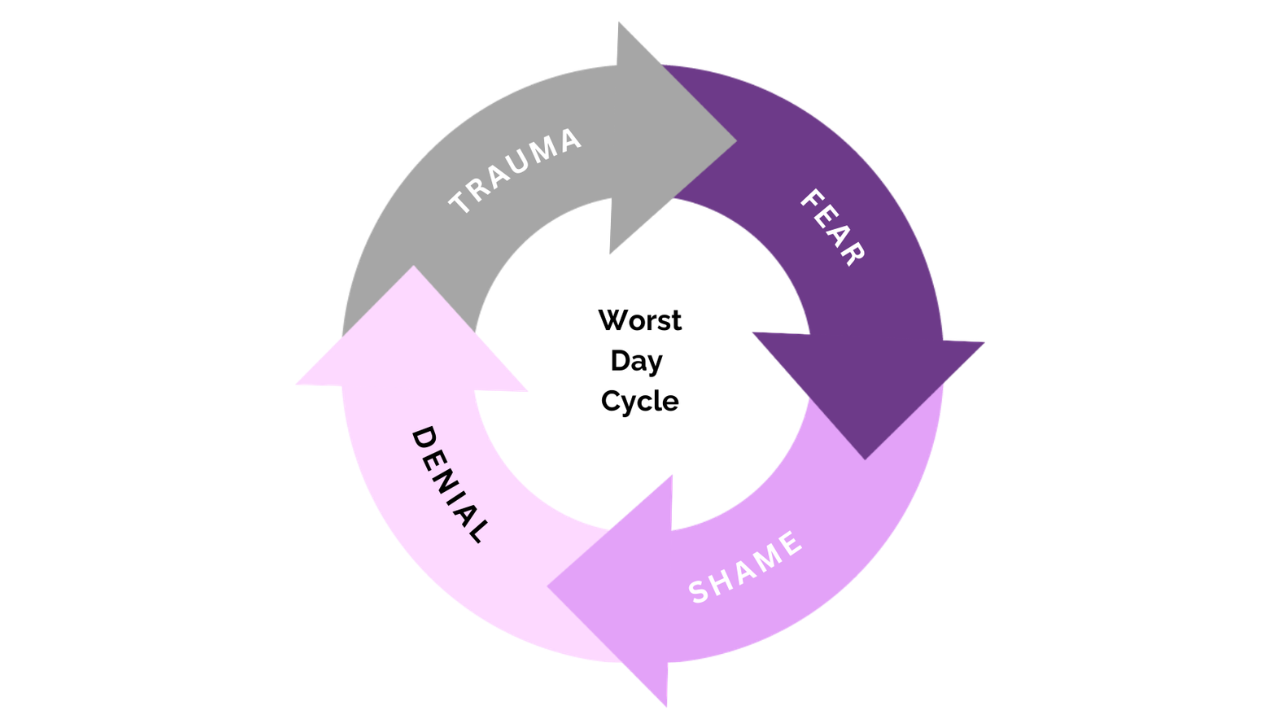
Stage 1: Trauma. Childhood trauma is any negative emotional experience that created painful meanings about yourself, others, or the world. When your authentic expression was met with criticism, punishment, or abandonment, your brain recorded: “Being myself is dangerous. Following their rules is safe.” Every critical comment, every emotional withdrawal, every “stop crying” or “don’t be selfish” created a trauma imprint that installed their morals as your survival code.
Stage 2: Fear. Trauma triggers the hypothalamus, flooding your system with cortisol, adrenaline, dopamine misfires, and oxytocin disruptions. Your brain becomes addicted to these chemical states because they’re familiar. Fear drives repetition — your brain thinks repetition equals safety. So you keep following inherited morals even when they destroy you, because breaking them feels like the fear you felt as a child when attachment was threatened.
That’s you if you feel physical anxiety — racing heart, tight chest, stomach dropping — when you consider expressing a different opinion from your parent, partner, or boss.
Stage 3: Shame. Shame is where you lost your inherent worth. Where you decided “I am the problem.” In the context of morals and values, shame says: “If I disagree with their moral system, I’m selfish. I’m bad. I’m ungrateful.” Shame is the enforcer that keeps inherited morals in place. Every time you consider living by your own values, shame punishes you back into compliance.
Stage 4: Denial. To survive the unbearable shame, your psyche creates a survival persona — a false identity that says “I’m fine,” “I agree,” “I don’t have needs,” or “My parents did their best.” Denial keeps you from seeing that your entire moral system was inherited, not chosen. It keeps you from the terrifying truth that you’ve been living someone else’s life.
That’s the Worst Day Cycle™ — the invisible system that installed your parents’ morals as your operating code and punishes you every time you try to update it.
The Three Survival Personas and Their Moral Systems
Each survival persona develops its own version of inherited morality. Understanding which one you use reveals the moral rules running your life.
The Falsely Empowered Survival Persona’s Moral System
This persona controls, dominates, and rages. Their inherited moral code says: “I must be strong. Vulnerability is weakness. I need to have the answers. If I’m not in control, everything falls apart.”
The falsely empowered person’s “values” are actually fear-based morals disguised as strength. They value achievement because they were taught that worth comes from performance. They value control because chaos in childhood meant danger. They value self-sufficiency because asking for help brought shame.
That’s you if you believe “I don’t need anyone” and feel proud of it — that’s not a value, that’s a survival moral installed by a childhood where depending on others brought pain.
The Disempowered Survival Persona’s Moral System
This persona collapses, people-pleases, and disappears. Their inherited moral code says: “Good people don’t rock the boat. My needs are less important than everyone else’s. Saying no makes me selfish. If I just give enough, they’ll love me.”
The disempowered person’s “values” are actually submission dressed up as generosity. They value harmony because conflict in childhood meant abandonment. They value selflessness because having needs brought criticism. They value accommodation because standing up for themselves brought punishment.
That’s you if you feel guilty every time you set a boundary — that guilt isn’t moral wisdom, it’s moral obedience punishing your Authentic Self for daring to exist.
The Adapted Wounded Child Survival Persona’s Moral System
This persona oscillates between both. Sometimes they dominate; sometimes they collapse. Their moral system is inconsistent because they’re constantly shifting between “I must be strong” and “I must be good” depending on which strategy seems safest in the moment.
That’s you if your “values” change depending on who you’re with — that inconsistency isn’t flexibility, it’s a survival persona without a stable moral foundation.
The Three Levels of Moral Development (And Where You’re Stuck)
Psychologist Lawrence Kohlberg developed a three-level theory of moral development that explains why most codependent adults are operating from a child’s moral system.
Level 1: Preconventional Morality (Ages 3-7)
At this level, morality is about power and punishment. You do what’s “right” to avoid consequences and get rewards. A child at this stage thinks: “I’ll be good because I don’t want to get in trouble.”
If you’re still seeking power and afraid of punishment as an adult, you’re operating from preconventional morality — the moral development of a three-to-seven-year-old.
That’s you if your primary motivation in relationships is avoiding your partner’s anger, disappointment, or withdrawal — you’re still a child trying not to get punished.
Level 2: Conventional Morality (Ages 8-13)
At this level, morality is about duty, approval, and conformity. You do what’s “right” because you want to be liked, accepted, and praised. A significant marker of codependence is the desire to conform and do everything for others. Your esteem comes from outside sources.
If you’re only doing things for praise, to fit in with society’s values, or to avoid being seen as “bad” — you’re stuck in conventional morality. You’re living by inherited rules to earn approval, not by self-authored values to honor your identity.
Sound familiar? That’s conventional morality — the approval-seeking, conformity-driven moral system that keeps codependent people trapped in relationships, careers, and life patterns that go against their authentic selves.
Level 3: Post-Conventional Morality (True Adult Values)
Only 10-15% of people will ever achieve true post-conventional morality — meaning they reach emotional adulthood. This research-backed statistic proves that most of us are stuck in codependence.
At this level, you’re willing to cast off duty and conformity. You’re ready to take unpopular stances and hold unpopular beliefs — even if it means punishment and rejection — because it’s the right thing to do and is for the greater good. You’ve moved from inherited morals to self-authored values.
Post-conventional morality means you stop asking “What will make them happy?” and start asking “What honors my truth?” It means your negotiables and non-negotiables come from your Authentic Self, not from your survival persona’s need for approval.
That’s the goal of codependence recovery — moving from a child’s inherited moral system to an adult’s self-authored values.
The Authentic Self Cycle™: From Inherited Morals to Self-Authored Values
If the Worst Day Cycle™ is how inherited morals get installed, the Authentic Self Cycle™ is how you replace them with authentic values. It’s a four-stage identity restoration system.
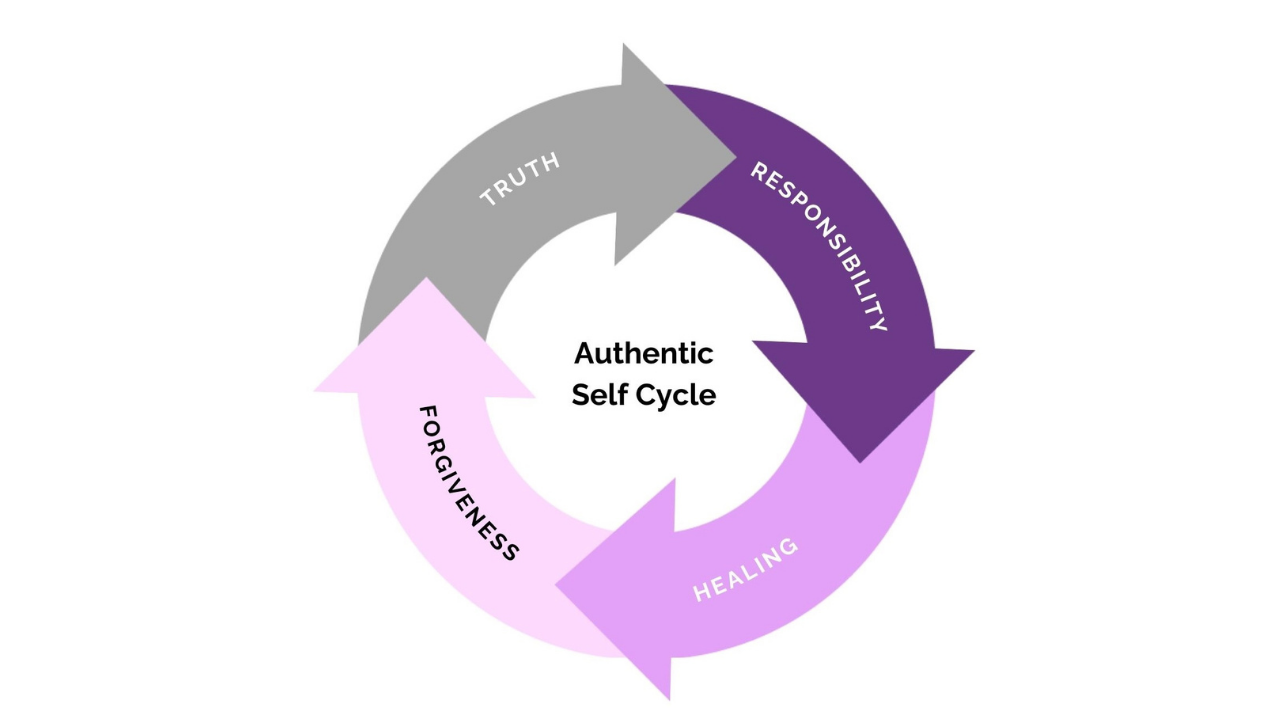
Stage 1: Truth. Name the blueprint. See “this isn’t about today.” When you feel guilt for setting a boundary, the truth is: “This guilt isn’t moral wisdom — it’s my childhood survival program punishing me for disobeying an inherited rule.” Truth means recognizing which of your “values” are actually fear-based morals inherited from parents who couldn’t honor your authentic self.
Stage 2: Responsibility. Own your emotional reactions without blame. “My parents installed these morals, but I’m the adult now. It’s my responsibility to discover what I actually stand for.” Responsibility in this context means: stop blaming your parents for your moral system AND stop obeying it. Both are versions of letting them run your life.
That’s you if you’ve been either resenting your parents or still trying to please them — both are ways of staying attached to their moral system instead of creating your own.
Stage 3: Healing. Rewire the emotional blueprint. Replace “Good people don’t…” with “Authentic people choose…” This is where you actively practice living by self-authored values instead of inherited morals. It’s uncomfortable. It triggers shame. Your survival persona fights it. But every time you choose truth over approval, you’re building new neural pathways.
Stage 4: Forgiveness. Release the inherited emotional blueprint and reclaim your authentic self. Forgiveness here means releasing your attachment to their moral system — not excusing what happened, but refusing to let it define your identity any longer. Values live here. In the Authentic Self Cycle™, your values become your north star.
That’s the Authentic Self Cycle™ — the pathway from living by inherited moral rules to living by self-authored values that actually protect your identity, your relationships, and your peace.
The Emotional Authenticity Method™: 6 Steps to Discover Your True Values
Understanding morals versus values is intellectual. Actually discovering your authentic values requires emotional work. The Emotional Authenticity Method™ is the 6-step practice that reconnects you to your Authentic Self so you can author your own moral code.
Step 1: Somatic Down-Regulation. When you try to question an inherited moral, your nervous system will panic. Your body will flood with shame, guilt, and fear. Before you can think clearly about what you value, you must settle your nervous system. Focus on what you can hear for 15-30 seconds. If you’re highly dysregulated, use titration — cold water on your face, step outside, hold ice.
Step 2: What am I feeling right now? Use the Feelings Wheel to name it with precision. When you feel “guilty” about setting a boundary, is it actually guilt? Or is it fear of abandonment? Shame about being “selfish”? Anxiety about punishment? Emotional granularity breaks the spell of inherited morals by revealing what’s really driving your compliance.
Step 3: Where in my body do I feel it? Locate the emotion physically. The tightness in your chest when you consider saying no. The knot in your stomach when you imagine disappointing someone. The heaviness in your shoulders from carrying everyone else’s emotions. Your body knows the cost of living by inherited morals.
That’s you if your body tenses up the moment you consider putting yourself first — that’s your survival persona’s alarm system, not your conscience.
Step 4: What is my earliest memory of this feeling? Trace the guilt, shame, or fear back to its origin. The first time you were punished for having your own opinion. The first time you were shamed for saying no. The first time you learned that your needs were a burden. This is where you see: “This moral rule was installed in me at age five. I’m still obeying it at forty.”
Step 5: Who would I be if I never had this feeling again? Envision the version of you that isn’t controlled by inherited moral rules. How would that person make decisions? What would they stand for? What would their relationships look like? This is where you begin to glimpse your authentic values.
Step 6: Feelization. Sit in the feeling of the Authentic Self and make it strong. Feel what it feels like to live by self-authored values instead of inherited morals. Feel the freedom of choosing integrity over approval. Feel the peace of knowing what you stand for. Create a new emotional chemical addiction to replace the old blueprint of fear and obedience. Ask yourself: “How would I respond to this situation from my authentic values? What would I say? What would I do?”
That’s the Emotional Authenticity Method™ — six steps to move from moral obedience to value-based living.
How Living by Inherited Morals Shows Up Across Your Life
When you’re living by inherited morals instead of self-authored values, the consequences show up everywhere — not just in relationships.
Family: The Original Moral Programming
You still follow your parents’ rules even when they conflict with who you are. You avoid topics that might upset them. You perform the role they assigned you — the good one, the responsible one, the peacekeeper. You feel guilty when you spend holidays differently than “tradition” demands. You can’t disagree with a parent without feeling like a bad child. You’re still enmeshed — their morals are your morals because separating feels like betrayal.
That’s you if you’re still living by “honor thy father and mother” in a way that means “abandon thyself for their comfort.”
Romantic Relationships: The Moral Surrender
You adopt your partner’s moral system to keep the peace. You don’t voice disagreement because “good partners compromise” (translation: good partners surrender). You don’t know what you want in the relationship because you never asked yourself — you only asked what they want. You stay in situations that violate your integrity because your inherited morals say leaving makes you a bad person. Your insecurity drives you to conform rather than confront.
That’s you if your relationship feels like performing a role rather than being a person — you’re following inherited morals about what a “good partner” should be.
Friendships: The Approval Performance
You’re the friend who always says yes. You take on the caretaker role because your inherited morals say “good friends sacrifice.” You hide parts of yourself that might be unpopular. You feel resentful but won’t say anything because “good people don’t complain.” You attract one-sided friendships because your moral system rewards self-abandonment.
That’s you if you have a list of things you’d never say to your closest friends because you’re afraid of their reaction — that’s moral obedience, not friendship.
Work: The Achievement Trap
You pursue careers your parents approved of, not careers that align with your authentic self. You overwork because your inherited morals say “hard work equals worth.” You can’t set boundaries with your boss because your survival persona equates authority figures with parents. You achieve and achieve and achieve — and still feel empty — because the achievement is based on inherited morals about success, not authentic values about fulfillment.
Sound familiar? That’s the achievement trap — winning at a game you never chose to play because your inherited morals defined success for you.
Body and Health: The Physical Cost
Your body is keeping score of every moral rule you follow that goes against yourself. Chronic tension from suppressing your truth. Digestive issues from swallowing your needs. Insomnia from the anxiety of living out of alignment. You eat to numb the discomfort of inauthenticity. You exercise to manage the anxiety of living someone else’s values. Your body knows what your mind won’t admit: this isn’t working.
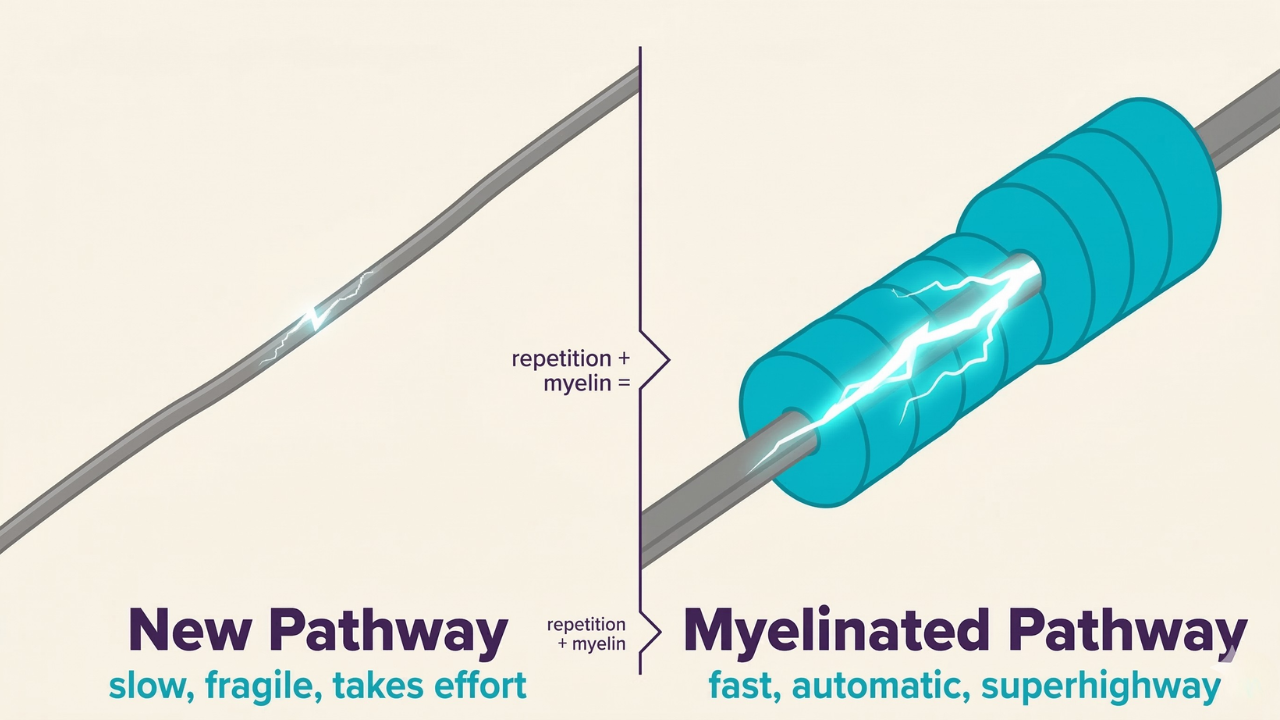
That’s your body trying to tell you what codependence recovery will teach you — you cannot thrive while living by someone else’s moral code.
The Seven Questions That Reveal Your Moral Development
These seven questions are the starting point for discovering where you are in your moral development — and where your recovery needs to focus.
1. Is my current set of morals and values helping or hindering me? Look at your life honestly. Are your relationships healthy? Are your finances where you want them? Is your health strong? If any of these areas are in disarray, your current moral system isn’t working.
2. Are my morals and values influenced by power? If you’re still trying to gain power, status, or dominance, you’re operating from preconventional morality — the moral development of a young child.
3. Are my morals and values based on the desire for reward or the avoidance of punishment? If your primary motivation is getting praised or avoiding consequences, you’re still in survival mode, not value-based living.
4. Do my morals and values stem from a sense of duty? “I should” and “I have to” are the language of inherited morals. Authentic values sound like “I choose to” and “I stand for.”
5. Are my morals and values based on conformity and acceptance seeking? If you change your position depending on who’s in the room, you don’t have values — you have a people-pleasing strategy.
6. Am I willing to face punishment or rejection to claim my own beliefs? This is the threshold of post-conventional morality. Can you hold an unpopular position because it’s true for you, even when it costs you approval?
7. What would my morals and values be if I thought for myself and pursued the greater good? This question invites your Authentic Self to speak. Not your survival persona. Not your parents’ voice. Yours.
That’s the self-assessment that begins codependence recovery — seven questions that reveal whether you’re living by inherited moral obedience or self-authored authentic values.
People Also Ask
What is the difference between morals and values in codependence recovery?
Morals are fear-based rules inherited from childhood attachment and authority conditioning — “be good,” “don’t upset anyone,” “don’t be selfish.” Values are truth-based, self-authored identity principles that protect the Authentic Self — “I will not abandon myself,” “I choose integrity.” In codependence recovery, the goal is to identify which of your “values” are actually inherited morals from your survival persona and replace them with authentic, self-authored values from your Authentic Self.
How do I know if my values are really mine or inherited from my parents?
Ask yourself: “Would I hold this belief if there were zero consequences for changing it?” If a belief only survives because of guilt, shame, or fear of rejection, it’s an inherited moral, not an authentic value. Authentic values feel like freedom and alignment. Inherited morals feel like obligation and anxiety. Use the Emotional Authenticity Method™ to trace each “value” back to its origin — if it traces to childhood survival, it’s inherited.
Why do I feel guilty when I try to set boundaries?
Guilt after boundary-setting is your inherited moral system punishing you for disobeying childhood rules. Your survival persona learned that “good people don’t have needs” or “saying no means you’re selfish.” That guilt is not moral wisdom — it’s moral obedience. In codependence recovery, you learn to recognize guilt as a signal that you’re breaking an old rule, not that you’re doing something wrong. Collapsing into guilt after asserting a boundary is moral obedience punishing your Authentic Self.
Can I discover my authentic values without doing codependence recovery work?
No. The reason you don’t know your authentic morals and values, needs and wants, negotiables and non-negotiables is because you’re stuck in codependence. Until you do the work of identifying your survival persona, understanding the Worst Day Cycle™, and reconnecting with your Authentic Self through the Authentic Self Cycle™ and the Emotional Authenticity Method™, your “values” will be inherited moral rules disguised as personal choices.
What does Kohlberg’s theory of moral development have to do with codependence?
Lawrence Kohlberg identified three levels of moral development: preconventional (power and punishment avoidance), conventional (approval and conformity seeking), and post-conventional (self-authored values for the greater good). Only 10-15% of people reach post-conventional morality, which means 85-90% of adults are stuck in the first two levels — operating from a child’s moral system. Codependence recovery is the process of moving from inherited moral obedience to self-authored adult values.
How do morals and values affect my relationships?
When you live by inherited morals, you abandon yourself in relationships — you say yes when you mean no, you suppress your needs, you perform a role instead of being a person. This creates resentment, enmeshment, and eventually relationship collapse. When you live by self-authored values, you bring your authentic self to relationships — you set clear boundaries, communicate honestly, and choose partners who respect your truth. Learn more about what healthy relationships look like when both people operate from authentic values.
The Bottom Line
You’ve been living by rules you didn’t write. Morals you didn’t choose. A code of conduct that was installed in you before you could question it — because questioning it meant losing the only love you knew.
That’s not your fault. It’s the attachment-authenticity bind that every child faces. You chose attachment over authenticity because you had to. You were a child. You couldn’t survive alone.
But you’re not a child anymore.
You have the capacity now to do what you couldn’t do then: examine the moral system running your life and ask, “Is this mine? Does this serve me? Does this protect my Authentic Self — or does it sacrifice my identity to keep others comfortable?”
The answers will be uncomfortable. You’ll discover that much of what you called “my values” are actually inherited moral rules designed to keep you compliant, connected, and codependent. You’ll feel guilt, shame, and fear as you begin to question them — because your survival persona doesn’t want you to change.
But on the other side of that discomfort is something most people never find: a life built on truth instead of fear. Relationships built on authenticity instead of performance. An identity that belongs to you — not to the parents, partners, or systems that programmed you.
Recovery requires many new skills. You’ll need to reclaim your self-esteem, conquer your fear, and rediscover your morals, values, needs, wants, negotiables, and non-negotiables. You’ll learn how to set boundaries, say no, and turn your confrontations into connections. There’s also the discovery of and the ability to face your self-deception and denial, along with many more aspects.
It starts with those seven questions. It deepens with the Emotional Authenticity Method™. It transforms through the Authentic Self Cycle™. And it becomes a way of life when you replace “Good people don’t…” with “Authentic people choose…”
Your authentic values are in there. Under the survival persona, beneath the inherited morals, beyond the fear. They’re waiting to be discovered. They’re waiting to guide your life.
The discovery starts now.
Take the Next Step
Emotional Blueprint Starter Course — Individual ($79) — Discover your emotional blueprint, identify your survival persona, and begin the work of defining your authentic morals, values, needs, and wants.
Relationship Starter Course — Couples ($79) — Learn how you and your partner’s inherited moral systems are creating conflict and disconnection — and build a shared value system based on authenticity.
Why We Can’t Stop Hurting Each Other ($479) — A comprehensive deep-dive into how inherited moral systems and survival personas create relationship pain, and the complete pathway to healing.
Why High Achievers Fail at Love ($479) — If your inherited morals drove you to professional success but your relationships are falling apart, this program reveals how the same survival persona that makes you successful is destroying your connection.
The Shutdown Avoidant Partner ($479) — If your partner’s inherited moral system tells them vulnerability is weakness, this program reveals what’s happening in their nervous system and how to break the cycle.
Tier 1: Mapping the Blueprint ($1,379) — The complete mastermind experience. Live monthly coaching, personalized feedback, access to all courses, and a community of people committed to discovering and living by their authentic values.
Recommended Reading
- Facing Codependence by Pia Mellody — The foundational text on how childhood attachment creates codependent moral systems and survival personas.
- The Body Keeps the Score by Bessel van der Kolk — Essential for understanding how inherited moral rules live in the nervous system and why healing requires more than intellectual understanding.
- When the Body Says No by Gabor Maté — How living by inherited morals instead of authentic values creates physical illness through emotional suppression.
- Codependent No More by Melody Beattie — The classic guide to breaking free from codependent moral systems and learning to honor your own needs.
- The Gifts of Imperfection by Brené Brown — A guide to wholehearted living that directly confronts the shame that keeps inherited moral systems in place.