Blog

  • When a Man or Woman Shuts Down Emotionally

    When a Man or Woman Shuts Down Emotionally

    Are you in a relationship with a man or woman who shuts down emotionally and avoids intimacy and connection? Would you like to know if you can save the relationship? That’s what we’re talking about in today’s article.

    First, I will be breaking down what causes a love avoidant, what’s going on inside them, and finally, how to save it – is it even possible?

    Before we start, I want to clarify that love avoidance is a spectrum. All of us have moments where we avoid love, but in this article.

    I will discuss those further out on the spectrum. In all my years of research, Pia Mellody is, in my belief, the foremost expert on codependence, love addiction, and love avoidance.

    I believe so strongly I earnestly tell people that her books should be required reading before anyone goes on a date. If her understanding of relationship dynamics were common knowledge,

    I believe the divorce epidemic would be profoundly reduced.

    She defines the characteristics of a love avoidant as:

    1- Evading intimacy within the relationship by creating intensity in activities (usually addictions) outside the relationship.

    2- Avoid being known in the relationship in order to protect themselves from engulfment and control by the other person

    3- Avoid intimate contact with their partners, using a variety of processes I call “distancing techniques.” (1)

    What causes love avoidance

    What causes love avoidance is sad and heartbreaking: they were most likely made to parent someone, typically an actual parent or sibling, emotionally and or physically.

    Or, they may have been smothered, used, controlled, or manipulated to become an adult too soon. Divorced parents of the avoidant are common and in the aftermath.

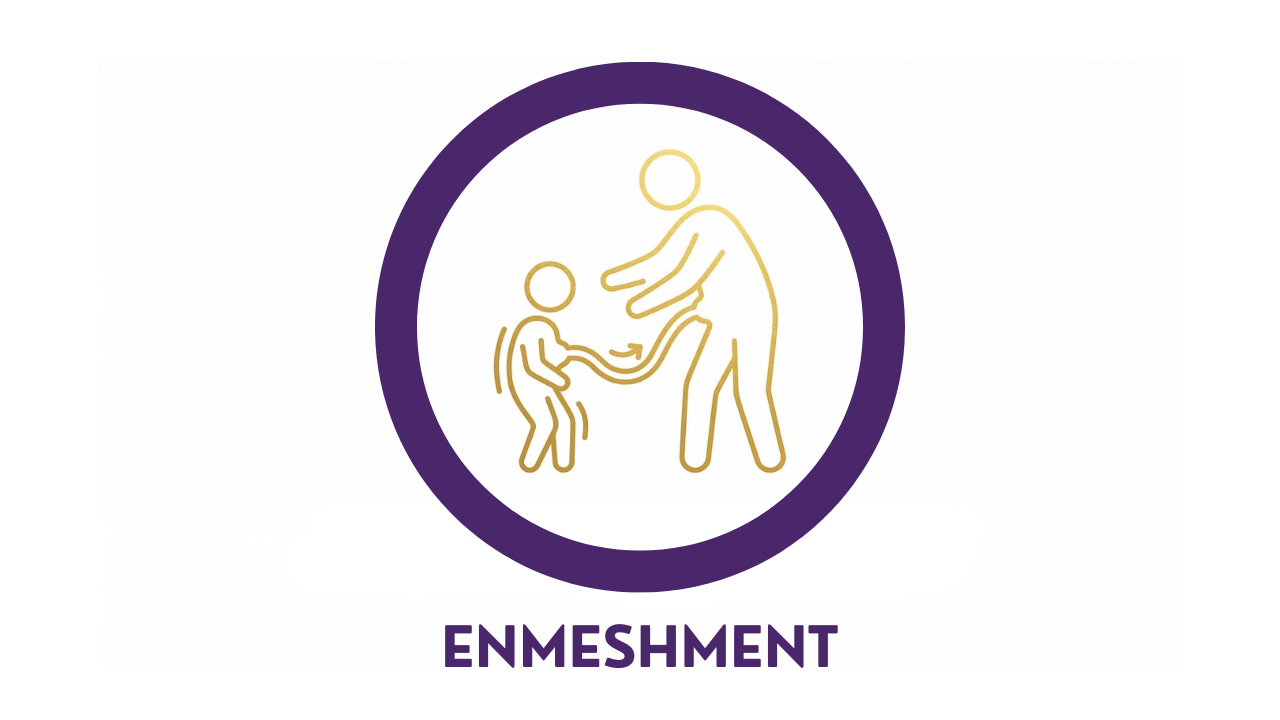
    The mom or dad makes the child a surrogate spouse or best friend using the child to comfort themselves emotionally. This was my experience.

    While my parents never divorced, my mom was an alcoholic who enmeshed me, made me her surrogate spouse, and covertly sexually abused me, while my father used me to unload his anger.

    In short, the avoidant’s childhood was stripped from them because they were required to sacrifice their emotional well-being for others’ benefit.

    What is going on inside the avoidant?

    Internally the avoidant is rarely in touch with themselves because they are so consumed with their addiction to their work, gambling, alcohol, porn, food, shopping, virtually any addiction will do.

    If not an addiction, there is always something more important than the relationship, an animal, a hobby, or kids.

    The avoidant needs something to be addictive or important because they feel alive only in their outside pursuits.

    Relationships in their childhood came at a severe cost, so, ultimately, as Pia Mellody points out, they don’t want to be known because it means to be smothered, suffocated, and abandoned for them.

    Is it possible to save the relationship?

    Unfortunately, it isn’t easy to save a relationship with a love avoidant. Here’s why: do you see what it requires from them? To participate, they would have to get help to heal their childhood pain, and help requires vulnerability and intimacy.

    In their life experience, intimacy looks like engulfment, control, manipulation, and suffocation.

    Therefore, it is infrequent for an avoidant to pursue counseling or coaching because it would require them to face what they fear most, being vulnerable.

    That is why it is fair to say that the love avoidant is never in the relationship – they can’t be.

    Being in a relationship means being vulnerable. So they guard their vulnerability by walking out of the room, avoiding deep discussions and arguments. All attempts to create connection are a trigger for them to run.

    Complicating matters more is that as a child, to survive, they detached from their feelings and created a falsely empowered reality that they are fine.

    So they wouldn’t have to feel the pain of how they were used and thus abandoned. In addition, being relied upon by an adult leaves a child with a sense of false power.

    This false reality and sense of power mean most are not even aware that they are in pain, and many will accuse you of being overly emotional. If you ask them to seek help, they are so disconnected from the truth.

    They honestly can’t see or feel that they have a problem. Unless you are the one in a million, who has found an avoidant who’s actually willing to get help.

    The chances of creating the relationship you crave are minimal.

    This leaves you with a decision to make: are you willing to stay in the relationship and accept that all you’re going to get are scraps? If you are, that’s the only way to “save” it. To achieve that, you have to be willing to drop everything you’ve complained about. It would be best if you relinquished nearly all of your expectations and accept that your needs and wants won’t be met.

    Tips for those who decide to stay.

    If you decide to stay, here are a few things that might make it a little better: stop chasing them, stop asking for intimacy. Ignore and “abandon” them.

    I know that sounds cruel, but remember, their childhood smothering and the requirement to meet others’ needs emotionally created excruciating abandonment.

    No one was there to care for them. But since they are disconnected from reality and believe that they are fine, they are not aware of their subconscious abandonment fear.

    When you start pursuing your own life and meet your needs and wants yourself, subconsciously, they will feel abandoned, and they will chase you but don’t be fooled.

    The second you start opening up, they’ll run again. Find that middle space where they don’t run and realize you can never fully trust that they will be intimate.

    You must remind yourself that avoidants will rarely join you consistently in that shared relationship space without recovery.

    Unfortunately, there is a cost to this approach. When you feel like you are acting just like them, cold, distant, and detached from the relationship.

    you will know you are doing it correctly. That’s what you’ll have to settle for.

    If you can live with that, that’s how you “save” the relationship.

    I know this is heartbreaking to recognize what your partner has been through. I’m not condoning their behavior.

    It’s about understanding what causes them to behave the way they do and seeing that there is very little we can do about it in many cases.

    On the positive side, knowing these truths empowers us to advocate for ourselves, and the best way to love another is to make decisions that express love towards ourselves. Furthermore, you can now make an informed decision as to how you want to proceed.

    Enjoy The Journey. ??

    (1) Pia Mellody: Facing Love Addiction pg. 38-39

    CLICK THE IMAGE TO LEARN MORE

    Are You Tired of Being in an Emotionally Toxic Relationship?

    You’re not alone. Millions of people are stuck in codependent relationships that make them feel bad about themselves, and they don’t know how to break free. We’ve all been there.

    Or maybe you find yourself always attracted to someone who is not good for you, and the cycle starts again.

    But it doesn’t have to be this way! There is hope! We will help you find your way out of the darkness and into the light.

    If you are single, you deserve better than being stuck in a cycle of narcissistic abuse or neglect. You deserve love and kindness! Don’t let another day go by where someone else controls your happiness or self-worth.

    Take control today with this course and start living life on your terms again! Save yourself from heartache and take back control over your life with this course now!

    If you have a partner, it’s time to take back control of your life and start learning how to save and resurrect a toxic, broken, codependent relationship.

    Fill it with love, safety, affection, kindness, understanding intimacy, and mutual connection. Start living the romantic life you deserve by breaking free from your toxic codependent relationship patterns today.

    It doesn’t have to be like this forever – we want to show you how it could be different for you now.

    All it takes is one step at a time…and we’ll walk with you every step of the way on your journey to the loving relationship you deserve.

    The sooner you take action, the sooner your life will get back on track. Join our community and learn how to heal yourself from codependence so that you can find happiness again.

    You are worth it!

    Sign up NOW!

    How To Break Free From Toxic Relationship Patterns


  • 7 Characteristics Of Relationship Insecurity!

    7 Characteristics Of Relationship Insecurity!

    Are you constantly afraid that you’re going to lose your relationship?

    In today’s article about relationship, I share how insecure people tend to think and behave. what their underlying beliefs are about themselves, and what they can do to get the security they crave and deserve.

    These characteristics have been coined many different things: relationship insecurity, anxious attachment style. Clinically, this is called love addiction.

    Don’t worry about the threatening name or shame yourself. Everything we love in life, like our favorite food or comfortable clothing creates the same basic reaction involved in addiction.

    It is just my preferrence to not use the politically correct, innocouous terms that most use. One of the core ingredients to recover from anything is to get into “reality.” Therefore, as helping professionals.

    if we don’t call things what they actually are for fear of offending, we are doing a disservice. We are enabling the person in need to stay out of touch with “reality.” That goes against my morals and values.

    What are the 7 characteristics of love addiction and relationship insecurity?

    1. Overthinking. This was me all my life! I would replay conversations, looking at texts, trying to decipher every little nuance.
    2. The critical distinction is the thoughts are obsessive and always about trying to figure the other person out.
    3. Catastrophe thinking. This happens when there is a communication gap. Even the slightest little pause in texting or talking triggers the love addict to project fears that the relationship might be over.
    4. That their partner might be angry with them or something is wrong.
    5. Needing constant reassurance. This was also me – I learned it from my mother.
    6. It was common for our family to be at dinner talking about politics or some other topic, and my mom would all of a sudden blurt out.
    7. How do I look in this dress? While I never did that, I did need constant affirmation from my partner yet it never satisfied.
    8. Bringing the past into the current relationship. Love addict’s internal fear creates an obsessive need to keep themselves safe.

    One of the ways they attempt to stay safe is by comparing the past to the present.

    1. For instance, I would constantly compare things my current girlfriend did to what my last girlfriend did.
    2. This attempt to avoid pain makes it impossible to be present, and being so hypervigilant can lead to the end of the relationship.
    3. Give too much time, attention, and power to the other person. The love addicts desperate need to avoid abandonment creates a disempowering abandonment of themselves.
    4. They do this by over-emphasizing their partner’s strengths by elevating them to fantasy. This results in the addict making their life about the other person. The addict gives up their interests, space, and desires. There is far too much attention on their partner and not enough on themselves. They effectively make the other person their higher power.
    5. Snooping. Love addicts will feel the need and even demand to check their partner’s phone or email or look at their partner’s social media too much.
    6. They will want to keep tabs on where their partner is going and who they are with. They are on constant alert for the possibility that they are being replaced.
    7. The last characteristic is the inability to feel whole or happy outside of a relationship.
    8. Love addicts will feel empty, sad, depressed if alone and often enter new relationships, even destructive ones, or relationships with someone they are only mildly interested in just to avoid being alone.

    Now let’s get into the 7 solutions:

    1. Face our self-deception and acknowledge the truth. This means we have to get into the “reality” that our expectations are addictive.
    2. Our desire for unlimited positive regard and our demand for so much time and attention from the other person is excessive.
    3. We have to recognize that how we define love is distorted, and we have recovery work to do on our codependence.

    The following three steps come from Al-anon and are called the three “gets.’ Step one is to get off their back.

    1. Our constant wondering what they’re doing, our need for continuous attention, overthinking all of their thoughts and actions, and snooping is evidence that we are “on their back” and paying too much attention to their life and not our own.
    2. Get out of their way. This means we have to stop trying to dictate or correct how they live their life. Let them be who they want to be.
    3. Don’t try to change them or get them to meet our needs. They’re okay the way they are. It’s not our place to critique, judge, and tell them who to be.
    4. This is also a defensive projection. We avoid focusing on healing ourselves by making them the problem.
    5. Get on with our own life. Instead of putting all our time and attention into them, put it into ourselves! Learn to meet our needs ourself, get back to living our own life, and pursuing the hobbies, friendships, and interests we gave up when the relationship began.
    6. Self-esteem work. For the love addict, their internal sense of security now is based on their partner or the object of their pursuit.
    7. They must start developing the belief that they have inherent value at all times and not only when they are in a relationship.
    8. Develop boundaries. This can be difficult for the addict. So here is a suggestion. I want you to think of gas pedals. Take your foot off the accelerator (constantly being vested) and pull way back.
    9. If your partner shares a little bit, going about 8-10 MPH, join them. Maybe try to advance to 12-13 MPH, but if they back off, we back off.


    Here’s how we know when we’re doing this right

    1. we should feel like we’re cold, mean, selfish, and disinterested. We should feel uncomfortable because we’re used to the gas pedal being pushed to the floor. When we feel this new discomfort.
    2. we’ll know we’re no longer acting addictively or anxious. Now we’re acting moderately. In no time, we’ll get used to it, and things will get better.
    3. Work with an expert. The addiction was created by childhood abandonment, and working with an expert is the only way to overcome it.
    4. We are too close to the situation to see our behaviors accurately and we don’t have access to the knowledge, skills and tools that the expert will provide us.
    5. I encourage you to pick up Pia Mellody’s Facing Love Addiction and Facing Codependence as well as Beverly Engle’s The Emotionally Abusive Relationship.
    6. These books will help the addict begin getting into reality about how abandoned we were in childhood.
    7. Furthermore, we will become more aware that many of the behaviors we believe are kind, authentic and loving are in fact, destructive and self-sabotaging.

    There are your seven solutions!

    Remember, the person struggling with love addiction is not bad or weak. They are in pain and doing the best they can not to feel that pain.

    Addictively pursuing someone is the only way they currently know how to alleviate that pain. Sadly, if left untreated, it creates more of the pain they are desperately trying to avoid.

    But there is hope. By gaining new knowledge, skills and tools and then putting a plan in place to heal the underlying pain, we can find the authentic love we crave and deserve.

    Enjoy The Journey! ??

    Are You Tired of Feeling Like You’re Not Good Enough?


    Do you feel like no one will ever love or accept you unless you are perfect?

    You are not alone. We’ve all felt this way at some point in our lives.

    But it doesn’t have to be this way. It is possible to overcome these feelings and live a life full of self-love and acceptance.

    Learn the seven characteristics of high self-love and how it can change your life for the better. Stop feeling lonely, rejected, or like an outsider in this world.

    This masterclass provides the knowledge, skills, and tools for overcoming low self-esteem and accepting who we are as individuals – flaws included!

    By the end of the class, participants will learn to take control of their lives by learning a simple process to stop negative thoughts.

    That same process will show you how to turn feelings of loneliness, rejection, and emotional wounds from the past into unshakeable self-confidence.

    The result is an individual who feels confident in themselves while also embracing their perfect imperfections.

    Imagine how exciting it will be to embrace change without fear; take risks with ease; communicate your needs and wants decisively, and simply shrug off attempts by others to judge or criticize you.

    Get started on changing your life today by signing up for our online masterclass “How To Love And Accept Your Perfect Imperfections!” TODAY!

    How To Love and Accept Your Perfect Imperfections


  • How To Love Yourself – 3 Steps To Love and Accept Yourself Completely

    How To Love Yourself – 3 Steps To Love and Accept Yourself Completely

    Today I want to share what I believe to be the three critical steps we want to take to fully and completely love and accept ourselves.

    The first step is a bit surprising – and the most overlooked!

    We need to sit down and write out our morals, values, needs, wants, negotiable’s, and non-negotiable’s. Almost every single person I come across has never done this.

    We think we don’t need to because we feel we already know our morals and values.

    But then someone will tell me about a work situation, a relationship, or even a hobby, describing something about it they hate. They don’t realize it doesn’t align with their morals and values: they had no idea.

    Most people don’t sit down and ponder: what do I really believe and want? Take a relationship.

    Do you believe in monogamy? Are you not OK with intimacy before marriage? Do you need intimacy within the first couple of dates? What’s your moral and value?

    Are any of these negotiable or non-negotiable?

    By taking the time to really ponder these fundamental questions. we will immediately know if you should or shouldn’t continue seeing someone on a first date.

    This is the single most significant way people don’t love themselves, and it’s the single most straightforward way to make sure we do love ourselves completely.

    So it is pivotal that we evaluate our work, relationships, hobbies, etc.: every area of our lives. Find your morals, values, needs, wants, negotiable’s, and non-negotiable’s for every category.

    Doing so provides us with a North Star to always guide our choices.

    Step two: give back the shame and negative feelings that are in all of us. As I talk about in many of my videos, 70% of the messaging we get as a child is negative, disempowering, and self-sabotaging.

    That means all of us are filled with messages of “you’re bad, stupid, ugly, fat, skinny”: whatever it may be, we all have these messages dumped on us.

    Here’s how you find them: discover your mantras. When you make a perfect mistake, what phrases do you use to shame yourself? “I’m so stupid.” “What was I thinking?

    Come on, Kenny!” How do you belittle yourself? Those phrases aren’t yours: write them down and ask yourself, “who taught me this?

    Then give it back. The next time it comes up, you’ll give it back to the mom, dad, sister, brother, coach, priest, whoever it may be, that placed it in you. Tell them you love them, but you won’t carry their phrase or pain any longer.

    Step three

    Step three: forgive yourself. We are all human and perfectly imperfect. You know those moments where you know precisely the right thing to do, but you can’t make yourself do it?

    That’s proof! If you were able to do it, you would have. You’re doing the best you can in every single moment. When we want to learn to conquer those things we can’t do.

    we gather more information. As we know more, we can do more. Make sure you forgive yourself for your perfect imperfections. Accept you’re doing the best you can.

    Now, what are the three signs that show us we are not loving ourselves?

    The first is allowing or pursuing behavior against our morals, values, needs, wants, negotiable’s, and non-negotiable’s.

    When we don’t love ourselves, we allow other people not to love us either. So, take a look at where in your life you are allowing behavior that goes against your morals, values, needs, wants, negotiable’s, and non-negotiable’s?

    When you find them, notice how they fill you with resentment and anger because you’re going against yourself. That’s the single most significant way we don’t love ourselves.

    Second:

    we stay in destructive relationships. I really don’t need to explain further – we’ve all done it. We all have this tendency because of the shameful messages from childhood that left us feeling unworthy.

    It’s our job to do the work, get back to our morals and values, and start loving ourselves.

    Step three: there’s addiction present.

    This is a tough one because nearly everyone on this planet is addicted to something, whether it’s food, TV, the phone, alcohol, pills, pot, clothing, gambling, etc.

    Addiction sabotages us because underneath all addiction is tremendous pain. Recognize the only reason we use addiction is that undressed pain is eating away at us.

    Addiction attempts to solve intolerable pain, but it creates pain because it goes against our morals and values. We must heal that pain to be free of the addiction.

    There are three keys to look for when we are and are not loving ourselves. I hope this helped and remember,

    Enjoy The Journey!

    CLICK THE IMAGE TO LEARN MORE

    Are You Tired of Feeling Like You’re Not Good Enough?

    Do you feel like no one will ever love or accept you unless you are perfect?

    You are not alone. We’ve all felt this way at some point in our lives.

    But it doesn’t have to be this way. It is possible to overcome these feelings and live a life full of self-love and accept.

    Learn the seven characteristics of high self-love and how it can change your life for the better. Stop feeling lonely, rejected, or like an outsider in this world.

    This masterclass provides the knowledge, skills, and tools for overcoming low self-esteem and accepting who we are as individuals – flaws included!

    By the end of the class, participants will learn to take control of their lives by learning a simple process to stop negative thoughts.

    That same process will show you how to turn feelings of loneliness, rejection, and emotional wounds from the past into unshakeable self-confidence.

    The result is an individual who feels confident in themselves while also embracing their perfect imperfections.

    Imagine how exciting it will be to embrace change without fear; take risks with ease; communicate your needs and wants decisively, and simply shrug off attempts by others to judge or criticize you.

    Get started on changing your life today by signing up for our online masterclass “How To Love And Accept Your Perfect Imperfections!” TODAY!


    CLICK THE IMAGE TO LEARN MORE
  • How To Stop Self Sabotage: Conquering The Worst Day Cycle

    How To Stop Self Sabotage: Conquering The Worst Day Cycle

    Welcome back! Today we’re talking about self-sabotage: what creates it and how to get out of the cycle.

    The first place we need to start is: what creates it? What makes the need and desire to self-sabotage is: we were told directly or indirectly that we had no worth as a child. what creates it and how to get out of the cycle.

    Think about it: underneath the self-sabotage is the belief that we don’t have the value to achieve it. In those self-sabotaging moments.

    we have a feeling that tells us we don’t want to take a particular action even though we know it will help us achieve our dreams.

    That sense of dread or procrastination was placed into us and stopped us from doing what we want. That feeling of anxiety or procrastination is a shame.

    It is the feeling that we will be bad if we claim what we want.

    Where does this come from?

    How does this happen? Over 80% of the people I talk to say their parents and childhood were great and perfect. I can appreciate that – personally.

    I believe every parent wants nothing but the best for their kids, even in imperfect parenting moments.

    But the fact of the matter is: our parents make mistakes. And a lot of them. I’m going to prove that to you.

    Here’s the first step to get out of denial about our childhood. Science shows 70% of the messaging we get as a child is negative, disempowering, and self-sabotaging.

    Think about that. Over 2/3 of what we heard from our parents was negative.

    Even a simple divorce causes actual brain damage and the feeling of abandonment. If we believe there were no imperfections in childhood, that means we think we were raised by a perfect human being – a God.

    That’s not possible! Finally, to get into the reality of childhood,

    I’ll ask you two questions to prove you suffered trauma or less-than-perfect parenting that still affects you:

    1- When you were a child and felt sad, lonely, or scared at anything your parents did or said, did you discuss it with them and voice it?

    No way. They probably yelled at you to get into your room and to not backtalk.

    2- Do you have any secrets from your parents? We all do. Do you see how traumatizing that is? It means that if I were to share who I really was, if they knew what I really thought, felt, or did.

    I believe they will reject me. Ultimately we don’t feel safe with our parents. That’s horrifically traumatizing! They are the two people we should feel the safest and secure with, yet we believe our truth is not allowed.

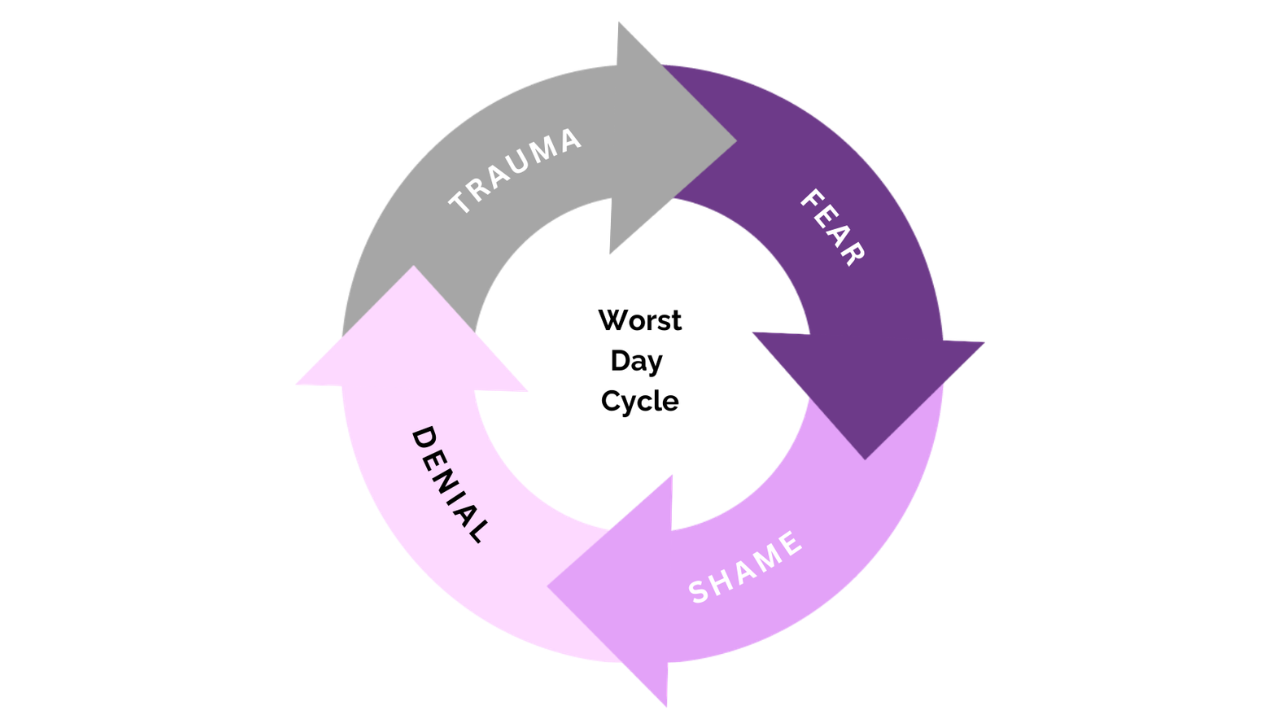
    This trauma creates what I call The Worst Day Cycle. There are four stages to it: trauma, fear, shame, and denial.

    Everyone is caught in this dynamic. Every choice in your life revolves around this cycle, and I’m going to walk you through it – it’s at the heart of self-sabotage.

    The cycle is created because we have two needs as a species: attachment (physical or emotional to someone else) and authenticity (the pursuit of who we naturally are).

    The previous questions show that our power was squashed if we were to speak our truth or pursue who we are.

    We weren’t allowed to follow our authentic selves.

    Because we don’t want to lose attachment – our survival depends on it as a child.

    In the pursuit of attachment, we lose our authenticity.

    We all downplay, deny, and justify what happened to us. We do it to stay alive.

    It’s the moment shame and denial are born.

    In those less-than-perfect moments, a big chemical explosion in our brain and body is created: fear. That chemical release becomes a chemical addiction.

    It takes a lot of energy for our brain to do anything: 25% of the calories we consume go straight to our brain. In addition, the brain doesn’t process right or wrong but rather known and unknown.

    If we’ve lived and experienced it, our brain will repeat it even if it’s wrong. The traumatic feelings got known in childhood, and the brain chooses to relive them in its effort to conserve energy.

    It’s an emotional chemical addiction that keeps us stuck. The fear we get addicted to is always one of three things: the fear of rejection, inadequacy, or powerlessness.

    Think of that moment when you went to express yourself as a child. Rejection. Inadequate. Powerlessness. It’s an overwhelming cocktail of horrifically painful emotions that get stuck in our bodies.

    The overwhelming nature of these feelings sends us into shame.

    Shame is the feeling that there’s something wrong with us – it’s internal.

    “Come on; you’re so stupid!” We learned we must be bad, wrong, stupid, or defective in some manner, either directly or indirectly, through our parent’s actions or expressions.

    This is why we self-sabotage. As a child, we were powerless, and we couldn’t argue with our parents. Now we’re adults. We get to pick where to live, where to work, who to marry. What’s the greatest way to get our power back?

    To choose things that don’t work because we get so much attention (attachment) from others. Because our brain and body were trained to repeat the miserable feeling of not liking ourselves – stuck on the emotional, chemical loop.

    We pick terrible relationships or careers to relive that pain against ourselves. It is a subconscious attempt to get our power back because I chose.

    Until we heal the original wound, this is precisely what we do: your life story is proof of it.

    Do you see how the terrible person you’re with or your bad job reminds you of the same chaos, confusion, uncertainty, and belittling dynamic in childhood?

    If you’re in denial, you won’t see it, and I urge you to seek professional help. We need help to see the tie-ins if we want to stop the cycle.

    The shame piece is our attempt to remedy how we were told, directly or indirectly, that we didn’t have worth.

    Who we were meant to be was squashed, so as a child, we develop a false persona to create attachment and survive.

    I tried out for two professional sports before deciding that neither of them was for me.

    I was only trying to gain my father’s attention and get back at my brother by repeating the agony. My brother was shooting at my head when I stopped the frozen tennis balls as a kid, therefore I became a hockey goalkeeper.

    it would make him mad. To get my power back as an adult, I relived the abuse against myself. I continued the cycle as the person in control.

    You’ll see this in every aspect of your life.

    Ask people about their careers, and you will hear how they are reliving the unhealed pain of their childhood.

    People in finance will tell you stories of money problems. Salespeople never felt a sense of worth, insurance people, no safety. The correlations are so transparent.

    All we do is relive it until we heal it. Gallup has done polls for years that show only 7% of people are happy in their careers. Now you know why.

    They are all reliving the pain and trauma from childhood against themselves; they are stuck in The Worst Day Cycle.

    This self-victimization kicks us into denial: this process shows us we have to admit we don’t know who we are. We have careers and hobbies but don’t honestly know what we like.

    Many of you will say there’s no way you’re starting over – that you can’t admit it to yourself. You may say I’m wrong.

    But science disagrees with you: 95% of our adult life, thoughts, feelings, and choices are all derived from the emotions placed into our subconscious as a child.

    Remember: our brain seeks to repeat what it knows. You may disagree with my premise, but your life story shows you the proof. You can’t outrun yourself.

    I know it’s hard to hear.

    It all comes down to imperfect parenting, but parents are not to blame – for centuries, we’ve never been taught these topics and their effects.

    Our parents don’t know any better. How can we blame – where does it end? Back to the first cell or Adam and Eve?

    Waste of time. Everyone is perfectly imperfect, and no parent can be blamed for doing something they weren’t even aware of. Many parenting skills we thought were good at the time were only later seen as abusive.

    We didn’t know. We always do the best we can with what we know at the time.

    It’s daunting enough to admit we are reliving a subconscious program, but there’s more.

    Can you see the second reason we self-sabotage and relive the cycle:

    if we accept the truth and pursue our authentic self, we give up attachment to our parents. If we heal, admit our secrets, become what we want, and succeed, we lose attachment.

    Remember, we became all of those things so our parents wouldn’t leave us. This may not make sense at first but think: what happens in a riot? People are mad at the police and government but destroy their own neighborhood and themselves.

    This is proof of the worst-day cycle. How do we celebrate as a culture? We get drunk, stoned, over-eat, victimize, destroy, and self-sabotage.

    Then, we repeat the self-sabotage and go into denial, saying these things aren’t true,

    I’m not forgiving myself for the suffering I’ve caused myself in the past?

    I didn’t make up a phoney identity to get attention; I’m comfortable with myself.

    Are you sure? What happened the last time you got drunk? You woke up hungover the next day, tell your kids you can’t play, boom.

    the kids feel rejected, and now the cycle has passed onto them. They can’t comprehend hangovers, only that mom or dad abandoned them.

    Do you remember how they tried to modify their behavior to get your attention/attachment and love? Can you now see how you did the same thing in your childhood?

    We’re all perfectly imperfect

    we can’t stop the cycle. But we can take ownership of our actions and choices and do the work to conquer the cycle. As a society, we need to talk about it openly with ourselves, friends, and family.

    We need to make it OK to end the cycle. If you’re honest with yourself, you’ll see we do all of this – everyone. I know it’s scary, but this is how we get our self-esteem back.

    If we can’t admit the truth, we have low self-esteem – we need to confront the pain, darkness, and pain.

    It hurts, but you will be in reality and gain self-esteem. It’s the recovery process.

    It’s how you get your authentic self back. You did the best you could with the information you had at the time. Now that you have new and better information, you can do something about it.

    This may be the first day in your life you actually have a choice to pursue your greatness: therefore, you are not to blame for any of your imperfections.

    You can’t be blamed for doing something you weren’t even aware of. But now you have a choice

    will you relive that pain against yourself or make a change to learn about this, do the work, recover, and end the cycle?

    If you want to make that choice, the process is pretty simple: become an expert in the worst day cycle. To do that, pick up my book.

    I lay out the exact process much more profound than I just did. Next, gain Emotional Authenticity. My book will help give you the tools to achieve Emotional Authenticity.

    Step three is to get out of denial and admit your trauma. Step four, become an expert in your fear, shame, and denial.

    Every person who’s done this process has reclaimed their authentic self: it has never failed. When there’s no denial, there’s truth, self-esteem, self-love, and authenticity. Or, as I like to call it, Our Greatness.

    Enjoy The Journey! ??

    CLICK THE IMAGE TO PURCHASE YOUR COPY TODAY
  • 7 Steps to Get Over a Toxic Ex

    7 Steps to Get Over a Toxic Ex

    Hello! Today I’m talking about the seven steps to get over a toxic ex. So let’s get right into it:

    Cut off all contact. Delete them off social media. Block them. Please get rid of them, stop all communication to get rid of toxic ex.

    1. I know that can be difficult, and the next six steps will help you do this, but this step is critical. Leave and be steadfast.
    2. Remove all pictures, mementos, music, etc., that are associated with them.
    3. First, we have to remove the reminders. If we don’t, we will keep analyzing them.

    Stop analyzing them.

    1. We sit there and think what this and that meant or didn’t mean, spending all our time ruminating over them. The main reason we do this is to understand and create closure.
    2. But they’re toxic: they won’t allow closure. So it’s our responsibility to make closure with ourselves. We do this by stopping analysis. Our analyzing them is an attempt to avoid our own pain.
    3. That’s the biggest reason we analyze them: we don’t want to go through withdrawal and investigate ourselves. They become a way we can medicate and keep ourselves from this.
    4. Our culture doesn’t allow us to feel and talk about pain – that’s absurd! We only get happy when we have the skillset to move through the difficult things in our life.
    5. The ugliest things in life are the most fantastic springboards to the best things in life. Recognize the rumination is robbing you of you. And only you can stop that.

    Stop letting them own you and get your power back.

    I’ll tell you how I stopped analyzing my second divorce.

    One day, I was ruminating in the car. I started yelling whatever I saw, whether it was a tree, a house, or an automobile.

    I forced myself to focus on the present moment rather than the past or the future.

    . Anytime she came up in my mind, I did that: carpet, tile, glasses. I got in the present. I was not going to give my power away.

    1. Get into self-care. What brings you joy and makes you smile? Hiking? Shopping? Manicures? Going hunting?
    2. Every time we want to obsess about them, go to our self-care list and do one of those things
    3. Get into reality and face our denial. We need to stop romanticizing the good parts of the relationship. This is one of the ways we stay stuck – thinking of the good things they did.
    4. But you wouldn’t be reading this if you didn’t know in your heart that they are toxic. All of those things they did were manipulations to keep you around.
    5. Make a list of all the painful, toxic moments. Then, when you start romanticizing, go back to the list and remind yourself of the truth.
    6. I know how difficult it can be to let go of – those beautiful moments because they felt so intense, like our hearts were on fire. Finally, I discovered I could love the memories and let go of the person.

    Look at ourselves. What do we need to heal in ourselves?

    A toxic person only gets in our lives due to our own dysfunction. None of us will get into a relationship unless we say yes – even if the other person “chased” us.

    We’re responsible for saying yes. I wrote a whole book called Your Journey To Success which describes the worst day cycle and how this happens to us all.

    I discovered that we are only in a relationship with a toxic person because our childhood was toxic. Unless we go back and heal that pain, we will always attract toxic people.

    There will always be toxicity in our life. We must heal the pain in the past. The other thing to recognize is: the best version of ourselves brought us to this person.

    All of our available skills, tools, and knowledge created the attraction. If we want this to end, we need to create a better version of ourselves.

    We need to attain new knowledge, skills, and tools. When we do that, we will attract someone who is not toxic and can love us.

    Finally, picture what you really want in a relationship?

    We weren’t taught to do this, but we need to sit down and write out our morals, values, needs, wants, negotiable’s, and non-negotiable’s if we wish to a genuinely loving relationship.

    When we don’t have this framework, we end up with behaviors we don’t like. When we write all this out.

    we will spot a non-negotiable on the first date and be done. If we haven’t mapped these out, we guarantee that we will pick a toxic person again.

    I hoped this helped you and as always:

    Enjoy The Journey! ??

    Are You Tired of Being in a Toxic Relationship?

    You’re not alone. Millions of people are stuck in codependent relationships that make them feel bad about themselves, and they don’t know how to break free. We’ve all been there.

    Or maybe you find yourself always attracted to someone who is not good for you, and the cycle starts again.

    But it doesn’t have to be this way! There is hope! We will help you find your way out of the darkness and into the light.

    If you are single, you deserve better than being stuck in a cycle of narcissistic abuse or neglect. You deserve love and kindness!

    Don’t let another day go by where someone else controls your happiness or self-worth.

    Take control today with this course and start living life on your terms again! Save yourself from heartache and take back control over your life with this course now!

    If you have a partner, it’s time to take back control of your life and start learning how to save and resurrect a toxic, broken, codependent relationship.

    Fill it with love, safety, affection, kindness, understanding intimacy, and mutual connection.

    Start living the romantic life you deserve by breaking free from your toxic codependent relationship patterns today.

    It doesn’t have to be like this forever – we want to show you how it could be different for you now.

    All it takes is one step at a time…and we’ll walk with you every step of the way on your journey to the loving relationship you deserve.

    The sooner you take action, the sooner your life will get back on track. Join our community and learn how to heal yourself from codependence so that you can find happiness again.

    You are worth it!

    Sign up NOW!


  • 10 Surprising Benefits Of a Broken Heart

    10 Surprising Benefits Of a Broken Heart

    Hello and welcome back! Today I’m talking about the ten surprising ways we benefit from a broken heart.

    Now, 3 of these are incredibly empowering

    They propel us forward and allow us to find the love and healing we deserve. The last 7 are the ones most people use. There’s benefit in them, but they are disempowering and self-sabotaging.

    Unfortunately, most of society uses these.

    1. For many people, it spurs them to seek help. When we seek help, we gain more profound self-awareness.  It’s hard to know every aspect of ourselves and having an outside reference helps.
    2. Here are some examples from clients of mine: a woman named Autumn came to me after many break-ups with narcissists. She suffered from anxiety, codependence, abuse.
    3. She was unaware but learned in this process that her anxiety was borne in childhood. Anxiety is caused by previous trauma that’s never been healed.
    4. Maybe you’re watching TV, and you get heart palpitations – it doesn’t make sense. You’re just relaxed watching TV. That’s your body sending you a signal that you have pain you’ve never dealt with.
    5. Autumn learned about the effects of childhood and where anxiety comes from through my online University classes.
    6. The longest she had gone without an anxiety attack in 40 years was four days. Now it’s been only one in a year. She’s elevated in her career now, developing a wonderful relationship with someone who is pursuing growth.
    7. Dave came to me because his marriage was falling apart. Dave was unaware of verbal abuse – he had no idea his wife was extremely verbally abusive.

    If someone tells you what you should think, feel, or do (especially in a demeaning way):

    1. That’s abuse. Many times there are also belittling aspects. Dave’s wife would condemn and criticize him all the time – he was completely unaware that this was abusive, and so was his wife.
    2. When he became aware, and I helped him gain the tools, the two of them could reconnect and save the marriage.
    3. Gerardo came to me because his marriage was falling apart – he knew nothing about narcissism. He joined my university program and didn’t show up the first three weeks – he was scared.
    4. Gerardo wasn’t aware he couldn’t advocate for himself because of narcissistic influences in his childhood. He didn’t know he was repeating the abuse and could stand up for himself.
    5. Once he began coming to the classes, He realized he couldn’t work with a narcissist – it’s impossible.
    6. He filed for divorce and was able to protect his son. By learning tools and skills and not being codependent. he can raise his son differently.
    7. His son won’t be conditioned and fall prey to the same type of woman. He can do things as a father to protect his son from taking on those personality traits.

    We learn more about what we do and don’t want.

    1. When we’re younger, most relationships we have when we’re younger teach us this: we get in them based on superficial things, and when we break up.
    2. we see what we don’t like. None of us have mapped out our morals, values, needs, wants, negotiable’s, and non-negotiable’s.
    3. Before we go on one date, we need to map this out – but no one had taught us! We end up in relationships with conflicting values because we got wrapped up in the dynamic of attraction.
    4. Georgie came to me not realizing that she could not express her needs and wants because of her childhood. She’d complain her partner wouldn’t do this or that.
    5. She exclaimed that her partner “should know” what she needs and wants. No, they shouldn’t. It’s our job to communicate our needs and wants.
    6. Even if we tell them once, we need to say it o them every day because it is our need.
    7. Another client would get frustrated when her husband would not ask her how her day was every day – what’s foremost in her mind is different than his.

    It’s always our responsibility to continually ask for our needs and wants.

    1. It’s not their job to read our minds. As we gain maturity and Emotional Authenticity and ask for our needs and wants, the relationship will blossom.
    2. Manny came for something similar: he’d grown up in an abusive childhood with selfish addicts. He became an addict and struggled.
    3. He didn’t know how to communicate his needs and wants. It created a considerable relationship problem with his daughter.
    4. When Manny learned to become vulnerable, share his needs and wants, talk about his past, and share how he wants to be a good father: he saved his relationship with his daughter.
    5. Jay came to me because he was dating a woman who wouldn’t commit – they lived together, but she wouldn’t take the next step and marry him.
    6. As we talked about it, I realized Jay didn’t know his needs and wants because of his childhood – he had to take care of his parents.
    7. I told him to start saying “no” for the next week – even if it’s something he likes. He came in the next week talking about how he went to dinner with his girlfriend.
    8. His steak was undercooked, and he told the waiter it didn’t work for him and asked for it to be redone. His girlfriend was shocked, almost angry.
    9. She wondered what he was doing and why. He said it didn’t meet his needs and wants. She looked appalled, like she couldn’t figure him out.

    Three weeks later,

    1. I’m scrolling through Facebook and see Jay proposing to his girlfriend. She said yes. When he stood up for his needs and wants, he became safe, powerful, and sexy.
    2. A woman doesn’t need a man who’s a bully and a tyrant but a man with purpose and boundaries.
    3. We realize all of this started in our childhood, and we do the work to heal the wounds. It’s our wounds from childhood that has us picking people that break our hearts.
    4. Science proves it. I discuss it in my book, summarized by the worst day cycle. If your heart keeps breaking, you’re repeating the pain from your childhood .
    5. it has nothing to do with the other person. This brings me to Michelle: I urge you to watch the YouTube video on 23 Minutes to Forgiveness.
    6. Michelle was married to an alcoholic, took care of the kids, cleaning the house, all of it. He was totally irresponsible. She had tried everything.
    7. But she couldn’t forgive him. I helped her see she had never forgiven herself for taking care of her mother, and she had never forgiven her mother.
    8. She was self-sabotaging by always being the dutiful little girl – she was picking people to relive that. She couldn’t forgive him because she couldn’t forgive herself.

    This is true for everyone.

    1. I urge you to watch that video. I met Amy at a networking event, and she eventually got in touch with me because she and her recent husband were separating.
    2. Amy didn’t realize that it all tied to her father and a simple exchange with him as a child. I won’t repeat it, but it was something he said to her that left her with tremendous guilt and shame.
    3. She had to put up this wall and shut off her vulnerability. Her inability to open her heart was playing a massive role in the struggles in her marriage.
    4. She learned about it and was able to turn things around. Finally, Kelly’s story is one of the most heartbreaking experiences I’ve had as a coach – it shows that the most successful people have the most trauma.
    5. When she walked into the office, struggling with several addictions, could not cook or clean, she was utterly incapable of taking care of herself.
    6. Her mom was an executive at a huge Fortune 500 company and did incredible things, yet she made her daughter a prisoner by spoiling her. Kelly was in her late 20s and never had a job –

    Mom was paying for everything.

    1. Even worse, Kelly could have a huge bar bill, and mom would pay the bill, yet if Kelly did anything loving for herself like self-care, mom would threaten to pull the funding.
    2. Think about that. Because of her pain, her mother had created a child molded into an alcoholic, just like mom. We think spoiling is good.
    3. But it’s severely abusive – it’s “the best” for the parent. Parents use their children this way. Kelly didn’t know this – she was utterly unaware her mother made her a prisoner.
    4. I’ve never seen a client work so hard and transform her life.She is now self-sufficient and has a job.She regained control of her life and her identity. She’d rescued herself.

    Here are the seven disempowering “benefits” that most people use from a broken heart.

    To be clear, most are completely unaware that they are doing these things. These processes most often happen detached from conscious awareness, and even if pointed out to the person, they will deny this is what they are doing:

    1. They seek attention! What happens when we tell our friends or post on social media about our break-up? We get 300 people saying, “oh, you poor thing,” “You are so great, he/she is such a jerk.”
    2. That’s a significant benefit – we were obviously in a bad relationship, and now we get the attention that was lacking in the relationship.
    3. Here’s where it’s disempowering: we try to get others to fix it for us. The second someone offers a real solution; we won’t do it. Do you see why we won’t fix it?
    4. If we go and fix the problem, we lose all of that attention.
    5. We love when others want to fix it for us. Therefore, unconsciously we repeated the pattern and chose to relive it.
    6. By choosing not to become an expert in healing ourselves, we are choosing disempowerment and disempowered benefits. This ties directly into…

    Power.

    1. Total power. When we don’t take ownership of our choices and don’t do the work to heal, we get control over other people by getting other people to shower us with care and concern.
    2. This gives us an added benefit. We don’t have to take responsibility.
    3. If I stay stuck, I don’t have to get real help because my friends care more about fixing my problem than I do.
    4. Staying stuck, playing the victim, and letting others take responsibility for the issue gives a person tremendous power.
    5. We never have to be vulnerable. If we don’t do the work, we don’t have to be vulnerable. We get to stay in self-deception, claiming we want a relationship.
    6. But our actions make it impossible. So again, unconsciously we are benefitting by not doing the work to know why we picked this person.

    We never have to know ourselves.

    1. If we don’t know ourselves, we can never be in a real relationship which protects me from being vulnerable with another person.
    2. What a benefit. All the people I mentioned above who did the work opened themselves up and saved themselves by being vulnerable.
    3. Freedom. Doing all this gives us freedom. If I’m not vulnerable, it guarantees my relationship will end. It gives me freedom. If my friends take responsibility instead of me, I am free to do as I please.
    4. The big one: all of these keep us stuck as the adapted wounded child. I talk about this in detail in my book Your Journey To Success. To survive our parent’s imperfect parenting.

    we all adapt victim tendencies to create a connection with our parents as a survival mechanism.

    1. As adults, we won’t get help, learn, and heal wounds from our childhood for fear of losing the adapted false survival connection we developed with our parents.
    2. Most are so out of touch with reality and the truth of their childhood that they don’t even think this has anything to do with the parenting they experienced.
    3. As science proves, 95% of our adult lives we are stuck in our subconscious (childhood experiences), making choices and decisions based on what we experienced as a child.
    4. The pain in our adult lives is a direct reflection of the pain we experienced in childhood. There is a direct and irrefutable connection.
    5. We are all living as the adapted, wounded child. To find the love we deserve, as a society, we must own this and bring this truth to the masses.

    Why do we all do this? We are only 50 years into the deep exploration of psychology and talking about these dynamics as a society.

    Owe are fitting against centuries of a culture that refuses to deal with childhood and be open about their feelings and pain.

    Pain is growth.

    The avoidance of pain creates more pain. The only way to liberate pain is to become an expert in it. I gave you nine examples of people who went head-first into the pain and changed their lives. The solution is in our pain and darkness.

    Society has always told us we aren’t allowed to be negative – that’s no way to live.

    The only way we can indeed be positive is to become an expert in pain and stop the seven disempowering benefits.

    In America, we want to be kind and friendly. But the model we’ve been shown, which includes the seven disempowering benefits, is codependent and not love. It’s not kindness.

    It’s abusive and keeps us stuck as the victim. It robs us of greatness and potential, making sure we continue to suffer a broken heart.

    Here’s the thing:

    1. If you recognize this in yourself, stop.
    2. Stop posting and telling people about it – hire a professional.
    3. If you aren’t ready for that yet, read books, watch videos, learn your needs and wants, and heal your wounds.

    If you find yourself trapped with a friend or loved one who won’t address the seven disempowering benefits: the most loving thing you can do is stop listening.

    Tell them you now recognize if you continue to sit and listen to them, you enable them and are part of the problem.

    I urge us to stop the seven disempowering benefits and move into the three empowering methods to find the love we all crave and deserve.

    Enjoy The Journey!

    CLICK THE IMAGE FOR MORE INFORMATION

    Are you feeling stuck?

    Is your life just not working out the way you hoped?


    You’ve come to the right place.

    The Greatness University is a safe space for you to get back on track. Achieve your dreams by offering online masterclasses that provide you with the knowledge, skills, and tools to become the greatest version of yourself!

    Through developing Emotional Authenticity, you will accept your perfect imperfections and attain self-love! Break the chains of fear, put an end to people-pleasing,

     Say no with ease! Break free from toxic relationships by learning to set and negotiate healthy boundaries and create the lasting love and connection you deserve.

    You deserve to be happy and have a life where you feel safe enough to show up as your authentic self.

    And we know that it takes courage – but we also know that it’s worth every single step on this journey.

    You deserve a life free from toxic people, pain, and frustration. It doesn’t matter if you’re just starting out or have already walked a long way down this path .

    our courses will help you take the next step in your journey to the greatest version of yourself. Join us today!


    It’s YOUR turn to be Great!

    Enjoy The Journey!

  • How To Stop Feeling Powerless

    How To Stop Feeling Powerless

    Hello and welcome back! Today we’re talking about how to conquer powerlessness.

    I’ll be talking about what creates the feeling of powerlessness, the two forms of powerless, and the solution, so you have the knowledge, skills, and tools to conquer powerlessness and have the safety in your life we all deserve. This topic comes from a loyal follower, Kim. If you’re a faithful watcher and reader, please get in touch with me about ideas – all of this is meant to help you.

    Let’s get started with where powerlessness originates? Life. Let’s face it. The process of life is overwhelming. There is so much to learn and navigate, from figuring out how to be a parent to relationships to careers. We all go to school for decades to gain knowledge and skills, yet at the heart of powerlessness is a lack of knowledge. If we don’t have that knowledge, we don’t know what to do. That’s an overwhelming powerless position we are all in. That’s why I’m always saying there is one solution to these problems: become an expert. Gain the knowledge to develop a skill that evolves into a tool that operates in your life to conquer the problem.

    Powerlessness is just a fact of life, but where do we learn the deeper essences of it? Childhood. Parenting. Let’s face it: everyone’s human and perfectly imperfect. We have all experienced less-than-loving moments in our childhood.

    Client Childhood

    A client was once telling me her childhood was great. She got in touch with me because she’s dating men that abandon her. One man forced her out of the car in a snowstorm – she had to walk home. I dug into her childhood: she was raised by a single mother. She said she was abandoned by her mother and raised by her loving aunts. I was struck. Do you see what she said? “I was abandoned by my mother BUT…” There’s the minimization. We justify and condone it. We suppress and repress. She is picking men that let her relive the dynamic of her childhood. Did her mother consciously choose to abandon her?

    Of course not; she had no choice but to go to work. This is what I mean – we are all perfectly imperfect. Her mother had to put food on the table, but her absence left her child feeling abandoned. While my client was telling me of her relationships, she was actually describing her childhood. She just didn’t know it. That’s why she keeps picking those men. This happens to all of us – it’s called The Worst Day Cycle. We all must get over denial and into the truth that we all experienced less-than-nurturing moments in childhood, and they are all replaying in our lives until we heal them.

    My Experience

    I experienced this myself. When I was 10, I woke up in the middle of the night to use the bathroom. I found my mom passed out naked on the toilet. It’s the day I discovered she was an alcoholic. I was horrifically powerless. I spent my teenage years throwing out alcohol, trying to control her drinking. If you’ve lived with an addict, you know this doesn’t work. On the other side, my father always had to be right. He would argue and gaslight me. It was his defense mechanism from his less than loving childhood. It made me totally powerless when I had no way to challenge him. He would make rules and then change them so he could never be wrong – I was utterly powerless. Childhood is the ultimate birthplace of powerlessness – if you look, you will see your current powerlessness is precisely like your childhood.

    There’s another aspect of parenting most people don’t consider. Throughout childhood, all we are told is “no.” What do we have to do in those moments? We have to agree. Almost all the time, they’re telling us good things! Wishing to protect us, but they’re like my father many times – they don’t want to be wrong. We learn that if we ever say “no,” we’re bad. This has devastating consequences.

    If you want to dig deeper, check out my book Your Journey To Success, where I go into the power of saying no more deeply.

    We have two forms of powerlessness: The first happens when we focus on what we can’t control rather than what we can. The second form of powerlessness is the inability to say “no.”

    To solve the first example, the first thing to do is:

    1. Get a piece of paper.
    2. On one side, put what you can control.
    3. On the other, put what you can’t control. You may want to have separate papers for each topic.
    4. List out everything.

    There are millions of things we have no control over. Yet, we keep trying to control them, which is our problem. Do you see what you can control? Ourselves. Our thoughts, feelings, and actions. That’s it. So we create a list to see what sort of things we can see, think, and feel to regain power. There are a million things. Meditate, go on a walk, participate in hobbies that bring joy, work on something that fills your soul. Here’s why: when we get in the powerlessness of what we can’t control, we go look at the list of what we can control. We should constantly be reminding ourselves what we do have control over and take action. To stop replaying what we can’t do, focus on what we can control at that exact moment.

    Learning Process

    When I was learning about this process, I was going through a divorce. My ex was a narcissist and stealing all the money, so naturally, I was worried. My counselor said one phrase: what can you control? I replied, “the credit cards and the business.” I made a plan with what I could control. I opened up new accounts and moved everything over. I took control of anything that was mine. I focused on what I can control. I stopped playing the victim and saying there’s nothing I can do. That’s just not true! It’s all a choice. The second I shifted, my feeling changed, and I became empowered. I saw ideas and solutions and executed them with my behaviors. Powerlessness is gone. Everything turned around. My business was saved.

    There’s one aspect to the “what I can and can’t control” that takes a tremendous amount of patience. Sometimes when we’re doing everything right and the problem isn’t going away – that means there’s a life experience waiting for us, and there’s nothing we can do until that happens.

    30 Years Spent of Powerless

    I’ll give you an example: I have spent 30 years working on myself. The majority started 17 years ago when I met my mentor. Over ten years, I saw him probably seven years straight. I was working my tail off, but I couldn’t get out of all the pain. My life was better, but there was some pain I hadn’t healed. During this time, my second wife and I got engaged – my counselor was also a pastor. I asked him if he’d marry us. He said he’d think about it and get back to me. My fiancé at the time was seeing his wife, who was also an expert in this – we were learning the same tools and language, helping our relationship. The following week he says he thought about it and thinks my fiancé and I have a lot of pain to work through, but he’d do it.

    Initial Thoughts

    My initial thought was that he’s exercising boundaries and letting us fix it ourselves. Instead, he’s appropriately codependent-guarded. What I didn’t realize (and I don’t think he did either) as if it hadn’t been for my second marriage and nearly killing myself, I would have never figured all this out and found peace and freedom. I needed to break myself so severely for me to get peace finally. The divorce was so desperately nasty it made me stop controlling things. I was hyper-vigilant as a kid, trying to figure everything out before it happened. That level of control was killing me.

    I had done all the recovery work but never given that piece up. Being suicidal made me realize I would die if I didn’t give it up. The following two years were spiritual unloading. I saw all the answers. If you’re doing all this and it’s not working out, you may have a life experience waiting for you. Sit back in your chair and let it come. Focus on what you can control, then let it come.

    Solution two is: saying “no.” I’m going to give you a couple of magic phrases, and by the end, while, you’ll see they work every time and put an end to people-pleasing.

    The first thing to do when a request comes in for anything is say,

    “Let me think about it, and I’ll get back to you.”

    You don’t have to say yes right away – you owe them nothing. It’s your life and decision, so buy yourself some time. Then you have time to work through the process. Now you ask yourself three critical questions:

    1- Will I ever keep score that I did this for them?

    2- Will I ever throw it in their face that I did this for them?

    3- Will I ever have any resentment that I did this for them?

    They all mean the same thing, but each person has their way of expressing it – so one of these will work for you. These feelings of resentment are from childhood. We are stuffed with resentment, keeping score and throwing it in their face from childhood. If we ask ourselves these questions and decide we would never do these things – we can say yes. And do it freely – we won’t feel powerless.

    If you’ve gone through the process and recognize you may hold whatever it is against them, you use magic phrase number two,

    “I’ve thought about it, and it just doesn’t work for me.”

    Isn’t that beautiful? How do you feel when someone says no to you? You feel attacked because of childhood – you felt attacked back then, and it’s the same thing now. If you use this phrase, the other person isn’t attacked because you make it about yourself. No matter what they say, they can’t talk you out of it – which is a prevalent defense when someone says “no.” If someone asks you, “why not?” or “what does that mean?” you can simply keep repeating the phrase. While, It’s magic! I don’t care what they throw at you – keep repeating it. They’re not your mother or father. Even if they are, you’re an adult now. You get to make your own decisions and simply say, “it just doesn’t work for me.” You don’t owe them an explanation unless you want to give it.

    Can you feel how powerful that is? It’s not condescending or rude, and it has nothing to do with the person making the request. For instance, If you say yes, you will resent them, which will create a block to intimacy, and you will be the only one to blame. Realizing that is power, love, and kindness. That is why I always say, “No” is the most loving thing you can speak to someone.

    Your solutions to feeling powerless are ways to help you overcome it and live in the empowered state we all deserve. Kim, thank you for a beautiful question. If you want to learn about something, send it to me.

    As I always say:

    Enjoy The Journey! ??

    CLICK THE IMAGE TO LEARN MORE

    Are You Ready to Break The Chains of Fear and Achieve Your Dreams?


    Fear is a natural human emotion. But it doesn’t have to hold you back from achieving what you want in life. You can learn how to use it as fuel for success, rather than letting it keep you stuck in place.

    This class will teach you everything about fear that no one else will tell you – including how to conquer any type of anxiety or fear quickly and easily with the right tools.

    It also includes new perspectives on anger, rejection, and self-sabotage that will transform your life forever!

    You deserve the best possible version of yourself – one who lives without fear or self-sabotage holding them back from their potential!

    Let me show you how to take control of your emotions and start living an empowered life today! I’m here for you every step of the way


    Sign up now for this empowering master class so we can help make your dreams come true!

    The sooner we start the journey together, the sooner your dreams will become reality!

    How To Break The Chains Of Fear And Achieve Your Dreams


  • 7 Steps For Balance And Stability In Your Life

    7 Steps For Balance And Stability In Your Life

    We all have moments in our lives where we feel unbalanced – so today, I’m sharing the seven steps to get the balance back in your life. I’m also going to discuss the science behind why I’ve chosen these steps, so make sure to read to the end.

    The first question to ask is: what is a lack of balance? This awareness leads right into step 1.

    Steps

    1. Go to my website and get the Feelings Wheel – I provide a free download. Over the next several days, use it to keep track of your feelings. I suggest stopping five times a day and asking yourself what you are feeling. Sensitive, trusting, indignant, etc. Whatever it is, you may be feeling? The first step in this process is to become aware and to do that. We must track what we feel.
    2. Ask yourself where in your body you feel this feeling? Is it your neck, shoulders, chest, or stomach? Make a note of that.
    3. Ask yourself what happened just before you felt unbalanced. If you’ve felt it for a while, what happened a day or two before that? If it’s just this moment, what triggered it? Make a note of that.
    4. Ask yourself how do you respond once you start feeling unbalanced. Ask yourself five questions: Did I sabotage myself? Did I get needy or manipulative? Did I do the opposite, shut down and run away? What coping skill did I use to help medicate this unbalance away (work, relationships, etc.)? Make a note of what’s positive and negative.

    Steps

    1. Ask yourself when your earliest recollection was of having this feeling of unbalance? You’ll draw not only on the feelings you categorized but also where you feel it in your body. Once you see the earliest instance, you will see the repetition, triggers, and common responses.
    2. Ask yourself how you are repeating this thought and feeling? Now you can see how the imbalance has shown up repeatedly in your life. More importantly, you have just discovered something I call The Worst Day Cycle. We all repeat the pain from the past until we heal it.
    3. Now that you’ve gained awareness become an expert in healing the feelings of imbalance that have plagued us all for days, years, and decades.

    Now I’m going to dive into the science of why learning this process is so important.

    Our subconscious is formed in childhood, and it is made up of the most intensely emotional experiences we have. Modern science shows that 70% of all messages we received in childhood (whether from family, friends, teachers, coaches, etc.) are negative, disempowering, and self-sabotaging. These experiences create an emotional chemical addiction in our brain and body. Add in what we have all been taught about emotions? Don’t have them, don’t talk about them, don’t deal with them. Now you can begin to see why you repeatedly feel unbalanced emotionally.

    It becomes even more evident when we acknowledge how the brain works.

    Because it takes tremendous energy for our brain to do anything, it is constantly seeking to conserve energy. Its solution is to repeat what it already “knows” by reliving what has been placed in the subconscious. Our brain repeating what it knows is a problem because remember what has been placed in the subconscious? The most emotional experiences we have from childhood– 70% of which were negative, disempowering, and self-sabotaging. If you have pursued CBT, thinking positive, or any thought-based solution and haven’t achieved much success, now you know why. To bring balance into our lives, trying to change our thoughts won’t help. Modern science shows almost every thought we have starts with a feeling. We need Emotional Authenticity.

    Negative Childhood Experiences

    Finally, because of our negative childhood experiences and the brain’s design, studies show that we are not present in 95% of our daily lives as an adult. Daily our thoughts, feelings, and behaviors are just the subconscious patterns our brain learned in childhood. We think we are in the moment and making decisions, but we’re not. Our brain is inherently biased to repeat the same negative, disempowering, and self-sabotaging messages we received as a child. We all are completely unaware that our pain from our childhood is still running our adult lives.

    Now you can see the value of the seven questions I gave you. They bring science to life and prove to ourselves why we have repeated the same negative, thoughts feelings, and behaviors our whole life. As adults, all of us are reliving and replaying the painful moments from our childhood. We are all stuck in The Worst Day Cycle.

    Emotions

    Sadly, because we have consistently downplayed emotions and the impact of our childhood, most are completely unaware that they are stuck in pain from the past. This lack of teaching and awareness has us all living a life out of balance.

    The solution is to become an expert in healing the pain from the past. The first step is to create a new emotional and chemical addiction in our brain and body to replace what was implanted in our subconscious. Our brains need a new “known.”

    If you want the entire process, I lay out how to achieve this awareness, shift and heal those feelings and create a new “known” in the subconscious brain in my book, Your Journey To Success, and my online courses.

    Enjoy The Journey� ?

    Are you feeling stuck?

    Is your life just not working out the way you hoped?


    You’ve come to the right place.

    The Greatness University is a safe space for you to get back on track and achieve your dreams by offering online masterclasses that provide you with the knowledge, skills, and tools to become the greatest version of yourself!

    Through developing Emotional Authenticity, you will accept your perfect imperfections and attain self-love! Break the chains of fear, put an end to people-pleasing, and say no with ease! Break free from toxic relationships by learning to set and negotiate healthy boundaries and create the lasting love and connection you deserve.

    You deserve to be happy and have a life where you feel safe enough to show up as your authentic self.

    And we know that it takes courage – but we also know that it’s worth every single step on this journey.

    You deserve a life free from toxic people, pain, and frustration. It doesn’t matter if you’re just starting out or have already walked a long way down this path – our courses will help you take the next step in your journey to the greatest version of yourself. Join us today!


    It’s YOUR turn to be Great!

    Enjoy The Journey!

    Greatness U
    Guiding You To Be The Greatest Version of Yourself!


  • How To Stop Holding Yourself Back

    How To Stop Holding Yourself Back

    Hello and welcome back to the journey! Today I’m sharing with you how to stop holding yourself back. To do this, I’m going to explain the three main ways we hold ourselves back, then give you five solutions to turn that around and allow yourself to reach your full potential.

    How we hold ourselves back:

    1. Fear of success. I know that sounds crazy! We think it’s because we’re scared to fail. I write about this in my book: no one on this planet has ever been afraid to fail. It’s not humanly possible. Think about it – in every area of your life, you know exactly what to do for your relationships, career, etc. You lay in bed and think about these things, knowing your life will get better if you do them. But what happens? A feeling comes up, and you say you don’t feel like doing it. Right there, we’ve all chosen failure. We are scared to death of confronting that feeling because we’d succeed. I wrote about the whole process in my book, the science behind it, and the cycle that creates it. If you want to get deeper, I encourage you to pick that up.
    2. We get too much benefit from holding ourselves back. When our relationship breaks, when we lose a career, or when we are struggling financially: all we have to do is post on social media, and 300 people say, “You poor thing! I can’t believe this is happening to you.” All those people are offering solutions. I get attention and power by holding myself back, which gives me freedom because they want to fix the problem more than I do. We don’t have to be responsible for our life. Others become more invested in fixing the problem than we are! Attention, power, freedom, no responsibility. I go into much more detail in my video, The Ten Surprising Benefits of a Broken Heart. I encourage you to check that out.

    How we hold ourselves back:

    1. Learned helplessness. This trait was discovered by accident in a laboratory doing experiments on dogs. There was a flood, and the dogs got trapped in their kennels. When the water rose, it got up to their chin. If you or I were in a situation like that, we’d try to escape. The dogs couldn’t. So when the water went back down, and people went in to open the kennel doors, the dogs wouldn’t leave. They had collapsed and given in to the futility of not being able to do anything. That’s what most people who are holding themselves back do: they don’t see the point. They think they’ll never be successful, make money, have someone love them, whatever it may be. They have collapsed and are stuck in learned helplessness like those poor dogs. That’s the essence of the worst day cycle. If this is you, you are stuck from trauma that’s never been healed. If you want to know more about recovering from the worst day cycle, watch my video How to Stop Self Sabotage: Conquer the Worst Day Cycle.

    Now let’s get on with the solutions:

    1. Make a choice (I’M DONE!). We have to make the choice that we are done holding ourselves back. While it sounds simple, we don’t act on it because choices are motivated by feelings, not thoughts. We can tell ourselves all day, but we have to feel it. Remember what stopped us from having success? A feeling. It’s the same thing here: learned helplessness. We have a patterned feeling that’s draining us. We have to…
    2. Create a substantial emotional shift. Depending on your personality type, I will give you several possibilities of what might motivate you and create that dynamic shift for you to change.
    3. Ask yourself, “How much has it cost me?” Make a list with categories: financially, relationally, emotionally, spiritually, professionally, intellectually—every area of your life. You could start with monetary amounts but work up to other emotional aspects like a broken heart or lost relationships. When I did it, I discovered millions of lost dollars, low productivity, careers taken beneath my skill level, divorces, emotional consequences, the list goes on. The costs were astronomical. We have to have an emotional shift that recognizes the cost of staying stuck is more significant than the payoff we are currently getting. Totaling it up will bring us into reality and see that the benefits don’t outweigh the costs.

    Solutions

    1. Future cast the cost. Ask yourself: one month, six months, 12 months, and five years from now. How high will the cost be then? How much will the cost be years from now? And even worse: now that you know the solution, could you live with the burden of knowing you could’ve ended it and chose not to? Feel that cost. That’s huge and overwhelming. Maybe you aren’t motivated that way, so flip it to the opposite. Ask yourself, what if you could never feel all the painful feeling of being stuck again. If the feeling wasn’t even possible: what thoughts and feelings are left over? Can you feel that? You feel lighter. You’re no longer carrying the weight of those costs. You’re free of it. You feel strong, sexy, safe. Can you feel that emotional shift if you choose to do the work?
    2. Ask yourself what the smallest thing you can do to move you towards the solution. Some days for me, it was literally just getting out of bed. Some days it was taking a shower. I knew it was the best I could do that day, and it gave me a sense of moving forward. Change isn’t this big thing. It happens in little moments.

    One of the little ways we can motivate ourselves to change and get out of that learned helplessness is titration.

    Here’s my suggestion:

    1. As you’re sitting in the pain of holding yourself back, flip to that feeling of wondering who you would be without it. You’ll feel a sense of relief.
    2. Spend 30 seconds in the pain, then 30 seconds in the freedom of no longer holding yourself back. You can do that by taking action or by dropping those thoughts and feelings.
    3. Keep bouncing between the two, pulling yourself in and out of the cage.

    You’re slowly titrating yourself. Finally, you’re getting a taste of it. The pain will start to feel lighter and smaller. The good will feel stronger and more prominent. This taps into James Clear’s Atomic Habits. He talks about the way change happens is through small, 1% changes. The cumulative effect of that makes us become something new and allows us to achieve what we want.

    There are your solutions – I hope this helped you. And as always:

    Enjoy The Journey! ??

    Are You Ready to Break The Chains of Fear and Achieve Your Dreams?


    Fear is a natural human emotion. But it doesn’t have to hold you back from achieving what you want in life. Instead, you can learn how to use it as fuel for success rather than letting it keep you stuck in place.

    This class will teach you everything about fear that no one else will tell you – including how to conquer any anxiety or fear quickly and easily with the right tools.

    It also includes new perspectives on anger, rejection, and self-sabotage that will transform your life forever!

    You deserve the best possible version of yourself – one who lives without fear or self-sabotage holding them back from their potential!

    Let me show you how to take control of your emotions and start living an empowered life today! I’m here for you every step of the way.


    Sign up now for this empowering master class so we can help make your dreams come true!

    The sooner we start the journey together, the sooner your dreams will become a reality!

  • How To Heal From Your Past

    How To Heal From Your Past

    Hello and welcome back! Today I’m talking about how to heal the pain from our past – I’ll be laying out the entire process. Before I get started, I want to disclaim: there are a ton of modalities out there. They’re all great, and they all work yoga, acupuncture, mindfulness, etc. It’s all part of the process. But I’ve seen in my experience personally and with clients that what I’m about to share must be in the recovery process. You can’t skip this. You won’t get the full benefit of the other modalities without this – this is the foundation to heal the pain from the past.

    Here are the steps to the awareness process:

    1. Download a feelings list – I have one on my website. The text has been highlighted to take you directly to the site. Keep this with you, and for the next several days, check in. See how you feel and pay particular attention to any negative feelings. Start getting attached to what you’re feeling – this entire process is a feeling process, not a thinking process.
    2. Where in your body are you feeling this? You may feel it in the same spot every time or in different areas. Please make a note of it.
    3. What’s your first memory of having this feeling? Most people will remember it from 1-5 years ago. Please write it down. Think of the subsequent memory before that: same thing, some life event. Keep going back. Eventually, you’ll arrive in childhood where something happened. This is where all this pain comes from. For many people, their childhood was so traumatic they don’t remember much of it, which leads me to…
    4. When we don’t remember our childhood, that means your childhood was filled with trauma that you dissociated. Many people struggle with admitting this. You may not remember a specific event, but you may remember a feeling. That’s fine. Think of the emotion and the age you were.
    5. Recognize you developed an emotional chemical addiction to this pain from your childhood. You can see now that you’ve repeated this pain all your life. It’s proof your childhood was less than perfect.

    Steps to the awareness process:

    1. Recognize The Worst Day Cycle. We repeat the pain from our childhood. Our brain and body create an emotional-chemical addiction to traumatic feelings and store them in our subconscious mind. All our life, our decisions are based on this programming. Studies show that 70% of what we experienced in childhood is negative, disempowering, and self-sabotaging; we keep repeating it. We want to shift the emotion and subconscious away from this and make a good foundation instead.
    2. What are your mantras? When we make a mistake, we think we’re stupid and wonder what we were doing. We all have these mantras: “What’s the point? F*** it!” etc. This keeps us replaying in that trauma. Write these mantras down.

    Now that we are aware, we have to start the5-step repairing process:


    Step 1:

    Grief and empathy. Many of us have never grieved our parents’ perfect imperfections. We’ve never been in the reality of how hurtful those moments were. Now that we are aware, we must grieve. Allow yourself to cry and be sad. It’s unfortunate! It still affects you directly. Don’t minimize and suppress it. Permit yourself to feel the pain. Have empathy for yourself and your parents. Our parents are not bad people – they are doing the best they can.

    They didn’t have all the information, so they made loving mistakes. Give the pain back. Use your mantra as a guide. Use the painful experience and how the mantra ties into it. Feel yourself, reach in, and grab that phrase. Pull it out. Say you love the person that put it there; you knew their heart was in the right place, but it was hurtful, and you will not carry the pain anymore.

    Step 2

    There is no blame or shame. It’s empathy – no one ever taught us this. We extract the pain from us and give it back.Reclaim your inherent self. When our parents roll their eyes or get exacerbated, we separate from ourselves and lose who we are. We have to reattach to ourselves. The first step in this is rage. We never got to express ourselves or defend ourselves.

    We went along as a survival mechanism. Here’s how to express anger: write a letter. You won’t send it. This is just for you. Make it really, really focused. Get into the feeling if you felt humiliated, discarded, insignificant, ignored, abandoned. List it out – this goes back to your feelings list. It will get in touch with the sadness and rage.

    Step 3

    I suggest you get really judgmental – it’s OK in this situation. Use profanity. Let yourself rage. Release it. Get it out. You’ve been carrying it for too long. Studies show that chronic fatigue, chronic pain, migraines, arthritis, cancer, obesity, and so much more are from the suppression of rage and despair. Please permit yourself to deal with the anger. It might be difficult – you might feel like a “bad child” for giving the pain back. It was challenging for me, it still is, but this work must be done. The pain is not yours. The process never ends. Go back to the letter if you need to.

    Step 4

    Next, you have to release it physically – we store trauma physically. This is how illness and disease are formed: the breakdown of a cell during the repeated firing of an emotion that’s never been processed. I suggest reading When the Body Says No by Gabor Mate. A great example is Lou Gehrig’s disease. Just a simple questionnaire can predict it – no tests are needed. Lou Gehrig himself played 2000 games without missing one with 17 fractures in his hand.

    Yet he’d take care of a rookie who had the flu. Some people can’t say no and constantly try to help others – they suffer physically from it and can’t take care of themselves. You have to release the rage physically. Take a baseball bat to the bed, punch a steering wheel, go to a rage-house! Please let that anger rip and let it out. The exhilaration is freeing. You may have to do this several times.

    Step 5

    We need to start reorienting the subconscious and creating a new neural pathway to make a best-day cycle. I call this the “Feelization” step. Sit in the feeling of being powerful. What does that look and feel like? Ask yourself what you would think and feel if you could never feel this negative thought and feeling ever again? What would be left over? All my clients say free, light, strong, safe, powerful, quiet, protected, etc. Sit in that feeling. Let your body get addicted to that new neural pathway: a sense and essence of who you’re meant to be. We can’t picture our authentic selves and who we’re meant to be for many of us.

    But, all of us have someone we respect – look for a person, place, or thing that makes you think, “Yeah, my authentic self is like that.” It could be a mountain, an art piece, a famous person, or someone you know. Ask yourself, “Is that the best version of me?” Think of what it would feel like for you to exemplify and own the best part of yourself. Sit in that. Start feeling and firing the chemical reaction. We’re trying to create a massive chemical explosion to make an imprint in our subconscious mind of who we are.

    Final Step

    The last piece is self-forgiveness. Many of us have a hard time forgiving ourselves because we’re just noticing the worst day cycle. It shows us the first time something happened, we weren’t responsible, but we chose to relive it in adulthood. It shows us we are responsible. Because you haven’t been taught, you are not to blame. It’s not about blaming but about getting into the reality that we do this to ourselves. It can feel horrible because of that original traumatic experience. Trauma leaves shame. It makes us feel worthless. But we need to forgive ourselves. We are always doing the best we can, even in those moments when we can’t get ourselves to do what we want. You’re the best you can be, and you can’t be blamed for doing things you aren’t aware of. As we know more, we can do more.

    Now the choice is in front of you: this is the first time you’ve had the choice. No one has taught you this – you are not flawed or defective. But now you have a choice: decide if you want to go back and heal the pain from the past. You are an infant today. You get to choose what sort of life you want to live now. You’re forgiven for what you did previous to this. There may be consequences from our past, but we don’t have to shame ourselves for it. How could you have done better? Forgive yourself, love yourself. What’s the best way to love yourself? Learn the skills and tools to turn this around. That’s how we regain our authentic selves and discover who we are meant to be.

    Forgiveness

    Forgiveness is ownership. It’s not your fault someone may have been toxic, but we are responsible for letting them into our life. Our inability to accept that responsibility is our inability to forgive ourselves. We are shaming ourselves when we don’t admit that truth. We’re keeping the cycle going and victimizing ourselves when we don’t take responsibility for our thoughts and actions. We must clear out our worst-day cycle and shame-based feeling. We must forgive ourselves.

    If you want to see more about this process, I coached a client live. The video is called 23 Minutes to Forgiveness – please watch it. She couldn’t forgive her ex-husband because she couldn’t forgive herself. I walk her through the process to realize and accomplish this. I ask questions to lead her to the answer – and she arrived at it. If you want the same experience, watch that video.

    Once we have the new neural pathway, really double down on your breathwork, mindfulness, manifestation, yoga, all of it. It will skyrocket! When you shift the way you feel, you will be blown away by the success of all the modalities.

    I hope this helped you – if you think it could help others, please like, share, and leave comments.

    Enjoy The Journey!

    Learn more here:


    Are you feeling stuck?

    Is your life just not working out the way you hoped?

    You’ve come to the right place.

    The Greatness University is a safe space for you to get back on track and achieve your dreams by offering online masterclasses that provide you with the knowledge, skills, and tools to become the greatest version of yourself!

    Through developing Emotional Authenticity, you will accept your perfect imperfections and attain self-love! Break the chains of fear, put an end to people-pleasing, and say no with ease! Break free from toxic relationships by learning to set and negotiate healthy boundaries and create the lasting love and connection you deserve.

    You deserve to be happy and have a life where you feel safe enough to show up as your authentic self.

    And we know that it takes courage – but we also know that it’s worth every single step on this journey.

    You deserve a life free from toxic people, pain, and frustration. It doesn’t matter if you’re just starting or have already walked a long way down this path – our courses will help you take the next step in your journey to the greatest version of yourself. Join us today!

    It’s YOUR turn to be Great!

    Enjoy The Journey!