Blog

  • 7 Signs Of High Self-Esteem

    7 Signs Of High Self-Esteem

    Welcome! Today I am breaking down the seven signs that someone has high self-esteem. So let’s jump right into it:

    1. We know what we value and believe. To do this: we must understand our needs and wants, morals and values, negotiables and nonnegotiable.
    2. We need a north star: something that provides direction, stability, balance, and framework to honor our self-worth. When we have these settings in place.
    3. we have a barometer for everything we do. This also allows us to live for our purpose and achieve our goals.
    4. It will enable us to say no to things that will divert us from everything we want, and it keeps us from going against our values and beliefs.
    5. We face our imperfections. People with high self-esteem believe inherently that talking about and addressing our perfect imperfections make us good, not bad.
    6. It increases our self-worth because we value honesty.

    We are all naturally in massive denial but don’t know we are .

    1. it’s a survival mechanism from childhood. In denial, there is no truth. If we see our perfect imperfections, we get truth and honesty.
    2. If I’m honest with myself, I love myself. We must become an expert in facing and embracing our imperfections . They are growth opportunities.
    3. We develop “bad traits” as survival mechanisms – they are part of us. We can’t banish them. Recovery is about integration, loving, and healing all aspects of ourselves. Shutting it out keeps us sick and broken.
    4. We will hear criticism without losing our core beliefs . we know who we are and are OK with that. We don’t put others down or judge them to put ourselves up.
    5. When people show me their darkness, I see their perfect imperfections. We all put people down sometimes – that’s a sign there’s still a part of us that doesn’t feel loved.And we should work on it.

    We take sole responsibility for our life outcomes.

    1. There is a phenomenon in our society of blaming others and playing the victim. We all determine our life outcomes. We all have roadblocks inherent in our makeup .
    2. That’s just life. With high self-esteem, we aren’t looking to blame or place the responsibility on others. Our choices have created the outcomes we experience.
    3. We must own them. We gain and learn new knowledge, skills, and tools to become better at overcoming roadblocks.

    I use a story in my book to illustrate this:

    1. imagine you’re walking down the street, and out of nowhere, you get shot.
    2. The person with low self-esteem would scream at the government or other people, saying it’s not their fault and it shouldn’t have happened to them.
    3. I agree. It shouldn’t have. But what they fail to recognize is they made thousands of choices that led them to that street at that time .
    4. you can’t divorce yourself from that. It doesn’t condone or let the sniper off the hook. But we have a choice. The alternative to crying and blaming is to ask for aid from others.
      Moments like these happen all the time in our personal and professional lives, as well as with our friends and family. In the end, we’re all responsible for pulling ourselves out of this predicament.
    5. No one else is. A person with high esteem takes ownership of all their life outcomes and wants to be the author of their own life.

    We embrace change.

    1. We recognize change is an opportunity to make us better and experience more joy. When we close ourselves off, we miss out on life.
    2. What is the most incredible experience in life? Hitting a roadblock and conquering it, right? Change is something I struggle with .
    3. it scares me from what happened in my childhood. In high school, I had been playing hockey, ready to come home for Christmas – so excited. My dad picked me up and said my mom had disappeared that day.
    4. Boom, out of nowhere, everything changed. I go home to my sister on the phone screaming at the police, begging them to find my mother.
    5. Change scares me because of this experience, and I have every reason to be scared. But my greatest blessings in life have come from confronting moments like that throughout my childhood.
    6. I get an opportunity to overcome that pain and reclaim myself. I get to put further distance from that pain and trauma.
    7. It brings me joy and possibility. When we don’t allow change, we stay stuck in those traumatic moments. If our life isn’t how we want it, we plan to make changes.

    Are you starting to see a theme?

    1. We have a healthy relationship outlook. Remember, we own that every person who comes into our lives is only there because we allow them into our lives.
    2. We recognize that we are responsible for any aspect of the relationship. We aren’t responsible for others choosing to be bad actors or mean, but we are accountable for allowing it into our lives.
    3. I ask myself, “what was it in me that attracted me to them?”
    4. And if I wasn’t aware they were like this, that is also about me. We need to gain more tools about human and relationship dynamics.
    5. People end up in bad relationships because they don’t have the knowledge, skills, and tools to look for specific characteristics. We have to take responsibility for it ourselves.
      Even while we don’t condone the mistreatment, we see it as an opportunity to grow and improve as a result of it.
      We devised a strategy to ensure that we take care of ourselves in all aspects of our lives. It is our responsibility, but we can accept and ask for help from others.
    6. Connection is a part of high esteem. We celebrate when those close to us are unavailable because we know we can do it ourselves.

    Relationships

    1. The relationships we see in our society of wanting someone who sees you as perfect and always supporting you are harmful.
    2. It’s an abusive fantasy of someone with low esteem waiting to be rescued. True love recognizes there are times in our life when our partners can’t be there.
    3. There’s an old fable where a girl asks her grandma how her marriage lasted so long.
    4. The grandma says she went to a pastor, and the pastor told them to each write down three things that no matter what, you will always forgive.
    5. The grandma said whenever the grandpa did something she didn’t like, she rolled her eyes and said it must’ve been one of the three things. This is a fable, but the sentiment is accurate.
    6. Typically, our partners will not always support us – and they shouldn’t when our behavior is poor! Taking care of ourselves should always be a priority.
      Our society has trained us all to be codependent, and we must realise this and devise a strategy to learn to develop beyond it.

    We take ownership and responsibility.

    1. We don’t need to be rescued. Some parents come to me concerned about their child’s relationship or marriage.
    2. The parent doesn’t realize that they are sending a message that they don’t believe in their child and only they the parent can save them.
    3. Is that the message we want to send? Let them figure things out on their own rather than intervening to save them.
      We have good lines of communication. We want to be open and honest with one other without fear of repercussions. Pain and imperfection are not taboo in our family.
      We know that rejection is a construct and not a true thing…
      We’ve never had a rejection. Low self-esteem manifests itself when we feel rejected since our value is placed in the hands of others. Someone with high self-esteem recognizes this and grows beyond it.

    We own our life when we have high self-esteem. Self-esteem is centered on being the author of our creation or destruction. It’s all an individual choice. And if we don’t know how to do it, we put a plan in place to gain the knowledge, skills, and tools to overcome the obstacles. We stop looking for things outside ourselves to fix the problem.

    There are thousands of choices we make to put ourselves in every life position. And once we learn that, we believe in ourselves to construct the best outcome.

    Are you looking to solidify your self-esteem? I have a masterclass that will provide you with the self-love, self-confidence, and self-esteem you deserve! Check it out!


    If you prefer AUDIBLE, then this is for you!


  • The Signs Of Enmeshment

    The Signs Of Enmeshment

    In this article, I’m talking about the signs and characteristics of enmehttp://kennyweiss.net/what-is-enmeshment-2/shment. I’ve spoken about what it is (because many people are unaware). Breaking down the differences between enmeshment and codependence in previous articles and videos. I encourage you to check out those videos.

    But now we are getting into how it shows up in your life.

    When we learn new things about ourselves, it can be not easy – especially if we were enmeshed. The general reaction is shame or low self-worth.

    If the feeling of shame hits you, I’ll use the old metaphor of a grape becoming wine to give you hope – I want you to hold onto something.

    Think of a grape. On its own, it’s perfect. Great color, shape, and taste.

    Perfectly imperfect, just how it is. How does it become wine? First, it must be crushed, pulverized, and completely disintegrated. Each grape experiences this process together. They are sharing in that process.

    Then they are fermented and allowed to sit and rest before they mature into wine.

    That’s all of us. We are all born perfect like a grape, nothing wrong with us. But life and parenting crush us. There’s only one way to reclaim ourselves:

    that crushing and pulverization. To become wine, first, we have to understand what happened to us with others. Then, like wine.

    we must gain additives (skills and tools) to turn ourselves into our potential. We then need a period of rest where we navigate the change and new knowledge.

    That is how it all comes together to form our best version. That is the recovery process that we must all go through. Please keep this metaphor in mind as I go through the signs of enmeshment, as they may be difficult to hear.

    Here are the signs of enmeshment:

    1. They’re driven to save as many people as they can, even if it’s just one.
      They have the impression that they require assistance from a third party.
      They are disconnected from reality. what they think and feel about themselves is not right. Often this comes in the form of being overly nice (see below).
    2. They are overly nice. The way they are nice is incredibly manipulative and meant to get attention .
    3. It is not freely given, but they are not aware of this truth. For an enmeshed person, a simple “thank you” is not enough; it feels rude.
    4. Often, they have to get the last word in. They don’t understand that constant niceness is not genuine.
    5. They have a history of dysfunctional and chaotic relationships.
    6. Divorce, narcissists, abusers are common in their history. They have general disarray and chaos in their life.

    While in a relationship,

      1. They lack friends and activities. Except when they’re with their partner, parent, or child, they’re all by themselves. They try to find methods to connect.
        There is no stopping them from thinking of each other.. There is no freedom.
        When their partner is sad, they can’t feel happy. They don’t have any limits. They can’t keep their tempers in check and can’t feel real empathy.
        Instead of understanding, they feel the same way.
        In relationships, they hold in their anger and sadness. They can’t speak up to say what they need and what they want.

      Often they silently resent the other person. Sometimes they are needless and wantless because that was the role they were placed in during childhood.

    1. They can’t say no or set boundaries. However, I have an article and video on how to say no – if you struggle with this, please check it out.
    2. They have constant health problems. Enmeshed people get their power back by becoming sick or hurt. Headaches, autoimmune disease, and arthritis are some common illnesses that are self-inflicted .
    3. The science behind it is overwhelming. Genes do not mean you are guaranteed to have an ailment; a gene requires a specific environment to be activated.
    4. The emotional turmoil in a person’s life is the most common activator. I experienced the veracity of this myself. Growing up.
    5. I had no health issues. After I found my mom passed out naked on the toilet, I was in and out of hospitals all of high school.

    They could never find out what was wrong.

    1. Finally, I discovered it was all self-induced. If I were sick or hurt, my mom would stay sober to take care of me. That’s what most everyone who is constantly sick or hurt is doing.
    2. Check out the book When the Body Says No by Dr. Gabor Mate – it lays out the studies and science showing our emotional condition determine our health.
    3. Sadly, our doctors aren’t taught about emotional trauma.
    4. They give pills to fix anything and everything. Healing needs to be all-inclusive with mind and body. I’ll end this point with an example: there’s less than a 3% difference between an antidepressant and the placebo pill.
    5. Your belief in the system gives you the benefit. And pharma companies are trying to get rid of these tests. We have been robbed of the root solution.

    They avoid intimacy and connection in relationships.

    1. They tend to feel smothered when asked for intimacy or help. Showing any sign of care could make them uncomfortable.
    2. As a result, they don’t want to have deep discussions, and they run away from arguments.
    3. They are afraid to support their partner for fear they may alienate their parents.
    4. So they’ll cancel plans for their parents.
    5. In my first marriage, everything was run by my ex-wife’s parents. We had to get their approval for everything. So you become a prisoner to their parents.
    6. They have addictions, especially to food.
    7. It makes me sad to see society normalize obesity. It’s a maladaptive excuse to avoid unaddressed pain.
    8. For an average person: it takes 1500 calories to feed us. Everything we eat after that is from emotion.
    9. Diets don’t work.
    10. The single greatest determinate of your weight is your emotional condition .
    11. This has been shown in many studies. We overeat because we are in emotional pain. Other addictions are familiar too: alcohol, tobacco, working, sex.

    They use it all to medicate.

    1. A healthy adult is moderate and doesn’t live at the extreme – enmeshed people do.
    2. They have a fear of conflict and being abandoned
    3. . Therefore, the enmeshed avoid fights to avoid being left alone.
    4. If their partner has ambitions or goals that are unrelated to them, they may feel intimidated.
      If you don’t stay with them, they’ll play the martyr and demand that you focus on them.
      They want to be in charge. They aren’t only a dictatorship. But they feel responsible for everyone and everything. They blame themselves for everything or sometimes take no responsibility at all.
    5. Their will has become disabled from childhood. Over-owning a situation is an attempt to gain control.

    The following traits will be specific to an empath.

    Having the ability to connect is great but being an empath goes too far. They become far too consumed with others. People will wear it as a badge of courage.

    A healthy adult has empathy where they relate but do not become the situation. Being an empath is destructive, invasive, and a sign of dysfunction.

    They lose themselves and cannot stay contained.

    1. Other people instantly or easily shift their emotions.
    2. They feel guilt, shame, or anxiety. The empath cannot do something for themselves without feeling guilty.They don’t understand the concept of a healthy boundary.
      As a result, individuals typically end up with narcissists or abusers since they don’t feel like they have a say in their lives.
      Their identity is unknown to them. It’s a wonder what they think, like, and don’t like.
    3. As a result, they have difficulty making decisions. That’s why they may have poor relationships or careers.
    4. They personalize. The empath makes everything about themselves and turns everything into criticism (even though it may not have been about them). As a result, they quite often feel attacked about everything.

    I hit on what I believe to be the most prevalent signs that will resonate with you all. Additionally, I urge you to read When the Body Says No by Dr. Gabor Mate if you would like to learn more about the connection between emotions and our health and The Emotional Incest Syndrome by Dr. Patricia Love to help you further understand the inner workings of enmeshment.

    I hope you will start on the journey of recovery. Be one of the grapes to jump in the circle and join others.

    If you are looking to begin your journey to heal enmeshment, my masterclasses will provide you with the knowledge, skills, and tools to do just that!

    Learn how to master your emotions and become the greatest version of yourself!


    If you prefer audible, this is for YOU!


  • How To Determine Our Negotiable’s And Non-negotiable’s

    How To Determine Our Negotiable’s And Non-negotiable’s

    Today I’m talking about the importance and differences between negotiable’s and non-negotiable’s when it comes to codependence recovery.

    The first thing to recognize is that

    we must know our morals and values to know our negotiable and non-negotiable’s. I’ve done videos and have articles on those, so please check them out.

    If we don’t have a North Star and know what we value: how do we know if something is negotiable in our life or not? It would help if you navigated that path first.

    What is a negotiable?

    It’s something you’re willing to compromise. While we may have a strong opinion on something, another person’s beliefs can move us. It may not be perfect.

    But it doesn’t go against our morals and values. It doesn’t go against our belief system. It may be in the gray area.

    What are some examples of negotiable’s?

    In a relationship, maybe you’re not as concerned with how clean your partner keeps the house. Or maybe how often someone drinks .

    It may not matter much to you. Or foods they like or table manners or activities.

    There’s an amount you’re willing to accept. This framework could apply to other aspects of your life, like your career.

    How do you determine a non-negotiable?

    That’s something that flat-out goes against your values (or your belief system). You won’t sacrifice your beliefs. An example for me is alcohol. I’m a recovering alcoholic .

    someone wanting a drink once a week is negotiable for me. Beyond that? Non-negotiable. Any drug is a non-negotiable for me. I want someone fully present.

    Bear in mind: this doesn’t make me right! It’s just mine, and you get to have yours. Yours could be the opposite – that’s what I want you to look at so you can honor it.

    If we allow any non-negotiable behavior and get upset, we are angry at ourselves and not the other person. Going against our non-negotiable’s is what messes people up in relationships.

    Most people have not sat and looked at their morals, values, negotiable’s, and non-negotiable’s. As a result, they end up in relationships with people they shouldn’t.

    Because of codependence,

    we will blame the other person when they engage in non-negotiable actions . Most of the time, the behaviors were there from the outset.

    We often get caught up in an immature way of selecting people, and we end up married to someone with five non-negotiable things.

    That’s not their fault. It’s ours. Many say, “well, I didn’t know!” Most people do not sit down and discuss their morals and values with their partner – but we need to.

    And most people will see signs early on but refuse to own it – that’s codependence. No one gets in our life unless we allow it.

    Codependent people almost always allow people, places, and things into their lives that go against what they believe.

    They are responsible for that, yet they project the blame onto others. They need to start taking ownership of that and do these exercises to change it and regain themselves.

    What’s the process to figure out your negotiable’s and non-negotiable’s?

    To start, make two lists. On one side, put “negotiable” and on the other “non-negotiable.”

    Next, list virtually every aspect of life. What are your morals and values? And which are negotiable and non-negotiable? I’ve talked about drugs and alcohol:

    where do you sit with those things? Politics, religion, relationships, intimacy, communication (and forms thereof), parenting, careers, friends, hobbies, etc., should all be on there. Every area of life.

    By employing this process, we begin healing codependence, having relationships we want, and achieving our life goals. Conversely, if we skip this process, we have no shot.

    WOULD YOU LIKE TO Conquer Codependence and achieve Lasting Love and Connection,

    My new masterclasses will provide you with the knowledge, skills, and tools to do just that.

    Greatness U
    Guiding You To Be The Greatest Version of Yourself!


    SEE THE FULL LIST OF MASTERCLASSES

    . .
    .

    ALL MASTERCLASSES ALSO AVAILABLE IN AUDIBLE

  • How To Say No Without Feeling Guilty

    How To Say No Without Feeling Guilty

    Today we’re breaking down the 5 step process so you can start saying no without feeling guilty – this is going to include two magic phrases that work every time. I am also going to talk about why we feel guilty for saying no.

    First, let’s start with the 5 step process.

    1. Make a list of all the people, places, and things you have a hard time saying no to. Then, rank them from easiest to hardest. For most of us, the toughest will be mom, dad, or family members! But we will not take them on from day one – we will worry about them later. So instead, I encourage you to start with an easier one.
    2. In step two, we want to lay out our morals, values, needs, wants, negotiables and non-negotiables. This step is critical. We want to do this for every area of our life: relationships, friends, as a parent, hobbies, career, all of it. Unfortunately, most people skip this step, which causes them to say yes to things that go against themselves. Sadly, if we haven’t done this step, we get stuck on whether to say yes or no to something.
    3. Now, when the request comes in, start with magic phrase number 1:

    “let me think about that, and I’ll get back to you.”

    The magic phrase allows us to create space, so we don’t get overrun by that guilt. It also gives us the freedom to ask ourselves if it fits our morals and values. It buys us time! Do this for every request you get the next week, even if you know it’s something you could immediately agree with. We want to practice using the magic phrase.

    4.    In step four, we want to ask ourselves four questions:

    Will I keep score? Am I tallying up what I’m doing for this person? If yes, I need to say no.

    Will I bring this up in the future? If yes, I need to say no.

    Will I harbor resentment if I do this for them? If yes, I need to say no.

    Imagine how a relationship ends: we end up listing everything we did for the other person and what we didn’t get in return. The other person isn’t to blame here – we went against ourselves because we never laid these steps out. We’re saying yes to things we don’t want to – and we are responsible for that. The movies and media teach us that if we love someone, we do everything for them, that we must say yes to everything. But that is not loving. If we have resentment and bring these up in the future, we weren’t saying yes from a loving place. We were after manipulation because we wanted something in return. Not because we are bad people, but because we have been taught this lie.

    The fourth question in step four that we need to ask ourselves is:

    Do I have the reserves? Just because we have been asked to do something we love doesn’t mean we have the energy for it at all times.

    Now that we have asked the four questions and decided to say no, we hit the final roadblock: most people hate saying “no.” And most people hate hearing it. Why? It feels like an attack.

    Growing up, we heard it so much from our parents, and they said no in such a way that it felt as though something was wrong with us. That’s why people tend to have a severe reaction to the word.

    5. It is now time for magic phrase number 2:

    “I thought about it, and this just doesn’t work for me.”

    The magic in this phrase comes alive because it is all about ourselves, so they don’t feel attacked. And they can’t argue with you. It’s over. There’s no talking you into it. So we never have to justify our no.

    Plus – you’re an adult. There’s no reason for you to justify your choices anymore, like when you were a child. Ultimately, if someone truly loves you, they won’t try to challenge you. People that question you don’t have your heart in mind. I’m not saying they don’t love and care about you – just that if they question you, their love and care are dysfunctional. They aren’t supportive and are more concerned with their need being met – that’s the hallmark of codependence.

    Some of you may use these steps and still feel guilty. So how do you stop it? Let’s talk about it.

    There are two main reasons why we feel guilty. First, instead of guilt, you may be feeling shame. Some people were sent the message they didn’t have value unless they were doing things for others. They were either told directly or indirectly that they have no worth. This left them with a deep shame core.

    The second is co-dependency. If we’re doing this out of a sense of guilt and obligation, we’re doing it to meet someone else’s needs. And their request is to meet their own needs – it’s not about you. We are raised with a standard that it’s our job to take care of others before ourselves. We can’t do that. We can only truly love someone by loving ourselves first – we can’t give away what we don’t have.

    How do we heal this? I’ve done two videos that can help: How to Heal From Your Past (this will help you work through your shame core) and

    (this will help with codependence). They’ll give you the knowledge to develop into a skill that becomes a tool to conquer both shame and codependence,

    If you are looking to gain the knowledge, skills, and tools to

    Say No with Ease,

    you might want to check out my new masterclasses?


    If you prefer AUDIBLE, this is perfect for you.


  • “CLINK”…Another Quarter In The Bucket!

    “CLINK”…Another Quarter In The Bucket!

    Sometimes the fact that I specialize in helping people overcome fear can be a curse. The old “ignorance is bliss” doesn’t apply. Having awareness means you tend to run headfirst into your own perfect imperfections.

    It was recently a typical morning with the usual people trying to merge or change lanes going slower than the pace of traffic. The quintessential “defensive driver,” who, because of their fear, is more often than naught the cause of the accident. Dammit, where is ignorance when you need it?

    Let me explain.

    See while I might be right about defensive drivers, I also know about judgment. Whenever we judge someone, it is because, in some area of our life.

    we feel inadequate and imperfect. It is a piece of ourselves we don’t want to acknowledge or heal. For example, on this day, I was trying to get to an appointment on time.

    For me, being late is a sign of disrespect, so it really triggers fear in me.

    But, instead of facing that fear, I became enraged that my view on how others should drive (you should accelerate past the trouble, not slow down, it can’t hurt you if it is behind you) isn’t the same as those I am writing about.

    The potent mix of powerlessness and inadequacy coalesced into a rage that exploded as I heard myself hurling obscenities as another “defensive driver” nearly hit me.

    Here is the positive side of what I do. When I start acting in extremes, especially anger, I know the issue is within me and NOT the other person.

    Anger is always a smokescreen for fear. It is basically the fight portion of “fight, flight or freeze.” Fear is where the truth lies, and it is what we hide and defend the most.

    Whenever fear is awakened, we are either feeling the fear of rejection or inadequacy; in other words, we don’t believe we have the knowledge, skills, or tools to achieve something or the fear of powerlessness.

    In this case, since I can’t get them to do what I want, I might be late. I feel powerless and inadequate to change it!

    Instantly I started asking myself new questions. Why is this bugging me? Why am I letting these strangers have so much control over how I feel?

    What am I getting out of that? Why is such a small thing affecting me so intensely? That was the question that stuck.

    Immediately I saw a picture of a bucket hanging by a rope. With each small instance of anger (fear), I was basically throwing a quarter in that bucket instead of dealing with it.

    It’s a bucket we all carry, one in which we throw tiny deposits of fear in, until one day, like Niagara Falls, it cascades down upon us.

    The confrontation we avoid, CLINK!

    The phone call we don’t want to make, CLINK!

    The chocolate we sneak that sabotages our diet, CLINK!

    The drinks we have at night, CLINK!

    The tv show we watch instead of talking with our kids. CLINK!

    The feeling we try not to feel, CLINK!

    The “I can break my morals and values this one-time” CLINK!

    Like forgetting something on a grocery list. Big deal, we say, “I’ll get it next time.”

    CLINK, another quarter in the bucket!

    The next thing you know, we’re screaming and yelling at the traffic, our spouse, our kids…..We know we shouldn’t be shouting, we know that we shouldn’t be so upset, but we can’t help ourselves.

    WE HAVE TO SCREAM; WE HAVE TO YELL; WE HAVE TO GET IT OUT. WHY CAN” T I STOP MYSELF,”

    we think. The more we yell, the angrier we get at ourselves! None of this makes sense.

    “WHY AM I SO UPSET, THIS IS INSANE!” This is too big of a price to pay for such a small thing.

    WHAT THE HELL JUST HAPPENED?

    The accumulation of all of those “Clinks” has snapped the rope. The bucket now hurtling down upon me. I am in a shower with 40 different heads in the walls, floor, and ceiling.

    Everywhere I turn, I come face to face with all of that fear. Like trying to take a sip from a firehose, I am blown wide open. Each droplet became a symbol of my anger and frustration for ignoring the fear I didn’t want to face. I may be screaming at them, but in reality, I am yelling at myself.

    When the torrent ceases, I slump gutted and exhausted—my insides floating down the drain.

    Who knows now when it started? When did I first say,

    “I’ll get it next time!” CLINK!

  • How To Know The Difference Between Narcissists, Sociopaths and Borderline Personalities.

    How To Know The Difference Between Narcissists, Sociopaths and Borderline Personalities.

    How To Know The Difference Between Narcissists, Sociopaths and Borderline Personalities.


    “Narcissist” is a common buzzword today – so are words like “sociopath” and “psychopath.” Unfortunately, people throw these words around without really knowing what they entail, which can be dangerous. Today, we will break down the differences between narcissists, sociopaths, psychopaths, and borderline personalities. Some intertwine, but there are clear distinctions between them.

    Narcissists


    The first thing to understand: all of us are narcissists. Narcissism is a spectrum, and your extent depends on how far along you are on that spectrum. Some narcissism is healthy – we need it to survive and self-advocate. However, as you go further along on the narcissistic spectrum, the traits become abusive.


    Narcissism is a trait not a disorder


    Secondly, narcissism is a trait, not a disorder. It’s not a chemical imbalance or psychological disorder. Narcissism stems from severe childhood abuse and neglect, leaving the Narcissist insecure and needing constant outside validation. Narcissists will feel guilt and shame (primarily shame) when they do something wrong because they fear others’ thoughts. It’s an external condition, not an internal condition. That’s why we see such heavy narcissism in the social media generations – the need for external validation (via likes and comments) is only increasing.


    Narcissists are made, not born. 


    The third and most significant distinction: narcissists are made, not born. Parents create narcissists by either being extremely overindulging/spoiling or significantly under indulging. The spoiling parents give their kids whatever they want, and they rescue them (I’m sure you’re picturing a few people you know). The child never feels any public discomfort. The parents frequently focus heavily on appearance and achievements. Telling every child will be the best creates an overindulgence in the sense of superiority. We must hold our kids responsible and let them suffer consequences (to an extent, of course).


    Narcissists hate to be left.


    Even if they are mistreating you, it is never OK for you to go. They could become mean and violent, depending on where they are on the continuum. Narcissists also lack empathy and the ability to listen. They’ll go on about what’s important to them but are disinterested in what you have to say. They’re grandiose with their ideas and accomplishments, saying things like “Yeah, I ran for office,” while in reality, they ran for treasurer in high school. Finally, narcissists are incredibly superficial, caring only about how they look and who they socialize with. They like to name-drop, describe the parties they attend, and brag.


    Narcissists will throw tantrums


    if they don’t get their way. We see entitlement quite frequently in the millennial generation. I’ve had a millennial client be unaware she had to pay for an appointment with me! It’s a perfect example of millennial narcissism and entitlement. “Safe spaces,” now common on college campuses, are another example of overindulgent parenting and children who never experienced uncomfortable environments. Narcissists are incredibly jealous people. They have to be the center of attention at all times. They will also gaslight you, convincing you that what you see, feel, or believe is wrong. Narcissists on the far end of the spectrum enjoy gaslighting and get pleasure from hurting others.

    The Narcissist is the one who will sit at a cocktail party and rip apart everyone and everything. They lack empathy. But here’s the beauty: self-awareness is possible for those of us not very far on the spectrum. I’m an example. I was pretty far out when I was younger, but I’ve significantly improved, sharing the truth about my life. And that’s what set me free. I believe that our inherent greatness and success can be achieved when we overcome how broken we are and are willing to share it.


    Sociopaths


    The critical distinction here is: to be a sociopath, there must involve a criminal element. So you can have all these other traits, but if they aren’t breaking the law, they aren’t a sociopath. Killing people, robbing banks, etc., are all obvious crimes of sociopaths, but there are many more closeted examples: tax evasion, escorting, the sex industry, and more. Even in Nevada, escorts will cover themselves by claiming it’s legal. Sex workers are prevalent sociopaths in our society – even those involved in “sugar baby – sugar daddy” relationships could fall under this category.


    They (narcissistically) re-define what they do so it’s perceived better by the public.


    Like the Narcissist, the sociopath is not born that way; they are made. They learn to be con artists, and they get trained not to be aroused by or empathetic towards others. The trainer could be a father who hits his kid and tells them not to cry. Their reality and emotions get stripped. They act first, think later. They have inconsistent work histories. Narcissists are purely self-indulgent while sociopaths take it to the next level – in a way, they’re out to get you. Sociopaths often use aliases, including on social media. Everything for them is a game – they love to outthink you. They are chameleons, and sometimes they’ll even admit it. My second wife was like this; she’d find what she liked about someone and suck it dry. They gaslight to the point where you may feel you need to record your conversations.

    Then, when you narrow down the problem, they’ll start all over again. Sociopaths will have no problem up and leaving a relationship with no emotion – done and over.


    Psychopaths


    Every psychopath is a narcissist – but not every Narcissist is a psychopath. Psychopaths are killers or commit other serious crimes. They completely lack empathy. They’d be able to pass a polygraph test completely lying. That part of their brain, the chemical reaction when you lie, doesn’t happen. Completely entitled, lack self-esteem, all of the above traits. The key difference is they lack shame, remorse, and guilt entirely. Psychopaths will lie and gaslight even beyond narcissists. Their autonomic nervous system, which controls the sympathetic, doesn’t get aroused at all. They do not feel fear or stress. They can watch death right in front of them and not flinch. In brain scans, there is absolutely no empathetic activity.

    Here’s the thing with psychopaths: they will show a pattern of truancy, skipping school, setting fires, or the like before the age of 15. They are born like this.


    Borderline Personalities


    The final term we will touch on, Borderlines, is the only condition that you really cannot treat. Borderlines were abandoned so heavily that the authentic person cannot be found. Primarily women and gay men are borderline personalities, rarely straight men. These people are highly victim-oriented, use medication, are constantly sick and hurt, and cannot hold a job. They are extreme hypochondriacs and have learned helplessness. They’ll doctor shop and have phantom illnesses from firing so much fear in their body. Since they are so focused on being a victim. They are untreatable and unwilling to do the work. As a result, it is nearly impossible for them to see their true selves. Bear in mind that, as a society, we are very victim-minded.


    Many people think they are with a sociopath or borderline personality or Narcissist, but it’s their victimhood and projections.


    We always play a part in the relationship, and we allow the person into our life. I’m not blaming you, but you must remember a relationship is a two-way street.


    Be wary before labeling someone as one of these – you may be the one who needs help?

    On the other hand, if another is constantly pointing the finger at you. Would you please reach out to someone for help

    Are you looking for more solutions? Pick the one that suits your needs best!


    1- My Book, Your Journey To Success
    2- My Complete Emotional Authenticity Method
    3- My Perfectly Imperfect Private Group
    4- My Private Coaching


    To learn more, watch the video here: 

    [embedyt] https://www.youtube.com/watch?v=epfiUE8DR80[/embedyt]


    *Disclaimer-In no way should this article or video be used as a means to diagnose others or self-assess. This is a very cursory explanation of these dynamics. They have many subtleties and variants. It is encouraged that any assessments be made by a professional.

  • How To Break The Cycle Of Self-Sabotage

    How To Break The Cycle Of Self-Sabotage

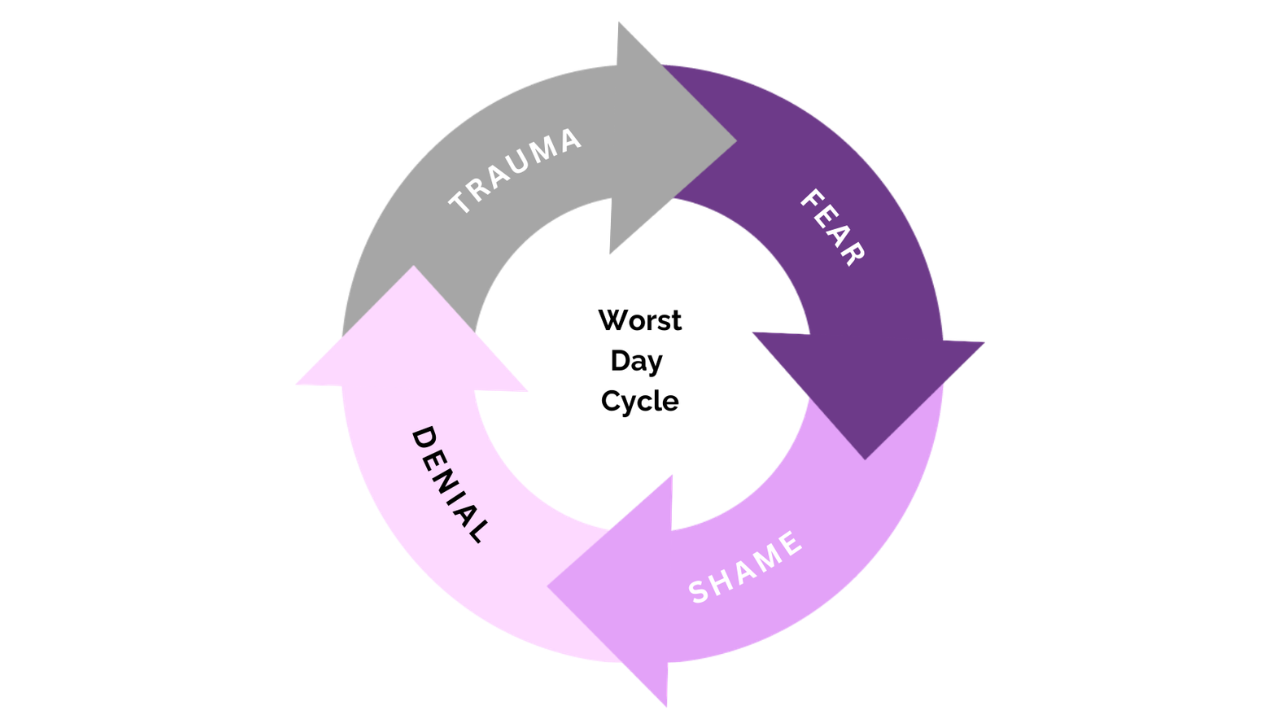
    It has been my life experience that every person on the planet lives their life stuck in the “Worst Day Cycle” – no one is immune from it.

    Are you unsure if you do? Here are two questions that will give you that answer?

    1- As a child, when you felt angry, sad, or scared by anything your parents said or did, at that moment, could you discuss it with them?

    Of course not because what was the typical response? “Get in your room! No backtalking! I don’t want to hear it!” Do those responses sound familiar?

    That shows that all of us were squashed and had to deny our thoughts, feelings, and beliefs. For the first time, we learned denial and saw the truth of our parents’ perfect imperfections.

    We learned to survive. We had to deny who we authentically are.

    2-Do you have any secrets from your parents? Something you’ve done? Something you believe?

    Of course, we do? That means if we shared who we authentically are, deep in our soul.

    we know our parents won’t accept us. Instead, they left us with the shameful message that our authentic feelings, thoughts, and beliefs are defective.

    That shows me we have all been through massive trauma and caught in “The Worst Day Cycle!”

    These events are significant because our brain becomes addicted to the emotional, chemical response we secrete in these traumatic moments.

    Unbeknownst to ourselves, our brain seeks to repeat it.

    It unconsciously chooses this because it takes tremendous energy for our brain to do anything. Its solution is to do as little work as possible. It accomplishes it by repeating what it already knows.

    Since our brain “knows” trauma and denial from childhood.

    it proactively seeks to repeat The Worst Day Cycle. It’s true. Our brain seeks to self-victimize us as adults.

    What is the solution? We have to admit:

    1. I am not really who I think I am.
    2. I am the author of my self-destruction.

    Who wants to own these things? No one has shown us how. So we don’t, and that kicks off the cycle again, so it repeats over and over.

    Imagine it this way.

    Have you ever watched a 3D movie without the special glasses? Of course, the colors and images are distorted, but since you have had the movie experience.

    you can still somewhat know what’s going on, but not everything is clear.

    That’s how we live our life. But, unfortunately, we don’t realize that with every choice we make (our friends, our hobbies, our partners), we are reliving our Worst Day Cycles.screaming back at us the trauma, fear, shame, and denial that we haven’t addressed. And ultimately, we haven’t forgiven ourselves.

    What are we missing? Why can’t we see it? We don’t have the glasses.

    That’s what I discovered: the glasses.

    I want to show you how I discovered it and showed up in my life.

    Accepting the Answers You Discover on Your Way to Success: Amazon.com: 9781981471010: Kenny Weiss
    How to Accept the Answers You Discover Along Your Journey to Success [Weiss, Kenny] available at Amazon.com. Qualifying deals qualify for free delivery. How to Accept the Answers You Find Along the Way on Your Path to Success
    As a result of Kenny Weiss’s efforts,


  • I Want You Back! Why An Ex Come Crawling Back!

    I Want You Back! Why An Ex Come Crawling Back!

    This question came from a Facebook fan.

    “Why does someone become more desirable when they are attached to someone else? My friend is about to become engaged, and her ex-fiancé is begging her to come back!

    He is professing his love, asking if it’s too late to win her back. It doesn’t make sense, and it never does!”

    This scenario is all too common and has nothing to do with the woman.

    It has everything to do with the man. Unfortunately, because of the lack of education on these topics, he believes he is professing his love

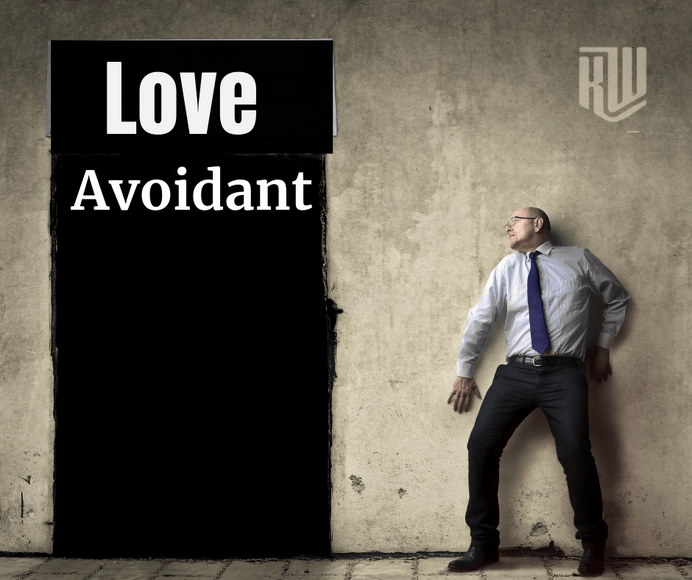
    But he is a love-avoidant codependent.

    We are all raised codependent, and the version of relationships we see in movies is codependent. We rarely have an example of an actual healthy relationship.

    Therefore, we think codependency is a normal relationship, and that is why most relationships fail.

    This phenomenon is partially responsible for the high divorce rate.

    The woman told me she and her friend and ex-fiancé had attended marriage counseling. The ex left counseling saying he wasn’t sure if he loved her .

    This happens a lot with a love avoidant codependent. An avoidant is scared of intimacy and being known. The closer they get to the connection, the more likely they are to turn away.

    Even someone who is suddenly “too busy” to be with you is most often suffering from love-avoidant, codependent intimacy issues.

    The bigger and deeper fear for these people is abandonment.

    For example, this man likely experienced abandonment as a child from his caregivers.

    So he is triggered and projecting this trauma onto her (it is important to remember he does not know he is doing this . it is not malicious intent).

    Now that she has moved on, he feels he has been left, that is why he is throwing everything at her to get her to stay, but it isn’t real love.

    It’s deep-rooted abandonment fears. If she takes him back, he will most often leave again when the prospect of connection and intimacy returns.

    This man is screaming to cover over his abandonment fears! The best solution for the woman? Ignore him.

    The most loving thing she can do is stop communicating and let him learn on his own to deal with those feelings.

    If she tries to talk him through it, it robs him of the opportunity to search out the knowledge, skills, and tools to heal.

    If you are in this situation, my suggestion is to empathize that this person is hurting from something you did not cause (and they don’t know), but tell them you are with someone else and end communication with them.

    Learn more here:

    How To Break Free From Toxic Relationship Patterns


  • 7 Steps For Healing From Narcissistic Abuse

    7 Steps For Healing From Narcissistic Abuse

    7 Steps For Healing From Narcissistic Abuse

    Today I will share the seven steps to heal from narcissistic abuse and how we know we’ve broken the Worst Day Cycle. This article could be a book – there are thousands of resources and people breaking down this sort of recovery. Instead, I’ve just picked out what I feel to be the highlights. Make sure you take advantage of all the free downloads I have created to help you heal. They can be found here: http://kennyweiss.net/resources/

    1. Grieving. There is so much pain that we experience from narcissists.
    2. I believe grieving is the single greatest step to break the cycle. This could mean bawling your eyes out!Making a list of all the things I’d miss would be a good way for me to process my loss.
      I had to come to terms with the fact that there is a time limit on how long I could sit in grief before I sank into a state of learned helplessness and melancholy.
      Once I figured out that 30 minutes was the maximum amount of time I could focus on anything, I had to take care of myself afterwards (paint, go on a walk, etc.). Every now and again, I’d take a deep breath and pull myself back into the present moment.
      A safe spot to rest may be your only refuge from the world.

    You don’t think about it or feel it when you’re asleep.


    1. Yet sometimes, I would wake myself from crying in my sleep.
    2. The pain is overwhelming but must be grieved. If you are filled with rage, anger, or resentment: you have not grieved, and you need to.
    3. If you still have rage, the Narcissistic owns and controls you without even being with you.
    4. Support. It’s a must. A Narcissistic alienated us, shamed us, and belittled us.
      Whether it’s a support group, a family member, or a professional, we all require some sort of safety net. I believe this type and extent of trauma requires professional support and help.
    5. The Narcissistic strips us so much of our identity that our solutions and thinking processes are very distorted.

    That’s why we need a caring professional to guide us through it.


    1. Expertise. Become an expert on relationships, parenting, codependence, grief, etc. We don’t teach these things as a society .
    2. please don’t assume that it’s our fault we don’t know them, but we need to learn. The only examples of relationships we see are in TV shows and movies, which are massively dysfunctional .
    3. you will recognize this when you become an expert. What areas must we become an expert in?
    4. My opinion is primarily codependence.
    5. I think Facing Codependence by Pia Mellody should be on everyone’s bookshelf.

    This book will blow your doors off.


    1. PTSD Recovery. A relationship with a narcissist creates PTSD, whether we like to acknowledge it or not.
    2. COMPLEX PTSD: From Surviving to Thriving by Pete Walker is wonderful for learning – you will learn that nearly everyone on this planet is walking around with PTSD from childhood trauma.
    3. Imperfect Parenting. Nobody is a perfect parent, and no one came from a perfect childhood.
    4. Parents adore us and do wonderful things most of the time, but they are perfectly imperfect.
    5. A common trait of narcissists is they were spoiled growing up – this is horrifically abusive.
    6. The Emotionally Abusive Relationship by Beverly Engel breaks down different parenting styles – you will be able to look at your own childhood and evaluate.
    7. Parents don’t know that what they think is loving is actually hurtful.
    8. Denial Work. We cannot remove ourselves from responsibility for the part we played. Saying we had nothing to do with what happened is disempowering and allows it to happen again. No person, place, or thing gets near our life unless we allow it to.
    9. Your Journey to Success. My book, Your Journey to Success, is a mix of all I’ve discussed here. You will discover how your childhood created your attraction to a narcissist and how to heal.


    How to know you’ve recovered from narcissistic abuse:


    1. Boring people are attractive. Our excitement with a narcissist, the butterfly feeling, is a result of trauma.
    2. When that tingly feeling goes away, we know we’ve healed and are ready for a real relationship.
    3. You adore your narcissist.
    4. This is not saying you condone the behavior, that you go near them, or that you would be in a relationship with them.
    5. Instead, you realize you’ve picked this person so that you could learn about your own perfect imperfections. You see them as your greatest teacher and that they helped you discover the best part of yourself that was hidden under all the pain you didn’t know you had or needed to deal with.

    My counselor once said to me:


    if you take a Labrador puppy, the sweetest and most gentle animal on the planet. And chain it up to a fence, starve it, and mistreat it – it will bite you.This happened to you. When you put in the work and see your part in the relationship, you will learn to adore the narcissist and recover.When we no longer resent, loathe or hate them, we have broken the cycle.


    Are you looking for more solutions? Pick the one that suits your needs best!


    1- My Book, Your Journey To Success
    2- My Complete Emotional Authenticity Method
    3- My Perfectly Imperfect Private Group
    4- My Private Coaching


    To Learn more, watch the video here: 

  • How Narcissists are Made

    How Narcissists are Made

    How Narcissists are Made

    There is much confusion surrounding narcissists and what makes a narcissist in the modern-day. Keep in mind that not everyone who experiences what I’m about to describe becomes a narcissist – everyone creates their own process to cope and survive. However, these characteristics are always present in what created the narcissist. I am not defending narcissists. The point is to show how they developed their characteristics.


    What creates the narcissist


    1. Adverse childhood experiences. There’s always neglect, abuse, abandonment. The attachment style in their childhood is chaotic and insecure.
    2. The parents could have been neglectful, over-protective.
    3. “helicopter” parents, and more. Overprotective parents lead to children being unable to regulate their emotions.
    4. Narcissists could have had entitled parents.
    5. Narcissism develops as a result of a lack of self-worth in the parents. Who are unable to endure their children having any bad emotions.
    6. A great example is the recent college admissions scandal .
    7. This type of parenting can have serious negative effects on the children.

    Conditional love.


    1. If the child only has value if they do something that makes mom and dad feel good about themselves, narcissism can very likely develop.
    2. Spoiling a child is not loving a child .
    3. It is essentially abandoning the child.
    4. The spoiled child never learns disappointment or how to regulate emotions.
    5. We want the child to make mistakes when they are young when the mistakes are just bruised knees.
    6. Spoiling is deprivation.
    7. Oftentimes, the parents will continue to enable the behavior into early adulthood and beyond.
    8. Social media. It’s becoming the new (external) way we validate ourselves.
    9. The parents were narcissists. A child will model what their parents do, so they are far more likely to become narcissistic if they grow up with narcissistic parents.

    Each child responds differently, so children from the same adverse household may not all become narcissists. It’s the same with habits and addictions present in households. We all develop our own unique, dysfunctional coping skills and solutions to adverse childhoods.


    There is an overwhelming collective denial in a society where many people think their childhood was “perfect.”


    That would mean your parents made zero mistakes – it’s impossible. We are all perfectly imperfect, and we all make mistakes as parents. Every single one of us has experienced adverse childhood experiences. Don’t blame or hate your parents – acknowledge and accept the truth.


    Nobody escapes childhood without pain. Nobody.


    The final thing to touch on: genetics. While genetics can be a factor, genetics do not determine narcissism. In his groundbreaking research on genetics. Dr. Bruce Lipton pointed out that only three disorders or diseases can 100% be determined by genetics without any external factors, and narcissism is certainly not one. Genes are only activated when something triggers them in their environment. The emotional environment that the individual was raised in is the most important. If there’s a genetic predisposition in the family history for narcissism. But the parents don’t “turn it on” with their parenting style and emotional condition. The child will not become a narcissist. It’s like this with many other genetic ailments, like cancer. If you would like to learn more about his groundbreaking research on genes, you can read his seminal book, The Biology Of Belief.


    What creates a narcissist is nearly always childhood and parenting.


    This is not to blame parents, but please remember: none of us have been raised by Jesus. We don’t blame our parents, but we accept the reality that they were perfectly imperfect. We must admit that and do the work to overcome it to reach our full potential.


    Are you looking for more solutions? Pick the one that suits your needs best!

    1- My Book, Your Journey To Success
    2- My Complete Emotional Authenticity Method
    3- My Perfectly Imperfect Private Group
    4- My Private Coaching

    To learn more watch the video here: