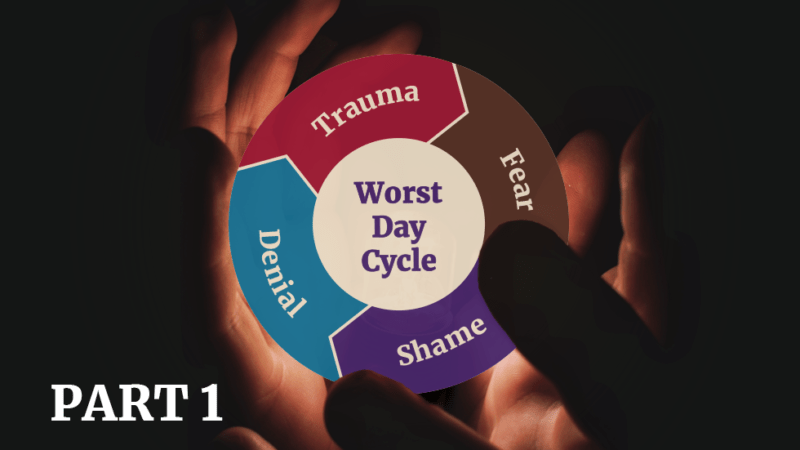
The Worst Day Cycle™ is the predictable neurochemical pattern — Trauma → Fear → Shame → Denial — that your brain built in childhood to survive emotional pain, and it is now running every relationship, career decision, and health outcome in your adult life on autopilot. If you’ve ever wondered why you keep choosing the same toxic relationships, why success never fills the void, or why you can’t stop repeating patterns you swore you’d never repeat — this is why. Your brain isn’t broken. It’s running a survival program that was installed before you could tie your shoes.
That’s you — the one who promised yourself you’d never end up like your parents and then woke up one day realizing you’re living their exact pattern.
The Worst Day Cycle™ isn’t a theory. It’s the operating system your nervous system has been running since childhood — and until you see it, name it, and learn to rewire it, nothing changes. Not the next relationship. Not the next promotion. Not the next self-help book.
What Is the Worst Day Cycle™?
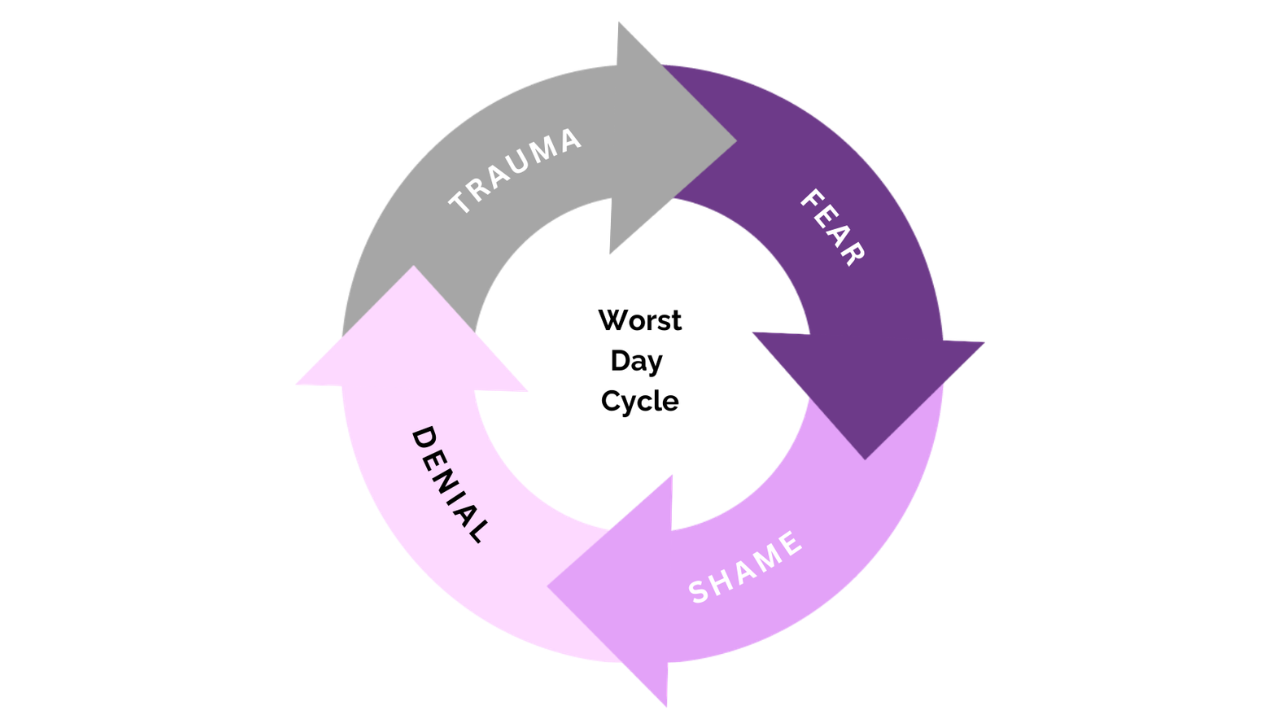
The Worst Day Cycle™ is a four-stage neurochemical pattern that forms in childhood and drives every major decision, relationship, and emotional reaction in your adult life. The four stages are Trauma → Fear → Shame → Denial. Every single person on this planet is caught in this dynamic — and with just a couple of questions, you can see how every choice in your life revolves around this cycle.
That’s you — wondering why you keep ending up in the same situations with different people, not realizing your brain is running a program it wrote when you were five years old.
Here’s how it works: childhood trauma — any negative emotional experience that created painful meanings — triggers a massive chemical reaction in the brain and body. The hypothalamus generates chemical cocktails of cortisol, adrenaline, dopamine, and oxytocin misfires. The brain becomes addicted to these emotional states. It conserves energy by repeating known patterns — it can’t tell right from wrong, only known from unknown. Since 70%+ of childhood messaging is negative and shaming, adults repeat these painful patterns in relationships, career, hobbies, health — everything.
The Worst Day Cycle™ is a childhood-created neurochemical addiction that forces your brain to repeat painful patterns because repetition equals survival.
What Are the Four Stages of the Worst Day Cycle™?
The Worst Day Cycle™ has four interconnected stages, and they all work together to keep you stuck. Trauma creates the chemical reaction that sends you into fear. Fear drives repetition. Repetition reinforces shame. And shame creates denial — the survival persona that keeps the entire cycle hidden from your conscious awareness.
That’s you — caught in a loop you can’t see, wondering why every relationship feels the same and every achievement feels hollow.
Think of it like watching a 3D movie without the glasses. You’ve heard about what life and relationships should look like, so you can piece together enough to get by. But everything is fuzzy. The colors don’t line up. Nothing makes total sense. Learning the Worst Day Cycle™ is putting on the glasses — and suddenly, for the first time, you see everything clearly. You see why you chose that partner. Why you took that job. Why you can’t stop the pattern. Shame and denial keep us from seeing the world the way it truly is.
The four stages of the Worst Day Cycle™ — Trauma, Fear, Shame, and Denial — form an interconnected neurochemical loop that operates below conscious awareness, driving every adult pattern on autopilot until you learn to see it, name it, and rewire it.
Stage 1: How Does Childhood Trauma Start the Worst Day Cycle™?
Trauma is any negative emotional experience in childhood that created painful meanings. It doesn’t have to be dramatic. It doesn’t have to be physical or sexual abuse — though those certainly qualify. Trauma can be as subtle as a parent who was emotionally unavailable, a household where feelings were treated as weakness, or a caregiver whose love was conditional on performance.
That’s you — the one who says “my childhood wasn’t that bad” while your body tells a completely different story.
Here’s what happens during trauma: the brain and body have a chemical reaction to even the slightest emotional event. Any stressful or fearful experience actually changes the physical makeup of who you are. The brain’s alarm system activates. Stress hormones flood the body. And the more you experience these events, the more the brain and body become wired for pain.
The most significant source of all trauma is childhood. None of us leave childhood unscathed. The Adverse Childhood Experience Study (ACE) shows that two-thirds of people have experienced childhood trauma. But here’s the part most people can’t accept: the primary way we experience trauma is through perfectly imperfect parenting. This isn’t about blame. It’s about responsibility. Every parent does what they feel is kind and loving. But because society and science have not taught us emotional authenticity, parents are unaware that no matter how great they are, they will leave wounds in their children.
That’s you — defending your parents’ behavior while simultaneously repeating their exact emotional patterns in your own life.
The emotional environment a child lives in during the critical early years of brain development — pre-birth to seven years old — shapes the entire trajectory of their adult life. Children carefully observe their environment and download the fundamental behaviors and feelings of their parents directly into their subconscious memory. Those behaviors and feelings become hardwired and control our biology for the rest of our lives — or until we make the effort to reprogram them.
Childhood trauma is any negative emotional experience that created painful meanings — even subtle neglect rewires the brain and body, setting the Worst Day Cycle™ in motion.
Stage 2: How Does Fear Drive Repetition in the Worst Day Cycle™?
Fear is the engine of the Worst Day Cycle™. Once trauma creates the initial chemical pattern, fear locks it in place. The brain conserves energy by repeating known patterns — it literally cannot tell right from wrong, only known from unknown. And to the brain, known equals safe, even when “known” is painful, chaotic, and destructive.
That’s you — choosing the same type of partner over and over, not because you want to, but because your nervous system is terrified of anything unfamiliar.
This is why scared animals return home — regardless of whether home is safe or frightening. The very event that caused so much pain has also become the sole source of meaning. People feel fully alive only when they are revisiting their traumatic past. This is everybody. This is why polls have shown that the vast majority of people on this planet are unhappy — because everybody is simply living the Worst Day Cycle™ day in and day out.
It’s literally the same process that casinos use. As a child, every day you were sitting at a slot machine pulling the handle. Which parent am I going to get today? Are they going to be kind, cold, drunk, distracted, enraged, disengaged? You were desperate to win. And you’re still desperate to win — in every relationship, every job, every situation that mirrors that original childhood dynamic.
That’s you — finding stable, calm love “boring” because your nervous system was calibrated for chaos and intermittent reinforcement.
Fear drives the Worst Day Cycle™ by locking the brain into repeating known patterns — the nervous system equates familiarity with survival and treats anything healthy as a threat.
Stage 3: How Does Shame Destroy Your Inherent Worth?
Shame is where you lost your inherent worth. Not “I made a mistake” — but “I AM the mistake.” This is the core wound underneath every pattern in the Worst Day Cycle™. Shame strips you of your inherent value and power, and everything you do from that point forward is an attempt to get it back.
That’s the shame talking — the voice that’s been running your life since before you could spell your own name, telling you that who you are isn’t enough.
Whether falsely empowered, disempowered, or narcissistic — it’s all a power game. It’s all about regaining power because shame strips us of our inherent value and worth and our authentic power. The falsely empowered hides behind dominance, ego, and being right. The disempowered hides behind niceness, selflessness, and emotional absorption. But both have been through unspeakable pain and are filled with unspeakable shame. Terribly low self-esteem and terribly high shame.
Shame doesn’t just make you feel bad about yourself. It rewires your entire identity. It tells you that your authentic self — the person you actually are underneath all the performance — isn’t safe to be. So you abandon yourself. You create a persona. You become whoever you need to be to earn love, approval, or safety. And after decades of living through this persona, you can’t tell the difference between who you really are and who you had to become.
That’s you — achieving everything society says you should want and still feeling empty, because shame told you that your authentic self wasn’t enough, so you built an impressive life on top of a foundation of “I am the problem.”
Shame is where your inherent worth was destroyed — not “I made a mistake” but “I AM the mistake” — and this core wound drives every pattern in the Worst Day Cycle™.
Stage 4: How Does Denial Create the Survival Persona?
Denial is the survival persona you created to survive the pain. It was brilliant in childhood — absolutely necessary. Without it, you wouldn’t have made it. But in adulthood, it sabotages everything. The survival persona keeps you performing instead of feeling. Producing instead of connecting. Running instead of resting.
That’s you — the one who can run a company but can’t sit still for five minutes, because sitting still means feeling, and feeling means facing what’s underneath.
Studies show that we lie to ourselves 10 to 200 times daily. What keeps us from the life we want is our inability to acknowledge that our upbringing was not as perfect as we like to think it was. Most people believe placing any responsibility on their parents is unacceptable or disrespectful. Due to underlying shame and fear, any thought of challenging a parent will activate the inner child, who will be fearful of getting in trouble or losing their parents’ love.
Think of a child who can do a finger painting but can’t do a mural. Adult life requires you to paint a mural — it’s complex, nuanced, requires emotional regulation, boundaries, and authentic expression. But the survival persona only has child-level skills. It’s trying to navigate adult situations with a strategy that was never designed for them.
That’s you — frustrated that your old patterns keep failing, not realizing you’re using a five-year-old’s strategy to solve a forty-year-old’s problems.
The most common form of denial is the 80% statistic: 80% of people say they never went through childhood trauma. That number alone tells you how deep denial runs. Not because people are lying — but because denial is so powerful that it literally rewrites your memory of childhood to protect you from the pain.
Denial is the final stage of the Worst Day Cycle™ — it creates the survival persona, a protective identity built in childhood that was brilliant for surviving an unsafe environment but now sabotages every adult relationship, career, and health outcome because it operates with child-level strategies in an adult world.
What Are the Three Survival Persona Types?
The survival persona is not who you are — it’s who you had to become. There are three types, and understanding yours is the first step to breaking free from the Worst Day Cycle™.
The Falsely Empowered: This persona controls, dominates, and rages. They look powerful on the outside, but their power comes from fear, not strength. They manage others to avoid being managed. They stay in control to avoid the terror of being out of control. They hide behind dominance, ego, and always being right.
That’s you — the leader who commands every room but can’t have a vulnerable conversation with the person you love most.
The Disempowered: This persona collapses, people-pleases, and disappears. They make themselves small to stay safe. They give everything to everyone and wonder why they feel invisible. They confuse hypervigilance with empathy and call themselves “empaths” because they can read every room — not realizing they learned to read rooms because reading rooms wrong as a child meant danger.
That’s you — the one everyone calls “so empathetic” while you’re actually terrified of what happens if you stop monitoring everyone’s emotional state.
The Adapted Wounded Child: This persona oscillates between both — controlling one moment, collapsing the next. They swing between “I don’t need anyone” and “please don’t leave me.” They never have a stable sense of self because they’re constantly flipping between two survival strategies, never landing in their authentic self.
Sound familiar? The person who rages on Monday and people-pleases on Tuesday and can’t figure out which one is the “real” them?
The three survival persona types — falsely empowered, disempowered, and adapted wounded child — are the identities created in the denial stage of the Worst Day Cycle™, each representing a different strategy for managing the unbearable pain of childhood shame.
How Does the Worst Day Cycle™ Show Up in Every Area of Your Life?
Family: You’re replaying your childhood at every family gathering. You slip back into the role you were assigned at age six — the peacekeeper, the performer, the invisible one. You manage your parents’ emotions. You swallow your reactions. You leave family events feeling drained, triggered, or numb — and you tell yourself it’s “just how families are.”
That’s you — still playing a role that expired decades ago because your nervous system doesn’t know how to be anything else around your family of origin.
Romantic Relationships: You choose partners who mirror your childhood wound. If your parent was emotionally unavailable, you chase emotionally unavailable people. If love was conditional on performance, you overperform to keep your partner. You confuse intensity with intimacy, chaos with passion, and anxiety with love. Your relationships are a replay of your childhood — different actors, same script.
That’s you — wondering why you keep attracting the same person in a different body, over and over.
Friendships: You’re either the friend everyone relies on (disempowered), the friend who controls every plan (falsely empowered), or the friend who disappears when things get real (adapted wounded child). You struggle to let people know the real you because the real you was never safe to show.
Work: Your career is driven by shame. You overwork to prove your worth. You undercharge because you don’t believe you deserve more. You stay in toxic work environments because they feel familiar. You self-sabotage right before a breakthrough because success means admitting the survival persona was always wrong. Nobody is afraid to fail — because in the moment you choose not to do something, you’ve chosen failure and you’re comfortable with it. What you’re actually afraid of is success.
That’s you — sabotaging yourself right before the finish line because your survival persona says success means losing connection with mom and dad.
Body and Health: The ACE studies show that childhood dysfunction plays a significant role in chronic diseases — heart disease, cancer, stroke, diabetes. Your emotional trauma history primarily determines your health outcomes. Chronic pain, digestive issues, insomnia, autoimmune conditions — these are often the body’s last resort when emotional signals have been ignored for decades. Your body is keeping score.
Why Does Your Brain Keep Repeating Painful Patterns?
Your brain keeps repeating painful patterns because it became chemically addicted to the emotional states created by childhood trauma. The brain doesn’t care about your happiness — it cares about survival. And survival means repeating what’s known, even when what’s known is destroying you.
That’s you — knowing exactly what you should do differently and being completely unable to do it, because your nervous system overrides your intentions every single time.
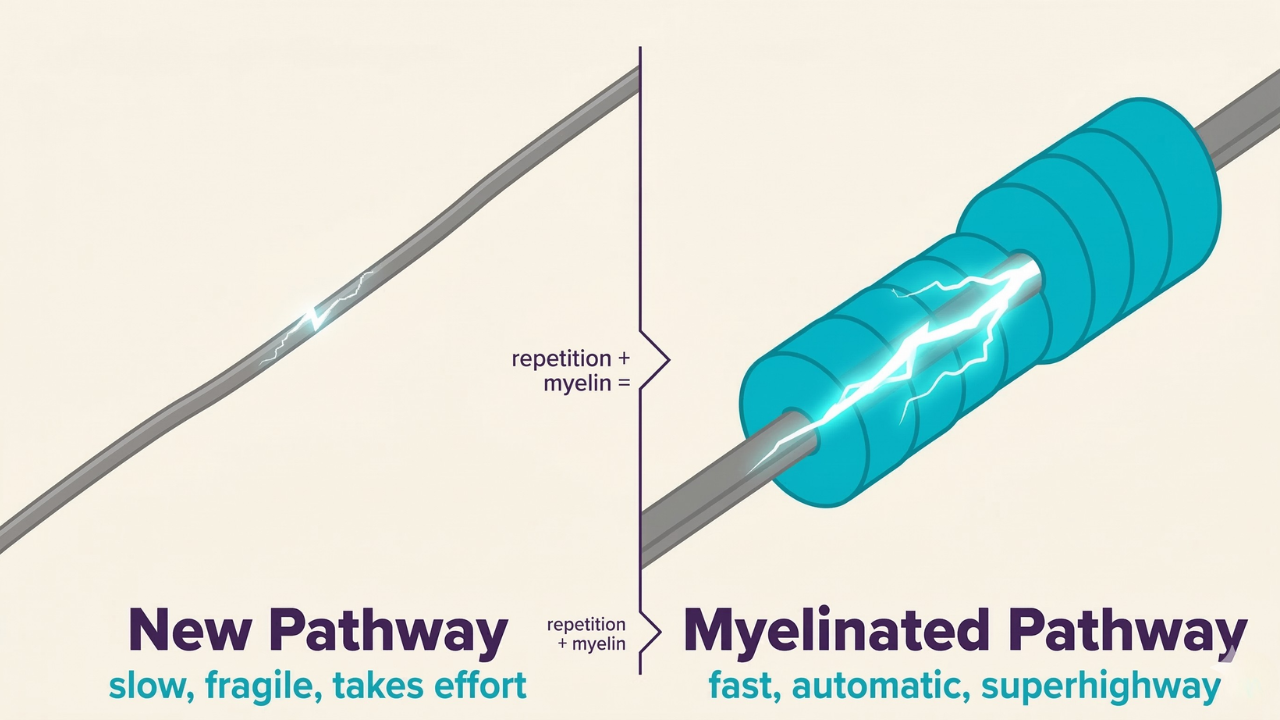
We choose to remain in the same circumstances because we have become addicted to the emotional state they produce and the chemicals that arouse that state of being. The drama king or queen who can’t live in peace, constantly stirring up trouble — they’re not doing it on purpose. Their brain is literally addicted. It’s sitting there going “hey, it’s too quiet, I need my fix.” It sends a signal, creates the loop, the chemicals release, and boom — chaos everywhere.
Your childhood blueprint keeps your nervous system ping-ponging between fight, flight, fawn, and freeze. You grew up in an environment where being relaxed, being yourself, and having needs just wasn’t safe. So your body learned that calm is dangerous and stillness is dangerous. As an adult, your life can look safe to everyone on the outside — but your nervous system still thinks you’re that kid in that house.
That’s you — always waiting for the other shoe to drop, scanning every room for danger, unable to relax even when there’s nothing to be afraid of.
The brain repeats painful patterns because childhood trauma created a neurochemical addiction — the emotional chemicals produced by chaos, shame, and fear became the brain’s baseline, and anything peaceful or healthy registers as unfamiliar and therefore dangerous.
How Does the Emotional Authenticity Method™ Break the Worst Day Cycle™?
The Emotional Authenticity Method™ is the daily practice that breaks the Worst Day Cycle™ at the nervous system level. It works because it targets the body — where trauma actually lives — not just the mind.
You cannot change emotional patterns through thoughts alone. Emotions are biochemical events. Thoughts originate from feelings — not the other way around. This is why affirmations don’t work, why insight alone doesn’t change behavior, and why you can understand the Worst Day Cycle™ intellectually and still be completely stuck in it.
That’s you — collecting insights like trophies and wondering why nothing actually changes.
Here’s how the Emotional Authenticity Method™ works:
Step 1: Somatic Down-Regulation. Focus on what you can hear for 15-30 seconds. If you’re highly dysregulated, use titration — go slowly. Before you can process anything, you have to get your nervous system out of survival mode. Think of it like this: if your emotional temperature is already at 102 and something happens that pushes it to 110, that’s a coma. You can’t function at that temperature. The somatic exercises are the aspirin that lowers your emotional temperature so you can think, feel, and choose.
Step 2: What am I feeling right now? Use the Feelings Wheel to develop emotional granularity — the ability to name specific emotions instead of lumping everything into “stressed” or “fine.” Most people have no idea what they’re actually feeling because they’ve been disconnected from their emotions for decades.
Step 3: Where in my body do I feel it? All emotional trauma is stored physically. Your chest tightens. Your stomach drops. Your jaw clenches. Locating the feeling in your body moves you from intellectual understanding to somatic processing — where healing actually happens.
Step 4: What is my earliest memory of having this exact feeling? This is where the rewiring happens. You trace today’s reaction back to its childhood origin. You realize: this isn’t about today. My partner isn’t my parent. My nervous system just thinks they are.
That’s the moment everything shifts — when you see that your reaction belongs to a five-year-old, not a forty-year-old.
Step 5: Who would I be if I never had this thought or feeling again? What would be left over? This is the vision step — it connects you to the Authentic Self Cycle™ and gives your nervous system a new destination.
Step 6: Feelization. Sit in the feeling of the Authentic Self and make it strong. Create a new emotional chemical addiction to replace the old blueprint. Ask: how would I respond to this situation from this feeling? What would I say? What would I do? Visualize and FEEL yourself operating from your Authentic Self. This is the emotional blueprint remapping and rewiring step — the moment where the new pattern begins to replace the old one.
The Emotional Authenticity Method™ breaks the Worst Day Cycle™ because emotions are biochemical events — you cannot think your way out of a pattern installed at the neurochemical level.
How Does the Authentic Self Cycle™ Replace the Worst Day Cycle™?
The Authentic Self Cycle™ is the healing counterpart to the Worst Day Cycle™. Where the Worst Day Cycle™ traps you in Trauma → Fear → Shame → Denial, the Authentic Self Cycle™ restores your identity through Truth → Responsibility → Healing → Forgiveness.
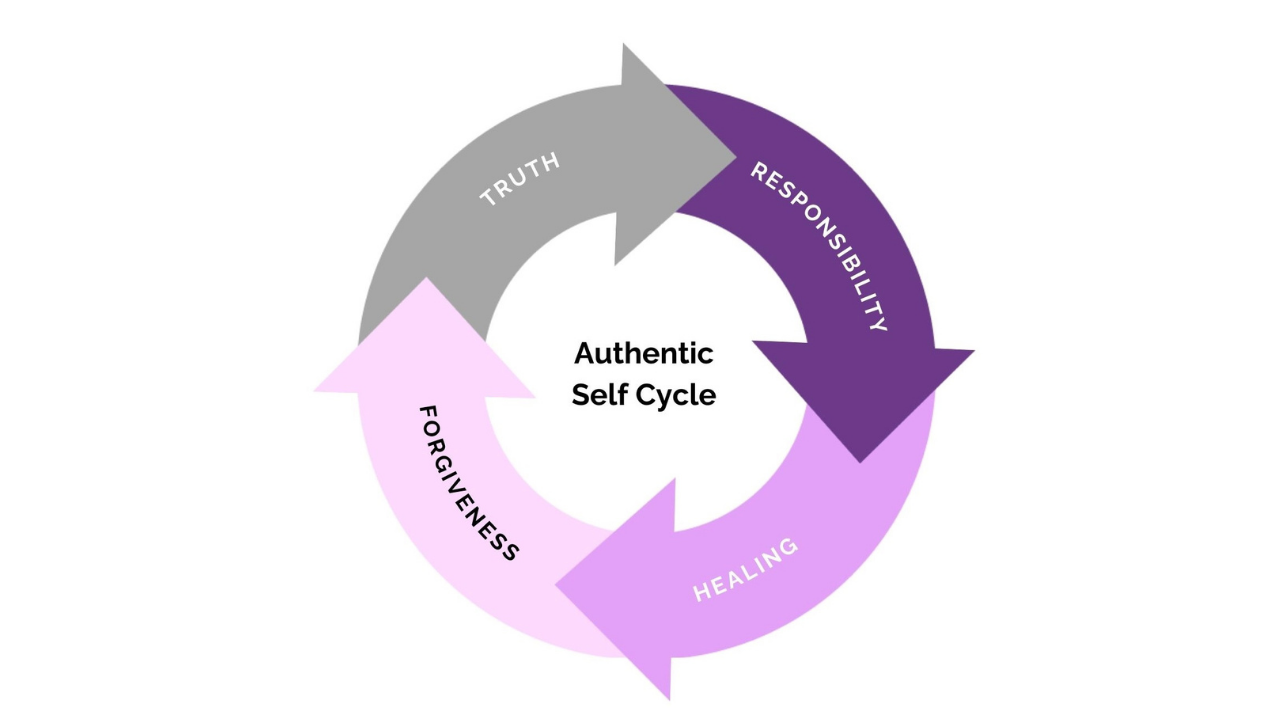
Truth: Name the blueprint. See that “this isn’t about today.” When your partner asks for space and your chest tightens, truth says: “This feeling is from childhood. My partner isn’t abandoning me — my nervous system just thinks they are.” Being forbidden to live in truth is at the core of the Worst Day Cycle™. The ability to not blame your parents but hold them responsible is what truth offers.
That’s the first step out of the cycle — seeing the pattern instead of being trapped inside it.
Responsibility: Own your emotional reactions without blame. “My partner isn’t my parent — my nervous system just thinks they are.” This isn’t about fault. It’s about taking back your power from a childhood that stole it. Blame says “you did something wrong.” Responsibility says “I played a part in this, not deliberately, but I accept the consequences because I love myself enough to heal.”
Healing: Rewire the emotional blueprint so conflict becomes uncomfortable but not dangerous, space isn’t abandonment, and intensity isn’t attack. Most people look at healing as trying to get the hour hand to move. But what makes the hour hand move? The second hand moves first. What’s the smallest thing you can do in this moment? Some days the best you can do is roll out of bed and put your feet on the floor. That’s victory. One second of effort toward something new — and the survival persona’s grip breaks.
That’s the truth — you don’t need a bigger breakthrough. You need a smaller, more consistent practice. The second hand moves the minute hand. The minutes move the hours. The hours change your entire life.
Forgiveness: Release the inherited emotional blueprint and reclaim your authentic self. Forgiveness is where the adult consistently shows up and replaces the child at the wheel. It says, “Hey kids, love you, but back seat. I’m driving now.” It’s not excusing the past. It’s releasing the shame that says “I’m the problem” or “they’re the problem.” It creates a NEW emotional chemical pattern that replaces fear, shame, and denial with safety, worth, and connection.
That’s you — not becoming someone new, but finally meeting who you always were underneath the survival persona.
The Authentic Self Cycle™ is an identity restoration system — it doesn’t teach you to cope with the Worst Day Cycle™, it replaces the neurochemical pattern that created it with a new blueprint built on truth, responsibility, healing, and forgiveness.
Frequently Asked Questions About the Worst Day Cycle™
What is the Worst Day Cycle and how does it affect my daily life?
The Worst Day Cycle™ is a four-stage neurochemical loop — Trauma, Fear, Shame, Denial — that forms in childhood and drives every adult pattern on autopilot. It affects your daily life by making you repeat painful patterns in relationships, career, health, and self-worth. Your brain became addicted to the emotional chemicals produced by childhood trauma, so it unconsciously recreates situations that trigger those same chemicals — even when they cause pain.
Can you break the Worst Day Cycle without therapy?
Yes — the Worst Day Cycle™ can begin to break with daily somatic practices like the Emotional Authenticity Method™. The six-step process targets the body where trauma is stored, not just the mind. A skilled guide can accelerate the process, but the daily work — down-regulation, emotional naming, body awareness, childhood tracing, vision, and Feelization — creates real neurological change regardless of setting.
How do I know if I’m stuck in the Worst Day Cycle?
Ask yourself four questions: (1) As a child, could you openly discuss your hurt feelings with your parents? (2) Have you kept thoughts, feelings, or behaviors secret from your parents? (3) Can you openly discuss your parents’ imperfect parenting with them? (4) Do you excuse, minimize, or justify your parents’ hurtful behavior? If you answered yes to any of these, you’re in the cycle. Every person on this planet is — the question is how deep.
What is the difference between the Worst Day Cycle and normal stress?
Normal stress is a response to a present-moment challenge. The Worst Day Cycle™ is a neurochemical pattern from childhood that hijacks your present-moment response and overlays it with a five-year-old’s fear, shame, and survival strategy. When your reaction is disproportionate to the situation — when a simple text triggers a meltdown or a minor disagreement feels like abandonment — that’s not stress. That’s the Worst Day Cycle™.
How does the Worst Day Cycle affect relationships?
The Worst Day Cycle™ makes you choose partners who mirror your childhood wound, react to your partner as if they’re your parent, and use your survival persona instead of your authentic self in every intimate interaction. It creates patterns of pursuit-withdrawal, people-pleasing, rage, emotional shutdown, and codependence. Your relationships become a stage where you unconsciously reenact your childhood, hoping for a different outcome using the same broken blueprint.
How long does it take to heal the Worst Day Cycle?
The Worst Day Cycle™ was installed over years of childhood experience and reinforced over decades of adult repetition — it doesn’t reverse overnight. But noticeable shifts can happen within weeks of consistent daily practice with the Emotional Authenticity Method™. The key is repetition, not intensity. One second of effort toward something new breaks the survival persona’s grip. The Authentic Self Cycle™ provides the framework for long-term identity restoration through truth, responsibility, healing, and forgiveness.
The Bottom Line
The Worst Day Cycle™ is running your life. It’s been running your life since childhood. And it will continue running your life until you see it, name it, and make the conscious choice to rewire it.
You didn’t choose this cycle. You didn’t create it. A child doesn’t choose trauma, fear, shame, or denial. A child survives. And the survival persona you built was brilliant — it got you here. It kept you alive. It deserves gratitude, not shame.
But it’s time. The strategies that saved you at five are destroying you at forty. The fear that kept you alive is now keeping you stuck. The shame that made you perform is now making you empty. The denial that protected you is now isolating you from the truth of who you actually are.
That’s you — not the survival persona the world sees. The authentic self underneath who’s been waiting your entire life for permission to exist.
You don’t need to be fixed. You need to be found. And the Authentic Self Cycle™ — truth, responsibility, healing, forgiveness — is the map that leads you home. Not to the home you grew up in. To the home inside yourself that you’ve never been allowed to live in.
Start with one second. One moment of truth. One honest feeling. That’s the second hand moving. And the second hand moves the minute hand. And the minutes move the hours. And the hours change your entire life.
Recommended Reading
These books complement the Worst Day Cycle™ framework and deepen your understanding of how childhood trauma creates lifelong patterns:
Facing Codependence by Pia Mellody — the foundational text on how childhood trauma creates codependent patterns and survival personas.
The Body Keeps the Score by Bessel van der Kolk — the science of how trauma lives in the body, not just the mind, and why the brain repeats painful patterns.
When the Body Says No by Gabor Maté — how chronic emotional suppression manifests as physical illness and disease.
Codependent No More by Melody Beattie — a practical guide to recognizing and healing codependent patterns driven by the Worst Day Cycle™.
The Gifts of Imperfection by Brené Brown — how shame drives identity performance and why vulnerability is the path back to authenticity.
Take the Next Step
If you’re ready to break the Worst Day Cycle™ and start living from your authentic self, Kenny Weiss offers courses designed for people who are done surviving and ready to heal:
Emotional Blueprint Starter Course — Individual ($79) — Your personal roadmap to understanding the Worst Day Cycle™ and beginning the journey to your authentic self.
Relationship Starter Course — Couples ($79) — For couples ready to break the cycle of reactivity and build interdependence.
Why We Can’t Stop Hurting Each Other ($479) — Deep-dive into the Worst Day Cycle™ and how childhood trauma creates relationship pain.
Why High Achievers Fail at Love ($479) — Built for high achievers who’ve mastered their career but can’t figure out relationships.
The Shutdown Avoidant Partner ($479) — Understanding avoidant attachment through the lens of trauma chemistry and survival personas.
Tier 1: Mapping the Blueprint ($1,379) — The comprehensive program for learning and practicing the Emotional Authenticity Method™.
Download the Feelings Wheel — the free tool used in Step 2 of the Emotional Authenticity Method™ to build emotional granularity.
Explore more: The Signs of Enmeshment | 7 Signs of Relationship Insecurity | 7 Signs of High Self-Esteem | How to Determine Your Negotiables and Non-Negotiables | 10 Do’s and Don’ts for a Great Relationship