How to feel worthy is a question that haunts millions of people — and the answer has nothing to do with accomplishing more, earning more love, or finally proving yourself to the person who withheld approval in childhood. Unworthiness is not a character flaw. It is not evidence that something is fundamentally broken inside you. Unworthiness is a childhood emotional meaning — a conclusion your nervous system created when you were too young to understand that your caregivers’ pain had nothing to do with your value. The feeling of “I’m not enough” was installed before you could walk, before you could speak, before you had any say in the matter. And it has been running your decisions, your relationships, your career, and your health ever since.
If you’ve spent your life performing for approval, shrinking to keep the peace, or wondering why success never fills the emptiness — you’re not broken. You’re running an outdated emotional blueprint. That’s you if you’ve achieved everything on the outside and still feel hollow on the inside — because no amount of external validation can heal an internal wound.
The path to genuine self-worth doesn’t start with affirmations or positive thinking. It starts with understanding where the unworthiness came from, how your nervous system turned it into an identity, and how to rewire your emotional blueprint so that worthiness becomes your baseline — not something you have to earn.
Table of Contents
- What Is Worthiness? The Difference Between Earned and Inherent Worth
- Where Unworthiness Comes From: Your Childhood Emotional Blueprint
- The Worst Day Cycle™: How Unworthiness Becomes an Addiction
- The Three Survival Personas of Unworthiness
- How Unworthiness Shows Up Across Your Life
- The Authentic Self Cycle™: Rebuilding Worth From the Inside
- The Emotional Authenticity Method™: 6 Steps to Rewire Your Worth
- Frequently Asked Questions
- The Bottom Line
- Recommended Reading
- Courses
What Is Worthiness? The Difference Between Earned and Inherent Worth
Most people operate from a belief that worthiness is something you earn. You earn it through achievement. You earn it through being useful. You earn it through perfect behavior, selfless giving, or relentless productivity. This belief is so deeply embedded that it feels like objective truth. But it’s not truth — it’s a childhood survival strategy.
At all times, no matter what you are thinking, feeling, believing, or doing, you always have value and worth. At all times. Your worth is not negotiable. It is not conditional. It is not something that increases when you succeed and decreases when you fail.
That’s you if you can’t take a compliment without deflecting it. That’s you if you believe you need to do something to deserve love. That’s you if your inner voice says “I’m not enough” louder than anything anyone else has ever said to you.
Inherent worth means you are worthy simply because you exist. Not because of what you produce. Not because of who loves you. Not because of how perfectly you perform. Authentic worth comes from existing — nothing more, nothing less. This isn’t a feel-good platitude. It’s the neurological reality that gets buried under years of childhood conditioning.
That’s you if you’ve been chasing worthiness your whole life — through promotions, relationships, approval, weight loss, achievements — and it still doesn’t feel like enough. Because earned worth is a treadmill. Inherent worth is solid ground.
Where Unworthiness Comes From: Your Childhood Emotional Blueprint
Unworthiness is not a personality trait. It is a childhood emotional meaning — a conclusion your nervous system created during experiences of abandonment, neglect, conditional love, criticism, or emotional volatility. When a child experiences pain they cannot understand, they do the only thing a child’s brain can do: they make it about themselves.
The child concludes: “If I was worthy, they wouldn’t treat me this way.” But the child doesn’t realize that the parent’s pain didn’t belong to them. The chaos wasn’t their fault. The neglect wasn’t a judgment of their worth. The criticism wasn’t truth. The inconsistency wasn’t personal.
That’s you if you grew up in a home where love was conditional — where you had to be perfect to receive attention, where your emotions were dismissed, where you learned that your needs were burdensome.
Worthlessness is the childhood explanation for things the child couldn’t understand. It’s an inherited emotional conclusion — not truth. These meanings harden into identity. “I’m the problem.” “I’m not wanted.” “I have no value.” “I’m unlovable.” And then your brain — brilliant and efficient — begins seeking evidence to confirm what it already believes. Every rejection reinforces it. Every failure proves it. Every relationship that doesn’t work out becomes another data point in the case against your own worth.
Your emotional blueprint — the nervous system’s learned pattern for what love, safety, and connection feel like — was set in childhood. If your childhood contained shame, your blueprint says shame is home. If your childhood contained conditional love, your blueprint says you have to earn your place. The blueprint doesn’t know the difference between familiar and healthy. It only knows: this is what I recognize.
That’s you if you keep choosing relationships, jobs, and situations that confirm your unworthiness — not because you’re masochistic, but because your nervous system is running childhood software on adult hardware.
The Worst Day Cycle™: How Unworthiness Becomes a Neurological Addiction
The Worst Day Cycle™ explains why unworthiness doesn’t just visit you — it lives in you. It’s a four-stage neurological loop: Trauma → Fear → Shame → Denial. This cycle repeats endlessly until you interrupt it.
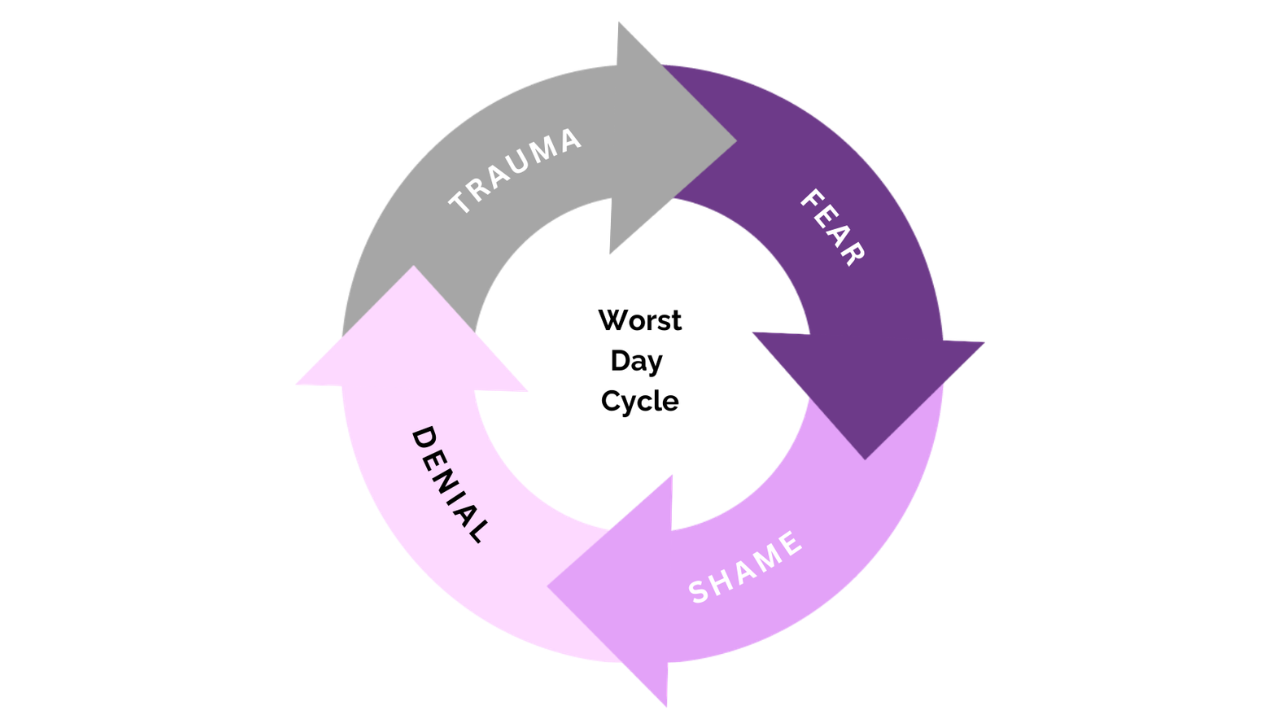
Stage 1: Trauma. Childhood trauma is any negative emotional experience that created painful meanings. It doesn’t require abuse. A parent who rolled their eyes when you expressed needs. A sibling who was always favored. A teacher who shamed you in front of the class. Any of these creates a massive chemical reaction in your nervous system. The hypothalamus generates chemical cocktails — cortisol, adrenaline, dopamine misfires, oxytocin disruptions — and your brain becomes addicted to these emotional states.
Stage 2: Fear. Fear drives repetition. Your brain conserves energy by repeating known patterns. It can’t tell right from wrong — only known versus unknown. Since approximately 70% of childhood messaging is negative and shaming, adults repeat these painful patterns in relationships, career, hobbies, health — everything. That’s you if unfamiliar peace feels scarier than familiar pain.
Stage 3: Shame. This is where you lost your inherent worth. Where you decided “I am the problem.” Not “I made a mistake” (which is healthy responsibility), but “I AM a mistake” (which is toxic shame). When you belittle your worth by saying “I’m so stupid” or “why didn’t I do that differently?” — you’ve just said “I don’t have value and worth unless I do this perfectly.”
Stage 4: Denial. To survive unbearable shame, your psyche creates a survival persona — a false identity that protects you from the truth. This survival persona was brilliant in childhood. It kept you alive. But in adulthood, it keeps you disconnected from your authentic self and your inherent worth.
That’s you if you’ve been performing confidence while secretly feeling like a fraud. That’s you if you’ve been giving endlessly while feeling empty. That’s you if you know exactly what to say to help everyone else but can’t seem to help yourself.
The Three Survival Personas of Unworthiness
Unworthiness doesn’t look the same in everyone. It creates three distinct survival personas — adaptive identities built in childhood to protect you from shame. Each one masks the same wound: “I am not worthy as I am.”
The Falsely Empowered Persona. This survival persona hides unworthiness behind control, dominance, achievement, and emotional distance. You became the overachiever, the one who has it all together, the person everyone depends on. You can’t show vulnerability because vulnerability in childhood meant being consumed, dismissed, or exploited. So you inflate, withdraw, become critical, intellectualize, and project shame outward.
That’s you if you’ve been promoted for the very pattern that’s destroying you from the inside — your survival persona’s perfectionism is your company’s greatest asset and your nervous system’s greatest prison.
The Disempowered Persona. This survival persona hides unworthiness behind collapse, people-pleasing, and self-abandonment. You became invisible. You learned that safety meant disappearing, that your needs were burdensome, that love required self-sacrifice. You over-apologize, take all blame, fawn, over-function, and feel chronically “not enough.”
That’s you if you rehearse your needs in your head but can’t get the words out — because your nervous system still believes that having needs means losing love.
The Adapted Wounded Child. This survival persona oscillates between both. One moment you’re controlling and rigid; the next you’re collapsing and people-pleasing. You shift constantly depending on who’s in the room, reading emotions like a survival manual, performing whatever version of yourself seems safest in the moment.
That’s you if you feel like a different person depending on who you’re with — because your survival persona learned to be whatever the room needed, never what you actually are.
Sound familiar? Most of us recognize ourselves in all three at different times. That’s because they were all brilliant childhood survival strategies — and now they’re running your adult life without your permission.
How Unworthiness Shows Up Across Your Life
Unworthiness doesn’t confine itself to one area. It infiltrates everything — because the emotional blueprint runs beneath every decision, every relationship, every moment of self-talk.
Family Relationships
You still seek approval from a parent who gives it conditionally. You change who you are around family to keep the peace. You feel guilty for setting boundaries. You sacrifice your needs “for family.” You can’t share your real self — you manage their perception of you instead.
That’s you if your parent’s mood still determines your entire day — even though you’re a grown adult with your own life.
Romantic Relationships
You suppress your needs to avoid conflict. You stay in situations that don’t work because you fear abandonment. Your worth depends on whether your partner loves you back. You try to change yourself to be “the right” partner. You keep score of sacrifices and expect repayment. You attract people who confirm your unworthiness because your nervous system recognizes their emotional unavailability as “home.” Learn more about the signs of relationship insecurity.
That’s you if you’ve ever said “I’m fine” when you weren’t — because speaking up felt more dangerous than suffering in silence.
Friendships
You’re the emotional support person but can’t ask for support. You abandon your plans when friends need you. You stay friends with people who don’t respect you. You hide your real struggles because you’re afraid they’ll leave if they see the real you.
That’s you if you’re exhausted from being everyone’s therapist while nobody holds space for you.
Work and Achievement
You work beyond your capacity to prove your worth. You struggle to advocate for yourself or ask for raises. You take on everyone else’s emotional labor. You can’t say no without guilt. You suffer from imposter syndrome — the constant fear that someone will discover you’re not as capable as you appear. Build genuine self-esteem that doesn’t depend on productivity.
That’s you if you’ve been working yourself into exhaustion trying to prove something that was never in question — your inherent worth.
Body and Health
You ignore your own needs until you’re in crisis. You use food, substances, or other numbing strategies to manage emotions. You punish your body instead of caring for it. You feel shame about your body, needs, or desires. You prioritize others’ comfort over your own physical safety.
That’s you if your body has been screaming for rest and you keep telling it to be quiet — because your survival persona says rest is weakness.
The Authentic Self Cycle™: Rebuilding Worth From the Inside
The Authentic Self Cycle™ is the healing counterpart to the Worst Day Cycle™ — a four-stage identity restoration system: Truth → Responsibility → Healing → Forgiveness. This is how you reclaim the inherent worth that was always there beneath the survival persona.
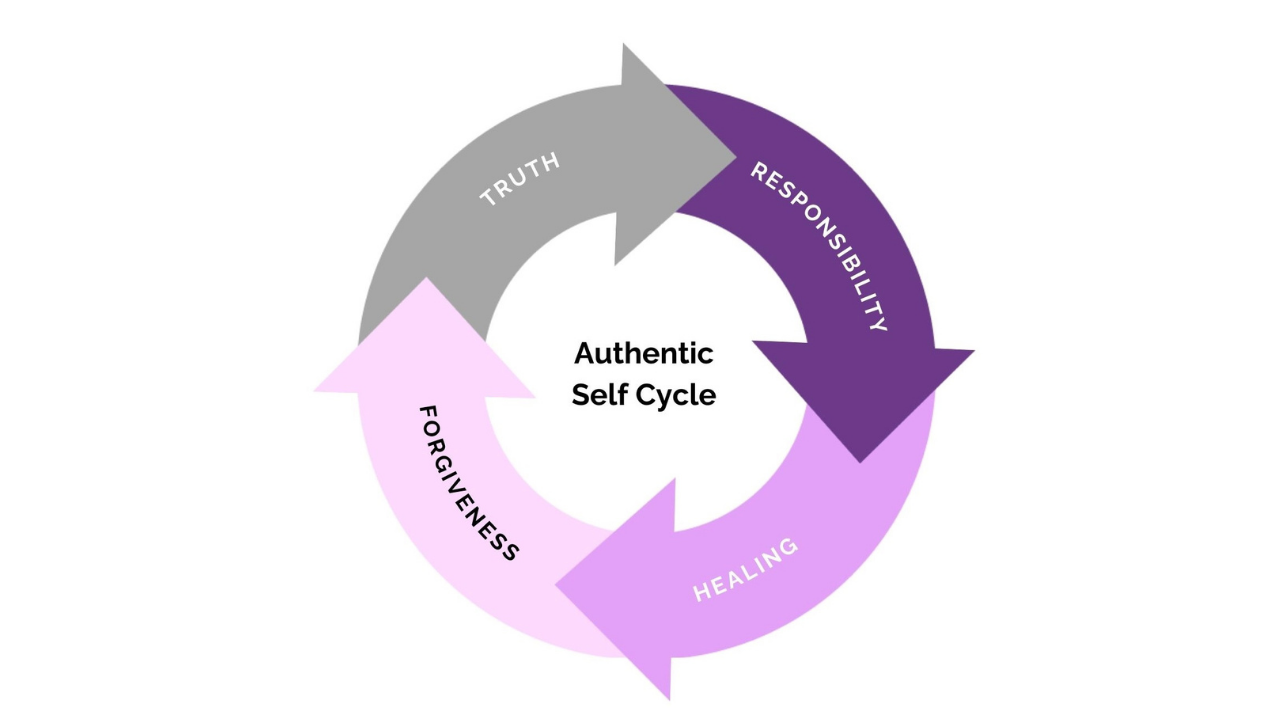
Stage 1: Truth. Name the blueprint. “This unworthiness isn’t about today. It’s about a meaning I created in childhood — that I had to earn love, that my needs were burdensome, that something was fundamentally wrong with me. That meaning was never true. It was the only explanation a child’s brain could create for pain it couldn’t understand.”
Stage 2: Responsibility. Own your emotional reactions without blame. “My partner isn’t my parent — my nervous system just thinks they are. The unworthiness I feel when they’re disappointed isn’t about them. It’s my childhood blueprint activating. I’m responsible for healing this, not for having it.” That’s you if you’re finally seeing the pattern — the same unworthiness showing up in every relationship, every job, every mirror.
Stage 3: Healing. Rewire the emotional blueprint so that worthiness becomes your baseline state. This is where the Emotional Authenticity Method™ does its deepest work — creating a NEW emotional chemical pattern that replaces the old shame-based identity. Conflict becomes uncomfortable but not dangerous. Rejection stings but doesn’t destroy. Failure disappoints but doesn’t define. That’s you if you’re ready to stop performing worth and start feeling it.
Stage 4: Forgiveness. Release the inherited emotional blueprint and reclaim your authentic self. Forgive yourself for the survival strategies you developed. Forgive your parents — not because what happened was acceptable, but because they were doing the best they could with the information they had. When you can look at your childhood without rage or collapse — and feel genuine compassion for the child you were — you’ve broken the cycle.
Your behavior changes; your worth doesn’t. Shame says: “I did something bad, so I am bad.” Your Authentic Self says: “I did something I regret, and I’m still worthy — I’ll own it and repair.”
The Emotional Authenticity Method™: 6 Steps to Rewire Your Worth
The Emotional Authenticity Method™ is a six-step process that literally rewires your nervous system’s relationship with worthiness. This isn’t positive thinking. This is somatic, chemical, neurological transformation.
Step 1: Somatic Down-Regulation. When unworthiness floods you — when shame takes over and your inner critic is screaming — pause. Focus on what you can hear for 15-30 seconds. Wind. Traffic. Your own breath. If you’re highly dysregulated, use titration: cold water on your face, step outside, hold ice. Your prefrontal cortex cannot come online while your amygdala is running the show.
Step 2: What am I feeling right now? Not “I feel worthless.” Use the Feelings Wheel to name it with precision. Are you feeling ashamed? Inadequate? Rejected? Invisible? Afraid? Emotional granularity breaks the shame spiral and moves you from survival mode into your thinking brain.
Step 3: Where in my body do I feel it? All emotional trauma is stored physically. Unworthiness might be heaviness in your chest, a knot in your stomach, tension in your jaw, or collapse in your posture. Locate the feeling. This grounds you in the present moment. That’s you if you’ve been “in your head” trying to think your way to worthiness — you can’t think your way out of a feeling.
Step 4: What is my earliest memory of having this exact feeling? The unworthiness you feel today echoes something much older. When was the first time you felt “not enough”? The first time love was conditional? The first time your needs were dismissed? Your present-day trigger didn’t create this feeling — it activated a blueprint that was already there.
Step 5: Who would I be if I never had this thought or feeling again? Not “I’d be happy.” Specific: “I’d be someone who doesn’t need permission to take up space. Someone who asks for what they need without apologizing. Someone who believes they deserve care. Someone who can receive love without suspecting it will be taken away.” This plants the seed of your authentic self — the vision step that connects you to the Authentic Self Cycle™.
Step 6: Feelization — The New Chemical Addiction. Sit in the feeling of who you’d be — the authentic self. Make it strong. Feel it in your body. The confidence, the groundedness, the worthiness. Create a new emotional chemical addiction to replace the old shame blueprint. Ask yourself: “How would I respond to this situation from this feeling? What would I say? What would I do?” Visualize and FEEL yourself operating from your Authentic Self. This is the emotional blueprint remapping and rewiring step. You cannot change emotional patterns through thoughts alone — emotions are biochemical events, and thoughts originate from feelings.
That’s you if you’ve never been taught that you can literally rewire your nervous system by changing what you practice feeling — that unworthiness is a chemical addiction, not a permanent identity.
Frequently Asked Questions
How do I know if I have a worthiness problem or just low self-esteem?
Low self-esteem is a symptom. Unworthiness is the root cause. Self-esteem fluctuates based on circumstances — you feel better after a win, worse after a loss. Unworthiness is a baseline state that persists regardless of achievement. If you accomplish something great and the good feeling disappears within hours, that’s unworthiness — your emotional blueprint won’t let you hold positive feelings because they don’t match the childhood programming.
Can affirmations fix feelings of unworthiness?
Affirmations alone cannot rewire your nervous system. Saying “I am worthy” while your body holds decades of shame creates cognitive dissonance — your thinking brain says one thing while your emotional brain screams the opposite. The Emotional Authenticity Method™ works because it addresses the somatic, chemical, neurological level — not just the intellectual level. Affirmations can support the process but cannot replace it.
Why do I feel unworthy even when I know logically that I have value?
Because worthlessness is not a thought — it’s a felt sense. It lives in your body, not your intellect. You can understand your worth cognitively and still feel unworthy somatically because the emotional blueprint was set before your logical brain was fully developed. This is why the Emotional Authenticity Method™ starts with the body (somatic down-regulation) and moves through feeling — not thinking.
How long does it take to feel worthy?
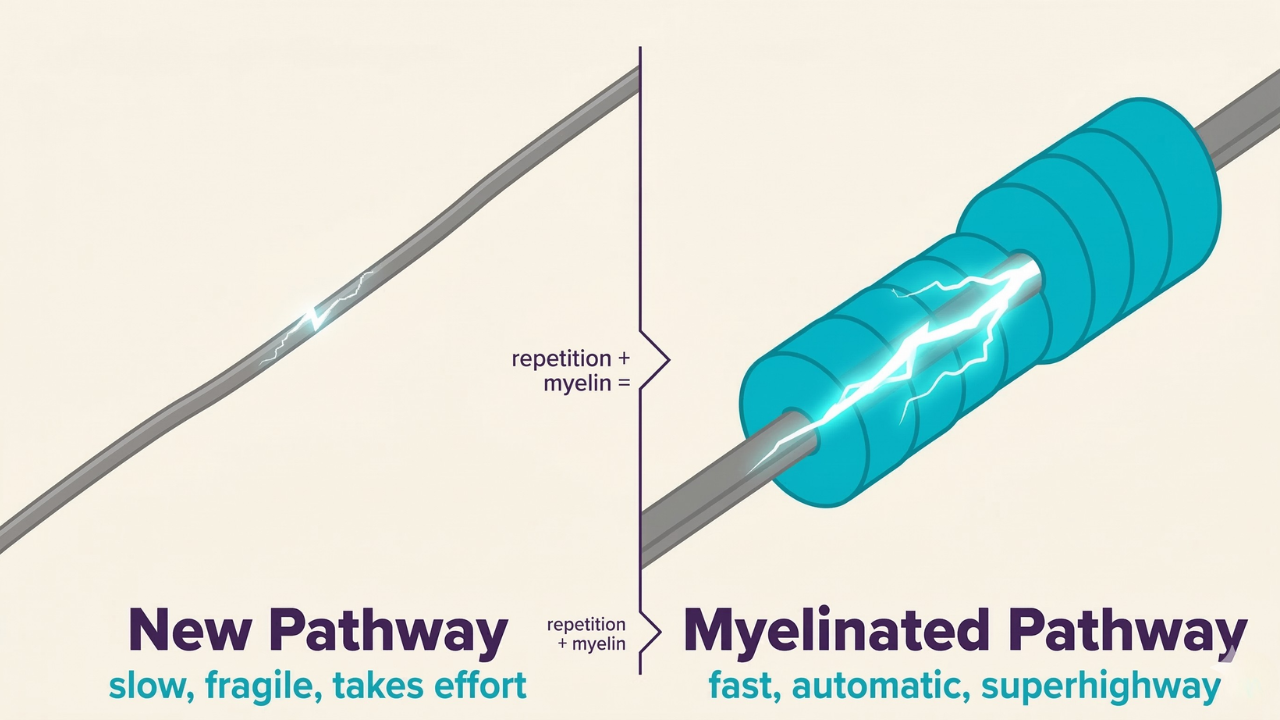
There’s no timeline. Most people report significant shifts within 6-12 months of consistent work. The timeline depends on how deep the childhood wounds run, how much professional support you get, and how committed you are to the daily practice of Feelization. The good news: every time you practice, you’re building new neural pathways. The old blueprint weakens with each repetition of the new one.
Is it possible to feel worthy and still have bad days?
Absolutely. Worthiness doesn’t mean you never feel shame or self-doubt. It means those feelings no longer define you. When shame shows up — and it will — you recognize it as a childhood echo, not current reality. You use the Emotional Authenticity Method™ to move through it rather than getting stuck in it. Healing isn’t the absence of triggers. It’s the presence of tools.
What if my unworthiness comes from something that happened in adulthood, not childhood?
Adult experiences can certainly trigger and reinforce unworthiness. But the emotional blueprint — the vulnerability to that specific wound — was set in childhood. An adult who was never exposed to conditional love or shame in childhood processes a job loss very differently than an adult whose childhood taught them “your worth depends on your performance.” The adult event activates the childhood meaning. Healing requires addressing both.
The Bottom Line
You are worthy. Not because of what you’ve accomplished. Not because of who loves you. Not because of how hard you work or how much you give. You are worthy because you exist. That is the truth your survival persona has been hiding from you since childhood.
The unworthiness you carry is not yours. It was placed in you by experiences you couldn’t control, by people who were doing the best they could with their own unhealed wounds, by a society that never taught any of us the basic emotional skills we need to thrive. You absorbed shame that belonged to someone else’s pain. You created meanings that protected you as a child and imprisoned you as an adult.
That’s you if you’re finally ready to stop earning your place in the world and start claiming it.
The Worst Day Cycle™ keeps you stuck in unworthiness by repeating the same trauma, fear, shame, and denial. The Authentic Self Cycle™ breaks it by moving through truth, responsibility, healing, and forgiveness. And the Emotional Authenticity Method™ gives you the six steps to literally rewire your nervous system so that worthiness becomes your new baseline — not something you perform, but something you feel in your bones.
There isn’t anything you need to do or become. You already are enough. At all times. That is not a motivational quote — that is the neurological reality waiting beneath the survival persona.
Your authentic self — the one beneath the shame, beneath the performance, beneath the survival strategies — already knows this. Your only job is to clear the path back to it.
Recommended Reading
- Facing Codependence by Pia Mellody — The foundational text on how childhood trauma strips away inherent worth and creates survival personas, codependent patterns, and the loss of authentic self.
- The Body Keeps the Score by Bessel van der Kolk — Essential reading on how shame and unworthiness live in your nervous system and why healing requires more than talk therapy.
- When the Body Says No by Gabor Maté — How emotional repression and chronic unworthiness manifest as physical illness.
- Codependent No More by Melody Beattie — The classic guide to reclaiming your worth and stopping the cycle of self-abandonment in relationships.
- The Gifts of Imperfection by Brené Brown — A guide to wholehearted living that directly counters the shame keeping you disconnected from your inherent worth.
Ready to Reclaim Your Inherent Worth?
- Emotional Blueprint Starter Course — Individual ($79) — Your personal roadmap to understanding your emotional blueprint and reconnecting with inherent worth.
- Relationship Starter Course — Couples ($79) — If unworthiness is showing up in your relationship and you want to break the pattern together.
- Why We Can’t Stop Hurting Each Other ($479) — A deep dive into how shame and unworthiness create relationship conflict and how to interrupt it.
- Why High Achievers Fail at Love ($479) — If your falsely empowered survival persona has you succeeding at work but struggling in connection.
- The Shutdown Avoidant Partner ($479) — Understanding how unworthiness drives emotional distance and avoidant attachment.
- Tier 1: Mapping the Blueprint ($1,379) — The comprehensive program for deep rewiring of your emotional blueprint and rebuilding inherent worth.
Start with the Feelings Wheel exercise to begin reconnecting with your emotional life today. Then explore the signs of enmeshment to understand how your boundaries collapsed under childhood shame. Learn your negotiables and non-negotiables to rebuild the foundation of authentic self-worth. And discover the do’s and don’ts for great relationships to build connections from wholeness, not from wound.