
What puts men in the doghouse is not what most people think — it is not forgetting an anniversary, leaving socks on the floor, or saying the wrong thing at dinner. What actually puts men in the doghouse is a childhood emotional blueprint that taught them to shut down, suppress, and perform a version of masculinity that makes genuine emotional connection nearly impossible. If you are a woman wondering why the man in your life goes distant, moody, and unreachable — or if you are a man who keeps ending up on the couch wondering what you did wrong this time — the answer is not on the surface. The answer lives in the survival persona that was created in childhood to protect a little boy who was told, directly or indirectly, that his feelings were dangerous, weak, and unacceptable.
That’s you if your partner shuts down the moment things get emotional. That’s you if you have spent years trying to get the man in your life to open up and it feels like pulling teeth. That’s you if you are a man who genuinely does not understand what your partner wants from you — because nobody ever taught you that what she wants is to actually know you.
Nearly twenty years of coaching men and couples has revealed a painful truth: most men do not end up in the doghouse because they are bad partners. They end up there because their nervous system learned in childhood that vulnerability equals danger, and that lesson runs every relationship they enter as adults. The only appropriate emotion for a man growing up is anger — unless that anger causes trouble for his mother or his teacher. Everything else gets buried. And what gets buried does not disappear. It festers, it controls, and it destroys the very connections men desperately want but have no idea how to create.
Why Do Men Really End Up in the Doghouse?
The surface reasons men end up in the doghouse — forgetting something, being insensitive, saying the wrong thing — are symptoms, not causes. The real reason is that most men were raised inside an emotional environment that systematically dismantled their ability to be vulnerable, emotionally present, and authentically connected. Society told them feelings are bad. Their fathers modeled emotional shutdown. Their mothers either over-controlled their emotional world or needed them to be the strong one. And by the time they entered adult relationships, they had built an entire identity around an image they thought they were supposed to uphold.
Most men do not want to face that they have needs and wants. They do not want to face that they have pain inside — because they spent their entire lives being taught one message: do not feel.
That’s you if you spend your life building an image of strength while feeling empty inside. That’s you if you genuinely do not know what your partner means when she says she wants to “connect.” That’s you if the idea of sharing three feelings you experienced today sounds like an impossible task.
What happens is predictable. A man gets into a relationship with a woman who wants to know him — who wants to share dreams, build something together, experience real intimacy. And he does not even notice that this is what she is asking for. The self-deception is: “I will give you the impression of closeness because I need you right now.” But the reality of genuine vulnerability — sharing dreams, goals, fears, and the messy truth of who he actually is — feels like too much. It feels like losing control. So what does he do? He goes to work. He buries himself in productivity. He finds someone else who will allow him to maintain the facade. And he ends up in the doghouse again, wondering what went wrong.
How Childhood Taught Men to Shut Down Emotionally
The emotional shutdown that puts men in the doghouse did not start in adulthood. It started in a childhood where three forces conspired to strip boys of their emotional authenticity.
The first force is society’s messaging about masculinity. Boys are told — through direct instruction, through media, through peer culture — that emotions other than anger are unacceptable. When NFL player Odell Beckham Jr. was going through a difficult period and was seen crying on the sidelines, Hall-of-Famer Ray Lewis responded by saying the anger was perfectly fine but the tears were unacceptable. He celebrated the rage and chastised the vulnerability. This is the message every boy receives: anger is masculine, tears are weakness, and if you show the wrong emotion, other men will shame you for it.
That’s you if you learned as a boy that crying meant something was wrong with you. That’s you if the men in your life taught you that feelings were a luxury you could not afford. That’s you if the only emotion that felt safe was anger — and even that had to be controlled.
The second force is how boys are raised inside their families. Young boys learn they cannot express their thoughts or feelings, and they cannot ask for their needs or wants to be met. They are supposed to be independent, needing no one. As those boys grow into men, they face a devastating double bind: if they stand up for their needs, they are labeled toxic. If they do not, they are labeled a pushover. Either way, the authentic self gets buried deeper.
Your childhood emotional blueprint taught you how to behave, how to feel, how to hide, how to protect, how to perform, how to disappear, how to adapt, and how to survive. That blueprint becomes your identity — not by choice, but by necessity.
The third force is fear. There is a real fear in men that if they express themselves, they will be rejected or reprimanded — because that is exactly what happened every time they tried. A man appropriately asks for his needs and wants, and he is called toxic. He does not ask, and he is called a pushover. He is placed in a double bind where the safest option is silence. And silence, over decades, becomes the emotional wall that puts him in the doghouse every single time.
That’s you if you walk a fine line between being labeled toxic or being labeled weak. That’s you if silence became your default because every other option felt dangerous. That’s you if you have given up trying to express yourself because the cost has always been too high.
The Worst Day Cycle™ and Why Men Cannot Open Up
To understand why men keep ending up in the doghouse despite genuinely wanting connection, you have to understand the Worst Day Cycle™ — the repeating emotional loop that was installed in childhood and runs every pattern a man cannot seem to break in adulthood.
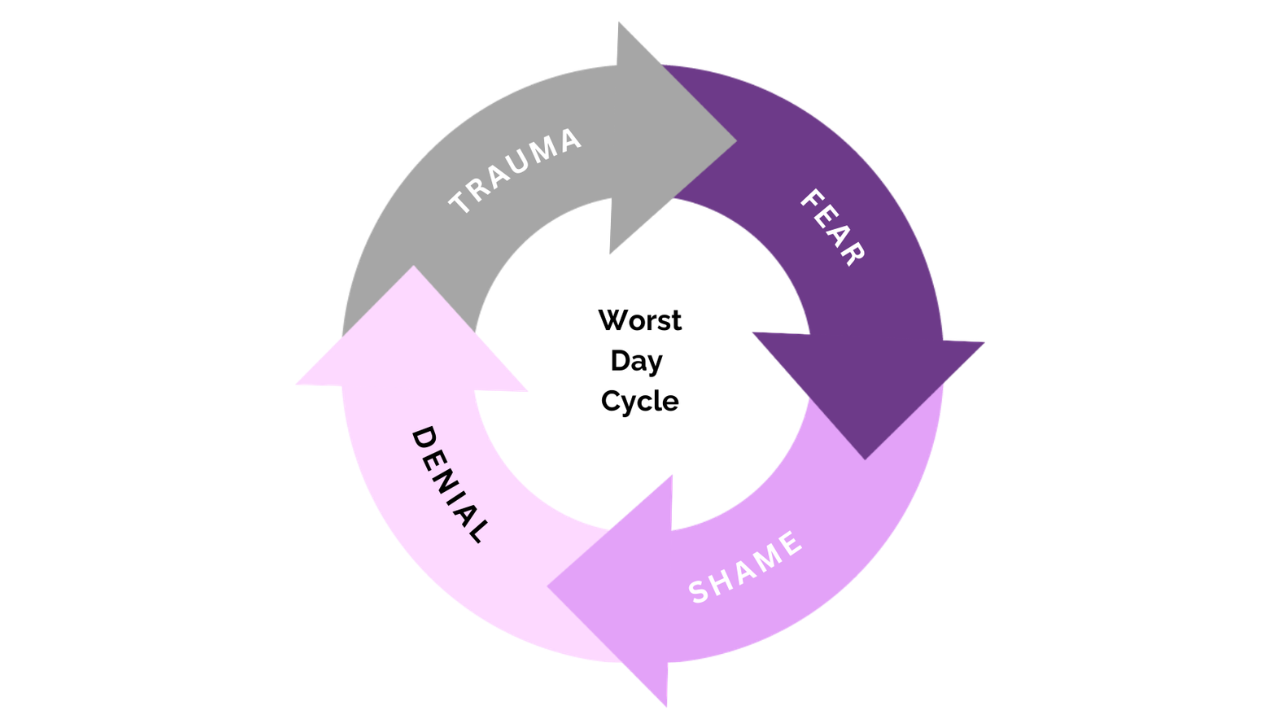
The Worst Day Cycle™ has four stages: Trauma → Fear → Shame → Denial.
Trauma is any negative emotional experience in childhood that created painful meanings. For boys, this includes every moment they were told their feelings were wrong, every time vulnerability was punished, every instance where the authentic self was unsafe. These experiences create a massive chemical reaction in the brain and body — the hypothalamus generates chemical cocktails of cortisol, adrenaline, dopamine, and oxytocin misfires that the brain becomes addicted to.
Fear drives repetition. The brain conserves energy by repeating known patterns — it cannot tell right from wrong, only known versus unknown. Since seventy percent or more of childhood messaging is negative and shaming, the brain defaults to repeating painful patterns because painful is familiar, and familiar equals safe. For men, this means repeating the emotional shutdown pattern in every relationship because shutdown is what the nervous system knows.
Shame is where a boy lost his inherent worth. It is the moment the child concluded: “I am the problem. Something is fundamentally wrong with me. My feelings are the problem.” For men specifically, shame gets welded to vulnerability itself — so the act of opening up triggers the deepest wound they carry. This is why a man can want to connect with his partner and still be physically unable to do it. The shame identity says: if you show who you really are, you will be destroyed.
That’s you if you want to open up but your body literally will not let you. That’s you if the words are in your head but they cannot make it past your throat. That’s you if you feel like there is a wall between you and your partner that you did not build on purpose.
People remain in emotionally shut-down patterns not because they want the distance, but because their bodies crave the chemical familiarity of the known pattern — and that craving overrides logic, love, and good intentions every single time.
Denial is the survival persona — the brilliant adaptation created in childhood to survive the pain. For men, denial sounds like: “I’m fine.” “Nothing’s wrong.” “I don’t know why you’re upset.” “You’re being too emotional.” These are not conscious lies. They are the survival persona speaking — the identity that was built to keep the shame wound protected at all costs.
How Survival Personas Keep Men Emotionally Unavailable
There are three survival persona types, and each one creates a specific version of the doghouse dynamic.
The Falsely Empowered survival persona controls, dominates, achieves, and rages. This is the man who stays in his head, thinks emotions are silly, and has built his entire identity around logic, productivity, and control. When things get vulnerable, he shuts down. He makes jokes, changes the subject, reaches for his phone, or buries himself in work. He is not avoiding his partner on purpose — his nervous system is running a childhood program that says closeness is dangerous and vulnerability will get him engulfed, smothered, and controlled. That’s you if you feel trapped by other people’s emotional needs and resent them for it — not because of who they are today, but because of what happened to the child inside you who was made to carry everyone else’s emotional weight.
The Disempowered survival persona collapses, people-pleases, caretakes, and disappears. This is the man who does everything for everyone, never asks for what he needs, and then gets discarded anyway. He learned in childhood that the only way to get attachment was to do everything for everybody else — and they would still take their problems out on him. In relationships, he over-gives until he is empty, then withdraws in silent resentment, and ends up in the doghouse because his partner can feel the inauthenticity underneath the compliance. That’s you if you give everything and get nothing back. That’s you if you roll over to keep the peace and then wonder why she lost respect for you.
The Adapted Wounded Child oscillates between both — sometimes controlling, sometimes collapsing, always reacting from the emotional age where the original wound occurred. This man swings between over-functioning and shutting down completely. One day he is in charge, the next day he is on the couch unable to speak. His partner never knows which version she is going to get. That’s you if your emotional life feels like a roller coaster that you cannot get off — and you are taking everyone you love on the ride with you.

Signs the Doghouse Pattern Is Running Your Life — By Life Area
The emotional shutdown pattern that puts men in the doghouse does not stay in romantic relationships. Because the emotional blueprint operates across every domain, the same childhood programming that creates distance with a partner creates distance everywhere.
Family
You take on the role assigned to you in childhood — the strong one, the fixer, the provider — and you never question whether that role serves you. You cannot set emotional boundaries with parents or siblings without guilt. You show up at family gatherings performing the same character you have played since you were ten years old. That’s you if your family knows your resume but has no idea what you actually feel.
Romantic Relationships
Your partner asks you what you are feeling and you genuinely do not know. When she gets emotional, your first instinct is to fix it, escape it, or shut down. You confuse providing financially with providing emotionally. She tells you she feels alone in the relationship and you are baffled because you are standing right there. That’s you if she keeps saying she wants more of you and you have no idea what that means.
Friendships
Your friendships are built around activities — sports, work, drinking — never around actual emotional sharing. You have guys you hang out with but not a single person who knows what you are going through. The idea of telling another man you are struggling feels impossible. That’s you if you have a hundred contacts and zero people you can call at two in the morning.
Work and Career
You pour everything into your career because it is the one place where the rules are clear and emotions are not required. Your identity is fused with your job title. When work goes well you feel worthy; when it does not, you spiral. You use productivity as a hiding place from the emotional demands of every other area of your life. That’s you if your career is the only place you feel competent — and even that feeling is never quite enough.
Body and Health
You ignore your body’s signals because you were taught that pain is weakness. You push through exhaustion, illness, and injury because stopping feels like failure. Your body is running on cortisol and adrenaline and you call it toughness. The emotional weight you refuse to process gets stored physically — in your back, your chest, your gut, your jaw. That’s you if your body has been screaming at you for years and you have been told to ignore it.
Why Women Accidentally Push Men Further Into Shutdown
Here is the painful irony that most couples never see: the way women respond when men finally do open up often confirms every fear the man’s nervous system has been carrying since childhood.
When a man finally opens up after years of shutdown, many women instantly jump in: “That’s not true.” “That’s not what happened.” “Why didn’t you tell me this earlier?” “That’s silly.” They correct him. They shame him — especially if what he shares has anything to do with the relationship. And what happens? He closes right back up. Because she just proved what his nervous system has been telling him since childhood: when you open up, you get hit over the head with it.
That’s you if you have been begging your partner to open up and then got upset when what he shared was not what you wanted to hear. That’s you if you punished him for not telling you sooner — and did not realize you just slammed the door on the very vulnerability you were asking for.
When a man finally opens up and the woman reacts with correction, judgment, or frustration, she has just created the exact dynamic she is complaining about. She is now the one lacking vulnerability, doing exactly what she accuses him of — and neither of them sees it.
This is not about blaming women. Both partners are running childhood survival personas. Both are operating from emotional blueprints that were installed before either of them had any say in the matter. But understanding this dynamic is the first step toward breaking it.
The Modern Masculinity Trap: Why Both Extremes Fail
Modern culture has created a new version of the double bind that puts men in the doghouse. The old model said: be the Marlboro Man — closed, shut down, take care of everything yourself, never open up. The new model says: anything masculine is toxic, all male emotion is suspicious, and men should essentially become compliant versions of what they think women want.
Neither extreme works. Men laid down under the cultural pressure and stopped standing up for themselves. Now there is a whole population of men who just roll over — and women get the ick. It is not attractive. Women are drawn to a man who politely and firmly says, “Let’s think about this. Let’s have a discussion because I don’t think this is going to go well.” That is not a bully. That is not a tyrant. That is a leader. But men collapsed because the messaging said anything strong is toxic.
That’s you if you swing between being too aggressive and too passive because nobody ever showed you what healthy masculinity actually looks like. That’s you if you have tried being the “sensitive guy” and it backfired. That’s you if you are exhausted by the impossible standards being placed on men from every direction.
What if men were told to hold on to their traditional masculine traits of being hunters, go-getters, and protectors — while also rounding out their masculinity with emotional depth and breadth? What if the best way to provide, protect, and lead is to be her emotional leader?
The answer is not the old model and it is not the new model. The answer is maturity and moderation — the ability to be strong and express needs without being demanding or abusive, combined with the ability to get in touch with emotions from a place of inner security. A man who can do both is not weak. He is the most attractive, the most connected, and the most powerful version of himself that exists.
How the Emotional Authenticity Method™ Helps Men Break Free
You cannot think your way out of emotional shutdown. Emotions are biochemical events. Thoughts originate from feelings — not the other way around. This is why willpower fails, why “just communicate better” does not work, and why a man can understand intellectually what his partner needs and still be unable to provide it. The Emotional Authenticity Method™ works because it addresses the body, not just the mind.

The Emotional Authenticity Method™ is a six-step process:
Step 1: Somatic Down-Regulation. Focus on what you can hear for fifteen to thirty seconds. If you are highly dysregulated, use titration — oscillating between the activation and the calm stimulus until your nervous system settles enough to proceed. For men who have spent decades in shutdown, this step alone can be revolutionary because it asks the body to slow down before the survival persona takes over.
Step 2: What am I feeling right now? Use emotional granularity — expand your vocabulary beyond “fine” or “frustrated” using the Feelings Wheel. Seventy percent of the population cannot name what they feel. For men raised to suppress everything except anger, the Feelings Wheel is often the first tool that gives them language for an internal world they have been running from their entire lives.
Step 3: Where in my body do I feel it? All emotional trauma is stored physically. Every feeling resides in a specific area of your body — the tightness in your chest, the knot in your stomach, the clenching in your jaw. For men, the body often speaks what the mouth cannot.
Step 4: What is my earliest memory of having this exact feeling? Trace the feeling back to its childhood origin. You will always arrive at a memory of a less-than-perfect event from childhood. That is the source being replayed in this moment. You are not shutting down because of your partner. You are shutting down because your nervous system thinks you are back in the room where vulnerability first became dangerous.
Step 5: Who would I be if I never had this thought or feeling again? What would be left over? This is the vision step — the bridge into the Authentic Self Cycle™. For a man who has spent decades performing masculinity, this question can crack open an entirely new identity. What would be left if the fear of vulnerability disappeared? Who are you underneath the armor?
Step 6: Feelization. Sit in the feeling of the Authentic Self and make it strong. Create a new emotional chemical pattern to replace the old blueprint. Ask yourself: How would I respond to my partner from this feeling? What would I say? What would I do? Visualize and feel yourself operating from your Authentic Self — present, open, strong, and emotionally available. This is the emotional blueprint remapping and rewiring step — the moment you begin replacing decades of shutdown with a new pattern rooted in truth instead of survival.
The Authentic Self Cycle™: From the Doghouse to Genuine Connection
The Authentic Self Cycle™ is the healing counterpart to the Worst Day Cycle™ — an identity restoration system with four stages: Truth → Responsibility → Healing → Forgiveness.
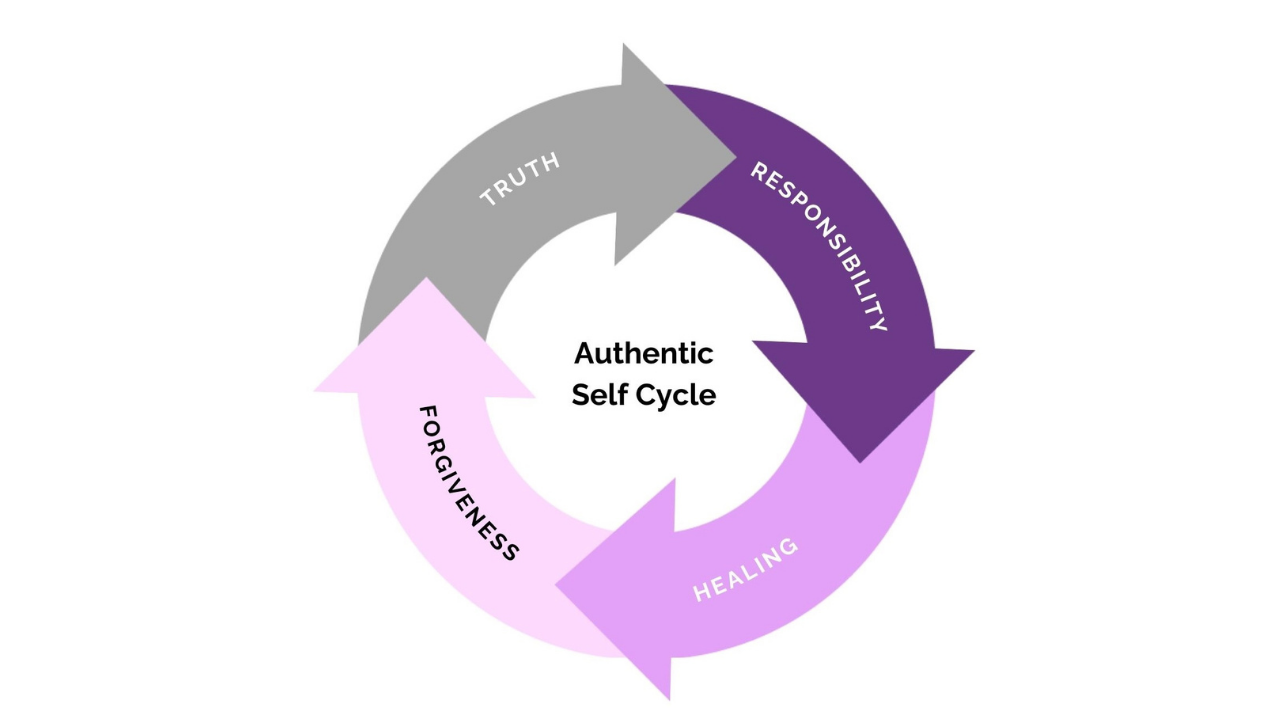
Truth means naming the blueprint. It means seeing clearly: “This shutdown is not about my partner. This pattern was installed in childhood. I am repeating my worst day, not responding to today.” When a man can name the truth — that his emotional unavailability is a survival strategy, not a personality trait — everything begins to shift.
Responsibility means owning your emotional reactions without blame. “My partner is not my mother. My partner is not my father. My nervous system just thinks she is.” This is not about fault. It is about authorship — becoming the author of your emotional life instead of a character in a script written when you were six years old.
Healing means rewiring the emotional blueprint so that vulnerability does not feel like death, so that emotional presence does not feel like losing control, so that connection can exist without the survival persona hijacking every conversation. This is the work of the Emotional Authenticity Method™ — reworking the stored emotion until the nervous system finally learns that closeness is safe.
Forgiveness means releasing the inherited emotional blueprint and reclaiming your authentic self. Not forgiving the people who hurt you because they deserve it — forgiving because the alternative is staying chemically bonded to the childhood wound forever. For men, forgiveness often means releasing the version of masculinity that was handed to them and choosing a version that actually serves their lives, their relationships, and their children.
That’s you if you are tired of the couch. That’s you if you want to be known but do not know how to let someone in. That’s you if you are finally ready to stop performing masculinity and start actually living it.
What Men Actually Need to Feel Safe Enough to Open Up
There is a huge lie that society has taught about relationships — that women are the emotional ones and men are stoic. That is simply not true. Men require an incredible amount of emotional affirmation. Men will shut down, quit, and crawl back into the little boy if they are not recognized. Women have their girlfriends for support. Men often have no one.
When a man steps up, owns his mistakes, listens with empathy, and shows vulnerability — and his partner looks him in the eyes and says, “Thank you. I love the way you love me” — that man will melt. That is all he needs. Not the mother’s voice correcting him. The lover’s voice recognizing him.
Here is a practical starting point for couples. Suggest that he share three feelings he experienced that day. Simple things — “At work today I felt a little insecure when my boss asked me to take on a new project.” That is it. One sentence. Does not have to be deep or profound. But here is the key: no feedback. Do not fix it. Do not correct it. Do not get into it. Just listen. Say, “Thank you for sharing. Is there more?” Create the safety for him to start learning that vulnerability does not lead to punishment.
That’s you if you have never had a safe place to share what you actually feel. That’s you if the three-feelings exercise sounds terrifying — because it means admitting you have feelings at all. That’s you if you are a woman reading this and realizing you may have been the unsafe environment your partner was avoiding.
And for the men: ask yourself honestly — has the old model of masculinity worked? Being closed, shut down, handling everything alone, never opening up — is that getting you the intimacy, the connection, the partnership you actually want? If it is not, then the willingness to face the false narrative that vulnerability makes you weak is the most courageous and attractive thing you will ever do. A man who can navigate both sides of the dynamic — who can be declaratively strong and emotionally available — is not a pushover. He is the fullest expression of what a man can be.
Frequently Asked Questions
Why do men shut down emotionally in relationships?
Men shut down because their childhood emotional blueprint taught them that vulnerability is dangerous. The only emotion deemed acceptable for boys is anger. Every other feeling gets suppressed, creating a survival persona that automatically shuts down when emotional intimacy is required. This is not a choice — it is a nervous system pattern that was installed before the man had any say in the matter.
How can I get my partner to open up without pushing him away?
Start with the three-feelings exercise: ask him to share three simple feelings he experienced that day. The critical rule is no feedback — do not correct, do not fix, do not judge. Just listen and create safety. Men have been rejected and reprimanded for being vulnerable their entire lives. The goal is to create a consistent experience where opening up does not lead to punishment.
Is emotional unavailability in men a form of toxic masculinity?
Emotional unavailability is not toxicity — it is a survival strategy formed in childhood. The real toxicity is the cultural messaging that taught boys their feelings were unacceptable. When men are shamed for vulnerability by other men and then punished for shutdown by women, they are placed in an impossible double bind. Healing requires addressing the childhood blueprint, not labeling the symptom.
Can men change their emotional patterns after decades of shutdown?
Yes. The emotional blueprint can be rewired at any age through the Emotional Authenticity Method™. Because emotions are biochemical events stored in the body, the work involves tracing current patterns back to their childhood origin, dismantling the shame identity that drives the shutdown, and creating new chemical patterns through Feelization — the sixth step of the method.
Why do women lose attraction when men become emotionally compliant?
Because compliance is not emotional authenticity — it is another survival persona. Women are drawn to a man who can be strong, declarative, and emotionally present simultaneously. When a man collapses into people-pleasing, he is not being vulnerable — he is running the disempowered survival persona. True emotional strength is the ability to say “this is who I am” without demand and to share feelings without losing your center.
What is the difference between emotional vulnerability and emotional weakness in men?
Emotional vulnerability is the willingness to be known — to share your authentic experience without performing strength or collapsing into helplessness. Emotional weakness is the inability to tolerate your own feelings, which leads to either shutdown or uncontrolled emotional flooding. The Authentic Self Cycle™ teaches men to be vulnerable from a place of inner security, which is the foundation of genuine masculine strength.
The Bottom Line
What puts men in the doghouse is not bad behavior. It is a childhood emotional blueprint that taught a little boy his feelings were dangerous, his vulnerability was weakness, and his only option for survival was to build a wall between himself and everyone who tries to get close. That wall was brilliant at age six. It is destroying his relationships at forty.
If you are a man reading this, the path out of the doghouse is not trying harder, communicating better, or memorizing the right things to say. The path out is understanding the Worst Day Cycle™ that created the shutdown, identifying the survival persona that maintains it, and reconnecting to the authentic self that has been buried underneath decades of performed masculinity. You are not broken. You are programmed. And programming can be rewritten.
If you are a woman reading this, the path forward is not demanding vulnerability or punishing shutdown. The path forward is creating safety, recognizing courage when it appears, and understanding that the man in your life is not choosing to be distant — his nervous system is running a program that was installed in a childhood he had no control over. Both of you deserve better than the doghouse. And both of you can get there.
Recommended Reading
- Facing Codependence by Pia Mellody
- Codependent No More by Melody Beattie
- The Gifts of Imperfection by Brené Brown
- In the Realm of Hungry Ghosts by Gabor Maté
- When the Body Says No by Gabor Maté
- Your Journey To Success by Kenny Weiss, Lara Currie, and Elizabeth Smithson
Ready to Get Out of the Doghouse for Good?
If this post described your life or your relationship, the next step is not reading another article. It is doing the work. Kenny Weiss has created courses specifically designed to dismantle these patterns at their root:
- Emotional Blueprint Starter Course — Individual — $79
- Relationship Starter Course — Couples — $79
- Why We Can’t Stop Hurting Each Other — $479
- Why High Achievers Fail at Love — $479
- The Shutdown Avoidant Partner — $479
- Tier 1: Mapping the Blueprint — $1,379
Visit kennyweiss.net/life-changing-exercise to download the free Feelings Wheel and begin the Emotional Authenticity Method™ today.
Learn more about the signs of enmeshment, relationship insecurity, signs of high self-esteem, 10 do’s and don’ts for a great relationship, and negotiables and non-negotiables in codependence recovery.