Leaving a narcissist isn’t just hard—it’s designed to be hard. When you leave, you’re not just ending a relationship. You’re breaking what’s called a trauma bond, a powerful neurochemical attachment that your brain created as a survival mechanism. Understanding why you can’t just “leave and move on” isn’t weakness. It’s neuroscience. It’s your Worst Day Cycle™ in full play. And once you understand the patterns, you can actually heal instead of repeating them.
Here’s what we know: When you’ve been in a relationship with a narcissist, your nervous system has been hijacked. Your body learned to fear abandonment, your mind learned to decode their moods like a smoke detector, and your soul learned to shrink. The moment you try to leave, every cell in your body screams to go back. That’s not because the relationship was good. That’s because your survival persona—the part of you designed to keep you alive in chaos—is terrified of what comes next.
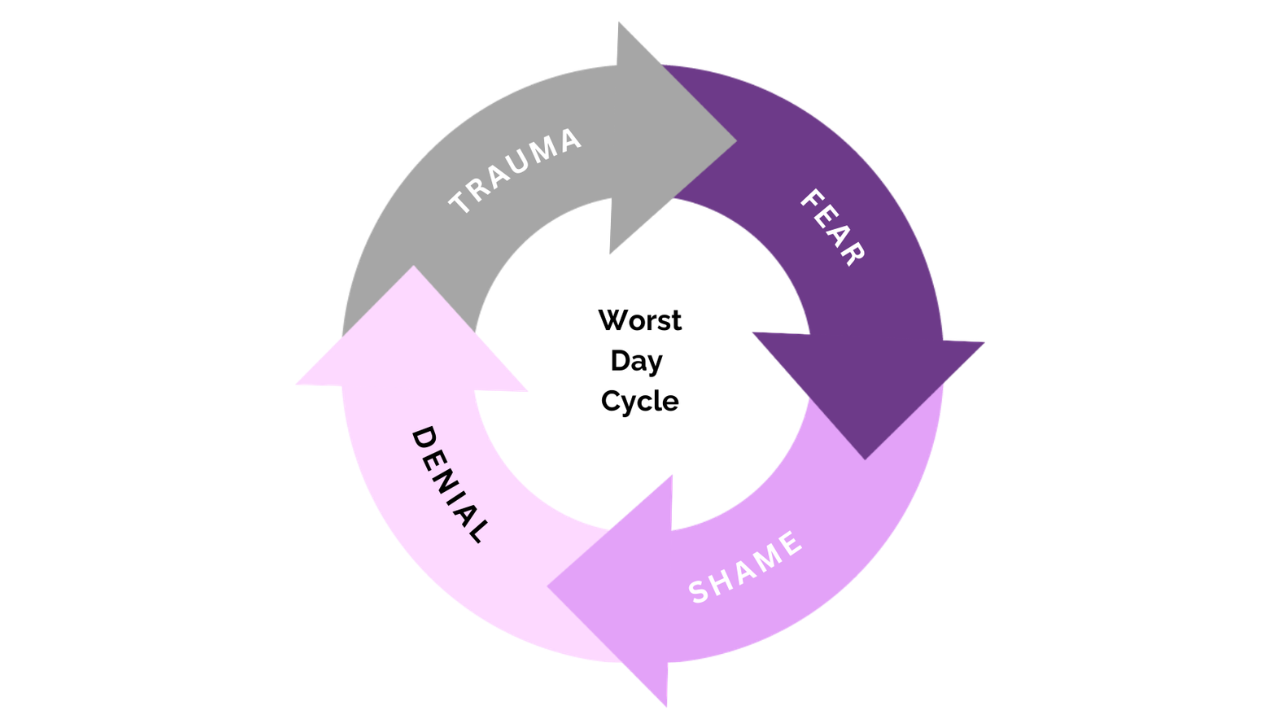
Leaving a narcissist activates your Worst Day Cycle™ (trauma → fear → shame → denial). You’re not weak for going back. Your brain is addicted to the familiar pain. Healing requires understanding your survival persona, tracing your childhood blueprint, and using the Authentic Self Cycle™ to reclaim your emotional authenticity instead of living in your survival persona’s denial.
Why Is Leaving a Narcissist So Impossibly Hard?
If you’ve tried to leave and found yourself crawling back—sometimes days later, sometimes weeks—you’re not alone. And you’re not broken. What you’re experiencing is a deliberate cycle that a narcissist has trained into your nervous system.
That’s you sitting in your car outside their apartment at 2 AM, shaking, unable to go inside but unable to drive away.
The narcissist doesn’t need physical chains to keep you trapped. They’ve already installed themselves in your brain as the authority on your worth. When you leave, you trigger the deepest wound from your childhood: abandonment, rejection, or the message that you’re unlovable if you’re not needed.
That’s you — the one who knows they should leave but feels paralyzed every time you try.
Your survival persona created a deal in childhood: “If I disappear myself, if I become indispensable, if I manage their emotions, then I’ll be safe.” Leaving violates that core agreement. And your nervous system interprets leaving as a threat to survival itself.
Here’s what actually happens: A narcissist’s childhood wounds of abandonment and rejection were never healed. Instead of facing that pain, they developed a falsely empowered survival persona that dominates, controls, and rages when their supply (your attention, your validation, your presence) is threatened. When you leave, you’re pulling their emotional oxygen. They will escalate their tactics—love-bombing, threats, smear campaigns, financial sabotage—not because they love you, but because your absence is unbearable to their survival persona.
The Trauma Bond: What You’re Actually Addicted To
A trauma bond is not love. Let’s be clear. It’s a neurochemical addiction to intermittent reinforcement paired with danger and uncertainty.
That’s you — telling yourself “this time it’s different” when they promise to change after every blowup.
Here’s how it’s built: The narcissist gives you crumbs of affection (love-bombing, rare moments of vulnerability, promises of change). Then they withdraw. Then they return with intensity. Your brain releases dopamine during the love-bombing and cortisol during the withdrawal. This exact pattern—reward followed by threat—creates the most addictive neurochemical cocktail known to humans.
Sound familiar? You get one text: “I miss you. I was wrong. I’ve changed. Come home.” And suddenly the weeks of silent treatment evaporate. You feel alive again. That’s dopamine. Your brain is rewarded for returning.
Trauma bonds are built on a cycle of intermittent reinforcement: unpredictable rewards paired with threats create the same neurochemical addiction as a slot machine. Your brain becomes conditioned to crave the relief after the withdrawal, which feels like love but is actually your nervous system seeking resolution of threat.
The narcissist didn’t design this consciously. They’re running their own Worst Day Cycle™. But the effect is devastating: you become neurologically bonded to someone who treats you like an object to be used and discarded.
That’s the cycle — and your brain doesn’t care that it’s destroying you. It only cares that it’s familiar.
Leaving breaks that cycle, but the withdrawal is real. You’ll go through actual neurochemical withdrawal—anxiety, insomnia, obsessive thoughts about them, urges to contact them, the false memory of the good times. That’s not weakness. That’s addiction.
The Worst Day Cycle™ and Why You Keep Going Back
To understand why you can’t leave, we need to look at Kenny’s Worst Day Cycle™—the four-stage pattern that both you and the narcissist are running.
Stage 1: Trauma (The Chemical Flood)
Your childhood was traumatic in some way. Maybe it was overt abuse. Maybe it was covert enmeshment or neglect. Either way, when you were young and helpless, your hypothalamus created a chemical blueprint: How to survive THIS. That blueprint is now playing on a loop in your nervous system. When you leave the narcissist, you don’t just leave them. You trigger the original trauma. Your body goes into fight-flight-freeze. Cortisol and adrenaline flood your system. Your nervous system believes you’re dying.
Stage 2: Fear (The Brain’s Familiar Pattern)
Fear is what bonds us to the known. Your brain doesn’t distinguish between “this is good” and “this is familiar.” It only knows “this is known, therefore survivable.” The narcissist is known. Loneliness is unknown. Rejection is unknown. Your brain will always choose the known threat over the unknown threat, because at least you know how to survive the known.
That’s you lying awake thinking, “At least when I was with them, I knew what to expect.” You’re not minimizing abuse. You’re letting your fear brain make the decision. Fear-brain is older, louder, and more powerful than logic-brain when you’re in survival mode.
Stage 3: Shame (The Belief System)
This is where the trap locks. Seventy percent of childhood messaging is negative and shaming. “You’re too sensitive. You’re broken. You’re the problem. If you were different, they would love you.” That’s your childhood speaking — and the narcissist learned to speak its language perfectly. That message embedded into your identity becomes: I am the problem. That shame is so unbearable that your nervous system will create a survival persona to hide it.
When you’re in the narcissistic relationship, the narcissist confirms your deepest shame: “You’re crazy. You’re too needy. You’re unlovable.” Instead of leaving, you work harder to disprove it. You become more available, more accommodating, more self-sacrificing. You’re trying to prove the shame is wrong by becoming perfect.
Shame is where you lost your inherent worth: “I am the problem” lives deeper than logic. When a narcissist confirms your childhood shame, you unconsciously believe they’re the only one who sees the real you. Leaving them means facing the shame without anyone to blame, which feels impossible.
Stage 4: Denial (Your Survival Persona Takes Over)
Denial is not stupidity. It’s your survival persona’s job. Your falsely empowered persona takes control and says, “This isn’t real. They love me. I’m overreacting. I can fix this. I just need to try harder.” Or your disempowered persona takes over: “I can’t do this alone. I need them. I’m nothing without them.” Either way, denial lets you stay in the familiar pain instead of facing the unknown.
Your Survival Persona in the Narcissistic Relationship
You didn’t create your survival persona to be broken. You created it to survive an impossible childhood. In a narcissistic relationship, that survival persona goes into overdrive.
That’s you — brilliant at surviving, exhausted from it.
The Falsely Empowered Survival Persona
This persona says, “I will control and dominate to feel safe.” In a narcissistic relationship, if you have this persona, you might mirror the narcissist’s behavior—becoming controlling, critical, or rageful yourself. You’re trying to win the power game. You think if you can just out-play them, you’ll regain control. This persona keeps you in the relationship because you’re invested in winning.
The Disempowered Survival Persona
This persona says, “I will collapse and people-please to survive.” You become hyper-aware of their needs, their moods, their reactions. You arrange your entire life around managing their emotional state. You’ve become codependent. The narcissist loves this because you’re their perfect supply source. This persona keeps you in the relationship because you genuinely believe you can’t survive without them.
That’s you checking their location five times a day to see if they’re safe. That’s you rehearsing conversations to avoid triggering their anger. That’s you crying alone in the closet so they don’t have to deal with your pain.
The Adapted Wounded Child Survival Persona
This persona oscillates between both. One day you’re falsely empowered and telling them exactly what you think. The next day you’re disempowered and apologizing for your honesty. You’re a human compass trying to read which direction will keep you safe. This persona is exhausting because you’re constantly shifting, constantly checking, constantly adapting. The narcissist keeps you guessing, which keeps your persona in constant motion.
That’s you — never knowing which version of yourself will show up today, because survival demands constant adaptation.
The problem is none of these personas is you. None of them is your authentic self. And as long as you’re running your survival persona, you can’t leave. You’re too busy surviving.
Remember This About Survival Personas
Your survival persona isn’t your fault. It’s your genius. It kept you alive when the world wasn’t safe. In a narcissistic relationship, that genius becomes a trap. To leave and heal, you have to retire your survival persona and activate your authentic self. That’s scary. That’s also the only way out.
Signs of Narcissistic Impact by Life Area
Family Relationships
- You’re managing the narcissist’s relationship with your parents or siblings
- Your family has noticed the relationship is unhealthy but you defend them anyway
- You’ve become the emotional translator between the narcissist and your family
- You’re protecting their image more than your own well-being
- You’ve lost touch with family members because the narcissist discouraged those relationships
Romantic and Physical Intimacy
- Sex has become a tool for managing their mood or a weapon they withdraw
- You’ve lost desire because your nervous system is in constant threat mode
- You’re performing intimacy instead of experiencing it
- You’re more focused on their pleasure or their mood afterward than your own experience
- Physical touch feels obligatory or used as control
Friendships
- You’ve isolated from friends because the narcissist was jealous or critical
- You’re afraid to mention the relationship problems because you don’t want them judging your partner
- Your friendships have become transactional—you seek them out only when desperate
- You’ve stopped being vulnerable with anyone because you’ve learned vulnerability is weaponized
Work and Achievement
- You’re either over-achieving to prove your worth or under-achieving because it’s easier than being criticized
- You’re distracted at work because you’re monitoring the narcissist’s behavior through texts and calls
- You’ve downplayed your successes so they don’t feel threatened
- Your career has stalled because the relationship is your full-time job
Body and Health
- You’ve gained or lost significant weight due to stress
- You have chronic pain, sleep problems, or digestive issues related to nervous system dysregulation
- You’ve stopped caring for your body because self-care feels selfish — that’s you, putting their needs above your own survival
- Your immune system is compromised from chronic stress
- You’re using substances or behaviors to numb the pain
The Authentic Self Cycle™: Your Healing Path
You can’t will yourself out of the Worst Day Cycle™. You have to heal into the Authentic Self Cycle™. This is the counterpart framework that rebuilds your emotional authenticity from the ground up.
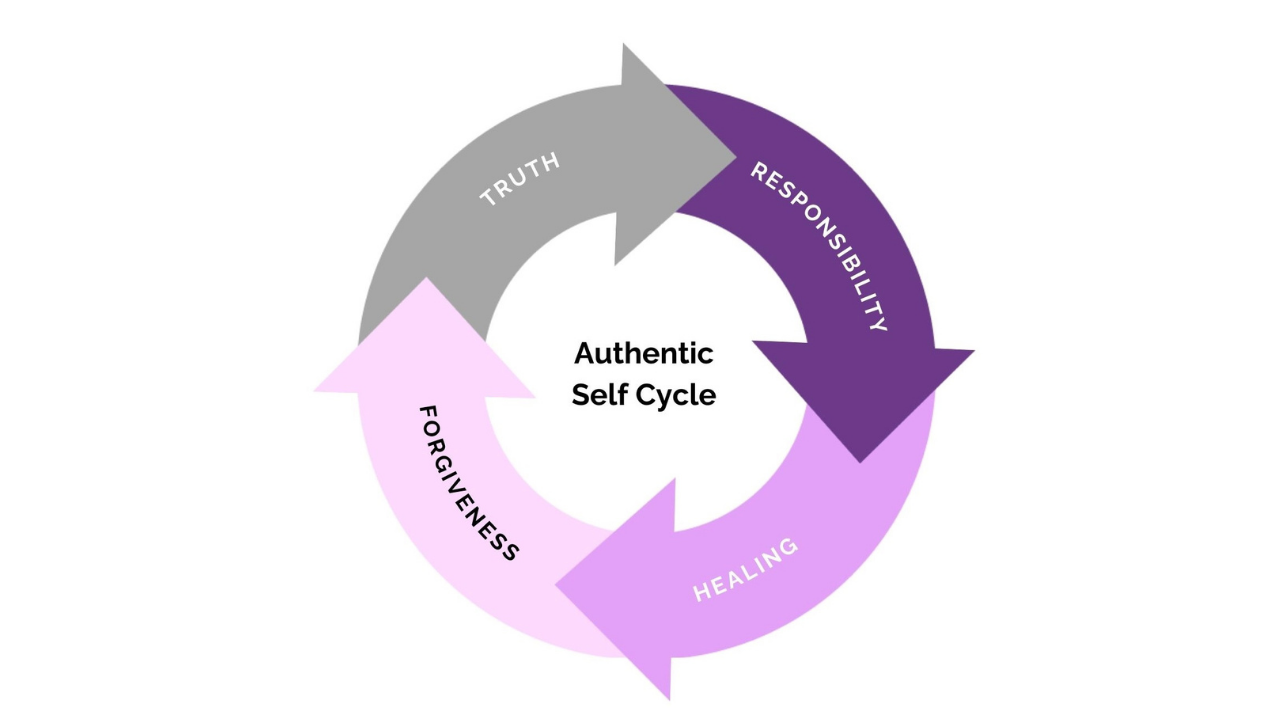
Stage 1 of ASC: Truth
Truth means naming the blueprint. This isn’t just “my partner is a narcissist.” It’s “My childhood taught me I was responsible for my caregiver’s emotions. My narcissistic partner confirmed that belief. I’ve spent this entire relationship trying to fix someone who doesn’t want to be fixed, using strategies that worked in my family but are killing me now.”
Truth is seeing the pattern clearly. It’s understanding that the narcissist’s behavior isn’t about you. But your response to it has everything to do with your childhood. That’s the you that finally understands: this isn’t about today.
Truth in the ASC requires naming the blueprint: “My role was to manage my parent’s emotions. I learned I had to disappear myself to keep them safe. I picked a partner who confirmed that role. Now I have to unlearn it.” Without naming the blueprint, you’ll keep repeating it with someone new.
Stage 2 of ASC: Responsibility
This is where people get stuck because they confuse responsibility with blame. Responsibility isn’t “I created this situation.” It’s “I own my reaction without blaming them or myself.”
You couldn’t control that your childhood was traumatic. You couldn’t control that you chose a narcissist. But you can control what you do now. You can stop using your survival persona to manage their behavior. You can stop abandoning yourself to keep them comfortable. You can stop performing who you think they need you to be.
That’s the shift — from “what did I do wrong?” to “what pattern am I running?”
Responsibility means: “I keep going back because my fear brain is calling the shots. That’s my responsibility to manage. Not because I’m weak, but because it’s my nervous system, my life, my soul.”
Stage 3 of ASC: Healing
Healing is rewiring your emotional blueprint so that the old trauma patterns lose their power. This is where the Emotional Authenticity Method™ comes in. You’re not bypassing the pain. You’re moving through it deliberately, with awareness, so your nervous system can release it.
Healing looks like: developing genuine boundaries (not angry boundaries, but clean “I’m leaving” boundaries), rebuilding your capacity to feel emotions without being hijacked by them, and slowly trusting that safety is possible even when someone is upset with you.
Stage 4 of ASC: Forgiveness
Forgiveness doesn’t mean reconciliation. It doesn’t mean the narcissist gets off the hook. Forgiveness means releasing your attachment to their changing, your responsibility for their pain, and the belief that their behavior means something about your worth.
You forgive them so you can be free. Not so they can feel better. Not so the relationship can resume. So YOU can move forward without carrying their load.
The Authentic Self Cycle™
Truth: Name your blueprint and the pattern. Responsibility: Own your reactions without blame. Healing: Rewire your emotional response. Forgiveness: Release their load and reclaim your authentic self.
The Emotional Authenticity Method™ to Break Free
The Emotional Authenticity Method™ is a five-step process that helps you move from your survival persona back to your authentic self. You use this whenever you feel the urge to go back, whenever you feel the shame rising, whenever your survival persona tries to take over.
Step 1: Somatic Down-Regulation with Optional Titration
You’re in activation. Your nervous system is flooded. You need to calm your body before you can think clearly. This might be cold water on your face, a 20-minute walk, box breathing, or moving your body. The goal is to bring your nervous system out of fight-flight-freeze and into the window of tolerance where thinking is possible.
Titration means doing this gradually. If you’re in full panic, you might not be able to jump to calm. You might need to go from panic to angry to sad to neutral. That’s fine. That’s the journey.
Step 2: What Am I Feeling?
Once your nervous system is regulated enough, name the emotion. Not “I feel bad.” Specific. Angry? Sad? Ashamed? Afraid? Many of us were taught not to feel our feelings, so we have to practice this. Use the Feelings Wheel for emotional granularity. It’s a game-changer for identifying exactly what’s moving through you.
Step 3: Where in My Body Do I Feel It?
Emotions live in the body. Shame lives in the chest and throat. Fear lives in the belly. Anger lives in the jaw and fists. Locate it. Get specific. “I feel anger in my chest and my jaw.” This grounds you in your body instead of spinning in your head.
Step 4: What Is My Earliest Memory of This Feeling?
That’s you — realizing this isn’t about them. It never was.
This is the pivot point. This feeling you’re having right now—it’s old. It’s from your childhood. You’re not actually responding to today. You’re responding to then. When you trace it back, when you see the seven-year-old or the fourteen-year-old in you creating this feeling as a survival strategy, something shifts. It’s not a character flaw. It’s a brilliant survival mechanism that’s now outdated.
Step 5: Who Would I Be If I Never Had This Feeling Again?
This is the vision step. This is stepping into the Authentic Self Cycle™. If I never had to feel shame about my needs again, who would I be? If I never had to fear abandonment again, what would I do? If I never had to control to feel safe again, how would I show up in my life?
Don’t answer with logic. Feel into it. See yourself. That vision is your authentic self waiting to come forward.
That’s you — not the broken person they told you you were. The whole, worthy human being underneath the survival persona.
The Emotional Authenticity Method™ is a five-step somatic process: Regulate your body, name the specific emotion, locate it physically, trace it to childhood, then envision your authentic self without that wound. This breaks the trauma response in real time by creating space between stimulus and response—the only space where healing happens.
In this video, we look at how to recognize a narcissist and understand the patterns that keep you bonded to them.
If you had a narcissistic parent, this video shows how that blueprint plays out in your adult relationships.
Here’s how the Authentic Self Cycle™ actually heals your nervous system and rebuilds your authentic self.
And this is a deep dive into the Worst Day Cycle™ and why it keeps you bonded to narcissists.
People Also Ask About Leaving Narcissists
What happens to the narcissist when you leave?
Their abandonment wound gets triggered and they escalate their manipulation tactics. They’ll love-bomb, threaten, smear your character, weaponize your children, or sabotage your finances. They do this not because they love you, but because losing supply is unbearable. They’re running their Worst Day Cycle™ on turbo. This escalation is temporary if you maintain no contact. They will eventually move to a new supply source. That’s not your responsibility to manage.
Why do I feel guilty for leaving?
Because your childhood taught you that you’re responsible for managing other people’s emotions and pain. Leaving violates that core belief. You feel like you’re abandoning them the way you were abandoned. But here’s the truth: You’re not responsible for their wounds. You’re responsible for your own healing. Guilt is your survival persona’s voice. It’s not truth.
How long does it take to get over a narcissist?
There’s no timeline. You’ll get over the relationship faster if you understand your Worst Day Cycle™ and stop repeating it. You’ll heal deeper if you use the Emotional Authenticity Method™ to release the childhood trauma that made you vulnerable to a narcissist in the first place. Some people heal in months. Some take years. The variable is how willing you are to face your own blueprint instead of blaming theirs.
Can a narcissist change?
Rarely. Not because change is impossible, but because it requires facing shame, taking responsibility, and releasing the survival persona that’s keeping them alive. Most narcissists aren’t willing to do that work because their falsely empowered persona feels like strength. If your narcissist is willing to enter genuine trauma therapy (not couples therapy, which is dangerous with active narcissists), transformation is theoretically possible. But betting your life on “if they change” is betting on a miracle instead of building your own healing.
What if we have kids together?
Co-parenting with a narcissist is heartbreaking because they will use your children as tools. Document everything. Keep communications written. Don’t badmouth them to your kids (let them discover who the narcissist is themselves). Focus on being the stable, safe parent they can anchor to. Your presence is what heals them more than your criticism of the narcissist ever could. And get a therapist for your kids. Narcissistic relationships are traumatic for children.
How do I know if I should stay or leave?
You already know. You know in your body, in your nervous system, in the part of you that’s exhausted. You’re asking this question because your survival persona is still negotiating with your authentic self. Your survival persona will always find reasons to stay—for the kids, for stability, because they promised to change. Your authentic self knows the answer. The question is whether you’re willing to listen to it.
The Bottom Line
Your brain is literally addicted to the familiar pain. Your nervous system is running survival patterns from your childhood. Your survival persona is doing its job protecting you. None of that is weakness. It’s neuroscience.
But here’s what IS within your power: You can learn about your Worst Day Cycle™. You can see your survival persona at work. You can use the Emotional Authenticity Method™ to rewire your nervous system one feeling at a time. You can step into the Authentic Self Cycle™ and rebuild your emotional authenticity instead of performing who you think someone needs you to be.
Leaving a narcissist doesn’t happen in a moment. It’s a process of slowly, consistently choosing yourself. And that’s not selfish. That’s the most important work you’ll ever do.
You deserve a life where you’re not managing someone else’s abandonment wounds. You deserve to be chosen, not tolerated. You deserve emotional authenticity, not denial.
Your authentic self is waiting. It’s been waiting a long time. And it’s time to let it come home.
Recommended Reading & Resources
Facing Codependence by Pia Mellody — The foundational text on how childhood trauma creates codependency and the survival patterns that bond you to narcissists.
Codependent No More by Melody Beattie — A practical guide to recognizing codependent patterns and reclaiming your life after narcissistic relationships.
When the Body Says No by Gabor Maté — How chronic emotional suppression from narcissistic relationships manifests as physical illness.
The Gifts of Imperfection by Brené Brown — How shame drives performance-based identity and why vulnerability is the path to emotional authenticity.
The Body Keeps the Score by Bessel van der Kolk — The science of how trauma from narcissistic abuse lives in the body, not just the mind.
Take the Next Step
If you’re ready to break free from the narcissistic cycle and start building a life from your authentic self, Kenny Weiss offers courses designed for people who are done surviving and ready to heal:
Emotional Blueprint Starter Course — Individual ($79) — A guided exploration of your emotional blueprint and where your survival persona took over.
Relationship Starter Course — Couples ($79) — For couples ready to break the cycle of reactivity and build interdependence.
Why We Can’t Stop Hurting Each Other ($479) — Deep-dive into the Worst Day Cycle™ and how childhood trauma creates relationship pain.
Why High Achievers Fail at Love ($479) — Built for people who’ve mastered their career but can’t figure out relationships.
The Shutdown Avoidant Partner ($479) — Understanding avoidant attachment through the lens of trauma chemistry and survival personas.
Tier 1: Mapping the Blueprint ($1,379) — The comprehensive program for learning and practicing the Emotional Authenticity Method™.
Download the Feelings Wheel — the free tool used in Step 2 of the Emotional Authenticity Method™ to build emotional granularity.
Explore more: The Signs of Enmeshment | 7 Signs of Relationship Insecurity | 7 Signs of High Self-Esteem | How to Determine Your Negotiables and Non-Negotiables | 10 Do’s and Don’ts for a Great Relationship