Toxic relationships are not random bad luck — they are the predictable result of a childhood emotional blueprint that wired your brain to seek out partners who recreate the exact pain you experienced as a child, because your nervous system became chemically addicted to that pain before you had any say in the matter. If you keep ending up with partners who lie, manipulate, control, or emotionally abandon you — and you can’t figure out why — you’re not broken. Your brain is doing exactly what it was trained to do. And that training started decades before your first relationship.
That’s you — the one who can spot a red flag in someone else’s relationship from a mile away but can’t see the ones waving right in front of your own face.
This isn’t about being naive. It isn’t about not being smart enough. It’s about understanding that your attraction to toxic partners is a neurochemical event rooted in childhood trauma — and until you address the blueprint that created it, no amount of dating advice, boundary-setting tips, or “knowing your worth” affirmations will change the pattern.
Why Do You Keep Attracting Toxic Partners?
Here’s the truth nobody tells you: you don’t attract toxic partners by accident. Your brain selects them with surgical precision — because they recreate the exact emotional environment of your childhood. Not because you want pain. Because your nervous system is addicted to it.
That’s you — swiping past every safe, stable, “boring” person and feeling an electric pull toward the one who will eventually destroy you.
Imagine being placed in a room with 20,000 potential partners. All of them are attractive, kind, financially stable, emotionally available — everything you say you want. But hidden among them is one person whose emotional wiring mirrors the abandonment, the control, the chaos of your childhood. Like radar, you’d walk past every safe option and zero in on that one person. And you’d say the same thing everyone says: “There’s just something about them.”
That “something” isn’t chemistry. It’s trauma recognition. Your brain and body went: “I get to relive the exact same hopelessness, powerlessness, and confusion of my childhood.” That butterfly feeling in your stomach? That’s not love. That’s your nervous system recognizing familiar pain.
You attract toxic partners because your brain became emotionally and chemically addicted to the trauma patterns of your childhood — it cannot distinguish between familiar pain and genuine love, so it seeks out partners who recreate the original wound with radar-like precision.
That’s the room of 20,000 — and your trauma will find the one person who matches your childhood pain every single time, until you heal the blueprint that created the radar.
How the Worst Day Cycle™ Creates Your Toxic Relationship Radar
To understand why you keep choosing toxic partners, you need to understand the Worst Day Cycle™. This is the neurochemical pattern that runs underneath every relationship decision you make — and it explains why smart, successful, capable people end up in relationships that look insane from the outside.
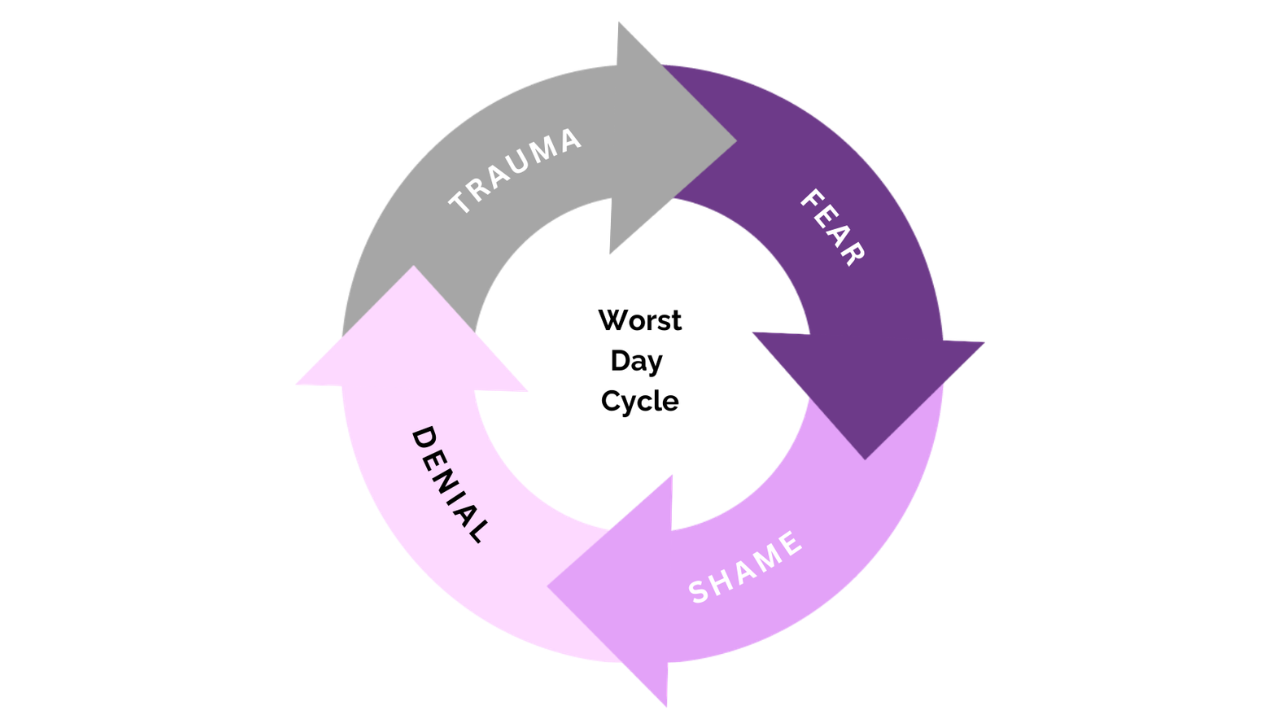
The Worst Day Cycle™ has four stages: Trauma → Fear → Shame → Denial.
Trauma: Any negative emotional experience in childhood that created painful meanings. It doesn’t have to be dramatic — a parent who was emotionally unavailable, a household where feelings were punished, a caregiver whose love was conditional. These experiences create a massive chemical reaction in the brain and body. The hypothalamus generates chemical cocktails — cortisol, adrenaline, dopamine, oxytocin misfires — and the brain becomes addicted to these emotional states.
That’s you — feeling most alive in the chaos of a toxic relationship, because your nervous system was calibrated for chaos in childhood and interprets calm as dangerous.
Fear: Fear drives repetition. The brain conserves energy by repeating known patterns — it can’t tell right from wrong, only known from unknown. Since 70%+ of childhood messaging is negative and shaming, adults repeat these painful patterns in relationships, career, hobbies, health — everything. Your brain doesn’t choose toxic partners despite your intelligence. It chooses them because of its programming.
Shame: This is where you lost your inherent worth. “I am the problem.” Not “I made a mistake” — but “I AM the mistake.” This is the core wound underneath every toxic relationship pattern. You tolerate toxic behavior because deep down, you believe it’s what you deserve. You stay because leaving would mean admitting your authentic self has value — and shame told you decades ago that it doesn’t.
That’s the shame talking — the voice that says “maybe if I love them harder, they’ll finally love me back.” But you’re not trying to earn their love. You’re trying to earn the love your childhood told you that you didn’t deserve.
Denial: Denial is the survival persona you created to survive the pain. It was brilliant in childhood — absolutely necessary. But in adulthood, it’s the reason you explain away red flags, make excuses for toxic behavior, and convince yourself that “this time will be different.” Denial keeps you in the cycle because seeing the truth would mean feeling the original childhood wound — and your nervous system will do anything to avoid that.
The Worst Day Cycle™ reveals why you attract toxic partners with such consistency — your brain created a neurochemical radar in childhood that scans every potential partner for the specific emotional signature of your original trauma, and when it finds a match, it floods you with chemicals that feel like love.
What Is Trauma Chemistry and How Does It Drive Toxic Attraction?
What most people call “chemistry” in a relationship is actually trauma chemistry — the neurochemical response your body produces when it recognizes a partner who matches your childhood emotional blueprint. It feels like passion. It feels like destiny. It feels like the most intense connection you’ve ever experienced. And it is the most reliable predictor that you’re about to repeat your worst day.
That’s you — confusing intensity with intimacy, chaos with connection, and the adrenaline rush of uncertainty with the warmth of genuine love.
Trauma chemistry evolves into trauma bonding through a predictable cycle: Idealization → Anxiety → Clinging → Withdrawal → Abandonment fear → Reunion → Repeat. Each stage produces a specific chemical cocktail that your brain has been craving since childhood.
You’re not addicted to them. You’re addicted to the high of being chosen, the crash of being neglected, the relief when they come back, the hope of changing them, and the possibility of finally healing the childhood wound through this relationship. It’s an emotional drug — and like any addiction, it gets stronger with each cycle.
Sound familiar? The partner who disappears for days, then comes back with just enough warmth to keep you hooked? That’s not love. That’s your nervous system getting its fix.
Here’s what makes trauma chemistry so dangerous: safe partners don’t trigger it. When you meet someone emotionally healthy — someone who is consistent, available, and honest — your body registers… nothing. No butterflies. No electric charge. No obsessive thinking. And you interpret that absence of chaos as a lack of chemistry. So you leave. And you go find another toxic partner who makes you “feel something.”
Trauma chemistry is the neurochemical con that makes toxic partners feel like soulmates — your brain floods you with the same chemicals it produced during childhood trauma, creating an intensity that feels like love but is actually your nervous system recognizing familiar danger.
How Your Survival Persona Keeps You Trapped in Toxic Relationships
Your survival persona is the identity you created in childhood to navigate an emotionally unsafe environment. It’s not who you are — it’s who you had to become. And in toxic relationships, it’s the engine that keeps you stuck in patterns you intellectually know are destroying you.
There are three survival persona types, and each one creates a specific pattern in toxic relationships:
The Falsely Empowered: This persona controls, dominates, and rages. In toxic relationships, the falsely empowered person often becomes the one others call “the narcissist.” They use anger, control, and intimidation to avoid vulnerability. They look powerful on the outside, but their power comes from fear, not strength. They attract disempowered partners because the power imbalance recreates the dynamic of their childhood — and both people get to replay their original wounds.
That’s you — the one who wonders why every partner eventually calls you “controlling” when all you’re trying to do is keep everything from falling apart.
The Disempowered: This persona collapses, people-pleases, and disappears. In toxic relationships, the disempowered person becomes the one who gives everything and tolerates anything. They confuse self-sacrifice with love. They believe that if they just love harder, give more, or become whatever the toxic partner needs, the pain will stop. It never does — because the pain isn’t coming from the partner. It’s coming from childhood.
That’s you — the one who bends over backward to make a toxic partner happy and then wonders why you feel invisible, used, and empty.
The Adapted Wounded Child: This persona oscillates between both — raging one moment, collapsing the next. In toxic relationships, they swing between “I don’t need you” and “please don’t leave me.” They attract partners whose survival strategy is the exact opposite of theirs — because the brain seeks out the dynamic that recreates the original childhood wound from both sides.
That’s you — the one who threatens to leave every week but never does, because leaving feels more terrifying than the pain of staying.
Here’s the tragedy: in almost all cases, we pick a partner whose denial strategy is the exact opposite of ours. Your survival strategy threatens theirs, and their survival strategy threatens yours. This creates a cycle of reactivity that both people mistake for “the relationship being toxic” — when really, it’s two wounded children triggering each other’s unhealed pain.
Your survival persona doesn’t just attract toxic partners — it creates the conditions for toxicity in every relationship by replacing your authentic self with a childhood performance that can’t create genuine intimacy, only recreate familiar pain.
Why Can’t You Leave a Toxic Relationship? The Trauma Bond Explained
If you’ve ever tried to leave a toxic relationship and couldn’t — or left and went back — you’re not weak. You’re experiencing a trauma bond. And a trauma bond is not a relationship problem. It’s a neurochemical addiction rooted in your childhood.
That’s you — knowing with absolute intellectual clarity that this person is bad for you, and feeling completely powerless to walk away.
The Victim Position Paradox explains part of why leaving feels impossible. The victim position is a societal construct meant to protect victims, but in reality it has created a paradoxical falsely empowered position that nearly guarantees the victim will reexperience their childhood victimization, leaving them disempowered. Society tells you that the toxic partner is entirely to blame — and they may be behaving terribly. But as long as you stay in the victim position, you never examine the childhood blueprint that drew you to them in the first place. And that blueprint will draw you to the next toxic partner, and the next one, until it’s healed.
You can’t leave because your brain is addicted to the cycle — the high of being chosen, the crash of being neglected, the relief when they come back. Every time they return after pulling away, your brain gets a dopamine hit that’s more powerful than almost any drug. You’re not staying for love. You’re staying for the chemical.
That’s the trauma bond — not a sign that the love is real, but a sign that the wound is deep.
Leaving a toxic relationship requires more than willpower. It requires rewiring the emotional blueprint that makes the toxic cycle feel like home. And that work starts not with the relationship — but with the childhood that created the pattern.
A trauma bond is a neurochemical addiction to the emotional cycle of a toxic relationship — you can’t think your way out of it because the bond lives in your body’s chemistry, not in your mind’s understanding, and it was wired into your nervous system decades before you met your partner.
How Toxic Relationship Patterns Show Up in Every Area of Your Life
Family: You tolerate behavior from family members that you would never accept from a stranger. You minimize their cruelty. You make excuses for their dysfunction. You keep going back to family gatherings that leave you emotionally wrecked because the guilt of not going feels worse than the pain of being there. Your original toxic relationship was with a caregiver — and every family interaction recreates it.
That’s you — driving home from a family dinner feeling gutted, telling yourself “that’s just how they are” while your body screams that something is deeply wrong.
Romantic Relationships: You choose partners who need to be saved, who can’t give you what you need, or who recreate the emotional neglect or chaos of your childhood. You confuse intensity with love. You tolerate lying, infidelity, emotional withdrawal, or verbal abuse because it feels normal — because it IS normal for your nervous system. Safe love feels boring. Toxic love feels alive.
Sound familiar? The person who gives everything to someone who gives nothing back — and then blames themselves for not being enough?
Friendships: You attract friends who drain you. You’re the listener, the fixer, the one everyone calls in crisis. But when you need something? Silence. You surround yourself with people who replicate the one-sided dynamic of your childhood — where your value was measured by what you gave, not who you were.
Work: You tolerate toxic bosses, overwork yourself to earn approval, and stay in jobs that undervalue you. You attract workplace dynamics that mirror your family system — the controlling boss who reminds you of a critical parent, the colleagues who take credit for your work while you stay silent, the promotion you never ask for because you don’t believe you deserve it.
That’s you — building someone else’s dream while your own dies quietly because your childhood taught you that your needs don’t matter.
Body and Health: Your body absorbs everything your relationships won’t let you express. Chronic pain, digestive issues, insomnia, autoimmune conditions, weight struggles — these are often the body’s response to years of emotional suppression in toxic dynamics. You’ve trained yourself to ignore your body’s signals the same way you ignore red flags in relationships — because both require a level of self-trust that was stolen in childhood.
How the Emotional Authenticity Method™ Breaks the Toxic Attraction Pattern
You cannot break the toxic relationship pattern through dating advice, boundary lists, or “knowing your worth.” Those approaches target the thinking brain. Your toxic attraction pattern lives in your nervous system — in the body, not the mind. The Emotional Authenticity Method™ is the daily practice that actually rewires the blueprint.
Step 1: Somatic Down-Regulation. Focus on what you can hear for 15-30 seconds. Before you can process anything, you have to get your nervous system out of survival mode. If you’re highly dysregulated — which you will be in or after a toxic relationship — use titration: go slowly, don’t force yourself to feel everything at once.
That’s you — learning that you don’t have to white-knuckle your way through the pain of a toxic relationship. You can actually slow down enough to feel it safely.
Step 2: What am I feeling right now? Not “what should I feel?” Not “what would a healthy person feel?” But: what am I actually feeling? Use the Feelings Wheel to develop emotional granularity — the ability to name specific emotions instead of lumping everything into “heartbroken” or “angry.” Most people in toxic relationships have been disconnected from their feelings for so long that they genuinely don’t know what they feel.
Step 3: Where in my body do I feel it? All emotional trauma is stored physically. Your chest tightens when they text. Your stomach drops when they go silent. Your jaw clenches when they gaslight you. Locating the feeling in your body is how you move from intellectual understanding to somatic processing — which is where actual healing happens.
Step 4: What is my earliest memory of having this exact feeling? This is the step that changes everything. You trace today’s reaction back to its childhood origin. You realize: this isn’t about them. My partner isn’t my parent. My nervous system just thinks they are. The abandonment panic you feel when they pull away? That’s not about this relationship. It’s about being five years old and learning that love could disappear at any moment.
That’s the moment the toxic pattern starts to dissolve — when you see that your “soulmate” was actually your nervous system’s way of recreating your childhood wound, not healing it.
Step 5: Who would I be if I never had this thought or feeling again? What would be left over? This is the vision step. It connects you to the Authentic Self Cycle™ and gives your nervous system a new destination — not another toxic relationship, but actual identity restoration.
Step 6: Feelization. Sit in the feeling of the Authentic Self and make it strong. Create a new emotional chemical addiction to replace the old blueprint. Ask: how would I respond to this situation from this feeling? What would I say? What would I do? Visualize and FEEL yourself operating from your Authentic Self. This is the emotional blueprint remapping and rewiring step — the step that actually builds the new neural pathway that makes safe love feel like home instead of boring.
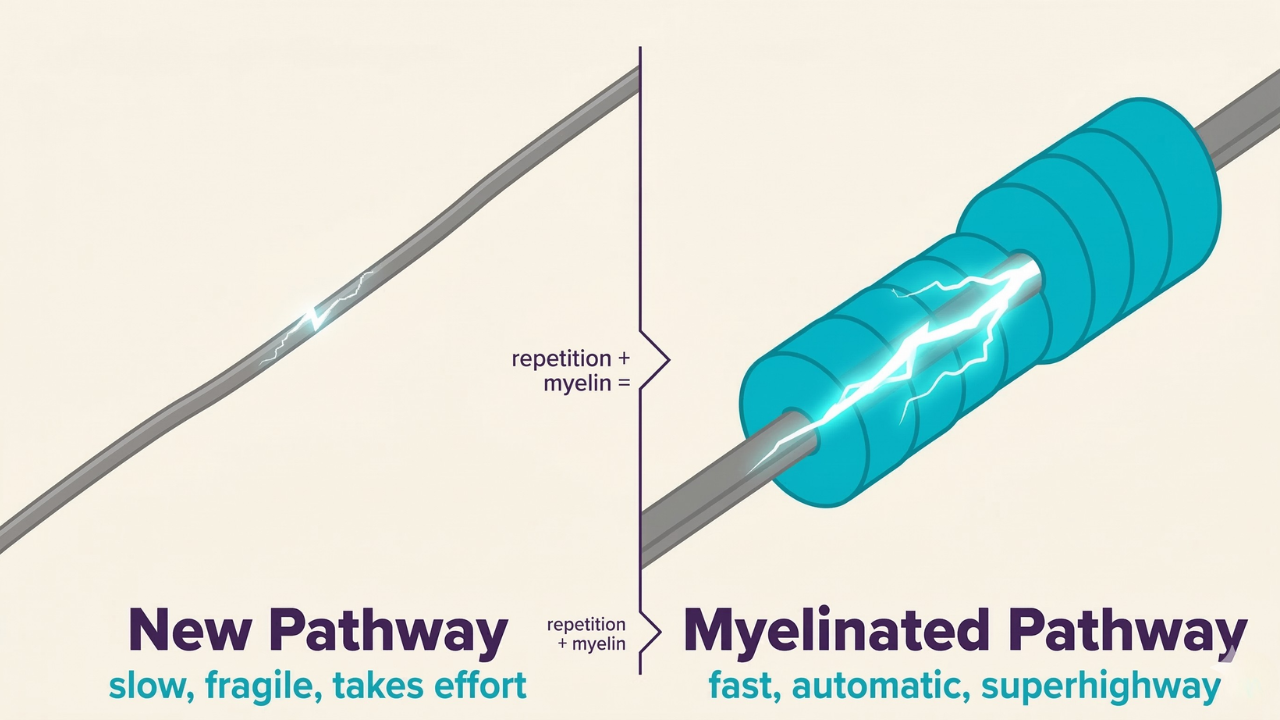
The Emotional Authenticity Method™ works because emotions are biochemical events — you cannot change toxic attraction patterns through thoughts alone. Thoughts originate from feelings, not the other way around. Until you rewire the feeling, the pattern will repeat.
How the Authentic Self Cycle™ Replaces Toxic Love With Authentic Connection
The Authentic Self Cycle™ is the healing counterpart to the Worst Day Cycle™. Where the Worst Day Cycle™ traps you in Trauma → Fear → Shame → Denial, the Authentic Self Cycle™ restores your identity through Truth → Responsibility → Healing → Forgiveness.
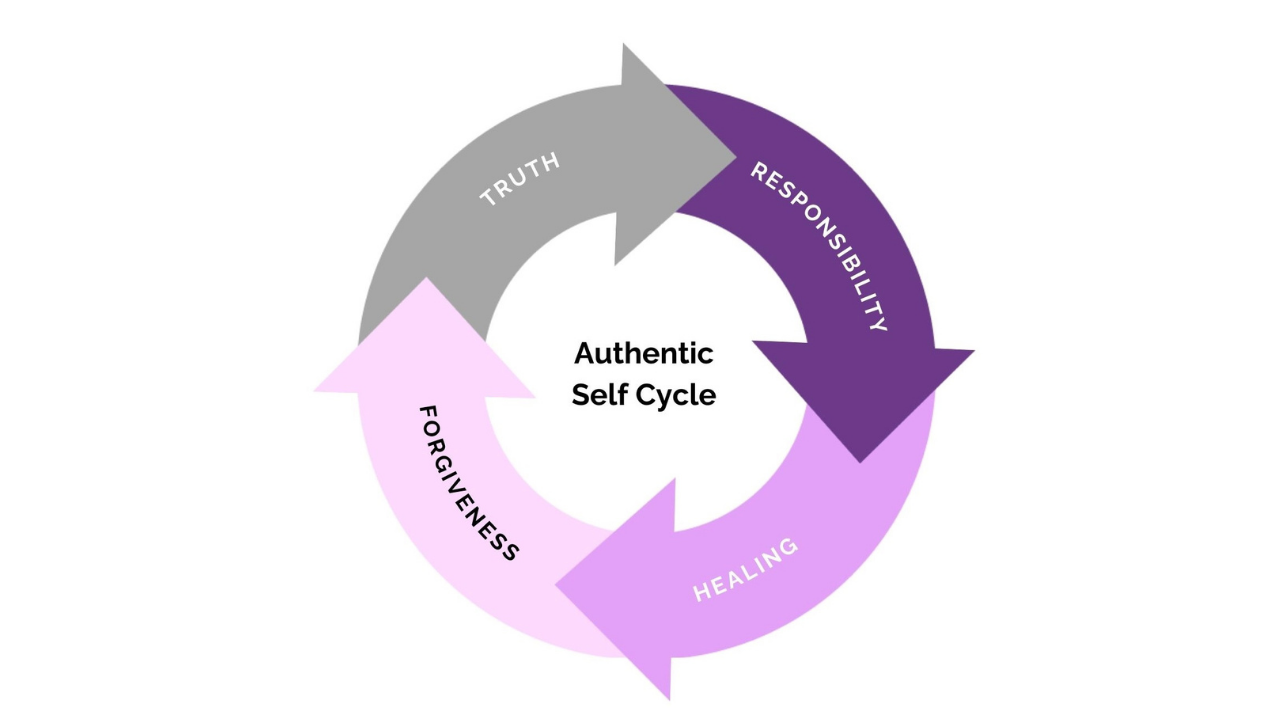
Truth: Name the blueprint. See that “this isn’t about today.” When your partner goes silent and your chest tightens with abandonment panic, truth says: “This feeling is from childhood. My partner isn’t my neglectful parent — my nervous system just thinks they are.” Truth also means seeing clearly: this person’s behavior is not acceptable, AND I chose them because of my unhealed wound. Both things are true.
That’s the first step out of the toxic cycle — seeing the pattern instead of being trapped inside it.
Responsibility: Own your emotional reactions without blame. “My partner isn’t my parent — my nervous system just thinks they are.” This doesn’t mean excusing toxic behavior. It means understanding why YOU stayed, why YOU tolerated it, why YOUR nervous system interpreted chaos as love. Taking responsibility isn’t about fault. It’s about taking back your power from a childhood that stole it.
Healing: Rewire the emotional blueprint so that safe love doesn’t feel boring, consistent partners don’t feel suffocating, and calm doesn’t trigger restlessness. This is where daily practice with the Emotional Authenticity Method™ does its work — second by second, like the ticks of a clock. The second hand moves in tiny, almost insignificant ticks. But those ticks move the minute hand. The minutes move the hours. Healing toxic patterns works the same way.
Forgiveness: Release the inherited emotional blueprint and reclaim your authentic self. This creates a NEW emotional chemical pattern that replaces the addiction to chaos with a capacity for genuine connection. You don’t become someone who can’t feel attraction. You become someone whose attraction system is finally calibrated for safety, not danger.
That’s you — not the person who keeps choosing toxic partners. The person who finally feels drawn to someone kind, consistent, and real — and for the first time, it doesn’t feel boring. It feels like home.
The Authentic Self Cycle™ is an identity restoration system — it doesn’t teach you to avoid toxic partners, it replaces the neurochemical blueprint that made toxic partners feel like love with a new blueprint built on truth, responsibility, and emotional authenticity.
Frequently Asked Questions About Toxic Relationships
Why do I keep attracting toxic partners even though I know better?
Knowing better doesn’t change the pattern because toxic attraction is a neurochemical event, not an intellectual one. Your brain became chemically addicted to the emotional patterns of your childhood trauma. It selects partners who recreate that specific emotional signature — regardless of what your conscious mind knows. The Worst Day Cycle™ explains how this addiction forms: trauma creates fear, fear drives repetition, repetition creates shame, and shame locks you in denial. Breaking the pattern requires somatic rewiring through the Emotional Authenticity Method™, not more knowledge.
What is a trauma bond and how do I know if I’m in one?
A trauma bond is a neurochemical attachment to the emotional cycle of a toxic relationship — idealization, anxiety, clinging, withdrawal, abandonment fear, reunion, repeat. You’re in a trauma bond if you intellectually know the relationship is harmful but feel physically unable to leave, if you feel most alive during the highs and lows of the cycle, or if you keep returning after leaving. The bond isn’t about love. It’s about your nervous system’s addiction to the same emotional chemicals it learned in childhood.
Can a toxic relationship become healthy without leaving?
A relationship can only become healthy when BOTH partners commit to healing their individual Worst Day Cycles™. The toxicity exists because two survival personas are triggering each other’s unhealed childhood wounds. If both partners learn the Emotional Authenticity Method™ and begin the Authentic Self Cycle™ — Truth, Responsibility, Healing, Forgiveness — the dynamic can shift. But this requires both people to stop blaming and start owning their part. One person healing alone cannot fix a toxic dynamic.
Why do safe partners feel boring to me?
Safe partners feel boring because your nervous system was calibrated for chaos in childhood. Consistency, emotional availability, and honesty don’t produce the neurochemical spike that your brain has been addicted to since childhood. Your body interprets the absence of drama as the absence of connection. The Emotional Authenticity Method™ rewires this by creating new neural pathways that allow your body to experience safety as desirable rather than threatening. Feelization — Step 6 — specifically builds a new emotional chemical addiction to replace the old one.
Is it my fault that I attract toxic partners?
It is not your fault — and you are responsible. These are two different things. You didn’t choose your childhood trauma. You didn’t choose the emotional blueprint that was installed before you could read. The toxic partner’s behavior is THEIR responsibility. But understanding why your brain selected them — why your nervous system interpreted their chaos as chemistry — is YOUR responsibility. Taking responsibility isn’t blame. It’s the path to freedom. It’s the difference between “I deserve this” and “I can heal this.”
How long does it take to stop attracting toxic partners?
The timeline depends on the depth of the childhood wound and the consistency of your daily practice. Noticeable shifts can happen within weeks of practicing the Emotional Authenticity Method™. You’ll start noticing red flags earlier, feeling less pulled toward chaos, and experiencing less panic when safe partners show up. Full rewiring of the attraction blueprint takes longer — like the second hand on a clock, each small moment of emotional truth moves the larger pattern. The Authentic Self Cycle™ provides the framework for long-term identity restoration.
The Bottom Line
You’re not broken. You’re not a magnet for bad people. And you’re not cursed to repeat this pattern forever.
You are a human being whose brain did exactly what it was designed to do — it took the pain of childhood and built a survival strategy around it. That strategy drew you to partners who felt like home. And home was painful.
But here’s what nobody told you when they said “just leave”: leaving doesn’t heal the blueprint. You can leave a hundred toxic relationships and your brain will find the hundred-and-first. Because the pattern isn’t about THEM. It’s about the five-year-old inside you who learned that love looks like chaos, sounds like criticism, and feels like walking on eggshells.
That’s you — not the person who keeps choosing wrong. The person whose childhood never gave them a chance to learn what right feels like.
The way out isn’t through dating advice. It isn’t through willpower. It’s through the daily, brave, terrifying work of feeling the feelings you’ve been running from since childhood. One somatic check-in at a time. One moment of emotional truth at a time. One tick of the clock at a time.
The room of 20,000 will always be there. But when you heal the blueprint — when you rewire the radar — you’ll finally walk past the one who matches your wound and feel nothing. And the one who matches your authentic self? For the first time, you’ll feel everything.
Recommended Reading
These books complement the frameworks in this article and deepen your understanding of toxic relationship patterns and trauma recovery:
Facing Codependence by Pia Mellody — the foundational text on how childhood trauma creates the relational patterns that draw people into toxic dynamics.
The Body Keeps the Score by Bessel van der Kolk — the science of how trauma lives in the body, explaining why you can’t think your way out of toxic attraction.
When the Body Says No by Gabor Maté — how chronic emotional suppression in toxic relationships manifests as physical illness and disease.
Codependent No More by Melody Beattie — a practical guide to recognizing when your pattern of overgiving and self-sacrifice is trauma, not love.
The Gifts of Imperfection by Brené Brown — how shame drives toxic relationship patterns and why vulnerability is the path to authentic connection.
Take the Next Step
If you’re ready to break the toxic relationship pattern and build a life from your authentic self, Kenny Weiss offers courses designed for people who are done repeating their worst day and ready to heal:
Emotional Blueprint Starter Course — Individual ($79) — Your personal roadmap to understanding the Worst Day Cycle™ and how it creates your toxic relationship radar.
Relationship Starter Course — Couples ($79) — For couples ready to break the cycle of reactivity and build interdependence instead of codependence.
Why We Can’t Stop Hurting Each Other ($479) — Deep-dive into the Worst Day Cycle™ and how childhood trauma creates the toxic relationship dynamic between partners.
Why High Achievers Fail at Love ($479) — Built specifically for high achievers who keep choosing toxic partners despite having “everything together.”
The Shutdown Avoidant Partner ($479) — Understanding avoidant attachment through the lens of trauma chemistry and survival personas.
Tier 1: Mapping the Blueprint ($1,379) — The comprehensive program for learning and practicing the Emotional Authenticity Method™.
Download the Feelings Wheel — the free tool used in Step 2 of the Emotional Authenticity Method™ to build emotional granularity and reconnect with your authentic feelings.
Explore more: The Signs of Enmeshment | 7 Signs of Relationship Insecurity | 7 Signs of High Self-Esteem | How to Determine Your Negotiables and Non-Negotiables | 10 Do’s and Don’ts for a Great Relationship