What Is Codependency? The Clinical Definition
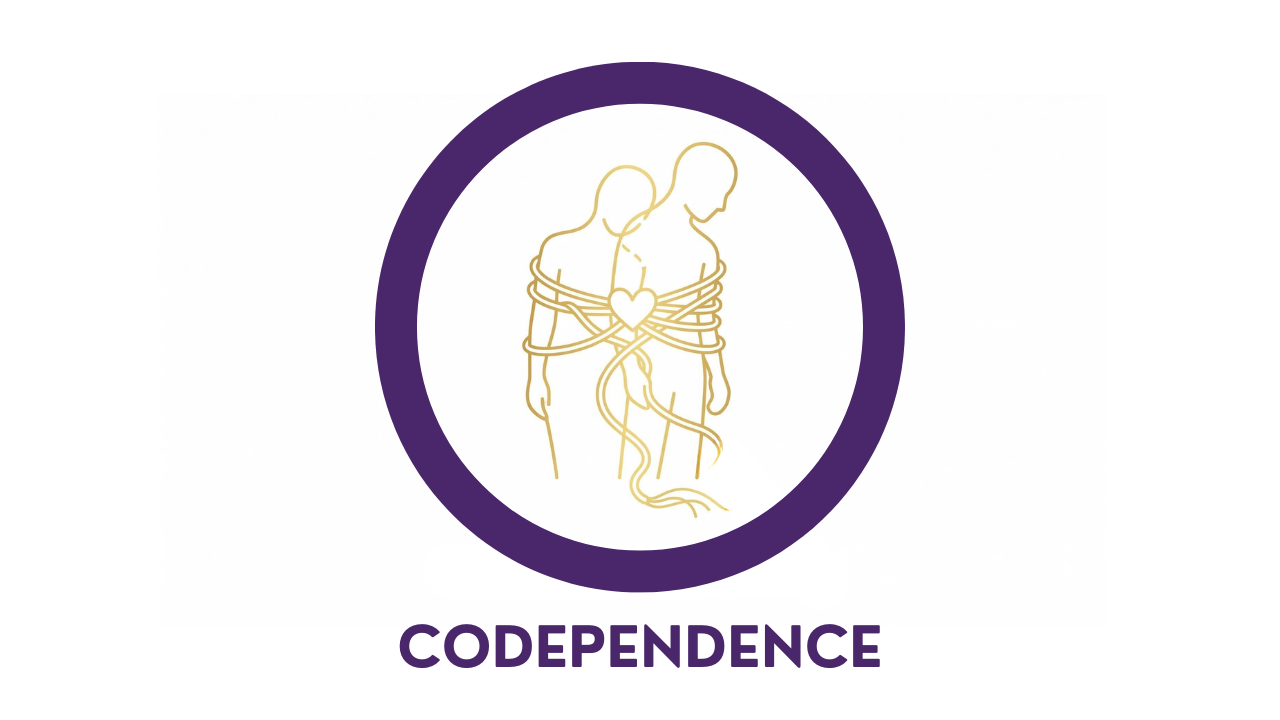
Codependency is not about loving too much. It’s a learned emotional and behavioral pattern where you lose yourself in relationships, override your own needs for others, and develop an identity built on managing someone else’s emotions, behaviors, or approval.
Core definition: Codependency occurs when a person excessively relies on others for self-worth, makes sacrificing decisions to avoid conflict or abandonment, and abandons their own emotional authenticity to maintain connection—all rooted in childhood patterns of survival.
The pain you feel—the constant anxiety, the obsessive need to fix your partner, the inability to say no, the deep shame when someone leaves—that’s your nervous system still running on a childhood survival program. It’s not a character flaw. It’s a brilliant adaptation that kept you alive emotionally in an environment that wasn’t equipped to honor your authentic self.
Most people think codependency is about being “too nice” or “too caring.” The reality is darker and more hopeful at once. You’re not broken—you’re operating from an inherited emotional blueprint that no longer serves you.
That’s you if you constantly ask yourself “Am I doing enough?” or “Will they leave me?”
How Childhood Trauma Creates Codependent Patterns
Here’s what most therapy misses: codependency doesn’t come from one big traumatic event (though it can). It comes from thousands of small emotional abandonments, moments where your authentic feelings weren’t honored, and an environment where love felt conditional.
Childhood trauma is any negative emotional experience that created painful meanings about yourself, others, or the world. This includes obvious trauma (abuse, loss, neglect) but also the quiet kind: parents who criticized you for crying, families where anger was punished, environments where your job was to keep the peace by suppressing yourself.
When your nervous system experiences threat—emotional or physical—your hypothalamus floods your body with cortisol, adrenaline, dopamine misfires, and oxytocin confusion. Your brain becomes neurologically addicted to these states because they’re the only emotional home you know.
The brain is a prediction machine. It learns from patterns. When 70%+ of your childhood messaging is negative, critical, or conditional, your brain learns that you are the problem. And because humans are energy-conserving creatures, your brain keeps repeating the same patterns in adult relationships, work, health, and every area of life. It’s not your fault—it’s neurobiology.
That’s the painful truth: your nervous system doesn’t know right from wrong. It only knows familiar versus unfamiliar. And safety, in your wiring, means repeating what you learned in childhood.
The Worst Day Cycle™ Explained
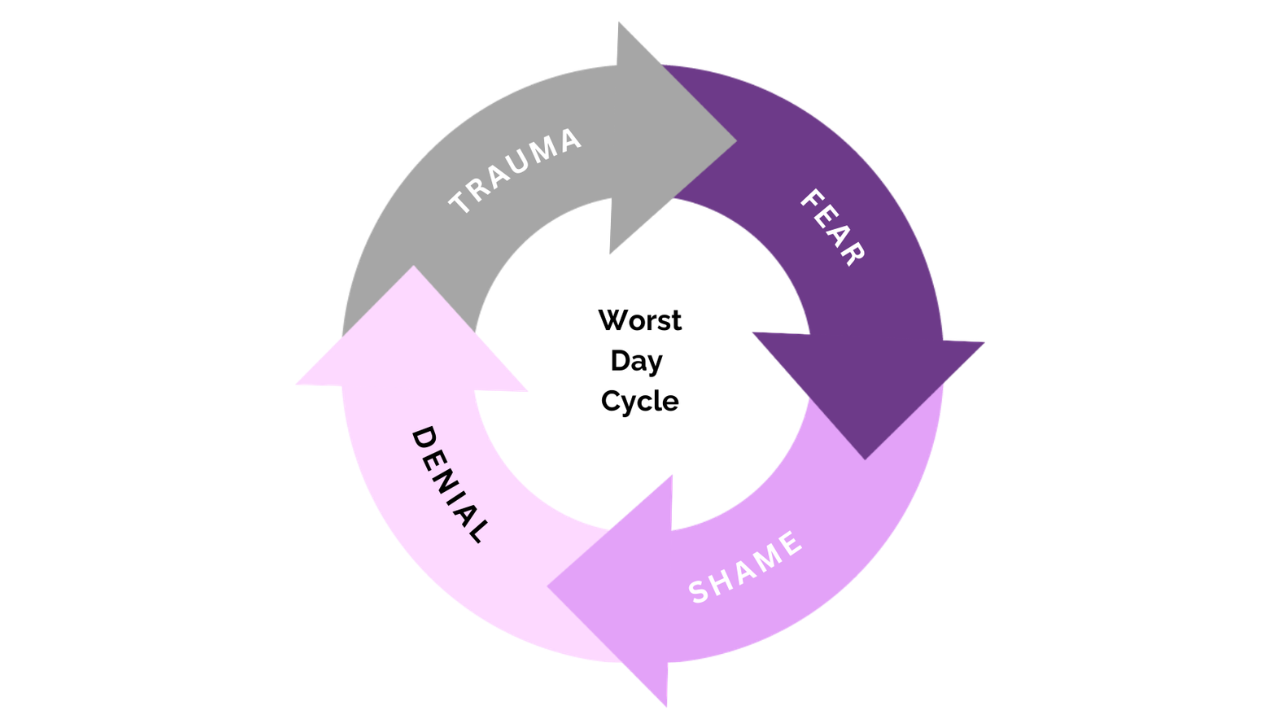
The Worst Day Cycle™ is the four-stage loop that keeps codependency alive. Once you see it, you can’t unsee it. Understanding this cycle is the first step toward freedom.
Stage 1: Trauma. This is the original wound. Your nervous system stores every painful moment as threat. A partner’s tone of voice, a parent’s disappointment, a friend’s distance—these activate your threat response as if you’re a child again, helpless and unsafe.
Stage 2: Fear. Once trauma is triggered, fear follows instantly. Your body floods with stress chemicals. Your thinking brain shuts down. You go into fight, flight, freeze, or fawn mode. Your amygdala (threat detector) is running the show now, not your prefrontal cortex (wisdom, discernment, choice).
That’s you — your heart racing at a text message that takes too long, your stomach dropping when your partner goes quiet.
Stage 3: Shame. Here’s where codependency locks in. Fear morphs into shame—the belief that you are inherently wrong, unlovable, or broken. “I am the problem” becomes the operating system. You don’t just believe you made a mistake; you believe you ARE a mistake.
Stage 4: Denial. To survive unbearable shame, your psyche creates a survival persona—a false identity that says “I’m fine,” “I can handle this,” “I’ll fix it,” or “I don’t have needs.” This survival persona becomes your go-to strategy for staying connected, avoiding abandonment, and managing the pain.
The problem: this survival persona is brilliant in childhood (it keeps you safe, keeps you connected to parents you depend on) but catastrophic in adult relationships. You abandon yourself to keep the peace. You ignore red flags. You override your needs. You become obsessed with fixing your partner’s emotions.
Sound familiar? That’s the Worst Day Cycle™ running your life without your permission.
The Three Survival Persona Types
Everyone who experiences childhood trauma develops a survival persona—a false identity designed to protect them from unbearable pain and abandonment. There are three primary archetypes. You may recognize yourself in one, two, or all three at different times.
The Falsely Empowered Survival Persona
This persona says “I’m in control. I’m strong. I don’t need anyone.” On the surface, it looks like confidence. In reality, it’s a hypervigilant defense against abandonment. You over-function, over-give, over-achieve because being needed feels like being loved.
In relationships, the falsely empowered persona takes on the fixer role: managing your partner’s emotions, solving their problems, staying one step ahead of their moods to prevent conflict or rejection. You’re exhausted because you’re carrying two emotional loads—yours and theirs.
That’s you if you’re the one always making the relationship work while your partner seems unbothered.
The Disempowered Survival Persona
This persona says “I can’t. I’m not enough. I need you to survive.” It emerges from environments where your opinions were minimized, your voice was silenced, or your needs were treated as inconvenient. You learned early that small, quiet, compliant people are safer.
That’s you — the one who says “I’m fine” while silently drowning, because showing need felt like begging as a child.
In relationships, the disempowered persona abandons agency entirely. You suppress your preferences, avoid conflict at any cost, and interpret every disagreement as evidence of impending abandonment. Your partner’s happiness becomes your job. Your authenticity becomes the price of connection.
The pain here is acute: you feel controlled, voiceless, and trapped—but you can’t leave because abandonment feels like death.
The Adapted Wounded Child Survival Persona
This persona tries to stay innocent and helpless: “I’m just a kid who doesn’t know how to handle this.” It’s a regression—an attempt to access the nurturing or protection you never received by staying emotionally young, needy, or confused.
In relationships, this persona creates a dynamic where your partner becomes the parent—rescuer, caretaker, decision-maker. You may feel genuinely incompetent or confused in areas where you’re actually capable. You unconsciously repeat the child-parent dynamic because it’s the only relational template you learned.
The adapted wounded child can also appear as the “nice” partner who never expresses anger, always accommodates, and seems content to disappear into the relationship.
That’s the adapted wounded child if you find yourself waiting for permission to have needs or opinions.
Emotional Neglect as a Root Cause
One of the deepest roots of codependency is emotional neglect—not the absence of food, shelter, or clothing, but the absence of emotional attunement and validation. This is insidious because it’s invisible. There are no bruises. No one can see it. But it shapes your entire sense of self.
Emotional neglect happens when:
— Your parents were emotionally unavailable (depressed, addicted, checked out)
— Your feelings were dismissed (“You’re being too sensitive”)
— Expressing needs was met with criticism or punishment (“Stop crying or I’ll give you something to cry about”)
— Love felt conditional on performance, achievement, or compliance
— You were given the message that your emotional life was a burden to others
When you grow up emotionally neglected, your brain doesn’t develop a strong sense of what you feel, what you want, or what you deserve. You become expert at reading others—hyper-attuned to their moods, needs, and potential reactions—because your emotional survival depended on it.
In adult relationships, this shows up as obsessive attention to your partner’s moods, constant checking in, over-apologizing, and a terrifying inability to know what you actually want apart from them.
The paradox: you’re incredibly attuned to others while being completely disconnected from yourself. You can name your partner’s feelings before they can. You have no idea what you feel. Enmeshment—the blurring of emotional boundaries between you and others—becomes your normal.
Sound familiar? That’s emotional neglect creating an expert people-reader and a disconnected self.
The Role of Shame in Codependency
Shame is the engine of codependency. Not guilt. Guilt says “I did something bad.” Shame says “I am bad.” And when shame is wired into your sense of self in childhood, it drives every codependent behavior in adulthood.
Shame emerges in childhood through:
— Criticism, humiliation, or shaming language from parents
— Punishment for normal developmental emotions (anger, sadness, sexuality)
— Being blamed for family problems or emotional dynamics
— Witnessing or experiencing abuse without protection
— Being made responsible for a parent’s emotional regulation
When shame becomes part of your identity, you develop the belief “I am fundamentally wrong, unlovable, or broken.” This is the wound that codependency emerges from and the wound that codependency perpetuates.
In relationships, shame manifests as:
— Staying in situations where you’re disrespected
— Accepting blame for things that aren’t your responsibility
— Hiding your authentic self, preferences, and needs
— Seeking constant reassurance that you’re “okay” or “enough”
— Feeling like you deserve mistreatment
The codependent strategy is to fix the shame by being “perfect”—perfectly attuned, perfectly accommodating, perfectly self-sacrificing. The belief, buried deep: “If I can just be good enough, loved enough, or needed enough, the shame will disappear.”
It never does. The shame only deepens as you abandon yourself more completely.
That’s the shame engine — convincing you that if you just try harder, give more, need less, the pain will finally stop. It never does.
The Authentic Self Cycle™: How Healing Works
Here’s the hopeful part: understanding the Worst Day Cycle™ immediately suggests the healing path. The Authentic Self Cycle™ is the direct inverse—a four-stage recovery loop that reverses codependency at the neurological level.
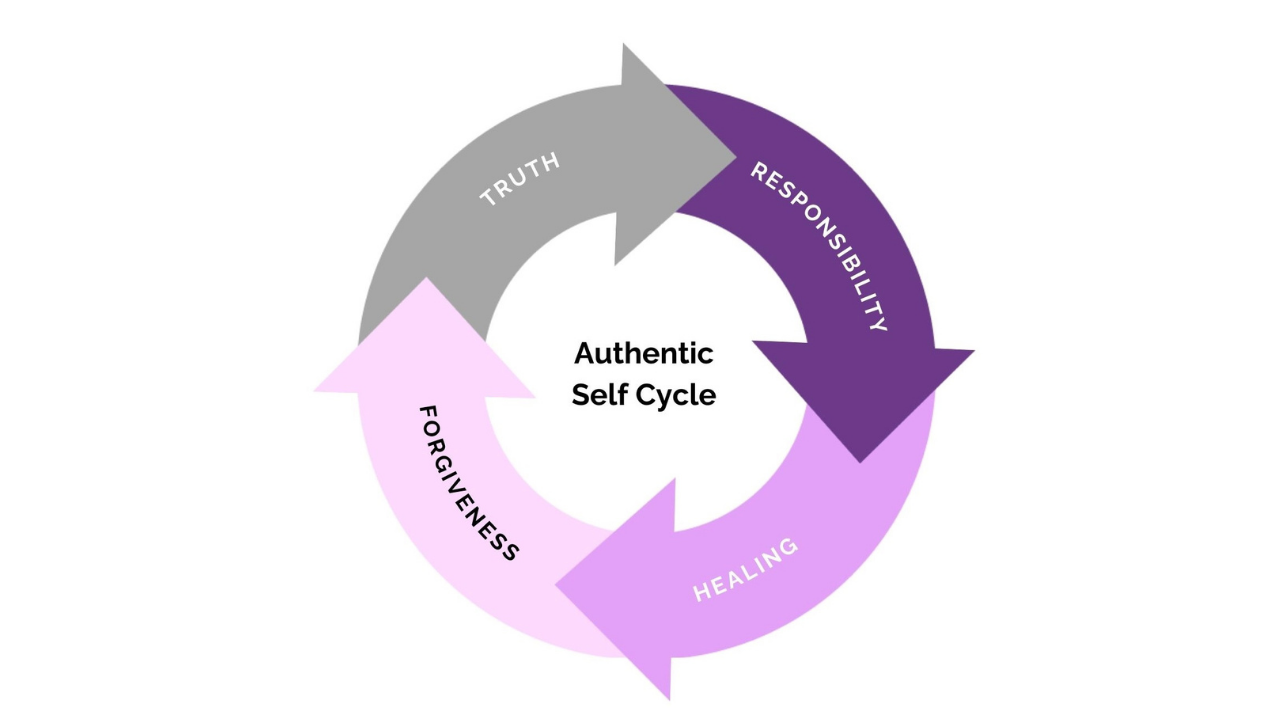
Stage 1: Truth. This is naming the blueprint. Seeing it clearly. “This isn’t about today. My partner’s criticism activated my childhood fear of being wrong. My abandonment panic came from my parent’s conditional love, not from current evidence that I’ll be left.”
Truth is the flashlight you shine on your own neurobiology. It’s compassionate realism. It says: “That survival persona? It saved your life. And now it’s drowning you. Both things are true.”
Stage 2: Responsibility. This is the hardest stage for codependent people because we’re used to taking responsibility for things that aren’t ours. True responsibility means owning your emotional reactions without blame—without blaming yourself, your partner, or your parents.
“My partner isn’t my parent. My nervous system just thinks they are. It’s not their job to heal my childhood. It’s mine.”
This is where you reclaim agency. You stop waiting for your partner to change, stop blaming them for your pain, and start acknowledging: “My emotional response is mine to manage. I can feel triggered and still choose not to abandon myself.”
Stage 3: Healing. This is rewiring the emotional blueprint. It’s the actual neurochecking process where you teach your nervous system that conflict is uncomfortable but not dangerous, that disagreement doesn’t mean abandonment, that your authentic voice won’t destroy the relationship.
Healing is not forgetting the past. It’s changing what the past means. It’s building new emotional associations through deliberate practice and somatic work.
Stage 4: Forgiveness. This is releasing the inherited emotional blueprint. Not forgiving your parents or others for what they did—though you may do that. Forgiving yourself for the survival strategies you developed. Forgiving your nervous system for its brilliant, protective repetitions. Reclaiming your authentic self as the foundation of your identity.
That’s the Authentic Self Cycle™—the way out of codependency is through, not around.
The Emotional Authenticity Method™ for Recovery
Understanding your patterns is one thing. Changing them requires a concrete practice. The Emotional Authenticity Method™ is a five-step process that rewires your nervous system, reconnects you to your authentic self, and builds the skill of emotional integrity.
Step 1: Somatic Down-Regulation with Optional Titration.
Before your thinking brain can engage, you must settle your nervous system. When you’re triggered, you’re in threat response—amygdala hijacked, prefrontal cortex offline. Somatic down-regulation means using your body to send your nervous system a signal of safety: deep breathing, cold water on your face, walking, or gentle movement.
Titration (from somatic therapy) means you don’t have to go from triggered to calm in one leap. You can take small steps: slightly lower your shoulders, soften your jaw, take one deeper breath. Your nervous system will follow these micro-signals.
Step 2: What Am I Feeling?
Once you’re slightly regulated, name the emotion with granularity. Not “I feel bad.” Use the Feelings Wheel to identify whether you’re feeling hurt, disappointed, abandoned, embarrassed, or furious. Codependent people are often trained to ignore or minimize their emotional life. Naming it with precision reconnects you to your authentic self.
Step 3: Where in My Body Do I Feel It?
Emotions aren’t abstract—they’re somatic. Where is the feeling in your body? Tightness in your chest? Heat in your face? Heaviness in your stomach? This grounds you in the present moment and breaks the dissociation that codependency creates.
Step 4: What Is My Earliest Memory of This Feeling?
Here’s where you connect present to past. The feeling you’re experiencing now likely echoes an earlier version of itself. What’s the first time you remember feeling this way? Often, it’s not your current partner that’s the problem—it’s that they remind your nervous system of an old threat.
Step 5: Who Would I Be If I Never Had This Feeling Again?
This is the visioning step. It’s not about pushing the feeling away or denying it. It’s about asking: “What would become possible if this particular wound was healed? How would I relate? What would I choose? Who would I be?” This reconnects you to your authentic self—the you that exists beneath the survival persona.
That’s the Emotional Authenticity Method™—five steps to reconnect with yourself in real time, to rewire your nervous system, and to reclaim agency in your own emotional life.
Signs of Codependency Across Life Areas
Codependency doesn’t exist in a vacuum. It bleeds into every relationship and area of your life. Here are the signs across five life domains:
Family Codependency Signs
— You manage your parent’s emotions, even as an adult
— You feel responsible for your parent’s happiness or well-being
— You hide your accomplishments to avoid triggering your parent’s jealousy or shame
— You accept abuse or mistreatment without setting boundaries
— Insecurity appears when family members express criticism or disappointment
— You seek constant reassurance of being loved or accepted
That’s you — if your parent’s mood determines your entire day, you’re still living inside a childhood survival program.
Romantic Relationship Codependency Signs
— You abandon your own needs, preferences, and authentic voice to keep the peace
— You feel responsible for your partner’s emotions, moods, and problems
— You over-give: time, energy, money, emotional labor, sex
— You stay in situations where you’re disrespected, neglected, or mistreated
— You interpret your partner’s withdrawal or irritability as evidence of your failure
— You change yourself constantly to be what you think your partner needs
— Abandonment anxiety drives your behavior more than love does
— You obsess about your partner’s feelings, thoughts, and reactions
Boundaries are unclear or nonexistent—you can’t say no without guilt.
Friendship Codependency Signs
— You’re the one who always reaches out, initiates plans, and maintains the relationship
— You accept mistreatment or flakiness because you fear losing the friendship
— You take on the role of therapist, advisor, or problem-solver for your friends
— You hide parts of yourself to be more likable or acceptable
— You feel hurt when your friends don’t reciprocate your effort or attention
— You feel obligated to be available even when it costs you
That’s you — exhausted from being everyone’s support system while nobody holds space for you.
Work Codependency Signs
— You over-function: taking on too many projects, staying late, taking work home
— You seek constant validation from your boss or colleagues
— Your self-worth is entirely dependent on productivity or performance
— You can’t delegate or ask for help—you believe it’s all your responsibility
— You manage your boss’s moods or emotions
— You accept disrespect, unreasonable demands, or low pay
— You fear disappointing people more than you fear burnout
That’s you — getting promoted for the very pattern that’s destroying you from the inside out.
Body and Health Codependency Signs
— You ignore your body’s signals: hunger, fatigue, pain, sexual boundaries
— Your body image or health choices are determined by what others want
— You neglect self-care because you’re too busy managing others
— You use food, sex, substances, or work to numb emotional pain
— You have difficulty staying present in your body—dissociation is common
— You prioritize your partner’s or family’s health over your own
— You feel shame about your body or your needs
That’s your body keeping score — it’s been trying to tell you something for years, but codependency taught you to ignore it.
Sound familiar? Codependency doesn’t whisper — it shouts across every area of your life until you’re too exhausted to ignore it anymore.
Breaking Free: From Survival to Authenticity
Here’s the truth nobody tells you about codependency recovery: it’s not about learning to love better. It’s about learning to love yourself so fiercely that you stop abandoning yourself for connection.
Breaking free requires three non-negotiable elements:
First: Awareness. You can’t change what you can’t see. The Worst Day Cycle™ runs in the background of your consciousness, autopiloting your choices. Seeing it—naming it—is the beginning of freedom. You’re reading this, which means awareness is already starting.
Second: Rewiring. Awareness without rewiring just creates guilt. “I see the pattern. I hate it. Why can’t I stop?” Because your nervous system is still wired for threat, still seeking the familiar, still running survival programs. Rewiring happens through the Emotional Authenticity Method™ and deliberate nervous system work—not through willpower or self-judgment.
Third: Reclamation. This is where you rebuild your identity around your authentic self, not your survival persona. You discover what you actually want, what your real needs are, what your values are independent of other people’s approval. You practice genuine self-esteem—not narcissistic confidence, but quiet knowing of your own worth.
The paradox of codependency recovery: the thing you fear most (abandonment) becomes less likely when you stop abandoning yourself. When you have clear boundaries and emotional authenticity, you attract healthier people and relationships. When you’re willing to leave, many partners step up and do their own work.
The work is not easy. It’s not quick. But it’s the most important investment you can make in your own life.
People Also Ask
No. Codependency is not about loving too much—it’s about abandoning yourself in the name of connection. True love includes healthy boundaries, authentic communication, and mutual respect. Codependency abandons all three to maintain connection through people-pleasing and self-sacrifice.
Codependency is a pattern that repeats across all relationships—romantic, family, friendship, and work. However, it often shows up most intensely in your primary romantic relationship because that’s where your deepest fears of abandonment live. If you notice the same painful patterns repeating across multiple relationships, that’s a sign of a deeper emotional blueprint that needs rewiring.
Self-awareness and intentional practice (like the Emotional Authenticity Method™) can create significant shifts. However, most people benefit from professional support—a therapist who understands trauma, nervous system healing, and emotional patterns. Therapy accelerates the process and provides personalized guidance for your specific blueprint.
This is the hardest question. If your partner is unwilling to acknowledge patterns, take responsibility, or do their own work, healing the relationship dynamics requires you to get healthy first. Often, when one person stops abandoning themselves and sets clear boundaries, the other person either steps up or the relationship ends. Both outcomes are better than staying stuck in codependency.
Both. You’re neurologically wired by your childhood environment (attachment style, trauma responses, nervous system patterns). You’re also taught behavioral patterns through modeling and direct experience. The good news: neither genetics nor learning are destiny. You can rewire your nervous system and learn new patterns at any age.
Recovery is not a destination—it’s a practice. You know you’re healing when: you can disagree without fear of abandonment, you have clear boundaries without guilt, you know what you want apart from others’ approval, you feel your feelings without compulsively managing others’, and you choose your relationships from a place of wholeness, not neediness. Healthy relationships become your baseline.
Recommended Reading
- Facing Codependence by Pia Mellody — The foundational text on how childhood trauma creates codependent patterns, survival personas, and the loss of authentic self.
- “The Body Keeps the Score” by Bessel van der Kolk — Essential for understanding how trauma lives in the nervous system and why healing requires more than talk therapy.
- “When the Body Says No” by Gabor Maté — Explores how emotional repression and codependency manifest as physical illness and what authentic expression looks like.
- “Codependent No More” by Melody Beattie — The classic that helped countless people set boundaries and stop trying to fix other people.
- “The Gifts of Imperfection” by Brené Brown — A guide to wholehearted living that directly counters the shame that keeps codependency locked in place.
The Bottom Line
Codependency is not a character flaw or proof that you’re broken. It’s a brilliant survival system that kept you connected and safe in an environment that wasn’t equipped to honor your authentic self. Your childhood taught you that abandoning yourself was the price of love. Your adult nervous system is still running that program.
But here’s what changes everything: understanding the root causes is the first step toward freedom. When you see the Worst Day Cycle™ running, when you recognize your survival persona, when you understand that shame is the fuel and emotional neglect is the blueprint, you can stop blaming yourself and start rewiring your nervous system.
The Authentic Self Cycle™ and the Emotional Authenticity Method™ are not theoretical—they’re actionable pathways to rebuilding your relationship with yourself and, by extension, your relationships with others. The work is not easy, but it’s infinitely worth it.
Your authentic self is still in there. Under the survival persona, beneath the shame, beyond the pain. That version of you—the one who knows what they want, honors their own needs, and loves from wholeness instead of desperation—is waiting to come home.
The healing starts when you stop abandoning yourself. It starts now.
Next Steps: Courses for Your Recovery
Ready to Break Free From Codependency?
Understanding your patterns is the beginning. Rewiring your nervous system and rebuilding your identity is the work. These courses guide you through the entire journey with video lessons, worksheets, live trainings, and community support.
A 6-week self-guided course on understanding your emotional blueprint, identifying your survival persona, and the first steps toward nervous system healing.
$79
For partners who want to heal the relationship together. Learn how to break codependent patterns, communicate authentically, and rebuild intimacy from a foundation of self-awareness.
$79
A comprehensive deep-dive into how childhood trauma creates adult relationship pain, the neurobiology of conflict, and the complete pathway to healing.
$479
For high-functioning codependents. Learn how success at work is enabled by the same survival patterns that sabotage your relationships. Rewire for wholeness.
$479
If you’re in a relationship with someone who pulls away, shuts down, or refuses intimacy—understand what’s happening in their nervous system and what you can actually control.
$479
The complete mastermind experience. Live monthly calls, personalized feedback on your growth, access to all courses, and a community of people doing the deep work alongside you.
$1,379
Continue Your Learning
The Emotional Authenticity Method™ requires practice. Start with the Feelings Wheel exercise to reconnect with your emotional life. Then explore these related topics:
- The Signs of Enmeshment: When You Lose Yourself in Relationships
- 7 Signs of Relationship Insecurity (And What They Actually Mean)
- Real Self-Esteem: 9 Signs You’re Building It (Not Faking It)
- Negotiables and Non-Negotiables: Setting Boundaries in Codependency Recovery
- 10 Do’s and Don’ts for a Healthy, Authentic Relationship