You’re in another argument with your partner about something small — maybe they forgot to text you back — and suddenly you’re flooded with panic. Your chest tightens. Your mind races with worst-case scenarios. Your partner looks confused because they’re just being human, but your nervous system is firing like they’re leaving you forever.
Or maybe you’re at work, crushing it professionally, yet you go home and feel empty. You overachieve, people-please, and sacrifice your own needs until you collapse. Nothing feels safe enough. Nothing feels good enough.
These patterns didn’t start today. They started in childhood — when you learned what love looked like, what safety felt like, what you were worth. The blueprint was written decades ago, and until you rewrite it, you’ll keep repeating it.
The good news? You can heal from your past. This healing isn’t about understanding why your parents failed you. It’s not about talking about it endlessly. It’s about rewiring the emotional blueprint that’s running your nervous system right now. And this guide will show you exactly how.
Table of Contents
- Understanding How Your Past Created Your Present
- The Worst Day Cycle™: How Trauma Becomes a Chemical Addiction
- The Three Survival Personas That Kept You Alive
- The Authentic Self Cycle™: Your Path to Healing
- The Emotional Authenticity Method™: 6 Steps to Rewire Your Blueprint
- The Signs That You’re Still Living in Your Childhood Blueprint
- Reparenting: Give the Pain Back and Heal Yourself
- Grief and Forgiveness: The Emotional Truth
- People Also Ask
- The Bottom Line
- Recommended Reading and Resources
- Your Next Steps
Understanding How Your Past Created Your Present
Nearly every aspect of your adult struggles, you learned in childhood. That’s not blame. That’s truth.
Your parents weren’t bad people. They adored you. They wanted to do everything they could to raise you perfectly. But they didn’t have all the information, so they made loving mistakes. And because you’re a child whose brain is still forming its threat-assessment system, those mistakes became your blueprint for how the world works.
That’s you if you’re anxiously checking your phone waiting for a text back, interpreting silence as rejection.
That’s you if you’re saying yes to everything, terrified to disappoint, collapsing under invisible weight.
That’s you if you’re raging at small things because you learned that anger was how you got needs met.
The first step in all recovery is getting into truth. Not blame. Not resentment. Just clarity: This pattern I’m repeating was created in my childhood, and it made sense at the time.
Your survival persona wasn’t broken — it was brilliant. It kept you alive. It helped you navigate an environment where you weren’t safe or weren’t truly seen. The problem is that you’re still running that system now, in adult relationships where the rules have completely changed.
Healing means understanding what happened, grieving what you needed but didn’t get, and then rewiring your emotional blueprint so your nervous system gets the memo: you’re safe now.
The Worst Day Cycle™: How Trauma Becomes a Chemical Addiction
Here’s what most people get wrong about trauma: they think it’s just a memory. A story you tell yourself about what happened. But trauma is biochemistry. It’s a chemical pattern that your body learned and got addicted to.
When you experienced childhood trauma — and trauma is any negative emotional experience that created painful meanings about yourself, others, or the world — your brain reacted with a massive chemical reaction. Your hypothalamus generated a cocktail of cortisol, adrenaline, dopamine, and oxytocin misfires. These chemicals flooded your nervous system, and your body learned: This is what unsafe feels like. This is what I need to watch for.
The brain is energy-efficient. It conserves resources by repeating known patterns. It can’t tell right from wrong — only known versus unknown. Since 70% or more of childhood messaging is negative and shaming, your adult brain defaults to repeating those painful patterns. Because at least they’re familiar. At least you know how to survive them.
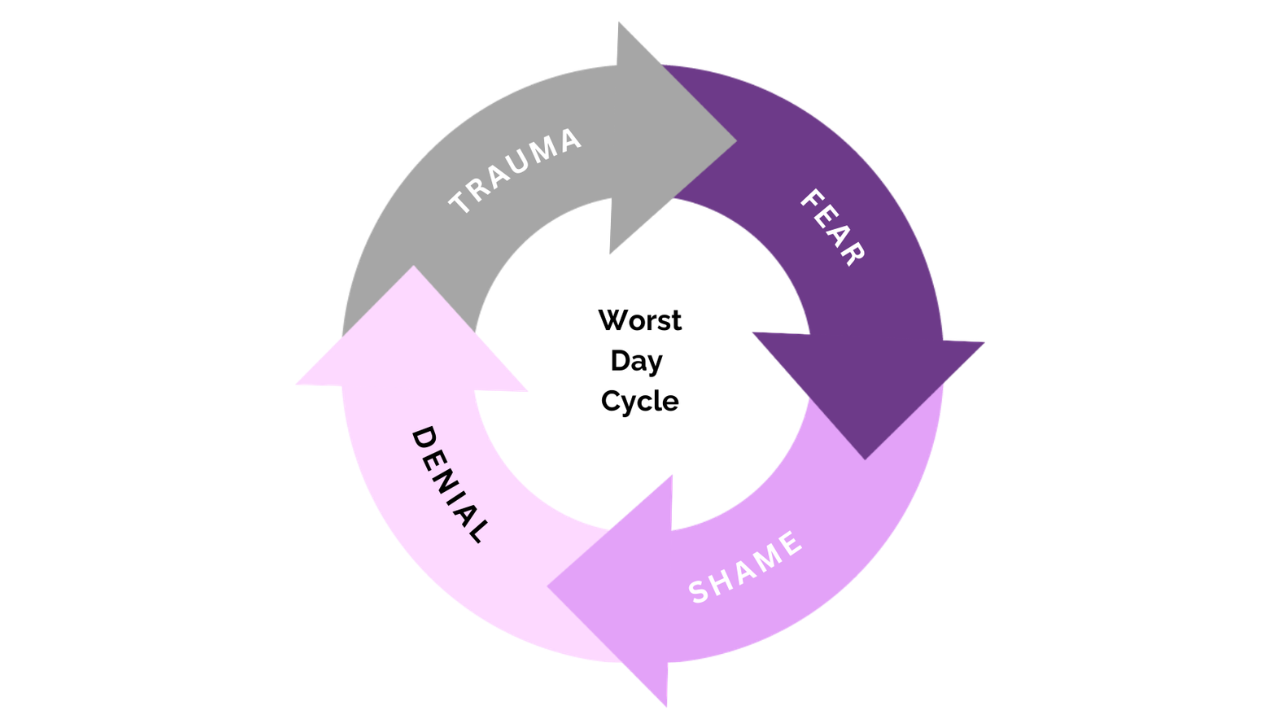
The Worst Day Cycle™ has four stages:
Stage 1: Trauma
Childhood trauma creates a painful meaning. Maybe your parent was distant, so you learned: If I’m not perfect, I’ll be abandoned. Maybe they were volatile, so you learned: Emotions are dangerous. Maybe they ignored you, so you learned: My needs don’t matter. That painful meaning became your operating system.
Stage 2: Fear
Fear drives repetition. Your nervous system is constantly scanning for evidence that the painful meaning is true. Your partner is quiet? They’re leaving. Your boss didn’t reply to your email? I’m going to be fired. Your friend made plans without you? Nobody actually likes me. Fear keeps the cycle spinning.
Stage 3: Shame
Shame is where you lost your inherent worth. It’s the moment you shifted from What happened to me to What’s wrong with me. In shame, you believe you are the problem. Not your circumstances. Not your parents’ limitations. You. This is the deepest level of the childhood blueprint, and it runs nearly every adult struggle.
Stage 4: Denial
Denial is the survival persona you created to survive the pain. It’s not lying. It’s a brilliant protection mechanism. You denied the truth because the truth was too painful. You minimized what happened. You condoned your parents’ imperfections. You told yourself stories that made the pain smaller. That survival persona kept you functional.
But here’s the problem: for many of you, you’ve never grieved. You’ve been in denial. You’ve suppressed and minimized. And that denial is still running, keeping you stuck in the same emotional pattern.
The Three Survival Personas That Kept You Alive
You didn’t just create one response to your childhood. You created a survival persona — a protective version of yourself designed to keep you safe in an unsafe environment. And that persona became your identity.
There are three main survival persona types, though most of us oscillate between them depending on the situation.
The Falsely Empowered Survival Persona
This is the controller. The dominant one. The rager. This persona learned that the only way to stay safe was to take control, dominate situations, and suppress anything that felt vulnerable. Maybe your parent was out of control, so you became hyper-responsible. Maybe your parent was weak, so you became strong. Maybe you learned that vulnerability meant pain, so you armored up.
That’s you if you’re always in charge, always the one managing the relationship, always the one with the plan. That’s you if you rage when things aren’t perfect or if people don’t follow your lead. That’s you if vulnerability feels like drowning.
The falsely empowered persona is powerful, but it’s lonely. And it’s exhausting. Because you’re carrying everyone else’s emotional weight, you can never actually rest.
The Disempowered Survival Persona
This is the pleaser. The collapser. The one who learned that the only way to stay safe was to make yourself small, to be “easy,” to never ask for anything, and to adapt endlessly to other people’s moods. Maybe your parent was narcissistic, so you learned to be invisible. Maybe your parent was fragile, so you became their emotional support. Maybe you learned that your needs were a burden, so you stopped having them.
That’s you if you’re constantly apologizing, constantly adjusting, constantly wondering what other people think. That’s you if you collapse when conflict happens. That’s you if you’re saying yes when you mean no.
The disempowered persona feels safe in relationships, but it’s based on self-abandonment. And eventually, you become so invisible that the people closest to you don’t actually know you.
The Adapted Wounded Child
This is the oscillator. This persona learned to switch between falsely empowered and disempowered depending on the situation. Maybe one parent was controlling and the other was passive, so you learned to read the room and adapt. Maybe you had to be strong with one parent and invisible with the other. Maybe you learned that safety meant constant vigilance.
That’s you if you’re confident at work but crumble in relationships. That’s you if you’re strong with friends but powerless with your partner. That’s you if you’re always switching, always reading the room, always trying to get the balance right.
None of these personas is bad. They all made perfect sense. They kept you alive. But now they’re running your adult relationships, and they’re keeping you trapped in patterns that don’t serve you anymore.
The Authentic Self Cycle™: Your Path to Healing
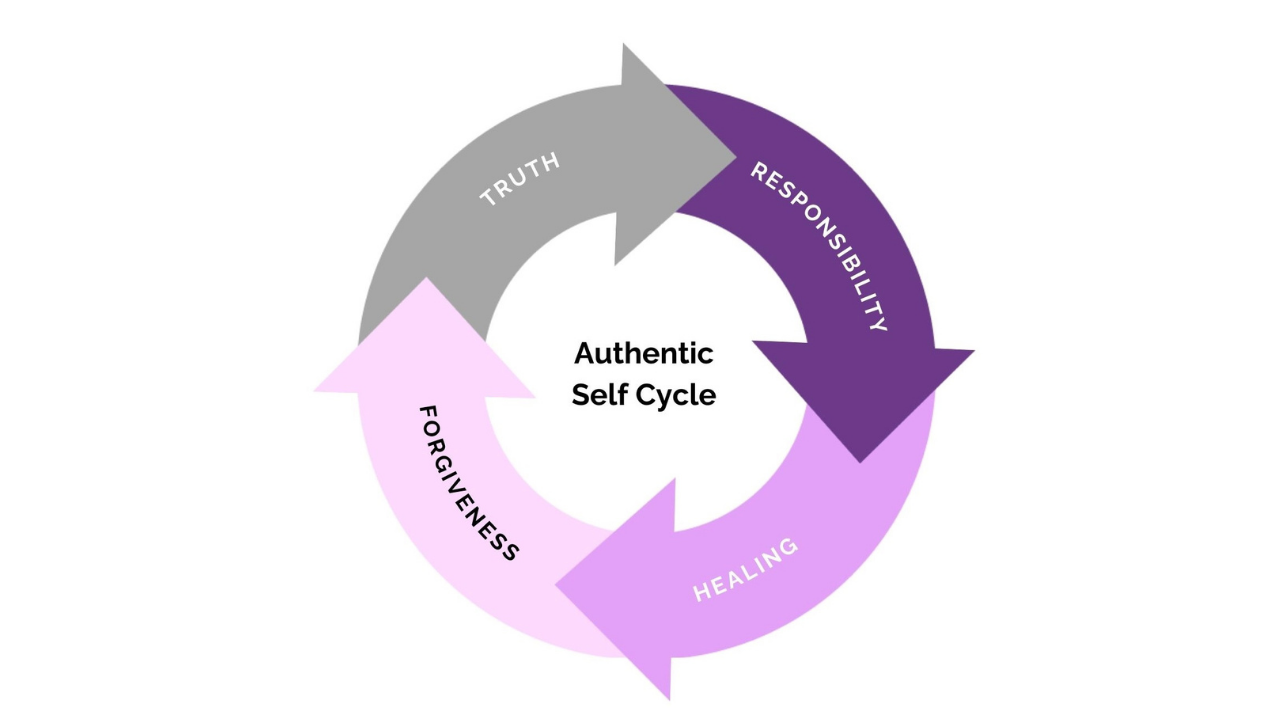
The Worst Day Cycle™ is the pattern that’s been running you. The Authentic Self Cycle™ is the pattern that will set you free.
This is the healing journey, and it has four stages:
Stage 1: Truth
The first stage is getting into truth. This means naming the blueprint. Seeing it clearly. Understanding that the way you relate to love, conflict, intimacy, boundaries, connection, and emotional presence was shaped by your childhood trauma. But here’s the key: this isn’t about today.
When you’re triggered by your partner, the truth is: This isn’t about them. This is my childhood nervous system responding to something that feels familiar. When you’re panicking about being alone, the truth is: My nervous system thinks abandonment is coming, but my partner is right here. When you’re raging at something small, the truth is: I’m not actually angry about this. I’m angry about what happened to me as a child.
Truth isn’t blame. It’s clarity. And clarity is where healing begins.
Stage 2: Responsibility
Once you see the truth, the next stage is taking responsibility. But responsibility is not the same as blame. Taking responsibility means owning your emotional reactions without blame.
This means saying: My partner isn’t my parent. My nervous system just thinks they are. I’m going to feel my feelings, and I’m not going to make them responsible for my childhood. This means understanding that your behavior — your rage, your pleasing, your distance — is coming from your nervous system, not from your partner’s failure.
When you take responsibility, you move from victim to agent. You move from This is happening to me to This is happening in me, and I can change it.
Stage 3: Healing
Healing is where you commit to doing the work to rewire your emotional blueprint. This is active, somatic work — not just thinking about it, but feeling through it and rewiring your nervous system at the cellular level.
In healing, conflict becomes uncomfortable but not dangerous. Your nervous system no longer interprets disagreement as a threat to the relationship. Space doesn’t mean abandonment. Your partner going to see friends doesn’t activate your alarm bells. Intensity doesn’t automatically mean attack. Your partner being passionate doesn’t mean they’re enraged.
This is the stage where your nervous system learns a new baseline. A new normal. A new chemical addiction — to safety, to presence, to authentic connection.
Stage 4: Forgiveness
Forgiveness is the final stage, and it’s not what you think. It’s not letting your parents off the hook. It’s not saying what happened was okay. Forgiveness is releasing the inherited emotional blueprint and reclaiming your authentic self.
Forgiveness means: My parents did the best they could with where they were at the time. They weren’t bad people — they were limited people. And now I get to choose differently.
When you forgive, you release the fight against your past. You stop making your parents’ limitations your identity. You step into your own agency.
The Emotional Authenticity Method™: 6 Steps to Rewire Your Blueprint
Understanding your past is the first part of healing. But understanding alone doesn’t change anything. You can’t be blamed for doing something you weren’t even aware of. You did the best you could with where you were at the time. And now that you know more, you get the chance to choose something different.
The problem is: you can’t change emotional patterns through thoughts alone. Emotions are biochemical events. They happen in your body and your nervous system, not in your brain. Thoughts actually originate from feelings — not the other way around.
This is why the Emotional Authenticity Method™ is a somatic, step-by-step process for rewiring your emotional blueprint at the neurological and biochemical level. It’s the difference between understanding you have a problem and actually healing it.
Step 1: Somatic Down-Regulation
You can’t heal from a dysregulated nervous system. Your first job is to bring yourself back to baseline. This is simple: focus on what you can hear for 15 to 30 seconds. Really listen. Notice the sounds around you. This activates your parasympathetic nervous system and brings you out of fight-flight-freeze.
If you’re highly dysregulated — if you’re in full panic or rage — you might need to use titration: smaller, shorter bursts of regulation work. Maybe 5 seconds of listening, then a pause, then 5 seconds again. The goal is to get your nervous system calm enough that you can actually access your emotional awareness.
Step 2: What Am I Feeling Right Now?
Once you’re regulated, the next step is to get specific about your emotion. Not “I feel bad.” Not “I feel anxious.” Use emotional granularity. Are you feeling afraid? Ashamed? Angry? Lonely? Disappointed?
Use the Feelings Wheel — it’s a visual tool that helps you map out exactly what you’re experiencing. Most people have been taught to suppress their emotions, so you’ve probably been using the same 3–5 words your whole life. Getting specific is the beginning of mastery.
Step 3: Where in My Body Do I Feel It?
All emotional trauma is stored physically in your body. Your nervous system holds memories in your muscles, your spine, your chest, your stomach. When you can locate the feeling in your body, you’re accessing the actual trauma imprint.
Where do you feel the fear? In your chest? Your throat? Your stomach? The more specific you can be, the more you’re working with the actual nervous system pattern that created the feeling.
Step 4: What Is My Earliest Memory of Having This Exact Feeling?
This is the tracing step. This is where you go back to childhood and find the origin of this emotional pattern. You might not get a specific memory — you might get a feeling tone, a sense, an image. That’s fine. You’re connecting your adult trigger to the childhood blueprint that created it.
This is where you understand: This feeling didn’t start today. My nervous system learned this in childhood, and now it’s triggering in my adult life because something feels familiar.
Step 5: Who Would I Be If I Never Had This Thought or Feeling Again? What Would Be Left Over?
This is the vision step. This is where you move into the Authentic Self Cycle™. You’re asking: if this childhood pattern disappeared, who am I underneath it? What’s my authentic response? What would I say? What would I do? What would I believe about myself, others, and the world?
You’re not suppressing the feeling. You’re not denying it. You’re asking: beyond this survival mechanism, what’s actually true? And who would I be if I lived from that truth?
Step 6: Feelization — Create a New Emotional Chemical Addiction
This is the last and most powerful step. Feelization means: sit in the feeling of the Authentic Self, and make it strong. Don’t think about it. Feel it. Visualize yourself operating from this authentic response. And most importantly, feel the chemical sensation of it.
Your body learned the chemical addiction of the Worst Day Cycle™. Cortisol, adrenaline, the panic of abandonment, the shame of not being good enough. These became your normal neurochemistry. Feelization means you’re creating a new normal — the chemical sensation of safety, of agency, of authenticity.
Ask yourself: How would I respond from this feeling? What would I say? What would I do? Visualize it. Feel it. Let your nervous system get addicted to this new pattern instead of the old one.
The truth is: you can’t think your way out of a feeling. But you can feel your way out of a pattern. Feelization is that feeling-based transformation.
That’s you if you’re tired of understanding your patterns and you’re ready to actually change them.
The Signs That You’re Still Living in Your Childhood Blueprint
Unhealed childhood trauma shows up differently in different areas of your life. Here’s how to recognize if you’re still caught in the Worst Day Cycle™:
In Your Family Relationships
You’re still managing your parents’ emotions. You’re still trying to earn their approval. You’re still adapting yourself to keep the peace. You’ve never grieved what you needed but didn’t get. You’re still operating from the belief that your job is to keep your family members comfortable, even at the expense of your own needs.
That’s you if you can’t have a real conversation with your parents because you’re still the child trying to keep them happy.
In Your Romantic Relationships
You’re triggered by normal conflict. You interpret small disconnections as rejection. You oscillate between pursuing and withdrawing. You can’t ask for what you need. You people-please until you collapse. You rage at small things because you learned that anger was how you got needs met. You’re anxious, avoidant, or oscillating between both.
That’s you if you’re repeating the same relationship pattern over and over, just with different partners.
In Your Friendships
You’re the giver. The listener. The one who always shows up. But you rarely ask for support. You feel like a burden if you need anything. You’re enmeshed with certain friends and isolated from others. You choose friendships with people who need you, because needing them back feels too scary.
That’s you if your friendships feel one-directional and you’re exhausted from always being the strong one.
In Your Work Life
You’re a high achiever, but you don’t feel successful. You’re always pushing, always striving, never resting. You struggle with authority because your boss reminds you of your parent. You’re either a perfectionist or you self-sabotage. You can’t receive recognition without minimizing it.
That’s you if you reach your goals and immediately set new ones, never actually celebrating.
In Your Body and Health
Your body holds the trauma. You have chronic pain, chronic tension, digestive issues, or autoimmune problems. You dissociate from your body. You overexercise or you can’t move. You struggle with body image. You use substances or behaviors to numb the feelings your body is trying to communicate.
That’s you if your body is sending you signals and you’ve been ignoring them for years.
Reparenting: Give the Pain Back and Heal Yourself
The healing journey has three clear steps, and the third one is where most people miss the transformation.
Step One: Identify the Source
You have to know what you’re healing from. You have to name it. You have to look at your childhood and say: This is where I learned to fear abandonment. This is where I learned that my needs don’t matter. This is where I learned that I’m not safe.
That’s you if you’re beginning to see the connections between your childhood and your adult struggles.
Step Two: Give the Pain Back to Your Parents
This is the grief work. For many of you, you’ve never grieved. You’ve been in denial. You’ve suppressed and minimized your parents’ perfect imperfections. But your parents are not bad people — they adored you. They wanted to do everything they could to raise you perfectly. They didn’t have all the information, so they made loving mistakes.
Giving the pain back doesn’t mean blaming them. It means: Mom, you did the best you could with where you were at the time. And the way you showed up taught me painful things about myself and the world. I’m going to grieve that now.
Grief is not regression. Grief is the emotional truth the child was never allowed to feel. And when you finally let yourself feel it, something shifts.
Step Three: Reparent Yourself
This is the transformation. Reparenting means you become the parent your child self needed. You learn to attune to your own needs. You learn to soothe your own nervous system. You learn to believe in yourself when the world tells you not to.
Reparenting looks like:
- When you’re dysregulated, you bring yourself back to baseline. You don’t judge yourself for falling apart — you just help yourself get regulated.
- When you want something, you ask for it. Not in a demanding way, but in a clear, authentic way. Your needs matter.
- When you fail, you don’t shame yourself. You say: That didn’t work. What would help me next time?
- When you’re scared, you get curious instead of critical. What’s actually scary here? What do I need to feel safe?
- When you achieve something, you actually celebrate it. You don’t immediately move to the next goal.
- When you’re alone, you don’t panic. You’ve learned to be your own safe person.
Reparenting is the daily practice of treating yourself the way you always needed to be treated. And it’s the foundation of all adult healing. As you reparent, your relationships change too — you start recognizing the do’s and don’ts for great relationships because you finally have the internal stability to show up authentically.
Grief and Forgiveness: The Emotional Truth
There’s a Victim Position Paradox that most people don’t understand. It says: as long as you’re waiting for your parents to give you what they couldn’t give you, you’re still a victim. But the moment you grieve what you didn’t get, you become an agent in your own healing.
Grief is the bridge between victim and agency.
In grief, you allow yourself to feel the loss. Not anger. Not resentment. Not blame. Loss. The loss of the childhood you should have had. The loss of the parents you needed. The loss of the safety and attunement you deserved.
That’s you if you’re ready to cry for the child you were.
And once you’ve grieved, forgiveness becomes possible. Forgiveness doesn’t mean you’re okay with what happened. It means you’re releasing the fight against the past. It means you understand that your parents were limited, wounded people who did what they could. And now you get to choose differently.
When you take responsibility for your healing, you take your power back. Your parents no longer have to be perfect for you to be okay. Your past no longer has to change for your future to be different.
People Also Ask
How long does it take to heal from childhood trauma?
Healing is not a timeline. It’s a practice. Some people see shifts in days when they understand the framework and start doing the work. Some people need months or years to rewire deep patterns. The key is consistency, not speed. You’re literally rewiring your nervous system, and that takes repetition. Trust the process, not the timeline.
Can you heal from childhood trauma without therapy?
You can absolutely do deep healing work on your own. Understanding the frameworks (Worst Day Cycle™, Authentic Self Cycle™, Emotional Authenticity Method™) and practicing the 6-step process consistently will create real change. That said, some people benefit from having a guide — someone who can hold them accountable, help them see blind spots, and support them through the grief. It’s not mandatory, but it accelerates the process.
What if I don’t remember my childhood?
You don’t need detailed memories to do this work. Your body remembers what your mind forgot. The Emotional Authenticity Method™ works with feelings and somatic sensations, not just memories. As you do the work, memories often emerge naturally. Your job is just to follow the feeling back to its origin.
How do I know if I’m truly healed?
You’re healed when conflict doesn’t feel dangerous. When space doesn’t feel like abandonment. When intensity doesn’t feel like attack. When you can ask for what you need without shame. When you can be alone without panic. When you can celebrate your wins. When you can hold genuine self-esteem without needing external validation. Healing isn’t perfection — it’s freedom from the compulsive repetition of your childhood pattern.
What if my parents won’t acknowledge what happened?
Your parents’ acknowledgment would be nice, but it’s not required for your healing. Your healing is for you, not for them. You get to grieve what happened regardless of whether they admit it. In fact, waiting for their permission to feel your feelings keeps you stuck in victim position. Your healing begins when you decide it’s true for you.
Can relationships actually get better after trauma?
Yes. Absolutely. Once you understand your blueprint and start rewiring it, your relationships transform. Your partner stops being your parent. Conflict becomes information instead of threat. Intimacy becomes possible. But this requires both people to be willing to do the work. If you’re the only one healing, you eventually have to make a choice about whether to stay.
The Bottom Line
Your past doesn’t have to be your prison. The Worst Day Cycle™ that started in your childhood doesn’t have to run your adult life. You have the power to rewire your emotional blueprint and create a completely different future.
This doesn’t require perfect parents. It doesn’t require erasing what happened. It requires honest truth, willingness to grieve, and consistent practice of the Emotional Authenticity Method™. It requires you to become the parent you always needed. It requires you to release the inherited emotional blueprint and reclaim your authentic self.
You’re not broken. You’re not damaged beyond repair. You’re just operating from an old system that made perfect sense when you were eight. And now that you’re grown, you get to choose something different.
The question isn’t whether you can heal. The question is: are you ready to?
Recommended Reading and Resources
If you want to go deeper into this work, these books offer foundational wisdom:
- Facing Codependence by Pia Mellody — The foundational text on how childhood trauma creates survival personas, codependent patterns, and the loss of authentic self.
- The Body Keeps the Score by Bessel van der Kolk — Essential reading on how trauma lives in the nervous system and why healing requires more than talk therapy.
- When the Body Says No by Gabor Maté — How emotional repression and unresolved childhood pain manifest as physical illness.
- Codependent No More by Melody Beattie — The classic guide to setting boundaries and stopping the cycle of self-abandonment in relationships.
- The Gifts of Imperfection by Brené Brown — A guide to wholehearted living that directly counters the shame keeping you disconnected from your authentic self.
Use the Feelings Wheel daily to build emotional granularity and awareness.
Your Next Steps
You now understand the frameworks. You know the Worst Day Cycle™. You know what your survival persona is. You know the path to the Authentic Self Cycle™. The question is: are you ready to walk it?
Here are your options:
Start With Self-Guided Work
Emotional Blueprint Starter Course — Individual — $79 is the foundational course for doing this work on your own. You’ll get the complete framework, daily practices, and the Emotional Authenticity Method™ explained step-by-step.
If You’re In a Relationship
Relationship Starter Course — Couples — $79 walks you and your partner through how your childhood blueprints interact and how to rewire them together. This is perfect if you want to do this work as a team.
If you’re struggling with avoidant patterns specifically, The Shutdown Avoidant Partner — $479 is the deep dive into why avoidance happens and how to actually connect.
If You’re a High Achiever Struggling With Love
Why High Achievers Fail at Love — $479 addresses the specific way that childhood trauma shows up when you’re successful, driven, and can’t figure out why relationships still feel broken.
If You Want the Complete Transformation
Why We Can’t Stop Hurting Each Other — $479 is the complete codependence blueprint: where it comes from, how it shows up, and the exact pathway to rewire it.
Tier 1: Mapping the Blueprint — $1,379 is the most comprehensive program. This is where you learn every detail of the Emotional Authenticity Method™, practice it in real time, and get accountability for the work.
The Real Truth
You can read this guide a hundred times. You can understand every framework perfectly. But understanding is not transformation. Transformation happens through feeling. Through the daily practice of the Emotional Authenticity Method™. Through sitting with your grief. Through reparenting yourself over and over until it becomes your new normal.
Your childhood created your blueprint. But your choices create your future. And that future starts right now, with the decision to heal.
The question is: are you ready?