You Know Something Was Wrong, You Just Didn’t Have Words for It
You remember his rage. Or maybe it was his coldness. The way he disappeared into himself when you needed him. Or the way he made everything about him, even your pain. Years later, you’re still waiting for an apology that never comes. You still feel that familiar knot in your chest when you hear his voice. You still find yourself performing, trying to be the right version of yourself to avoid his disappointment.
That’s not just bad parenting. That’s what happens when your father has a narcissistic wound so deep that he can’t let you be separate from him. He doesn’t see you. He sees a reflection he can control, or a mirror he can break when he needs to feel powerful again.
This post names the 7 signs that your father was a narcissistic parent. More importantly, it explains why those signs still run your life. And how to stop them.
Quick Recognition: The 7 Signs of a Narcissistic Father
If you’re reading this because you suspect your father is narcissistic, you’re not looking for a diagnosis. You’re looking for permission to stop blaming yourself for his emotional unavailability. Here are the core patterns:
Sign 1: He Lacks Genuine Empathy (But Mimics It Perfectly)
A narcissistic father can be charming in public. He’ll hug you in front of others, ask about your day, seem interested. But in private, he’s absent. Not just physically—emotionally unreachable.
When you were hurt, he didn’t feel your pain. He felt inconvenienced by it. When you cried, he either rage-shamed you into silence or ignored you completely. His question “What’s wrong?” wasn’t an invitation to share; it was a demand to stop being a problem.
This created a wound: you learned that your feelings don’t matter. They’re only important if they serve his image or his needs. Real empathy would require him to see you as a separate person with your own inner world. A narcissist can’t do that. It would threaten his sense of control.
That’s you when you prioritize other people’s comfort over your own pain. That’s you when you apologize for being upset. That’s you when you believe that real love means not needing anything.
Sign 2: He Demands Control and Punishes Disagreement
There was a hierarchy in your house. His way. No negotiation. Disagreement wasn’t just wrong—it was a personal attack on him. If you questioned his decision, he heard it as “You’re not good enough.” And he punished that.
The punishment was either rage or withdrawal. Maybe he exploded and made you feel small. Maybe he went silent and let you feel abandoned. Both work the same way: they teach you that having your own thoughts is dangerous.
As an adult, you probably do one of two things. You either overcorrect and need to control everything (your partner, your children, your environment) to feel safe. Or you’ve become compliant—you go along with what others want and bury your own needs so deep you don’t remember what you want anymore.
That’s you when you can’t say no without feeling guilty. That’s you when you need approval before you trust your own judgment. That’s you in relationships where you’re always adjusting yourself to keep the peace.
Sign 3: He Requires Constant Validation and Makes You His Supply
Your father needed you to admire him. Not because he loved you and wanted you to be proud of him—but because he didn’t believe in himself and needed you to believe in him instead. You became his emotional supply.
This looked like endless conversations about his achievements, his struggles, his brilliance. Or it looked like him needing you to fix his mood. You became responsible for his emotional state. If he was angry, you tried to cheer him up. If he was disappointed, you tried to prove your worth. If he failed at something, you had to reassure him.
Your own accomplishments only mattered if they reflected well on him. When you succeeded, it was about his parenting. When you failed, it was your shame to carry alone.
That’s you when you’re exhausted from managing other people’s emotions. That’s you when you feel guilty for having your own life. That’s you when you can’t celebrate your own wins without minimizing them.
Sign 4: He Cannot Apologize (Because Apologies Require Shame Awareness)
Your father harmed you. And he never said sorry. Maybe he said “I was just trying to teach you a lesson” or “I did the best I could” or “You’re too sensitive.” Maybe he said nothing at all and expected you to move on like it never happened.
An apology requires three things a narcissist cannot do: acknowledge harm, take responsibility, and commit to change. Each one requires him to feel ashamed. And shame is the one thing he cannot tolerate. So instead, he re-writes the narrative. He was right. You misunderstood. You’re overreacting.
This creates a specific trauma in you: the belief that harm never happened, or that you deserved it. You learn to gaslight yourself. You minimize his behavior. You make excuses for him to friends. And you feel insane, because deep down you know he hurt you, but you’ve been trained to deny it.
That’s you when you defend your father to others even though he hurt you. That’s you when you question your own memory of events. That’s you when you apologize for things that weren’t your fault.
Sign 5: He Uses Rage or Withdrawal as His Primary Weapons
Some narcissistic fathers explode. The rage comes from nowhere—or from something tiny—and suddenly the house is a war zone. You walk on eggshells. You learn his moods. You become hypervigilant to the smallest sign that he’s getting angry so you can adjust yourself to prevent the explosion.
Other narcissistic fathers are ice. They withdraw emotionally or physically. They punish through silence. Either way, the message is the same: “You made me do this. Your existence is a problem. The way to be safe is to make yourself smaller.”
These are different tactics, but they create the same wound: you learned that relationships are dangerous. That love is conditional on your ability to read minds and prevent harm. That your presence alone is enough to trigger abandonment.
That’s you when you’re always trying to anticipate what will upset your partner. That’s you when you’ve built walls to protect yourself from being abandoned. That’s you when you sabotage relationships because you expect them to fail.
Sign 6: He Treats You as an Extension of Himself, Not a Separate Person
A narcissistic father sees you as a tool for his own needs. Your job is to make him look good, make him feel powerful, validate his worldview, or carry his unfulfilled dreams.
This might look like: forcing you into his career path, controlling your appearance, shaming your sexuality, requiring you to share his politics, or using you to compete against your mother. He couldn’t see you. He could only see what you could do for him.
The deepest wound here is that you were never really known. Your preferences, your gifts, your truth—they only mattered if they aligned with his needs. So you learned to hide your real self and perform the version he wanted to see. Over time, you forgot who you actually were.
That’s you when you don’t know what you want because you’ve always been living for other people. That’s you when you change yourself completely for each relationship. That’s you when you feel like a fraud because your inner world doesn’t match your outer presentation.
Sign 7: He Alternates Between Idealization and Devaluation
With a narcissistic father, you were either perfect or worthless. There was no middle ground. You were his favorite, his source of pride—until you weren’t. Then you became the problem, the disappointment, the reason his life didn’t turn out the way he wanted.
These cycles whiplashed you. When you were idealized, you felt relieved—finally, you had his approval. But it was fragile. You were always one mistake away from being devalued. This taught you that love is conditional, unstable, and impossible to keep.
In your adult relationships, you either recreate this pattern (seeking partners who idealize and devalue you) or you try to prevent it by staying perfect. Both are exhausting. Both are rooted in the same wound: you believe you have to earn the right to exist.
That’s you when you’re addicted to the highs and lows of a relationship. That’s you when you stay with someone who alternates between cherishing you and punishing you. That’s you when you believe that if you just get better, the abuse will stop.
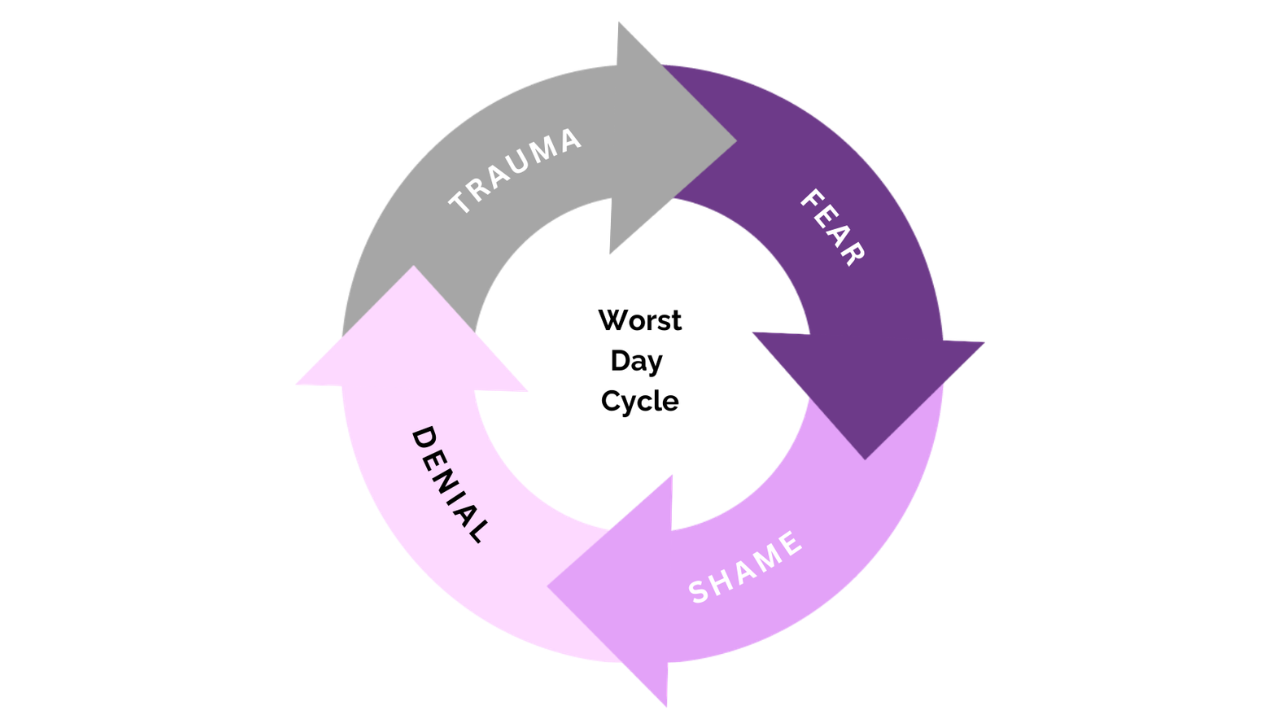
Why This Pattern Is Still Running Your Life: The Worst Day Cycle™
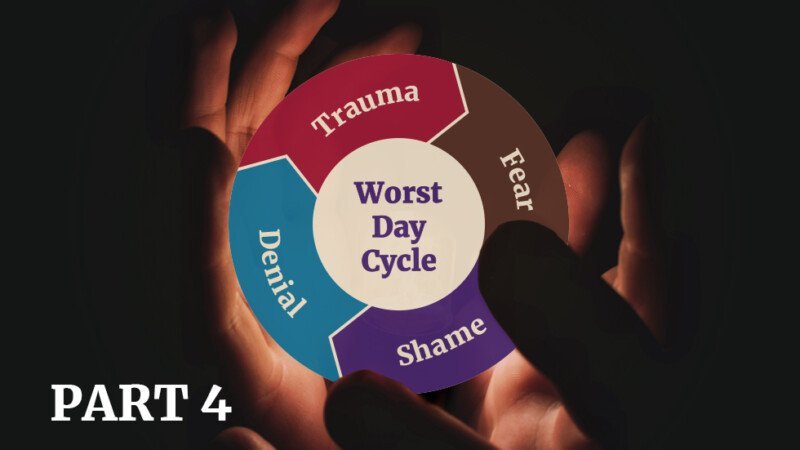
Your father was a narcissist. But the real problem isn’t him anymore. It’s the Worst Day Cycle™—the loop of trauma, fear, shame, and denial that he programmed into you.
Here’s how it works:
Trauma: Something triggers you. A comment from your partner. A moment where you’re invisible. A situation where you need someone and they’re not there. It echoes the original wound with your father.
Fear: Your nervous system recognizes the pattern. You’re flooded with fear that this will end in abandonment, shame, or control loss. Your body goes into fight/flight/freeze.
Shame: Instead of recognizing that your father hurt you, you blame yourself. You believe that if you were just better—smarter, prettier, more compliant, less needy—this wouldn’t be happening. The shame is old. It’s from childhood. But it feels present and true.
Denial: The pain is too much, so you deny it. You tell yourself it wasn’t that bad. You make excuses for the other person. You reframe the situation to make sense of it. You deny what you felt. You deny what happened. You deny that you deserve better.
Then something else triggers you, and the cycle repeats.
This is why your relationships keep recreating the narcissistic dynamic. This is why therapy and self-help books haven’t fully fixed this. Because you’re not just dealing with memories of your father. You’re dealing with a nervous system that learned to expect harm, a psyche that learned to deny pain, and a survival persona that learned to be invisible.
Why Therapy and Self-Help Haven’t Fixed This (Yet)
You’ve probably tried therapy. Maybe you’ve read a dozen books about narcissistic parents. You understand intellectually that his behavior was wrong. You can articulate the ways he damaged you. You know the theory.
But you still feel it. You still recreate it. You still shame yourself. You still attract narcissistic partners, or you’ve built walls so thick that real intimacy feels impossible.
Here’s why: traditional therapy treats this as a thinking problem. It works from your prefrontal cortex—your rational brain. It asks you to process, to reframe, to logically understand that you weren’t to blame. And that’s necessary. But it’s not sufficient.
The wound with your narcissistic father isn’t in your thinking. It’s in your body. It’s in your nervous system. It’s in the way your survival persona learned to operate to keep you safe. No amount of insight will change what your body learned in childhood.
Self-help books promise that if you just practice self-love, set better boundaries, or work on your self-esteem, you’ll heal. But they skip over the core issue: you don’t have a self-esteem problem. You have a survival problem. You learned to survive by disappearing, by denying, by becoming what others needed. Your survival persona isn’t a character flaw. It’s evidence of your genius for staying alive in an impossible situation.
What you need isn’t another framework for self-improvement. What you need is a somatic, emotion-centered approach that brings your whole self into alignment with your truth. That’s where the Emotional Authenticity Method™ comes in.
The Shift: From Survival Persona to Emotional Authenticity
The Emotional Authenticity Method™ is not a mental exercise. It’s a somatic process that realigns your nervous system with your truth. It brings your survival persona out of the shadows and helps it evolve into your authentic self.

Step 1: Feel, Don’t Think
Stop analyzing. Start sensing. Where do you feel your father’s narcissism in your body right now? In your chest? Your stomach? Your throat? Don’t think about where you should feel it. Notice where you actually feel it. Your body knows the truth before your mind does.
Step 2: Name the Survival Persona Type
You created a survival persona to survive your father. Which one? The falsely empowered persona that learned to control and perform strength to avoid vulnerability? The disempowered persona that learned to disappear and comply to avoid punishment? Or the adapted wounded child persona that learned to take care of others and deny your own needs to earn belonging?
Naming it is crucial. Because it’s not who you are. It’s who you had to become to survive.
Step 3: Grieve What You Needed and Didn’t Get
Your father owed you something. He owed you empathy, protection, attunement, and unconditional acceptance. He owed you the experience of being truly seen. You didn’t get it. That’s a loss. And losses need to be grieved.
This isn’t about blaming him. It’s about acknowledging that what happened was real, it mattered, and it hurt. Your grief is justified.
Step 4: Locate Your Authentic Truth
Underneath the survival persona is your authentic self. The part of you that knows what you actually want, what matters to you, what feels true. This part has been hidden. Your job is to find it. To listen to it. To ask: What is true for me right now? Not what should be true. Not what he taught me is true. What is actually, genuinely true for me?
Step 5: Reparent Yourself Into Integration
Your nervous system learned that authority figures are dangerous. Now you get to become the authority figure who is safe. This is reparenting. This is you giving yourself what your father couldn’t: empathy, protection, attunement, and unconditional acceptance. This is you learning to move from your head into your body, from shame into truth, from denial into responsibility.
What Healing Actually Looks Like: The Authentic Self Cycle™
The Authentic Self Cycle™ is the path from “my father’s narcissism is still running my life” to “I am free to be myself.” It has four stages.
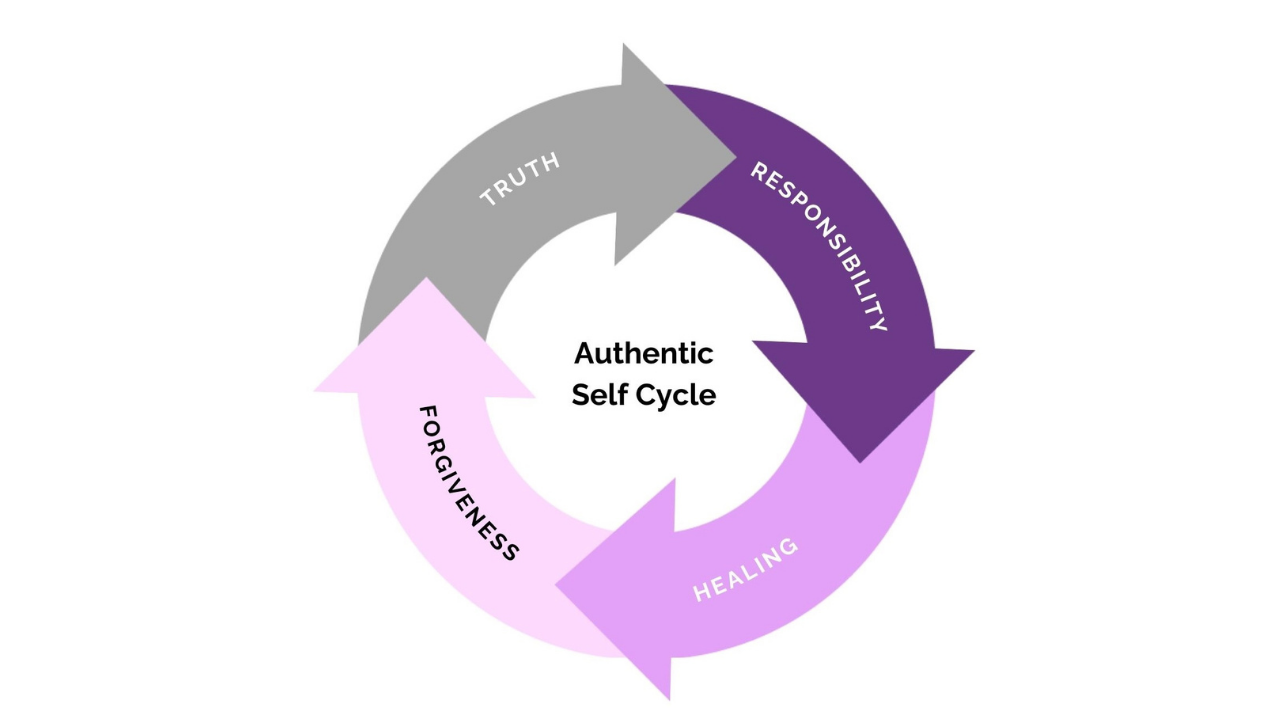
Truth: You stop denying. You name what happened. You acknowledge the ways your father’s narcissism shaped you. Not to blame him. But to stop blaming yourself. Truth is the foundation of everything that follows.
Responsibility: Here’s the hard part. Once you know the truth, you’re responsible for your own healing. Your father hurt you, yes. But he’s not the one stopping you from being authentic. Your survival persona is. Your denial is. Your fear is. Taking responsibility means acknowledging that you now have agency. You can change the patterns.
Healing: This is the work. This is reparenting. This is the Emotional Authenticity Method™ applied consistently. This is teaching your nervous system that you’re safe. That your needs matter. That your truth is valid. That you don’t have to perform or disappear to be worthy.
Forgiveness: Not of your father. Not yet, maybe not ever. Forgiveness of yourself. Forgiveness of the part of you that believed his lies about you. Forgiveness of the survival persona that did what it had to do to keep you alive. This is where freedom lives.
What This Looks Like in Your Adult Life
When your father’s narcissism was running your life, relationships were a series of compromises and denials. You either became the caretaker (managing everyone else’s emotions) or the avoider (afraid of real connection). You either recreated the narcissistic dynamic or built walls so high no one could get in.
Here’s what changes when you move through the Authentic Self Cycle™:
In Romantic Relationships: You stop choosing partners who remind you of your father. You stop performing versions of yourself to earn love. You can name what you actually want—and you can ask for it without shame. You recognize when a partner is being narcissistic, and you don’t normalize it. You can leave, without guilt. Or, if you choose to stay, you can do it from a place of authentic choice, not compulsion.
In Parenting: You break the cycle. You don’t repeat your father’s patterns with your own children. You learn to see them as separate people. You provide the attunement, the unconditional acceptance, the emotional authenticity that you never received. This is reparenting them—and through them, reparenting yourself.
In Your Body: Your nervous system stops living in survival mode. Your hypervigilance eases. You sleep better. You breathe easier. You feel safer in your own skin because you’ve become the safe parent you needed.
In Your Self-Perception: You stop believing the lies your father taught you about yourself. You aren’t unworthy. You aren’t too needy. You aren’t selfish for having needs. You aren’t responsible for his emotional state. You’re allowed to exist. You’re allowed to want things. You’re allowed to be yourself.
That’s you when you can say no without explaining. That’s you when you know what you want and you go after it. That’s you when you’re in a relationship and you’re still yourself. That’s you when your past doesn’t dictate your present.
Related Articles on Narcissistic Parenting
If you’re working through the impact of a narcissistic father, these resources dive deeper into specific patterns and recovery strategies:
- Five Ways to Deal with a Narcissistic Parent — practical strategies for managing ongoing contact (or no contact)
- How to Heal from a Narcissistic Parent — deeper work on the emotional authenticity journey
- Enmeshment: Why You Can’t Separate from Your Narcissistic Parent — understanding the fusion that keeps the cycle alive
- 7 Ways We Attract a Narcissist — how your Emotional Blueprint leads you to repeat the pattern
- 13 Traits of a Narcissist — a deeper dive into narcissistic behavior beyond your father
- Are They a Codependent or a Narcissist? — clarifying the dynamics in your adult relationships
Frequently Asked Questions
Q: What if my father was a covert narcissist—outwardly nice but emotionally unavailable?
A: The damage is the same. Covert narcissists are often harder to identify because they don’t explode or dominate openly. They withdraw, subtly punish, and hide their contempt behind a nice facade. The wound they create is the same: the belief that you’re not worth genuine emotional connection. The 7 signs still apply—they just look quieter. Your job is the same: recognizing the pattern and healing your nervous system through the Emotional Authenticity Method™.
Q: Am I a narcissist if I have some of these traits?
A: Probably not. Children of narcissistic parents often develop narcissistic-like defenses. The falsely empowered survival persona, for example, can look narcissistic. But there’s a crucial difference: it comes from fear, not entitlement. A true narcissist lacks capacity for shame. You’re reading this because you feel shame. That’s a sign of your humanity, not your narcissism. Your task is to evolve that defense into genuine authenticity, not to shame yourself for having it.
Q: Should I confront my father about his narcissism?
A: This depends entirely on your situation. Some people find healing through direct conversation. Others find that confrontation triggers more harm or denial. What matters most is your own healing. If confrontation would serve that, and you’re emotionally resourced to handle his response, it might help. But healing does not require him to acknowledge his behavior. Healing requires you to acknowledge what happened and commit to your own recovery. That work happens inside you, regardless of whether he ever understands.
Q: How long does it take to heal from a narcissistic father?
A: This isn’t linear. You can have insights and breakthroughs and still find yourself back in the Worst Day Cycle™ when you’re triggered. That’s normal. That’s not failure. Healing is about moving through these cycles with more awareness, more compassion for yourself, and more ability to return to your truth. Most people notice significant shifts within months of consistent emotional authenticity work. But this is a lifetime practice. You’re not trying to get over it. You’re trying to learn to live from your authentic self regardless of your history.
Q: What if my father is still alive and in my life?
A: Your healing doesn’t depend on his death or his absence. It depends on your willingness to grieve what you needed and didn’t get, and to reparent yourself into wholeness. That said, managing ongoing contact with a narcissistic parent requires boundaries. These aren’t walls meant to punish him. They’re containers meant to protect your emotional authenticity. You might decide to maintain contact with strict boundaries, or you might decide that no contact is what your healing requires. Both are valid. The key is that this choice comes from your truth, not from guilt or obligation to him.
Q: How do I know if my survival persona is falsely empowered, disempowered, or adapted wounded child?
A: The falsely empowered persona is hypervigilant to control. It needs to be powerful, to be right, to prevent harm through force or dominance. The disempowered persona is hypervigilant to compliance. It learns to be invisible, to go along, to deny its own needs. The adapted wounded child persona is hypervigilant to caretaking. It learned that being needed is how you earn belonging. Pay attention to which patterns you default to under stress. That’s your primary survival strategy. Most of us have elements of all three, but one dominates. Identifying it is the first step to evolving it into genuine authenticity through the Emotional Authenticity Method™.
Your Next Step: Move from Understanding to Healing
Recognizing that your father is narcissistic is important. But it’s not enough. The goal isn’t understanding—it’s freedom. Freedom from his voice in your head. Freedom from the shame that isn’t yours. Freedom to be yourself in your relationships. Freedom to choose your own path.
That freedom comes through the Emotional Authenticity Method™—through feeling, naming, grieving, locating your truth, and reparenting yourself into integration.
If you’re ready to move beyond insight into actual transformation, I’ve created a comprehensive program at The Greatness U. This is where I teach the full methodology—the Worst Day Cycle™, the Authentic Self Cycle™, and the 5-step Emotional Authenticity Method™ that I’ve outlined in this post. You’ll work through real scenarios from your life, you’ll learn to recognize when you’re in your survival persona, and you’ll develop the capacity to return to your authentic self even when triggered.
You’ll also have access to my book, “Your Journey to Success,” which goes deeper into the frameworks and the personal work required to move from survival to authenticity.
This is the kind of work that changes lives. Not because it’s complicated, but because it’s honest. It meets you where you are—in the shame, the denial, the old patterns—and it shows you the path to the other side.
The Bottom Line
Your father’s narcissism was never about you. It was about his inability to see you as a separate person, to tolerate his own shame, to offer genuine empathy. The way he treated you was a reflection of his wound, not your worth.
But his patterns have shaped you. They’ve programmed your nervous system. They’ve created your survival persona. And they’ve kept you locked in the Worst Day Cycle™—repeating the same dynamics in your adult relationships, your career, your parenting, your relationship with yourself.
The good news: this is changeable. You have the capacity to break the cycle. You have the capacity to move from your survival persona into your authentic self. You have the capacity to build relationships where you’re genuinely seen and accepted. You have the capacity to be free.
It starts with truth. It continues with responsibility. It moves through healing. And it culminates in forgiveness—of yourself, for doing what you had to do to survive.
Your father may never understand what he did. But you will. And that understanding, paired with consistent emotional authenticity work, will set you free.