Your conversations don’t turn into fights because of what’s happening in the present moment. They turn into fights because unhealed childhood trauma is hijacking your nervous system, activating the Worst Day Cycle™, and making your partner feel like your parent. When you can’t stay present in conflict without spiraling into shame, rage, or collapse, you’re not broken — you’re repeating an emotional blueprint that protected you as a child but sabotages you as an adult.
Fights in relationships aren’t caused by current disagreements — they’re triggered by unprocessed childhood wounds that make your nervous system perceive danger where there is none. The Worst Day Cycle™ (Trauma → Fear → Shame → Denial) activates your survival persona, which either explodes, collapses, or oscillates. The path forward is recognizing the pattern isn’t about your partner, it’s about rewiring your emotional blueprint through the Authentic Self Cycle™ and the Emotional Authenticity Method™.
Table of Contents
- Why Your Conversations Turn Into Fights (It’s Not What You Think)
- How Childhood Trauma Hijacks Your Nervous System
- The Worst Day Cycle™: Four Stages of Relational Sabotage
- Meet Your Survival Persona (And Why It Destroys Relationships)
- The Signs: Where This Shows Up in Your Life
- Your Emotional Blueprint Is Not Your Destiny
- The Path Forward: The Authentic Self Cycle™
- The Five-Step Emotional Authenticity Method™ to End the Cycle
- People Also Ask (FAQ)
- The Bottom Line
Why Your Conversations Turn Into Fights (It’s Not What You Think)
You’re having a normal conversation with your partner. They mention something you did that bothered them. Simple. Fixable. But within seconds, your body floods with adrenaline, your heart rate spikes, and you either explode in anger, shut down completely, or oscillate between both. By the end, you’re not discussing the original issue — you’re in a full-blown fight about tone, past grievances, or whether they even love you.
You blame the conversation. You blame your partner. You blame the fact that you “can’t communicate.” But here’s the truth: the conversation didn’t cause the fight. Your unhealed childhood wounds caused the fight. Your nervous system perceived danger where there was none, activated the Worst Day Cycle™, and your survival persona took over.
That’s you — having normal conversations escalate into relationship-threatening conflicts that make zero sense in the moment, but everything makes sense once you understand the pattern.
This isn’t a communication skills problem. This is a nervous system regulation problem. This is a trauma response. And it’s entirely fixable once you understand what’s actually happening.
How Childhood Trauma Hijacks Your Nervous System
When you were a child, something happened (or many things happened) that created painful emotional meanings. Maybe a parent was critical, absent, or volatile. Maybe you were enmeshed with a parent’s emotional state. Maybe you learned that expressing your needs meant abandonment, shame, or rage. Maybe you absorbed a parent’s anxiety or depression as if it were your own fault.
That experience created what neuroscientists call a “negative emotional template” — an expectation about how relationships work, what you’re worth, and what danger looks like. Your brain didn’t file this away as “that happened then.” Your brain filed it as “this is how the world works.”
Childhood trauma creates a massive chemical reaction in the brain and body. The hypothalamus generates a chemical cocktail of cortisol, adrenaline, dopamine, and oxytocin misfires. The brain becomes addicted to these emotional states because they’re familiar. Repetition equals safety in a traumatized nervous system.
Here’s the devastating part: your brain conserves energy by repeating known emotional patterns. It can’t tell right from wrong. It can only tell known from unknown. Since 70%+ of childhood messaging is negative and shaming, you automatically repeat these painful patterns in your adult relationships, career, hobbies, health — everywhere.
That’s you — repeating relationship patterns you swore you’d never repeat, without realizing your nervous system thinks repetition equals survival.
When your partner brings up a conflict, your nervous system doesn’t register “my partner wants to discuss something.” It registers “danger. This is what happened with my parent. I’m not safe.” Your amygdala hijacks your prefrontal cortex. Your survival mode activates. And you respond not to your partner, but to your childhood.
The Worst Day Cycle™: Four Stages of Relational Sabotage
The Worst Day Cycle™ is the blueprint of how unhealed trauma repeats in your relationships. It has four stages, and once you see it, you can’t unsee it. You’ll start recognizing this pattern everywhere — in your fights, your denial, your rage, your collapse.
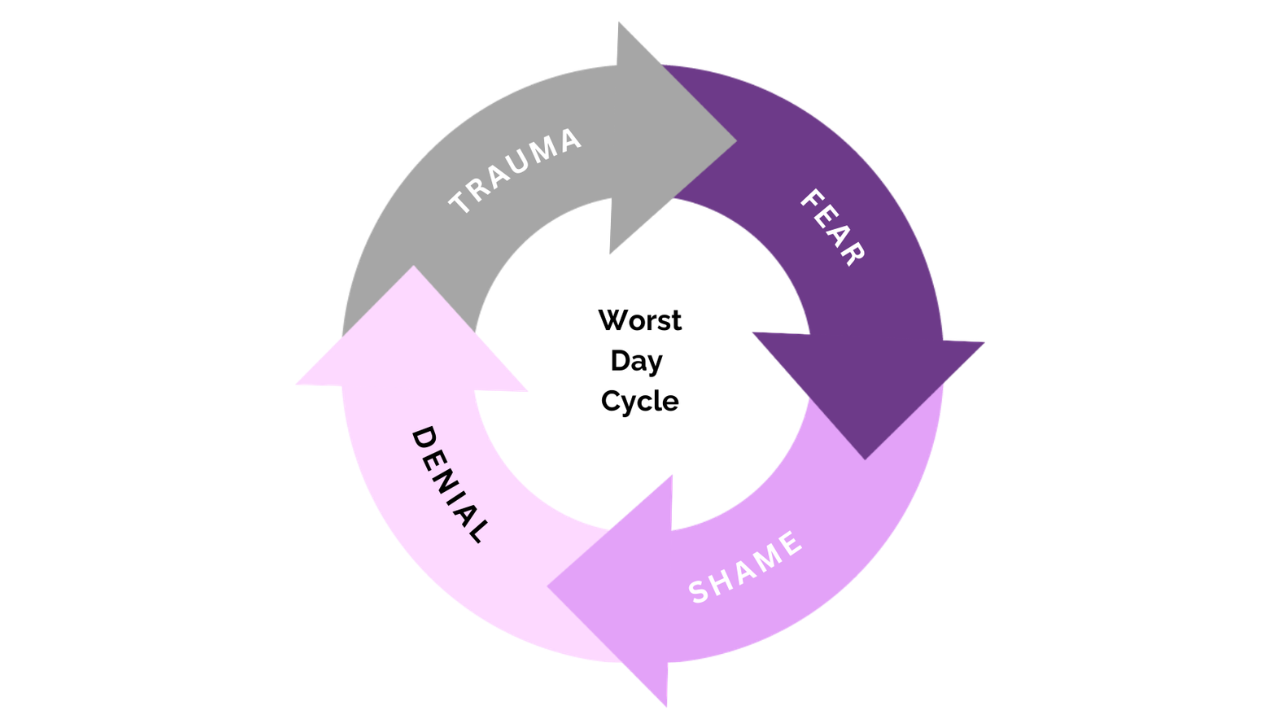
Stage 1: Trauma (The Trigger)
Something happens in the present moment that resembles (even slightly) an unhealed childhood wound. Your partner withdraws during conflict. They raise their voice. They prioritize something over you. They say something that activates an old meaning you’ve carried since childhood.
The trigger itself is usually small. It’s rarely about the present moment. It’s about what it means.
Stage 2: Fear (The Nervous System Flood)
Your nervous system doesn’t know it’s 2026 and you’re a capable adult with choices. It thinks it’s 1995 and you’re six years old and your parent is withdrawing their love or rage is coming. Fear floods your system. Cortisol spikes. Adrenaline courses through your body. You move into fight/flight/freeze mode.
That’s you — your hands shaking, your heart racing, your mind flooded with catastrophic thoughts about what this means about the relationship or about you.
Stage 3: Shame (The Core Belief Activation)
Fear activates shame. And shame is where you lost your inherent worth. Shame whispers: “I am the problem. I’m not lovable. I’m too much. I’m not enough. I can’t do anything right.” This is where your survival persona was born — it’s the response you developed to manage the unbearable experience of believing you were fundamentally flawed.
Shame is the belief that you are wrong, not that you did something wrong. It’s the belief that your existence itself is the problem. This is where your nervous system decides to protect you through denial, rage, or collapse — whatever kept you alive as a child.
Stage 4: Denial (The Survival Persona Activation)
To escape the unbearable pain of shame, your nervous system activates your survival persona — a brilliant, adaptive response that worked beautifully in childhood but sabotages your adult relationships. Denial is the story your survival persona tells to make the shame bearable. “This isn’t happening.” “My partner is the problem.” “I don’t care.” “I’m fine.” “Everyone else is the crazy one.”
This is where the fight explodes, where you shut down, or where you oscillate between both. This is where your nervous system is trying to protect you, but it’s actually protecting you from your partner instead of with your partner.
Meet Your Survival Persona (And Why It Destroys Relationships)
Your survival persona isn’t your authentic self. It’s the version of you that you had to become to survive your childhood. It’s brilliant. It’s adaptive. It literally kept you alive. But now it’s running your relationships into the ground.
There are three main survival persona types. You might recognize yourself in one, or you might oscillate between all three depending on the situation.
The Falsely Empowered Survival Persona
This is the controller. The rager. The one who “doesn’t need anyone.” In childhood, you learned that expressing your authentic needs meant pain, so you learned to control everything and everyone around you. Vulnerability was dangerous. Power was safety.
In relationships, this looks like: rage when your partner doesn’t comply with your needs, dominance as a way to feel safe, criticism of your partner’s “incompetence,” creating chaos to maintain control, or emotional unavailability masked as independence. That’s you — becoming the critical, controlling voice that drives your partner away, the exact dynamic you experienced with a parent.
The Disempowered Survival Persona
This is the people-pleaser. The collapsed one. The one who lost yourself in relationships. In childhood, you learned that your needs mattered less than keeping the peace or managing a parent’s emotional state. Self-abandonment was survival.
In relationships, this looks like: losing your voice in conflict, absorbing your partner’s emotions and taking responsibility for their feelings, chronic resentment because you’ve never actually said what you need, making yourself small, or exploding unexpectedly because you’ve suppressed so much. That’s you — feeling invisible and unheard in your relationship because you stopped being visible and heard to protect yourself.
The Adapted Wounded Child Survival Persona
This is the oscillator. You swing between falsely empowered and disempowered depending on the situation. Sometimes you rage and dominate. Sometimes you collapse and disappear. Sometimes you do both in the same conversation.
In relationships, this looks like: unpredictability, explosive arguments followed by total shutdown, confusion about which “version” of you is real, or triggering cycles where your partner never knows which persona they’re about to get. This is the most confusing for both you and your partner because the inconsistency makes it impossible to feel safe or predict how to interact with you.
That’s you — swinging between “I don’t need anyone” and “please don’t leave me” in the same argument, and genuinely not knowing which one is the real you.
Regardless of which survival persona you embody, the core belief is the same: “I am fundamentally flawed and unlovable.” The persona is just the protective shell that keeps that belief hidden — even from yourself.
The Signs: Where This Shows Up in Your Life
The Worst Day Cycle™ doesn’t just show up in romantic relationships. It shows up everywhere. Here’s where to look:
In Your Family Relationships
You either have unresolved conflict with your parents (you’re still trying to prove your worth, get their approval, or punish them for their failures), or you’ve gone no-contact. With siblings, you recreate old hierarchies or competition. You either seek too much closeness or maintain cold distance. That’s you — still fighting the same fights you fought twenty years ago with the people who hurt you, unable to simply have an adult relationship with your family.
In Your Romantic Relationships
You attract people who remind you of your parents (even if they’re completely different on the surface). You recreate the same dynamic — chasing an emotionally unavailable partner, controlling a partner who feels suffocated, or oscillating between both. You might have a pattern of passionate beginnings followed by explosive endings. Or you might stay in relationships that don’t serve you because the familiar pain feels safer than the unknown.
In Your Friendships
You either merge completely with friends (losing yourself, absorbing their emotions, making their problems your problems) or maintain cold distance. You might have friendships that feel one-sided — you’re always the giver or always the taker. That’s you — replaying the same enmeshed or emotionally distant dynamics that characterized your childhood relationships.
In Your Work Life
Sound familiar? The person who gives everything at work and has nothing left for the people who actually matter?
You either seek perfectionism and overachievement to prove your worth (repeating the survival message: “I only matter if I’m producing”), or you self-sabotage right before success (unconsciously protecting yourself from the shame of being seen). You might have a pattern of conflict with authority figures (recreating parent-child dynamics), or you might be completely conflict-avoidant and resentful.
In Your Body and Health
Unhealed trauma lives in your body. You might have chronic pain, digestive issues, tension, or immune dysfunction. You might use substances, food, or exercise to regulate your nervous system. You might have a complicated relationship with your body — either disconnected from it or hypervigilant to every sensation. That’s you — carrying the weight of your childhood in your shoulders, your stomach, your nervous system.
The pattern is consistent: wherever you see conflict, shame, control, or collapse, you’re seeing the Worst Day Cycle™ in action. Wherever you feel emotionally flooded, you’re seeing your nervous system respond to your childhood, not your present moment.
Your Emotional Blueprint Is Not Your Destiny
Here’s what you need to know: your emotional blueprint — the set of beliefs, triggers, and responses you developed as a child — is not permanent. It’s not who you are. It’s a brilliant adaptation that your nervous system created to keep you alive.
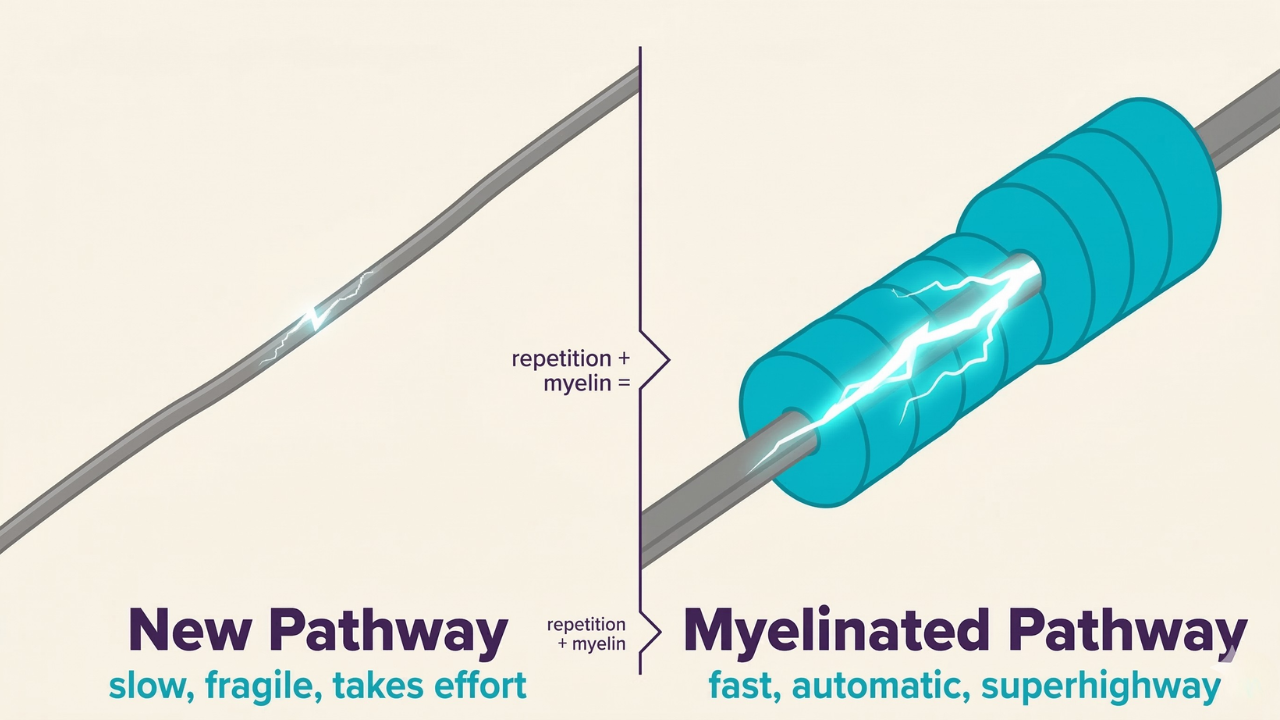
Think of your emotional blueprint as myelin — the insulating sheath around your neural pathways. Right now, the pathways that lead to fear, shame, and denial are heavily myelinated. They’re well-traveled highways. When stress hits, your nervous system doesn’t have to think. It just drives down the well-worn road.
The good news? Myelin can be remyelinated. New pathways can be built. Your nervous system can learn new patterns. But — and this is important — you cannot change emotional patterns through thoughts alone. Emotions are biochemical events that happen in your body before your thoughts catch up. You have to work with your nervous system, not against it.
This is where most self-help fails. You read something, think “I understand that,” and nothing changes. Because understanding is a thought. Healing is a nervous system rewiring. It requires somatic work — work that happens in your body.
The Path Forward: The Authentic Self Cycle™
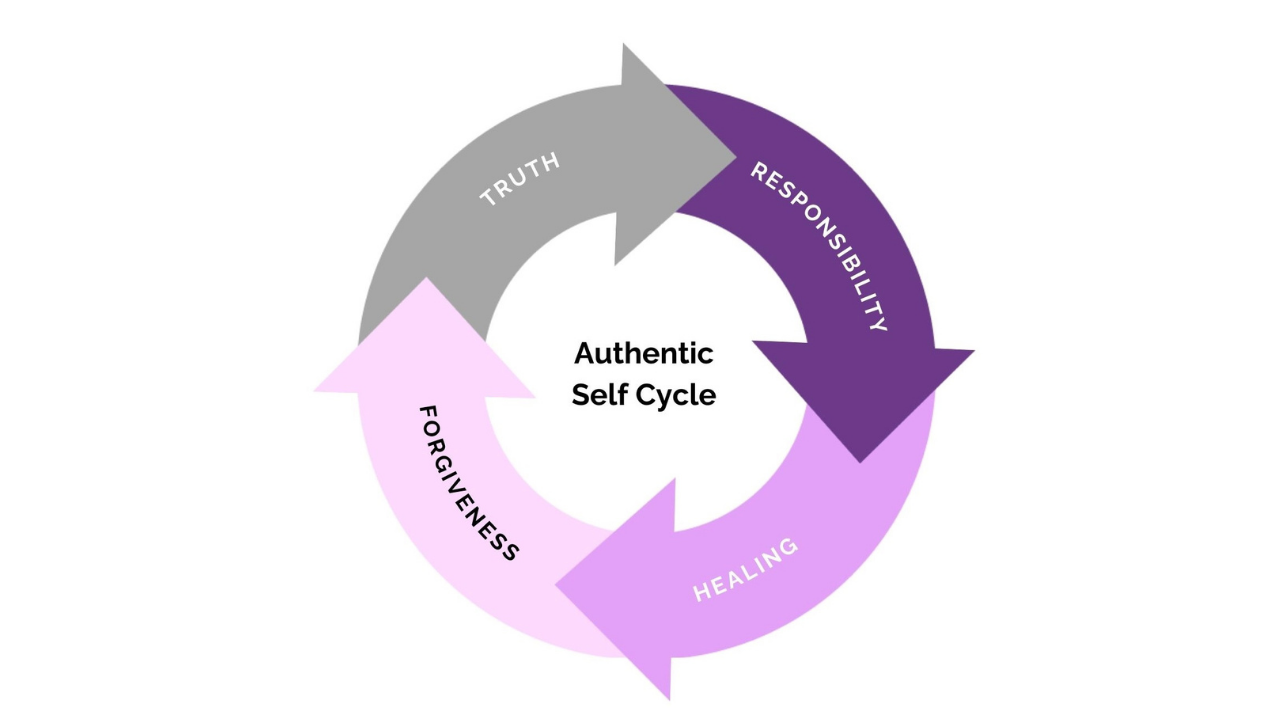
If the Worst Day Cycle™ is the blueprint of how trauma repeats, the Authentic Self Cycle™ is the blueprint of how trauma heals. It has four stages that directly counter the Worst Day Cycle™.
Stage 1: Truth (Naming the Blueprint)
Truth is saying out loud: “This isn’t about today. This is about my childhood. My partner isn’t my parent. My nervous system just thinks they are. This feeling is real, but the danger isn’t.”
Truth is getting curious about your pattern instead of defensive. It’s asking: “Where have I felt this before? Who does my partner remind me of? What am I actually afraid of?” Truth is the foundation. You can’t heal what you won’t name.
Stage 2: Responsibility (Owning Your Reaction)
Responsibility is saying: “My emotional reaction is my responsibility. My partner didn’t cause this. They triggered it. I need to own that my nervous system is on high alert, and I’m the only one who can regulate it.”
This is not blame. This is agency. This is stepping out of the victim role and into the role of someone who can change their life. That’s you — realizing that your partner’s behavior is information, not proof that you’re unlovable, and that your reaction is your choice, even if it doesn’t feel like it.
Stage 3: Healing (Rewiring the Blueprint)
Healing is the actual nervous system rewiring. It’s using practices like the Emotional Authenticity Method™ to trace your feelings back to their origin, to bring conscious awareness to the pattern, and to literally change the chemical signature of your nervous system. Healing means conflict becomes uncomfortable but not dangerous. Space becomes connection, not abandonment. Intensity becomes passion, not attack.
Stage 4: Forgiveness (Reclaiming Your Authentic Self)
Forgiveness is releasing the inherited emotional blueprint and reclaiming your authentic self — the self that doesn’t have to control, collapse, or oscillate. Forgiveness is saying: “I forgive my parents for damaging me. I forgive myself for repeating the pattern. I release this blueprint.”
The Authentic Self Cycle™ creates a NEW emotional chemical pattern that replaces fear, shame, and denial with truth, responsibility, and healing. This new pattern rewires your myelin and rebuilds your nervous system from the inside out.
The Five-Step Emotional Authenticity Method™ to End the Cycle
The Emotional Authenticity Method™ is the practical daily tool for moving from the Worst Day Cycle™ to the Authentic Self Cycle™. It’s a five-step somatic process that works with your nervous system, not against it.
Step 1: Somatic Down-Regulation (With Optional Titration)
You can’t think your way out of a nervous system that’s in fight/flight/freeze mode. You have to regulate your body first. This means: cold water on your face, grounding (feeling your feet on the earth), slow breath (longer exhales than inhales), movement, or sound.
Titration means bringing the intensity down slowly — just enough to get your nervous system to a place where thinking is possible. You’re not trying to feel calm. You’re trying to get from “I might explode” to “I can have a conversation about this.”
Step 2: What Am I Feeling? (Emotional Granularity)
Most people live in vague emotional categories: “I feel bad.” “I’m upset.” “I hate this.” But emotions are specific. There’s a difference between anger, rage, resentment, frustration, and irritation. There’s a difference between sadness, grief, disappointment, and despair.
Use the Feelings Wheel to get specific. The more specific you get, the more you understand what your nervous system is actually processing. That’s you — realizing that the feeling you called “anxiety” is actually “fear of abandonment” or “shame about being too much.”
Step 3: Where In My Body Do I Feel It?
All emotional trauma is stored physically. When you were a child and your parent raged at you, your body froze, contracted, braced for impact. That somatic memory is still there. You might feel tightness in your chest, a knot in your stomach, tension in your jaw, numbness in your limbs, or heat rising in your face.
The body is the gateway to the nervous system. When you can locate the feeling in your body and acknowledge it (“yes, there’s a tight knot in my chest”), you’re starting to regulate your nervous system. You’re saying: “I see you. You’re safe now. I’m listening.”
Step 4: What Is My Earliest Memory of This Feeling?
This is where you trace the feeling back to its origin. When was the first time you felt this exact feeling in your body? Who were you with? What did it mean about you? What did you decide about yourself, about love, about safety?
This isn’t about blame. This is about understanding that your nervous system is an old filing system. When your partner triggers a feeling, your nervous system goes back to the first time it learned to feel this way. And usually, that’s childhood.
Once you see the connection between your childhood wound and your current reaction, something fundamental shifts. You realize: “Oh, this isn’t about my partner. My nervous system is protecting me from something that happened thirty years ago.” This clarity alone begins to rewire the pattern.
Step 5: Who Would I Be If I Never Had This Feeling Again?
This is the vision step. It’s the bridge to the Authentic Self Cycle™. If you no longer had to protect yourself from abandonment, if you didn’t have to prove your worth, if you didn’t have to control, collapse, or oscillate — who would you be? What would your relationships look like? How would you move through the world?
This step activates hope and creates a new neural pathway toward possibility. Your nervous system doesn’t just heal from pain. It heals toward something. It heals toward your authentic self.
The Role of Codependence in Relational Fights
Here’s what most relationship advice misses: fights aren’t just about communication. They’re often about codependence — the pattern of losing yourself in relationships to manage another person’s emotional state or to earn their love.
When you’re codependent, a fight isn’t just a disagreement. It’s proof that your partner doesn’t love you, that you’ve failed to keep them happy, or that the relationship is falling apart. So you either rage to regain control, or collapse and apologize for things you didn’t do, just to restore peace.
That’s you — staying up all night trying to figure out what you did wrong, taking responsibility for your partner’s feelings, or creating chaos to feel like you still have some power in a relationship where you’ve lost yourself.
The cure for codependence is learning that you are not responsible for your partner’s emotional state. You are responsible for your own. Your partner’s anger, sadness, or disappointment is information about them, not a referendum on your worth. This is where the negotiables and non-negotiables framework becomes essential.
How Emotional Regulation Stops the Cycle
Insecurity in relationships is rooted in dysregulation. When you can’t regulate your nervous system, you’re at the mercy of your triggers. A neutral comment becomes a threat. A partner’s need for space becomes evidence of rejection. A disagreement becomes a relationship-ending catastrophe.
Emotional regulation is the ability to stay present with your own feelings without requiring your partner to manage them for you. It’s the ability to sit with discomfort without acting it out. It’s the ability to feel fear without creating chaos to prove your partner loves you. This is the foundational skill that stops fights before they start.
Regulation isn’t about “staying calm” or “being nice.” It’s about creating enough space between stimulus and response that your prefrontal cortex can participate in the decision. It’s about being able to say: “I’m feeling triggered right now. I need a break. Let’s come back to this in twenty minutes.”
That’s you — being the adult in the room, even when your nervous system is screaming that danger is coming.
Why Understanding Isn’t Enough
You can read this entire article and understand everything intellectually. You can say: “Yes, my fights are about my childhood, not my partner. Yes, I have a survival persona. Yes, I’m repeating the Worst Day Cycle™.” And none of it will change until you do the work in your body.
This is the gap that most self-help falls into. Understanding is necessary. But understanding is not healing. Healing requires: somatic awareness, nervous system rewiring, repeated practice, and often professional support.
That’s you — reading relationship advice, thinking you’ve solved the problem, and then having the exact same fight next week because your nervous system hasn’t actually changed.
This is why the Emotional Authenticity Method™ works. It’s not just cognitive. It’s somatic. It works with the part of your nervous system that controls your reactions — the part that existed before language, before thinking, before your survival persona formed.
People Also Ask (FAQ)
Why do I keep attracting the same type of partner?
Because your nervous system is drawn to what’s familiar. If you grew up with an emotionally unavailable parent, you’re magnetized to emotionally unavailable partners. If your parent was critical, you seek critical partners. If your parent was chaotic, you create or seek chaos. This isn’t because you’re broken. It’s because your nervous system thinks: “Familiar equals safe.” The cure is healing the original wound so familiar stops meaning safe.
Can someone heal their emotional blueprint without therapy?
You can absolutely do significant healing on your own through self-awareness, somatic practices, and frameworks like the Emotional Authenticity Method™. But most people benefit from having a guide — someone trained to help you understand your nervous system, recognize patterns you can’t see yourself, and hold space for the vulnerability that healing requires. Think of it like learning music: you can learn some things solo, but a teacher accelerates everything.
What if my partner doesn’t want to heal their trauma?
You can’t heal someone else’s nervous system. You can only heal yours. When you stop abandoning yourself, stop making their emotional state your responsibility, and stop accepting treatment that contradicts your worth, you change the dynamic. Sometimes your partner will rise to meet you. Sometimes they won’t. But your healing shouldn’t depend on their willingness to heal theirs.
How long does it take to rewire an emotional blueprint?
This varies based on the depth of the wound, how long you’ve been repeating the pattern, and how consistently you practice. Most people notice shifts within weeks. Real rewiring — myelin remyelination — typically takes months to years of consistent practice. But each time you interrupt the Worst Day Cycle™ and activate the Authentic Self Cycle™, you’re building new neural pathways. It’s like exercise: one workout doesn’t transform your body, but consistent workouts do.
Is it possible to have a healthy relationship while healing from trauma?
Yes, absolutely. In fact, a committed, conscious relationship can be one of the most powerful healing containers available. When you have a partner who understands that your triggers aren’t about them, who can stay present while you regulate, and who’s willing to heal their own blueprint, the relationship becomes a healing laboratory instead of a repetition of old patterns.
What’s the difference between the Emotional Authenticity Method™ and other healing practices?
The Emotional Authenticity Method™ specifically works with the Worst Day Cycle™ and survival persona dynamics. It bridges somatic regulation with cognitive understanding and vision-based activation of new neural pathways. Most practices do one or two of these. The EAM™ does all five, which is why it’s so effective for relational trauma and the specific patterns that show up in fights.
The Bottom Line
Your conversations turn into fights because you’re not fighting your partner. You’re fighting your childhood. Your nervous system learned, a long time ago, that connection was dangerous. Vulnerability meant rejection. Needs meant shame. Conflict meant catastrophe. So it built a survival persona — a brilliant, protective mechanism that kept you alive.
But that survival persona is now running your relationship into the ground. And the painful truth is: your partner can’t fix this. Communication classes can’t fix this. Couples therapy alone can’t fix this. Only you can fix this — by doing the somatic, nervous system work to rewire your emotional blueprint.
The good news? It’s absolutely possible. Thousands of people have used the Worst Day Cycle™, the Authentic Self Cycle™, and the Emotional Authenticity Method™ to break the pattern. To have fights that are just about the present moment. To have partners who feel safe instead of triggering. To have relationships where conflict is uncomfortable but not dangerous.
That could be you — not someday, but starting today. Not as a fantasy, but as a completely achievable reality. The only question is: are you ready to do the work?
Recommended Reading
- Facing Love Addiction by Pia Mellody — The foundational text on codependence and relational patterns
- The Myth of Normal by Gabor Maté — How childhood adversity becomes adult dis-ease
- Codependent No More by Melody Beattie — Breaking the cycle of emotional enmeshment
- Dare to Lead by Brené Brown — Vulnerability as the foundation of authentic relationships
- Complex PTSD by Pete Walker — Understanding trauma responses in relationships
Ready to Transform Your Relationships?
Understanding the pattern is the first step. Doing the work is the second. Here are the courses that will guide you through the Authentic Self Cycle™ and the Emotional Authenticity Method™:
- Emotional Blueprint Starter Course — Individual ($79) — Start here to understand your emotional blueprint and begin rewiring it
- Relationship Starter Course — Couples ($79) — For couples ready to heal the pattern together
- Why We Can’t Stop Hurting Each Other ($479) — Deep dive into codependence and the Worst Day Cycle™
- Why High Achievers Fail at Love ($479) — For the falsely empowered survival persona
- The Shutdown Avoidant Partner ($479) — For the disempowered survival persona
- Tier 1: Mapping the Blueprint ($1,379) — The complete system for nervous system rewiring
Download the Feelings Wheel — the free tool used in Step 2 of the Emotional Authenticity Method™ to build emotional granularity.
Explore more: The Signs of Enmeshment | 7 Signs of Relationship Insecurity | 7 Signs of High Self-Esteem | How to Determine Your Negotiables and Non-Negotiables | 10 Do’s and Don’ts for a Great Relationship
Your fights don’t have to be your future. Your childhood doesn’t have to be your destiny. The Worst Day Cycle™ can stop with you — starting today.