The inability to relax is not a personality trait or a lack of discipline — it is a neurochemical survival pattern built in childhood that keeps your nervous system locked in threat mode, making stillness feel dangerous even when you are completely safe. If you finally got the day off, the vacation, the quiet weekend — and your body responded with restlessness, guilt, anxiety, or an overwhelming urge to check your phone — you are not broken. Your nervous system is doing exactly what it was trained to do. And that training started long before your first job.
That’s you — the one who can run a company but can’t sit on the couch for ten minutes without reaching for your laptop.
This isn’t about discipline. It isn’t about gratitude. And it isn’t about “just learning to unwind.” It’s about a childhood emotional blueprint that wired your brain to equate stillness with danger — and until you address that blueprint, no vacation, meditation app, or productivity hack will ever let you truly rest.
Why Can’t You Relax Even When Nothing Is Wrong?
You finally got the break. No deadlines. No meetings. No one asking you for anything. You’ve been craving this for weeks. And then it happens — your body won’t cooperate. Your mind starts scanning for problems. Your chest tightens. Your leg bounces. You feel guilty for sitting still. So you grab your phone, open your laptop, start planning something, cleaning something, fixing something. Because doing nothing feels physically wrong.
That’s you — craving rest with every cell in your body and then panicking the moment you actually get it.
This isn’t a character flaw. It’s not that you “just like being busy.” Your nervous system is stuck in survival mode — and it has been since childhood. The brain has one job: keep you alive. It doesn’t care about your vision board or your work-life balance goals. It asks one question: “Am I safe right now?” And if your childhood taught it that stillness means danger — that calm means something bad is about to happen — then every quiet moment triggers an alarm.
The inability to relax is the predictable result of a nervous system that was calibrated in childhood to treat stillness as a survival threat — the brain learned that hypervigilance and constant doing were the price of safety, and it automated that pattern for life.
That’s you — the person whose body doesn’t know the difference between a Sunday afternoon and a childhood where quiet meant someone was about to explode.
How Does Your Nervous System Keep You Stuck in Survival Mode?
Your brain conserves energy by repeating known patterns. It can’t tell right from wrong — only known from unknown. If you grew up in an environment where being relaxed wasn’t safe, where having needs wasn’t welcomed, where love felt conditional, or where approval had to be earned — your nervous system learned something powerful: calm is dangerous and performance is safety.
Since 70%+ of childhood messaging is negative and shaming, adults repeat these painful patterns in relationships, career, hobbies, health — everything. Your childhood created a massive chemical reaction in the brain and body. The hypothalamus generates chemical cocktails — cortisol, adrenaline, dopamine, oxytocin misfires — and the brain becomes addicted to these emotional states. So now, as an adult, even when your life looks stable and successful on the outside, your body still thinks it’s that kid trying not to get blindsided.
That’s you — feeling most alive when you’re in crisis mode, because your nervous system was calibrated for chaos and quiet feels like the moment before the storm.
That’s why when things go quiet, you don’t feel peace. You feel exposed. Your body has been running on stress hormones for so long that the absence of stress feels like something is wrong. The adrenaline, the cortisol, the rush of urgency — those stress chemicals are intense, but they’re familiar. And your brain loves familiar. It doesn’t know healthy from unhealthy. It only knows: “Have I survived this before?”
That’s the trap — your brain keeps choosing urgency over peace, not because urgency is better, but because it’s the only thing your nervous system trusts.
Your nervous system maintains survival mode because it became chemically addicted to the stress-performance-validation loop created in childhood — the brain treats the absence of stress as a threat signal, making genuine rest neurologically impossible without rewiring the original emotional blueprint.
How the Worst Day Cycle™ Explains Why Calm Feels Dangerous
The inability to relax isn’t random. It follows a predictable neurochemical pattern called the Worst Day Cycle™. Understanding this cycle is the first step to breaking free from the restlessness that runs your life.
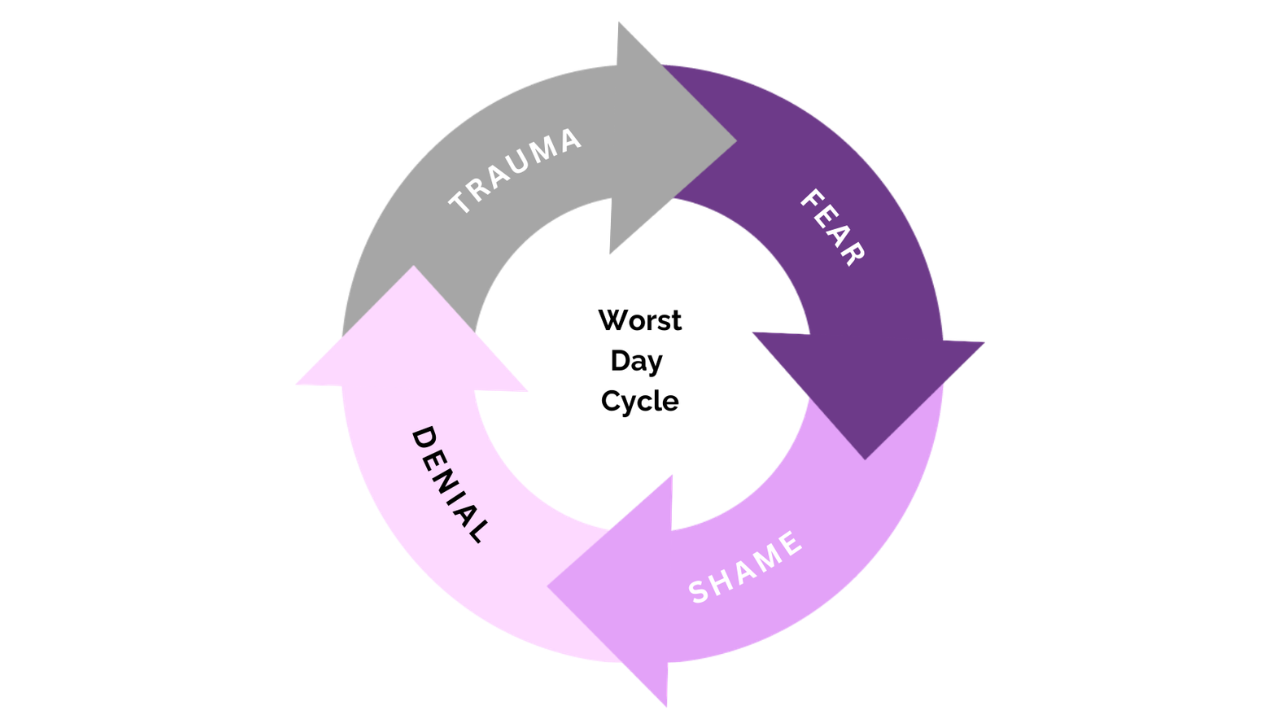
The Worst Day Cycle™ has four stages: Trauma → Fear → Shame → Denial.
Trauma: Any negative emotional experience in childhood that created painful meanings. It doesn’t have to be dramatic — it can be as subtle as a parent who was emotionally unavailable, a household where feelings were treated as weakness, or a caregiver whose love was conditional on performance. These experiences create a massive chemical reaction in the brain and body.
That’s you — the one who grew up in a home where everything looked fine on the outside but your body was always bracing for impact.
Fear: Fear drives repetition. The brain thinks repetition equals safety. So you keep choosing the same work patterns, the same relentless pace, the same cycles of overgiving and burnout — not because you want to, but because your nervous system is terrified of the unknown. Rest is unknown. Stillness is unknown. And to a trauma brain, unknown means dangerous.
Shame: This is where you lost your inherent worth. “I am the problem.” Not “I made a mistake” — but “I AM the mistake.” This is the core wound underneath the inability to relax. You can’t rest because deep down, you believe your worth is conditional on your output. The moment you stop producing, the shame voice starts: “You’re lazy. You’re falling behind. You don’t deserve this.”
That’s the shame talking — the voice that says you haven’t earned the right to sit down, and it’s been running your schedule since before you could spell your own name.
Denial: Denial is the survival persona you created to survive the pain. It was brilliant in childhood — absolutely necessary. But in adulthood, it sabotages everything. It keeps you performing instead of feeling. Producing instead of resting. Running instead of being. You tell yourself: “I just have high standards.” “I’m wired this way.” “I’ll rest when I’m done.” But you’re never done — because done means feeling, and feeling means confronting the original wound.
The Worst Day Cycle™ reveals why you can’t relax — your brain created a neurochemical loop in childhood that equates stillness with danger and constant doing with survival, and it repeats that loop thousands of times per day without your conscious awareness.
How Your Survival Persona Turns Rest Into a Threat
Your survival persona is the identity you created in childhood to navigate an emotionally unsafe environment. It’s not who you are — it’s who you had to become. And it’s the engine that makes rest feel impossible.
There are three survival persona types:
The Falsely Empowered: This persona controls, dominates, and rages. They can’t relax because relaxing means surrendering control — and control is the only thing that makes them feel safe. They fill every quiet moment with planning, strategizing, and managing. They look powerful on the outside, but their constant doing comes from fear, not strength.
That’s you — the CEO who can command a boardroom but can’t sit through a movie without checking email, because sitting still feels like losing your grip on everything.
The Disempowered: This persona collapses, people-pleases, and disappears. They can’t relax because resting means they’re not taking care of someone else — and if they’re not useful, they believe they’ll be abandoned. They fill every quiet moment with checking on others, anticipating needs, and staying available. Rest feels selfish. Stillness feels like the moment people will realize they don’t need you anymore.
That’s you — the one who can’t take a vacation without bringing your laptop “just in case someone needs you,” because being needed is the only way you know how to matter.
The Adapted Wounded Child: This persona oscillates between both — controlling one moment, collapsing the next. They can’t relax because they never have a stable sense of self. They swing between overperforming and shutting down, between filling every moment with activity and numbing out on the couch with their phone — but neither state is rest. It’s just two different forms of survival.
That’s you — the one who swings between “I’ll sleep when I’m dead” and scrolling your phone for three hours in a fog, and neither one feels like actual rest.
Your survival persona is the most sophisticated obstacle to genuine rest because it replaces your authentic relationship with your body with a performance — and after decades, you can’t tell the difference between productive rest and another form of self-abandonment.
Why Are High Achievers Addicted to Urgency?
When you live in survival mode long enough, your body gets hooked on the chemistry of it. Adrenaline. Cortisol. The rush of urgency. The “almost there” feeling. One more email. One more task. One more win. Those stress chemicals are intense — but they’re familiar. And your brain loves familiar.
That’s you — the one who feels more comfortable in a crisis than on a beach, because chaos is the emotional weather you grew up in.
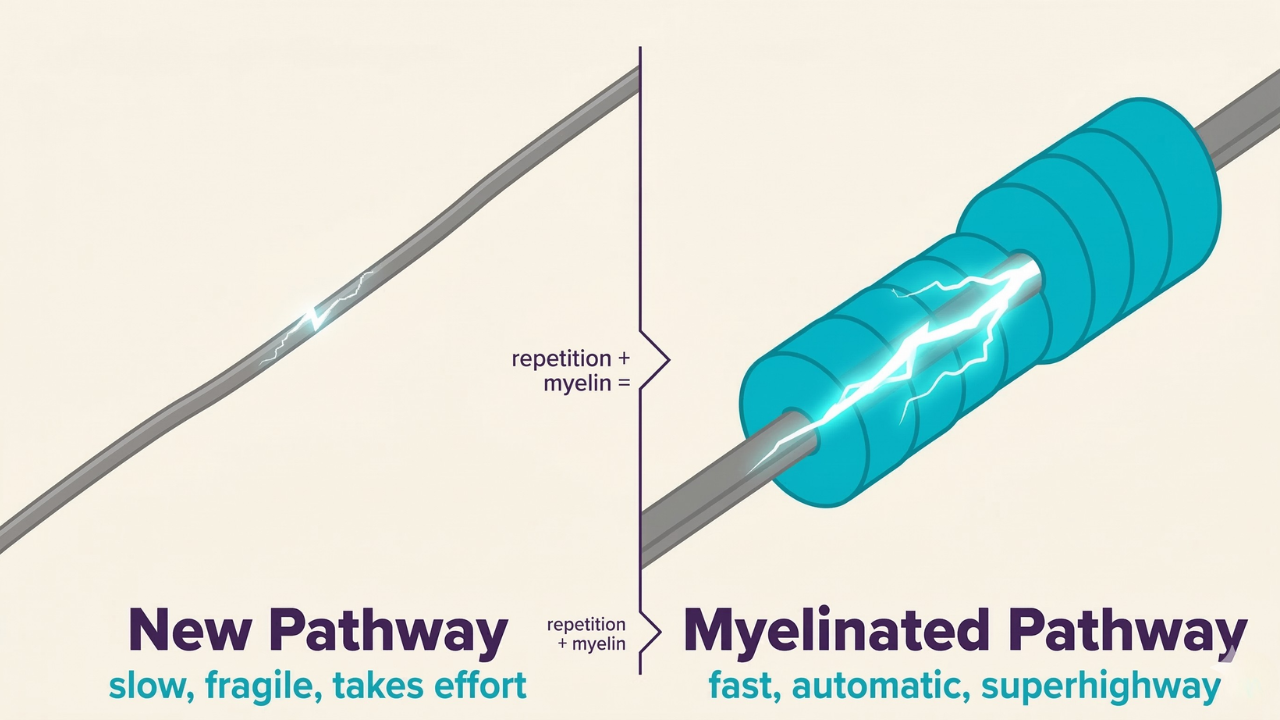
For many high achievers, productivity didn’t start as ambition. It started as adaptation. If you grew up in an environment where being relaxed wasn’t safe, where having needs wasn’t welcomed, where love felt conditional, or where approval had to be earned — your nervous system learned that calm is dangerous and performance is safety.
So now, as an adult, you live in fight, flight, fawn, or freeze all day long — even when nothing bad is happening. Your body doesn’t know the difference between a real threat and a remembered one. Fight sounds like: “I’ll power through. I’ll outwork everyone.” Flight looks like constant busyness, over-scheduling, never sitting still. Fawn shows up as people-pleasing, over-giving, saying yes when you mean no. Freeze is numbing out — scrolling, zoning out, collapsing on the couch but not actually resting.
That’s you — the one who collapses at 10pm and calls it rest, when really your body just ran out of cortisol and crashed into freeze mode.
The void shows up loudest at night. After the launch. After the deadline. After everyone’s taken care of. When you finally sit down. That’s when the thoughts start racing: “What’s the point? Why do I feel alone? Why doesn’t any of this feel like enough?” Your survival system doesn’t celebrate your success. It panics in the quiet. Because it doesn’t know how to exist without scanning for what might go wrong.
Sound familiar? The person who can’t enjoy a single evening without that hollow, restless, “something’s wrong” feeling creeping in?
High achievers are addicted to urgency because their childhood trauma created a neurochemical dependency on stress hormones — the brain treats cortisol and adrenaline as evidence of safety through familiar repetition, making genuine rest feel like a withdrawal symptom rather than a reward.
How the Inability to Relax Shows Up in Every Area of Your Life
Family: You’re the one who plans every holiday, manages every conflict, and makes sure everyone else is comfortable. Even at family gatherings, you’re “on” — monitoring the room, smoothing over tension, handling logistics. You can’t sit and just be present with your family because your nervous system was trained to be the emotional manager of the household. And if you’re not managing, you feel useless.
That’s you — still running the same emotional program your family assigned you at age six, even at the dinner table twenty years later.
Romantic Relationships: You choose partners and then struggle to be present with them. You’re physically there but mentally elsewhere — planning, worrying, future-tripping. When your partner wants to just be together, doing nothing, you feel anxious. Intimacy requires presence, and presence requires your nervous system to feel safe. If it doesn’t, you stay in your head — and your partner feels it.
Sound familiar? The partner who says “I love you” but can’t put the phone down, because being fully present with another human feels more vulnerable than running a business?
Friendships: You’re the reliable one. The busy one. The one who’s hard to pin down. But your friends don’t know that your constant doing isn’t ambition — it’s a wall. If you slowed down enough to actually connect, they’d see the exhaustion, the loneliness, the person underneath the performance. And that feels terrifying.
Work: You overdeliver. You say yes to every project. You check email at midnight. You take on other people’s responsibilities because if you don’t do it, no one will. Your worth is measured in productivity, and rest feels like laziness. You’ve been promoted for your inability to relax — and rewarded for it. The workplace celebrates your survival strategy. And every promotion makes it harder to stop.
That’s you — getting promotions and praise for the very pattern that’s destroying your health, your relationships, and your connection to yourself.
Body and Health: You push through exhaustion, pain, hunger, and stress. You ignore your body’s signals because stopping to listen feels dangerous. Chronic pain, digestive issues, insomnia, jaw clenching, shallow breathing — your body has been trying to get your attention for years. But your survival persona interprets body signals as weakness, not information. So you override them. Until your body forces you to stop.
How the Emotional Authenticity Method™ Teaches Your Body That Rest Is Safe
The Emotional Authenticity Method™ is the daily practice that rewires your nervous system’s relationship with rest. It works because it targets the body — where the survival pattern lives — not just the mind.
Step 1: Somatic Down-Regulation with optional Titration. Before you can process anything, you have to get your nervous system out of survival mode. This might mean deep breathing, grounding, or simply slowing down enough to feel your body. Titration means you go slowly — you don’t force yourself to feel everything at once. For someone who can’t relax, even 30 seconds of genuine stillness is a revolution.
That’s you — learning that you don’t have to white-knuckle your way to calm. You just have to let your body experience safety in tiny doses.
Step 2: What am I feeling? Most high achievers who can’t relax have no idea what they’re feeling. They’ve been disconnected from their emotions for so long that “stressed” is their default answer. Using the Feelings Wheel, you develop emotional granularity — the ability to name specific emotions instead of lumping everything into “stressed” or “fine.” When you can name the feeling underneath the restlessness — fear, guilt, shame, loneliness — the urgency begins to lose its grip.
Step 3: Where in my body do I feel it? All emotional trauma is stored physically. The tight chest when you try to rest. The clenched jaw. The shallow breathing. The knot in your stomach. Locating the feeling in your body is how you move from intellectual understanding to somatic processing. Your inability to relax isn’t in your mind — it’s in your nervous system.
Step 4: What is my earliest memory of this feeling? This is where the rewiring happens. You trace today’s restlessness back to its childhood origin. You realize: this isn’t about today. This isn’t laziness or a lack of discipline. My nervous system is replaying a childhood pattern where stillness meant danger. My partner isn’t my parent. My Sunday isn’t my childhood living room. My nervous system just thinks they are.
That’s the moment everything shifts — when you see that your restlessness belongs to a seven-year-old who had to stay hypervigilant to survive, not a forty-year-old sitting on their own couch.
Step 5: Who would I be if I never had this feeling again? This is the vision step. It connects you to the Authentic Self Cycle™ and gives your nervous system a new destination — not more coping, not “better relaxation techniques,” but actual identity restoration. Who would you be if rest felt safe? If you could sit in silence without guilt? If your worth wasn’t measured in productivity?
The Emotional Authenticity Method™ works because emotions are biochemical events — you cannot change emotional patterns through thoughts alone. Thoughts originate from feelings, not the other way around. You can’t think your way to relaxation. You have to feel your way there.
How the Authentic Self Cycle™ Replaces Survival Mode With Safety
The Authentic Self Cycle™ is the healing counterpart to the Worst Day Cycle™. Where the Worst Day Cycle™ traps you in Trauma → Fear → Shame → Denial, the Authentic Self Cycle™ restores your identity through Truth → Responsibility → Healing → Forgiveness.
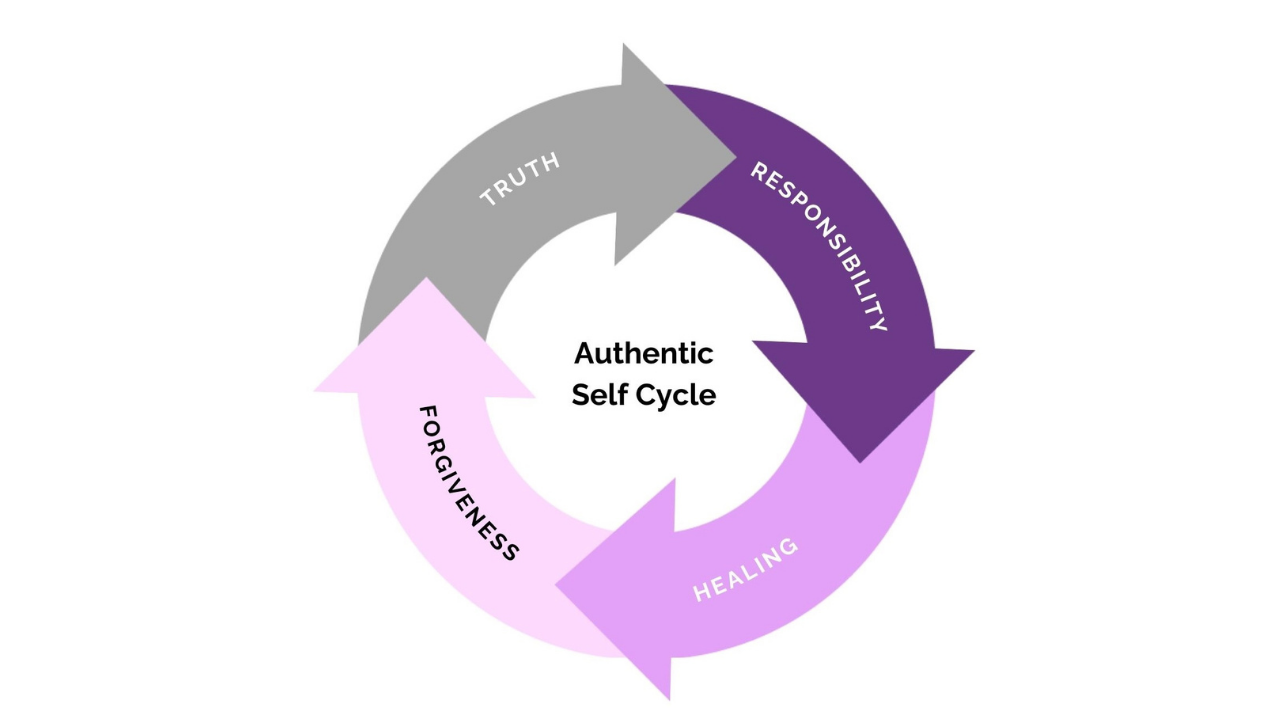
Truth: Name the blueprint. See that “this isn’t about today.” When you try to rest and your body floods with anxiety, truth says: “This feeling is from childhood. My couch isn’t a dangerous place — my nervous system just thinks it is because stillness was never safe growing up.”
That’s the first step out of survival mode — seeing the pattern instead of being trapped inside it.
Responsibility: Own your emotional reactions without blame. “My parents did the best they could with their own emotional blueprints — and the pattern they created in me is now mine to heal.” This isn’t about fault. It’s about taking back your power from a childhood that stole your ability to rest.
Healing: Rewire the emotional blueprint so stillness becomes uncomfortable but not dangerous, rest isn’t laziness, and quiet isn’t the moment before the explosion. This is where the Emotional Authenticity Method™ does its daily work — second by second, like the ticks of a clock. The second hand moves in tiny, almost insignificant ticks. But those ticks move the minute hand. The minutes move the hours. Healing works the same way.
Forgiveness: Release the inherited emotional blueprint and reclaim your authentic self. This creates a NEW emotional chemical pattern that replaces fear, shame, and denial with safety, worth, and connection. You don’t become someone new. You finally meet who you always were underneath the survival persona — someone who can achieve AND rest, produce AND be present, work AND feel worthy of stillness.
That’s you — not the person who has to earn the right to sit down. The person who rests because they finally understand that their worth was never conditional on their output.
The Authentic Self Cycle™ is an identity restoration system — it doesn’t teach you relaxation techniques, it replaces the neurochemical pattern that made rest feel dangerous with a new blueprint built on truth, responsibility, and the understanding that your worth exists independent of your productivity.
Why Willpower and Productivity Hacks Can’t Fix This
You’ve probably tried everything. Morning routines. Meditation apps. Digital detoxes. Scheduled downtime. And maybe they worked — for a few hours. Maybe even a few days. But the restlessness always comes back. Because willpower targets the thinking brain. And your inability to relax doesn’t live in your thoughts. It lives in your nervous system.
That’s you — the one who downloaded the meditation app, did it perfectly for a week, and then felt more anxious than before because sitting still surfaced feelings you’ve been running from for decades.
You can’t out-optimize a survival pattern. You can’t hack your way to nervous system safety. The pattern was installed before you had language, before you had conscious memory, before you could make a choice about who to become. It was built into your body’s operating system. And it requires body-level rewiring to change — not another productivity framework.
That’s the hardest truth for high achievers — you can’t achieve your way to rest. You can’t earn the right to relax. You have to feel your way to safety, and that means doing the one thing your survival persona was built to prevent: stopping.
Frequently Asked Questions About Why You Can’t Relax
Why can’t I relax even when nothing is wrong?
Your inability to relax isn’t caused by current circumstances — it’s driven by a childhood emotional blueprint that trained your nervous system to treat stillness as a threat. The Worst Day Cycle™ explains how childhood trauma creates a neurochemical loop where the brain equates constant doing with safety. Your body doesn’t know the difference between a real threat and a remembered one, so it stays in survival mode even when you’re completely safe.
Is the inability to relax a trauma response?
Yes. For most high achievers, the inability to relax is a survival pattern that originated in childhood. If you grew up in an environment where love was conditional, feelings weren’t safe, or your worth depended on performance, your nervous system learned that stillness equals danger. This isn’t a personality trait — it’s an adaptation that was brilliant in childhood and sabotaging in adulthood.
Why do high achievers feel guilty when they rest?
Rest guilt comes from the shame stage of the Worst Day Cycle™. When your childhood blueprint taught you that your worth equals your output, resting triggers the core shame wound: “I am not enough unless I’m producing.” The guilt isn’t rational — it’s a neurochemical response from your survival persona, which believes that stopping means losing love, safety, or relevance.
Can meditation help if you can’t relax?
Meditation addresses symptoms — it can temporarily down-regulate your nervous system. But it doesn’t address the root cause: the childhood emotional blueprint that made stillness feel dangerous. The Emotional Authenticity Method™ goes deeper by tracing today’s restlessness to its childhood origin and rewiring the pattern at the nervous system level. Meditation manages the surface. Emotional authenticity heals the foundation.
What is the difference between rest and freeze mode?
Genuine rest involves a regulated nervous system that feels safe in stillness. Freeze mode is a survival response — your body collapses because it has exhausted its stress hormones, not because it feels safe. Scrolling your phone for three hours, zoning out on the couch, or sleeping twelve hours and waking up exhausted are freeze responses, not rest. The three survival persona types — falsely empowered, disempowered, and adapted wounded child — each have different freeze patterns that masquerade as relaxation.
How long does it take to learn to genuinely relax?
Nervous system patterns that have been running for 20, 30, or 40 years don’t reverse overnight. But noticeable shifts can happen within weeks of consistent daily practice with the Emotional Authenticity Method™. The key is repetition, not intensity. Small moments of genuine stillness — even 30 seconds — create cumulative neurological change. The Authentic Self Cycle™ provides the framework for long-term nervous system restoration.
The Bottom Line
Your inability to relax is not a personality trait. It is not weakness. It is not laziness. It is not proof you’re broken.
It is proof you adapted to survive.
Your nervous system simply never got the update that you’re not back there anymore. And because so many emotional patterns are formed between ages zero and seven — before you could even put words to them — this survival mode feels normal. It feels like “just who you are.”
But it isn’t.
You were not born incapable of rest. You were trained out of it. By a childhood that rewarded performance and punished stillness. By a nervous system that learned the only safe way to exist was to keep moving. By a survival persona that was brilliant at keeping you alive — and terrible at letting you live.
That’s you — not the person who can’t relax. The person whose survival persona convinced them that rest is a privilege they haven’t earned yet. And that was never true.
Healing doesn’t mean you stop achieving. It means you stop needing achievement to feel safe. It means rest becomes possible — not through willpower, but because your nervous system finally gets the message: you survived. You made it. You can put the armor down now.
And once you begin to separate your survival persona from your authentic self, rest won’t feel like danger anymore. It will feel like home.
Recommended Reading
These books complement the frameworks in this article and can deepen your understanding of why high achievers can’t relax:
Facing Codependence by Pia Mellody — the foundational text on how childhood trauma creates the survival patterns that turn rest into a threat.
The Body Keeps the Score by Bessel van der Kolk — the science of how trauma lives in the body and why your nervous system stays in survival mode decades after childhood ended.
When the Body Says No by Gabor Maté — how chronic inability to rest manifests as physical illness and disease when the body’s signals are overridden for years.
Codependent No More by Melody Beattie — a practical guide to recognizing when your inability to stop doing is actually codependent self-abandonment.
The Gifts of Imperfection by Brené Brown — how shame drives performance-based identity and why vulnerability is the path back to genuine rest.
Take the Next Step
If you’re ready to teach your nervous system that rest is safe and stop running on survival mode, Kenny Weiss offers courses designed for high achievers who are done performing and ready to heal:
Emotional Blueprint Starter Course — Individual ($79) — Your personal roadmap to understanding the Worst Day Cycle™ and beginning the journey from survival mode to genuine rest.
Relationship Starter Course — Couples ($79) — For couples where one or both partners can’t slow down enough to be present in the relationship.
Why We Can’t Stop Hurting Each Other ($479) — Deep-dive into the Worst Day Cycle™ and how childhood trauma creates the restlessness that destroys connection.
Why High Achievers Fail at Love ($479) — Built specifically for high achievers who have mastered their career but can’t figure out how to be present in their relationships.
The Shutdown Avoidant Partner ($479) — Understanding avoidant attachment through the lens of trauma chemistry and survival personas.
Tier 1: Mapping the Blueprint ($1,379) — The comprehensive program for learning and practicing the Emotional Authenticity Method™.
Download the Feelings Wheel — the free tool used in Step 2 of the Emotional Authenticity Method™ to build emotional granularity and finally name what’s underneath the restlessness.
Explore more: The Signs of Enmeshment | 7 Signs of Relationship Insecurity | 7 Signs of High Self-Esteem | How to Determine Your Negotiables and Non-Negotiables | 10 Do’s and Don’ts for a Great Relationship