How to stop numbing your emotions starts with understanding a truth that changes everything: you are not choosing to be numb. Emotional numbness is not laziness, weakness, or a character flaw. It is a trauma response — a survival strategy your nervous system installed in childhood to protect you from feelings that were too big, too dangerous, or too punishing to experience safely. If you go blank during conflict, if you cannot cry even when you want to, if you feel like a robot moving through life while everyone else seems to actually feel things — your nervous system learned decades ago that feeling equals danger. And it has been protecting you from that danger ever since.
The problem is that the protection that saved you as a child is now destroying your adult life. You cannot connect in relationships because connection requires vulnerability, and vulnerability requires feeling. You cannot set boundaries because boundaries require knowing what you need, and knowing what you need requires accessing emotions your system deleted years ago. You cannot heal because healing is a feeling process, not a thinking process — and your entire survival strategy is built on replacing feeling with thinking.
That’s you if you’ve tried therapy, journaling, meditation, and positive thinking — and none of it has worked because all of those approaches ask you to access emotions your nervous system has been trained to suppress since before you could walk.
The path out of emotional numbness does not begin with trying harder to feel. It begins with understanding why your nervous system shut feeling down in the first place, how the Worst Day Cycle™ keeps you trapped in that shutdown, and how the Emotional Authenticity Method™ literally rewires your nervous system so that feeling becomes safe again.
Table of Contents
- What Is Emotional Numbness? Why You Shut Down
- The Childhood Blueprint: Where Numbness Begins
- The Worst Day Cycle™: How Numbness Becomes an Addiction
- The Three Survival Personas and Emotional Shutdown
- Why Thinking Cannot Fix a Feeling Problem
- How Emotional Numbness Shows Up Across Your Life
- The Emotional Authenticity Method™: 6 Steps to Feel Again
- The Authentic Self Cycle™: From Shutdown to Connection
- Frequently Asked Questions
- The Bottom Line
- Recommended Reading
- Courses
What Is Emotional Numbness? Why You Shut Down Instead of Feeling
Emotional numbness is not the absence of emotion. It is the absence of permission to feel it. Underneath the blankness, the flatness, the “I don’t know what I feel” — every emotion is still there. Your nervous system has not deleted your feelings. It has locked them behind a door that was sealed in childhood because the feelings behind that door were too overwhelming, too punished, or too dangerous to express.
Emotional numbness is not emotional incompetence. It is trauma-induced self-protection. The nervous system suppresses emotion as an act of love for the self — protecting the child from feelings that would have destroyed them.
That’s you if you go blank during conflict. That’s you if you feel like you’re watching your own life from behind glass. That’s you if your partner accuses you of not caring — and the truth is you care so deeply that your nervous system shut feeling down entirely to survive it.
Adults who are emotionally numb say things like: “I don’t know what I feel.” “I go blank.” “I shut down during conflict.” “I feel like a robot.” “I can’t connect to myself.” “I can’t access my needs.” These are not signs of weakness. They are signs of a nervous system that learned in childhood: feeling is not safe, my emotions cause problems, expression leads to shame, staying small keeps me protected, if I speak I will be punished or abandoned.
That’s you if you’ve been called “cold” or “distant” by people who love you — and you know they’re right, but you genuinely don’t know how to be different. Your emotional shutdown was installed before you had any say in the matter.
The Childhood Blueprint: Where Emotional Numbness Begins
Your emotional blueprint — the nervous system’s learned pattern for what feelings are safe and which ones are forbidden — was set in childhood. If your childhood contained a parent who punished your tears, mocked your sensitivity, withdrew when you expressed needs, or became volatile when you showed fear — your brain made a calculation that has been running your life ever since: emotions create danger, suppress them to survive.
Trauma overwhelms the emotional system, causing the child to disconnect from their internal world. The child learns that emotions are too big, create danger, overwhelm caregivers, provoke shame, result in disconnection, lead to punishment, and destabilize the environment. To survive, the child suppresses emotions they cannot afford to feel.
That’s you if you grew up hearing “stop crying,” “don’t be so sensitive,” “you’re overreacting,” or “there’s nothing to be upset about.” Every one of those messages taught your nervous system that feeling is wrong — and your system obeyed.
The child who was never allowed to feel doesn’t grow into an adult who can feel. They grow into an adult who intellectualizes everything, who lives in their head, who can analyze their pain but cannot touch it. Suppression was the child’s salvation. Visibility becomes the adult’s liberation.
The result is a constellation of symptoms that most therapists treat individually but that all share a single root: emotional numbness, shutdown, alexithymia — the clinical term for difficulty identifying emotions — disconnection from body sensations, difficulty crying, difficulty expressing needs, intellectualizing feelings, avoiding emotional intimacy, and collapsing when overwhelmed.
That’s you if you can explain your childhood trauma in perfect clinical language but feel absolutely nothing when you talk about it. That’s the survival persona in action — turning feeling into thinking so the pain never reaches you.
The Worst Day Cycle™: How Emotional Numbness Becomes a Chemical Addiction
The Worst Day Cycle™ explains why numbness doesn’t just visit you — it lives in you. It is a four-stage neurological loop: Trauma → Fear → Shame → Denial. This cycle repeats endlessly until you interrupt it.
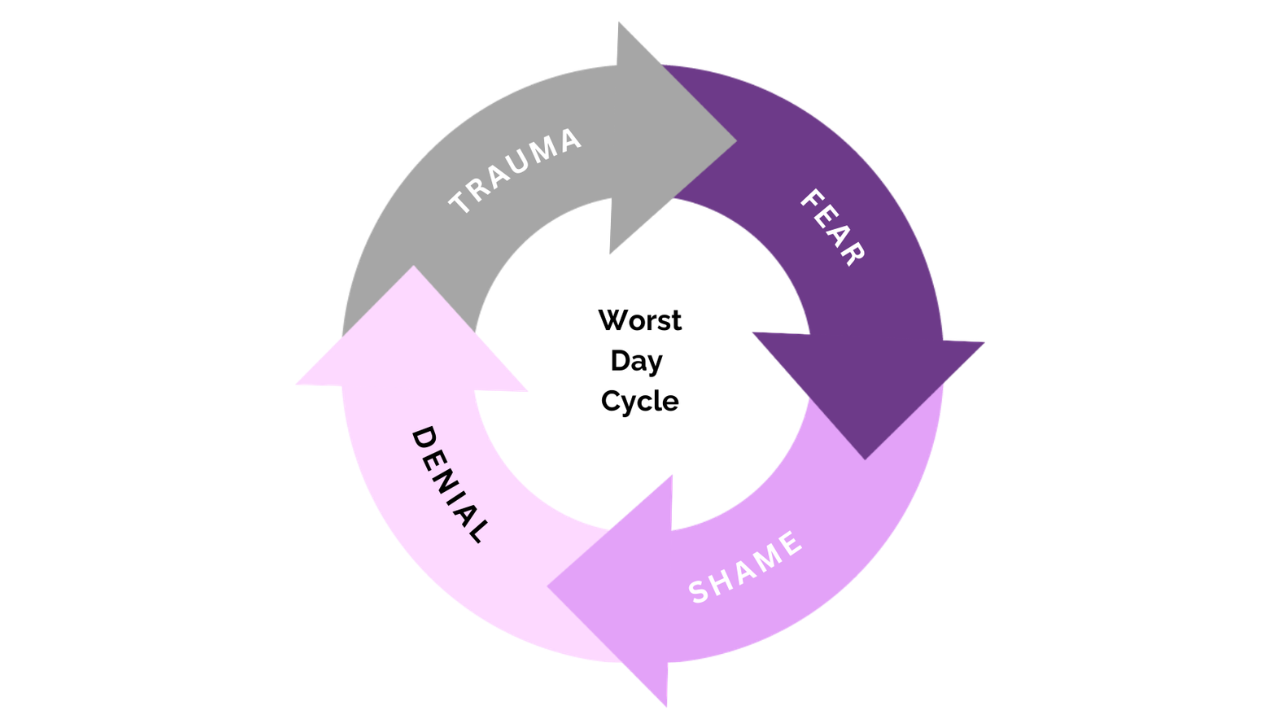
Stage 1: Trauma. Childhood trauma is any negative emotional experience that created painful meanings. A parent who rolled their eyes when you cried. A father who said “stop crying or I’ll give you something to cry about.” A mother who needed you to be happy so she wouldn’t fall apart. Any of these creates a massive chemical reaction in the nervous system. The hypothalamus generates chemical cocktails — cortisol, adrenaline, dopamine misfires, oxytocin disruptions — and the brain becomes addicted to these emotional states.
Stage 2: Fear. Fear drives repetition. The brain conserves energy by repeating known patterns. It cannot tell right from wrong — only known versus unknown. Since approximately 70% of childhood messaging is negative and shaming, the brain defaults to emotional suppression because that is what it learned to do. That’s you if feeling nothing feels safer than feeling something — because the last time you felt something fully, you were punished for it.
Stage 3: Shame. This is where you lost your inherent worth. Where you decided “I am the problem.” The child who was told not to cry concluded not just “crying is bad” but “I am bad for wanting to cry.” Shame says your emotions themselves are defective — that there is something fundamentally wrong with the way you experience the world.
Stage 4: Denial. To survive unbearable shame, your psyche creates a survival persona — a false identity that says “I’m fine,” “I don’t need anyone,” “emotions are weakness,” “I’m just not an emotional person.” This is the numbness. Three survival persona types emerge: falsely empowered (controls, dominates, rages), disempowered (collapses, people-pleases), adapted wounded child (oscillates between both).
Sound familiar? That’s the Worst Day Cycle™ running your emotional life without your permission — keeping you numb so you never have to face the shame underneath.
The Three Survival Personas and Emotional Shutdown
Emotional numbness doesn’t look the same in everyone. It creates three distinct survival personas — adaptive identities built in childhood to protect you from the pain of feeling.
The Falsely Empowered Persona. This survival persona hides numbness behind control, intellect, achievement, and emotional dominance. You became the person who “doesn’t do emotions.” You replaced vulnerability with productivity. You intellectualize every feeling. You analyze pain instead of experiencing it. You are the one everyone calls “strong” — and you are exhausted from the performance.
That’s you if you’ve been promoted for the very pattern that’s destroying you — your survival persona’s emotional detachment is your company’s greatest asset and your nervous system’s greatest prison.
The Disempowered Persona. This survival persona hides numbness behind collapse, people-pleasing, and disappearance. You feel nothing because you learned that feeling meant being consumed by someone else’s emotional needs. Your numbness is not coldness — it is exhaustion from a lifetime of carrying emotions that were never yours to carry.
That’s you if you absorb everyone else’s feelings but can’t locate your own. You feel everything for other people and nothing for yourself — because your childhood taught you that your feelings don’t matter.
The Adapted Wounded Child. This survival persona oscillates between both — sometimes controlling and numb, sometimes collapsing and overwhelmed, never grounded in authentic feeling. You shift depending on who is in the room, reading emotions like a survival manual.
That’s you if you swing between feeling nothing and feeling everything — between weeks of numbness and sudden floods of emotion that seem to come from nowhere. Your nervous system is cycling between two survival strategies, neither of which allows authentic feeling.
Why Thinking Cannot Fix a Feeling Problem
Here is the truth that most therapy, most self-help, and most personal development gets wrong: every thought you have and every action you ever take starts with an emotion, a feeling. You feel before you think. Your thoughts are a byproduct of what you are feeling. Therefore, thought-based programs will have limited effectiveness because they are not addressing the core source of what is creating the negative patterns.
This is how the brain is designed. Every bit of information you take in — whether you see it, smell it, touch it, taste it, hear it — comes through the thalamus, the emotional center of the brain. It gets cataloged based on previous emotional experiences, and only then does it reach thought. That is why positive thinking does not work for people carrying childhood trauma — the emotional blueprint generates the feeling before the thought even forms, and no amount of affirmation can override a chemical reaction that happens in milliseconds.
That’s you if you’ve read every self-help book, done every meditation app, repeated every affirmation — and you still feel numb. Because you’ve been trying to think your way out of a feeling problem. And that is neurologically impossible.
This is a feeling process, not a thinking process. Pain is a feeling experience, not a thinking experience. You cannot change emotional patterns through thoughts alone — emotions are biochemical events, and thoughts originate from feelings. To heal emotional numbness, you must work at the level where the numbness was installed: the body, the nervous system, the emotional blueprint.
That’s you if you understand your trauma intellectually but still react — or fail to react — the same way in relationships. That’s the gap between knowing and feeling. The Emotional Authenticity Method™ closes that gap.
How Emotional Numbness Shows Up Across Your Life
Emotional numbness does not confine itself to one area. Because the emotional blueprint runs beneath every decision, every relationship, every moment of self-talk — the shutdown infiltrates everything.
Family Relationships
You sit through family gatherings feeling detached, like you are watching a movie of your own life. You cannot connect with your parents in any authentic way. You avoid emotional conversations. You perform the role of “the strong one” or “the easy one” because you learned early that your feelings created problems for the family system. Learn more about these patterns at the signs of enmeshment.
That’s you if your family calls you “the calm one” — and you know the truth is that you are not calm. You are disconnected.
Romantic Relationships
Your partner says “I feel like I’m talking to a wall.” You want to connect but you literally cannot access the feelings they are asking for. Intimacy feels threatening because intimacy requires vulnerability, and vulnerability means opening the door your survival persona sealed shut in childhood. You choose partners who are either emotionally explosive (providing the feelings you cannot generate) or emotionally unavailable (matching your own shutdown). Explore deeper patterns in signs of relationship insecurity.
That’s you if you love someone and cannot say it. Not because you don’t mean it — because the words feel physically stuck in your throat, blocked by a lifetime of emotional suppression.
Friendships
Your friendships are surface-level. You can talk about work, sports, shows — but the moment someone asks “how are you really doing?” you deflect. You have acquaintances but few genuine connections because genuine connection requires letting someone see you, and you have spent your life making sure nobody does.
That’s you if people think they know you but actually know your survival persona. The real you — the one with feelings, needs, fears, and desires — has never been safe enough to show up.
Work and Achievement
You are highly productive because emotional numbness makes you efficient. You do not get derailed by feelings because you do not have access to them. But underneath the productivity is emptiness. The achievements mean nothing. The promotions mean nothing. Build genuine self-esteem that does not depend on output.
That’s you if you’ve achieved everything on your checklist and still feel hollow — because achievement cannot fill a hole that only feeling can fill.
Body and Health
Your body has been storing the emotions your mind refused to feel. Chronic tension, digestive issues, headaches, fatigue, insomnia, autoimmune conditions — your body is keeping the score. When we suppress emotions, we do not eliminate them. We drive them underground into the body, where they manifest as physical symptoms.
That’s you if your doctor says there is nothing wrong with you — but your body disagrees. The numbness you feel emotionally, your body feels as pain.
The Emotional Authenticity Method™: 6 Steps to Stop Numbing and Start Feeling Again
The Emotional Authenticity Method™ is a six-step process that rewires your nervous system’s relationship with feeling. This is not talk therapy. This is not positive thinking. This is somatic, chemical, neurological rewiring — working at the level where the numbness was installed.
Step 1: Somatic Down-Regulation. When you notice the numbness descending — when you feel yourself going blank, shutting down, checking out — pause. Focus on what you can hear for 15–30 seconds. Wind. Traffic. Your own breath. If you are highly dysregulated, use titration: cold water on your face, step outside, hold ice. You cannot access feeling from a flooded or frozen state. This step brings your nervous system back into the window where feeling becomes possible.
Step 2: What am I feeling right now? Not “I feel nothing.” Use the Feelings Wheel to expand your emotional vocabulary beyond “fine” and “nothing.” Research shows that 70% of the population cannot name what they feel because they were taught to suppress their authentic emotional experience. Are you numb? Or are you terrified? Are you blank? Or are you so overwhelmed with sadness that your system shut it down? Emotional granularity activates your thinking brain and begins to crack the numbness.
Step 3: Where in my body do I feel it? All emotional trauma is stored physically. Even numbness has a body signature — heaviness in the chest, tension in the jaw, a hollow feeling in the stomach, tingling in the fingers. Locate the sensation. This grounds you in your body, which is exactly where the numbness was designed to keep you from going.
That’s you if you’ve been living in your head for so long that the idea of feeling something in your body sounds foreign. That’s exactly why this step matters — your body has been holding what your mind refused to carry.
Step 4: What is my earliest memory of having this exact feeling? The numbness you feel today echoes something much older. When was the first time you shut down? When was the first time you were told not to feel? When was the first time feeling created danger? This is where you connect present-day numbness to the childhood blueprint that installed it.
Step 5: Who would I be if I never had this numbness again? Not “I’d be happy.” Specific: “I’d be someone who cries at movies. Someone who tells their partner ‘I love you’ without rehearsing it first. Someone who can sit with sadness without needing to fix it or flee from it.” This plants the seed of your authentic self — the version of you that existed before the numbness was installed.
Step 6: Feelization — The New Chemical Addiction. Sit in the feeling of who you would be — the authentic self. Make it strong. Feel the openness, the softness, the vulnerability, the aliveness in your body. Create a new emotional chemical addiction to replace the old numbness blueprint. Ask yourself: “How would I respond to this situation from this feeling? What would I say? What would I do?” Visualize and FEEL yourself operating from your Authentic Self. This is the emotional blueprint remapping and rewiring step. The more you practice Feelization, the more you become blended with feeling — and the weaker the old numbness pattern becomes.
That’s you if you’ve never been taught that you can literally rewire your nervous system by changing what you practice feeling — that numbness is a chemical addiction, not a permanent identity.
The Authentic Self Cycle™: From Shutdown to Authentic Connection
The Authentic Self Cycle™ is the healing counterpart to the Worst Day Cycle™ — a four-stage identity restoration system: Truth → Responsibility → Healing → Forgiveness. This is how you reclaim the emotional life that was stolen from you in childhood.
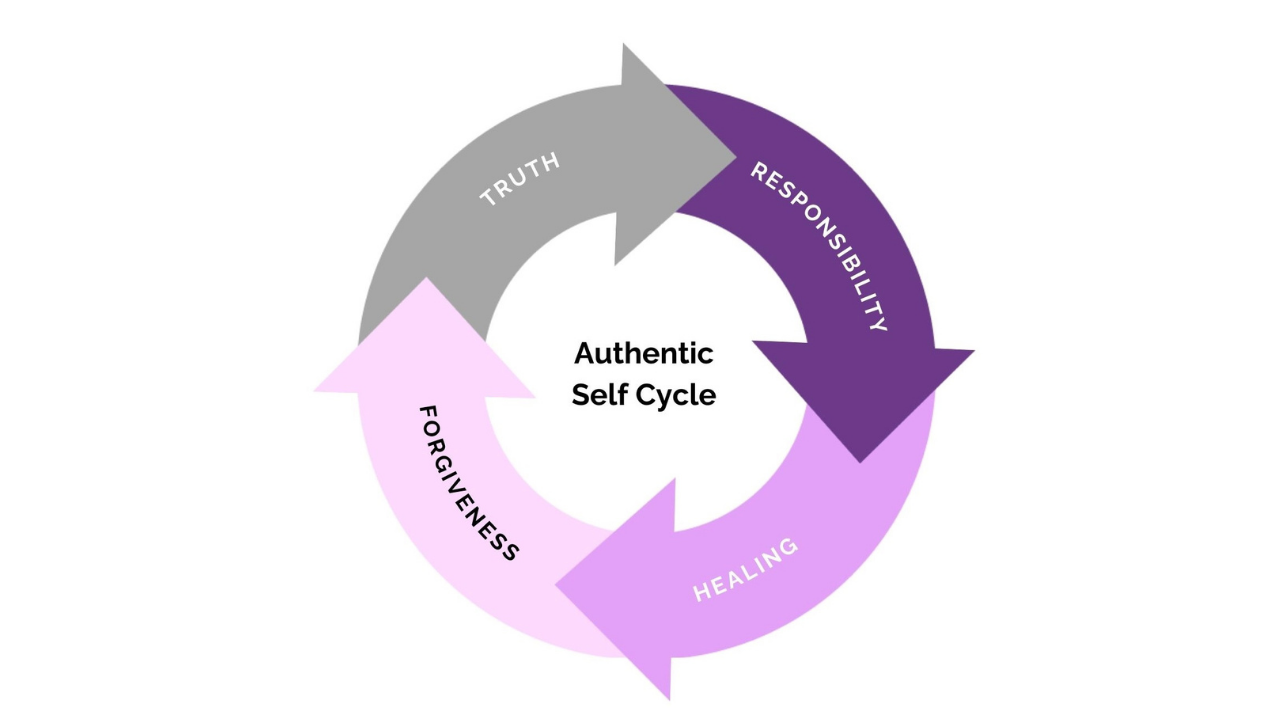
Stage 1: Truth. Name the blueprint. “My numbness is not a personality trait. It is a survival strategy I developed in childhood because feeling was dangerous. I was never allowed to cry. I was never allowed to express anger. I was never allowed to have needs. My nervous system did the only thing it could — it shut feeling down to keep me safe.” That’s you if you’re finally seeing the pattern — the same numbness showing up in every relationship, every conflict, every mirror.
Stage 2: Responsibility. Own your emotional patterns without blame. “My partner is not my parent — my nervous system just thinks they are. When they ask me to be vulnerable, my system fires the childhood alarm. That alarm is mine to heal.” This is not about fault. It is about authorship — becoming the author of your emotional life instead of a character in a script written before you could speak.
Stage 3: Healing. Rewire the emotional blueprint so that feeling becomes safe. This is where the Emotional Authenticity Method™ does its deepest work — creating a NEW emotional chemical pattern that replaces the old numbness. Feeling becomes uncomfortable but not dangerous. Tears become allowed. Anger becomes information instead of threat. Need becomes human instead of shameful. Creates a new emotional chemical addiction rooted in authenticity rather than suppression.
Stage 4: Forgiveness. Release the inherited emotional blueprint and reclaim your authentic self. Forgive yourself for the numbness. Forgive your parents — not because what happened was acceptable, but because they were doing the best they could with the tools they were given. When you can think about your childhood without rage or collapse — and feel genuine compassion for the child who had to disappear to survive — you have broken the cycle.
That’s you if you’re ready to stop being invisible and start being whole. Your authentic self — the one who was there before the numbness, the one who felt everything before the world taught you not to — is still in there. Waiting.
Frequently Asked Questions
Why can’t I feel my emotions even when I want to?
Your nervous system learned in childhood that feeling is dangerous, and it is still running that program. Emotional numbness is not a choice — it is a neurological pattern installed before your logical brain was fully developed. The feelings are still there. Your system has simply locked the door to protect you from them. The Emotional Authenticity Method™ teaches you to open that door safely, at the pace your nervous system can handle.
Is emotional numbness the same as depression?
They can look similar, but they are not the same. Depression often involves sadness, hopelessness, and loss of interest. Emotional numbness involves the absence of all feeling — including sadness. Many people who are emotionally numb would welcome sadness because at least sadness is something. Numbness is the flat, blank nothing that happens when your survival persona has suppressed every emotion equally. Both can be rooted in childhood trauma and the Worst Day Cycle™.
Can you become emotionally numb from a single traumatic event?
A single overwhelming event can trigger shutdown, but most chronic emotional numbness develops from repeated exposure to environments where feeling was unsafe. It is the accumulation — like quarters dropping into a bucket — that eventually breaks the rope and floods the system. The child who was told “stop crying” once might adapt. The child who was told “stop crying” every day for years builds a nervous system that eliminates crying altogether.
How long does it take to stop feeling numb?
Most people report moments of breakthrough feeling within weeks of consistent practice with the Emotional Authenticity Method™, with significant shifts within 6–12 months. The feeling comes back in waves — not all at once. It is becoming more intense because you are awakening to what it is like to actually feel. You were never allowed to feel. And so you are learning what it is like — and learning that you can survive it.
Will I be overwhelmed if I start feeling again?
This is the most common fear — that opening the emotional floodgates will drown you. The Emotional Authenticity Method™ addresses this directly through Step 1 (somatic down-regulation) and titration. You do not rip the door open. You crack it. You feel a little, you regulate, you feel a little more. Over time, your nervous system learns that feeling is survivable — that waves of emotion can move through you without destroying you.
Is emotional numbness genetic or learned?
Emotional numbness is learned, not inherited. You are not born numb. You are born with a full range of emotions. Watch any infant — they feel everything, fully, without suppression. Numbness is installed through repeated experiences where feeling was punished, ignored, or unsafe. Because it is learned, it can be unlearned. Your emotional blueprint can be rewritten.
The Bottom Line
You are not broken. You are not cold. You are not incapable of feeling. You are running a survival program that was installed in childhood to protect you from emotions that were too big, too punished, or too dangerous to experience safely. That program saved your life. And now it is time to update it.
The numbness you carry is not permanent. It is not who you are. It is what your nervous system learned to do when feeling meant danger. Underneath the blankness, underneath the shutdown, underneath the “I don’t know what I feel” — your full emotional life is waiting. Every feeling you were never allowed to have is still there, preserved, ready to be accessed the moment your nervous system learns that feeling is safe again.
That’s you if you’re finally ready to feel — not because someone told you to, not because a therapist assigned it, but because you are tired of watching your life through glass and you want to actually be in it.
The Worst Day Cycle™ keeps you numb by repeating trauma, fear, shame, and denial. The Authentic Self Cycle™ breaks it by moving through truth, responsibility, healing, and forgiveness. And the Emotional Authenticity Method™ gives you the six steps to literally rewire your nervous system so that feeling becomes your new baseline — not something you perform, but something you live.
Your authentic self — the one beneath the numbness, beneath the performance, beneath the survival strategies — already knows how to feel. Your only job is to make it safe enough for them to come forward.
Recommended Reading
- Facing Codependence by Pia Mellody — The foundational text on how childhood trauma strips away emotional access and creates survival personas that suppress authentic feeling.
- The Body Keeps the Score by Bessel van der Kolk — Essential reading on how emotional suppression and numbness live in your nervous system and why healing requires more than talk therapy.
- When the Body Says No by Gabor Maté — How chronic emotional suppression manifests as physical illness, autoimmune conditions, and chronic pain.
- Codependent No More by Melody Beattie — The classic guide to reclaiming your emotional life and stopping the cycle of self-abandonment.
- The Gifts of Imperfection by Brené Brown — A guide to wholehearted living that directly counters the shame keeping you disconnected from your authentic emotions.
Ready to Stop Numbing and Start Feeling?
- Emotional Blueprint Starter Course — Individual ($79) — Your personal roadmap to understanding your emotional blueprint and reconnecting with your authentic emotional life.
- Relationship Starter Course — Couples ($79) — If emotional numbness is showing up in your relationship and you want to break the pattern together.
- Why We Can’t Stop Hurting Each Other ($479) — A deep dive into how emotional shutdown creates relationship conflict and how to interrupt it.
- Why High Achievers Fail at Love ($479) — If your falsely empowered survival persona has you succeeding at work but emotionally absent in relationships.
- The Shutdown Avoidant Partner ($479) — Understanding how emotional numbness drives avoidant attachment and emotional distance.
- Tier 1: Mapping the Blueprint ($1,379) — The comprehensive program for deep rewiring of your emotional blueprint and reconnecting with your full emotional life.
Start with the Feelings Wheel exercise to begin rebuilding your emotional vocabulary today. Then explore the signs of enmeshment to understand how your emotional boundaries collapsed. Learn your negotiables and non-negotiables to rebuild the foundation. And discover the do’s and don’ts for great relationships to build connections from wholeness.