Tag: Shame

  • Shame in the Worst Day Cycle™: How Childhood Shame Strips Your Worth

    Shame in the Worst Day Cycle™: How Childhood Shame Strips Your Worth

    Shame in the Worst Day Cycle™ is the stage where you lose your inherent worth — the moment childhood trauma convinces you that you ARE the problem, not that you HAVE a problem, and it is the hidden engine that drives every pattern of self-sabotage, people-pleasing, perfectionism, and emotional shutdown in your adult life. If you’ve ever pushed yourself to the point of burnout, tolerated treatment you know is wrong, or felt hollow inside despite external success — shame is the invisible force running the program. And it started long before you had words for it.

    That’s you — the one who works harder than everyone in the room because deep down, you believe that if you stop producing, you’ll be exposed as worthless.

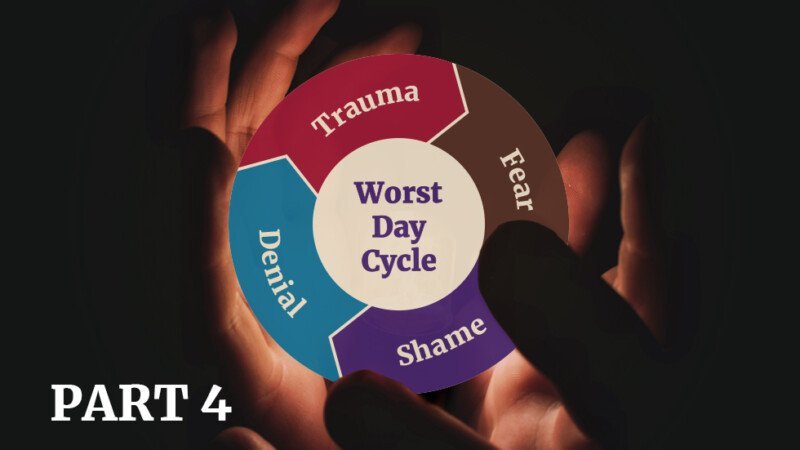
    This is Part 4 of my series on healing the Worst Day Cycle™. In Part 1, we explored how childhood trauma creates the cycle. In Part 2, we examined how the emotional blueprint runs your adult life. In Part 3, we explored how fear drives repetition. Now we arrive at the stage that locks the entire cycle in place: shame.
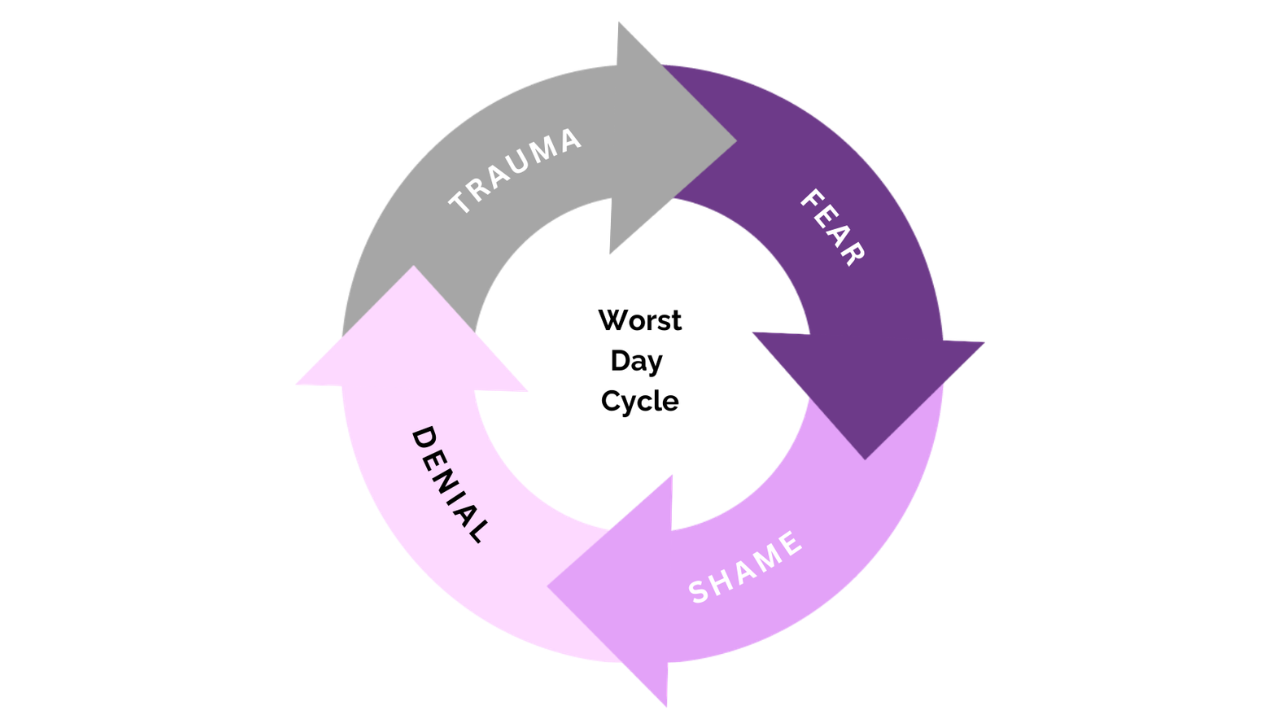
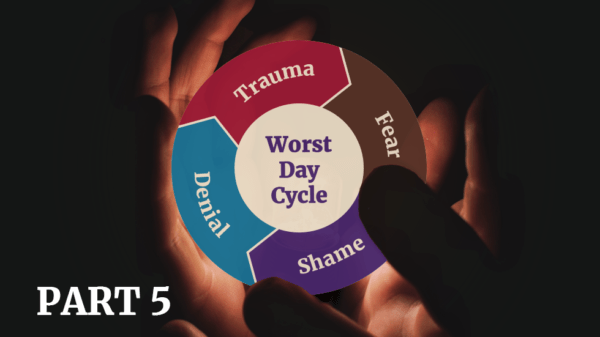
    Worst Day Cycle diagram showing trauma fear shame denial — shame is the stage where you lose your inherent worth

    What Is Shame in the Worst Day Cycle™?

    Shame is the third stage of the Worst Day Cycle™ — the four-stage neurochemical loop of Trauma → Fear → Shame → Denial that runs underneath every self-sabotaging pattern in your life. Shame sits at the center of your Worst Day Cycle™. It is the glue of trauma repetition. It is the prison of the adapted child-self.

    That’s you — feeling a wave of worthlessness wash over you after a small mistake at work, and wondering why your reaction is so much bigger than the situation deserves.

    Shame is not guilt. Guilt is healthy — it says “I did something against my values” and motivates repair. Shame says something entirely different. Shame says: “I AM the problem.” Not “I made a mistake” — but “I am fundamentally broken, defective, unworthy of love.” That belief didn’t come from nowhere. It was installed in childhood, and it has been running your operating system ever since.

    Shame is the stage of the Worst Day Cycle™ where childhood trauma convinces you that your inherent worth is conditional — that you must perform, produce, please, or prove yourself to deserve love, connection, or even basic safety.
    Trauma chemistry icon showing how childhood shame creates neurochemical addiction to worthlessness

    How Does Childhood Trauma Create Shame?

    As a species, we need two things to survive: attachment to another human being and the ability to pursue our authentic selves. Because our caregivers are human — and therefore perfectly imperfect — every child faces a brutal choice: drop your authentic self to maintain attachment, or risk losing connection entirely.

    That’s you — the child who stopped crying because tears made your parent uncomfortable. The child who learned that being “easy” was the only way to be loved.

    The loss of your authentic self creates shame. Here’s how the Worst Day Cycle™ builds it:

    Stage 1 — Trauma: Any negative emotional experience in childhood that created painful meanings about you. It doesn’t have to be dramatic — a parent who was emotionally unavailable, a household where feelings were weakness, a caregiver whose love was conditional on performance. These experiences create a massive chemical reaction in the brain and body. The hypothalamus generates chemical cocktails — cortisol, adrenaline, dopamine, oxytocin misfires — and the brain becomes addicted to these emotional states.

    Stage 2 — Fear: Fear drives repetition. The brain conserves energy by repeating known patterns — it can’t tell right from wrong, only known from unknown. Since 70%+ of childhood messaging is negative and shaming, adults repeat these painful patterns in relationships, career, hobbies, health — everything. The brain thinks repetition equals safety.

    That’s you — choosing the same emotionally unavailable partner over and over, not because you want to, but because your nervous system is terrified of anything unfamiliar.

    Stage 3 — Shame: This is where it all collapses inward. The powerlessness within fear is what creates shame. Instead of seeing the fear as your nervous system’s response to a childhood wound, you internalize it as truth about yourself. “There’s something wrong with me because I can’t figure this out.” Shame strips you of your inherent value and worth and your authentic power.

    Stage 4 — Denial: To survive the overwhelming nature of those feelings, you create denial. Denial is the moment shame kicks in the survival persona, suppresses the pain from childhood, and runs the old program. “I’m fine. I just have high standards. I just need to keep moving.” Instead of feeling the original wound, you deny it and throw yourself into more work, more fixing, more taking care of everybody else but yourself.
    Emotional blueprint icon showing how childhood shame creates the operating system running your adult life

    That’s the cycle — and it repeats thousands of times per day without your conscious awareness. You wake up and the shame engine fires up. You feel the fear it creates. You deny it by pushing harder. You get temporary relief. And then boom — the void. And the process repeats over and over and over.

    The Worst Day Cycle™ reveals that shame is not a character flaw — it is a neurochemical survival pattern your brain created in childhood to make sense of unbearable pain, and it has been running on autopilot ever since.

    How Does Shame Strip Your Inherent Worth?

    Every human being has inherent value and worth — whether they are being perfect or imperfect. Worth is not something you earn through achievement, performance, usefulness, or compliance. It exists at birth and can never be lost.

    But shame convinces you otherwise.

    That’s the lie shame tells — that your value is conditional. That you must perform, produce, or please others to deserve love. That without your achievements, your gifts, you could never be loved and would never have been loved.
    Perfectly imperfect icon representing inherent worth that shame cannot destroy

    As John Bradshaw explains, “The wounded inner child contaminates intimacy in relationships because he has no sense of his authentic self.” When a parent cannot affirm a child’s feelings, needs, and desires, they reject that child’s authentic self. A survival persona must then be set up to replace the authentic self. And that persona runs on shame.

    Shame is the core motivator of both the super-achiever and the under-achiever. The super-achiever uses accomplishment to prove they have worth — “If I just work harder, achieve more, become more impressive, maybe I’ll finally feel enough.” The under-achiever has given up the fight entirely — “Why bother? I’ll never be enough anyway.” Both are running the same shame program. Both have lost contact with their inherent worth.

    That’s you — either grinding yourself into the ground trying to prove you’re worthy, or collapsed under the weight of believing you never will be. Two sides of the same shame coin.

    Trying to be perfect is actually self-rejection — it is choosing to give up your own identity and making yourself powerless. The single greatest way to love yourself and develop self-worth is to follow your own morals, values, needs, and wants — and to accept that you are a human being with overwhelming inherent worth regardless of what you’ve done or what’s been done to you.

    Shame creates a counterfeit identity system — it convinces you that your authentic self is unlovable, so you build a survival persona to earn the love that was always your birthright, and that persona becomes the prison you live in for decades.

    How Do the Three Survival Personas Use Shame?

    Your survival persona is the identity your brain built in childhood to navigate an emotionally unsafe environment. It’s not who you are — it’s who you had to become. And shame is the fuel that powers every version of it.

    Whether falsely empowered, disempowered, or adapted wounded child — it’s all a power game. Shame strips us of our inherent value and worth and our authentic power. So the survival persona tries to get that power back — through control, through collapse, or through oscillating between both.
    Three survival personas — falsely empowered disempowered adapted wounded child — all driven by childhood shame

    The Falsely Empowered: This persona controls, dominates, and rages. The shame engine tells them: “If I’m in charge, if I win, if I’m perfect, people can’t hurt me or abandon me.” They’re driven by a deep terror of vulnerability and powerlessness. Work is their addiction, success is their medication, and failure is their nightmare. They use achievement to deny how deeply unworthy they feel — not because that’s true, but because that’s the message that was placed into them.

    That’s you — the one who’d rather burn out than admit you’re exhausted, because admitting weakness feels like proof that you are fundamentally flawed.

    The Disempowered: This persona collapses, people-pleases, and disappears. The shame engine tells them: “If I make myself small, if I sacrifice myself, if I’m always available, people won’t leave me.” They hide their shame behind being the “nice” person. But being nice is a covert way of playing the victim — the nice person wants recognition for being such a nice person while continually picking people and situations where they give more and do more.

    Sound familiar? The feeling that you have to earn love through sacrifice, that saying no will cause abandonment, that your own needs are selfish?

    The Adapted Wounded Child: This persona oscillates between falsely empowered and disempowered depending on the context. One moment they’re raging and controlling, the next they’re collapsed and people-pleasing. They’re unpredictable even to themselves. This person is exhausted by their own inconsistency.
    Adapted wounded child icon showing oscillation between falsely empowered and disempowered survival personas driven by shame

    That’s you — the one who can’t understand why you blow up at your partner one moment and then become a doormat the next, wondering why you can’t just be consistent.

    All three survival personas use shame as a control mechanism — they tell you that if you step out of your survival role, if you become vulnerable, if you ask for what you need, you’ll be exposed, abandoned, or destroyed. Self-sabotage is the collision between the authentic self and the shame-based survival persona.

    How Does Shame Show Up in Every Area of Your Life?

    Shame doesn’t stay in one corner of your life. It’s a system that runs everything — because it’s your nervous system trying to keep you safe.

    Family: You’re either still trying to earn your parents’ approval (falsely empowered) or completely dependent on their validation (disempowered). You can’t set healthy boundaries because boundaries feel like abandonment. Shame makes you feel less than — and when someone in the family brings up a topic that touches your unhealed wound, that childhood shame jumps up and you lash out or shut down. You try to create a diversion so you don’t have to admit what you’re really feeling.

    That’s you — still playing the role your family assigned you at age six, managing everyone’s emotions at holiday dinners while your own feelings sit unvisited.

    Romantic Relationships: The shame engine ensures you choose partners who trigger your childhood wounds. You recreate the Worst Day Cycle™ with your partner over and over. Something triggers your fear, you shame yourself, you activate your survival persona (control or collapse), and your partner reacts to the persona — not the real you. Both of you are having two completely different conversations: one in the present and one in the past.

    That’s you — unable to have a conversation about a legitimate need without either exploding or shutting down, wondering why your relationships never feel secure.

    Friendships: You’re the friend who always has it together and secretly resents that others never check on you. Or you’re the friend who abandons yourself completely and becomes bitter when others don’t reciprocate. You don’t let people see you struggle. You feel lonely even when surrounded by people because no one actually knows you — they know your survival persona.

    Work: The falsely empowered shame engine shows up as burnout, perfectionism, and inability to delegate. The disempowered shame engine shows up as underearning, underselling yourself, and accepting terrible treatment from employers. Either way, you’re not working from your real motivation — you’re working from fear and shame. You’re proving something instead of creating something.

    Sound familiar — working 60+ hours a week because you believe that’s the only way you’re valuable, or staying in a job that pays you 30% less than your market value because you don’t think you deserve better?

    Body and Health: Shame creates disconnection from your body. You push through pain and exhaustion (falsely empowered) or abandon self-care entirely (disempowered). Chronic pain, digestive issues, insomnia, and autoimmune conditions are often the body’s last resort when emotional signals have been ignored for decades. Your body has been trying to tell you something — but shame taught you to stop listening.

    That’s your body keeping score — every swallowed feeling, every suppressed need, every moment you abandoned yourself to keep someone else comfortable.

    Why Can’t You Think Your Way Out of Shame?

    Affirmations. Willpower. Positive thinking. Cognitive reframing. You’ve probably tried all of these. You’ve probably spent years telling yourself you’re worthy, capable, enough. And you probably still feel the shame.

    Here’s why: shame is not a thought — it’s a nervous system state. Your emotions are biochemical events, not intellectual ones. Thoughts originate from feelings, not the other way around. You cannot think your way out of a nervous system that’s still running the Worst Day Cycle™.

    That’s you — repeating “I am worthy” while your nervous system is screaming that you’re not, and then shaming yourself for not being “positive enough.”
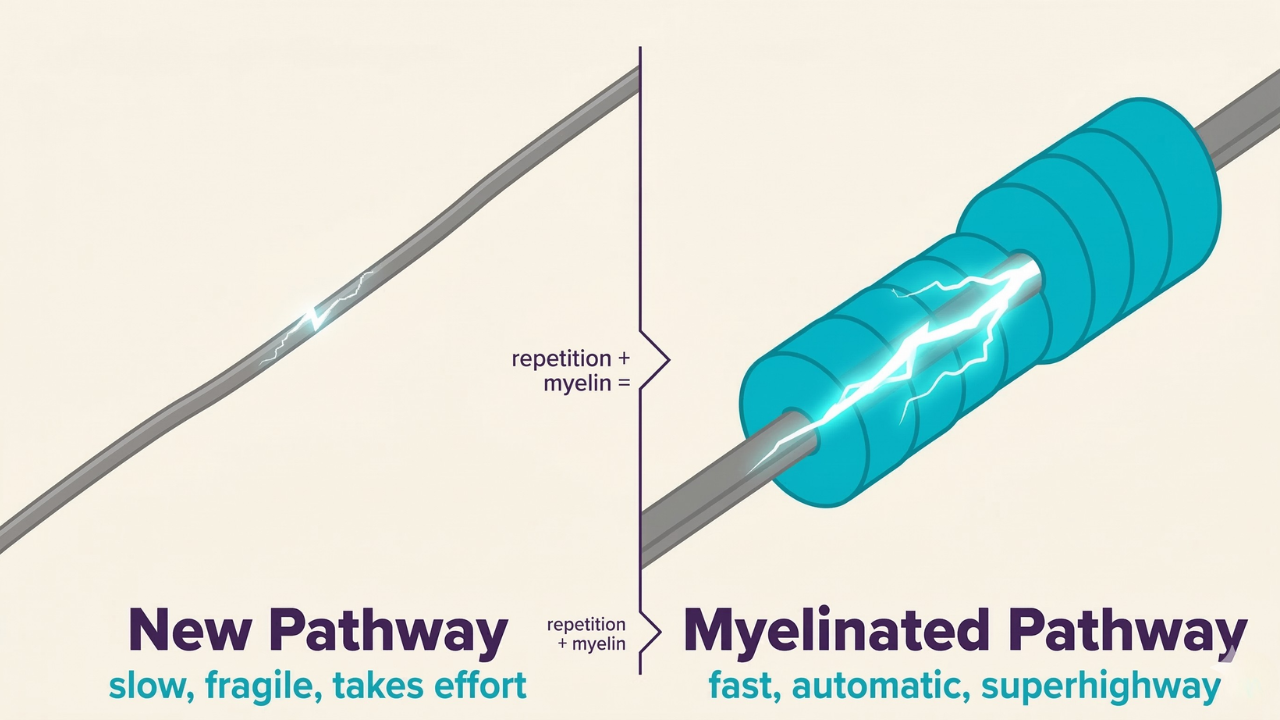
    Myelin and neural pathways icon showing why thinking alone cannot rewire shame patterns stored in the nervous system

    As John Bradshaw wrote, “Cognitive addictions are a powerful way to avoid feelings. Thinking can be a way to avoid feelings.” Every thought starts as a feeling — the emotion comes first. Yet we all try to think our way through things, which is a waste of time because you can’t change your thoughts until you change your feelings.

    When your nervous system is in the shame state, it doesn’t care what your mind says. It’s running on survival code written in childhood. Your conscious mind is no match for your nervous system’s survival patterns. And that’s exactly why you need a practice that speaks your nervous system’s language — not just your intellect’s.

    Shame cannot be resolved through intellectual understanding because it is stored as a neurochemical pattern in the body — the brain created a chemical addiction to worthlessness in childhood, and that addiction runs below conscious awareness thousands of times per day.

    How the Emotional Authenticity Method™ Rewires Shame

    The only way to rewire the shame pattern is to change your nervous system’s emotional blueprint. And that requires the Emotional Authenticity Method™ — a somatic, nervous-system-based approach that actually changes your neurochemistry.
    Emotional Authenticity Method icon for rewiring shame at the nervous system level

    Step 1: Somatic Down-Regulation. Focus on what you can hear for 15-30 seconds. Before you can process anything, you have to get your nervous system out of survival mode. If you’re highly dysregulated, use titration — feel a little bit of the emotion, get regulated, then feel a little bit more. You’re teaching your nervous system that this feeling won’t destroy you.

    That’s you — finally understanding that “handling it” means pausing to calm your nervous system first, not pushing through with willpower.

    Step 2: What am I feeling right now? Most people respond to shame with “I feel bad” or “I’m stressed.” Your nervous system needs more specificity to heal. Use the Feelings Wheel to develop emotional granularity — the ability to name specific emotions instead of lumping everything into surface-level labels.

    Step 3: Where in my body do I feel it? All emotional trauma is stored physically. Your chest tightens. Your stomach drops. Your jaw clenches. Locating the feeling in your body is how you move from intellectual understanding to somatic processing. You’re moving from “I AM ashamed” to “I FEEL shame in my chest” — and that difference is everything.

    Step 4: What is my earliest memory of having this exact feeling? This is where the real rewiring happens. You trace today’s shame reaction back to its childhood origin. You realize: this isn’t about today. My partner isn’t my parent. My boss isn’t my father. My nervous system just thinks they are.

    That’s the moment everything shifts — when you see that your shame reaction belongs to a five-year-old, not a forty-year-old. The reason it’s so scary is that at some point in your childhood, you didn’t have the answer, you were imperfect, and your caregivers sent the message that there’s something defective about you.

    Step 5: Who would I be if I never had this thought or feeling again? This is the vision step. It connects you to the Authentic Self Cycle™. When clients are asked this question, the answer is always some version of: “I feel lighter. I feel calm. I feel free. I feel more like myself.” They don’t describe a new survival persona — they describe their authentic self. That emotional experience is the truth of who they are without the Worst Day Cycle™, without the faulty emotional blueprint, without the shame voice.

    Step 6: Feelization. Sit in the feeling of the Authentic Self and make it strong. Create a new emotional chemical addiction to replace the old blueprint. Ask: how would I respond to this situation from this feeling? What would I say? What would I do? Visualize and FEEL yourself operating from your Authentic Self. This is the emotional blueprint remapping and rewiring step — you’re building a new neurochemical neural pathway that works for you instead of the Worst Day Cycle™ working against you.

    That’s you — not just thinking about who you could be, but feeling it in your body. Creating the emotional experience of your Authentic Self so your nervous system has something real to move toward.

    The Emotional Authenticity Method™ works because emotions are biochemical events — you cannot change emotional patterns through thoughts alone. Thoughts originate from feelings, not the other way around. The EAM speaks your nervous system’s language and rewires shame at the source.

    How the Authentic Self Cycle™ Replaces Shame With Worth

    While the Worst Day Cycle™ traps you in Trauma → Fear → Shame → Denial, the Authentic Self Cycle™ restores your identity through Truth → Responsibility → Healing → Forgiveness. It is the healing counterpart — an identity restoration system that creates a new emotional chemical pattern to replace fear, shame, and denial.
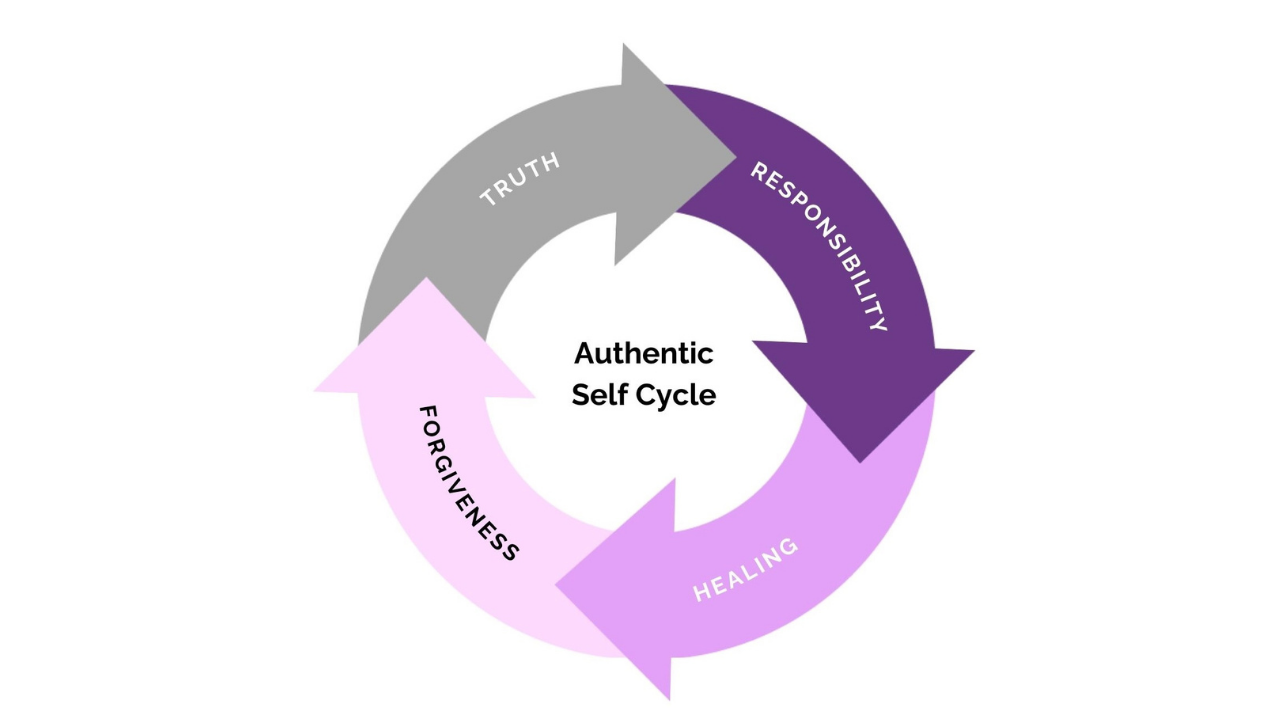
    Authentic Self Cycle diagram showing truth responsibility healing forgiveness as the path out of shame

    Truth: Name the blueprint. See that “this isn’t about today.” When your colleague gives you critical feedback and your chest tightens, truth says: “This feeling is from childhood. My colleague isn’t my critical parent — my nervous system just thinks they are.” Truth breaks the wall of denial and exposes that the fixer, the giver, the survival personas are not the authentic self but adaptations.

    That’s the first step out of shame — seeing the pattern instead of being trapped inside it.

    Responsibility: This is not blame or shame. You did the best you could with what you knew at the time. Responsibility means owning that “this survival pattern kept me safe, but now it’s time to let it go.” You are always responsible for how you are making yourself feel, protecting yourself, and meeting your needs and wants — without controlling or changing the other person.

    Sound familiar? The relief of finally understanding that you can’t control anyone else, but you CAN rewire how you respond to them.

    Healing: Rewire the emotional blueprint so conflict becomes uncomfortable but not dangerous, space isn’t abandonment, and intensity isn’t attack. This is where the Emotional Authenticity Method™ does its work — reparenting the inner child, becoming the parent who chooses you. When you do that, you break the shame story, heal the fear-based chemical addiction, confront the emotional memory your body carries, and create emotional safety inside your own nervous system.

    Forgiveness: Forgiveness is not condoning what happened. Forgiveness is the moment the adult self consistently takes the driver’s seat from the child self and the shame voice. It says: “Hey kids, love you, but back seat. I’m driving now.” It is forgiving yourself: “I see it now. I’ve been stuck in this survival persona. I don’t need to shame myself for that. I was brilliant to come up with that. But I can see now it’s no longer fit for the adult world.”

    That’s you — not becoming someone new. Finally meeting who you always were underneath the survival persona and the shame that built it.

    Because I live in truth, responsibility, healing, and forgiveness, I can forgive myself for being imperfect and that I still have healing to do. Our authentic self knows at all times whether we are being perfect or imperfect — and that we always have value and worth.

    The Authentic Self Cycle™ creates a new emotional chemical pattern that gradually replaces the fear/shame/denial pattern — as this new pattern strengthens through daily Feelization practice, your survival persona becomes less necessary and your authentic self becomes your default operating system.

    Frequently Asked Questions About Shame and Healing

    What is the difference between shame and guilt?

    Guilt is healthy — it says “I did something against my values” and motivates you to repair. Shame says “I AM the problem” — it attacks your identity, not your behavior. Guilt leads to accountability. Shame leads to self-destruction, people-pleasing, or perfectionism. In the Worst Day Cycle™, shame is the third stage that strips your inherent worth and creates your survival persona.

    Why is shame so hard to heal?

    Shame is hard to heal because it is stored in the body as a neurochemical pattern, not as a thought. Your brain became chemically addicted to the emotional state of worthlessness in childhood — cortisol, adrenaline, and stress hormones became your nervous system’s baseline. The Emotional Authenticity Method™ addresses shame at the somatic level where it actually lives, not just the cognitive level where most approaches stop.

    Can shame be healed without therapy?

    You can make real progress using the Emotional Authenticity Method™ on your own. But your nervous system learned shame in relationship, so it heals most powerfully in relationship — whether that’s coaching, therapy, group work, or a trusted partner who understands the Worst Day Cycle™. Having someone witness your process accelerates healing dramatically.

    How does shame create self-sabotage?

    Self-sabotage is the collision between the authentic self and the shame-based survival persona. When you start to succeed, your survival persona panics — because if you live in your authentic self, the persona loses its connection to the old attachment patterns. If you actually succeed, it means the survival persona was always wrong. So it pulls you back into the Worst Day Cycle™ to keep you stuck in the known pattern.

    What are the three survival persona types?

    The three survival personas are the falsely empowered (controls, dominates, rages to avoid vulnerability), the disempowered (collapses, people-pleases, disappears to avoid abandonment), and the adapted wounded child (oscillates between both depending on the situation). All three are driven by shame and are attempts to reclaim the power that childhood trauma stole.

    How long does it take to rewire shame?

    Most people see shifts within weeks of consistent practice with the Emotional Authenticity Method™, but real neurological rewiring takes months and years. The key is repetition, not intensity. Within weeks, your reactions become less automatic. Within months, shame has less power. After a year of consistent work, your baseline nervous system state will be fundamentally different. The Authentic Self Cycle™ provides the framework for long-term identity restoration.

    The Bottom Line

    Shame told you that you are the problem. It has been running that message since you were a child — through your relationships, your career, your friendships, your body, and the quiet moments when the noise stops and the void creeps in.

    But shame lied.

    You were never the problem. You were a child in an impossible situation who created a brilliant survival strategy to stay alive. That strategy — the survival persona — was genius at age seven. But you’re not seven anymore. And the shame that powers it has been keeping you from the one thing you’ve been searching for your entire life: your authentic self.

    There’s nothing wrong with any of us — we’re all perfectly imperfect, we’re human, we’re limited, and we always have inherent value and worth even in our imperfections.

    That’s you — not the survival persona grinding for approval. Not the people-pleaser swallowing your needs. Not the adapted wounded child swinging between both. The real you. The one underneath all of it. The one who has been waiting to be seen, chosen, and valued — not for what you do, but for who you are.

    The Worst Day Cycle™ runs on shame. The Authentic Self Cycle™ runs on truth. And healing begins the moment you choose truth over denial — even for one breath, one moment, one small act of emotional authenticity.

    It’s not an easy journey, but I promise if you choose to do this healing work, you’ll discover the truth about the world and about yourself — and that truth will produce real freedom in your life.

    Healing the Shame That Binds You by John Bradshaw — the foundational work on toxic shame and how it colonizes identity.

    Facing Codependence by Pia Mellody — how childhood trauma creates the survival patterns that shame powers.

    The Body Keeps the Score by Bessel van der Kolk — the neuroscience of how trauma and shame live in the body, not the mind.

    When the Body Says No by Gabor Maté — how chronic shame and emotional suppression manifest as physical illness.

    Codependent No More by Melody Beattie — a practical guide for recognizing shame-driven codependent patterns.

    The Gifts of Imperfection by Brené Brown — how shame drives performance-based identity and why vulnerability is the path back to worth.

    Daring Greatly by Brené Brown — shame resilience and the courage to be imperfect.

    Take the Next Step

    If you’re ready to rewire the shame pattern and reclaim your authentic self, Kenny Weiss offers courses designed for people who are done performing and ready to heal:

    Emotional Blueprint Starter Course — Individual ($79) — Your personal roadmap to understanding the Worst Day Cycle™ and beginning the journey from shame to your authentic self.

    Relationship Starter Course — Couples ($79) — For couples ready to break the shame-driven cycle of reactivity and build interdependence.

    Why We Can’t Stop Hurting Each Other ($479) — Deep-dive into the Worst Day Cycle™ and how childhood shame creates relationship pain.

    Why High Achievers Fail at Love ($479) — Built specifically for the falsely empowered survival persona and the shame engine driving success addiction.

    The Shutdown Avoidant Partner ($479) — Understanding avoidant attachment through the lens of trauma chemistry and shame-driven survival personas.

    Tier 1: Mapping the Blueprint ($1,379) — The comprehensive program for learning and practicing the Emotional Authenticity Method™ to rewire shame at the nervous system level.

    Download the Feelings Wheel — the free tool used in Step 2 of the Emotional Authenticity Method™ to build emotional granularity beyond surface-level shame responses.

    Explore more: The Signs of Enmeshment | 7 Signs of Relationship Insecurity | 7 Signs of High Self-Esteem | How to Determine Your Negotiables and Non-Negotiables | 10 Do’s and Don’ts for a Great Relationship
  • Denial in the Worst Day Cycle™: How Self-Deception Keeps You Trapped

    Denial in the Worst Day Cycle™: How Self-Deception Keeps You Trapped

    Denial is the fourth and final stage of the Worst Day Cycle™ — the unconscious self-deception system your brain built in childhood to protect you from unbearable emotional pain, and it is the single greatest barrier to healing because it guarantees the cycle repeats. If you’ve spent your life insisting “my childhood wasn’t that bad,” minimizing your pain, or wondering why you keep ending up in the same painful patterns despite years of therapy, you’re not lazy or broken. You’re experiencing the most sophisticated survival strategy the human brain can create — and it’s running your life without your permission.

    That’s you — the one who can see everyone else’s patterns clearly but can’t see your own.

    Denial isn’t lying. It’s not stupidity. It’s the brilliant emotional architecture your nervous system built when you were a child who had no other option. And understanding how it works is the most important step you will ever take toward reclaiming your authentic self.

    you created in childhood to protect yourself from shame. It’s not conscious lying — it’s an automated self-deception system that minimizes your pain, normalizes dysfunction, and keeps you performing instead of feeling. The Worst Day Cycle™ explains how denial locks you into repeating painful patterns. The Emotional Authenticity Method™ (6 steps including Feelization) and the Authentic Self Cycle™ provide the path to confronting denial and reclaiming who you actually are.

    Worst Day Cycle diagram showing how denial is the fourth stage that locks you into repeating trauma fear shame patterns

    What Is Denial in the Worst Day Cycle™?

    Denial is not what most people think it is. It’s not stubbornness. It’s not ignorance. It’s not choosing to look away from the truth. Denial is the survival persona you created in childhood to survive the unbearable pain of shame — an automated self-deception system that minimizes, normalizes, and protects you from facing the emotional reality of what happened to you.

    That’s you — the person who says “I’ve dealt with my childhood” while your body, your relationships, and your choices tell a completely different story.

    Self-deception and denial is the single greatest killer on the planet today. It’s not a virus. It’s not guns. It’s not any of the external threats we spend billions fighting. It’s this invisible internal mechanism that nobody talks about because the very nature of denial is to deny its own existence.

    In childhood, denial was genius. You couldn’t leave. You couldn’t fight back. You couldn’t speak the truth about what was happening in your family system. So your nervous system did the only thing it could do — it denied the truth hard enough to make the unbearable bearable. It minimized: “It wasn’t that bad.” It normalized: “All families are like this.” It suppressed: “I don’t remember much of my childhood.” It rationalized: “They did the best they could.”

    That’s the brilliance of denial — it kept a helpless child attached to the people they needed to survive.

    But the survival persona you created as a child becomes the prison you live in as an adult. Denial boomerangs back against you because you don’t realize you’re operating from your wounded child self. You keep choosing people who retraumatize you. You keep reenacting childhood patterns trying to “finally win.” You expect partners, friends, bosses, or even your own children to be the rescuing parent you never had.

    Denial makes you believe you’re an adult — when emotionally, you’re still the child who needed saving. Denial is the final stage of the Worst Day Cycle™ — the stage that guarantees the cycle repeats until you confront the truth and reclaim your authentic self.

    Survival persona icon showing how denial creates a false identity that replaces your authentic self

    How Does Denial and Self-Deception Actually Operate?

    Denial operates through three primary mechanisms, all of which begin in childhood and run automatically in adulthood. Understanding these mechanisms is essential because becoming an expert in your own denial and self-deception is the single most important skill you need to learn if you want to overcome the Worst Day Cycle™.

    Emotional blueprint icon showing how childhood denial patterns become automatic adult self-deception

    Mechanism 1: False Attachment Protection. As a species, we must attach to another human being or we will die. Because our parents are perfectly imperfect and human, they hurt us. To attach and survive, we create a survival persona. We had no choice — our life depended on it. The role of the survival persona is to minimize, suppress, repress, condone, justify, and deny that our parents hurt us. We create this self-deception to forge attachment with them. We subconsciously fear that if we accepted the truth, we would lose their attachment and die.

    That’s you — still protecting the image of your parents at age 40, 50, or 60 because your nervous system still believes the truth would kill the connection.

    Even if you’re aware of your parents’ imperfections, a false attachment seems better than no attachment. That furthers your resistance to admitting how they hurt you. Your inability to live in truth affects every single adult decision for the rest of your life until addressed.

    Mechanism 2: Blame Projection. We blame, judge, and criticize other people, places, and things so that we don’t have to admit the part that our shame-based survival persona played in setting up our own patterns in adult life. There is an added benefit to our self-deception — it shields us from having to face that we created a survival persona and therefore, we don’t know who we really are.

    Sound familiar? Pointing at your partner’s flaws so you don’t have to look at why you chose them in the first place.

    Mechanism 3: Brain Design Reinforcement. The left hemisphere of the brain becomes myopic and shuts out truth unless it confirms its current belief. The emotional right hemisphere’s ability to include context and diverse options makes for a more complete and precise intellectual thought and decision. In short, the more emotionally developed a person is, the better their thoughts and decisions. But the left hemisphere doesn’t want to hear what it takes to be reality. It blindly pushes on, always along the same track.

    That’s the neurological trap — your brain is literally designed to reinforce the self-deception that keeps you stuck.

    The combination of the Worst Day Cycle™, societal beliefs, and the brain’s design creates a formidable adversary to reclaiming your authentic self, accepting your perfect imperfections, and achieving your personal potential.

    How the Worst Day Cycle™ Creates and Sustains Denial

    The Worst Day Cycle™ has four stages: Trauma → Fear → Shame → Denial. Denial is the final stage — and it’s the stage that locks the entire cycle into permanent repetition.

    Trauma chemistry icon showing how childhood creates neurochemical addiction patterns that denial protects

    Trauma: Any negative emotional experience in childhood that created painful meanings. It doesn’t have to be dramatic — it can be as subtle as a parent who was emotionally unavailable, a household where feelings were treated as weakness, or love that was conditional on performance. These experiences create a massive chemical reaction in the brain and body. The hypothalamus generates chemical cocktails — cortisol, adrenaline, dopamine, oxytocin misfires — and the brain becomes addicted to these emotional states.

    That’s you — feeling most alive when you’re in crisis mode, because your nervous system was calibrated for chaos in childhood.

    Fear: Fear drives repetition. The brain conserves energy by repeating known patterns — it can’t tell right from wrong, only known from unknown. Since 70%+ of childhood messaging is negative and shaming, adults repeat these painful patterns in relationships, career, hobbies, health — everything. Fear says: “Don’t change. Don’t look. Stay where you are. At least this pain is familiar.”

    Shame: This is where you lost your inherent worth. “I am the problem.” Not “I made a mistake” — but “I AM the mistake.” Shame creates the core wound underneath all denial. You deny the truth because facing it means facing the shame — and the shame feels like annihilation.

    That’s the shame talking — the voice that says “if people really knew me, they’d leave.”

    Denial: Denial is the survival persona created to survive the pain of shame. It was brilliant in childhood — absolutely necessary. But in adulthood, it sabotages everything. The goal of denial is to keep the focus on managing the symptoms, keeping you in the survival persona, and preventing you from actually feeling the emotional weight from the original trauma and facing the emotional blueprint that was written in childhood.

    Denial can sound like: “My childhood wasn’t that bad.” “I’ve already dealt with all that.” “Other people had it worse.” “This is just how relationships are.” “If I could just stop being so sensitive, this would all be fine.” “I just have to try harder, be calmer, be more patient.” Whatever it may be, every form of denial keeps you from feeling what actually needs to be felt.

    That’s you — collecting new strategies, reading more books, attending more workshops, and never actually sitting with the feeling underneath all of it.

    Denial guarantees the Worst Day Cycle™ repeats because it prevents you from ever reaching the root cause — the childhood emotional blueprint that created your survival persona in the first place.

    How Your Survival Persona Uses Denial to Keep You Trapped

    Your survival persona is the identity you created in childhood to navigate an emotionally unsafe environment. It’s not who you are — it’s who you had to become. And denial is the engine that keeps the survival persona running.

    Adapted wounded child icon showing oscillation between falsely empowered and disempowered denial patterns

    There are three survival persona types, and each uses denial differently:

    The Falsely Empowered: This persona controls, dominates, and rages. They deny vulnerability. They deny need. They deny that their control is driven by terror. The falsely empowered survival persona’s denial sounds like: “I don’t need anyone.” “Emotions are weakness.” “I’ve got this handled.” Their denial keeps them performing strength instead of feeling anything real.

    That’s you — the one who built an empire but can’t have a vulnerable conversation with your partner without shutting down or exploding.

    The Disempowered: This persona collapses, people-pleases, and disappears. They deny their own worth. They deny their own anger. They deny that their constant giving is actually fear-driven, not love-driven. The disempowered survival persona’s denial sounds like: “I’m fine, really.” “Their needs are more important.” “I don’t mind — I like helping.” Their denial keeps them invisible and self-abandoning.

    That’s you — the one who gives everything to everyone and then wonders why you feel invisible and resentful.

    The Adapted Wounded Child: This persona oscillates between both — raging one moment, collapsing the next. They deny having a stable sense of self. They flip between overperforming and shutting down, between control and submission, never landing in their authentic self. Their denial sounds like: “I’m working on it” while nothing actually changes.

    That’s you — swinging between “I don’t need anyone” and “please don’t leave me” and calling both of them your “real self.”

    Here is the deeper truth about the survival persona and denial: when you start to succeed and your authentic self begins emerging, the survival persona activates shame to pull you back. The conflict is this — you’re starting to do better, starting to feel good, and then the shame-based persona says: “Wait. If you live in your authentic self, the connection with Mom and Dad is gone.” The other half of the fear: “If I actually succeed, it means the survival persona was always wrong. Who wants to admit at my age that I’ve lived my life as an imposter?”

    That’s the reason self-sabotage exists — your survival persona would rather destroy your success than face the truth about who you’ve been performing as your entire life.

    Your survival persona uses denial as a shield against the most terrifying truth of all: you don’t know who you really are underneath the performance — and facing that unknown feels more dangerous than repeating every painful pattern you’ve ever known.

    Emotional authenticity icon representing the path from denial and self-deception to truth and healing

    How Denial and Self-Deception Show Up in Every Area of Your Life

    Denial doesn’t stay in one lane. It’s a system-wide operating system that touches every area of your existence.

    Family: You defend your parents’ behavior. “They did the best they could.” “My childhood was normal.” You replay holiday dinners where you were criticized, dismissed, or emotionally abandoned — and you call it “family being family.” You feel anxious before family gatherings but can’t name why. You minimize the impact of childhood emotional neglect because “other people had it worse.”

    That’s you — still protecting the family narrative at the expense of your own truth.

    Romantic Relationships: You choose partners who recreate your childhood emotional environment. You stay in relationships where your needs are dismissed because it feels “normal.” You blame yourself when they can’t love you the way you need. You deny that you chose this person because your nervous system recognized the familiar pain — and familiar pain feels like home.

    Sound familiar? Choosing the same type of partner over and over and insisting “this time it’s different.”

    Friendships: You surround yourself with people who confirm your survival persona. If you’re falsely empowered, your friends admire your strength and never challenge you. If you’re disempowered, your friends lean on you constantly and never ask how you’re doing. You deny that your friendships are one-directional because admitting it would mean facing loneliness — and loneliness triggers the childhood abandonment wound.

    Work: You call workaholism “ambition.” You deny that your drive is fueled by shame — the belief that if you stop producing, you stop being worthy of existence. You tolerate toxic work environments because confrontation feels dangerous. You deny that your career is another survival persona performing worth instead of experiencing it.

    That’s you — being promoted for the very denial pattern that’s destroying your health, your relationships, and your connection to yourself.

    Body and Health: You ignore your body’s signals. Chronic pain, digestive issues, insomnia, autoimmune conditions — your body has been screaming the truth your denial won’t let you hear. You medicate symptoms instead of addressing roots. You push through exhaustion because rest feels like failure. Your body keeps the score even when your denial refuses to read it.

    Emotional fitness icon showing the work required to confront denial across all life areas

    Why Traditional Therapy Can’t Break Through Denial

    Here’s what most therapy gets wrong about denial: it tries to think its way through a feeling problem. Cognitive-behavioral therapy attempts to restructure your thoughts. Talk therapy gives you insight. Both are valuable — but neither touches the neurochemical pattern that denial is protecting.

    That’s the gap — you can understand your denial intellectually and still be completely run by it.

    Think of it like watching a 3D movie without the glasses. You’ve heard about relationships and careers and what it is to be human — you’re watching life, which is a 3D movie with all these different aspects to it. But since you don’t have the glasses, everything’s a bit fuzzy. The colors don’t line up, and you can’t make out everything exactly. But since you’ve heard about what life looks like, you can kind of piece together what’s happening. None of it’s clear. None of it makes total sense.

    Learning about the Worst Day Cycle™, the Authentic Self Cycle™, and Emotional Authenticity — that’s the glasses. All of a sudden, you see everything clearly for the first time. It all makes sense. Shame and denial keep us from seeing the world truly the way it is. The confrontation puts the glasses on, and the glasses are truth, responsibility, healing, and forgiveness.

    You cannot change emotional patterns through thoughts alone. Emotions are biochemical events. Thoughts originate from feelings, not the other way around. This is why cognitive approaches hit a ceiling with denial — they’re trying to use the thinking brain to override a survival program that runs below conscious awareness, in the body, in the nervous system, in the chemical patterns your brain has been repeating since childhood.

    Myelin and neural pathways icon showing how denial patterns become hardwired through neurological repetition

    Traditional therapy fails to break through denial because denial is a somatic and neurochemical pattern, not a cognitive one — it requires body-level, emotion-level intervention to rewire the survival program that has been running automatically since childhood.

    How the Emotional Authenticity Method™ Confronts Denial

    The Emotional Authenticity Method™ is a six-step somatic and emotional process that goes where denial doesn’t want you to go — into the body, into the feeling, into the childhood origin of the pattern. This is the daily practice that actually rewires denial at the nervous system level.

    Emotional regulation icon representing the Emotional Authenticity Method for confronting denial and self-deception

    Step 1: Somatic Down-Regulation (focus on what you can hear for 15-30 seconds; titration if highly dysregulated). Before you can confront denial, your nervous system needs to come down from activation. When denial is challenged, your body goes into survival mode — heart racing, chest tight, mind foggy. Down-regulation creates the safety your nervous system needs to let the truth in. For highly activated states, titration means going slowly — approaching the feeling in small doses so you don’t overwhelm your system.

    That’s you — learning that you don’t have to face everything at once. You can titrate the truth.

    Step 2: What am I feeling right now? Most people in denial can’t answer this question. They’ve been disconnected from their emotions for so long that “fine” or “stressed” is the best they can offer. Using the Feelings Wheel, you develop emotional granularity — the ability to name specific emotions instead of lumping everything into one vague category. “I’m not just stressed — I’m ashamed, I’m terrified, and underneath that, I’m grieving.”

    Step 3: Where in my body do I feel it? All emotional trauma is stored physically. Your chest tightens. Your stomach drops. Your jaw clenches. Your shoulders climb toward your ears. Locating the feeling in your body is how you move from intellectual understanding to somatic truth. This is where denial starts to crack — your body can’t lie the way your mind can.

    That’s the moment denial starts to dissolve — when your body tells the truth your mind has been hiding.

    Step 4: What is my earliest memory of having this exact feeling? This is where you trace today’s reaction back to its childhood origin. You realize: “This isn’t about today. My partner isn’t my parent. My boss isn’t my father. My nervous system just thinks they are.” This step confronts denial directly because it connects the adult pattern to the childhood blueprint. You can no longer deny that your childhood affects your present — the evidence is in your body.

    Step 5: Who would I be if I never had this thought or feeling again? What would be left over? This is the vision step. It connects you to the Authentic Self Cycle™ and gives your nervous system a new destination. Not more denial. Not better coping. Actual identity restoration. You begin to see who you are underneath the survival persona — and that vision becomes the motivation to keep confronting denial.

    Step 6: Feelization — Sit in the feeling of the Authentic Self and make it strong. Create a new emotional chemical addiction to replace the old blueprint. Ask: How would I respond to this situation from this feeling? What would I say? What would I do? Visualize and FEEL yourself operating from your Authentic Self. This is the emotional blueprint remapping and rewiring step. Your brain doesn’t distinguish between a vividly felt experience and a lived one. When you feelingly inhabit the Authentic Self, you’re building new myelin sheaths, new neural pathways, and a new emotional addiction to replace the old denial pattern.

    That’s when everything changes — not when you understand denial, but when you feel who you are without it.

    The Emotional Authenticity Method™ confronts denial by working at the somatic level where denial actually lives — you cannot think your way out of denial because denial is a biochemical survival pattern, not a cognitive choice.

    How the Authentic Self Cycle™ Replaces Denial With Truth

    The Authentic Self Cycle™ is the healing counterpart to the Worst Day Cycle™. Where the Worst Day Cycle™ traps you in Trauma → Fear → Shame → Denial, the Authentic Self Cycle™ restores your identity through Truth → Responsibility → Healing → Forgiveness.

    Authentic Self Cycle diagram showing truth responsibility healing forgiveness as the replacement for denial

    Truth: Name the blueprint. See that “this isn’t about today.” When your colleague gives you critical feedback and your chest tightens, truth says: “This feeling is from childhood. My colleague isn’t my critical parent — my nervous system just thinks they are.” Truth is the direct opposite of denial. It doesn’t minimize. It doesn’t normalize. It says: “This is what happened. This is how it affected me. This is the pattern it created.”

    That’s the first step out of denial — seeing the pattern instead of being trapped inside it.

    Responsibility: Own your emotional reactions without blame. “My partner isn’t my parent — my nervous system just thinks they are. I’m responsible for regulating my nervous system, not for controlling whether triggers happen.” This is radically different from denial, which says: “It’s their fault I feel this way.” Responsibility says: “I’m accountable for my healing and my nervous system’s response.”

    That’s the shift that changes everything — from “they did this to me” to “I inherited a blueprint and I’m choosing to rewire it.”

    Healing: Rewire the emotional blueprint so conflict becomes uncomfortable but not dangerous, space isn’t abandonment, and intensity isn’t attack. This is where the Emotional Authenticity Method™ does its work — second by second, like the ticks of a clock. The second hand moves in tiny, almost insignificant ticks. But those ticks move the minute hand. The minutes move the hours. Healing works the same way.

    Forgiveness: Release the inherited emotional blueprint and reclaim your authentic self. Forgiveness isn’t about the people who hurt you. It’s about releasing the blueprint they gave you. This creates a NEW emotional chemical pattern that replaces fear, shame, and denial with safety, worth, and connection. You don’t become someone new. You finally meet who you always were underneath the survival persona.

    That’s you — not the denial-protected performance. The real you underneath all of it.

    The Authentic Self Cycle™ is an identity restoration system — it doesn’t teach you to manage denial, it replaces the neurochemical pattern that created denial with a new blueprint built on truth, responsibility, healing, and forgiveness.

    Reparenting icon showing the process of replacing denial with authentic self-care and self-loyalty

    Frequently Asked Questions About Denial and Self-Deception

    What is denial in the context of childhood trauma and the Worst Day Cycle™?

    Denial is the fourth stage of the Worst Day Cycle™ — the survival persona your brain created in childhood to protect you from the unbearable pain of shame. It’s not conscious lying or stubbornness. It’s an automated self-deception system that minimizes, normalizes, and rationalizes your childhood experience so you could maintain attachment with your caregivers. In adulthood, this same denial system prevents you from seeing the patterns that keep you stuck in painful relationships, careers, and health choices.

    How do I know if I’m in denial about my childhood trauma?

    If you insist your childhood “wasn’t that bad” while your adult life is marked by repeating painful patterns — relationship dysfunction, workaholism, people-pleasing, chronic emptiness, or emotional shutdown — you’re likely in denial. Other signs include difficulty accepting compliments, defensive reactions to feedback, minimizing your own needs, and believing “other people had it worse.” The Worst Day Cycle™ explains how 70%+ of childhood messaging is negative and shaming, yet most adults deny this impacted them.

    Why is denial considered the most dangerous stage of the Worst Day Cycle™?

    Denial is the most dangerous stage because it’s the stage that locks the entire cycle into permanent repetition. Without denial, you would feel the shame, trace it to its childhood origin, and begin healing. But denial prevents you from ever reaching the root cause. It keeps you managing symptoms — through coping skills, therapy, positive thinking, or medication — without ever addressing the childhood emotional blueprint that created the pattern. Denial guarantees the Worst Day Cycle™ repeats.

    Can you break through denial on your own or do you need professional help?

    You can begin confronting denial with the Emotional Authenticity Method™ — a six-step somatic practice that includes down-regulation, emotional naming, body awareness, childhood tracing, vision work, and Feelization. Consistent daily practice creates measurable shifts within weeks. However, the depth of healing often depends on the depth of the original trauma. A skilled guide can accelerate the process by holding a mirror to denial patterns you genuinely cannot see on your own — because the nature of denial is to hide from itself.

    What is the relationship between denial and the three survival persona types?

    Each survival persona type uses denial differently. The falsely empowered persona denies vulnerability and need, using control and performance as shields. The disempowered persona denies their own worth and anger, using people-pleasing as a shield. The adapted wounded child oscillates between both, denying they have a stable identity at all. All three survival persona types were created in childhood as denial strategies — brilliant adaptations to emotionally unsafe environments that now sabotage adult relationships, health, and self-worth.

    How long does it take to move from denial to emotional authenticity?

    The shift from denial to emotional authenticity is not a single breakthrough — it’s a daily practice of confronting the survival persona through the Emotional Authenticity Method™. Most people notice significant shifts in self-awareness within weeks of consistent practice. Deeper patterns — especially those involving family-of-origin denial — can take months of consistent work. The Authentic Self Cycle™ (Truth → Responsibility → Healing → Forgiveness) provides the long-term framework for sustained identity restoration beyond the denial system.

    The Bottom Line

    Denial kept you alive. It was the most brilliant adaptation your childhood brain could create. It protected you when nothing else could. And it has been running your life — your relationships, your career, your health, your sense of self — ever since.

    But you’re here now. You’re reading this. And that means something inside you — your authentic self — is pushing against the denial. It’s asking to be seen. It’s asking for the truth.

    The truth is: your childhood affected you more than you’ve been willing to admit. The truth is: your survival persona is not who you are. The truth is: the patterns you keep repeating are not character flaws — they’re the Worst Day Cycle™ running on automatic, sustained by denial.

    That’s you — not the survival persona who has it all figured out. The real you underneath, who has been waiting decades to finally be met with truth instead of more denial.

    Confronting denial is terrifying. It means admitting that the life you built may have been built by a survival persona, not your authentic self. It means grieving the years spent in self-deception. It means sitting with shame that has been avoided since childhood.

    But on the other side of that confrontation is freedom. On the other side is who you actually are — not the performance, not the people-pleasing, not the control, not the collapse. The authentic, perfectly imperfect human being who deserves to live in truth.

    The glasses are available. The 3D movie of your life can come into focus. But you have to be willing to put the glasses on — and see what denial has been hiding.

    These books complement the frameworks in this article and can deepen your understanding of denial, self-deception, and the path to emotional authenticity:

    Facing Codependence by Pia Mellody — the foundational text on how childhood trauma creates the survival patterns that denial maintains.

    The Body Keeps the Score by Bessel van der Kolk — the science of how trauma lives in the body, explaining why cognitive approaches alone can’t break through denial.

    When the Body Says No by Gabor Maté — how chronic denial and emotional suppression manifest as physical illness and disease.

    Codependent No More by Melody Beattie — a practical guide to recognizing codependent denial patterns and beginning the journey to authenticity.

    The Gifts of Imperfection by Brené Brown — how shame drives denial and why vulnerability is the path back to your authentic self.

    The Master and His Emissary by Iain McGilchrist — the neuroscience of how the left and right brain hemispheres contribute to self-deception and denial.

    Take the Next Step

    If you’re ready to confront denial and begin reclaiming your authentic self, Kenny Weiss offers courses designed for people who are done managing symptoms and ready to heal the root cause:

    Emotional Blueprint Starter Course — Individual ($79) — Your personal roadmap to understanding the Worst Day Cycle™ and identifying your denial patterns.

    Relationship Starter Course — Couples ($79) — For couples ready to see how denial sabotages relationships and build authentic connection instead.

    Why We Can’t Stop Hurting Each Other ($479) — Deep-dive into the Worst Day Cycle™ and how denial keeps painful relationship patterns repeating.

    Why High Achievers Fail at Love ($479) — Built specifically for the falsely empowered survival persona whose denial looks like strength and ambition.

    The Shutdown Avoidant Partner ($479) — Understanding avoidant attachment through the lens of denial, trauma chemistry, and survival personas.

    Tier 1: Mapping the Blueprint ($1,379) — The comprehensive program for learning the Emotional Authenticity Method™ and beginning the journey from denial to truth.

    Download the Feelings Wheel — the free tool used in Step 2 of the Emotional Authenticity Method™ to build emotional granularity beyond the fog of denial.

    Explore more: The Signs of Enmeshment | 7 Signs of Relationship Insecurity | 7 Signs of High Self-Esteem | How to Determine Your Negotiables and Non-Negotiables | 10 Do’s and Don’ts for a Great Relationship
  • How to Overcome Limiting Beliefs: Why Positive Thinking Fails

    How to Overcome Limiting Beliefs: Why Positive Thinking Fails

    Limiting beliefs are deeply held convictions about yourself — “I’m not enough,” “I’m not lovable,” “I don’t deserve success” — that originated in childhood trauma and now run your life on autopilot, sabotaging your relationships, career, health, and self-worth. They aren’t thoughts you chose. They’re emotional blueprints that were installed before you could read, and they’ve been dictating your decisions ever since. If you’ve tried affirmations, positive thinking, and personal development programs and nothing sticks — it’s not because you’re broken. It’s because you’ve been trying to think your way out of a feeling problem.

    That’s you — the one who can list everything wrong with yourself in five seconds flat but can’t accept a compliment without deflecting it.

    Limiting beliefs don’t live in your thoughts. They live in your body, in your nervous system, in the chemical patterns your brain has been running since childhood. And until you address what created them — not just what they say — no amount of positive thinking will set you free.

    Emotional authenticity icon representing the path to overcoming limiting beliefs through feeling rather than thinking

    What Are Limiting Beliefs and Where Do They Come From?

    A limiting belief is a deeply held conviction about yourself or the world that constrains your choices, your relationships, and your sense of possibility. “I’m not smart enough.” “I don’t deserve love.” “If I let my guard down, I’ll get hurt.” “I’m too much.” “I’m not enough.” These aren’t random thoughts. They’re emotional conclusions your brain drew in childhood — and they’ve been running your life ever since.

    That’s you — carrying a belief about yourself that was written by a five-year-old in a moment of pain, and treating it like absolute truth at forty.

    Here’s what most personal development programs get wrong: they treat limiting beliefs as a thinking problem. “Just change the thought! Replace the negative belief with a positive one!” But here’s what actually happens in the brain. With every piece of information you take in — whether you see it, hear it, touch it, or smell it — you first have an emotional reaction. All incoming information checks your emotional centers first. Your brain is checking previous emotional experiences so they can be categorized. All of this happens well before you’re cognitively aware.

    Limiting beliefs are not thoughts that create feelings — they are childhood emotional experiences that generate automatic thoughts. You become what you feel, not what you think. Until you heal the feeling underneath the belief, no amount of cognitive restructuring will produce lasting change.

    Because in the past, you received the message that you’re not capable, not smart, not beautiful, not worthy. You are replaying those feelings. That is why when you try to talk positively to yourself, you can’t believe it. The previously unhealed feeling is more powerful than any affirmation you can construct.

    That’s you — telling yourself “I am worthy” in the mirror while your body screams “no, you’re not” — and your body always wins.

    Emotional blueprint icon showing how childhood experiences create limiting beliefs that run on autopilot

    Why Can’t Positive Thinking and Affirmations Fix Limiting Beliefs?

    Think about a limiting belief you have right now. “I’m not attractive.” “I’m not smart.” “I’m not thin enough.” “I don’t make enough money.” Whatever it is — notice when you think about that limiting belief that the feeling is deeply negative. The feeling matches the thought. That’s because a belief is when your thoughts and your feelings line up.

    Now try to change it. Tell yourself “I’m beautiful.” “I’m intelligent.” “I’m powerful.” Notice the feeling hasn’t changed. You don’t feel more attractive, smart, or powerful. The words bounce off the wall of the original emotional experience like tennis balls off concrete.

    That’s you — buying the self-help book, doing the exercises, reciting the affirmations for three weeks, and then feeling worse than when you started because nothing changed.

    This is why personal development programs produce limited results. They all teach that you need to change the way you think about yourself. But no amount of thinking will change what you feel. The feeling was installed first. The thought was generated by the feeling. Trying to change the belief by changing the thought is like trying to change the weather by moving the thermometer.

    Metacognition icon showing awareness of how thoughts originate from feelings not the other way around

    Positive thinking and affirmations fail because they target the cognitive output of a limiting belief while leaving the emotional source — the childhood trauma that created the belief — completely untouched. The brain processes emotion before cognition, which means feelings generate thoughts, not the reverse.

    That’s the reason every “mindset shift” you’ve tried has had an expiration date — you were trying to overwrite software while the hardware kept running the original program.

    How the Worst Day Cycle™ Creates and Maintains Limiting Beliefs

    Limiting beliefs aren’t random. They follow a predictable neurochemical pattern called the Worst Day Cycle™. Understanding this cycle is the first step to finally breaking free from beliefs that have controlled you for decades.

    Worst Day Cycle diagram showing trauma fear shame denial loop that creates and maintains limiting beliefs

    The Worst Day Cycle™ has four stages: Trauma → Fear → Shame → Denial.

    Trauma: Any negative emotional experience in childhood that created painful meanings. It doesn’t have to be dramatic — a parent who was emotionally unavailable, a household where feelings were treated as weakness, a caregiver whose love was conditional on performance, a sibling who got more attention. These experiences create a massive chemical reaction in the brain and body. The hypothalamus generates chemical cocktails — cortisol, adrenaline, dopamine, oxytocin misfires — and the brain becomes addicted to these emotional states.

    That’s you — wondering why you keep choosing the same painful patterns even though you “know better.” Your brain doesn’t care what you know. It cares what it’s addicted to.

    Fear: Fear drives repetition. The brain conserves energy by repeating known patterns — it can’t tell right from wrong, only known from unknown. Since 70%+ of childhood messaging is negative and shaming, adults repeat these painful patterns in relationships, career, hobbies, health — everything. Your limiting belief is the brain’s way of keeping you in known territory. “I’m not enough” keeps you small. Small is familiar. Familiar feels safe — even when it’s destroying you.

    Shame: This is where you lost your inherent worth. “I am the problem.” Not “I made a mistake” — but “I AM the mistake.” This is the core wound underneath every limiting belief. You don’t believe you’re not enough because of evidence. You believe it because shame rewired your sense of self before you could defend against it. Shame is the soil that every limiting belief grows in.

    That’s the shame talking — the voice that installed the belief so early and so deeply that you can’t tell the difference between the belief and who you actually are.

    Denial: Denial is the survival persona you created to survive the pain. It was brilliant in childhood — absolutely necessary. But in adulthood, it sabotages everything. Your survival persona protects the limiting belief by making sure you never go deep enough to question where it actually came from. It keeps you in your head — thinking about the belief instead of feeling into its origin.

    Trauma chemistry icon showing how childhood creates neurochemical addiction patterns that maintain limiting beliefs

    The Worst Day Cycle™ reveals that limiting beliefs are not cognitive errors — they are neurochemical addictions created by childhood trauma. The brain became chemically dependent on the emotional state that produced the belief, and it repeats the pattern thousands of times per day without your conscious awareness.

    How Your Survival Persona Protects Your Limiting Beliefs

    Your survival persona is the identity you created in childhood to navigate an emotionally unsafe environment. It’s not who you are — it’s who you had to become. And it is the guardian of your limiting beliefs. It makes sure you never challenge them, because challenging the belief means challenging the survival strategy — and to the brain, that feels like death.

    Survival persona icon showing three types of protective identities that maintain limiting beliefs

    There are three survival persona types:

    The Falsely Empowered: This persona controls, dominates, and rages. Their limiting belief is usually “I have to be in control or I’ll be destroyed.” They overcompensate for the belief by becoming the most powerful person in every room. They don’t look like they have limiting beliefs — they look like they have no limits at all. But underneath the dominance is a terrified child who believes they’re only safe when they’re in charge.

    That’s you — the one who built an empire to prove “I’m not enough” wrong, and discovered the empire didn’t change the feeling.

    The Disempowered: This persona collapses, people-pleases, and disappears. Their limiting belief is usually “I’m not worth taking up space.” They make themselves invisible to stay safe. They don’t pursue their abilities, don’t ask for their needs, don’t assert their worth — because the childhood blueprint says doing any of those things leads to rejection, punishment, or abandonment.

    That’s you — the one who dims your light in every room so nobody feels threatened, and then wonders why nobody sees you.

    The Adapted Wounded Child: This persona oscillates between both — controlling one moment, collapsing the next. Their limiting beliefs shift depending on which mode they’re in. In falsely empowered mode: “I don’t need anyone.” In disempowered mode: “Please don’t leave me.” They never land in their authentic self because the limiting beliefs keep pulling them between extremes.

    Adapted wounded child icon showing oscillation between falsely empowered and disempowered survival personas driven by limiting beliefs

    That’s you — swinging between “I can do anything” and “I can’t do anything right” and never knowing which voice is telling the truth.

    Your survival persona is the enforcement mechanism for your limiting beliefs — it was designed in childhood to keep you safe by keeping you small, controlled, or compliant, and it will resist any attempt to change the belief because change represents the unknown, and to the brain, unknown equals dangerous.

    How Limiting Beliefs Sabotage Every Area of Your Life

    Family: You replay your childhood role at every family gathering. If your limiting belief is “my needs don’t matter,” you over-function for everyone. You manage your parents’ emotions. You swallow your reactions. You give and give and give — and then feel resentful when nobody gives back. Your family reinforced the limiting belief, and every interaction with them reactivates the original blueprint.

    That’s you — still performing the role your family assigned you at age six, wondering why you feel like a child every time you go home for the holidays.

    Romantic Relationships: If your limiting belief is “I’m not lovable,” you choose partners who confirm it. You tolerate behavior that crosses your boundaries because the belief says you don’t deserve better. You confuse intensity with intimacy. You give everything to prove your worth — and then feel devastated when it’s not enough. Or you avoid intimacy entirely because the belief says vulnerability will get you destroyed.

    Sound familiar? The person who either gives too much or walls off completely — and can’t figure out why neither approach creates the love they want?

    Friendships: Your limiting beliefs determine who you befriend and how you show up. “I’m too much” makes you dim yourself. “I’m not interesting” makes you the permanent listener. “People always leave” makes you keep everyone at arm’s length. You feel lonely even when surrounded by people because the belief won’t let anyone get close enough to actually know you.

    Work: “I’m not smart enough” makes you overwork to compensate. “I don’t deserve success” makes you self-sabotage right before the breakthrough. “I have to be perfect” makes you paralyzed by decisions. Your career is a direct reflection of your limiting beliefs — every promotion you didn’t go for, every raise you didn’t ask for, every idea you didn’t share was a limiting belief making your choices for you.

    That’s you — watching people with half your talent get ahead because they don’t carry the belief that they’re not allowed to take up space.

    Body and Health: Limiting beliefs don’t just live in your mind — they live in your body. “I’m not worth caring for” shows up as ignoring your body’s signals, pushing through exhaustion, numbing with food or alcohol. Chronic stress from limiting beliefs produces sustained cortisol, which damages the immune system, digestive system, and cardiovascular system. Your body has been trying to tell you about your limiting beliefs for years — through tension, pain, insomnia, and illness.

    Emotional fitness icon representing the whole-life impact of overcoming limiting beliefs

    How the Emotional Authenticity Method™ Rewires Limiting Beliefs

    The Emotional Authenticity Method™ is the daily practice that actually rewires limiting beliefs at the nervous system level. It works because it targets the body — where the belief actually lives — not just the mind.

    Emotional regulation icon representing the Emotional Authenticity Method for rewiring limiting beliefs at the nervous system level

    Step 1: Somatic Down-Regulation with optional Titration. Before you can challenge any limiting belief, you have to get your nervous system out of survival mode. When you’re activated — heart racing, chest tight, stomach clenched — your brain is in threat response and cannot process new information. Down-regulation calms the system enough to begin. Titration means you go slowly — you don’t force yourself to confront the deepest belief all at once.

    That’s you — learning that you don’t have to white-knuckle your way through healing. You can go at the pace your nervous system can actually handle.

    Step 2: What am I feeling? Most people with deeply held limiting beliefs have lost connection with their emotions. “Fine” is their default answer. Using the Feelings Wheel, you develop emotional granularity — the ability to name specific emotions instead of lumping everything into “stressed” or “anxious.” When you can name the specific feeling underneath a limiting belief — not just the belief itself, but the feeling that powers it — you’ve taken the first real step toward freedom.

    Step 3: Where in my body do I feel it? All emotional trauma is stored physically. When the limiting belief activates, your chest tightens. Your stomach drops. Your throat closes. Your shoulders climb. Locating the feeling in your body is how you move from intellectual awareness to somatic processing — from knowing about the belief to actually meeting it where it lives.

    Step 4: What is my earliest memory of this feeling? This is where the rewiring happens. You trace today’s limiting belief back to its childhood origin. You ask: when is the first time I ever felt “not enough”? And you follow the feeling backward — five years ago, ten years ago, fifteen, twenty — until you arrive at the original moment when that belief was installed. Usually by a parent or caregiver who was passing on their own unhealed pain.

    That’s the moment everything shifts — when you realize your limiting belief was never your truth. It was somebody else’s pain that was placed into you, and you’ve been carrying it for them your entire life.

    Step 5: Who would I be if I never had this feeling again? This is the vision step. It connects you to the Authentic Self Cycle™ and gives your nervous system a new destination — not a positive affirmation plastered over an unhealed wound, but an actual felt experience of who you are without the limiting belief. When the feeling underneath the belief heals, the belief dissolves on its own. You don’t have to argue with it. You don’t have to replace it. It simply loses its power.

    The Emotional Authenticity Method™ works because emotions are biochemical events — you cannot change limiting beliefs through thoughts alone. Thoughts originate from feelings, not the other way around. When you heal the feeling, the limiting thought has no fuel to run on.

    How the Authentic Self Cycle™ Replaces Limiting Beliefs With Truth

    The Authentic Self Cycle™ is the healing counterpart to the Worst Day Cycle™. Where the Worst Day Cycle™ traps you in Trauma → Fear → Shame → Denial, the Authentic Self Cycle™ restores your identity through Truth → Responsibility → Healing → Forgiveness.

    Authentic Self Cycle diagram showing truth responsibility healing forgiveness as the path to overcoming limiting beliefs

    Truth: Name the blueprint. See that “this isn’t about today.” When the limiting belief fires — “I’m not enough,” “I don’t deserve this,” “something bad is about to happen” — truth says: “This belief is from childhood. This feeling was installed by someone who was in their own pain. It was never mine.” This isn’t denial or dismissal. It’s the radical honesty of seeing the pattern instead of being trapped inside it.

    That’s the first step out of a limiting belief — recognizing that it’s a recording, not reality.

    Responsibility: Own your emotional reactions without blame. “My partner isn’t my parent — my nervous system just thinks they are.” “My boss isn’t the teacher who humiliated me — my body just responds as if they are.” Responsibility means you stop waiting for someone else to disprove your limiting belief. You take back the power that was stolen in childhood by owning the fact that the belief is yours to heal — even though it wasn’t yours to create.

    Healing: Rewire the emotional blueprint so the old triggers lose their charge. Conflict becomes uncomfortable but not dangerous. Rejection stings but doesn’t annihilate. Success feels earned, not like something that’s about to be taken away. This is where daily practice does its work — second by second, like the ticks of a clock. The second hand moves in tiny, almost insignificant ticks. But those ticks move the minute hand. The minutes move the hours. Healing works the same way.

    That’s you — not looking for the one big breakthrough that changes everything, but showing up for the thousand small moments that actually do.

    Forgiveness: Release the inherited emotional blueprint and reclaim your authentic self. This creates a NEW emotional chemical pattern that replaces fear, shame, and denial with safety, worth, and connection. Forgiveness isn’t saying what happened was okay. It’s saying you’re done carrying someone else’s pain as your identity.

    It was somebody else’s pain that was placed into you. You’ve been carrying it for far too many years. With the Authentic Self Cycle™, you learn to give it back — not with anger, but with clarity: “I love you. I know you were doing the best you could. But this is your pain, and I will not carry it for you anymore.”

    That’s you — not becoming someone new, but finally meeting who you always were underneath the limiting beliefs your family installed.

    The Authentic Self Cycle™ is an identity restoration system — it doesn’t paste positive beliefs over negative ones, it heals the emotional wound that made the limiting belief necessary as a survival strategy, replacing the entire neurochemical pattern with one built on truth, worth, and authentic self-connection.

    Perfectly imperfect icon showing that healing limiting beliefs means accepting your humanity not achieving perfection

    Why Knowing Your Limiting Beliefs Isn’t Enough to Change Them

    You probably already know what your limiting beliefs are. You’ve done the worksheets. You’ve identified the patterns. You’ve had the insight. And yet — the beliefs persist. Here’s why.

    Knowledge is cognitive. Limiting beliefs are somatic. Knowing that “I’m not enough” came from your father’s criticism doesn’t change the fact that your body still floods with shame every time you make a mistake. Insight without somatic processing is like reading a map without taking a step. It’s useful — but it doesn’t move you anywhere.

    That’s you — the person who can articulate their trauma perfectly in therapy and still gets triggered by a single text message.

    The brain conserves energy by repeating known patterns. If “I’m not enough” has been running for 20, 30, or 40 years, your neural pathways have been myelinated — literally reinforced with a fatty sheath that makes the signal travel faster and more efficiently. Your limiting belief has a superhighway in your brain. The new belief has a dirt path. That’s why insight alone doesn’t change the pattern. You need repetition — daily, somatic, embodied practice — to build a new neural pathway strong enough to compete with the old one.

    Myelin and neural pathways icon showing how repetition builds new neural pathways to overcome limiting beliefs

    That’s why healing isn’t a breakthrough — it’s a practice. Not dramatic. Not glamorous. But the only thing that actually works.

    Reparenting icon showing the process of becoming the safe parent you never had to overcome limiting beliefs

    Frequently Asked Questions About Limiting Beliefs

    What are limiting beliefs and where do they come from?

    Limiting beliefs are deeply held convictions about yourself — such as “I’m not enough,” “I’m not lovable,” or “I don’t deserve success” — that originated in childhood emotional experiences. They are not thoughts you chose; they are emotional conclusions your brain drew during trauma and encoded into your nervous system. The Worst Day Cycle™ shows how childhood trauma creates a loop of fear, shame, and denial that installs and maintains these beliefs automatically.

    Why don’t affirmations work to overcome limiting beliefs?

    Affirmations target the cognitive layer of a limiting belief while leaving the emotional root untouched. Since the brain processes emotion before cognition — feelings generate thoughts, not the reverse — repeating a positive thought cannot override the deeper emotional pattern that produced the limiting belief. The Emotional Authenticity Method™ addresses the feeling underneath the belief, which is why it produces lasting change where affirmations cannot.

    Can limiting beliefs be completely eliminated?

    Limiting beliefs can be fundamentally rewired through consistent somatic practice. The Emotional Authenticity Method™ traces the belief to its childhood origin, processes the unhealed emotion underneath it, and creates a new neurochemical pathway. As the emotional charge diminishes, the belief loses its power. It doesn’t disappear overnight — patterns that have been running for decades require daily repetitive practice — but real, measurable shifts happen within weeks of consistent work.

    What is the connection between limiting beliefs and childhood trauma?

    Limiting beliefs are the cognitive output of childhood trauma. When a child experiences emotional pain — abandonment, criticism, conditional love, emotional neglect — the brain creates a meaning: “I am the problem.” This meaning becomes chemically encoded in the nervous system through the Worst Day Cycle™ of trauma, fear, shame, and denial. The brain then repeats this pattern to conserve energy, creating a lifelong loop that feels like truth but is actually an inherited survival strategy.

    How long does it take to overcome a limiting belief?

    Limiting beliefs that have been running for decades don’t reverse overnight. But the Emotional Authenticity Method™ produces noticeable shifts within weeks of consistent daily practice. The key is repetition, not intensity — like the second hand on a clock, each small moment of emotional truth moves the larger pattern. The Authentic Self Cycle™ provides the framework for long-term identity restoration beyond surface-level belief change.

    What is the difference between a limiting belief and low self-esteem?

    Low self-esteem is the overall experience of not feeling worthy. Limiting beliefs are the specific statements that create and maintain low self-esteem — “I’m not smart enough,” “I’m not lovable,” “I don’t deserve success.” Low self-esteem is the landscape; limiting beliefs are the individual weeds growing in it. The three survival persona types — falsely empowered, disempowered, and adapted wounded child — each produce different patterns of limiting beliefs that all lead to the same core wound: shame.

    The Bottom Line

    Your limiting beliefs are not your truth. They are somebody else’s pain — placed into you before you could defend against it, automated by a brain that was trying to keep you safe, and reinforced by decades of repetition until they felt like who you are.

    They are not who you are.

    You didn’t choose them. You didn’t earn them. And you are not defined by them. But you are the only one who can heal them — not by thinking harder, not by affirming louder, not by achieving more, but by feeling into the wound underneath the belief and finally letting it be seen, named, and released.

    You become what you feel, not what you think. When you learn to change what you feel — when the feeling underneath “I’m not enough” dissolves because you traced it to its origin and processed it in your body — the belief that grew from it has nowhere to live.

    That’s you — not the collection of limiting beliefs that were installed in childhood. The authentic human being underneath who has been waiting their entire life for someone to say: “That belief was never yours. And you can put it down.”

    You can put it down. Today. Not through willpower. Through truth. Through feeling. Through the brave, daily practice of meeting yourself exactly where you are — and choosing to stay.

    These books complement the frameworks in this article and deepen your understanding of how limiting beliefs form and how to heal them:

    Facing Codependence by Pia Mellody — the foundational text on how childhood trauma creates the core wounds that produce limiting beliefs and codependent patterns.

    The Body Keeps the Score by Bessel van der Kolk — the science of how trauma lives in the body, not the mind, explaining why cognitive approaches to limiting beliefs have fundamental limits.

    When the Body Says No by Gabor Maté — how chronic emotional suppression and unhealed limiting beliefs manifest as physical illness and disease.

    Codependent No More by Melody Beattie — a practical guide to recognizing how limiting beliefs drive codependent patterns in relationships.

    The Gifts of Imperfection by Brené Brown — how shame drives limiting beliefs and why vulnerability is the path back to authenticity and self-worth.

    Take the Next Step

    If you’re ready to stop managing limiting beliefs and start healing them at the root, Kenny Weiss offers courses designed for people who are done with surface-level solutions and ready for real transformation:

    Emotional Blueprint Starter Course — Individual ($79) — Your personal roadmap to understanding the Worst Day Cycle™ and discovering which limiting beliefs are running your life.

    Relationship Starter Course — Couples ($79) — For couples ready to see how each partner’s limiting beliefs create the cycle of conflict and disconnection.

    Why We Can’t Stop Hurting Each Other ($479) — Deep-dive into the Worst Day Cycle™ and how childhood limiting beliefs create relationship pain.

    Why High Achievers Fail at Love ($479) — Built specifically for high achievers whose limiting beliefs created career success but relationship failure.

    The Shutdown Avoidant Partner ($479) — Understanding avoidant attachment through the lens of limiting beliefs, trauma chemistry, and survival personas.

    Tier 1: Mapping the Blueprint ($1,379) — The comprehensive program for learning and practicing the Emotional Authenticity Method™ to rewire limiting beliefs at the nervous system level.

    Download the Feelings Wheel — the free tool used in Step 2 of the Emotional Authenticity Method™ to build emotional granularity and reconnect with the feelings underneath your limiting beliefs.

    Explore more: The Signs of Enmeshment | 7 Signs of Relationship Insecurity | 7 Signs of High Self-Esteem | How to Determine Your Negotiables and Non-Negotiables | 10 Do’s and Don’ts for a Great Relationship
  • How to Raise Your Self-Esteem: Why Affirmations Fail and What Actually Works

    How to Raise Your Self-Esteem: Why Affirmations Fail and What Actually Works

    Self-esteem is not confidence, positive thinking, or the ability to feel good about yourself — it is the felt sense of inherent worth that exists independent of your achievements, appearance, relationships, or productivity, and for most adults, it was stolen in childhood before you had any say in the matter. If you’ve spent years trying to raise your self-esteem through affirmations, accomplishments, or other people’s approval — and it still doesn’t stick — you’re not broken. Your emotional blueprint was set in childhood, and no amount of surface-level work can override it.

    That’s you — the one who can list everything you’ve accomplished and still feel like it’s never enough.

    This isn’t about thinking more positively. It isn’t about collecting more wins. It’s about understanding that your self-esteem was hijacked by childhood trauma — and that the only way to rebuild it is to rewire the emotional blueprint that destroyed it in the first place.

    Perfectly imperfect icon representing inherent self-esteem and worth beyond achievement

    What Is Self-Esteem and Why Is Yours So Low?

    Self-esteem is the internal felt sense of your own value and worth — not as something earned through performance, but as something inherent to your existence. True self-esteem doesn’t fluctuate based on what you accomplished today or who approved of you. It’s a stable, grounded knowing that you matter — regardless of what you’re thinking, feeling, believing, or doing.

    That’s you — confusing confidence with self-esteem, thinking that if you could just achieve enough, you’d finally feel worthy.

    But here’s what nobody tells you: most people don’t have low self-esteem because they haven’t achieved enough. They have low self-esteem because their childhood emotional environment taught them that their worth was conditional. Conditional on being good enough, quiet enough, productive enough, perfect enough. And that conditional worth became the emotional blueprint your brain has been running ever since.

    Low self-esteem is not a character flaw or a lack of effort — it is a childhood emotional meaning that hardened into identity, teaching your nervous system that your worth must be constantly earned, proved, and defended rather than simply existing as an inherent part of who you are.

    Emotional authenticity icon representing the path from conditional worth to inherent self-esteem

    At all times, no matter what you’re thinking, feeling, believing, or doing — you always have value and worth. That’s not a platitude. That’s the foundational truth that childhood stole from you. And rebuilding self-esteem starts with understanding exactly how it was taken.

    How Did Childhood Trauma Destroy Your Self-Esteem?

    Your self-esteem wasn’t destroyed in a single moment. It was eroded over thousands of small interactions — interactions that taught you painful meanings about yourself before you had the cognitive ability to question them.

    That’s you — still carrying the emotional conclusions of a five-year-old and wondering why you can’t just “think positive” your way out of feeling worthless.

    When a child experiences emotional neglect, criticism, conditional love, or any environment where their feelings don’t matter and their needs are treated as a burden, the child doesn’t think “my parent has a problem.” The child thinks “I am the problem.” That’s not a thought — it’s an emotional meaning that becomes the foundation of identity.

    Emotional blueprint icon showing how childhood meanings create the foundation for low self-esteem

    Worthlessness is not a fact. Worthlessness is a childhood emotional meaning. It forms when the child experiences emotional overwhelm, rejection, abandonment, neglect, manipulation, comparison, shame, emotional volatility, or parents in survival mode who lacked the emotional skills to mirror the child’s inherent value. The child concludes: “I’m the problem.” “I’m not wanted.” “I have no value.” “I’m unlovable.” And these meanings harden into identity.

    That’s the voice — the one that wakes you at 3 AM telling you that you’re not good enough, not far enough along, not worthy of the life you’ve built. That voice isn’t yours. It’s your childhood’s.

    Here’s what Kenny teaches in his practice: whether at your worst or best, you always have inherent worth and value. Childhood taught something different — “worth equals being a certain way.” But the truth is that your behavior changes while your worth doesn’t. Shame says: “I did X, so I am bad.” The Authentic Self says: “I did X, and I’m still worthy — I’ll own it and repair.”

    Worthlessness is the emotional residue of a child who concluded “if I was worthy, they wouldn’t treat me this way” — but the child didn’t realize that the parent’s pain didn’t belong to them, that the chaos wasn’t their fault, and that the neglect was never a judgment of their worth.

    How Does the Worst Day Cycle™ Keep Your Self-Esteem Trapped?

    Low self-esteem isn’t random. It follows a predictable neurochemical pattern called the Worst Day Cycle™. Understanding this cycle is the first step to breaking free from it — because you can’t change what you can’t see.

    Worst Day Cycle diagram showing how trauma fear shame denial destroy self-esteem

    The Worst Day Cycle™ has four stages: Trauma → Fear → Shame → Denial.

    Trauma: Any negative emotional experience in childhood that created painful meanings about you. It doesn’t have to be dramatic — it can be as subtle as a parent who never said “I’m proud of you,” a household where emotions were treated as weakness, or a caregiver whose love was conditional on performance. These experiences create a massive chemical reaction in the brain and body. The hypothalamus generates chemical cocktails — cortisol, adrenaline, dopamine, oxytocin misfires — and the brain becomes addicted to these emotional states.

    That’s you — addicted to the stress of proving yourself because your nervous system was calibrated for conditional worth in childhood.

    Fear: Fear drives repetition. The brain conserves energy by repeating known patterns — it can’t tell right from wrong, only known from unknown. Since 70%+ of childhood messaging is negative and shaming, adults repeat these painful patterns in relationships, career, hobbies, health — everything. Your low self-esteem doesn’t just feel familiar — it feels safe. And that’s terrifying to realize.

    Shame: This is where you lost your inherent worth. “I am the problem.” Not “I made a mistake” — but “I AM the mistake.” This is the core wound underneath low self-esteem. Every time you belittle your worth by saying “I was so stupid” or “why didn’t I do that differently,” you’ve just said: I don’t have value and worth unless I do this perfectly.

    That’s the shame — and it’s been running your self-esteem since before you could spell your own name.

    Denial: Denial is the survival persona you created to survive the pain of shame. It was brilliant in childhood — absolutely necessary. But in adulthood, it creates a false version of self-esteem built on achievement, control, or people-pleasing rather than inherent worth. Three survival persona types emerge: Falsely Empowered (controls, dominates, rages), Disempowered (collapses, people-pleases), and Adapted Wounded Child (oscillates between both).

    Trauma chemistry icon showing how childhood creates neurochemical addiction to low self-esteem patterns

    The Worst Day Cycle™ explains why low self-esteem feels permanent — your brain created a neurochemical loop in childhood that equates your worth with external validation, and it repeats that loop thousands of times per day without your conscious awareness.

    How Does Your Survival Persona Fake Self-Esteem?

    Your survival persona is the identity you created in childhood to navigate an emotionally unsafe environment. It’s not who you are — it’s who you had to become. And for most people struggling with self-esteem, their survival persona is either performing confidence or collapsing into invisibility.

    Survival persona icon showing how childhood creates false self-esteem through three survival types

    The Falsely Empowered: This persona controls, dominates, and rages. They look like they have the highest self-esteem in the room — confident, decisive, unstoppable. But their “confidence” is built on fear, not worth. They achieve relentlessly because deep down they believe they’re worthless without their accomplishments. They can’t tolerate criticism because it confirms what they already believe about themselves. They’re hiding that they feel shame and less than by being falsely empowered and better than.

    That’s you — the one everyone thinks has it all together while you’re secretly terrified that if you stopped performing, everyone would see you’re a fraud.

    The Disempowered: This persona collapses, people-pleases, and disappears. Their low self-esteem is visible — they don’t ask for what they need, they tolerate mistreatment, they make themselves small. They believe their worth is conditional on what they give to others. They abandon their own needs, boundaries, and voice to maintain connection — because being alone feels like proof that they’re unlovable.

    That’s you — the one who gives everything to everyone else and then wonders why you feel invisible, unvalued, and empty.

    The Adapted Wounded Child: This persona oscillates between both — raging one moment, collapsing the next. One day they feel unstoppable; the next day they can’t get out of bed. Their self-esteem is wildly inconsistent because they never developed a stable sense of inherent worth. They flip between overperforming and shutting down, between “I don’t need anyone” and “please don’t leave me.”

    Adapted wounded child icon showing oscillation between falsely empowered and disempowered self-esteem

    That’s you — swinging between feeling like you can conquer the world and feeling like you’re fundamentally broken, never landing in a stable sense of your own worth.

    All three survival personas use shame as a control mechanism — they tell you that if you step out of your survival role, if you become vulnerable, if you rest without earning it, you’ll be exposed as the worthless person you secretly believe you are. The survival persona doesn’t build self-esteem — it performs it.

    How Does Low Self-Esteem Show Up in Every Area of Your Life?

    Family: You’re still trying to earn the approval you never got as a child. You over-function at family gatherings, manage everyone’s emotions, and swallow your own feelings to keep the peace. You can’t set boundaries because saying no feels like confirming that you’re the selfish, ungrateful child your family always implied you were. Or you’ve cut off entirely — because the pain of never being enough was unbearable.

    That’s you — a grown adult still performing for people who couldn’t see your worth when you were seven.

    Romantic Relationships: You choose partners who confirm your childhood belief about yourself. If you believe you’re not enough, you’ll choose someone who treats you like you’re not enough — because your nervous system recognizes that dynamic as “home.” You confuse intensity with love. You tolerate behavior that crosses your boundaries because leaving feels like proof that you don’t deserve better. Or you control everything to avoid the vulnerability that real intimacy requires.

    Sound familiar? The person who gives everything in relationships but never feels truly seen or valued?

    Friendships: You’re the friend everyone leans on but no one checks on. Your low self-esteem makes you the listener, the helper, the one who shows up for everyone else’s crisis. But you never share your own struggles — because deep down, you believe your pain isn’t important enough, that you’d be a burden, that if people saw the real you, they’d leave.

    That’s you — surrounded by people and still fundamentally alone, because the person you hide most from is yourself.

    Work: You either overdeliver compulsively — staying late, saying yes to everything, checking email at midnight — because your worth is measured in productivity. Or you underperform and undersell yourself, accepting less than you deserve because you genuinely believe you don’t deserve more. Either way, your career is being driven by your childhood emotional blueprint, not your authentic desires.

    That’s you — getting promoted for your survival persona’s performance while your authentic self sits in the corner, exhausted and unseen.

    Body and Health: Low self-esteem disconnects you from your body. You push through exhaustion, ignore pain signals, numb with food or scrolling or alcohol. You treat your body as something to control rather than something to listen to. Chronic stress, digestive issues, insomnia, and autoimmune conditions are often the body’s final attempt to get your attention after decades of being ignored.

    Emotional regulation icon showing how body awareness rebuilds self-esteem from the nervous system up

    Why Can’t Affirmations and Positive Thinking Fix Your Self-Esteem?

    You’ve tried the affirmations. You’ve stood in front of the mirror and said “I am worthy.” You’ve read the books, attended the seminars, collected the insights. And nothing sticks. Here’s why: you cannot think your way out of a biochemical event.

    That’s you — repeating “I am enough” while your nervous system is screaming that you’re not, and then shaming yourself for not being “positive enough.”

    Emotions are biochemical events, not intellectual ones. Thoughts originate from feelings, not the other way around. Your low self-esteem doesn’t live in your thoughts — it lives in your body. In the tightening in your chest when someone criticizes you. In the hollow feeling in your stomach when you’re alone. In the surge of panic when you make a mistake. Those responses are neurochemical — and no affirmation can override them.

    Think of the second hand on a clock. It moves in tiny, almost insignificant ticks. But those ticks move the minute hand. The minutes move the hours. Healing self-esteem works the same way. It’s not about the big breakthrough or the perfect affirmation. It’s about tiny, repeated moments where your nervous system experiences something different — where you feel your worth instead of just thinking about it.

    That’s the truth nobody tells you — you don’t need a bigger insight. You need a smaller, more consistent practice that speaks to your body, not just your mind.

    Affirmations cannot rebuild self-esteem because low self-esteem is stored in the body’s neurochemistry as an automated survival pattern — the brain doesn’t respond to what you tell it, it responds to what it feels, and what it feels was programmed in childhood.

    How Does the Emotional Authenticity Method™ Rebuild Real Self-Esteem?

    The Emotional Authenticity Method™ is the practice that actually rebuilds self-esteem at the nervous system level. It works because it targets the body — where the wound lives — not just the mind where you’ve been trying to fix it.

    Emotional fitness icon representing the daily practice of rebuilding self-esteem through the Emotional Authenticity Method

    Step 1: Somatic Down-Regulation. Before you can rebuild anything, you have to get your nervous system out of survival mode. Focus on what you can hear for 15-30 seconds. If you’re highly dysregulated, use titration — feel a little bit, regulate, feel a little more. You’re teaching your body that it’s safe enough to feel what’s underneath the survival persona.

    That’s you — learning that the first step to self-esteem isn’t thinking differently, it’s calming your nervous system enough to feel what’s actually there.

    Step 2: What am I feeling right now? Most people with low self-esteem have no idea what they’re actually feeling. They’ve been disconnected from their emotions for so long that “fine” is their default. Using the Feelings Wheel, you develop emotional granularity — the ability to name specific emotions instead of lumping everything into “stressed” or “fine” or “I’m not good enough.”

    Step 3: Where in my body do I feel it? All emotional trauma is stored physically. Your chest tightens. Your stomach drops. Your jaw clenches. Locating the feeling in your body is how you move from intellectual understanding to somatic processing — from thinking about self-esteem to actually feeling your worth.

    Step 4: What is my earliest memory of having this exact feeling? This is where everything changes. You trace today’s feeling of worthlessness back to its childhood origin. You realize: this isn’t about today. This isn’t about the criticism I just received. My nervous system is replaying a childhood moment when I learned that my worth was conditional.

    That’s the moment — when you see that the voice saying “you’re not enough” belongs to your childhood, not your present reality.

    Step 5: Who would I be if I never had this thought or feeling again? What would be left over? This is the vision step. It connects you to the Authentic Self Cycle™ and gives your nervous system a destination — not more coping, not better affirmations, but actual identity restoration. What would you create? How would you show up? What risks would you take if you knew, deep in your body, that your worth was inherent?

    Step 6: Feelization. This is the emotional blueprint remapping and rewiring step. Sit in the feeling of the Authentic Self and make it strong. Ask: how would I respond to this situation from this feeling? What would I say? What would I do? Visualize and FEEL yourself operating from your Authentic Self — from inherent worth, not earned worth. Create a new emotional chemical addiction to replace the old blueprint of shame and conditional value.

    That’s you — not just imagining a more confident version of yourself, but actually creating the neurochemical experience of being that person, one practice at a time.

    The Emotional Authenticity Method™ rebuilds self-esteem because emotions are biochemical events — you cannot change emotional patterns through thoughts alone. Thoughts originate from feelings, not the other way around. Real self-esteem is felt, not thought.

    How Does the Authentic Self Cycle™ Restore Your Inherent Worth?

    The Authentic Self Cycle™ is the healing counterpart to the Worst Day Cycle™. Where the Worst Day Cycle™ traps you in Trauma → Fear → Shame → Denial, the Authentic Self Cycle™ restores your identity through Truth → Responsibility → Healing → Forgiveness.

    Authentic Self Cycle diagram showing truth responsibility healing forgiveness as the path to real self-esteem

    Truth: Name the blueprint. See that “this isn’t about today.” When someone criticizes you and your entire sense of self collapses, truth says: “This reaction is from childhood. This person’s feedback isn’t defining my worth — my nervous system just thinks it is because that’s what happened with my parents.”

    That’s the first step to real self-esteem — seeing the pattern instead of being trapped inside it.

    Responsibility: Own your emotional reactions without blame. “My partner isn’t my parent — my nervous system just thinks they are.” This isn’t about fault. It’s about reclaiming your power. As long as your self-esteem depends on how others treat you, you’re still operating from the child’s definition of worth: borrowed, conditional, revocable. Adults never place the responsibility of determining their worth in others’ hands.

    Healing: Rewire the emotional blueprint so criticism becomes uncomfortable but not identity-destroying, rejection doesn’t mean you’re worthless, and making mistakes doesn’t collapse your entire sense of self. This is where repeated practice creates new neural pathways — second by second, like the ticks of a clock, building a new emotional foundation.

    Forgiveness: Release the inherited emotional blueprint and reclaim your authentic self. This creates a NEW emotional chemical pattern that replaces fear, shame, and denial with safety, worth, and connection. You don’t become someone new — you finally meet who you always were underneath the survival persona.

    That’s you — discovering that your worth was never lost. It was buried under layers of childhood shame that were never yours to carry.

    The Authentic Self Cycle™ is an identity restoration system — it doesn’t teach you to perform higher self-esteem, it replaces the neurochemical pattern that destroyed your inherent worth with a new blueprint built on truth, responsibility, and emotional authenticity.

    Reparenting icon showing the process of rebuilding self-esteem through the Authentic Self Cycle

    What Is the Micro-Worth Inventory Practice?

    One of the most powerful daily practices for rebuilding self-esteem is the Micro-Worth Inventory. It’s deceptively simple — and it works precisely because it bypasses the thinking mind and speaks directly to the body.

    Here’s how it works: every day, list one to five things you genuinely like or appreciate about yourself. No “shoulds.” No forced affirmations. Only felt truths. The key word is genuinely — you have to actually feel it, not just think it.

    That’s you — starting where you actually feel it, not where you think you should feel it.

    It doesn’t have to be deep or lofty. Kenny teaches his clients to start with the most basic, embodied experience of appreciating something real about themselves. “I have great feet.” “I’m kind to my friends.” “I show up on time.” “I make people laugh.” These aren’t Instagram affirmations — they’re micro-evidence of worth that your nervous system can actually accept.

    Inherent worth is rebuilt in micro-evidence, not grand affirmations. Because your nervous system doesn’t trust grand declarations — it was trained to distrust them by a childhood that promised love and delivered conditions. But small, felt truths? Those slip past the survival persona’s defenses and land in the body where real self-esteem lives.

    That’s how self-esteem actually rebuilds — not through dramatic breakthroughs, but through daily moments of honest self-appreciation that your body believes.

    Myelin and neural pathways icon showing how daily micro-worth practice builds new self-esteem neural pathways

    Frequently Asked Questions About Self-Esteem

    What is self-esteem and where does it come from?

    Self-esteem is the felt sense of inherent worth — the internal knowing that you have value regardless of your accomplishments, appearance, or relationships. True self-esteem originates in childhood, when a child’s emotional environment either mirrors their inherent worth or teaches them that worth is conditional. When childhood trauma, neglect, or conditional love damages this foundation, the Worst Day Cycle™ creates a neurochemical pattern that makes low self-esteem feel permanent.

    Why do affirmations and positive thinking fail to build self-esteem?

    Affirmations target the thinking brain, but low self-esteem lives in the body as a neurochemical pattern. Emotions are biochemical events — thoughts originate from feelings, not the other way around. You cannot override a nervous system running on childhood shame with words alone. The Emotional Authenticity Method™ rebuilds self-esteem at the somatic level where the wound actually exists.

    Can high achievers have low self-esteem?

    Yes — and this is extremely common. High achievers often operate from a falsely empowered survival persona that performs confidence while running on shame underneath. Their achievement is driven by the belief that their worth equals their output. The Worst Day Cycle™ explains how childhood trauma creates a neurochemical addiction to the stress-performance-validation loop that looks like confidence but feels like emptiness.

    How long does it take to rebuild self-esteem?

    Self-esteem patterns that have been running for decades don’t reverse overnight. But noticeable shifts can happen within weeks of consistent daily practice with the Emotional Authenticity Method™ and the Micro-Worth Inventory. The key is repetition, not intensity — small moments of felt worth create cumulative neurological change. The Authentic Self Cycle™ provides the framework for long-term identity restoration.

    What is the difference between self-esteem and confidence?

    Confidence is situational — you can be confident in your skills, your knowledge, or your ability to perform. Self-esteem is foundational — it’s the felt sense that you have inherent worth regardless of performance. Many people have high confidence and low self-esteem, which creates the paradox of external success and internal emptiness. True self-esteem doesn’t require achievement to sustain itself.

    Is low self-esteem connected to codependency?

    Low self-esteem is the foundation of codependence. When you don’t believe you have inherent worth, you try to earn worth through what you do for others — giving too much, tolerating too much, abandoning yourself to maintain connection. The three survival persona types — falsely empowered, disempowered, and adapted wounded child — each express low self-esteem differently in relationships.

    The Bottom Line

    Your self-esteem was never broken by a lack of effort. It was broken by a childhood that taught you your worth was conditional — and then your brain automated that belief into a neurochemical pattern that has been running your life ever since.

    No affirmation can fix this. No achievement can fill this. No relationship can complete this.

    But you can rebuild it. Not through thinking differently, but through feeling differently — one micro-moment of honest self-appreciation at a time. One practice of the Emotional Authenticity Method™ at a time. One step through the Authentic Self Cycle™ at a time.

    Worth does not come from approval, performance, attraction, success, productivity, or perfection. Worth comes from existing. Your worth is not negotiable. It never was.

    There is nothing you’ve done to lose your worth. No matter how imperfect, how messy, how human you’ve been — your inherent value was never lost. It was just buried under layers of childhood shame that were never yours to carry in the first place.

    That’s you — not the person who needs to achieve more to feel worthy. The person who was always worthy, and is finally ready to feel it.

    These books complement the frameworks in this article and deepen your understanding of self-esteem, shame, and childhood trauma recovery:

    Facing Codependence by Pia Mellody — the foundational text on how childhood trauma creates conditional worth and the survival personas that destroy self-esteem.

    The Body Keeps the Score by Bessel van der Kolk — the science of how trauma lives in the body and why cognitive approaches alone can’t rebuild self-esteem.

    When the Body Says No by Gabor Maté — how chronic self-abandonment and suppressed worth manifest as physical illness and disease.

    Codependent No More by Melody Beattie — a practical guide to recognizing when low self-esteem drives codependent patterns in relationships.

    The Gifts of Imperfection by Brené Brown — how shame destroys self-esteem and how vulnerability is the path back to inherent worth.

    Healing the Shame That Binds You by John Bradshaw — foundational work on how toxic shame becomes internalized identity and destroys self-worth.

    Take the Next Step

    If you’re ready to stop performing self-esteem and start feeling it, Kenny Weiss offers courses designed for people who are done chasing worth through achievement and ready to reclaim what was always theirs:

    Emotional Blueprint Starter Course — Individual ($79) — Your personal roadmap to understanding the Worst Day Cycle™ and beginning the journey to inherent worth.

    Relationship Starter Course — Couples ($79) — For couples ready to stop triggering each other’s shame and build relationships from authentic self-esteem.

    Why We Can’t Stop Hurting Each Other ($479) — Deep-dive into the Worst Day Cycle™ and how childhood shame creates relationship pain.

    Why High Achievers Fail at Love ($479) — Built specifically for high achievers whose falsely empowered survival persona has been performing confidence while their self-esteem crumbles.

    The Shutdown Avoidant Partner ($479) — Understanding avoidant attachment through the lens of trauma chemistry and the survival personas that mask low self-esteem.

    Tier 1: Mapping the Blueprint ($1,379) — The comprehensive program for learning and practicing the Emotional Authenticity Method™ and rebuilding self-esteem from the nervous system up.

    Download the Feelings Wheel — the free tool used in Step 2 of the Emotional Authenticity Method™ to build the emotional granularity that self-esteem requires.

    Explore more: The Signs of Enmeshment | 7 Signs of Relationship Insecurity | 7 Signs of High Self-Esteem | How to Determine Your Negotiables and Non-Negotiables | 10 Do’s and Don’ts for a Great Relationship
  • Signs of Childhood Emotional Neglect: How CEN Shapes Your Adult Life

    Signs of Childhood Emotional Neglect: How CEN Shapes Your Adult Life

    Childhood emotional neglect (CEN) is the quiet absence of emotional attunement, validation, and guidance during your formative years—the silent injury that teaches you your emotions are invisible, that your inner world doesn’t matter, and that self-reliance is the only path to safety. Unlike abuse, which announces itself through violence or cruelty, CEN whispers its damage through what was never offered: no one saw you, no one asked how you felt, no one modeled what it looks like to live with emotional authenticity. You grew up in a family where emotions were managed through denial, minimized as weakness, or simply ignored until you learned to do the same—to yourself. And now, as an adult, you’re living inside a survival persona that keeps you disconnected from your own truth, exhausted by the effort of staying small, and trapped in patterns that feel impossible to break because the roots run deeper than you realized.

    Table of Contents

    What Is Childhood Emotional Neglect (CEN)?

    Childhood emotional neglect is not about bad parenting in the traditional sense. Your parents didn’t necessarily abuse you. They may have provided food, shelter, education, even financial stability. But they didn’t provide emotional presence. That’s you—growing up in a household where emotions weren’t discussed, where feelings were treated as problems to solve rather than experiences to understand, where you learned that your inner world was either irrelevant or dangerous.

    CEN happens when:

    • Your parents were emotionally unavailable—too caught up in their own struggles, shame, or denial to notice your feelings
    • Emotions were seen as weakness and suppressed rather than validated
    • You were expected to handle your own emotional needs without guidance, modeling, or support
    • Achievement and success mattered more than how you felt about yourself
    • Your family communicated through denial rather than truth-telling
    • No one taught you how to name, understand, or work through feelings

    Childhood emotional neglect is the absence of emotional attunement, validation, and guidance during formative years—leaving adults unable to identify emotions, prone to shame, and trapped in denial about their own needs because no one ever modeled or taught them how to stay emotionally honest.

    childhood emotional neglect impact on emotional regulation development

    The insidious part: CEN feels normal to you because it was your normal. You didn’t experience overt trauma. Nothing was obviously wrong. So you grew up thinking the problem was you—that you were too sensitive, too needy, too much, or not enough. You internalized the silence as truth.

    How CEN Shapes Your Survival Persona

    When your emotional world is ignored, your nervous system doesn’t just passively accept it. It adapts. It develops a survival persona—a way of being in the world that keeps you safe in an environment where emotions are dangerous, invisible, or not allowed.

    Your survival persona is not who you are. It’s who you had to become to survive emotional neglect. And now, decades later, it’s running your adult life without your conscious consent.

    survival persona formation in response to childhood emotional neglect

    That’s you—waking up at 40 years old and realizing that the person everyone knows isn’t actually you, that you’ve been performing a role so well for so long that you don’t remember what the real you even likes.

    The survival persona does three things:

    1. It protects you from feeling abandoned or rejected—by never expressing vulnerability, by being so “easy” that no one would ever leave, by being so competent that you don’t need anyone
    2. It keeps you safe in the original family system—by not rocking the boat, by managing everyone else’s emotions, by denying your own needs so no one has to deal with the burden of you
    3. It becomes the barrier between you and your authentic self—so that even when you leave home, you’re still living according to the rules of a family that isn’t even in the room anymore

    The problem: your survival persona was designed for childhood, not adulthood. It was built to keep you quiet, not to help you thrive. And the longer you stay inside it, the more disconnected you become from your actual needs, desires, and truth—which is where all the signs of CEN show up.

    The Worst Day Cycle™: How CEN Gets Locked Into Your Nervous System

    To understand how childhood emotional neglect becomes a permanent pattern, you need to understand the Worst Day Cycle™—the four-stage neurochemical loop that keeps you trapped in denial and disconnection.

    Worst Day Cycle framework showing trauma fear shame denial loop

    Stage 1: Trauma (The Wound)

    In childhood, the trauma of emotional neglect is the repeated message: “Your feelings don’t matter.” It happens 10,000 times—the parent who doesn’t ask how you’re feeling, the sibling conflict no one helps you process, the shame you carry alone, the rejection you internalize without anyone saying “that’s not your fault.” Each moment is a small wound. Together, they rewire your brain’s attachment system and create a belief: I am not worth emotional attention.

    Stage 2: Fear (The Threat Activation)

    As an adult, when you approach emotional authenticity—when you consider telling someone how you really feel, when you think about admitting vulnerability, when you even consider that your needs might matter—your nervous system reads this as danger. Fear floods your body. Your amygdala activates. Your cortisol rises. Your body says: “This will get you rejected, abandoned, or humiliated.” Your survival persona steps in: Don’t say anything. Stay silent. Manage this alone.

    Stage 3: Shame (The Internalization)

    The shame that follows is profound. It’s not guilt (which is “I did something bad”). It’s shame (which is “I am something bad”). You feel shame for having emotions at all, shame for needing anything, shame for not being “enough” in some indefinable way. You feel ashamed of your authenticity—of the parts of you that want connection, support, and truth. The shame tells you: There’s something wrong with wanting to be seen.

    Stage 4: Denial (The Neurochemical Lock)

    This is where the cycle becomes a prison. Denial is not conscious lying. It’s the brain’s neurochemical response to overwhelming shame—a numbing mechanism that protects you from feeling the full weight of your pain. You deny that the problem is CEN. You deny that you’re isolated. You deny that you’re exhausted. You deny that your relationships are shallow. You deny that there’s a problem at all. And this denial actually releases dopamine—it feels safer than truth. So you keep doing it. You keep choosing the familiar pain of denial over the terrifying uncertainty of facing what’s real.

    That’s you—saying “I’m fine” when you’re drowning, convincing yourself that your relationship is just “how it is,” telling yourself that your loneliness is just part of who you are, instead of seeing it as a symptom of a system that taught you to stay invisible.

    The neurochemical lock means that healing CEN requires more than insight. It requires intentional, repeated rewiring of your nervous system—which is exactly what the Authentic Self Cycle™ is designed to do.

    The Three Survival Personas Born From CEN

    While every person with CEN is unique, there are three primary survival personas that emerge from emotional neglect. You might identify with one, or you might move between them depending on the relationship or context.

    adapted wounded child survival persona from childhood emotional neglect

    The Falsely Empowered Survival Persona

    You learned that the only way to stay safe was to never need anyone. You became hyper-independent, hypercompetent, the one who always has it together. You pride yourself on not needing help. You overfunction in relationships, at work, in every domain. You fix other people’s problems before they even ask. You’re the rock, the strong one, the one everyone can count on.

    The hidden cost: you’re terrified of vulnerability. You can’t ask for help without feeling shame. You’re exhausted from the effort of never falling apart. You feel resentment building because no one is taking care of you—but you also can’t let anyone try because that would mean admitting you need something. That’s you—successful on the outside, hollow on the inside, wondering why no one really knows you despite how much you do for them.

    The falsely empowered persona says: “I don’t need anyone. My worth comes from what I produce and how much I can handle.” This keeps CEN in place by making vulnerability feel like failure.

    The Disempowered Survival Persona

    You learned that your emotions were a burden to others, so you became small. You took up less space. You stopped expressing your needs. You deferred to others’ preferences, comfort, and desires. You became the peacekeeper, the one who goes along, the one who doesn’t make waves.

    The hidden cost: you’re invisible. You don’t know what you want because you were never encouraged to develop preferences or desires of your own. You feel resentful and controlled, but you can’t identify the source because you’ve been trained to deny your own frustration. You’re lonely despite being surrounded by people—because no one actually knows you.

    That’s you—in relationships where your needs never get discussed, jobs where you keep taking on more because you can’t say no, friendships where you listen to everyone else’s problems but have no one to talk to yourself.

    The disempowered persona says: “My needs don’t matter. What matters is keeping the peace and not burdening others.” This keeps CEN in place by making you invisible even to yourself.

    The Adapted Wounded Child Survival Persona

    You learned that your pain could be useful—either because it got you attention or because it kept you connected to a caretaker. You developed a subtle, chronic sense that something is wrong with you, but you’ve become attached to that identity. You’re the sensitive one, the fragile one, the one who needs rescue.

    The hidden cost: you stay stuck in victim consciousness. You struggle to take responsibility for your own healing. You may unconsciously recreate situations where you need rescuing because that’s the only context in which you feel seen or valuable. You attract partners who need to fix you, bosses who need to manage you, friends who are always worried about you.

    The adapted wounded child persona says: “I’m broken and someone else needs to fix me.” This keeps CEN in place by preventing you from developing agency or autonomy.

    That’s you—and the key insight is that none of these personas are you. They’re all strategies your nervous system developed to survive emotional neglect. And you can develop a different strategy.

    CEN Signs Across Every Life Area

    Signs of CEN in Family Relationships

    Your current family relationships are still governed by the rules of emotional neglect, even though you’re an adult.

    • You don’t know how to talk to your family about feelings. Attempts to share something emotional are met with subject changes, dismissal, or discomfort. You’ve learned to keep your inner world private.
    • You feel obligated to maintain contact despite feeling disconnected. You go to family events, send holiday cards, make phone calls—not out of genuine connection, but out of guilt or obligation. That’s you—showing up physically while your heart stays protected at the door.
    • You replay family dynamics in your adult relationships. You recreate the same patterns—either becoming the caretaker like you were in childhood, or waiting for someone to take care of you because no one ever did.
    • You struggle with boundaries because you were never taught them. You either have no boundaries (the falsely empowered or disempowered persona) or walls so high no one can get in (the falsely empowered persona in protective mode).
    • You feel shame about your family and hide them from people you’re close to. You don’t talk about your parents or your childhood because to do so feels like exposing something fundamentally wrong about you.
    • You feel responsible for managing your parents’ emotions. As an adult, you’re still the one who has to smooth things over, who can’t make your own choices without thinking about how it will affect them, who carries the burden of keeping the family stable.

    Signs of CEN in Romantic Relationships

    This is where CEN does its most visible damage because romantic relationships demand exactly what CEN never taught you: vulnerability, emotional honesty, and the ability to stay connected through conflict.

    • You can’t ask for what you need. You either don’t know what you need, or you know and you feel too much shame to ask for it. You expect your partner to just understand you (because you were trained to be invisible) or you manage your own needs alone (because you were trained to be independent).
    • You struggle with emotional intimacy. Sex might be fine. Intellectual connection might be fine. But the vulnerability of being truly seen? That terrifies you. That’s you—physically close to someone but emotionally miles away, wondering why the connection feels hollow.
    • You’re either the giver or the taker, never truly equal. Either you overfunction in the relationship (taking care of your partner’s needs while yours go unmet), or you underfunction (expecting your partner to manage you emotionally, to be your therapist, to “get” you without you having to explain).
    • Conflict feels life-threatening. Because emotions were dangerous in your family, conflict doesn’t feel like a normal part of relationship—it feels like abandonment is coming. You either avoid conflict at all costs or you escalate it as a way to prove someone won’t leave you.
    • You attract partners with their own attachment wounds. You might attract avoidant partners (who are comfortable with the distance CEN taught you to create) or anxious partners (who are desperate to get close to the unavailable person you’ve become). Read more about the seven signs of insecurity in relationships.
    • You leave relationships before you get hurt, or you stay long after they’ve become toxic. If you’re falsely empowered, you leave when things get intimate because vulnerability triggers fear. If you’re disempowered, you stay no matter what because abandonment feels worse than mistreatment.
    • You don’t know what emotional authenticity actually looks like. You might confuse it with oversharing, with using your partner as a therapist, with performing vulnerability. True emotional authenticity was never modeled for you, so you don’t have a template.

    Signs of CEN in Friendships

    Friendships often reveal the most about CEN because they should feel optional, low-stakes, and based on genuine connection—but CEN makes all of that impossible.

    • Your friendships are one-directional. You’re either the one who always listens (and no one ever asks about you), or you’re so guarded that people can’t get close enough to know what’s going on in your life.
    • You have many acquaintances and very few close friends. People like you, but nobody really knows you. That’s you—saying yes to social plans you don’t want to go to, maintaining friendships that feel obligatory, wondering why you feel lonely in a room full of people.
    • You don’t know how to maintain friendships that require vulnerability. When friendships deepen and start requiring emotional honesty, you either withdraw or you overshare in ways that push people away.
    • You choose friends who validate your survival persona. If you’re falsely empowered, you befriend people who admire your strength. If you’re disempowered, you befriend people who need you or people who dominate you.
    • You feel guilty taking up space in friendships. Even close friends get the version of you that’s edited, controlled, and performance-based. You don’t fully trust that being yourself is enough.
    • You abandon friendships when they require you to work on yourself. Once a friend challenges you to look at your patterns or to change, you either cut them off or you punish them with distance.

    Signs of CEN in Work and Achievement

    CEN survivors often excel at work—because work is one domain where emotions aren’t supposed to matter and achievement can substitute for self-worth.

    • Your identity is fused with your productivity. You don’t know who you are apart from what you do. Your worth is completely tied to your performance. That’s you—unable to take a day off without feeling anxious, unable to rest without guilt, unable to see yourself as valuable unless you’re producing something.
    • You overachieve to prove you’re not the invisible, unworthy person you internalized. You get the degree, the job title, the income—and it still doesn’t fill the hole inside.
    • You can’t take feedback without shame spiraling. Constructive feedback triggers a disproportionate emotional response because criticism confirms the secret belief you’ve carried since childhood: something is fundamentally wrong with you.
    • You’re uncomfortable in leadership roles that require emotional intelligence. You can manage tasks, but managing people’s emotions? Inspiring a team through vulnerability? Giving feedback with care? These feel impossible because you were never taught how to do them.
    • You struggle with work-life balance because you don’t have a life outside of work. Your hobbies are things you do to improve yourself. Your relationships are maintained through obligation. Your only consistent sense of purpose comes from your career.
    • You’re drawn to fields that match your survival persona. Falsely empowered survivors often choose high-stress, high-control careers. Disempowered survivors choose jobs where they’re not in the spotlight. Adapted wounded child survivors often choose helping professions where their “damage” is an asset.

    Signs of CEN in Your Body and Health

    CEN doesn’t just affect your emotions—it literally lives in your body.

    • You can’t identify what your body is feeling. Hunger, fatigue, pain, arousal—these signals are confusing to you because you were trained to ignore your body’s needs in childhood. That’s you—eating without noticing, exercising compulsively, ignoring pain until it becomes a crisis.
    • You have a pattern of self-neglect. You skip meals, skip sleep, ignore health issues. Not because you’re careless, but because your body’s needs were never treated as important, so they don’t feel important to you now.
    • You use your body as a tool for proving your worth. You punish it through overexercise, restrict it through diets, ignore its signals to stay functional. Your body is something to control and manage, not something to live in.
    • You have difficulty with physical touch or sexuality. Either you’re uncomfortable with any physical affection (the falsely empowered persona protecting itself), or you use sexuality to get validation and closeness without emotional intimacy.
    • You have stress-related health issues. Chronic pain, digestive issues, tension, insomnia—your body is holding the tension of emotional suppression. The Worst Day Cycle™ keeps your nervous system in a low-level state of threat activation.
    • You disconnect from pleasure. You experience guilt when you relax, when you enjoy yourself, when you do something just for the sake of it. Pleasure without purpose feels frivolous or dangerous.

    The Authentic Self Cycle™: How to Escape CEN’s Grip

    If the Worst Day Cycle™ is the problem, the Authentic Self Cycle™ is the solution. And the solution is not what you’ve been taught to believe—it’s not more achievement, more control, more willpower, or more self-improvement.

    Authentic Self Cycle framework showing path to emotional healing from CEN

    The Authentic Self Cycle™ is a four-stage neurochemical process that rewires the parts of your brain shaped by CEN, replacing denial with truth, shame with responsibility, and survival personas with authentic presence.

    Stage 1: Truth (Breaking Through Denial)

    Healing CEN begins the moment you stop denying it. You look at the evidence: the way you disconnect in relationships, the way you can’t cry even when you need to, the way you feel like a stranger to yourself, the way your success never feels like enough. You acknowledge what was actually missing in your childhood—not physical care, but emotional presence. Not criticism from parents, but absence.

    Truth is terrifying because it means accepting that your parents weren’t available in a way that matters, that your childhood wasn’t actually fine, that the survival strategies that kept you safe are now keeping you sick. But truth is also the first step toward freedom.

    Stage 2: Responsibility (Grieving What Was Lost)

    Once you stop denying, you have to grieve. You grieve the emotional attunement you didn’t get, the vulnerability you weren’t taught, the validation that was missing, the modeling of healthy emotions that never happened. You grieve the childhood you should have had and the years you spent in survival mode.

    This grieving is not blame. It’s not about your parents being bad people. It’s about accepting that they weren’t able to give you what you needed, and that this has consequences for your adult life. That’s you—finally allowing yourself to feel sad about the emotional poverty of your childhood, instead of defending your parents and abandoning yourself.

    Responsibility here means accepting that you inherited a wound that isn’t your fault—but healing it is your responsibility. No one else can do this work for you.

    Stage 3: Healing (Reparenting and Rewiring)

    Healing CEN means developing the emotional capacity your parents didn’t model. It means learning to stay present with your own feelings, to validate your own experiences, to ask for help, to say no, to take up space. It means developing what I call “reparenting”—the practice of giving yourself the emotional attunement that was missing.

    This is where you start to break the neurochemical patterns. When fear arises (Stage 2 of the Worst Day Cycle™), instead of moving into shame and denial, you pause. You get curious. You acknowledge the fear. You comfort yourself. You stay present with what’s true. This literally rewires your amygdala and your prefrontal cortex, building new neural pathways that run parallel to the old survival pathways.

    Stage 4: Forgiveness (Releasing the Burden)

    Forgiveness doesn’t mean excusing what happened or rebuilding a relationship with parents who harmed you through emotional neglect. Forgiveness means releasing the burden of carrying anger, blame, and resentment toward people who were doing the best they could with the resources they had.

    It also means forgiving yourself—for all the years you didn’t know this was a pattern, for all the relationships you sabotaged, for all the ways you abandoned yourself before anyone else could. That’s you—finally understanding that you were doing what you needed to do to survive, and that was okay.

    Emotional Authenticity Method steps for healing childhood emotional neglect

    The Emotional Authenticity Method™: 5 Steps to Heal CEN

    The Emotional Authenticity Method™ is a practical framework for breaking out of survival personas and rewiring the neurochemical patterns CEN created. It works because it targets the exact mechanisms keeping you stuck: denial, shame, disconnection, and survival personas.

    Step 1: Name Your Emotional Truth

    You can’t heal what you can’t name. Most CEN survivors have a tiny emotional vocabulary. You know “fine,” “stressed,” and maybe “sad.” You don’t know the difference between anger, frustration, and disappointment. You can’t identify shame. You definitely can’t name what your body is feeling.

    This step is about developing emotional literacy. Use the Feelings Wheel at kennyweiss.net/life-changing-exercise to expand your vocabulary. Start noticing the difference between what you think and what you feel. Notice the color, temperature, and location of emotions in your body.

    That’s you—for the first time in your life, actually knowing what you’re feeling instead of intellectualizing it away.

    Step 2: Locate Where the Emotion Lives in Your Body

    CEN taught you to live from your head. This step brings you back into your body. When you notice an emotion, pause. Where do you feel it? Is it in your chest, your stomach, your throat? What’s the texture? What’s the temperature?

    By locating emotions in your body, you’re literally activating the part of your brain (the interoceptive cortex) that was damaged by emotional neglect. You’re rebuilding the connection between your feeling brain and your thinking brain.

    Step 3: Stay Present Instead of Fleeing Into Denial

    This is the hardest step. When the feeling is present, your survival persona will tell you to do the old thing: ignore it, minimize it, distract yourself, dissociate, or push through. Don’t. Stay with it.

    You don’t have to do anything. You don’t have to fix it or understand it or make it mean something. You just have to let it be there. Breathe. Notice. Stay curious about what this emotion has been trying to tell you.

    This is where the rewiring happens. Each time you do this—each time you choose presence over denial—you’re building a new neural pathway. You’re teaching your nervous system that emotions aren’t dangerous.

    Step 4: Speak Your Truth With Responsibility

    Once you can name your emotion and stay present with it, you’re ready to communicate it. But not the way survival personas do—not in ways that blame, that manipulate, that protect yourself through distance or overfunctioning.

    Speak your truth with responsibility: “When X happened, I felt Y, and I need Z.” Own your experience. Don’t weaponize your feelings or use them to control others. Don’t apologize for having them.

    That’s you—finally saying the hard things, asking for what you need, letting people know when they’ve hurt you—without shame, without blame, just with honesty.

    Step 5: Receive the Response Without Abandoning Yourself

    This is where CEN survivors usually derail. You finally work up the courage to be authentic, and then the other person either responds with support or dismisses you. If they dismiss you, your old pattern kicks in: you abandon yourself. You decide you were wrong to feel what you felt, wrong to ask for what you needed, wrong to be authentic.

    This step is about maintaining self-loyalty no matter how others respond. If someone can’t handle your truth, that’s information about them, not about you. Their response doesn’t determine your worth or the validity of your experience.

    This is emotional authenticity: being true to yourself whether someone affirms you or not.

    People Also Ask

    Is childhood emotional neglect the same as emotional abuse?

    Not exactly. Emotional abuse is active—it’s criticism, shame, or humiliation directed at you. Emotional neglect is passive—it’s the absence of emotional attunement, validation, and guidance. In both cases, you’re left with shame and disconnection. But the mechanism is different. With emotional abuse, you feel attacked. With emotional neglect, you feel invisible.

    How does childhood emotional neglect differ from enmeshment?

    CEN is about emotional absence. Enmeshment is about emotional fusion—where your feelings, thoughts, and identity are merged with your parents’ instead of separate. A family can be both emotionally neglectful and enmeshed. You can be invisible as an individual while simultaneously being responsible for your parents’ emotional well-being. Learn more about the signs of enmeshment and how it overlaps with CEN.

    Can you recover from childhood emotional neglect?

    Absolutely. The brain is plastic. You can rewire the neural patterns CEN created. You can develop emotional literacy, learn to stay present instead of dissociate, build authentic relationships, and become genuinely intimate with yourself and others. Recovery is not about becoming a different person—it’s about becoming the person you’ve always been underneath the survival persona.

    What’s the difference between high self-esteem and false confidence from a survival persona?

    High self-esteem is rooted in genuine self-knowledge and self-acceptance. You know who you are, you accept your limitations, and you value yourself anyway. False confidence (often the falsely empowered survival persona) is rooted in what you do and what you accomplish. Without the achievement, there’s no confidence. Learn the signs of authentic high self-esteem here.

    How does childhood emotional neglect affect relationship choices?

    CEN survivors often attract partners with complementary attachment wounds. If you learned to be falsely empowered, you might attract an avoidant partner (comfortable with distance) or an anxious partner (desperate for the unavailable you). If you learned to be disempowered, you might attract a narcissistic or controlling partner who needs you to be small. These aren’t random choices—they’re your nervous system looking for something familiar, something that feels like home even if home was unhealthy.

    Can you have a healthy relationship without first healing your CEN?

    You can have a relationship. It will probably have the same dynamics you developed in childhood: distance, people-pleasing, caretaking, lack of vulnerability, or some combination. Real intimacy—where you’re known and you know someone else—requires the vulnerability that CEN teaches you to avoid. You can heal CEN and have a healthy relationship simultaneously (especially if your partner is also willing to do the work), but without addressing the CEN patterns, you’re likely to repeat them, regardless of who you’re with.

    emotional blueprint and healing from childhood emotional neglect patterns

    The Bottom Line: This Is Healing, Not Fixing

    Childhood emotional neglect is not a personal failure. It’s not a sign that something is fundamentally broken about you. It’s a wound your nervous system adapted to survive, and that adaptation is both brilliant and, at this point in your life, limiting.

    The healing path is not about becoming a different person. You don’t need to be “fixed.” The person underneath the survival persona is still there. They’re the one who wants connection. They’re the one who yearns to be seen. They’re the one who created an entire protective structure just to stay safe.

    That person deserves to come home to themselves.

    And that’s what the Authentic Self Cycle™ and the Emotional Authenticity Method™ are designed to do—to help you come home, to rebuild your relationship with your own emotional truth, and to finally stop abandoning yourself the way you were abandoned.

    The signs of CEN might feel permanent. They might feel like who you are. But they’re not. They’re the residue of a system that wasn’t equipped to see you. You can develop new systems. You can learn what your parents never taught you. You can become the emotionally authentic person you’ve been trying to access your whole life.

    The question isn’t whether healing is possible. The question is: are you ready?

    Recommended Reading

    • Running on Empty: Overcome Your Childhood Emotional Neglect by Jonice Webb
    • The Body Keeps the Score by Bessel van der Kolk
    • Scattered: How Attention Deficit Disorder Originates and What You Can Do About It by Gabor Maté
    • Attached: The New Science of Adult Attachment and How It Can Help You Find—and Keep—Love by Amir Levine and Rachel Heller
    • Codependent No More by Melody Beattie
    • Daring Greatly: How the Courage to Be Vulnerable Transforms the Way We Live, Love, Parent, and Lead by Brené Brown
    • The Courage to Be Disliked by Ichiro Kishimi and Fumitake Koga

    Ready to Heal Your Childhood Emotional Neglect?

    Understanding CEN is the first step. But understanding alone won’t rewire your nervous system or dissolve the survival personas that are running your life. You need structured guidance, community, and accountability.

    Start Here:

    • Emotional Blueprint Starter Course — Individual ($79) — A self-guided course that teaches you the frameworks in this post and gives you daily practices to start rewiring your relationship with emotions, rebuilding trust in yourself, and stepping out of denial. Perfect if you’re just beginning to see how CEN has shaped you.
    • Relationship Starter Course — Couples ($79) — If you’re in a relationship, this course teaches you and your partner how to communicate authentically, break the cycles you’re repeating, and build genuine intimacy. Even if your partner isn’t ready, this course gives you the tools to change your half of the dynamic.

    Go Deeper:

    • Why We Can’t Stop Hurting Each Other ($479) — A comprehensive course that explores how childhood wounds show up in relationships, how the Worst Day Cycle™ operates between partners, and how to use the Authentic Self Cycle™ to break the patterns. This is where real transformation happens.
    • Why High Achievers Fail at Love ($479) — Designed specifically for the falsely empowered survivor persona, this course explores why success never felt like enough, why vulnerability feels like failure, and how to build authentic intimacy without abandoning the drive that got you here.
    • The Shutdown Avoidant Partner ($479) — If you recognize yourself as an avoidant survivor (whether you’re the avoidant person or you’re in a relationship with one), this course breaks down exactly how CEN creates denial patterns and what it actually takes to become emotionally available.

    For Advanced Practitioners:

    • Tier 1: Mapping the Blueprint ($1,379) — This is the complete transformation program. It includes all the frameworks, daily practices, community support, and accountability. This is where you fully rewire your nervous system, dissolve your survival persona, and step into genuine emotional authenticity. This is for people who are committed to real change.

    Every course includes video training, downloadable resources, daily practices, and lifetime access. Because healing CEN isn’t a one-time thing—it’s a practice you’ll return to as your life evolves and new contexts trigger old patterns.

    The path from emotional neglect to emotional authenticity is not about changing who you are. It’s about finally coming home to who you’ve always been underneath the survival persona.

    And that work begins right now, in this moment, with the decision to stop denying and start telling yourself the truth.

    neurochemistry of trauma and childhood emotional neglect healing

    The dynamics of childhood emotional neglect often overlap with other relationship patterns and attachment challenges:

  • People Pleasing Is a Trauma Response: Why You Can’t Stop Giving Yourself Away

    People Pleasing Is a Trauma Response: Why You Can’t Stop Giving Yourself Away

    You say yes when every cell in your body is screaming no. You volunteer for the project you don’t have time for. You apologize for something that wasn’t your fault — again. You rearrange your entire schedule because someone else “really needs” you, and the knot in your stomach gets a little tighter, but you smile through it because that’s what you do. That’s who you are. The helpful one. The reliable one. The one who never lets anyone down.

    Except yourself. You let yourself down every single time.

    People pleasing is not a personality trait. It is a trauma response — a survival persona created in childhood to manage the terror of powerlessness, and it has been running your nervous system on autopilot ever since.

    The fear of powerlessness is the most prevalent and most destructive pattern that comes out of childhood. When you were a child, your survival depended on your caregivers. You couldn’t feed yourself, protect yourself, or leave. If your authentic self was rejected — if your feelings were dismissed, your needs were ignored, or your voice was silenced — you learned one devastating lesson: who I really am isn’t safe to show. And so you created an identity organized around making other people comfortable, because in childhood, that was how you stayed alive.

    That’s you if you’ve spent your whole life taking care of everyone else and can’t remember the last time someone asked what you need. That’s you if the word “no” gets stuck in your throat like it’s a foreign language. That’s you if you’re exhausted, resentful, and you don’t even know how you got here — because you were too busy making sure everyone else was okay.

    This isn’t about learning to “set boundaries” or practicing saying no in a mirror. This is about what your brain did with pain it couldn’t process — and what happens when you finally understand why you can’t stop giving yourself away.

    codependence and people pleasing as a childhood trauma response

    What Is People Pleasing Really? (It’s Not Kindness)

    Most articles about people pleasing will tell you it’s about “having trouble with boundaries.” They’ll give you scripts, assertiveness exercises, and tips on saying no. And none of it works — because they’re treating a biochemical survival pattern with cognitive strategies that can’t reach the wound.

    You cannot change emotional patterns through thoughts alone. Emotions are biochemical events. Thoughts originate from feelings. People pleasing isn’t a boundary problem — it’s a shame problem that started before you ever had the power to draw a boundary.

    People pleasing is what happens when a child learns that their authentic self — their real feelings, real needs, real desires — will be met with rejection, punishment, or abandonment. The child doesn’t conclude “my parent can’t handle my emotions.” The child concludes “something is wrong with me.” And from that moment, the child begins performing. Smiling when they’re hurt. Agreeing when they disagree. Helping when they’re depleted. Because performing kept the attachment intact. And attachment meant survival.

    That’s you if you learned early that love was conditional — that you had to earn it by being good, quiet, helpful, easy, or invisible.

    The brain conserves energy by repeating known patterns. It can’t tell right from wrong — only known from unknown. Since 70% or more of childhood messaging is negative and shaming, the brain treats self-abandonment as “normal” and self-advocacy as “dangerous.” Your people pleasing isn’t generosity. It’s your nervous system replaying the only survival strategy it ever learned.

    emotional blueprint showing how childhood shame creates people pleasing patterns

    Where People Pleasing Actually Comes From

    People pleasing doesn’t appear out of nowhere in adulthood. It was installed in childhood — during the moments when your authentic self was met with rejection instead of affirmation.

    We are the only species on this planet where we must physically and emotionally attach to another human being or we will die. Our survival depends on it. There are tremendous moments in childhood where our sense of self — our authenticity — is challenged. Our parents impart their views on us. “If you don’t stop crying, I’ll give you something to really cry about.” “Children are to be seen and not heard.” Comments like these make it clear we cannot express our authentic selves. And we are powerless to prevent them.

    Trauma and shame are conditions of powerlessness. We lose our inherent power because we are an infant, a young child, a developing child — survival depends on our caregivers. If we don’t adapt in that moment, if we don’t create a survival persona that gives us away and puts us in the position of pleasing, we won’t survive.

    So the child creates a strategy. The child who got shamed for having needs learns to never ask. The child who got punished for saying no learns to always agree. The child who got rewarded for caretaking learns that their only value is in what they do for others. And the child who watched a parent’s mood swing like a wrecking ball learns to scan every room, read every face, and adjust their entire being to keep things calm.

    That’s you if you can feel the emotional temperature of a room before you’ve said a word. That’s you if your radar for other people’s feelings is flawless — but you can’t name your own.

    The hypothalamus generates chemical cocktails of cortisol, adrenaline, dopamine, and oxytocin misfires in response to those childhood moments — and the brain becomes addicted to these emotional states. Self-sacrifice feels “normal.” Being chosen for who you actually are feels terrifying. The fear of powerlessness from childhood becomes the operating system of your adult life, and people pleasing is the software it runs.

    trauma chemistry showing how childhood powerlessness creates people pleasing through cortisol and shame

    Four Signs You’re Trapped in the Fear of Powerlessness

    The fear of powerlessness is the engine underneath people pleasing. It doesn’t always look like what you’d expect. Here are the four signs that you’re living inside it.

    You Focus on What You Can’t Control Instead of What You Can

    You spend all day worrying about what other people think, feel, or might do. You rehearse conversations. You catastrophize. You try to control outcomes that were never yours to control — because as a child, you had no control over your parents’ abandonment, addiction, divorce, moods, or rules. Your nervous system is still operating from that childlike state, stuck reliving the problem instead of focusing on a solution. The powerlessness you feel today is the powerlessness you felt then — you just don’t realize it’s a memory.

    That’s you if you spend more energy managing other people’s feelings than living your own life. That’s you if “what if” runs on a loop in your head from the moment you wake up.

    You Give Yourself Away

    You go against your own morals, values, needs, wants, negotiables, and non-negotiables to keep the peace, avoid conflict, or make someone else happy. You don’t even know you’re doing it most of the time — because you’ve been doing it since childhood. The pattern is so deeply wired that self-betrayal feels like love and self-advocacy feels like selfishness.

    That’s you if you’ve ever said “I’m fine” when you were falling apart inside — because someone else’s comfort mattered more than your truth.

    You Cannot Say No

    Most people can’t say no because they think it’s rude, mean, or selfish. But this belief originated in childhood — because in essence, you could never say no to your parents. You were powerless. A child who says no risks losing the attachment they need to survive. So “no” became coded as dangerous in your nervous system. And now, decades later, the word still gets stuck in your throat.

    That’s you if you’ve agreed to things that made you sick inside — and then hated yourself for not speaking up.

    You Don’t Trust the Process of Life

    You try to control everything because trusting anything — any person, any situation, any outcome — means surrendering the vigilance that kept you alive as a child. People pleasers don’t trust life because trusting life requires trusting yourself, and you were taught that who you are can’t be trusted. So you micromanage, overfunction, and exhaust yourself trying to make sure nothing goes wrong — because if something goes wrong, your childhood blueprint says it will be your fault.

    That’s you if relaxation feels more dangerous than chaos. That’s you if you can’t sit still without the anxiety that something bad is about to happen.

    survival persona types created by childhood powerlessness that fuel adult people pleasing

    How People Pleasing Shows Up in Every Area of Life

    People pleasing doesn’t stay in one relationship. It infiltrates everything — because the shame blueprint that created it touches every area of your life.

    Family

    You revert to the child you were the moment you walk through your parents’ door. You bite your tongue at dinner. You absorb their criticism without responding. You take on their emotions, their problems, their moods — because that was your role. The people pleasing started here, and it’s strongest here, because these are the people who installed the powerlessness in the first place.

    That’s you if you leave family gatherings emotionally drained and wondering why you didn’t say any of the things you rehearsed on the drive over.

    Romantic Relationships

    You lose yourself in relationships. You abandon your morals, values, needs, and wants to keep your partner happy — or to keep them from leaving. You attract partners who take without giving, who need you to perform, who confirm the childhood belief that your value lies only in what you provide. And when they pull away, you chase harder — because your nervous system reads their distance as the abandonment that almost killed you in childhood.

    That’s you if you’ve ever looked up in the middle of a relationship and realized you have no idea who you are anymore. That’s you if you give and give and give — and then resent them for not giving back.

    Friendships

    You’re the listener, the planner, the emotional garbage disposal for everyone else’s pain. You cancel your own plans to show up for theirs. You perform being “fine” so convincingly that nobody ever asks if you’re okay — and the loneliest part is that everyone believes the performance. You don’t share what’s really going on because you’re terrified that if they saw the real you, they’d leave.

    That’s you if your friendships feel more like a job than a connection — and you’re the only one on the clock.

    Work and Career

    You say yes to every project. You stay late while everyone else goes home. You absorb criticism without defending yourself and deflect praise like it’s an accusation. Your childhood blueprint for “my worth comes from what I produce” now runs your entire professional identity. You overfunction so no one can ever say you didn’t do enough — because “not enough” is the shame wound that runs everything.

    That’s you if you’ve burned out multiple times and each time told yourself “I just need to try harder.” That’s you if you can’t accept a compliment from your boss without immediately listing what you should have done better.

    Body and Health

    Every chronic pattern of people pleasing is the mind’s attempt to manage a powerlessness wound the body has been carrying since childhood — and when that wound goes unaddressed, it doesn’t just stay emotional. It becomes physical.

    The cortisol from chronic self-abandonment breaks down cells over time. The tight jaw, the stomach problems, the tension headaches, the insomnia, the autoimmune flares — your body has been absorbing the impact of saying yes when you mean no for years. People pleasing isn’t just exhausting mentally. It’s destroying you physically. Your body is keeping score even when your mind refuses to.

    That’s you if your body has been trying to tell you something for years — and you keep overriding it because someone else needs you more.

    Worst Day Cycle showing trauma fear shame denial loop that creates people pleasing

    The Worst Day Cycle™: Why Your Brain Keeps Giving You Away

    To understand why you can’t stop people pleasing — even when you know it’s destroying you — you need to understand the Worst Day Cycle™. This is the cycle that explains why the brain and body keep repeating painful patterns long after the original event is over.

    The Worst Day Cycle™ has four stages: Trauma → Fear → Shame → Denial.

    Trauma is any negative emotional experience that created painful meanings. It doesn’t have to be dramatic. It could be the constant pressure to perform, a parent’s disappointment when you expressed a need, or the chronic feeling that who you were wasn’t welcome unless you were useful. That experience triggered a massive chemical reaction in the brain and body. The hypothalamus generated chemical cocktails of cortisol, adrenaline, dopamine, and oxytocin misfires — and the brain became addicted to these emotional states.

    Fear drives the repetition. The brain conserves energy by repeating known patterns. It can’t tell right from wrong — only known from unknown. Since 70% or more of childhood messaging is negative and shaming, your brain learned that self-abandonment is “safe” and self-assertion is “dangerous.” Every time you say yes when you mean no, that’s your brain choosing the known pattern of compliance over the terrifying unknown of speaking your truth.

    Shame is where you lost your inherent worth. “I am the problem.” When your authentic self was rejected in childhood — when having needs was punished, saying no was dangerous, or your feelings were dismissed — you didn’t conclude “my parents couldn’t handle this.” You concluded “something is wrong with me.” That shame went underground and became the silent engine that drives every act of self-betrayal.

    Denial is the survival persona you created to survive the pain. For the people pleaser, denial sounds like “I just like helping people” or “I’m just a giving person” or “it’s easier to just go along.” Denial keeps you from looking at what’s actually underneath the pleasing — because looking at it means feeling the original powerlessness, and that feels like it could destroy you.

    That’s you if you’ve justified the people pleasing as “who I am.” That’s you if someone suggesting you’re a people pleaser makes you defensive — because the survival persona can’t afford to be seen through.

    adapted wounded child survival persona oscillating between people pleasing and overcompensation

    Three Survival Personas That Keep People Pleasing Alive

    The denial stage of the Worst Day Cycle™ doesn’t look the same for everyone. It shows up as one of three survival personas — patterns that were created in childhood to manage the overwhelming powerlessness. Each one keeps the pattern running in a different way.

    The Disempowered Survival Persona

    This is the classic people pleaser. They collapse, people-please, and give themselves away. They were given no power in childhood — usually the scapegoat, the black sheep, or the one who was always in trouble. This type of abandonment and powerlessness gets manifested by being a people-pleaser or being frozen and helpless. They learned they could not ask for what they needed. They learned they could not say no. They go against their own morals, values, needs, and wants. The confluence of these two factors means they “give themselves away,” which leaves them feeling powerless, out of control, and thus disempowered.

    That’s you if your first instinct in any situation is to ask someone else what you should do — because trusting your own judgment feels impossible. That’s you if you apologize for existing.

    The Falsely Empowered Survival Persona

    This person doesn’t look like a people pleaser — they look bulletproof. They control, dominate, and rage. But underneath the confidence is the same powerlessness wound, just managed differently. They were given too much power in childhood — usually the golden child, the confidant, or the one made to take care of siblings or the parents themselves. While society celebrates the overworked high achiever, they feel just as powerless and empty as the more frozen and helpless. Their people pleasing is hidden inside performance — they please through achievement, through being indispensable, through making sure no one can ever say they didn’t deliver.

    That’s you if you respond to the fear of powerlessness by becoming the most powerful person in the room — and the emptiness is still there when the applause stops.

    The Adapted Wounded Child

    This person oscillates between both — sometimes collapsing into people pleasing, sometimes overcompensating with false power. They can people-please all day at work and then rage at their partner that night. The pattern shifts based on which survival strategy feels safest in the moment. Their nervous system is the most dysregulated because it’s constantly switching between fawn and fight — between “I’ll do anything to keep the peace” and “I can’t take this anymore.”

    That’s you if your response to powerlessness depends entirely on who you’re with — and you never know which version of yourself is going to show up.

    Emotional Authenticity Method six steps to heal people pleasing at the root

    The Emotional Authenticity Method™: How to Stop People Pleasing at the Root

    Boundary scripts don’t work when your entire emotional system is organized around the belief that asserting yourself will destroy your most important relationships. Saying “no” in a therapist’s office feels doable. Saying it to the person your nervous system has coded as essential to survival — that’s where the real work lives.

    You cannot heal people pleasing through boundary worksheets, assertiveness training, or self-help mantras — because the pattern is biochemical, not cognitive, and it will persist until the original powerlessness wound is addressed at the body level where it lives.

    The Emotional Authenticity Method™ is a six-step process designed to trace the people-pleasing pattern back to its source and rewire the emotional blueprint at the root.

    Step 1: Somatic Down-Regulation. The moment you feel the pull to say yes against your will — before you volunteer, before you apologize, before you rearrange your life for someone else — focus on what you can hear for 15 to 30 seconds. Not what you’re thinking — what you can actually hear in the room right now. This engages your auditory system and interrupts the fawn response. If you’re highly dysregulated, use titration — go back and forth between the distressing sensation and the neutral auditory focus until the intensity drops.

    Step 2: What am I feeling right now? Not “I should help them” — that’s a thought born from the survival persona. Use a feelings wheel and get precise. Anxious? Terrified? Ashamed? Trapped? Resentful? Use emotional granularity — expand your vocabulary beyond “stressed” or “overwhelmed.” The more precisely you can name the feeling, the more power you have over it.

    Step 3: Where in my body do I feel it? Chest tightness? Stomach dropping? Throat closing? Shoulders rising to your ears? All emotional trauma is stored physically in the body — your body has been holding the powerlessness for you, and the tension you feel before saying yes is the stored sensation of a child who couldn’t say no.

    Step 4: What is my earliest memory of having this exact feeling? Not the feeling of wanting to help — the feeling of being unable to refuse. The feeling of having to give yourself away to stay safe. Keep tracing it back. Eventually you’ll arrive at a moment in childhood where you realize: “That’s where I first learned that my needs didn’t matter.” Some people don’t remember a specific event — they just remember a feeling in the house. A mood. A tension. That’s enough.

    Step 5: Who would I be if I never had this thought or feeling again? What would be left over? This is the vision step. It moves you from the Worst Day Cycle™ into the Authentic Self Cycle™. For the first time, you’re imagining an identity that isn’t organized around pleasing, performing, and self-abandonment. Who are you when you’re not managing everyone else’s emotional experience?

    Step 6: Feelization. This is the most important step. Sit in the feeling of your Authentic Self and make it strong. Create a new emotional chemical pattern to replace the old blueprint. Ask yourself: How would I respond to this request from this feeling? What would I say? What would I do? Visualize and FEEL yourself saying no without guilt, choosing yourself without shame, letting someone else be uncomfortable without rushing to fix it. This isn’t visualization — it’s Feelization. You’re creating a new biochemical pattern to replace the one your childhood powerlessness installed. This is the emotional blueprint remapping and rewiring step.

    That’s you if you’ve read every boundaries book and nothing stuck — because the information went to your head, and the wound lives in your body. That’s you if you’re ready to stop managing the symptom and start healing the cause.

    Authentic Self Cycle for healing people pleasing and restoring authentic power

    The Authentic Self Cycle™: Replacing People Pleasing With Authentic Connection

    The Worst Day Cycle™ explains why you’re stuck in people pleasing. The Authentic Self Cycle™ is how you get unstuck. It’s the healing counterpart — an identity restoration system with four stages: Truth → Responsibility → Healing → Forgiveness.

    Truth: Name the blueprint. See that “this isn’t about today.” Your people pleasing isn’t about the favor someone just asked for or the conflict you’re trying to avoid. It’s about a childhood where your authentic self was rejected and your worth became conditional on compliance. Naming the pattern takes away its invisible power.

    Responsibility: Own your emotional reactions without blame. “My friend isn’t my parent — my nervous system just thinks they are.” The person asking for help isn’t taking your power. Your childhood blueprint is interpreting every request through the lens of the original wound. Responsibility means you stop blaming others for “making” you people-please and start looking at why you can’t stop.

    Healing: Rewire the emotional blueprint so that saying no becomes uncomfortable but not dangerous. So that someone else’s disappointment doesn’t trigger a shame spiral. So that being yourself — truly yourself — feels safe instead of terrifying. The brain learns new patterns. The chemistry changes. The survival persona loosens its grip.

    Forgiveness: Release the inherited emotional blueprint and reclaim your Authentic Self. This doesn’t mean forgiving the people who installed the powerlessness. It means releasing the chemical pattern your body has been running on autopilot — the one that says “give yourself away to stay safe.” Forgiveness creates a new emotional chemical pattern that replaces fear, shame, and denial with presence, worth, and truth.

    That’s you if you’re exhausted from a lifetime of earning love that should have been free. That’s you if you’re ready to find out who you are when you stop performing.

    perfectly imperfect teaching that people pleasers can stop pursuing perfection for others

    The Three Questions That Change Everything Before You Say Yes

    While you’re doing the deeper healing work, there’s a practical tool that can interrupt the people-pleasing pattern in real time. Before you ever say yes to anyone for anything, ask yourself these three questions:

    1. Am I going to keep score?
    If you’re going to mentally track what you gave and what you got back, you’re not giving from love. You’re giving from the survival persona’s need to control the outcome.

    2. Am I going to throw it in their face?
    If there’s even a chance you’ll bring this up later in a moment of resentment — “After everything I did for you” — then the yes isn’t a gift. It’s a transaction disguised as generosity.

    3. Will this ever lead to resentment?
    If the answer is yes to any of these three, you need to say no. Otherwise, you’re making yourself powerless. You’re giving your power away and setting up the exact dynamic your childhood blueprint keeps repeating — give, resent, feel used, give again.

    And if you have a hard time saying the word “no,” there’s a phrase that works every time: “That doesn’t work for me.” It’s powerful because they can’t argue with it. “What do you mean it doesn’t work for you?” — “It just doesn’t work for me.” “So what part doesn’t work?” — “It just doesn’t work for me.” You don’t have to explain. You don’t have to justify. You are no longer a child. You don’t have to defend why you don’t want to do something. It is enough that it just doesn’t work for you.

    That’s you if you’ve never had permission to say no without a detailed explanation. That’s you if “that doesn’t work for me” feels revolutionary — and terrifying — at the same time.

    reparenting yourself to build authentic power and stop people pleasing
    emotional regulation as a tool to interrupt the people pleasing fawn response

    FAQ: People Pleasing and Trauma

    Is people pleasing a trauma response?

    Yes. People pleasing is a survival persona created in childhood to manage the fear of powerlessness. When a child’s authentic self — their real feelings, needs, and desires — is met with rejection, punishment, or conditional love, the child creates an identity organized around making others comfortable. This pattern becomes biochemically wired through cortisol, adrenaline, and shame chemistry. It’s not a personality trait or a choice. It’s an automatic nervous system response that was installed before you had the language to name it or the power to resist it.

    Why can’t I stop people pleasing even when I know I’m doing it?

    Because awareness lives in the brain, but people pleasing lives in the body. The pattern is biochemical — your nervous system fires a fear response the moment you consider saying no, and the survival persona overrides your conscious decision within milliseconds. You cannot change emotional patterns through thoughts alone, because emotions are biochemical events and thoughts originate from feelings. Stopping people pleasing requires a process like the Emotional Authenticity Method™ that addresses the powerlessness wound at the body level where it actually lives. A feelings wheel is a better starting point than a willpower exercise.

    What is the connection between people pleasing and codependence?

    People pleasing is one of the primary expressions of the disempowered codependent survival persona. Codependence is a relational pattern born from childhood powerlessness where a person abandons their authentic self to maintain attachment. The people pleaser specifically manages this by over-giving, over-functioning, and going against their own morals, values, needs, and wants to keep the peace. They are the Love-Addict pole of the codependent polarity — chasing connection, self-abandoning, and mistaking intensity for love, all because childhood taught them that “if I assert myself, love disappears.”

    Can people pleasing cause physical health problems?

    Absolutely. Chronic people pleasing keeps the body in a perpetual stress response — elevated cortisol, suppressed immune function, and constant hyperarousal. Over time, this manifests as tension headaches, digestive issues, jaw clenching, insomnia, chronic fatigue, and autoimmune conditions. The body is absorbing the impact of every yes that should have been a no. As Gabor Maté documents extensively, when we suppress our authentic emotional responses to maintain relationships, the body eventually says what the mouth won’t.

    How do I stop being a people pleaser in relationships?

    People pleasing in relationships is rooted in a childhood attachment wound where love was conditional on compliance. The first step isn’t better boundaries — it’s understanding why boundaries feel like they’ll destroy the relationship. The Authentic Self Cycle™ teaches you to name the childhood blueprint running your relationship pattern, own your reactions without blaming your partner, rewire the emotional response so that asserting yourself doesn’t trigger abandonment terror, and release the inherited belief that you have to earn love through self-sacrifice.

    What’s the difference between being kind and being a people pleaser?

    Kindness comes from fullness — you give because you want to, and you feel good afterward. People pleasing comes from emptiness — you give because you’re afraid of what happens if you don’t, and you feel depleted afterward. The test is simple: if you’re keeping score, if you’ll throw it in their face, or if it will lead to resentment, it’s not kindness. It’s the survival persona managing the fear of powerlessness. True kindness has no strings attached. People pleasing is a transaction with a hidden price tag — and the person paying the highest price is always you.

    The Bottom Line

    Your people pleasing is not kindness. It’s not generosity. It’s not “just who you are.” It’s your nervous system running a program that was installed in childhood — a program that says “give yourself away or lose the attachment you need to survive.”

    That program was brilliant when you were a child. It kept you alive. It helped you navigate a world where having needs was dangerous and saying no could cost you everything. But you’re not a child anymore. And the people pleasing that once protected you is now the thing standing between you and the life you were meant to live.

    You can keep performing — keep saying yes, keep sacrificing, keep earning love that should have been free. Or you can do the one thing the survival persona doesn’t want you to do: stop, feel what’s underneath the compliance, and trace it back to the moment you first learned that your authentic self wasn’t safe.

    The people pleasing will quiet when the powerlessness gets heard. Not before.

    That’s you if something in this article landed — and the survival persona is already trying to talk you out of believing it. That’s you if the voice is saying “but I really am just a kind person.” That’s the denial stage doing its job. And you just caught it.

    Facing Codependence by Pia Mellody — the original framework for understanding how childhood experiences create adult relational patterns and the loss of authentic self.

    When the Body Says No by Gabor Maté — the connection between suppressed emotions, people pleasing, and physical illness, and why the body always tells the truth when we won’t.

    The Body Keeps the Score by Bessel van der Kolk — the foundational text on how trauma is stored physically in the body and why cognitive approaches alone can’t heal survival patterns.

    Healing the Shame That Binds You by John Bradshaw — the definitive work on toxic shame, how it creates the survival persona, and what authentic healing requires.

    The Gifts of Imperfection by Brené Brown — how shame drives us to hide our authentic selves behind performance and what it takes to reclaim vulnerability as strength.

    Codependent No More by Melody Beattie — the classic guide to breaking the patterns of people pleasing and self-abandonment that fuel chronic powerlessness.

    Ready to Heal What’s Underneath the People Pleasing?

    If this article found you, your people pleasing has already done the hard part — it got your attention. Now it’s time to do the work that actually changes the pattern.

    Kenny Weiss’s courses at Greatness U give you the tools to trace the people pleasing back to its source and build a new emotional blueprint:

    Emotional Blueprint Starter Course — Individual ($79) — Identify your survival persona and map the childhood blueprint driving your people pleasing today.

    Relationship Starter Course — Couples ($79) — Understand how two powerlessness blueprints collide in a relationship and learn to create safety together instead of performing for each other.

    Why We Can’t Stop Hurting Each Other ($479) — A deep dive into the Worst Day Cycle™ and how trauma chemistry keeps us stuck in painful patterns with the people we love.

    Why High Achievers Fail at Love ($479) — For the falsely empowered people pleaser whose career works but whose relationships keep falling apart — this is why.

    The Shutdown Avoidant Partner ($479) — Understand the survival persona that runs from intimacy and learn what’s actually driving the withdrawal that makes the people pleaser chase harder.

    Tier 1: Mapping the Blueprint ($1,379) — The complete Emotional Authenticity Method™ with guided practice, community support, and direct access to the tools that rewire your emotional blueprint from the ground up.

    Related articles:
    The Signs of Enmeshment and How to Heal
    7 Signs of Insecurity in a Relationship
    Signs of High Self-Esteem (and What’s Actually Underneath)
    Negotiables and Non-Negotiables in Codependence Recovery
    10 Do’s and Don’ts for a Great Relationship

  • Narcissistic Family Dynamics: How Your Family System Created Your Survival Persona

    Narcissistic Family Dynamics: How Your Family System Created Your Survival Persona

    You’re sitting at the holiday dinner table and your mother is telling a story about your childhood — except it’s not how it happened. She’s rewriting it. She’s the hero. You’re the ungrateful one. And everyone at the table is nodding along because they’ve learned the same thing you learned at age five: don’t challenge her version. Don’t bring up the truth. Just smile.

    Your chest tightens. Your jaw clenches. A voice in your head says: “Just let it go.” And you do — because that’s what you’ve always done. That’s what you were trained to do.

    Narcissistic family dynamics are not just about one difficult parent. They are an entire family system organized around protecting one person’s emotional fragility at the expense of every other person’s authentic self — and the wounds created in that system follow you into every relationship, career, and decision you make as an adult.

    If you grew up in a narcissistic family, you didn’t just have a “tough childhood.” You grew up in a system where reality was negotiable, your feelings were inconvenient, and your worth was determined by how well you performed your assigned role. The golden child, the scapegoat, the invisible one — these aren’t personality types. They’re survival personas created by children who had no other option. And those survival personas are still running your life today.

    That’s you if you’ve spent decades questioning your own memory — wondering if it really was “that bad” or if you’re just being dramatic. That’s you if you can manage a crisis at work but fall apart the moment your parent calls. That’s you if the holidays fill you with dread disguised as obligation.

    This isn’t about labeling your parent. This is about understanding the system that shaped you — and finally seeing how it’s still shaping every relationship you have.

    emotional blueprint showing how narcissistic family dynamics create childhood trauma patterns

    What Are Narcissistic Family Dynamics?

    Most people think narcissistic family dynamics means “having a narcissistic parent.” That’s only part of it. A narcissistic family is an entire system — a structure where one person’s emotional needs become the organizing principle for everyone else’s existence. Every family member learns their role. Every interaction is filtered through the question: How do I keep the narcissistic parent comfortable?

    A narcissistic family system doesn’t just wound one child. It creates a blueprint where every member learns to abandon their authentic self in service of one person’s emotional fragility — and that blueprint becomes the template for every relationship that follows.

    What creates a narcissistic parent is childhood developmental trauma. This is not a genetic disorder. Based on all available science and studies, what creates a narcissist is childhood trauma — developmental trauma — almost always at the hands of the primary caregivers. That’s devastating, because if there’s anyone in this world we want complete love and acceptance from, it’s our parents. Your parents didn’t get it. And sadly, they couldn’t give it to you. They weren’t capable of it.

    That’s you if you’ve spent years trying to understand your parent — reading books, watching videos, analyzing their behavior — because some part of you still believes that if you just understand them well enough, you can fix it. That’s you if the phrase “they did their best” makes your stomach turn because you know their “best” left you shattered.

    At the core of a narcissist is deep, deep abandonment and rejection wounds. Narcissism is created in childhood by very erratic, chaotic parenting. They suffered severe abandonment and neglect — and abandonment isn’t just physical. A mother or father who enmeshes with the child, who smothers the child, who makes them the golden child — that is severe abandonment because they’re placing the child on a pedestal instead of treating the child as a child.

    enmeshment in narcissistic family dynamics where boundaries are dissolved

    How Narcissistic Families Actually Operate

    In a narcissistic family, the child exists to meet the selfish needs of the parent. The child is a prop — that’s it. Everything is about the parent. The child’s individuality, their thoughts, feelings, desires, dreams, needs, and wants are completely ignored. All of them are fashioned, controlled, and decided by the parent. They’re molded. It has to be to please the parent.

    The parent uses guilt as currency. If you try to go off on your own, they turn it on you: “You just don’t care about this family.” There’s always a double bind — if you pursue your authentic self, you’re letting the parent down. You’re always placed in that impossible position.

    That’s you if you feel guilty for having your own life. That’s you if pursuing something you want — a career move, a relationship, a boundary — feels like betrayal.

    The second part of this system is that you’re treated like an ornament. As the narcissistic parent pursues their status, their career, their social image, you’re propped up as a decoration. “Look at my child’s grades. Look at my child’s sport. Look at how great they look.” You’re not a person with an inner world — you’re a display piece that exists to elevate the parent’s self-importance.

    And if you weren’t the ornament? Then you were the one standing right there while the parent talked about the golden child — and said nothing about you. Because you weren’t the prop that could lift their self-image.

    That’s you if you were either the child who could do no wrong or the child who could do nothing right — and both positions left you without a self.

    With a narcissistic parent, the child’s authentic self is not just ignored — it is actively replaced with whatever version of the child serves the parent’s emotional needs. The child doesn’t lose their identity gradually. It is taken from them before they ever had a chance to discover it.

    survival persona types created by narcissistic family dynamics in childhood

    The Roles Children Are Forced to Play

    Every narcissistic family assigns roles. These aren’t chosen — they’re imposed. And every child in the system organizes their entire identity around the role they were given.

    The Golden Child

    The golden child is the parent’s extension — the ornament, the trophy, the proof that the parent is exceptional. This child receives conditional love in exchange for performance. They learn that their worth is entirely dependent on what they produce, how they look, and how much admiration they reflect back onto the parent. They appear confident, successful, and favored. Underneath, they’re terrified — because they know the love disappears the moment they stop performing.

    That’s you if you were the “successful” one in your family and you’ve never once felt like it was enough. That’s you if the praise always came with strings.

    The Scapegoat

    The scapegoat carries the family’s dysfunction. Every family system needs a place to put its shame, and the scapegoat is that place. This child gets blamed for everything — the tension, the conflict, the parent’s bad mood. They internalize the message that they are the problem. Many scapegoats either rebel outwardly or collapse inwardly, but both responses are survival strategies for an impossible position: being told you’re the reason the family hurts.

    That’s you if you were labeled the “difficult” one — and decades later, you still carry the belief that everything is your fault.

    The Invisible Child

    The invisible child disappears. They learn that the safest strategy is to need nothing, want nothing, and be nothing. They don’t cause problems. They don’t ask for help. They become so self-sufficient that no one in the family notices they’re drowning — because the family was never set up to notice anyone except the narcissist.

    That’s you if you learned to take care of yourself at an age when you shouldn’t have had to. That’s you if you still struggle to ask for anything — because in your family, having needs was a burden.

    codependence patterns originating from narcissistic family dynamics

    How Narcissistic Family Dynamics Show Up in Every Area of Adult Life

    The roles you were assigned in your narcissistic family didn’t stay in childhood. They followed you into every area of your adult life — because the emotional blueprint created in that family system became the template for how you relate to everyone and everything.

    Family

    You regress the moment you walk into your parents’ house. Decades of adulting disappear and you’re suddenly the child again — performing, people-pleasing, or shrinking. Family gatherings feel like walking through a minefield where one wrong word triggers the narcissistic parent’s rage or silent treatment. You rehearse conversations in advance. You manage everyone’s emotions. You leave exhausted and wonder why you keep going back.

    That’s you if you drive home from every family event feeling drained, confused, and questioning whether your experience was valid.

    Romantic Relationships

    You replicate the family dynamic in your romantic relationships — because the brain seeks what’s familiar, not what’s healthy. If your narcissistic parent required you to manage their emotions, you’ll attract partners who need the same thing. If you were the scapegoat, you’ll gravitate toward people who blame you. If you were the golden child, you’ll choose partners who only value your output. The Worst Day Cycle™ ensures you keep picking partners who confirm the emotional blueprint your family installed.

    That’s you if every relationship follows the same painful pattern — and you keep thinking the problem is that you haven’t found the right person, when the real problem is the blueprint you’re choosing from.

    Friendships

    You either overfunction in friendships — becoming the caretaker, the therapist, the one who holds everyone together — or you keep people at arm’s length because vulnerability was never safe in your family. You attract people who take more than they give, because that’s the relational dynamic you know. And when a friend actually shows up for you, it feels uncomfortable — even suspicious — because in your family, love always had a cost.

    That’s you if you have a reputation for being the “strong” friend and the loneliest part is that nobody asks how you’re doing.

    Work and Career

    The narcissistic family system taught you that your value comes from what you produce. At work, this shows up as overachievement driven by terror — not ambition. You overprepare. You can’t delegate. You take criticism as a personal attack because your childhood blueprint says feedback equals rejection. Or you underperform because the scapegoat in you believes you’ll fail anyway. Authority figures trigger you because your nervous system can’t tell the difference between your boss and your narcissistic parent.

    That’s you if a performance review sends you into a spiral — not because of what was said, but because of what your body remembers.

    Body and Health

    Growing up in a narcissistic family forces the body into a permanent state of hypervigilance — constantly scanning for danger, managing other people’s emotions, suppressing authentic responses — and that chronic stress doesn’t just stay emotional. It becomes autoimmune conditions, chronic pain, digestive issues, and exhaustion that no amount of sleep can fix.

    The cortisol from decades of walking on eggshells destroys cells over time. The tension you carry in your shoulders, the stomach problems, the insomnia, the migraines — your body has been absorbing the impact of your family’s dysfunction for years.

    That’s you if doctors can’t find what’s wrong with you — because what’s wrong isn’t in your bloodwork. It’s in your nervous system.

    Worst Day Cycle showing how narcissistic family trauma creates repeating patterns

    The Worst Day Cycle™: Why Your Family’s Patterns Keep Repeating

    To understand why you keep recreating your family’s dynamics in adult relationships, you need to understand the Worst Day Cycle™. This is the cycle that explains why the brain and body repeat painful patterns long after you’ve left the family home.

    The Worst Day Cycle™ has four stages: Trauma → Fear → Shame → Denial.

    Trauma is any negative emotional experience that created painful meanings. In a narcissistic family, trauma wasn’t necessarily dramatic. It was the daily reality of living in a system where your authentic self was rejected. Every time the narcissistic parent’s mood shifted, every time you were blamed for their unhappiness, every time your reality was overwritten with theirs — your brain experienced a massive chemical reaction. The hypothalamus generated chemical cocktails of cortisol, adrenaline, dopamine, and oxytocin misfires — and the brain became addicted to these emotional states.

    Fear drives the repetition. The brain conserves energy by repeating known patterns. It can’t tell right from wrong — only known from unknown. Since your childhood was organized around managing a narcissistic parent’s emotions, your brain treats hypervigilance as “normal” and relaxation as “dangerous.” Every time you meet someone new — a boss, a partner, a friend — your nervous system scans for the narcissistic dynamic, because that’s the only relational pattern it knows.

    Shame is where you lost your inherent worth. In a narcissistic family, the child doesn’t conclude “my parent can’t handle this.” The child concludes “I am the problem.” That shame went underground. And now it runs every self-doubting thought, every moment of people-pleasing, every time you abandon your own needs to make someone else comfortable.

    Denial is the survival persona you created to survive. It was brilliant in childhood — it kept you alive in an impossible system. But in adulthood, it’s the voice that says “my family wasn’t that bad” or “they did their best” or “I should just be grateful.” Denial keeps you from looking at the truth of what happened — because looking at it means feeling the original pain of having a parent who couldn’t love the real you.

    That’s you if you’ve minimized your childhood for years — telling yourself “other people had it worse” — because accepting the truth of your family feels like it would shatter something fundamental. That’s you if defending your parents is an automatic reflex, even when your body is telling you a different story.

    adapted wounded child oscillating between survival strategies from narcissistic family

    Three Survival Personas Born in Narcissistic Families

    The denial stage of the Worst Day Cycle™ doesn’t look the same for everyone. It shows up as one of three survival personas — patterns that were created in childhood to manage the overwhelming pain of growing up in a narcissistic family system. Each one keeps the family’s blueprint running in a different way.

    The Falsely Empowered Survival Persona

    This person controls, dominates, and rages. They look bulletproof — often becoming high achievers, leaders, or the person everyone else defers to. Underneath, they’re running from the same shame that was installed in their narcissistic family. They overpower conversations, dismiss vulnerability, and never admit uncertainty — because their childhood taught them that being soft gets you destroyed. Some children of narcissistic families actually become narcissistic themselves — not because it’s genetic, but because they learned that the person with power doesn’t get hurt.

    That’s you if you respond to any threat by getting louder, working harder, or dominating the room — because the alternative is feeling as powerless as you did at that dinner table.

    The Disempowered Survival Persona

    This person collapses and people-pleases. They give themselves away — going against their own morals, values, needs, and wants to keep the peace. Their body is in constant freeze or fawn mode. In the narcissistic family, they were the child who learned that having any need at all was dangerous. They absorbed the family’s pain. They became the emotional support for everyone — sometimes for both parents — and they never once learned that their feelings mattered too.

    That’s you if your first instinct in any conflict is to apologize — even when you’ve done nothing wrong — because in your family, keeping the narcissist calm was your only job.

    The Adapted Wounded Child

    This person oscillates between both — sometimes overcompensating with false confidence, sometimes collapsing into paralysis. One moment they’re setting a boundary; the next they’re apologizing for it. Their nervous system is the most dysregulated because it’s constantly switching between fight and freeze, between “I’ll never let anyone treat me like that again” and “maybe I’m the problem.” This pattern is especially common in children of narcissistic families because the family system was so unpredictable — the same parent who praised you could destroy you in the next breath.

    That’s you if you can’t predict which version of yourself will show up — the one who stands their ground or the one who crumbles the moment someone raises their voice.

    Emotional Authenticity Method six steps to heal from narcissistic family dynamics

    The Emotional Authenticity Method™: How to Heal From a Narcissistic Family

    You cannot think your way out of a wound that was created at the emotional and biochemical level. Affirmations don’t work. Journaling about your parent’s behavior doesn’t work. Understanding narcissism intellectually doesn’t heal the child inside you who is still performing for a parent who will never be satisfied. You cannot change emotional patterns through thoughts alone. Emotions are biochemical events. Thoughts originate from feelings.

    The Emotional Authenticity Method™ is a six-step process designed to trace the family wound back to its source and rewire the emotional pattern at the root.

    Step 1: Somatic Down-Regulation. The moment a family trigger fires — a phone call from your parent, a holiday obligation, a sibling conflict — focus on what you can hear for 15 to 30 seconds. Not what you’re thinking or feeling — what you can actually hear in the room right now. This engages your auditory system and interrupts the shame spiral that your narcissistic family installed. If you’re highly dysregulated, use titration — go back and forth between the distressing sensation and the neutral auditory focus until the intensity drops.

    Step 2: What am I feeling right now? Not “I’m triggered” — that’s a thought. Use a feelings wheel and get precise. Are you terrified? Abandoned? Furious? Ashamed? Invisible? Use emotional granularity — expand your vocabulary beyond “upset” or “stressed.” The more precisely you can name the feeling, the more power you reclaim from the family system that taught you to suppress it.

    Step 3: Where in my body do I feel it? Throat closing? Chest tightness? Stomach knot? Jaw clenching? All emotional trauma is stored physically in the body. Your body has been holding the pain of your narcissistic family for decades — waiting for you to finally notice.

    Step 4: What is my earliest memory of having this exact feeling? This is where the family dynamic reveals itself. Most people first remember a recent event — an argument with a sibling, a manipulative text from their parent. Keep tracing it back. Eventually you’ll arrive at a moment in childhood — maybe the first time your reality was overwritten, the first time you realized your feelings didn’t matter, the first time you understood that who you really were wasn’t welcome in this family.

    Step 5: Who would I be if I never had this thought or feeling again? What would be left over? This is the vision step. For the first time, you’re imagining an identity that isn’t organized around your narcissistic family’s blueprint. Who are you without the people-pleasing? Without the hypervigilance? Without the need to prove your worth to someone who was never capable of seeing it?

    Step 6: Feelization. This is the most important step. Sit in the feeling of your Authentic Self and make it strong. Create a new emotional chemical pattern to replace the one your family installed. Ask yourself: How would I respond to my parent from this feeling? What would I say to my sibling? How would I show up at the next family gathering? Visualize and FEEL yourself operating from your Authentic Self — setting the boundary without guilt, speaking the truth without performing, walking away without shame. This isn’t visualization — it’s Feelization. You’re creating a new biochemical pattern to replace the addiction your narcissistic family’s trauma installed. This is the emotional blueprint remapping and rewiring step.

    That’s you if you’ve read every book on narcissism and still freeze when your parent calls. That’s you if understanding the problem was never the issue — it’s that you can’t stop feeling the wound.

    Authentic Self Cycle for healing identity wounds from narcissistic family dynamics

    The Authentic Self Cycle™: Reclaiming the Self Your Family Couldn’t See

    The Worst Day Cycle™ explains why you’re stuck in your family’s patterns. The Authentic Self Cycle™ is how you break free. It’s the healing counterpart — an identity restoration system with four stages: Truth → Responsibility → Healing → Forgiveness.

    Truth: Name the blueprint. See that “this isn’t about today.” Your reaction to your parent’s phone call isn’t about the phone call. It’s about a childhood where your authentic self was systematically replaced with whatever version of you served the narcissistic parent’s needs. Naming the family dynamic — honestly, without minimizing — takes away its invisible power.

    Responsibility: Own your emotional reactions without blame. “My partner isn’t my narcissistic parent — my nervous system just thinks they are.” This is where healing gets uncomfortable. You have to accept that you picked relationships that recreated the family dynamic. Not because you’re broken — but because your brain was trained to seek what’s familiar. Responsibility means you stop pointing the finger exclusively at the narcissist and start looking at the blueprint inside you that keeps drawing you back into the pattern.

    Healing: Rewire the emotional blueprint so that setting a boundary doesn’t trigger a shame spiral. So that someone’s displeasure doesn’t feel life-threatening. So that being your authentic self in a room full of family members feels possible instead of dangerous. The brain learns new patterns. The chemistry changes. The family’s grip on your nervous system begins to loosen.

    Forgiveness: Release the inherited emotional blueprint and reclaim your Authentic Self. This doesn’t mean forgiving the narcissistic parent. It doesn’t mean excusing what happened. It means releasing the chemical pattern your body has been running since childhood — the one that says “I have to perform to have worth” or “my feelings don’t matter” or “I am the problem.” Forgiveness creates a new emotional chemical pattern that replaces fear, shame, and denial with presence, worth, and truth.

    That’s you if you’re ready to stop living your life organized around a family system that was never organized around you.

    trauma gut versus authentic gut in narcissistic family recovery

    The Victim Position Paradox: Why Blame Keeps You Stuck

    Here’s the hardest truth about healing from a narcissistic family: blaming the narcissist keeps you in the cycle.

    The victim position is a societal construct meant to protect victims, but in reality it has created a paradoxical falsely empowered position that nearly guarantees the victim will reexperience their childhood victimization, leaving them disempowered. When you stay in the position of “they destroyed me and it’s all their fault,” you feel powerful — but it’s false power. It’s the same survival persona pattern, just wearing different clothes.

    This doesn’t mean what happened to you wasn’t real. It doesn’t mean the narcissistic parent wasn’t harmful. It means that staying in blame — swimming in trying to figure out what’s inside the abuser’s head, whether they intended to hurt you, what their diagnosis is — is a defense mechanism that allows you to avoid dealing with the pain from childhood. It diverts you and keeps you ruminating on the problem instead of living in the solution.

    Every person who ends up in a relationship with a narcissist — whether that’s a parent, partner, or friend — arrived there through their own unhealed childhood blueprint. Not because they deserve the abuse, but because the brain repeats known patterns. Healing requires accepting both truths simultaneously: what they did was wrong, and your blueprint drew you to them.

    That’s you if you’ve spent years analyzing the narcissist — reading their texts, replaying their words, building a case — and the pain hasn’t lessened. That’s you if understanding their behavior became your full-time job while your own healing sat waiting.

    reparenting yourself after growing up in a narcissistic family system

    FAQ: Narcissistic Family Dynamics

    Are narcissistic family dynamics the same as having a narcissistic parent?

    No. Having a narcissistic parent is one element, but narcissistic family dynamics describes the entire system that forms around that parent. Every family member gets assigned a role — golden child, scapegoat, invisible child — and the whole family organizes around managing the narcissistic parent’s emotional needs. Siblings become competitors or allies based on their assigned roles. The non-narcissistic parent often becomes an enabler. The family develops unspoken rules about what can be said, felt, and remembered. Healing requires seeing the system, not just the individual parent.

    Can you develop narcissistic traits from growing up in a narcissistic family?

    Yes. Narcissism is not genetic — it is learned through childhood developmental trauma. Children who grow up in narcissistic families can develop narcissistic traits because that’s the relational model they internalized. The golden child, in particular, is at risk because they were taught that their worth comes from being superior, special, and performing for admiration. However, developing traits doesn’t mean becoming a full narcissist. The Emotional Authenticity Method™ and the Authentic Self Cycle™ can interrupt the pattern before it becomes a fixed identity.

    Why do I keep attracting narcissistic partners if I grew up with a narcissistic parent?

    Because your brain repeats known patterns. The Worst Day Cycle™ explains this: the emotional blueprint installed in your narcissistic family trained your nervous system to feel “comfortable” in dynamics where you manage someone else’s emotions, suppress your own needs, and earn love through performance. That’s not comfort — it’s familiarity. Your brain can’t tell right from wrong, only known from unknown. Breaking this pattern requires rewiring the blueprint itself, not just recognizing the pattern intellectually.

    Is going no-contact with a narcissistic family the only way to heal?

    No-contact can be a necessary boundary, but it’s not a healing strategy by itself. If you go no-contact without doing the internal work — without tracing the family wound back to its source, without recognizing your survival persona, without rewiring your emotional blueprint — you’ll carry the same patterns into every new relationship. The family’s influence doesn’t live in their phone number. It lives in your nervous system. Some people need distance to do the work safely. But the work itself is internal.

    How do narcissistic family dynamics affect parenting?

    If your narcissistic family blueprint goes unhealed, you will either replicate the same parenting style or overcompensate in the opposite direction — both of which create new wounds for your children. The parent who was controlled by a narcissist often becomes a helicopter parent, overprotecting their child from every discomfort because they never want their child to feel what they felt. But that overprotection is its own form of abandonment — it robs the child of learning to regulate emotions, tolerate disappointment, and develop genuine self-worth. Healing your own blueprint is the single most important thing you can do for your children.

    What is the difference between a narcissistic family and a dysfunctional family?

    All narcissistic families are dysfunctional, but not all dysfunctional families are narcissistic. The distinguishing feature of a narcissistic family is that one person’s emotional needs become the organizing principle for everyone else’s behavior. In a generally dysfunctional family, multiple members may contribute to the dysfunction without a single person dominating the system. In a narcissistic family, the roles are rigid, reality is controlled by the narcissist, and the children’s authentic selves are systematically replaced with survival personas that serve the narcissistic parent’s needs.

    The Bottom Line

    Your narcissistic family didn’t just give you a tough childhood. It gave you a blueprint — one that dictates how you relate to yourself, your partner, your children, your colleagues, and your own body. That blueprint says: your feelings don’t matter, your worth is conditional, and who you really are isn’t safe to show.

    That blueprint was installed by people who were themselves wounded. Your narcissistic parent didn’t choose to be this way — they were created by their own horrific childhood. And understanding that isn’t the same as excusing it. It’s seeing the full picture so you can finally stop the cycle.

    You can keep managing the family — showing up at holidays, performing your role, suppressing your truth. Or you can do the one thing the family system never allowed: stop, feel what’s underneath, and trace it back to the moment when your authentic self was replaced with a survival persona.

    The family won’t change. Your blueprint can.

    That’s you if something in this article made your throat tighten — and the voice is already saying “but they weren’t that bad.” That’s the survival persona protecting the family system. And you just caught it.

    emotional regulation tools for healing from narcissistic family dynamics

    Facing Codependence by Pia Mellody — the original framework for understanding how childhood experiences in dysfunctional families create adult relational patterns and the loss of authentic self.

    When the Body Says No by Gabor Maté — the connection between suppressed emotions in narcissistic family systems and physical illness, and why the body always tells the truth.

    The Body Keeps the Score by Bessel van der Kolk — the foundational text on how family trauma is stored physically in the body and why traditional talk therapy isn’t enough.

    Healing the Shame That Binds You by John Bradshaw — the definitive work on toxic shame, how narcissistic families install it, and what authentic healing requires.

    The Gifts of Imperfection by Brené Brown — how shame from narcissistic families drives us to hide our authentic selves, and what it takes to reclaim vulnerability as strength.

    Codependent No More by Melody Beattie — the classic guide to breaking the codependent patterns that narcissistic families create.

    Ready to Heal the Blueprint Your Family Installed?

    If this article found you, your nervous system already knows it’s time. The family system taught you to suppress that knowing. Today, you’re choosing to listen to it instead.

    Kenny Weiss’s courses at Greatness U give you the tools to trace the family wound back to its source and build a new emotional blueprint:

    Emotional Blueprint Starter Course — Individual ($79) — Identify your survival persona and map the narcissistic family blueprint driving your patterns today.

    Relationship Starter Course — Couples ($79) — Understand how two family blueprints collide in a relationship and learn to create safety together.

    Why We Can’t Stop Hurting Each Other ($479) — A deep dive into the Worst Day Cycle™ and how narcissistic family trauma keeps couples stuck in painful patterns.

    Why High Achievers Fail at Love ($479) — For the golden child whose career works but whose relationships keep falling apart — this is why.

    The Shutdown Avoidant Partner ($479) — Understand the survival persona that runs from intimacy and learn what’s actually driving the withdrawal.

    Tier 1: Mapping the Blueprint ($1,379) — The complete Emotional Authenticity Method™ with guided practice, community support, and direct access to the tools that rewire your emotional blueprint from the ground up.

    Related articles:
    The Signs of Enmeshment and How to Heal
    7 Signs of Insecurity in a Relationship
    Signs of High Self-Esteem (and What’s Actually Underneath)
    Negotiables and Non-Negotiables in Codependence Recovery
    10 Do’s and Don’ts for a Great Relationship

  • Abandonment Anxiety: Why Your Fear of Being Left Is a Childhood Trauma Response

    Abandonment Anxiety: Why Your Fear of Being Left Is a Childhood Trauma Response

    Your partner is ten minutes late and your chest is already tight. You check your phone — nothing. You check again. Your mind starts building the case: “They forgot. They don’t care. They’re pulling away.” By the time they walk in the door, apologizing for traffic, you’re already somewhere else emotionally — you’re six years old, standing at the school pickup line, watching every other car leave except yours.

    That reaction isn’t about tonight. It isn’t about the ten minutes. Abandonment anxiety is the nervous system’s alarm from childhood firing in your adult relationships — and it has been running on autopilot for decades, hijacking your ability to feel safe with the people you love most.

    Abandonment anxiety isn’t a personality flaw or “being too needy.” It’s the emotional residue of a childhood where your attachment to your caregivers was unpredictable, conditional, or interrupted. Every parent, because they are perfectly imperfect, could not consistently be there for you. They just couldn’t. Life is difficult. No parent can be one hundred percent attuned to their child — that’s not possible. But in those moments of disconnection, a child doesn’t think “my parent is overwhelmed.” A child thinks: “I’m the problem. Something is wrong with me.” And the brain gets addicted to that conclusion.

    That’s you if a delayed text message can send you into a spiral. That’s you if you rehearse breakup conversations that haven’t happened. That’s you if the people closest to you keep telling you “I’m not going anywhere” — and you can’t believe them.

    This isn’t about learning to “trust more” or “stop overthinking.” This is about what your brain did with pain it couldn’t process in childhood — and what happens when you finally trace that pain back to where it started.

    emotional blueprint showing how childhood abandonment creates anxiety patterns in adult relationships

    What Is Abandonment Anxiety? (It’s Not What You Think)

    Most articles about abandonment anxiety will tell you it’s an “attachment style” problem. They’ll give you communication tips, reassurance scripts, and advice to “work on your self-esteem.” And none of it reaches the actual wound — because they’re treating a biochemical pattern with cognitive Band-Aids.

    Abandonment anxiety is not a thinking problem. It is a feeling problem that originated in childhood — and you cannot change emotional patterns through thoughts alone, because emotions are biochemical events and thoughts originate from feelings.

    Abandonment anxiety is what happens when a child’s need for secure attachment is met with inconsistency, absence, or emotional unavailability. It doesn’t have to be dramatic — it can be a tone of voice that said “not now,” a parent who was physically present but emotionally checked out, a household where love had conditions attached, or a divorce that split the child’s world in half. In those moments, the child’s hypothalamus generated a massive chemical reaction — cortisol, adrenaline, dopamine misfires — and the brain became addicted to that emotional state.

    That’s you if you learned early that love could disappear without warning. That’s you if you’ve spent your whole life scanning for signs that someone is about to leave — and finding them everywhere, even when they’re not there.

    Here’s what makes abandonment anxiety so persistent: the brain conserves energy by repeating known patterns. It can’t tell right from wrong — only known from unknown. Since 70% or more of childhood messaging is negative and shaming, the brain treats hypervigilance as “safe” and relaxation as “dangerous.” Your anxiety isn’t protecting you. Your anxiety is your brain repeating the only pattern it knows.

    trauma chemistry showing how childhood abandonment creates anxiety through cortisol and shame addiction

    Where Abandonment Anxiety Actually Comes From

    Abandonment anxiety doesn’t appear in adulthood out of nowhere. It was installed in childhood — during the moments when your need for connection was met with absence, inconsistency, or rejection.

    Every child must attach to another human being physically and emotionally to survive as a species. The overwhelming responsibility of being a parent means that each parent will experience perfectly imperfect moments when they aren’t available to substantiate their child. In those moments, the child experiences abandonment. And the only solution available to a child — who has limited power, limited knowledge, and limited emotional capacity — is to blame themselves.

    When a child is abandoned — emotionally or physically — they don’t conclude “my parent couldn’t handle this.” They conclude “I am the problem.” And that conclusion becomes the emotional blueprint that runs every relationship for the rest of their life, until it’s consciously interrupted and rewired.

    Here’s how it works: if I blame myself, that means I might be able to fix it. It gives me hope that my perfectly imperfect parents will not abandon me if I change. As an adult, the thought “if I’m rejected, I can change or fix it and make you like me” may feel like power — but it is false power. It means you gave away your power to the other person. You placed their wants and needs above yours. You decided something is wrong with you. And by pursuing being someone different, you are looking outside of yourself to validate your worth.

    That’s you if you shape-shift in every relationship — becoming whoever the other person needs you to be, losing yourself a little more each time. That’s you if you can’t remember the last time you said what you actually wanted without checking someone else’s reaction first.

    The truth is no one ever rejects us. Ever. It’s not humanly possible. People are acting on what they believe to be in their best interest. When someone leaves, they’re pursuing their own needs and wants — that’s not a rejection of who you are. But your childhood blueprint can’t see that. Your nervous system interprets every departure through the lens of the original wound: “I am being abandoned again because I am not enough.”

    survival persona types created by childhood abandonment that fuel adult anxiety

    Shame: The Engine That Powers Every Anxious Thought

    Underneath every abandonment fear is a single emotion: shame. Not guilt — guilt says “I did something bad.” Shame says “I am bad.” And that distinction changes everything about how you experience relationships.

    Shame is where you lost your inherent worth. It’s the moment in childhood where you stopped believing you had value simply for existing and started believing you had to earn the right to take up space. The anxious voice that says “they’re going to leave” isn’t anxiety talking — it’s shame talking. And it has been talking since childhood.

    Shame strips you of inherent power, inherent value and worth, the ability to ask for your needs and wants, and the ability to choose direction and be the author of your own life. Abandonment anxiety is not a fear of being alone — it is the shame-based belief that you are not enough to keep anyone from leaving, and that belief was installed before you ever had a chance to prove otherwise.

    This is why reassurance doesn’t work. Your partner can tell you “I love you” a thousand times, and the shame underneath whispers: “They just don’t know the real you yet.” You can’t absorb love when the emotional system receiving it believes it’s undeserved. The reassurance bounces off the shame wound like rain off concrete.

    That’s you if you need to hear “I love you” multiple times a day and it still doesn’t land. That’s you if you interpret silence as rejection, space as abandonment, and independence as proof that you’re not needed.

    The most paradoxical aspect of shame is that it is the core motivator of the super-achiever. People who appear the most confident on the outside are often running the loudest abandonment soundtrack on the inside — because they use over-functioning, people-pleasing, and hyper-independence to control the one thing they can’t control: whether someone stays. They become human doings instead of human beings, constantly earning love that was supposed to be free.

    That’s you if you’ve built your entire personality around being indispensable — because if they need you, they can’t leave you. That’s you if the idea of having nothing to offer someone terrifies you more than any breakup ever could.

    perfectly imperfect teaching that abandonment anxiety comes from trying to be enough to prevent loss

    How Abandonment Anxiety Shows Up in Every Area of Life

    Abandonment anxiety doesn’t stay in your relationships. It infiltrates every area of your life — because the shame blueprint that created it touches everything.

    Family

    You revert to childhood the moment you’re around your parents. You monitor their tone, their mood, their body language — scanning for signs that you’ve disappointed them. You overfunction at family gatherings, managing everyone’s emotions, making sure nobody is upset. The original abandonment happened in this system, so your nervous system is on highest alert in this system. You can be a CEO in the boardroom and a terrified child at the dinner table.

    That’s you if holidays feel like emotional minefields — and you spend the drive home dissecting every interaction for proof that you did something wrong.

    Romantic Relationships

    This is where abandonment anxiety is loudest. You track your partner’s energy like a weather system. A shift in tone becomes evidence. A cancelled plan becomes proof. You create tests — sometimes consciously, sometimes not — to see if they’ll stay. You push them away to see if they’ll fight to come back. You cling and then withdraw. Your nervous system is running the same alarm it learned in childhood every time closeness is followed by distance.

    That’s you if you’ve been told you’re “too much” or “too intense” in relationships — and you know they’re right but you can’t stop, because underneath the intensity is a terror that predates this relationship by decades.

    Friendships

    You overfunction in friendships — always available, always the one who reaches out first, always the one holding the group together. When a friend doesn’t text back, the spiral starts. You replay conversations looking for the moment you said the wrong thing. You give more than you have, hoping that if you’re useful enough, indispensable enough, they won’t disappear.

    That’s you if you have a hundred contacts in your phone and still feel profoundly alone — because none of them know the real you, only the version you built to keep them close.

    Work and Career

    Abandonment anxiety at work looks like never saying no, overdelivering on every project, and interpreting constructive feedback as the beginning of being pushed out. You stay late. You volunteer for everything. You obsessively check your standing with your boss. Your childhood blueprint for “if I don’t perform, I lose love” now runs your entire professional identity — and you’re exhausted by it.

    That’s you if losing a job feels like losing your identity — because without the role, who are you? That’s you if every performance review triggers a shame spiral that lasts for days.

    Body and Health

    Every chronic pattern of abandonment anxiety is the mind’s attempt to communicate a shame wound the body has been carrying since childhood — and when that wound goes unaddressed, it doesn’t just stay emotional. It becomes physical.

    The cortisol from chronic hypervigilance breaks down cells over time. The knot in your stomach, the chest tightness, the jaw clenching, the insomnia — your body has been running an emergency broadcast for years. Abandonment anxiety isn’t just emotionally exhausting. It is physically destroying you — because the nervous system cannot sustain a state of perpetual threat without consequences.

    That’s you if your body is always braced for impact — even when nothing is happening. That’s you if the doctor says “stress” but what they mean is: your nervous system hasn’t felt safe since childhood.

    Worst Day Cycle showing trauma fear shame denial loop that creates abandonment anxiety

    The Worst Day Cycle™: Why Your Brain Keeps Repeating the Pattern

    To understand why abandonment anxiety has been running your relationships for years — maybe decades — you need to understand the Worst Day Cycle™. This is the cycle that explains why the brain and body keep repeating painful patterns long after the original event is over.

    The Worst Day Cycle™ has four stages: Trauma → Fear → Shame → Denial.

    Trauma is any negative emotional experience that created painful meanings. For abandonment anxiety, the trauma doesn’t have to be a parent walking out. It could be emotional unavailability, unpredictability, a household where you never knew which version of your parent would come home, or the quiet devastation of being physically present with a caregiver who was emotionally absent. That experience triggered a massive chemical reaction in the brain and body. The hypothalamus generated chemical cocktails of cortisol, adrenaline, dopamine, and oxytocin misfires — and the brain became addicted to these emotional states.

    Fear drives the repetition. The brain conserves energy by repeating known patterns. It can’t tell right from wrong — only known from unknown. Since your childhood wired hypervigilance as “normal,” your brain treats scanning for abandonment as “safe” and relaxation in love as “dangerous.” Every time you panic when your partner doesn’t respond immediately, that’s your brain choosing the known pattern of fear over the unknown experience of secure attachment.

    Shame is where you lost your inherent worth. “I am the problem.” When your need for consistent attachment was unmet in childhood — when a parent left, checked out, or made love conditional — you didn’t conclude “my parents couldn’t handle this.” You concluded “something is wrong with me that makes people leave.” That shame went underground. And now it runs your inner monologue in every relationship.

    Denial is the survival persona you created to survive the pain. It was brilliant in childhood — it kept you alive. But in adulthood, it’s the thing telling you “I just need more reassurance” or “I’m just a sensitive person” or “I need to find someone who won’t trigger me.” Denial keeps you from looking at what’s actually underneath the anxiety, because looking at it means feeling the original pain of being a child who couldn’t make their parent stay.

    That’s you if you’ve blamed every partner for your anxiety instead of tracing it back to the childhood wound that created it. That’s you if the idea of looking at your childhood makes your chest tighten — because the survival persona knows that looking at the truth means the denial can’t hold.

    adapted wounded child survival persona oscillating between anxious clinging and emotional withdrawal

    Three Survival Personas That Keep Abandonment Anxiety Alive

    The denial stage of the Worst Day Cycle™ doesn’t look the same for everyone. It shows up as one of three survival personas — patterns that were created in childhood to manage the overwhelming pain of abandonment. Each one keeps the anxiety running in a different way.

    The Falsely Empowered Survival Persona

    This person controls, dominates, and rages. They don’t look anxious — they look bulletproof. But underneath the armor is a terror of abandonment so deep that they built an entire identity to make sure they never feel it. They leave before they can be left. They push people away before people can pull away. They control every variable in a relationship — because if they’re in control, abandonment can’t happen. Their anxiety is invisible because they converted it into aggression.

    That’s you if you’ve ended relationships the moment they got real — because closeness means vulnerability and vulnerability means someone has the power to leave you.

    The Disempowered Survival Persona

    This person collapses and people-pleases. Their abandonment anxiety is visible — they cling, pursue, apologize constantly, and give themselves away. They go against their own morals, values, needs, and wants to keep the peace and maintain connection. Their body is in constant freeze or fawn mode. They cannot tolerate space, silence, or distance — because in childhood, space meant someone was about to disappear.

    That’s you if you’ve stayed in relationships that were destroying you because leaving felt more terrifying than staying — because at least if they’re here, even if they’re hurting you, you’re not alone.

    The Adapted Wounded Child

    This person oscillates between both — sometimes pushing away in false independence, sometimes collapsing into desperate pursuit. They can be calm and secure in one moment and spiraling in the next. The pattern shifts based on which survival strategy feels safest in the moment. Their nervous system is the most dysregulated because it’s constantly switching between fight and freeze — between “I don’t need anyone” and “please don’t leave me.”

    That’s you if your partner has said “I never know which version of you I’m going to get” — and neither do you, because the survival persona changes based on how threatened the abandonment wound feels in any given moment.

    Emotional Authenticity Method six steps to heal abandonment anxiety at the root

    The Emotional Authenticity Method™: How to Actually Heal the Wound

    Telling yourself “they’re not going to leave” doesn’t work when your entire emotional system is organized around the belief that everyone leaves. Reassurance bounces off a shame wound like rain off concrete — because you cannot change emotional patterns through thoughts alone. Emotions are biochemical events. Thoughts originate from feelings.

    You cannot heal abandonment anxiety through reassurance, communication tools, or attachment theory worksheets — because the pattern is biochemical, not cognitive, and it will persist until the original emotional wound is addressed at the body level where it has been stored since childhood.

    The Emotional Authenticity Method™ is a six-step process designed to trace the anxious response back to its source and rewire the emotional pattern at the root.

    Step 1: Somatic Down-Regulation. The moment abandonment anxiety spikes — when they don’t text back, when they mention needing space, when a friend cancels plans — focus on what you can hear for 15 to 30 seconds. Not what you’re thinking — what you can actually hear in the room right now. This engages your auditory system and interrupts the shame spiral before it takes over. If you’re highly dysregulated, use titration — go back and forth between the distressing sensation and the neutral auditory focus until the intensity drops.

    Step 2: What am I feeling right now? Not “I think they’re pulling away” — that’s a thought, not a feeling. Use a feelings wheel and get precise. Terrified? Panicked? Ashamed? Furious? Use emotional granularity — expand your vocabulary beyond “anxious” or “worried.” The more precisely you can name the feeling, the more power you have over it.

    Step 3: Where in my body do I feel it? Chest tightening? Stomach dropping? Throat closing? Hands shaking? All emotional trauma is stored physically in the body — your body has been holding this abandonment wound for you, waiting for you to notice.

    Step 4: What is my earliest memory of having this exact feeling? Most people first remember something recent — a partner pulling away, a friend not calling back, a boss being distant. Write it down. Then ask: what’s my next memory before that? And before that? Keep tracing it back. Eventually you’ll arrive at a moment in childhood: standing at the school pickup line, waiting in your room for a parent who never came to check on you, watching a suitcase go out the door. Some people don’t remember a specific event — they just remember a feeling in the house. A feeling of not being enough to make someone stay. That’s enough.

    Step 5: Who would I be if I never had this thought or feeling again? What would be left over? This is the vision step. It moves you from the Worst Day Cycle™ into the Authentic Self Cycle™. For the first time, you’re imagining an identity that isn’t organized around preventing abandonment — an identity that can experience space without terror and closeness without desperation.

    Step 6: Feelization. This is the most important step. Sit in the feeling of your Authentic Self and make it strong. Create a new emotional chemical pattern to replace the old blueprint. Ask yourself: How would I respond to this situation from this feeling? What would I say? What would I do? Visualize and FEEL yourself operating from your Authentic Self — receiving a delayed text without spiraling, allowing your partner space without panic, trusting that someone can leave the room and still come back. This isn’t visualization — it’s Feelization. You’re creating a new biochemical addiction to replace the one your trauma installed. This is the emotional blueprint remapping and rewiring step.

    That’s you if you’ve read every book on attachment theory and nothing changed. That’s you if you’re ready to stop managing the symptom and start healing the cause.

    Authentic Self Cycle for healing abandonment anxiety and building secure attachment

    The Authentic Self Cycle™: Replacing Anxiety With Secure Attachment

    The Worst Day Cycle™ explains why you’re stuck in the loop. The Authentic Self Cycle™ is how you get unstuck. It’s the healing counterpart — an identity restoration system with four stages: Truth → Responsibility → Healing → Forgiveness.

    Truth: Name the blueprint. See that “this isn’t about today.” Your abandonment anxiety isn’t about this partner, this friendship, or this situation. It’s about a childhood where your need for consistent, unconditional attachment wasn’t met — and the meaning you made from that absence. Naming the pattern takes away its invisible power.

    Responsibility: Own your emotional reactions without blame. “My partner isn’t my parent — my nervous system just thinks they are.” The person asking for space isn’t abandoning you. Your childhood blueprint is interpreting everything through the lens of the original wound. Responsibility means you stop waiting for someone to prove they won’t leave and start looking at why you need them to.

    Healing: Rewire the emotional blueprint so that space becomes uncomfortable but not dangerous, so that someone going quiet doesn’t trigger a shame spiral, so that closeness doesn’t require constant monitoring to feel safe. The brain learns new patterns. The chemistry changes. The hypervigilance loosens its grip.

    Forgiveness: Release the inherited emotional blueprint and reclaim your Authentic Self. This doesn’t mean forgiving the parents who installed the wound. It means releasing the chemical pattern your body has been running on autopilot. You had no shot because of the way you were raised. You’re not bad, you’re not stupid — you were trained. Forgiveness creates a new emotional chemical pattern that replaces fear, shame, and denial with presence, worth, and trust.

    That’s you if you’re exhausted from a lifetime of trying to keep people close enough to feel safe — and it’s never enough. That’s you if you’re ready to find out what love feels like when it isn’t fueled by fear.

    enmeshment pattern showing how abandonment anxiety creates codependent attachment in relationships

    The Deepest Betrayal: How You Abandon Yourself

    Here is the part nobody talks about. While you’re terrified of other people abandoning you, you are abandoning yourself every single day. Every time you say yes when you mean no. Every time you suppress what you actually feel to keep someone comfortable. Every time you go against your own morals, values, needs, and wants to maintain a connection — you are the one doing the abandoning.

    It’s really hard to set boundaries when you’re so deeply afraid of being abandoned and left alone — afraid you’ll have nobody. But here’s what the pattern reveals every single time: one, it never works. You never get the closeness, attachment, or recognition you’re chasing. And two, something worse happens. You abandon yourself. And that’s what creates the deepest shame.

    Self-abandonment is the deepest betrayal — committed not by the people who leave, but by you against yourself. It’s bad enough that the other person won’t acknowledge you. But when you stop acknowledging yourself — when you betray your own needs to chase connection that never comes — you become your own perpetrator.

    Every people-pleasing move does two harms: others still don’t show up the way you need them to, and you betray yourself in the process. The abandonment you fear from others is already happening — from you, to you, every day.

    That’s you if you’ve given everything to someone and felt emptier than when you started. That’s you if the angriest you’ve ever been was at yourself — for knowing better and doing it anyway. That’s you if the voice that says “something is wrong with me” gets loudest after you abandon yourself for someone who didn’t ask you to.

    Recognizing the self-abandonment pattern is actually the first step toward healing. The real victory isn’t getting the other person to do the right thing. The real victory is: “I don’t pick it up. I don’t abandon me.” When you stop abandoning yourself — when you start choosing your own truth, your own needs, your own worth — the desperate need for external validation begins to quiet. Not because someone finally proved they’d stay, but because you finally proved that you would.

    reparenting yourself to build secure attachment and stop abandonment anxiety
    trauma gut versus authentic gut showing how abandonment anxiety distorts intuition

    FAQ: Abandonment Anxiety and Fear of Rejection

    Is abandonment anxiety the same as anxious attachment?

    Abandonment anxiety and anxious attachment overlap significantly, but anxious attachment is a description of the pattern while abandonment anxiety reveals the cause. Attachment theory maps the behavior — the clinging, the pursuit, the hypervigilance. The Worst Day Cycle™ explains why the behavior exists: childhood trauma created a shame wound that says “I am not enough to keep someone here,” and the brain became addicted to the chemical cocktail of fear that drives the pattern. Healing doesn’t come from learning to “act more secure.” It comes from tracing the anxiety back to the childhood origin and rewiring the emotional blueprint at the body level through a process like the Emotional Authenticity Method™.

    Why does abandonment anxiety get worse in good relationships?

    Because the brain treats unfamiliar experiences as dangerous — and for someone with an abandonment wound, consistent love is unfamiliar. Your nervous system was wired for unpredictability, not safety. When a partner shows up reliably, the brain panics: “This isn’t what I know. Something must be wrong. They must be about to leave.” Good relationships expose the wound instead of confirming it, which makes the survival persona work harder to protect you from the very thing you want. This is why people sabotage loving relationships — the shame underneath says you don’t deserve them.

    Can abandonment anxiety cause physical symptoms?

    Absolutely. Abandonment anxiety is a chronic nervous system activation — your body is running a survival response that was designed for short-term emergencies, not decades of hypervigilance. The cortisol from constant scanning breaks down cells over time. Common physical symptoms include chest tightness, stomach problems, jaw clenching, insomnia, chronic fatigue, headaches, and autoimmune flare-ups. Your body has been absorbing the impact of this fear for years. A feelings wheel can help you connect the physical sensation to the emotional root.

    How do I stop being so clingy in relationships?

    The question itself reveals the shame wound — you’re framing your need for connection as a flaw rather than a wound. Clinginess is the disempowered survival persona’s response to abandonment terror. You’re not “too clingy” — your nervous system is replaying the childhood moment when attachment was threatened. Telling yourself to “stop being clingy” is like telling yourself to stop bleeding. The Authentic Self Cycle™ teaches you to name the pattern, own your reaction without shaming yourself for it, and heal the original wound so that closeness no longer requires desperation to feel safe.

    Is there a connection between childhood abandonment and codependence?

    Codependence is abandonment anxiety wearing a relational costume. When a child’s authentic self is rejected, abandoned, or conditionally accepted, they create a survival persona organized around managing other people’s emotions to prevent loss. That’s codependence — the systematic abandonment of self to maintain connection with others. The caretaking, the people-pleasing, the inability to say no — all of it is the child’s strategy for preventing the one thing that terrified them most: being left alone. Healing codependence requires healing the abandonment wound that created it, not just learning “better boundaries.”

    Will abandonment anxiety ever fully go away?

    The wound may always be part of your story, but it doesn’t have to run your life. Healing doesn’t mean the feeling never comes back — it means the feeling no longer hijacks your nervous system and dictates your behavior. Through the Emotional Authenticity Method™, you rewire the emotional blueprint so that when the anxiety surfaces, you can recognize it as the childhood echo it is, locate it in your body, trace it to its origin, and respond from your Authentic Self instead of your survival persona. The alarm still sounds occasionally — but you learn to hear it without obeying it.

    The Bottom Line

    Your abandonment anxiety is not a flaw. It’s not neediness. It’s not a personality trait you’re stuck with. It’s your nervous system running a program that was installed in childhood — a program that says “if I’m not perfect, if I’m not needed, if I stop performing, they will leave.”

    That program was brilliant when you were a child. It helped you survive a world where attachment was uncertain. But you’re not a child anymore. And the anxiety that once protected you is now the thing standing between you and the love you were meant to experience — including love for yourself.

    You can keep managing it — keep scanning, keep pursuing, keep accommodating. Or you can do the one thing the anxiety doesn’t want you to do: stop, feel what’s underneath, and trace it back to where it started.

    The anxiety will quiet when the abandonment wound gets heard. Not before.

    That’s you if something in this article landed — and the anxiety is already trying to convince you it doesn’t apply to you. That’s the survival persona doing its job. And you just caught it.

    Facing Codependence by Pia Mellody — the original framework for understanding how childhood abandonment creates adult relational patterns, including the loss of authentic self and the development of survival personas.

    When the Body Says No by Gabor Maté — the connection between suppressed emotions, abandonment anxiety, and physical illness, and why the body always tells the truth about what the mind refuses to feel.

    The Body Keeps the Score by Bessel van der Kolk — the foundational text on how trauma is stored physically in the body and why traditional talk therapy isn’t enough to heal abandonment wounds.

    Healing the Shame That Binds You by John Bradshaw — the definitive work on toxic shame, how it creates the survival persona, and what authentic healing from abandonment wounds requires.

    The Gifts of Imperfection by Brené Brown — how shame drives us to hide our authentic selves and what it takes to reclaim vulnerability as strength in the face of abandonment fear.

    Codependent No More by Melody Beattie — the classic guide to breaking the patterns of self-abandonment and people-pleasing that fuel chronic abandonment anxiety.

    Ready to Heal What’s Underneath the Anxiety?

    If this article found you, your abandonment wound has already done the hard part — it got your attention. Now it’s time to do the work that actually changes the pattern.

    Kenny Weiss’s courses at Greatness U give you the tools to trace the anxiety back to its source and build a new emotional blueprint:

    Emotional Blueprint Starter Course — Individual ($79) — Identify your survival persona and map the childhood blueprint driving your abandonment anxiety today.

    Relationship Starter Course — Couples ($79) — Understand how two abandonment wounds collide in a relationship and learn to create safety instead of survival.

    Why We Can’t Stop Hurting Each Other ($479) — A deep dive into the Worst Day Cycle™ and how trauma chemistry keeps two people locked in the pursuit-withdrawal dance of abandonment.

    Why High Achievers Fail at Love ($479) — For the person whose career works but whose relationships keep falling apart — this is why the abandonment wound sabotages your closest connections.

    The Shutdown Avoidant Partner ($479) — Understand the survival persona that runs from intimacy and learn what’s actually driving the withdrawal that triggers your abandonment fear.

    Tier 1: Mapping the Blueprint ($1,379) — The complete Emotional Authenticity Method™ with guided practice, community support, and direct access to the tools that rewire your emotional blueprint from the ground up.

    Related articles:
    The Signs of Enmeshment and How to Heal
    7 Signs of Insecurity in a Relationship
    Signs of High Self-Esteem (and What’s Actually Underneath)
    Negotiables and Non-Negotiables in Codependence Recovery
    10 Do’s and Don’ts for a Great Relationship

  • Self-Love and Confidence: Why You Can’t Achieve Your Way to Self-Worth

    Self-Love and Confidence: Why You Can’t Achieve Your Way to Self-Worth

    Self-love is the integration of self-esteem and confidence — where self-esteem is the unconditional belief in your inherent worth regardless of achievement, and confidence is the belief in your capacity to grow, create, and show up authentically. Most people chase self-love through affirmations, achievements, and external validation. They build impressive careers, collect compliments, and curate a life that looks confident from the outside. But underneath all of it — a quiet emptiness. A void that no amount of success can fill. That’s because real self-love doesn’t come from what you do. It comes from who you are when you stop doing.

    That’s you — the one who can crush a presentation at work but can’t sit alone in a quiet room without feeling like something is fundamentally wrong with you.

    If you’ve tried affirmations, positive thinking, and personal development programs and nothing sticks — it’s not because you’re broken. It’s because you’ve been trying to think your way out of a feeling problem. Self-love isn’t built through thoughts. It’s restored through healing the emotional blueprint that stole your sense of worth in childhood.

    Emotional authenticity icon representing the path to genuine self-love and confidence

    What Is Self-Love and Why Can’t You Find It?

    Self-love is the unconditional acceptance of your whole self — your strengths, your wounds, your imperfections, and your inherent worth. It’s not a feeling you manufacture. It’s the natural state that exists when you stop abandoning yourself and start telling the truth about who you are.

    That’s you — the person who has read every self-help book, done every course, and still feels like something is missing at your core.

    Most people confuse self-love with self-improvement. They think: if I just get thinner, richer, more successful, more disciplined — then I’ll finally love myself. But that’s not self-love. That’s conditional acceptance. And conditional acceptance is exactly what wounded you in childhood.

    Here’s what actually happened: as a child, you learned that love was conditional. It depended on your behavior, your performance, your ability to make others comfortable. So your brain built a system — achieve more, need less, perform better — to earn the love that should have been given freely. And that system became your identity.

    That’s you — still running the same program your nervous system installed at age five, wondering why decades of achievement haven’t made you feel worthy.

    Self-love is not something you build through achievement — it is the natural state that emerges when you heal the childhood emotional blueprint that taught you your worth was conditional on performance, approval, or self-suppression.

    Perfectly imperfect icon showing that self-love includes accepting all parts of yourself

    What Is the Difference Between Self-Esteem and Confidence?

    Self-love requires two things: self-esteem and confidence. Most people have one without the other — and that gap is where the void lives.

    Self-esteem is the belief that no matter what — whether you have a great career, money, the trophy partner, impressive kids, or any other marker of success — you instinctively and inherently have worth. Just the fact that you were born makes you worthy. You don’t have to do or be or accomplish anything for this to be true. Whether at your worst or your best, your worth doesn’t change. Your behavior changes. Your worth is constant.

    That’s you — the one who can list your accomplishments in five seconds but can’t accept a compliment without deflecting it, because deep down you don’t believe you deserve it.

    Confidence is the belief in your capacity to achieve what you want in the areas of life you can control. When you put your mind to something and stick with it, you know you’ll get there. Confidence is about capability. Self-esteem is about worth.

    When you put self-esteem and confidence together, you get self-love. Most high achievers have built enormous confidence — they can perform, produce, and deliver at extraordinary levels. But their self-esteem is shattered. They feel worthy only when they’re achieving. The moment they stop producing, the void creeps in.

    Emotional fitness icon representing the integration of self-esteem and confidence into self-love

    That’s the gap — confidence without self-esteem is performance masquerading as self-love. You look confident on the outside while your nervous system screams “I’m not enough” on the inside.

    The bottom line on self-esteem is this: at the core of it is a sense that “I’m worthy.” It’s not about what you achieved or accomplished or what others think about you. It’s an overwhelming sense of warmth in your heart that you are worthy — regardless of what’s going on externally. That’s self-esteem. It’s nothing more complicated than that.

    How the Worst Day Cycle™ Destroyed Your Self-Love

    You weren’t born with low self-esteem. It was installed. And the Worst Day Cycle™ explains exactly how it happened — and why it keeps running on autopilot decades later.

    Worst Day Cycle diagram showing trauma fear shame denial loop that destroys self-love in childhood

    The Worst Day Cycle™ has four stages: Trauma → Fear → Shame → Denial.

    Trauma: Any negative emotional experience in childhood that created painful meanings. It doesn’t have to be dramatic — a parent who was emotionally unavailable, a household where feelings were treated as weakness, a caregiver whose love depended on your performance. These experiences create a massive chemical reaction in the brain and body. The hypothalamus generates chemical cocktails — cortisol, adrenaline, dopamine, oxytocin misfires — and the brain becomes addicted to these emotional states.

    That’s you — feeling most alive when you’re under pressure, because your nervous system was calibrated for chaos in childhood and mistook stress for safety.

    Fear: Fear drives repetition. The brain conserves energy by repeating known patterns — it can’t tell right from wrong, only known from unknown. Since 70%+ of childhood messaging is negative and shaming, adults repeat these painful patterns in relationships, career, hobbies, health — everything. You keep choosing situations that confirm the belief “I’m not enough” because that belief feels familiar, and familiar feels safe to the brain.

    Shame: This is where you lost your inherent worth. “I am the problem.” Not “I made a mistake” — but “I AM the mistake.” This is the core wound underneath every struggle with self-love. When a child makes a simple mistake and the parent’s response communicates that the child is bad — not just the behavior — the child absorbs that message into their identity. Shame says: “I did something wrong, so I am wrong.” The Authentic Self says: “I did something wrong, and I’m still worthy. I’ll own it and repair.”

    That’s the shame talking — the voice that says you have to earn your worth through performance, because somewhere in childhood you learned that just being you wasn’t enough.

    Denial: Denial is the survival persona you created to survive the pain. It was brilliant in childhood — absolutely necessary. But in adulthood, it sabotages everything. It keeps you performing instead of feeling. Achieving instead of healing. Running from the void instead of understanding what created it.

    Trauma chemistry icon showing how childhood creates neurochemical patterns that destroy self-love

    The Worst Day Cycle™ explains why self-love feels impossible — your brain created a neurochemical loop in childhood that equates your worth with your output, and it repeats that loop thousands of times per day without your conscious awareness, making the absence of self-love feel like reality instead of a trauma response.

    How Your Survival Persona Fakes Confidence to Hide Low Self-Worth

    Your survival persona is the identity you created in childhood to navigate an emotionally unsafe environment. It’s not who you are — it’s who you had to become. And it’s the greatest obstacle to self-love because it replaces your authentic self with a performance.

    Survival persona icon showing how childhood creates a false identity that blocks self-love

    There are three survival persona types:

    The Falsely Empowered: This persona controls, dominates, and rages. They look powerful on the outside — successful, commanding, unshakeable. But their power comes from fear, not self-love. They achieve to avoid feeling worthless. They control others to avoid feeling out of control inside. Their “confidence” is a fortress built on shame.

    That’s you — the person everyone calls “so confident” while you’re terrified that if you stop achieving for one day, people will see who you really are underneath.

    The Disempowered: This persona collapses, people-pleases, and disappears. They make themselves small to be safe. They abandon their needs, their voice, their boundaries — all to maintain connection. They don’t struggle with confidence in the traditional sense — they struggle with existing. They believe their worth depends entirely on being needed by others.

    That’s you — the one who bends over backward for everyone and then wonders why you feel invisible, unloved, and empty.

    The Adapted Wounded Child: This persona oscillates between both — dominating one moment, collapsing the next. They swing between “I don’t need anyone” and “please don’t leave me.” They never land in their authentic self because they have no stable foundation of self-worth to stand on.

    Adapted wounded child icon showing oscillation between falsely empowered and disempowered survival personas

    That’s you — the one who swings between arrogance and collapse and can’t figure out which version of yourself is real.

    Your survival persona is the most sophisticated barrier to self-love because it replaces your authentic identity with a performance — and after decades, you can’t tell the difference between who you really are and who you had to become to survive.

    How Low Self-Love Shows Up in Every Area of Your Life

    Family: You’re still playing the role your family assigned you as a child — the peacekeeper, the achiever, the invisible one, the problem solver. You manage everyone’s emotions at family gatherings. You swallow your feelings to avoid conflict. You feel responsible for your parents’ happiness even as an adult. And when you try to set a boundary, the guilt is so overwhelming that you cave — because deep down, you believe your worth in this family depends on your compliance.

    That’s you — still auditioning for love from people who never learned how to give it unconditionally.

    Romantic Relationships: You choose partners who confirm your deepest fear: that you’re not enough. You tolerate behavior that crosses your boundaries because being alone feels more terrifying than being mistreated. You confuse intensity with intimacy, and you abandon yourself to keep the relationship “safe.” Or you avoid intimacy entirely — keeping partners at arm’s length because letting someone see the real you feels too dangerous.

    Sound familiar? The person who gives everything in a relationship and then feels resentful when their partner doesn’t read their mind?

    Friendships: You’re the friend everyone calls in a crisis but no one checks on. You listen for hours but never share your own struggles. You cancel your own plans when someone else needs you. You feel lonely even when surrounded by people — because no one actually knows you. They know your survival persona.

    Work: You overdeliver. You say yes to every project. You check email at midnight. You measure your worth in productivity. You’ve been promoted for your self-abandonment — praised for the very pattern that’s destroying your self-love. Rest feels like laziness. Taking credit feels like arrogance. And no matter how much you accomplish, the void says: “That wasn’t enough. Do more.”

    That’s you — getting promoted for the very survival persona pattern that prevents you from ever feeling genuinely worthy.

    Body and Health: You ignore your body’s signals. You push through exhaustion, pain, hunger, and stress because your body has always been a vehicle for performance, not a source of wisdom. You numb with food, alcohol, scrolling, or exercise — anything to avoid sitting still with the feelings your body is trying to show you. Chronic pain, digestive issues, insomnia, and autoimmune conditions are often the body’s last resort when emotional signals have been ignored for decades.

    Emotional blueprint icon showing how childhood patterns create low self-love across every life area

    Why Affirmations and Positive Thinking Can’t Build Self-Love

    Here’s the hard truth most self-help misses: your nervous system doesn’t care what you think. It cares what it feels.

    You can stand in front of the mirror every morning and say “I am worthy. I am enough. I love myself.” But if your nervous system learned in childhood that you’re not worthy, not enough, and not lovable — the affirmations just create a split. Your mind believes one thing while your body believes another. That split creates more anxiety, not less.

    That’s you — saying the affirmation with your mouth while your stomach tightens and your chest says “liar.”

    Positive thinking is window dressing on a house with a cracked foundation. You can paint the walls, rearrange the furniture, hang inspiring quotes — but if the foundation was damaged in childhood, the house will keep shifting. Affirmations address symptoms. Self-love requires addressing the root cause — the childhood emotional blueprint that taught you your worth was conditional.

    You cannot think your way to self-love because self-worth was not destroyed through thinking — it was destroyed through feeling. Shame is a biochemical event stored in your nervous system, not a thought stored in your mind. Only a somatic process that addresses the body can restore what was taken from you in childhood.

    Metacognition icon showing how awareness of thinking patterns reveals the limits of affirmations for self-love

    How the Emotional Authenticity Method™ Restores Self-Love

    The Emotional Authenticity Method™ is the daily practice that actually restores self-love at the nervous system level. It works because it targets the body — where shame lives — not just the mind.

    Emotional regulation icon representing the Emotional Authenticity Method for restoring self-love

    Step 1: Somatic Down-Regulation. Focus on what you can hear for 15-30 seconds. Before you can process anything, you have to get your nervous system out of survival mode. If you’re highly dysregulated, use titration — go slowly, don’t force yourself to feel everything at once.

    That’s you — learning that you don’t have to power through healing the way you power through everything else.

    Step 2: What am I feeling right now? Most people who struggle with self-love have no idea what they’re actually feeling. They’ve been disconnected from their emotions for so long that “fine” is their default answer. Using the Feelings Wheel, develop emotional granularity — the ability to name specific emotions instead of lumping everything into “stressed” or “fine.”

    Step 3: Where in my body do I feel it? All emotional trauma is stored physically. Your chest tightens. Your stomach drops. Your jaw clenches. Locating the feeling in your body is how you move from intellectual understanding to somatic processing.

    Step 4: What is my earliest memory of having this exact feeling? This is where the rewiring happens. You trace today’s reaction back to its childhood origin. You realize: this isn’t about today. My partner isn’t my parent. My boss isn’t my father. My nervous system just thinks they are.

    That’s the moment everything shifts — when you see that your lack of self-love belongs to a five-year-old who was told their worth depended on being perfect, not to the adult you are today.

    Step 5: Who would I be if I never had this thought or feeling again? What would be left over? This is the vision step. It connects you to the Authentic Self Cycle™ and gives your nervous system a new destination — not more achievement, but actual identity restoration.

    Step 6: Feelization — Sit in the feeling of the Authentic Self and make it strong. Create a new emotional chemical addiction to replace the old blueprint. Ask: how would I respond to this situation from this feeling? What would I say? What would I do? Visualize and FEEL yourself operating from your Authentic Self. This is the emotional blueprint remapping and rewiring step — you’re literally building new neural pathways that replace shame with worth.

    That’s where self-love is actually born — not in a thought, but in a felt experience of your own worth that your nervous system can taste, remember, and repeat.

    The Emotional Authenticity Method™ restores self-love because emotions are biochemical events — you cannot change your sense of worth through thoughts alone. Thoughts originate from feelings, not the other way around. When you change the feeling, the thoughts about yourself change automatically.

    How the Authentic Self Cycle™ Rebuilds Your Worth From the Inside

    The Authentic Self Cycle™ is the healing counterpart to the Worst Day Cycle™. Where the Worst Day Cycle™ traps you in Trauma → Fear → Shame → Denial, the Authentic Self Cycle™ restores your identity through Truth → Responsibility → Healing → Forgiveness.

    Authentic Self Cycle diagram showing truth responsibility healing forgiveness as the path to self-love

    Truth: Name the blueprint. See that “this isn’t about today.” When you receive a compliment and your chest tightens, truth says: “This discomfort is from childhood. I was taught that accepting praise was arrogant — my nervous system just replays that rule automatically.”

    That’s the first step toward self-love — seeing the pattern instead of being trapped inside it.

    Responsibility: Own your emotional reactions without blame. “My partner isn’t my parent — my nervous system just thinks they are.” This isn’t about fault. It’s about taking back your power from a childhood that stole your sense of worth.

    Healing: Rewire the emotional blueprint so your worth isn’t conditional on performance. This is where the Emotional Authenticity Method™ does its daily work — second by second, like the ticks of a clock. The second hand moves in tiny, almost insignificant ticks. But those ticks move the minute hand. The minutes move the hours. Healing self-love works the same way.

    Forgiveness: Release the inherited emotional blueprint and reclaim your authentic self. This creates a NEW emotional chemical pattern that replaces fear, shame, and denial with safety, worth, and connection. A key ingredient of the Authentic Self is that it recognizes at all times — whether living its perfection or its imperfection — it has inherent value and worth.

    That’s you — not becoming someone new, but finally meeting who you always were underneath the survival persona. The person whose worth was never actually lost — just buried under decades of shame.

    Reparenting icon showing how the Authentic Self Cycle rebuilds self-love from the inside

    The Authentic Self Cycle™ is an identity restoration system — it doesn’t teach you to perform self-love through affirmations and positive thinking, it replaces the neurochemical pattern that destroyed your self-worth with a new blueprint built on truth, responsibility, and emotional authenticity.

    Frequently Asked Questions About Self-Love and Confidence

    What is the difference between self-love and self-care?

    Self-care addresses symptoms — bubble baths, vacations, affirmations. Self-love addresses the root cause — the childhood emotional blueprint that taught you your worth was conditional. You can practice self-care while still deeply lacking self-love. True self-love means rewiring your nervous system’s relationship to your own inherent worth using practices like the Emotional Authenticity Method™.

    Why do I struggle with self-love even though I’m successful?

    Success builds confidence but not self-esteem. Self-love requires both. High achievers often have extraordinary confidence in their ability to perform but shattered self-esteem underneath. The Worst Day Cycle™ explains how childhood trauma creates a neurochemical addiction to the achievement-validation loop — making success feel urgent but never satisfying. Your worth isn’t determined by anything external.

    Can you build self-love without addressing childhood trauma?

    Surface-level self-love practices like affirmations and journaling can provide temporary relief. But lasting self-love requires addressing the childhood emotional blueprint that installed the belief “I’m not enough.” The survival persona — whether falsely empowered, disempowered, or adapted wounded child — will continue to override any positive self-talk until the underlying shame is processed somatically through the body, not just the mind.

    How long does it take to develop genuine self-love?

    Self-love isn’t a destination you reach — it’s a daily practice of choosing yourself. Noticeable shifts can happen within weeks of consistent work with the Emotional Authenticity Method™. The key is repetition, not intensity. Small moments of self-loyalty — checking in with your feelings, honoring a boundary, sitting with discomfort instead of numbing — create cumulative neurological change. The Authentic Self Cycle™ provides the framework for long-term identity restoration.

    Is low self-love the same as low self-esteem?

    Low self-esteem is one component of low self-love. Self-love is the integration of self-esteem (unconditional belief in your inherent worth) and confidence (belief in your capacity to grow and create). You can have high confidence and low self-esteem — which looks like success on the outside and emptiness on the inside. True self-love requires healing both, starting with the self-esteem that was damaged in childhood.

    What is the fastest way to start building self-love today?

    Start with the Emotional Authenticity Method™: pause, ask “what am I feeling right now?”, locate that feeling in your body, and trace it to your earliest memory of that same feeling. This single practice — done consistently — begins rewiring the emotional blueprint that stole your self-worth. Download the Feelings Wheel to build emotional granularity, and practice one micro-boundary per day — saying no to something small to teach your nervous system that your needs matter.

    The Bottom Line

    You don’t need more confidence. You don’t need more achievements. You don’t need another affirmation or another self-help book that tells you to believe in yourself harder.

    You need to stop running from the part of yourself that was told it wasn’t enough.

    Whether at your worst or your best, you always have inherent worth and value. That’s not something you earn. It’s something you were born with. Childhood taught you that worth equals being a certain way. It doesn’t. Your behavior changes. Your worth doesn’t. Shame says: “I did something wrong, so I am bad.” Your Authentic Self says: “I did something wrong, and I’m still worthy — I’ll own it and repair.”

    Every time you check in with your feelings instead of ignoring them, you choose self-love. Every time you honor a boundary instead of abandoning yourself, you choose self-love. Every time you sit with the void instead of filling it with achievement, you choose self-love.

    That’s you — not the person who performed their way to confidence. The person who finally stopped performing and discovered that underneath all the doing, there was always someone worth loving. And that someone is you.

    There is nothing you’ve done to lose your worth. It is a birthright that you were born into this world with inherent worth — and the only time you lose it is when you give it away to others. Don’t let them take that worth from you.

    These books complement the frameworks in this article and can deepen your understanding of self-love, shame, and emotional healing:

    Facing Codependence by Pia Mellody — the foundational text on how childhood trauma creates the shame patterns that destroy self-love and self-esteem.

    The Body Keeps the Score by Bessel van der Kolk — the science of how trauma lives in the body, not just the mind, explaining why affirmations alone can’t build self-love.

    When the Body Says No by Gabor Maté — how chronic self-abandonment and suppressed emotions manifest as physical illness.

    Codependent No More by Melody Beattie — a practical guide to recognizing codependent patterns and rebuilding self-worth.

    The Gifts of Imperfection by Brené Brown — how shame drives performance-based identity and why vulnerability is the path back to self-love.

    Take the Next Step

    If you’re ready to stop performing confidence and start building genuine self-love, Kenny Weiss offers courses designed for people who are done chasing worth through achievement and ready to heal:

    Emotional Blueprint Starter Course — Individual ($79) — Your personal roadmap to understanding the Worst Day Cycle™ and beginning the journey to your authentic self.

    Relationship Starter Course — Couples ($79) — For couples ready to break the cycle of reactivity and build interdependence rooted in self-love.

    Why We Can’t Stop Hurting Each Other ($479) — Deep-dive into the Worst Day Cycle™ and how childhood trauma creates relationship pain.

    Why High Achievers Fail at Love ($479) — Built specifically for high achievers who have mastered confidence but can’t figure out self-love.

    The Shutdown Avoidant Partner ($479) — Understanding avoidant attachment through the lens of trauma chemistry and survival personas.

    Tier 1: Mapping the Blueprint ($1,379) — The comprehensive program for learning and practicing the Emotional Authenticity Method™.

    Download the Feelings Wheel — the free tool used in Step 2 of the Emotional Authenticity Method™ to build emotional granularity.

    Explore more: The Signs of Enmeshment | 7 Signs of Relationship Insecurity | 7 Signs of High Self-Esteem | How to Determine Your Negotiables and Non-Negotiables | 10 Do’s and Don’ts for a Great Relationship
  • How to Accept Your Imperfections: Why Perfectionism Is a Trauma Response

    How to Accept Your Imperfections: Why Perfectionism Is a Trauma Response

    Perfectionism is a trauma response — a survival strategy your brain built in childhood to earn love, stay safe, and avoid the shame of being seen as flawed. It is not discipline. It is not high standards. It is the desperate, exhausting, never-ending attempt to perform your way out of a core belief that was installed before you could spell your own name: “I am not enough as I am.” And until you understand where that belief came from, you will keep chasing perfection — and the void will keep growing.

    That’s you — the one who can accomplish extraordinary things and still feel like a fraud the moment you make a single mistake.

    The truth nobody tells you about perfectionism is this: your imperfections are not the problem. They are the doorway. In your imperfections lies your greatness — because self-esteem isn’t the ability to accept your perfection. It’s the ability to accept all the things you’re not good at and still know you have inherent worth.

    Perfectly imperfect icon showing that accepting imperfections is the foundation of self-love and self-esteem

    What Is Perfectionism and Why Is It a Trauma Response?

    Perfectionism is the compulsive need to appear flawless, perform flawlessly, and avoid any exposure of weakness, mistakes, or vulnerability. It masquerades as ambition. It hides behind phrases like “I just have high standards” and “I’m detail-oriented.” But underneath that performance is a terrified child who learned that love, safety, and acceptance were conditional — and the only way to earn them was to never, ever be imperfect.

    That’s you — rewriting the email seventeen times, rehearsing conversations in your head, and lying awake at night replaying the one thing you said wrong at dinner.

    Here’s what actually happened: in childhood, you received the message — through words, silence, expressions, or absence — that your worth depended on your performance. Maybe your parent praised you only when you got A’s. Maybe mistakes were met with rage, withdrawal, or cold silence. Maybe you were parentified — forced to be the responsible one, the competent one, the one who held the family together. And your brain, brilliant as it is, built a survival strategy: be perfect. Never let them see a crack.

    Perfectionism is the predictable outcome of childhood emotional trauma — the brain learns that flawlessness is the price of love, and it automates that pattern so completely that by adulthood, you genuinely believe your worth depends on your output.

    That’s you — not choosing perfectionism. Running on a program that was installed before you had any say in the matter.

    Emotional authenticity icon showing the path from perfectionism to accepting imperfections

    How the Worst Day Cycle™ Creates Perfectionism

    Perfectionism doesn’t come from nowhere. It follows a predictable neurochemical pattern called the Worst Day Cycle™. Understanding this cycle is the first step to breaking free from the exhausting chase for flawlessness.

    Worst Day Cycle diagram showing trauma fear shame denial loop that creates perfectionism

    The Worst Day Cycle™ has four stages: Trauma → Fear → Shame → Denial.

    Trauma: Any negative emotional experience in childhood that created painful meanings. It doesn’t have to be dramatic — it can be as subtle as a parent who withdrew love after a bad report card, or a household where emotions were treated as weakness. These experiences create a massive chemical reaction in the brain and body. The hypothalamus generates chemical cocktails — cortisol, adrenaline, dopamine, oxytocin misfires — and the brain becomes addicted to these emotional states.

    That’s you — feeling a spike of panic when you notice a typo in an email you already sent, because your nervous system learned that mistakes equal danger.

    Fear: Fear drives repetition. The brain conserves energy by repeating known patterns — it can’t tell right from wrong, only known from unknown. Since 70%+ of childhood messaging is negative and shaming, adults repeat these painful patterns in relationships, career, hobbies, health — everything. You keep perfecting, controlling, and performing because your nervous system is terrified of what happens when you stop.

    Shame: This is where you lost your inherent worth. “I am the problem.” Not “I made a mistake” — but “I AM the mistake.” This is the engine of perfectionism. Every time you demand flawlessness from yourself, you’re running from shame. Every time you hide a weakness, you’re confirming the belief that your imperfections make you unworthy. Shame says: “I did something wrong, so I am wrong.” The Authentic Self says: “I did something wrong, and I’m still worthy — I’ll own it and repair.”

    That’s the shame talking — the voice that tells you one mistake erases everything you’ve ever accomplished, because somewhere in childhood, that’s exactly what happened.

    Denial: Denial is the survival persona you created to survive the pain. It was brilliant in childhood — absolutely necessary. But in adulthood, it sabotages everything. For perfectionists, denial looks like calling the compulsion “high standards.” It looks like reframing exhaustion as “dedication.” It looks like genuinely believing that if you just achieve one more thing, you’ll finally feel enough.

    Trauma chemistry icon showing how childhood creates neurochemical addiction to perfectionism

    The Worst Day Cycle™ reveals why perfectionism feels automatic — your brain created a neurochemical loop in childhood that equates flawlessness with safety, and it repeats that loop thousands of times per day without your conscious awareness.

    How Your Survival Persona Uses Perfectionism to Hide Shame

    Your survival persona is the identity you created in childhood to navigate an emotionally unsafe environment. It’s not who you are — it’s who you had to become. And perfectionism is one of its most powerful tools.

    Survival persona icon showing how perfectionism masks shame through three survival persona types

    There are three survival persona types:

    The Falsely Empowered: This persona controls, dominates, and rages. Their perfectionism looks like demanding flawlessness from everyone — including themselves. They micromanage. They criticize. They hold impossible standards and punish anyone who falls short. Their perfectionism is about control — if everything is perfect, nothing can hurt them. But underneath the control is a terrified child who learned that imperfection meant rejection.

    That’s you — the leader whose team walks on eggshells because your standard for “good enough” doesn’t exist.

    The Disempowered: This persona collapses, people-pleases, and disappears. Their perfectionism looks like never putting anything out into the world until it’s flawless. They procrastinate — not from laziness, but from terror that their imperfection will be exposed. They say yes to everything because saying no might reveal that they have limits. Their perfectionism is about hiding — if they never show their real self, they can never be rejected.

    That’s you — the one with a novel in a drawer, a business idea in your head, and a life unlived because nothing ever feels ready enough to share.

    The Adapted Wounded Child: This persona oscillates between both — demanding perfection from others one moment, paralyzed by their own imperfection the next. They swing between “I’m the best” and “I’m worthless” with no stable ground in between. Their perfectionism is a pendulum that never rests.

    Adapted wounded child icon showing oscillation between falsely empowered and disempowered perfectionism

    That’s you — crushing it at work on Monday and unable to get out of bed on Saturday, swinging between superhuman performance and complete shutdown.

    Your survival persona uses perfectionism as armor — it performs flawlessness to prevent the world from seeing what shame convinced you of in childhood: that your authentic, imperfect self isn’t worthy of love.

    Why Self-Esteem Is the Ability to Accept Your Imperfections

    Here’s the truth that changes everything: self-esteem isn’t the ability to accept your perfection — all the things you’re good at. Self-esteem is the ability to accept all the things you’re not good at. It’s the belief that no matter what — whether you have a great career, money, the trophy partner, impressive kids, or any of it — you instinctively and inherently have worth. Just the fact that you were born makes you worthy.

    That’s you — reading those words and feeling your chest tighten, because some part of you still doesn’t believe them.

    Whether at your worst or your best, your worth doesn’t change. Your behavior changes. Your worth is constant. You don’t have to do or be or accomplish anything for this to be true. But perfectionism tells you the opposite. Perfectionism says your worth is earned, measured, and revocable. And that lie was installed in childhood.

    When you try to be perfect, you are creating your own lack of control. You are making yourself powerless. You are choosing to give up your own identity. You are actually self-rejecting — because perfection demands that you hide, suppress, or destroy everything about yourself that doesn’t match an impossible standard. And that hiding is the deepest form of self-abandonment there is.

    Emotional fitness icon representing the work of accepting imperfections and building authentic self-esteem

    That’s the paradox — perfectionism promises control, but it actually strips you of your power by making your worth dependent on something you can never fully achieve.

    The real question is: are you willing to accept that in your imperfections lies your greatness? That’s the best part of you. Not the polished presentation. Not the flawless performance. The messy, real, human part of you that makes mistakes and still has inherent worth — that is where self-love lives.

    Self-esteem is not built by achieving perfection — it is restored by embracing imperfection. When you can love, forgive, and share how imperfect you are, you reclaim the worth that shame stole from you in childhood.

    How Perfectionism Shows Up in Every Area of Your Life

    Family: You’re the one who hosts the flawless holiday dinner while dying inside. You manage every detail, anticipate every conflict, and present a picture-perfect family that doesn’t exist. You can’t tolerate your children making the same mistakes you made — because watching their imperfection triggers your own shame. You overparent, overfunction, and over-control — not because you’re a control freak, but because imperfection in your family feels like a direct reflection of your worth.

    That’s you — micromanaging your children’s lives because you’re terrified they’ll experience the same shame you did when you weren’t perfect enough.

    Romantic Relationships: You demand perfection from your partner — or you demand it from yourself in the relationship. You keep score. You notice every flaw, every misstep, every moment they don’t meet your unspoken expectations. Or you bend yourself into impossible shapes to be the “perfect partner” — losing yourself entirely in the process. Either way, intimacy suffers because perfectionism and vulnerability cannot coexist.

    Sound familiar? The partner who does everything “right” but still feels completely alone in the relationship because they won’t let anyone see the real, imperfect them?

    Friendships: You curate which version of yourself people get to see. You share accomplishments but hide struggles. You cancel plans when you’re not feeling “together enough” to perform. Your friendships feel shallow — not because your friends don’t care, but because you’ve never let them see the real you. Perfectionism says: “If they knew the truth, they’d leave.”

    Work: You overdeliver on every project. You rewrite reports five times. You check email obsessively because a missed message feels catastrophic. You take criticism as a personal attack — not because you’re sensitive, but because your nervous system interprets feedback as the same message you got in childhood: “You’re not good enough.” You’ve been promoted for your perfectionism — and destroyed by it.

    That’s you — getting rewarded for the very pattern that’s burning you out, because the workplace celebrates what childhood trauma created.

    Body and Health: Your relationship with your body is another arena for perfectionism. You control your eating, punish yourself through exercise, or numb with substances when the body doesn’t meet the standard. Chronic tension, jaw clenching, insomnia, digestive issues — these are your body screaming for the acceptance your mind refuses to give it. Your body has been trying to tell you something for years: stop trying to be perfect. Start being real.

    Emotional blueprint icon showing how childhood perfectionism patterns manifest across all life areas

    Kenny Weiss’s 3-Step Process to Love Your Perfect Imperfections

    Loving your perfect imperfections is a three-step process — and this is the doorway into emotional authenticity, being able to heal the pain from your past and reclaim your authentic self.

    Step 1: Admit Them. This is the hardest step, right out of the gate. You have to become an expert in your own self-deception — how you deny and hide your imperfections from yourself. Not just from others — mostly from yourself. Your perfect imperfections are all the things you don’t want anyone to know about. All of your scabs, all of your skeletons. The dirty dark secret in the closet. The behaviors you hide — the drinking too much wine, the checking out, the affairs, the numbing, the lying. These are perfect imperfections that you don’t even want to admit to yourself, and you definitely don’t want to admit to someone else.

    That’s you — keeping a carefully curated version of yourself on display while the real you hides in the dark, terrified of being found out.

    Step 2: Love and Forgive Them. Once you’ve named your imperfections — really named them, without the spin, without the justification — the next step is radical self-acceptance. Not “I’ll accept myself when I fix this.” Not “I’ll love myself once I get past this flaw.” Right now. In the mess. With the imperfection fully visible. You allow yourself to be human and limited, and you still have value and worth even if you know what to do and you can’t do it. You are perfectly imperfect — and so you let yourself off the hook. You take ownership: “Oops, that wasn’t my best. What do I need to practice so that next time I can do it a little bit better?” And even if you don’t — you will still love and value yourself. You will not shame and belittle yourself.

    That’s you — finally letting go of the impossible standard and discovering that the imperfect version of you is actually the most lovable one.

    Reparenting icon showing how accepting imperfections rebuilds the self-love that childhood shame destroyed

    Step 3: Share Them. This is where the magic happens. When you can share your imperfections with another human being — vulnerably, honestly, without performing — you break the isolation that shame depends on. Shame thrives in secrecy. It dies in connection. When you say “This is who I really am — messy, flawed, imperfect — and I’m not hiding anymore,” you reclaim a power that perfectionism stole from you decades ago.

    That’s you — discovering that the people who love you don’t love the performance. They love the person you’ve been hiding.

    The three-step process of admitting, loving, and sharing your perfect imperfections is the foundation of self-esteem — because when you can embrace what shame told you to hide, you prove to your nervous system that your worth was never conditional on being flawless.

    How the Emotional Authenticity Method™ Heals Perfectionism

    The Emotional Authenticity Method™ is the daily practice that rewires the perfectionism pattern at the nervous system level. It works because it targets the body — where the shame behind perfectionism lives — not just the mind.

    Emotional regulation icon representing the Emotional Authenticity Method for healing perfectionism

    Step 1: Somatic Down-Regulation. Focus on what you can hear for 15-30 seconds. Before you can process the shame underneath your perfectionism, you have to get your nervous system out of survival mode. If you’re highly dysregulated — spiraling over a mistake, frozen by fear of imperfection — use titration. Go slowly. You don’t have to feel everything at once.

    That’s you — learning that healing doesn’t require perfection either.

    Step 2: What am I feeling right now? Most perfectionists have no idea what they’re actually feeling. They’ve been disconnected from their emotions for so long that “fine” or “stressed” are their only answers. Using the Feelings Wheel, develop emotional granularity — the ability to name specific emotions instead of lumping everything into “anxious” or “fine.”

    Step 3: Where in my body do I feel it? All emotional trauma is stored physically. The tightness in your chest when you make a mistake. The knot in your stomach before a presentation. The clenched jaw during criticism. Locating the feeling in your body moves you from intellectual understanding to somatic processing.

    Step 4: What is my earliest memory of having this exact feeling? This is where the rewiring happens. You trace today’s perfectionism back to its childhood origin. You realize: this isn’t about today. This isn’t about the typo or the missed deadline. My nervous system is replaying a five-year-old’s terror of being punished for imperfection.

    That’s the moment everything shifts — when you see that your perfectionism belongs to a child who was taught that mistakes meant losing love, not to the adult you are today.

    Step 5: Who would I be if I never had this thought or feeling again? What would be left over? This is the vision step. It connects you to the Authentic Self Cycle™ and gives your nervous system a new destination — not more perfection, but actual identity restoration.

    Step 6: Feelization — Sit in the feeling of the Authentic Self and make it strong. Create a new emotional chemical addiction to replace the old perfectionism blueprint. Ask: how would I respond to this mistake from my Authentic Self? What would I say? What would I do? Visualize and FEEL yourself operating from self-acceptance instead of shame. This is the emotional blueprint remapping and rewiring step — building new neural pathways that replace the perfectionism loop with genuine self-worth.

    That’s where freedom from perfectionism is actually born — not in a thought, but in a felt experience of your own worth that exists regardless of your performance.

    The Emotional Authenticity Method™ heals perfectionism because emotions are biochemical events — you cannot change the shame pattern through thoughts alone. Thoughts originate from feelings, not the other way around. When you change the feeling, the need for perfection dissolves naturally.

    How the Authentic Self Cycle™ Replaces Perfectionism With Self-Love

    The Authentic Self Cycle™ is the healing counterpart to the Worst Day Cycle™. Where the Worst Day Cycle™ traps you in Trauma → Fear → Shame → Denial, the Authentic Self Cycle™ restores your identity through Truth → Responsibility → Healing → Forgiveness.

    Authentic Self Cycle diagram showing truth responsibility healing forgiveness as the path from perfectionism to self-love

    Truth: Name the blueprint. See that “this isn’t about today.” When you make a mistake and the shame tsunami hits, truth says: “This panic is from childhood. This mistake is not dangerous — my nervous system just thinks it is because imperfection meant losing love when I was a child.”

    That’s the first step out of perfectionism — seeing the pattern instead of being controlled by it.

    Responsibility: Own your emotional reactions without blame. “My reaction to this mistake is disproportionate — my nervous system is replaying a childhood script, not responding to reality.” This isn’t about fault. It’s about taking back your power from a childhood that taught you imperfection was unforgivable.

    Healing: Rewire the emotional blueprint so mistakes become uncomfortable but not catastrophic, imperfection isn’t shameful, and vulnerability isn’t dangerous. This is where daily practice does its work — second by second, like the ticks of a clock. The second hand moves in tiny, almost insignificant ticks. But those ticks move the minute hand. The minutes move the hours. Healing perfectionism works the same way.

    Forgiveness: Release the inherited emotional blueprint and reclaim your authentic self. This creates a NEW emotional chemical pattern that replaces the shame-perfection-denial loop with safety, worth, and genuine self-acceptance. It is the ultimate forgiveness of our humanness and how perfectly imperfect all of us are. A key ingredient of the Authentic Self is that it recognizes at all times — whether living its perfection or its imperfection — it has inherent value and worth.

    That’s you — not becoming someone new, but finally meeting who you always were underneath the perfectionism. The person whose worth was never actually earned — it was always there.

    The Authentic Self Cycle™ is an identity restoration system — it doesn’t teach you to manage perfectionism or cope with it, it replaces the neurochemical pattern that created it with a new blueprint built on truth, responsibility, and the radical acceptance that you are perfectly imperfect.

    Myelin and neural pathways icon showing how the brain can rewire perfectionism patterns through repeated practice

    Frequently Asked Questions About Perfectionism and Imperfections

    Is perfectionism really a trauma response?

    Yes. Perfectionism develops when a child learns that love, safety, or acceptance are conditional on flawless performance. The brain builds an automated survival strategy — perform perfectly to avoid shame and rejection. The Worst Day Cycle™ explains how childhood trauma creates a neurochemical loop of fear, shame, and denial that drives perfectionism in adulthood, long after the original threat is gone.

    What does it mean to accept your perfect imperfections?

    Accepting your perfect imperfections means recognizing that your flaws, mistakes, and limitations are not evidence of unworthiness — they are evidence of your humanity. It’s a three-step process: admit your imperfections honestly (especially to yourself), love and forgive yourself for them, and share them with trusted people. This breaks the isolation that shame depends on and rebuilds genuine self-esteem.

    Why can’t positive thinking or affirmations cure perfectionism?

    Affirmations target the thinking brain, but perfectionism is stored in the body as a neurochemical pattern. You can say “I am enough” every morning while your nervous system screams “liar.” The Emotional Authenticity Method™ works because it addresses the somatic root — the actual feelings stored in your body since childhood — not just the thoughts about those feelings. You cannot think your way out of a biochemical event.

    How do the three survival persona types experience perfectionism differently?

    The falsely empowered persona demands perfection from everyone around them as a way to maintain control. The disempowered persona paralyzes themselves with perfectionism — never starting, never sharing, never risking exposure. The adapted wounded child oscillates between demanding perfection and collapsing under the weight of imperfection. All three are running from the same childhood shame — they just express it differently.

    How long does it take to heal perfectionism?

    Perfectionism patterns that have been running for decades don’t reverse overnight. But noticeable shifts can happen within weeks of consistent daily practice with the Emotional Authenticity Method™. The key is repetition, not intensity. Small moments of self-acceptance — letting a mistake stand without fixing it, sharing a vulnerability, resting without guilt — create cumulative neurological change. The Authentic Self Cycle™ provides the framework for long-term identity restoration.

    What is the connection between perfectionism and codependence?

    Perfectionism and codependence share the same root: childhood emotional trauma that taught you your worth is conditional. Codependence says “I’ll earn love by meeting your needs.” Perfectionism says “I’ll earn love by being flawless.” Both are survival strategies. Both abandon the authentic self. And both heal through the same pathway: learning to accept your inherent worth regardless of performance, using the Emotional Authenticity Method™ and the Authentic Self Cycle™.

    The Bottom Line

    You were not born a perfectionist. You were made one. And the thing that made you one — childhood shame — is the same thing that can unmake it, once you understand how it works.

    It’s so easy to shame ourselves for imperfections that we forget to love ourselves when we are perfect. So hang your hat on that. Please don’t forget to love yourself when you do get it right. And please — please — learn to love yourself when you don’t.

    Your imperfections are not your weakness. They are your doorway to self-esteem, to authenticity, to the kind of self-love that doesn’t depend on performance. In your imperfections lies your greatness. That’s the best part of you.

    Every time you admit an imperfection instead of hiding it, you choose self-love. Every time you forgive yourself instead of shaming yourself, you choose healing. Every time you share your messy, real, imperfect self with another human being, you break the power that shame has held over you since childhood.

    That’s you — not the person who performed their way to worth. The person who finally stopped performing and discovered that underneath all the perfectionism, there was always someone worth loving. Perfectly imperfect. And that is enough.

    These books complement the frameworks in this article and can deepen your understanding of perfectionism, shame, and self-acceptance:

    Facing Codependence by Pia Mellody — the foundational text on how childhood trauma creates the shame patterns that drive perfectionism and conditional self-worth.

    The Body Keeps the Score by Bessel van der Kolk — the science of how trauma lives in the body, not just the mind, explaining why cognitive approaches to perfectionism have limits.

    When the Body Says No by Gabor Maté — how chronic perfectionism and emotional suppression manifest as physical illness and disease.

    Codependent No More by Melody Beattie — a practical guide to recognizing the codependent patterns that fuel perfectionism.

    The Gifts of Imperfection by Brené Brown — how shame drives perfectionism and why vulnerability is the path back to authenticity and self-love.

    Take the Next Step

    If you’re ready to stop performing perfection and start embracing your perfectly imperfect self, Kenny Weiss offers courses designed for people who are done chasing worth through flawlessness and ready to heal:

    Emotional Blueprint Starter Course — Individual ($79) — Your personal roadmap to understanding the Worst Day Cycle™ and beginning the journey from perfectionism to your authentic self.

    Relationship Starter Course — Couples ($79) — For couples ready to stop demanding perfection from each other and build interdependence.

    Why We Can’t Stop Hurting Each Other ($479) — Deep-dive into the Worst Day Cycle™ and how childhood trauma creates perfectionism in relationships.

    Why High Achievers Fail at Love ($479) — Built specifically for high achievers whose perfectionism has mastered their career but destroyed their relationships.

    The Shutdown Avoidant Partner ($479) — Understanding avoidant attachment through the lens of trauma chemistry and survival personas.

    Tier 1: Mapping the Blueprint ($1,379) — The comprehensive program for learning and practicing the Emotional Authenticity Method™.

    Download the Feelings Wheel — the free tool used in Step 2 of the Emotional Authenticity Method™ to build emotional granularity.

    Explore more: The Signs of Enmeshment | 7 Signs of Relationship Insecurity | 7 Signs of High Self-Esteem | How to Determine Your Negotiables and Non-Negotiables | 10 Do’s and Don’ts for a Great Relationship