Tag: reality arguments

  • Communication Mistakes in Relationships: Why Every Conversation Turns Into a Fight

    Communication Mistakes in Relationships: Why Every Conversation Turns Into a Fight

    Communication mistakes in relationships are the invisible bridge between a passing comment and a full-blown argument. You say something that feels reasonable to you. Your partner hears something completely different. Two people, same conversation, two entirely different realities. Within minutes, you’re in a fight neither of you intended. The worst part? You’re not even fighting about the original topic anymore. You’re fighting about whether the fight is even valid. Communication mistakes in relationships aren’t about what you’re saying—they’re about what’s happening beneath the surface, in the nervous systems and survival patterns that took decades to build. When you understand the roots of these mistakes, you can finally stop the cycle.

    That’s you if every conversation with your partner feels like you’re speaking different languages.

    Table of Contents

    What Are the Most Common Communication Mistakes in Relationships?

    There are two communication mistakes that sit at the root of nearly every fight couples have. The first is what I call a reality argument. The second is taking inventory. Most couples don’t even know these have names. They just know that conversations spiral.

    Sound familiar: you’re explaining your perspective and your partner keeps insisting you’re wrong about your own experience?

    Reality arguments happen when two people see the same situation and both believe their version of what happened is objectively correct. It’s not about opinion. It’s about fact. He thinks she was dismissive in that conversation last week. She knows she wasn’t. She was just tired. Not dismissive—tired. He felt dismissed. She knows the truth about her own intentions. Two realities. One situation. Both certain.

    emotional authenticity communication mistakes in relationships

    That’s the dance where you’re explaining yourself and your partner is building a case against you.

    The second mistake is taking inventory. This is when you tell your partner what they should think, feel, or do. Not once, but as a pattern. “You never listen.” “You always get defensive.” “You’re just like your mother.” “You need to be more grateful.” “You shouldn’t feel that way.” These aren’t invitations to change—they’re verdicts. They’re evidence in an ongoing trial where your partner is the defendant and you’re the prosecutor.

    Taking inventory is the slow erosion of intimacy disguised as feedback. It tells your partner that who they are isn’t enough. What they feel isn’t valid. How they see things is wrong. Over time, your partner doesn’t argue back about the inventory. They just disappear into it. They get quieter. Smaller. More defended.

    Sound familiar: the look in your partner’s eyes when they realize you’re building a case against them, not building a bridge toward them?
    codependence communication mistakes relational patterns

    Why Do Conversations Turn Into Fights? Reality Arguments Explained

    A reality argument isn’t a disagreement. It’s a collision. You’re both right, from where you’re standing. And that’s the problem.

    Your felt experience is your truth. When your partner dismisses it, they’re not disagreeing with your opinion—they’re dismissing your experience. That lands as a threat. To your nervous system, being told “that didn’t happen” or “you’re overreacting” is being told “your reality doesn’t matter.” Your brain doesn’t parse the philosophical nuance. It just knows: I’m not safe. My world doesn’t match his world. One of us is lying.

    That’s you thinking: if he really loved me, he’d believe me without question.

    The fight escalates because both of you are now in a defensive crouch. You’re not trying to understand anymore. You’re trying to prove. Prove what happened. Prove your intentions. Prove you’re not the bad guy. The more you prove, the more defensive your partner becomes, which makes you feel even more unheard, which makes you prove harder.

    A reality argument is two people caught in the same moment, experiencing two completely different realities, and both convinced the other person is either crazy, dishonest, or doesn’t care. By the time you’re thirty minutes into it, the original moment doesn’t even matter. What matters is: will my partner ever understand me?

    The answer is: not while you’re both in fight mode. Fight mode is a nervous system state. Logic can’t touch it. Evidence can’t touch it. Only safety touches it.
    worst day cycle trauma communication breakdown

    What Is “Taking Inventory” and Why Does It Destroy Relationships?

    Taking inventory is the habit of keeping score. It’s cataloging your partner’s failures, flaws, and shortcomings. It’s the mental list that grows every time they disappoint you. And when you’re angry or hurt, you pull out that list and read it to them like an indictment.

    That’s the moment you say: “This is exactly what you always do. You never think about my feelings. You’re just like your father. You don’t deserve to be in a relationship.”

    Taking inventory usually starts as protection. You’ve been hurt. You’re looking for patterns so you can predict the pain and maybe avoid it next time. But prediction becomes judgment. You start assuming your partner’s motives. He’s not listening because he doesn’t care. She’s defensive because she’s controlling. He’s withdrawn because he’s selfish. These aren’t observations anymore. They’re stories. And once a story hardens into fact, your partner becomes a character in a narrative where they’re always the villain.

    When you take inventory on your partner, you’re not describing who they are—you’re describing who your survival persona needs them to be. Your falsely empowered self needs a villain to prove you’re right. Your disempowered self needs to confirm that you’re stuck with someone incapable of change. Your adapted wounded child needs to prove that vulnerability will always be punished.

    The inventory never stops at one conversation. It bleeds into the next fight, the next disappointment, the next morning when your partner does something small that activates the whole pattern again. Your partner feels the accumulated weight of every mistake they’ve made, every character flaw you’ve assigned to them, every time they’ve been found guilty without trial.

    Sound familiar: your partner saying “you always bring up the past” and you insisting that history matters?

    History matters. But history becomes a weapon when it becomes inventory. When it becomes evidence instead of context. The difference is everything.

    How the Worst Day Cycle™ Drives Communication Breakdown

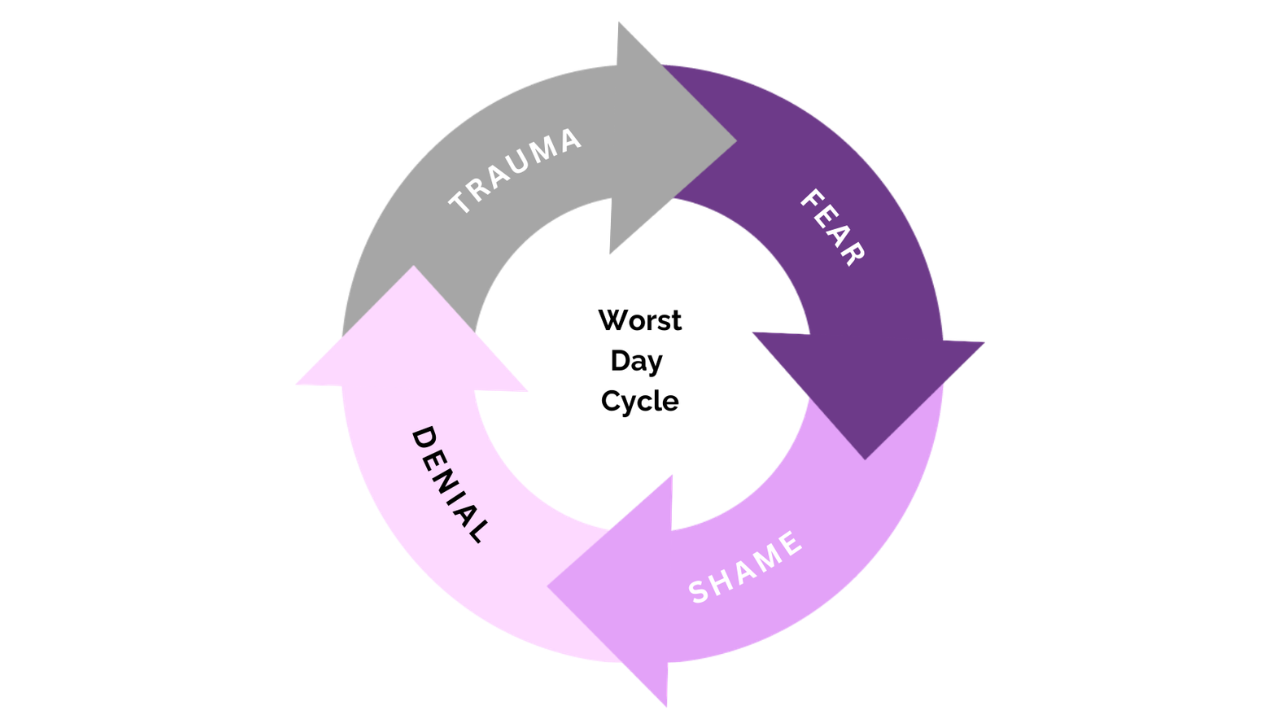
    Behind every reality argument and every inventory session is the Worst Day Cycle™. This is the neurobiological pattern that hijacks your nervous system and transforms a conversation into a courtroom.

    The Worst Day Cycle™ has four stages: Trauma, Fear, Shame, and Denial. Let me walk you through it.

    Stage 1: Trauma

    Trauma here doesn’t mean only big events. It means moments where you weren’t safe—physically, emotionally, or psychologically. Maybe your parent was unpredictable. Maybe you were betrayed by someone you trusted. Maybe you grew up in a house where you had to be perfect to avoid punishment. Maybe you learned that your emotions were inconvenient. These moments are encoded in your nervous system. They’re not just memories. They’re templates.

    That’s you if you flinch when your partner raises their voice, even though they’ve never hit you.

    Stage 2: Fear

    Years later, your partner does something that echoes that original trauma. It might be small. They sigh during a conversation. They check their phone while you’re talking. They disagree with you. Your nervous system doesn’t distinguish between the original trauma and this echo. It just knows: danger. Your amygdala—the fear center in your brain—floods your body with cortisol and adrenaline. Your rational mind goes offline. You’re in fight, flight, or freeze mode.

    Fear in the Worst Day Cycle™ is the nervous system’s way of trying to protect you from a threat it perceives as imminent. Your partner isn’t actually threatening you. But your nervous system learned a long time ago that situations like this one end in pain.
    trauma chemistry neurobiological response fight or flight

    Stage 3: Shame

    Once fear takes over, shame arrives quickly. Shame is the feeling that something is wrong with you. Not that you did something wrong—that you ARE something wrong. In this moment, your partner has confirmed what you suspected all along: you’re not worthy of being treated well. You’re not lovable. You’re not safe. You’re the problem.

    That’s the voice that says: he doesn’t really love you, he’s just tolerating you.

    Shame is a chemical state. When shame floods your system, you can’t access the part of your brain that remembers you’re loved. You can’t remember your partner’s good intentions. You can’t think clearly. You can only feel: small, wrong, unworthy.

    Stage 4: Denial

    The last stage is denial—or what I call self-deception. This is where your nervous system tries to escape the unbearable feeling of shame by denying the reality that caused it. You deny your own feelings. “I’m not upset.” You deny the situation. “That didn’t even happen.” You deny your partner’s perspective. “You’re just being dramatic.” Denial is the nervous system’s attempt to go numb, to escape the pain of shame by refusing to feel it.

    Denial in the context of communication mistakes looks like stonewalling, dismissing, minimizing, or refusing to acknowledge what just happened. It’s not conscious dishonesty. It’s a survival mechanism. Feeling the shame is too much. So the nervous system just… stops.

    Sound familiar: the moment you shut down and your partner can’t reach you?
    survival persona communication patterns falsely empowered disempowered

    The Worst Day Cycle™ completes in seconds. From the moment your partner sighs to the moment you’re in denial about the whole thing happening—it’s neurobiological speed. You don’t have time to think. You only have time to survive. And once you’re both in the cycle, communication stops. What’s left is two nervous systems in fight mode, trying to prove they’re not the villain in each other’s survival story.

    How Your Survival Persona Hijacks Communication

    A survival persona is who you learned to be in order to stay safe. It’s not a conscious choice. It’s a brilliant adaptation. When you were young and the world felt dangerous, you became someone who could manage that danger. That persona worked. It kept you alive. It kept you functioning. But now it’s running the show in your relationship, and it’s terrible at intimacy.

    There are three primary survival personas: the falsely empowered, the disempowered, and the adapted wounded child.

    The Falsely Empowered Survival Persona

    If you developed the falsely empowered persona, you learned that the world respected strength and dismissed weakness. So you became strong. Competent. In control. You don’t ask for help. You don’t show vulnerability. You know what’s best, and you’re usually right. When communication breaks down, your falsely empowered self goes into overdrive. You take inventory to prove you’re the reasonable one. You engage in reality arguments to establish that your way of seeing things is the correct way. You lead with certainty because certainty feels like safety.

    That’s you if you’re the one who usually “wins” arguments but feel more alone after winning them.

    The falsely empowered survival persona believes that love means being right, being in control, being the strong one. It doesn’t know how to be vulnerable. Vulnerability feels like weakness. And weakness feels like death.

    The Disempowered Survival Persona

    The disempowered persona learned the opposite lesson. You learned that the world had all the power, and you had none. So you became small. Accommodating. You learned to read people and adjust yourself accordingly. You became an expert at knowing what others wanted and trying to provide it. In relationships, your disempowered self tends toward compliance. You go along with your partner’s reality even when it doesn’t match yours. You don’t argue back in reality arguments—you just accept the verdict. You accept the inventory. You internalize the criticism. Your shame is already so big that your partner’s judgment just confirms what you already believe about yourself.

    Sound familiar: staying silent when you disagree, nodding along, then feeling a slow burn of resentment?

    The disempowered survival persona believes that love means disappearing into what your partner needs, making yourself small enough to fit. By the time you realize you’ve lost yourself, you’re not sure how to find your way back.

    The Adapted Wounded Child Survival Persona

    The adapted wounded child learned that emotions were dangerous. Maybe they were mocked. Maybe they were punished. Maybe they were simply ignored. So this persona learned to hide feelings. To keep the peace. To be “the easy one.” In relationships, the adapted wounded child gets very good at managing everyone else’s emotions while abandoning their own. Communication breaks down because you’re not actually communicating. You’re performing. You’re showing your partner the version of you that you think will keep them from leaving. When conflict arises, the adapted wounded child either shuts down completely or explodes—there’s usually no middle ground because there’s been no practice in the middle ground.

    That’s the one who says “I’m fine” while crying, or who seems calm right before they lose it completely.
    adapted wounded child survival persona emotional suppression

    The adapted wounded child survival persona believes that love means feeling nothing, staying small, and keeping everyone comfortable at the cost of your own authenticity.

    Most of us aren’t just one survival persona. We’re a blend. And in relationships, two blended survival personas collide. A falsely empowered person meets a disempowered person. A falsely empowered person meets an adapted wounded child. Two adapted wounded children. Whatever the combination, the communication becomes about managing the personas instead of meeting the people underneath them.

    How Communication Mistakes Show Up in Every Area of Your Life

    Communication mistakes don’t stay confined to your romantic relationship. They ripple through every connection you have.

    That’s you if you’re realizing the same fight happens at work, with your family, and in friendships.

    In Family Relationships

    With your parents and siblings, communication mistakes often look like the original trauma replayed. You’re fighting about the same things you’ve always fought about. Your parent dismisses your perspective the way they always have. You defend yourself the way you always have. Nothing changes because the neurobiological patterns are decades old. Your survival persona was literally built to manage this specific dynamic.

    In Romantic Relationships

    This is where the stakes feel highest. You’re not just communicating with someone—you’re trying to build a life with them. Communication mistakes here become a slow erosion of intimacy. Each reality argument, each inventory session, each moment of denial pushes your partner further away. The relationship doesn’t usually end in a dramatic blowup. It ends in slow disconnect. You’re both still there, but you’re speaking different languages.

    In Friendships

    Friendships often become a place where your survival persona feels safer because there’s less at stake. But the communication mistakes are still there. You might be the friend who takes inventory on others, always ready to point out what they’re doing wrong. Or you might be the friend who disappears into what others need, never asking for anything yourself. Real friendship requires the same authenticity that real romance does, and communication mistakes corrode that just as effectively.

    At Work

    Your survival persona runs your professional relationships too. The falsely empowered persona becomes the overcontrolling manager. The disempowered persona becomes the person who gets walked over. The adapted wounded child becomes the person everyone likes because they never rock the boat. Communication mistakes at work look like misalignment, conflict, and a work culture where people hide who they really are.

    In Your Relationship With Your Body and Health

    Communication mistakes extend even to how you talk to yourself about your body. Your survival persona has opinions about your health. Strong opinions. If you’re falsely empowered, you might push your body too hard, dismissing its signals. If you’re disempowered, you might abandon your body’s needs entirely. If you’re an adapted wounded child, you might use food or exercise to manage emotions instead of feeling them. The communication between you and your body is a reflection of the communication between your parts.
    emotional fitness health communication with your body

    Communication mistakes are a systemic pattern, not a relational glitch. They show up everywhere because they’re hardwired into your nervous system. Fixing them in one area means fixing them everywhere.

    How the Emotional Authenticity Method™ Transforms Communication

    The Emotional Authenticity Method™ is a five-step process that interrupts the Worst Day Cycle™ before it hijacks your communication. It’s not about changing what you say. It’s about changing what’s happening in your nervous system before you say it.

    Step 1: Somatic Down-Regulation

    The first step is bringing your nervous system back online. When you’re in the Worst Day Cycle™, your rational brain is offline. You’re running on pure survival instinct. You can’t think clearly. You can’t access empathy. You can’t remember that your partner loves you. So the first step is: stop talking. Get your body regulated.

    That’s the moment you step away from the conversation and take five deep breaths.

    Down-regulation looks different for different people. For some, it’s cold water on your face. For others, it’s a walk. For others, it’s breathwork. The goal is simple: bring your nervous system from fight/flight/freeze mode back to a state where your prefrontal cortex is online. Where you can think. Where you can feel without being consumed by fear.

    Step 2: What Am I Feeling?

    Once your nervous system is regulated, the next step is to identify the feeling. Not the story. The feeling. You’re not asking “what happened?” You’re asking “what am I experiencing right now?” Anger? Fear? Shame? Loneliness? Rejection?

    Most of us have been taught to skip this step entirely, to move straight from emotion to action. We feel hurt and we attack. We feel fear and we defend. We skip the part where we actually sit with what we’re feeling. The Emotional Authenticity Method™ says: pause. Name it. What’s happening in you right now?

    Step 3: Where In My Body Am I Feeling This?

    Emotions are not abstract. They’re physical. Fear lives in your chest. Shame lives in your throat. Anger lives in your hands. When you locate the feeling in your body, you’re doing something powerful: you’re connecting your mind to your nervous system. You’re bringing awareness to the physical reality of what you’re experiencing. This is where healing begins—in the body, not in the story.

    That’s you if you’ve never noticed where anger actually lives in your body.

    Step 4: What’s the Earliest Memory of This Feeling?

    This step is the bridge between your present moment and your past. The feeling you’re having right now isn’t just about this conversation. It’s connected to something older. Your nervous system recognized an echo of an old threat. So you ask: when did I first feel this? What was happening? This isn’t about blame. It’s about understanding that your nervous system is trying to protect you from something that happened long ago.

    When you connect your present feeling to its earliest origin, you break the spell of immediacy. You realize: oh, I’m not just reacting to what my partner did right now. I’m reacting to who I had to become to survive my past.

    Step 5: Who Would I Be Without This Survival Pattern?

    This is the question that changes everything. Without the falsely empowered need to be right. Without the disempowered need to disappear. Without the adapted wounded child need to feel nothing. Who would you actually be? What would you want to say? How would you want to show up in this conversation?

    Sound familiar: realizing that what you want to say and what your survival persona is forcing you to say are completely different things?

    The Emotional Authenticity Method™ doesn’t give you a script. It gives you access to yourself. To your actual wants. Your actual feelings. Your actual perspective. Not the persona-protected version. The real version.
    emotional regulation authenticity method nervous system

    Once you’ve worked through these five steps, you’re no longer in the Worst Day Cycle™. You’re regulated. You’re connected to your actual feelings. You understand what’s being activated. You have access to who you actually want to be. Now you can communicate from authenticity instead of from survival.

    How the Authentic Self Cycle™ Replaces Conflict With Connection

    Once you can access your authenticity through the Emotional Authenticity Method™, the next move is the Authentic Self Cycle™. This is what happens when both people in a relationship show up from their actual selves instead of from their survival personas.

    The Authentic Self Cycle™ has four stages: Truth, Responsibility, Healing, and Forgiveness.

    Stage 1: Truth

    Truth means telling your actual reality. Not the defended version. Not the version designed to win the argument. Not the version designed to protect you. Your actual reality. “I felt hurt when you said that” instead of “you’re always hurting me.” “I was scared you didn’t care” instead of “you never think about my feelings.” “I didn’t know how to tell you” instead of “you’re impossible to talk to.”

    That’s you if you’ve never actually told your partner what you’re really feeling, underneath all the defense.

    Truth in the Authentic Self Cycle™ is risky because it requires vulnerability. It means your partner might reject you. Might dismiss you. Might use this against you. But it’s also the only place real connection can happen. Connection requires that you be known. And you can’t be known if you’re always performing.

    Stage 2: Responsibility

    Responsibility means owning your part. Not your partner’s part. Your part. How did your survival persona show up? What did you do to protect yourself that might have hurt your partner? Where did you take inventory instead of building a bridge? Where did you engage in a reality argument instead of trying to understand?

    This isn’t about blame. It’s not about flagellating yourself. It’s about recognizing that you had a part in how this unfolded. That you’re not helpless. That your choices matter.

    Sound familiar: the moment you realize your survival persona’s protection mechanism became your partner’s wounding?

    Stage 3: Healing

    Healing means turning toward your partner instead of away. It means creating the safety that allows both of you to come out of survival mode. It means saying “I’m sorry” and actually meaning it. Not a defensive sorry. Not a sorry designed to move past this quickly. A sorry that acknowledges: I did something that hurt you, and I’m committed to understanding what happened and doing it differently.

    Healing in the Authentic Self Cycle™ is the moment the nervous system finally feels safe enough to soften. It’s the moment you can actually listen to your partner’s perspective without immediately constructing a counter-argument. It’s the moment you can hold their pain without it threatening your sense of self.

    Stage 4: Forgiveness

    Forgiveness isn’t about condoning. It’s not about pretending it didn’t hurt. It’s about releasing the grip of the past on the present. It’s about recognizing that your partner, like you, was doing the best they could with the nervous system they had. That they weren’t trying to hurt you—they were trying to survive. That underneath the defense, underneath the survival persona, is a person who loves you.

    That’s the moment you can finally see your partner as a whole human being instead of as a character in your survival story.
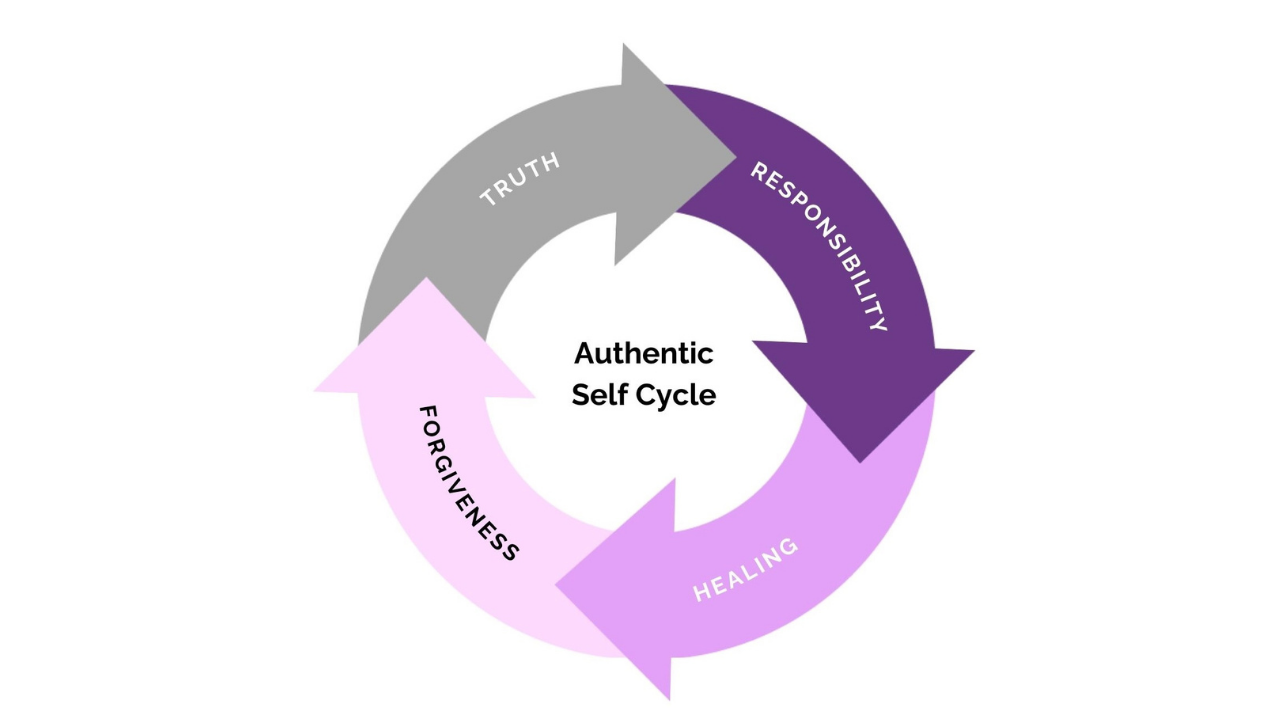
    authentic self cycle healing forgiveness connection

    The Authentic Self Cycle™ is where real intimacy lives. Not in being right. Not in winning arguments. Not in proving that your reality is the correct reality. In being seen. Being known. Being loved for who you actually are, not for the person your survival persona learned to be.

    Frequently Asked Questions About Communication Mistakes in Relationships

    How do I know if I’m in a reality argument?

    You’re in a reality argument when both people are insisting they’re right about what happened, what was intended, or what was said. You’re not debating ideas. You’re debating facts. The conversation sounds like: “You said this.” “No, I didn’t.” “Yes, you did.” “You’re lying.” The goal has shifted from understanding to proving. If you’re trying to get your partner to admit they were wrong, you’re in a reality argument.

    Is taking inventory ever okay in a relationship?

    There’s a difference between noticing patterns and taking inventory. Noticing a pattern is internal awareness: “I’ve noticed that when I express a need, my partner often gets defensive. I want to understand why.” Taking inventory is external judgment: “You always get defensive when I need something. It’s just like when your mother wouldn’t listen to you.” One is self-awareness. The other is prosecution. The line is: are you trying to understand, or are you building a case?

    Can someone have more than one survival persona?

    Most people are a blend. You might be falsely empowered at work and disempowered at home. You might be an adapted wounded child in your romantic relationships but falsely empowered in your friendships. The personas aren’t fixed identities—they’re adaptive strategies. You became different things in different contexts because different contexts required different survival mechanisms. Understanding which persona shows up in which situation is part of the healing work.

    What if my partner won’t do the Emotional Authenticity Method™?

    You can’t force your partner to do this work. But here’s what’s true: when you change how you show up, the dynamic shifts. When you stop taking inventory, your partner has less to defend against. When you speak from your actual feelings instead of from your survival persona, your partner has a real person to relate to instead of a defensive wall. Change doesn’t always require both people to commit at the same time. It often requires one person to commit first, and watch what happens when they do.

    How long does it take to break these patterns?

    It depends on how long you’ve been building them. If your nervous system has been running the same survival strategy for thirty years, your brain has built actual neural pathways around that strategy. You’re not just changing your mind. You’re rewiring your brain. That’s weeks and months and years of consistent practice. But the good news is: every single time you interrupt the pattern, you’re building a new neural pathway. Every time you choose authenticity over defense, you’re making a deposit in a new account. The patterns loosen faster than you think once you start noticing them.

    What if I realize I’ve been taking inventory on my partner for years?

    First: awareness is everything. You can’t change what you can’t see. Second: your partner probably already knows. They’ve felt it. The weight of being continuously judged erodes a relationship slowly. But here’s the repair: you acknowledge it. You take responsibility for it. You recognize what you were doing and why your survival persona felt the need to do it. And you commit to doing something different. That conversation—that real conversation where you’re vulnerable about your own fear and shame instead of prosecuting their flaws—is where the repair begins. Go through the 10 Do’s and Don’ts for a Great Relationship to see what shifts.

    The Bottom Line

    Communication mistakes in relationships aren’t about being a bad communicator. They’re about a nervous system that learned to survive by doing certain things—being right, being small, being numb. Those strategies kept you alive. They kept you functioning. But they’re terrible at creating intimacy.

    The path forward isn’t about becoming a better arguer. It’s about becoming more authentic. It’s about understanding that beneath every reality argument is a person terrified that their reality doesn’t matter. Beneath every inventory session is a person protecting themselves against more pain. Beneath every moment of denial is a nervous system that can’t handle another drop of shame.

    Sound familiar: the moment you realize that every fight with your partner is actually a conversation between two survival personas that are terrified of being seen?

    When you understand that, everything changes. You stop trying to win. You start trying to heal. You stop trying to prove your partner wrong. You start trying to help them feel safe enough to be right about their own experience. You stop taking inventory. You start taking responsibility. You stop living in the Worst Day Cycle™. You start living in the Authentic Self Cycle™.

    That’s where real communication begins. That’s where real intimacy is possible. That’s where your partner gets to meet the actual you instead of the survival persona you’ve been performing your whole life.

    And that changes everything.
    emotional blueprint transformation healing relationships

    Recommended Reading

    If you’re ready to go deeper into understanding communication mistakes and healing relationship patterns, these resources have shaped my work and my clients’ transformations:

    • Facing Codependence by Pia Mellody — the foundational text on how childhood trauma creates codependent communication patterns and survival personas.
    • When the Body Says No by Gabor Maté — how chronic emotional suppression and communication breakdown manifest as physical illness.
    • Codependent No More by Melody Beattie — the classic guide to recognizing when you’re taking inventory instead of taking responsibility.
    • The Gifts of Imperfection by Brené Brown — how shame drives defensive communication and why vulnerability is the path to real connection.
    • The Body Keeps the Score by Bessel van der Kolk — the neuroscience of how trauma lives in the body and hijacks communication.

    Start with The Feelings Wheel to build awareness of what you’re actually feeling beneath the survival persona’s story.

    Take the Next Step

    Understanding communication mistakes is the first step. Doing the work to rewire your nervous system is the second. I’ve built several paths for you depending on where you are right now:

    Emotional Blueprint Starter Course — Individual ($79) — A guided journey through understanding your survival persona, the Worst Day Cycle™, and how to access your Authentic Self. Start here if you want to understand yourself before trying to fix your relationships.

    Relationship Starter Course — Couples ($79) — Built for both partners. Walk through the Emotional Authenticity Method™ together. Learn how to interrupt reality arguments before they escalate.

    Why We Can’t Stop Hurting Each Other ($479) — The deepest couples work. Tools, frameworks, and daily practices to rewire how you communicate.

    Why High Achievers Fail at Love ($479) — For the falsely empowered. Learn why being right is destroying your relationships.

    The Shutdown Avoidant Partner ($479) — For those who shut down, check out emotionally, or disappear into work.

    Tier 1: Mapping the Blueprint ($1,379) — The full integration. Deep work for those ready to fundamentally rewire how they show up in every relationship.

    Download the Feelings Wheel — the free tool used in Step 2 of the Emotional Authenticity Method™ to build emotional granularity.

    Explore more: The Signs of Enmeshment | 7 Signs of Relationship Insecurity | 7 Signs of High Self-Esteem | How to Determine Your Negotiables and Non-Negotiables | 10 Do’s and Don’ts for a Great Relationship

  • How to Fight Fair in a Relationship

    How to Fight Fair in a Relationship

    Every couple fights. But most couples fight the same fight over and over — not because the issue is unresolvable, but because their nervous systems are replaying childhood survival patterns instead of communicating as adults. You are not arguing about the dishes, the kids, or the money. You are arguing about the shame, the fear, and the unhealed pain your body carries from childhood. One partner attacks from their falsely empowered survival persona — controlling, criticizing, dominating. The other collapses into their disempowered survival persona — people-pleasing, withdrawing, going silent. Or both of you oscillate between the two, never finding solid ground. The result is the same every time: nobody feels heard, nobody feels safe, and the relationship erodes one fight at a time.

    That’s you if you’ve ever thought: “We keep having the same argument and nothing changes.”

    The reason nothing changes is that traditional communication advice — “use I-statements,” “don’t raise your voice,” “take a timeout” — treats the symptoms while ignoring the root cause. Your fights are not communication problems. They are nervous system problems driven by the Worst Day Cycle™. And the only way to stop destroying your relationship is to learn a confrontation model that works at the level where the damage actually happens — your emotional blueprint.

    How to Fight Fair in a Relationship: Why Every Couple Needs a Confrontation Model

    How to fight fair in a relationship is the single most important skill that no one ever teaches you. Fighting fair means having a structured confrontation model — a shared language and step-by-step process that transforms every argument from a destructive war into an opportunity for deeper intimacy, understanding, and connection. Without this model, couples default to hurling pain, defending their position, and fighting over who is the bigger victim — a pattern rooted in childhood survival, not adult love.

    Here is what twenty years of working with couples has taught me: unless you have a specific confrontation model, just trying to talk about it will not solve it. There has to be a process that both people commit to following. When couples adopt a confrontation model, every single fight becomes like dating again — you discover deep, vulnerable truths about your partner that create connection instead of destruction.

    How to fight fair in a relationship - confrontation model for couples in codependency recovery

    Most couples believe they know how to fight. They don’t. What they know is how to re-enact childhood pain with an adult vocabulary. The screaming, the silent treatment, the blame, the withdrawal — none of this is fighting. It’s two wounded children in adult bodies, each desperately trying to prove they are the bigger victim.

    That’s you if every argument with your partner ends the same way — someone storms off, someone shuts down, and nothing ever changes.

    The confrontation model I created has three components: understanding reality arguments, establishing ground rules for both the speaker and the listener, and following seven specific steps that turn conflict into connection. If you commit to this process, you will learn to love fighting. Literally. Because every disagreement becomes a window into your partner’s inner world — and your own.

    What Are Reality Arguments and Why Do They Destroy Relationships?

    Before you can fight fair, you need to understand why most fights are unwinnable. The answer: you’re having a reality argument — and you don’t even know it.

    A reality argument happens when two people experience the exact same event and walk away with two completely different interpretations. Neither person is right or wrong — they simply have different realities. Most couples destroy their relationship by arguing over whose reality is correct, which is like arguing over whether a referee’s call was right when half the stadium disagrees.

    Reality arguments in relationships - two different realities from the same event

    Think about it: have you ever watched a sport where the referee makes a call and half the people in the arena scream he’s wrong while the other half scream he’s right? That’s a reality argument. Now think about politics — Democrat, Republican — both sides believe they’re right and the other side is wrong. Religion works the same way. We all look at the exact same thing and have completely different interpretations.

    That’s you — arguing with your partner about what “really happened” last Tuesday, both of you certain you’re right, both of you walking away feeling unheard.

    Here’s why this destroys relationships: when you fight over realities, you’re fighting to prove you’re the bigger victim. “What you did is bad.” “No, what you did is worse.” “Well, if you hadn’t done it, I wouldn’t have done it.” Each person is saying the same thing: I’m the bigger victim here, and what happened to me is worse.

    Is that reconcilable? No. Because you both feel victimized. You’re fighting a war that nobody can win.

    Sound familiar? Every fight that ends with “you always” or “you never” is a reality argument in disguise.

    Defense is the first act of war. When you defend yourself in an argument, you are making a conscious choice to fight over who is the bigger victim rather than creating connection, intimacy, and understanding. That is not the goal of a confrontation — it is a declaration of war against your partner.

    The Worst Day Cycle™: Why Your Fights Are Never About What You Think

    Every destructive fight follows the same invisible pattern. Your partner says something critical, and within milliseconds your body floods with stress chemicals, your thinking brain goes offline, and you’re no longer an adult having a disagreement — you’re a child fighting for survival. This is the Worst Day Cycle™, and until you see it, it runs your relationships without your permission.

    Worst Day Cycle - Trauma Fear Shame Denial - why couples fight destructively

    Stage 1: Trauma. Childhood trauma is any negative emotional experience that created painful meanings about yourself, others, or the world. Your partner’s tone of voice, their criticism, their withdrawal — these activate your nervous system’s threat response as if you’re back in your childhood home, helpless and unsafe. The hypothalamus generates chemical cocktails of cortisol, adrenaline, and dopamine misfires, and your brain becomes addicted to these emotional states because they’re all it knows.

    Stage 2: Fear. Once trauma is activated, fear floods your body instantly. Your amygdala hijacks your prefrontal cortex. You lose access to wisdom, discernment, and choice. You go into fight, flight, freeze, or fawn mode. This is why you say things you don’t mean during arguments — your thinking brain is literally offline. The brain conserves energy by repeating known patterns, and since 70%+ of childhood messaging is negative and shaming, your adult brain repeats those painful patterns in every conflict.

    That’s you — your heart pounding, your face flushing, words flying out of your mouth that you’ll regret in an hour, and you can’t stop yourself.

    Stage 3: Shame. Fear morphs into the core belief: “I am the problem.” Not “I made a mistake” — “I AM a mistake.” This is where you lost your inherent worth. In childhood, shame was installed through criticism, punishment for normal emotions, and conditional love. In adult fights, shame drives you to either attack (prove it’s their fault, not yours) or collapse (accept all blame to end the conflict).

    Stage 4: Denial. To survive unbearable shame, your psyche activates your survival persona — a false identity created in childhood to manage pain. “I’m fine.” “I can handle this.” “I don’t have needs.” This is self-deception at its most brilliant and most destructive. Your survival persona takes over the fight, and your authentic self disappears.

    That’s the Worst Day Cycle™ — running underneath every argument you’ve ever had with your partner, turning a simple disagreement into a childhood re-enactment.

    How Your Survival Persona Hijacks Every Argument

    When conflict arises, your survival persona takes the wheel. Understanding which persona you default to — and which one your partner defaults to — is essential for learning how to fight fair. There are three primary survival persona types, and most people oscillate between them depending on the situation.

    Three survival persona types that hijack arguments - falsely empowered disempowered adapted wounded child

    The Falsely Empowered Survival Persona in Conflict

    This persona controls, dominates, and rages. In fights, the falsely empowered persona attacks first, raises their voice, uses blame and shame as weapons, and needs to “win” the argument. They appear strong, but underneath they’re terrified of being wrong — because being wrong in childhood meant being abandoned or punished. Their strategy: if I control the fight, I control whether I get hurt.

    That’s you if you notice your voice getting louder, your finger pointing, your words getting sharper — and you can’t seem to stop even though part of you knows you’re making it worse.

    The Disempowered Survival Persona in Conflict

    This persona collapses, people-pleases, and surrenders. In fights, the disempowered persona immediately takes all the blame, says “you’re right, I’m sorry” before the conversation even starts, and shuts down their authentic voice to end the conflict. They’d rather die inside than risk abandonment. Their strategy: if I make myself small enough, maybe the pain will stop.

    That’s you if you go silent in every fight, agree with everything your partner says just to make it stop, and then feel hollow and resentful for days afterward.

    The Adapted Wounded Child Survival Persona in Conflict

    This persona oscillates between the falsely empowered and disempowered positions — sometimes raging, sometimes collapsing, sometimes regressing to a helpless, confused state. They might cry uncontrollably, feel overwhelmed, or seem incapable of engaging. Their strategy: if I stay emotionally young and helpless, maybe someone will finally rescue me the way my parents never did.

    That’s you if your partner says “I can never have a real conversation with you because you either blow up or shut down — I never know which version I’m getting.”

    All three survival personas are brilliant childhood strategies that kept you connected and alive. In adult relationships, they guarantee that every fight re-creates the exact pain you’re trying to escape. The confrontation model replaces these survival strategies with a structured process that creates safety, trust, and genuine intimacy.

    Ground Rules for the Speaker: How to Express Without Destroying

    Fighting fair starts with rules — not to restrict you, but to create the safety required for vulnerability. Without ground rules, your survival persona runs the conversation. With them, your authentic self has a chance to speak. Here are the seven ground rules for the person speaking.

    Ground rules for fighting fair - speaker boundaries for emotional authenticity in relationships

    First: Moderate your emotions before you speak. If you’re flooded with stress chemicals, you are not capable of fighting fair. Take time to regulate. Say “I can’t talk about this right now — I need to go contain myself.” This is not running away. This is wisdom. You cannot have a productive conversation from a hijacked nervous system.

    Second: No shaming, accusing, blaming, judging, yelling, or screaming. And never give your partner unsolicited advice. The moment you shame or blame, you’ve declared war. Your partner’s nervous system will activate, their survival persona will emerge, and the conversation is over before it started.

    Third: Your goal is to be known, not to be right. “I honestly see this as water, and I want you to know that about me.” You’re sharing your reality — not trying to change theirs. This is the most profound shift in fighting: from winning to being understood.

    That’s the shift — from “I need you to agree with me” to “I need you to know who I am.”

    Fourth: Never tell your partner what they should think or feel. “You should have known.” “You shouldn’t even think that way.” “Why do you feel that?” These are reality arguments — you’re trying to control how they see the world. That’s not love. That’s domination.

    Fifth: Don’t guess at their motivation or read their mind. “Well, you rolled your eyes, so obviously you don’t care.” You’re projecting your interpretation onto their behavior. Stay in your lane. If you’re confused, ask — don’t assume.

    Sixth: Nobody ever makes you feel anything. “You made me feel” is the language of enmeshment and codependence. You always have a choice in how you respond. Whenever you say “you made me feel,” you are demanding that your partner take responsibility for your emotional life. That is not their job.

    Seventh: Always use “I” statements. “I felt hurt when…” instead of “You always…” The moment you start with “you,” your partner’s defenses go up and the conversation becomes a war.

    Sound familiar? Most of us break every single one of these rules every time we fight — and then wonder why nothing ever gets resolved.

    Ground Rules for the Listener: How to Hear Without Defending

    Listening is harder than speaking. Most people don’t listen to understand — they listen to form a defense. They’re mentally preparing their rebuttal while their partner is still talking. This is the fastest way to destroy intimacy and guarantee that every fight escalates.

    Listening ground rules for fighting fair - metacognitive awareness in relationship conflict

    First: Never interrupt, and don’t absorb their blame. When someone has lost containment, they may blame you, they may say “you” and “you made me feel.” Don’t take that on. Those are their feelings. They get to have them, but you don’t absorb them as truth. They’re just their feelings.

    Second: Do not interrupt to correct them. You’re listening to know them, not to be right or wrong. You’re responsible for your feelings about the words they’re using — you get to choose how you respond.

    Third: Listen to learn about their reality, not to form a defense. This is the biggest mistake people make. Defense is the first act of war. When you defend yourself, you give yourself away and the relationship is lost. You’re just listening to learn about them — this is how they view the world.

    That’s you — mentally rehearsing your comeback while your partner is pouring their heart out, and wondering why they say you never listen.

    Fourth: If you’re unsure about their reality, ask for information. It’s your job to gather information, not to judge it. “Wait, are you saying you mean this or this? Your memory of it is this?” Keep it to four sentences or less.

    Fifth: If the information they’re sharing is true, own it immediately. Nothing disarms a fight faster than genuine accountability. “You’re right. I did that. I see how that hurt you.”

    Sixth: If your realities are different, detach from the emotions being shared. Just listen without judgment. Accept that their reality is different from yours. Don’t try to change it. Their reality is valid even when it contradicts yours.

    Seventh: After you’ve listened completely, negotiate if necessary. But only after you’ve done the first six steps. This is where most couples fail — they try to negotiate before they’ve truly listened, and the negotiation becomes another fight.

    That’s the shift — from “I need to defend myself” to “I need to understand their world.”

    The 7-Step Confrontation Model That Turns Every Fight Into Intimacy

    This is the process. It will feel clinical at first. It will feel uncomfortable. Nobody talks like this naturally, and that’s exactly the point — because the way you naturally talk during conflict is destroying your relationship. If you commit to this model, you will learn to love fighting because every confrontation becomes an act of discovery and intimacy.

    7-step confrontation model for fighting fair - turns conflict into intimacy and connection

    Step 1: Share what you observed — just the facts. No judgments, no blame. Use “I” statements. “I noticed that when I brought up the credit card bill, you left the room.” Not “You always run away from hard conversations.” Facts, not interpretations.

    Step 2: Share how you chose to make yourself feel about what you observed. Notice the language: “chose to make myself feel.” This is radical responsibility. “I chose to feel hurt. I chose to feel abandoned. I chose to feel scared.” You’re owning your emotional response rather than blaming your partner for causing it.

    That’s you learning a completely new language — one where your feelings belong to you, not to whoever triggered them.

    Step 3: Ask for more information. “Can you help me understand what was happening for you in that moment?” This is curiosity instead of accusation. You’re inviting your partner into the conversation instead of putting them on trial.

    Step 4: Make a request for change. “I would like to request that next time we need to discuss finances, we set aside a specific time when we’re both regulated and ready.” This is clear, specific, and respectful.

    Step 5: Celebrate their “no.” This is the most counterintuitive and most important step. The most loving thing your partner can ever say to you is “no.” Because when they say no, it means every “yes” they’ve ever given you was freely given — not a manipulation, not a transaction, not keeping score. If you can’t celebrate the no, then every yes carries a hidden cost, and that’s not love — it’s a manipulation disguised as generosity.

    Think about it: how many times have you and your partner fought and the fight consisted of “I’ve done this for you and this for you and this for you, and you never did this for me”? That means you did all those things hoping you’d get something back. You wanted to say no, but you were hoping for a return. That’s not freely given — there’s a cost to it. You don’t want someone keeping score. You don’t want someone filled with resentment. You don’t want someone throwing it back in your face.

    Sound familiar? Every time you give with strings attached, you’re not giving — you’re investing in future ammunition.

    Step 6: Share what you’ve decided to do for yourself. After you’ve had time to process, come back and say: “Here’s what I’ve decided to do for myself about this situation.” This is agency. This is self-respect. This is emotional authenticity in action.

    Step 7: Meet the need yourself. Before you ever have a confrontation, have a backup plan in place in case your partner refuses to agree to your request. You are never dependent on their response. You always have a plan for how to meet your own need. This eliminates desperation, manipulation, and the codependent trap of waiting for someone else to save you.

    Signs Your Fighting Pattern Is Destroying Every Area of Your Life

    Destructive fighting doesn’t stay in your relationship. It bleeds into every area of your life because the same survival persona that hijacks your arguments also runs your behavior at work, with family, with friends, and in your body.

    Family Fighting Patterns

    — You regress to childhood roles the moment a parent criticizes you

    — Family gatherings trigger the same fights you’ve been having since adolescence

    — You either dominate family conversations or disappear entirely

    — You feel responsible for managing everyone’s emotions at holidays

    — Siblings can push your buttons in ways that no one else can, and you react the same way every time

    — You avoid family altogether because the pain feels unmanageable

    That’s you if you’re forty years old and still arguing with your mother the exact same way you did when you were twelve.

    Romantic Relationship Fighting Patterns

    — Every fight follows the same script: attack, defend, withdraw, repeat

    — You fight about the same topics repeatedly with zero resolution

    — One partner always pursues while the other withdraws

    — Arguments escalate from a small issue to “everything that’s wrong with our relationship” within minutes

    — You use the silent treatment as punishment or self-protection

    — Make-up sex replaces actual resolution

    — You can’t bring up difficult topics without your partner shutting down or exploding

    Relationship insecurity drives every confrontation

    Friendship Fighting Patterns

    — You avoid conflict entirely and let resentment build silently

    — You ghost friends rather than having difficult conversations

    — You over-explain and over-apologize to avoid any tension

    — You take on the peacemaker role in friend groups, managing everyone’s emotions

    — You feel betrayed when friends disagree with you because disagreement feels like abandonment

    That’s you if you’ve lost friendships not because of a big betrayal, but because you couldn’t have one honest conversation about something that bothered you.

    Work Fighting Patterns

    — You can’t give or receive feedback without your survival persona activating

    — You avoid difficult conversations with your boss or colleagues

    — You over-function to prevent anyone from being upset with you

    — You interpret constructive criticism as a personal attack

    — You people-please at work the same way you people-please in your relationship

    — Conflict with a coworker triggers the same shame spiral as conflict with your partner

    Body and Health Fighting Patterns

    — Unresolved conflict lives in your body: headaches, stomach issues, chronic tension, insomnia

    — You numb emotional pain from fights with food, alcohol, substances, or screens

    — Your body goes into shutdown mode during arguments — you literally can’t think or speak

    — Post-fight anxiety and shame keep you awake at night

    — Chronic stress from destructive fighting is damaging your immune system, sleep, and overall health

    Emotional blueprint - how childhood fighting patterns affect every area of adult life

    That’s your body keeping score — every unresolved fight, every swallowed feeling, every moment you chose peace over truth.

    The Authentic Self Cycle™: How to Break the Cycle of Destructive Fighting

    The Authentic Self Cycle™ is the direct inverse of the Worst Day Cycle™ — a four-stage healing loop that transforms how you relate to conflict at the neurological level. When you fight from your authentic self instead of your survival persona, every disagreement becomes an opportunity for deeper connection.

    Authentic Self Cycle - Truth Responsibility Healing Forgiveness - breaking destructive fighting patterns

    Stage 1: Truth. Name the blueprint. “This isn’t about today. My partner’s criticism activated my childhood fear of being wrong. My panic came from my parent’s conditional love, not from current evidence that I’m in danger.” Truth is the flashlight you shine on your own neurobiology.

    Stage 2: Responsibility. Own your emotional reactions without blame. “My partner isn’t my parent. My nervous system just thinks they are. It’s not their job to heal my childhood — it’s mine.” This is where you reclaim agency in conflict rather than outsourcing your emotional regulation to your partner.

    That’s the moment everything changes — when you stop blaming your partner for your pain and start owning your nervous system’s response.

    Stage 3: Healing. Rewire the emotional blueprint so conflict becomes uncomfortable but not dangerous, disagreement isn’t abandonment, and your authentic voice doesn’t destroy the relationship. This is the actual neurological rewiring that happens through deliberate practice with the confrontation model.

    Stage 4: Forgiveness. Release the inherited emotional blueprint and reclaim your authentic self. Forgive yourself for the survival strategies you developed. Forgive your nervous system for its brilliant, protective repetitions. This creates a new emotional chemical pattern that replaces fear, shame, and denial.

    The Emotional Authenticity Method™: Your 6-Step Practice for Mid-Conflict Recovery

    When you’re in the middle of a fight and your survival persona has taken over, you need a concrete practice to reconnect with your authentic self. The Emotional Authenticity Method™ is a six-step process that rewires your nervous system in real time.

    Emotional Authenticity Method - six step nervous system regulation for mid-conflict recovery

    Step 1: Somatic Down-Regulation. Focus on what you can hear for 15-30 seconds. If you’re highly dysregulated, use titration — small, incremental steps toward calm. Soften your jaw. Lower your shoulders one inch. Take one slightly deeper breath. Your nervous system will follow these micro-signals of safety.

    Step 2: What am I feeling right now? Use emotional granularity. Not “I’m upset” — use the Feelings Wheel to identify whether you’re feeling betrayed, dismissed, controlled, humiliated, or terrified. The more precise you can be, the more power you reclaim over your emotional experience.

    Step 3: Where in my body do I feel it? All emotional trauma is stored physically. Tightness in your chest? Heat in your face? A pit in your stomach? This grounds you in the present moment and breaks the dissociation that conflict creates.

    That’s you learning to come back into your body when every instinct says to check out.

    Step 4: What is my earliest memory of having this exact feeling? Trace the feeling to its childhood origin. The feeling you’re experiencing with your partner right now likely echoes an earlier version of itself. Your partner’s criticism isn’t the problem — it’s that their criticism reminds your nervous system of your parent’s disappointment.

    Step 5: Who would I be if I never had this thought or feeling again? What would be left over? This is the vision step — reconnecting to your authentic self beneath the survival persona. How would the version of you who isn’t run by this wound respond to this argument?

    Step 6: Feelization. Sit in the feeling of the Authentic Self and make it strong. Create a new emotional chemical addiction to replace the old blueprint. Ask: how would I respond to this argument from this feeling? What would I say? What would I do? Visualize and FEEL yourself operating from your authentic self — choosing the confrontation model instead of the survival persona. This is the emotional blueprint remapping and rewiring step.

    You cannot change emotional patterns through thoughts alone. Emotions are biochemical events. Thoughts originate from feelings. That is why every attempt to “just be calmer” during fights has failed — you’re trying to think your way out of a biological response. The Emotional Authenticity Method™ works at the level of the nervous system, not the intellect.

    From Destructive Fighting to Deeper Intimacy

    Here’s what nobody tells you about learning to fight fair: it doesn’t just save your relationship — it transforms you. When you commit to a confrontation model, you’re committing to knowing yourself at the deepest level. Every argument becomes a mirror that shows you where your childhood blueprint is still running the show.

    That’s the paradox — the thing you avoid most (conflict) becomes the most powerful tool for intimacy when you have a structure for it.

    Couples who adopt the confrontation model report something unexpected: they start looking forward to difficult conversations because each one reveals something new about their partner’s inner world. The clinical feeling fades. The structure becomes natural. And what used to be a war zone becomes the safest space in your relationship.

    When couples commit to a shared language — a confrontation model, negotiables and non-negotiables, and ground rules for how they will pursue unconditional love — they create safety. And safety is the prerequisite for vulnerability. And vulnerability is the prerequisite for intimacy. Without a confrontation model, you are asking your partner to be vulnerable in a space that feels dangerous. With one, you are building the foundation for the kind of relationship most people only dream about.

    The work isn’t easy. The first time you try to follow the seven steps, you’ll feel awkward, uncomfortable, and exposed. That discomfort is your survival persona resisting change. Push through it. Because on the other side of that discomfort is a relationship where conflict creates connection, disagreement creates understanding, and every fight makes you love each other more.

    Your authentic self knows how to love. It’s your survival persona that needs a confrontation model. Give it one, and watch everything change.

    People Also Ask

    What does it mean to fight fair in a relationship?

    Fighting fair means having a structured confrontation model — a shared process with clear ground rules for both the speaker and the listener that transforms destructive arguments into opportunities for deeper intimacy. It means no shaming, no blaming, no defending, and a commitment to understanding your partner’s reality rather than proving yours is correct. The confrontation model replaces survival-persona-driven fighting with a seven-step process rooted in emotional authenticity.

    Why do my partner and I keep having the same fight over and over?

    Repetitive fights happen because your nervous system is stuck in the Worst Day Cycle™ — a four-stage loop of Trauma, Fear, Shame, and Denial that replays childhood pain in adult relationships. Your brain conserves energy by repeating known patterns, so the same triggers produce the same reactions every time. Without a confrontation model that interrupts this neurological loop, your survival persona will run the same script in every argument regardless of the topic.

    How do I stop getting defensive during arguments with my partner?

    Defense is the first act of war in any relationship argument. When you defend, you’re fighting over who is the bigger victim — which is irreconcilable. To stop defending, practice the Emotional Authenticity Method™: regulate your nervous system somatically, identify what you’re actually feeling beneath the defensiveness, and trace it back to its childhood origin. When you realize your partner’s criticism activated an old wound (not a current threat), you can listen to understand rather than defend.

    Can a relationship be saved if we fight all the time?

    Yes — if both partners commit to a structured confrontation model and stop fighting from their survival personas. The frequency of fighting isn’t the problem; the destructiveness of HOW you fight is the problem. Couples who adopt ground rules, learn to recognize reality arguments, and follow a seven-step confrontation process often discover that their fights were actually attempts to connect — just executed through a survival blueprint. With structure, every fight becomes an act of intimacy.

    What is a reality argument and how do I stop having them?

    A reality argument happens when two people experience the same event and walk away with completely different interpretations — and then fight over whose version is “correct.” Neither person is right or wrong; they have different realities. You stop having reality arguments by recognizing them in the moment, accepting that your partner’s reality is valid even when it contradicts yours, and shifting your goal from being right to being known. The confrontation model gives you the structure to do this.

    How long does it take to learn to fight fair in a relationship?

    Most couples feel the shift within 2-4 weeks of consistently using a confrontation model, though the first conversations will feel awkward and clinical. This discomfort is normal — it means your survival persona is resisting a new pattern. The key is commitment: both partners must agree to use the model even when it feels unnatural, because “just talking about it” is what created the destructive pattern in the first place. Within 2-3 months, the structure becomes second nature and fights genuinely become opportunities for connection.

    • Facing Codependence by Pia Mellody — The foundational text on how childhood trauma creates survival personas, shame-based identities, and destructive relationship patterns including fighting styles.
    • The Body Keeps the Score by Bessel van der Kolk — Essential for understanding why your nervous system hijacks arguments and why somatic awareness is the key to breaking destructive conflict patterns.
    • When the Body Says No by Gabor Maté — Explores how suppressed emotions and unresolved conflict manifest as physical illness — the cost of never learning to fight fair.
    • Codependent No More by Melody Beattie — The classic guide to stopping people-pleasing, setting boundaries, and reclaiming your voice in relationships and conflict.
    • The Gifts of Imperfection by Brené Brown — A guide to vulnerability, courage, and authenticity that directly supports the shift from survival-persona fighting to authentic connection.

    The Bottom Line

    Every destructive fight you’ve ever had with your partner was two survival personas going to war — not two adults having a disagreement. Your survival persona was brilliant in childhood. It kept you safe, kept you connected, kept you alive. But in your adult relationship, it is the single biggest obstacle to the love you actually want.

    The confrontation model changes everything. Not because it teaches you magic words or secret techniques — but because it replaces the chaos of survival-persona fighting with a structure that creates safety. And safety is the only foundation upon which genuine love, vulnerability, and intimacy can be built.

    You don’t have to fight less. You have to fight better. With a confrontation model, ground rules for both the speaker and the listener, and the courage to show up as your authentic self instead of your survival persona, every argument becomes what it was always meant to be: a doorway to deeper understanding, connection, and love.

    The first step is recognizing that the way you’ve been fighting isn’t working — not because you’re broken, but because nobody ever taught you how. Now you know. The question is: are you willing to feel awkward for a few weeks in exchange for a lifetime of fights that make your relationship stronger?

    Your authentic self already knows the answer.

    Next Steps: Courses for Your Recovery

    Ready to Transform How You Fight and Love?

    Understanding the confrontation model is the beginning. Mastering it — and rewiring the survival personas that sabotage your arguments — requires guided practice. These courses walk you through every step.

    Emotional Blueprint Starter Course — Individual

    A self-guided course on understanding your emotional blueprint, identifying your survival persona, and the first steps toward nervous system healing and authentic communication.

    $79

    Relationship Starter Course — Couples

    For partners ready to adopt a confrontation model together. Learn how to fight fair, communicate authentically, and rebuild intimacy from a foundation of safety and mutual respect.

    $79

    Why We Can’t Stop Hurting Each Other

    A comprehensive deep-dive into how childhood trauma creates destructive fighting patterns, the neurobiology of conflict, and the complete pathway to healing your relationship.

    $479

    Why High Achievers Fail at Love

    For high-functioning people whose falsely empowered survival persona dominates every argument. Learn how the same patterns driving your career success are destroying your relationships.

    $479

    The Shutdown Avoidant Partner

    If your partner shuts down, withdraws, or refuses to engage in conflict — understand what’s happening in their nervous system and learn what you can actually control.

    $479

    Tier 1: Mapping the Blueprint

    The complete mastermind experience. Live monthly calls, personalized feedback, access to all courses, and a community of people doing the deep work of transforming their relationships.

    $1,379

    Continue Your Learning

    The Emotional Authenticity Method™ requires practice. Start with the Feelings Wheel exercise to reconnect with your emotional life. Then explore these related topics: