Tag: powerlessness

  • How to Stop Feeling Powerless: Why Your Childhood Stole Your Power and How to Reclaim It

    How to Stop Feeling Powerless: Why Your Childhood Stole Your Power and How to Reclaim It

    Powerlessness is the feeling that you don’t matter—that your choices don’t shape your life, that your boundaries don’t stick, that other people’s needs eclipse your own. It’s not laziness or lack of ambition. It’s a learned survival strategy from childhood that became your emotional blueprint.

    If you grew up in a chaotic, neglectful, or controlling home, you learned early: What I do doesn’t matter. What I want doesn’t count. My job is to manage other people’s emotions. That belief became hardwired into your nervous system. Today, decades later, you might be financially independent, professionally successful, or externally competent—yet still feel like a powerless passenger in your own life.

    The truth is: powerlessness isn’t about external circumstances. It’s about the choices you stopped making and the boundaries you never learned to defend.

    Table of Contents

    Emotional Blueprint diagram showing childhood trauma creating powerlessness and survival personas

    The Roots of Powerlessness: Your Childhood Blueprint

    Every child needs three things to feel powerful: agency (your choices matter), voice (your needs matter), and protection (someone keeps you safe). If you grew up without these, your developing brain learned a bitter lesson: I am powerless.

    That wasn’t the truth. That was survival intelligence. Your brain was protecting you from the pain of hoping your needs would be met. So it deleted the hope. It erased the need. It built a survival persona that could survive in chaos without expecting anything.

    That’s you if you grew up in a home where your emotions were invisible, your needs were secondary to a parent’s dysfunction, or your boundaries were punished as selfishness.

    Childhood trauma isn’t just what happened to you—it’s the meaning your developing brain made. If your parent raged, you didn’t learn “Mom/Dad has anger problems.” You learned “I caused this. I’m not safe. My job is to manage this.” That meaning became your emotional blueprint: the chemical-emotional pattern your nervous system now automatically activates in stress.

    Neuroscience shows that childhood stress creates persistent changes in brain architecture and stress-response chemistry. Your hypothalamus—the brain’s emotional command center—generates a chemical cocktail of cortisol, adrenaline, dopamine dysregulation, and oxytocin misfires that your developing brain becomes chemically addicted to these states. This addiction is why you unconsciously recreate family patterns even when they harm you.

    The powerlessness you feel today isn’t new. It’s the echo of a child who learned to disappear to stay safe.

    The Two Forms of Powerlessness

    Powerlessness shows up two ways. Both leave you feeling stuck, but they look dramatically different on the surface.

    Form 1: Focusing on What You Can’t Control

    That’s you if you’re obsessed with what others think, what others do, or what the external world demands—and you’ve given up on shaping your own life.

    You might ruminate endlessly about your partner’s moods, your boss’s opinions, or the economy’s trajectory. You scan for threats. You over-prepare. You try to predict every outcome so you can protect yourself. But underneath all that hypervigilance is a core belief: What I do doesn’t actually matter. I can only control what others do.

    This is the victim position—and here’s the paradox: the Victim Position Paradox means that when you position yourself as a victim, you actually gain the most power. You get to control people through their pity. You get them to shower you with concern. You stay stuck repeating the story because the story is the only place you have power.
    Codependence pattern showing focus on others' needs and loss of personal power

    The science of codependence reveals that when we don’t take ownership of our choices or do the work to heal, we gain control over other people by getting them to shower us with care and concern. We unconsciously engineer scenarios where others have to rescue us, because that’s the only relational pattern our nervous system knows. The payoff is that we never have to be fully responsible for our lives.

    Form 2: The Inability to Say No

    That’s you if you say yes to requests that drain you, accept treatment you wouldn’t wish on anyone, or sacrifice your own needs to keep the peace.

    You learned early that your needs were threatening. Maybe your mother said no and got yelled at. Maybe your father’s needs always came first. Maybe you learned that love meant merging—your boundaries dissolved into someone else’s.

    Now you can’t say no without feeling guilty, selfish, or afraid. You martyr yourself. You build resentment. You eventually explode or collapse. But you still can’t defend your own line.

    This isn’t weakness. This is a nervous system that was never taught that your needs are legitimate.

    Survival Personas: How You Learned to Cope

    Your developing brain created a survival persona—a protective strategy that kept you safe in an unsafe environment. There are three types. You probably cycle between at least two.
    Three survival personas diagram showing falsely empowered, disempowered, and adapted wounded child strategies

    The Falsely Empowered Survival Persona

    That’s you if you control, dominate, rage, or use criticism to maintain power in relationships.

    This persona learned: I’m safe if I’m in control. You came from a home where chaos was constant, so you became hypercompetent, perfectionistic, or aggressive to maintain order. You might use anger to force compliance. You might use intelligence to outmaneuvre others. You might use money or status to maintain dominance.

    The cost: no genuine intimacy. People fear you or resent you. You’re exhausted from controlling everything. And underneath, you’re terrified that if you stop controlling, everything will collapse.

    The Disempowered Survival Persona

    That’s you if you people-please, collapse under pressure, or abandon yourself to keep others comfortable.

    This persona learned: I’m safe if I disappear. You came from a home where your presence was a problem, so you learned to shrink. You read the room obsessively. You manage other people’s emotions. You say yes when you mean no. You’re a caretaker, a peacekeeper, an emotional first responder.

    The cost: you lose yourself. Your resentment grows. You attract people who take advantage. And you never develop the muscles you need to be truly powerful.

    The Adapted Wounded Child Survival Persona

    That’s you if you oscillate between control and collapse, between dominating and disappearing, never able to find solid ground.

    This persona learned flexibility through necessity—sometimes you had to be aggressive to survive, sometimes you had to disappear. So you developed both strategies and swapped between them. One moment you’re raging at your partner; the next you’re apologizing and abandoning your own needs. One moment you’re confident; the next you’re devastated by a single criticism.

    The cost: nobody knows which version of you will show up. You don’t know which version will show up. You’re unpredictable even to yourself.

    The Worst Day Cycle™: How Trauma Keeps You Stuck

    The Worst Day Cycle™ is the neurological loop that keeps powerlessness alive. It has four stages.
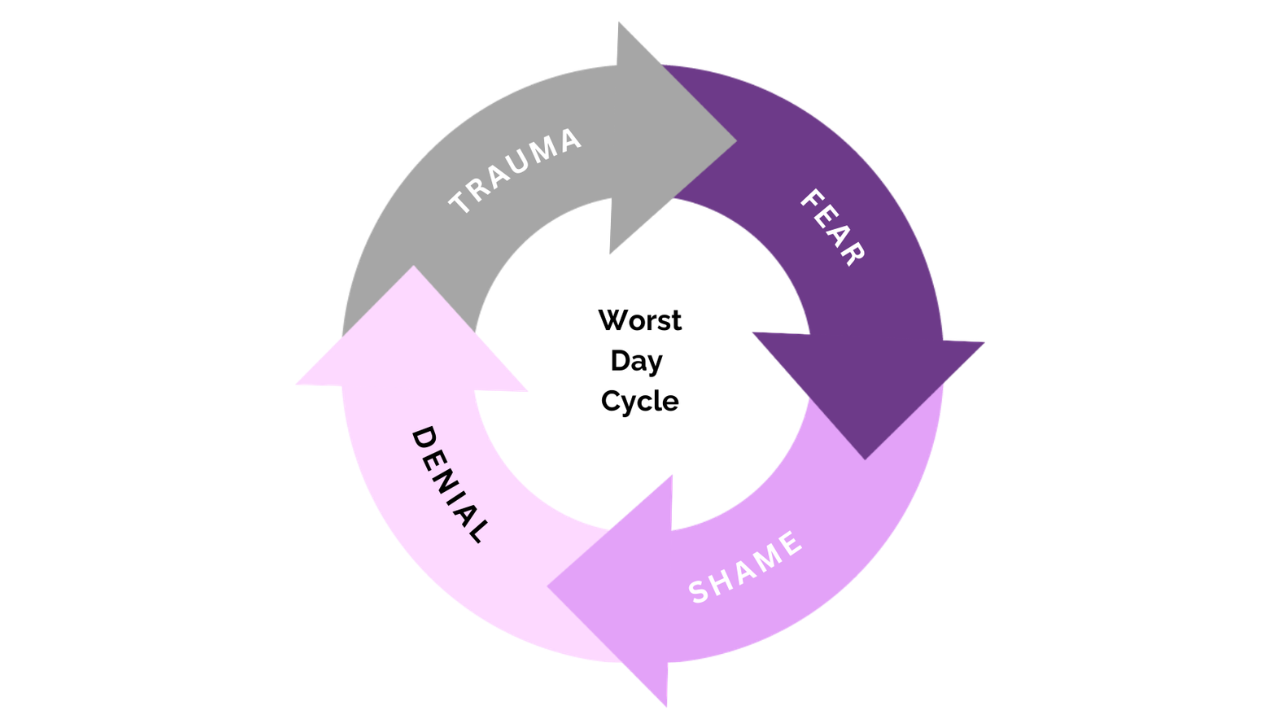
    Worst Day Cycle showing four stages trauma, fear, shame, denial creating repetitive emotional patterns

    Stage 1: Trauma (The Original Wound)

    Trauma is any negative emotional experience that created a painful meaning. Your parent’s rage wasn’t just yelling—it was evidence that you were bad. Your parent’s abandonment wasn’t just their choice—it was proof you weren’t worth staying for. Your parent’s control wasn’t just their need—it was because you couldn’t be trusted.

    This meaning became the core belief of your emotional blueprint.

    Stage 2: Fear (The Nervous System Activation)

    When your nervous system perceives a threat related to that original trauma, it triggers a massive chemical reaction. Your hypothalamus floods your body with cortisol (stress), adrenaline (fight/flight), dopamine dysregulation (reward-seeking through chaos), and oxytocin misfires (bonding with harm).

    Your developing brain became chemically addicted to these neurochemical states during childhood. Now your nervous system unconsciously seeks situations that recreate these familiar chemical patterns, even though they’re toxic. This is why you attract the same kind of partner or get stuck in the same workplace dynamic—your nervous system is seeking the chemical state it knows.

    Stage 3: Shame (The Core Wound Activated)

    When the fear activates, the original wound floods back. I’m not enough. I’m bad. I’m unlovable. I’m powerless. Shame isn’t just emotion—it’s a complete dissolution of self-worth. You move from “I made a mistake” to “I am a mistake.”

    Stage 4: Denial (The Escape)

    That’s you if you minimize, intellectualize, distract, numb, or dissociate when things get hard.

    Denial is your nervous system’s way of protecting you from unbearable shame. You don’t consciously choose it. Your brain just shuts down reality and creates a story that feels safer. Maybe you tell yourself “It’s not that bad.” Maybe you distract with work, substances, or drama. Maybe you dissociate entirely.

    Denial feels like relief in the moment. But it’s actually the lock that keeps you stuck in the cycle. When you deny what’s real, you can’t take ownership. When you can’t take ownership, you can’t change anything. So the cycle repeats.

    The Authentic Self Cycle™: Breaking Free

    The way out of powerlessness isn’t willpower or positive thinking. It’s rewiring your emotional blueprint by moving through the Authentic Self Cycle™—four stages that break the Worst Day Cycle™ and restore your power.
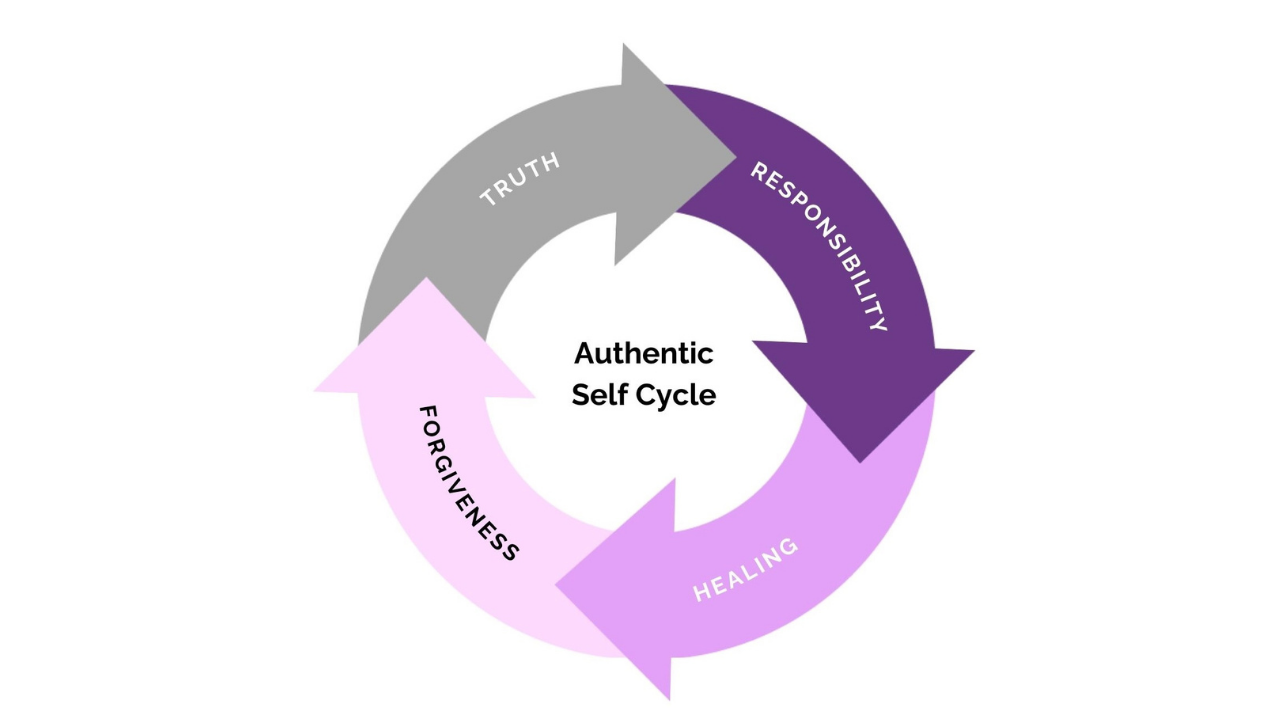
    Authentic Self Cycle showing four stages truth, responsibility, healing, forgiveness leading to power recovery

    Stage 1: Truth (Naming the Blueprint)

    That’s you when you stop denying what’s real and start saying: “This is what happened. This is what I learned. This isn’t about today.”

    Truth isn’t blame. It’s not “My parents ruined me.” It’s “My parents did the best they could with what they had. And what they gave me was a survival blueprint that no longer serves me.”

    You get into truth by telling yourself the full story without minimizing or intellectualizing. You feel it in your body. You let it hurt. You stop explaining it away.

    Neuroscience shows that naming an emotional experience—using words to describe what you feel—actually reduces amygdala (fear center) activation. The simple act of truth-telling begins to rewire your nervous system away from denial and toward reality.

    Stage 2: Responsibility (Owning Your Choices)

    That’s you when you move from victim to author—when you stop blaming your childhood and start owning your adult choices.

    This is where real power lives. Not in denying your past. Not in blame. In taking ownership.

    You owned the choice to keep saying yes when you meant no. You owned the choice to recreate family dynamics. You owned the choice to stay in situations that hurt. You’re not a bad person for these choices—you were doing the best you could with your wounded nervous system. But they’re yours to own now.

    When you take ownership, you get your power back. Because if you created the pattern, you can create something different.

    Stage 3: Healing (Rewiring Your Emotional Blueprint)

    That’s you when you use the Emotional Authenticity Method™ to create new emotional pathways in your brain and nervous system.

    Healing isn’t about being nice to yourself or positive thinking. It’s about literally rewiring the neurochemistry that keeps you stuck. Your brain’s job is to conserve energy by repeating known patterns—good or bad. To change a pattern, you have to create a new emotional experience strong enough to override the old one.

    Stage 4: Forgiveness (Releasing the Blueprint)

    That’s you when you let go of the story and step into your authentic self—no longer defined by your wound.

    Forgiveness doesn’t mean what happened was okay. It means you’re releasing the inherited emotional blueprint and reclaiming ownership of who you are now.

    The Emotional Authenticity Method™: Your 6-Step Path to Reclaiming Power

    The Emotional Authenticity Method™ is the protocol for actually rewiring your emotional blueprint. It’s the bridge between understanding your powerlessness and living your power.
    Emotional Authenticity Method six step process for rewiring emotional blueprint and reclaiming authentic power

    Step 1: Somatic Down-Regulation (Calm Your Nervous System)

    That’s you when you interrupt the stress response before shame takes over.

    Your nervous system is flooding with cortisol and adrenaline. Your body is in fight-or-flight. You can’t think clearly. You can’t access your authentic self. So first, you down-regulate your nervous system.

    The Practice: Focus on what you can hear for 15-30 seconds. Just listen. Notice ambient sounds, distant sounds, close sounds. This activates your parasympathetic nervous system (rest-digest) and creates a circuit breaker for fight-or-flight.

    If you’re highly dysregulated (shaking, dissociating, panicking), use titration: step outside, splash cold water on your face, feel your feet on the ground, or hold ice. You’re creating a sensory experience strong enough to interrupt the chemical cascade.

    Step 2: Name the Feeling (Get Emotional Granularity)

    That’s you when you move beyond “I feel bad” and identify the actual emotion.

    Your survival persona probably taught you emotional illiteracy. You feel something big and scary, so you label it “stress” or “overwhelmed” or “tired.” But emotional precision matters. Different emotions activate different neural pathways and require different healing approaches.

    The Practice: Use the Feelings Wheel at kennyweiss.net/life-changing-exercise. Start with the core emotion (angry, sad, afraid, ashamed) and move toward the edge to find the specific feeling (betrayed, disappointed, vulnerable, inadequate).

    This granularity activates your prefrontal cortex (thinking brain) and reduces amygdala hyperactivity (emotional reactivity). You’re literally changing your brain state by getting precise.

    Step 3: Locate the Sensation (Where Do You Feel It?)

    That’s you when you move from head-based analysis to body-based wisdom.

    Emotions live in your body, not your mind. When you feel powerless, where does it live? Chest tightness? Stomach heaviness? Jaw clenching? Throat closing? Your body is the truth-teller. Your mind is the story-maker.

    The Practice: Notice where in your body you feel the emotion most intensely. Don’t try to change it—just be curious about it. “Oh, I feel powerlessness as heaviness in my chest, right here.” You’re creating a somatic (body-based) connection to the emotion, which is how deep rewiring happens.

    Step 4: Find the First Memory (When Did This Begin?)

    That’s you when you trace the emotion back to its origin and see: “This isn’t about today.”

    The powerlessness you feel right now isn’t really about your current situation. It’s the old feeling overlaid onto today. So you trace it back: “When’s the first time I felt this exact feeling in this exact place in my body?”

    This is usually a childhood memory—something your conscious mind might have forgotten, but your nervous system never did. Maybe you felt this helplessness when your parent shut you out. Maybe you felt this shame when you were criticized. Maybe you felt this inability to move when you were powerless to stop the chaos.

    Neuroscience shows that connecting a present emotion to its original context literally changes how your brain processes that emotion. When you say “This isn’t about today—this is about when I was seven,” you’re deactivating the present-moment threat response and activating historical perspective, which reduces amygdala activation.

    Step 5: Imagine Your Authentic Self (Who Would You Be Without This?)

    That’s you when you envision the person you’d be if this emotional wound never happened.

    Not the falsely empowered persona who controls. Not the disempowered persona who disappears. The authentic you—the person who could feel powerless emotions but not be controlled by them.

    The Practice: Ask yourself: “If I never had this thought or feeling again, who would I be? How would I move? How would I speak? How would I relate?” Get specific. Don’t fantasize—imagine. See yourself in that power. Feel what that version of you feels like.

    Step 6: Feelization (Create the New Chemical Addiction)

    That’s you when you sit in the feeling of your authentic self long enough to rewire your nervous system.

    Your nervous system is addicted to the chemical state of powerlessness. To change that addiction, you have to create a new emotional chemical state strong enough to compete.

    The Practice: Stay in the feeling of your authentic self—your actual power—for 2-3 minutes. Not visualizing. Not thinking. Feeling. Feel the confidence in your chest. Feel the groundedness in your feet. Feel the clarity in your mind. Feel the peace in your nervous system. You’re literally building new myelin—neural insulation—around this new emotional pathway.

    Do this daily, and you’re building a new addiction to power.
    Emotional regulation and nervous system down-regulation techniques for managing powerlessness

    Signs You’re Stuck in Powerlessness

    Powerlessness doesn’t announce itself. It hides in your habits, your relationships, your body. Here are the signs across every life area.

    In Your Family of Origin

    That’s you if:

    • You still can’t say no to your parents—you give explanations, justifications, apologies instead of a simple answer
    • You carry responsibility for your parents’ emotions (their happiness, their loneliness, their disappointment)
    • You were the peacekeeper, the caretaker, or the scapegoat growing up
    • You minimize what happened to you (“It wasn’t that bad”) or defend your parents’ behavior
    • You still seek their approval or validation, even though you logically know they won’t give it

    In Your Romantic Relationships

    That’s you if:

    • You show signs of insecurity—seeking constant reassurance, monitoring your partner’s moods, scanning for rejection
    • You say yes to sex, time, or energy you don’t want to give, then resent your partner
    • You can’t remember what you want independently—your wants merge with theirs
    • You recreate enmeshment patterns—blurred boundaries, merged identities, emotional fusion
    • You attract partners who need rescuing or who are emotionally unavailable
    • You use anger, criticism, or withdrawal to maintain control

    In Your Friendships

    That’s you if:

    • You’re the listener, the advice-giver, the emotional support—but rarely receive it
    • You drop your own needs to manage a friend’s crisis
    • You’re afraid to disagree or set non-negotiables
    • You choose friends who need fixing or who are emotionally draining
    • You stay in friendships long after they’ve become painful

    At Work

    That’s you if:

    • You overwork to prove your worth or to avoid criticism
    • You can’t delegate or ask for help—you carry everything
    • You’re hypervigilant to your boss’s moods or opinions
    • You accept projects that aren’t in your job description
    • You struggle with genuine self-esteem—you need external validation to feel competent
    • You either disappear or dominate—no middle ground

    In Your Body and Health

    That’s you if:

    • You ignore your body’s signals—hunger, tiredness, pain, pleasure
    • You prioritize others’ comfort over your own (staying in an uncomfortable position to avoid moving, tolerating cold/heat, etc.)
    • You use your body as a way to gain control (restricting food, excessive exercise, overdoing productivity)
    • You don’t advocate for your health with doctors—you accept diagnoses or dismissals without questioning
    • You experience chronic tension, IBS, headaches, or other stress-based conditions
    • You can’t relax without guilt—rest doesn’t feel legitimate
    Adapted Wounded Child survival persona oscillating between control and collapse in relationships

    Magic Phrases for Saying No

    Learning to say no is the single most powerful skill for reclaiming your power. These aren’t scripts—they’re permission.

    The Three-Question Filter (Before You Say Yes)

    Before you commit to anything, ask yourself:

    1. Will I keep score? Will I resent this person or mentally note that they “owe me”?
    2. Will I throw it in their face? If conflict happens later, will I use this against them? (“After everything I’ve done for you…”)
    3. Will I have any resentment? Will this drain me, sacrifice something I value, or betray my own boundaries?

    If you answer yes to any of these, the answer is no.

    The Magic Phrase #1: The Buy-Time Response

    “Let me think about it, and I’ll get back to you.”

    This is your permission slip to pause. You don’t have to decide immediately. Your nervous system doesn’t have to react from fear. You get to take time, check your three-question filter, and choose consciously.

    Most people will accept this. And if they push back? That’s data. That tells you they need an immediate answer for their own reasons, not for yours.

    The Magic Phrase #2: The Clear No

    “I’ve thought about it, and it just doesn’t work for me.”

    This is the power stance. No apology. No justification. No explanation. No leaving room for negotiation.

    That’s you when you can say no to a request, a relationship, a situation, or a person—clearly, calmly, and without guilt.

    Notice: you don’t have to explain why it doesn’t work. You don’t have to convince them. You don’t have to make it their fault or your fault. You just say the truth: it doesn’t work for me.

    This shifts the dynamic immediately. Instead of them controlling the terms of your relationship, you do.

    The Hard No: When They Push Back

    Some people will argue, question, or guilt-trip. They’ll say:

    • “But I really need you.”
    • “You always help me.”
    • “That’s not like you.”
    • “You’re being selfish.”

    This is where you find out if you’ve actually reclaimed your power or if you’re still operating from your survival persona.

    Research on boundary-setting shows that pushback is predictable and normal. When you change the dynamic, people unconsciously try to pull you back into the familiar pattern. Your job is to stay in your power regardless of their reaction. The moment you explain, justify, or give in to guilt—you’ve handed your power back to them.

    Your response: “I understand you need help. And my answer is still no.” Or even simpler: “That doesn’t change my answer.”

    Repeat as needed. Your boundary isn’t negotiable.

    Frequently Asked Questions

    If I take ownership of my choices, doesn’t that mean I’m blaming myself for my childhood trauma?

    No. Taking ownership in the Authentic Self Cycle™ doesn’t mean denying what happened or suggesting you caused your trauma. It means you’re taking ownership of your adult choices—how you’ve responded to your wound, what patterns you’ve recreated, what boundaries you haven’t defended.

    Your parents created your wound. You’re responsible for healing it. Those are different things.

    I feel powerless in so many areas of my life. How do I even start?

    Start with one area where powerlessness is most painful. Maybe it’s your marriage. Maybe it’s with your mother. Maybe it’s at work. Pick the relationship or situation where your powerlessness costs you the most emotional energy.

    Use the Emotional Authenticity Method™ for that specific situation. Once you experience your power returning in one arena, you’ll have evidence that change is possible, and you can apply the same tools elsewhere.

    What if the people in my life don’t want me to change and get more powerful?

    That’s you discovering who benefits from your powerlessness.

    If your partner relies on your people-pleasing, they might resist. If your parent benefits from your caretaking, they might guilt-trip. If your friend exploits your lack of boundaries, they might withdraw. This is normal. When you reclaim your power, the dynamic shifts, and people who were comfortable with the old dynamic will feel uncomfortable.

    Your job isn’t to manage their discomfort. Your job is to reclaim your life.

    Isn’t saying no mean or aggressive?

    Only if you make it mean or aggressive. A clear, calm “It doesn’t work for me” is neither kind nor cruel. It’s just true. You’re not attacking. You’re not blaming. You’re just stating a boundary.

    What feels mean is your survival persona’s belief that your needs are inherently selfish. That’s the wound talking, not the truth.

    If I’m in the disempowered persona and I say no, will people abandon me?

    Some people might. The ones who loved you only because you said yes will leave. That’s painful. And that’s also data that tells you the relationship was conditional.

    The people who truly care about you want you to have boundaries. They want you to value yourself. They’ll respect your no.

    How long does it take to rewire my emotional blueprint?

    There’s no timeline. Your nervous system didn’t get wounded in days—it took years. Rewiring takes consistent practice with the Emotional Authenticity Method™.

    But you’ll notice shifts within weeks. You’ll say no more easily. You’ll feel less resentment. You’ll notice yourself choosing differently. These early wins build momentum.
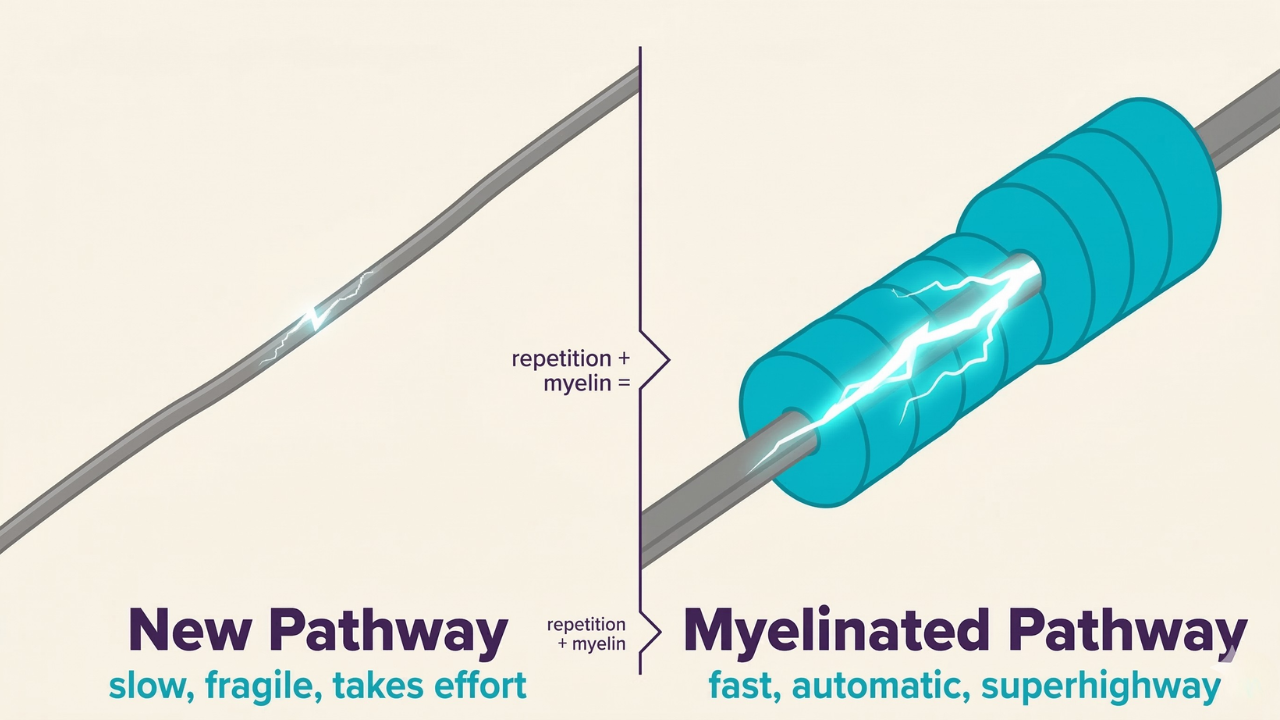
    Myelin building new neural pathways through consistent practice of emotional authenticity

    The Bottom Line

    Powerlessness isn’t your fault. Your childhood created a survival strategy that kept you safe then. But that same strategy is stealing your power now.

    The good news: your nervous system isn’t broken. It’s just running an old program. And you can rewrite that program.

    Every time you say no when you mean no, you’re rewiring. Every time you take ownership instead of blaming, you’re healing. Every time you stay in the feeling of your authentic power through the Emotional Authenticity Method™, you’re building a new addiction to genuine strength.

    That’s you when you stop focusing on what you can’t control and start defending what matters most: your own life, your own choices, your own voice.

    You didn’t survive your childhood to stay powerless forever. You survived it to become this person—someone capable of feeling deeply, seeing clearly, and choosing consciously. Someone powerful.

    It’s time to claim that power.

    • Mellody BeattieCodependent No More (the foundational text on boundaries and self-abandonment)
    • Gabor MatéWhen the Body Says No (the neuroscience of how emotional suppression manifests as physical illness)
    • Melody BeattieBeyond Codependency (advanced work on emotional authenticity and authentic power)
    • Brené BrownRising Strong (the science of shame resilience and emotional courage)
    • John BradshawHomecoming: Reclaiming and Championing Your Inner Child (reparenting your wounded nervous system)
    • Pete WalkerComplex PTSD: From Surviving to Thriving (understanding the survival personas and trauma responses)

    Take the Next Step: Heal Your Powerlessness with Kenny

    Understanding your powerlessness intellectually is one thing. Rewiring your nervous system and reclaiming your authentic power is another.

    Kenny has created specific courses to guide you through the process:

    That’s you—choosing to stop accepting powerlessness and starting to build your authentic power.
  • 10 Empowering Questions to Shift From Powerlessness to Personal Power

    10 Empowering Questions to Shift From Powerlessness to Personal Power

    Empowering questions to ask yourself are the fastest way to shift from feeling stuck, powerless, and frozen to feeling clear, grounded, and capable of making real decisions about your life. If you’ve been lying awake at night replaying problems you can’t solve, obsessing over what someone else thinks of you, or feeling paralyzed by a decision that shouldn’t be this hard — the issue isn’t that you lack answers. The issue is that you’ve been asking the wrong questions. You’ve been asking questions about what you can’t control — other people’s behavior, other people’s opinions, other people’s choices — and every time you focus on what you can’t control, you hand your power away.

    The feeling of disempowerment didn’t start today. It started in childhood, when your nervous system learned that safety meant compliance, that your voice created conflict, and that other people’s needs mattered more than yours. Your brain learned to focus outward — scanning for threats, managing other people’s moods, trying to earn approval — because that’s what kept you safe as a child. But now you’re an adult, and that same pattern is keeping you stuck in relationships that drain you, jobs that diminish you, and a life that doesn’t feel like yours.

    That’s you if you know exactly what you need to do but can’t seem to make yourself do it — if you feel frozen, overwhelmed, or stuck in a loop of overthinking that never leads to action.

    These ten empowering questions are designed to interrupt the Worst Day Cycle™ and move you from your survival persona into your Authentic Self. They shift your focus from what you can’t control to what you can. They move you from disempowerment to agency. And when you practice them daily, they literally rewire your nervous system’s default response from helplessness to wholeness.

    Table of Contents

    Emotional fitness and empowering questions for personal growth and self-discovery

    Why You Feel Stuck: The Neuroscience of Disempowerment

    When you feel powerless, your brain is doing something very specific: it’s focusing on what you can’t control. Get out two pieces of paper. On one, write “What I Can Control.” On the other, write “What I Can’t Control.” Then add three columns to each: People, Places, Things. If you’re really struggling, you’ll discover that you’re spending almost all of your time — mentally and emotionally — focused on the people, places, and things you have absolutely no control over.

    That’s you if you’ve spent the last week obsessing over why they won’t change, why your boss doesn’t appreciate you, or why your family can’t see what they’re doing to you.

    Emotional regulation showing how to shift from disempowerment to personal power

    You can never tell somebody what to think, what to feel, what to believe, or what to do. Whenever you try, you’re enacting verbal abuse — and you’re also guaranteeing your own powerlessness, because you have zero control over another person’s internal world. The more you demand that someone change, the more powerless you become. Your power lives exclusively in what you can control: your own thoughts, feelings, choices, and actions.

    To feel powerful, you need to defend against feeling powerless. And the single most effective way to shift from powerlessness to power is to change the questions you ask yourself. When you ask disempowering questions — “Why does this always happen to me?” “Why won’t they change?” “What’s wrong with me?” — your brain searches for evidence that confirms the helplessness. When you ask empowering questions — “What can I control?” “What do I actually want?” “What’s the smallest step I can take today?” — your brain shifts into solution mode. The chemical cocktail changes. Cortisol drops. Dopamine rises. You move from survival to agency.

    That’s you if you’ve been asking “why” questions that keep you stuck instead of “what” questions that move you forward.

    The Worst Day Cycle™: How Childhood Trauma Creates Powerlessness

    Disempowerment isn’t a personality trait. It’s a trauma response created in childhood and maintained by the Worst Day Cycle™ — a four-stage neurological loop: Trauma → Fear → Shame → Denial.

    The Worst Day Cycle showing how childhood trauma creates disempowerment through fear shame and denial

    Stage 1: Trauma. Childhood trauma is any negative emotional experience that created painful meanings about yourself, others, or the world. Think of all the times you were asked and forced to do things that went against your own inclinations and desires. Many of those things your parents did were good for you, but many times your parents — because of their own disempowerment — passed on the habits to you. If your mother or father grew up with addiction in their household, and thus a precondition to be afraid, it may have been projected onto you with helicopter parenting. That takes your inherent power away to explore the world and make perfectly imperfect decisions. The hypothalamus generates chemical cocktails — cortisol, adrenaline, dopamine misfires, oxytocin disruptions — and your brain becomes addicted to these emotional states.

    Stage 2: Fear. Fear drives repetition. Your brain conserves energy by repeating known patterns. It can’t tell right from wrong — only known versus unknown. Since approximately 70% of childhood messaging is negative and shaming, adults repeat these painful patterns in relationships, career, hobbies, health — everything. When you’re in that place where you can’t find an answer for anything, you are stuck focusing on what you can’t control rather than what you can control.

    That’s you if unfamiliar confidence feels scarier than familiar helplessness — if stepping into your power makes your stomach clench because your nervous system equates visibility with danger.

    Stage 3: Shame. Shame is where you lost your inherent worth. Where you decided “I am the problem.” Not “I made a mistake” (which is healthy responsibility), but “I AM a mistake” (which is toxic shame). When you belittle your worth by saying “I’m so stupid” or “why didn’t I do that differently?” — you’ve just said “I don’t have value and worth unless I do this perfectly.” Shame is what makes the empowering questions feel impossible to answer. Shame whispers that you don’t deserve to dream, don’t deserve to say no, don’t deserve to take up space.

    Stage 4: Denial. To survive unbearable shame, your psyche creates a survival persona — a false identity that protects you from the truth. This survival persona was brilliant in childhood. It kept you alive. But in adulthood, it keeps you locked in disempowered patterns, focused outward instead of inward, managing everyone else’s emotions while your own needs sit untouched and unmet.

    That’s you if you’ve been performing strength while secretly feeling like you’re drowning — if everyone thinks you’re fine because your survival persona is doing an excellent job of hiding the collapse underneath.

    The Three Survival Personas That Keep You Stuck in Powerlessness

    Your survival persona is the adaptive identity you created in childhood to stay safe. It’s not your fault that you built it — it was brilliant and necessary. But now it’s the primary obstacle between you and the empowered life you deserve. There are three primary types:

    Three survival persona types showing falsely empowered disempowered and adapted wounded child responses to powerlessness

    The Falsely Empowered Persona. This survival persona hides powerlessness behind control, dominance, and over-functioning. You became the one who has all the answers, makes all the decisions, and carries all the weight. You can’t ask empowering questions because you already “know” the answer — your survival persona insists that vulnerability is weakness and asking for help means losing control. You rage when things go wrong. You micromanage. You exhaust yourself trying to control outcomes that were never yours to control.

    That’s you if you’re always in charge, always managing, always the strong one — and secretly terrified of what would happen if you stopped performing and let people see the exhaustion underneath.

    The Disempowered Persona. This survival persona hides powerlessness behind collapse, people-pleasing, and self-abandonment. You became invisible. You learned that safety meant disappearing, that your needs were burdensome, that love required self-sacrifice. You can’t ask empowering questions because your survival persona has convinced you that your answers don’t matter — that someone else should be making these decisions for you.

    That’s you if you’ve been saying yes to everything while silently resenting everyone — if you can’t remember the last time someone asked what you wanted and you actually told the truth.

    The Adapted Wounded Child. This survival persona oscillates between both — controlling one moment, collapsing the next. You read every room constantly, adjusting yourself to whatever seems safest in the moment. You flip between rage and surrender depending on which strategy your nervous system thinks will bring relief. Neither does.

    Adapted wounded child survival persona oscillating between control and collapse in response to disempowerment

    That’s you if you feel like a different person depending on who’s in the room — strong at work but powerless at home, confident with friends but paralyzed with your partner.

    Sound familiar? Most of us recognize ourselves in all three at different times. That’s because they were all brilliant childhood survival strategies — and now they’re running your adult life without your permission.

    The 10 Empowering Questions That Shift You From Survival to Authenticity

    These ten questions are designed to create a massive emotional shift. We become what we feel, not what we think. Each question moves your nervous system from the Worst Day Cycle™ — where you’re focused on what you can’t control — into the Authentic Self Cycle™, where you’re focused on truth, responsibility, healing, and what you actually want.

    Emotional Authenticity Method empowering questions framework for shifting from disempowerment to personal power

    Question 1: What Can I Control?

    This is the foundation of all empowerment. Make two lists: one of what you can completely control and one of what you can’t. This is a living document — you’ll discover more things in the future. When you’re in a depressed or disempowered state, you’ll have this list to return to. You’ll find that most of your mental energy has been going toward people, places, and things you have zero influence over. The moment you redirect that energy toward yourself — your choices, your responses, your boundaries — the chemical shift begins.

    That’s you if you’ve been spending hours trying to change someone who doesn’t want to change — while your own life sits untended.

    Question 2: What Do I Actually Want?

    Tattoo three questions everywhere in your life: What do I want? What will I not tolerate? What can I control? If you don’t know what you want, pay attention to all the complaints you’re making about the person, place, or thing. Ask yourself: what’s the opposite? That lets you know what you want. Most disempowered people can tell you exactly what they don’t want but can’t articulate what they do want. That’s because childhood taught them that wanting was dangerous — that having desires meant being disappointed, rejected, or punished.

    That’s you if someone asks “what do you want for dinner?” and you genuinely don’t know — because you’ve spent so long catering to everyone else’s preferences that you’ve lost access to your own.

    Question 3: What Can I Start Saying No To?

    When you are powerless, you allow behavior and things that don’t work for you. You may be trying to be nice and help others, but you often don’t have the reserves. You get stuck in people-pleasing and guilt, and it robs you of your inherent power. Here’s the test: if you feel guilty, resentful, inclined to keep score, or want to throw it in the other person’s face — you’ve been saying yes to things you need to say no to. The most loving thing you can ever say to anyone is no. Learn to identify your negotiables and non-negotiables.

    That’s you if you say yes when you mean no, and then wonder why you’re bitter toward the people you love — your survival persona is performing generosity while your authentic self is screaming for rest.

    Question 4: What Brings Me Joy?

    When you’re disempowered, you lose access to joy. You survive. You manage. You push through. But you stop doing things that actually light you up. It’s the small things in life that bring us joy — lying in the sun, going on walks, cooking something simple, reading a book with no agenda. Make a list. This is an empowering perspective: nurturing yourself and meeting your own needs and wants. Joy isn’t frivolous. Joy is the signal that your authentic self is present.

    That’s you if you can’t remember the last time you did something purely because it made you happy — not because it was productive, not because someone needed you to, just because it felt good.

    Perfectly imperfect self-acceptance and joy as foundation for personal empowerment

    Question 5: What Do I Love Most About Myself?

    This can be tough for some people, but really think about it. Aren’t you a great friend? Maybe it’s your spirituality, your career, your eyes, your smile. There’s always something about yourself that you genuinely appreciate. This question creates an emotional shift, moving you out of the disempowered position and into truth. We are all lovable and perfectly imperfect. We all have many wonderful things about us that we often don’t give ourselves credit for. Start looking at your life and making a list of what you genuinely value about who you are. Build real self-esteem that isn’t dependent on what you produce.

    That’s you if you deflect every compliment, dismiss every achievement, and focus exclusively on what’s wrong — because shame taught you that self-appreciation is arrogance.

    Question 6: What Is My Best Skill?

    What do you do really, really well? There’s something each of us is genuinely excellent at — whether that’s an activity, career, parenting, willingness to learn, communication, or pursuing growth. When you’re disempowered, you dismiss your skills as “not good enough” or “anyone could do that.” But naming your skill — owning it without apology — moves you into your authentic self. Your skill isn’t accidental. It’s evidence of your capacity. It’s proof that you’ve already overcome challenges, already built competence, already created something real.

    That’s you if you minimize your accomplishments because your survival persona says you haven’t done “enough” yet — the goalpost keeps moving because your childhood taught you that worth is always conditional.

    Question 7: What Have I Always Dreamed of Doing?

    When we’re powerless, we see all the things we can’t do. But we all have dreams. Many times we lose sight of them — but think of how good it feels to dream. You’ll start looking for solutions in the empowered position. What have you always wanted to pursue? Start focusing on that. Sit and dream. Change the way you feel. When you dream, your nervous system begins to reorganize around possibility instead of limitation. This is the beginning of the Authentic Self Cycle™.

    That’s you if you stopped dreaming years ago because it felt safer to expect nothing than to hope and be disappointed — your survival persona calls that “being realistic,” but it’s actually self-protection from shame.

    Question 8: What Skill Do I Need to Learn to Achieve That Dream?

    Maybe you want a dream marriage, or a great friendship, or to play the piano. What skills do you need to learn these things? The best way to achieve what you can control is to develop new skills. This first requires knowledge. Then you turn that knowledge into a skill. Then the skill becomes a tool. Then the tool can help you achieve your dream. This progression — knowledge → skill → tool → dream — is empowerment in action. It moves you from helpless wishing to deliberate building.

    That’s you if you’ve been waiting for someone to give you permission to start — your disempowered persona says you need to be ready first, but the truth is readiness comes from doing, not from waiting.

    Question 9: What Is the Smallest Step I Can Take Today?

    Even the dream may feel overwhelming. So start focusing on what you can control: maybe the smallest step you take today is Googling a topic. Read one article. You’ve already started the journey and are living in what you can control. The greatest chemically-producing way to shift the way we feel is to learn. It’s the single greatest way we feel self-esteem — learning and education. It will really shift you out of the disempowered position into a sense of achievement. One small step creates momentum. Momentum creates confidence. Confidence creates the next step.

    That’s you if you’ve been paralyzed by the size of what needs to change — your survival persona sees the mountain and freezes, but your authentic self only needs to take the next step.

    Neural pathway rewiring through small empowering steps and consistent practice

    Question 10: Who Would I Be If I Never Had This Disempowered Feeling Again?

    This is the most powerful question on the list — and it comes directly from Step 5 of the Emotional Authenticity Method™. Think about when you felt disempowered. What would be left over if you could never feel that again? When that feeling is removed, what emerges are the feelings of lightness, strength, safety, joy, and happiness. Those bad feelings and moments are always temporary — they lead you to solutions and aren’t bad. When you choose to no longer see them as a disempowering problem, you see your authentic self and your greatness. That’s when you can achieve anything and everything you want.

    That’s you if you’ve never asked this question before — if you’ve been so identified with the disempowerment that you can’t imagine who you’d be without it. That person exists beneath your survival persona. They’ve been waiting.

    Emotional blueprint showing the authentic self beneath childhood survival patterns

    The Emotional Authenticity Method™: 6 Steps to Reclaim Your Power

    Empowering questions create awareness. But awareness alone doesn’t change your nervous system. The Emotional Authenticity Method™ is a six-step process that literally rewires the disempowerment pattern at the somatic, chemical, and neurological level. You cannot change emotional patterns through thoughts alone. Emotions are biochemical events. Thoughts originate from feelings — not the other way around.

    Step 1: Somatic Down-Regulation. When you feel powerless — when the freeze response takes over and you can’t act — pause. Focus on what you can hear for 15-30 seconds. Wind. Traffic. Your own breath. If you’re highly dysregulated, use titration: smaller, shorter bursts. This activates your parasympathetic nervous system and brings your thinking brain back online.

    Step 2: What am I feeling right now? Not “I feel stuck.” Use the Feelings Wheel to name it with precision. Are you feeling helpless? Afraid? Ashamed? Overwhelmed? Frustrated? Emotional granularity breaks the reactive cycle and moves you from your survival persona into your thinking brain.

    Step 3: Where in my body do I feel it? All emotional trauma is stored physically. Powerlessness might be heaviness in your chest, collapse in your posture, tension in your jaw, or a knot in your stomach. Locate the feeling. This grounds you in the present moment instead of the childhood memory your nervous system is replaying.

    Step 4: What is my earliest memory of having this exact feeling? The powerlessness you feel today echoes something much older. When was the first time you felt like you had no control? The first time your voice didn’t matter? The first time your needs were dismissed? Your present-day trigger didn’t create this feeling — it activated a blueprint that was already there.

    Step 5: Who would I be if I never had this thought or feeling again? This is Question 10 from the empowering questions list — and it’s the vision step that connects you to the Authentic Self Cycle™. Not “I’d be happy.” Specific: “I’d be someone who speaks up in meetings. Someone who asks for what they need. Someone who makes decisions without second-guessing. Someone who trusts their own judgment.”

    Step 6: Feelization — The New Chemical Addiction. Sit in the feeling of who you’d be — the authentic self. Make it strong. Feel it in your body. The confidence, the groundedness, the power. Create a new emotional chemical addiction to replace the old disempowerment blueprint. Ask yourself: “How would I respond to this situation from this feeling? What would I say? What would I do?” Visualize and FEEL yourself operating from your Authentic Self. This is the emotional blueprint remapping and rewiring step.

    That’s you if you’ve been trying to think your way into empowerment — reading books, watching videos, understanding the concepts — but still feeling stuck when the moment arrives. Feelization is where the neurological change actually happens.

    Trauma chemistry showing how Feelization creates new chemical patterns to replace disempowerment

    The Authentic Self Cycle™: From Victim to Author of Your Life

    The Authentic Self Cycle™ is the healing counterpart to the Worst Day Cycle™ — a four-stage identity restoration system: Truth → Responsibility → Healing → Forgiveness. This is where the empowering questions become a permanent operating system instead of a temporary fix.

    The Authentic Self Cycle showing truth responsibility healing and forgiveness for lasting empowerment

    Stage 1: Truth. Name the blueprint. “This powerlessness isn’t about today. It’s about a childhood where my voice didn’t matter, where my needs were dismissed, where I learned that the only way to survive was to focus on everyone else. That was true then. It’s not true now.”

    Stage 2: Responsibility. Own your emotional reactions without blame. “My boss isn’t my parent. My partner isn’t my parent. My nervous system just thinks they are. The disempowerment I feel is mine to heal, not theirs to fix.” This is where you move from victim to agent — from “this is happening to me” to “this is happening in me, and I can change it.”

    Stage 3: Healing. Rewire the emotional blueprint so that personal power becomes your baseline state, not something you have to earn or perform. Conflict becomes uncomfortable but not dangerous. Saying no becomes assertive but not aggressive. Having needs becomes human but not burdensome. Creates a NEW emotional chemical pattern that replaces fear, shame, and denial with clarity, confidence, and authentic self-worth.

    Stage 4: Forgiveness. Release the inherited emotional blueprint and reclaim your authentic self. Forgive your parents — not because what happened was acceptable, but because they were doing the best they could with the information they had. Your parents weren’t bad people. They adored you. They wanted to do everything they could to raise you perfectly. But they didn’t have all the information, so they made loving mistakes. When you release the fight against your past, you release the disempowerment that came with it.

    That’s you if you’re finally ready to stop waiting for permission to live your life — to stop managing everyone else’s emotions and start asking yourself the questions that actually matter.

    Where Disempowerment Shows Up Across Your Life

    Disempowerment doesn’t confine itself to one area. It infiltrates everything because the emotional blueprint runs beneath every decision, every relationship, every moment of self-talk.

    Family Relationships

    You still seek approval from a parent who gives it conditionally. You change who you are around family to keep the peace. You feel guilty for setting boundaries. You sacrifice your needs “for family.” You can’t share your real self — you manage their perception of you instead. Your parents’ mood still determines your entire day, even though you’re a grown adult with your own life. Learn more about how enmeshment strips away personal power.

    That’s you if you’re still performing the role of the “good child” — managing your family’s emotional world while your own needs go unspoken and unmet.

    Romantic Relationships

    You suppress your needs to avoid conflict. You stay in situations that don’t work because you fear abandonment. Your worth depends on whether your partner loves you back. You try to change yourself to be “the right” partner. You keep score of sacrifices and expect repayment. You can’t answer “what do I want?” because your survival persona has been focused entirely on what they want. Recognize the signs of relationship insecurity and understand how they connect to childhood disempowerment.

    That’s you if you’ve lost yourself in a relationship — if you couldn’t tell someone who you are outside of being someone’s partner.

    Friendships

    You’re the emotional support person but can’t ask for support. You abandon your plans when friends need you. You feel resentful but continue the pattern anyway. You stay friends with people who don’t respect you because being needed feels better than being alone.

    That’s you if you’re exhausted from being everyone’s therapist, advice-giver, and crisis manager while nobody ever asks how you’re doing.

    Work and Achievement

    You work beyond your capacity to prove your worth. You struggle to advocate for yourself or ask for raises. You take on everyone else’s emotional labor. You can’t say no without guilt. You suffer from imposter syndrome — the constant fear that someone will discover you’re not as capable as you appear. Your survival persona’s perfectionism is your company’s greatest asset and your nervous system’s greatest prison.

    That’s you if you’ve been promoted for the very pattern that’s destroying you — your over-functioning keeps the company running while it runs you into the ground.

    Body and Health

    You ignore your body’s signals. You push through exhaustion, pain, and hunger. You use food, substances, or behaviors to numb the feelings your nervous system is trying to communicate. You punish your body instead of caring for it. You prioritize others’ comfort over your own physical needs.

    That’s you if your body has been screaming for rest and you keep telling it to be quiet — because your survival persona says rest is laziness and need is weakness.

    Codependence and disempowerment patterns showing self-abandonment across every area of life

    Frequently Asked Questions

    How do empowering questions actually change my brain chemistry?

    When you ask a disempowering question like “why does this always happen to me?” your brain searches for evidence of helplessness — flooding your system with cortisol and stress hormones. When you ask an empowering question like “what can I control?” your brain shifts into problem-solving mode, activating your prefrontal cortex and releasing dopamine. Over time, this practice rewires your neural pathways so that solution-oriented thinking becomes your default. The Emotional Authenticity Method™ accelerates this process through Feelization — creating new chemical baselines at the somatic level.

    What if I genuinely don’t know what I want?

    That’s not a failure — that’s evidence of how effectively your survival persona has been running your life. When childhood teaches you that your wants create danger, you learn to stop wanting. The path back to desire starts with paying attention to your complaints. Every complaint is an inverted want. If you complain that your partner never listens, you want to be heard. If you complain about your job, you want meaningful work. Start there and work backward from frustration to desire.

    Why do I freeze when it’s time to take action even after asking empowering questions?

    Freezing is a trauma response, not a character flaw. Your nervous system learned in childhood that action creates danger — speaking up got you punished, trying got you criticized, dreaming got you dismissed. Understanding the questions intellectually is Step 1. But your body still holds the old blueprint. That’s why the Emotional Authenticity Method™ starts with somatic down-regulation and moves through the body — not just the mind. You can’t think your way out of a freeze response. You have to feel your way through it.

    How long does it take for empowering questions to create real change?

    Most people report a noticeable shift within days of consistent practice. The chemical shift happens immediately — every time you redirect your focus from what you can’t control to what you can, your nervous system recalibrates. But deep, lasting change — the kind where empowerment becomes your default state — typically takes 6-12 months of consistent work with the Emotional Authenticity Method™ and the Authentic Self Cycle™. The timeline depends on how deep the childhood pattern runs and how committed you are to the daily practice.

    Can I use these questions to help someone else who feels stuck?

    Yes — but here’s the key: turn everything into a question so they figure out the answer for themselves. When someone comes to you for advice, instead of telling them what to do, ask: “What do you think your options are?” “What part of this situation do you think you can control?” “What do you think would help you?” This empowers them instead of creating dependency. The moment you tell someone what to do, you become the parent they never had — and they stay disempowered.

    What’s the difference between empowering questions and positive affirmations?

    Affirmations tell your brain what to believe. Empowering questions ask your brain to search for evidence. When you say “I am powerful,” your shame-based nervous system rejects it — cognitive dissonance. When you ask “what can I control?” your brain actively searches for answers and finds them. Questions engage your prefrontal cortex. Affirmations bounce off your survival persona’s armor. Both have value, but questions create neurological movement where affirmations often create resistance. The Emotional Authenticity Method™ goes deeper than both — it changes the felt experience at the body level through Feelization.

    The Bottom Line

    You’re not powerless. You never were. What happened in childhood was real — the dismissal, the control, the shame, the message that your voice didn’t matter. Those experiences created a survival persona that focused outward instead of inward, that managed everyone else’s emotions while abandoning your own, that performed strength while hiding collapse. But that survival persona is not you. It’s a brilliant adaptation that kept you alive. And now it’s time to outgrow it.

    At all times, no matter what you are thinking, feeling, believing, or doing, you always have value and worth. At all times. Your power doesn’t come from controlling other people. It comes from knowing yourself — your values, your needs, your non-negotiables, your dreams — and having the courage to honor them.

    These ten empowering questions aren’t just a list to read once. They’re a daily practice. Every time you catch yourself spiraling into “why won’t they change?” pause. Redirect. Ask: “What can I control?” Every time your survival persona tries to keep you small, ask: “Who would I be if I never felt this way again?” Every time shame whispers that you don’t deserve to take up space, ask: “What do I love about myself?”

    The questions change your chemistry. The chemistry changes your nervous system. The nervous system changes your life. That’s not theory. That’s neuroscience. And it starts right now, with the decision to stop focusing on what you can’t control and start focusing on the one person you’ve been neglecting your entire life: yourself.

    That’s you if you’re finally ready to stop performing strength and start feeling it — to stop managing everyone else’s world and start building your own.

    Reparenting yourself through empowering questions and authentic self-discovery

    Recommended Reading

    • Facing Codependence by Pia Mellody — The foundational text on how childhood trauma strips away inherent power and creates survival personas, codependent patterns, and the loss of authentic self.
    • The Body Keeps the Score by Bessel van der Kolk — Essential reading on how disempowerment lives in your nervous system and why healing requires more than positive thinking.
    • When the Body Says No by Gabor Maté — How chronic disempowerment and emotional suppression manifest as physical illness.
    • Codependent No More by Melody Beattie — The classic guide to reclaiming your power and stopping the cycle of self-abandonment.
    • The Gifts of Imperfection by Brené Brown — A guide to wholehearted living that directly counters the shame keeping you disconnected from your authentic power.

    Ready to Reclaim Your Personal Power?

    Start with the Feelings Wheel exercise to rebuild your emotional vocabulary today. Then explore the signs of enmeshment to understand where your power was first lost. Map out your negotiables and non-negotiables to rebuild the foundation of authentic empowerment. And learn the do’s and don’ts for great relationships to build connections from wholeness, not from wound.