If you are an overthinker, a high achiever, or someone who lives entirely in their head, you probably believe that if you just analyze a problem from every possible angle, you can solve your anxiety. You use logic, spreadsheets, and pros-and-cons lists to try and “think” your way out of disturbing feelings.
Somatic emotional regulation is the process of healing trauma through the body—not the mind. It works because your emotions are biochemical events that originate in your nervous system before your brain ever constructs a thought. Your feelings come first, your thoughts come second, and no amount of intellectual analysis can override the chemical cascade your body has already initiated. Traditional approaches like CBT and positive thinking fail for trauma because they target thoughts while leaving the body’s alarm system untouched.
You have probably tried Cognitive Behavioral Therapy, repeating positive affirmations, or telling yourself, “Just let it go, it makes no logical sense to be upset about this.” But despite your massive intellect, the physical panic remains. The tightness in your chest doesn’t care about your logic. The knot in your stomach ignores your spreadsheets. You end up exhausted, stressed, and frustrated because your brilliant mind cannot turn off your body’s alarm system.
That’s you… lying in bed at 2am with your mind running cost-benefit analyses on a conversation that happened six hours ago, as if the right spreadsheet could make the knot in your chest disappear.
If this is you, there is nothing wrong with your brain. You are simply trying to solve a somatic, body-based trauma problem with an intellectual tool.
Here is the neuroscience of why “thoughts are not the leaders” of your behavior, how your intellect is actually operating as a highly sophisticated denial machine, and the exact Somatic Emotional Regulation process you need to use to finally get out of your head, into your body, and heal the root of your overthinking.
Why Are Your Thoughts Not the Leaders of Your Nervous System?
Let’s start with a massive paradigm shift. For decades, the self-help industry has pushed the narrative: “Change your thoughts, change your life.” But based on the latest neuroscience, that is completely backward.
Your thoughts are not the leaders of your life. Your feelings come first, and your intellect and your words emerge from the emotions that follow.
Neuroscience shows us that milliseconds prior to any action or thought, your brain experiences a lightning-fast flash of subconscious emotion associated with a childhood memory. Your brain filters sensory input from your environment, compares it to the emotional simulations and concepts you learned from your perfectly imperfect parents, and constructs an emotional reaction.
That’s you… thinking you made a “rational decision” to pull away from your partner, when really your nervous system detected a tone of voice that matched your mother’s disappointment thirty years ago and hit the eject button before your prefrontal cortex even woke up.
By the time you start “thinking” about why you are upset, your nervous system has already decided you are in danger based on your childhood emotional blueprint. Your thoughts are just the lawyers arguing for whatever your body has already decided is true.
This is why trying to change your thoughts without addressing your body is useless. Your thoughts and intellect aren’t Santa Claus; they cannot magically bring you the peaceful life you crave if your body is trapped in trauma.
That’s you… in therapy for three years understanding exactly why you shut down in conflict, and still shutting down every single time because understanding didn’t change the chemistry.
How Does the Left-Brain Denial Machine Block Your Nervous System Regulation?
To stop overthinking, we have to look at what intellectualization actually is. It is not a sign of emotional maturity; it is a defense mechanism.
All sensory information that enters your body first goes through the right hemisphere of your brain, which is your emotional center. It is then supposed to pass to the left hemisphere to be categorized and simplified, and then return to the right hemisphere for a final emotional sifting.
But in trauma survivors, that last biological step goes missing.
You get stuck in the left hemisphere. And the left hemisphere is a denial machine. When you are confronted with emotional pain, your left brain jumps to irrational conclusions, dismisses new information, and becomes frozen in denial. When confronted with the truth, it actually doubles down and uses logic to fuel its destructive thinking.
That’s you… building an airtight logical case for why you “don’t need anyone” when the truth is your body is terrified of the vulnerability that intimacy requires.
When you intellectualize a problem, you aren’t solving it. You are using logic to detach from all emotion, completely avoiding the intimacy and vulnerability required to actually heal. You put on the survival persona of the Falsely Empowered—the avoidant who stays busy, stays blank, and stays numb. Your intellect becomes the fortress wall that keeps everyone out, including yourself.
But the Disempowered survival persona overthinks differently. Instead of using logic as a wall, they use it as a weapon against themselves. They replay every conversation looking for proof that they are the problem. They over-analyze every text, every tone, every micro-expression, searching for evidence that confirms the shame story their childhood installed: “I am too much. I am not enough. I drove them away.”
That’s you… replaying a two-second pause in your partner’s voice for four hours straight, constructing an entire narrative about how they’re about to leave you based on literally nothing.
And the Adapted Wounded Child oscillates between both—intellectualizing to push people away one day, then overthinking to pull them back the next. One moment building logical walls, the next moment tearing them down in a panic of self-blame.

Overthinking is simply your inner child hiding behind a wall of logic because they are terrified of feeling the original shame and powerlessness of their past.
What Does Unregulated Somatic Trauma Look Like Across Your Life?
When your body is holding trauma that your mind refuses to feel, it doesn’t just show up as overthinking. It bleeds into every area of your life through physical symptoms your intellect cannot explain away.
In Family: Your jaw locks when your mother calls. Your shoulders climb toward your ears during holiday dinners. You get migraines after family gatherings and tell yourself it’s “just stress” while your body screams that it’s reliving the emotional environment of your childhood.
That’s you… taking three Advil before Thanksgiving dinner and calling it “being prepared” instead of acknowledging that your body knows exactly what’s coming.
In Romantic Relationships: Your chest tightens when your partner goes quiet. Your stomach drops when they don’t respond to a text. You intellectualize these reactions—”I’m just anxious, it’s nothing”—while your body is replaying the exact moment your caregiver withdrew their love and your nervous system learned that silence means danger.
In Friendships: You feel physically exhausted after social interactions because your body has been in fight-or-flight the entire time, scanning for rejection signals. You cancel plans because your body “doesn’t feel right” even though nothing is medically wrong. The truth is your nervous system is overloaded from performing safety assessments on every human interaction.
In Work and Career: Your neck and shoulders carry chronic tension. You clench your jaw through meetings. You get stomach pain before presentations—not because you’re unprepared, but because performing in front of authority figures activates the same nervous system response as performing for a critical parent who was never satisfied.
That’s you… with a perfect presentation and a stomach full of acid, wondering why your body treats a Tuesday morning meeting like a life-threatening event.
In Body and Health: Chronic pain with no clear medical cause. IBS, TMJ, tension headaches, autoimmune flares that worsen during emotional stress. Your body is keeping a running tab of every emotion your intellect has refused to process. As Bessel van der Kolk says, the body keeps the score.
Why Does CBT Fail for Trauma in the Body?
To illustrate why intellectualizing and standard cognitive therapies fail to regulate the nervous system, let’s look at how they handle fear.
Traditional Cognitive Behavioral Therapy (CBT) often tells you to re-describe a situation differently or divert your attention, which only serves to suppress your emotions. It strengthens the left-hemisphere dominance, which is the exact opposite of what you need.
Imagine a venomous snake is coiled up on the floor in front of you. The intellectual, CBT approach tells you to reframe your thoughts: “Look at this beautiful, safe, and peacefully coiled up creature before you.”
But your body is screaming! Your heart is pounding. You are terrified. Lying to your brain does not calm your nervous system.
That’s you… repeating “I am safe, I am safe, I am safe” while your hands are literally trembling, your palms are sweating, and your body knows you are absolutely lying.
Somatic emotional regulation requires what I call Negative Emotional Differentiation. It requires intense physical truth. Instead of positive thinking, you look at the snake and say, “I feel petrified. I feel breathtakingly afraid. My stomach feels like it’s in knots looking at this slithering, menacing creature… but I am open to feeling differently about it.”
You have to know exactly how you feel physically in order to change how you feel. You must get out of the story in your head and drop into the sensations in your body.
Why Do All Thinking-Based Tools Fail for Somatic Trauma?
CBT is not the only approach that fails. Every tool that starts with thoughts and works backward to feelings has the same fundamental flaw: it treats the symptom (the thought) instead of the cause (the body’s stored trauma chemistry).
Positive affirmations tell you to override your body’s alarm system with words. But your amygdala does not speak English. It speaks cortisol, adrenaline, and muscle tension. Telling it “I am worthy” while it is flooded with shame chemistry from 1987 is like whispering to a fire alarm that there is no fire while the building is actually burning.
That’s you… with a vision board on your wall and a panic attack in your chest, wondering why the universe isn’t responding to your positive energy.
Talk therapy helps you understand your story, and understanding matters. But understanding without somatic engagement is like reading a cookbook without ever turning on the stove. You know all the ingredients. You can describe the meal in detail. But you are still hungry.
Mindfulness meditation tells you to observe your thoughts without judgment. This is useful for building metacognitive awareness—the ability to think about your own thinking. But observation alone does not rewire the neural pathway. You can watch the train wreck in slow motion with perfect mindful awareness and still be standing on the tracks.
The missing piece in all of these approaches is the body. Your trauma lives in your nervous system, not your narrative. And the only way to heal it is to go where it lives.
How Does the 5-Step Emotional Authenticity Method™ Stop Overthinking Through Somatic Regulation?
How do we bypass the left-brain denial machine and actually regulate the body? We use the Emotional Authenticity Method™ to connect directly to the somatic truth.

Here is exactly what you do the next time you catch yourself overthinking, pacing the floor, or endlessly analyzing a conflict.
Somatic Titration: How to Lower Your Nervous System Activation Before Starting
First, if your body is completely flooded with panic, do not start asking yourself deep psychological questions. You must lower the emotional temperature first. Use somatic titration: spend 30 seconds focusing entirely on what you can hear in your room. Then, bring the stressful thought back for 30 seconds. Then return to listening for 30 seconds. Do this back-and-forth three to five times to unstick your emotional thermostat and bring your prefrontal cortex back online.
That’s you… discovering that thirty seconds of listening to the air conditioner does more for your nervous system than three hours of journaling about why you’re anxious.
Once the panic drops, you apply the 5 steps:
Step 1: What am I feeling right now? Look at the Feelings Wheel. Stop analyzing the situation and name the emotion. Expand your emotional vocabulary. Are you feeling isolated, apathetic, inferior, or remorseful? Pick the strongest one. This is Negative Emotional Differentiation—the antidote to intellectual denial.
Step 2: Where do I feel this in my body? This is the antidote to overthinking. List all the places you feel this emotion physically. A tight jaw? A heavy chest? A buzzing in your arms? Reconnecting to your bodily sensations is how you bypass the intellect.
Step 3: What is my earliest memory of having this exact feeling? Follow the body sensation back in time. Write down the memories. You will find the exact childhood moment where you first felt this physical sensation and adopted a painful emotional definition.
Step 4: How does the current event mirror the first time? Look at how your current overthinking is just a reenactment of that childhood moment. You aren’t reacting to your boss; you are reacting to your critical parent. You aren’t panicking about the text; you are reliving the moment your caregiver’s silence meant you had done something wrong.
That’s you… realizing that the knot in your stomach during your performance review is the exact same knot you felt at eight years old waiting for your father to read your report card.
Step 5: Who would I be if I never had this feeling again? If this feeling were completely wiped out, what would be left? You would feel light, strong, safe, and joyful. Using “feelization,” visualize and feel yourself responding from this new, peaceful state, creating a new emotional neural pathway. That is your Authentic Self.
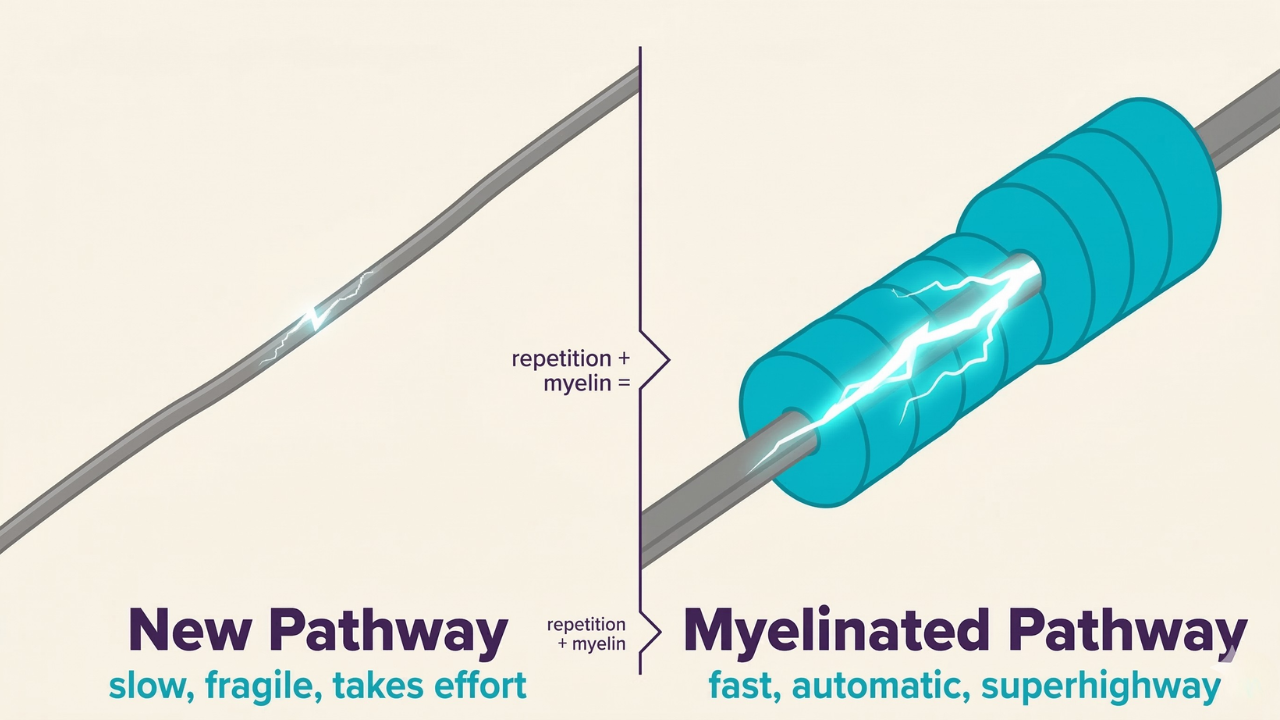
Every time you complete these five steps, you are laying down myelin—the biological insulation that strengthens new neural pathways. You are literally building a somatic highway that bypasses the old intellectual detour your trauma installed.
How the Worst Day Cycle™ Keeps You Trapped in Your Head
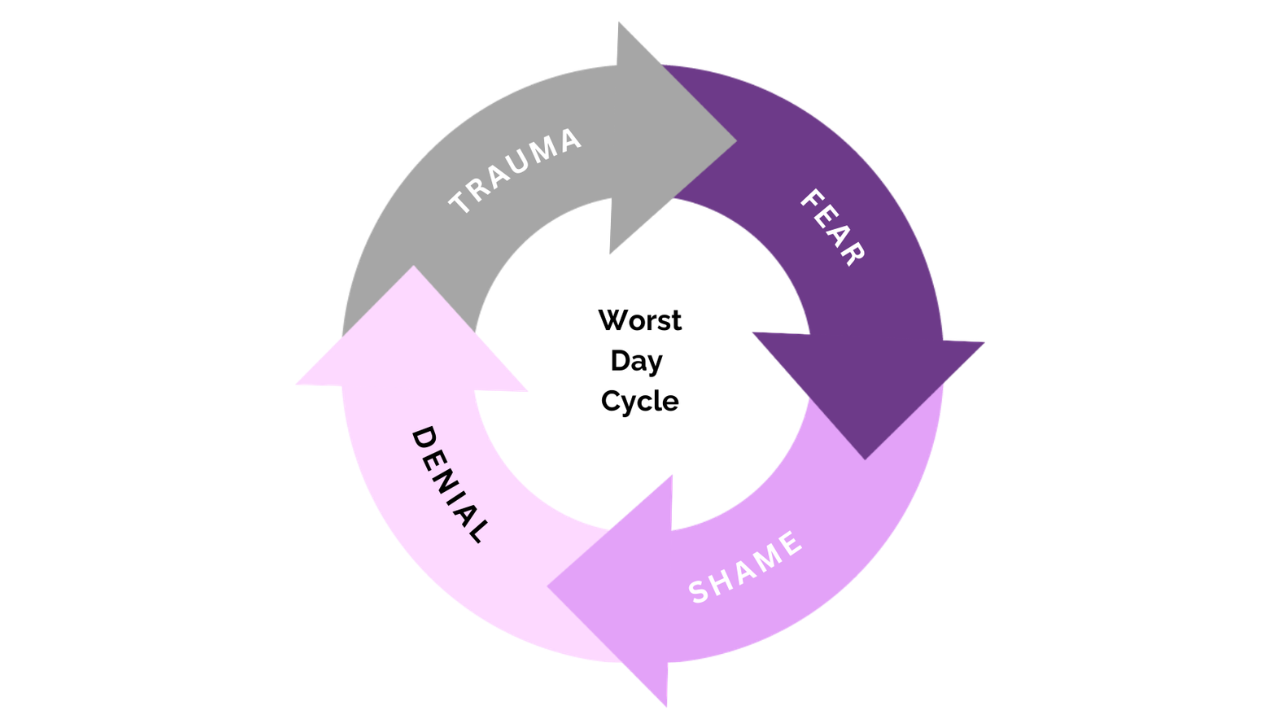
The Worst Day Cycle™ explains exactly why overthinking feels impossible to stop: Trauma creates Fear, Fear creates Shame, Shame creates Denial, and Denial loops you back into Trauma. Your intellectualization is the Denial stage—the sophisticated, high-functioning version of denial that looks like productivity and intelligence but is actually your nervous system’s way of avoiding the shame underneath.
When you were a child, your perfectly imperfect parents transferred their unhealed pain into you. Your body absorbed it. Your nervous system cataloged it. And your brilliant brain created a strategy to survive it: think harder, analyze more, stay in your head where it’s safe. The problem is that strategy worked at seven years old, and now at forty-seven it’s running your entire life while the body that holds the original wound goes completely unaddressed.
That’s you… the smartest person in every room, with the answer to everyone else’s problems, who goes home and can’t figure out why you feel empty, tense, and alone.
The Authentic Self Cycle™: From Overthinking to Embodied Healing
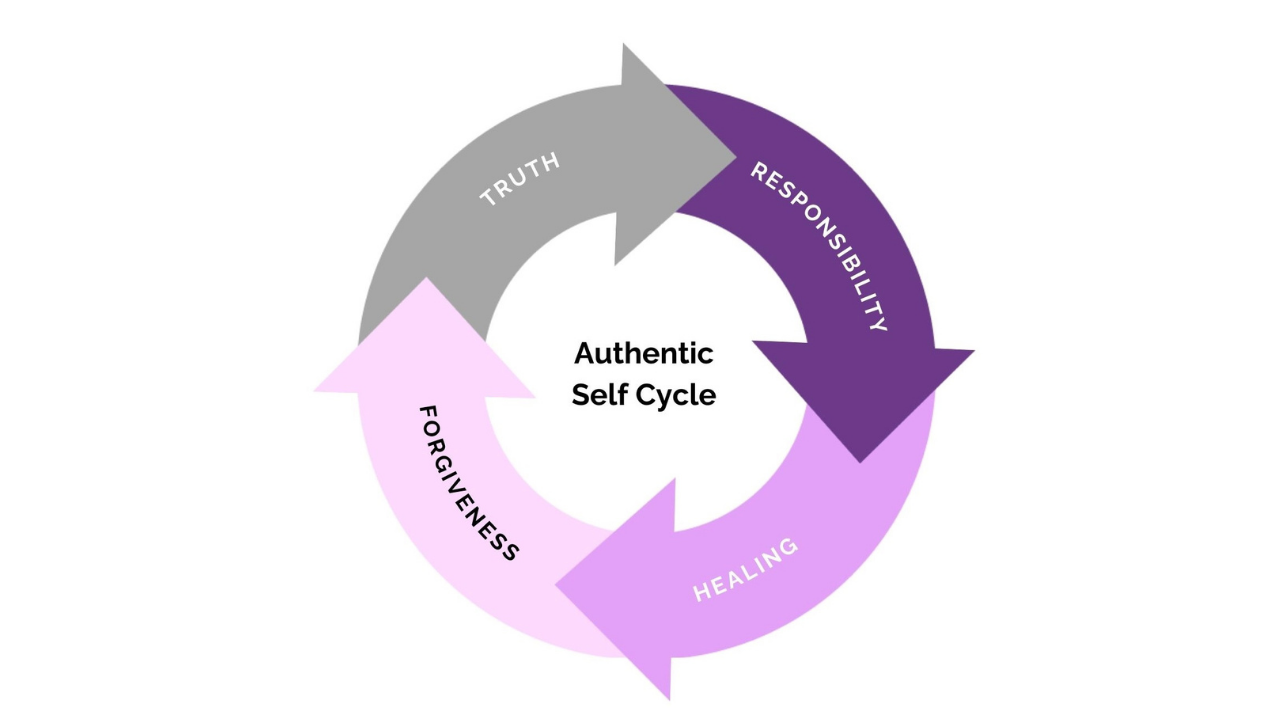
The Authentic Self Cycle™ is the healing counterpart to the Worst Day Cycle™. Where the WDC traps you in Trauma → Fear → Shame → Denial, the ASC moves you through Truth → Responsibility → Healing → Forgiveness.
Truth: Name what your body is actually feeling instead of what your intellect is constructing. “I’m not ‘fine.’ My chest is tight, my jaw is clenched, and I feel invisible.”
Responsibility: Own that your overthinking is a survival persona response, not a personality trait. “My analysis of this situation is my childhood denial machine running, not my adult self solving a problem.”
Healing: Use the Emotional Authenticity Method™ to drop into the body, trace the sensation to its origin, and create a new neural pathway. This is the somatic work that thinking-based tools skip entirely.
Forgiveness: Release the emotional blueprint that installed the overthinking pattern. Forgive the child who needed intellectualization to survive. And step into the embodied, present, Authentic Self who no longer needs a fortress of logic to feel safe.
That’s you… feeling something shift in your chest as you read this—not a thought, but a sensation. That’s your body recognizing the truth before your mind can argue with it.
What Is Your Next Step to Stop Overthinking and Start Healing?
You cannot think your way out of a feeling. You have to drop into your body, locate the origin of the trauma, and heal the emotional definitions that are keeping your nervous system trapped in the past.
That’s you… ready to finally put down the spreadsheet and pick up the Feelings Wheel.
Start with the Feelings Wheel exercise—it is completely free and will immediately begin building the emotional granularity you need for Step 1 of the Emotional Authenticity Method™.
For those ready to go deeper, explore how enmeshment patterns may be fueling your intellectualization, or how relationship insecurity keeps your body locked in hypervigilance.
When you are ready to map your specific survival persona patterns and rewire the somatic blueprint, explore what fits your journey:
- Emotional Blueprint Starter Course — Individual ($79) — Your individual starter roadmap to identifying your emotional blueprint
- Relationship Starter Course — Couples ($79) — A couples framework for healing somatic patterns together
- Why We Can’t Stop Hurting Each Other ($479) — Deep dive into relationship trauma and the Worst Day Cycle™
- Why High Achievers Fail at Love ($479) — For the overthinker who has everything figured out except their body
- The Shutdown Avoidant Partner ($479) — Understanding intellectualization, withdrawal, and emotional unavailability
- Tier 1: Mapping the Blueprint ($1,379) — The comprehensive program for full somatic emotional blueprint rewiring
Whatever choice you make, just know that when you are ready, you now have a root-level solution, not a symptom-based topical band-aid approach, that will provide you with the root-level emotional regulation you are looking for.
And don’t forget: You are not to blame, and you are not broken. You were just programmed, and programs can be rewritten. You did the best you could with the information you had at the time. But now that you know more, you can equip yourself with the tools to do more.
If This Article Hit Home, the Book Goes Deeper
Everything I write about on this site — the Worst Day Cycle™, your childhood emotional blueprint, why you keep repeating the same patterns no matter how hard you try — it all started with my first book, Your Journey To Success: How to Accept the Answers You Discover Along the Way.
This is the book readers call “the first time I found a roadmap I could actually understand and that seemed attainable.” It is the book that walks you through WHY your life hasn’t changed despite all the work you’ve done — and shows you, step by step, exactly how to break free. No fluff. No motivational hype. Just the truth about what was done to you, why it stuck, and what to do about it.
If you’ve read this far, you already know something needs to change. This book is where that change starts.
Ready to Stop Understanding the Problem and Start Rewiring It?
The article you just read scratches the surface. My new book, Your Journey To Being Yourself: How to Overcome the Worst Day Cycle & Reclaim Your Authentic Self with Emotional Authenticity, gives you the complete system — the Worst Day Cycle™, the Authentic Self Cycle™, and the full Emotional Authenticity Method™ — all in one place, with the neuroscience behind every step.
This is the book readers call “a genius piece of art in mastering emotion and the art of healing.” It speaks directly to the person who feels stuck, overwhelmed, and confused by the same repeating patterns — the same arguments, the same relationship breakdowns, the same shame — and is done accepting surface-level answers. Every chapter combines powerful stories, clear steps, and practical tools that show you how to rewire your emotional patterns from the inside out.
You are not broken. You were programmed. And this book shows you exactly how to rewrite the program.
Frequently Asked Questions About Somatic Emotional Regulation
What is somatic emotional regulation and how is it different from traditional emotional regulation?
Somatic emotional regulation addresses trauma through the body’s nervous system rather than through thoughts or cognitive reframing. Traditional emotional regulation tools like CBT, affirmations, and mindfulness work top-down—from thoughts to feelings. Somatic regulation works bottom-up—from body sensations to emotional origins to new neural pathways. The Emotional Authenticity Method™ combines somatic awareness with emotional granularity to rewire trauma at the level where it actually lives: your nervous system.
Why can’t I think my way out of trauma even though I understand it intellectually?
Because your thoughts are not the leaders of your nervous system—they are the lawyers arguing for whatever your body has already decided. Neuroscience shows that emotions fire milliseconds before thoughts. By the time you construct a thought about your trigger, your body has already flooded with cortisol and adrenaline based on your childhood emotional blueprint. Understanding why you react does not change the biochemistry of the reaction itself.
What is the left-brain denial machine Kenny Weiss talks about?
In trauma survivors, sensory information gets stuck in the left hemisphere of the brain instead of completing its natural circuit back to the right hemisphere for emotional processing. The left brain then uses logic, intellectualization, and analysis as a defense mechanism to avoid feeling the original pain. Kenny Weiss calls this the “left-brain denial machine” because it looks like intelligence and productivity but is actually a sophisticated form of emotional denial.
What is Negative Emotional Differentiation and why does it work better than positive thinking?
Negative Emotional Differentiation is the practice of naming your uncomfortable emotions with precise, granular specificity—”I feel petrified, I feel breathtakingly afraid”—instead of reframing them as positive. It works because your nervous system responds to truth, not affirmations. When you accurately name what your body is experiencing, your prefrontal cortex comes back online and you gain the ability to process the emotion rather than suppress it.
How long does somatic emotional regulation take to show results?
Most people notice a shift within the first few sessions of consistent practice with the Emotional Authenticity Method™. The somatic titration technique—alternating 30 seconds of environmental listening with 30 seconds of touching the trigger—can lower nervous system activation within minutes. Building new myelin on somatic neural pathways typically takes 3-6 months of regular practice. The key difference from thinking-based tools is that somatic work produces felt changes in the body, not just intellectual understanding.
Can somatic emotional regulation help with physical symptoms like chronic pain or IBS?
Many physical symptoms with no clear medical cause—chronic pain, IBS, TMJ, tension headaches, autoimmune flares—are the body’s way of expressing unprocessed emotional trauma. Somatic emotional regulation addresses the stored trauma chemistry that drives these symptoms. While it is not a replacement for medical care, many people find that as they process stored emotions through the body, their unexplained physical symptoms significantly improve or resolve.
The Bottom Line
Your intellect has been your greatest asset and your most elegant prison. It got you through childhood. It built your career. It earned you respect. And it has been quietly, brilliantly keeping you disconnected from the body that holds everything you have been running from.
You are not broken for being an overthinker. You are trauma-trained. Your brilliant brain created the most sophisticated denial machine it could to protect a child who was never given permission to feel. But you are not that child anymore, and the fortress of logic that kept you safe then is keeping you trapped now.
That’s you… feeling the truth of that land somewhere in your chest, not your head. That’s your body, finally being heard.
The Worst Day Cycle™ taught you that safety lives in your thoughts. The Authentic Self Cycle™ shows you that freedom lives in your body. Every time you drop out of analysis and into sensation, every time you name the feeling instead of explaining it away, every time you trace the knot in your stomach back to the seven-year-old who first felt it—you are laying down new myelin. You are building a new path. You are coming home to the self you abandoned when thinking became safer than feeling.
You are not to blame. You are not broken. You are trauma-trained. And the body that has been keeping the score is also the body that knows how to heal.
Recommended Reading
- Bessel van der Kolk — The Body Keeps the Score
- Lisa Feldman Barrett — How Emotions Are Made
- Pete Walker — Complex PTSD: From Surviving to Thriving
- Gabor Maté — When the Body Says No