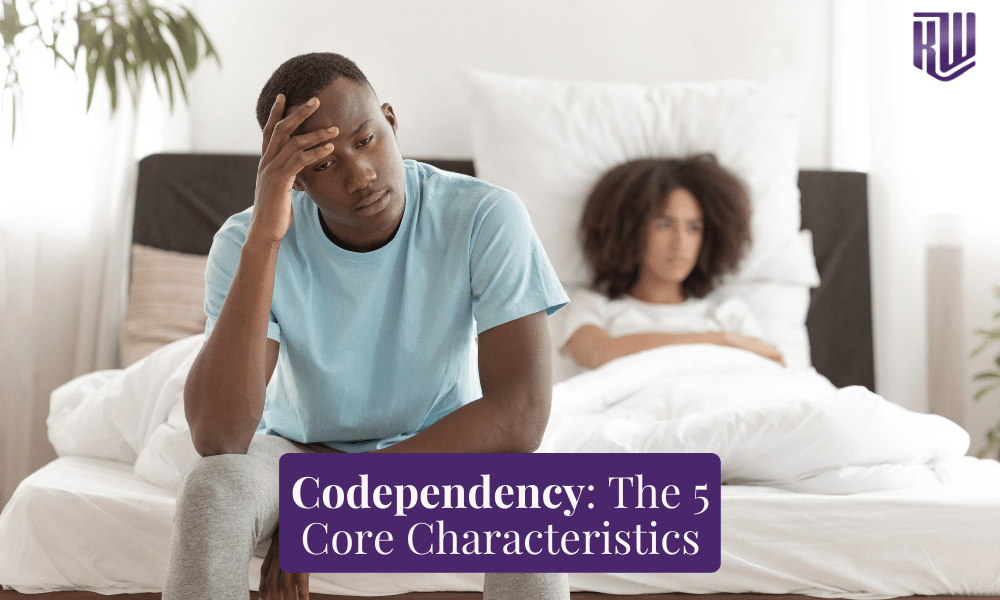
Codependency is a learned emotional survival strategy shaped by childhood trauma that causes adults to abandon their own needs, over-function in relationships, and compulsively seek external validation and control. It’s not a personal weakness — it’s your nervous system’s brilliant adaptation to an unsafe childhood. The five core traits of codependency are over-responsibility, difficulty with boundaries, over-functioning, shame-based identity, and emotional caretaking. There are two primary codependent operating systems: falsely empowered (controllers who dominate to feel safe) and disempowered (people-pleasers who collapse to avoid conflict). Understanding which type you are is the first step toward breaking the cycle and reclaiming emotional authenticity.
Table of Contents
- What Is Codependency (Really)?
- The Five Traits Of Codependency
- The Two Types Of Codependents
- The Worst Day Cycle™: How Trauma Creates Codependency
- The Three Survival Persona Types
- Codependency Across Life Domains
- The Emotional Authenticity Method™: Your Path Out
- The Authentic Self Cycle™: Reclaiming Your Worth
- Frequently Asked Questions
- The Bottom Line
What Is Codependency (Really)?
Codependency isn’t about loving someone too much. It’s not a character flaw. That’s you trying to make sense of behavior that actually comes from your nervous system’s survival strategy.
Codependency is an emotional and relational pattern where you’ve learned to prioritize other people’s emotional safety, happiness, and needs over your own. You’ve trained yourself to read others’ emotions like a smoke detector reads smoke — hyperaware, hyperresponsive, hyperresponsible. Your childhood taught you that your needs were dangerous, burdensome, or irrelevant. So you learned to shrink yourself, anticipate others’ needs, and over-function to earn your place at the table.
The core belief underneath codependency: “I am only worthy if I’m useful to others.”
This belief wasn’t your idea. It was installed through years of implicit messaging: your parent’s emotional fragility, their addiction, their rage, their sadness. You learned that your job was to manage their emotional state. If they were happy, you were safe. If they were upset, you caused it. If they were hurting, you could fix it — or should try.
By adulthood, this survival strategy is wired into your nervous system as deeply as your heartbeat. That’s not weakness — that’s neurobiology.
The Five Traits Of Codependency
Codependency expresses itself through five consistent, identifiable traits. These traits appear across all codependents — whether they’re falsely empowered controllers or disempowered people-pleasers. Understanding these traits helps you see the pattern clearly and recognize when you’re operating from your survival persona rather than your authentic self.
Trait #1: Extreme Over-Responsibility
You feel responsible for other people’s emotions, choices, failures, and happiness. If your partner is upset, you caused it. If your friend is struggling, you should fix it. If your parent is lonely, you owe them constant connection. That’s you accepting emotional responsibility that was never yours to carry.
Over-responsibility means you blame yourself for things completely outside your control. Your partner drinks too much, and you think, “I should have been more supportive.” Your boss is stressed, and you work late unpaid trying to ease the pressure. Your parent yells at you, and you apologize for triggering them.
The codependent brain calculates: “If I’m responsible, I have control. If I have control, I’m safe.” But you don’t have control, and you never did.
Trait #2: Weak, Shifting Boundaries
Boundaries are the edge between your emotional responsibility and someone else’s. Codependents struggle to maintain boundaries because boundaries feel like abandonment or rejection. That’s you confusing healthy separation with cruelty.
You say “yes” when you mean “no.” You share information you regret sharing. You allow disrespect, broken promises, and emotional unavailability because you’re afraid setting a boundary will cause abandonment. You apologize for having needs. You shrink your expectations and pretend you don’t mind being treated poorly.
Weak boundaries aren’t a personal failing — they’re the predictable outcome of a childhood where your needs were either punished, ignored, or used against you.
Trait #3: Compulsive Over-Functioning
You do more than your fair share. You manage the relationship, the household, the emotional labor, the planning, the problem-solving. You take on responsibilities that belong to other adults because you believe that if you don’t do it, it won’t get done. Or worse — something terrible will happen.
That’s you running an invisible economy where love is earned through exhaustion.
Over-functioning means you stay in high-alert mode constantly. Your nervous system never downregulates because there’s always something to manage, fix, anticipate, or prevent. This is not generosity — this is survival mode masquerading as care.
Trait #4: Shame-Based Identity
Shame is the message embedded in your core identity: “I am the problem.” Not “I made a mistake” — “I am broken, flawed, unworthy, too much, not enough.” This shame doesn’t come from something you did. It comes from the way your caregivers made you feel about who you are.
Shame lives underneath codependency like a foundation. It’s why you over-function — trying to prove your worth. It’s why your boundaries are weak — you don’t feel entitled to protection. It’s why you over-apologize, over-explain, and over-accommodate. You’re trying to earn back the worthiness that was never actually taken from you.
The codependent brain thinks: “If I’m good enough, smart enough, helpful enough, they’ll finally see my value.” But your value was never in question. It was only your caregivers’ emotional capacity that was limited.
Trait #5: Emotional Caretaking (The Hidden Burden)
You’re the emotional manager in relationships. You read the room, sense others’ moods, and adjust your own behavior to manage their emotional state. You’re responsible for keeping the peace, soothing the upset, and preventing the explosion. That’s you playing therapist in relationships where you should be a peer.
Emotional caretaking is particularly insidious because it’s invisible. Nobody sees the exhaustion of constantly monitoring someone else’s emotional weather. But you feel it — the vigilance, the tension, the impossible burden of managing someone else’s internal world.
This trait shows up most severely with emotionally unavailable, addicted, or narcissistic partners — and with parents who never emotionally nurtured you in the first place.
The Two Types Of Codependents (Plus One Oscillator)
Not all codependents look the same. In fact, codependency expresses itself through two fundamentally different behavioral types — and a third type that oscillates between both. Understanding which type you are illuminates why your relationships pattern the way they do and what nervous system state dominates your survival strategy.
Type 1: The Falsely Empowered Codependent
Falsely empowered codependents manage anxiety through control, dominance, and assertion of their will. They’re often the “strong ones” in relationships — the providers, the decision-makers, the ones who “hold it together.” That’s you confusing control with safety.
What they look like:
- Controlling partners who need things done their way
- Parents who micromanage their children into adulthood
- Workaholics who over-function through achievement
- People who rage when their partner’s choices feel unsafe or unpredictable
- Those who criticize, correct, and advise constantly
- Partners who manage finances, social calendars, and major decisions unilaterally
The falsely empowered codependent’s core belief is: “If I’m in control, I can prevent pain.” Their childhood taught them that the world was chaotic or dangerous, so they learned to organize it. They learned to anticipate problems and prevent them through vigilance and control. They’re not trying to be controlling — they’re trying to be safe.
Sound familiar? You believe that if you just manage enough variables, predict enough problems, and stay focused enough, you can prevent loss, abandonment, or catastrophe. But you can’t. And the attempt to control exhausts everyone around you.
Type 2: The Disempowered Codependent
Disempowered codependents manage anxiety through collapse, accommodation, and the abandonment of their own needs. They’re often the “supportive ones” — the listeners, the servers, the ones who think everyone else’s needs matter more than their own. That’s you confusing self-abandonment with love.
What they look like:
- Partners who absorb their partner’s mood and emotional state
- People-pleasers who can’t say “no” without tremendous guilt
- Those who collapse when faced with conflict or emotional intensity
- Partners who lose themselves entirely in relationships
- Employees who volunteer for extra work and never ask for raises
- Friends who are always available but rarely ask for support
The disempowered codependent’s core belief is: “If I make myself small, I’ll be safe from harm.” Their childhood taught them that their needs were dangerous or unwelcome, so they learned to disappear. They learned that conflict came when they asked for things, so they stopped asking. They learned that other people’s happiness was the price of their survival, so they paid it constantly.
Sound like you? You believe that if you just accommodate enough, sacrifice enough, and ask for nothing, you’ll prevent abandonment. But you don’t prevent it — you guarantee it, because nobody can truly know or love a person who isn’t there.
Type 3: The Adapted Wounded Child (The Oscillator)
Some codependents oscillate between falsely empowered and disempowered modes depending on the relationship, the stakes, or the nervous system state. This is the “adapted wounded child” — the person who learned to read which survival mode would work best in each moment. That’s you shape-shifting to survive.
You might be disempowered with your partner (collapsing, accommodating) but falsely empowered with your children (controlling, managing). You might be disempowered at work (over-functioning without asking for recognition) but falsely empowered in your friendships (giving advice, managing others’ lives). This flexibility is actually a trauma response — evidence of your nervous system’s adaptive capacity.
The adapted wounded child oscillates because they’re reading environmental threat constantly. “Which mode will keep me safe right now? Which version of myself survives this particular relationship?”
The Worst Day Cycle™: How Trauma Creates Codependency
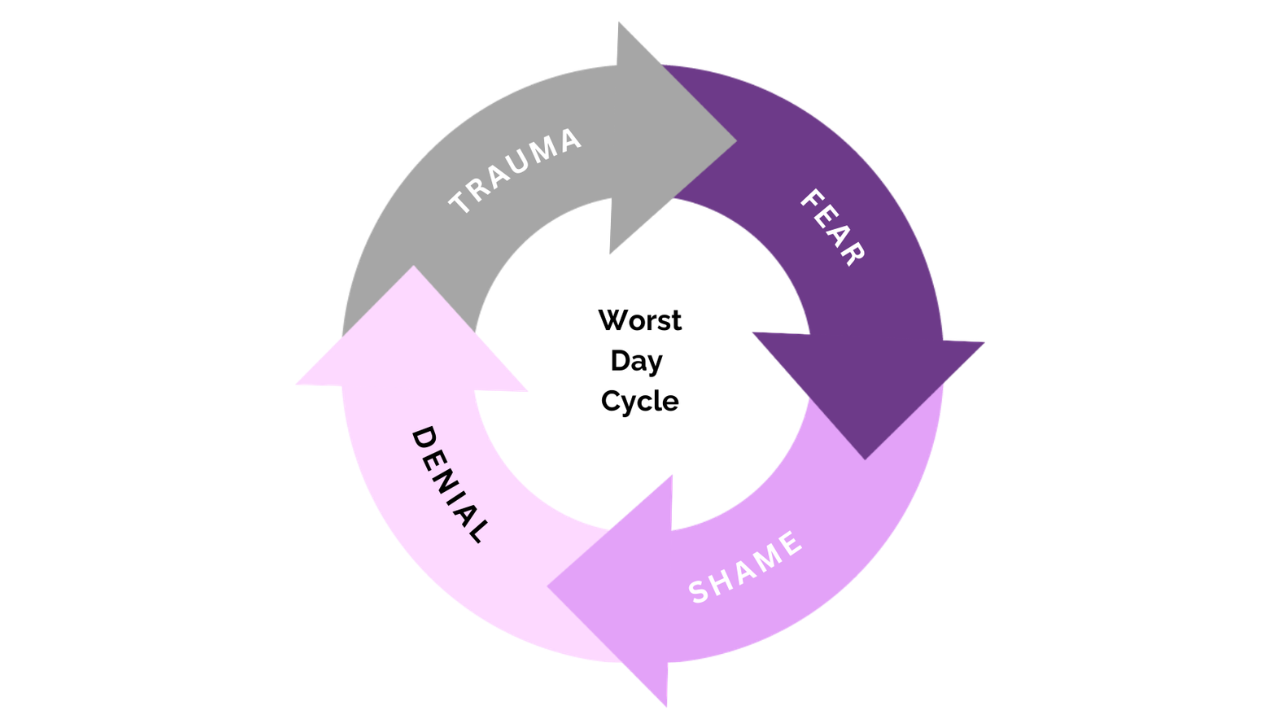
Codependency doesn’t exist in a vacuum. It’s the visible expression of a much deeper emotional system called the Worst Day Cycle™ — a four-stage loop where childhood trauma rewires your nervous system to repeat familiar painful patterns in relationships, work, hobbies, health, and every other domain of life.
Understanding the Four Stages of the Worst Day Cycle™
Stage 1: Childhood Trauma (The Installation)
Childhood trauma is any negative emotional experience that created painful meanings about yourself, others, or the world. It doesn’t have to be “big” — a parent’s addiction, their emotional unavailability, their rage, their depression, their inconsistency — all of these create trauma.
When trauma occurs, your hypothalamus generates a chemical cocktail: cortisol (the stress hormone), adrenaline (the fight/flight molecule), dopamine (the reward chemical), and oxytocin (the bonding hormone, misfired). Your brain becomes addicted to this emotional state because it’s the only one it knows. Your nervous system learned to live in this chemistry.
Stage 2: Fear (The Repetition Driver)
Fear keeps the cycle alive. Your brain learned that repetition equals safety — a known pattern, however painful, is safer than an unknown one. That’s why you keep choosing emotionally unavailable partners. That’s why you keep accepting disrespect. That’s why conflict triggers the same childhood panic.
Your brain cannot tell right from wrong. It can only tell known from unknown. Since 70% or more of your childhood messaging was negative and shaming, adults unconsciously recreate these painful patterns. You’re not masochistic — you’re pattern-loyal. Your nervous system is seeking homeostasis in familiar pain.
Stage 3: Shame (The Worth Erasure)
Shame is where you lost your inherent worth. Not “I made a mistake” — “I am the mistake.” Shame is the message that something is fundamentally wrong with you. And shame is the foundation of codependency. Because if you’re broken, you have to work harder to earn your place. You have to over-function. You have to manage others’ emotions. You have to abandon yourself.
Shame says: “This is who you are — inadequate, unworthy, unlovable.” Codependency is your nervous system’s response to shame.
Stage 4: Denial (The Survival Persona)
Denial is the fourth stage — the creation of your survival persona. Your falsely empowered self that controls everything. Your disempowered self that accommodates everything. These weren’t chosen — they were brilliant adaptations to an unsafe emotional environment.
Your survival persona kept you alive. In childhood, it was genius. But in adulthood, it’s sabotaging everything. Your controlling nature drives partners away. Your people-pleasing guarantees that your needs never get met. Your over-functioning means you never develop real reciprocal relationships. Your shame means you accept treatment that wounds your soul.
The survival persona created to survive your childhood is now the primary obstacle to the adult life you want.
Why Your Brain Repeats These Patterns
Your brain conserves energy by repeating known patterns. Neuroplasticity (your brain’s ability to rewire itself) is real, but it requires deliberate, uncomfortable practice. Without intervention, your brain will choose the familiar pathway every single time.
That’s why willpower alone doesn’t work. That’s why you know better but do it anyway. That’s why you’ve tried to change and ended up in the same relationship pattern three times over. You’re fighting neurobiology with intention. You’ll lose that fight every time.
You need a system to rewire the emotional blueprint itself — not just change your thinking.
The Three Survival Persona Types (Your Adaptive Selves)
Your survival persona is the version of yourself that learned to survive an unsafe childhood. It’s not your authentic self — it’s your protective self. Understanding your survival persona helps you see that the parts of you that are “broken” are actually the parts that kept you alive.
Survival Persona #1: Falsely Empowered (The Controller)
The falsely empowered survival persona learned to manage anxiety through dominance, control, and assertion. That’s you believing that if you can just organize enough variables, you can prevent pain.
Core operating principles:
- If I’m in control, I’m safe
- If I predict the problem, I can prevent it
- Others’ incompetence is a threat I must manage
- Vulnerability is dangerous; strength is survival
- My way is the right way; other ways lead to disaster
This persona shows up as the controlling partner, the micromanaging parent, the workaholic, the critical friend. That’s you trying to solve the unsolvable problem of making other people safe and predictable.
Survival Persona #2: Disempowered (The Accommodator)
The disempowered survival persona learned to manage anxiety through accommodation, collapse, and the abandonment of self. That’s you believing that if you make yourself small enough, you won’t get hurt.
Core operating principles:
- If I make myself small, I’m safe from harm
- My needs are dangerous or unwelcome
- Other people’s happiness is my responsibility
- Conflict is unbearable; accommodation is survival
- I don’t deserve to ask for what I need
This persona shows up as the people-pleaser, the enabler, the one who’s always available, the one who never asks for anything. That’s you guaranteeing the abandonment you’re terrified of because nobody can love a person who isn’t present.
Survival Persona #3: Adapted Wounded Child (The Shape-Shifter)
The adapted wounded child oscillates between falsely empowered and disempowered modes depending on the relationship, the stakes, and the perceived threat level. That’s you reading environmental danger constantly and shape-shifting to survive it.
You might be disempowered with your emotionally volatile parent (accommodating their moods) but falsely empowered with your children (controlling their behavior). You might be disempowered with your partner (collapsing, people-pleasing) but falsely empowered at work (micromanaging, controlling). Your flexibility is a testament to your nervous system’s adaptive brilliance — and a sign that your survival depends on reading and responding to threat.
The adapted wounded child is the most exhausting survival persona because you’re constantly code-switching. You’re reading threat. You’re adjusting. You’re managing. You never get to just be yourself.
Codependency Across Life Domains: Where It Shows Up
Codependency doesn’t exist only in romantic relationships. It’s a systemic pattern that shows up across every domain of your life. Understanding where codependency is active helps you see the full scope of what you’re up against.
Codependency in Family Relationships
Family codependency looks like:
- Assuming responsibility for a parent’s emotional state or recovery
- Enabling a sibling’s addiction or poor choices
- Managing conflict between family members
- Staying in contact with family members who hurt you because you feel responsible for their feelings
- Micromanaging adult children’s lives (falsely empowered codependency)
- Over-accommodating family demands and never setting boundaries
That’s you still trying to fix the family system that broke you. You’re still trying to make your emotionally unavailable parent feel loved. You’re still trying to prevent your sibling’s self-destruction. You’re still managing the family emotional temperature. And it’s costing you everything.
Codependency in Romantic Relationships
Romantic codependency looks like:
- Choosing emotionally unavailable, addicted, or narcissistic partners (matching your childhood)
- Over-functioning in the relationship while your partner under-functions
- Managing your partner’s emotions, moods, and reactions
- Losing yourself entirely in the relationship
- Controlling your partner’s behavior (falsely empowered) or accepting disrespect (disempowered)
- Staying in relationships long after they stop serving you because you feel responsible for your partner’s wellbeing
Sound familiar? You chose a partner who reminds you of your emotionally unavailable parent. You’re trying to get from them what you never got from your childhood — unconditional love, emotional attunement, consistent presence. But they can’t give it because they’re unavailable, just like your parent was. So you over-function, over-accommodate, and over-give. And they under-function, under-contribute, and under-appreciate. This is the codependent dance, and it ends in heartbreak — unless you break the pattern.
Codependency in Friendships
Friendship codependency looks like:
- Being the friend who’s always available but never asks for support
- Taking on others’ problems as your own responsibility
- Giving advice constantly (falsely empowered)
- Losing friendships because you accommodated too much and never shared your real needs
- Choosing friendships with people who are needy or struggling because caregiving feels like love
- Feeling responsible for your friend’s happiness
That’s you mistaking one-directional caretaking for friendship. True friendship has reciprocity, mutuality, and balanced emotional labor. Codependent friendships are exhausting because you’re carrying all the weight.
Codependency at Work
Work codependency looks like:
- Over-functioning without asking for raises or recognition
- Taking on responsibilities that belong to managers or colleagues
- Managing your boss’s mood or emotional state
- Unable to set boundaries around work hours or workload
- Micromanaging colleagues (falsely empowered) or taking blame for team failures (disempowered)
- Staying in jobs that exploit you because you feel responsible for the company’s success
Work codependency often masquerades as “dedication” or “strong work ethic.” But it’s really you proving your worth through exhaustion, just like you learned in childhood.
Codependency in Health and Body
Health and body codependency looks like:
- Ignoring your own health needs while managing others’ health
- Prioritizing others’ comfort over your own physical wellbeing
- Using food, substances, or behaviors to manage emotional pain instead of processing it
- Chronic stress-related illness from over-functioning
- Unable to rest because you feel responsible for maintaining family equilibrium
- Abandoning self-care practices because they feel “selfish”
That’s your nervous system paying the price for decades of emotional over-responsibility. Your body holds the trauma. Your body holds the shame. Your body holds the fear. And your body will keep breaking down until you address the emotional blueprint underneath.
The Emotional Authenticity Method™: Your Path Out Of Codependency
You cannot change emotional patterns through thoughts alone. Emotions are biochemical events. Your feelings originate in your body and nervous system — your amygdala, your hippocampus, your vagus nerve. Thoughts originate from feelings, not the other way around. This is why positive affirmations fail and willpower doesn’t work.
The Emotional Authenticity Method™ is a five-step system designed to rewire your emotional blueprint at the source — in your body and nervous system. It moves you from survival mode to authentic presence.
Step 1: Somatic Down-Regulation (With Optional Titration)
Before you can access truth, you must calm your nervous system. Somatic down-regulation means bringing your nervous system out of fight/flight/freeze and into a state where thinking and feeling are possible.
This might include:
- Box breathing (4 counts in, 4 counts hold, 4 counts out)
- Progressive muscle relaxation (tensing and releasing muscle groups)
- Cold water immersion (30 seconds on your face)
- Grounding techniques (5-4-3-2-1 sensory awareness)
- Movement (walking, shaking, dancing)
Titration is the practice of slowly bringing awareness to the edge of discomfort without triggering full activation. You’re teaching your nervous system that you can touch the wound without being overwhelmed by it.
Step 2: What Am I Feeling? (Emotional Granularity)
Most people operate with a vocabulary of three emotions: fine, stressed, and angry. This is emotional poverty. You cannot change what you cannot name.
Emotional granularity means developing precision in how you experience and name your internal emotional world. Instead of “I feel bad,” you feel disappointed, unheard, unsafe, betrayed, misunderstood. That’s you getting honest with yourself about what’s really happening inside.
The Feelings Wheel is the tool I recommend. It maps 160+ emotions arranged by intensity and parent emotion. Using the Feelings Wheel, you can move from vague emotional awareness to precise naming. And naming your emotion is the first step toward changing it.
Step 3: Where In My Body Do I Feel It?
All emotional trauma is stored physically. The betrayal lives in your chest. The shame lives in your throat. The abandonment lives in your belly. The powerlessness lives in your legs. Your body is the archive of your emotional history.
In this step, you locate the physical sensation of the emotion. You might feel tightness, heaviness, heat, cold, numbness, vibration. You stay with that sensation without trying to change it. You develop what Bessel van der Kolk calls “somatic awareness” — the ability to feel your body as it actually is, not as your survival strategy tells you it should be.
This is where the actual rewiring happens. Not in your thoughts. In your body. In your nervous system’s lived experience.
Step 4: What Is My Earliest Memory Of This Feeling?
Your current triggers are rarely about today. Your partner isn’t your parent, but your nervous system thinks they are. Your boss isn’t your critical parent, but your body remembers the voice. Your friend’s distance isn’t abandonment, but your childhood learned it as such.
In this step, you trace the current feeling back to its origin. You ask yourself: “When was the first time I felt this exact sensation in my body?” You’re not looking for a story. You’re looking for a memory, an image, a moment. A flashback. A knowing.
Once you locate the origin, the current trigger loses its charge. Because now you can tell yourself the truth: “This isn’t about today. This is about 1992. This is about my parent’s addiction. This is about my childhood. And I’m not a child anymore.”
Step 5: Who Would I Be If I Never Had This Feeling Again? (The Vision Step)
This is where you access the Authentic Self Cycle™. You imagine yourself liberated from this particular emotional wound. How would you move through the world differently? What would be possible? What would you do, say, choose, risk?
That’s you beginning to imagine an identity not built on fear, shame, and denial. That’s you accessing the version of yourself that’s been buried under your survival persona for decades.
This vision becomes your North Star. It’s the direction your nervous system rewires toward. Every time you practice this method, you strengthen the neural pathways that lead to your authentic self instead of your survival persona.
The Authentic Self Cycle™: Reclaiming Your Inherent Worth
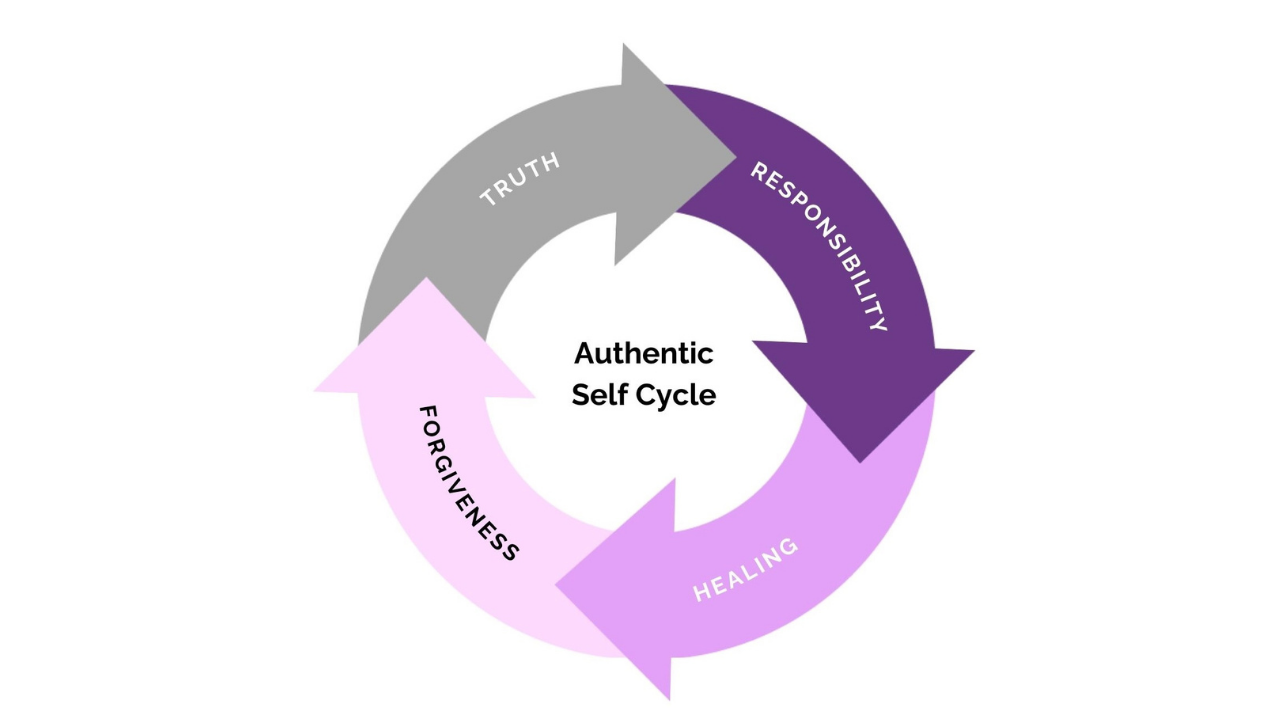
The Worst Day Cycle™ creates codependency. The Authentic Self Cycle™ unravels it. This is the healing counterpart — the identity restoration system that moves you from survival mode to authentic presence, from shame to inherent worth.
The Authentic Self Cycle™ has four stages: Truth, Responsibility, Healing, and Forgiveness.
Stage 1: Truth (Naming the Blueprint)
Truth is the first step toward freedom. You name what’s actually happened. You name your parents’ limitations, your childhood wounds, the shame that was installed. You stop minimizing. You stop making excuses. You name it clearly.
The truth sounds like: “My parent was emotionally unavailable. My childhood wasn’t safe. I learned to abandon myself to survive. I was a child — this wasn’t my fault. But now I’m an adult — it’s my responsibility.”
Truth is not blame. Truth is clarity. And clarity is the foundation of change.
Stage 2: Responsibility (Owning Your Reactions Without Shame)
Responsibility means recognizing that while your patterns weren’t your choice, how you move forward is. Your partner isn’t your parent, but your nervous system thinks they are — and that’s your responsibility to rewire. Your boss isn’t your critical parent, but your body responds as if they are — and that’s your work to do.
Responsibility doesn’t mean shame. It means agency. It means you’re not a victim of your nervous system forever. You can change it. It will be uncomfortable. It will take time. But you can do it.
This is where you stop waiting for your parents to change so you can finally be okay. This is where you stop expecting your partner to be different so you can finally relax. This is where you own your emotional state as your own creation — not inherited, not permanent, not unchangeable.
Stage 3: Healing (Rewiring Your Emotional Blueprint)
Healing is where you practice the Emotional Authenticity Method™ repeatedly, consistently, until your nervous system learns a new pattern. You teach your nervous system that conflict isn’t dangerous. Space isn’t abandonment. Intensity isn’t attack. Vulnerability isn’t weakness.
Healing rewires the emotional chemistry. Instead of the trauma cocktail (cortisol + adrenaline + misfired oxytocin), you generate new chemistry: serotonin (calm), oxytocin (genuine bonding), GABA (peace). Your nervous system learns to downregulate in relationships. Your body learns to be present instead of in constant defensive mode.
Healing takes time because you’re literally rewiring your brain. Every time you stay calm during conflict instead of raging or collapsing, you’re building a new neural pathway. Every time you set a boundary without shame, you’re challenging the old belief that your needs are dangerous. Every time you choose authentic expression over survival mode, you’re strengthening the nervous system patterns of your authentic self.
Stage 4: Forgiveness (Releasing the Inherited Emotional Blueprint)
Forgiveness is not about excusing what happened. Forgiveness is about releasing the emotional charge of the past so you can move forward unburdened. It’s about understanding that your parents did the best they could with the emotional resources they had. And it’s about choosing not to carry their limitations as your identity anymore.
Forgiveness is the final reclamation of your inherent worth. It says: “I am not defined by what was done to me. I am not responsible for my parents’ emotional limitations. I am not broken because of my childhood. I am healing. And I am worthy exactly as I am.”
This is where you truly leave codependency behind. Not because your family changes. Not because you finally fix your parents. But because you release the need for them to be different in order for you to be okay.
Frequently Asked Questions About Codependency
What is the difference between codependency and healthy interdependence?
Codependency is one-directional. You give without receiving. You accommodate without asking. You over-function while your partner under-functions. You manage their emotions. You’ve abandoned your own needs to care for theirs.
Healthy interdependence is reciprocal. Both people contribute. Both people ask for what they need. Both people take responsibility for their own emotions. You support each other, but you don’t complete each other. You enhance each other’s life, but you don’t create each other’s sense of worth.
In codependency, you lose yourself. In healthy interdependence, you find more of yourself because your partner sees you clearly.
Can codependent people have healthy relationships?
Yes, but not without working on themselves first. Codependency is a pattern that will repeat in every relationship until the underlying emotional blueprint is rewired. You’ll choose the same type of partner. You’ll create the same dynamic. You’ll re-enact the same wound.
The good news is that the Emotional Authenticity Method™ and the Authentic Self Cycle™ work. You can rewire your nervous system. You can build the capacity for genuine intimacy. You can have relationships where you’re not abandoning yourself. It takes commitment and practice, but it’s absolutely possible.
Is codependency a mental illness or a trauma response?
Codependency is a trauma response. It’s your nervous system’s adaptation to an unsafe emotional environment. It’s not a mental illness — it’s a symptom of unhealed childhood trauma. This is actually good news, because trauma can be healed. Your nervous system can be rewired. Your emotional blueprint can be rewritten.
The DSM-5 doesn’t list codependency as a diagnosis, but most therapists recognize it as a pattern that emerges from childhood trauma and insecure attachment.
Why do codependents keep choosing the same type of partner?
Because your partner matches your childhood emotional template. Your brain recognizes the familiar abandonment, the familiar unavailability, the familiar chaos — and it mistakes that recognition for love. You’re not attracted to them because they’re healthy. You’re attracted to them because they feel like home. And home was never emotionally safe.
Until you heal your emotional blueprint, you’ll keep choosing partners who trigger your old wounds. Because part of you believes that if you finally get it right with this person, you’ll retroactively heal your childhood.
You won’t. Only healing yourself will do that.
Can someone with codependency recover without therapy?
Self-awareness + consistent practice + a solid framework can create significant change. But most people benefit from professional support — especially if their childhood was significantly traumatic or if they’re in a relationship with someone who is actively harmful (addict, narcissist, abuser).
Therapy provides external accountability, professional guidance, and a corrective emotional relationship where you experience being truly seen and valued. That corrective relationship begins rewiring your nervous system in ways self-help alone might not.
You don’t have to choose between therapy and self-directed work. The best healing usually includes both.
Is codependency hereditary?
Not genetically, but generationally. Your parent’s emotional patterns became your emotional template. If they were codependent — over-functioning, managing others’ emotions, abandoning their own needs — you learned that as normal. You replicated it.
The good news? This pattern ends with you. When you heal your emotional blueprint, you stop passing the wound to the next generation. Your children will learn from your emotional authenticity, not your survival persona.
The Bottom Line: Your Codependency Is Not A Life Sentence
Codependency is real. It’s painful. It’s exhausting. It’s devastating to your relationships, your career, your health, your sense of self. And it can be healed.
You learned codependency in relationship. You will unlearn it in relationship — first with yourself, then with safe others. When you practice the Emotional Authenticity Method™ consistently, when you move through the Authentic Self Cycle™ with intention, when you rewire your nervous system’s response to fear and shame, something miraculous happens.
You stop choosing partners who abandon you. You stop over-functioning in relationships. You stop managing others’ emotions. You stop apologizing for having needs. You stop making yourself small to earn love. You become present. You become real. You become authentically you.
Your survival persona protected you. Thank it. Acknowledge its brilliance. And then choose something different.
Choose your authentic self. Choose emotional authenticity. Choose the belief that you are worthy exactly as you are — not because of what you do, but because of who you are. That worthiness was never lost. It was only buried under layers of shame and survival strategy.
It’s time to excavate it.
Recommended Reading
- Pia Mellody — Facing Codependence (the definitive clinical text on how childhood trauma creates the five core codependency symptoms)
- Melody Beattie — Codependent No More (the foundational text on codependency)
- Gabor Maté — When the Body Says No (trauma’s impact on nervous system and body)
- Bessel van der Kolk — The Body Keeps the Score (somatic trauma healing)
- Brené Brown — Dare to Lead (vulnerability and authentic leadership)
- Harriet Lerner — Why Won’t You Apologize? (how codependents weaponize apologies)
- Thich Nhat Hanh — The Miracle of Mindfulness (somatic awareness and presence)
- Peter Levine — Waking the Tiger (trauma resolution and nervous system healing)
Next Steps: Your Recovery Path
Understanding codependency is the first step. Acting on that understanding is where transformation happens. Here are your options:
Self-Guided Recovery
Start with the Feelings Wheel — the foundational tool of the Emotional Authenticity Method™. Spend 5 minutes daily with this exercise. Track your emotional patterns. Learn emotional granularity. This single practice begins rewiring your nervous system.
Investment: Free
Self-Paced Learning (Individual)
Emotional Blueprint Starter Course — Individual ($79) — A self-paced course that guides you through your emotional blueprint, shows you where codependency shows up in your life, and teaches you the Emotional Authenticity Method™ step by step. Perfect for independent learners ready to do the work alone.
Investment: $79 (one-time)
Self-Paced Learning (Couples)
Relationship Starter Course — Couples ($79) — If you’re in a relationship and want to heal codependency patterns together, this course teaches both of you how to break the dynamic. It’s about building genuine intimacy instead of codependent enmeshment.
Investment: $79 (one-time)
Deep Dives (All Survival Personas)
If you want to understand exactly why you keep sabotaging your relationships, explore these courses tailored to your survival persona type:
- Why We Can’t Stop Hurting Each Other ($479) — For codependents who keep choosing the same type of partner and recreating the same dynamic
- Why High Achievers Fail at Love ($479) — For falsely empowered codependents (controllers) who struggle to be vulnerable or ask for help
- The Shutdown Avoidant Partner ($479) — For disempowered codependents who collapse in relationships and struggle with emotional expression
The Gold Standard: Master Training
Tier 1: Mapping the Blueprint ($1,379) — The most comprehensive training in the Emotional Authenticity Method™. This is for those ready to fundamentally rewire their nervous system and reclaim their authentic self. Includes the 5-step EAM protocol, the Worst Day Cycle™ map, the Authentic Self Cycle™ system, and the practical tools to implement them daily.
Investment: $1,379 (one-time)
The question isn’t whether you can afford to invest in your healing. It’s whether you can afford not to. Every day you stay in codependency costs you peace, authenticity, and the possibility of genuine love. Every day you wait, your nervous system gets more entrenched in survival mode.
Your healing is not selfish. It’s essential. Start today.
Related Articles
- The Signs of Enmeshment: When Codependency Becomes Fusion
- Insecurity in Relationships: 7 Signs Your Codependency Is Sabotaging Your Love
- Signs of High Self-Esteem: What Emotional Authenticity Actually Looks Like
- Negotiables vs. Non-Negotiables: Building Boundaries in Codependence Recovery
- 10 Dos and Don’ts for a Great Relationship (That Actually Work)