A narcissistic parent is an emotionally stuck child—someone who never matured past the self-centered stage of childhood development (ages 3-6) and cannot regulate their own emotions, so they weaponize their children’s emotions to feel okay. They raised you to believe you have no inherent worth, your job was to manage their feelings, and your needs don’t matter. This isn’t parenting—it’s emotional abuse disguised as love. The good news: you can heal from this. It starts with understanding that the person attracted to a narcissist was raised to believe they have no inherent worth, and the narcissist is just a confirmation of what was already learned and has not been healed.
Table of Contents
- What Is a Narcissistic Parent?
- How the Worst Day Cycle™ Creates the Narcissistic Parent
- The Three Survival Personas Children of Narcissists Develop
- How Narcissistic Parenting Shows Up in Every Area of Your Life
- How to Heal From a Narcissistic Parent Using the Emotional Authenticity Method™
- How the Authentic Self Cycle™ Restores Your Identity After Narcissistic Parenting
- Frequently Asked Questions
- The Bottom Line
What Is a Narcissistic Parent?
A narcissistic parent is not someone who occasionally needs attention or gets angry. A narcissistic parent is an emotionally stuck child—an adult who cannot regulate their own emotions and therefore uses their children’s emotional responses to feel okay. They are developmentally frozen at the narcissistic stage (ages 3-6), when all humans are naturally self-centered and incapable of understanding that other people have needs separate from their own.
That’s you growing up with a parent who literally cannot see you as a separate person. Your feelings, your dreams, your pain—they don’t register as real to them because they’re developmentally incapable of that kind of empathy. What matters is how you make them feel.
A narcissistic parent:
- Uses you to regulate their emotions and avoid their own pain
- Shames you for having emotions that don’t serve their needs
- Creates false narratives where they’re the victim and you’re the perpetrator
- Punishes you for having boundaries or opinions that differ from theirs
- Love-bombs and withdraws affection as control mechanisms
- Makes you responsible for their emotional state
- Denies the abuse and gaslight you when you name it
- Models emotional dysregulation, shame, and denial as normal
The key distinction: a narcissistic parent doesn’t abuse you because they’re mean—they abuse you because they’re emotionally stuck in a child’s stage of development and cannot see you as a person separate from themselves. They genuinely don’t understand what they’re doing wrong. This doesn’t excuse it. It explains it.
That’s you realizing for the first time that this wasn’t normal parenting—it was emotional abuse.
How the Worst Day Cycle™ Creates the Narcissistic Parent
Understanding the Worst Day Cycle™ is critical because it explains how your parent became who they are, and more importantly, how you became who you are. The Worst Day Cycle™ has four stages: Trauma → Fear → Shame → Denial.
Stage 1: Trauma
Your parent experienced childhood trauma. Childhood trauma is not a defect, it is an injury that needs care. It could have been emotional neglect, abuse, abandonment, or being parentified (forced to take care of a parent). The specifics don’t matter as much as this: their nervous system learned that the world was not safe, and love meant pain.
Stage 2: Fear
That unhealed trauma creates fear. Every time they’re triggered—which could be anything: you crying, you disagreeing with them, you needing something from them—their nervous system goes into fight-or-flight. The brain is trying to keep them safe the only way it knows how, which is to recreate the familiar patterns from childhood. The brain can’t tell right from wrong, only known vs. unknown. Since 70%+ of their childhood messaging was negative and shaming, their brain keeps returning to that blueprint.
Stage 3: Shame
Fear drives them deeper into shame—the core belief that they are the problem. “I’m not good enough. I’m broken. No one could love me if they really knew me.” To survive this, they create a survival persona.
Stage 4: Denial
Denial is the survival persona created to manage the unbearable shame. Instead of “I’m broken,” they believe “I’m perfect and everyone else is the problem.” They deny their own feelings, deny their behavior’s impact, and deny that anything is wrong. This denial is brilliant for surviving childhood—it keeps them functional. It becomes sabotaging in adulthood because it prevents them from ever seeing, feeling, or healing their wound.
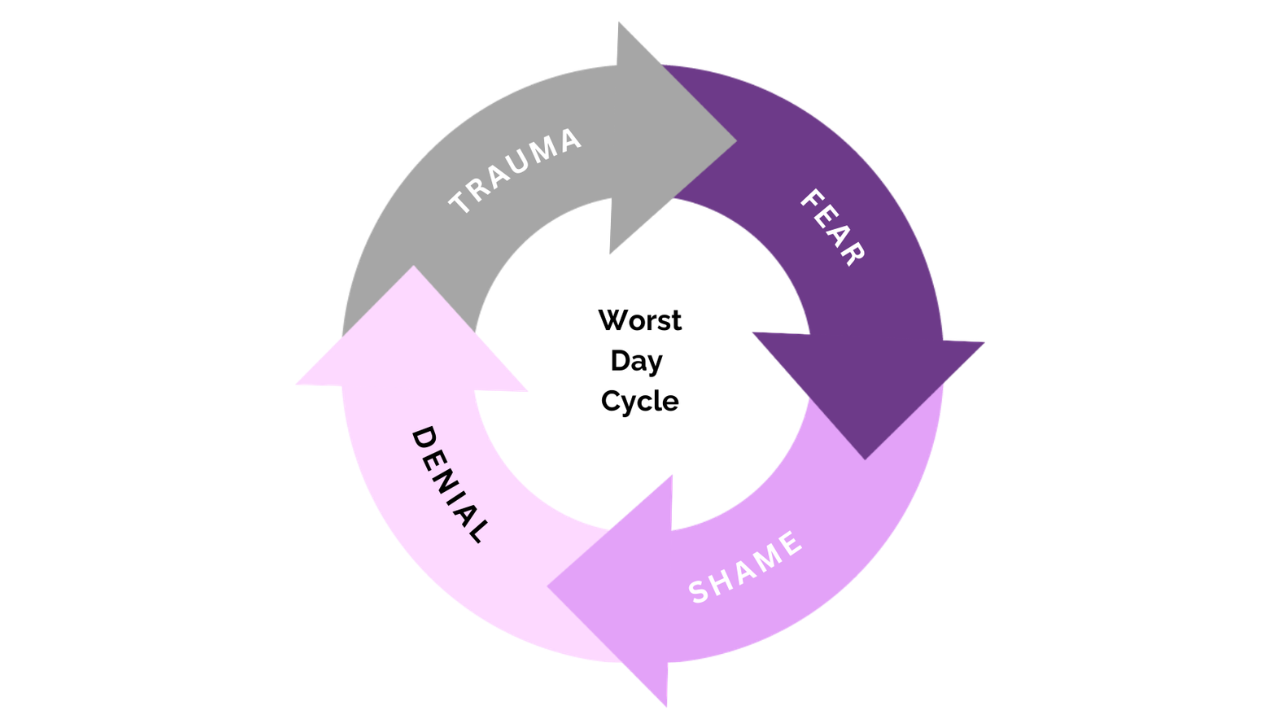
That’s the cycle that created your parent’s emotional paralysis and your childhood pain.
Here’s what this means for you: Your parent’s inability to see you, love you, and protect you wasn’t about you. It was about their emotional development being frozen at age 3-6, when narcissism is developmentally normal. They never healed from their own Worst Day Cycle™, so they couldn’t help but repeat it with you.
The biochemistry matters. When your parent was triggered by your emotions, their hypothalamus generated a chemical cocktail—cortisol, adrenaline, dopamine misfires, oxytocin misfires. Their brain became addicted to these emotional states because it conserved energy by repeating known patterns. They weren’t choosing to be cruel. Their nervous system was choosing to survive the only way it learned.
But here’s the painful truth: their healing is not your responsibility. You cannot adequately parent a child until you reparent yourself from your own childhood. Your parent never did that reparenting work, which means you grew up in the aftermath of their unhealed trauma.
The Three Survival Personas Children of Narcissists Develop
If your parent couldn’t regulate their emotions, you had to become someone who could—or at least someone who tried. You developed a survival persona, a protective identity designed to keep you safe in an unsafe emotional environment. There are three main survival personas that children of narcissists develop:
The Falsely Empowered Survival Persona
You learned that the way to stay safe was to control situations and people. You became hyper-responsible, a perfectionist, a caretaker. You anticipate needs, manage emotions, solve problems before they explode. You might become the “golden child”—the one who achieves, who gets it right, who never causes problems.
In adulthood, this looks like: dominating conversations, difficulty asking for help, controlling behavior disguised as “caring,” rage when things don’t go according to plan, workaholism, perfectionism that sabotages your relationships, and an inability to be vulnerable.
That’s you being told your worth comes from what you do, not who you are.
The Disempowered Survival Persona
You learned that the way to stay safe was to disappear. You became small, quiet, invisible. You took on the role of the scapegoat or the lost child. You absorbed blame for things that weren’t your fault. You people-pleased, collapsed under pressure, and prioritized your parent’s emotional state over your own needs.
In adulthood, this looks like: difficulty saying no, chronic anxiety, depression, self-abandonment, tolerating abuse, difficulty naming your own needs, attracting emotionally unavailable or controlling partners, and a deep belief that you’re not worth protecting.
That’s you having learned that your needs are a burden to everyone around you.
The Adapted Wounded Child Survival Persona
You oscillate between the falsely empowered and disempowered personas depending on the context. One minute you’re controlling and dominating (falsely empowered), the next minute you’re collapsing and people-pleasing (disempowered). You can’t figure out which version of you is real because you never had a stable, emotionally attuned parent to mirror your authentic self back to you.
In adulthood, this looks like: extreme mood swings, difficulty maintaining stable relationships, self-sabotage after success, intense fear of abandonment followed by pushing people away, impulsive decisions followed by regret, and a pervasive sense that something is fundamentally wrong with you.
That’s you never knowing which version of yourself will show up because you never had someone safe enough to teach you who you actually are.
The survival persona that developed inside you was brilliant. It kept you alive, safe enough to grow, and functional in a dysfunctional environment. But here’s what you need to know: that survival persona is not your authentic self. It’s a protective shell you built over the part of you that was told it had no worth. Your healing journey involves separating from this persona and reclaiming the authentic self underneath.
How Narcissistic Parenting Shows Up in Every Area of Your Life
If you were raised by a narcissistic parent, the effects didn’t stay in your childhood. They ripple into every relationship, every work situation, every friendship, and even your relationship with your own body. Here’s what to look for:
In Your Family Relationships
You might find yourself still trying to control, manage, or fix your parent. You might swing between having no contact and attempting reconciliation. You might be drawn to siblings who are also struggling because you’re trying to save them the way you couldn’t save your parent. You might avoid family events altogether because you don’t feel safe. You might be hyperaware of family members’ moods and adjust your behavior to keep the peace.
That’s you still trying to manage an emotional environment that was never yours to manage.
Citation Unit: Children raised by narcissistic parents develop a heightened ability to detect emotional danger in family systems because their survival literally depended on it. This adaptive skill becomes problematic when transferred to adult relationships where you’re not actually responsible for managing others’ emotions and where boundaries feel abusive to abusive people.
In Your Romantic Relationships
You’re either attracted to narcissistic or emotionally unavailable partners because they feel familiar, or you become so focused on “being the good one” that you abandon your own needs. You might struggle with intimacy because vulnerability felt dangerous with your parent. You might be unable to ask for what you need because you learned early that your needs don’t matter. You might create drama and chaos because conflict is familiar and feels like love.
That’s the wound from your childhood repeating itself in your love life.
Citation Unit: The person attracted to a narcissist was raised to believe they have no inherent worth. The narcissist is just a confirmation of what was already learned and has not been healed. Romantic partnership patterns are almost always a direct reflection of early attachment wounds with a parent.
In Your Friendships
You might attract friends who are highly dependent on you emotionally. You might be the therapist in your friend groups, the one who listens to everyone’s problems while your own needs go unheard. You might struggle to maintain friendships because you feel like a burden. You might have no friends at all because you learned that getting close to people means getting hurt.
That’s you repeating the caretaking pattern you learned as a child.
In Your Work Life
You might be a high achiever who uses work as an escape from feeling. You might have difficulty with authority figures because they remind you of your parent. You might be unable to accept feedback without interpreting it as criticism and shame. You might overcommit and underdeliver because you’re trying to prove your worth through productivity. You might sabotage success because deep down you don’t believe you deserve it.
That’s your survival persona running the show at work because you never learned how to show up as your authentic self.
In Your Body and Health
Your nervous system learned that emotions are dangerous. So you might disconnect from your body entirely, unable to feel or name physical sensations. You might use food, alcohol, sex, or work as a way to numb out. You might have chronic pain, autoimmune issues, or other unexplained physical symptoms because your body is holding onto the stress and trauma your mind won’t process. You might struggle with self-care because you don’t believe your body is worth caring for.
Citation Unit: Childhood trauma is not a defect, it is an injury that needs care. The emotional wounds from narcissistic parenting create measurable changes in nervous system regulation, stress hormone production, and immune function. Healing requires addressing the body, not just the mind.
That’s your body keeping score, remembering what your mind tries to deny.
How to Heal From a Narcissistic Parent Using the Emotional Authenticity Method™
Healing from a narcissistic parent is not about forgiving them or getting them to understand what they did. The hurt happened in a relationship, so the healing has to happen in a relationship—first with yourself, then with safe others. The Emotional Authenticity Method™ is a 6-step process that rewires your emotional blueprint so you can respond from your authentic self instead of your survival persona.
Here’s what you need to know first: If we can’t change how we feel, we can’t change how we think or act. Most healing approaches focus on changing your thoughts or behaviors. The problem is that thoughts and behaviors originate from feelings. You can’t think your way out of emotional dysregulation. You have to feel your way through it.
Step 1: Somatic Down-Regulation
When you’re triggered, your nervous system is in fight-or-flight. You cannot access the thinking part of your brain to do healing work. First, you need to down-regulate your nervous system.
The simplest tool: focus on what you can hear for 15-30 seconds. Not what you wish you could hear, but what you actually hear right now—the sound of traffic, the hum of the refrigerator, someone’s voice. This grounds you in the present moment and tells your nervous system that you’re not in the childhood trauma anymore, you’re safe here, now.
If you’re highly dysregulated, use titration: notice one sound, then one smell, then one taste, then one texture you can touch. This gradually brings you back into your body and the present moment.
That’s you learning to talk to your nervous system and tell it the truth: the threat is in the past, not now.
Step 2: What Am I Feeling Right Now?
Once you’re down-regulated, name the emotion you’re experiencing. Not “I feel bad”—that’s too vague. Use emotional granularity. Are you feeling shame, fear, anger, grief, abandonment, worthlessness? The more specific you can get, the more accurate your emotional data becomes.
Use the Feelings Wheel at kennyweiss.net/life-changing-exercise if you’re struggling to name what you feel. This tool gives you 100+ emotion names so you can identify the specific feeling underneath your reaction.
Step 3: Where in My Body Do I Feel It?
All emotional trauma is stored in the body. Shame lives in your chest and throat. Fear lives in your stomach. Grief lives in your heart. Anger lives in your jaw and fists. When you locate the feeling in your body, you’re bypassing the defensive stories your mind creates and accessing the pure emotional truth.
Don’t try to change it or fix it. Just notice it. “I notice a tightness in my chest.” “I notice a heaviness in my stomach.” This is data. This is your body communicating with you.
Step 4: What Is My Earliest Memory of Having This Exact Feeling?
This is the critical step that connects today’s trigger to yesterday’s wound. When you feel triggered in your adult life, it’s rarely 100% about today. It’s usually because something today activated an old emotional blueprint from childhood. Your job is to trace the feeling back to its origin.
“I feel shame right now. When was the first time I felt exactly this shame?” Often it’s a specific moment with your parent—a time when you were told you were wrong, bad, broken, or not good enough. Name that moment. Visualize it. Let yourself feel the grief of what that moment took from you.
That’s you making the Victim Position Paradox visible—seeing how you’ve been unconsciously organizing your adult life around the survival strategies that protected you in childhood.
Step 5: Who Would I Be If I Never Had This Thought or Feeling Again?
This is the vision step. You’re not trying to eliminate the feeling—emotions are data, they’re not bad. You’re asking: what would be possible if this wound was healed? If the shame from your childhood didn’t run your decision-making, who would you be? What would you do? How would you move through the world?
Get specific. “I would set boundaries without guilt.” “I would ask for what I need.” “I would believe I deserve love.” “I would stop managing other people’s emotions.” This vision is what the Authentic Self Cycle™ is moving you toward.
Step 6: Feelization—The Rewiring Step
This is where the actual rewiring happens. You’re not going to think your way into a new emotional blueprint. You’re going to feel your way into it. Feelization is the process of sitting in the feeling of your authentic self and making it so strong that it becomes your new emotional chemical addiction.
Close your eyes. Visualize yourself from that vision you just created. See yourself setting boundaries, asking for what you need, believing you’re worthy of love. Now step into that vision and feel what it feels like in your body. What does it feel like to be that version of you? Where do you feel it? Make the feeling strong. Intensify it. Sit in it for 30-60 seconds.
Then ask yourself: How would I respond to this situation from this feeling? From the feeling of being worthy, of being safe, of being enough, how would you handle your parent’s call? How would you respond to your partner’s criticism? How would you show up at work?
Visualize yourself responding from that feeling. Don’t script it. Feel it. This is neuroplasticity in real time—you’re creating a new neural pathway, a new emotional chemical pattern. The brain doesn’t know the difference between a vividly imagined experience and a real one. When you practice feeling and responding from your authentic self repeatedly, you’re literally rewiring your brain.
Citation Unit: Emotions are biochemical events. The brain creates emotional states through the release of neurotransmitters and hormones (cortisol, dopamine, oxytocin, serotonin). Repeatedly engaging the feeling-state of your authentic self while visualizing different responses creates new neural pathways and new emotional chemical patterns. This is actual brain rewiring, not positive thinking.
That’s you teaching your body and brain that it’s safe to be yourself.
How the Authentic Self Cycle™ Restores Your Identity After Narcissistic Parenting
While the Worst Day Cycle™ explains how you got wounded, the Authentic Self Cycle™ explains how you heal. The Authentic Self Cycle™ has four stages: Truth → Responsibility → Healing → Forgiveness. This is an identity restoration system that helps you reclaim the self that was buried underneath your survival persona.
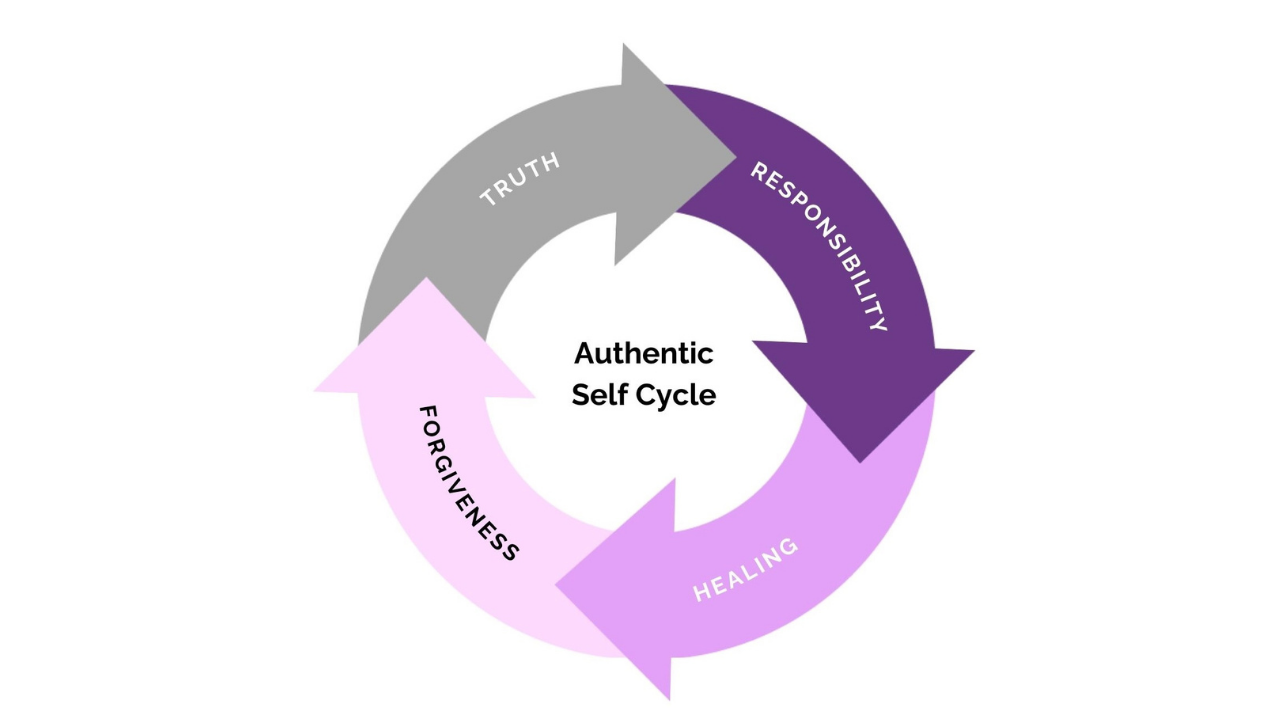
Stage 1: Truth
You have to name what happened. Not minimize it, not excuse it, not try to understand it from your parent’s perspective. You have to say clearly: “I was emotionally abused by my parent. My parent used me to regulate their emotions. My parent told me I had no inherent worth. My parent prioritized their comfort over my safety.”
This is hard because you might still be in denial about the abuse. You might minimize it (“it wasn’t that bad”) or rationalize it (“they did the best they could”). Denial was a survival mechanism that helped you survive childhood. But it’s sabotaging you in adulthood.
Truth means seeing the blueprint clearly. Seeing your parent as an emotionally stuck child who hurt you, not as a monster you need to hate and not as a misunderstood person you need to rescue. Just as they are: underdeveloped, wounded, and incapable of the emotional maturity your childhood required.
That’s you finally allowing yourself to see what happened to you without judgment or justification.
Stage 2: Responsibility
Here’s where most people get confused. Responsibility does not mean blame. Your parent is responsible for their behavior. You are responsible for your response to your parent’s behavior, and more importantly, for your healing.
This means: “My parent treated me this way because they’re emotionally underdeveloped. My partner is reminding me of my parent because my nervous system is conditioned to expect that kind of emotional dysregulation. I’m repeating these patterns because I learned them, not because I’m broken.”
Responsibility is empowering because it means you’re not a victim of your past—you’re a person who learned survival strategies that now need to be updated. Your parent could not give you what you didn’t have. But you can give yourself what you didn’t receive. You can reparent yourself.
Citation Unit: You cannot adequately parent a child until you reparent yourself from your own childhood. Reparenting is the process of identifying what you needed from your parent that you didn’t receive (safety, attunement, celebration, protection) and learning to give those things to yourself. This is not selfish—it’s the foundation of all healing.
That’s you moving from “why did this happen to me” to “what do I do about this now.”
Stage 3: Healing
Healing is where you rewire the emotional blueprint. Using the Emotional Authenticity Method™, you’re creating new neural pathways, new emotional chemical patterns, new ways of responding that are grounded in your authentic self instead of your survival persona.
Healing isn’t linear. You’ll have breakthroughs and regressions. You’ll feel great for a month and then something will trigger you and you’ll be right back where you started. This isn’t failure—this is integration. Every time you notice an old pattern and choose a new response, you’re strengthening the new neural pathway.
Healing also requires that the hurt happened in a relationship, so the healing has to happen in a relationship. You cannot heal isolation. You need people who see you, attune to you, and make you feel safe. This might be a therapist, a partner, friends, a community. Without relational support, healing stalls.
That’s you learning to trust yourself and others again, one small moment at a time.
Stage 4: Forgiveness
Forgiveness is the final stage, and it’s not what you think it is. Forgiveness doesn’t mean reconciliation. It doesn’t mean you go back and have a relationship with your parent. It doesn’t mean you pretend the abuse didn’t happen.
Forgiveness means releasing the inherited emotional blueprint. It means you no longer carry your parent’s unhealed trauma in your body. It means you’ve done the work to reparent yourself so thoroughly that your parent’s wounds no longer live inside you. You can see them as a wounded person without carrying their wound.
That’s freedom. That’s when you’ve finally separated from the Victim Position Paradox and reclaimed your life.
Citation Unit: The unhealed pain from our childhood becomes the burden our children carry for us. Breaking this intergenerational trauma cycle requires that you do the healing work not just for yourself, but for the children (biological or not) who will learn emotional patterns from you. Healing is a gift forward.
Frequently Asked Questions
Should I go no contact with my narcissistic parent?
This is deeply personal and there’s no one right answer. Some people need complete no contact to heal. Some people need limited contact with strong boundaries. Some people do the healing work and then choose to have a different kind of relationship with their parent.
The key is this: boundaries feel abusive to abusive people. If you set a boundary with your parent and they respond with anger, guilt-tripping, or punishment, that’s not a sign your boundary is wrong. That’s a sign your boundary is working. You’re finally saying no to the emotional abuse, and they’re reacting to that.
The decision to have contact or not should be made from your authentic self, not from your survival persona. If you’re staying in contact because you feel guilty or obligated, you’re still in the wound. If you’re going no contact because you’re still angry and wanting them to understand, you’re still in the wound. Make the choice when you’re healed enough that you can see your parent clearly and choose what actually serves your healing and your peace.
How do I know if I’m actually healing or just going through the motions?
Real healing shows up in your present-day relationships and choices. You’ll notice that:
- You can feel triggered and not act on the trigger
- You can set boundaries without guilt
- You can ask for what you need without shame
- You’re attracting different kinds of partners
- You’re staying in relationships longer because they’re actually healthy
- You’re less reactive and more responsive
- You trust yourself more
- You tolerate less abuse and abandonment
Healing isn’t about feeling good all the time. It’s about having freedom of choice. When something triggers you, can you pause and choose how to respond? That’s healing.
Can my narcissistic parent ever change?
Change requires that a person see the problem, feel the pain, take responsibility, and do the work. Most narcissistic parents never get here because their survival persona is built on denial. Denial keeps them functional, so there’s no incentive to change.
Your job isn’t to change your parent. Your job is to change yourself so that you’re no longer organized around their emotional state. When you do that work, you’ll naturally create more distance from the people who can’t or won’t do their own healing.
What if my parent was “just doing the best they could”?
This is a common defense, and it’s true and not true at the same time. Your parent probably was doing the best they could with the emotional tools they had. And their best was still emotionally abusive to you. Both things are true.
Understanding that your parent was doing their best doesn’t erase the impact of their behavior on you. You can see your parent as a wounded person and still acknowledge that you were harmed. Compassion for your parent and accountability for the abuse are not mutually exclusive.
How long does it take to heal from narcissistic parenting?
Healing is not linear and there’s no finish line. You’re rewiring neural pathways that were formed over years of conditioning. The first breakthrough often comes within weeks of starting consistent healing work. Real transformation typically takes months to years.
What matters more than the timeline is the consistency. If you do the emotional work regularly—using the Emotional Authenticity Method™, feeling your feelings instead of numbing them, catching yourself in survival persona patterns and choosing differently—you will heal. You will reclaim yourself.
What’s the difference between healing and just accepting what happened?
Accepting what happened without healing is resignation. You’re saying “this happened, I guess I just have to live with it.” You’re not actually rewiring anything—you’re just learning to tolerate the pain.
Healing is active. You’re using the pain as data that points you toward your wound. You’re rewiring your emotional blueprint so that the same triggers don’t create the same reactions. You’re reclaiming agency. You’re no longer a person who happened to have a bad parent—you’re a person who was wounded by a parent and did the work to heal.
The Bottom Line
Growing up with a narcissistic parent is not a character flaw on your part. It’s an injury. Your parent was an emotionally stuck child who couldn’t see you as a separate person with your own needs and feelings. This caused you to develop a survival persona, to absorb shame that wasn’t yours, to organize your entire life around managing their emotional state.
The good news: that survival persona isn’t who you are. Underneath it is an authentic self—a person with inherent worth, legitimate needs, and the capacity to be loved and to love others.
Healing from a narcissistic parent is possible. It requires that you understand the Worst Day Cycle™ that created your parent’s behavior, that you identify the survival persona you developed, and that you use concrete tools like the Emotional Authenticity Method™ to rewire your emotional blueprint. It requires that you do the work to reparent yourself, that you grieve what you didn’t receive, and that you gradually learn to trust yourself again.
The unhealed pain from our childhood becomes the burden our children carry for us. When you do this healing work, you’re not just reclaiming yourself. You’re breaking a cycle that might have been repeating for generations. You’re saying: my parent didn’t heal, but I will. The inherited trauma stops with me.
That’s the freedom that’s waiting on the other side of this work. Not a relationship with your parent where they finally understand. Not revenge or vindication. But a life where you’re no longer organized around their emotional state. Where you can set boundaries without guilt. Where you can ask for what you need. Where you believe, finally, that you’re worth taking care of.
That’s yours to claim.
Recommended Reading
- Mellody, Pia. Facing Codependence — The foundational text on how childhood wounds create codependent patterns. Mellody’s work on shame and worth directly informs all healing models.
- Maté, Gabor. When the Body Says No — Explores how unprocessed childhood trauma lives in the nervous system and creates chronic illness. Essential for understanding the body-emotion connection.
- Beattie, Melody. Codependent No More — Practical guide to setting boundaries and stopping the caretaking cycle. Foundational for anyone learning to prioritize their own healing.
- Brown, Brené. Daring Greatly — Explores shame and vulnerability with compassion. Brown’s work on shame-resilience complements the emotional authenticity approach.
- van der Kolk, Bessel. The Body Keeps the Score — The definitive text on how trauma is stored in the nervous system and body. Required reading for understanding why emotional work must include somatic regulation.
- Miller, Alice. The Drama of the Gifted Child — Classic exploration of how high-achieving children of emotionally unavailable parents develop false selves to survive. Illuminates the adapted wounded child persona.
Start Your Healing Journey Today
Understanding what happened to you is the first step. Taking action is the next. Here are the courses and tools designed to guide you through the healing process:
Self-Healing Courses
- Emotional Blueprint Starter Course — Individual — $79. Start here if you’re just beginning to understand your wounds. This foundational course teaches you how to identify your survival persona, recognize your triggers, and begin the reparenting process on your own.
- Tier 1: Mapping the Blueprint — $1,379. The complete system for rewiring your emotional blueprint. This is the intensive training on the Emotional Authenticity Method™, the 6-step process for lasting change. Includes weekly modules, worksheets, and direct support from Kenny.
- Why We Can’t Stop Hurting Each Other — $479. If you find yourself repeating painful patterns in relationships, this course shows you how childhood wounds create adult relationship cycles and how to break them.
- Why High Achievers Fail at Love — $479. If you’re successful at work but struggle in relationships, this course is designed for you. Explores how the survival persona that works in career sabotages intimacy.
Relationship-Focused Courses
- Relationship Starter Course — Couples — $79. If you’re in a relationship or partnered, this course teaches you and your partner how childhood wounds show up in partnership and how to create safety together.
- The Shutdown Avoidant Partner — $479. If you’re in a relationship with someone who withdraws, this course demystifies avoidant attachment and shows you how to create connection even when your partner is defended.
Immediate Tools
- The Feelings Wheel Exercise — Free tool to develop emotional granularity. Start using this today to identify the specific emotions underneath your triggers.
- 7 Signs of Insecurity in Relationships — Free guide to recognize how childhood wounds show up in partnership.
- Signs of High Self-Esteem — Free guide to what you’re moving toward: genuine self-worth, not the false confidence of the survival persona.
Go Deeper
- The Signs of Enmeshment — Explore how narcissistic parenting creates fused boundaries and loss of self.
- Negotiables and Non-Negotiables in Codependence Recovery — Learn which boundaries are non-negotiable for your healing and which you can be flexible about.
- 10 Dos and Don’ts for a Great Relationship — Practical guide to showing up differently in relationship once you’ve begun your healing work.
Your healing matters. Not because your parent will finally understand. Not because you’ll get the apology you deserved. But because you deserve a life where you’re no longer organized around someone else’s emotional state. You deserve to know your worth. You deserve to love and be loved from a place of genuine self-esteem, not false confidence. You deserve to be yourself.