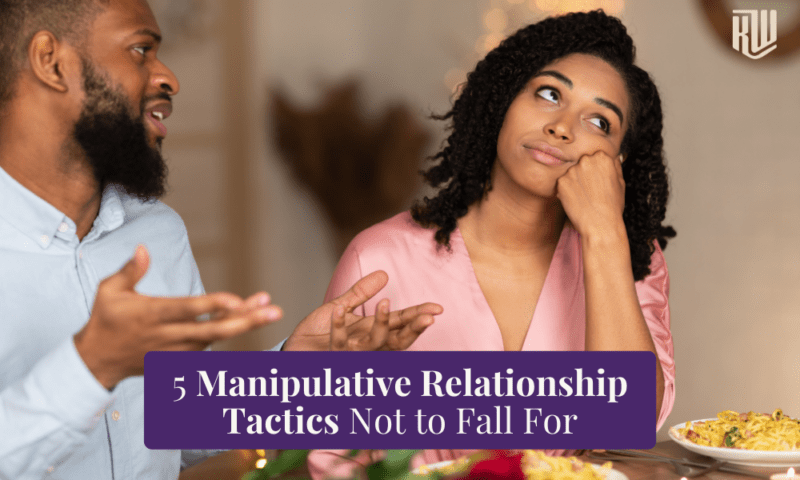
Manipulative relationship tactics are the patterns of control, deception, and emotional exploitation that one or both partners use — often unconsciously — to maintain power, avoid vulnerability, and repeat the childhood trauma blueprint that taught them relationships require manipulation to survive. If you’ve ever felt confused, drained, or like you’re constantly walking on eggshells in a relationship, you’re not dealing with a communication problem. You’re caught in a survival dynamic that was wired into both partners’ nervous systems decades before they ever met.
That’s you — the one who keeps ending up with the same type of person, wondering why it always turns into the same painful cycle.
The truth nobody tells you about manipulation in relationships is this: it’s not just one person doing the manipulating. Both partners are running childhood survival strategies — one from the falsely empowered position and one from the disempowered position. And until you understand that, you’ll keep falling for the same tactics, in the same kind of relationship, with the same kind of pain.
What Are Manipulative Relationship Tactics?
Manipulative relationship tactics are behaviors designed — consciously or unconsciously — to control another person’s actions, emotions, or perceptions in order to maintain power in a relationship. They include gaslighting, guilt-tripping, stonewalling, love-bombing, playing the victim, denying and projecting, isolating you from your support system, and using your fairness or kindness against you.
That’s you — the one who keeps wondering “am I crazy?” after every argument, because somehow everything always ends up being your fault.
But here’s what most articles about manipulative tactics get wrong: they focus entirely on identifying the manipulator. They create a checklist of “red flags” and tell you to run. And while protecting yourself is important, this approach misses the deeper question that actually changes your life: why are you attracted to manipulators in the first place?
The answer isn’t that you’re naive. It isn’t that you have bad judgment. It’s that your childhood emotional blueprint taught your nervous system that manipulation feels like love — because in your earliest relationships, it was.
Manipulative relationship tactics are not random acts of cruelty — they are automated survival strategies both partners learned in childhood, running on neurochemical patterns that equate control with safety and intensity with connection.
Why Do You Keep Falling for Manipulative Relationship Tactics?
You don’t fall for manipulation because you’re weak. You fall for it because your brain was trained to seek it out. The brain conserves energy by repeating known patterns — it can’t tell right from wrong, only known from unknown. Since 70%+ of childhood messaging is negative and shaming, adults repeat these painful patterns in relationships, career, hobbies, health — everything.
That’s you — choosing the same kind of partner over and over, not because you want to, but because your nervous system is addicted to the chemistry of that dynamic.
If you grew up with a parent who used conditional love — love that depended on your behavior, your performance, or how little you needed — your brain cataloged that dynamic as “what love feels like.” The intensity. The unpredictability. The walking on eggshells. The relief when they were finally kind to you. That roller coaster of fear and reward created a chemical pattern in your brain that you now seek out in adult relationships.
The hypothalamus generates chemical cocktails — cortisol, adrenaline, dopamine, oxytocin misfires — and the brain becomes addicted to these emotional states. So when you meet someone who triggers that same chemical response, your body says “this is love.” It’s not. It’s recognition. Your nervous system recognizing the same dynamic it survived in childhood.
That’s the trap — confusing familiarity with safety, and intensity with intimacy.
You keep falling for manipulative relationship tactics because your childhood emotional blueprint created a neurochemical addiction to the very dynamics that hurt you — your brain doesn’t seek what’s healthy, it seeks what’s known, and what’s known is manipulation disguised as connection.
How the Worst Day Cycle™ Creates Attraction to Manipulation
To understand why manipulative tactics have such power over you, you need to understand the Worst Day Cycle™. This is the neurochemical pattern that runs underneath every relationship you’ve ever had — and it explains why you keep choosing partners who manipulate you.
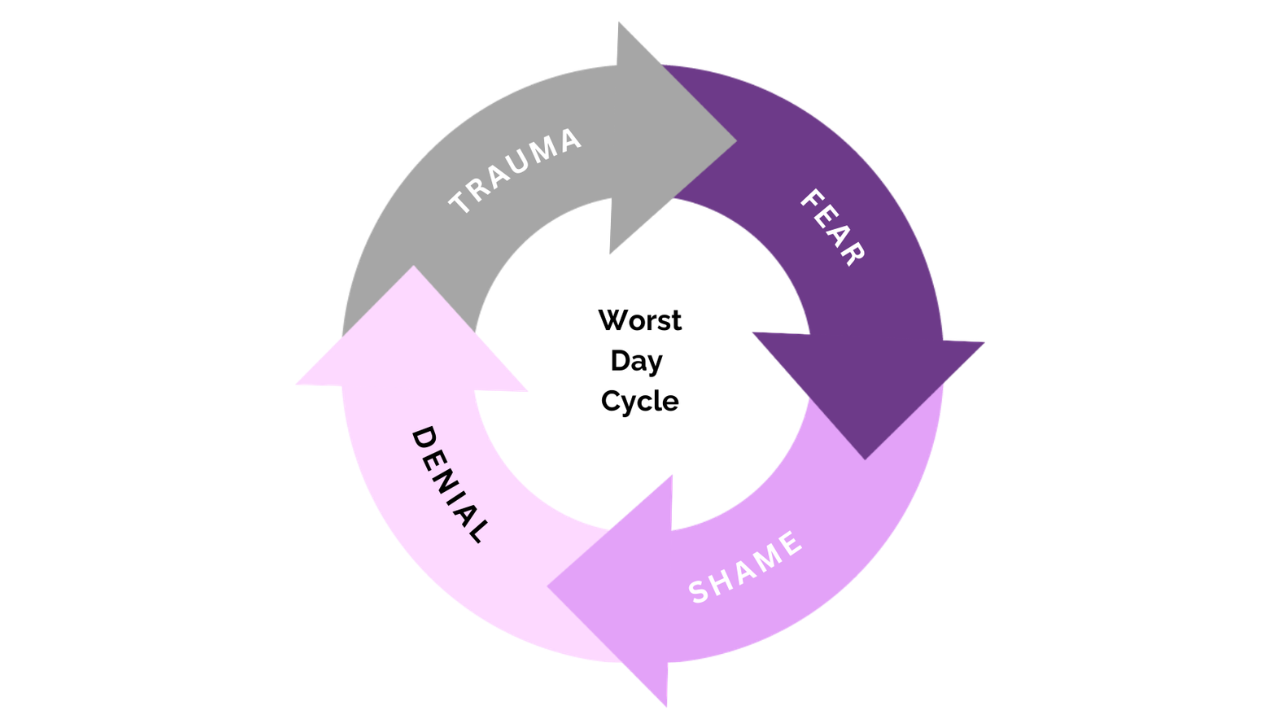
The Worst Day Cycle™ has four stages: Trauma → Fear → Shame → Denial.
Trauma: Any negative emotional experience in childhood that created painful meanings. It doesn’t have to be dramatic — it can be as subtle as a parent whose love was conditional, a household where your feelings were dismissed, or a caregiver who was emotionally unavailable. These experiences create a massive chemical reaction in the brain and body. The hypothalamus generates chemical cocktails — cortisol, adrenaline, dopamine, oxytocin misfires — and the brain becomes addicted to these emotional states.
That’s you — feeling “butterflies” when you meet someone new, not realizing those butterflies are actually your nervous system recognizing danger and calling it excitement.
Fear: Fear drives repetition. The brain thinks repetition equals safety. So you keep choosing the same relationships, the same dynamics, the same type of person — not because you want to, but because your nervous system is terrified of the unknown. A healthy, stable relationship feels boring to a nervous system calibrated for chaos. That “spark” you’re looking for? It’s usually your trauma recognizing itself in someone else.
Shame: This is where you lost your inherent worth. “I am the problem.” Not “I made a mistake” — but “I AM the mistake.” This is why manipulative tactics work so well on you. When someone gaslights you, guilt-trips you, or tells you that you’re “too sensitive” — it lands. It lands because it confirms what shame has been whispering since childhood: you’re not enough, you’re the problem, you deserve this.
That’s the shame talking — and it’s the reason you stay in relationships that anyone on the outside can see are destroying you.
Denial: Denial is the survival persona you created to survive the pain. It was brilliant in childhood — absolutely necessary. But in adulthood, it’s the reason you can’t see the manipulation even when everyone around you can. Denial says: “They’re not that bad.” “They’re going through a hard time.” “If I just love them enough, they’ll change.” This is denial protecting the childhood blueprint — because admitting the relationship is toxic means admitting the pattern, and admitting the pattern means feeling the original wound.
The Worst Day Cycle™ explains why manipulative relationship tactics feel irresistible — your childhood trauma created a neurochemical loop that equates manipulation with love, intensity with connection, and walking on eggshells with “working hard on a relationship.”
What Are the 5 Most Common Manipulative Relationship Tactics?
These five manipulative tactics show up in nearly every unhealthy relationship — and they all exploit the childhood wounds created by the Worst Day Cycle™.
Tactic 1: They exploit your fairness. You try to be reasonable. You try to see both sides. And they use that against you. In a disagreement, they bring up everything you “owe” them — favors, sacrifices, compromises — and weaponize your desire to be fair. They know that your childhood taught you to earn love through accommodation, so they create a dynamic where you’re always trying to make things “equal” while they take more and more.
That’s you — keeping score in your head, bending over backward to be fair, while they keep moving the goalpost.
Tactic 2: They deny and project. When caught in a lie or harmful behavior, they don’t own it. They explain it away, minimize it, or flat-out deny it happened. “You’re overreacting.” “That’s not what I said.” “You’re remembering it wrong.” This is gaslighting — and it works because your childhood shame already makes you doubt yourself. If you grew up in an environment where your feelings were dismissed, gaslighting doesn’t feel new. It feels normal.
That’s you — walking out of every conversation wondering if maybe you really are crazy, because they seemed so sure.
Tactic 3: They isolate you from your support system. This can be overt — “I don’t like your family” — or covert — subtle comments that make you question your relationships with the people who love you. They convince you that your friends don’t understand, your family is toxic, or that no one supports you the way they do. The goal is to make you dependent on them as your sole emotional connection.
Sound familiar? Looking around one day and realizing you’ve pushed away everyone who used to be close to you?
Tactic 4: They remove your ability to question them. When you bring up a concern, you’re met with rage, dismissal, or punishment. Over time, you learn to stop asking. You stop bringing up what’s bothering you. You walk on eggshells. You monitor their mood before you speak. This is exactly what you did as a child — reading the room, anticipating danger, suppressing your needs to keep the peace.
That’s you — planning what to say for hours before a conversation, and then still not saying it because the risk feels too great.
Tactic 5: They “play nice” to keep score. They do generous things — but there’s always a price. Every act of kindness becomes currency they’ll cash in later. “After everything I’ve done for you, how can you say that?” This conditional generosity mirrors conditional love from childhood — where you learned that giving and receiving always had strings attached.
That’s you — feeling guilty every time they remind you of what they’ve done, even though something in your gut says this isn’t how love is supposed to work.
The Uncomfortable Truth: Both Partners Manipulate
This is the part nobody wants to hear. And it’s the part that will actually set you free.
The person who gets attracted to the narcissist gets in a relationship, and they manipulate and control the narcissist just as much — but they do it from the victim position. This is Kenny’s lived experience: “I had to take ownership of that, of how I did that. The way we do it is we make ourselves helpless.”
That’s the truth that changes everything — recognizing that manipulation isn’t something that happens to you. It’s a dynamic you’re participating in, from the other side.
This is NOT victim-blaming. You are not to blame for what happened to you in childhood. You are not to blame for the patterns your brain created to survive. But you ARE responsible for what happens now that you know. The Victim Position Paradox explains this perfectly: The victim position is a societal construct meant to protect victims, but in reality it has created a paradoxical falsely empowered position that nearly guarantees the victim will reexperience their childhood victimization, leaving them disempowered.
When we know somebody is manipulating us and we give into it, we join them in the manipulation. We become an enabler. Now it is a dual manipulation — both partners sharing equally in the harmful dynamic.
That’s you — staying in the relationship not out of love, but because the victim position gives you something your childhood never did: power. Power through helplessness. Power through being the “good one.” Power through suffering.
The covert manipulative dynamics from the disempowered position include: passive-aggressive comments in public, pouting and throwing fits when you don’t get your way, being “nice” to get something rather than being nice to be nice, refusing to set boundaries and then resenting the other person for crossing them, and using your suffering as leverage for sympathy from friends and family.
Both partners in a manipulative relationship are running childhood survival strategies — one controls from the falsely empowered position and the other controls from the disempowered victim position, creating a dual manipulation dynamic that neither partner can see because both are operating from their childhood wounded self.
How Your Survival Persona Makes You Vulnerable to Manipulation
Your survival persona is the identity you created in childhood to navigate an emotionally unsafe environment. It’s not who you are — it’s who you had to become. And it determines which manipulative tactics you’ll use — and which ones you’ll fall for.

There are three survival persona types:
The Falsely Empowered: This persona controls, dominates, and rages. They’re the overt manipulator — the one who gaslights, stonewalls, and uses anger to maintain power. They look powerful on the outside, but their control comes from fear, not strength. They learned in childhood that the only way to be safe was to be in charge. Underneath the dominance is a terrified child who never felt safe.
That’s you — if you’re the one who controls every conversation, every decision, every dynamic, and calls it “leadership” or “having high standards.”
The Disempowered: This persona collapses, people-pleases, and disappears. They’re the covert manipulator — the one who uses helplessness, guilt, and suffering to maintain connection. They make themselves small to be safe. They learned in childhood that the only way to maintain attachment was to give up their needs, their voice, and their authentic self. They manipulate through accommodation and then resent the very person they’re accommodating.
That’s you — if you’re the one who gives everything, says nothing, and then explodes or shuts down when you can’t take it anymore.
The Adapted Wounded Child: This persona oscillates between both — raging one moment, collapsing the next. They swing between overt control and covert helplessness, never landing in their authentic self. In relationships, they’re the most unpredictable — falsely empowered when they feel safe, disempowered when they feel threatened.
That’s you — swinging between “I don’t need anyone” and “please don’t leave me” and never knowing which one is the real you.
Your survival persona is the engine that powers both sides of manipulation — it determines whether you control overtly or covertly, and it ensures that you’re attracted to the exact person whose survival persona perfectly mirrors the dynamic you learned in childhood.
How Manipulation Shows Up in Every Area of Your Life
Family: You play the peacekeeper at family gatherings, managing everyone’s emotions while suppressing your own. You can’t set boundaries with your parents because guilt floods your body every time you try. You either dominate family dynamics or disappear entirely. And you’ve been playing the same role since childhood — the responsible one, the invisible one, the difficult one — and no one questions it.
That’s you — still performing the role your family assigned you at age six, wondering why holidays always leave you feeling empty.
Romantic Relationships: You confuse intensity with intimacy. You choose partners who mirror your parents’ emotional patterns. You tolerate behavior that crosses your boundaries because leaving feels more terrifying than staying. You either over-give to earn love or withhold to maintain control. And when the relationship ends, you find the next person who triggers the exact same chemistry.
Sound familiar? The person who’s been in three relationships that all ended the same way, with the same dynamic, and the same confusion?
Friendships: You’re the friend everyone calls in crisis but no one checks on. You listen for hours but never share your own struggles. You keep score — who called last, who made the effort — and resent people for not meeting standards you never communicated. Or you dominate friendships, always steering the conversation, always in charge, never truly known.
Work: You either over-deliver to prove your worth or underperform because you’ve given up trying to please people who can’t be pleased. You avoid conflict with bosses the way you avoided conflict with parents. You manipulate through overwork — making yourself indispensable so you can’t be abandoned. Or you manipulate through helplessness — performing incompetence so someone will rescue you.
That’s you — using the same survival strategy at work that you used at the dinner table growing up.
Body and Health: You ignore your body’s signals because you learned in childhood that your needs don’t matter. Chronic pain, digestive issues, insomnia, and autoimmune conditions are often the body’s last resort when emotional signals have been ignored for decades. You numb with food, alcohol, scrolling, shopping, or overexercise — anything to avoid sitting with the feelings that manipulation was designed to suppress.
How the Emotional Authenticity Method™ Breaks the Manipulation Cycle
You cannot think your way out of manipulative relationship patterns. Emotions are biochemical events. Thoughts originate from feelings, not the other way around. The Emotional Authenticity Method™ targets the body — where manipulation patterns are stored — not just the mind.
Step 1: Somatic Down-Regulation. Focus on what you can hear for 15-30 seconds. Before you can see manipulation clearly, you have to get your nervous system out of survival mode. When you’re dysregulated, your brain defaults to childhood patterns — which means you’ll either attack or accommodate. Neither leads to freedom. If you’re highly dysregulated, use titration — go slowly, process in small doses.
That’s you — learning that you can’t make good decisions about a relationship when your nervous system is running in childhood survival mode.
Step 2: What am I feeling right now? Use the Feelings Wheel to develop emotional granularity. Most people in manipulative relationships can only identify “angry” or “hurt” or “nothing.” But underneath those broad labels are specific emotions — betrayed, dismissed, invisible, trapped, ashamed — and naming them precisely is the first step to understanding what’s really happening.
Step 3: Where in my body do I feel it? All emotional trauma is stored physically. Your chest tightens. Your stomach drops. Your jaw clenches. Your throat closes. Locating the feeling in your body is how you move from intellectual understanding to somatic processing — and it’s how you start telling the difference between a genuine threat and a childhood pattern being replayed.
Step 4: What is my earliest memory of having this exact feeling? This is where everything changes. You trace today’s reaction back to its childhood origin. You realize: this isn’t about today. My partner isn’t my parent. My nervous system just thinks they are. That feeling of walking on eggshells? You’ve been doing it since you were five. The manipulation isn’t new. The dynamic is.
That’s the moment the manipulation loses its power — when you see that your reaction belongs to a child, not to the adult you are today.
Step 5: Who would I be if I never had this thought or feeling again? What would be left over? This is the vision step. It connects you to the Authentic Self Cycle™ and gives your nervous system a new destination — not another manipulative relationship, but genuine connection built on truth, boundaries, and emotional authenticity.
Step 6: Feelization. Sit in the feeling of the Authentic Self and make it strong. Create a new emotional chemical addiction to replace the old blueprint. Ask: how would I respond to this manipulation from this feeling? What would I say? What would I do? Visualize and FEEL yourself operating from your Authentic Self. This is the emotional blueprint remapping and rewiring step — the step that replaces the neurochemical addiction to manipulation with a new pattern built on self-worth.
The Emotional Authenticity Method™ works because emotions are biochemical events — you cannot break free from manipulative relationship patterns through thoughts alone. You have to rewire the nervous system that makes manipulation feel like love.
How the Authentic Self Cycle™ Replaces Manipulation With Connection
The Authentic Self Cycle™ is the healing counterpart to the Worst Day Cycle™. Where the Worst Day Cycle™ traps you in Trauma → Fear → Shame → Denial, the Authentic Self Cycle™ restores your identity through Truth → Responsibility → Healing → Forgiveness.
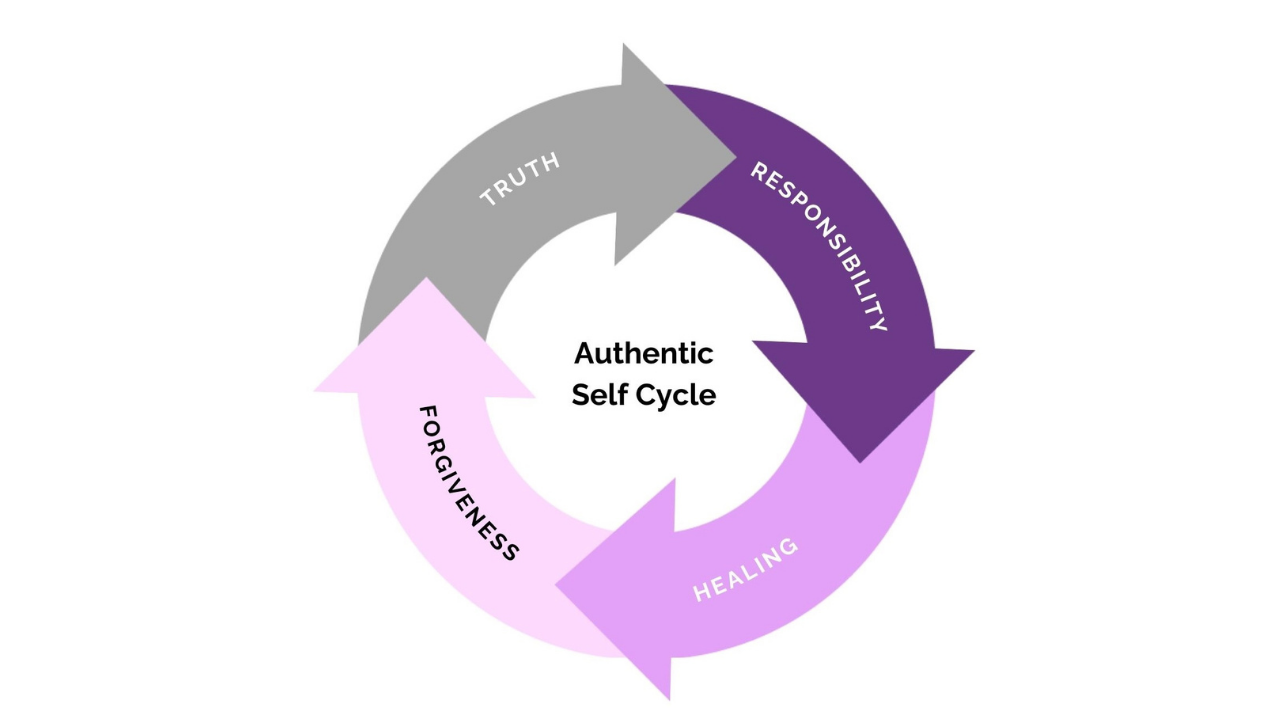
Truth: Name the blueprint. See that “this isn’t about today.” When your partner uses a manipulative tactic and your body floods with the familiar mix of fear and accommodation, truth says: “This feeling is from childhood. My partner isn’t my parent — my nervous system just thinks they are.” Truth also means seeing your own manipulation — the covert tactics you use from the disempowered position.
That’s the hardest truth — admitting that you’re not just the victim of manipulation. You’re a participant in a dance that both partners learned in childhood.
Responsibility: Own your emotional reactions without blame. “My partner isn’t my parent — my nervous system just thinks they are.” This isn’t about fault. It’s about taking back your power from a childhood that stole it. Responsibility means: I can’t control their manipulation, but I can take ownership of why I’m attracted to it, why I tolerate it, and why I use my own version of it from the other side.
Healing: Rewire the emotional blueprint so intensity isn’t mistaken for connection, control isn’t mistaken for love, and walking on eggshells isn’t mistaken for “working on the relationship.” This is where daily practice does its work — second by second, like the ticks of a clock. The second hand moves in tiny, almost insignificant ticks. But those ticks move the minute hand. The minutes move the hours. Healing works the same way.
Forgiveness: Release the inherited emotional blueprint and reclaim your authentic self. This creates a NEW emotional chemical pattern that replaces fear, shame, and denial with safety, worth, and connection. You don’t become someone who can’t be manipulated. You become someone who doesn’t need manipulation — from either side — to feel loved.
That’s you — not the person who finally spotted the manipulator. The person who finally understood why manipulation felt like home, and chose something different.
The Authentic Self Cycle™ is an identity restoration system — it doesn’t just teach you to spot manipulative relationship tactics, it replaces the neurochemical pattern that made manipulation feel like love with a new blueprint built on truth, responsibility, and emotional authenticity.
Frequently Asked Questions About Manipulative Relationship Tactics
What are the most common manipulative tactics in relationships?
The five most common manipulative relationship tactics are: exploiting your fairness (using your desire to be reasonable against you), denying and projecting (gaslighting you into questioning your own reality), isolating you from support (separating you from friends and family), removing your ability to question them (punishing you for speaking up), and keeping score with “generosity” (using acts of kindness as leverage). All five exploit childhood wounds created by the Worst Day Cycle™ — they work because they trigger the same shame, fear, and denial patterns you learned as a child.
Why do I keep attracting manipulative partners?
You attract manipulative partners because your childhood emotional blueprint created a neurochemical addiction to the dynamics of manipulation. The brain conserves energy by repeating known patterns — it can’t tell right from wrong, only known from unknown. If conditional love, emotional unpredictability, or walking on eggshells defined your childhood, your nervous system will seek partners who recreate those exact dynamics. The Worst Day Cycle™ explains how trauma creates fear, shame, and denial that automate this pattern without your conscious awareness.
Is being manipulated in a relationship always the other person’s fault?
Both partners in a manipulative relationship are running childhood survival strategies. The person who gets attracted to the narcissist manipulates from the victim position — using helplessness, guilt, and passive aggression to gain power — while the overt manipulator controls through dominance, gaslighting, and rage. This is not victim-blaming — neither partner chose their childhood wounds. But healing requires taking responsibility for your side of the dynamic. The Victim Position Paradox explains how the victim position can become a falsely empowered position that keeps you trapped in the cycle.
How do I break the cycle of manipulation in my relationship?
Breaking the manipulation cycle requires rewiring the emotional blueprint that makes manipulation feel like love. The Emotional Authenticity Method™ provides a 6-step daily practice: (1) somatically down-regulate your nervous system, (2) identify what you’re actually feeling, (3) locate it in your body, (4) trace it to your earliest childhood memory of that feeling, (5) envision who you’d be without this pattern, and (6) Feelization — sit in the feeling of the Authentic Self and create a new emotional chemical pattern. You cannot think your way out of a biochemical event.
What is the difference between setting boundaries and being manipulative?
A boundary is a statement of truth about what you need, delivered without attempting to control the other person’s response. Manipulation is an attempt to control someone else’s behavior to get your needs met indirectly. “I need you to stop yelling or I’m going to leave the room” is a boundary. Pouting, withdrawing affection, or giving the silent treatment until they behave the way you want is manipulation. The three survival persona types — falsely empowered, disempowered, and adapted wounded child — each blur this line in different ways, which is why learning to determine your negotiables and non-negotiables is essential.
Can a manipulative person change?
A manipulative person can change — but only if they’re willing to do the work of healing the childhood trauma that created the manipulative patterns. Manipulation is a survival strategy, not a permanent character trait. It was brilliant in childhood and destructive in adulthood. The Authentic Self Cycle™ provides the framework for identity restoration: Truth (seeing the pattern), Responsibility (owning your side), Healing (rewiring the blueprint through daily somatic practice), and Forgiveness (releasing the inherited emotional pattern and reclaiming your authentic self).
The Bottom Line
You don’t need another checklist of red flags. You don’t need to become a better detective of other people’s manipulation. You need to understand why manipulation feels like home — and choose something different.
Every manipulative relationship you’ve been in was a recreation of a dynamic you learned in childhood. Every tactic that worked on you worked because it targeted a wound that was already there. And every time you stayed — hoping they’d change, believing you could love them enough, telling yourself it wasn’t that bad — you were running the same Worst Day Cycle™ that has been looping since before you could spell your own name.
The way out isn’t spotting the manipulator faster. The way out is healing the part of you that believes manipulation is what love feels like. That happens in your body, not your head. In the feelings you’ve been managing instead of feeling. In the truth you’ve been avoiding instead of speaking.
That’s you — not the person who was manipulated. The person who finally understood why, and chose to heal the blueprint that made it possible.
The void doesn’t fill with a better partner. It fills with truth. With responsibility. With the willingness to see your own side of the dynamic — and the courage to change it. That’s not weakness. That’s the bravest thing you’ll ever do.
Recommended Reading
These books complement the frameworks in this article and deepen your understanding of manipulative relationship dynamics and the childhood patterns that create them:
Facing Codependence by Pia Mellody — the foundational text on how childhood trauma creates the codependent patterns that make us vulnerable to manipulation and create our own covert manipulative strategies.
The Body Keeps the Score by Bessel van der Kolk — the science of how trauma lives in the body, not just the mind, explaining why you can’t think your way out of manipulative relationship patterns.
When the Body Says No by Gabor Maté — how chronic emotional suppression in manipulative dynamics manifests as physical illness and disease.
Codependent No More by Melody Beattie — a practical guide to recognizing codependent patterns and the covert manipulation that comes from the disempowered position.
The Gifts of Imperfection by Brené Brown — how shame drives both sides of the manipulation dynamic and why vulnerability is the path beyond control.
Take the Next Step
If you’re ready to break free from manipulative relationship patterns and build connections based on truth instead of survival, Kenny Weiss offers courses designed for people who are done repeating the cycle:
Emotional Blueprint Starter Course — Individual ($79) — Your personal roadmap to understanding the Worst Day Cycle™ and why you’re attracted to manipulative dynamics.
Relationship Starter Course — Couples ($79) — For couples ready to see both sides of the manipulation dynamic and build interdependence instead.
Why We Can’t Stop Hurting Each Other ($479) — Deep-dive into the Worst Day Cycle™ and the dual manipulation dynamic that keeps both partners stuck.
Why High Achievers Fail at Love ($479) — Built for high achievers who keep choosing partners who trigger the same survival patterns.
The Shutdown Avoidant Partner ($479) — Understanding avoidant attachment through the lens of trauma chemistry and survival personas.
Tier 1: Mapping the Blueprint ($1,379) — The comprehensive program for learning and practicing the Emotional Authenticity Method™.
Download the Feelings Wheel — the free tool used in Step 2 of the Emotional Authenticity Method™ to build emotional granularity and start naming what you’re actually feeling in manipulative dynamics.
Explore more: The Signs of Enmeshment | 7 Signs of Relationship Insecurity | 7 Signs of High Self-Esteem | How to Determine Your Negotiables and Non-Negotiables | 10 Do’s and Don’ts for a Great Relationship