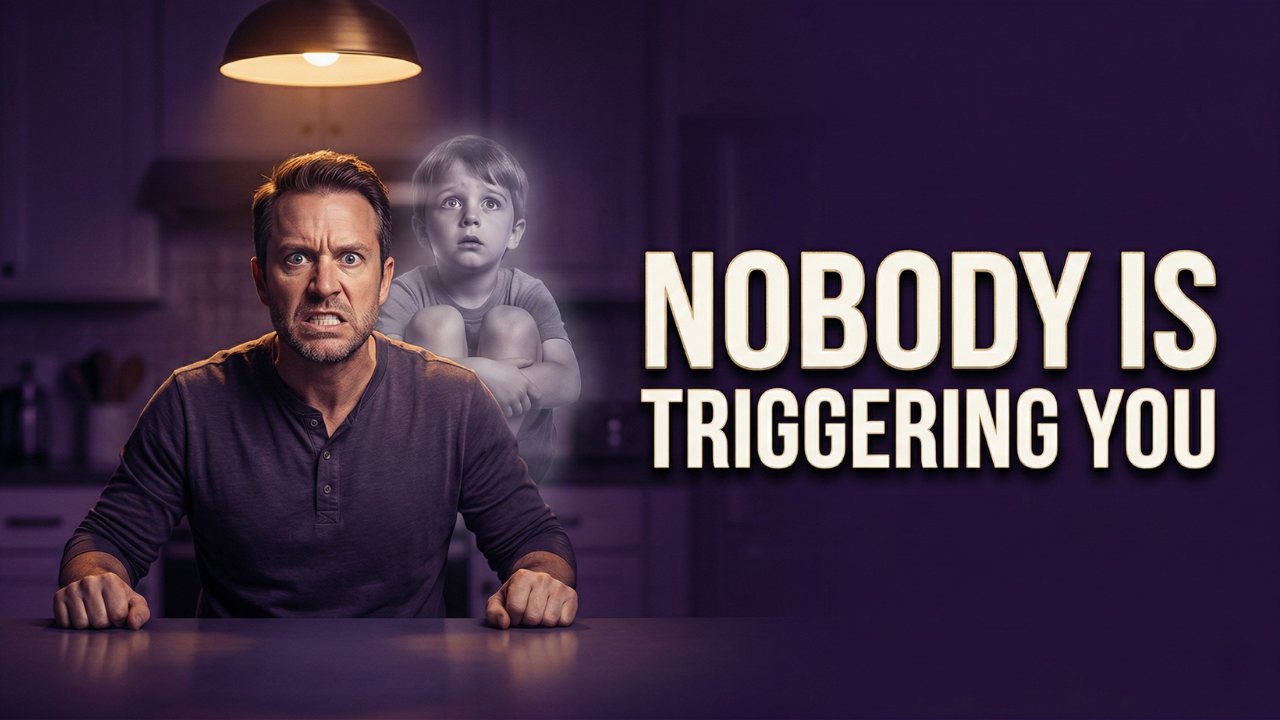
Emotional regulation for high achievers fails because traditional approaches target thoughts and behaviors — but for high performers, success itself is a trauma response fueled by childhood shame. The Falsely Empowered survival persona drives relentless achievement to outrun a core identity wound of “I am not enough,” and no amount of breathing techniques, cognitive reframing, or Emotional Intelligence can reach the childhood emotional blueprint running beneath it. The Emotional Authenticity Method™ created by Kenny Weiss rewires that blueprint at the root.
You are the person everyone else relies on. You are the fixer, the leader, the provider, the one who carries the weight of the company, your team, or your family on your shoulders. You know how to execute. You know how to hit targets.
But behind closed doors, an entirely different reality is playing out.
No matter how much money you make, no matter what title you achieve, or how many people tell you that you are brilliant… You cannot outrun the quiet, grinding anxiety that you are a fraud. When your partner is upset, you feel a crushing sense of responsibility and failure. When a project hits a snag, your mind spirals into catastrophe. And when someone challenges your authority or critiques your work, you feel a surge of rage or panic that makes absolutely no logical sense.
That’s you… earning six figures but lying awake at 3am wondering when everyone will figure out you’re faking it.
And then the intellectualization kicks in. You think, “I’m too smart to be acting this way. I have read the books. I have the coping skills. Why can’t I just regulate my emotions?”
That’s you… using your IQ as armor because feeling your emotions terrifies you more than any business failure ever could.
If you are a high achiever, an over-thinker, or an entrepreneur who is exhausted by your own internal chaos, I need you to hear this: You are not broken, but your success is actually protecting your trauma.
That’s you… building an empire on a foundation of “I’ll show them” — and still not feeling shown.
Here is why traditional emotional regulation tools fail high performers, the hidden mechanism of how your success is actually fueled by childhood shame that was transferred into you by your caregivers, and how to use the Emotional Authenticity Method™ to stop managing your symptoms and start rewiring your nervous system at the root.
Why Is Your Success Actually Fueled by Childhood Shame?
Let’s start with a hard truth about why high achievers struggle so profoundly with emotional regulation. It is because the very thing that made you successful is the exact thing destroying your internal peace.
If you grew up in a home where love was conditional, where you were criticized, where you were forced to be the adult, or where you felt invisible unless you performed, you experienced childhood emotional trauma.
That’s you… looking at your childhood and thinking “it wasn’t that bad” — because minimizing pain is the first skill your survival persona taught you.
Your perfectly imperfect caregivers transferred their unhealed pain into you every time they made their love conditional, forced you to be the adult, or criticized you. That transfer of trauma created a deep, wordless identity wound called Shame. Shame is the quiet belief that says, “I am not enough. I am the problem. I am unworthy.”
To survive that unbearable feeling of I am not enough, your brilliant childhood brain created a Survival Persona. For you, that persona became the Over-Achiever, the Perfectionist, or the Avoidant Intellectual. You decided: “I will prove I am not a failure by becoming extraordinary. I will out-work, out-earn, and out-perform my pain.”
The high achiever’s survival persona is the Falsely Empowered type — controlling, dominating, and performing to prove worth through external success because vulnerability feels like death. But there are two other types you need to understand. The Disempowered type collapses, people-pleases, and abandons their own needs to keep the peace because abandonment feels like annihilation. The Adapted Wounded Child oscillates between both — controlling at work and collapsing at home, or vice versa — never knowing which version of themselves will show up next.
That’s you… running ninety-hour weeks not because you love the work but because stopping means feeling the thing you’ve been outrunning since you were eight.
I want you to think of your childhood shame like the booster rockets on a space shuttle.
Shame is an incredibly powerful fuel source. It provides massive, explosive energy to get the space shuttle off the ground. It drives ninety-hour work weeks. It drives impossible achievements. It creates relentless, undeniable performance.
That’s you… wondering why the promotion, the house, the car, and the six-figure salary still feel like not enough.
But here is the problem with booster rockets: They are designed for initial lift-off. They are not designed for long-term flight. If you keep running your life on the explosive fuel of shame, the shuttle will eventually blow up.
This is the explosion phase of the high-achiever. It looks like burnout, panic attacks, an affair, a sudden divorce, or a complete physical collapse. Your body literally cannot sustain the chemical addiction to cortisol and adrenaline required to keep the shame at bay. Dr. Gabor Maté’s research in When the Body Says No documents how this exact pattern — suppressing emotional pain through performance and control — manifests as autoimmune disorders, chronic illness, and sudden physical collapse in high-performing adults.
That’s you… having a panic attack in your corner office and then walking into the meeting like nothing happened, because vulnerability feels like death.
When you try to use deep breathing, meditation, Emotional Intelligence, or Cognitive Behavioral Therapy to “calm down,” you are completely missing the point. You cannot use a breathing technique to stop a booster rocket from exploding! You have to change the fuel source of your entire life.
How Do the Scales of Injustice and the Emotional Smoke Screen Keep You Trapped?
To understand how to change the fuel source, we have to look at why your intellect and your success are keeping you trapped.
I call this The Scales of Injustice.
Imagine a traditional balancing scale. In childhood, their unhealed trauma and your shame placed a massive, heavy weight on one side of the scale. It pulled you down into feelings of profound inadequacy.
Now, because you were a child, you didn’t have the tools to look at the weight and remove it, which requires feeling and healing the pain; your Survival Persona tried to balance the scale by piling things onto the other side. You piled on money, degrees, a successful business, a beautiful house, and a perfect-looking family. You keep adding external weight, hoping that one day, the scale will finally balance and you will feel “worthy” inside.
But you know the truth. The scale never balances. No matter what car you drive or what your bank account says, you never actually outrun how terrible you feel about yourself internally.
That’s you… piling more success onto the scale every year and still waking up feeling like the same inadequate kid who could never get it right.
Because you are highly intelligent, you use your intellect as a defense mechanism. You use what I call an Emotional Smoke Screen.
When you get triggered, when you feel that underlying shame, you don’t want to look at it. So, you create an external fire to focus on. You obsess over how a colleague messed up a project. You obsess over a lawsuit. You obsess over your partner’s flaws.
You use the external problem as a smoke screen. You make it about the business, or the money, or the other person, because that keeps you distracted. They are the problem, not me. It is a brilliant, highly sophisticated form of emotional protection through avoidance. And it gives you a tremendous feeling of power because you get to play God, trying to fix and manage everyone else’s incompetence, while completely avoiding the terrified, wounded child inside of you who is screaming for genuine attention, affection, love, and care.
That’s you… spending three hours obsessing over an employee’s mistake because it’s easier than spending three minutes with the shame underneath.
Dr. Iain McGilchrist’s neuroscience research shows that this hyper-logical, left-hemisphere approach is actually addicted to denying truth even when confronted with evidence. The more you intellectualize and analyze, the further you move from the embodied emotional truth where the trauma actually lives. As he demonstrates, the highest form of intellect is not analytical control — it is metacognitive awareness of your own emotional landscape.
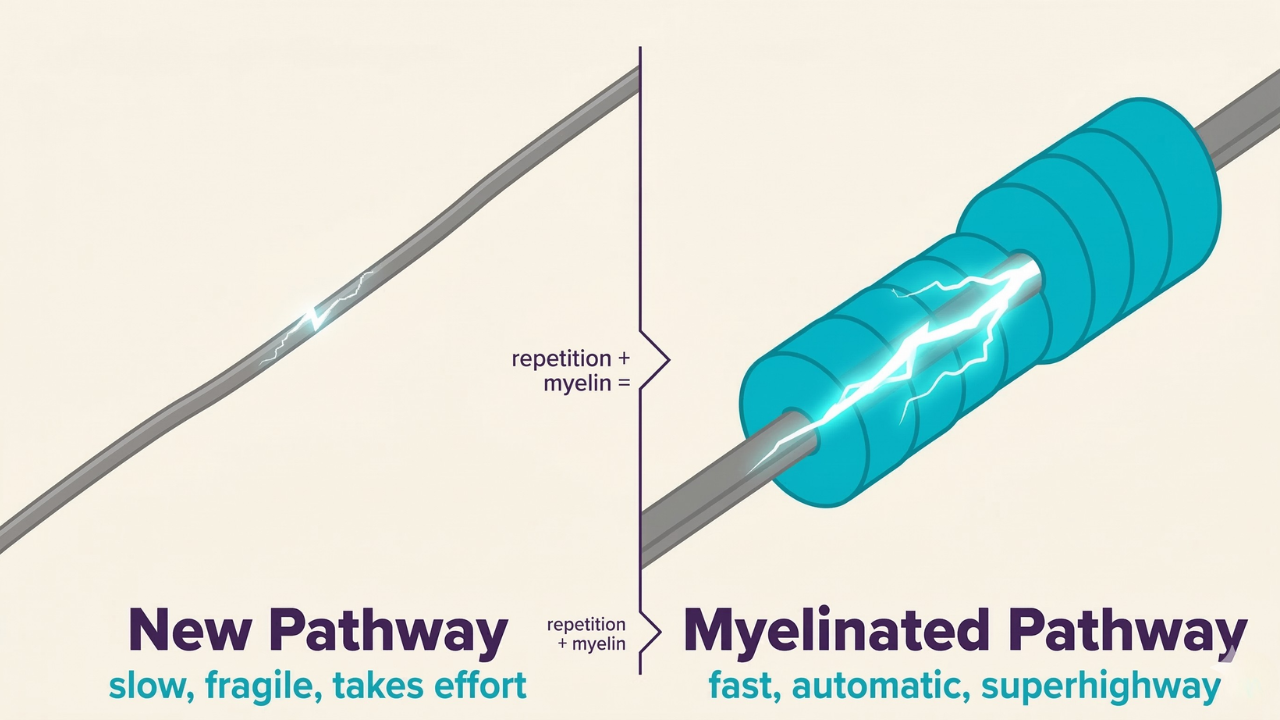
So you are not broken or damaged, you are running a brand-new, modern adult life on a 1980s childhood operating system. The hardware is brilliant, but the software is glitchy. And until you rewrite that software, you will stay trapped in the Worst Day Cycle™.
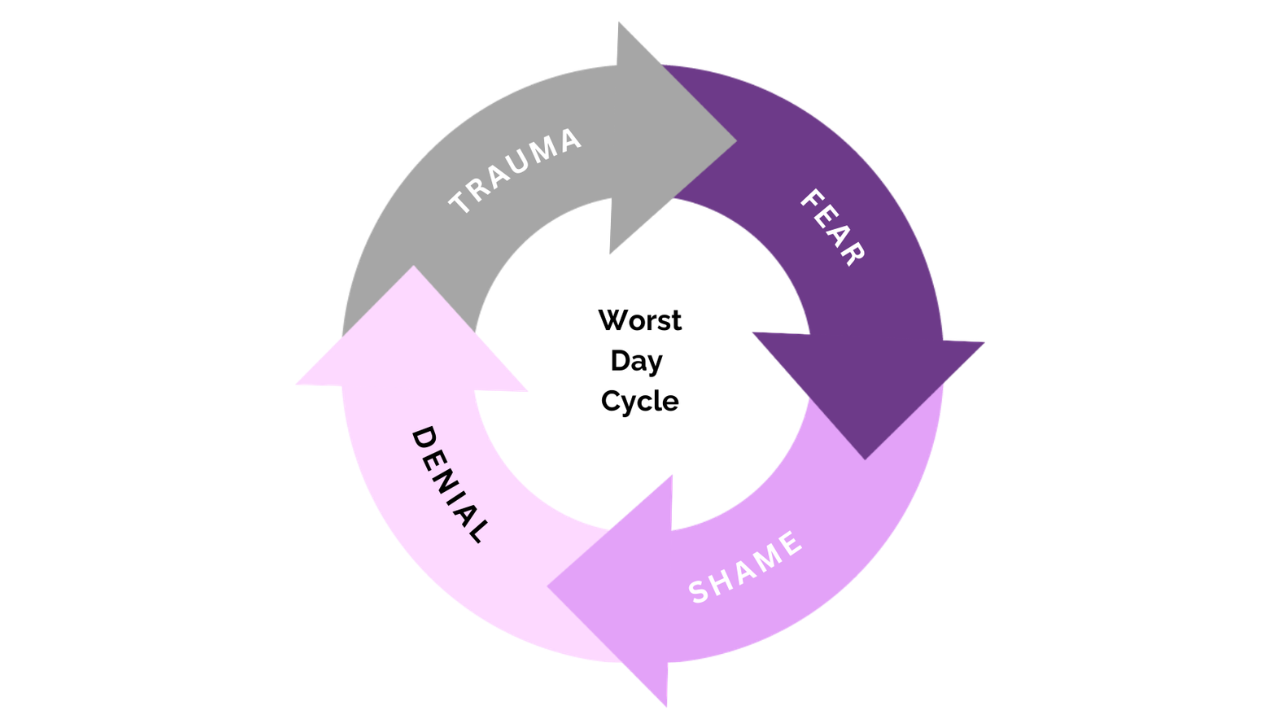
The Worst Day Cycle™ explains why your success feels empty: Trauma from childhood created Fear, Fear created Shame — the identity wound of “I am not enough” — and Shame created Denial, which is your Falsely Empowered survival persona achieving its way out of feeling the pain. Every accomplishment is another lap around the cycle, not an escape from it.
That’s you… closing the biggest deal of your career and feeling nothing — because the shame underneath just whispers “now do it again, or you’re worthless.”
How Do You Shift From Intellectualization to Your Authentic Self?
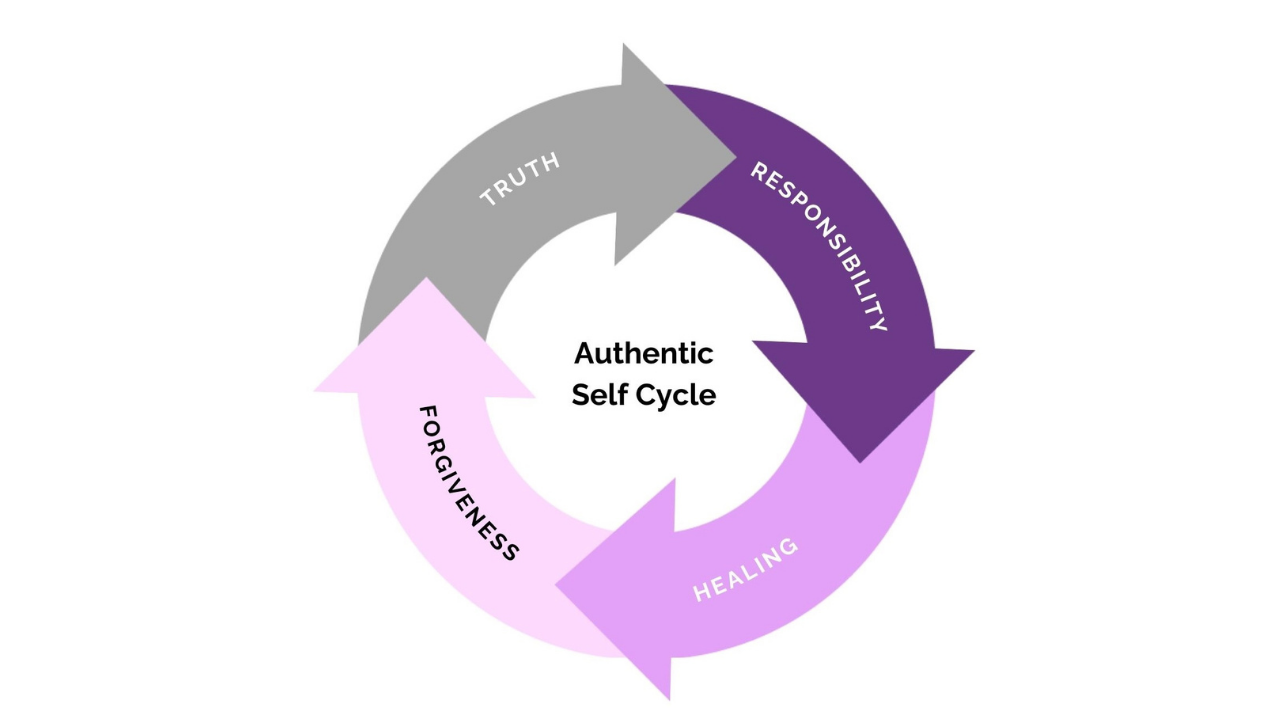
So, how do you stop the booster rockets, clear the smokescreen, and actually regulate your emotions? You have to shift from intellectualization to Emotional Authenticity through the Authentic Self Cycle™. You have to connect with your authentic self to start leading your inner emotional world.
Imagine you are sitting in a park. You are a massive, grounded, silverback gorilla sitting calmly on a park bench. All around you, in the trees, are frantic chimpanzees. They are screeching, swinging from branch to branch, throwing things, and creating total chaos.
When you get triggered — when the deal falls through, or your partner criticizes you — the chimpanzees in your brain take over. Your Survival Persona starts swinging from branch to branch: checking emails at 2:00 AM, catastrophizing, fixing, arguing, and defending.
That’s you… the CEO who runs a company with precision but can’t sit still for five minutes without checking email because stillness feels like dying.
Your goal is not to reason with the chimpanzees. Your goal is to be the big ape on the bench. The big ape doesn’t swing with them. The big ape just sits, breathes, observes the chaos, and remains completely contained.
That big ape is your Adult Authentic Self. And you bring the big ape back to the bench using the Emotional Authenticity Method™.
How Does the Emotional Authenticity Method™ Heal Triggers for High Achievers?
The next time you feel the panic rising, the next time your intellect tries to fix an unfixable problem, or you feel the urge to over-explain and defend yourself… I want you to stop. Stop trying to out-think the feeling.
Instead, I want you to become the big ape on the bench by activating metacognition. Take 15 to 30 seconds and focus entirely on your physical environment. What can you hear? What can you feel? What do you smell? Ground your nervous system.
Then, ask yourself these four root-cause questions:
Number One: What am I feeling right now? You have to drop the Emotional Smokescreen. Stop talking or thinking about the spreadsheet, the employee, or the money. Name the core emotion. “I feel powerless. I feel overwhelmed. I feel exhausted.”
That’s you… realizing you’ve never once named what you actually feel — you’ve only ever named what needs to be fixed.
Number Two: Where in my body do I feel it? High achievers live from the neck up. You must get into your body. “My chest is tight. My jaw is locked.” This connects your intellect to your somatic truth. Dr. Bessel van der Kolk’s research in The Body Keeps the Score proves that trauma is stored physically in your body — not in your thoughts — which is exactly why thinking your way out of a trigger never works.
Number Three: What is my earliest memory of having this exact feeling and sensation? This is where the scale finally balances. Because you will realize that the panic you feel about the business failing is the exact same panic you felt when you were eight years old, trying to keep your parents from getting a divorce. The smoke has cleared. You now see that the feeling is old. The danger is not happening right now. You are safe. You are the adult.
That’s you… connecting the panic about the board meeting to the exact same panic you felt trying to make your emotionally unavailable father proud.
Number Four: What would I think and feel if I never had this negative thought or feeling ever again? If this feeling of being overwhelmed were completely wiped off the face of the earth, and you could never feel it again… who would you be?

Do it now. Can you feel it? You feel grounded. You feel clear. You feel decisive, calm, and free.
That’s you… catching a glimpse of who you actually are without the armor, the title, and the relentless need to prove your worth.
That is your Authentic Self. For the first time, you can feel yourself without the shame that was transferred into you as a child. That is the fuel source you were meant to run on. You no longer need the booster rockets of shame. You can be successful, powerful, and driven simply because you enjoy creating, not because you are terrified of failing.
What Does High-Achiever Emotional Dysregulation Look Like Across Your Entire Life?
If you’re still wondering whether this applies to you, let me show you what high-achiever emotional dysregulation looks like when it bleeds across every area of your life — because your childhood emotional blueprint doesn’t stay in the boardroom. It drives everything.
Family: You are the one everyone calls when there’s a crisis. You fix the finances, mediate the arguments, and organize the holidays. But nobody asks how you’re actually doing — and you wouldn’t know how to answer if they did. When your parent makes a passive-aggressive comment about your choices, your body floods with the same defensive rage you felt at twelve, and you either shut down completely or deliver a devastating monologue that leaves everyone in stunned silence. You drive home feeling like a monster.
That’s you… being the family hero everyone depends on but never once being asked how you’re actually doing.
Romantic Relationships: You provide everything — the house, the vacations, the security. And then you resent your partner for not seeing the scared child underneath the provider. You equate love with performance, so when your partner asks for emotional intimacy, you feel trapped and inadequate. You either control the relationship with logic, withdraw into work, or explode when the emotional enmeshment from childhood gets activated. Every argument confirms your childhood definition: “If I’m not in control, I’m not safe.”
That’s you… being the provider who gives everything and then resenting your partner for not seeing the scared child underneath the success.
Friendships: You don’t really have friends — you have an audience. People admire you, respect you, and come to you for advice. But you keep everyone at arm’s length because letting someone close enough to see the real you feels like handing them a weapon. Your Falsely Empowered survival persona built a wall of competence around the wounded child, and intimacy threatens to expose what’s behind it. You tell yourself you don’t need close friends. You tell yourself you’re just “independent.”
Work and Career: You’ve built an impressive résumé, but one piece of constructive feedback can derail your entire week. Your Survival Persona equates criticism with the childhood message “you’re not good enough,” so you either rage at the person who gave the feedback, obsessively over-deliver to prove them wrong, or spiral into secret shame. Your self-esteem was never built on a foundation of authentic self-worth — it was built on performance, and performance can always be taken away.
That’s you… working yourself to the bone to prove your worth and then collapsing when the one person whose approval you need doesn’t give it.
Body and Health: Your body has been keeping the score of every suppressed emotion for decades. Chronic jaw tension from clenching through meetings. Stomach issues that no doctor can explain. Insomnia because your mind won’t stop running worst-case scenarios. You exercise obsessively — not for health, but for control. You ignore warning signs because slowing down feels more dangerous than burning out. Dr. Gabor Maté’s research shows that this exact pattern of emotional suppression drives autoimmune disorders, heart disease, and chronic fatigue in high performers.
That’s you… ignoring chest pain and chronic fatigue because slowing down feels more dangerous than burning out.
What Is Your Next Step to Stop Succeeding Your Way Out of Shame?
You cannot think your way out of trauma, and you cannot succeed your way out of shame. Emotional regulation isn’t about managing your stress so you can work harder. It is about taking radical responsibility for your childhood emotional blueprint programming and healing the shame that was placed into you so you can finally be free.
That’s you… ready to stop putting success Band-Aids on shame wounds and finally heal the blueprint that’s been running your life.
If you are sitting there right now, feeling overwhelmed and needing immediate guidance, there is something that will really help you. Go to KennyWeiss.net and talk to the brand-new AI clone. I have uploaded my entire brain — every book, every framework, and every solution you need directly into this AI. It is completely free to use, and it is literally like having a one-on-one conversation with me. You can ask it about your triggers, your relationship struggles, or your Worst Day Cycle™, and it will give you the exact, root-cause feedback I would give you. Go test it out and get the help you need right now.
While you are there, you can also take the completely free Childhood Assessment to help you identify the exact emotional origins of your Worst Day Cycle™. For those of you who are ready to map out your specific triggers and stop this loop for good, check out the books, classes, emotional freedom assessments, and private coaching to find what fits your emotional blueprint remapping journey.
Whatever choice you make, just know that when you are ready, you now have a root-level solution, not a symptom-based topical band-aid approach, that will provide you with the root-level emotional regulation you are looking for.
And don’t forget: You are not to blame, and you are not broken. You were just programmed, and programs can be rewritten. You did the best you could with the information you had at the time. But now that you know more, you can equip yourself with the tools to do more.
That’s you… finally understanding that the success was never the problem — it was the fuel source powering it.
If This Article Hit Home, the Book Goes Deeper
Everything I write about on this site — the Worst Day Cycle™, your childhood emotional blueprint, why you keep repeating the same patterns no matter how hard you try — it all started with my first book, Your Journey To Success: How to Accept the Answers You Discover Along the Way.
This is the book readers call “the first time I found a roadmap I could actually understand and that seemed attainable.” It is the book that walks you through WHY your life hasn’t changed despite all the work you’ve done — and shows you, step by step, exactly how to break free. No fluff. No motivational hype. Just the truth about what was done to you, why it stuck, and what to do about it.
If you’ve read this far, you already know something needs to change. This book is where that change starts.
Ready to Stop Understanding the Problem and Start Rewiring It?
The article you just read scratches the surface. My new book, Your Journey To Being Yourself: How to Overcome the Worst Day Cycle & Reclaim Your Authentic Self with Emotional Authenticity, gives you the complete system — the Worst Day Cycle™, the Authentic Self Cycle™, and the full Emotional Authenticity Method™ — all in one place, with the neuroscience behind every step.
This is the book readers call “a genius piece of art in mastering emotion and the art of healing.” It speaks directly to the person who feels stuck, overwhelmed, and confused by the same repeating patterns — the same arguments, the same relationship breakdowns, the same shame — and is done accepting surface-level answers. Every chapter combines powerful stories, clear steps, and practical tools that show you how to rewire your emotional patterns from the inside out.
You are not broken. You were programmed. And this book shows you exactly how to rewrite the program.
Frequently Asked Questions
Why do high achievers struggle with emotional regulation more than others?
High achievers struggle more because their success is fueled by childhood shame — the deep identity wound of “I am not enough.” The Falsely Empowered survival persona uses achievement to outrun that wound, creating a chemical addiction to cortisol and adrenaline. When you try to regulate emotions using logic or coping skills, you’re using the same intellectual defense mechanism that’s keeping you trapped. The Emotional Authenticity Method™ bypasses the intellect and addresses the emotional blueprint at its root.
What is the Falsely Empowered survival persona and how does it affect high performers?
The Falsely Empowered survival persona is one of three types identified in Kenny Weiss’s Worst Day Cycle™ framework. It is the over-achieving, controlling, dominating mask that a child creates when their home environment taught them that vulnerability equals danger. High performers often run on this persona for decades — using success, control, and intellectual dominance to avoid the underlying shame. The problem is that the persona is a booster rocket: explosive power that was never designed for sustainable flight.
Why doesn’t Cognitive Behavioral Therapy work for high-achieving trauma survivors?
CBT tells you to challenge your thoughts — but for high achievers, your thoughts are not the problem. Your childhood emotional blueprint generates the feelings, and then your brilliant intellect constructs thoughts to justify them. Dr. Lisa Feldman Barrett’s neuroscience proves that emotions are predictions from past experience, not reactions to the present. You cannot use the cognitive brain to override a prediction that was installed before you had language. The Emotional Authenticity Method™ works because it activates metacognition — the space between intellect and emotion.
What are the Scales of Injustice and how do they keep high achievers trapped?
The Scales of Injustice is Kenny Weiss’s metaphor for why external success never creates internal peace. Childhood shame placed a heavy weight on one side of the scale. Your survival persona tries to balance it by piling achievements, wealth, and status on the other side. But no amount of external weight can remove the original weight of shame — you have to feel and heal the wound directly. That is why the scale never balances no matter how much you achieve.
How is the Emotional Authenticity Method™ different from executive coaching or performance psychology?
Executive coaching and performance psychology optimize your survival persona — they help you perform better, manage stress more efficiently, and lead more effectively. But they never address the childhood emotional blueprint that created the persona in the first place. The Emotional Authenticity Method™ goes beneath performance to the root: the shame, the fear, and the childhood definitions that are generating every trigger. It doesn’t make you a better performer — it frees you from needing performance to feel worthy.
Can high achievers heal their childhood emotional blueprint without sacrificing their success?
Absolutely. Healing your emotional blueprint doesn’t eliminate your drive — it changes the fuel source. Instead of running on shame (the booster rocket), you run on authentic purpose, creativity, and genuine passion. Most high achievers who complete the Emotional Authenticity Method™ report that their performance actually improves because they are no longer wasting massive amounts of energy suppressing emotions, managing triggers, and maintaining the survival persona.
The Bottom Line
You have been using the most sophisticated survival mechanism on the planet — your intellect — to build an extraordinary life on a foundation of childhood shame. Every achievement, every title, every zero in your bank account was another brick in the wall between you and the terrified child you’ve been protecting since you were five years old.
The fact that you’ve read this far tells me something important about you. It tells me you already suspected that the success wasn’t filling the void. Something in you recognized that no amount of performance was going to buy you the peace you’ve been chasing. That recognition is your Authentic Self breaking through the noise of your Falsely Empowered survival persona.
Here’s what becomes possible when you stop running on shame and start running on authenticity: You stop performing and start being. You stop controlling and start connecting. You stop succeeding your way out of pain and start actually enjoying the success you’ve built. Not because you learned a better stress management technique — but because you rewired the childhood emotional blueprint that was turning every achievement into another lap around the Worst Day Cycle™.
You are not broken. You are not a fraud. You are not “too intense” or “too driven.” You were programmed — and programs can be rewritten. When you’re ready, the Emotional Authenticity Method™ will meet you exactly where you are.
Recommended Reading
These books deepen the understanding of why high achievers struggle with emotional regulation and how childhood emotional blueprints fuel success at the cost of inner peace:
Lisa Feldman Barrett — How Emotions Are Made
The neuroscience proving that emotions are predictions based on past experience — essential for understanding why your intellect cannot override your childhood programming.
Bessel van der Kolk — The Body Keeps the Score
How trauma is stored in the body, not the mind — and why high achievers who live from the neck up cannot think their way to emotional freedom.
Gabor Maté — When the Body Says No
The devastating physical cost of suppressing emotions through achievement and control — the research behind why the booster rocket eventually explodes.
Pete Walker — Complex PTSD: From Surviving to Thriving
Understanding the survival responses that childhood emotional programming creates — and why the Falsely Empowered persona is the most difficult to recognize because it looks like success.
Take Your Next Step With Kenny Weiss
If this article resonated with you and you’re ready to stop succeeding your way out of shame and start rewiring your childhood emotional blueprint, explore these resources:
Start Here:
• Emotional Blueprint Starter Course — Individual ($79) — Your individual roadmap for identifying your Worst Day Cycle™ patterns and the shame fuel driving your achievement
• Relationship Starter Course — Couples ($79) — Map the collision between both partners’ childhood emotional blueprints — essential for high achievers whose relationships suffer
Go Deeper:
• Why We Can’t Stop Hurting Each Other ($479) — Understand the Worst Day Cycle™ collision between partners
• Why High Achievers Fail at Love ($479) — Built specifically for the Falsely Empowered survival persona who built a career but can’t build intimacy
• The Shutdown Avoidant Partner ($479) — Root-cause work for the high achiever who withdraws, intellectualizes, and avoids emotional vulnerability
Full Transformation:
• Tier 1: Mapping the Blueprint ($1,379) — The comprehensive program for rewiring your childhood emotional blueprint and changing the fuel source of your life
Download Kenny’s free Feelings Wheel to begin building emotional granularity — the foundation of the Emotional Authenticity Method™ and the first step for high achievers who have never named what they actually feel.
Explore Kenny’s articles on signs of enmeshment, insecurity in relationships, codependence recovery, and 10 do’s and don’ts for a great relationship for more on how your childhood emotional blueprint shapes every area of your life.