Self-confidence is the deep internal knowing that you are worthy exactly as you are—not because of what you’ve achieved, how much money you make, or how many people approve of you. It’s the groundedness that comes from accepting yourself fully, including your flaws, mistakes, and imperfections. Real self-confidence emerges when you shift from being a human doing (performing, achieving, proving yourself) to being a human being (present, authentic, and accepting of your intrinsic worth). This shift is neurological, emotional, and spiritual. It begins in childhood through your emotional blueprint—the patterns of shame, fear, and self-doubt that were wired into your nervous system by your family of origin. When you were young, you learned whether you were safe, worthy, and lovable based on how you were treated, what was modeled, and what messages you received about yourself. If those messages were conditional (you’re only good if you achieve, look a certain way, or meet others’ expectations), your growing nervous system learned that your worth had to be earned. This creates what we call the Worst Day Cycle™—a repeating pattern of trauma, fear, shame, and denial that masquerades as confidence through achievement but is actually rooted in deep shame. The path to genuine self-confidence requires understanding this cycle, identifying the survival personas you created to protect yourself, and moving through the Authentic Self Cycle™—a process of truth, responsibility, healing, and forgiveness that rebuilds your ability to be in the world authentically.
What Is Self-Confidence? Human Being vs. Human Doing
Self-confidence has been completely misunderstood in our culture. We’ve been taught that confidence comes from achievement—getting good grades, making more money, building a successful business, hitting fitness goals, gaining status. But this is a lie. And a dangerous one.
There are two ways to move through the world: as a human being or as a human doing. A human being trusts their inherent worth. They don’t need external validation because they’ve already accepted themselves. A human doing, on the other hand, is always performing. Always proving. Always chasing the next accomplishment to feel okay about themselves.
That’s you if you feel like nothing you do is ever enough, or if you constantly need the next achievement to feel temporarily okay.
This is the core truth: real self-confidence isn’t about what you accomplish. It’s about who you are when no one’s watching. It’s the quiet knowing that you’re worthy exactly as you are—flaws included.
When you’re a human being, you can relax. You can be yourself. You can make mistakes without your identity shattering. You can fail at something without believing you’re a failure as a person. But when you’re a human doing, every setback feels like a referendum on your worth.
Most high achievers, most successful people on the outside, are human doings on the inside. They look confident. They sound confident. But the moment you look beneath the surface, you find someone terrified of being found out. Someone who believes if they stop achieving, they’ll be exposed as a fraud, as fundamentally unworthy.
Sound familiar?
How Childhood Stole Your Confidence
Your confidence didn’t just develop randomly. It was built—or destroyed—in childhood. Your early years created what we call your emotional blueprint: the deep patterns of how you see yourself, whether you believe you’re safe, worthy, and lovable, and what you have to do to earn love and acceptance.
If your parents or caregivers made their love conditional—if you were only truly seen and celebrated when you achieved, when you were “good,” when you didn’t burden them, when you performed—your nervous system learned: I am only worthy when I’m useful. I am only lovable when I meet expectations.
This happens in multiple ways. Maybe your parents were emotionally unavailable—too caught up in their own struggles to truly attune to you. Maybe they criticized constantly. Maybe they compared you to siblings or peers. Maybe they withdrew love when you disappointed them. Maybe they were never satisfied no matter what you achieved. Maybe they put their own emotional needs on you.
That’s you if you feel like you have to prove yourself constantly, or if you fear people will leave you if you’re not impressive enough.
Here’s the devastating part: your childhood brain couldn’t question these messages. It couldn’t think, “My parents are struggling with their own shame and projecting it onto me.” No. Your developing nervous system absorbed these messages as absolute truth: This is who I am. This is what I have to do to survive.
And your brain literally wired itself around these messages. The neural pathways that were reinforced by repetition became your automatic patterns. The shame that was implanted became your operating system. The strategies you developed to get love and safety became hardwired survival responses.
This is why no amount of adult success fixes it. You could become a millionaire, get the dream job, achieve the body you always wanted—and you’d still feel like a fraud. Still feel unworthy. Still need the next achievement to feel temporarily okay. Because the blueprint says: You are not enough.
The Worst Day Cycle™: How Shame Destroys Confidence
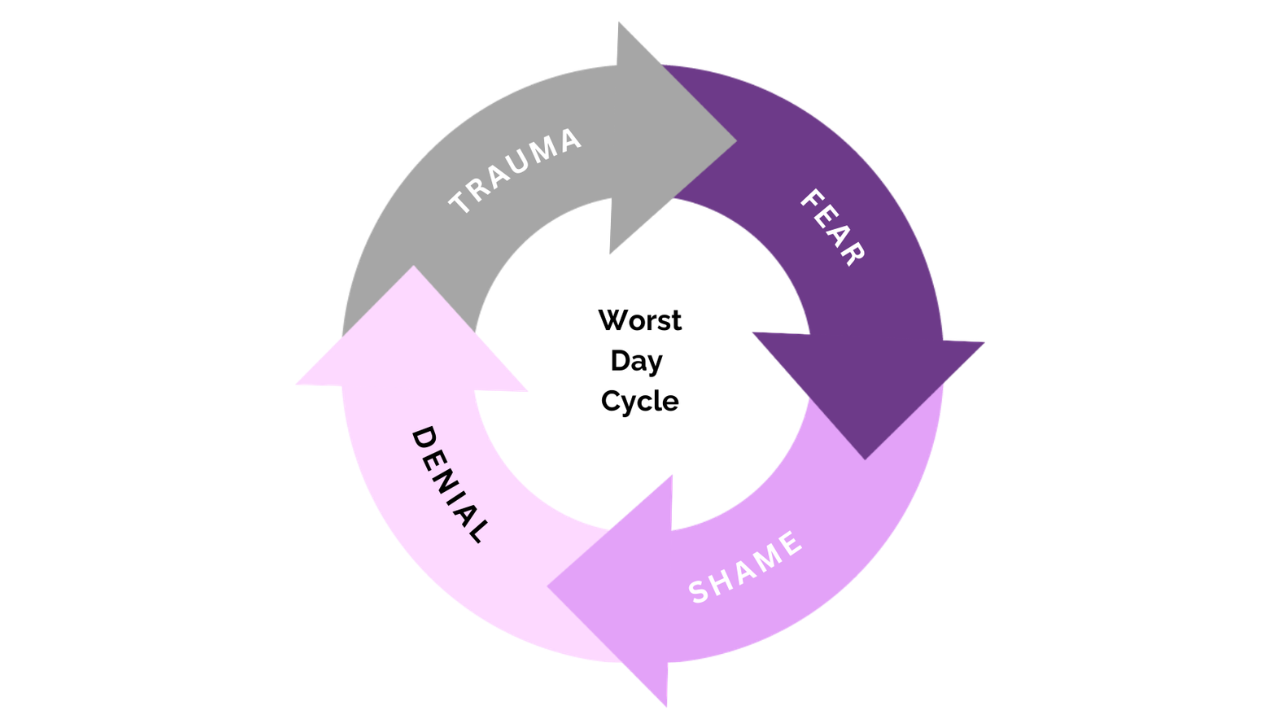
The emotional blueprint creates what we call the Worst Day Cycle™—a four-stage neurological and emotional pattern that destroys your ability to be confident. This cycle runs on autopilot, and most people have no idea it’s happening.
Stage 1: Trauma (The Trigger)
Something happens—usually something that reminds your nervous system of the original wound from childhood. Maybe someone gives you critical feedback. Maybe you make a mistake. Maybe someone leaves you. Maybe you don’t get the job. Maybe you feel invisible or rejected. Your nervous system instantly recognizes this as a threat to your worth and safety.
Stage 2: Fear (The Chemical Cocktail)
Your brain floods your body with a chemical cocktail: cortisol, adrenaline, and other stress hormones. Your nervous system goes into survival mode. Your amygdala—the alarm center of your brain—screams danger. Your prefrontal cortex—the part that thinks rationally and makes good decisions—shuts down. You’re no longer thinking. You’re reacting from primal fear.
That’s you if you feel panicked when someone criticizes you, or if rejection triggers an intense emotional response.
Stage 3: Shame (The Distortion)
In this flooded state, your brain can’t tell the difference between what’s real and what’s known (familiar from childhood). It doesn’t think: “I made a mistake, and mistakes are how humans learn.” Instead, your brain—flooded with fear chemicals and accessing childhood patterns—thinks: I am a mistake. I am fundamentally flawed. I am unworthy. I deserve this pain.
This is the neurological reality: when shame activates, your brain receives a barrage of negative messaging—studies suggest we give ourselves 70% negative self-talk in these moments. Your brain literally cannot access the truth. It can only access the program that was installed in childhood: You’re not good enough.
Stage 4: Denial (The Survival Mechanism)
Shame is too painful to sit with. So your psyche creates an escape route. You deny what happened. You minimize it. You rationalize it away. You project it onto someone else. You numb it with achievement, food, alcohol, shopping, working, scrolling, or any other compulsion. You essentially leave your body and your authentic self and step into a survival persona.
And here’s the trap: this denial creates a temporary sense of relief, so your nervous system learns: This works. This is how I survive. The pattern gets reinforced. The next time you’re triggered, you’ll follow the same cycle. Trauma → Fear → Shame → Denial. Over and over. Your nervous system is literally trapped in a feedback loop.
That’s you if you find yourself repeating the same relationship patterns, making the same mistakes, or feeling stuck in a cycle of self-sabotage.
The Three Survival Personas That Fake Confidence
To survive shame, your psyche creates what we call survival personas—false selves designed to protect your wounded inner child from further pain. These personas are not who you actually are. They’re coping mechanisms. And while they helped you survive childhood, they’re now destroying your relationships and your life.
There are three primary survival personas:
1. The Falsely Empowered Persona
This is the over-achiever, the controller, the person who looks supremely confident on the outside. They’re driven, ambitious, successful. They control everything they possibly can because controlling things feels safer than vulnerability. They often come across as arrogant or cold, but underneath that armor is someone terrified of being found out as a fraud, as fundamentally unworthy.
This persona says: “I’ll prove my worth through achievement. I’ll be so successful, so impressive, so undeniable that no one can reject me. I’ll never be vulnerable because vulnerability means exposure.”
That’s you if you’re driven to succeed, struggle with control, or feel deeply uncomfortable being vulnerable or asking for help.
2. The Disempowered Persona
This persona is the opposite. It’s the person who shrinks, who plays small, who makes themselves invisible. They learned in childhood that being seen was dangerous—maybe they had a narcissistic parent who couldn’t tolerate their child’s autonomy, or a volatile parent whose moods made visibility unsafe. So they learned to disappear. To be quiet. To take up less space. To never ask for what they need.
This persona says: “I’m not worthy. I don’t deserve to be heard. I’ll just fade into the background and let everyone else have their needs met.”
That’s you if you struggle to speak up, feel invisible, or believe your needs don’t matter.
3. The Adapted Wounded Child Persona
This persona is the people-pleaser, the caretaker, the one who’s always trying to manage everyone’s emotions and keep the peace. They often had a parent or sibling with addiction, mental illness, or emotional dysregulation, and they learned to read the room, manage others’ feelings, and sacrifice their own needs to maintain stability.
This persona says: “My job is to take care of others. If everyone around me is okay, then maybe I’m safe. Maybe they’ll stay. Maybe they’ll love me.”
Sound familiar?
Here’s what’s critical: you might have one dominant persona, or you might shift between personas depending on the relationship or context. And all three personas are forms of self-abandonment. You’ve left your authentic self—the real you underneath the armor—and stepped into a survival persona designed to survive.
The problem is, people can sense the falseness. You can’t truly connect with anyone while wearing a survival persona because you’re not fully present. You’re not authentically you. And this is why shame-based people often feel deeply isolated even in relationships. You’re performing, protecting, people-pleasing, controlling—everything except being yourself.
7 Steps to Build Real Self-Confidence
Building genuine self-confidence means interrupting the Worst Day Cycle™ and stepping out of your survival personas. It’s not a linear process, and it’s not fast. But it’s profoundly possible. Here are the seven core steps:
Step 1: Awareness of the Cycle
You can’t change what you don’t see. Start noticing when you enter the Worst Day Cycle™. What triggers it? What does shame feel like in your body? When do you shift into a survival persona? Simply noticing these patterns—without judgment—is the first step toward freedom.
That’s you if you’ve ever wondered why you keep ending up in the same painful situations — your Worst Day Cycle™ is running on autopilot.
Step 2: Grounding the Nervous System
When you’re in the fear stage of the cycle, your prefrontal cortex is offline. You can’t think your way out. You need to regulate your nervous system first. This might mean breathwork, movement, cold water, sound, or any somatic practice that brings you back into your body. Your nervous system has to feel safe before your brain can process truth.
Step 3: Separating Fact from Belief
In the shame stage, your childhood beliefs masquerade as facts. Your brain says: “I am unworthy.” But that’s a belief installed in childhood, not a fact. The fact is: you made a mistake, or you were rejected, or you failed at something. The belief is: “This means I’m fundamentally flawed.” Learning to separate these is crucial.
Step 4: Compassion for Your Younger Self
The shame and self-doubt you carry came from somewhere. A child—you—learned these messages from people you depended on. That child did the best they could with the nervous system they had. They created survival personas because they needed them to survive. When you can access compassion for that younger version of you, something shifts. Shame begins to transform.
Step 5: Identifying and Challenging Old Messages
What messages about yourself did you internalize in childhood? “You’re not smart enough.” “You’re too sensitive.” “You’re selfish for having needs.” “You’ll never be good enough.” These are the operating instructions your nervous system still runs on. Identifying them is the first step. Challenging them is the second. Are they true? Or are they lies you absorbed from people who were struggling?
Step 6: Taking Back Emotional Responsibility
That’s you if you still hear your parent’s voice in your head every time you make a mistake — those messages aren’t yours to carry anymore.
This doesn’t mean blaming yourself for what was done to you in childhood. It means recognizing that as an adult, you now have the ability to parent yourself differently. You can choose to believe different things about yourself. You can choose different responses. You can actively work to rewire your nervous system. This is empowering, not shameful.
Step 7: Consistent Practice of Authenticity
Sound familiar? That’s the survival persona whispering that you can’t handle the truth about yourself — but you can, and you’re stronger than you know.
Real change happens through repetition. You have to practice being authentic, being vulnerable, telling the truth, disappointing people, being imperfect—over and over again. Each time you do, you’re rewiring your nervous system. You’re building new neural pathways. You’re teaching your brain: “I can be myself and I’m still safe. I can be imperfect and I’m still worthy.”
The Emotional Authenticity Method™: 6-Step Practice for Confidence
The Emotional Authenticity Method™ is a practical framework for moving through shame and building real confidence. It’s a six-step process you can use whenever you’re triggered, whenever you feel yourself shifting into a survival persona, whenever shame shows up.
Step 1: Notice (Awareness Without Judgment)
Something triggered you. Instead of immediately trying to fix it or numb it, just notice: “I’m having a shame response right now. My body feels tight. My mind is racing. I want to perform/disappear/fix things.” This is pure observation. No judgment. No trying to be different.
Step 2: Name (Identify What You’re Feeling)
Get specific. Are you feeling shame? Fear? Anger at yourself? Rejection sensitivity? Unworthiness? The more precise you can be, the more your nervous system settles. Check out the Feelings Wheel if you struggle to identify emotions—it’s incredibly helpful for building emotional vocabulary.
Step 3: Ground (Regulate Your Nervous System)
Your body is in survival mode. You need to signal safety. This might be: deep breathing (4 counts in, 6 out), cold water on your face, putting your feet on the ground, movement, sound, or holding something cold. You’re telling your nervous system: “You’re safe now. We’re not in danger.”
Step 4: Trace (Connect to the Original Wound)
This feeling you’re having—where did it originate? What childhood memory does it connect to? What message about yourself does it activate? You don’t have to relive the trauma. You’re just making the connection between current triggered response and original source. This is where you begin to separate the past from the present.
Step 5: Truth-Tell (Speak the Reality)
What’s actually true in this moment? Not the shame story. Not the childhood belief. The actual truth. Maybe it’s: “I made a mistake and mistakes don’t define my worth.” Or: “Someone left me and that’s painful, but it doesn’t mean I’m unlovable.” Or: “I’m struggling and that’s being human, not being defective.” Speaking this truth out loud—to yourself or to a trusted person—is powerful. It interrupts the denial pattern.
Step 6: Feelization (Feel It All the Way Through)
Here’s where most people stop. They get to truth-telling and think the work is done. But healing requires feeling. You have to let yourself actually feel the sadness underneath the shame. The grief for what you didn’t get. The anger at how you were treated. The fear you’ve been carrying. The relief of telling the truth. You feel it fully, without trying to fix it or escape it. And when you let emotion move through you—rather than being stuck in the shame denial cycle—something neurologically shifts. Your nervous system learns: “Feeling is safe. It won’t kill me.”
That’s you if you’ve been numb for a long time and healing begins when you finally allow yourself to feel.
The Authentic Self Cycle™: Rebuilding From the Inside
While the Worst Day Cycle™ is what most people unconsciously run, the Authentic Self Cycle™ is what healthy people run—or what you can learn to run. It’s a four-stage process of Truth → Responsibility → Healing → Forgiveness, and it’s how you build genuine self-confidence.
Stage 1: Truth (Breaking Denial)
Real confidence begins with honesty. Not just intellectual honesty—emotional honesty. You stop denying what happened to you. You stop minimizing the impact. You stop lying about who you are or what you feel. You look at the patterns. You acknowledge the wounds. You admit what you’ve been trying to hide. This is terrifying because denial kept you safe. But truth is the foundation of everything that follows.
Stage 2: Responsibility (Adult Ownership)
This is not blame. This is not shame. Responsibility is: “I acknowledge that I have the power to choose differently going forward.” You can’t change what happened in childhood. But you can change how you respond to it now. You can choose to reparent yourself. You can choose authenticity instead of performance. You can choose healing instead of denial. Taking responsibility is profoundly empowering because it returns your power to you.
Stage 3: Healing (Rewiring the System)
Healing is the ongoing practice of interrupting old patterns and installing new ones. It’s grieving what you didn’t get in childhood. It’s releasing the survival personas you no longer need. It’s doing the practices—therapy, somatic work, meditation, journaling, whatever works for you—to rewire your nervous system. Healing isn’t linear. There will be setbacks. But each time you choose truth instead of denial, each time you ground yourself instead of spiraling, each time you practice authenticity instead of performance, you’re rewiring your brain. You’re building myelin—the insulation around neural pathways that makes them faster and more automatic. Eventually, authenticity becomes as automatic as the old shame patterns were.
Stage 4: Forgiveness (Freedom From the Past)
This is where real confidence solidifies. Forgiveness doesn’t mean the hurt didn’t happen. It doesn’t mean you condone what was done. It means you stop letting the past control you. You forgive your parents for struggling with their own shame and passing it to you. You forgive yourself for the coping mechanisms you had to create. You forgive the people who triggered you. You release the expectation that the past should have been different. And in that release, you become free to be yourself in the present.
The Authentic Self Cycle™ is what genuine confidence is built on. It’s not a fake it till you make it. It’s not positive affirmations. It’s not pretending you’re fine when you’re not. It’s the slow, sometimes painful, utterly rewarding work of becoming authentically yourself.
That’s you if you’ve tried every self-help trick and nothing sticks — because you were trying to build confidence on top of an unhealed shame foundation.
How Low Self-Confidence Shows Up Across Your Life
Low self-confidence isn’t just something you feel. It manifests across every area of your life. Here’s what to look for:
In Your Family Relationships
You might find yourself constantly seeking approval from your parents or extended family. Or you might be overfunction—managing everyone’s emotions, fixing problems, being the responsible one. You might struggle to set boundaries because you believe your needs don’t matter. You might feel like you have to earn your family’s love through achievement or compliance. You might feel like a kid in their presence, unable to claim your own authority.
That’s you if you still feel like you have to prove yourself to your family.
In Your Romantic Relationships
Low confidence manifests as settling for less than you deserve. Staying in relationships that don’t serve you because you don’t believe you can do better. Tolerating disrespect. Constantly trying to be the “right” version of yourself to keep your partner happy. Losing yourself in the relationship. Struggling with jealousy or possessiveness because you don’t believe they’d actually choose you. Having sex you don’t want. Not asking for what you need. Reading their moods constantly to make sure they’re okay.
Or the opposite: being unavailable. Being coldly independent. Not letting anyone in. Pushing people away before they can reject you. Check out our post on signs of insecurity in relationships to dive deeper.
In Your Friendships
You might feel like the less-than friend. The one who’s always there for others but can’t ask for support. The one who says yes to everything because you’re afraid if you say no, they’ll leave. The one who over-shares early because you’re trying to build intimacy before you’re ready. The one who gossips or tears others down to feel better about yourself. The one who has trouble trusting that people actually like you.
That’s you if you have acquaintances but few true friends, or if you feel replaceable in your friendships.
In Your Work Life
Low confidence shows up as imposter syndrome—feeling like you don’t deserve your position and someone will eventually expose you. Not asking for promotions or raises because you don’t believe you’ve earned them. Staying in jobs that undervalue you. Not speaking up in meetings. Letting coworkers take credit for your work. Or the opposite: being overly controlling, taking on too much, needing to prove your value through overwork.
That’s you if you’re exhausted from trying to prove your worth through performance — your survival persona has turned your career into a shame management system.
In Your Body and Health
This might look like body shame—hating how you look and believing you need to punish yourself through restrictive dieting or overexercise. Or using food, substances, or other numbing behaviors to escape emotional pain. Not taking care of your health because you don’t believe you’re worth the care. Experiencing shame in medical settings and avoiding doctors. Struggling with sexual confidence and body image during intimacy.
People Also Ask
What is the difference between self-confidence and self-esteem?
Self-esteem is your overall evaluation of your worth as a person. Self-confidence is your belief in your ability to handle situations. You can have high self-esteem but low confidence in specific areas (like public speaking), or low self-esteem but false confidence in areas where you overperform. Real, integrated confidence combines both: you know you’re worthy as a person, AND you trust your ability to navigate challenges. Most people who look confident on the outside actually have low self-esteem underneath—they’re performing in areas where they feel confident to compensate for deep unworthiness.
Why do I lose my confidence around certain people?
Certain people activate your original shame wound. This usually happens with authority figures (people who remind you of a parent), people you’re trying to impress, or people who represent rejection. Your nervous system recognizes a threat to your worth and automatically shifts into a survival persona. You start performing. Start people-pleasing. Start shrinking. Your authentic self disappears. This is neurological, not a character flaw. Once you understand which people trigger which wounds, you can practice grounding techniques and authentic self-expression in their presence. Each time you do, you rewire your nervous system’s response.
Can you build self-confidence after childhood trauma?
Absolutely yes. In fact, many of the most confidently authentic people have faced significant childhood trauma. The difference is they did the work to heal it. Trauma rewires your nervous system in ways that make confidence feel impossible. But the brain is neuroplastic—it can rewire. Through practices like therapy, somatic work, emotional authenticity, and consistent practice of being yourself, you absolutely can rebuild your nervous system. It takes time and dedication, but it’s deeply possible.
Why do high achievers lack real self-confidence?
Because achievement is a survival mechanism, not a measure of worth. High achievers were often children who learned that their worth was conditional—based on performance, grades, success, or meeting parents’ expectations. So they became human doings: always achieving, always striving, always needing the next accomplishment to feel okay. The higher they climb, the more they accomplish, the more they prove they’re operating from shame, not confidence. Real confidence would allow them to rest, to fail, to be mediocre. High achievers fear that more than anything. That’s why so many high-achieving, successful people are deeply insecure underneath.
How long does it take to build genuine self-confidence?
There’s no timeline. Some people have breakthroughs relatively quickly; for others it’s years of consistent work. What matters isn’t speed, it’s direction. Are you moving toward authenticity or away from it? Are you interrupting old patterns or reinforcing them? Are you getting support or trying to do it alone? The people who see the fastest transformation are those who: (1) understand the root of their shame, (2) commit to consistent practice, (3) get professional support, and (4) build community around their healing. Self-confidence is built through repetition. Each time you choose truth instead of denial, authenticity instead of performance, you’re building the neural pathways of genuine confidence.
Is self-confidence something you’re born with or can it be learned?
Some people are born into families that nurtured confidence and built secure nervous systems. But most people weren’t. Most of us were born into families where love was conditional, where shame was passed down, where our worth had to be earned. And that can all be changed. The human brain is capable of learning and rewiring at any age. Confidence is a skill—like playing an instrument or speaking a language. It requires practice, patience, and consistency. You absolutely can learn genuine self-confidence as an adult, even if you didn’t develop it in childhood.
Recommended Reading
Facing Codependence by Pia Mellody — The definitive guide to understanding how childhood shame creates codependency patterns and how to heal them.
The Body Keeps the Score by Bessel van der Kolk — Essential reading for understanding how trauma gets stored in the nervous system and somatic approaches to healing.
When the Body Says No by Gabor Maté — Explores the connection between suppressed emotions, stress, and illness; shows why acknowledging emotions is essential for health.
Codependent No More by Melody Beattie — A practical guide to setting boundaries and reclaiming your own emotional responsibility.
The Gifts of Imperfection by Brené Brown — Explores vulnerability, shame resilience, and authentic living; beautiful companion to confidence work.
Ready to Build Real Confidence?
Healing your emotional blueprint and building genuine self-confidence is possible. Our courses guide you through the exact frameworks and practices in this post, with support and community.
Emotional Blueprint Starter Course — Individual ($79) — A foundational course on understanding your emotional patterns and healing shame.
Tier 1: Mapping the Blueprint ($1,379) — Our signature program combining the Emotional Authenticity Method™, Worst Day Cycle™, and Authentic Self Cycle™ with live coaching.
Why High Achievers Fail at Love ($479) — Specifically for high-performing people who struggle with real confidence and authentic connection.
The Shutdown Avoidant Partner ($479) — If you tend toward the disempowered or falsely empowered persona in relationships.