
You’re standing in the kitchen and a cabinet door doesn’t close all the way. You slam it. Then you slam it again. Then you’re yelling at your partner about how nobody in this house respects anything. Your hands are shaking. Your chest is tight. And somewhere in the back of your mind, a quiet voice whispers: this isn’t about the cabinet.
It never is.
Emotional avoidance is the pattern of dodging, minimizing, or numbing uncomfortable emotions — and it is the single most destructive habit in adult relationships, career, health, and self-worth. Every time you swallow a feeling, ignore a boundary violation, or tell yourself “it’s not that big of a deal,” you’re dropping another quarter into an invisible bucket. And that bucket always overflows. The explosion that follows — the rage, the tears, the shutdown — feels disproportionate because it is disproportionate to the moment. But it is perfectly proportionate to the decades of unprocessed childhood pain you’ve been carrying.
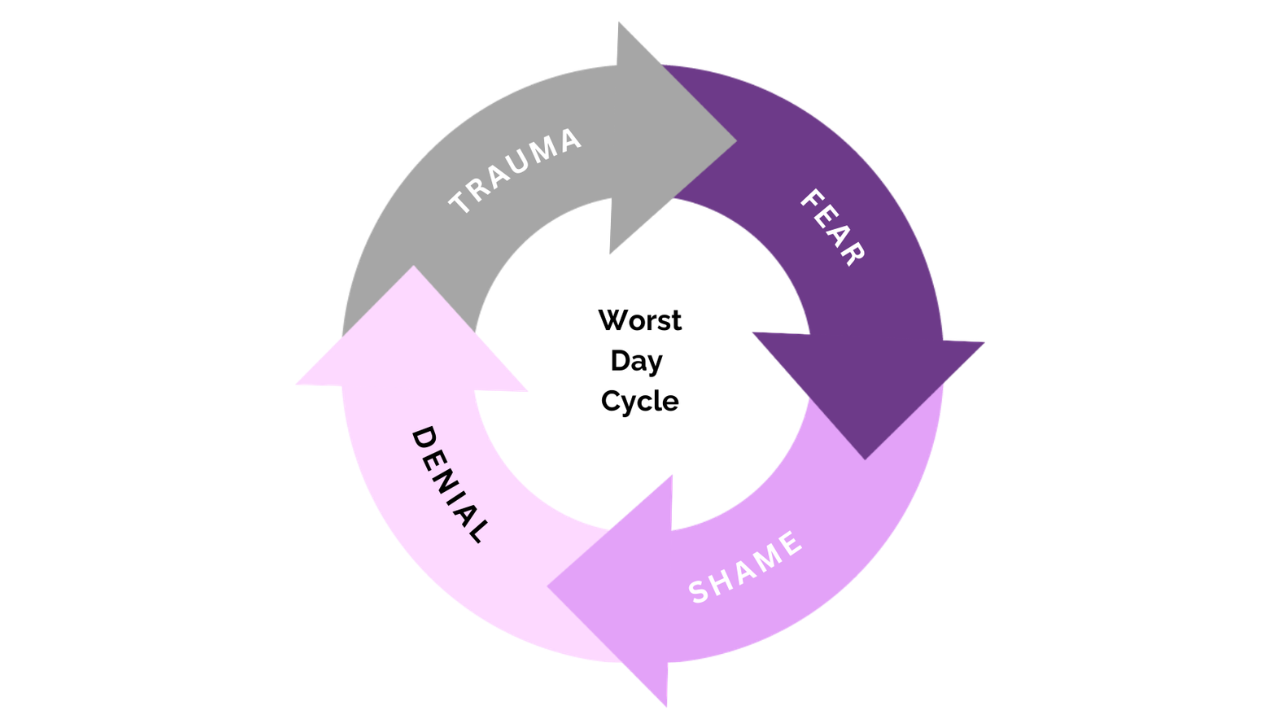
This is how the Worst Day Cycle™ works. Childhood trauma creates fear. Fear creates shame. Shame creates denial. And denial — emotional avoidance — keeps the entire cycle spinning. The good news? Once you see it, you can break it. This post will show you exactly how.
What Is Emotional Avoidance?
Emotional avoidance is any strategy — conscious or unconscious — that prevents you from feeling what you actually feel. It sounds like “I’m fine.” It looks like scrolling your phone during an argument. It feels like that third glass of wine you didn’t plan on having.
That’s you — telling yourself the fight with your mother wasn’t that bad while your stomach has been in knots for three days.
Most people don’t realize they’re avoiding. That’s because emotional avoidance was learned so early — typically before age ten — that it doesn’t feel like avoidance. It feels like who you are. You think you’re “the calm one” or “the strong one” or “the one who doesn’t let things bother them.” But underneath that identity is a child who learned that emotions were dangerous, unwelcome, or useless.
Denial is not lying. Denial is an emotional anesthetic — it puts distance between how big those childhood moments were and what your parents said or did. In that moment, you had to make sense of it. You had no other options. So denial taught you to say: “What mom and dad just said or did? It’s not that big a deal.”
That’s you — minimizing your own pain because someone taught you that your feelings were an inconvenience.
The Quarter in the Bucket: How Small Avoidances Become Big Explosions
Picture a bucket hanging by a rope. Every time you avoid a feeling — every confrontation you dodge, every boundary you don’t set, every chocolate you sneak that sabotages your diet, every drink you pour instead of having the conversation — you’re tossing a quarter into that bucket.
CLINK. The confrontation you avoid.
CLINK. The phone call you don’t want to make.
CLINK. The feeling you try not to feel.
CLINK. The “I can break my morals and values this one time.”
CLINK. The boundary violation you pretend didn’t happen.
CLINK. The TV show you watch instead of talking to your kids.
CLINK. The “I’ll deal with it next time.”
That’s you — telling yourself it’s no big deal while the rope is already fraying.
Then one day — a cabinet doesn’t close, someone cuts you off in traffic, your partner asks a simple question in the wrong tone — and the rope snaps. The bucket comes hurtling down. You’re screaming, crying, shaking. You know you shouldn’t be this upset. You know it doesn’t make sense. But you can’t stop.
The explosion is never about the moment. The explosion is the accumulated weight of every quarter you ever dropped into that bucket instead of facing the fear underneath.
That’s you — wondering why you can’t stop yourself from overreacting, not realizing your entire childhood is sitting at the table with you.
Why You Avoid Emotions: The Worst Day Cycle™ Explained
Emotional avoidance isn’t a character flaw. It’s a survival strategy that was brilliant in childhood and devastating in adulthood. It lives inside a four-stage pattern called the Worst Day Cycle™: Trauma → Fear → Shame → Denial.
Stage 1: Trauma. Childhood trauma is any negative emotional experience that created painful meanings. It doesn’t have to be abuse. It can be a parent who was emotionally unavailable, a household where feelings were dismissed, a caregiver whose mood swings kept you hypervigilant. The child’s brain generates a massive chemical reaction — cortisol, adrenaline, dopamine misfires — and the brain becomes addicted to these emotional states.
That’s you — thinking your childhood “wasn’t that bad” while your nervous system tells a completely different story.
Stage 2: Fear. The brain conserves energy by repeating known patterns. It cannot tell right from wrong — only known versus unknown. Since over seventy percent of childhood messaging is negative and shaming, the brain keeps pulling you back toward familiar pain. Fear drives repetition because the brain equates repetition with safety.
Stage 3: Shame. This is where you lost your inherent worth. Shame is not guilt — guilt says “I did something bad.” Shame says “I am something bad.” Shame strips self-authorship and replaces it with survival persona roles. It is a power loss — the loss of inherent value, inherent worth, the ability to ask for needs and wants, and the ability to be the author of your own life.
That’s you — working overtime, people-pleasing, performing, achieving — all to prove you’re worthy of love that was supposed to be unconditional.
Stage 4: Denial. To protect the authentic self from the truth of what happened, denial shows up. It can sound like: “My childhood wasn’t that bad.” “I’ve done the work on that.” “Other people had it worse.” “This is just how relationships are.” “If I could just stop being so sensitive, this would all be fine.” The goal of denial is to keep the focus on managing symptoms — keeping you in your survival persona and preventing you from feeling the emotional weight of the original trauma.
That’s you — intellectualizing your pain, making spreadsheets of your problems, using logic to think away feelings that are biochemical events stored in your body.
Three Survival Personas That Keep You Stuck in Avoidance
Denial doesn’t just sound one way. It wears a face — your face. The survival persona is the identity you created in childhood to survive pain. It was brilliant then. It is destroying you now. There are three types:
The Falsely Empowered Persona controls, dominates, and rages. This person avoids vulnerability by staying in power. They’re the one slamming cabinets, yelling in traffic, demanding everyone do things their way. Their avoidance sounds like: “I don’t have the problem — you do.”
That’s you — confusing control with confidence, not realizing the rage is a cover for the terror underneath.
The Disempowered Persona collapses, people-pleases, and gives themselves away. This person avoids conflict by disappearing. They say “I’m fine” when they’re not. They absorb everyone else’s emotions. Their avoidance sounds like: “It’s not worth fighting about.”
That’s you — keeping the peace at the cost of your own existence, wondering why you feel invisible in your own life.
The Adapted Wounded Child oscillates between both — dominating in one relationship, collapsing in another. Sometimes controlling at work and people-pleasing at home. Sometimes the opposite. Their avoidance sounds like: “I don’t even know who I am anymore.”
Signs of Emotional Avoidance by Life Area
Emotional avoidance doesn’t stay contained. It bleeds into every area of your life:
Family: You avoid difficult conversations with parents. You play peacemaker at holidays. You minimize how your childhood affected you. You repeat generational patterns while insisting “I’m nothing like my parents.”
That’s you — sitting at Thanksgiving pretending everything is fine while your chest is so tight you can barely breathe.
Romantic Relationships: You pick partners who confirm your childhood wound. You avoid confrontation until you explode. You confuse intensity with intimacy. You stay in relationships long past their expiration because leaving means feeling the abandonment wound underneath.
Friendships: You attract one-sided friendships. You over-give and under-receive. You never say what you actually need. You ghost people instead of having honest conversations.
Work: You overperform to prove your worth. You avoid asking for raises or promotions. You say yes to everything. You burn out and blame the job instead of recognizing the shame-driven pattern underneath.
That’s you — working seventy hours a week because somewhere deep inside, a child still believes they have to earn love through performance.
Body and Health: You numb with food, alcohol, exercise, or screens. You ignore physical symptoms. Your body carries the score — tension headaches, digestive issues, chronic pain, insomnia — and you treat the symptoms instead of addressing the emotional root.
Why Anger Is Never the Real Problem
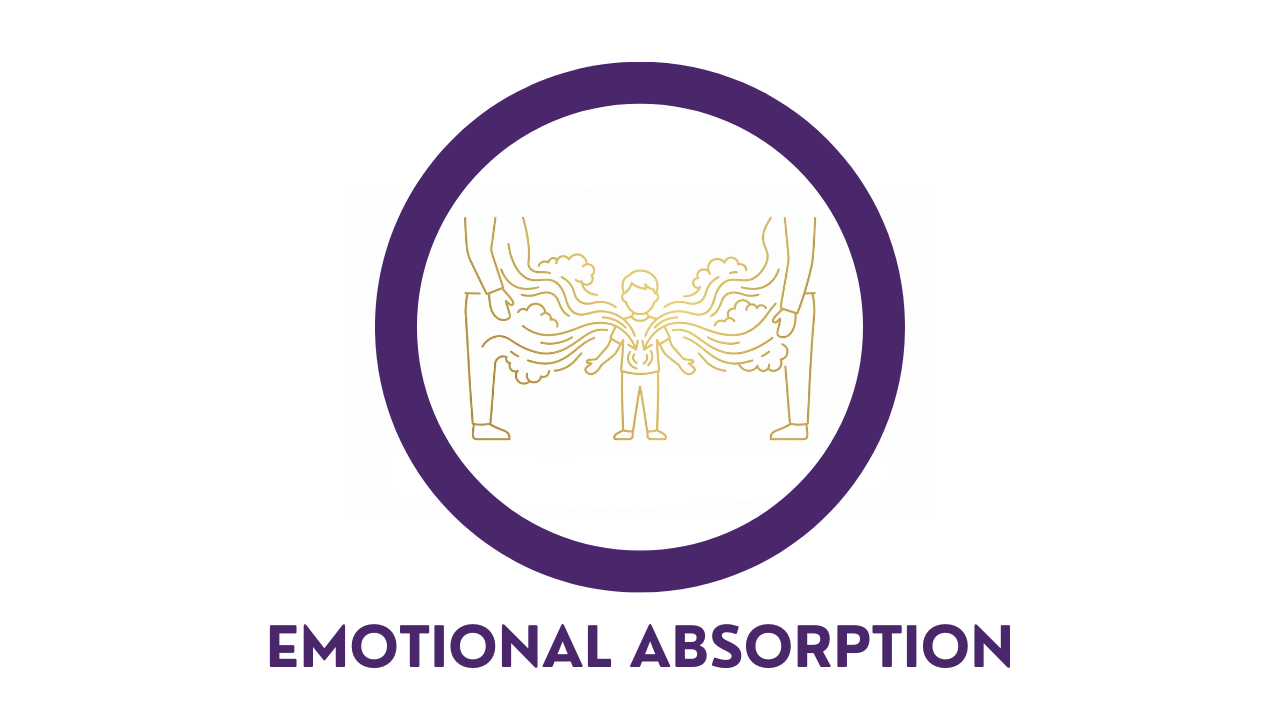
Here’s what most people get wrong: they think the anger is the problem. They go to anger management classes. They count to ten. They take deep breaths. And none of it works — because anger is never the actual issue.
Anger is always a smokescreen for fear. It is the fight portion of fight, flight, or freeze. Fear is where the truth lies, and it is what we hide and defend the most.
Whenever fear is awakened, you’re experiencing one of two things: the fear of rejection and inadequacy — “I don’t have the knowledge, skills, or tools to handle this” — or the fear of powerlessness — “I can’t control this outcome.” In both cases, what you’re actually feeling is a childhood wound. The present moment just triggered it.
That’s you — screaming at the traffic, but really screaming at the part of yourself that still feels helpless, just like you did when you were six.
One of the difficulties is that denial was classified by the Freuds as a defense mechanism. And it does start that way — as a child, you don’t have the emotional capabilities to process overwhelming experiences. But because we’ve never been taught emotional authenticity, denial doubles back and becomes an attack mechanism. It starts as defense, but when left unexamined and unhealed, it destroys us — and one of the greatest ways it destroys us is through anger.
That’s you — not lying to yourself, but anesthetizing yourself because no one ever taught you another way.
How to Stop Avoiding: The Emotional Authenticity Method™
You cannot change emotional patterns through thoughts alone. Emotions are biochemical events. Thoughts originate from feelings — not the other way around. That’s why affirmations, positive thinking, and traditional cognitive approaches don’t work for trauma. You need a process that goes into the body and rewires the emotional blueprint at its source.
The Emotional Authenticity Method™ is a six-step process that interrupts the Worst Day Cycle™ in real time:
Step 1: Somatic Down-Regulation. Focus on what you can hear for fifteen to thirty seconds. Just listen. If you’re highly dysregulated — shaking, crying, shut down — use titration: alternate between the distressing sensation and a neutral body part until your nervous system settles enough to proceed.
Step 2: What am I feeling right now? Not “what happened” — what are you feeling? Most people are so detached from their body they can’t answer this. They give a story instead of a feeling. Use a Feelings Wheel to build emotional granularity — expand your vocabulary beyond “bad” or “anxious” to specific emotions like “humiliated,” “dismissed,” “invisible,” “inadequate.”
That’s you — saying “I’m fine” for the thousandth time because you genuinely don’t know what you feel anymore.
Step 3: Where in my body do I feel it? All emotional trauma is stored physically. Chest, stomach, throat, shoulders, jaw — your body is holding what your mind has been avoiding. Focus on that specific location.
Step 4: What is my earliest memory of having this exact feeling? Trace it backward. Most people first remember something from last week. Then something from last year. Keep going. Eventually, you arrive at a memory between ages two and ten — your parent standing over you, a moment of helplessness, a time when your feelings were dismissed or punished. That’s the source. That’s the emotional blueprint being replayed right now.
That’s you — forty-five years old, fighting with your partner about dishes, but reliving the moment your father told you nothing you did was ever good enough.
Step 5: Who would I be if I never had this thought or feeling again? What would be left over? This is the vision step — the bridge into the Authentic Self Cycle™. When you strip away the shame, the fear, the survival persona — what remains is your authentic self. The person you were before the pain was.
Step 6: Feelization. Sit in the feeling of that authentic self and make it strong. Create a new emotional chemical addiction to replace the old blueprint. Ask yourself: how would I respond to this situation from this feeling? What would I say? What would I do? Visualize and feel yourself operating from your authentic self. This is the emotional blueprint remapping and rewiring step — the moment where you create a new neurological pathway that your brain can repeat instead of the old one.

The Authentic Self Cycle™: From Denial to Freedom
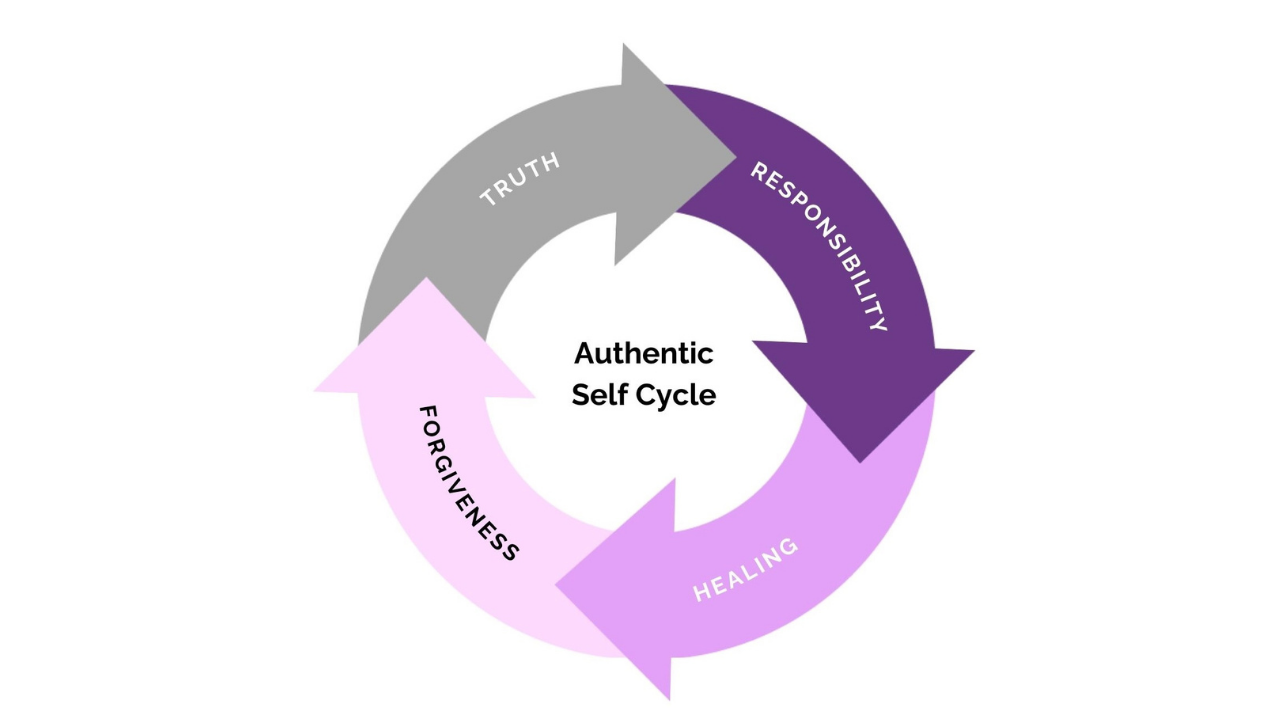
The Authentic Self Cycle™ is the healing counterpart to the Worst Day Cycle™ — an identity restoration system with four stages: Truth → Responsibility → Healing → Forgiveness.
Truth: Name the blueprint. See “this isn’t about today.” Recognize the emotional roles you were assigned as a child. Name those wounds without shame or blame. This isn’t about throwing your parents under the bus — they did their job. You’re an adult now. It’s your job to become the parent you needed when you were a child.
Responsibility: Own your emotional reactions without blame. “My partner isn’t my parent — my nervous system just thinks they are.” You stop pointing the finger outward and start looking at what’s happening inside. No one hurts you — your Worst Day Cycle™ sets you up for the pain, and you get to take responsibility for your adult choices.
That’s you — finally realizing that the fight isn’t about what they said, it’s about the unhealed wound inside you that heard something completely different.
Healing: Rewire the emotional blueprint through the Emotional Authenticity Method™ so conflict becomes uncomfortable but not dangerous, space isn’t abandonment, and intensity isn’t attack. Invest in yourself — learn the knowledge, skills, and tools you were never given.
Forgiveness: Release the inherited emotional blueprint and reclaim your authentic self. This creates a new emotional chemical pattern that replaces fear, shame, and denial. You reconnect to your inherent value and worth — you see yourself clearly and completely, and you can finally accept all of yourself.
That’s you — not the survival persona you’ve been wearing for decades, but the person underneath who’s been waiting to be seen.
Frequently Asked Questions About Emotional Avoidance
Why do I overreact to small things?
You’re not overreacting to the present moment — you’re reacting to every unprocessed emotion you’ve ever avoided. Each avoided feeling drops another “quarter in the bucket.” When the bucket overflows, the reaction matches the accumulated weight, not the trigger. Your entire childhood is sitting at the table with you during that argument about the dishes.
Is emotional avoidance the same as being strong?
No. What society calls “being strong” is often a survival persona — a disempowered or falsely empowered identity created in childhood to survive emotional pain. Real strength is the ability to feel your emotions fully and respond from your authentic self rather than react from your wounded child.
Can emotional avoidance cause physical symptoms?
Absolutely. All emotional trauma is stored in the body. Chronic tension, digestive issues, headaches, insomnia, jaw clenching, back pain, and autoimmune conditions can all be connected to unprocessed emotional material. The body keeps the score — when you avoid the emotion, the body carries it instead.
Why can’t I just think my way out of emotional avoidance?
Because emotions are biochemical events, not thoughts. Thoughts originate from feelings — not the other way around. That’s why affirmations, positive thinking, and cognitive-only approaches don’t resolve trauma. You need a somatic, body-based process like the Emotional Authenticity Method™ that goes to the root of the emotional blueprint.
How is emotional avoidance connected to childhood trauma?
Denial — the root of emotional avoidance — is Stage 4 of the Worst Day Cycle™. It was learned in childhood when you didn’t have the emotional capabilities to process overwhelming experiences. As a child, denial protected you. As an adult, it keeps you trapped in the same patterns, repeating your childhood wound in every relationship, career choice, and health habit.
What is the first step to stop emotionally avoiding?
Start with the Feelings Wheel. Most people are so disconnected from their emotions they can’t identify what they’re feeling. Download the wheel and begin asking yourself throughout the day: “What am I feeling right now?” This single practice begins to rebuild the emotional awareness that was shut down in childhood.
The Bottom Line
Every quarter you drop into that bucket is a conversation with yourself you’re refusing to have. Every CLINK is a moment where fear won and your authentic self lost. But here’s what I need you to hear: the bucket is not your destiny. The rope can be untied. The quarters can be emptied — one feeling at a time.
That’s you — reading this and feeling something stirring. Something that’s been buried for a long time. Something that’s tired of being ignored.
You didn’t choose the emotional blueprint you were given. You didn’t ask for the fear, the shame, or the denial. But you are the only one who can choose to stop dropping quarters and start feeling what’s actually there. The child inside you has been waiting your whole life for you to turn around and say: “I see you. I hear you. And we’re going to do this differently now.”
That’s you — not broken, not weak, not too far gone. Just someone whose bucket is full. And now you know why.
Recommended Reading
Pia Mellody — Facing Codependence and The Intimacy Factor. Gabor Maté — When the Body Says No and In the Realm of Hungry Ghosts. Melody Beattie — Codependent No More. Brené Brown — The Gifts of Imperfection. Bessel van der Kolk — The Body Keeps the Score. Pete Walker — Complex PTSD: From Surviving to Thriving.
Ready to Break the Cycle?
If this post hit something in you, that feeling is not a coincidence — it’s your authentic self trying to get your attention. Kenny Weiss offers courses at Greatness U designed to walk you through this process step by step:
- Emotional Blueprint Starter Course — Individual — $79 (your personal roadmap out of the Worst Day Cycle™)
- Relationship Starter Course — Couples — $79 (for couples ready to stop the cycle together)
- Why We Can’t Stop Hurting Each Other — $479
- Why High Achievers Fail at Love — $479
- The Shutdown Avoidant Partner — $479
- Tier 1: Mapping the Blueprint — $1,379 (the complete transformation)
Start with the free Feelings Wheel exercise — it takes five minutes and it will change how you see yourself.
Related Articles
Enmeshment: Signs, Meaning, and How to Heal ·
7 Signs of Relationship Insecurity ·
Signs of High Self-Esteem ·
10 Do’s and Don’ts for a Great Relationship ·
Negotiables and Non-Negotiables in Codependence Recovery