Tag: healing shame

  • Redefining Success: Why High Achievers Still Feel Empty

    Redefining Success: Why High Achievers Still Feel Empty

    Redefining success means shifting from shame-driven achievement to authentic self-worth. If you’ve accomplished everything you set out to do — yet still feel empty, exhausted, and disconnected — your success was built on a childhood emotional blueprint designed for survival, not fulfillment. The Worst Day Cycle™ explains why high achievers chase external validation while abandoning themselves, and the Emotional Authenticity Method™ provides the path back to wholeness.

    Success that’s built on self-abandonment will never feel like success inside your body. High achievers who feel empty aren’t broken — they’re living from a survival persona created in childhood. Redefining success means rewiring your emotional blueprint through the Authentic Self Cycle™, not chasing more achievements.

    Table of Contents

    What Does Redefining Success Actually Mean?

    Redefining success is the process of dismantling your childhood-programmed definition of worth — one built on performance, people-pleasing, and shame — and replacing it with an internal measure of self-loyalty, emotional honesty, and authentic connection.

    That’s you if you’ve hit every goal you set and still feel like something is missing.

    Most people think redefining success means lowering their standards or giving up ambition. It doesn’t. It means you stop using achievement as a shield against shame and start building a life that actually includes you — not just your output, your usefulness, and your image.
    Emotional authenticity redefining success for high achievers who feel empty

    That’s the difference between surviving and actually living.

    Redefining success requires what Kenny Weiss calls emotional authenticity — the willingness to tell the truth about what you feel, trace it to its origin, and make choices from your authentic self rather than your survival persona.

    Why Do High Achievers Feel Empty Despite Success?

    High achievers feel empty because their success was built on a foundation of self-abandonment. Every promotion, every achievement, every win was unconsciously designed to answer one question: “Am I enough yet?”

    That’s you if you’ve ever hit a massive goal and felt nothing — or worse, felt the pressure to immediately chase the next one.

    When your worth is tied to external metrics — income, titles, praise, productivity — your nervous system never relaxes. Because those metrics can disappear. And if they disappear, who are you?

    The emptiness high achievers feel is not ingratitude, weakness, or a character flaw. It’s the natural consequence of building your entire identity on performance while the real you — the one with feelings, needs, and pain — was left outside in the cold.
    Emotional blueprint driving high achiever emptiness and shame-based success

    That’s you if the quiet moments are the hardest — when there’s nothing to do, no one to impress, and the void just sits there.

    You chase more. Achieve more. Prove more. But the void grows. Not because you’re broken — because your current definition of success doesn’t even include you.

    How Your Childhood Emotional Blueprint Created Your Definition of Success

    Your definition of success was written long before you ever chose it. It was shaped by your childhood emotional blueprint — the environment where you learned how to be loved, how to avoid shame, how to stay safe, and who you had to be to belong.

    That’s you if success quietly became: “I never drop the ball,” “I’m always the strong one,” “I don’t need help,” or “I outwork everyone.”

    Childhood trauma — any negative emotional experience that created painful meanings about yourself — causes a massive chemical reaction in the brain and body. The hypothalamus generates chemical cocktails of cortisol, adrenaline, and misfired oxytocin. The brain becomes addicted to these emotional states because it conserves energy by repeating known patterns. It can’t tell right from wrong — only known versus unknown.
    Trauma chemistry driving shame-based success and achievement addiction in high achievers

    Since 70%+ of childhood messaging is negative and shaming, adults repeat these painful patterns in relationships, career, hobbies, health — everything. Look closer at your rules for success. Every one of them is about avoiding shame. Not about enjoying your life. Not about feeling at home inside yourself. Not about peace. Just protection.

    That’s you if you know logically that you’re successful, but your body doesn’t believe it.

    Sound familiar? That’s not success. That’s survival dressed up as ambition.

    How the Worst Day Cycle™ Drives Achievement Addiction

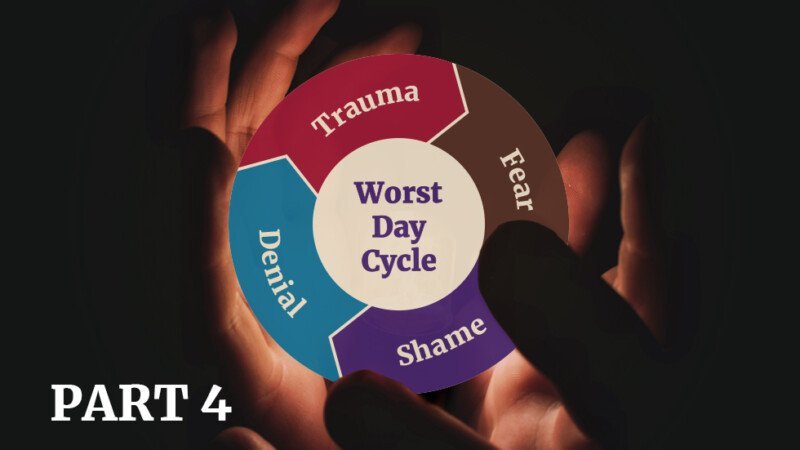
    The Worst Day Cycle™ is the four-stage pattern that explains why high achievers stay trapped in empty success: Trauma → Fear → Shame → Denial.
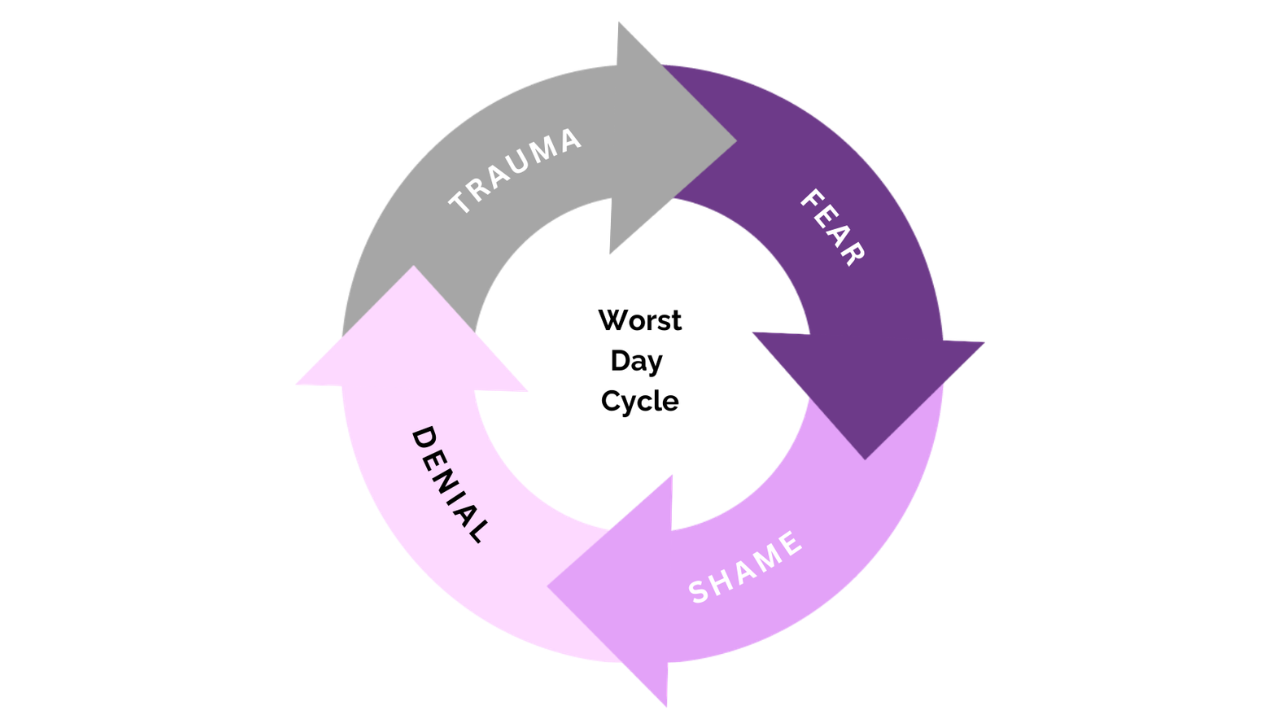
    Worst Day Cycle four stages trauma fear shame denial driving empty success

    Trauma is any childhood experience that created the meaning “I am the problem.” Fear drives repetition — the brain thinks repetition equals safety. Shame is where you lost your inherent worth and started believing you had to earn it through performance. Denial is the survival persona you created to survive the pain — brilliant in childhood, sabotaging in adulthood.

    That’s you if your drive to succeed feels less like passion and more like something you can’t turn off — even when you’re exhausted, sick, or burning out.

    Achievement addiction is the Worst Day Cycle™ in action. You work harder not because you love the work, but because slowing down triggers the same shame you felt as a child. Your brain learned: “If I’m not producing, I’m worthless.” So you keep producing. And the void keeps growing.

    That’s the cycle. And you can’t think your way out of it — because the cycle is biochemical, not intellectual.

    The Three Survival Persona Types That Fuel Empty Success

    The denial stage of the Worst Day Cycle™ creates a survival persona — a version of you that was designed to protect you from pain. There are three types, and understanding yours is the first step toward redefining success on your own terms.
    Three survival persona types falsely empowered disempowered adapted wounded child

    The Falsely Empowered Survival Persona controls, dominates, and rages. This person redefines success as being untouchable — the one who never needs anyone, never shows weakness, and runs everything. Their success looks impressive but is built on walls, not foundations.

    That’s you if people describe you as “intimidating” or “intense” and you secretly feel alone at the top.

    The Disempowered Survival Persona collapses, people-pleases, and over-gives. This person redefines success as being needed — the one everyone relies on, the fixer, the caretaker. Their success is measured by how much they sacrifice for others while abandoning themselves.

    That’s you if you feel resentful about how much you give but can’t stop giving.

    The Adapted Wounded Child oscillates between both — controlling in some situations, collapsing in others. This person’s definition of success changes depending on who they’re with, creating an exhausting cycle of performance that never feels stable.
    Adapted wounded child survival persona oscillating between control and collapse

    That’s you if you feel like a completely different person depending on whether you’re at work, with your partner, or alone.

    Signs Your Success Is Actually Survival — By Life Area

    Family: You’re the “strong one” everyone depends on. You manage everyone’s emotions. You dread holidays. You feel guilty when you set boundaries with parents or siblings. Your family role was assigned in childhood and you’ve never questioned it.

    That’s you if family gatherings leave you drained for days.

    Romantic Relationships: You attract partners who need fixing. You lose yourself in relationships. You confuse intensity with intimacy. When things get calm, you feel anxious — like something must be wrong. Your partner isn’t your parent, but your nervous system thinks they are.

    That’s you if peaceful relationships feel boring and chaotic ones feel “real.”

    Friendships: You’re the listener, never the one who shares. You keep people at arm’s length. You have many acquaintances but few people who actually know you. You cancel plans when you’re overwhelmed but never tell anyone why.

    That’s you if you feel lonely in a room full of people who say they love you.

    Work: You can’t stop. You tie your identity to your job title. Criticism feels like a personal attack. You overwork to avoid the quiet. Your inbox is your security blanket. Vacation feels more stressful than the office.

    That’s you if your body only relaxes when you’re producing.

    Body and Health: You ignore physical signals. You push through exhaustion. You use exercise as punishment, not care. You eat to numb or restrict to control. Your body is a machine, not a home.

    That’s you if you treat your body like it owes you something instead of like it’s carrying you.

    How the Emotional Authenticity Method™ Rewires Success

    The Emotional Authenticity Method™ is the five-step process that moves you from survival-based success to authentic success. You cannot change emotional patterns through thoughts alone — emotions are biochemical events, and thoughts originate from feelings.
    Emotional Authenticity Method five steps for redefining success and healing achievement addiction

    Step 1: Somatic Down-Regulation with optional Titration. Before you can think clearly, your nervous system needs to calm. This means pausing, breathing, and allowing your body to come out of fight-or-flight before making decisions about success, work, or relationships.

    Step 2: What am I feeling? Use the Feelings Wheel to develop emotional granularity. Most high achievers can only identify “fine,” “stressed,” or “frustrated.” Real healing requires naming the actual emotion — abandoned, ashamed, terrified, invisible.

    That’s you if someone asks how you feel and you answer with what you think.

    Step 3: Where in my body do I feel it? All emotional trauma is stored physically. The tightness in your chest. The knot in your stomach. The tension in your jaw. Your body has been keeping score even when your mind checked out.

    Step 4: What is my earliest memory of this feeling? This is the question that changes everything. Suddenly you realize you’re not just stressed about this moment — you’re reliving something older. Your nervous system is reacting to your past, not your present.

    That’s you if your reactions feel bigger than the situation warrants — and you can’t figure out why.

    Step 5: Who would I be if I never had this feeling again? This is the vision step that connects directly to the Authentic Self Cycle™. It moves you from pain to possibility, from survival to choice.

    The Authentic Self Cycle™: Redefining Success From the Inside Out

    The Authentic Self Cycle™ is the healing counterpart to the Worst Day Cycle™. Its four stages — Truth → Responsibility → Healing → Forgiveness — create an identity restoration system that replaces shame-driven success with authentic self-worth.
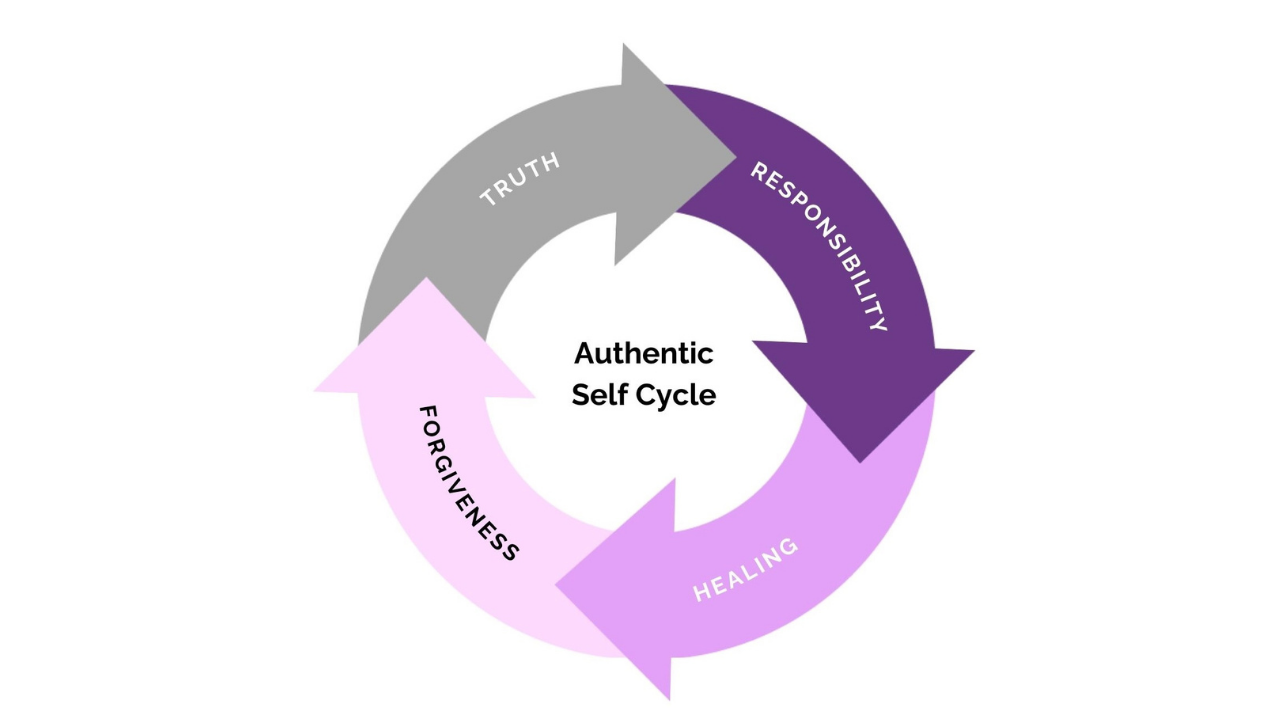
    Authentic Self Cycle four stages truth responsibility healing forgiveness for redefining success

    Truth: Name the blueprint. See “this isn’t about today.” Your drive to overwork isn’t ambition — it’s a childhood survival pattern running on autopilot.

    Responsibility: Own your emotional reactions without blame. “My partner isn’t my parent. My nervous system just thinks they are.” “My boss isn’t my critical father. My body just responds that way.”

    That’s you if you know your reactions don’t match the situation but you can’t stop them.

    Healing: Rewire the emotional blueprint so conflict becomes uncomfortable but not dangerous, rest becomes possible without guilt, and success becomes something you enjoy rather than something you survive.

    Forgiveness: Release the inherited emotional blueprint and reclaim your authentic self. This creates a NEW emotional chemical pattern that replaces fear, shame, and denial with truth, responsibility, and self-loyalty.

    The old model says: “I’ll be lovable when I achieve enough.” The new model says: “I achieve because I’m already lovable.” That’s the shift that changes everything.

    A Simple Exercise to Redefine Your Success

    Take a few minutes and answer these three questions honestly:

    1. According to your current unspoken rules, how do you know you’re successful? Be honest. Is it when nobody is mad at you? When you close the deal? When you don’t need help? When you outwork everyone? Write the real rules.

    That’s you if you’ve never consciously chosen your definition of success — it was handed to you.

    2. What has this definition cost you? Sleep? Joy? Health? Relationships? Presence with your kids? Peace in your body? Tell the truth.

    3. If your authentic self defined success, what would it include? Maybe: “I can rest without guilt.” “I don’t have to sacrifice my body.” “I can be honest without shame.” “I have time for what matters.” “I can sit still for 60 seconds and not crawl out of my skin.”

    That’s not weakness. That’s integration. That’s redefining success.

    Frequently Asked Questions About Redefining Success

    What does it mean to redefine success as a high achiever?

    Redefining success means dismantling the shame-based, performance-driven definition of worth you learned in childhood and replacing it with internal metrics — emotional honesty, self-loyalty, the ability to rest without guilt, and knowing your worth isn’t tied to your output. It doesn’t mean lowering your standards. It means your standards finally include you.

    Why do successful people still feel empty inside?

    Because their success was built on self-abandonment. The Worst Day Cycle™ explains this: childhood trauma creates shame, shame drives fear, and fear drives relentless achievement as a way to outrun the pain. The void grows because no amount of external validation can replace the internal worth that was lost in childhood.

    How is emotional authenticity different from emotional intelligence?

    Emotional intelligence teaches you to manage emotions — regulate yourself so you can function. Emotional authenticity teaches you to tell the truth about them — trace your reactions to their childhood origin, feel them fully, and let them reshape your choices. One manages symptoms. The other heals roots.

    What is the survival persona and how does it affect success?

    The survival persona is the version of you created in childhood to protect you from pain. There are three types: the Falsely Empowered (controls and dominates), the Disempowered (collapses and people-pleases), and the Adapted Wounded Child (oscillates between both). Each type creates a different flavor of “success” that ultimately feels empty because it’s driven by shame rather than authentic choice.

    Can you be ambitious and emotionally authentic at the same time?

    Absolutely. Redefining success isn’t about giving up ambition — it’s about achieving from wholeness instead of woundedness. When you achieve from your authentic self rather than your survival persona, success actually feels fulfilling instead of like a hamster wheel you can’t escape.

    What is the first step to redefining success?

    The first step is truth — specifically, Step 1 of the Emotional Authenticity Method™: somatic down-regulation. Pause. Breathe. Let your nervous system calm. Then ask: “What am I actually feeling right now?” Most high achievers haven’t asked themselves that question in years. That one pause is the beginning of a completely different relationship with success.

    The Bottom Line

    The void isn’t proof that you’re broken. It’s proof that you’ve been strong for too long — and strength without authenticity eventually collapses into emptiness.

    You built the mansion — the career, the reputation, the life. But you’ve been living outside of it. Like a Labrador puppy chained outside a $10 million house. You are lovable. Worthy. Valuable. But you haven’t let yourself inside.

    That’s you if you’re reading this and your chest just got tight. That tightness is the truth your body has been holding.

    Redefining success doesn’t mean burning your life down. It means you stop burning yourself down. You let yourself inside. You stop measuring your worth by your output and start measuring it by your honesty, your boundaries, and your willingness to stay connected to yourself while you achieve.

    You’ve spent long enough building a life that doesn’t feel like yours. Maybe it’s time to build one that does.

    That’s not weakness. That’s the bravest thing you’ll ever do.
    Perfectly imperfect self-worth beyond achievement and redefining success

    For deeper exploration of the patterns behind empty success and the path to authentic self-worth, these books complement the work of redefining success through emotional authenticity:

    Facing Codependence by Pia Mellody — The foundational work on how childhood trauma creates the survival patterns that drive self-abandonment in adulthood.

    The Myth of Normal by Gabor Maté — A groundbreaking look at how trauma shapes our biology, our relationships, and our definitions of “normal” success.

    Codependent No More by Melody Beattie — The classic guide to recognizing and releasing the people-pleasing patterns that masquerade as strength.

    The Gifts of Imperfection by Brené Brown — Essential reading on letting go of who you think you’re supposed to be and embracing who you actually are.

    Your Surviving Self by Kenny Weiss — The complete guide to the Worst Day Cycle™, the Authentic Self Cycle™, and reclaiming your authentic identity.

    Ready to Redefine Your Success?

    If this post described your life, you don’t need another achievement. You need a new relationship with yourself. Kenny Weiss offers courses designed specifically for high achievers who are ready to stop surviving and start living:

    Download the Free Feelings Wheel — The first tool in the Emotional Authenticity Method™.

    Emotional Blueprint Starter Course — Individual ($79) — Your personal roadmap to understanding your Worst Day Cycle™ and starting the Authentic Self Cycle™.

    Relationship Starter Course — Couples ($79) — See how both partners’ survival personas create conflict and learn to build authentic connection.

    Why High Achievers Fail at Love ($479) — The deep-dive course for driven people whose success hasn’t translated to fulfilling relationships.

    The Shutdown Avoidant Partner ($479) — Understand why you or your partner shuts down emotionally and how to rebuild trust.

    Tier 1: Mapping the Blueprint ($1,379) — Kenny’s most comprehensive program for rewiring your emotional blueprint and reclaiming your authentic self.

    Related: The Signs of Enmeshment | 7 Signs of Relationship Insecurity | 7 Signs of High Self-Esteem | How to Determine Your Negotiables and Non-Negotiables | 10 Do’s and Don’ts For a Great Relationship
  • How to Heal Self-Abandonment: 3 Daily Practices for High Achievers

    How to Heal Self-Abandonment: 3 Daily Practices for High Achievers

    Self-abandonment is the act of chronically ignoring your own feelings, needs, and boundaries in order to maintain connection, approval, or safety. It is one of the most common — and most invisible — patterns in high achievers. If you grew up learning that your worth depended on what you produced, how you performed, or how little you needed, you learned to abandon yourself long before you had words for it. And that pattern didn’t stop in childhood. It followed you into your career, your relationships, your body, and the quiet moments you spend alone.

    That’s you — the one who can run a company but can’t sit still for five minutes without reaching for your phone.

    This isn’t a character flaw. It’s a survival strategy that was brilliant when you were a child — and it’s destroying you now.

    Self-abandonment isn’t a single wound you fix with one breakthrough. It’s a daily pattern of ignoring your feelings, needs, and limits — built in childhood trauma. Healing requires small, repeated moments of self-loyalty using the Emotional Authenticity Method™, not more willpower or bigger achievements.

    Emotional authenticity icon representing self-abandonment healing through feeling your feelings

    What Is Self-Abandonment?

    Self-abandonment is the chronic pattern of dismissing, suppressing, or overriding your own emotional needs in favor of someone else’s comfort, approval, or expectations. It’s not a single event — it’s a way of living. Every time you say yes when your body screams no, every time you swallow your feelings to keep the peace, every time you push through exhaustion because resting feels dangerous — that is self-abandonment.

    That’s you — saying “I’m fine” when you’re falling apart inside, because showing vulnerability was never safe.

    Self-abandonment is the foundation of codependence. It’s the invisible cost of being the “strong one,” the “reliable one,” the one everyone leans on. And it starts in childhood — when the emotional environment taught you that your feelings didn’t matter, your needs were a burden, and your value was measured by what you gave, not who you were.

    Self-abandonment is the predictable outcome of childhood emotional neglect — the brain learns that suppressing your authentic self is the price of survival, and it automates that pattern for life.

    Why Do High Achievers Self-Abandon?

    High achievers are the most common self-abandoners — and the least likely to recognize it. That’s because their self-abandonment looks like discipline. It looks like drive. It looks like success.

    That’s you — working 12-hour days and calling it passion when really it’s just the only way you know how to feel safe.

    Here’s what actually happened: as a child, you learned that love, safety, or approval were conditional. They depended on your performance. On how little you needed. On how much you produced. So your brain built a survival strategy — become impressive, become indispensable, become so good that no one can reject you.

    Survival persona icon showing how high achievers use performance to mask self-abandonment

    And it worked. You built the career. You got the accolades. You became the person everyone admires.

    But underneath all of it — a quiet emptiness. A void. A hollow feeling that creeps in when the noise stops.

    That’s the void — the emotional space that exists because you’ve been abandoning yourself for decades and no amount of achievement can fill it.

    The brain conserves energy by repeating known patterns. It can’t tell right from wrong — only known from unknown. Since 70%+ of childhood messaging is negative and shaming, adults repeat these painful patterns in relationships, career, hobbies, health — everything. Your achievement isn’t healing. It’s the most socially acceptable form of self-abandonment.

    High achievers self-abandon because their childhood trauma taught them that their worth equals their output — the brain became chemically addicted to the stress-performance-validation loop, making self-abandonment feel like ambition.

    How the Worst Day Cycle™ Drives Self-Abandonment

    Self-abandonment isn’t random. It follows a predictable neurochemical pattern called the Worst Day Cycle™. Understanding this cycle is the first step to breaking free from it.

    Worst Day Cycle diagram showing trauma fear shame denial loop that drives self-abandonment

    The Worst Day Cycle™ has four stages: Trauma → Fear → Shame → Denial.

    Trauma: Any negative emotional experience in childhood that created painful meanings. It doesn’t have to be dramatic — it can be as subtle as a parent who was emotionally unavailable or a household where feelings were treated as weakness. These experiences create a massive chemical reaction in the brain and body. The hypothalamus generates chemical cocktails — cortisol, adrenaline, dopamine, oxytocin misfires — and the brain becomes addicted to these emotional states.

    That’s you — feeling most alive when you’re in crisis mode, because your nervous system was calibrated for chaos.

    Fear: Fear drives repetition. The brain thinks repetition equals safety. So you keep choosing the same relationships, the same work patterns, the same cycles of overgiving and burnout — not because you want to, but because your nervous system is terrified of the unknown.

    Shame: This is where you lost your inherent worth. “I am the problem.” Not “I made a mistake” — but “I AM the mistake.” This is the core wound underneath self-abandonment. You abandon yourself because deep down, you believe your authentic self isn’t worth keeping.

    That’s the shame talking — and it’s been running your life since before you could spell your own name.

    Denial: Denial is the survival persona you created to survive the pain. It was brilliant in childhood — absolutely necessary. But in adulthood, it sabotages everything. It keeps you performing instead of feeling. Producing instead of connecting. Running instead of resting.

    The Worst Day Cycle™ explains why self-abandonment feels automatic — your brain created a neurochemical loop in childhood that equates self-suppression with survival, and it repeats that loop thousands of times per day without your conscious awareness.

    What Are the Signs of Self-Abandonment?

    Self-abandonment is invisible because it disguises itself as virtue. It looks like being selfless, hardworking, flexible, and easygoing. But underneath those labels, your body is keeping score.

    That’s you — the person everyone describes as “so strong” while you’re silently drowning.

    Here are the signs that self-abandonment is running your life:

    You say yes when your body says no. You minimize your own feelings — “I shouldn’t be upset about this.” You consistently put others’ needs before your own, not out of generosity, but out of fear. You feel guilty for resting, for having needs, for taking up space. You numb out with food, scrolling, alcohol, work, or shopping when emotions get too big. You don’t know what you actually want — you only know what other people want from you. You feel responsible for other people’s emotions. You abandon your own plans the moment someone else has a preference.

    That’s you — knowing exactly what everyone else needs and having no idea what you need.

    Codependence icon showing the connection between self-abandonment and codependent patterns

    How Does Your Survival Persona Keep You Stuck in Self-Abandonment?

    Your survival persona is the identity you created in childhood to navigate an emotionally unsafe environment. It’s not who you are — it’s who you had to become. And it’s the engine that powers self-abandonment.

    There are three survival persona types:

    The Falsely Empowered: This persona controls, dominates, and rages. They look powerful on the outside, but their power comes from fear, not strength. They self-abandon by never allowing vulnerability — they perform strength instead of feeling anything real. They control others to avoid feeling out of control inside.

    That’s you — the CEO who can command a boardroom but can’t have a vulnerable conversation with your partner.

    Emotional fitness icon representing the work of healing survival persona patterns

    The Disempowered: This persona collapses, people-pleases, and disappears. They make themselves small to be safe. They self-abandon by making everyone else’s needs more important than their own — not out of love, but out of fear of abandonment. They believe that if they stop giving, they’ll be left.

    That’s you — the one who bends over backward for everyone and then wonders why you feel invisible.

    The Adapted Wounded Child: This persona oscillates between both — raging one moment, collapsing the next. They self-abandon by never having a stable sense of self. They flip between overperforming and shutting down, between control and submission, never landing in their authentic self.

    Adapted wounded child icon showing oscillation between falsely empowered and disempowered survival personas

    That’s you — the one who swings between “I don’t need anyone” and “please don’t leave me” and can’t figure out which one is real.

    Your survival persona is the most sophisticated form of self-abandonment because it replaces your authentic identity with a performance — and after decades, you can’t tell the difference between who you really are and who you had to become to survive.

    Why Can’t One Breakthrough Heal Self-Abandonment?

    High achievers love breakthroughs. The big realization. The life-changing seminar. The moment everything “clicks.” But here’s the truth no one tells you: you can’t heal a lifetime of self-abandonment with one breakthrough.

    That’s you — collecting insights like trophies and wondering why nothing actually changes.

    Here’s why breakthroughs fail: they target the thinking brain. They give you an intellectual understanding of your patterns. And for a few hours or days, you feel different. Hopeful. Clear.

    But self-abandonment doesn’t live in your thoughts. It lives in your nervous system. In your body. In the chemical patterns your brain has been running since childhood. And those patterns don’t care about your breakthrough. They respond to repetition, not realization.

    Trauma chemistry icon showing how childhood emotional patterns create neurochemical addiction

    Think of the second hand on a clock. It moves in tiny, almost insignificant ticks. But those ticks move the minute hand. The minutes move the hours. The hours change your entire day. Healing works the same way. It’s not dramatic. It’s repetitive. And it’s built on small moments where you choose not to abandon yourself.

    That’s the truth — you don’t need a bigger breakthrough. You need a smaller, more consistent practice.

    One breakthrough cannot heal self-abandonment because the pattern is stored in the body’s neurochemistry, not in the mind’s understanding — you cannot think your way out of a biochemical event that has been automated since childhood.

    How the Emotional Authenticity Method™ Rewires Self-Abandonment

    The Emotional Authenticity Method™ is the daily practice that actually rewires self-abandonment at the nervous system level. It works because it targets the body — where trauma lives — not just the mind.

    Emotional regulation icon representing the Emotional Authenticity Method for healing self-abandonment

    Here’s how it works:

    Step 1: Somatic Down-Regulation with optional Titration. Before you can process anything, you have to get your nervous system out of survival mode. This might mean deep breathing, grounding, or simply slowing down enough to feel your body. Titration means you go slowly — you don’t force yourself to feel everything at once.

    That’s you — learning that you don’t have to white-knuckle your way through healing.

    Step 2: What am I feeling? Most self-abandoners have no idea what they’re feeling. They’ve been disconnected from their emotions for so long that “fine” is their default answer. Using the Feelings Wheel, you develop emotional granularity — the ability to name specific emotions instead of lumping everything into “stressed” or “fine.”

    Step 3: Where in my body do I feel it? All emotional trauma is stored physically. Your chest tightens. Your stomach drops. Your jaw clenches. Locating the feeling in your body is how you move from intellectual understanding to somatic processing.

    Step 4: What is my earliest memory of this feeling? This is where the rewiring happens. You trace today’s reaction back to its childhood origin. You realize: this isn’t about today. My partner isn’t my parent. My nervous system just thinks they are.

    That’s the moment everything shifts — when you see that your reaction belongs to a five-year-old, not a forty-year-old.

    Step 5: Who would I be if I never had this feeling again? This is the vision step. It connects you to the Authentic Self Cycle™ and gives your nervous system a new destination — not more coping, but actual identity restoration.

    The Emotional Authenticity Method™ works because emotions are biochemical events — you cannot change emotional patterns through thoughts alone. Thoughts originate from feelings, not the other way around.

    3 Daily Practices That End Self-Abandonment

    These aren’t breakthroughs. They’re rewiring practices. Each one sends your nervous system a new message: “I’m not leaving you anymore.”

    Practice 1: The 60-Second Check-In. Most high achievers live from the neck up. They think their way through life. But every thought is driven by an emotion. So once a day — just once — pause for 60 seconds and ask: What am I feeling right now? What do I need in this moment? Not what should I feel. Not what do they need from me. Just you.

    That’s you — finally asking yourself the question nobody ever asked you as a child.

    You might notice anxiety, resentment, exhaustion, or numbness. And maybe what you need is water, a break, five minutes of silence, or permission to stop pushing. The goal isn’t perfection. The goal is emotional authenticity. Because the void grows when you never ask what you feel or need.

    Practice 2: The Micro-No. Many high achievers were trained to preserve connection by sacrificing themselves. The micro-no retrains your nervous system. Once a day, say no in a small way. Instead of “Yes, I’ll do it,” try “That doesn’t work for me right now.” Instead of responding immediately to every text, wait. Instead of staying three hours, stay one.

    That’s you — discovering that saying no doesn’t make people leave. It makes you arrive.

    Your body learned that saying no meant danger, rejection, disconnection. The micro-no teaches your body: “I can choose myself… and I’m still safe.” Every micro-no is one brick removed from the wall of self-abandonment.

    Practice 3: The Void Visit. This is the hardest one. Most people spend their lives avoiding silence. When it gets quiet, the void creeps in — that heavy, hollow, lonely feeling. Instead of running from it, visit it. Set a timer for 2 minutes, 1 minute, 30 seconds, or even 5 seconds — whatever you can tolerate. Sit still. No phone. No distraction. Just notice where you feel it in your body.

    That’s you — sitting with the part of yourself that’s been alone the longest, and finally saying: “I see you. And I’m not running.”

    The void isn’t punishment. It’s the part of you that’s been abandoned the longest. Visiting it is how you start rebuilding trust with yourself.

    Reparenting icon showing how daily practices rebuild self-trust and heal self-abandonment

    How the Authentic Self Cycle™ Replaces Self-Abandonment

    The Authentic Self Cycle™ is the healing counterpart to the Worst Day Cycle™. Where the Worst Day Cycle™ traps you in Trauma → Fear → Shame → Denial, the Authentic Self Cycle™ restores your identity through Truth → Responsibility → Healing → Forgiveness.

    Authentic Self Cycle diagram showing truth responsibility healing forgiveness as the path out of self-abandonment

    Truth: Name the blueprint. See that “this isn’t about today.” When your partner asks for space and your chest tightens, truth says: “This feeling is from childhood. My partner isn’t abandoning me — my nervous system just thinks they are.”

    That’s the first step out of self-abandonment — seeing the pattern instead of being trapped inside it.

    Responsibility: Own your emotional reactions without blame. “My partner isn’t my parent — my nervous system just thinks they are.” This isn’t about fault. It’s about taking back your power from a childhood that stole it.

    Healing: Rewire the emotional blueprint so conflict becomes uncomfortable but not dangerous, space isn’t abandonment, and intensity isn’t attack. This is where the three daily practices do their work — second by second, the clock ticks forward.

    Forgiveness: Release the inherited emotional blueprint and reclaim your authentic self. This creates a NEW emotional chemical pattern that replaces fear, shame, and denial with safety, worth, and connection.

    That’s you — not becoming someone new, but finally meeting who you always were underneath the survival persona.

    The Authentic Self Cycle™ is an identity restoration system — it doesn’t teach you to cope with self-abandonment, it replaces the neurochemical pattern that created it with a new blueprint built on truth, responsibility, and emotional authenticity.

    How Self-Abandonment Shows Up in Every Area of Your Life

    Family: You’re the peacekeeper. You manage everyone’s emotions. You swallow your reactions at holiday dinners. You feel responsible for your parents’ happiness — even now, as an adult. You over-function to keep the system running. And when you try to set a boundary, the guilt is so overwhelming that you cave.

    That’s you — still playing the role your family assigned you at age six.

    Romantic Relationships: You choose partners who need you more than they love you. You tolerate behavior that crosses your boundaries because leaving feels more terrifying than staying. You confuse intensity with intimacy. You abandon your needs to keep the relationship “safe” — and then feel resentful when your partner doesn’t read your mind.

    Sound familiar? The person who gives everything and then feels invisible?

    Friendships: You’re the friend everyone calls in a crisis but no one checks on. You listen for hours but never share your own struggles. You cancel your own plans when someone else needs you. You feel lonely even when surrounded by people because no one actually knows you — they know your survival persona.

    Work: You overdeliver. You say yes to every project. You check email at midnight. You take on other people’s responsibilities because if you don’t do it, no one will (or it won’t be good enough). Your worth is measured in productivity, and rest feels like laziness. You’ve been promoted for your self-abandonment — and rewarded for it.

    That’s you — getting promoted for the very pattern that’s destroying you.

    Body and Health: You ignore your body’s signals. You push through exhaustion, pain, hunger, and stress. You numb with food, alcohol, exercise, or scrolling. Your body has been trying to tell you something for years — but self-abandonment means you’ve stopped listening. Chronic pain, digestive issues, insomnia, and autoimmune conditions are often the body’s last resort when emotional signals have been ignored for decades.

    Emotional blueprint icon showing how childhood patterns create self-abandonment across all life areas

    Frequently Asked Questions About Self-Abandonment

    What is self-abandonment and how do I know if I’m doing it?

    Self-abandonment is the chronic pattern of ignoring your own feelings, needs, and boundaries to maintain connection or approval. You’re doing it if you consistently say yes when you mean no, if you don’t know what you actually want, if you feel guilty for resting, or if you make everyone else’s needs more important than your own. It usually originates in childhood emotional neglect and becomes so automatic that most people don’t realize they’re doing it.

    Can self-abandonment be healed without therapy?

    Self-abandonment can begin to heal with daily somatic practices like the Emotional Authenticity Method™ — but the depth of healing often depends on the depth of the original trauma. The three daily practices (60-Second Check-In, Micro-No, and Void Visit) create real neurological change. A skilled guide can accelerate the process, but the daily work is what creates lasting transformation.

    Why do high achievers struggle with self-abandonment more than others?

    High achievers learned in childhood that their worth was conditional on performance. Their self-abandonment got rewarded — with grades, promotions, praise, and success. So the pattern became invisible. They don’t see it as self-abandonment — they see it as discipline, drive, or work ethic. The Worst Day Cycle™ explains how childhood trauma creates a neurochemical addiction to the stress-performance-validation loop.

    What is the difference between self-care and healing self-abandonment?

    Self-care addresses symptoms — bubble baths, vacations, affirmations. Healing self-abandonment addresses the root cause — the childhood emotional blueprint that taught you to suppress your authentic self. You can practice self-care while still deeply self-abandoning. True healing means rewiring the nervous system’s relationship to your own feelings, needs, and worth using practices like the Emotional Authenticity Method™.

    How long does it take to stop self-abandoning?

    Self-abandonment patterns that have been running for 20, 30, or 40 years don’t reverse overnight. But noticeable shifts can happen within weeks of consistent daily practice. The key is repetition, not intensity. Small moments of self-loyalty — checking in with your feelings, saying a micro-no, sitting with the void — create cumulative neurological change. The Authentic Self Cycle™ provides the framework for long-term identity restoration.

    Is self-abandonment the same as codependency?

    Self-abandonment is the foundation of codependence. Codependence is the relational pattern that emerges when self-abandonment becomes your primary way of connecting with others. You abandon yourself to maintain attachment — giving too much, tolerating too much, and losing yourself in the process. Healing self-abandonment is the first step in healing codependence and building interdependence.

    The Bottom Line

    You don’t need a bigger breakthrough. You don’t need another seminar. You don’t need to try harder.

    You need to stop leaving yourself.

    Every 60-second check-in is a tiny act of self-loyalty. Every micro-no is a brick removed from the wall of self-abandonment. Every void visit is a message to the youngest part of you that says: “I see you. I’m here. And I’m not leaving.”

    Some days you’ll forget. Some days the survival persona will win. That doesn’t mean you failed — it means your brain is doing what it was trained to do. Healing is not about intensity. It’s about consistency. Tiny ticks of the clock. Truth. Responsibility. Healing. Over and over.

    That’s you — not the person who had the breakthrough. The person who showed up for themselves today. And tomorrow. And the day after that.

    The void doesn’t fill with achievement. It fills with presence. With honesty. With the willingness to finally stop running from yourself — and start running toward who you actually are.

    These books complement the frameworks in this article and can deepen your understanding of self-abandonment, codependence, and trauma recovery:

    Facing Codependence by Pia Mellody — the foundational text on how childhood trauma creates codependent patterns and self-abandonment.

    The Body Keeps the Score by Bessel van der Kolk — the science of how trauma lives in the body, not just the mind.

    When the Body Says No by Gabor Maté — how chronic self-abandonment manifests as physical illness and disease.

    Codependent No More by Melody Beattie — a practical guide to recognizing and healing codependent patterns.

    The Gifts of Imperfection by Brené Brown — how shame drives self-abandonment and how vulnerability is the path back to authenticity.

    Take the Next Step

    If you’re ready to stop self-abandoning and start building a life from your authentic self, Kenny Weiss offers courses designed for high achievers who are done performing and ready to heal:

    Emotional Blueprint Starter Course — Individual ($79) — Your personal roadmap to understanding the Worst Day Cycle™ and beginning the journey to your authentic self.

    Relationship Starter Course — Couples ($79) — For couples ready to break the cycle of reactivity and build interdependence.

    Why We Can’t Stop Hurting Each Other ($479) — Deep-dive into the Worst Day Cycle™ and how childhood trauma creates relationship pain.

    Why High Achievers Fail at Love ($479) — Built specifically for high achievers who have mastered their career but can’t figure out relationships.

    The Shutdown Avoidant Partner ($479) — Understanding avoidant attachment through the lens of trauma chemistry and survival personas.

    Tier 1: Mapping the Blueprint ($1,379) — The comprehensive program for learning and practicing the Emotional Authenticity Method™.

    Download the Feelings Wheel — the free tool used in Step 2 of the Emotional Authenticity Method™ to build emotional granularity.

    Explore more: The Signs of Enmeshment | 7 Signs of Relationship Insecurity | 7 Signs of High Self-Esteem | How to Determine Your Negotiables and Non-Negotiables | 10 Do’s and Don’ts for a Great Relationship

  • Survival Persona in High Achievers: Why Your Personality Is a Trauma Response

    Survival Persona in High Achievers: Why Your Personality Is a Trauma Response

    A survival persona is the identity your brain built in childhood to earn love, stay safe, and maintain control in an emotionally unpredictable environment — it was brilliant at age seven, but it is now the hidden engine behind burnout, emptiness, and self-sabotage in high-achieving adults. If you’ve ever been told you’re “so strong” or “so driven” and felt a quiet hollowness underneath those words, you’re not experiencing a character flaw. You’re experiencing the cost of living through a survival strategy that was never meant to run your entire life.

    That’s you — the one everyone admires from the outside while you’re silently wondering why none of it feels like enough.

    Your personality isn’t a personality. It’s an adaptation. And understanding that distinction is the first step toward reclaiming who you actually are.

    Survival persona icon showing how high achievers build a protective identity in childhood that drives performance in adulthood

    What Is a Survival Persona?

    A survival persona is the version of yourself that your brain constructed in childhood to navigate an emotionally unsafe environment. It’s not who you are — it’s who you had to become. Every high achiever who walks into a room scanning for threats, anticipating needs, and preparing to perform isn’t demonstrating strength. They’re demonstrating a pattern that was wired into their nervous system before they were old enough to choose it.

    That’s you — the one who walks into every room prepared, reads the energy, answers first, and carries the weight, because that’s what you learned survival looked like.

    You didn’t consciously create your survival persona. You built it one painful moment at a time — one critical comment, one chaotic dinner, one emotional outburst from a caregiver, one moment of feeling unseen. Each experience taught your brain a lesson: “This is what I have to do to be safe. This is who I have to be to be loved.”

    A survival persona is not a personality trait — it is a neurochemical adaptation created by childhood trauma that automates self-abandonment, overperformance, and emotional suppression so effectively that most high achievers mistake it for who they actually are.

    That’s you — believing “that’s just who I am” when really it’s just who you had to become.

    Emotional blueprint icon showing how childhood experiences wire survival persona patterns into the brain

    Why Do High Achievers Build Survival Personas?

    In the first seven years of life, the brain operates primarily in a theta brainwave state — the same frequency as hypnosis. During that time, you weren’t choosing who to be. You were absorbing everything: tension, instability, emotional inconsistency, unmet needs, unspoken rules. Your brain was downloading a blueprint for how to exist in the world.

    That’s you — running a program that was installed before you could spell your own name.

    If your childhood environment taught you that love was conditional — that it depended on your performance, your compliance, your ability to read the room and give people what they needed — your brain built a survival strategy around those conditions. Become impressive. Become indispensable. Become so good that no one can reject you, abandon you, or see the real you underneath.

    Trauma chemistry icon showing how childhood creates neurochemical addiction to the stress-performance-validation loop

    The brain conserves energy by repeating known patterns. It can’t tell right from wrong — only known from unknown. Since 70%+ of childhood messaging is negative and shaming, adults repeat these painful patterns in relationships, career, hobbies, health — everything. Your achievement isn’t ambition. It’s your brain’s most sophisticated survival strategy — running on autopilot, fueled by fear and shame, producing results that look like success but feel like emptiness.

    That’s you — performing so brilliantly that everyone applauds while you silently wonder: “If this is success, why do I feel nothing?”

    High achievers build survival personas because their childhood trauma created a neurochemical addiction to the stress-performance-validation loop — the brain became chemically dependent on the cycle of fear, overperformance, and temporary relief, making the survival persona feel like ambition rather than a trauma response.

    How the Worst Day Cycle™ Creates Your Survival Persona

    Your survival persona didn’t appear randomly. It follows a predictable neurochemical pattern called the Worst Day Cycle™. Understanding this cycle is the key to understanding why your personality might not be yours at all.

    Worst Day Cycle diagram showing how trauma fear shame denial creates and reinforces the survival persona

    The Worst Day Cycle™ has four stages: Trauma → Fear → Shame → Denial.

    Trauma: Any negative emotional experience in childhood that created painful meanings. It doesn’t have to be dramatic — it can be as subtle as a parent who was emotionally unavailable, a household where feelings were treated as weakness, or a caregiver whose love came with strings attached. These experiences create a massive chemical reaction in the brain and body. The hypothalamus generates chemical cocktails — cortisol, adrenaline, dopamine, oxytocin misfires — and the brain becomes addicted to these emotional states.

    That’s you — feeling most alive when you’re in crisis mode, because your nervous system was calibrated for chaos and the survival persona thrives there.

    Fear: Fear drives repetition. The brain thinks repetition equals safety. So you keep choosing the same patterns — the same overwork, the same people-pleasing, the same emotional suppression — not because you want to, but because your nervous system is terrified of the unknown. The survival persona IS the repetition. It’s the brain saying: “This is how we stayed safe before. Don’t change it.”

    Shame: This is where you lost your inherent worth. “I am the problem.” Not “I made a mistake” — but “I AM the mistake.” Shame is the core wound underneath every survival persona. You didn’t build the persona because you wanted to perform. You built it because deep down, you believed your authentic self wasn’t enough. Wasn’t lovable. Wasn’t safe.

    That’s the shame talking — the voice that convinced a child that who they really were would never be enough, so they’d better become someone impressive instead.

    Denial: Denial is the survival persona itself — the identity you created to survive the pain. It was brilliant in childhood — absolutely necessary. But in adulthood, it sabotages everything. It keeps you performing instead of feeling. Producing instead of connecting. Running instead of resting. And because the persona has been running for 20, 30, or 40 years, you can’t tell the difference between who you are and who you had to become.

    The Worst Day Cycle™ reveals that your survival persona is not a personality choice — it is a neurochemical loop created by childhood trauma that the brain repeats thousands of times per day, making overperformance, emotional suppression, and self-abandonment feel as natural as breathing.

    What Are the Three Survival Persona Types?

    Every survival persona falls into one of three types — or oscillates between them. Understanding which one runs your life is the first step toward reclaiming your authentic self.

    Emotional fitness icon representing the work of identifying and healing survival persona patterns in high achievers

    The Falsely Empowered: This persona controls, dominates, and rages. They look powerful on the outside — the CEO, the leader, the person who commands every room. But their power comes from fear, not strength. They control others to avoid feeling out of control inside. They perform strength instead of feeling anything real. They scan every room for problems — who’s upset? What’s broken? What needs managing? — because as children, being in charge was the only way they felt safe.

    That’s you — the fixer who scans every room for problems because as a child you learned: “If I’m not fixing it, I have no value.”

    The Disempowered: This persona collapses, people-pleases, and disappears. They make themselves small to stay safe. They grew up too fast — managing logistics, anticipating needs, picking up the slack. They say yes when their body screams no. They abandon their own needs to keep connection because they learned that if they stopped giving, they’d be left. Everyone leans on them. They’re steady, stoic, strong. But no one really knows them.

    That’s you — the responsible one who learned “If I don’t do it, nobody will. And if something goes wrong, it’s my fault” — so you became the emotional adult long before you were ready.

    The Adapted Wounded Child: This persona oscillates between both — raging one moment, collapsing the next. They overdeliver to the point of exhaustion, then shut down completely. They swing between “I don’t need anyone” and “please don’t leave me.” They never land in a stable sense of self because they never had one to begin with. Meeting expectations feels like failure, so they overprepare, overgive, and overfunction until they crash.

    Adapted wounded child icon showing oscillation between falsely empowered and disempowered survival persona types

    That’s you — the one who exhausts yourself trying to outrun invisibility, swinging between “The only way to stay safe is to be undeniably impressive” and “If I fall apart, everything falls apart.”

    The three survival persona types — falsely empowered, disempowered, and adapted wounded child — represent the brain’s three strategies for managing the shame created by childhood trauma, and every high achiever runs on one or a blend of these patterns without realizing it.

    How Your Survival Persona Shows Up in Every Area of Your Life

    Family: You’re the peacekeeper. You manage everyone’s emotions at every gathering — defusing tension, smoothing over conflicts, anticipating who’s about to blow up. You swallow your reactions at holiday dinners. You feel responsible for your parents’ happiness — even now, as an adult. And when you try to set a boundary, the guilt is so overwhelming that you cave. Your family doesn’t know you. They know your survival persona.

    That’s you — still playing the role your family assigned you at age six, wondering why family gatherings leave you feeling drained and invisible.

    Enmeshment icon showing how family systems create and reinforce survival persona patterns across generations

    Romantic Relationships: You choose partners who need you more than they love you. You tolerate behavior that crosses your boundaries because leaving feels more terrifying than staying. You confuse intensity with intimacy. You abandon your needs to keep the relationship “safe” — and then feel resentful when your partner doesn’t read your mind. The person your partner fell in love with isn’t you. It’s the persona.

    Sound familiar? The partner who gives everything and then wonders why they feel invisible — because the survival persona showed up to the relationship and left the real you at home.

    Friendships: You’re the friend everyone calls in a crisis but no one checks on. You listen for hours but never share your own struggles. You cancel your own plans when someone else needs you. You feel lonely even when surrounded by people — because no one actually knows you. They know the strong, capable, dependable version. The survival persona version.

    That’s you — surrounded by people who admire you and not one of them has ever seen you cry.

    Work: You overdeliver. You say yes to every project. You check email at midnight. You take on other people’s responsibilities because if you don’t do it, no one will — or it won’t be good enough. Your worth is measured in productivity, and rest feels like laziness. You’ve been promoted for your survival persona. Rewarded for it. Praised for the very pattern that’s destroying you.

    That’s you — getting promoted for the very survival strategy that’s keeping you disconnected from everyone who matters, including yourself.

    Body and Health: You ignore your body’s signals. You push through exhaustion, pain, hunger, and stress. You numb with food, alcohol, exercise, or scrolling. Your body has been trying to tell you something for years — but the survival persona means you’ve stopped listening. Chronic pain, digestive issues, insomnia, and autoimmune conditions are often the body’s last resort when emotional signals have been ignored for decades.

    Emotional absorption icon showing how the survival persona absorbs others' emotions while suppressing your own

    Why Do High Achievers Eventually Burn Out or Blow Up Their Lives?

    Survival personas create impressive lives. You may have a thriving career, a partner, children, status, financial success, and respect. But internally? There’s a void. That quiet, empty feeling you can’t explain. It’s not a lack of gratitude. It’s not a lack of discipline. It’s not that you need a bigger goal. It’s the grief of your authentic self being suppressed for decades.

    That’s you — the one who has everything and feels nothing, because the person everyone loves is the persona, and the real you has been hiding since childhood.

    Survival personas run on adrenaline and fear. And eventually, they run out of gas. The cycle looks like this: push, succeed, suppress, ignore, override your body, abandon yourself — until something breaks. Burnout. Infidelity. Addiction. Emotional shutdown. Explosive anger. Not because you’re weak. Because the persona was never meant to run your entire life. It was a child trying to do an adult’s job.

    That’s the truth nobody tells high achievers — your collapse isn’t a failure. It’s your authentic self finally demanding to be heard after decades of being silenced by the survival persona.

    High achievers burn out because the survival persona requires constant neurochemical fuel — cortisol, adrenaline, and shame — and the body can only sustain that chemical load for so long before it forces a collapse through burnout, illness, emotional explosion, or relationship destruction.

    Codependence icon showing how survival persona patterns create codependent relationships in high achievers

    How the Emotional Authenticity Method™ Dismantles the Survival Persona

    You don’t destroy the survival persona. You honor it — it was brilliant, it kept you safe — but you stop letting it run your emotional life. The Emotional Authenticity Method™ is the daily practice that rewires the emotional blueprint underneath the persona at the nervous system level.

    Emotional authenticity icon representing the practice of moving beyond the survival persona to your authentic self

    Step 1: Somatic Down-Regulation with optional Titration. Before you can see the survival persona clearly, you have to get your nervous system out of survival mode. Deep breathing, grounding, slowing down enough to feel your body. Titration means you go slowly — you don’t force yourself to feel everything at once. The persona has been protecting you for decades. You approach it with respect, not force.

    That’s you — learning that you don’t have to white-knuckle your way through healing the same way you white-knuckled your way through life.

    Step 2: What am I feeling? Most people living through a survival persona have no idea what they’re actually feeling. They’ve been disconnected from their emotions for so long that “fine” is their default answer. Using the Feelings Wheel, you develop emotional granularity — the ability to name specific emotions instead of lumping everything into “stressed” or “fine.”

    Step 3: Where in my body do I feel it? All emotional trauma is stored physically. Your chest tightens. Your stomach drops. Your jaw clenches. The survival persona keeps you in your head — analyzing, strategizing, controlling. This step moves you into your body, where the wound actually lives.

    Step 4: What is my earliest memory of this feeling? This is where the survival persona starts to lose its grip. You trace today’s reaction back to its childhood origin. You realize: this isn’t about today. My partner isn’t my parent. My boss isn’t my critical caregiver. My nervous system just thinks they are — and the survival persona activated to protect me the same way it did when I was five.

    That’s the moment the survival persona becomes visible — when you see that your reaction belongs to a child, not an adult, and the persona has been running a child’s program in an adult’s life.

    Step 5: Who would I be if I never had this feeling again? This is the vision step. It connects you to the Authentic Self Cycle™ and gives your nervous system a new destination — not more performance, not a better persona, but actual identity restoration. Who were you before the trauma taught you that you had to earn love?

    The Emotional Authenticity Method™ works because emotions are biochemical events — you cannot change the survival persona through thoughts alone. Thoughts originate from feelings, not the other way around. The persona was built by feelings, and it can only be dismantled by feeling what was never safe to feel as a child.

    How the Authentic Self Cycle™ Restores Your Real Identity

    The Authentic Self Cycle™ is the healing counterpart to the Worst Day Cycle™. Where the Worst Day Cycle™ traps you in Trauma → Fear → Shame → Denial, the Authentic Self Cycle™ restores your identity through Truth → Responsibility → Healing → Forgiveness.

    Authentic Self Cycle diagram showing truth responsibility healing forgiveness as the path from survival persona to authentic self

    Truth: Name the blueprint. See that “this isn’t about today.” Recognize the survival persona for what it is — a brilliant childhood adaptation, not your identity. When you walk into a room scanning for threats, truth says: “That’s the survival persona. I’m safe now. I don’t need to perform.”

    That’s the first crack in the armor — and that crack isn’t weakness. It’s the beginning of coming home to yourself.

    Responsibility: Own your emotional reactions without blame. “My partner isn’t my parent — my nervous system just thinks they are.” This isn’t about fault. It’s about taking back your power from a childhood that stole it. The survival persona runs on blame — blaming others or blaming yourself. Responsibility says: “I see the pattern, and I’m choosing differently.”

    Healing: Rewire the emotional blueprint so conflict becomes uncomfortable but not dangerous, space isn’t abandonment, and intensity isn’t attack. This is where daily practice does its work — second by second, like the ticks of a clock. The second hand moves in tiny, almost insignificant ticks. But those ticks move the minute hand. The minutes move the hours. Healing works the same way. It’s not dramatic. It’s repetitive.

    Forgiveness: Release the inherited emotional blueprint and reclaim your authentic self. This creates a NEW emotional chemical pattern that replaces fear, shame, and denial with safety, worth, and connection. Forgiveness isn’t about the people who hurt you. It’s about releasing the shame for ever needing the survival persona in the first place.

    That’s you — not becoming someone new, but finally meeting who you always were underneath the persona you had to build to survive.

    Reparenting icon showing the process of replacing the survival persona with authentic self through daily practice

    The Authentic Self Cycle™ is an identity restoration system — it doesn’t teach you to build a better survival persona, it replaces the neurochemical pattern that created the persona with a new blueprint built on truth, responsibility, and emotional authenticity.

    Three Questions to Begin Seeing Your Survival Persona

    If you suspect you’re living through a survival persona, start with these three questions. Not to analyze yourself — but to begin noticing the pattern.

    1. What would you name your survival persona? Give it a name. “The Fixer.” “The Rock.” “The Overachiever.” “The Peacekeeper.” Naming it creates separation between who you are and who you had to become. That separation is where healing begins.

    That’s you — finally putting a name on the thing that’s been running your life so you can start seeing it instead of being it.

    2. Where has it recently overridden what you actually wanted or needed? Think about the last week. Where did you say yes when you wanted to say no? Where did you swallow your truth to avoid conflict? Where did you push through exhaustion instead of resting? Those are the moments the survival persona stepped forward and said: “I’ve got this. You go away.” And your authentic self retreated.

    3. When it takes over, what happens in your body? Tension? Numbness? Wired energy? A clenched jaw? A tightness in your chest? The survival persona lives in the body. Noticing the physical signature is how you catch it in real time instead of only recognizing it in hindsight.

    That’s you — learning to read your body’s signals instead of overriding them, because awareness is the first crack in the armor.

    Metacognition icon showing the awareness practice of observing your survival persona patterns in real time
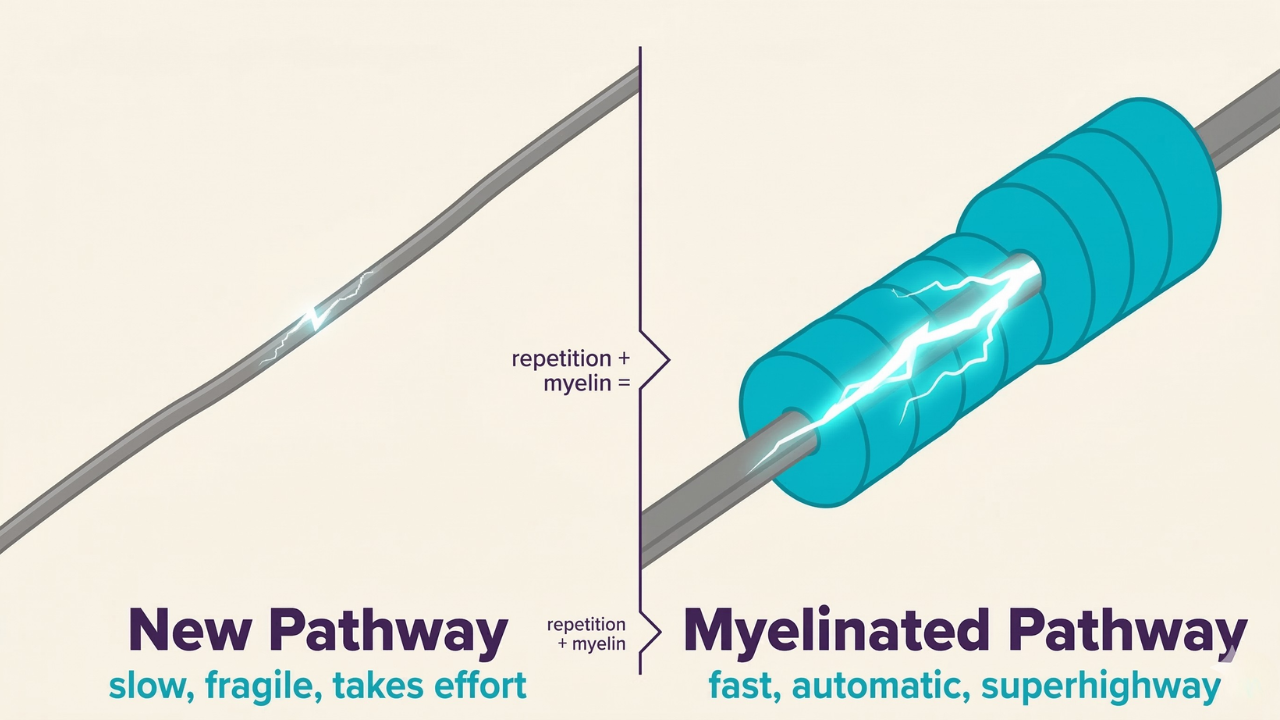
    Myelin and neural pathways icon showing how repetitive survival persona patterns become hardwired through neuroplasticity

    Frequently Asked Questions About Survival Personas

    What is a survival persona and how do I know if I have one?

    A survival persona is the identity your brain built in childhood to earn love, stay safe, and maintain control in an emotionally unpredictable environment. You likely have one if you’re a high achiever who feels empty despite success, if you scan rooms for problems, if you say yes when your body says no, or if people describe you as “strong” while you feel hollow inside. The survival persona feels like your personality — but it’s actually a trauma adaptation that the Worst Day Cycle™ keeps running on autopilot.

    What are the three types of survival personas?

    The three survival persona types are the falsely empowered (controls, dominates, rages — looks powerful but driven by fear), the disempowered (collapses, people-pleases, disappears — makes themselves small to stay safe), and the adapted wounded child (oscillates between both — overperforms then shuts down). Most high achievers run on one type or a blend. The Emotional Authenticity Method™ helps identify which pattern is running your life so you can begin rewiring it.

    Why do high achievers build survival personas instead of authentic identities?

    In the first seven years of life, the brain operates in a theta brainwave state — absorbing everything like hypnosis. If your environment taught you that love was conditional on performance, compliance, or emotional suppression, your brain built a survival strategy around those conditions. The brain can’t tell right from wrong — only known from unknown. Since most childhood messaging is negative and shaming, the brain automates the survival persona because it’s known, and known equals safe.

    Can a survival persona be healed or does it stay forever?

    The survival persona can absolutely be dismantled — but not through insight alone. Because the persona is stored in the body as a neurochemical pattern, healing requires somatic work, not just cognitive understanding. The Emotional Authenticity Method™ provides a 5-step daily practice that traces today’s survival reactions to their childhood origins and rewires the nervous system over time. The Authentic Self Cycle™ — Truth, Responsibility, Healing, Forgiveness — provides the long-term framework for identity restoration.

    How is the survival persona connected to the Worst Day Cycle™?

    The survival persona IS the denial stage of the Worst Day Cycle™. The cycle runs: Trauma → Fear → Shame → Denial. Denial is where the persona lives — it’s the identity you created to survive the pain of shame. The persona keeps the cycle running by suppressing authentic feelings, which prevents healing, which maintains the trauma response, which generates more fear and shame. Breaking the cycle requires moving into the Authentic Self Cycle™ through truth, responsibility, healing, and forgiveness.

    What is the difference between a survival persona and just having a strong personality?

    A strong personality comes from a secure emotional foundation — you’re strong because you can tolerate discomfort while staying connected to yourself. A survival persona looks strong but is driven by fear — you perform strength because vulnerability was never safe. The key difference: a strong person can rest, ask for help, say “I don’t know,” and show vulnerability without feeling like they’ll be abandoned. A survival persona can’t — because those actions trigger the childhood shame that created the persona in the first place.

    The Bottom Line

    You are not broken for becoming who you had to be. The survival persona you built was brilliant. It was necessary. It got you through a childhood that wasn’t emotionally safe. And it built an external life that looks impressive to everyone around you.

    But you don’t have to stay there.

    High achievement built your external world. Authenticity will build your internal one. And that’s the only place the void begins to soften.

    That’s you — not the persona everyone admires. The human being underneath who’s been waiting decades to finally be seen, to finally be known, to finally stop performing and start living.

    Your authentic self isn’t some perfect, enlightened version of you. It’s simply who you were before you were trained to earn love. From that place, you can say “I’m tired,” “I’m scared,” “I don’t know,” and “I need help” — without believing that makes you unlovable.

    The void doesn’t fill with achievement. It fills with truth. With feeling. With the willingness to finally stop running from yourself — and start running toward who you actually are.

    Perfectly imperfect icon showing that your authentic self doesn't need to perform to be worthy of love

    These books complement the frameworks in this article and deepen your understanding of how survival personas form and how to heal them:

    Facing Codependence by Pia Mellody — the foundational text on how childhood trauma creates the survival personas that drive overperformance and self-abandonment.

    The Body Keeps the Score by Bessel van der Kolk — the science of how trauma lives in the body, explaining why the survival persona can’t be dismantled through thought alone.

    When the Body Says No by Gabor Maté — how chronic survival persona activation manifests as physical illness and disease.

    Codependent No More by Melody Beattie — a practical guide to recognizing when your survival persona has created codependent patterns in your relationships.

    The Gifts of Imperfection by Brené Brown — how shame drives the survival persona and why vulnerability is the path back to your authentic self.

    Take the Next Step

    If you’re ready to stop living through your survival persona and start building a life from your authentic self, Kenny Weiss offers courses designed for high achievers who are done performing and ready to heal:

    Emotional Blueprint Starter Course — Individual ($79) — Your personal roadmap to identifying your survival persona and beginning the journey to your authentic self.

    Relationship Starter Course — Couples ($79) — For couples ready to see how their survival personas collide and learn to connect authentically.

    Why We Can’t Stop Hurting Each Other ($479) — Deep-dive into the Worst Day Cycle™ and how childhood trauma creates the survival personas that sabotage relationships.

    Why High Achievers Fail at Love ($479) — Built specifically for high achievers whose survival personas have mastered career but can’t figure out relationships.

    The Shutdown Avoidant Partner ($479) — Understanding avoidant attachment through the lens of trauma chemistry and survival personas.

    Tier 1: Mapping the Blueprint ($1,379) — The comprehensive program for learning and practicing the Emotional Authenticity Method™ to dismantle your survival persona.

    Download the Feelings Wheel — the free tool used in Step 2 of the Emotional Authenticity Method™ to build emotional granularity beyond the survival persona’s “I’m fine.”

    Explore more: The Signs of Enmeshment | 7 Signs of Relationship Insecurity | 7 Signs of High Self-Esteem | How to Determine Your Negotiables and Non-Negotiables | 10 Do’s and Don’ts for a Great Relationship

  • How to Heal Toxic Shame: 7 Steps to Reclaim Your Self-Worth

    How to Heal Toxic Shame: 7 Steps to Reclaim Your Self-Worth

    Toxic shame is the internalized belief that you — not your behavior, but your very self — are fundamentally broken, defective, and unworthy of love. It is not guilt, which says “I did something wrong.” Toxic shame says “I AM something wrong.” This core wound originates in childhood trauma — any negative emotional experience that created painful meanings about who you are — and it becomes the invisible engine driving self-sabotage, codependence, perfectionism, and the void that no amount of achievement can fill.

    That’s you — the one who can list every mistake you’ve ever made but can’t name a single thing you love about yourself without feeling like a fraud.

    Toxic shame isn’t a character flaw. It’s a neurochemical pattern your brain built in childhood to survive an emotionally unsafe environment. And the seven steps in this article will show you how to heal it — not by thinking differently, but by rewiring the emotional blueprint that created it.

    Emotional authenticity icon representing the path to healing toxic shame through feeling your feelings

    What Is Toxic Shame and How Is It Different From Guilt?

    Toxic shame and guilt sound similar, but they operate in completely different ways inside your nervous system. Understanding the difference is the first step toward healing.

    Guilt is healthy. Guilt says: “I did something that doesn’t align with my values, and I want to make it right.” Guilt is external — it’s about a behavior, a choice, an action. Guilt keeps your sense of self intact. You made a mistake. You are not a mistake.

    Toxic shame is the opposite. Toxic shame says: “I AM the mistake. I am fundamentally broken. There is something wrong with me at my core.” It’s not about what you did — it’s about who you believe you are. And that belief was installed in childhood, long before you had the cognitive ability to question it.

    That’s you — the one who can’t make a simple mistake without your entire identity collapsing, because somewhere deep inside, every mistake confirms what you’ve always believed: you’re not enough.

    Here’s how toxic shame gets installed: as a child, your perfectly imperfect parents couldn’t always separate YOU from your BEHAVIOR. Instead of saying “your choice was imperfect,” the message you received — through words, tone, withdrawal, or silence — was “YOU are defective.” A child’s brain can’t distinguish between “I did something bad” and “I am bad.” So the brain made the only conclusion available: I am the problem.

    Toxic shame is the internalized belief that your very self is defective — installed in childhood when your developing brain couldn’t distinguish between imperfect behavior and an imperfect identity, creating a core wound that drives every pattern of self-sabotage, people-pleasing, and perfectionism in your adult life.

    Emotional blueprint icon showing how childhood shame creates the core wound driving adult self-sabotage

    How Does the Worst Day Cycle™ Create Toxic Shame?

    Toxic shame doesn’t exist in isolation. It’s one stage of a larger neurochemical pattern called the Worst Day Cycle™ — and understanding this cycle is essential to breaking free from it.

    Worst Day Cycle diagram showing trauma fear shame denial loop that creates and perpetuates toxic shame

    The Worst Day Cycle™ has four stages: Trauma → Fear → Shame → Denial.

    Trauma: Any negative emotional experience in childhood that created painful meanings about you. It doesn’t have to be dramatic — it can be a parent who was emotionally unavailable, a household where feelings were treated as weakness, a caregiver whose love was conditional on performance, or a moment when you were told “stop crying” or “you’re too sensitive.” These experiences create a massive chemical reaction in the brain and body. The hypothalamus generates chemical cocktails — cortisol, adrenaline, dopamine, oxytocin misfires — and the brain becomes addicted to these emotional states.

    That’s you — still carrying the weight of a moment that lasted ten seconds when you were six years old, because your nervous system never processed it.

    Fear: Fear drives repetition. The brain conserves energy by repeating known patterns — it can’t tell right from wrong, only known from unknown. Since 70%+ of childhood messaging is negative and shaming, adults repeat these painful patterns in relationships, career, hobbies, health — everything. Your brain thinks repetition equals safety. So you keep choosing partners who confirm your shame, jobs that recreate the pressure, and situations that trigger the same wound — not because you’re broken, but because your nervous system is terrified of the unknown.

    Shame: This is where you lost your inherent worth. “I am the problem.” Not “I made a mistake” — but “I AM the mistake.” This is the core wound underneath every pattern of self-sabotage, codependence, and perfectionism. Toxic shame tells you that your authentic self isn’t worth keeping — that the only way to be safe is to perform, produce, and prove your worth through external validation.

    That’s the shame talking — the voice that wakes you at 3 AM replaying a conversation from two years ago, because deep down you believe every interaction is evidence of your defectiveness.

    Denial: Denial is the survival persona you created to survive the pain. It was brilliant in childhood — absolutely necessary. But in adulthood, it sabotages everything. Your survival persona is the mask you wear to avoid feeling the shame. Some people perform strength. Some people perform smallness. Some swing between both. But all of them are running from the same core wound.

    Trauma chemistry icon showing how childhood shame creates neurochemical addiction patterns in the brain

    The Worst Day Cycle™ explains why toxic shame feels permanent — your brain created a neurochemical loop in childhood that equates your identity with defectiveness, and it repeats that loop thousands of times per day without your conscious awareness, making shame feel like truth rather than a pattern.

    How Do the Three Survival Personas Express Toxic Shame?

    Your survival persona is the identity you created in childhood to navigate an emotionally unsafe environment. It’s not who you are — it’s who you had to become. And it’s the way toxic shame expresses itself in your adult life.

    Survival persona icon showing the three types of shame-driven identities created in childhood

    There are three survival persona types:

    The Falsely Empowered: This persona controls, dominates, and rages. Their toxic shame says: “If I’m perfect, if I’m powerful, if I’m in control, no one can see how broken I really am.” They run from shame by performing strength. They’re the perfectionist, the workaholic, the person who never asks for help. Their shame manifests as relentless self-criticism disguised as “high standards,” rage when things go wrong, and deep loneliness underneath external success.

    That’s you — the one who’d rather burn out than admit you’re struggling, because admitting weakness feels like proving the shame is true.

    The Disempowered: This persona collapses, people-pleases, and disappears. Their toxic shame says: “If I make myself small enough, if I sacrifice everything, if I’m always available, maybe people won’t leave me.” They run from shame by making themselves invisible. Their shame manifests as chronic resentment, depression, health issues from self-abandonment, and relationships where they’re completely unvalued.

    Sound familiar? The person who gives everything to everyone else and then wonders why they feel invisible, worthless, and empty?

    The Adapted Wounded Child: This persona oscillates between both — raging one moment, collapsing the next. They swing between “I don’t need anyone” and “please don’t leave me.” Their shame manifests as unpredictability, emotional exhaustion, and the feeling that they don’t know who they really are underneath all the switching.

    Adapted wounded child icon showing oscillation between falsely empowered and disempowered survival personas driven by toxic shame

    That’s you — the one who can’t understand why you explode at your partner one moment and become a doormat the next, wondering which version of you is the real one.

    All three survival personas are brilliant childhood adaptations to toxic shame — they protected you from feeling the full weight of “I am defective” by giving you a role to perform, but in adulthood, the performance itself becomes the prison.

    How Does Toxic Shame Show Up in Every Area of Your Life?

    Family: You’re still playing the role your family assigned you at age six. You manage everyone’s emotions at holiday dinners. You swallow your needs to keep the peace. You feel responsible for your parents’ happiness — even now, as an adult. When you try to set a boundary, the guilt is so overwhelming that you cave. That guilt isn’t really guilt — it’s toxic shame telling you that having needs makes you selfish, ungrateful, or bad.

    That’s you — the one who can’t say “no” to your mother without feeling like you’ve committed a crime against humanity.

    Romantic Relationships: You choose partners who confirm your toxic shame. You tolerate behavior that crosses every boundary because leaving feels more terrifying than staying. You confuse intensity with intimacy. You abandon your needs to keep the relationship “safe” — and then feel resentful when your partner doesn’t read your mind. Or you control, criticize, and rage to keep yourself from ever being vulnerable enough to be hurt.

    That’s you — either the one who gives everything and gets nothing, or the one who demands everything and gives nothing. Both patterns are shame driving the wheel.

    Friendships: You’re the friend everyone calls in a crisis but no one checks on. You listen for hours but never share your own struggles. You feel lonely even when surrounded by people because no one actually knows you — they know your survival persona. Your toxic shame convinced you that if anyone saw the real you, they’d leave.

    Work: The falsely empowered shame engine shows up as burnout, perfectionism, and inability to delegate. The disempowered shame engine shows up as underearning, underselling yourself, and accepting terrible treatment. Either way, you’re not working from authentic motivation — you’re working from shame. You’re proving something instead of creating something.

    Sound familiar? Working 60+ hours a week because you believe that’s the only way you’re valuable — or staying in a job that pays you 30% less than your worth because you don’t think you deserve better?

    Body and Health: You push through exhaustion, pain, hunger, and stress. You numb with food, alcohol, exercise, or scrolling. Your body has been trying to tell you something for years — chronic pain, digestive issues, insomnia, autoimmune conditions — but toxic shame taught you to ignore your body’s signals. Your body became something to fix, control, or override — never something to listen to.

    Emotional regulation icon showing how healing toxic shame requires listening to your body's signals

    Why Can’t Positive Thinking or Affirmations Heal Toxic Shame?

    You’ve probably already tried affirmations. You’ve stood in front of the mirror and said “I am worthy.” You’ve read the books. You’ve done the gratitude journals. And you probably still feel the shame.

    Here’s why: toxic shame is not a thought — it’s a nervous system state. Emotions are biochemical events, not intellectual ones. Thoughts originate from feelings, not the other way around. You cannot think your way out of a biochemical pattern that has been running since childhood.

    That’s you — repeating “I am enough” while your nervous system screams that you’re not, and then shaming yourself for not being “positive enough” to make the affirmations work.

    When your nervous system is locked in the shame state, it doesn’t care what your conscious mind says. It’s running survival code written when you were four years old. That code says: “I am defective. I must perform to earn love. If I stop performing, I will be abandoned.” Affirmations can’t reprogram that. Willpower can’t override that. Your conscious mind is no match for your nervous system’s survival patterns.

    Positive thinking fails for toxic shame because shame lives in the body’s neurochemistry, not in the mind’s narrative — you cannot affirm your way out of a biochemical event that was automated in childhood and reinforced through decades of repetition.

    Myelin and neural pathways icon showing why toxic shame requires neurological rewiring not just positive thinking

    What Are the 7 Steps to Heal Toxic Shame?

    These seven steps work because they address toxic shame where it actually lives — in your nervous system, your body, and your emotional blueprint — not just in your thoughts.

    Step 1: Recognize the Difference Between Shame and Guilt. Before you can heal toxic shame, you have to see it for what it is. Every time you catch yourself saying “I’m so stupid” or “I’m such an idiot” or “I’m the worst,” stop. That’s shame talking — not reality. Guilt says “my choice was imperfect.” Shame says “I am defective.” Start noticing the difference. This awareness alone begins to loosen shame’s grip.

    That’s you — finally hearing the voice that’s been narrating your life since childhood and realizing: that’s not my voice. That’s my shame.

    Step 2: Trace the Shame to Its Childhood Origin. Toxic shame didn’t start with you. It was inherited — passed down from your perfectly imperfect parents, who inherited it from theirs. Ask yourself: when is the first time I felt this feeling? Not today’s version — the original version. The moment your developing brain decided “I am the problem.” Your partner isn’t your parent. Your boss isn’t your father. Your nervous system just thinks they are.

    That’s the moment everything shifts — when you see that your shame belongs to a five-year-old, not a forty-year-old.

    Step 3: Learn the Worst Day Cycle™ and Identify Your Survival Persona. Once you see the origin, map the pattern. Which stage of the Worst Day Cycle™ are you most stuck in — trauma, fear, shame, or denial? Which survival persona do you default to — falsely empowered, disempowered, or adapted wounded child? Naming the pattern is the beginning of freedom from it.

    Step 4: Develop Emotional Granularity Using the Feelings Wheel. Most people living in toxic shame have two emotional settings: “fine” and “not fine.” That’s not enough information for your nervous system to heal. Using the Feelings Wheel, practice naming the specific emotion underneath the shame. Is it grief? Terror? Abandonment? Rage? Loneliness? Each emotion carries different information and requires a different response.

    Sound familiar? — going through life saying “I’m fine” when you’re actually drowning, because toxic shame taught you that having feelings makes you a burden?

    Step 5: Practice the Emotional Authenticity Method™ Daily. This is the core practice that actually rewires toxic shame at the nervous system level. The five steps — somatic down-regulation, naming the feeling, locating it in your body, tracing it to childhood, and envisioning who you’d be without it — create the neurological change that thoughts alone cannot produce. This is where healing actually happens.

    Emotional fitness icon representing the daily practice required to heal toxic shame through the Emotional Authenticity Method

    Step 6: Develop Your Own Morals, Values, Needs, and Non-Negotiables. Toxic shame erased your sense of self. You were raised to meet your parents’ morals and values, needs and wants — and were never given permission to discover your own. That’s why 99% of people can’t quickly list their morals, values, negotiables and non-negotiables. Reclaiming these isn’t selfish — it’s the foundation of identity restoration.

    That’s you — knowing exactly what everyone else needs and having absolutely no idea what you need, because toxic shame taught you that your needs don’t matter.

    Step 7: Forgive Yourself — You Were Never the Problem. Forgiveness doesn’t mean condoning what happened. It means releasing the inherited emotional blueprint. Your parents placed their unhealed pain, their shame, and their survival personas on you — not because they were evil, but because they were doing the best they could with their own unhealed wounds. You are not defective. You never were. You are perfectly imperfect — pure worth, born into a world that didn’t know how to honor it.

    That’s you — finally understanding that you were never the problem. The shame was never yours to carry. And today, for the first time, you have a choice to put it down.

    These seven steps work because they address toxic shame at every level — cognitive awareness, somatic processing, emotional granularity, and identity restoration — creating cumulative neurological change that replaces the shame blueprint with one built on inherent worth.

    How Does the Emotional Authenticity Method™ Rewire Toxic Shame?

    The Emotional Authenticity Method™ is the daily practice that rewires toxic shame at the nervous system level — where it actually lives. It works because it targets the body, not just the mind.

    Step 1: Somatic Down-Regulation with optional Titration. Before you can process shame, you have to get your nervous system below threat level. This might mean deep breathing, grounding, movement, or simply slowing down enough to feel your body. Titration means you go slowly — you don’t force yourself to feel everything at once. You feel a little, regulate, feel a little more.

    That’s you — learning that you don’t have to white-knuckle your way through healing. You can go slowly. Your nervous system needs permission to feel safe first.

    Step 2: What am I feeling? Most people stuck in toxic shame have been disconnected from their emotions for so long that “fine” is their default answer. Using the Feelings Wheel, you develop emotional granularity — the ability to name specific emotions instead of lumping everything into “stressed” or “fine” or “bad.”

    Step 3: Where in my body do I feel it? All emotional trauma is stored physically. Your chest tightens. Your stomach drops. Your jaw clenches. Your shoulders climb toward your ears. Locating the feeling in your body is how you move from intellectual understanding to somatic processing — from “I know I have shame” to “I feel the shame in my chest, and it’s heavy, and it’s been there since I was four.”

    Step 4: What is my earliest memory of this feeling? This is where the magic happens. You trace today’s shame reaction back to its childhood origin. You realize: this isn’t about today. This feeling was installed decades ago. My partner’s criticism isn’t my parent’s rejection — my nervous system just thinks it is.

    That’s the moment toxic shame starts to lose its power — when you see it as a pattern, not a truth.

    Step 5: Who would I be if I never had this feeling again? This is the vision step. It connects you to the Authentic Self Cycle™ and gives your nervous system a new destination — not more coping, not better management, but actual identity restoration. Who are you without the shame? What would you create, ask for, risk, love?

    The Emotional Authenticity Method™ works because emotions are biochemical events — you cannot change emotional patterns through thoughts alone. Thoughts originate from feelings, not the other way around. By processing shame somatically, you create a new neurochemical pattern that gradually replaces the old one.

    Reparenting icon showing how the Emotional Authenticity Method helps you become the parent you never had

    How Does the Authentic Self Cycle™ Replace Shame With Worth?

    The Authentic Self Cycle™ is the healing counterpart to the Worst Day Cycle™. Where the Worst Day Cycle™ traps you in Trauma → Fear → Shame → Denial, the Authentic Self Cycle™ restores your identity through Truth → Responsibility → Healing → Forgiveness.

    Authentic Self Cycle diagram showing truth responsibility healing forgiveness as the path from toxic shame to inherent worth

    Truth: Name the blueprint. See that “this isn’t about today.” When your partner gives you feedback and your stomach drops, truth says: “This feeling is from childhood. My partner isn’t my critical parent — my nervous system just thinks they are.” Truth is the moment you stop believing shame’s narrative and start seeing the pattern.

    That’s the first step out of toxic shame — seeing it as a pattern instead of being trapped inside it.

    Responsibility: Own your emotional reactions without blame. “My partner isn’t my parent — my nervous system just thinks they are.” This isn’t about fault. It’s about taking back your power from a childhood that stole it. Responsibility says: I can’t control what happened to me, but I can own how I respond to it now.

    Healing: Rewire the emotional blueprint so conflict becomes uncomfortable but not dangerous, space isn’t abandonment, and intensity isn’t attack. This happens through repeated somatic practice — second by second, like the ticks of a clock. The second hand moves in tiny, almost insignificant ticks. But those ticks move the minute hand. The minutes move the hours. Healing works the same way.

    Forgiveness: Release the inherited emotional blueprint and reclaim your authentic self. This creates a NEW emotional chemical pattern that replaces fear, shame, and denial with safety, worth, and connection. You don’t become someone new. You finally meet who you always were underneath the survival persona.

    That’s you — not becoming someone different. Becoming who you always were before toxic shame told you that person wasn’t worth keeping.

    The Authentic Self Cycle™ is an identity restoration system — it doesn’t teach you to cope with toxic shame, it replaces the neurochemical pattern that created it with a new blueprint built on truth, responsibility, and the inherent worth you were born with.

    Frequently Asked Questions About Toxic Shame

    What is toxic shame and how is it different from healthy shame?

    Toxic shame is the internalized belief that you — as a person — are fundamentally defective and unworthy. It says “I AM the problem.” Healthy shame doesn’t exist in Kenny Weiss’s framework — what people call “healthy shame” is actually guilt, which says “I DID something that doesn’t align with my values.” Guilt keeps your identity intact. Toxic shame destroys it. The distinction matters because guilt motivates change while toxic shame paralyzes you in a cycle of self-punishment.

    What causes toxic shame in childhood?

    Toxic shame is caused by any childhood experience where a child’s developing brain couldn’t separate their behavior from their identity. When a parent says “you’re bad” instead of “your choice was imperfect,” the child internalizes: “I AM defective.” This can come from overt abuse, but more commonly it comes from emotional neglect, conditional love, dismissive parenting, or households where feelings were treated as weakness. The Worst Day Cycle™ shows how these experiences create neurochemical patterns that automate shame throughout adulthood.

    Can toxic shame be healed without therapy?

    You can begin healing toxic shame with daily somatic practices like the Emotional Authenticity Method™. The seven steps in this article provide a framework for real neurological change. However, because toxic shame was created in relationship — through your childhood attachment experiences — it often heals most powerfully in relationship. A skilled guide, coach, or therapist can accelerate the process by providing the safe attachment your nervous system needs to risk vulnerability.

    How long does it take to heal toxic shame?

    Toxic shame patterns that have been running for 20, 30, or 40 years don’t reverse overnight. But noticeable shifts can happen within weeks of consistent daily practice using the Emotional Authenticity Method™. The key is repetition, not intensity. Like the second hand on a clock, each small moment of emotional truth moves the larger pattern. The Authentic Self Cycle™ provides the framework for long-term identity restoration.

    Why do affirmations and positive thinking fail to heal toxic shame?

    Affirmations target the thinking brain, but toxic shame lives in the nervous system as a biochemical pattern. Emotions are biochemical events — thoughts originate from feelings, not the other way around. You cannot think your way out of a nervous system state that was automated in childhood. The Emotional Authenticity Method™ works because it addresses the body — where trauma is actually stored — creating new neurochemical patterns through somatic processing rather than cognitive override.

    Is toxic shame the same as low self-esteem?

    Low self-esteem is a symptom of toxic shame, not the cause. Toxic shame is the core wound — the belief that “I AM defective.” Low self-esteem is one of the many ways that wound expresses itself. You can build high self-esteem temporarily through achievement and validation, but if the underlying toxic shame remains, the self-esteem collapses every time you make a mistake. True self-esteem comes from healing the shame wound and reconnecting with your inherent worth.

    The Bottom Line

    You are not defective. You never were.

    That voice in your head — the one that says you’re not enough, not worthy, not lovable — that’s not your voice. That’s your toxic shame. It was installed by perfectly imperfect parents who were carrying their own unhealed shame, passed down from their parents, and theirs before them.

    You didn’t choose it. You couldn’t have prevented it. And you are not to blame for it.

    But today — right now — you have something you didn’t have as a child: a choice. You can choose to see the pattern. You can choose to trace it to its origin. You can choose to feel what you’ve been running from. You can choose to rewire the blueprint, one small moment at a time.

    That’s you — not the defective person your shame told you that you were. The perfectly imperfect human being who survived something painful, built a brilliant survival strategy to cope with it, and is now brave enough to let that strategy go.

    Healing toxic shame isn’t about becoming someone new. It’s about meeting who you always were — underneath the survival persona, underneath the performance, underneath the decades of “I’m fine.” That person has been waiting for you. And they’re worth meeting.

    The void doesn’t fill with achievement. It fills with truth. With feeling. With the willingness to finally stop running from yourself — and start running toward who you actually are.

    Perfectly imperfect icon reminding you that inherent worth exists beneath toxic shame

    These books complement the frameworks in this article and deepen your understanding of toxic shame and its healing:

    Facing Codependence by Pia Mellody — the foundational text on how childhood trauma creates shame-based identity and codependent patterns.

    Healing the Shame That Binds You by John Bradshaw — the original work on toxic shame and how it becomes internalized as identity.

    The Body Keeps the Score by Bessel van der Kolk — the science of how trauma and shame live in the body, not just the mind.

    When the Body Says No by Gabor Maté — how chronic shame and emotional suppression manifest as physical illness.

    Codependent No More by Melody Beattie — a practical guide to recognizing and healing the codependent patterns that toxic shame creates.

    The Gifts of Imperfection by Brené Brown — how shame drives performance-based identity and why vulnerability is the path back to worth.

    Take the Next Step

    If you’re ready to heal toxic shame and reclaim the inherent worth you were born with, Kenny Weiss offers courses designed to guide you through the Emotional Authenticity Method™ and the Authentic Self Cycle™:

    Emotional Blueprint Starter Course — Individual ($79) — Your personal roadmap to understanding the Worst Day Cycle™ and identifying your survival persona.

    Relationship Starter Course — Couples ($79) — For couples ready to see how toxic shame drives conflict and build interdependence instead.

    Why We Can’t Stop Hurting Each Other ($479) — Deep-dive into the Worst Day Cycle™ and how childhood shame creates relationship pain.

    Why High Achievers Fail at Love ($479) — Built for the falsely empowered survival persona who uses achievement to outrun toxic shame.

    The Shutdown Avoidant Partner ($479) — Understanding avoidant attachment through the lens of trauma chemistry and survival personas.

    Tier 1: Mapping the Blueprint ($1,379) — The comprehensive program for learning and practicing the Emotional Authenticity Method™.

    Download the Feelings Wheel — the free tool used in Step 2 of the Emotional Authenticity Method™ to build emotional granularity and move beyond “I’m fine.”

    Explore more: The Signs of Enmeshment | 7 Signs of Relationship Insecurity | 7 Signs of High Self-Esteem | How to Determine Your Negotiables and Non-Negotiables | 10 Do’s and Don’ts for a Great Relationship

  • Shame in the Worst Day Cycle™: How Childhood Shame Strips Your Worth

    Shame in the Worst Day Cycle™: How Childhood Shame Strips Your Worth

    Shame in the Worst Day Cycle™ is the stage where you lose your inherent worth — the moment childhood trauma convinces you that you ARE the problem, not that you HAVE a problem, and it is the hidden engine that drives every pattern of self-sabotage, people-pleasing, perfectionism, and emotional shutdown in your adult life. If you’ve ever pushed yourself to the point of burnout, tolerated treatment you know is wrong, or felt hollow inside despite external success — shame is the invisible force running the program. And it started long before you had words for it.

    That’s you — the one who works harder than everyone in the room because deep down, you believe that if you stop producing, you’ll be exposed as worthless.

    This is Part 4 of my series on healing the Worst Day Cycle™. In Part 1, we explored how childhood trauma creates the cycle. In Part 2, we examined how the emotional blueprint runs your adult life. In Part 3, we explored how fear drives repetition. Now we arrive at the stage that locks the entire cycle in place: shame.

    Worst Day Cycle diagram showing trauma fear shame denial — shame is the stage where you lose your inherent worth

    What Is Shame in the Worst Day Cycle™?

    Shame is the third stage of the Worst Day Cycle™ — the four-stage neurochemical loop of Trauma → Fear → Shame → Denial that runs underneath every self-sabotaging pattern in your life. Shame sits at the center of your Worst Day Cycle™. It is the glue of trauma repetition. It is the prison of the adapted child-self.

    That’s you — feeling a wave of worthlessness wash over you after a small mistake at work, and wondering why your reaction is so much bigger than the situation deserves.

    Shame is not guilt. Guilt is healthy — it says “I did something against my values” and motivates repair. Shame says something entirely different. Shame says: “I AM the problem.” Not “I made a mistake” — but “I am fundamentally broken, defective, unworthy of love.” That belief didn’t come from nowhere. It was installed in childhood, and it has been running your operating system ever since.

    Shame is the stage of the Worst Day Cycle™ where childhood trauma convinces you that your inherent worth is conditional — that you must perform, produce, please, or prove yourself to deserve love, connection, or even basic safety.

    Trauma chemistry icon showing how childhood shame creates neurochemical addiction to worthlessness

    How Does Childhood Trauma Create Shame?

    As a species, we need two things to survive: attachment to another human being and the ability to pursue our authentic selves. Because our caregivers are human — and therefore perfectly imperfect — every child faces a brutal choice: drop your authentic self to maintain attachment, or risk losing connection entirely.

    That’s you — the child who stopped crying because tears made your parent uncomfortable. The child who learned that being “easy” was the only way to be loved.

    The loss of your authentic self creates shame. Here’s how the Worst Day Cycle™ builds it:

    Stage 1 — Trauma: Any negative emotional experience in childhood that created painful meanings about you. It doesn’t have to be dramatic — a parent who was emotionally unavailable, a household where feelings were weakness, a caregiver whose love was conditional on performance. These experiences create a massive chemical reaction in the brain and body. The hypothalamus generates chemical cocktails — cortisol, adrenaline, dopamine, oxytocin misfires — and the brain becomes addicted to these emotional states.

    Stage 2 — Fear: Fear drives repetition. The brain conserves energy by repeating known patterns — it can’t tell right from wrong, only known from unknown. Since 70%+ of childhood messaging is negative and shaming, adults repeat these painful patterns in relationships, career, hobbies, health — everything. The brain thinks repetition equals safety.

    That’s you — choosing the same emotionally unavailable partner over and over, not because you want to, but because your nervous system is terrified of anything unfamiliar.

    Stage 3 — Shame: This is where it all collapses inward. The powerlessness within fear is what creates shame. Instead of seeing the fear as your nervous system’s response to a childhood wound, you internalize it as truth about yourself. “There’s something wrong with me because I can’t figure this out.” Shame strips you of your inherent value and worth and your authentic power.

    Stage 4 — Denial: To survive the overwhelming nature of those feelings, you create denial. Denial is the moment shame kicks in the survival persona, suppresses the pain from childhood, and runs the old program. “I’m fine. I just have high standards. I just need to keep moving.” Instead of feeling the original wound, you deny it and throw yourself into more work, more fixing, more taking care of everybody else but yourself.

    Emotional blueprint icon showing how childhood shame creates the operating system running your adult life

    That’s the cycle — and it repeats thousands of times per day without your conscious awareness. You wake up and the shame engine fires up. You feel the fear it creates. You deny it by pushing harder. You get temporary relief. And then boom — the void. And the process repeats over and over and over.

    The Worst Day Cycle™ reveals that shame is not a character flaw — it is a neurochemical survival pattern your brain created in childhood to make sense of unbearable pain, and it has been running on autopilot ever since.

    How Does Shame Strip Your Inherent Worth?

    Every human being has inherent value and worth — whether they are being perfect or imperfect. Worth is not something you earn through achievement, performance, usefulness, or compliance. It exists at birth and can never be lost.

    But shame convinces you otherwise.

    That’s the lie shame tells — that your value is conditional. That you must perform, produce, or please others to deserve love. That without your achievements, your gifts, you could never be loved and would never have been loved.

    Perfectly imperfect icon representing inherent worth that shame cannot destroy

    As John Bradshaw explains, “The wounded inner child contaminates intimacy in relationships because he has no sense of his authentic self.” When a parent cannot affirm a child’s feelings, needs, and desires, they reject that child’s authentic self. A survival persona must then be set up to replace the authentic self. And that persona runs on shame.

    Shame is the core motivator of both the super-achiever and the under-achiever. The super-achiever uses accomplishment to prove they have worth — “If I just work harder, achieve more, become more impressive, maybe I’ll finally feel enough.” The under-achiever has given up the fight entirely — “Why bother? I’ll never be enough anyway.” Both are running the same shame program. Both have lost contact with their inherent worth.

    That’s you — either grinding yourself into the ground trying to prove you’re worthy, or collapsed under the weight of believing you never will be. Two sides of the same shame coin.

    Trying to be perfect is actually self-rejection — it is choosing to give up your own identity and making yourself powerless. The single greatest way to love yourself and develop self-worth is to follow your own morals, values, needs, and wants — and to accept that you are a human being with overwhelming inherent worth regardless of what you’ve done or what’s been done to you.

    Shame creates a counterfeit identity system — it convinces you that your authentic self is unlovable, so you build a survival persona to earn the love that was always your birthright, and that persona becomes the prison you live in for decades.

    How Do the Three Survival Personas Use Shame?

    Your survival persona is the identity your brain built in childhood to navigate an emotionally unsafe environment. It’s not who you are — it’s who you had to become. And shame is the fuel that powers every version of it.

    Whether falsely empowered, disempowered, or adapted wounded child — it’s all a power game. Shame strips us of our inherent value and worth and our authentic power. So the survival persona tries to get that power back — through control, through collapse, or through oscillating between both.

    Three survival personas — falsely empowered disempowered adapted wounded child — all driven by childhood shame

    The Falsely Empowered: This persona controls, dominates, and rages. The shame engine tells them: “If I’m in charge, if I win, if I’m perfect, people can’t hurt me or abandon me.” They’re driven by a deep terror of vulnerability and powerlessness. Work is their addiction, success is their medication, and failure is their nightmare. They use achievement to deny how deeply unworthy they feel — not because that’s true, but because that’s the message that was placed into them.

    That’s you — the one who’d rather burn out than admit you’re exhausted, because admitting weakness feels like proof that you are fundamentally flawed.

    The Disempowered: This persona collapses, people-pleases, and disappears. The shame engine tells them: “If I make myself small, if I sacrifice myself, if I’m always available, people won’t leave me.” They hide their shame behind being the “nice” person. But being nice is a covert way of playing the victim — the nice person wants recognition for being such a nice person while continually picking people and situations where they give more and do more.

    Sound familiar? The feeling that you have to earn love through sacrifice, that saying no will cause abandonment, that your own needs are selfish?

    The Adapted Wounded Child: This persona oscillates between falsely empowered and disempowered depending on the context. One moment they’re raging and controlling, the next they’re collapsed and people-pleasing. They’re unpredictable even to themselves. This person is exhausted by their own inconsistency.

    Adapted wounded child icon showing oscillation between falsely empowered and disempowered survival personas driven by shame

    That’s you — the one who can’t understand why you blow up at your partner one moment and then become a doormat the next, wondering why you can’t just be consistent.

    All three survival personas use shame as a control mechanism — they tell you that if you step out of your survival role, if you become vulnerable, if you ask for what you need, you’ll be exposed, abandoned, or destroyed. Self-sabotage is the collision between the authentic self and the shame-based survival persona.

    How Does Shame Show Up in Every Area of Your Life?

    Shame doesn’t stay in one corner of your life. It’s a system that runs everything — because it’s your nervous system trying to keep you safe.

    Family: You’re either still trying to earn your parents’ approval (falsely empowered) or completely dependent on their validation (disempowered). You can’t set healthy boundaries because boundaries feel like abandonment. Shame makes you feel less than — and when someone in the family brings up a topic that touches your unhealed wound, that childhood shame jumps up and you lash out or shut down. You try to create a diversion so you don’t have to admit what you’re really feeling.

    That’s you — still playing the role your family assigned you at age six, managing everyone’s emotions at holiday dinners while your own feelings sit unvisited.

    Romantic Relationships: The shame engine ensures you choose partners who trigger your childhood wounds. You recreate the Worst Day Cycle™ with your partner over and over. Something triggers your fear, you shame yourself, you activate your survival persona (control or collapse), and your partner reacts to the persona — not the real you. Both of you are having two completely different conversations: one in the present and one in the past.

    That’s you — unable to have a conversation about a legitimate need without either exploding or shutting down, wondering why your relationships never feel secure.

    Friendships: You’re the friend who always has it together and secretly resents that others never check on you. Or you’re the friend who abandons yourself completely and becomes bitter when others don’t reciprocate. You don’t let people see you struggle. You feel lonely even when surrounded by people because no one actually knows you — they know your survival persona.

    Work: The falsely empowered shame engine shows up as burnout, perfectionism, and inability to delegate. The disempowered shame engine shows up as underearning, underselling yourself, and accepting terrible treatment from employers. Either way, you’re not working from your real motivation — you’re working from fear and shame. You’re proving something instead of creating something.

    Sound familiar — working 60+ hours a week because you believe that’s the only way you’re valuable, or staying in a job that pays you 30% less than your market value because you don’t think you deserve better?

    Body and Health: Shame creates disconnection from your body. You push through pain and exhaustion (falsely empowered) or abandon self-care entirely (disempowered). Chronic pain, digestive issues, insomnia, and autoimmune conditions are often the body’s last resort when emotional signals have been ignored for decades. Your body has been trying to tell you something — but shame taught you to stop listening.

    That’s your body keeping score — every swallowed feeling, every suppressed need, every moment you abandoned yourself to keep someone else comfortable.

    Why Can’t You Think Your Way Out of Shame?

    Affirmations. Willpower. Positive thinking. Cognitive reframing. You’ve probably tried all of these. You’ve probably spent years telling yourself you’re worthy, capable, enough. And you probably still feel the shame.

    Here’s why: shame is not a thought — it’s a nervous system state. Your emotions are biochemical events, not intellectual ones. Thoughts originate from feelings, not the other way around. You cannot think your way out of a nervous system that’s still running the Worst Day Cycle™.

    That’s you — repeating “I am worthy” while your nervous system is screaming that you’re not, and then shaming yourself for not being “positive enough.”

    Myelin and neural pathways icon showing why thinking alone cannot rewire shame patterns stored in the nervous system

    As John Bradshaw wrote, “Cognitive addictions are a powerful way to avoid feelings. Thinking can be a way to avoid feelings.” Every thought starts as a feeling — the emotion comes first. Yet we all try to think our way through things, which is a waste of time because you can’t change your thoughts until you change your feelings.

    When your nervous system is in the shame state, it doesn’t care what your mind says. It’s running on survival code written in childhood. Your conscious mind is no match for your nervous system’s survival patterns. And that’s exactly why you need a practice that speaks your nervous system’s language — not just your intellect’s.

    Shame cannot be resolved through intellectual understanding because it is stored as a neurochemical pattern in the body — the brain created a chemical addiction to worthlessness in childhood, and that addiction runs below conscious awareness thousands of times per day.

    How the Emotional Authenticity Method™ Rewires Shame

    The only way to rewire the shame pattern is to change your nervous system’s emotional blueprint. And that requires the Emotional Authenticity Method™ — a somatic, nervous-system-based approach that actually changes your neurochemistry.

    Emotional Authenticity Method icon for rewiring shame at the nervous system level

    Step 1: Somatic Down-Regulation. Focus on what you can hear for 15-30 seconds. Before you can process anything, you have to get your nervous system out of survival mode. If you’re highly dysregulated, use titration — feel a little bit of the emotion, get regulated, then feel a little bit more. You’re teaching your nervous system that this feeling won’t destroy you.

    That’s you — finally understanding that “handling it” means pausing to calm your nervous system first, not pushing through with willpower.

    Step 2: What am I feeling right now? Most people respond to shame with “I feel bad” or “I’m stressed.” Your nervous system needs more specificity to heal. Use the Feelings Wheel to develop emotional granularity — the ability to name specific emotions instead of lumping everything into surface-level labels.

    Step 3: Where in my body do I feel it? All emotional trauma is stored physically. Your chest tightens. Your stomach drops. Your jaw clenches. Locating the feeling in your body is how you move from intellectual understanding to somatic processing. You’re moving from “I AM ashamed” to “I FEEL shame in my chest” — and that difference is everything.

    Step 4: What is my earliest memory of having this exact feeling? This is where the real rewiring happens. You trace today’s shame reaction back to its childhood origin. You realize: this isn’t about today. My partner isn’t my parent. My boss isn’t my father. My nervous system just thinks they are.

    That’s the moment everything shifts — when you see that your shame reaction belongs to a five-year-old, not a forty-year-old. The reason it’s so scary is that at some point in your childhood, you didn’t have the answer, you were imperfect, and your caregivers sent the message that there’s something defective about you.

    Step 5: Who would I be if I never had this thought or feeling again? This is the vision step. It connects you to the Authentic Self Cycle™. When clients are asked this question, the answer is always some version of: “I feel lighter. I feel calm. I feel free. I feel more like myself.” They don’t describe a new survival persona — they describe their authentic self. That emotional experience is the truth of who they are without the Worst Day Cycle™, without the faulty emotional blueprint, without the shame voice.

    Step 6: Feelization. Sit in the feeling of the Authentic Self and make it strong. Create a new emotional chemical addiction to replace the old blueprint. Ask: how would I respond to this situation from this feeling? What would I say? What would I do? Visualize and FEEL yourself operating from your Authentic Self. This is the emotional blueprint remapping and rewiring step — you’re building a new neurochemical neural pathway that works for you instead of the Worst Day Cycle™ working against you.

    That’s you — not just thinking about who you could be, but feeling it in your body. Creating the emotional experience of your Authentic Self so your nervous system has something real to move toward.

    The Emotional Authenticity Method™ works because emotions are biochemical events — you cannot change emotional patterns through thoughts alone. Thoughts originate from feelings, not the other way around. The EAM speaks your nervous system’s language and rewires shame at the source.

    How the Authentic Self Cycle™ Replaces Shame With Worth

    While the Worst Day Cycle™ traps you in Trauma → Fear → Shame → Denial, the Authentic Self Cycle™ restores your identity through Truth → Responsibility → Healing → Forgiveness. It is the healing counterpart — an identity restoration system that creates a new emotional chemical pattern to replace fear, shame, and denial.

    Authentic Self Cycle diagram showing truth responsibility healing forgiveness as the path out of shame

    Truth: Name the blueprint. See that “this isn’t about today.” When your colleague gives you critical feedback and your chest tightens, truth says: “This feeling is from childhood. My colleague isn’t my critical parent — my nervous system just thinks they are.” Truth breaks the wall of denial and exposes that the fixer, the giver, the survival personas are not the authentic self but adaptations.

    That’s the first step out of shame — seeing the pattern instead of being trapped inside it.

    Responsibility: This is not blame or shame. You did the best you could with what you knew at the time. Responsibility means owning that “this survival pattern kept me safe, but now it’s time to let it go.” You are always responsible for how you are making yourself feel, protecting yourself, and meeting your needs and wants — without controlling or changing the other person.

    Sound familiar? The relief of finally understanding that you can’t control anyone else, but you CAN rewire how you respond to them.

    Healing: Rewire the emotional blueprint so conflict becomes uncomfortable but not dangerous, space isn’t abandonment, and intensity isn’t attack. This is where the Emotional Authenticity Method™ does its work — reparenting the inner child, becoming the parent who chooses you. When you do that, you break the shame story, heal the fear-based chemical addiction, confront the emotional memory your body carries, and create emotional safety inside your own nervous system.

    Forgiveness: Forgiveness is not condoning what happened. Forgiveness is the moment the adult self consistently takes the driver’s seat from the child self and the shame voice. It says: “Hey kids, love you, but back seat. I’m driving now.” It is forgiving yourself: “I see it now. I’ve been stuck in this survival persona. I don’t need to shame myself for that. I was brilliant to come up with that. But I can see now it’s no longer fit for the adult world.”

    That’s you — not becoming someone new. Finally meeting who you always were underneath the survival persona and the shame that built it.

    Because I live in truth, responsibility, healing, and forgiveness, I can forgive myself for being imperfect and that I still have healing to do. Our authentic self knows at all times whether we are being perfect or imperfect — and that we always have value and worth.

    The Authentic Self Cycle™ creates a new emotional chemical pattern that gradually replaces the fear/shame/denial pattern — as this new pattern strengthens through daily Feelization practice, your survival persona becomes less necessary and your authentic self becomes your default operating system.

    Frequently Asked Questions About Shame and Healing

    What is the difference between shame and guilt?

    Guilt is healthy — it says “I did something against my values” and motivates you to repair. Shame says “I AM the problem” — it attacks your identity, not your behavior. Guilt leads to accountability. Shame leads to self-destruction, people-pleasing, or perfectionism. In the Worst Day Cycle™, shame is the third stage that strips your inherent worth and creates your survival persona.

    Why is shame so hard to heal?

    Shame is hard to heal because it is stored in the body as a neurochemical pattern, not as a thought. Your brain became chemically addicted to the emotional state of worthlessness in childhood — cortisol, adrenaline, and stress hormones became your nervous system’s baseline. The Emotional Authenticity Method™ addresses shame at the somatic level where it actually lives, not just the cognitive level where most approaches stop.

    Can shame be healed without therapy?

    You can make real progress using the Emotional Authenticity Method™ on your own. But your nervous system learned shame in relationship, so it heals most powerfully in relationship — whether that’s coaching, therapy, group work, or a trusted partner who understands the Worst Day Cycle™. Having someone witness your process accelerates healing dramatically.

    How does shame create self-sabotage?

    Self-sabotage is the collision between the authentic self and the shame-based survival persona. When you start to succeed, your survival persona panics — because if you live in your authentic self, the persona loses its connection to the old attachment patterns. If you actually succeed, it means the survival persona was always wrong. So it pulls you back into the Worst Day Cycle™ to keep you stuck in the known pattern.

    What are the three survival persona types?

    The three survival personas are the falsely empowered (controls, dominates, rages to avoid vulnerability), the disempowered (collapses, people-pleases, disappears to avoid abandonment), and the adapted wounded child (oscillates between both depending on the situation). All three are driven by shame and are attempts to reclaim the power that childhood trauma stole.

    How long does it take to rewire shame?

    Most people see shifts within weeks of consistent practice with the Emotional Authenticity Method™, but real neurological rewiring takes months and years. The key is repetition, not intensity. Within weeks, your reactions become less automatic. Within months, shame has less power. After a year of consistent work, your baseline nervous system state will be fundamentally different. The Authentic Self Cycle™ provides the framework for long-term identity restoration.

    The Bottom Line

    Shame told you that you are the problem. It has been running that message since you were a child — through your relationships, your career, your friendships, your body, and the quiet moments when the noise stops and the void creeps in.

    But shame lied.

    You were never the problem. You were a child in an impossible situation who created a brilliant survival strategy to stay alive. That strategy — the survival persona — was genius at age seven. But you’re not seven anymore. And the shame that powers it has been keeping you from the one thing you’ve been searching for your entire life: your authentic self.

    There’s nothing wrong with any of us — we’re all perfectly imperfect, we’re human, we’re limited, and we always have inherent value and worth even in our imperfections.

    That’s you — not the survival persona grinding for approval. Not the people-pleaser swallowing your needs. Not the adapted wounded child swinging between both. The real you. The one underneath all of it. The one who has been waiting to be seen, chosen, and valued — not for what you do, but for who you are.

    The Worst Day Cycle™ runs on shame. The Authentic Self Cycle™ runs on truth. And healing begins the moment you choose truth over denial — even for one breath, one moment, one small act of emotional authenticity.

    It’s not an easy journey, but I promise if you choose to do this healing work, you’ll discover the truth about the world and about yourself — and that truth will produce real freedom in your life.

    Healing the Shame That Binds You by John Bradshaw — the foundational work on toxic shame and how it colonizes identity.

    Facing Codependence by Pia Mellody — how childhood trauma creates the survival patterns that shame powers.

    The Body Keeps the Score by Bessel van der Kolk — the neuroscience of how trauma and shame live in the body, not the mind.

    When the Body Says No by Gabor Maté — how chronic shame and emotional suppression manifest as physical illness.

    Codependent No More by Melody Beattie — a practical guide for recognizing shame-driven codependent patterns.

    The Gifts of Imperfection by Brené Brown — how shame drives performance-based identity and why vulnerability is the path back to worth.

    Daring Greatly by Brené Brown — shame resilience and the courage to be imperfect.

    Take the Next Step

    If you’re ready to rewire the shame pattern and reclaim your authentic self, Kenny Weiss offers courses designed for people who are done performing and ready to heal:

    Emotional Blueprint Starter Course — Individual ($79) — Your personal roadmap to understanding the Worst Day Cycle™ and beginning the journey from shame to your authentic self.

    Relationship Starter Course — Couples ($79) — For couples ready to break the shame-driven cycle of reactivity and build interdependence.

    Why We Can’t Stop Hurting Each Other ($479) — Deep-dive into the Worst Day Cycle™ and how childhood shame creates relationship pain.

    Why High Achievers Fail at Love ($479) — Built specifically for the falsely empowered survival persona and the shame engine driving success addiction.

    The Shutdown Avoidant Partner ($479) — Understanding avoidant attachment through the lens of trauma chemistry and shame-driven survival personas.

    Tier 1: Mapping the Blueprint ($1,379) — The comprehensive program for learning and practicing the Emotional Authenticity Method™ to rewire shame at the nervous system level.

    Download the Feelings Wheel — the free tool used in Step 2 of the Emotional Authenticity Method™ to build emotional granularity beyond surface-level shame responses.

    Explore more: The Signs of Enmeshment | 7 Signs of Relationship Insecurity | 7 Signs of High Self-Esteem | How to Determine Your Negotiables and Non-Negotiables | 10 Do’s and Don’ts for a Great Relationship