Tag: Guilt

  • How to Keep Your Boundaries: 3 Steps That Actually Work

    How to Keep Your Boundaries: 3 Steps That Actually Work

    Keeping your boundaries is the daily practice of honoring your own feelings, needs, and limits — even when the people around you pressure you to abandon them — because boundaries aren’t walls you build once, they’re choices you make every single day. If you’ve ever set a boundary only to watch yourself crumble the moment someone pushes back, guilt-trips you, or gives you the silent treatment, you’re not weak. You’re running a childhood pattern that taught you that your boundaries were dangerous — and that pattern has been operating on autopilot ever since.

    That’s you — the one who can articulate the perfect boundary in therapy but can’t hold it for five minutes when your mother calls.

    The reason most people can’t keep their boundaries isn’t a lack of willpower. It’s a nervous system that was trained in childhood to believe that boundaries equal abandonment. And until you understand the emotional blueprint underneath your boundary failures, no amount of scripts, tips, or assertiveness training will stick.

    Most people can’t keep their boundaries because their childhood trauma wired their nervous system to equate self-protection with abandonment. The Worst Day Cycle™ explains how fear, shame, and denial sabotage boundaries automatically. The Emotional Authenticity Method™ rewires the emotional blueprint so boundaries become natural — not forced. You can’t think your way into boundaries. You have to feel your way there.
    Codependence icon showing how broken boundaries create codependent relationship patterns

    What Are Boundaries and Why Can’t You Keep Them?

    A boundary is the line between where you end and another person begins. It’s the internal knowing of what is yours to carry and what belongs to someone else. It protects your feelings, your time, your energy, your body, and your sense of self. Without boundaries, you lose yourself — in relationships, in family dynamics, in work, in everything.

    That’s you — the one who knows exactly what a healthy boundary looks like but dissolves the second someone needs you.

    Here’s what nobody tells you about boundaries: the problem isn’t that you don’t know how to set them. The internet is full of boundary scripts. You’ve probably memorized a dozen of them. The problem is that your nervous system won’t let you keep them. The moment you try to hold a boundary, your body floods with guilt, fear, anxiety, or shame — and you fold. Not because you’re weak. Because your body learned in childhood that boundaries were dangerous.

    Boundaries fail not because of a lack of knowledge or willpower, but because the childhood emotional blueprint taught the nervous system that self-protection triggers abandonment — and the brain will always choose connection over self-preservation when it believes survival is at stake.

    When you were a child and you tried to say no — to a parent’s demand, to an unfair situation, to emotional overwhelm — what happened? In most cases, your boundary was met with anger, withdrawal, guilt-tripping, or punishment. Your brain recorded a clear message: boundaries equal danger. And that message is still running your life today.

    That’s you — saying yes when every cell in your body is screaming no, because the last time you said no as a child, someone you loved made you pay for it.
    Emotional blueprint icon showing how childhood boundary violations create lifelong patterns of people-pleasing

    Why Do Your Boundaries Fail Every Time?

    You don’t have a boundary problem. You have a nervous system problem. Every time you try to hold a boundary, your brain runs a lightning-fast calculation: “Is this safe? What happened last time I said no? Will they leave? Will they rage? Will I be alone?” And before your conscious mind can even finish the sentence, your body has already surrendered.

    That’s you — rehearsing the boundary in the car, then abandoning it the moment you walk through the door.

    This happens because emotions are biochemical events. They aren’t thoughts you can override with logic. When your partner pushes back on a boundary, your hypothalamus generates a chemical cocktail — cortisol, adrenaline, dopamine misfires — that recreates the exact feeling you had as a child when your boundary was punished. Your body doesn’t know the difference between your mother’s disapproval in 1992 and your partner’s frustration today. It just knows: this feeling is known, and known means survival.

    The brain conserves energy by repeating known patterns. It can’t tell right from wrong — only known from unknown. Since 70%+ of childhood messaging is negative and shaming, adults repeat these painful patterns in relationships, career, hobbies, health — everything. Your boundary collapse isn’t a choice. It’s a neurochemical event that was automated decades ago.

    That’s you — not choosing to fold. Being hijacked by a nervous system that still thinks you’re seven years old and saying no means losing the only people who keep you alive.
    Trauma chemistry icon showing how childhood boundary violations create neurochemical addiction to people-pleasing

    Boundaries fail because the nervous system was trained in childhood to interpret self-protection as a threat to attachment — every boundary attempt triggers the same neurochemical cascade that was originally paired with parental rejection, creating an automatic surrender response that bypasses conscious intention.

    How the Worst Day Cycle™ Sabotages Your Boundaries

    To understand why your boundaries collapse, you need to understand the Worst Day Cycle™. This is the neurochemical pattern that runs underneath every boundary failure — and it’s been running since childhood.
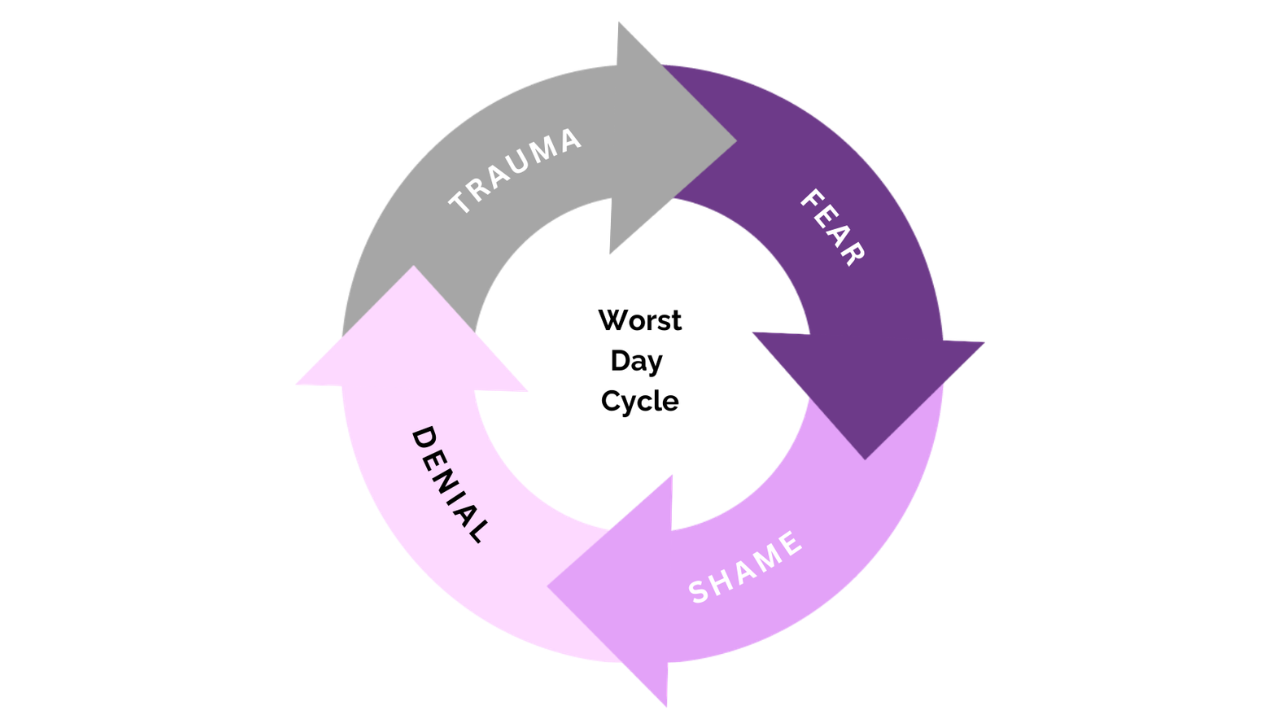
    Worst Day Cycle diagram showing trauma fear shame denial loop that destroys boundaries

    The Worst Day Cycle™ has four stages: Trauma → Fear → Shame → Denial.

    Trauma: Any negative emotional experience in childhood that created painful meanings. It doesn’t have to be dramatic — a parent who raged when you said no, a household where your needs were treated as selfish, a caregiver who withdrew love when you didn’t comply. These experiences create a massive chemical reaction in the brain and body. The hypothalamus generates chemical cocktails — cortisol, adrenaline, dopamine, oxytocin misfires — and the brain becomes addicted to these emotional states.

    That’s you — feeling the same gut-punch of terror when your boss asks “can we talk?” that you felt when your father’s tone changed at the dinner table.

    Fear: Fear drives repetition. The brain thinks repetition equals safety. So you keep saying yes when you mean no. You keep tolerating behavior that crosses your limits. You keep choosing relationships that require you to shrink — not because you want to, but because your nervous system is terrified of the unknown. An unknown where you say no and someone still loves you? Your brain has never experienced that. So it won’t let you try.

    Shame: This is where you lost your inherent worth. “I am the problem.” Not “I have a right to say no” — but “who am I to have boundaries? I’m not worth protecting.” This is the core wound underneath every boundary failure. You don’t hold boundaries because deep down, you believe you don’t deserve them.

    That’s the shame talking — the voice that says “you’re being selfish” every time you try to protect yourself. That voice isn’t yours. It was installed in childhood.

    Denial: Denial is the survival persona you created to survive the pain. It was brilliant in childhood — absolutely necessary. But in adulthood, it sabotages everything. It tells you “it’s not that bad” or “I can handle it” or “they didn’t mean it.” Denial is the reason you minimize boundary violations and make excuses for people who hurt you.

    The Worst Day Cycle™ reveals why boundary-setting techniques fail — they address the conscious mind while the neurochemical loop of trauma, fear, shame, and denial operates below awareness, automatically collapsing every boundary before the thinking brain can intervene.

    How Your Survival Persona Destroys Your Boundaries

    Your survival persona is the identity you created in childhood to navigate an emotionally unsafe environment. It’s not who you are — it’s who you had to become. And it’s the reason you can’t keep boundaries no matter how hard you try.
    Survival persona icon showing how childhood identity adaptations destroy adult boundary-keeping

    There are three survival persona types, and each one destroys boundaries in a different way:

    The Falsely Empowered: This persona controls, dominates, and rages. They don’t lose boundaries by caving — they lose them by bulldozing. They violate other people’s boundaries while maintaining iron walls around their own. They confuse aggression with strength. They use anger to keep people at a distance so they never have to be vulnerable enough to have a real boundary conversation.

    That’s you — the one who thinks you have strong boundaries because nobody crosses you, when really you’ve just built a fortress that keeps everyone out, including the people you love.

    The Disempowered: This persona collapses, people-pleases, and disappears. They lose boundaries by making themselves invisible. They say yes to everything. They absorb other people’s emotions. They make everyone else’s needs more important than their own — not out of love, but out of terror. They believe that if they stop giving, they’ll be abandoned.

    That’s you — the one who can’t say no without a tidal wave of guilt so overwhelming that you’d rather suffer than disappoint anyone.

    The Adapted Wounded Child: This persona oscillates between both — raging one moment, collapsing the next. They set a boundary with fury, then feel so guilty they apologize and undo it. They swing between “I don’t need anyone” and “please don’t leave me.” Their boundaries are wildly inconsistent because their sense of self is unstable.
    Adapted wounded child icon showing oscillation between rigid walls and no boundaries at all

    That’s you — setting a fierce boundary on Monday and apologizing for it by Wednesday because the guilt became unbearable.

    Your survival persona is the hidden saboteur of every boundary you’ve ever tried to set — it replaces authentic self-protection with a childhood performance that either bulldozes others or surrenders yourself, and neither one is a real boundary.

    How Broken Boundaries Show Up in Every Area of Your Life

    Family: You answer every call. You show up to every event. You manage everyone’s emotions at holiday dinners. When a family member crosses a line, you swallow your reaction because “that’s just how they are.” You feel responsible for your parents’ happiness — even now, decades later. You’ve never said no to a family obligation without drowning in guilt for days afterward.

    That’s you — still playing the role your family assigned you before you were old enough to choose it.

    Romantic Relationships: You tolerate behavior that violates your values because leaving feels more terrifying than staying. You abandon your own needs to keep the relationship “safe.” When your partner crosses a boundary, you bring it up once, get met with defensiveness, and never mention it again. You confuse tolerating pain with being a good partner. You give and give until resentment builds to an explosion — then you feel guilty for the explosion.

    Sound familiar? The partner who absorbs everything until they finally snap, then apologizes for having feelings at all?
    Emotional absorption icon showing how absorbing others emotions destroys personal boundaries

    Friendships: You’re the friend who listens for hours but never shares your own struggles. You cancel your own plans when someone else needs you. You say “it’s fine” when it isn’t. You let people take from you without reciprocating because asking for reciprocity feels selfish. You feel lonely even when surrounded by people because no one actually knows you — they know your survival persona.

    Work: You say yes to every project. You check email at midnight. You take on other people’s responsibilities because “if I don’t do it, no one will.” Your boss knows you’re the one who will never push back. You’ve been promoted for your lack of boundaries — rewarded for the very pattern that’s burning you out.

    That’s you — getting promoted for the same boundarylessness that’s destroying your health, your relationships, and your sense of self.

    Body and Health: You ignore your body’s signals. You push through exhaustion, pain, and stress. You numb with food, alcohol, scrolling, or overwork when emotions get too big. Chronic pain, digestive issues, insomnia, and autoimmune conditions are often the body’s final boundary — the one it sets when you refuse to set your own.

    3 Steps to Keep Your Boundaries (That Actually Work)

    These aren’t scripts. They’re nervous system practices. Each one sends your body a new message: “I can protect myself and still be loved.”
    Emotional fitness icon representing the daily practice of boundary-keeping as emotional strength

    Step 1: Focus on Your Part — Get Into Reality. Before you can hold a boundary with someone else, you have to tell yourself the truth. Most boundary failures start with self-deception — minimizing how much something hurt, pretending you’re “fine,” or convincing yourself the other person didn’t mean it. Psychologist Jerry Jellison showed that the average person lies to themselves and others 200 times a day. Pia Mellody identified being out of reality as one of the five core symptoms of codependence.

    That’s you — telling yourself “it’s not that bad” when your body is screaming that it is.

    When someone says or does something that crosses your boundary, ask three questions: Is any part of what they’re saying true? If so, take ownership of your part — openly admit your imperfections and put a plan in place. Then ask: why is this true? Trace it back to your childhood. This step requires you to investigate how the pain from your past created this pattern. Once discovered, you can do the healing work and forgive yourself for doing the best you could.

    Step 2: Focus on Their Part — Understand Their Reality. If all or part of what they said is untrue, shift your focus to what might be happening inside them. Most people who violate your boundaries are projecting their own unhealed pain. Look at how they delivered their message — with sarcasm, anger, or fear. Sarcasm masks anger. Anger masks fear. Fear masks sadness. At the heart of every boundary violation is someone else’s unhealed sadness.

    That’s you — learning to see the wounded child behind the person who just crossed your line, without making their wound your responsibility to fix.

    This creates the distance between what someone is saying and who you are. It breaks the codependent pattern of “they made me feel this way.” Nobody makes you feel anything unless you lose your internal boundary. Understanding their reality doesn’t mean excusing their behavior — it means you stop carrying their sadness for them.

    Step 3: Make an Empowered Choice — Nobody Makes You Feel Anything Unless You Give Them That Power. Now you choose: Am I going to surrender my worth and let another person’s reality determine who I am? Or am I going to love myself and them by honoring my reality and keeping my internal boundary?

    That’s you — choosing yourself for the first time, not because you’re selfish, but because you finally understand that self-abandonment isn’t love. It’s a trauma response.

    This choice gets easier with practice. Not because the guilt disappears — it doesn’t, not at first. But because each time you choose yourself, your nervous system gets a new data point: “I said no, and I survived.” Over time, those data points rewrite the childhood message that boundaries equal danger.
    Perfectly imperfect icon showing how self-acceptance enables authentic boundary-keeping

    These three steps work because they address the internal boundary — the relationship you have with yourself — not just the external script you deliver to someone else. You cannot keep a boundary with another person if you haven’t first stopped lying to yourself about what you feel and what you need.

    How the Emotional Authenticity Method™ Rewires Boundary Patterns

    The Emotional Authenticity Method™ is the daily practice that rewires the nervous system’s relationship to boundaries. It works because it targets the body — where the boundary collapse actually happens — not just the mind.
    Emotional authenticity icon representing the practice of feeling your feelings to build unshakeable boundaries

    Step 1: Somatic Down-Regulation with optional Titration. When a boundary is crossed and your body floods with guilt or fear, the first step is to get your nervous system out of survival mode. Deep breathing, grounding, or simply slowing down enough to feel your body. Titration means you go slowly — you don’t force yourself to feel everything at once. You can’t make a boundary decision from a hijacked nervous system.

    That’s you — learning to pause before you fold, because that pause is where your power lives.

    Step 2: What am I feeling? Most people who can’t keep boundaries have no idea what they’re actually feeling in the moment. They default to “guilty” or “anxious” or “I should just let it go.” Using the Feelings Wheel, you develop emotional granularity — the ability to name the specific emotion underneath the urge to cave. Maybe it’s not guilt. Maybe it’s terror. Maybe it’s grief. Naming it changes your relationship to it.

    Step 3: Where in my body do I feel it? All emotional trauma is stored physically. When someone pushes back on your boundary, your chest tightens. Your stomach drops. Your throat closes. Locating the feeling in your body moves you from the thinking brain — which will rationalize the boundary away — into the somatic experience where actual change happens.

    Step 4: What is my earliest memory of this feeling? This is where the rewiring happens. You trace the guilt, fear, or shame back to its childhood origin. You realize: this isn’t about today. My partner pushing back isn’t my parent punishing me for saying no. My nervous system just thinks they are. That recognition breaks the automatic pattern.

    That’s the moment everything shifts — when you see that your boundary collapse belongs to a five-year-old who was punished for having needs, not to the adult you are today.

    Step 5: Who would I be if I never had this feeling again? This is the vision step. It connects you to the Authentic Self Cycle™ and gives your nervous system a new destination — a version of you who keeps boundaries not because you memorized a script, but because you know in your body that you’re worth protecting.

    The Emotional Authenticity Method™ works because emotions are biochemical events — you cannot keep boundaries through thoughts alone. Thoughts originate from feelings. The guilt that collapses your boundaries is a neurochemical event from childhood, and only somatic processing can rewire it.

    How the Authentic Self Cycle™ Makes Boundaries Natural

    The Authentic Self Cycle™ is the healing counterpart to the Worst Day Cycle™. Where the Worst Day Cycle™ traps you in Trauma → Fear → Shame → Denial, the Authentic Self Cycle™ restores your identity through Truth → Responsibility → Healing → Forgiveness.
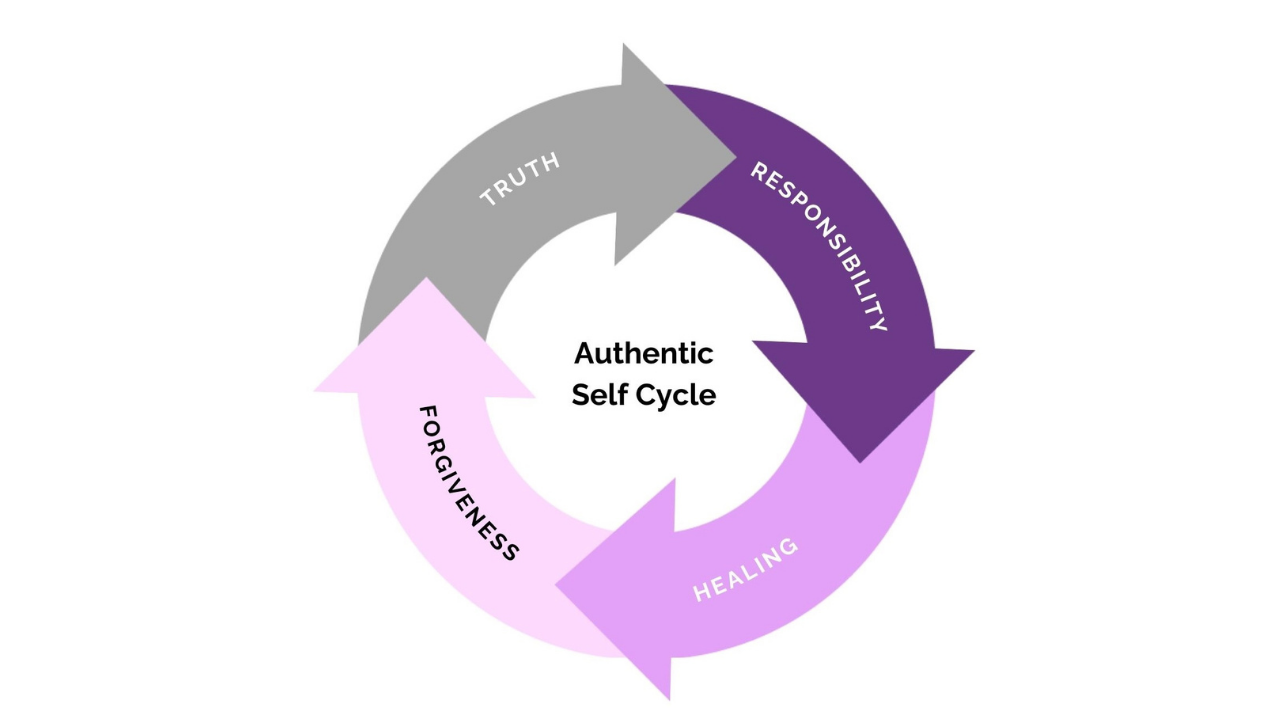
    Authentic Self Cycle diagram showing truth responsibility healing forgiveness as the path to natural boundary-keeping

    Truth: Name the blueprint. See that “this isn’t about today.” When your mother guilt-trips you for saying no to Thanksgiving and your body floods with shame, truth says: “This feeling is from childhood. My mother’s disappointment today isn’t the same as her rejection when I was six. My nervous system just thinks it is.”

    That’s the first step to boundaries that hold — seeing the pattern instead of drowning in it.

    Responsibility: Own your emotional reactions without blame. “My partner isn’t my parent — my nervous system just thinks they are.” This isn’t about fault. It’s about taking back your power from a childhood that stole it. When you stop blaming others for “making you” feel guilty, you reclaim the ability to choose how you respond.

    Healing: Rewire the emotional blueprint so conflict becomes uncomfortable but not dangerous, saying no doesn’t feel like abandonment, and someone else’s disappointment doesn’t feel like your death sentence. This is where the daily practice does its work — second by second, like the ticks of a clock. The second hand moves in tiny, almost insignificant ticks. But those ticks move the minute hand. The minutes move the hours.

    Forgiveness: Release the inherited emotional blueprint and reclaim your authentic self. This creates a NEW emotional chemical pattern that replaces fear, shame, and denial with safety, worth, and connection. You don’t become someone new. You finally meet who you always were underneath the survival persona that couldn’t say no.

    That’s you — not the person who memorized boundary scripts. The person whose body finally knows it’s safe to say no and still be loved.
    Reparenting icon showing how healing the inner child creates natural boundaries in adult relationships

    The Authentic Self Cycle™ is an identity restoration system — it doesn’t teach you boundary scripts, it replaces the neurochemical pattern that made boundaries feel dangerous with a new blueprint built on truth, responsibility, and the deep knowing that you are worth protecting.

    Frequently Asked Questions About Keeping Boundaries

    Why can’t I keep my boundaries even when I know I should?

    You can’t keep boundaries because the pattern isn’t in your thinking brain — it’s in your nervous system. Childhood trauma taught your body that boundaries equal danger, abandonment, or punishment. When you try to hold a boundary, your hypothalamus floods you with the same neurochemicals you experienced as a child when saying no was punished. The Worst Day Cycle™ explains how this automatic loop of trauma, fear, shame, and denial overrides your conscious intentions every time.

    How do I set boundaries without feeling guilty?

    The guilt isn’t a sign that your boundary is wrong — it’s a trauma response from childhood. You felt guilty because as a child, saying no threatened your connection to the people you depended on for survival. Healing boundary guilt requires somatic work, not cognitive reframing. The Emotional Authenticity Method™ teaches you to feel the guilt, locate it in your body, trace it to its childhood origin, and process it — rather than letting it collapse your boundary.

    What is the difference between a wall and a boundary?

    A wall keeps everyone out. A boundary lets the right people in. Walls are built from fear — they’re the falsely empowered survival persona’s version of self-protection. Boundaries are built from worth — they come from knowing you deserve to be treated with respect while staying open to genuine connection. If you can’t let anyone close, you don’t have strong boundaries. You have walls built by a wounded child who decided that closeness was too dangerous.

    Why do I keep attracting people who violate my boundaries?

    You attract boundary violators because your nervous system is drawn to the familiar, not the healthy. The brain conserves energy by repeating known patterns — it can’t tell right from wrong, only known from unknown. If boundary violation was your normal in childhood, your adult brain will interpret boundary-respecting people as boring or “lacking chemistry.” The Worst Day Cycle™ explains this as the fear stage — your brain mistakes danger for safety because danger is what it knows.

    Can I learn to keep boundaries as an adult if I never had them growing up?

    Yes — but not through willpower or scripts alone. Boundary-keeping requires rewiring the emotional blueprint at the nervous system level. The Emotional Authenticity Method™ provides a 5-step daily practice that rewires the body’s automatic surrender response. The Authentic Self Cycle™ provides the identity restoration framework that makes boundaries feel natural. It takes consistent daily practice — like the ticks of a clock — but the nervous system can learn new patterns at any age.

    How long does it take to build strong boundaries?

    Boundary patterns that have been running for 20, 30, or 40 years don’t reverse overnight. But noticeable shifts can happen within weeks of consistent daily practice with the Emotional Authenticity Method™. The key is repetition, not intensity. Each time you hold a micro-boundary — saying no to something small, waiting before responding, honoring your own need — your nervous system gets new evidence that boundaries are safe. Over time, those micro-moments rewire the childhood blueprint.

    The Bottom Line

    You don’t need another boundary script. You don’t need to rehearse your words one more time. You don’t need to become more assertive, more confident, or tougher.

    You need to heal the part of you that believes you’re not worth protecting.

    Every boundary you’ve ever failed to keep was a moment when your nervous system chose survival over self-respect — because that’s what it was trained to do in childhood. That training wasn’t your fault. But rewiring it is your responsibility. Not as blame. As freedom.

    Boundaries don’t come from scripts. They come from worth. From the deep, body-level knowing that you deserve to take up space, to have needs, to say no without apologizing for existing.

    That’s you — not the person who memorized the perfect boundary phrase. The person who finally knows, in their bones, that they’re worth protecting. Even when it’s hard. Even when someone is disappointed. Even when the guilt shows up. You hold the boundary anyway — because you’ve met yourself, and you’ve decided you’re not leaving again.

    The guilt will come. The fear will come. They’re old visitors from an old blueprint. But this time, you don’t let them run the show. You feel them. You name them. You trace them back to where they started. And you choose yourself anyway.

    That’s not selfish. That’s the most loving thing you’ll ever do — for yourself, and for everyone who gets the real you instead of the survival persona.

    These books complement the frameworks in this article and deepen your understanding of why boundaries fail and how to build real ones:

    Facing Codependence by Pia Mellody — the foundational text on how childhood trauma creates the boundary failures and codependent patterns that run adult relationships.

    The Body Keeps the Score by Bessel van der Kolk — the science of how trauma lives in the body, explaining why boundary scripts fail when the nervous system hasn’t been rewired.

    When the Body Says No by Gabor Maté — how chronic boundary violations and self-abandonment manifest as physical illness when the body finally sets the boundary you wouldn’t.

    Codependent No More by Melody Beattie — a practical guide to recognizing codependent patterns and building the internal boundary that makes external boundaries possible.

    The Gifts of Imperfection by Brené Brown — how shame destroys boundaries and how vulnerability is the path back to authentic self-worth.

    Take the Next Step

    If you’re ready to stop collapsing your boundaries and start building a life from your authentic self, Kenny Weiss offers courses designed for people who are done people-pleasing and ready to heal:

    Emotional Blueprint Starter Course — Individual ($79) — Your personal roadmap to understanding the Worst Day Cycle™ and beginning the journey from boundaryless survival to authentic self-protection.

    Relationship Starter Course — Couples ($79) — For couples ready to break the cycle of boundary violations and build interdependence.

    Why We Can’t Stop Hurting Each Other ($479) — Deep-dive into the Worst Day Cycle™ and how childhood trauma creates the boundary failures that destroy relationships.

    Why High Achievers Fail at Love ($479) — Built for high achievers who have mastered their career boundaries but can’t figure out emotional ones.

    The Shutdown Avoidant Partner ($479) — Understanding avoidant attachment through the lens of trauma chemistry and survival personas — including why avoidants build walls instead of boundaries.

    Tier 1: Mapping the Blueprint ($1,379) — The comprehensive program for learning and practicing the Emotional Authenticity Method™ to rewire boundary patterns at the nervous system level.

    Download the Feelings Wheel — the free tool used in Step 2 of the Emotional Authenticity Method™ to build the emotional granularity that makes boundary-keeping possible.

    Explore more: The Signs of Enmeshment | 7 Signs of Relationship Insecurity | 7 Signs of High Self-Esteem | How to Determine Your Negotiables and Non-Negotiables | 10 Do’s and Don’ts for a Great Relationship

  • What Is Healthy Shame? The Difference Between Guilt and Toxic Shame

    What Is Healthy Shame? The Difference Between Guilt and Toxic Shame

    Healthy shame is the internal signal that tells you when your behavior has crossed your own values — and it is one of the most powerful catalysts for genuine change, authentic connection, and emotional growth available to you. But most people have never been taught the difference between healthy shame and toxic shame. Toxic shame says “I am bad.” Healthy shame says “I did something that doesn’t align with who I want to be — and I can repair it.” That distinction changes everything. Because without it, every moment of self-awareness collapses into self-destruction. Every opportunity for accountability becomes an excuse for self-abandonment. And every relationship that could deepen through vulnerability instead fractures under the weight of character assassination disguised as humility.

    If you’ve ever made a mistake in a relationship — hurt someone you love, said something you regret, acted from your survival persona instead of your authentic self — and then spent days, weeks, or years punishing yourself for it, you’ve experienced the collapse from healthy shame into toxic shame. That’s you if the voice in your head doesn’t say “I can make this right” but instead says “I’m disgusting, I’m unforgivable, I’m fundamentally broken.” That voice is not accountability. That voice is your childhood blueprint running a shame program that was installed before you had any say in the matter.

    Understanding what healthy shame actually is — and how to use it as the transformational tool it was meant to be — is the difference between a life spent drowning in self-hatred and a life spent growing through honest, compassionate self-awareness.

    Survival persona types showing how toxic shame creates false identities

    Table of Contents

    What Is Healthy Shame? A Complete Definition

    Healthy shame is the emotional experience that arises when your behavior conflicts with your authentic values, morals, and standards. It is a signal — not a sentence. Healthy shame says: “What I did doesn’t match who I want to be.” It clarifies your values, motivates genuine repair, and moves you toward alignment between your actions and your authentic self. Healthy shame is short-term, behavior-focused, and empowering. It creates responsibility, strengthens character, and builds intimacy.

    Emotional Authenticity Method for processing healthy shame and building self-awareness

    That’s you if you’ve ever felt a pang of regret after snapping at your partner — and used that feeling to apologize, understand what triggered you, and commit to handling it differently next time. That pang was healthy shame doing exactly what it was designed to do.

    Healthy shame is not the enemy of self-worth — it is the guardian of it. When you can feel shame about a behavior without making it mean something about your identity, you have access to the most powerful self-correcting mechanism in human psychology.

    Toxic shame, by contrast, is identity-level. It doesn’t say “I did something bad.” It says “I am bad.” Toxic shame is long-term, character-focused, and disempowering. It creates self-deception, triggers denial, breaks intimacy, and lives at the core of the Worst Day Cycle™. Toxic shame was installed in childhood — through conditional love, criticism, neglect, abandonment, or emotional volatility — and it became the baseline emotional state from which your survival persona was built.

    That’s you if you can’t make a mistake without spiraling into “I’m such an idiot” or “What’s wrong with me?” — because your nervous system doesn’t distinguish between a mistake and a death sentence.

    The Critical Difference Between Guilt and Shame

    Most people use the words guilt and shame interchangeably. They are not the same thing — and confusing them is one of the most destructive mistakes you can make in your healing journey.

    Guilt is about behavior. It says: “I did something that violated my values, and I can repair it.” Shame is about identity. It says: “I am fundamentally flawed, and I cannot be fixed.” Guilt heals. Shame wounds. Guilt empowers. Shame weakens. Guilt builds intimacy. Shame destroys it. Guilt is grounded in truth. Shame is grounded in a childhood story. Guilt creates responsibility. Shame creates self-deception. Guilt is adult emotionality and part of the Authentic Self Cycle™. Shame is child emotionality and the core of the Worst Day Cycle™.

    Perfectly imperfect self-acceptance showing healthy guilt versus toxic shame

    Here’s what healthy guilt looks like in practice: “I can really see how my avoidance was detrimental — to me, to my partner, to everyone I’ve come in contact with. I’m genuinely sad about the impact it’s had. From this point forward, I’d like to put a plan in place to address that. I’m going to spend some time thinking about my commitment to myself and to others, because that is not who I’d like to be.”

    Here’s what toxic shame sounds like: “I’m so disgusting. What I’ve done is unforgivable. I’m such a terrible person.”

    That’s you if you recognize the second voice more than the first — because your childhood taught you that mistakes mean you’re defective, not that you’re human.

    The collapse from guilt into shame happens so fast most people don’t even notice it. One moment you’re feeling appropriate regret about a behavior. The next moment you’re in full character assassination — and your survival persona has taken the wheel.

    The Three Gifts of Healthy Shame

    When you can stay in healthy shame without collapsing into toxic shame, three powerful things happen:

    Gift 1: It Clarifies Your Values

    When you feel shame after acting in a certain way, you’re telling yourself what you value and what you see as moral. That sense of discomfort you feel for going against your morals and values helps you reconnect with your authentic self. Without healthy shame, you wouldn’t be able to see the gap between who you are and who you want to be.

    That’s you if you felt terrible after losing your temper with your child — that feeling isn’t your enemy. It’s your values system working exactly as designed, telling you: “This isn’t who you want to be as a parent.”

    Metacognition and self-awareness in healthy shame and values clarification

    Gift 2: It Motivates Genuine Amends

    Healthy shame triggers empathy. It helps you recognize how your imperfections affect others as well as yourself. Everyone has imperfections — we’re all perfectly imperfect because we’re all human. Healthy shame provides an opportunity to accept this humanity and act on it by making amends with yourself or those you have harmed.

    That’s you if you’ve ever gone back to someone and said “I’m sorry, that wasn’t okay” — and meant it. That moment of repair is healthy shame turned into connection.

    Healthy shame provides a sense of forgiveness and love for yourself. When you act imperfectly and make genuine amends to whoever was impacted, you establish a favorable opinion of yourself. You turn pain into self-respect, self-care, and self-love.

    Gift 3: It Spurs Action and Growth

    When you do something against your defined morals and values, healthy shame inspires you to change and repair. Adverse action without shame leads to more negative action. With healthy shame, you’re more likely to initiate a plan to fix the wrong you are responsible for. You tend to double down on doing what you can to improve yourself.

    Emotional fitness through healthy shame and personal growth

    That’s you if you’ve ever had a moment of clarity after a mistake — not the “I’m terrible” kind, but the “I see what happened, and I’m going to do something about it” kind. That’s healthy shame moving you forward.

    The Worst Day Cycle™: How Healthy Shame Becomes Toxic

    The Worst Day Cycle™ is the four-stage neurological loop that hijacks healthy shame and turns it into identity-level destruction: Trauma → Fear → Shame → Denial.

    The Worst Day Cycle showing how healthy shame becomes toxic through trauma fear shame and denial

    Stage 1: Trauma. Childhood trauma is any negative emotional experience that created painful meanings about yourself. Your parent criticized your attempt at helping. Your teacher shamed you in front of the class. Your sibling was favored. Any of these creates a massive chemical reaction in your nervous system. The hypothalamus generates chemical cocktails — cortisol, adrenaline, dopamine misfires, oxytocin disruptions — and your brain becomes addicted to these emotional states.

    Stage 2: Fear. Fear drives repetition. Your brain conserves energy by repeating known patterns. It can’t tell right from wrong — only known versus unknown. Since approximately 70% of childhood messaging is negative and shaming, adults repeat these painful patterns in relationships, career, hobbies, health — everything. That’s you if a small mistake at work sends you into a panic spiral that lasts for days — your nervous system is treating a minor error like a childhood catastrophe.

    Stage 3: Shame. This is where you lost your inherent worth. Where you decided “I am the problem.” Not “I made a mistake” (which is healthy responsibility), but “I AM a mistake” (which is toxic shame). When you belittle your worth by saying “I’m so stupid” or “Why didn’t I do that differently?” — you’ve just said “I don’t have value and worth unless I do this perfectly.”

    Stage 4: Denial. To survive unbearable shame, your psyche creates a survival persona — a false identity that protects you from the truth. This survival persona was brilliant in childhood. It kept you alive. But in adulthood, it keeps you disconnected from your authentic self, your inherent worth, and your ability to use healthy shame constructively. Three survival persona types emerge: falsely empowered (controls, dominates, rages), disempowered (collapses, people-pleases), adapted wounded child (oscillates between both).

    That’s you if you can watch yourself collapse from “I made a mistake” into “I’m a terrible person” in the space of three seconds — and you can’t stop the fall. That’s the Worst Day Cycle™ hijacking healthy shame and weaponizing it against you.

    Three Survival Personas and How They Handle Shame

    Each survival persona has a completely different — and completely dysfunctional — relationship with shame. Understanding yours is the first step to reclaiming healthy shame as a tool instead of a weapon.

    Adapted wounded child survival persona oscillating between shame responses

    The Falsely Empowered Persona

    This survival persona cannot tolerate shame at all. When healthy shame arises, the falsely empowered persona immediately projects it outward — blaming others, criticizing, raging, intellectualizing, or withdrawing into cold silence. This persona experienced being consumed, controlled, or enmeshed in childhood, and shame feels like annihilation. So they armor up. They become the one who is never wrong, never vulnerable, never at fault.

    That’s you if your first response to making a mistake is to find someone else to blame — not because you’re cruel, but because your survival persona cannot survive feeling shame for even a moment.

    The Disempowered Persona

    This survival persona drowns in shame. When healthy shame arises, the disempowered persona swallows it whole and adds it to the mountain of evidence that they are fundamentally worthless. Every mistake becomes proof of their defectiveness. They over-apologize, self-flagellate, and use shame as a form of penance — believing that punishing themselves enough will eventually make them worthy of love.

    That’s you if you apologize for things that aren’t your fault, or if you believe that hating yourself enough is somehow noble or humble — your disempowered persona has confused self-destruction with accountability.

    The Adapted Wounded Child

    This survival persona oscillates between both responses. One moment they’re projecting blame outward; the next they’re collapsing into self-hatred. They shift constantly depending on who’s in the room, reading the emotional temperature and performing whatever version of shame response seems safest.

    Sound familiar? That’s you if you defended yourself fiercely in the argument and then sobbed with guilt alone in your car afterward — your adapted wounded child tried both survival strategies and neither one worked.

    Shame Burps: What to Do When Old Shame Resurfaces

    On your road to recovery, you are going to face what Kenny calls “shame burps.” These are moments when you feel good about yourself and your progress — and suddenly a shameful memory ambushes you out of nowhere. It only lasts a moment but can affect you with a full-body reaction and make you feel like you’re regressing.

    Most likely, you’re not regressing at all.

    Trauma chemistry showing how shame burps activate old emotional patterns

    Shame burps are temporary. They are not an opportunity for you to re-victimize or belittle yourself. Instead, these moments are exactly when your self-respect, self-care, self-love, and acceptance of your perfect imperfections must come in. The shame burp is showing up to give you an opportunity to realize that yes, you’re imperfect — and you need to forgive yourself.

    That’s you if you were having a perfectly good day and then a memory of something you did five years ago flashed through your mind and your stomach dropped — that’s a shame burp, not a verdict. Your job is to meet it with compassion, not to let it drag you back into the Worst Day Cycle™.

    When healthy shame turns dysfunctional during a shame burp, you start re-victimizing yourself over past mistakes you have already reconciled and moved on from. You keep the shame alive by refusing to forgive yourself. People often make the mistake of labeling this refusal as humility. But refusing to forgive yourself when you’ve already made amends isn’t humble — it’s grandiose. It’s saying you are above forgiveness. That’s a survival persona running the show, not your authentic self.

    That’s you if you’ve been carrying guilt about something you addressed years ago — your toxic shame won’t let go because it needs you to keep proving you’re bad. That’s not accountability. That’s addiction to a childhood emotional pattern.

    How Toxic Shame Shows Up Across Your Life

    Toxic shame doesn’t stay in one compartment. It infiltrates every area of your life because the emotional blueprint runs beneath every decision, every relationship, every moment of self-talk.

    Family Relationships

    You can’t make mistakes around your parents without reverting to a child state. You absorb their disappointment as evidence of your defectiveness. You perform perfection to avoid their criticism. You feel responsible for their emotional states. Healthy shame would say “I could have handled that dinner conversation better.” Toxic shame says “I’m a terrible son/daughter.” Learn more about the signs of enmeshment to understand how family shame patterns form.

    That’s you if your mother’s sigh can ruin your entire week — because your nervous system still interprets her disappointment as proof that you’re fundamentally flawed.

    Romantic Relationships

    Toxic shame makes you unable to receive feedback from your partner without spiraling. A simple “I wish you’d called” gets translated through your childhood blueprint into “I messed up again, I can’t get anything right, I’m obviously not enough.” You stop responding to the actual question and start defending against an old emotional wound. That’s why small conversations escalate — both people are having two completely different conversations, one in the present and one in the past. Explore the signs of relationship insecurity to understand this pattern.

    That’s you if your partner asks a simple question and you hear an accusation — your wounded child is translating their words through a shame filter installed decades ago.

    Friendships

    You can’t be authentically vulnerable with friends because you believe they’d reject the real you. You perform confidence while hiding struggle. You can’t ask for help because needing help proves you’re weak. You over-give to earn belonging rather than simply belonging.

    That’s you if you’ve cancelled plans rather than admit you’re struggling — because your toxic shame says vulnerability equals rejection.

    Work and Achievement

    Toxic shame drives perfectionism, imposter syndrome, and workaholism. Every success is dismissed. Every mistake is catastrophized. You can’t celebrate wins because your baseline emotional state is “not enough.” You’ve been promoted for the very pattern that’s destroying you — your survival persona’s perfectionism is your company’s greatest asset and your nervous system’s greatest prison. Build genuine self-esteem that doesn’t depend on performance.

    That’s you if you hit your targets and immediately feel empty instead of proud — because your emotional blueprint says achievement can’t fill the shame hole. It’s right. But the solution isn’t more achievement. It’s healing the shame.

    Body and Health

    Toxic shame lives in your body. Chronic tension, digestive issues, autoimmune problems, and insomnia are often the body’s way of carrying unprocessed shame. You disconnect from physical signals. You punish your body through over-exercise or neglect. You use food, substances, or compulsive behaviors to numb the shame your conscious mind can’t face.

    That’s you if your body tightens every time you make a mistake — that’s not just emotional discomfort. That’s toxic shame stored somatically, activating the same chemical cocktail your nervous system learned in childhood.

    The Authentic Self Cycle™: Transforming Shame Into Growth

    The Authentic Self Cycle™ is the healing counterpart to the Worst Day Cycle™ — a four-stage identity restoration system: Truth → Responsibility → Healing → Forgiveness. This is how you reclaim healthy shame as a tool and release toxic shame as an identity.

    The Authentic Self Cycle showing truth responsibility healing and forgiveness for transforming shame

    Stage 1: Truth. Name the blueprint. “This shame spiral isn’t about today’s mistake. It’s about a childhood meaning that says every mistake proves I’m defective. That meaning was installed before I had any say in the matter — and it’s not true.” That’s you if you’re finally seeing the difference between the mistake you made and the identity you’ve been punishing yourself for.

    Stage 2: Responsibility. Own your emotional reactions without blame. “I made a mistake. I can feel healthy guilt about the impact it had without assassinating my own character. My partner isn’t my parent — my nervous system just thinks they are. I’m responsible for repairing the harm, not for proving I’m worthy of existing.” This is where the crucial distinction lives: you cannot ever say you are a victim. You have to take ownership and be responsible. But blame requires intent — a conscious choice to know you could do something and choose not to. A person conditioned in childhood to operate from shame cannot be blamed for doing something they didn’t even know they were doing.

    Stage 3: Healing. Rewire the emotional blueprint so that mistakes become uncomfortable but not catastrophic. Healthy shame becomes your ally instead of your executioner. You create a NEW emotional chemical pattern that replaces the old shame-based identity. Conflict becomes feedback, not annihilation. Error becomes information, not identity.

    Stage 4: Forgiveness. Release the inherited emotional blueprint and reclaim your authentic self. Forgive yourself for the survival strategies you developed. The adult takes the wheel from the child and the shame voice. It says: “Hey kids, love you, but back seat. I’m driving now.” It’s not excusing the past. It’s releasing the shame that says you’re the problem. It’s forgiving yourself: “I see it now. I have been stuck in this survival persona. I don’t need to shame myself for that. I was brilliant to come up with that. But I can see now it’s no longer needed.”

    That’s you if you’re ready to stop punishing yourself for being human and start using your mistakes as fuel for genuine transformation.

    The Emotional Authenticity Method™: 6 Steps to Process Shame Without Collapsing

    The Emotional Authenticity Method™ is a six-step process that teaches your nervous system to stay in healthy shame without sliding into toxic shame. This isn’t positive thinking. This is somatic, chemical, neurological rewiring.

    Emotional regulation through the Emotional Authenticity Method for processing shame

    Step 1: Somatic Down-Regulation. When shame floods you — when the inner critic starts its character assassination — pause. Focus on what you can hear for 15-30 seconds. Wind. Traffic. Your own breath. If you’re highly dysregulated, use titration: smaller, shorter bursts. Your prefrontal cortex cannot come online while your amygdala is running the show. You cannot process shame constructively from a triggered state.

    Step 2: What am I feeling right now? Use the Feelings Wheel to identify the specific emotion with granularity. Not “I feel terrible.” Are you feeling ashamed? Guilty? Embarrassed? Remorseful? Humiliated? Disappointed in yourself? Emotional granularity breaks the shame spiral and activates your thinking brain.

    Step 3: Where in my body do I feel it? All emotional trauma is stored physically. Shame might be heat in your face, a knot in your stomach, heaviness in your chest, or collapse in your posture. Locate it. This grounds you in the present moment. That’s you if you’ve been trying to think your way out of shame — you can’t think your way out of a feeling. Emotions are biochemical events. Thoughts originate from feelings.

    Step 4: What is my earliest memory of having this exact feeling? The toxic shame you feel after today’s mistake echoes something much older. When was the first time a mistake felt like proof of your worthlessness? The first time a parent’s disappointment felt like the end of the world? Your present trigger didn’t create this response — it activated a blueprint that was already there.

    Step 5: Who would I be if I never had this thought or feeling again? Envision your authentic self — the version of you who can make mistakes, feel appropriate guilt, make genuine repair, and move forward without self-destruction. “I’d be someone who says ‘I’m sorry, I see what I did, here’s how I’ll handle it differently’ — and then actually lets it go.” This is the vision step that connects you to the Authentic Self Cycle™.

    Step 6: Feelization — The New Chemical Addiction. Sit in the feeling of who you’d be — the authentic self. Make it strong. Feel the self-compassion, the groundedness, the worthiness in your body. Create a new emotional chemical addiction to replace the old shame blueprint. Ask yourself: “How would I respond to this mistake from this feeling? What would I say? What would I do?” Visualize and FEEL yourself operating from your authentic self — making amends from self-respect instead of self-destruction. This is the emotional blueprint remapping and rewiring step.

    That’s you if you’ve never been taught that you can literally rewire your nervous system’s relationship with shame — that toxic shame is a chemical addiction, not a permanent identity, and that healthy shame is available to you the moment you build the internal capacity to hold it.

    Reparenting yourself to transform toxic shame into healthy self-awareness

    Frequently Asked Questions

    What is the difference between healthy shame and toxic shame?

    Healthy shame is about behavior — it says “I did something that doesn’t align with my values, and I can repair it.” Toxic shame is about identity — it says “I am fundamentally broken and cannot be fixed.” Healthy shame is short-term, empowering, and drives genuine change. Toxic shame is long-term, disempowering, and keeps you trapped in the Worst Day Cycle™. The key distinction: healthy shame leads to repair and growth. Toxic shame leads to self-destruction and denial.

    How do I know if I’m experiencing guilt or shame?

    Guilt focuses on what you did and motivates repair: “I hurt someone, and I want to make it right.” Shame focuses on who you are and motivates hiding: “I’m a terrible person, and nothing I do can fix that.” If your response to a mistake is to create a plan for change, that’s guilt. If your response is character assassination — “I’m so stupid, I’m disgusting, I’m unforgivable” — that’s toxic shame running your childhood blueprint.

    Can shame ever be completely eliminated?

    Healthy shame should never be eliminated — it’s a vital emotional signal that keeps you aligned with your values. What can be healed is toxic shame — the identity-level belief that you are fundamentally defective. Through the Emotional Authenticity Method™, you rewire your nervous system so that mistakes produce healthy guilt (which drives repair) instead of toxic shame (which drives self-destruction). The goal isn’t to never feel shame. The goal is to feel it appropriately and use it constructively.

    Why do shame burps happen even after years of healing?

    Shame burps happen because your nervous system stored decades of painful experiences physically. As you heal, old memories surface — not because you’re regressing, but because your system finally feels safe enough to process them. Each shame burp is an opportunity to practice meeting yourself with compassion instead of re-victimization. They decrease in frequency and intensity over time as your emotional blueprint rewires.

    How do I stop toxic shame from taking over during conflict?

    Start with Step 1 of the Emotional Authenticity Method™ — somatic down-regulation. Focus on what you can hear for 15-30 seconds. This interrupts the amygdala hijack and brings your thinking brain back online. From there, use the Feelings Wheel to name what you’re actually feeling with specificity. The more granular you get, the more you interrupt the shame spiral. Remember: you cannot process shame constructively from a triggered state.

    Is refusing to forgive myself for past mistakes actually arrogance?

    Yes. When you refuse to forgive yourself after you’ve made genuine amends, you’re placing yourself above forgiveness — as if everyone else on the planet deserves grace except you. Almost every spiritual tradition teaches that forgiveness is available to all. Refusing it isn’t humility — it’s a survival persona that needs you to stay in shame because shame is the only emotional state your nervous system recognizes as home. True humility accepts imperfection and moves forward with intention.

    The Bottom Line

    Healthy shame is one of the most misunderstood and undervalued emotions in human psychology. It is not your enemy. It is not proof that you’re broken. It is the internal compass that tells you when your behavior has drifted from your authentic values — and it is the force that drives genuine repair, authentic connection, and lasting transformation.

    The problem was never shame itself. The problem was that childhood trauma hijacked your shame system and turned it from a compass into a weapon. Your survival persona — whether falsely empowered, disempowered, or adapted wounded child — developed its own dysfunctional relationship with shame, either projecting it outward or drowning in it internally. And the Worst Day Cycle™ kept that pattern spinning endlessly: trauma, fear, shame, denial, repeat.

    That’s you if you’re finally ready to reclaim shame as a tool for growth instead of a sentence for punishment.

    The path forward is the Authentic Self Cycle™ — truth, responsibility, healing, forgiveness. The tool is the Emotional Authenticity Method™ — six steps to literally rewire your nervous system’s relationship with shame. And the destination is a life where you can make mistakes, feel appropriate guilt, make genuine repair, and move forward without character assassination. Where shame burps are met with compassion instead of collapse. Where your imperfections make you human, not worthless.

    At all times, no matter what you are thinking, feeling, believing, or doing, you always have value and worth. Your behavior changes. Your worth doesn’t. That is the foundation of healthy shame — and it is available to you right now.

    Emotional blueprint showing how childhood shame patterns can be rewired through healing

    Recommended Reading

    • Facing Codependence by Pia Mellody — The foundational text on how childhood trauma creates shame-based survival personas, codependent patterns, and the loss of authentic self.
    • The Body Keeps the Score by Bessel van der Kolk — Essential reading on how shame and trauma live in your nervous system and why healing requires more than talk therapy.
    • When the Body Says No by Gabor Maté — How emotional repression and chronic shame manifest as physical illness.
    • Codependent No More by Melody Beattie — The classic guide to reclaiming your worth and stopping the cycle of shame-driven self-abandonment.
    • The Gifts of Imperfection by Brené Brown — A guide to wholehearted living that directly addresses the relationship between shame, vulnerability, and authentic connection.

    Ready to Transform Your Relationship With Shame?

    Start with the Feelings Wheel exercise to begin reconnecting with your emotional life today. Then explore your negotiables and non-negotiables to rebuild the foundation of values-driven living. And discover the do’s and don’ts for great relationships to build connections from healthy shame instead of toxic shame.