Tag: fear of change

  • Why Coping Skills Fail for Emotional Regulation: The Childhood Blueprint They Can’t Reach

    Why Coping Skills Fail for Emotional Regulation: The Childhood Blueprint They Can’t Reach

    TL;DR: Coping skills fail because they target your thoughts and behaviors — but your emotions were programmed by your childhood emotional blueprint long before you could think. The Worst Day Cycle™ runs beneath every trigger, and no breathing technique or reframe can reach it. The Emotional Authenticity Method™ rewires the blueprint at the root so you stop managing symptoms and start living free.

    Coping skills for emotional regulation fail because they address symptoms — your reactions in the present moment — while your emotional responses were hardwired by a childhood emotional blueprint that operates beneath conscious thought. True emotional regulation requires rewiring the blueprint itself, not managing its output. The Emotional Authenticity Method™ created by Kenny Weiss targets the root-level programming that no coping skill, breathing exercise, or cognitive reframe can reach.

    You’ve done the work. You’ve sat in the therapist’s chair. You’ve read the books, you’ve downloaded the apps, and you’ve practiced the deep breathing exercises. You know how to reframe your negative thoughts. You can probably explain your childhood trauma better than most licensed clinicians.

    And yet… the moment your partner uses that specific tone of voice, or your boss sends that vague email, or you feel invisible in a crowded room… you’re gone. Your chest tightens, your jaw locks, and before you can catch yourself, you are either raging, people-pleasing, or completely shutting down.

    That’s you… doing everything “right” and still ending up in the same emotional wreckage by Tuesday.

    And then, the shame hits. “Why did I do that again? I know better than this. What is wrong with me?”

    If you are exhausted by your own reactions and sick of trying to “manage” your emotions, I need you to hear this: You are not broken. You are not defective. You are simply using the wrong tools.

    Most of what the personal development world teaches about “emotional regulation” and “coping skills” is essentially putting a Band-Aid over open-heart surgery. You cannot skill your way out of a childhood emotional blueprint.
    Emotional regulation icon showing a thermometer at 98.6 degrees representing nervous system baseline — why coping skills fail to reach the childhood emotional blueprint — by Kenny Weiss

    Here is the neuroscience of why your coping skills are failing, why you aren’t actually reacting to the present moment, and how to use the Emotional Authenticity Method™ to stop managing your symptoms and start rewiring your brain at the root.

    That’s you… collecting techniques like trading cards and still getting blindsided by the same emotions every time.

    Why Do Your Emotions Control Your Thoughts Instead of the Other Way Around?

    Let’s start with a hard truth. Emotional Intelligence, Cognitive Behavioral Therapy (CBT), Dialectical Behavior Therapy (DBT), and even Internal Family Systems (IFS) operate on a massive, fundamental flaw. They assume you can think, skill, or manage your way to change. They tell you, “Just change your thoughts, use a coping skill, or talk to your fragmented parts, and you’ll change your feelings.”

    But here is the scientific proof that shatters that illusion: Your thoughts do not control your emotions. Your emotions control your thoughts.

    That’s you… sitting in therapy explaining your childhood perfectly, then walking to the parking lot and calling the same toxic ex.

    Think of your thoughts like lawyers for your emotions. Your thoughts do not care about the objective truth. Their only job is to argue whatever case your underlying emotional system hands them. If your childhood emotional blueprint says “I am unworthy” or “I am unsafe,” your thoughts will immediately build an entire logical argument to prove it.

    Dr. Lisa Feldman Barrett, one of the top neuroscientists in the world, proved that feelings actually drive your next thought and perception as predictions. You don’t react to the present; your brain categorizes your bodily sensations based on your past experiences to predict what you should do right now.

    And when you try to use logic, reframing, or “coping skills” to fix a feeling, you are using the wrong hardware. Dr. Iain McGilchrist’s neuroscience research shows that this hyper-logical approach activates the left hemisphere of your brain, which is addicted to denying the truth even when it is shown to be wrong. Trying to “think” your way out of a trigger literally detaches you from your embodied experience, which is exactly where the trauma actually lives. As he points out, knowing your emotional landscape at the root level creates the highest form of intellect.
    Childhood emotional blueprint diagram showing how the brain predicts adult emotional reactions based on childhood trauma programming — why coping skills cannot reach the root — by Kenny Weiss

    This means when you get triggered, you aren’t actually reacting to your partner or your boss. Your brain is scanning the environment, recognizing a tone of voice or a facial expression, and saying, “Oh, I know this feeling. This is just like when Dad used to withdraw,” or “This is just like when Mom shamed me.” You are predicting the present based on a childhood blueprint.

    That’s you… hearing your partner say “we need to talk” and your body responds like you’re seven years old about to get screamed at.

    And when that happens, your Adult Authentic Self gets thrown in the back seat of the car, and your wounded, shame-based child grabs the steering wheel, and starts playing Grand Theft Auto with your life—crashing into trees, people, and relationships.

    You don’t need a breathing technique to calm that child down. You don’t need to break yourself into “parts.” You need to take the wheel back at the root level of the emotion, and I am going to show you how.

    That’s you… wondering why you become a completely different person the moment conflict starts.

    What Is the Worst Day Cycle™ and Why Can’t Coping Skills Break It?

    To understand why your coping skills fail and how to take the wheel back, you have to understand the invisible engine running your life. I call it the Worst Day Cycle™.
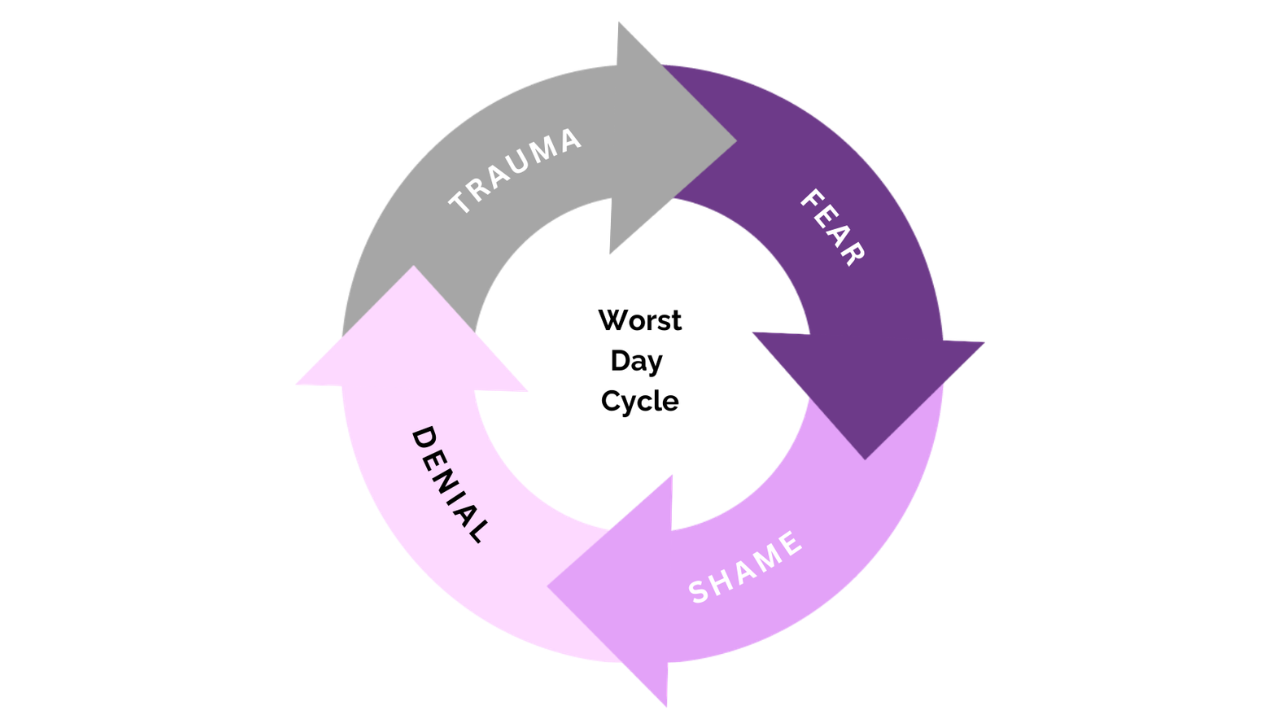
    Worst Day Cycle™ — the four-stage trauma loop of trauma, fear, shame, and denial that repeats from childhood into adult relationships — by Kenny Weiss

    Long before you had language or logic, you absorbed the emotional climate of your home. If your home was chaotic, critical, emotionally distant, or inconsistent, you experienced Trauma. Now, trauma isn’t just a horrific event. Trauma is any negative emotional event, therefore, we have all been traumatized as children.

    That trauma created Fear. Your nervous system became wired to anticipate danger, rejection, or inadequacy. But because a child cannot blame their parents—because blaming your parents threatens your survival—you blamed yourself.

    That’s you… still believing at forty-five that you’re “too much” or “not enough” — a story that was written when you were four.

    This brings us to the third stage: Shame. Shame isn’t just feeling bad; it’s an identity. It’s the deep, wordless belief that “I am the problem. I am not enough. I am unlovable.”

    But nobody can live in pure shame. It’s too painful. So, your brilliant, adaptive childhood brain created the fourth stage: Denial. You created a Survival Persona—a mask designed to protect you from ever feeling that shame again.
    Survival Persona mask showing the three types — Falsely Empowered, Disempowered, and Adapted Wounded Child — the false identity children create to avoid shame — by Kenny Weiss

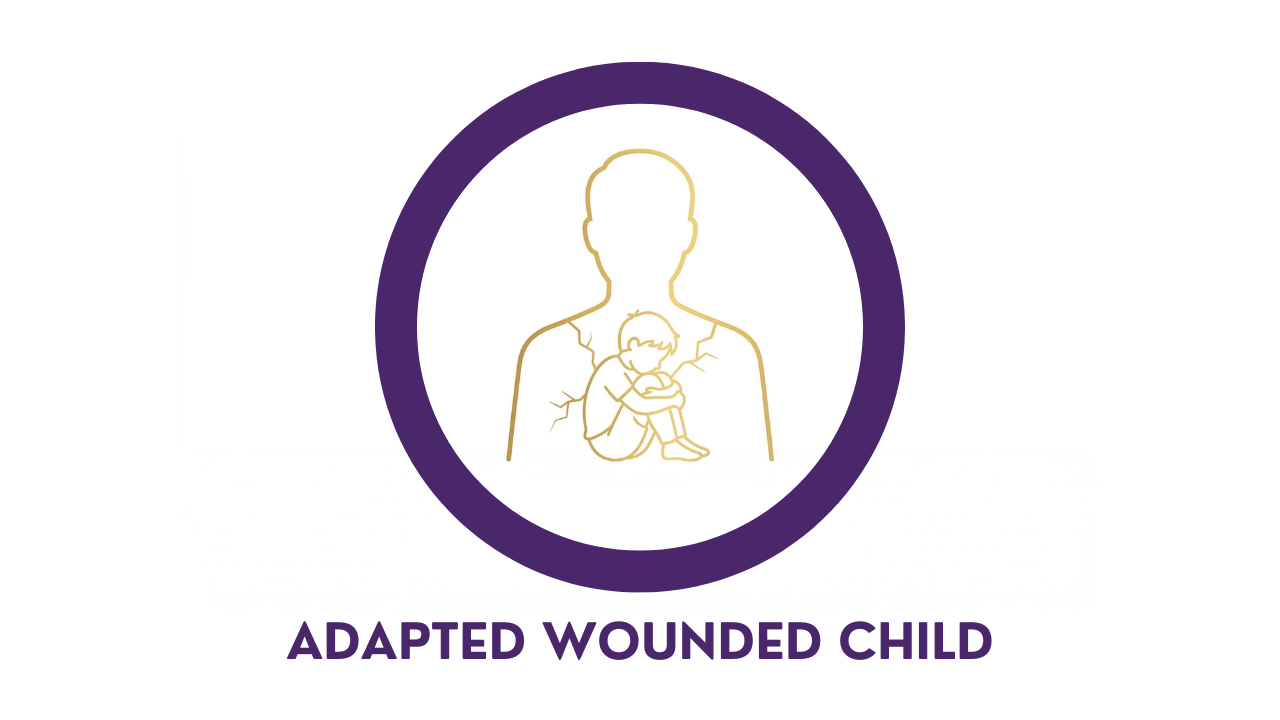
    Maybe your Survival Persona is the Falsely Empowered type — the Over-Achiever who controls, dominates, and rages to prove their worth through success, because vulnerability feels like death. Maybe it’s the Disempowered type — the People-Pleaser who collapses, abandons their own needs, and loses themselves to keep the peace because abandonment feels like annihilation. Or maybe it’s the Adapted Wounded Child — oscillating between controlling and collapsing depending on the situation, never knowing which version of yourself will show up next.

    That’s you… being the unshakable leader at work and then falling apart the second your partner raises an eyebrow.

    Here is why your coping skills are failing: You are using them to keep your Survival Persona comfortable. You are using “mindset hacks” and “stress management” to stay in Denial. But the Worst Day Cycle™ doesn’t care about your coping skills because they are based on thoughts, and your cycle was created by your perfectly imperfect childhood emotional experiences. So, you will keep repeating the loop—Trauma, Fear, Shame, Denial—until you address the emotional blueprint at the root with Emotional Authenticity.

    That’s you… journaling your triggers every night and still waking up the same person every morning.
    Emotional Fitness icon representing the capacity to process emotions at the root level rather than managing symptoms with coping skills — by Kenny Weiss

    Why Does Your Childhood Emotional Blueprint Keep You Crashing Into the Same Reactions?

    Think of your emotional blueprint like a sled track on a snowy hill. As a kid, you walked up to the top of the hill and went down in the fresh powder. You did it again and again, reacting the same way to fear and shame. Eventually, you compacted the snow. You created deep, icy ruts.

    Now, as an adult, you try to steer the sled in a different direction using “coping skills” or “positive thinking.” But it doesn’t work. The ruts are too deep. Your brain loves this because it knows the path, even if the path leads to misery. That is because your brain conserves energy by replaying its earliest emotional memories and experiences.

    That’s you… knowing the relationship is toxic, knowing the job is killing you, and choosing it anyway because it feels like home.
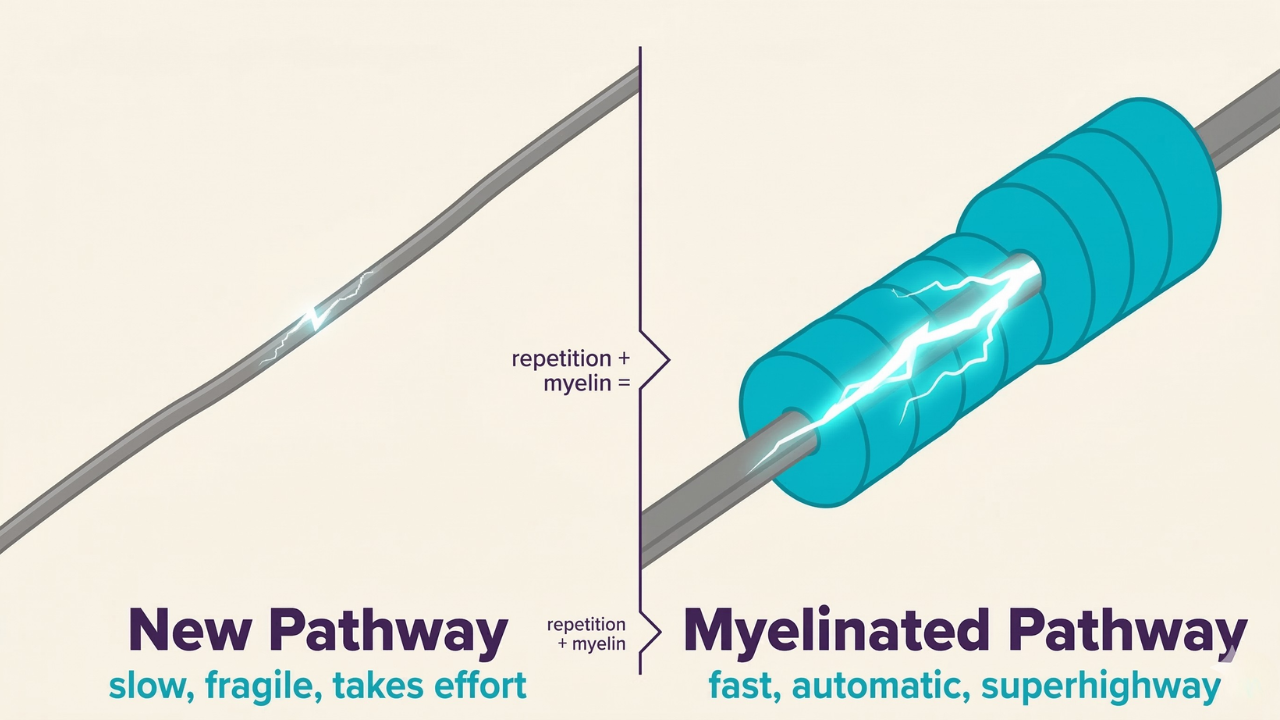
    Myelin and neural pathways icon showing how repetition in childhood creates hardwired emotional reactions that coping skills cannot override — by Kenny Weiss

    You cannot steer out of the rut halfway down the hill. You have to go back to the top of the mountain and forge a completely new track. You must address the emotion where it originated.

    So do you see? You aren’t broken or damaged; all you need is to update your emotional software programs so you can create a brand-new emotional blueprint sled path.

    How Does the Emotional Authenticity Method™ Replace Coping Skills and Rewire Your Emotional Blueprint?

    So, how do we forge a new track? How do we actually regulate our emotions at the root? We use the Emotional Authenticity Method™ to activate the anterior prefrontal cortex—the part of your brain designed for self-observation. It’s called metacognition, which is the highest form of intellect because this area of the brain sits between intellect and emotion, and Emotional Authenticity is the only process that fully achieves this.
    Emotional Authenticity Method™ diagram showing the metacognitive process that rewires the childhood emotional blueprint at the root — by Kenny Weiss

    The next time you get triggered—the next time your chest tightens, your throat closes, and you feel that surge of panic or rage—I want you to stop trying to “cope.” Stop trying to fix the other person. Stop analyzing the argument.

    Instead, activate metacognition by taking 15 to 30 seconds and focusing on everything you can hear. It could be your breath, the furnace, the noise outside… whatever it is. By focusing on what you can hear, you stop your thoughts, ground yourself somatically, and open the door to metacognition.
    Metacognition icon representing the highest form of intellect — the anterior prefrontal cortex activation that the Emotional Authenticity Method™ achieves — by Kenny Weiss

    Then, ask yourself these four deceptively simple questions:

    Number One: What am I feeling right now? Strip away the story. Don’t say, “I feel like he’s disrespecting me.” That’s a story. Name the core emotion: “I feel fear. I feel shame. I feel sadness.”

    That’s you… realizing you’ve never once asked yourself what you’re actually feeling — you’ve only ever asked what the other person did wrong.

    Number Two: Where in my body do I feel it? Get out of your head and into your somatic truth. “My throat is tight. My stomach is dropping. My chest is on fire.” This bridges the gap between your adult cognition and your nervous system.

    Number Three: What is my earliest memory of having this exact feeling and sensation? This is the question that changes everything. Because the answer almost always leads you back to childhood. It takes you back to the exact moment the sled track was formed. When you ask this, you will suddenly realize: “Oh my God. I’m not reacting to my husband forgetting the groceries. I’m reacting to the feeling of being invisible to my father when I was seven years old.” That recognition is the pause. That is the moment you take the microphone away from the terrified child inside of you and hand it back to your Adult Self.

    That’s you… finally understanding why a forgotten text message can make you feel like the world is ending.

    Number Four: What would I think and feel if I never had this negative thought or feeling ever again? Now, here is the game changer. This final question will reconnect you with your Authentic Self and who you were before your earliest painful emotional experiences. This is how you create a brand-new sled hill to form a brand-new emotional neural pathway blueprint that you can fill with new emotional meanings and predictions, so your brain fires these to change your thoughts and actions. In other words, this is the root-level solution that no other program offers you.

    Ask yourself: If this feeling could be wiped away from the face of the earth, and it wasn’t even possible to ever think or feel this again, what would be left over? What would I think and feel then?

    Do it now. Can you see it? You feel lighter. Free from the burden of the shame and pain you have been carrying for decades. You feel joy, excitement, empowerment, confidence, safety, and security.

    That’s you… catching a glimpse of who you actually are underneath all the armor.

    Congratulations. You have just written the first line of code in your new emotional blueprint software program to replace the faulty one that was installed in you as a child. You have stepped out of the Worst Day Cycle™ and into the Authentic Self Cycle™.
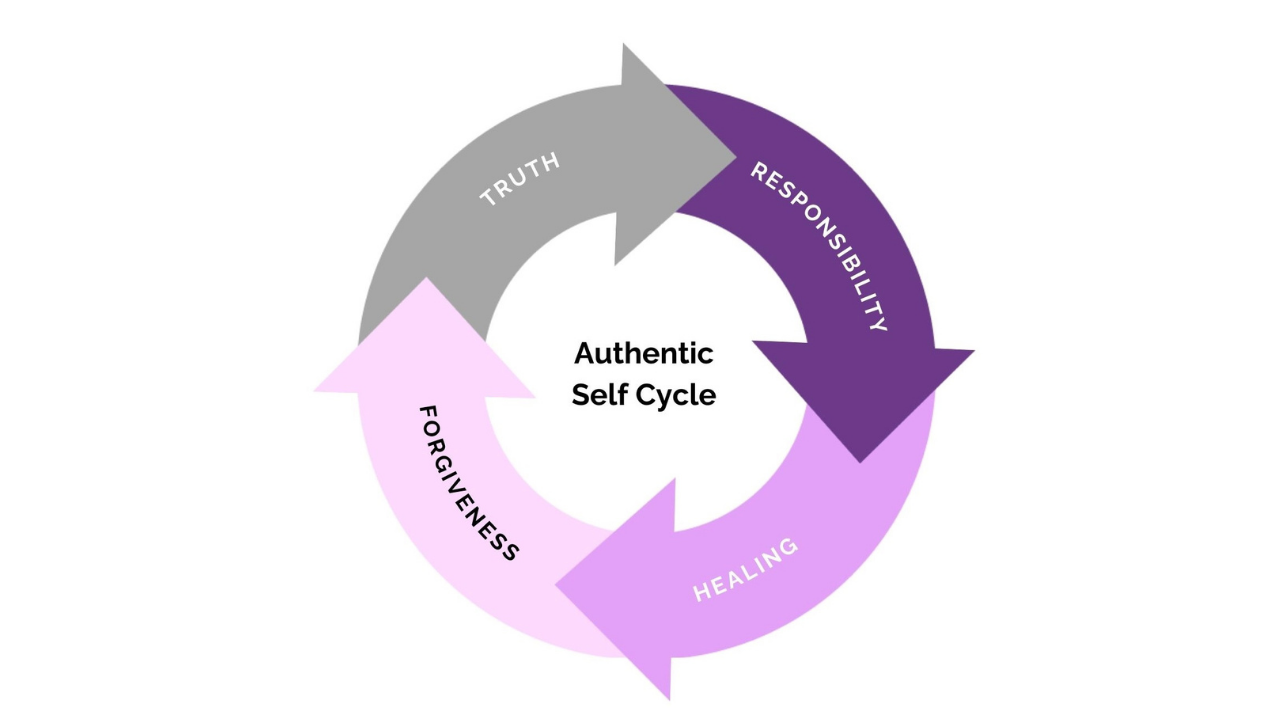
    Authentic Self Cycle™ — the four-stage healing pathway of truth, responsibility, healing, and forgiveness that replaces the Worst Day Cycle™ — by Kenny Weiss

    Now, the full rewiring process is too extensive to fit into this blog; my books, classes, and coaching are where we map it all out together.

    What Does Coping Skill Failure Look Like Across Your Entire Life?

    If you’re still wondering whether this applies to you, let me show you what coping skill failure looks like when it bleeds across every area of your life — because it always does. Your childhood emotional blueprint doesn’t stay in one lane. It drives everything.

    Family: You go home for the holidays and within thirty minutes you’re fourteen again. Your sibling makes a comment, your parent gives you that look, and suddenly all your “growth” evaporates. You cope by going quiet, over-drinking, or picking a fight — and then you spend the drive home wondering why you can’t just be “normal” around your own family.

    That’s you… spending three thousand dollars on therapy to prepare for Thanksgiving dinner and still losing it before dessert.

    Romantic Relationships: You’ve read every book on codependence recovery and communication. You know the language of healthy boundaries. But the moment your partner pulls away — even slightly — your nervous system hijacks you. You either chase, control, or shut down completely. The coping skills you learned in couples therapy worked in the therapist’s office. They don’t work at 11pm when your partner hasn’t texted back.

    That’s you… knowing exactly what a healthy relationship looks like on paper and being unable to sustain one in real life.

    Friendships: You over-give, over-accommodate, and then resent everyone for not reciprocating. Or you keep people at arm’s length because letting anyone close enough to really see you feels like handing them a loaded weapon. Your coping skill? Stay busy. Stay helpful. Stay indispensable. Never need anything from anyone.

    Work and Career: You’ve built an impressive résumé, but success feels hollow. You achieve, you perform, you exceed expectations — and you still feel like a fraud. Your Falsely Empowered survival persona got you the promotion, but it can’t get you peace. One critical email from a superior and your entire sense of self crumbles.

    That’s you… running an entire department but unable to handle a single piece of constructive feedback without spiraling for three days.

    Body and Health: Your body is keeping the score your coping skills can’t reach. Chronic tension in your jaw. Stomach issues that no doctor can explain. Insomnia that started in childhood and never left. You meditate, you exercise, you eat clean — and your nervous system still runs on high alert because the emotional enmeshment from childhood is stored in your tissues, not your thoughts.

    That’s you… getting a clean bill of health from your doctor while your body screams that something is terribly wrong.

    What Is Your Next Step to Stop Coping and Start Rewiring?

    I think you can now clearly see that emotional regulation isn’t about managing your symptoms so you can quietly endure a life you hate. It is about taking radical responsibility for your childhood programming so you can finally be free.

    That’s you… ready to stop putting Band-Aids on bullet wounds and finally pull out the bullet.

    And if you are sitting there right now, feeling overwhelmed and needing immediate guidance, I have something groundbreaking for you. Go to KennyWeiss.net and talk to my brand-new AI clone. I have uploaded my entire brain—every book, every framework, and every private coaching session—directly into this AI. It is completely free to use, and it is literally like having a one-on-one conversation with me. You can ask it about your triggers, your relationship struggles, or your Worst Day Cycle™, and it will give you the exact, root-cause feedback I would give you. Go test it out and get the help you need right now.

    While you are there, you can also take my completely free Childhood Assessment to help you identify the exact emotional origins of your Worst Day Cycle™. For those of you who are ready to map out your specific triggers and stop this loop for good, check out my books, my other classes, my emotional freedom assessments, and my private coaching, and pick the one that fits where you are in your emotional blueprint remapping journey.

    Whatever choice you make, just know that when you are ready, you now have a root-level solution, not a symptom-based topical band-aid approach, that will provide you with the root-level emotional regulation you are looking for when you are ready for it.

    And don’t forget. You are not to blame, and you are not broken. You were just programmed, and programs can be rewritten. You did the best you could with the information you had at the time. Now that you know more, you can choose to develop the knowledge, skills, and tools to do more.

    That’s you… finally understanding that there was never anything wrong with you — just faulty programming that can be updated.

    If This Article Hit Home, the Book Goes Deeper

    Everything I write about on this site — the Worst Day Cycle™, your childhood emotional blueprint, why you keep repeating the same patterns no matter how hard you try — it all started with my first book, Your Journey To Success: How to Accept the Answers You Discover Along the Way.

    This is the book readers call “the first time I found a roadmap I could actually understand and that seemed attainable.” It is the book that walks you through WHY your life hasn’t changed despite all the work you’ve done — and shows you, step by step, exactly how to break free. No fluff. No motivational hype. Just the truth about what was done to you, why it stuck, and what to do about it.

    If you’ve read this far, you already know something needs to change. This book is where that change starts.

    Get Your Journey To Success on Amazon →

    Ready to Stop Understanding the Problem and Start Rewiring It?

    The article you just read scratches the surface. My new book, Your Journey To Being Yourself: How to Overcome the Worst Day Cycle & Reclaim Your Authentic Self with Emotional Authenticity, gives you the complete system — the Worst Day Cycle™, the Authentic Self Cycle™, and the full Emotional Authenticity Method™ — all in one place, with the neuroscience behind every step.

    This is the book readers call “a genius piece of art in mastering emotion and the art of healing.” It speaks directly to the person who feels stuck, overwhelmed, and confused by the same repeating patterns — the same arguments, the same relationship breakdowns, the same shame — and is done accepting surface-level answers. Every chapter combines powerful stories, clear steps, and practical tools that show you how to rewire your emotional patterns from the inside out.

    You are not broken. You were programmed. And this book shows you exactly how to rewrite the program.

    Get Your Journey To Being Yourself on Amazon →

    Frequently Asked Questions

    Why do coping skills stop working when I’m triggered?

    Coping skills engage the cognitive, logical part of your brain — but when you’re triggered, your childhood emotional blueprint has already hijacked your nervous system before your thinking brain comes online. Dr. Lisa Feldman Barrett’s research confirms that emotions drive thoughts, not the other way around. Your brain is predicting the present based on childhood experiences, and no amount of deep breathing can override a prediction that was installed when you were four years old. The Emotional Authenticity Method™ works because it targets the emotional origin, not the cognitive symptom.

    What is the difference between coping skills and emotional regulation?

    Coping skills manage symptoms — they help you get through a triggered moment without doing damage. True emotional regulation rewires the neural pathway that causes the trigger in the first place. Think of coping skills as painkillers and emotional regulation as surgery. The Worst Day Cycle™ framework shows that triggers originate from childhood trauma, fear, and shame, and the only way to truly regulate is to address the emotional blueprint at its root using the Emotional Authenticity Method™.

    Can CBT or DBT help with emotional triggers from childhood?

    CBT and DBT can teach useful cognitive and behavioral techniques, but they operate on a fundamental flaw: they assume you can think or skill your way to emotional change. Dr. Iain McGilchrist’s neuroscience research shows that this hyper-logical approach activates the left hemisphere of the brain, which is prone to denying embodied truth. Because your triggers were created by pre-verbal emotional experiences — not thoughts — a thought-based approach cannot reach the root. The Emotional Authenticity Method™ activates the anterior prefrontal cortex through metacognition, which sits between intellect and emotion.

    Why do I keep having the same emotional reactions even after years of therapy?

    Because traditional therapy often stays at the level of insight without reaching the emotional blueprint where your reactions were programmed. You can understand your childhood perfectly and still react from it. Kenny Weiss’s Worst Day Cycle™ framework explains that insight lives in the cognitive brain, but your triggers live in the emotional and somatic systems that were wired before you had language. Until you address the original emotion — the exact childhood moment the neural pathway was formed — you will keep repeating the same loop of trauma, fear, shame, and denial.

    What is a childhood emotional blueprint and how does it affect me as an adult?

    Your childhood emotional blueprint is the set of neural pathways formed by your earliest emotional experiences — it determines what love means, what safety means, and what belonging means to your nervous system. Like a sled track carved in snow, these pathways become deep ruts that your brain automatically follows to conserve energy. As an adult, your brain predicts the present based on these childhood patterns, which is why a partner’s tone of voice can trigger a five-year-old’s panic response. The Emotional Authenticity Method™ helps you forge entirely new neural pathways.

    How is the Emotional Authenticity Method™ different from mindfulness or meditation?

    Mindfulness and meditation help you observe your thoughts and create a pause — which is valuable. But observation alone doesn’t rewire the childhood emotional blueprint that generates the thoughts in the first place. The Emotional Authenticity Method™ goes further by using metacognition to trace your current emotional reaction back to its earliest childhood origin, then creating a new emotional neural pathway from that root. It doesn’t just help you watch the Worst Day Cycle™ — it helps you step out of it entirely and into the Authentic Self Cycle™.

    The Bottom Line

    You have been fighting yourself with the wrong weapons. Every breathing technique, every journal prompt, every cognitive reframe — they were all aimed at the symptom while the real problem sat untouched in the basement of your nervous system, running the show from the shadows.

    The fact that you’ve read this far tells me something important about you. It tells me you’re not looking for another quick fix. You’re not looking for someone to pat you on the head and tell you to think positive. You’re looking for the truth — even when it’s uncomfortable. That takes courage.

    Here’s what becomes possible when you step out of the Worst Day Cycle™ and into the Authentic Self Cycle™: You stop reacting and start responding. You stop performing and start being. You stop surviving your relationships and start actually living in them. Not because you learned a new technique — but because you rewired the blueprint that was running your life without your permission.

    You are not broken. You are not defective. You are not “too sensitive” or “too much.” You were programmed — and programs can be rewritten. When you’re ready, the Emotional Authenticity Method™ will meet you exactly where you are.

    These books align with the root-cause approach to emotional regulation discussed in this article and will deepen your understanding of why coping skills fail to reach your childhood emotional blueprint:

    Lisa Feldman Barrett — How Emotions Are Made
    The neuroscience behind why your emotions are predictions based on past experience, not reactions to the present moment. Essential reading for understanding why thought-based coping skills cannot override emotional programming.

    Bessel van der Kolk — The Body Keeps the Score
    The definitive work on how trauma is stored in the body, not just the mind — and why cognitive approaches alone cannot heal it.

    Pete Walker — Complex PTSD: From Surviving to Thriving
    A practical guide to understanding the survival responses that develop in childhood and how they persist into adulthood.

    Gabor Maté — When the Body Says No
    Explores the connection between emotional suppression, childhood programming, and chronic illness — the physical cost of coping without healing.

    Take Your Next Step With Kenny Weiss

    If this article resonated with you and you’re ready to move beyond coping skills to root-level emotional regulation, explore these resources:

    Start Here:

    Emotional Blueprint Starter Course — Individual ($79) — Your individual roadmap for identifying your Worst Day Cycle™ patterns and beginning the rewiring process

    Relationship Starter Course — Couples ($79) — Map your relationship dynamics through the lens of both partners’ childhood emotional blueprints

    Go Deeper:

    Why We Can’t Stop Hurting Each Other ($479) — Understand the Worst Day Cycle™ collision between partners

    Why High Achievers Fail at Love ($479) — For the Falsely Empowered survival persona who built a career but can’t build intimacy

    The Shutdown Avoidant Partner ($479) — Root-cause work for avoidant attachment patterns

    Full Transformation:

    Tier 1: Mapping the Blueprint ($1,379) — The comprehensive program for rewiring your childhood emotional blueprint

    Download Kenny’s free Feelings Wheel to begin building emotional granularity — the foundation of the Emotional Authenticity Method™.

    Explore Kenny’s articles on signs of high self-esteem, insecurity in relationships, and 10 do’s and don’ts for a great relationship for more on how your childhood emotional blueprint shapes every area of your life.
  • How to Overcome the Fear of Change: Why Your Brain Resists Growth

    How to Overcome the Fear of Change: Why Your Brain Resists Growth

    The fear of change is a biochemical event rooted in your childhood emotional blueprint—not a character flaw or weakness. Your brain learned to associate change with threat during formative trauma, creating a Worst Day Cycle™ of fear, shame, and denial that keeps you stuck in familiar pain. By understanding the three survival personas and applying the Authentic Self Cycle™, you can rewire your relationship with change and reclaim authentic freedom.

    That’s you: You know change is necessary, but the moment you consider it—a new job, ending a relationship, moving, starting therapy—you feel a wave of panic, numbness, or sabotage. Something inside says “stay small, stay familiar, stay safe.”

    Emotional fitness and overcoming fear of change through nervous system healing

    What Is Fear of Change? (And Why It’s Not Your Fault)

    Fear of change isn’t laziness, lack of motivation, or personal failure. It’s a survival mechanism—your nervous system doing exactly what it was designed to do: protect you from perceived danger.

    When you were a child, negative experiences created emotional imprints. Maybe a parent’s abandonment taught you that change = loss. Maybe instability meant chaos and pain. Maybe criticism made you believe you’d fail at anything new. Your brain absorbed these messages and built an emotional blueprint—a set of unconscious rules that still run your decision-making today.

    That’s you: You’ve quit before you started. You’ve stayed in jobs, relationships, or situations that drain you because the devil you know feels safer than the unknown. Somewhere inside, change = danger.

    Here’s the neurochemistry: Childhood trauma triggers the hypothalamus to release a chemical cocktail—cortisol, adrenaline, dopamine, and misfiring oxytocin. Your brain becomes addicted to these emotional states and actively seeks repetition of familiar patterns, even painful ones, because repetition signals safety to the unconscious mind. The brain can’t tell right from wrong; it only knows known versus unknown.

    This isn’t broken neurology—it’s survival intelligence. Your fear of change protected you when you were small and vulnerable. But in adulthood, that same protection has become a prison.

    The Worst Day Cycle™: Why Change Triggers Your Survival Persona

    The Worst Day Cycle™ is a four-stage feedback loop that explains why change feels so dangerous and why you keep repeating familiar pain.

    Worst Day Cycle framework showing trauma, fear, shame, and denial in healing emotional blueprints

    Stage 1: Childhood Trauma Creates the Blueprint

    Trauma doesn’t require abuse. Trauma is any negative emotional experience that created painful meanings about yourself, others, or the world. It could be a parent’s unpredictable anger, a sibling’s betrayal, divorce, critical feedback, enmeshment, abandonment, or unmet emotional needs.

    In that moment, your developing brain made survival conclusions: “If I change, I’ll lose control and people will abandon me.” Or: “If I try something new, I’ll fail and prove I’m not good enough.” Or: “If I speak up, I’ll be punished.” These conclusions became hardwired in your nervous system.

    That’s you: You remember the exact moment you decided it wasn’t safe to try. Now every big life change feels like stepping toward that same danger.

    Stage 2: Fear Keeps the Cycle Running

    Fear is the activation signal. When you consider change—a new relationship, a career pivot, moving away from family, starting therapy—your nervous system screams: “Danger! This is how it started last time!”

    Your body floods with cortisol and adrenaline. Your chest tightens. Your mind races through catastrophe scenarios. You feel unsafe, even though objectively you’re safe in your current moment.

    Fear is biochemical panic rooted in an old survival blueprint, not accurate information about current reality. Your nervous system is running a program from age 7, but you’re living in 2026.

    The fear doesn’t feel irrational—it feels absolutely true. And that’s the problem. Fear becomes the lens through which you evaluate whether change is worth the risk. Spoiler alert: when fear is running the show, the answer is always “no.”

    Stage 3: Shame Anchors You to Denial

    Shame is the moment you internalize the fear as identity. Fear says: “Change is dangerous.” Shame says: “I am the problem. I’m broken. I’m not capable of handling change. Something is wrong with me.”

    You’ve lost your inherent worth. You no longer believe you deserve better or can create different. Shame is the deepest wound because it’s not about behavior—it’s about being.

    That’s you: You feel defective. You tell yourself: “Other people can handle change. Why can’t I? There must be something wrong with me.”

    Shame is where the Worst Day Cycle™ locks in. Because once you believe you’re the problem, you stop trying. You accept limitation as identity. You create internal narratives that justify staying stuck: “I’m not a risk-taker. I’m not brave. I’m not built for change.”

    Stage 4: Denial Forms Your Survival Persona

    Denial is the brilliant adaptation your nervous system created to survive unbearable shame and fear. It’s not conscious lying—it’s a complete shift in identity and behavior designed to feel safe and avoid the pain.

    Your survival persona is the character you became to survive childhood. It’s not your authentic self—it’s the protection strategy that kept you alive. And it works. For a while.

    But in adulthood, that survival persona becomes the main barrier to change. It’s the voice that sabotages new relationships, talks you out of the job interview, convinces you that your situation isn’t that bad. It’s not trying to hurt you—it’s trying to keep you alive by keeping you small and familiar.

    Here’s the cycle: Trauma → Fear (your nervous system protects) → Shame (you internalize the fear as broken identity) → Denial (you create a survival persona) → Repetition of familiar pain (the cycle reinforces itself).

    The Three Survival Personas: Which One Are You?

    When childhood trauma taught your nervous system that the world wasn’t safe, you developed a survival persona—a protective identity that helped you manage unbearable pain, shame, and fear. That persona is still running the show in adulthood.

    The three survival persona types exist on a spectrum: Falsely Empowered (over-controlling), Disempowered (collapsed), and Adapted Wounded Child (oscillating between both). Most people don’t fit neatly into one—they oscillate or blend, depending on context.

    Three survival persona types: Falsely Empowered, Disempowered, and Adapted Wounded Child in trauma recovery

    Falsely Empowered (The Controller)

    The Falsely Empowered persona protects by controlling, dominating, raging, or perfectionism. In childhood, you learned that safety came from controlling outcomes and other people’s behavior. Vulnerability equaled danger.

    As an adult, your fear of change manifests as rigidity. You micromanage. You resist flexibility. You rationalize why change is impossible or unnecessary. You catastrophize others’ change decisions. You maintain the illusion of control by keeping everything—and everyone—in place.

    That’s you: You say “I have everything under control” while relationships suffer and opportunities pass by. You know what needs to change, but the thought of surrendering control feels like drowning.

    The Falsely Empowered persona can look like ambition, strength, and leadership on the surface. But underneath, it’s panic and shame. The moment control is threatened, rage or shutdown appears. Change feels like losing yourself entirely.

    Disempowered (The Collapser)

    The Disempowered persona protects by collapsing, people-pleasing, and abandoning your own needs. In childhood, you learned that the only way to survive was to make yourself small, compliant, and emotionally attuned to others. Your safety depended on being needed, invisible, or helpful.

    As an adult, your fear of change manifests as paralysis. You say “yes” to things you don’t want. You stay in harmful situations because leaving feels selfish. You wait for permission that never comes. You sabotage positive change because growth feels disloyal to the family or belief system that raised you.

    That’s you: You’ve spent years adapting to everyone else’s needs. The idea of choosing yourself—changing careers, ending a relationship, setting a boundary—triggers guilt and terror. Who are you if you’re not taking care of others?

    The Disempowered persona can look like kindness and selflessness. But underneath, it’s self-abandonment and invisible rage. You’re not genuinely giving—you’re protecting yourself by making sure no one abandons you first.

    Adapted Wounded Child (The Oscillator)

    The Adapted Wounded Child persona oscillates between Falsely Empowered and Disempowered, depending on the perceived threat level. You can be rigidly controlling one moment and completely collapsed the next. You’re the chameleon, the code-switcher, the person who reads the room and becomes whoever’s needed.

    In childhood, unpredictability forced you to develop extreme flexibility. You had to sense danger and shift strategies constantly. Your survival depended on being able to control when necessary and collapse when necessary.

    As an adult, change triggers rapid oscillation. You plan a big shift, feel excited, then panic and abandon the plan. You’re in a conversation about your needs, you start advocating for yourself, then you collapse back into people-pleasing. You want to leave a relationship, then you convince yourself you’re being ungrateful. This oscillation is exhausting and deeply confusing to others.

    That’s you: People say you’re inconsistent or moody. You feel like you’re being torn in two directions constantly. One minute you’re ready for change, the next you’re drowning in doubt and shame.

    All three survival personas are brilliant adaptations. They kept you alive. The problem isn’t that they exist—it’s that they’re still running your adult life and blocking your capacity for authentic change.

    Adapted Wounded Child survival persona oscillating between control and collapse in emotional recovery

    The Authentic Self Cycle™: How to Heal

    If the Worst Day Cycle™ explains the problem, the Authentic Self Cycle™ is the solution. It’s an identity restoration system—a four-stage process that rewires your emotional blueprint and reclaims your authentic self from underneath the survival persona.

    Authentic Self Cycle framework for emotional healing and authentic identity restoration

    Stage 1: Truth — Name the Blueprint

    Truth means seeing the emotional blueprint clearly. It’s naming where your fear came from, what painful meanings you made about change, and how those meanings have run your life.

    This isn’t blame or victimhood—it’s clarity. You’re not saying “My parent’s abandonment ruined me forever.” You’re saying “My parent’s abandonment taught my nervous system that I’m not safe when things change. That’s the blueprint I’m carrying. That blueprint is no longer serving me.”

    That’s you: You stop telling yourself “I’m just not a risk-taker” and start seeing “I was trained to fear change because change meant danger.”

    Truth is the first step because you cannot change what you cannot see. The survival persona stays invisible by convincing you it’s just “who you are.” Truth breaks that invisibility.

    Stage 2: Responsibility — Own Your Emotional Reactions

    Responsibility doesn’t mean blame. It means reclaiming your power by owning that your emotional reactions to change are coming from your blueprint, not from current reality.

    This is the pivot point: Your partner isn’t your abandoning parent. Your new job opportunity isn’t a setup for failure. Your nervous system just thinks they are because you’re running an old program.

    Responsibility means: “When I consider leaving this job, I feel terror. That terror isn’t information about the job—it’s information about my blueprint. My nervous system learned that change = danger. That’s not the job’s fault. That’s not my weakness. That’s my blueprint. And I’m responsible for healing it.”

    This shift is radical. It moves you from victim (“This is happening to me”) to agent (“I’m responsible for my own healing”). You reclaim your power.

    Stage 3: Healing — Rewire Your Nervous System

    Healing means creating new neural pathways. It means experiencing change in small, regulated doses so your nervous system learns: “Change is uncomfortable, but I survive. Change is unfamiliar, but it’s not dangerous. I can handle uncertainty.”

    Healing isn’t intellectual. You can’t think your way out of emotional patterns. You have to feel your way through them. This is where the Emotional Authenticity Method™ comes in—it’s a somatic process that works with your body and emotions, not just your thoughts.

    As your nervous system learns safety in the face of change, space stops meaning abandonment. Intensity stops meaning attack. Uncertainty stops triggering survival panic. A new emotional chemistry replaces fear and shame.

    Stage 4: Forgiveness — Release the Inherited Blueprint

    Forgiveness is releasing the inherited emotional blueprint so you can build your own. This doesn’t mean condoning harm or staying in contact with people who hurt you.

    It means: “My parents did the best they could with the emotional blueprints they inherited. The pain they passed to me wasn’t personal—it was inherited. I can acknowledge that and choose differently for myself.”

    That’s you: You stop seeing yourself as damaged by your past and start seeing yourself as responsible for your future. You reclaim your authentic identity.

    Forgiveness is where you truly become free. Not free from the past—but free from letting the past dictate your present and future.

    The Emotional Authenticity Method™: Five Steps to Rewire Your Blueprint

    The Emotional Authenticity Method™ is how you execute the Authentic Self Cycle™. It’s a five-step somatic process that rewires your emotional blueprint by working with your body, not just your thoughts.

    You cannot change emotional patterns through thoughts alone. Emotions are biochemical events. Thoughts originate from feelings, not the other way around. This is why positive affirmations don’t work if your nervous system still believes you’re in danger.

    Emotional Authenticity Method for rewiring trauma and fear-based emotional patterns

    Step 1: Somatic Down-Regulation (with Optional Titration)

    Before you can access truth, you have to calm your nervous system. If you’re in fight-flight-freeze mode, your prefrontal cortex (the thinking brain) is offline. You can’t access clarity or wisdom from a dysregulated state.

    Down-regulation might look like: deep breathing, cold water on your face, grounding techniques (5-4-3-2-1 sensory awareness), movement, bilateral stimulation, or simply slowing down.

    Titration means doing this in small doses. You don’t try to calm completely—you gently lower the activation level so you’re accessible but still connected to the feeling. If you fully suppress the emotion, you can’t access it for healing.

    That’s you: When you think about change, panic floods your system. Step 1 is: “Okay, I’m going to breathe slowly for 60 seconds. I’m going to feel my feet on the ground. Now I’m calm enough to actually think.”

    Step 2: What Am I Feeling? (Emotional Granularity)

    Most people collapse all difficult feelings into “anxiety” or “stress.” But your nervous system is far more specific. Is it shame? Terror? Sadness? Rage? Helplessness? Betrayal? Loneliness?

    The more granular you can get, the more information the emotion reveals. Shame says: “I’m the problem.” Rage says: “Someone violated my boundary.” Sadness says: “I’ve lost something.” They require different responses.

    Use the Feelings Wheel to expand your emotional vocabulary. Start with the primary emotion (fear, sadness, anger, joy, disgust, surprise) and spiral inward to find the specific shade of the feeling you’re experiencing. This alone is healing—our nervous systems calm when we name the experience accurately.

    We offer a free interactive Feelings Wheel at kennyweiss.net/life-changing-exercise to help you build this emotional literacy.

    Step 3: Where in My Body Do I Feel It?

    All emotional trauma is stored in the body. When you avoided your feelings, your nervous system stored the incomplete experience as physical sensation. Until you process it somatically, your body keeps trying to complete the experience.

    Locate the feeling: Does your chest tighten? Does your throat close? Does your belly clench? Does your skin flush? Does your jaw clench? What part of your body is holding this emotion?

    This is crucial information. Your body is the gateway to your emotional blueprint. The nervousness about change might feel like throat closure (can’t speak your truth) or chest tightness (can’t breathe/move forward) or stomach clenching (can’t trust your gut instinct).

    That’s you: You notice that when you think about changing careers, your chest immediately tightens and you feel suffocated. That’s not a heart attack—that’s your nervous system saying “This change feels like suffocation because of what you experienced before.”

    Step 4: What Is My Earliest Memory of This Feeling?

    This is the trace step. You follow the feeling backward to its origin in your childhood blueprint. This feeling of panic about change—when’s the first time you felt it? How old were you? What was happening?

    You might trace terror about change back to the day your parent said they were leaving. You might trace paralysis back to a teacher’s harsh criticism of your work. You might trace rage back to feeling invisible in your chaotic family.

    This isn’t about reliving trauma—it’s about connecting the dots. Your nervous system responds to change with such intensity because change has been dangerous before. You’re not broken. You’re responding logically to past experience.

    When you trace the feeling to its origin, something shifts. You literally see: “This response made sense when I was seven. I was protecting myself from actual danger. That danger is no longer present, but my nervous system is still running that old program.”

    Step 5: Who Would I Be If I Never Had This Feeling Again?

    This is the vision step. It’s not positive affirmation—it’s genuine imagination of your authentic self, free from this specific emotional pattern.

    If you didn’t feel terror when you considered change, who would you be? What would you do? What would you try? What would you create? How would you move through the world differently?

    That’s you: “If I wasn’t terrified of change, I would leave this job I hate. I would tell my partner the truth. I would start that creative project. I would trust myself.”

    This vision step connects you to the Authentic Self Cycle™. It shows you what’s possible on the other side of healing. It’s not a fantasy—it’s a preview of your authentic self once the survival persona releases its grip.

    Repeat this process as often as needed. Each cycle weakens the emotional pattern and strengthens your capacity for change. Over time, your nervous system rewires. Change becomes uncomfortable but not dangerous. You access your authentic agency.

    Signs of Fear-Based Resistance by Life Area

    Fear of change manifests differently across life domains. Here’s how to recognize it in the areas where you feel most stuck.

    Family & Origin Dynamics

    • You stay entangled with family patterns even though they cause pain
    • You can’t set boundaries because change in family dynamics feels unsafe
    • You replay childhood roles (caretaker, scapegoat, invisible one) even as an adult
    • You feel obligated to stay the same so family members feel comfortable
    • You tell yourself “my family will never change” and accept dysfunction as permanent
    • You avoid therapy or healing work because it might change the family dynamic

    That’s you: You know the family dynamic is unhealthy, but the thought of changing it—setting a boundary, speaking the truth, reducing contact—triggers overwhelming guilt and terror. Who are you if you’re not the person they need you to be?

    Romantic Relationships

    • You stay in relationships that drain you because leaving feels like abandonment (of them or by them)
    • You sabotage good relationships because they’re unfamiliar and therefore feel unsafe
    • You repeat the same dysfunctional pattern in every relationship
    • You can’t communicate your needs because vulnerability feels dangerous
    • You choose partners who are unavailable or harmful because that dynamic is familiar
    • You feel paralyzed when a partner wants to deepen intimacy (that’s too much change)

    Explore this deeper in our post on insecurity in relationships and how trauma patterns show up in partnerships.

    Friendships & Social Connection

    • You maintain friendships that are one-sided or harmful because ending them feels disloyal
    • You don’t speak up when a friend hurts you because conflict means loss
    • You’re isolated because making new friends requires vulnerability and risk
    • You people-please in friendships, never showing your authentic self
    • You disappear when friendships naturally evolve because change in closeness triggers fear
    • You feel unable to ask for support because you learned that needing others is dangerous

    Career & Creative Work

    • You stay in jobs that don’t align with your values because change feels risky
    • You sabotage promotions or opportunities because visibility triggers shame
    • You don’t pursue creative work because failure would confirm you’re not good enough
    • You tell yourself you’re “not that person” who takes risks or pursues passion
    • You’re over-cautious, over-prepared, perfectionist (trying to control the outcome)
    • You shrink yourself to fit the expectations of others rather than creating on your terms

    That’s you: You have a business idea, a creative dream, a career change waiting inside you. But every time you consider it, panic and self-doubt paralyze you. You tell yourself “I’m not brave enough” or “It’s too risky.” The real fear: “If I try and fail, I’m a failure. If I try and succeed, I have to be visible and that’s not safe.”

    Body & Health

    • You avoid medical care because the unknown feels dangerous
    • You stay in harmful physical patterns (sedentary, eating habits, substance use) because change feels threatening
    • You can’t sustain exercise or nutrition changes because your nervous system sabotages progress
    • You ignore body signals and stay disconnected from physical sensation
    • You punish your body through stress or neglect as a way to feel in control
    • You fear the vulnerability of asking for help or admitting you’re struggling
    Trauma chemistry and nervous system activation in fear response to change

    People Also Ask

    Why does change trigger such intense fear if the danger is no longer present?

    Your nervous system doesn’t distinguish between past and present. It only knows “pattern matches = safety, unknown = danger.” When you were seven and your parent abandoned the family, change was genuinely dangerous. Your nervous system learned: change = loss, separation, danger. Now, decades later, your body still treats all change as a threat signal, even though the actual danger is no longer present. This is why logical reassurance doesn’t work—the fear is biochemical, not rational. Your nervous system needs to learn through repeated safe experiences of change that you can handle uncertainty. That’s why the Emotional Authenticity Method™ works—it rewires your nervous system somatically, not just mentally.

    I’ve tried therapy and self-help books, but nothing changes. Why am I still stuck?

    Most traditional talk therapy and self-help focus on thoughts and behavior. But your emotional blueprint is biochemical and somatic. You can understand intellectually that change is safe while your nervous system still believes it’s dangerous. The disconnect between what you know and what you feel is maddening because your emotions are running the show, not your thoughts. The Emotional Authenticity Method™ is different—it doesn’t ask you to think your way out. It works with your body and emotions directly. You calm your nervous system first, then trace the feeling to its origin, then create new neural pathways through somatic practice. This takes longer than a self-help book, but it actually creates lasting change.

    How do I know if I’m a Falsely Empowered, Disempowered, or Adapted Wounded Child survival persona?

    Most people aren’t purely one type—they oscillate or blend depending on context. But you can identify your primary patterns by noticing: When you’re anxious about change, do you try to control (Falsely Empowered), collapse and people-please (Disempowered), or oscillate between the two (Adapted Wounded Child)? A Falsely Empowered person might rigidly maintain their job and relationship because leaving feels like losing control. A Disempowered person might stay in a bad situation and people-please their way through it. An Adapted Wounded Child might want to leave, start planning, then suddenly decide to stay, then want to leave again. All three are protecting against the same core fear of change—just using different strategies.

    Can I overcome fear of change without addressing my childhood trauma?

    Not fully. You can develop coping strategies that make change feel more manageable, but you’ll always be managing from a place of underlying fear. True freedom from fear-based resistance requires understanding and rewiring your emotional blueprint—the survival conclusions you made as a child that still run your nervous system. That’s what the Emotional Authenticity Method™ does. It connects your current fear of change to the childhood experience that created it, then uses somatic practice to rewire your nervous system so change becomes uncomfortable but not dangerous.

    What’s the difference between healthy caution about change and fear-based resistance?

    Healthy caution is thoughtful and measured. You consider the risks, gather information, make a deliberate choice, and move forward even with uncertainty. Fear-based resistance is paralyzing. You can’t move forward. You sabotage positive change. You rationalize staying stuck. You feel shame about your inability to change. If you’re considering a big life change and your entire body is screaming “no” while your mind is saying “yes, you should do this,” that’s a sign your nervous system is running an old survival program.

    How long does it take to rewire fear of change?

    There’s no fixed timeline. It depends on the depth of your childhood trauma, how long you’ve been stuck in the pattern, and how committed you are to the healing work. Some people experience shifts in weeks—a few rounds of the Emotional Authenticity Method™ and they’re noticeably more capable of handling change. Others need months or longer of consistent practice to rewire deep patterns. What’s important: every time you practice the method, you’re creating new neural pathways. Your brain is literally building new tissue (myelin) around new patterns of response. Daily practice accelerates healing far more than sporadic effort.

    The Bottom Line: Fear of Change Is Grief in Disguise

    Your fear of change isn’t weakness or broken neurology. It’s your nervous system mourning the loss of the familiar, even when the familiar causes pain.

    Change means letting go—of identity, of roles, of the world as you’ve known it. That’s a real loss, and your system is wise to grieve it. The problem isn’t the grief. The problem is when grief becomes paralysis, when mourning the loss of the familiar keeps you from stepping into authentic possibility.

    That’s you: You’re standing at the threshold of change. One foot wants to move forward. One foot is cemented in the past. You’re torn. Exhausted. Ashamed of how stuck you are.

    Here’s what I want you to know: Every single person who has healed their fear of change has felt exactly what you’re feeling right now. That terror isn’t a sign you shouldn’t change. It’s a sign your nervous system needs to learn that change is safe. The Worst Day Cycle™ isn’t permanent. It’s a pattern—and patterns can be rewired.

    Your authentic self is waiting on the other side of this fear. Not a perfect self—an imperfect, vulnerable, real self who gets to choose. Who gets to speak. Who gets to try. Who gets to fail and try again. Who gets to move forward even when it’s scary.

    The Authentic Self Cycle™ is the path. The Emotional Authenticity Method™ is the map. Your job is to show up consistently, trace your fear to its origin, and practice moving forward in small, regulated doses until your nervous system learns: “I am safe. Change is uncomfortable, but I can handle it. I am worthy of the life I actually want.”

    You don’t have to stay afraid. Not because fear will disappear—but because you’ll become someone who moves forward anyway.

    • Codependent No More by Melody Beattie — Understanding how to stop abandoning yourself to please others
    • The Body Keeps the Score by Bessel van der Kolk — How trauma is stored in the nervous system and how somatic healing works
    • Attached by Amir Levine & Rachel Heller — Understanding attachment styles and how childhood patterns show up in adult relationships
    • The Gifts of Imperfection by Brené Brown — Releasing perfectionism and shame to show up authentically
    • Facing Codependence by Pia Mellody — The foundational text on how childhood trauma creates survival personas and codependent patterns
    • When the Body Says No by Gabor Maté — How chronic emotional suppression manifests as physical illness
    • It Didn’t Start With You by Mark Wolynn — Understanding inherited emotional patterns and transgenerational trauma

    Take the Next Step

    You don’t have to figure this out alone. Kenny Weiss has created courses specifically designed to help you understand your emotional blueprint and practice the Emotional Authenticity Method™.

    Emotional Blueprint Starter Course — Individual ($79) — Understand your emotional blueprint, identify your survival persona, and create a personalized healing roadmap.

    Relationship Starter Course — Couples ($79) — If your fear of change shows up in your romantic relationship, understand the dynamic with your partner.

    Why We Can’t Stop Hurting Each Other ($479) — How emotional blueprints create relationship patterns and how to break them.

    Why High Achievers Fail at Love ($479) — Understanding why success in career feels impossible in relationships.

    The Shutdown Avoidant Partner ($479) — How to show up and stay connected when change threatens your stability.

    Tier 1: Mapping the Blueprint ($1,379) — The most comprehensive program: Master the Emotional Authenticity Method™.

    Download the Feelings Wheel — the free tool used in Step 2 of the Emotional Authenticity Method™ to build emotional granularity.

    Explore more: The Signs of Enmeshment | 7 Signs of Relationship Insecurity | 7 Signs of High Self-Esteem | How to Determine Your Negotiables and Non-Negotiables | 10 Do’s and Don’ts for a Great Relationship