Your partner is ten minutes late and your chest is already tight. You check your phone — nothing. You check again. Your mind starts building the case: “They forgot. They don’t care. They’re pulling away.” By the time they walk in the door, apologizing for traffic, you’re already somewhere else emotionally — you’re six years old, standing at the school pickup line, watching every other car leave except yours.
That reaction isn’t about tonight. It isn’t about the ten minutes. Abandonment anxiety is the nervous system’s alarm from childhood firing in your adult relationships — and it has been running on autopilot for decades, hijacking your ability to feel safe with the people you love most.
Abandonment anxiety isn’t a personality flaw or “being too needy.” It’s the emotional residue of a childhood where your attachment to your caregivers was unpredictable, conditional, or interrupted. Every parent, because they are perfectly imperfect, could not consistently be there for you. They just couldn’t. Life is difficult. No parent can be one hundred percent attuned to their child — that’s not possible. But in those moments of disconnection, a child doesn’t think “my parent is overwhelmed.” A child thinks: “I’m the problem. Something is wrong with me.” And the brain gets addicted to that conclusion.
That’s you if a delayed text message can send you into a spiral. That’s you if you rehearse breakup conversations that haven’t happened. That’s you if the people closest to you keep telling you “I’m not going anywhere” — and you can’t believe them.
This isn’t about learning to “trust more” or “stop overthinking.” This is about what your brain did with pain it couldn’t process in childhood — and what happens when you finally trace that pain back to where it started.
What Is Abandonment Anxiety? (It’s Not What You Think)
Where Abandonment Anxiety Actually Comes From
Shame: The Engine That Powers Every Anxious Thought
How Abandonment Anxiety Shows Up in Every Area of Life
The Worst Day Cycle™: Why Your Brain Keeps Repeating the Pattern
Three Survival Personas That Keep Abandonment Anxiety Alive
The Emotional Authenticity Method™: How to Actually Heal the Wound
The Authentic Self Cycle™: Replacing Anxiety With Secure Attachment
The Deepest Betrayal: How You Abandon Yourself
FAQ: Questions People Also Ask
The Bottom Line
Recommended Reading
What Is Abandonment Anxiety? (It’s Not What You Think)
Most articles about abandonment anxiety will tell you it’s an “attachment style” problem. They’ll give you communication tips, reassurance scripts, and advice to “work on your self-esteem.” And none of it reaches the actual wound — because they’re treating a biochemical pattern with cognitive Band-Aids.
Abandonment anxiety is not a thinking problem. It is a feeling problem that originated in childhood — and you cannot change emotional patterns through thoughts alone, because emotions are biochemical events and thoughts originate from feelings.
Abandonment anxiety is what happens when a child’s need for secure attachment is met with inconsistency, absence, or emotional unavailability. It doesn’t have to be dramatic — it can be a tone of voice that said “not now,” a parent who was physically present but emotionally checked out, a household where love had conditions attached, or a divorce that split the child’s world in half. In those moments, the child’s hypothalamus generated a massive chemical reaction — cortisol, adrenaline, dopamine misfires — and the brain became addicted to that emotional state.
That’s you if you learned early that love could disappear without warning. That’s you if you’ve spent your whole life scanning for signs that someone is about to leave — and finding them everywhere, even when they’re not there.
Here’s what makes abandonment anxiety so persistent: the brain conserves energy by repeating known patterns. It can’t tell right from wrong — only known from unknown. Since 70% or more of childhood messaging is negative and shaming, the brain treats hypervigilance as “safe” and relaxation as “dangerous.” Your anxiety isn’t protecting you. Your anxiety is your brain repeating the only pattern it knows.
Where Abandonment Anxiety Actually Comes From
Abandonment anxiety doesn’t appear in adulthood out of nowhere. It was installed in childhood — during the moments when your need for connection was met with absence, inconsistency, or rejection.
Every child must attach to another human being physically and emotionally to survive as a species. The overwhelming responsibility of being a parent means that each parent will experience perfectly imperfect moments when they aren’t available to substantiate their child. In those moments, the child experiences abandonment. And the only solution available to a child — who has limited power, limited knowledge, and limited emotional capacity — is to blame themselves.
When a child is abandoned — emotionally or physically — they don’t conclude “my parent couldn’t handle this.” They conclude “I am the problem.” And that conclusion becomes the emotional blueprint that runs every relationship for the rest of their life, until it’s consciously interrupted and rewired.
Here’s how it works: if I blame myself, that means I might be able to fix it. It gives me hope that my perfectly imperfect parents will not abandon me if I change. As an adult, the thought “if I’m rejected, I can change or fix it and make you like me” may feel like power — but it is false power. It means you gave away your power to the other person. You placed their wants and needs above yours. You decided something is wrong with you. And by pursuing being someone different, you are looking outside of yourself to validate your worth.
That’s you if you shape-shift in every relationship — becoming whoever the other person needs you to be, losing yourself a little more each time. That’s you if you can’t remember the last time you said what you actually wanted without checking someone else’s reaction first.
The truth is no one ever rejects us. Ever. It’s not humanly possible. People are acting on what they believe to be in their best interest. When someone leaves, they’re pursuing their own needs and wants — that’s not a rejection of who you are. But your childhood blueprint can’t see that. Your nervous system interprets every departure through the lens of the original wound: “I am being abandoned again because I am not enough.”
Shame: The Engine That Powers Every Anxious Thought
Underneath every abandonment fear is a single emotion: shame. Not guilt — guilt says “I did something bad.” Shame says “I am bad.” And that distinction changes everything about how you experience relationships.
Shame is where you lost your inherent worth. It’s the moment in childhood where you stopped believing you had value simply for existing and started believing you had to earn the right to take up space. The anxious voice that says “they’re going to leave” isn’t anxiety talking — it’s shame talking. And it has been talking since childhood.
Shame strips you of inherent power, inherent value and worth, the ability to ask for your needs and wants, and the ability to choose direction and be the author of your own life. Abandonment anxiety is not a fear of being alone — it is the shame-based belief that you are not enough to keep anyone from leaving, and that belief was installed before you ever had a chance to prove otherwise.
This is why reassurance doesn’t work. Your partner can tell you “I love you” a thousand times, and the shame underneath whispers: “They just don’t know the real you yet.” You can’t absorb love when the emotional system receiving it believes it’s undeserved. The reassurance bounces off the shame wound like rain off concrete.
That’s you if you need to hear “I love you” multiple times a day and it still doesn’t land. That’s you if you interpret silence as rejection, space as abandonment, and independence as proof that you’re not needed.
The most paradoxical aspect of shame is that it is the core motivator of the super-achiever. People who appear the most confident on the outside are often running the loudest abandonment soundtrack on the inside — because they use over-functioning, people-pleasing, and hyper-independence to control the one thing they can’t control: whether someone stays. They become human doings instead of human beings, constantly earning love that was supposed to be free.
That’s you if you’ve built your entire personality around being indispensable — because if they need you, they can’t leave you. That’s you if the idea of having nothing to offer someone terrifies you more than any breakup ever could.
How Abandonment Anxiety Shows Up in Every Area of Life
Abandonment anxiety doesn’t stay in your relationships. It infiltrates every area of your life — because the shame blueprint that created it touches everything.
Family
You revert to childhood the moment you’re around your parents. You monitor their tone, their mood, their body language — scanning for signs that you’ve disappointed them. You overfunction at family gatherings, managing everyone’s emotions, making sure nobody is upset. The original abandonment happened in this system, so your nervous system is on highest alert in this system. You can be a CEO in the boardroom and a terrified child at the dinner table.
That’s you if holidays feel like emotional minefields — and you spend the drive home dissecting every interaction for proof that you did something wrong.
Romantic Relationships
This is where abandonment anxiety is loudest. You track your partner’s energy like a weather system. A shift in tone becomes evidence. A cancelled plan becomes proof. You create tests — sometimes consciously, sometimes not — to see if they’ll stay. You push them away to see if they’ll fight to come back. You cling and then withdraw. Your nervous system is running the same alarm it learned in childhood every time closeness is followed by distance.
That’s you if you’ve been told you’re “too much” or “too intense” in relationships — and you know they’re right but you can’t stop, because underneath the intensity is a terror that predates this relationship by decades.
Friendships
You overfunction in friendships — always available, always the one who reaches out first, always the one holding the group together. When a friend doesn’t text back, the spiral starts. You replay conversations looking for the moment you said the wrong thing. You give more than you have, hoping that if you’re useful enough, indispensable enough, they won’t disappear.
That’s you if you have a hundred contacts in your phone and still feel profoundly alone — because none of them know the real you, only the version you built to keep them close.
Work and Career
Abandonment anxiety at work looks like never saying no, overdelivering on every project, and interpreting constructive feedback as the beginning of being pushed out. You stay late. You volunteer for everything. You obsessively check your standing with your boss. Your childhood blueprint for “if I don’t perform, I lose love” now runs your entire professional identity — and you’re exhausted by it.
That’s you if losing a job feels like losing your identity — because without the role, who are you? That’s you if every performance review triggers a shame spiral that lasts for days.
Body and Health
Every chronic pattern of abandonment anxiety is the mind’s attempt to communicate a shame wound the body has been carrying since childhood — and when that wound goes unaddressed, it doesn’t just stay emotional. It becomes physical.
The cortisol from chronic hypervigilance breaks down cells over time. The knot in your stomach, the chest tightness, the jaw clenching, the insomnia — your body has been running an emergency broadcast for years. Abandonment anxiety isn’t just emotionally exhausting. It is physically destroying you — because the nervous system cannot sustain a state of perpetual threat without consequences.
That’s you if your body is always braced for impact — even when nothing is happening. That’s you if the doctor says “stress” but what they mean is: your nervous system hasn’t felt safe since childhood.
The Worst Day Cycle™: Why Your Brain Keeps Repeating the Pattern
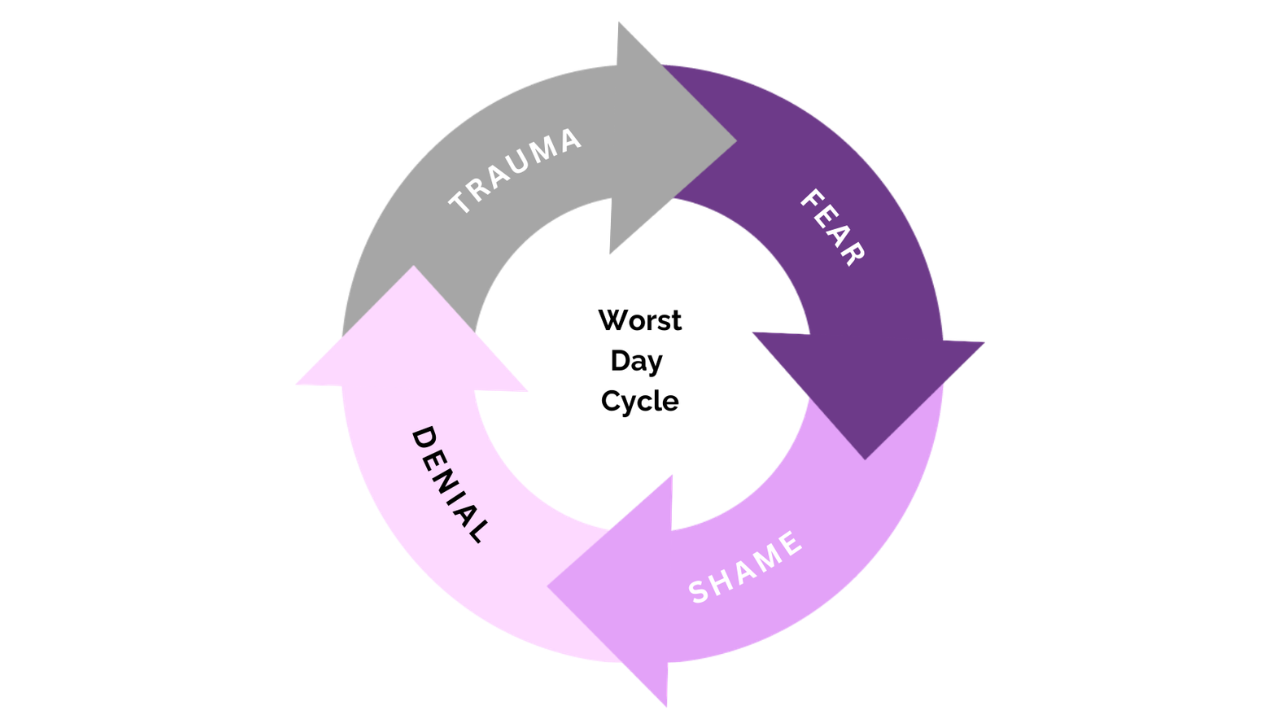
To understand why abandonment anxiety has been running your relationships for years — maybe decades — you need to understand the Worst Day Cycle™. This is the cycle that explains why the brain and body keep repeating painful patterns long after the original event is over.
The Worst Day Cycle™ has four stages: Trauma → Fear → Shame → Denial.
Trauma is any negative emotional experience that created painful meanings. For abandonment anxiety, the trauma doesn’t have to be a parent walking out. It could be emotional unavailability, unpredictability, a household where you never knew which version of your parent would come home, or the quiet devastation of being physically present with a caregiver who was emotionally absent. That experience triggered a massive chemical reaction in the brain and body. The hypothalamus generated chemical cocktails of cortisol, adrenaline, dopamine, and oxytocin misfires — and the brain became addicted to these emotional states.
Fear drives the repetition. The brain conserves energy by repeating known patterns. It can’t tell right from wrong — only known from unknown. Since your childhood wired hypervigilance as “normal,” your brain treats scanning for abandonment as “safe” and relaxation in love as “dangerous.” Every time you panic when your partner doesn’t respond immediately, that’s your brain choosing the known pattern of fear over the unknown experience of secure attachment.
Shame is where you lost your inherent worth. “I am the problem.” When your need for consistent attachment was unmet in childhood — when a parent left, checked out, or made love conditional — you didn’t conclude “my parents couldn’t handle this.” You concluded “something is wrong with me that makes people leave.” That shame went underground. And now it runs your inner monologue in every relationship.
Denial is the survival persona you created to survive the pain. It was brilliant in childhood — it kept you alive. But in adulthood, it’s the thing telling you “I just need more reassurance” or “I’m just a sensitive person” or “I need to find someone who won’t trigger me.” Denial keeps you from looking at what’s actually underneath the anxiety, because looking at it means feeling the original pain of being a child who couldn’t make their parent stay.
That’s you if you’ve blamed every partner for your anxiety instead of tracing it back to the childhood wound that created it. That’s you if the idea of looking at your childhood makes your chest tighten — because the survival persona knows that looking at the truth means the denial can’t hold.
Three Survival Personas That Keep Abandonment Anxiety Alive
The denial stage of the Worst Day Cycle™ doesn’t look the same for everyone. It shows up as one of three survival personas — patterns that were created in childhood to manage the overwhelming pain of abandonment. Each one keeps the anxiety running in a different way.
The Falsely Empowered Survival Persona
This person controls, dominates, and rages. They don’t look anxious — they look bulletproof. But underneath the armor is a terror of abandonment so deep that they built an entire identity to make sure they never feel it. They leave before they can be left. They push people away before people can pull away. They control every variable in a relationship — because if they’re in control, abandonment can’t happen. Their anxiety is invisible because they converted it into aggression.
That’s you if you’ve ended relationships the moment they got real — because closeness means vulnerability and vulnerability means someone has the power to leave you.
The Disempowered Survival Persona
This person collapses and people-pleases. Their abandonment anxiety is visible — they cling, pursue, apologize constantly, and give themselves away. They go against their own morals, values, needs, and wants to keep the peace and maintain connection. Their body is in constant freeze or fawn mode. They cannot tolerate space, silence, or distance — because in childhood, space meant someone was about to disappear.
That’s you if you’ve stayed in relationships that were destroying you because leaving felt more terrifying than staying — because at least if they’re here, even if they’re hurting you, you’re not alone.
The Adapted Wounded Child
This person oscillates between both — sometimes pushing away in false independence, sometimes collapsing into desperate pursuit. They can be calm and secure in one moment and spiraling in the next. The pattern shifts based on which survival strategy feels safest in the moment. Their nervous system is the most dysregulated because it’s constantly switching between fight and freeze — between “I don’t need anyone” and “please don’t leave me.”
That’s you if your partner has said “I never know which version of you I’m going to get” — and neither do you, because the survival persona changes based on how threatened the abandonment wound feels in any given moment.

The Emotional Authenticity Method™: How to Actually Heal the Wound
Telling yourself “they’re not going to leave” doesn’t work when your entire emotional system is organized around the belief that everyone leaves. Reassurance bounces off a shame wound like rain off concrete — because you cannot change emotional patterns through thoughts alone. Emotions are biochemical events. Thoughts originate from feelings.
You cannot heal abandonment anxiety through reassurance, communication tools, or attachment theory worksheets — because the pattern is biochemical, not cognitive, and it will persist until the original emotional wound is addressed at the body level where it has been stored since childhood.
The Emotional Authenticity Method™ is a six-step process designed to trace the anxious response back to its source and rewire the emotional pattern at the root.
Step 1: Somatic Down-Regulation. The moment abandonment anxiety spikes — when they don’t text back, when they mention needing space, when a friend cancels plans — focus on what you can hear for 15 to 30 seconds. Not what you’re thinking — what you can actually hear in the room right now. This engages your auditory system and interrupts the shame spiral before it takes over. If you’re highly dysregulated, use titration — go back and forth between the distressing sensation and the neutral auditory focus until the intensity drops.
Step 2: What am I feeling right now? Not “I think they’re pulling away” — that’s a thought, not a feeling. Use a feelings wheel and get precise. Terrified? Panicked? Ashamed? Furious? Use emotional granularity — expand your vocabulary beyond “anxious” or “worried.” The more precisely you can name the feeling, the more power you have over it.
Step 3: Where in my body do I feel it? Chest tightening? Stomach dropping? Throat closing? Hands shaking? All emotional trauma is stored physically in the body — your body has been holding this abandonment wound for you, waiting for you to notice.
Step 4: What is my earliest memory of having this exact feeling? Most people first remember something recent — a partner pulling away, a friend not calling back, a boss being distant. Write it down. Then ask: what’s my next memory before that? And before that? Keep tracing it back. Eventually you’ll arrive at a moment in childhood: standing at the school pickup line, waiting in your room for a parent who never came to check on you, watching a suitcase go out the door. Some people don’t remember a specific event — they just remember a feeling in the house. A feeling of not being enough to make someone stay. That’s enough.
Step 5: Who would I be if I never had this thought or feeling again? What would be left over? This is the vision step. It moves you from the Worst Day Cycle™ into the Authentic Self Cycle™. For the first time, you’re imagining an identity that isn’t organized around preventing abandonment — an identity that can experience space without terror and closeness without desperation.
Step 6: Feelization. This is the most important step. Sit in the feeling of your Authentic Self and make it strong. Create a new emotional chemical pattern to replace the old blueprint. Ask yourself: How would I respond to this situation from this feeling? What would I say? What would I do? Visualize and FEEL yourself operating from your Authentic Self — receiving a delayed text without spiraling, allowing your partner space without panic, trusting that someone can leave the room and still come back. This isn’t visualization — it’s Feelization. You’re creating a new biochemical addiction to replace the one your trauma installed. This is the emotional blueprint remapping and rewiring step.
That’s you if you’ve read every book on attachment theory and nothing changed. That’s you if you’re ready to stop managing the symptom and start healing the cause.
The Authentic Self Cycle™: Replacing Anxiety With Secure Attachment
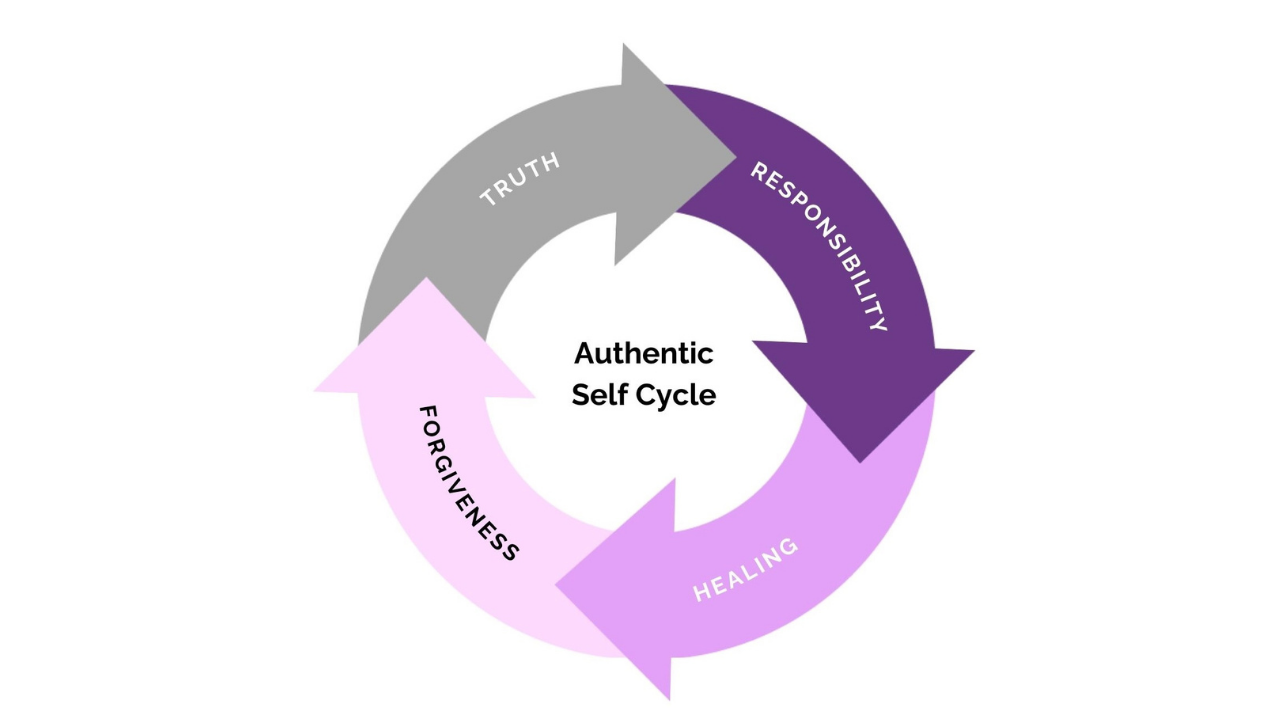
The Worst Day Cycle™ explains why you’re stuck in the loop. The Authentic Self Cycle™ is how you get unstuck. It’s the healing counterpart — an identity restoration system with four stages: Truth → Responsibility → Healing → Forgiveness.
Truth: Name the blueprint. See that “this isn’t about today.” Your abandonment anxiety isn’t about this partner, this friendship, or this situation. It’s about a childhood where your need for consistent, unconditional attachment wasn’t met — and the meaning you made from that absence. Naming the pattern takes away its invisible power.
Responsibility: Own your emotional reactions without blame. “My partner isn’t my parent — my nervous system just thinks they are.” The person asking for space isn’t abandoning you. Your childhood blueprint is interpreting everything through the lens of the original wound. Responsibility means you stop waiting for someone to prove they won’t leave and start looking at why you need them to.
Healing: Rewire the emotional blueprint so that space becomes uncomfortable but not dangerous, so that someone going quiet doesn’t trigger a shame spiral, so that closeness doesn’t require constant monitoring to feel safe. The brain learns new patterns. The chemistry changes. The hypervigilance loosens its grip.
Forgiveness: Release the inherited emotional blueprint and reclaim your Authentic Self. This doesn’t mean forgiving the parents who installed the wound. It means releasing the chemical pattern your body has been running on autopilot. You had no shot because of the way you were raised. You’re not bad, you’re not stupid — you were trained. Forgiveness creates a new emotional chemical pattern that replaces fear, shame, and denial with presence, worth, and trust.
That’s you if you’re exhausted from a lifetime of trying to keep people close enough to feel safe — and it’s never enough. That’s you if you’re ready to find out what love feels like when it isn’t fueled by fear.
The Deepest Betrayal: How You Abandon Yourself
Here is the part nobody talks about. While you’re terrified of other people abandoning you, you are abandoning yourself every single day. Every time you say yes when you mean no. Every time you suppress what you actually feel to keep someone comfortable. Every time you go against your own morals, values, needs, and wants to maintain a connection — you are the one doing the abandoning.
It’s really hard to set boundaries when you’re so deeply afraid of being abandoned and left alone — afraid you’ll have nobody. But here’s what the pattern reveals every single time: one, it never works. You never get the closeness, attachment, or recognition you’re chasing. And two, something worse happens. You abandon yourself. And that’s what creates the deepest shame.
Self-abandonment is the deepest betrayal — committed not by the people who leave, but by you against yourself. It’s bad enough that the other person won’t acknowledge you. But when you stop acknowledging yourself — when you betray your own needs to chase connection that never comes — you become your own perpetrator.
Every people-pleasing move does two harms: others still don’t show up the way you need them to, and you betray yourself in the process. The abandonment you fear from others is already happening — from you, to you, every day.
That’s you if you’ve given everything to someone and felt emptier than when you started. That’s you if the angriest you’ve ever been was at yourself — for knowing better and doing it anyway. That’s you if the voice that says “something is wrong with me” gets loudest after you abandon yourself for someone who didn’t ask you to.
Recognizing the self-abandonment pattern is actually the first step toward healing. The real victory isn’t getting the other person to do the right thing. The real victory is: “I don’t pick it up. I don’t abandon me.” When you stop abandoning yourself — when you start choosing your own truth, your own needs, your own worth — the desperate need for external validation begins to quiet. Not because someone finally proved they’d stay, but because you finally proved that you would.
FAQ: Abandonment Anxiety and Fear of Rejection
Is abandonment anxiety the same as anxious attachment?
Abandonment anxiety and anxious attachment overlap significantly, but anxious attachment is a description of the pattern while abandonment anxiety reveals the cause. Attachment theory maps the behavior — the clinging, the pursuit, the hypervigilance. The Worst Day Cycle™ explains why the behavior exists: childhood trauma created a shame wound that says “I am not enough to keep someone here,” and the brain became addicted to the chemical cocktail of fear that drives the pattern. Healing doesn’t come from learning to “act more secure.” It comes from tracing the anxiety back to the childhood origin and rewiring the emotional blueprint at the body level through a process like the Emotional Authenticity Method™.
Why does abandonment anxiety get worse in good relationships?
Because the brain treats unfamiliar experiences as dangerous — and for someone with an abandonment wound, consistent love is unfamiliar. Your nervous system was wired for unpredictability, not safety. When a partner shows up reliably, the brain panics: “This isn’t what I know. Something must be wrong. They must be about to leave.” Good relationships expose the wound instead of confirming it, which makes the survival persona work harder to protect you from the very thing you want. This is why people sabotage loving relationships — the shame underneath says you don’t deserve them.
Can abandonment anxiety cause physical symptoms?
Absolutely. Abandonment anxiety is a chronic nervous system activation — your body is running a survival response that was designed for short-term emergencies, not decades of hypervigilance. The cortisol from constant scanning breaks down cells over time. Common physical symptoms include chest tightness, stomach problems, jaw clenching, insomnia, chronic fatigue, headaches, and autoimmune flare-ups. Your body has been absorbing the impact of this fear for years. A feelings wheel can help you connect the physical sensation to the emotional root.
How do I stop being so clingy in relationships?
The question itself reveals the shame wound — you’re framing your need for connection as a flaw rather than a wound. Clinginess is the disempowered survival persona’s response to abandonment terror. You’re not “too clingy” — your nervous system is replaying the childhood moment when attachment was threatened. Telling yourself to “stop being clingy” is like telling yourself to stop bleeding. The Authentic Self Cycle™ teaches you to name the pattern, own your reaction without shaming yourself for it, and heal the original wound so that closeness no longer requires desperation to feel safe.
Is there a connection between childhood abandonment and codependence?
Codependence is abandonment anxiety wearing a relational costume. When a child’s authentic self is rejected, abandoned, or conditionally accepted, they create a survival persona organized around managing other people’s emotions to prevent loss. That’s codependence — the systematic abandonment of self to maintain connection with others. The caretaking, the people-pleasing, the inability to say no — all of it is the child’s strategy for preventing the one thing that terrified them most: being left alone. Healing codependence requires healing the abandonment wound that created it, not just learning “better boundaries.”
Will abandonment anxiety ever fully go away?
The wound may always be part of your story, but it doesn’t have to run your life. Healing doesn’t mean the feeling never comes back — it means the feeling no longer hijacks your nervous system and dictates your behavior. Through the Emotional Authenticity Method™, you rewire the emotional blueprint so that when the anxiety surfaces, you can recognize it as the childhood echo it is, locate it in your body, trace it to its origin, and respond from your Authentic Self instead of your survival persona. The alarm still sounds occasionally — but you learn to hear it without obeying it.
The Bottom Line
Your abandonment anxiety is not a flaw. It’s not neediness. It’s not a personality trait you’re stuck with. It’s your nervous system running a program that was installed in childhood — a program that says “if I’m not perfect, if I’m not needed, if I stop performing, they will leave.”
That program was brilliant when you were a child. It helped you survive a world where attachment was uncertain. But you’re not a child anymore. And the anxiety that once protected you is now the thing standing between you and the love you were meant to experience — including love for yourself.
You can keep managing it — keep scanning, keep pursuing, keep accommodating. Or you can do the one thing the anxiety doesn’t want you to do: stop, feel what’s underneath, and trace it back to where it started.
The anxiety will quiet when the abandonment wound gets heard. Not before.
That’s you if something in this article landed — and the anxiety is already trying to convince you it doesn’t apply to you. That’s the survival persona doing its job. And you just caught it.
Recommended Reading
Facing Codependence by Pia Mellody — the original framework for understanding how childhood abandonment creates adult relational patterns, including the loss of authentic self and the development of survival personas.
When the Body Says No by Gabor Maté — the connection between suppressed emotions, abandonment anxiety, and physical illness, and why the body always tells the truth about what the mind refuses to feel.
The Body Keeps the Score by Bessel van der Kolk — the foundational text on how trauma is stored physically in the body and why traditional talk therapy isn’t enough to heal abandonment wounds.
Healing the Shame That Binds You by John Bradshaw — the definitive work on toxic shame, how it creates the survival persona, and what authentic healing from abandonment wounds requires.
The Gifts of Imperfection by Brené Brown — how shame drives us to hide our authentic selves and what it takes to reclaim vulnerability as strength in the face of abandonment fear.
Codependent No More by Melody Beattie — the classic guide to breaking the patterns of self-abandonment and people-pleasing that fuel chronic abandonment anxiety.
Ready to Heal What’s Underneath the Anxiety?
If this article found you, your abandonment wound has already done the hard part — it got your attention. Now it’s time to do the work that actually changes the pattern.
Kenny Weiss’s courses at Greatness U give you the tools to trace the anxiety back to its source and build a new emotional blueprint:
Emotional Blueprint Starter Course — Individual ($79) — Identify your survival persona and map the childhood blueprint driving your abandonment anxiety today.
Relationship Starter Course — Couples ($79) — Understand how two abandonment wounds collide in a relationship and learn to create safety instead of survival.
Why We Can’t Stop Hurting Each Other ($479) — A deep dive into the Worst Day Cycle™ and how trauma chemistry keeps two people locked in the pursuit-withdrawal dance of abandonment.
Why High Achievers Fail at Love ($479) — For the person whose career works but whose relationships keep falling apart — this is why the abandonment wound sabotages your closest connections.
The Shutdown Avoidant Partner ($479) — Understand the survival persona that runs from intimacy and learn what’s actually driving the withdrawal that triggers your abandonment fear.
Tier 1: Mapping the Blueprint ($1,379) — The complete Emotional Authenticity Method™ with guided practice, community support, and direct access to the tools that rewire your emotional blueprint from the ground up.
Related articles:
The Signs of Enmeshment and How to Heal
7 Signs of Insecurity in a Relationship
Signs of High Self-Esteem (and What’s Actually Underneath)
Negotiables and Non-Negotiables in Codependence Recovery
10 Do’s and Don’ts for a Great Relationship