You’re in the middle of a presentation and a voice in your head says: “They’re going to find out you don’t know what you’re talking about.” You pause. Your chest tightens. You stumble over a word — and the voice gets louder: “See? You’re a fraud.”
That voice isn’t insight. It’s not protecting you. That voice is unhealed shame from childhood running your nervous system on autopilot — and it has been running it for decades.
Self-doubt isn’t a personality trait. It isn’t humility. It isn’t “just being realistic.” Self-doubt is the emotional residue of a childhood where your authentic self was never affirmed — where mistakes were punished, slowness was shamed, and your worth became tied to performance. The voice that says “you’re not enough” isn’t yours. It’s the internalized voice of a parent, a teacher, a bully, or a mood in the house that told you something was fundamentally wrong with who you are. And your brain got addicted to that message.
That’s you if you’ve achieved more than most people around you — and still feel like you’re faking it. That’s you if compliments make you uncomfortable because somewhere inside, you don’t believe them. That’s you if the voice gets loudest right before something good is about to happen.
This isn’t about positive affirmations or “believing in yourself.” This is about what your brain did with pain it couldn’t process — and what happens when you finally trace that pain back to where it started.
What Is Self-Doubt Really? (It’s Not What You Think)
Where Self-Doubt Actually Comes From
Shame: The Engine That Powers Every Doubting Thought
How Self-Doubt Shows Up in Every Area of Life
The Worst Day Cycle™: Why Your Brain Keeps Repeating the Pattern
Three Survival Personas That Keep Self-Doubt Alive
The Emotional Authenticity Method™: How to Actually Silence the Inner Critic
The Authentic Self Cycle™: Replacing Self-Doubt With Self-Worth
The Perfectionism Trap: When Self-Doubt Disguises Itself as High Standards
FAQ: Questions People Also Ask
The Bottom Line
Recommended Reading
What Is Self-Doubt Really? (It’s Not What You Think)
Most articles about self-doubt will tell you it’s a “mindset problem.” They’ll give you affirmations, journaling prompts, and power poses. And none of it works — because they’re treating a biochemical wound with a Band-Aid made of words.
Self-doubt is not a thinking problem. It is a feeling problem that originated in childhood — and you cannot change emotional patterns through thoughts alone, because emotions are biochemical events and thoughts originate from feelings.
Self-doubt is what happens when a child’s authentic self gets rejected — not necessarily through dramatic abuse, but through the thousand small moments where a child learns: who I really am isn’t safe to show. A tone of voice. A look of disappointment. A parent who only lit up when you performed. A household where mistakes meant punishment and vulnerability meant danger.
That’s you if you learned early that love was conditional — that you had to earn it by being good, smart, quiet, helpful, or perfect.
When those moments overwhelm a child’s ability to process them, the brain doesn’t file them away neatly. It stores the pain in the body and creates a chemical pattern — a cocktail of cortisol, adrenaline, and shame — that becomes the child’s emotional baseline. That baseline follows you into adulthood. And every time you’re about to take a risk, speak up, or step into something new, your nervous system fires the same alarm it learned at the dinner table when you were six years old.
Where Self-Doubt Actually Comes From
Self-doubt doesn’t appear out of nowhere in adulthood. It was installed in childhood — during the moments when your authentic self was met with rejection instead of affirmation.
Shame expert John Bradshaw described it this way: when a parent cannot affirm a child’s feelings, needs, and desires, they reject that child’s authentic self. Then a survival persona must be created to survive. The child concludes: “Something is wrong with me.” Not “something is wrong with this situation” — but “I am the problem.”
A shame-based person guards against exposing their inner self to others — but more significantly, they guard against exposing themselves to themselves. This is at the heart of self-doubt: you don’t trust yourself because you were taught that who you really are isn’t trustworthy.
The child who got shamed for crying learns to doubt their emotions. The child who got punished for mistakes learns to doubt their competence. The child who got ignored learns to doubt their worth. And the child who got praised only for achievement learns to doubt anything about themselves that isn’t productive.
That’s you if you’ve spent your whole life proving yourself — and the finish line keeps moving. That’s you if you can list everything wrong with you in seconds but freeze when someone asks what you’re proud of.
Here’s what makes self-doubt so stubborn: the brain conserves energy by repeating known patterns. It can’t tell right from wrong — only known from unknown. Since 70% or more of childhood messaging is negative and shaming, the brain treats self-criticism as “normal” and self-compassion as “dangerous.” Your doubt isn’t protecting you. Your doubt is your brain repeating the only pattern it knows.
Shame: The Engine That Powers Every Doubting Thought
Underneath every self-doubting thought is a single emotion: shame. Not guilt — guilt says “I did something bad.” Shame says “I am bad.” And that distinction changes everything.
Shame is where you lost your inherent worth. It’s the moment in childhood where you stopped believing you had value simply for existing and started believing you had to earn the right to take up space. The inner critic isn’t a character flaw. It’s shame talking — and it has been talking since childhood.
The most paradoxical aspect of shame is that it is the core motivator of the super-achiever. People who appear the most confident on the outside are often running the loudest shame soundtrack on the inside — because they use self-loathing to motivate themselves so they don’t have to feel the original wound of no worth.
This is why success doesn’t cure self-doubt. You can get the promotion, the degree, the relationship, the body — and the voice still says “not enough.” Because the voice was never about your accomplishments. It was about your worth. And your worth was wounded before you ever had a chance to prove anything.
That’s you if you’ve hit every goal you’ve set and still feel empty. That’s you if the moment you achieve something, the goalposts move and the doubt rushes back in.
Shame turns a person into a human doing instead of a human being. The perfectionist, the overachiever, the people-pleaser — they’re all running from the same wound. The pursuit of perfection is actually the pursuit of control, an attempt to create an identity that’s acceptable enough to avoid the original pain. But since all of us are perfectly imperfect, perfection can never be achieved — and every failure to reach it reinflicts the exact same abandonment, powerlessness, and low self-worth the person is trying to escape.
That’s you if you give ten times more weight to the one thing you didn’t get done than to the thousands of things you did. That’s you if a single piece of criticism can undo weeks of confidence.
How Self-Doubt Shows Up in Every Area of Life
Self-doubt doesn’t stay in your head. It infiltrates every area of your life — because the shame blueprint that created it touches everything.
Family
You second-guess every decision around your parents. You rehearse conversations before family gatherings. You feel like a child again the moment you walk through their door — because your nervous system is firing the same alarm it learned in that house decades ago. You doubt yourself most around the people who installed the doubt in the first place.
That’s you if you become a different person around your family — smaller, quieter, less sure of yourself.
Romantic Relationships
You can’t accept love without questioning it. “Why are they with me?” “When will they figure out I’m not that great?” You sabotage good relationships because your emotional blueprint says you don’t deserve them. You attract partners who confirm the doubt — critical, unavailable, or controlling — because the brain seeks what’s familiar, not what’s healthy.
That’s you if you push away the people who treat you well because something about it feels “wrong” — when what actually feels wrong is being valued.
Friendships
You overfunction in friendships — always the listener, the planner, the one who holds everyone else together. You don’t share what’s really going on because you’re terrified that if people saw the real you, they’d leave. You perform confidence while drowning in doubt. And when a friend doesn’t text back, the voice says: “They’re done with you.”
That’s you if you’ve built a reputation for “having it all together” and the loneliest part is that everyone believes it.
Work and Career
Imposter syndrome isn’t a syndrome — it’s a shame response. You downplay your achievements. You overprepare for meetings. You don’t apply for the job, pitch the idea, or ask for the raise because the voice says you’ll be exposed. Your childhood blueprint for “mistakes equal punishment” now runs your entire professional identity.
That’s you if you’re the most qualified person in the room and you still feel like you’re about to get caught.
Body and Health
Every chronic pattern of self-doubt is the mind’s attempt to communicate a shame wound the body has been carrying since childhood — and when that wound goes unaddressed, it doesn’t just stay emotional. It becomes physical.
The cortisol from chronic self-criticism breaks down cells over time. The tight chest, the stomach problems, the tension headaches, the insomnia — your body has been absorbing the impact of shame for years. Self-doubt isn’t just exhausting mentally. It’s destroying you physically.
That’s you if your body carries the weight of thoughts you’ve never said out loud.
The Worst Day Cycle™: Why Your Brain Keeps Repeating the Pattern
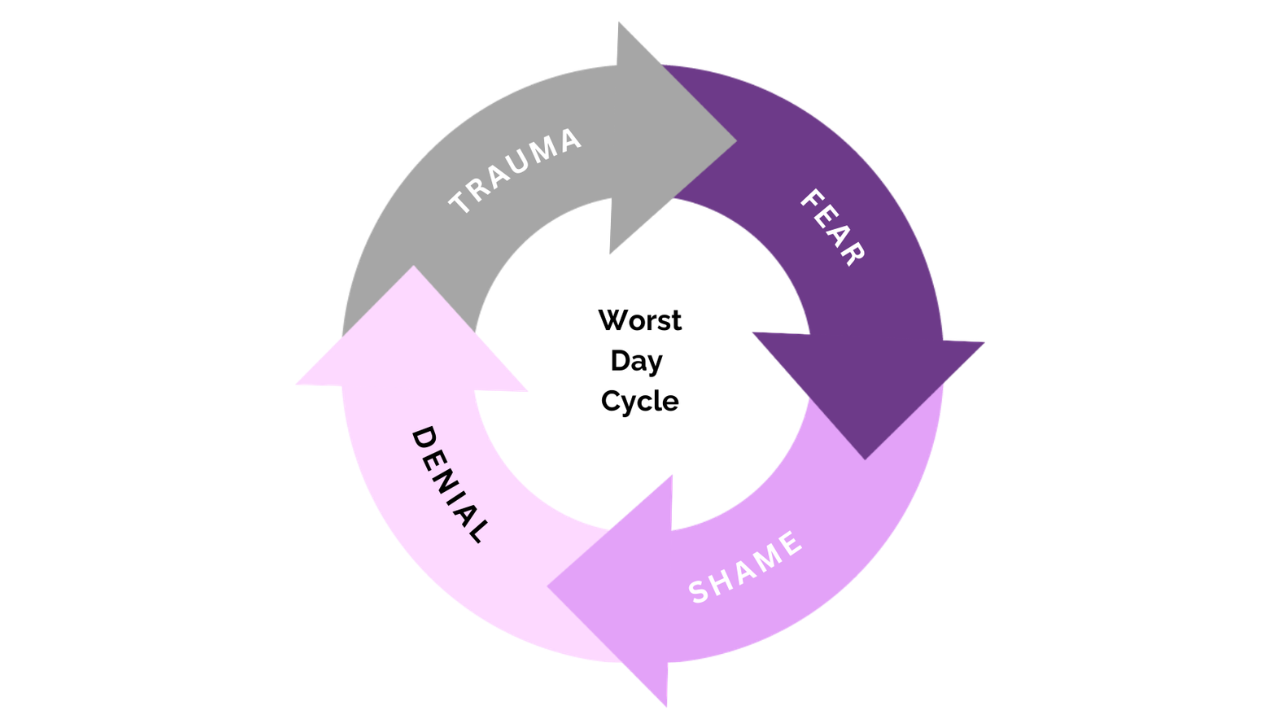
To understand why self-doubt has been running your life for years — maybe decades — you need to understand the Worst Day Cycle™. This is the cycle that explains why the brain and body keep repeating painful patterns long after the original event is over.
The Worst Day Cycle™ has four stages: Trauma → Fear → Shame → Denial.
Trauma is any negative emotional experience that created painful meanings. It doesn’t have to be a dramatic event. It could be the constant pressure to perform, a parent’s disappointment, or the chronic feeling that who you were wasn’t good enough. That experience triggered a massive chemical reaction in the brain and body. The hypothalamus generated chemical cocktails of cortisol, adrenaline, dopamine, and oxytocin misfires — and the brain became addicted to these emotional states.
Fear drives the repetition. The brain conserves energy by repeating known patterns. It can’t tell right from wrong — only known from unknown. Since 70% or more of childhood messaging is negative and shaming, your brain learned that self-criticism is “safe” and self-trust is “dangerous.” Every time you doubt yourself before a big moment, that’s your brain choosing the known pattern of fear over the unknown possibility of success.
Shame is where you lost your inherent worth. “I am the problem.” When your authentic self was rejected in childhood — when mistakes were punished, emotions were dismissed, or love was conditional — you didn’t conclude “my parents couldn’t handle this.” You concluded “something is wrong with me.” That shame went underground. And now it runs your inner monologue.
Denial is the survival persona you created to survive the pain. It was brilliant in childhood — it kept you alive. But in adulthood, it’s the thing telling you “I’m just a realist” or “I just have high standards” or “I’m fine, I just need to work harder.” Denial keeps you from looking at what’s actually underneath the doubt, because looking at it means feeling the original pain.
That’s you if you’ve justified the self-doubt as “motivation.” That’s you if the idea of being kind to yourself feels dangerous — because self-compassion means dropping the guard your survival persona built to keep shame at bay.
Three Survival Personas That Keep Self-Doubt Alive
The denial stage of the Worst Day Cycle™ doesn’t look the same for everyone. It shows up as one of three survival personas — patterns that were created in childhood to manage overwhelming pain. Each one keeps self-doubt running in a different way.
The Falsely Empowered Survival Persona
This person controls, dominates, and rages. They don’t look like they doubt themselves — they look like they’re bulletproof. But underneath the confidence is a terror of being exposed. They overpower conversations, dismiss feedback, and never admit uncertainty — because if they let the mask slip for one second, the shame underneath would be unbearable. Their self-doubt is so deep that they built an entire identity to make sure nobody — including themselves — ever sees it.
That’s you if you respond to doubt by getting louder, working harder, or proving people wrong — and the emptiness is still there when the applause stops.
The Disempowered Survival Persona
This person collapses and people-pleases. Their self-doubt is visible — they apologize constantly, defer to others, and can’t make a decision without polling five people first. They give themselves away, going against their own morals, values, needs, and wants to keep the peace. Their body is in constant freeze or fawn mode. They doubt every thought, every feeling, every choice — because in childhood, having an opinion was dangerous.
That’s you if your first instinct in any situation is to ask someone else what you should do — because trusting your own judgment feels impossible.
The Adapted Wounded Child
This person oscillates between both — sometimes overcompensating with false confidence, sometimes collapsing into paralysis. They can nail a presentation in one meeting and spiral into self-loathing in the next. The pattern shifts based on which survival strategy feels safest in the moment. Their nervous system is the most dysregulated because it’s constantly switching between fight and freeze — between “I’ll show them” and “who am I kidding.”
That’s you if your confidence depends entirely on the room you’re in and the people you’re with — and you never know which version of yourself is going to show up.
The Emotional Authenticity Method™: How to Actually Silence the Inner Critic
Telling yourself “I’m enough” doesn’t work when your entire emotional system is organized around the belief that you’re not. Positive affirmations bounce off a shame wound like rain off concrete — because you cannot change emotional patterns through thoughts alone. Emotions are biochemical events. Thoughts originate from feelings.
You cannot heal self-doubt through affirmations, therapy homework, or motivational speeches — because the pattern is biochemical, not cognitive, and it will persist until the original emotional wound is addressed at the body level where it lives.
The Emotional Authenticity Method™ is a six-step process designed to trace the doubting voice back to its source and rewire the emotional pattern at the root.
Step 1: Somatic Down-Regulation. The moment self-doubt spikes — before a meeting, after a mistake, during a difficult conversation — focus on what you can hear for 15 to 30 seconds. Not what you’re thinking — what you can actually hear in the room right now. This engages your auditory system and interrupts the shame spiral. If you’re highly dysregulated, use titration — go back and forth between the distressing sensation and the neutral auditory focus until the intensity drops.
Step 2: What am I feeling right now? Not “I doubt myself” — that’s a thought. Use a feelings wheel and get precise. Anxious? Terrified? Ashamed? Furious? Use emotional granularity — expand your vocabulary beyond “bad” or “stressed.” The more precisely you can name the feeling, the more power you have over it.
Step 3: Where in my body do I feel it? Chest tightness? Stomach knot? Throat closing? Jaw clenching? All emotional trauma is stored physically in the body — your body has been holding this for you, waiting for you to notice.
Step 4: What is my earliest memory of having this exact feeling? Most people first remember something recent — a bad review, a rejection, an argument. Write it down. Then ask: what’s my next memory before that? And before that? Keep tracing it back. Eventually you’ll arrive at a moment in childhood where you realize: “That’s where I first learned I wasn’t enough.” Some people don’t remember a specific event — they just remember a feeling in the house. That’s enough.
Step 5: Who would I be if I never had this thought or feeling again? What would be left over? This is the vision step. It moves you from the Worst Day Cycle™ into the Authentic Self Cycle™. For the first time, you’re imagining an identity that isn’t organized around doubt, shame, and performance.
Step 6: Feelization. This is the most important step. Sit in the feeling of your Authentic Self and make it strong. Create a new emotional chemical pattern to replace the old blueprint. Ask yourself: How would I respond to this situation from this feeling? What would I say? What would I do? Visualize and FEEL yourself operating from your Authentic Self — making the decision without second-guessing, speaking up without rehearsing, accepting the compliment without deflecting. This isn’t visualization — it’s Feelization. You’re creating a new biochemical addiction to replace the one your trauma installed. This is the emotional blueprint remapping and rewiring step.
That’s you if you’ve read every self-help book on confidence and nothing stuck. That’s you if you’re ready to stop managing the symptom and start healing the cause.
The Authentic Self Cycle™: Replacing Self-Doubt With Self-Worth
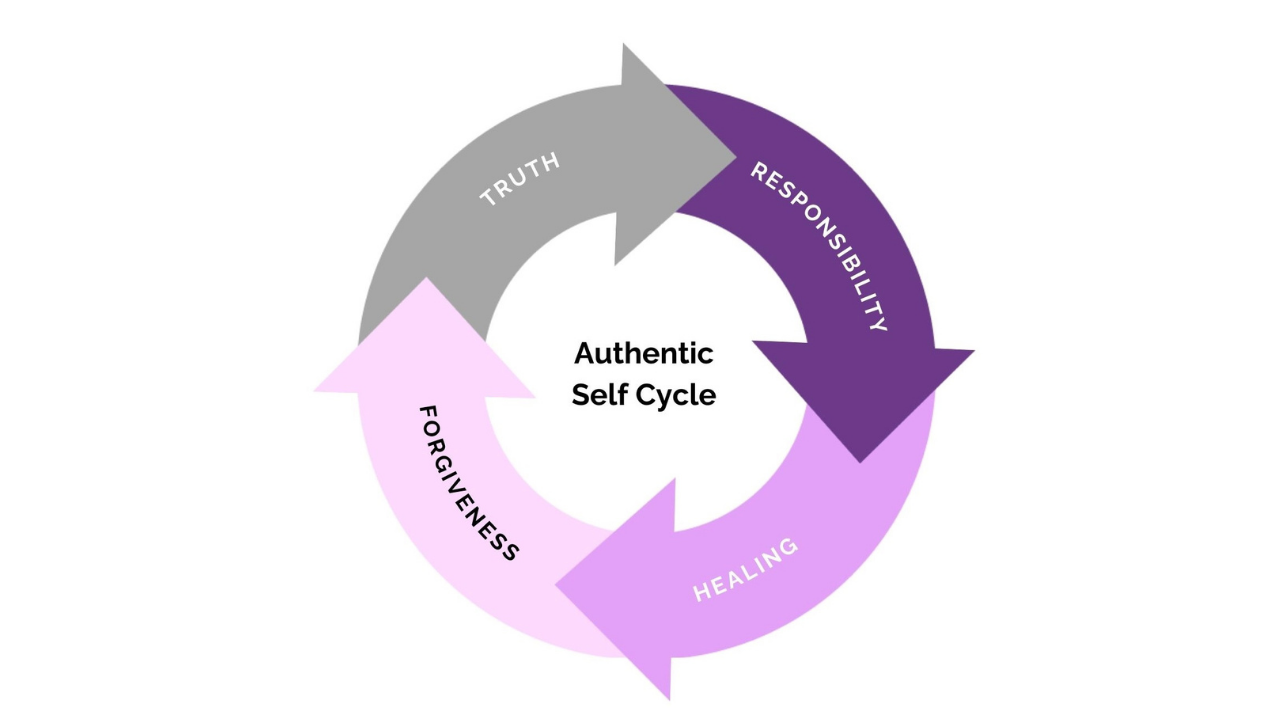
The Worst Day Cycle™ explains why you’re stuck in doubt. The Authentic Self Cycle™ is how you get unstuck. It’s the healing counterpart — an identity restoration system with four stages: Truth → Responsibility → Healing → Forgiveness.
Truth: Name the blueprint. See that “this isn’t about today.” Your self-doubt isn’t about the presentation, the relationship, or the decision in front of you. It’s about a childhood where your authentic self was rejected and your worth became conditional. Naming the pattern takes away its invisible power.
Responsibility: Own your emotional reactions without blame. “My boss isn’t my parent — my nervous system just thinks they are.” The person giving you feedback isn’t attacking your worth. Your childhood blueprint is interpreting everything through the lens of the original wound. Responsibility means you stop waiting for external validation to silence the doubt and start looking inward.
Healing: Rewire the emotional blueprint so that uncertainty becomes uncomfortable but not dangerous. So that making a mistake doesn’t trigger a shame spiral. So that being seen — truly seen — feels safe instead of terrifying. The brain learns new patterns. The chemistry changes. The inner critic loses its grip.
Forgiveness: Release the inherited emotional blueprint and reclaim your Authentic Self. This doesn’t mean forgiving the people who installed the doubt. It means releasing the chemical pattern your body has been running on autopilot. Forgiveness creates a new emotional chemical pattern that replaces fear, shame, and denial with presence, worth, and truth.
That’s you if you’re exhausted from a lifetime of proving yourself to a voice that was never going to be satisfied. That’s you if you’re ready to find out who you are without the doubt.
The Perfectionism Trap: When Self-Doubt Disguises Itself as High Standards
The most dangerous form of self-doubt is the one that looks like ambition. The perfectionist doesn’t say “I doubt myself.” They say “I just have high standards.” But the truth underneath is devastating.
The perfectionist’s subconscious belief is: if I can just be perfect enough — with my diet, my career, my parenting, my body — I can create an identity that’s acceptable. All of those exterior pursuits and effort are an attempt to create an interior self-worth. But it never works. Because all of us are human beings, which means we are all perfectly imperfect, which means perfection can never be attained.
So as the perfectionist pursues it and falls short — which is inevitable — they reinflict the exact same abandonment, powerlessness, loss of control, and low self-worth they were trying to escape. The shame-based voice of their parents becomes their own voice. “Not good enough. Try harder. What’s wrong with you?”
That’s you if you’ve ever looked at something you accomplished and the first thought wasn’t pride — it was all the ways you could have done it better. That’s you if “good enough” feels like failure.
Recognizing the perfectionism trap is actually the first step toward healing. Every time you want to be perfect, you are creating your own lack of control. You are making yourself powerless. You are choosing to give up your own identity. You are actually self-rejecting. It is a complete embodiment and acceptance of the truth that you have worth no matter what — even if you fail, even if you do nothing — that breaks the cycle. It is the ultimate forgiveness of your humanness.
FAQ: How to Stop Self-Doubt
Is self-doubt a sign of low self-esteem?
Self-doubt and low self-esteem are deeply connected, but self-doubt is the symptom and shame is the cause. Low self-esteem isn’t something you developed because you aren’t good enough. It was installed in childhood during moments when your authentic self was rejected — when love was conditional on performance, when emotions were dismissed, or when mistakes were treated as character flaws. The doubt you feel today is the echo of a child who concluded “I am the problem.” Healing self-doubt requires tracing it back to the shame wound that created it, not just building confidence on top of a fractured foundation.
Why do successful people still struggle with self-doubt?
Because success doesn’t heal shame. The most paradoxical aspect of shame is that it’s the core motivator of the super-achiever. Successful people often use self-loathing as fuel — chasing achievement so they never have to sit still and feel the original wound of no worth. They become human doings instead of human beings. The accolades, the money, the titles — none of it reaches the part of them that was wounded in childhood. Self-doubt persists because the emotional blueprint that created it was installed before any achievement could have prevented it.
Can positive affirmations cure self-doubt?
No. Positive affirmations treat self-doubt as a thinking problem, but it’s a feeling problem. You cannot change emotional patterns through thoughts alone — emotions are biochemical events and thoughts originate from feelings. Telling yourself “I’m worthy” while your nervous system is screaming “I’m not safe” creates internal conflict, not healing. Real change requires a process like the Emotional Authenticity Method™ that addresses the biochemical pattern at the body level where the wound actually lives. A feelings wheel is a better starting point than a mirror affirmation.
What’s the difference between self-doubt and imposter syndrome?
Imposter syndrome is self-doubt wearing a professional costume. The feeling that you’ll “be found out” or “don’t belong” in your career is the same shame wound that tells you you’re not enough in relationships, friendships, and family. The clinical language makes it sound like a workplace issue, but it’s actually a childhood trauma response playing out in a professional setting. Your boss isn’t your parent — but your nervous system doesn’t know that. It fires the same alarm it learned decades ago every time authority, evaluation, or performance enters the picture.
How do I stop doubting myself in relationships?
Self-doubt in relationships is almost always rooted in a childhood attachment wound. If love was conditional, unpredictable, or unsafe growing up, your brain learned that closeness equals danger. The doubt that says “they’ll leave” or “I’m not enough for them” is your childhood blueprint interpreting your adult relationship through the lens of the original wound. The Authentic Self Cycle™ teaches you to name the blueprint, own your reactions without blaming your partner, rewire the emotional pattern so that intimacy feels safe, and release the inherited belief that you have to earn love.
Is there a connection between childhood trauma and the inner critic?
Absolutely. The inner critic is the internalized voice of the shame that was installed in childhood. When a child is repeatedly criticized, dismissed, or conditionally loved, they absorb that messaging as their own voice. The inner critic isn’t you — it’s the survival persona’s mechanism for keeping you in line, making sure you never step outside the boundaries that felt safe in childhood. The critic protected you then by keeping you small enough to survive. But in adulthood, it’s sabotaging you by keeping you small enough to never heal. Healing the inner critic means confronting the survival persona — and that requires the courage to feel what’s underneath it.
The Bottom Line
Your self-doubt is not a flaw. It’s not weakness. It’s not a personality trait you’re stuck with. It’s your nervous system running a program that was installed in childhood — a program that says “who you really are isn’t safe to show.”
That program was brilliant when you were a child. It kept you alive. It helped you navigate a world where your authentic self wasn’t welcome. But you’re not a child anymore. And the doubt that once protected you is now the thing standing between you and the life you were meant to live.
You can keep managing it — keep achieving, keep performing, keep proving. Or you can do the one thing the doubt doesn’t want you to do: stop, feel what’s underneath, and trace it back to where it started.
The doubt will quiet when the shame gets heard. Not before.
That’s you if something in this article landed — and the voice is already trying to talk you out of believing it. That’s the survival persona doing its job. And you just caught it.
Recommended Reading
Facing Codependence by Pia Mellody — the original framework for understanding how childhood experiences create adult relational patterns and the loss of authentic self.
When the Body Says No by Gabor Maté — the connection between suppressed emotions, self-doubt, and physical illness, and why the body always tells the truth.
The Body Keeps the Score by Bessel van der Kolk — the foundational text on how trauma is stored physically in the body and why traditional talk therapy isn’t enough.
Healing the Shame That Binds You by John Bradshaw — the definitive work on toxic shame, how it creates the survival persona, and what authentic healing requires.
The Gifts of Imperfection by Brené Brown — how shame drives us to hide our authentic selves and what it takes to reclaim vulnerability as strength.
Codependent No More by Melody Beattie — the classic guide to breaking the patterns of people-pleasing and self-abandonment that fuel chronic self-doubt.
Ready to Heal What’s Underneath the Doubt?
If this article found you, your doubt has already done the hard part — it got your attention. Now it’s time to do the work that actually changes the pattern.
Kenny Weiss’s courses at Greatness U give you the tools to trace the doubt back to its source and build a new emotional blueprint:
Emotional Blueprint Starter Course — Individual ($79) — Identify your survival persona and map the childhood blueprint driving your self-doubt today.
Relationship Starter Course — Couples ($79) — Understand how two shame blueprints collide in a relationship and learn to create safety together.
Why We Can’t Stop Hurting Each Other ($479) — A deep dive into the Worst Day Cycle™ and how trauma chemistry keeps us stuck in painful patterns with the people we love.
Why High Achievers Fail at Love ($479) — For the person whose career works but whose relationships keep falling apart — this is why.
The Shutdown Avoidant Partner ($479) — Understand the survival persona that runs from intimacy and learn what’s actually driving the withdrawal.
Tier 1: Mapping the Blueprint ($1,379) — The complete Emotional Authenticity Method™ with guided practice, community support, and direct access to the tools that rewire your emotional blueprint from the ground up.
Related articles:
The Signs of Enmeshment and How to Heal
7 Signs of Insecurity in a Relationship
Signs of High Self-Esteem (and What’s Actually Underneath)
Negotiables and Non-Negotiables in Codependence Recovery
10 Do’s and Don’ts for a Great Relationship