Tag: Emotional Authenticity

  • Survival Persona in High Achievers: Why Your Personality Is a Trauma Response

    Survival Persona in High Achievers: Why Your Personality Is a Trauma Response

    A survival persona is the identity your brain built in childhood to earn love, stay safe, and maintain control in an emotionally unpredictable environment — it was brilliant at age seven, but it is now the hidden engine behind burnout, emptiness, and self-sabotage in high-achieving adults. If you’ve ever been told you’re “so strong” or “so driven” and felt a quiet hollowness underneath those words, you’re not experiencing a character flaw. You’re experiencing the cost of living through a survival strategy that was never meant to run your entire life.

    That’s you — the one everyone admires from the outside while you’re silently wondering why none of it feels like enough.

    Your personality isn’t a personality. It’s an adaptation. And understanding that distinction is the first step toward reclaiming who you actually are.
    Survival persona icon showing how high achievers build a protective identity in childhood that drives performance in adulthood

    What Is a Survival Persona?

    A survival persona is the version of yourself that your brain constructed in childhood to navigate an emotionally unsafe environment. It’s not who you are — it’s who you had to become. Every high achiever who walks into a room scanning for threats, anticipating needs, and preparing to perform isn’t demonstrating strength. They’re demonstrating a pattern that was wired into their nervous system before they were old enough to choose it.

    That’s you — the one who walks into every room prepared, reads the energy, answers first, and carries the weight, because that’s what you learned survival looked like.

    You didn’t consciously create your survival persona. You built it one painful moment at a time — one critical comment, one chaotic dinner, one emotional outburst from a caregiver, one moment of feeling unseen. Each experience taught your brain a lesson: “This is what I have to do to be safe. This is who I have to be to be loved.”

    A survival persona is not a personality trait — it is a neurochemical adaptation created by childhood trauma that automates self-abandonment, overperformance, and emotional suppression so effectively that most high achievers mistake it for who they actually are.

    That’s you — believing “that’s just who I am” when really it’s just who you had to become.
    Emotional blueprint icon showing how childhood experiences wire survival persona patterns into the brain

    Why Do High Achievers Build Survival Personas?

    In the first seven years of life, the brain operates primarily in a theta brainwave state — the same frequency as hypnosis. During that time, you weren’t choosing who to be. You were absorbing everything: tension, instability, emotional inconsistency, unmet needs, unspoken rules. Your brain was downloading a blueprint for how to exist in the world.

    That’s you — running a program that was installed before you could spell your own name.

    If your childhood environment taught you that love was conditional — that it depended on your performance, your compliance, your ability to read the room and give people what they needed — your brain built a survival strategy around those conditions. Become impressive. Become indispensable. Become so good that no one can reject you, abandon you, or see the real you underneath.
    Trauma chemistry icon showing how childhood creates neurochemical addiction to the stress-performance-validation loop

    The brain conserves energy by repeating known patterns. It can’t tell right from wrong — only known from unknown. Since 70%+ of childhood messaging is negative and shaming, adults repeat these painful patterns in relationships, career, hobbies, health — everything. Your achievement isn’t ambition. It’s your brain’s most sophisticated survival strategy — running on autopilot, fueled by fear and shame, producing results that look like success but feel like emptiness.

    That’s you — performing so brilliantly that everyone applauds while you silently wonder: “If this is success, why do I feel nothing?”

    High achievers build survival personas because their childhood trauma created a neurochemical addiction to the stress-performance-validation loop — the brain became chemically dependent on the cycle of fear, overperformance, and temporary relief, making the survival persona feel like ambition rather than a trauma response.

    How the Worst Day Cycle™ Creates Your Survival Persona

    Your survival persona didn’t appear randomly. It follows a predictable neurochemical pattern called the Worst Day Cycle™. Understanding this cycle is the key to understanding why your personality might not be yours at all.
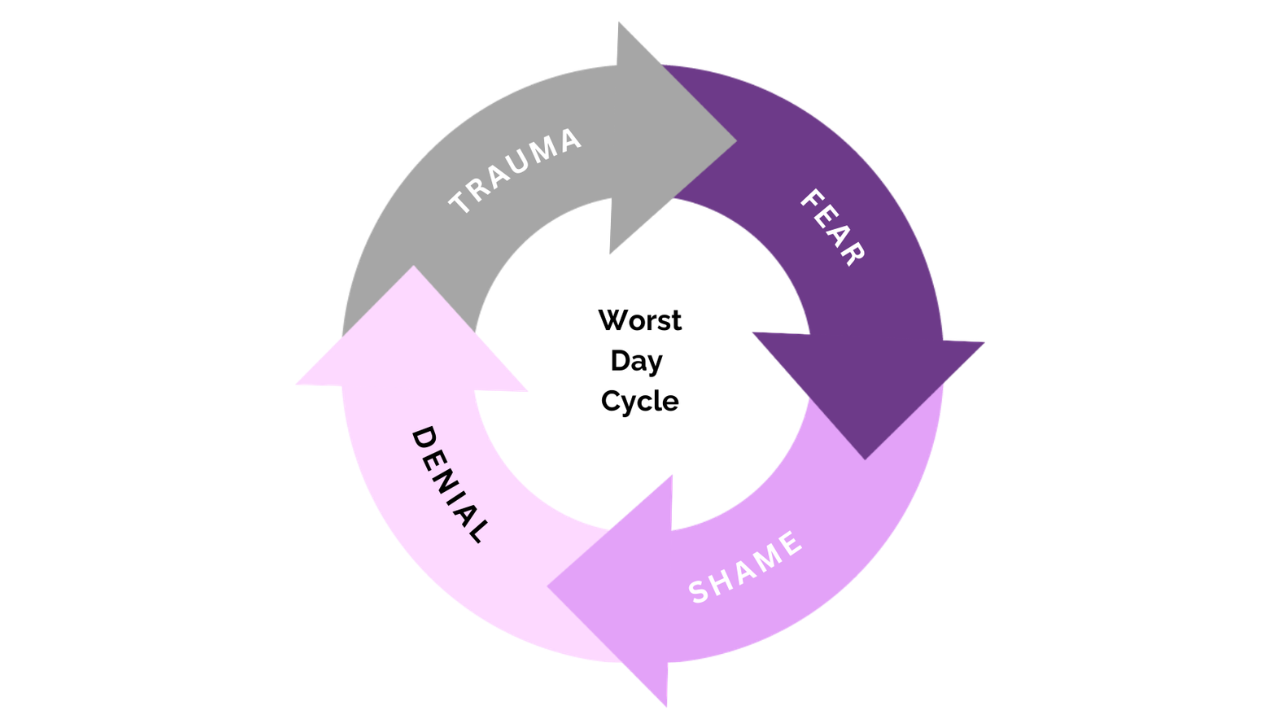
    Worst Day Cycle diagram showing how trauma fear shame denial creates and reinforces the survival persona

    The Worst Day Cycle™ has four stages: Trauma → Fear → Shame → Denial.

    Trauma: Any negative emotional experience in childhood that created painful meanings. It doesn’t have to be dramatic — it can be as subtle as a parent who was emotionally unavailable, a household where feelings were treated as weakness, or a caregiver whose love came with strings attached. These experiences create a massive chemical reaction in the brain and body. The hypothalamus generates chemical cocktails — cortisol, adrenaline, dopamine, oxytocin misfires — and the brain becomes addicted to these emotional states.

    That’s you — feeling most alive when you’re in crisis mode, because your nervous system was calibrated for chaos and the survival persona thrives there.

    Fear: Fear drives repetition. The brain thinks repetition equals safety. So you keep choosing the same patterns — the same overwork, the same people-pleasing, the same emotional suppression — not because you want to, but because your nervous system is terrified of the unknown. The survival persona IS the repetition. It’s the brain saying: “This is how we stayed safe before. Don’t change it.”

    Shame: This is where you lost your inherent worth. “I am the problem.” Not “I made a mistake” — but “I AM the mistake.” Shame is the core wound underneath every survival persona. You didn’t build the persona because you wanted to perform. You built it because deep down, you believed your authentic self wasn’t enough. Wasn’t lovable. Wasn’t safe.

    That’s the shame talking — the voice that convinced a child that who they really were would never be enough, so they’d better become someone impressive instead.

    Denial: Denial is the survival persona itself — the identity you created to survive the pain. It was brilliant in childhood — absolutely necessary. But in adulthood, it sabotages everything. It keeps you performing instead of feeling. Producing instead of connecting. Running instead of resting. And because the persona has been running for 20, 30, or 40 years, you can’t tell the difference between who you are and who you had to become.

    The Worst Day Cycle™ reveals that your survival persona is not a personality choice — it is a neurochemical loop created by childhood trauma that the brain repeats thousands of times per day, making overperformance, emotional suppression, and self-abandonment feel as natural as breathing.

    What Are the Three Survival Persona Types?

    Every survival persona falls into one of three types — or oscillates between them. Understanding which one runs your life is the first step toward reclaiming your authentic self.
    Emotional fitness icon representing the work of identifying and healing survival persona patterns in high achievers

    The Falsely Empowered: This persona controls, dominates, and rages. They look powerful on the outside — the CEO, the leader, the person who commands every room. But their power comes from fear, not strength. They control others to avoid feeling out of control inside. They perform strength instead of feeling anything real. They scan every room for problems — who’s upset? What’s broken? What needs managing? — because as children, being in charge was the only way they felt safe.

    That’s you — the fixer who scans every room for problems because as a child you learned: “If I’m not fixing it, I have no value.”

    The Disempowered: This persona collapses, people-pleases, and disappears. They make themselves small to stay safe. They grew up too fast — managing logistics, anticipating needs, picking up the slack. They say yes when their body screams no. They abandon their own needs to keep connection because they learned that if they stopped giving, they’d be left. Everyone leans on them. They’re steady, stoic, strong. But no one really knows them.

    That’s you — the responsible one who learned “If I don’t do it, nobody will. And if something goes wrong, it’s my fault” — so you became the emotional adult long before you were ready.

    The Adapted Wounded Child: This persona oscillates between both — raging one moment, collapsing the next. They overdeliver to the point of exhaustion, then shut down completely. They swing between “I don’t need anyone” and “please don’t leave me.” They never land in a stable sense of self because they never had one to begin with. Meeting expectations feels like failure, so they overprepare, overgive, and overfunction until they crash.
    Adapted wounded child icon showing oscillation between falsely empowered and disempowered survival persona types

    That’s you — the one who exhausts yourself trying to outrun invisibility, swinging between “The only way to stay safe is to be undeniably impressive” and “If I fall apart, everything falls apart.”

    The three survival persona types — falsely empowered, disempowered, and adapted wounded child — represent the brain’s three strategies for managing the shame created by childhood trauma, and every high achiever runs on one or a blend of these patterns without realizing it.

    How Your Survival Persona Shows Up in Every Area of Your Life

    Family: You’re the peacekeeper. You manage everyone’s emotions at every gathering — defusing tension, smoothing over conflicts, anticipating who’s about to blow up. You swallow your reactions at holiday dinners. You feel responsible for your parents’ happiness — even now, as an adult. And when you try to set a boundary, the guilt is so overwhelming that you cave. Your family doesn’t know you. They know your survival persona.

    That’s you — still playing the role your family assigned you at age six, wondering why family gatherings leave you feeling drained and invisible.
    Enmeshment icon showing how family systems create and reinforce survival persona patterns across generations

    Romantic Relationships: You choose partners who need you more than they love you. You tolerate behavior that crosses your boundaries because leaving feels more terrifying than staying. You confuse intensity with intimacy. You abandon your needs to keep the relationship “safe” — and then feel resentful when your partner doesn’t read your mind. The person your partner fell in love with isn’t you. It’s the persona.

    Sound familiar? The partner who gives everything and then wonders why they feel invisible — because the survival persona showed up to the relationship and left the real you at home.

    Friendships: You’re the friend everyone calls in a crisis but no one checks on. You listen for hours but never share your own struggles. You cancel your own plans when someone else needs you. You feel lonely even when surrounded by people — because no one actually knows you. They know the strong, capable, dependable version. The survival persona version.

    That’s you — surrounded by people who admire you and not one of them has ever seen you cry.

    Work: You overdeliver. You say yes to every project. You check email at midnight. You take on other people’s responsibilities because if you don’t do it, no one will — or it won’t be good enough. Your worth is measured in productivity, and rest feels like laziness. You’ve been promoted for your survival persona. Rewarded for it. Praised for the very pattern that’s destroying you.

    That’s you — getting promoted for the very survival strategy that’s keeping you disconnected from everyone who matters, including yourself.

    Body and Health: You ignore your body’s signals. You push through exhaustion, pain, hunger, and stress. You numb with food, alcohol, exercise, or scrolling. Your body has been trying to tell you something for years — but the survival persona means you’ve stopped listening. Chronic pain, digestive issues, insomnia, and autoimmune conditions are often the body’s last resort when emotional signals have been ignored for decades.
    Emotional absorption icon showing how the survival persona absorbs others' emotions while suppressing your own

    Why Do High Achievers Eventually Burn Out or Blow Up Their Lives?

    Survival personas create impressive lives. You may have a thriving career, a partner, children, status, financial success, and respect. But internally? There’s a void. That quiet, empty feeling you can’t explain. It’s not a lack of gratitude. It’s not a lack of discipline. It’s not that you need a bigger goal. It’s the grief of your authentic self being suppressed for decades.

    That’s you — the one who has everything and feels nothing, because the person everyone loves is the persona, and the real you has been hiding since childhood.

    Survival personas run on adrenaline and fear. And eventually, they run out of gas. The cycle looks like this: push, succeed, suppress, ignore, override your body, abandon yourself — until something breaks. Burnout. Infidelity. Addiction. Emotional shutdown. Explosive anger. Not because you’re weak. Because the persona was never meant to run your entire life. It was a child trying to do an adult’s job.

    That’s the truth nobody tells high achievers — your collapse isn’t a failure. It’s your authentic self finally demanding to be heard after decades of being silenced by the survival persona.

    High achievers burn out because the survival persona requires constant neurochemical fuel — cortisol, adrenaline, and shame — and the body can only sustain that chemical load for so long before it forces a collapse through burnout, illness, emotional explosion, or relationship destruction.
    Codependence icon showing how survival persona patterns create codependent relationships in high achievers

    How the Emotional Authenticity Method™ Dismantles the Survival Persona

    You don’t destroy the survival persona. You honor it — it was brilliant, it kept you safe — but you stop letting it run your emotional life. The Emotional Authenticity Method™ is the daily practice that rewires the emotional blueprint underneath the persona at the nervous system level.
    Emotional authenticity icon representing the practice of moving beyond the survival persona to your authentic self

    Step 1: Somatic Down-Regulation with optional Titration. Before you can see the survival persona clearly, you have to get your nervous system out of survival mode. Deep breathing, grounding, slowing down enough to feel your body. Titration means you go slowly — you don’t force yourself to feel everything at once. The persona has been protecting you for decades. You approach it with respect, not force.

    That’s you — learning that you don’t have to white-knuckle your way through healing the same way you white-knuckled your way through life.

    Step 2: What am I feeling? Most people living through a survival persona have no idea what they’re actually feeling. They’ve been disconnected from their emotions for so long that “fine” is their default answer. Using the Feelings Wheel, you develop emotional granularity — the ability to name specific emotions instead of lumping everything into “stressed” or “fine.”

    Step 3: Where in my body do I feel it? All emotional trauma is stored physically. Your chest tightens. Your stomach drops. Your jaw clenches. The survival persona keeps you in your head — analyzing, strategizing, controlling. This step moves you into your body, where the wound actually lives.

    Step 4: What is my earliest memory of this feeling? This is where the survival persona starts to lose its grip. You trace today’s reaction back to its childhood origin. You realize: this isn’t about today. My partner isn’t my parent. My boss isn’t my critical caregiver. My nervous system just thinks they are — and the survival persona activated to protect me the same way it did when I was five.

    That’s the moment the survival persona becomes visible — when you see that your reaction belongs to a child, not an adult, and the persona has been running a child’s program in an adult’s life.

    Step 5: Who would I be if I never had this feeling again? This is the vision step. It connects you to the Authentic Self Cycle™ and gives your nervous system a new destination — not more performance, not a better persona, but actual identity restoration. Who were you before the trauma taught you that you had to earn love?

    The Emotional Authenticity Method™ works because emotions are biochemical events — you cannot change the survival persona through thoughts alone. Thoughts originate from feelings, not the other way around. The persona was built by feelings, and it can only be dismantled by feeling what was never safe to feel as a child.

    How the Authentic Self Cycle™ Restores Your Real Identity

    The Authentic Self Cycle™ is the healing counterpart to the Worst Day Cycle™. Where the Worst Day Cycle™ traps you in Trauma → Fear → Shame → Denial, the Authentic Self Cycle™ restores your identity through Truth → Responsibility → Healing → Forgiveness.
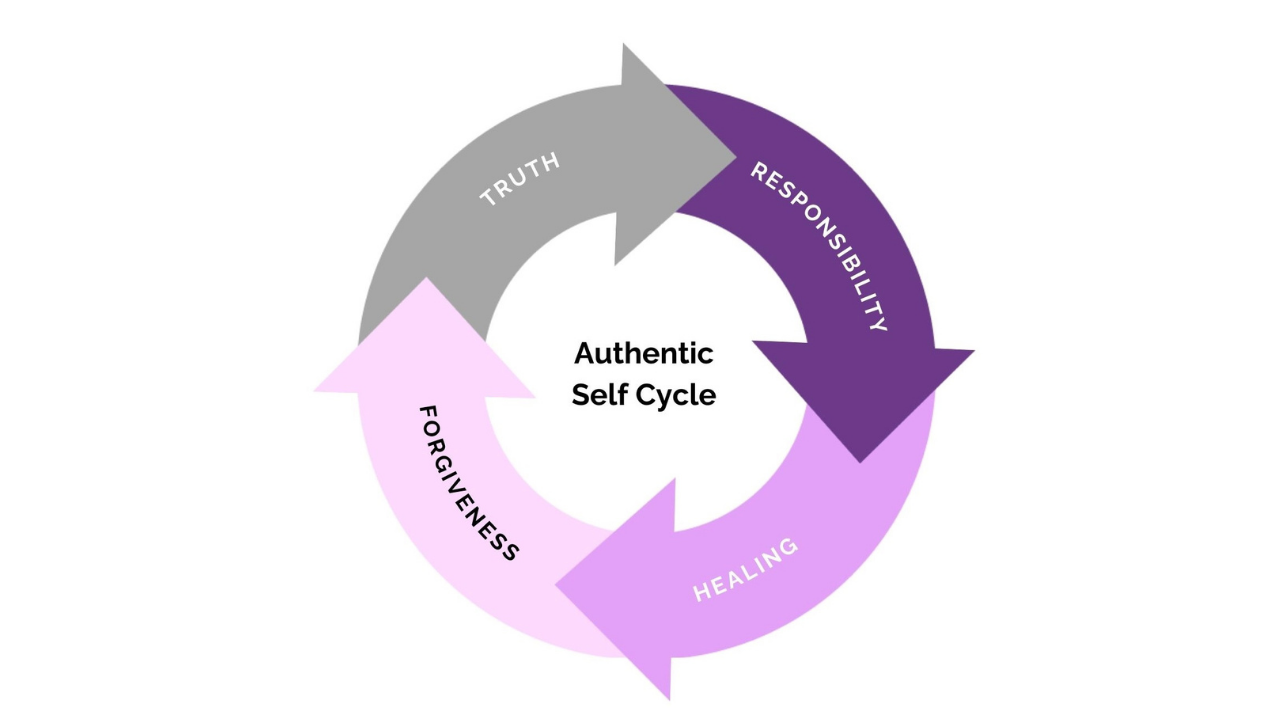
    Authentic Self Cycle diagram showing truth responsibility healing forgiveness as the path from survival persona to authentic self

    Truth: Name the blueprint. See that “this isn’t about today.” Recognize the survival persona for what it is — a brilliant childhood adaptation, not your identity. When you walk into a room scanning for threats, truth says: “That’s the survival persona. I’m safe now. I don’t need to perform.”

    That’s the first crack in the armor — and that crack isn’t weakness. It’s the beginning of coming home to yourself.

    Responsibility: Own your emotional reactions without blame. “My partner isn’t my parent — my nervous system just thinks they are.” This isn’t about fault. It’s about taking back your power from a childhood that stole it. The survival persona runs on blame — blaming others or blaming yourself. Responsibility says: “I see the pattern, and I’m choosing differently.”

    Healing: Rewire the emotional blueprint so conflict becomes uncomfortable but not dangerous, space isn’t abandonment, and intensity isn’t attack. This is where daily practice does its work — second by second, like the ticks of a clock. The second hand moves in tiny, almost insignificant ticks. But those ticks move the minute hand. The minutes move the hours. Healing works the same way. It’s not dramatic. It’s repetitive.

    Forgiveness: Release the inherited emotional blueprint and reclaim your authentic self. This creates a NEW emotional chemical pattern that replaces fear, shame, and denial with safety, worth, and connection. Forgiveness isn’t about the people who hurt you. It’s about releasing the shame for ever needing the survival persona in the first place.

    That’s you — not becoming someone new, but finally meeting who you always were underneath the persona you had to build to survive.
    Reparenting icon showing the process of replacing the survival persona with authentic self through daily practice

    The Authentic Self Cycle™ is an identity restoration system — it doesn’t teach you to build a better survival persona, it replaces the neurochemical pattern that created the persona with a new blueprint built on truth, responsibility, and emotional authenticity.

    Three Questions to Begin Seeing Your Survival Persona

    If you suspect you’re living through a survival persona, start with these three questions. Not to analyze yourself — but to begin noticing the pattern.

    1. What would you name your survival persona? Give it a name. “The Fixer.” “The Rock.” “The Overachiever.” “The Peacekeeper.” Naming it creates separation between who you are and who you had to become. That separation is where healing begins.

    That’s you — finally putting a name on the thing that’s been running your life so you can start seeing it instead of being it.

    2. Where has it recently overridden what you actually wanted or needed? Think about the last week. Where did you say yes when you wanted to say no? Where did you swallow your truth to avoid conflict? Where did you push through exhaustion instead of resting? Those are the moments the survival persona stepped forward and said: “I’ve got this. You go away.” And your authentic self retreated.

    3. When it takes over, what happens in your body? Tension? Numbness? Wired energy? A clenched jaw? A tightness in your chest? The survival persona lives in the body. Noticing the physical signature is how you catch it in real time instead of only recognizing it in hindsight.

    That’s you — learning to read your body’s signals instead of overriding them, because awareness is the first crack in the armor.
    Metacognition icon showing the awareness practice of observing your survival persona patterns in real time
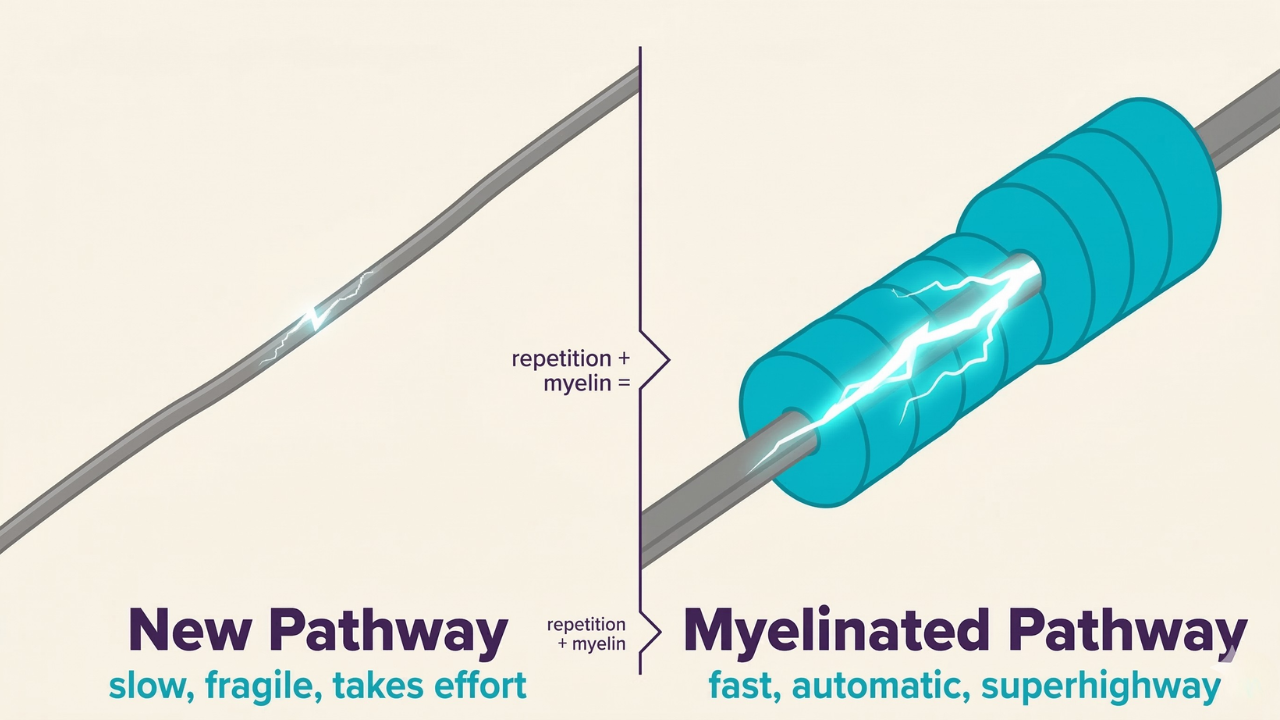
    Myelin and neural pathways icon showing how repetitive survival persona patterns become hardwired through neuroplasticity

    Frequently Asked Questions About Survival Personas

    What is a survival persona and how do I know if I have one?

    A survival persona is the identity your brain built in childhood to earn love, stay safe, and maintain control in an emotionally unpredictable environment. You likely have one if you’re a high achiever who feels empty despite success, if you scan rooms for problems, if you say yes when your body says no, or if people describe you as “strong” while you feel hollow inside. The survival persona feels like your personality — but it’s actually a trauma adaptation that the Worst Day Cycle™ keeps running on autopilot.

    What are the three types of survival personas?

    The three survival persona types are the falsely empowered (controls, dominates, rages — looks powerful but driven by fear), the disempowered (collapses, people-pleases, disappears — makes themselves small to stay safe), and the adapted wounded child (oscillates between both — overperforms then shuts down). Most high achievers run on one type or a blend. The Emotional Authenticity Method™ helps identify which pattern is running your life so you can begin rewiring it.

    Why do high achievers build survival personas instead of authentic identities?

    In the first seven years of life, the brain operates in a theta brainwave state — absorbing everything like hypnosis. If your environment taught you that love was conditional on performance, compliance, or emotional suppression, your brain built a survival strategy around those conditions. The brain can’t tell right from wrong — only known from unknown. Since most childhood messaging is negative and shaming, the brain automates the survival persona because it’s known, and known equals safe.

    Can a survival persona be healed or does it stay forever?

    The survival persona can absolutely be dismantled — but not through insight alone. Because the persona is stored in the body as a neurochemical pattern, healing requires somatic work, not just cognitive understanding. The Emotional Authenticity Method™ provides a 5-step daily practice that traces today’s survival reactions to their childhood origins and rewires the nervous system over time. The Authentic Self Cycle™ — Truth, Responsibility, Healing, Forgiveness — provides the long-term framework for identity restoration.

    How is the survival persona connected to the Worst Day Cycle™?

    The survival persona IS the denial stage of the Worst Day Cycle™. The cycle runs: Trauma → Fear → Shame → Denial. Denial is where the persona lives — it’s the identity you created to survive the pain of shame. The persona keeps the cycle running by suppressing authentic feelings, which prevents healing, which maintains the trauma response, which generates more fear and shame. Breaking the cycle requires moving into the Authentic Self Cycle™ through truth, responsibility, healing, and forgiveness.

    What is the difference between a survival persona and just having a strong personality?

    A strong personality comes from a secure emotional foundation — you’re strong because you can tolerate discomfort while staying connected to yourself. A survival persona looks strong but is driven by fear — you perform strength because vulnerability was never safe. The key difference: a strong person can rest, ask for help, say “I don’t know,” and show vulnerability without feeling like they’ll be abandoned. A survival persona can’t — because those actions trigger the childhood shame that created the persona in the first place.

    The Bottom Line

    You are not broken for becoming who you had to be. The survival persona you built was brilliant. It was necessary. It got you through a childhood that wasn’t emotionally safe. And it built an external life that looks impressive to everyone around you.

    But you don’t have to stay there.

    High achievement built your external world. Authenticity will build your internal one. And that’s the only place the void begins to soften.

    That’s you — not the persona everyone admires. The human being underneath who’s been waiting decades to finally be seen, to finally be known, to finally stop performing and start living.

    Your authentic self isn’t some perfect, enlightened version of you. It’s simply who you were before you were trained to earn love. From that place, you can say “I’m tired,” “I’m scared,” “I don’t know,” and “I need help” — without believing that makes you unlovable.

    The void doesn’t fill with achievement. It fills with truth. With feeling. With the willingness to finally stop running from yourself — and start running toward who you actually are.
    Perfectly imperfect icon showing that your authentic self doesn't need to perform to be worthy of love

    These books complement the frameworks in this article and deepen your understanding of how survival personas form and how to heal them:

    Facing Codependence by Pia Mellody — the foundational text on how childhood trauma creates the survival personas that drive overperformance and self-abandonment.

    The Body Keeps the Score by Bessel van der Kolk — the science of how trauma lives in the body, explaining why the survival persona can’t be dismantled through thought alone.

    When the Body Says No by Gabor Maté — how chronic survival persona activation manifests as physical illness and disease.

    Codependent No More by Melody Beattie — a practical guide to recognizing when your survival persona has created codependent patterns in your relationships.

    The Gifts of Imperfection by Brené Brown — how shame drives the survival persona and why vulnerability is the path back to your authentic self.

    Take the Next Step

    If you’re ready to stop living through your survival persona and start building a life from your authentic self, Kenny Weiss offers courses designed for high achievers who are done performing and ready to heal:

    Emotional Blueprint Starter Course — Individual ($79) — Your personal roadmap to identifying your survival persona and beginning the journey to your authentic self.

    Relationship Starter Course — Couples ($79) — For couples ready to see how their survival personas collide and learn to connect authentically.

    Why We Can’t Stop Hurting Each Other ($479) — Deep-dive into the Worst Day Cycle™ and how childhood trauma creates the survival personas that sabotage relationships.

    Why High Achievers Fail at Love ($479) — Built specifically for high achievers whose survival personas have mastered career but can’t figure out relationships.

    The Shutdown Avoidant Partner ($479) — Understanding avoidant attachment through the lens of trauma chemistry and survival personas.

    Tier 1: Mapping the Blueprint ($1,379) — The comprehensive program for learning and practicing the Emotional Authenticity Method™ to dismantle your survival persona.

    Download the Feelings Wheel — the free tool used in Step 2 of the Emotional Authenticity Method™ to build emotional granularity beyond the survival persona’s “I’m fine.”

    Explore more: The Signs of Enmeshment | 7 Signs of Relationship Insecurity | 7 Signs of High Self-Esteem | How to Determine Your Negotiables and Non-Negotiables | 10 Do’s and Don’ts for a Great Relationship
  • Why You Can’t Relax: The Nervous System Trap High Achievers Can’t Escape

    Why You Can’t Relax: The Nervous System Trap High Achievers Can’t Escape

    The inability to relax is not a personality trait or a lack of discipline — it is a neurochemical survival pattern built in childhood that keeps your nervous system locked in threat mode, making stillness feel dangerous even when you are completely safe. If you finally got the day off, the vacation, the quiet weekend — and your body responded with restlessness, guilt, anxiety, or an overwhelming urge to check your phone — you are not broken. Your nervous system is doing exactly what it was trained to do. And that training started long before your first job.

    That’s you — the one who can run a company but can’t sit on the couch for ten minutes without reaching for your laptop.

    This isn’t about discipline. It isn’t about gratitude. And it isn’t about “just learning to unwind.” It’s about a childhood emotional blueprint that wired your brain to equate stillness with danger — and until you address that blueprint, no vacation, meditation app, or productivity hack will ever let you truly rest.

    Emotional regulation icon showing why high achievers can't relax due to childhood nervous system patterns

    Why Can’t You Relax Even When Nothing Is Wrong?

    You finally got the break. No deadlines. No meetings. No one asking you for anything. You’ve been craving this for weeks. And then it happens — your body won’t cooperate. Your mind starts scanning for problems. Your chest tightens. Your leg bounces. You feel guilty for sitting still. So you grab your phone, open your laptop, start planning something, cleaning something, fixing something. Because doing nothing feels physically wrong.

    That’s you — craving rest with every cell in your body and then panicking the moment you actually get it.

    This isn’t a character flaw. It’s not that you “just like being busy.” Your nervous system is stuck in survival mode — and it has been since childhood. The brain has one job: keep you alive. It doesn’t care about your vision board or your work-life balance goals. It asks one question: “Am I safe right now?” And if your childhood taught it that stillness means danger — that calm means something bad is about to happen — then every quiet moment triggers an alarm.

    The inability to relax is the predictable result of a nervous system that was calibrated in childhood to treat stillness as a survival threat — the brain learned that hypervigilance and constant doing were the price of safety, and it automated that pattern for life.

    That’s you — the person whose body doesn’t know the difference between a Sunday afternoon and a childhood where quiet meant someone was about to explode.

    How Does Your Nervous System Keep You Stuck in Survival Mode?

    Your brain conserves energy by repeating known patterns. It can’t tell right from wrong — only known from unknown. If you grew up in an environment where being relaxed wasn’t safe, where having needs wasn’t welcomed, where love felt conditional, or where approval had to be earned — your nervous system learned something powerful: calm is dangerous and performance is safety.

    Trauma chemistry icon showing how childhood stress creates neurochemical addiction to urgency in high achievers who can't relax

    Since 70%+ of childhood messaging is negative and shaming, adults repeat these painful patterns in relationships, career, hobbies, health — everything. Your childhood created a massive chemical reaction in the brain and body. The hypothalamus generates chemical cocktails — cortisol, adrenaline, dopamine, oxytocin misfires — and the brain becomes addicted to these emotional states. So now, as an adult, even when your life looks stable and successful on the outside, your body still thinks it’s that kid trying not to get blindsided.

    That’s you — feeling most alive when you’re in crisis mode, because your nervous system was calibrated for chaos and quiet feels like the moment before the storm.

    That’s why when things go quiet, you don’t feel peace. You feel exposed. Your body has been running on stress hormones for so long that the absence of stress feels like something is wrong. The adrenaline, the cortisol, the rush of urgency — those stress chemicals are intense, but they’re familiar. And your brain loves familiar. It doesn’t know healthy from unhealthy. It only knows: “Have I survived this before?”

    That’s the trap — your brain keeps choosing urgency over peace, not because urgency is better, but because it’s the only thing your nervous system trusts.

    Your nervous system maintains survival mode because it became chemically addicted to the stress-performance-validation loop created in childhood — the brain treats the absence of stress as a threat signal, making genuine rest neurologically impossible without rewiring the original emotional blueprint.

    How the Worst Day Cycle™ Explains Why Calm Feels Dangerous

    The inability to relax isn’t random. It follows a predictable neurochemical pattern called the Worst Day Cycle™. Understanding this cycle is the first step to breaking free from the restlessness that runs your life.

    Worst Day Cycle diagram showing trauma fear shame denial loop that makes high achievers unable to relax

    The Worst Day Cycle™ has four stages: Trauma → Fear → Shame → Denial.

    Trauma: Any negative emotional experience in childhood that created painful meanings. It doesn’t have to be dramatic — it can be as subtle as a parent who was emotionally unavailable, a household where feelings were treated as weakness, or a caregiver whose love was conditional on performance. These experiences create a massive chemical reaction in the brain and body.

    That’s you — the one who grew up in a home where everything looked fine on the outside but your body was always bracing for impact.

    Fear: Fear drives repetition. The brain thinks repetition equals safety. So you keep choosing the same work patterns, the same relentless pace, the same cycles of overgiving and burnout — not because you want to, but because your nervous system is terrified of the unknown. Rest is unknown. Stillness is unknown. And to a trauma brain, unknown means dangerous.

    Shame: This is where you lost your inherent worth. “I am the problem.” Not “I made a mistake” — but “I AM the mistake.” This is the core wound underneath the inability to relax. You can’t rest because deep down, you believe your worth is conditional on your output. The moment you stop producing, the shame voice starts: “You’re lazy. You’re falling behind. You don’t deserve this.”

    That’s the shame talking — the voice that says you haven’t earned the right to sit down, and it’s been running your schedule since before you could spell your own name.

    Denial: Denial is the survival persona you created to survive the pain. It was brilliant in childhood — absolutely necessary. But in adulthood, it sabotages everything. It keeps you performing instead of feeling. Producing instead of resting. Running instead of being. You tell yourself: “I just have high standards.” “I’m wired this way.” “I’ll rest when I’m done.” But you’re never done — because done means feeling, and feeling means confronting the original wound.

    Emotional blueprint icon showing how childhood patterns make calm feel dangerous for high achievers

    The Worst Day Cycle™ reveals why you can’t relax — your brain created a neurochemical loop in childhood that equates stillness with danger and constant doing with survival, and it repeats that loop thousands of times per day without your conscious awareness.

    How Your Survival Persona Turns Rest Into a Threat

    Your survival persona is the identity you created in childhood to navigate an emotionally unsafe environment. It’s not who you are — it’s who you had to become. And it’s the engine that makes rest feel impossible.

    Survival persona icon showing how childhood identity adaptation prevents high achievers from relaxing

    There are three survival persona types:

    The Falsely Empowered: This persona controls, dominates, and rages. They can’t relax because relaxing means surrendering control — and control is the only thing that makes them feel safe. They fill every quiet moment with planning, strategizing, and managing. They look powerful on the outside, but their constant doing comes from fear, not strength.

    That’s you — the CEO who can command a boardroom but can’t sit through a movie without checking email, because sitting still feels like losing your grip on everything.

    The Disempowered: This persona collapses, people-pleases, and disappears. They can’t relax because resting means they’re not taking care of someone else — and if they’re not useful, they believe they’ll be abandoned. They fill every quiet moment with checking on others, anticipating needs, and staying available. Rest feels selfish. Stillness feels like the moment people will realize they don’t need you anymore.

    That’s you — the one who can’t take a vacation without bringing your laptop “just in case someone needs you,” because being needed is the only way you know how to matter.

    The Adapted Wounded Child: This persona oscillates between both — controlling one moment, collapsing the next. They can’t relax because they never have a stable sense of self. They swing between overperforming and shutting down, between filling every moment with activity and numbing out on the couch with their phone — but neither state is rest. It’s just two different forms of survival.

    Adapted wounded child icon showing oscillation between overperforming and numbing that prevents genuine rest

    That’s you — the one who swings between “I’ll sleep when I’m dead” and scrolling your phone for three hours in a fog, and neither one feels like actual rest.

    Your survival persona is the most sophisticated obstacle to genuine rest because it replaces your authentic relationship with your body with a performance — and after decades, you can’t tell the difference between productive rest and another form of self-abandonment.

    Why Are High Achievers Addicted to Urgency?

    When you live in survival mode long enough, your body gets hooked on the chemistry of it. Adrenaline. Cortisol. The rush of urgency. The “almost there” feeling. One more email. One more task. One more win. Those stress chemicals are intense — but they’re familiar. And your brain loves familiar.

    That’s you — the one who feels more comfortable in a crisis than on a beach, because chaos is the emotional weather you grew up in.

    Myelin and neural pathways icon showing how urgency addiction creates neurological grooves that prevent relaxation

    For many high achievers, productivity didn’t start as ambition. It started as adaptation. If you grew up in an environment where being relaxed wasn’t safe, where having needs wasn’t welcomed, where love felt conditional, or where approval had to be earned — your nervous system learned that calm is dangerous and performance is safety.

    So now, as an adult, you live in fight, flight, fawn, or freeze all day long — even when nothing bad is happening. Your body doesn’t know the difference between a real threat and a remembered one. Fight sounds like: “I’ll power through. I’ll outwork everyone.” Flight looks like constant busyness, over-scheduling, never sitting still. Fawn shows up as people-pleasing, over-giving, saying yes when you mean no. Freeze is numbing out — scrolling, zoning out, collapsing on the couch but not actually resting.

    That’s you — the one who collapses at 10pm and calls it rest, when really your body just ran out of cortisol and crashed into freeze mode.

    The void shows up loudest at night. After the launch. After the deadline. After everyone’s taken care of. When you finally sit down. That’s when the thoughts start racing: “What’s the point? Why do I feel alone? Why doesn’t any of this feel like enough?” Your survival system doesn’t celebrate your success. It panics in the quiet. Because it doesn’t know how to exist without scanning for what might go wrong.

    Sound familiar? The person who can’t enjoy a single evening without that hollow, restless, “something’s wrong” feeling creeping in?

    High achievers are addicted to urgency because their childhood trauma created a neurochemical dependency on stress hormones — the brain treats cortisol and adrenaline as evidence of safety through familiar repetition, making genuine rest feel like a withdrawal symptom rather than a reward.

    How the Inability to Relax Shows Up in Every Area of Your Life

    Family: You’re the one who plans every holiday, manages every conflict, and makes sure everyone else is comfortable. Even at family gatherings, you’re “on” — monitoring the room, smoothing over tension, handling logistics. You can’t sit and just be present with your family because your nervous system was trained to be the emotional manager of the household. And if you’re not managing, you feel useless.

    That’s you — still running the same emotional program your family assigned you at age six, even at the dinner table twenty years later.

    Romantic Relationships: You choose partners and then struggle to be present with them. You’re physically there but mentally elsewhere — planning, worrying, future-tripping. When your partner wants to just be together, doing nothing, you feel anxious. Intimacy requires presence, and presence requires your nervous system to feel safe. If it doesn’t, you stay in your head — and your partner feels it.

    Sound familiar? The partner who says “I love you” but can’t put the phone down, because being fully present with another human feels more vulnerable than running a business?

    Friendships: You’re the reliable one. The busy one. The one who’s hard to pin down. But your friends don’t know that your constant doing isn’t ambition — it’s a wall. If you slowed down enough to actually connect, they’d see the exhaustion, the loneliness, the person underneath the performance. And that feels terrifying.

    Work: You overdeliver. You say yes to every project. You check email at midnight. You take on other people’s responsibilities because if you don’t do it, no one will. Your worth is measured in productivity, and rest feels like laziness. You’ve been promoted for your inability to relax — and rewarded for it. The workplace celebrates your survival strategy. And every promotion makes it harder to stop.

    That’s you — getting promotions and praise for the very pattern that’s destroying your health, your relationships, and your connection to yourself.

    Body and Health: You push through exhaustion, pain, hunger, and stress. You ignore your body’s signals because stopping to listen feels dangerous. Chronic pain, digestive issues, insomnia, jaw clenching, shallow breathing — your body has been trying to get your attention for years. But your survival persona interprets body signals as weakness, not information. So you override them. Until your body forces you to stop.

    Emotional fitness icon representing the work of healing the nervous system so high achievers can finally rest

    How the Emotional Authenticity Method™ Teaches Your Body That Rest Is Safe

    The Emotional Authenticity Method™ is the daily practice that rewires your nervous system’s relationship with rest. It works because it targets the body — where the survival pattern lives — not just the mind.

    Emotional authenticity icon representing the method that teaches high achievers how to relax by rewiring the nervous system

    Step 1: Somatic Down-Regulation with optional Titration. Before you can process anything, you have to get your nervous system out of survival mode. This might mean deep breathing, grounding, or simply slowing down enough to feel your body. Titration means you go slowly — you don’t force yourself to feel everything at once. For someone who can’t relax, even 30 seconds of genuine stillness is a revolution.

    That’s you — learning that you don’t have to white-knuckle your way to calm. You just have to let your body experience safety in tiny doses.

    Step 2: What am I feeling? Most high achievers who can’t relax have no idea what they’re feeling. They’ve been disconnected from their emotions for so long that “stressed” is their default answer. Using the Feelings Wheel, you develop emotional granularity — the ability to name specific emotions instead of lumping everything into “stressed” or “fine.” When you can name the feeling underneath the restlessness — fear, guilt, shame, loneliness — the urgency begins to lose its grip.

    Step 3: Where in my body do I feel it? All emotional trauma is stored physically. The tight chest when you try to rest. The clenched jaw. The shallow breathing. The knot in your stomach. Locating the feeling in your body is how you move from intellectual understanding to somatic processing. Your inability to relax isn’t in your mind — it’s in your nervous system.

    Step 4: What is my earliest memory of this feeling? This is where the rewiring happens. You trace today’s restlessness back to its childhood origin. You realize: this isn’t about today. This isn’t laziness or a lack of discipline. My nervous system is replaying a childhood pattern where stillness meant danger. My partner isn’t my parent. My Sunday isn’t my childhood living room. My nervous system just thinks they are.

    That’s the moment everything shifts — when you see that your restlessness belongs to a seven-year-old who had to stay hypervigilant to survive, not a forty-year-old sitting on their own couch.

    Step 5: Who would I be if I never had this feeling again? This is the vision step. It connects you to the Authentic Self Cycle™ and gives your nervous system a new destination — not more coping, not “better relaxation techniques,” but actual identity restoration. Who would you be if rest felt safe? If you could sit in silence without guilt? If your worth wasn’t measured in productivity?

    The Emotional Authenticity Method™ works because emotions are biochemical events — you cannot change emotional patterns through thoughts alone. Thoughts originate from feelings, not the other way around. You can’t think your way to relaxation. You have to feel your way there.

    How the Authentic Self Cycle™ Replaces Survival Mode With Safety

    The Authentic Self Cycle™ is the healing counterpart to the Worst Day Cycle™. Where the Worst Day Cycle™ traps you in Trauma → Fear → Shame → Denial, the Authentic Self Cycle™ restores your identity through Truth → Responsibility → Healing → Forgiveness.

    Authentic Self Cycle diagram showing truth responsibility healing forgiveness pathway that replaces survival mode restlessness

    Truth: Name the blueprint. See that “this isn’t about today.” When you try to rest and your body floods with anxiety, truth says: “This feeling is from childhood. My couch isn’t a dangerous place — my nervous system just thinks it is because stillness was never safe growing up.”

    That’s the first step out of survival mode — seeing the pattern instead of being trapped inside it.

    Responsibility: Own your emotional reactions without blame. “My parents did the best they could with their own emotional blueprints — and the pattern they created in me is now mine to heal.” This isn’t about fault. It’s about taking back your power from a childhood that stole your ability to rest.

    Healing: Rewire the emotional blueprint so stillness becomes uncomfortable but not dangerous, rest isn’t laziness, and quiet isn’t the moment before the explosion. This is where the Emotional Authenticity Method™ does its daily work — second by second, like the ticks of a clock. The second hand moves in tiny, almost insignificant ticks. But those ticks move the minute hand. The minutes move the hours. Healing works the same way.

    Forgiveness: Release the inherited emotional blueprint and reclaim your authentic self. This creates a NEW emotional chemical pattern that replaces fear, shame, and denial with safety, worth, and connection. You don’t become someone new. You finally meet who you always were underneath the survival persona — someone who can achieve AND rest, produce AND be present, work AND feel worthy of stillness.

    That’s you — not the person who has to earn the right to sit down. The person who rests because they finally understand that their worth was never conditional on their output.

    Reparenting icon showing how the Authentic Self Cycle teaches the nervous system that rest is safe

    The Authentic Self Cycle™ is an identity restoration system — it doesn’t teach you relaxation techniques, it replaces the neurochemical pattern that made rest feel dangerous with a new blueprint built on truth, responsibility, and the understanding that your worth exists independent of your productivity.

    Why Willpower and Productivity Hacks Can’t Fix This

    You’ve probably tried everything. Morning routines. Meditation apps. Digital detoxes. Scheduled downtime. And maybe they worked — for a few hours. Maybe even a few days. But the restlessness always comes back. Because willpower targets the thinking brain. And your inability to relax doesn’t live in your thoughts. It lives in your nervous system.

    That’s you — the one who downloaded the meditation app, did it perfectly for a week, and then felt more anxious than before because sitting still surfaced feelings you’ve been running from for decades.

    You can’t out-optimize a survival pattern. You can’t hack your way to nervous system safety. The pattern was installed before you had language, before you had conscious memory, before you could make a choice about who to become. It was built into your body’s operating system. And it requires body-level rewiring to change — not another productivity framework.

    That’s the hardest truth for high achievers — you can’t achieve your way to rest. You can’t earn the right to relax. You have to feel your way to safety, and that means doing the one thing your survival persona was built to prevent: stopping.

    Frequently Asked Questions About Why You Can’t Relax

    Why can’t I relax even when nothing is wrong?

    Your inability to relax isn’t caused by current circumstances — it’s driven by a childhood emotional blueprint that trained your nervous system to treat stillness as a threat. The Worst Day Cycle™ explains how childhood trauma creates a neurochemical loop where the brain equates constant doing with safety. Your body doesn’t know the difference between a real threat and a remembered one, so it stays in survival mode even when you’re completely safe.

    Is the inability to relax a trauma response?

    Yes. For most high achievers, the inability to relax is a survival pattern that originated in childhood. If you grew up in an environment where love was conditional, feelings weren’t safe, or your worth depended on performance, your nervous system learned that stillness equals danger. This isn’t a personality trait — it’s an adaptation that was brilliant in childhood and sabotaging in adulthood.

    Why do high achievers feel guilty when they rest?

    Rest guilt comes from the shame stage of the Worst Day Cycle™. When your childhood blueprint taught you that your worth equals your output, resting triggers the core shame wound: “I am not enough unless I’m producing.” The guilt isn’t rational — it’s a neurochemical response from your survival persona, which believes that stopping means losing love, safety, or relevance.

    Can meditation help if you can’t relax?

    Meditation addresses symptoms — it can temporarily down-regulate your nervous system. But it doesn’t address the root cause: the childhood emotional blueprint that made stillness feel dangerous. The Emotional Authenticity Method™ goes deeper by tracing today’s restlessness to its childhood origin and rewiring the pattern at the nervous system level. Meditation manages the surface. Emotional authenticity heals the foundation.

    What is the difference between rest and freeze mode?

    Genuine rest involves a regulated nervous system that feels safe in stillness. Freeze mode is a survival response — your body collapses because it has exhausted its stress hormones, not because it feels safe. Scrolling your phone for three hours, zoning out on the couch, or sleeping twelve hours and waking up exhausted are freeze responses, not rest. The three survival persona types — falsely empowered, disempowered, and adapted wounded child — each have different freeze patterns that masquerade as relaxation.

    How long does it take to learn to genuinely relax?

    Nervous system patterns that have been running for 20, 30, or 40 years don’t reverse overnight. But noticeable shifts can happen within weeks of consistent daily practice with the Emotional Authenticity Method™. The key is repetition, not intensity. Small moments of genuine stillness — even 30 seconds — create cumulative neurological change. The Authentic Self Cycle™ provides the framework for long-term nervous system restoration.

    The Bottom Line

    Your inability to relax is not a personality trait. It is not weakness. It is not laziness. It is not proof you’re broken.

    It is proof you adapted to survive.

    Your nervous system simply never got the update that you’re not back there anymore. And because so many emotional patterns are formed between ages zero and seven — before you could even put words to them — this survival mode feels normal. It feels like “just who you are.”

    But it isn’t.

    You were not born incapable of rest. You were trained out of it. By a childhood that rewarded performance and punished stillness. By a nervous system that learned the only safe way to exist was to keep moving. By a survival persona that was brilliant at keeping you alive — and terrible at letting you live.

    That’s you — not the person who can’t relax. The person whose survival persona convinced them that rest is a privilege they haven’t earned yet. And that was never true.

    Healing doesn’t mean you stop achieving. It means you stop needing achievement to feel safe. It means rest becomes possible — not through willpower, but because your nervous system finally gets the message: you survived. You made it. You can put the armor down now.

    And once you begin to separate your survival persona from your authentic self, rest won’t feel like danger anymore. It will feel like home.

    These books complement the frameworks in this article and can deepen your understanding of why high achievers can’t relax:

    Facing Codependence by Pia Mellody — the foundational text on how childhood trauma creates the survival patterns that turn rest into a threat.

    The Body Keeps the Score by Bessel van der Kolk — the science of how trauma lives in the body and why your nervous system stays in survival mode decades after childhood ended.

    When the Body Says No by Gabor Maté — how chronic inability to rest manifests as physical illness and disease when the body’s signals are overridden for years.

    Codependent No More by Melody Beattie — a practical guide to recognizing when your inability to stop doing is actually codependent self-abandonment.

    The Gifts of Imperfection by Brené Brown — how shame drives performance-based identity and why vulnerability is the path back to genuine rest.

    Take the Next Step

    If you’re ready to teach your nervous system that rest is safe and stop running on survival mode, Kenny Weiss offers courses designed for high achievers who are done performing and ready to heal:

    Emotional Blueprint Starter Course — Individual ($79) — Your personal roadmap to understanding the Worst Day Cycle™ and beginning the journey from survival mode to genuine rest.

    Relationship Starter Course — Couples ($79) — For couples where one or both partners can’t slow down enough to be present in the relationship.

    Why We Can’t Stop Hurting Each Other ($479) — Deep-dive into the Worst Day Cycle™ and how childhood trauma creates the restlessness that destroys connection.

    Why High Achievers Fail at Love ($479) — Built specifically for high achievers who have mastered their career but can’t figure out how to be present in their relationships.

    The Shutdown Avoidant Partner ($479) — Understanding avoidant attachment through the lens of trauma chemistry and survival personas.

    Tier 1: Mapping the Blueprint ($1,379) — The comprehensive program for learning and practicing the Emotional Authenticity Method™.

    Download the Feelings Wheel — the free tool used in Step 2 of the Emotional Authenticity Method™ to build emotional granularity and finally name what’s underneath the restlessness.

    Explore more: The Signs of Enmeshment | 7 Signs of Relationship Insecurity | 7 Signs of High Self-Esteem | How to Determine Your Negotiables and Non-Negotiables | 10 Do’s and Don’ts for a Great Relationship
  • Your Success Is a Trauma Response: Why High Achievers Feel Empty

    Your Success Is a Trauma Response: Why High Achievers Feel Empty

    Your success is a trauma response — it is the survival persona’s most sophisticated strategy, built in childhood to earn love, prove worth, and avoid rejection, which is why no amount of achievement will ever fill the void inside. If you’ve hit every goal, built the career, became the person everyone depends on — and still feel a quiet emptiness underneath all of it — you’re not broken. You’re experiencing the predictable cost of running your entire adult life on a childhood survival blueprint that was never designed to make you happy. It was designed to keep you safe.

    That’s you — the one who can close a million-dollar deal but can’t sit still on a Sunday morning without reaching for your phone.

    This isn’t a lack of gratitude. It isn’t a character flaw. It’s the neurochemical evidence that your drive was never about ambition — it was about survival. And understanding that distinction is the first step toward building a life that actually feels as good as it looks.

    Emotional authenticity icon representing healing the trauma response behind high achiever success

    Why Is Your Success a Trauma Response?

    Most high achievers believe their success comes from ambition, talent, or discipline. And those things are real. But underneath them — driving them — is something most people never examine: a childhood emotional blueprint that wired your brain to equate performance with survival.

    That’s you — the one who built an empire because resting felt more dangerous than working yourself into the ground.

    Here’s what actually happened: as a child, you learned that love, safety, or approval were conditional. They depended on what you produced. On how little you needed. On how impressive you were. Maybe your parent only noticed you when you brought home straight A’s. Maybe the household was so chaotic that being the “responsible one” was the only way to feel safe. Maybe love showed up when you performed — and disappeared when you didn’t.

    So your brain did something brilliant: it built a survival strategy around achievement. Become impressive. Become indispensable. Become so successful that no one can reject you, abandon you, or see the shame underneath.

    That’s you — not chasing success because you love the work, but because your nervous system is terrified of what happens when you stop.

    Success as a trauma response is the predictable outcome of childhood emotional conditioning — the brain learned that performance equals safety and worth, then automated that pattern so thoroughly that most high achievers can’t distinguish between genuine ambition and survival-driven compulsion.

    Survival persona icon showing how high achievers use success as a trauma response to earn love and avoid rejection

    How the Worst Day Cycle™ Turns Trauma Into Achievement Addiction

    To understand why your success feels empty, you need to understand the neurochemical engine running underneath it. The Worst Day Cycle™ explains how childhood trauma creates an automated loop that drives achievement addiction — and why no amount of success can break it.

    Worst Day Cycle diagram showing trauma fear shame denial loop that drives success as a trauma response in high achievers

    The Worst Day Cycle™ has four stages: Trauma → Fear → Shame → Denial.

    Trauma: Any negative emotional experience in childhood that created painful meanings. It doesn’t have to be dramatic — it can be as subtle as a parent who was emotionally unavailable, a household where your feelings were treated as weakness, or a family system where love was earned through performance. These experiences create a massive chemical reaction in the brain and body. The hypothalamus generates chemical cocktails — cortisol, adrenaline, dopamine, oxytocin misfires — and the brain becomes addicted to these emotional states.

    That’s you — feeling most alive when you’re under pressure, because your nervous system was calibrated for high-stress performance in childhood and it’s been chasing that chemical cocktail ever since.

    Fear: Fear drives repetition. The brain conserves energy by repeating known patterns — it can’t tell right from wrong, only known from unknown. Since 70%+ of childhood messaging is negative and shaming, adults repeat these painful patterns in relationships, career, hobbies, health — everything. For high achievers, fear sounds like: “If I stop producing, I’ll lose everything. If I’m not impressive, I’m nothing.” So you keep achieving — not because you want to, but because your nervous system is terrified of what happens if you don’t.

    Shame: This is where you lost your inherent worth. “I am the problem.” Not “I made a mistake” — but “I AM the mistake.” This is the core wound underneath every high achiever’s drive. You don’t achieve because you’re confident. You achieve because deep down, you believe your authentic self isn’t enough — so you compensate with performance, production, and success. Every achievement is a temporary reprieve from the shame. And when the high fades, the shame comes flooding back.

    That’s the shame talking — the voice that says “I’ll finally feel okay when I hit the next goal.” But you’ve hit a hundred goals and the void is still there.

    Denial: Denial is the survival persona you created to survive the pain. It was brilliant in childhood — absolutely necessary. But in adulthood, it sabotages everything. For high achievers, the denial stage looks like calling your trauma response “ambition.” Calling your compulsion “passion.” Calling your inability to rest “discipline.” The survival persona is so convincing that most high achievers defend it with their lives — because admitting it’s a trauma response means feeling the shame underneath.

    Trauma chemistry icon showing how childhood creates neurochemical addiction to achievement and success in high achievers

    The Worst Day Cycle™ reveals why success feels empty — your brain created a neurochemical addiction to the stress-performance-validation loop in childhood, and each achievement produces a diminishing dopamine return while the underlying shame remains completely untouched.

    How Your Survival Persona Uses Success to Avoid Pain

    Your survival persona is the identity you created in childhood to navigate an emotionally unsafe environment. It’s not who you are — it’s who you had to become. And for high achievers, success is the survival persona’s most impressive disguise.

    There are three survival persona types, and each one uses success differently:

    The Falsely Empowered: This persona controls, dominates, and rages. They build empires. They command rooms. They look powerful, confident, and unstoppable. But their power comes from fear, not strength. They achieve to dominate — because losing control means feeling the vulnerability they’ve been running from since childhood. Their success is a fortress built to keep everyone out and the shame locked inside.

    That’s you — the one whose success looks like power but feels like a prison you can’t escape.

    Emotional fitness icon representing the work of moving from survival persona success to authentic fulfillment

    The Disempowered: This persona collapses, people-pleases, and disappears. They achieve through service — becoming indispensable, the person everyone leans on, the one who never says no. Their success comes from making themselves essential to others. They don’t build empires for power — they build them so no one can leave. Their worth is measured by how much they give, how much they sacrifice, how little they need.

    That’s you — the one who achieved everything by abandoning yourself, and now you don’t even know who you are underneath the giving.

    The Adapted Wounded Child: This persona oscillates between both — dominating one moment, collapsing the next. They might build a thriving business (falsely empowered) and then sabotage a relationship by people-pleasing until they disappear (disempowered). They swing between “I don’t need anyone” and “please don’t leave me.” Their success is inconsistent — brilliant periods followed by crashes, burnout, or self-sabotage — because they can never settle into a stable identity.

    Adapted wounded child icon showing oscillation between falsely empowered and disempowered survival personas in high achievers

    That’s you — the one who can crush it at work and then fall apart at home, swinging between superhuman and shutdown with no middle ground.

    Your survival persona weaponizes success — it uses achievement as emotional armor, keeping you performing at extraordinary levels while your authentic self stays buried under decades of shame, fear, and denial.

    How Success as a Trauma Response Shows Up in Every Area of Your Life

    Family: You’re the one who “made it.” The success story. The one everyone points to and says, “Look how well they turned out.” But underneath the pride is an invisible contract: your family’s validation depends on your performance. You can’t be struggling. You can’t be vulnerable. You can’t be human. If you showed them the emptiness underneath the success, the entire family narrative would collapse — and so would your place in it.

    That’s you — still performing for a family audience that assigned you the role of “the successful one” before you could choose it for yourself.

    Romantic Relationships: You choose partners who admire your success — but never truly see you. You attract people who love what you do, not who you are. When the relationship gets intimate — when they want the real you, not the impressive you — you pull away. Because the real you is the one your childhood taught you wasn’t enough. Your success becomes a wall between you and genuine connection.

    Sound familiar? The partner who has it all together on the outside but can’t let anyone past the surface?

    Friendships: Your friends know you as the successful one, the driven one, the one who always has their life together. But no one actually knows you. You share achievements, not feelings. You bond over ambition, not vulnerability. And when someone asks, “How are you really doing?” — your survival persona answers for you: “Great. Busy. Can’t complain.”

    That’s you — surrounded by people who admire you and not a single person who actually knows you.

    Work: This is where the trauma response looks most like a gift. You outperform everyone. You work longer, harder, smarter. You’re the first one in and the last one out. Your success is undeniable — and it’s destroying you. Because the fuel isn’t passion. It’s fear. Fear of being seen as ordinary. Fear of being exposed as “not enough.” Fear of what happens in the quiet when there’s no work to hide behind.

    That’s you — getting promoted for the very pattern that’s eating you alive.

    Body and Health: Your body has been keeping score. The chronic tension in your shoulders. The insomnia. The digestive issues. The unexplained fatigue that no amount of sleep fixes. The autoimmune conditions that appeared in your thirties or forties. Your body isn’t breaking down from success — it’s breaking down from decades of running on shame-fueled cortisol while pretending everything is fine.

    Emotional blueprint icon showing how childhood trauma creates success as a trauma response across all life areas

    Why Achieving More Will Never Fill the Void

    Every achievement gives you a temporary high. For a few hours or days, the shame quiets down. The void shrinks. You feel: “See? I’m enough. Look what I did. Now I matter.”

    That’s you — chasing the next goal not because you want it, but because the last one already stopped working.

    But because the achievement doesn’t touch the original emotional blueprint, the void returns. Every single time. And when it does, you set a bigger goal. Not because you’re greedy or ungrateful — because your nervous system is trying to outrun a wound that lives inside your own body.

    Here’s the neuroscience: each achievement triggers a dopamine release. But your brain adapts. It requires more stimulation to produce the same effect. So the goals get bigger. The hours get longer. The stakes get higher. And the void gets deeper. This is the same mechanism behind every addiction — and achievement addiction is one of the most socially rewarded addictions on the planet.

    Myelin and neural pathways icon showing how the brain automates achievement addiction through repetition

    That’s the trap — you’re not lazy for feeling empty. You’re experiencing the diminishing returns of a neurochemical strategy that was never designed to produce fulfillment.

    Achievement cannot fill the void because the void is not a lack of success — it is the absence of your authentic self, which was abandoned in childhood when your brain decided that who you are wasn’t enough and who you could perform as was the only path to survival.

    How the Emotional Authenticity Method™ Heals What Success Cannot

    The Emotional Authenticity Method™ is the daily practice that rewires the trauma response underneath your success. It works because it targets the body — where trauma lives — not the mind where your survival persona has been running the show.

    Emotional regulation icon representing the Emotional Authenticity Method for healing success as a trauma response

    Step 1: Somatic Down-Regulation with optional Titration. Before you can process anything, you have to get your nervous system out of survival mode. For high achievers, this is the hardest step — because your survival mode looks like productivity. Slowing down feels dangerous. But regulation is the doorway, not the destination. Titration means you go slowly — you don’t force yourself to feel everything at once.

    That’s you — learning that the most powerful thing you can do isn’t more work. It’s stopping long enough to feel what you’ve been running from.

    Step 2: What am I feeling? Most high achievers have two emotional settings: “fine” and “productive.” Using the Feelings Wheel, you develop emotional granularity — the ability to name specific emotions instead of lumping everything into “stressed” or “driven.” You might discover that underneath “motivated” is fear. Underneath “focused” is shame. Underneath “driven” is a five-year-old who believes rest equals rejection.

    Step 3: Where in my body do I feel it? All emotional trauma is stored physically. Your chest tightens before a presentation — not from performance anxiety, but from a childhood moment when being seen meant being judged. Your stomach drops when the calendar is empty — not from laziness, but from a nervous system that equates stillness with abandonment. Locating the feeling in your body is how you move from intellectual understanding to somatic processing.

    Step 4: What is my earliest memory of this feeling? This is where the rewiring happens. You trace today’s compulsive drive back to its childhood origin. You realize: this isn’t about the quarterly report. This isn’t about the promotion. My nervous system is replaying a childhood scene where my worth depended on my output. My boss isn’t my parent. My nervous system just thinks they are.

    That’s the moment the achievement treadmill starts to slow down — when you see that your forty-year-old ambition is being driven by a seven-year-old’s terror.

    Step 5: Who would I be if I never had this feeling again? This is the vision step. It connects you to the Authentic Self Cycle™ and gives your nervous system a new destination — not more achievement, not better performance, but actual identity restoration. For the first time, you get to imagine a life where you succeed because you choose to, not because you have to.

    The Emotional Authenticity Method™ works because emotions are biochemical events — you cannot change emotional patterns through thoughts alone. Thoughts originate from feelings, not the other way around. Your success was built on feelings of shame and fear, and no amount of thinking about success differently will change the biochemistry driving it.

    How the Authentic Self Cycle™ Replaces the Achievement Loop

    The Authentic Self Cycle™ is the healing counterpart to the Worst Day Cycle™. Where the Worst Day Cycle™ traps you in Trauma → Fear → Shame → Denial, the Authentic Self Cycle™ restores your identity through Truth → Responsibility → Healing → Forgiveness.

    Authentic Self Cycle diagram showing truth responsibility healing forgiveness as the path from trauma-driven success to authentic fulfillment

    Truth: Name the blueprint. See that “this isn’t about today.” When you can’t stop working even though your body is begging for rest, truth says: “This drive isn’t ambition — it’s a childhood survival strategy. I’m not pursuing success. I’m fleeing shame.” Truth is the moment you stop defending the survival persona and start seeing it clearly.

    That’s the first step off the achievement treadmill — seeing the pattern instead of being trapped inside it.

    Responsibility: Own your emotional reactions without blame. “My childhood wasn’t my fault — but my healing is my responsibility.” This isn’t about blaming your parents. It’s about taking back your power from a childhood that defined your worth by your output. Responsibility means choosing to heal even when it’s uncomfortable — even when every fiber of your survival persona screams to just work harder.

    Healing: Rewire the emotional blueprint so stillness becomes safe, rest isn’t laziness, and your worth isn’t measured by your productivity. This is where the Emotional Authenticity Method™ does its work — second by second, like the ticks of a clock. The second hand moves in tiny, almost insignificant ticks. But those ticks move the minute hand. The minutes move the hours. The hours change your entire day. Healing works the same way. It’s not dramatic. It’s repetitive. And it’s built on small moments where you choose presence over performance.

    Forgiveness: Release the inherited emotional blueprint and reclaim your authentic self. This creates a NEW emotional chemical pattern that replaces fear, shame, and denial with safety, worth, and genuine connection. Forgiveness isn’t about excusing what happened. It’s about releasing the blueprint that’s been running your life — and finally meeting who you actually are underneath the success.

    That’s you — not the high achiever running from shame. The human being underneath who’s been waiting decades for permission to just exist without performing.

    Reparenting icon showing how the Authentic Self Cycle replaces trauma-driven success with authentic fulfillment

    The Authentic Self Cycle™ is an identity restoration system — it doesn’t ask you to give up success, it replaces the neurochemical pattern that made success a survival requirement with a new blueprint where achievement becomes a choice, not a compulsion.

    What Fulfillment Actually Looks Like After Healing

    Fulfillment after healing doesn’t mean you stop achieving. It means you stop needing achievement to feel okay. The difference is seismic.

    That’s you — imagining a life where you work because you want to, not because you’ll collapse into shame if you stop.

    After healing the trauma response underneath your success, you can still build companies, close deals, and pursue ambitious goals. But the fuel changes. Instead of fear, shame, and denial driving your engine, you operate from clarity, purpose, and genuine desire. Rest stops feeling dangerous. Stillness stops feeling like failure. And the quiet moments — the ones that used to terrify you — become the moments where you actually feel alive.

    You can still be successful. But you won’t need success to prove you deserve to exist.

    That’s the difference nobody talks about — the difference between success that fills you and success that empties you is not what you achieve. It’s why you achieve it.

    Perfectly imperfect icon showing how healing allows high achievers to embrace authentic fulfillment beyond performance

    Frequently Asked Questions About Success and Trauma

    How do I know if my success is a trauma response?

    If your success comes with a persistent feeling of emptiness, if you can’t rest without guilt or anxiety, if you feel like you’re performing rather than living, or if achieving your goals brings relief rather than joy — your success may be driven by a childhood survival blueprint. The Worst Day Cycle™ explains how childhood trauma creates a neurochemical addiction to the stress-performance-validation loop that makes trauma-driven success feel identical to genuine ambition.

    Can you be successful and still have unhealed childhood trauma?

    Yes — and this is extremely common. In fact, unhealed childhood trauma is often the engine behind extraordinary success. The three survival persona types — falsely empowered, disempowered, and adapted wounded child — each create impressive external results while leaving the original emotional wound completely untouched. You can build an empire on shame. But you can’t build a life that feels good on shame.

    Why does success feel empty even when I’ve achieved everything I wanted?

    Success feels empty because achievement addresses the external world while the wound is internal. Each accomplishment triggers a temporary dopamine release that quiets the shame — but the brain adapts, requiring bigger achievements for the same relief. This is the same mechanism behind all addiction. The void isn’t a lack of success — it’s the absence of your authentic self, which was abandoned in childhood when performance became the price of love.

    What is the difference between healthy ambition and trauma-driven achievement?

    Healthy ambition comes from genuine desire and curiosity — you pursue goals because they align with your values and bring you fulfillment. Trauma-driven achievement comes from fear and shame — you pursue goals to escape feelings of worthlessness, to prove you deserve love, or to avoid the void that appears when you stop producing. The Emotional Authenticity Method™ helps you distinguish between the two by tracing your drive back to its emotional origin.

    How do I stop using success as a coping mechanism without losing my career?

    Healing doesn’t mean abandoning your career or giving up ambition. It means changing the fuel source. The Authentic Self Cycle™ replaces fear-driven performance with purpose-driven action. You can still achieve at the highest level — but from a place of choice rather than compulsion. Most high achievers find that their performance actually improves when they heal the trauma underneath, because they’re no longer burning energy managing shame while trying to produce results.

    Can the Emotional Authenticity Method™ help high achievers who feel burned out?

    Burnout in high achievers is rarely about workload — it’s about running on shame-fueled cortisol for decades until the body can no longer sustain the chemical demand. The Emotional Authenticity Method™ is a 5-step somatic practice that rewires the nervous system’s relationship to rest, worth, and productivity. By tracing burnout to its childhood origin and processing it at the body level, high achievers can rebuild their relationship with work from a foundation of authenticity rather than survival.

    The Bottom Line

    Your success isn’t the problem. It’s proof of how brilliant you are — how hard you worked to survive emotionally. You took a childhood wound and turned it into something the world admires. That’s extraordinary.

    But survival and fulfillment are not the same thing.

    You don’t need to blow up your life. You don’t need to quit your job. You don’t need to abandon ambition. You need to heal the wound underneath the ambition — the childhood blueprint that told you your worth equals your output.

    When that heals, you can still build. You can still create. You can still achieve extraordinary things. But you’ll do it because you choose to — not because your survival persona can’t imagine any other way to exist.

    That’s you — not the high achiever who needs another goal to feel okay. The human being underneath who’s finally ready to stop running and start living.

    The void doesn’t fill with achievement. It fills with truth. With presence. With the willingness to finally stop performing your life and start experiencing it.

    These books complement the frameworks in this article and deepen your understanding of how childhood trauma drives achievement addiction:

    Facing Codependence by Pia Mellody — the foundational text on how childhood trauma creates the survival patterns that drive compulsive achievement.

    The Body Keeps the Score by Bessel van der Kolk — the science of how trauma lives in the body, explaining why success can’t heal a wound that’s stored in your nervous system.

    When the Body Says No by Gabor Maté — how chronic stress from trauma-driven achievement manifests as physical illness, autoimmune conditions, and burnout.

    Codependent No More by Melody Beattie — a practical guide to recognizing when your drive to help, produce, and achieve is actually a codependent survival strategy.

    The Gifts of Imperfection by Brené Brown — how shame drives performance-based identity and why vulnerability is the path from survival to authenticity.

    Take the Next Step

    If you’re ready to heal the trauma response underneath your success and build a life that feels as good as it looks, Kenny Weiss offers courses designed for high achievers who are done performing and ready to live:

    Emotional Blueprint Starter Course — Individual ($79) — Your personal roadmap to understanding the Worst Day Cycle™ and seeing how your success connects to your childhood emotional blueprint.

    Relationship Starter Course — Couples ($79) — For couples ready to stop performing “healthy relationship” and start building genuine emotional connection.

    Why We Can’t Stop Hurting Each Other ($479) — Deep-dive into the Worst Day Cycle™ and how childhood trauma creates the patterns that drive both relationship pain and compulsive achievement.

    Why High Achievers Fail at Love ($479) — Built specifically for high achievers who’ve mastered success but can’t figure out why their relationships feel empty.

    The Shutdown Avoidant Partner ($479) — Understanding avoidant attachment through the lens of trauma chemistry and survival personas.

    Tier 1: Mapping the Blueprint ($1,379) — The comprehensive program for learning and practicing the Emotional Authenticity Method™.

    Download the Feelings Wheel — the free tool used in Step 2 of the Emotional Authenticity Method™ to develop the emotional granularity that achievement has been masking.

    Explore more: The Signs of Enmeshment | 7 Signs of Relationship Insecurity | 7 Signs of High Self-Esteem | How to Determine Your Negotiables and Non-Negotiables | 10 Do’s and Don’ts for a Great Relationship
  • Why You Shut Down During Conflict: Nervous System Trauma Response

    Why You Shut Down During Conflict: Nervous System Trauma Response

    You’re in the middle of an important conversation with your partner. Things get tense. And then — nothing. Your mind goes blank. Your body feels heavy. You can’t find the words. You want to engage, to fight for the relationship, but instead you just… freeze.

    Sound familiar?

    That shutdown isn’t weakness. It’s not you being difficult or emotionally unavailable. Shutting down during conflict is a nervous system trauma response from your childhood — a brilliant survival strategy your brain learned to keep you safe when you were small and powerless. The problem is that strategy still runs the show, even though you’re now an adult in a relationship with someone who loves you.

    Here’s the neurobiological truth: your nervous system learned during childhood that conflict equals danger. When your parents fought, raised their voices, withdrew, or shamed you, your developing brain created a survival blueprint. That blueprint says: “When conflict starts, shut down. Conserve energy. Go invisible. Don’t fight back — you’ll lose and it will hurt worse.”

    Today, when your partner brings up a difficult topic or raises their voice, your nervous system doesn’t see your adult partner. It sees the threat from your childhood. Your dorsal vagal nerve activates — the ancient “freeze” response. Your body conserves energy. Your brain goes offline. You shut down.

    And then you both suffer, because you can’t connect when you’re frozen.

    This post will show you exactly why this happens, how your childhood emotional blueprint gets wired into your nervous system, and — most importantly — how to rewire it so conflict becomes uncomfortable but not dangerous.

    Table of Contents

    What Shutting Down During Conflict Actually Is (It’s Not What You Think)

    When most people talk about “shutting down,” they mean different things. Some describe it as going emotionally numb. Others say they just can’t find the words. Some describe it as physically leaving the room or mentally checking out mid-conversation.

    The common thread: your nervous system is protecting you from what it perceives as danger.

    That’s you — standing in the kitchen while your partner tries to talk about hurt feelings, and suddenly you feel like you’re underwater. Nothing they’re saying makes sense. You can’t respond. Your body feels heavy and numb.

    Here’s what’s actually happening: your dorsal vagal nerve — part of your parasympathetic nervous system — is activating your “freeze” response. This is the same response wild animals use when a predator appears. They freeze because movement draws attention. If the predator doesn’t see them, they survive.

    Your childhood brain learned the same thing: if you freeze, if you don’t respond, if you make yourself small and invisible, maybe the conflict will stop hurting. Maybe your parent will stop yelling. Maybe you’ll stay safe.

    Your adult brain knows better. Your adult brain knows your partner isn’t a threat. But your nervous system doesn’t care what your adult brain knows. Your nervous system is still running a 25-year-old program that says: “Conflict = danger. Freeze = survival.”

    nervous system regulation emotional response shutdown during conflict

    The Dorsal Vagal Nervous System: Your Freeze Response

    Your nervous system has three main gears: sympathetic (fight/flight), parasympathetic vagal (rest/digest), and dorsal vagal (freeze/collapse). Most people know about fight-or-flight. But they don’t know about the freeze response — and that’s usually where conflict-shutdown lives.

    When your sympathetic nervous system activates, you feel flooded with adrenaline. Your heart races. You want to run or fight. You’re activated. This is uncomfortable but at least you’re available — you can talk, respond, engage.

    When your dorsal vagal nerve activates, something different happens. Your body literally shuts down. Your heart rate drops. Your muscles relax into numbness. Your breath becomes shallow. Your brain conserves energy.

    That’s the shutdown — your body going into conservation mode.

    This response makes sense in true survival situations. If you’re caught by a predator and can’t escape, playing dead is your best chance. But in modern relationships, this response creates disaster. When you freeze during a conflict with your partner, they interpret it as coldness, avoidance, or not caring. They don’t see a trauma response. They see someone emotionally unavailable.

    And you feel trapped because you want to respond but you literally can’t access your nervous system. You’re stuck in freeze.

    The dorsal vagal response isn’t a choice. It’s not something you’re doing on purpose. It’s an automatic nervous system reaction that developed in childhood and now activates whenever conflict triggers the same threat-perception your brain learned long ago.

    childhood trauma nervous system chemistry cortisol adrenaline dopamine

    The Worst Day Cycle™: How Childhood Trauma Gets Wired Into Your Nervous System

    The Worst Day Cycle™ (WDC) is the four-stage loop that turns childhood trauma into adult emotional patterns. Understanding this cycle is the foundation for understanding why you shut down.

    The Four Stages: Trauma → Fear → Shame → Denial

    Stage 1: Trauma (The Blueprint Gets Created)

    When you’re a child, your parents or caregivers are your entire world. They’re not just people — they’re your nervous system’s external regulator. When they’re calm, you feel safe. When they’re chaotic, angry, withdrawn, or shaming, your developing brain registers that as existential threat.

    Let’s say your parent would yell during disagreements. Or shut down and give silent treatment. Or criticize you for having feelings. Or withdraw affection when you didn’t perform. These experiences become your emotional blueprint — the template your nervous system uses to understand what relationships are “supposed” to be.

    Your brain catalogs these moments: “When there’s conflict, bad things happen. When I speak up, I get shamed. When I have needs, I’m abandoned. The safest thing is to freeze and disappear.”

    That’s the blueprint — the invisible rules your nervous system learned about survival.

    Stage 2: Fear (Your Brain Becomes Addicted to Repetition)

    Here’s what neuroscience shows us: your brain doesn’t distinguish between danger and familiarity. Your brain’s job is to keep you alive, and it does this by learning patterns. Once your brain learns a pattern — even a painful one — it likes that pattern because it’s known.

    Unknown = potentially dangerous. Known = safe (even if it hurts).

    When conflict triggers start to happen in your adult relationships, your nervous system recognizes them as “known patterns” from childhood. Your brain actually feels safer repeating painful patterns than exploring new ones. So you unconsciously recreate dynamics from your childhood.

    Your partner raises their voice. Your nervous system says: “I’ve seen this before. I know how this ends. I need to protect myself the way I learned to protect myself then.”

    Fear drives the repetition. Your brain thinks: “If I do what I did before, maybe I’ll survive this time.”

    Stage 3: Shame (Where You Lost Your Inherent Worth)

    Shame is the deepest level of the Worst Day Cycle. While guilt says “I did something bad,” shame says “I am something bad. I am the problem.”

    When childhood conflict involved criticism, rejection, or emotional abandonment, you internalized a core message: “There’s something wrong with me.” Not with how your parents responded. Not with their unhealed trauma. With YOU.

    Research shows that over 70% of childhood messaging is negative and shaming. Parents tell children what they’re doing wrong far more often than what they’re doing right. This creates a nervous system that’s primed to see threat in conflict because conflict confirms the core shame: “I’m the problem. I’m not good enough. I’m broken.”

    That’s shame hijacking your system — the belief that you ARE the problem, not that you HAVE a problem.

    When you shut down during conflict, shame is running the program. Your nervous system is protecting you from the unbearable reality: “If I stay present during this conflict, I have to face the fact that I’m fundamentally flawed.”

    Freezing protects you from that shame. Going numb means you don’t have to feel how broken you believe yourself to be.

    Stage 4: Denial (Your Survival Persona Takes Over)

    Denial is when your nervous system creates a survival persona — a protective identity — that shields you from having to feel the truth of your trauma and shame. This persona was brilliant when you were a child. It kept you safe. It helped you survive.

    But now it’s sabotaging your adult relationships because it’s still operating from childhood rules.

    The survival persona shows up as either control and dominance (the Falsely Empowered persona), collapse and people-pleasing (the Disempowered persona), or oscillation between both (the Adapted Wounded Child). All three are brilliant survival strategies. All three destroy modern relationships.

    Worst Day Cycle trauma fear shame denial emotional blueprint

    The Three Survival Personas: Which One Are You?

    Your survival persona is the protective identity you created to handle childhood trauma. It’s not who you are. It’s who you became to survive. And while it protected you then, it’s probably destroying your relationships now.

    The Falsely Empowered Persona: Control, Dominance, and Rage

    The Falsely Empowered persona responds to childhood threat by taking control. If you can control everything — your partner, your kids, your environment, the narrative — then you can’t be hurt the way you were hurt before.

    This persona shows up as:

    • Needing to be right in every conversation
    • Controlling partner behavior or decisions
    • Raging when things don’t go as planned
    • Dominating conversations or decisions
    • Using threats or intimidation (even subtle ones)
    • Never admitting mistakes or vulnerabilities

    That’s you — in the heat of a disagreement, your voice gets louder and your need to win becomes everything. You can’t let your partner have the last word because that feels like losing.

    The Falsely Empowered persona shuts down differently than other personas. Instead of going numb, you might shut your partner down — by raging, by leaving the room, by refusing to talk. You’re shutting DOWN the conflict, not shutting DOWN yourself. But the effect is the same: no real connection happens.

    The Disempowered Persona: Collapse and People-Pleasing

    The Disempowered persona responds to childhood threat by surrendering. If you make yourself small, if you agree with everything, if you people-please and never upset anyone, maybe you’ll be safe. Maybe someone will finally stay.

    This persona shows up as:

    • Apologizing for things that aren’t your fault
    • Agreeing with your partner even when you disagree
    • Your needs always coming last
    • Difficulty setting boundaries
    • Fear of abandonment driving every decision
    • Conflict making you want to disappear

    That’s you — when conflict starts, you immediately go into protect-the-relationship mode. You’ll say whatever keeps the peace, even if it means betraying yourself.

    The Disempowered persona WILL shut down during conflict. This is the classic shutdown response — going numb, unable to speak, feeling paralyzed, wanting to disappear.

    The Adapted Wounded Child: Oscillating Between Both

    The Adapted Wounded Child is the most confusing persona because it switches between Falsely Empowered and Disempowered depending on what’s happening. Sometimes you’re the controller. Sometimes you’re the collapser. Sometimes you’re both in the same conversation.

    This persona develops when childhood trauma was unpredictable. Your parents might have been controlling one moment and withdrawn the next. Or they might have treated you harshly one day and affectionate the next. Your nervous system learned: “I need to be ready for anything. I need to be able to collapse AND dominate depending on what keeps me safe.”

    That’s you — unpredictable even to yourself. One day you’re standing up for your needs. The next day you’re collapsed and people-pleasing. Your partner never knows which version of you will show up.

    The Adapted Wounded Child often shuts down in the middle of conflict. You’ll start out defending yourself (Falsely Empowered) and then suddenly collapse into numbness and withdrawal (Disempowered). Or you’ll oscillate between both within the same conversation.

    survival persona falsely empowered disempowered adapted wounded child

    All three survival personas are brilliant. They kept you alive when you were powerless. The problem is that they still run your nervous system in situations where you’re actually safe and powerful. Healing means developing a new response: staying present during conflict even when your nervous system says it’s dangerous.

    How Shame Hijacks Your Nervous System

    Shame is the glue that holds the entire shutdown pattern in place. Understanding how shame works in your nervous system is crucial to breaking free from shutdown cycles.

    Shame isn’t just an emotion. It’s a biochemical event. When shame activates, your nervous system interprets it as threat. Your body releases cortisol and adrenaline. Your brain goes into protection mode. And protection mode looks like shutdown.

    Here’s how it works:

    1. Conflict triggers → 2. Your nervous system recognizes it as similar to childhood threat → 3. Shame activates (“I’m the problem”) → 4. Shutdown happens (your body tries to protect you from feeling that shame) → 5. Your partner interprets shutdown as coldness → 6. Conflict escalates → 7. Shame deepens

    The cycle feeds itself. Each time you shut down during conflict, you confirm the shame: “See? I can’t handle this. I’m broken. I’m not good enough for a healthy relationship.”

    That’s the shame trap — every shutdown reinforces the belief that there’s something fundamentally wrong with you.

    The neuroscience is clear: shame lives in your nervous system, not your thoughts. You can’t think your way out of shame. You can’t positive-affirm your way out of it. You have to regulate your nervous system so deeply that shame loses its grip.

    This is where most people get stuck. They try to think differently, but their nervous system is still screaming danger. They try to communicate differently, but their body is still locked in freeze. They try to be more present, but shame makes them want to disappear.

    The solution isn’t better thinking. The solution is nervous system rewiring through the Emotional Authenticity Method™.

    emotional blueprint childhood shame core beliefs attachment patterns

    Signs You’re Shutting Down (By Life Area)

    Shutdown patterns aren’t just in romantic conflict. They show up across your entire life. Here’s what to look for:

    Family Relationships

    That’s you — sitting at the holiday dinner table, smiling on the outside while your body is completely numb on the inside, because your family still triggers the same shutdown you learned at age seven.

    • Going numb when parents bring up old wounds
    • Avoiding certain family members because conflict feels unsafe
    • Not speaking up about your needs or boundaries
    • Repeating the same unresolved patterns with parents year after year
    • Feeling like a child again when around family
    • Unable to have difficult conversations without shutting down

    Romantic Relationships

    • Going silent or numb mid-argument
    • Feeling like you “can’t communicate” no matter how much you try
    • Your partner says you’re “emotionally unavailable” during conflict
    • Choosing to stay in unhealthy relationships because confrontation feels impossible
    • Unable to express needs or boundaries with romantic partners
    • After conflict, feeling disconnected and unsure how to reconnect

    Friendships

    • Disappearing from friendships when there’s disagreement
    • Difficulty having vulnerable conversations with friends
    • Friendships ending because you shut down instead of working through issues
    • People perceiving you as “cold” or “distant” after conflict
    • Unable to repair friendships after conflict without professional help

    Work Environment

    That’s you — the professional who can run a department but freezes the moment your boss gives critical feedback, because your nervous system hears your parent’s voice, not your manager’s.

    • Going silent in meetings when challenged or criticized
    • Difficulty speaking up about work needs or boundaries
    • Shutting down during performance reviews or difficult conversations with managers
    • Conflict with coworkers creating anxiety that keeps you up at night
    • Struggling to advocate for yourself professionally

    Body and Health

    Sound familiar? Your body has been keeping score of every shutdown for decades — and now it’s sending the bill.

    • Chronic tension, especially in neck, shoulders, and jaw
    • Frequent headaches or migraines triggered by stress or conflict
    • Digestive issues that worsen during relationship conflict
    • Low-grade inflammation and immune system dysfunction
    • Sleep problems, especially the night after conflict
    • Feeling physically “numb” or disconnected from your body
    • History of autoimmune conditions or chronic pain syndromes

    That’s you in all these areas — the common thread is shutdown and disconnection when conflict or high emotion shows up.

    adapted wounded child oscillating between control and collapse in relationships

    The Emotional Authenticity Method™: How to Rewire Your Response

    The Emotional Authenticity Method™ (EAM) is the five-step process for rewiring your emotional response to conflict. This isn’t about learning better communication skills. It’s about teaching your nervous system that conflict isn’t danger.

    The core principle: you cannot change emotional patterns through thoughts alone. Emotions are biochemical events. Your thoughts originate from your feelings, not the other way around. To change how you respond to conflict, you have to rewire the emotional blueprint stored in your body.

    The Five Steps of Emotional Authenticity

    Step 1: Somatic Down-Regulation (with Optional Titration)

    Before you can access your nervous system’s wisdom, you have to bring your body out of threat state. Somatic down-regulation means using your body to signal safety to your nervous system.

    This might include:

    • Box breathing (breathe in for 4, hold for 4, out for 4, hold for 4)
    • Cold water immersion on your wrists or face
    • Gentle movement like walking or stretching
    • Progressive muscle relaxation
    • Humming or singing (stimulates the vagal nerve)
    • Being near someone you trust

    Titration is a technique where you briefly touch into the emotional pain and then return to safety. You’re teaching your nervous system: “This feeling is manageable. I can be present with it.”

    That’s the first step — getting your body to a place where learning is possible.

    Step 2: What Am I Feeling? (Emotional Granularity)

    Most people shutdown because they lump all negative emotion into one bucket: “I feel bad.” This keeps emotions vague and overwhelming.

    Real healing requires emotional granularity — the ability to name exactly what you’re feeling. This is where the Feelings Wheel becomes essential. Instead of “I feel bad,” you might discover you’re feeling: frustrated, disappointed, scared, ashamed, and unseen.

    Naming emotions is neurologically powerful. When you name an emotion, you activate your prefrontal cortex — the rational thinking part of your brain. This actually reduces the intensity of the emotional response.

    That’s granularity — the difference between drowning in emotion and being able to describe it with precision.

    Step 3: Where in My Body Do I Feel It? (Somatic Awareness)

    All emotional trauma is stored in your body. When you shut down, you’re literally disconnecting from the physical sensations of your emotions. This is dissociation — a nervous system trick to protect you from feeling.

    Healing requires reconnecting with your body. Where do you feel the fear? Is it in your chest as tightness? In your throat as constriction? In your gut as heaviness? In your limbs as numbness?

    The more specific you can be about where emotions live in your body, the more power you have to regulate them.

    That’s embodied awareness — the difference between thinking about your emotions and actually feeling them in your nervous system.

    Step 4: What Is My Earliest Memory of This Feeling? (Trace to Origin)

    This is the crucial step where healing actually happens. When you feel shutdown during conflict, you’re usually not responding to what’s happening today. You’re responding to what happened in your childhood.

    Your nervous system can’t tell the difference between then and now. So you need to make that difference conscious. When you’re feeling the shutdown, ask: “What’s the earliest time I felt this exact feeling?”

    Maybe the answer is: “I felt this with my father when I was eight and he yelled at me for making a mistake.” Or: “I felt this with my mother when she withdrew and gave silent treatment.”

    Once you consciously connect your current shutdown to your childhood wound, your adult brain can start to differentiate: “Oh. I’m not with my parent anymore. I’m with my partner. This isn’t the same situation.”

    That’s the breakthrough — realizing your nervous system is confusing your partner with your parent.

    Step 5: Who Would I Be If I Never Had This Feeling Again? (Vision Step)

    This final step moves you toward the Authentic Self Cycle. Instead of staying focused on the wound, you imagine the healed version of yourself.

    Ask yourself: “If I never felt this shutdown again, who would I be in my relationships? How would I respond to conflict? What would become possible for me?”

    This vision step isn’t about denial or bypassing. It’s about giving your nervous system a new goal, a new blueprint to work toward. Your brain’s job is to solve problems and reach goals. Once you give it a clear vision of who you want to become, it starts working toward that goal automatically.

    That’s the vision — moving from “I shut down because of my past” to “I want to stay present because of my future.”

    Emotional Authenticity Method five steps somatic regulation emotional granularity

    The Authentic Self Cycle™: Your Path to Healing

    While the Worst Day Cycle™ is what got you stuck, the Authentic Self Cycle™ (ASC) is what gets you free. This four-stage cycle is how you rewire your emotional blueprint and reclaim your authentic self.

    The Four Stages: Truth → Responsibility → Healing → Forgiveness

    Stage 1: Truth (Name the Blueprint)

    The first stage is seeing your emotional blueprint clearly. This means understanding: “Here’s what my nervous system learned in childhood. Here’s how that shows up in my adult relationships. Here’s why I shut down.”

    Truth isn’t about blame. It’s not about your parents being bad people. It’s about seeing clearly: “This is what happened. This is what I learned. This is what my nervous system still believes.”

    Once you see the blueprint clearly, you can also see: “This isn’t about today. When my partner brings up a difficult topic, my nervous system isn’t responding to my partner. It’s responding to a threat pattern from thirty years ago.”

    That’s the truth — this isn’t about today, it’s about then.

    Stage 2: Responsibility (Own Your Reactions Without Blame)

    The second stage is owning your nervous system response without blame. This is subtle but crucial.

    Responsibility means: “My partner isn’t my parent. My nervous system just thinks they are. I’m responsible for managing my nervous system, not for pretending my childhood didn’t happen.”

    This is different from blame. Blame says: “I’m shutting down because my partner is like my parent.” Responsibility says: “I’m shutting down because my nervous system learned to respond this way to conflict. That’s my job to heal.”

    You’re not responsible for your childhood. You’re not responsible for how your nervous system got wired. But you ARE responsible for what you do with that knowledge going forward.

    That’s responsibility — the difference between “This is my parent’s fault” and “This is my work to do.”

    Stage 3: Healing (Rewire the Emotional Blueprint)

    Healing is where the real nervous system work happens. This is where you use the Emotional Authenticity Method™ to gradually teach your nervous system that conflict isn’t danger.

    You start having small conflicts. You practice staying present. You notice the shutdown impulse and breathe through it. You get curious about your body’s response instead of running from it. You reconnect the feeling to its origin. Slowly, gradually, your nervous system learns: “We’re safe. This isn’t like then. We can stay present.”

    This isn’t a linear process. You won’t feel healed one day and then never feel shutdown again. But over time, your nervous system’s default response changes. Conflict becomes uncomfortable but not dangerous. Shutdown becomes possible but not automatic.

    That’s healing — the slow rewiring of your nervous system’s threat response through repeated experiences of safety.

    Stage 4: Forgiveness (Release the Inherited Blueprint)

    The final stage is forgiveness — not of your parents necessarily, but of yourself and your nervous system. Forgiveness means releasing the inherited emotional blueprint so you can reclaim your authentic self.

    This looks like: “I understand why my nervous system responds this way. I understand why my parents responded the way they did. I’m no longer obligated to repeat these patterns. I’m free to be myself.”

    Forgiveness creates space for a new emotional chemical pattern. Instead of the trauma chemistry of cortisol, adrenaline, and dopamine misfire, you develop the chemistry of oxytocin (safety), serotonin (wellbeing), and endogenous opioids (comfort).

    That’s forgiveness — moving from “I’m still managing my childhood trauma” to “I’m free to be who I actually am.”

    Authentic Self Cycle truth responsibility healing forgiveness rewire emotional blueprint

    People Also Ask: Common Questions About Shutdown and Conflict

    Why Do I Go Blank During Arguments?

    Going blank during arguments is a dorsal vagal response where your nervous system activates your freeze response. Your brain perceives conflict as threat (based on childhood learning) and literally shuts down cognitive function to conserve energy. This isn’t stupidity or emotional damage — it’s a survival mechanism that made sense when you were small.

    Is Shutting Down the Same as Dissociation?

    Shutting down and dissociation are related but not identical. Shutdown is primarily a dorsal vagal freeze response affecting your ability to engage. Dissociation is disconnecting from your thoughts, emotions, and bodily sensations — it’s a deeper disconnection from reality. Someone can shut down without fully dissociating, but chronic shutdown often leads to dissociation. Both require nervous system rewiring.

    Can I Learn to Stay Present During Conflict?

    Yes, absolutely. Your nervous system learned the shutdown response through repeated experiences in childhood. It can learn a new response through repeated experiences of safety in adulthood. This doesn’t happen overnight, but with consistent work using the Emotional Authenticity Method™, your default response to conflict changes. Conflict becomes uncomfortable but not dangerous.

    Why Do I Shut Down With My Partner but Not With Others?

    Your partner (especially if you’re in a serious relationship) likely triggers the deepest childhood wounds because romantic relationships activate your core attachment patterns. You shut down with your partner because they’re the one whose potential rejection triggers your deepest fear. Other people don’t activate the same nervous system response because the stakes feel different.

    What’s the Difference Between Shutting Down and Just Being Quiet?

    Shutting down involves an involuntary nervous system response where you lose access to your words, emotions, and body awareness. Choosing to be quiet is conscious. You can choose to be quiet AND stay emotionally available. Shutdown is when you want to engage but literally cannot because your nervous system has gone offline.

    Is Shutdown Permanent? Will I Always Do This?

    No. Shutdown is a learned response, not a permanent trait. Your nervous system learned it can learn anything else. The Authentic Self Cycle™ and Emotional Authenticity Method™ directly address the nervous system patterns that create shutdown. Healing is possible, but it requires consistent work and often professional support.

    The Bottom Line: You’re Not Broken, You’re Wired for Survival

    The next time you shut down during conflict, here’s what I want you to remember:

    You’re not broken. You’re not emotionally unavailable. You’re not a bad partner or a bad person. Your nervous system is doing exactly what it learned to do in order to keep you safe when you were powerless.

    Your parents probably weren’t villains. They were probably doing the best they could with the nervous system regulation they learned from their parents. And now their trauma lives in your nervous system, showing up as shutdown during conflict.

    That’s not your fault. But healing is your responsibility.

    The beautiful part: shutdown is fixable. Your nervous system isn’t broken. It just learned wrong. And what it learned can be unlearned.

    The path forward isn’t through thinking harder or communicating better. The path forward is through your body. It’s through the Emotional Authenticity Method™ — getting curious about what your nervous system learned, where it learned it, and what it needs to feel safe enough to respond differently.

    It’s through the Authentic Self Cycle™ — moving from truth about your blueprint to responsibility to healing to forgiveness.

    And it’s through doing this work consistently, with support, until your nervous system gets the message: “We’re safe now. Conflict isn’t danger. You can stay present.”

    Your authentic self is still in there. The part of you that’s not shaped by childhood trauma. The part that can be present during conflict. The part that can be vulnerable and real and connected to another person.

    Healing means reclaiming that self. And it starts by understanding why you shut down in the first place.

    reparenting rewire nervous system childhood wounds healing attachment

    If you want to go deeper into understanding nervous system trauma and healing, these books are gold:

    • Facing Codependence by Mellody Beattie — The foundational text on understanding how childhood patterns show up in adult relationships. Essential reading.
    • The Body Keeps the Score by Bessel van der Kolk — The neuroscience of trauma and how it gets stored in your nervous system. This book changed how we understand healing.
    • When the Body Says No by Gabor Maté — How unresolved emotional wounds show up as chronic illness and pain. Connects childhood trauma to physical health.
    • Codependent No More by Melody Beattie — The practical guide to understanding codependence and setting healthy boundaries.
    • The Gifts of Imperfection by Brené Brown — How shame shows up in our lives and why vulnerability is the antidote. Important for understanding the shame component of shutdown.

    Get Help: Courses & Resources

    If you’re ready to start rewiring your nervous system and healing your shutdown patterns, here are the resources that will help:

    Self-Guided Healing Paths

    • Emotional Blueprint Starter Course — Individual — $79 — The foundational guide to understanding your emotional blueprint and starting the healing journey on your own. Best for people who want to begin with self-awareness before professional support.
    • Relationship Starter Course — Couples — $79 — Designed for couples who want to understand each other’s emotional blueprints and how they interact. Best if you’re in a relationship and want to heal together.

    Comprehensive Courses

    • Why We Can’t Stop Hurting Each Other — $479 — A complete deep-dive into the Worst Day Cycle™ and how to break it. For people ready to do serious nervous system work.
    • Why High Achievers Fail at Love — $479 — Specific to high-achievers and high-performers whose survival personas sabotage their relationships. Best for people who crush it professionally but struggle personally.
    • The Shutdown Avoidant Partner — $479 — Specifically addresses avoidant attachment patterns and shutdown responses. Best if avoidance is your primary challenge.
    • Tier 1: Mapping the Blueprint — $1,379 — The complete training in the Emotional Authenticity Method™. This is the advanced work for serious transformation. Best for people ready to rewire their entire emotional response system.

    Free Resources

    The journey from shutdown to authentic presence doesn’t happen overnight. But it happens. Thousands of people have moved through their nervous system trauma and learned to stay present during conflict. You can too.

    The first step is understanding why you shut down. You’ve done that by reading this post.

    The second step is deciding that healing is worth the work.

    Everything else follows from there.

  • Why You Chase Love and They Pull Away: The Childhood Trauma Blueprint

    Why You Chase Love and They Pull Away: The Childhood Trauma Blueprint

    You send the text. Then another. Then you check your phone every 87 seconds waiting for a response. The silence feels like drowning. Your nervous system is screaming that something is catastrophically wrong — that they don’t love you, that you’ve done something unforgivable, that abandonment is imminent. So you chase harder.

    But here’s what nobody tells you: chasing love isn’t a character flaw. It’s a survival mechanism. Your brain learned this pattern in childhood when emotional safety depended on managing other people’s emotions, reading invisible cues, and proving your worth through effort and accessibility. This isn’t about being “too needy” or “too clingy.” This is about an emotional blueprint — a neural pathway carved into your nervous system through trauma — that still believes love is something you have to earn through pursuit, performance, and emotional self-abandonment.

    When they pull away, you don’t see a healthy boundary. You see rejection. You see proof that you’re unlovable. And you chase harder because your survival depends on it.

    The good news? This pattern is not your identity. It’s not permanent. And you can rewire it — but not with thoughts alone. You have to go deeper.

    What Is Chasing Love? The Neurobiological Reality

    Chasing love is the compulsive pursuit of emotional reassurance, validation, and proof of connection from someone who is withdrawing, unavailable, or emotionally inconsistent. It’s driven by a nervous system conditioned by childhood trauma to believe that love requires constant effort, emotional self-abandonment, and the ability to anticipate and manage another person’s feelings.

    When you chase, you’re not making a logical choice. Your amygdala — the brain’s threat-detection center — has been activated. Your limbic system is screaming that abandonment = death. Your nervous system believes that the only way to survive is to pursue, perform, prove, and placate.

    That’s you — sending the long text at 2am, rewriting it four times, then lying awake waiting for the reply that never comes.

    The irony? Chasing pushes away exactly the people you’re trying to keep close. Because people who are healthy and secure don’t respond well to pressure, manipulation, or emotional pursuit. They experience it as enmeshment. They feel suffocated. So they pull away more. And you chase harder.

    Codependence and chasing love patterns in relationships

    That’s you — the one who texts goodnight, good morning, and a play-by-play of your day because silence feels like abandonment.

    Where Chasing Love Begins: The Childhood Blueprint

    Every pattern has an origin story. For the chaser, that story usually starts in a childhood home where love was conditional, inconsistent, or contingent on emotional labor.

    Maybe one of your parents was emotionally unavailable. Maybe they were unpredictable — loving one moment, cold the next. Maybe they needed you to be their emotional support system, their therapist, their source of validation. Maybe you learned early that your worth was measured by what you could do for others, how well you could read the room, how perfectly you could manage the emotional climate.

    Your child brain made a logical conclusion: If I can just be good enough, try hard enough, anticipate their needs well enough, I can make them love me consistently. That belief became your nervous system’s operating system.

    That’s you — the child who learned to read the room before you could read a book, because getting it wrong meant losing love.

    Now, decades later, you’re still running that program. You’re still trying to earn love through pursuit. You’re still believing that if someone is pulling away, it’s because you haven’t done enough.

    Emotional blueprint from childhood trauma affecting adult relationships

    Sound familiar — being the child who had to read the room, manage emotions, and prove your worth through compliance and effort?

    The Worst Day Cycle™: How Trauma Perpetuates Chasing

    The Worst Day Cycle™ is the four-stage neurobiological loop that explains why you keep chasing even though it doesn’t work.

    Stage 1: Trauma

    Childhood trauma is any negative emotional experience that created painful meanings about yourself, love, or safety. It could be explicit abuse. It could be neglect. It could be a parent’s emotional unavailability, their rage, their perfectionism, their substance use. It could be divorce, loss, or even cultural shame.

    When this trauma happened, your hypothalamus generated a chemical cocktail — cortisol, adrenaline, oxytocin misfires, dopamine dysregulation. Your nervous system wasn’t just distressed. It was biochemically marked. Your brain learned: This kind of situation = danger.

    Stage 2: Fear

    Fast-forward to adulthood. Your partner doesn’t respond to a text for three hours. Your nervous system doesn’t recognize this as a normal boundary. It recognizes it as the beginning of abandonment — the same threat that existed in childhood. Fear floods your system.

    The brain conserves energy by repeating known patterns. It can’t tell right from wrong. It only knows: safe (because it’s familiar) vs. unsafe (because it’s unknown). So it defaults to the pattern you learned as a child: pursuit, performance, reassurance-seeking.

    How childhood trauma creates chemical addiction to emotional patterns

    Stage 3: Shame

    That’s you — checking their location, analyzing their tone, replaying every conversation looking for proof that they’re about to leave.

    When chasing doesn’t work — when they continue to pull away despite your efforts — shame arrives. Not the healthy guilt of “I did something wrong.” The kind of shame that says: I am the problem.

    You lost something fundamental in this moment: your sense of inherent worth. You became convinced that you’re fundamentally unlovable, that something is broken inside you, that you deserve abandonment because you are abandonment-worthy.

    Stage 4: Denial

    To survive this intolerable shame, your psyche creates a survival persona — a false identity that insulates you from the pain of unworthiness. This is where the real damage happens, because now you’re not just chasing. You’re operating from a fractured sense of self.

    Worst Day Cycle showing trauma to fear to shame to denial stages

    That’s the cycle you’re stuck in — trauma creates fear, fear drives repetition, repetition creates shame, shame creates denial, and denial creates a survival persona that keeps you chasing.

    Three Survival Personas That Drive the Chase

    The survival persona is a brilliant adaptation. It’s your psyche’s way of making unbearable pain bearable. But it comes at a cost: your authentic self goes into hiding.

    Most chasers operate from one of three survival personas (and many oscillate between them depending on context):

    1. The Falsely Empowered Persona

    This is the survival persona that controls, dominates, and rages. It says: I will never be vulnerable. I will never need anyone. I will earn love through dominance and control. In the context of chasing, the falsely empowered person pursues aggressively, uses guilt-tripping, creates drama, or stages withdrawals to test whether their partner will chase back.

    That’s you — withdrawing attention, creating jealousy, testing their commitment to prove they really love you.

    2. The Disempowered Persona

    This is the survival persona that collapses, people-pleases, and abandons its own needs. It says: My needs don’t matter. Your comfort is my responsibility. If you’re upset, it’s my fault and I have to fix it. In the context of chasing, the disempowered person pursues softly, apologizes for things they didn’t do, shrinks themselves, and becomes obsessively attuned to their partner’s moods.

    Sound familiar — the constant apologies, the self-blame, the belief that you could fix them if you just loved them right?

    3. The Adapted Wounded Child Persona

    This is the survival persona that oscillates between control and collapse. One moment it’s dominating; the next it’s disappearing. This is the most exhausting persona because it keeps the nervous system in constant dysregulation. You’re either chasing aggressively or withdrawing completely, with no middle ground.

    Three survival persona types that drive relationship chasing patterns

    That’s the push-pull relationship — intense pursuit followed by cold withdrawal, cycling endlessly because your nervous system can’t find a regulated middle ground.

    How Chasing Shows Up Across Your Life

    Chasing isn’t just a romantic pattern. When your nervous system is wired to believe that safety requires pursuit, you chase in every domain of life.

    In Family Relationships

    You’re the adult child who calls your parent repeatedly, seeking approval or reassurance. You take responsibility for their emotional state. You shrink your own needs to make room for theirs. You interpret their distance as rejection.

    In Romantic Relationships

    That’s you — the one who gives 90% and then feels guilty about the 10% you kept for yourself.

    You’re the one initiating all contact, planning all dates, managing all emotional labor. You interpret lack of text response as abandonment. You merge your identity with theirs. You can’t imagine life without them, even when the relationship is hurting you.

    In Friendships

    You’re the one always reaching out, always accommodating, always canceling your plans to be available for them. You stay in friendships long after they’ve become one-sided. You monitor their social media for signs they’re angry with you.

    That’s you — the friend who sees a Snapchat from your group and wasn’t included, and the panic sets in immediately.

    In Work

    That’s you — staying in a friendship where you do all the emotional labor and then wondering why you feel so alone.

    You over-deliver on projects to prove your worth. You can’t set boundaries with your boss. You take on others’ emotional labor and problems. You stay in jobs that exploit you because you’re afraid of abandonment or rejection.

    In Body and Health

    You neglect your own health to be available for others. You don’t rest when you’re sick because you fear being a burden. You use food, substances, or sex to regulate the anxiety of chasing. You ignore your body’s signals because you’re so focused on others’ needs.

    Enmeshment patterns showing loss of boundaries and self in relationships

    Sound familiar — the pattern is everywhere in your life, not just romantic, because your nervous system learned one way to survive: pursue, perform, prove.

    The Emotional Authenticity Method™: Breaking Free Step-by-Step

    Here’s what most therapists get wrong: they focus on thoughts. They tell you to challenge your negative self-talk, to think more positively, to use cognitive techniques. But thoughts don’t create feelings. Feelings create thoughts.

    Emotions are biochemical events. You cannot rewire emotional patterns through thought alone. You have to go to the source: the emotional blueprint stored in your nervous system and your body.

    The Emotional Authenticity Method™ is a five-step process that accesses this emotional blueprint and begins to rewire it.

    Step 1: Somatic Down-Regulation (with Optional Titration)

    Before you can access clarity, your nervous system has to come offline from threat mode. This means using body-based techniques — breathing, progressive muscle relaxation, cold water on your face, grounding — to calm your amygdala. Optional titration means you’re touching the edge of the feeling without drowning in it.

    Step 2: What Am I Feeling? (Emotional Granularity)

    Most chasers have one emotion: anxiety. But beneath anxiety is a universe of emotions — fear, shame, anger, grief, longing. Use the Feelings Wheel to get granular. This specificity is where healing begins.

    Step 3: Where in My Body Do I Feel It?

    All emotional trauma is stored in the body. That knot in your chest when they don’t respond. The heaviness in your limbs when they pull away. The tightness in your throat when shame arrives. Locate it. Feel it. Get curious about it instead of running from it.

    Step 4: What Is My Earliest Memory of This Feeling?

    Trace this feeling back to its origin. When did you first feel this abandonment terror? What was happening? Who was involved? What did your child brain decide about yourself and love in that moment? This is where you access the original trauma.

    Step 5: Who Would I Be if I Never Had This Feeling Again?

    This is the vision step. It’s where you begin to imagine an authentic self — someone who doesn’t chase, doesn’t merge their identity with another person, doesn’t abandon themselves for love. This vision becomes the target for the next framework: the Authentic Self Cycle™.

    Emotional Authenticity Method showing five steps to rewire emotional patterns

    That’s the pathway to freedom — not thinking your way out, but feeling your way through.

    The Authentic Self Cycle™: Healing and Restoration

    If the Worst Day Cycle™ is how you get trapped, the Authentic Self Cycle™ is how you escape.

    Stage 1: Truth

    Name the blueprint. Say it out loud: I learned to chase love in childhood because safety required it. I learned that my worth was conditional. I learned that abandonment was imminent and my job was to prevent it. This blueprint isn’t true anymore, but my nervous system still believes it.

    This isn’t blame. This is clarity. This is seeing “this isn’t about today” — seeing that your partner’s withdrawn mood isn’t about your unworthiness. It’s about your nervous system’s trauma response.

    Stage 2: Responsibility

    Own your emotional reactions without blame. My partner isn’t my parent. My nervous system just thinks they are. My terror isn’t proportional to the actual danger. My shame isn’t deserved. I’m responsible for my own emotional regulation, not for managing their feelings.

    This is where the boundary begins. Not the cold, rejecting boundary of avoidance. The warm, sovereign boundary of self-love.

    Stage 3: Healing

    Rewire the emotional blueprint. Do this through repetition, consistency, and what Bessel van der Kolk calls “felt sense” — the actual felt experience of safety with another person. Conflict becomes uncomfortable but not dangerous. Space becomes independence, not abandonment. Intensity becomes passion, not attack.

    This requires partners who are emotionally healthy and willing to do their own work. If your current partner isn’t, this is the moment you honor yourself by leaving.

    Stage 4: Forgiveness

    Release the inherited emotional blueprint. Not because your parents deserved forgiveness. But because carrying their trauma in your nervous system is like paying interest on a debt that was never yours.

    Forgiveness is the final stage of the Authentic Self Cycle™ because it’s where you truly reclaim yourself. Where you say: I was shaped by their pain, but I am not their pain. I inherited their emotional blueprint, but I can write my own.

    Authentic Self Cycle showing truth responsibility healing forgiveness path to recovery

    That’s the healing path — from blindness to truth, from blame to responsibility, from dysfunction to healing, from resentment to forgiveness.

    Frequently Asked Questions

    Is chasing love the same as being codependent?

    Chasing is usually a symptom of codependence, but they’re not identical. Codependence is a broader pattern of losing yourself in other people, taking responsibility for their emotions, and abandoning your own needs. Chasing is the behavioral manifestation — the pursuit, the reassurance-seeking, the obsessive contact. You can be codependent without being a chaser (some codependent people withdraw instead). But most chasers are codependent.

    Why doesn’t my partner understand that I’m just trying to feel loved?

    Because what feels like love to you feels like pressure to them. When you chase — when you text repeatedly, seek constant reassurance, monitor their mood — you’re communicating: Your emotional state is my responsibility. I don’t trust you to love me. I don’t believe you when you say you need space. To a healthy partner, this doesn’t feel like love. It feels like enmeshment. They need space to maintain their own identity and autonomy.

    Can I heal this pattern without leaving my current relationship?

    Yes, but only if your partner is willing to do their own emotional work. If they’re emotionally unavailable, unwilling to take responsibility for their behavior, or actively punishing you for your needs, healing becomes nearly impossible. The relationship itself becomes the trauma. In that case, your healing requires leaving. If your partner is willing — if they’re willing to be consistent, to communicate, to work on themselves — then healing can happen within the relationship.

    How long does it take to stop chasing?

    The behavioral pattern can shift in weeks. The emotional blueprint rewires over months and years. You’ll have moments where you feel completely free, and then something triggers the old pattern and you’re right back to chasing. This is normal. Healing isn’t linear. But with consistent practice of the Emotional Authenticity Method™ and the Authentic Self Cycle™, the episodes become shorter, the intensity becomes less, and your authentic self becomes stronger.

    What if I chase because I really do love them?

    Love is not pursuit. Love is not sacrifice of self. Love is not reading minds or managing emotions or proving worth. Love is showing up as your authentic self, setting boundaries, and letting someone choose to stay. Real love is the opposite of chasing. When you stop chasing and start honoring yourself, you’ll know if the relationship is worth keeping. If it’s not, you’ll have the clarity and the strength to leave.

    Can avoidant partners ever change?

    Yes. But only if they want to. And usually only with professional help and their own commitment to the Authentic Self Cycle™. What you need to understand is: their avoidance is not your fault. It’s not something you can fix. Your job is to stop chasing and start living. When you do, something remarkable happens. Either they feel safe enough to move toward you (because they’re no longer under pressure), or the relationship ends and you’re free to find someone who’s actually available. Either way, you win.

    The Bottom Line: From Chasing to Authenticity

    You were not born a chaser. You became one because survival required it. Your nervous system learned a life-saving strategy in childhood: pursue, perform, prove. That strategy protected you then. It’s harming you now.

    But here’s what most people miss: this isn’t a character flaw. This isn’t weakness. This is intelligence. Your psyche was brilliant enough to adapt, to survive, to create a strategy that kept you alive when the people you depended on were emotionally unavailable.

    The work now is to honor that brilliance while releasing the strategy. To say: Thank you, survival persona. You did what you had to do. But I’m safe now. I don’t need to chase. I don’t need to prove my worth. I don’t need to abandon myself for love. I can simply be myself, and that is enough.

    That’s you — not broken, not flawed, not too much. Just someone whose nervous system learned the wrong lesson about what love requires.

    This is the promise of the Authentic Self Cycle™. Not a promise that relationships will be easy. But a promise that you’ll stop abandoning yourself in relationships. You’ll stop merging your identity with another person’s. You’ll stop interpreting distance as rejection and silence as abandonment.

    You’ll reclaim your inherent worth. And from that place of wholeness, you’ll build relationships that are actually fulfilling — not codependent, not pursuit-based, but genuine, mutual, and real.

    That’s available to you right now. Not someday. Not when you find the perfect partner. Not when you finally become worthy enough. Right now, in this moment, by choosing to stop chasing and start honoring yourself.

    Next Steps: The Courses That Will Change Your Relationship With Love

    If you’re ready to break the chasing pattern and reclaim your authentic self, here are the resources designed specifically for this work:

    Emotional Blueprint Starter Course — Individual ($79) — A foundational course on understanding your emotional blueprint, your survival persona, and the first steps toward emotional authenticity. Start here if you’re new to this work.

    Tier 1: Mapping the Blueprint ($1,379) — The deep-dive course on the Emotional Authenticity Method™. This is where you learn the five-step process in detail, practice it with real scenarios, and begin rewiring your nervous system. This is the work that changes everything.

    Relationship Starter Course — Couples ($79) — If you’re in a relationship and your partner is willing to do the work too, this course teaches both of you how to navigate the healing process together.

    Why High Achievers Fail at Love ($479) — If you’re successful in every area of life except love, this course is designed for you. It addresses the specific trauma patterns of high-achieving chasers.

    Why We Can’t Stop Hurting Each Other ($479) — For couples stuck in recurring conflict patterns. Both partners learn the framework and how to interrupt the Worst Day Cycle™ together.

    The Shutdown Avoidant Partner ($479) — Understanding avoidant attachment through the lens of trauma chemistry and survival personas. Essential if your partner pulls away and you need to understand why.

    The most important resource, though, is this: the Feelings Wheel and the life-changing exercise (free). Start with that today. It’s the foundation of emotional granularity that makes all the other work possible.

    You’ve been chasing long enough. It’s time to come home to yourself.

  • Why Conversations Turn Into Fights: The Childhood Trauma Pattern Behind Every Argument

    Why Conversations Turn Into Fights: The Childhood Trauma Pattern Behind Every Argument

    Your conversations don’t turn into fights because of what’s happening in the present moment. They turn into fights because unhealed childhood trauma is hijacking your nervous system, activating the Worst Day Cycle™, and making your partner feel like your parent. When you can’t stay present in conflict without spiraling into shame, rage, or collapse, you’re not broken — you’re repeating an emotional blueprint that protected you as a child but sabotages you as an adult.

    Fights in relationships aren’t caused by current disagreements — they’re triggered by unprocessed childhood wounds that make your nervous system perceive danger where there is none. The Worst Day Cycle™ (Trauma → Fear → Shame → Denial) activates your survival persona, which either explodes, collapses, or oscillates. The path forward is recognizing the pattern isn’t about your partner, it’s about rewiring your emotional blueprint through the Authentic Self Cycle™ and the Emotional Authenticity Method™.

    Table of Contents

    Why Your Conversations Turn Into Fights (It’s Not What You Think)

    You’re having a normal conversation with your partner. They mention something you did that bothered them. Simple. Fixable. But within seconds, your body floods with adrenaline, your heart rate spikes, and you either explode in anger, shut down completely, or oscillate between both. By the end, you’re not discussing the original issue — you’re in a full-blown fight about tone, past grievances, or whether they even love you.

    You blame the conversation. You blame your partner. You blame the fact that you “can’t communicate.” But here’s the truth: the conversation didn’t cause the fight. Your unhealed childhood wounds caused the fight. Your nervous system perceived danger where there was none, activated the Worst Day Cycle™, and your survival persona took over.

    That’s you — having normal conversations escalate into relationship-threatening conflicts that make zero sense in the moment, but everything makes sense once you understand the pattern.

    This isn’t a communication skills problem. This is a nervous system regulation problem. This is a trauma response. And it’s entirely fixable once you understand what’s actually happening.

    How Childhood Trauma Hijacks Your Nervous System

    When you were a child, something happened (or many things happened) that created painful emotional meanings. Maybe a parent was critical, absent, or volatile. Maybe you were enmeshed with a parent’s emotional state. Maybe you learned that expressing your needs meant abandonment, shame, or rage. Maybe you absorbed a parent’s anxiety or depression as if it were your own fault.

    That experience created what neuroscientists call a “negative emotional template” — an expectation about how relationships work, what you’re worth, and what danger looks like. Your brain didn’t file this away as “that happened then.” Your brain filed it as “this is how the world works.”

    trauma chemistry, neurotransmitters in brain, stress hormones cortisol and adrenaline

    Childhood trauma creates a massive chemical reaction in the brain and body. The hypothalamus generates a chemical cocktail of cortisol, adrenaline, dopamine, and oxytocin misfires. The brain becomes addicted to these emotional states because they’re familiar. Repetition equals safety in a traumatized nervous system.

    Here’s the devastating part: your brain conserves energy by repeating known emotional patterns. It can’t tell right from wrong. It can only tell known from unknown. Since 70%+ of childhood messaging is negative and shaming, you automatically repeat these painful patterns in your adult relationships, career, hobbies, health — everywhere.

    That’s you — repeating relationship patterns you swore you’d never repeat, without realizing your nervous system thinks repetition equals survival.

    When your partner brings up a conflict, your nervous system doesn’t register “my partner wants to discuss something.” It registers “danger. This is what happened with my parent. I’m not safe.” Your amygdala hijacks your prefrontal cortex. Your survival mode activates. And you respond not to your partner, but to your childhood.

    The Worst Day Cycle™: Four Stages of Relational Sabotage

    The Worst Day Cycle™ is the blueprint of how unhealed trauma repeats in your relationships. It has four stages, and once you see it, you can’t unsee it. You’ll start recognizing this pattern everywhere — in your fights, your denial, your rage, your collapse.

    worst day cycle diagram: trauma, fear, shame, denial, survival persona

    Stage 1: Trauma (The Trigger)

    Something happens in the present moment that resembles (even slightly) an unhealed childhood wound. Your partner withdraws during conflict. They raise their voice. They prioritize something over you. They say something that activates an old meaning you’ve carried since childhood.

    The trigger itself is usually small. It’s rarely about the present moment. It’s about what it means.

    Stage 2: Fear (The Nervous System Flood)

    Your nervous system doesn’t know it’s 2026 and you’re a capable adult with choices. It thinks it’s 1995 and you’re six years old and your parent is withdrawing their love or rage is coming. Fear floods your system. Cortisol spikes. Adrenaline courses through your body. You move into fight/flight/freeze mode.

    That’s you — your hands shaking, your heart racing, your mind flooded with catastrophic thoughts about what this means about the relationship or about you.

    Stage 3: Shame (The Core Belief Activation)

    Fear activates shame. And shame is where you lost your inherent worth. Shame whispers: “I am the problem. I’m not lovable. I’m too much. I’m not enough. I can’t do anything right.” This is where your survival persona was born — it’s the response you developed to manage the unbearable experience of believing you were fundamentally flawed.

    Shame is the belief that you are wrong, not that you did something wrong. It’s the belief that your existence itself is the problem. This is where your nervous system decides to protect you through denial, rage, or collapse — whatever kept you alive as a child.

    Stage 4: Denial (The Survival Persona Activation)

    To escape the unbearable pain of shame, your nervous system activates your survival persona — a brilliant, adaptive response that worked beautifully in childhood but sabotages your adult relationships. Denial is the story your survival persona tells to make the shame bearable. “This isn’t happening.” “My partner is the problem.” “I don’t care.” “I’m fine.” “Everyone else is the crazy one.”

    This is where the fight explodes, where you shut down, or where you oscillate between both. This is where your nervous system is trying to protect you, but it’s actually protecting you from your partner instead of with your partner.

    emotional blueprint, childhood patterns, neural pathways formed in childhood

    Meet Your Survival Persona (And Why It Destroys Relationships)

    Your survival persona isn’t your authentic self. It’s the version of you that you had to become to survive your childhood. It’s brilliant. It’s adaptive. It literally kept you alive. But now it’s running your relationships into the ground.

    There are three main survival persona types. You might recognize yourself in one, or you might oscillate between all three depending on the situation.

    survival persona types: falsely empowered, disempowered, adapted wounded child

    The Falsely Empowered Survival Persona

    This is the controller. The rager. The one who “doesn’t need anyone.” In childhood, you learned that expressing your authentic needs meant pain, so you learned to control everything and everyone around you. Vulnerability was dangerous. Power was safety.

    In relationships, this looks like: rage when your partner doesn’t comply with your needs, dominance as a way to feel safe, criticism of your partner’s “incompetence,” creating chaos to maintain control, or emotional unavailability masked as independence. That’s you — becoming the critical, controlling voice that drives your partner away, the exact dynamic you experienced with a parent.

    The Disempowered Survival Persona

    This is the people-pleaser. The collapsed one. The one who lost yourself in relationships. In childhood, you learned that your needs mattered less than keeping the peace or managing a parent’s emotional state. Self-abandonment was survival.

    In relationships, this looks like: losing your voice in conflict, absorbing your partner’s emotions and taking responsibility for their feelings, chronic resentment because you’ve never actually said what you need, making yourself small, or exploding unexpectedly because you’ve suppressed so much. That’s you — feeling invisible and unheard in your relationship because you stopped being visible and heard to protect yourself.

    The Adapted Wounded Child Survival Persona

    This is the oscillator. You swing between falsely empowered and disempowered depending on the situation. Sometimes you rage and dominate. Sometimes you collapse and disappear. Sometimes you do both in the same conversation.

    In relationships, this looks like: unpredictability, explosive arguments followed by total shutdown, confusion about which “version” of you is real, or triggering cycles where your partner never knows which persona they’re about to get. This is the most confusing for both you and your partner because the inconsistency makes it impossible to feel safe or predict how to interact with you.

    That’s you — swinging between “I don’t need anyone” and “please don’t leave me” in the same argument, and genuinely not knowing which one is the real you.

    Regardless of which survival persona you embody, the core belief is the same: “I am fundamentally flawed and unlovable.” The persona is just the protective shell that keeps that belief hidden — even from yourself.

    The Signs: Where This Shows Up in Your Life

    The Worst Day Cycle™ doesn’t just show up in romantic relationships. It shows up everywhere. Here’s where to look:

    In Your Family Relationships

    You either have unresolved conflict with your parents (you’re still trying to prove your worth, get their approval, or punish them for their failures), or you’ve gone no-contact. With siblings, you recreate old hierarchies or competition. You either seek too much closeness or maintain cold distance. That’s you — still fighting the same fights you fought twenty years ago with the people who hurt you, unable to simply have an adult relationship with your family.

    In Your Romantic Relationships

    You attract people who remind you of your parents (even if they’re completely different on the surface). You recreate the same dynamic — chasing an emotionally unavailable partner, controlling a partner who feels suffocated, or oscillating between both. You might have a pattern of passionate beginnings followed by explosive endings. Or you might stay in relationships that don’t serve you because the familiar pain feels safer than the unknown.

    In Your Friendships

    You either merge completely with friends (losing yourself, absorbing their emotions, making their problems your problems) or maintain cold distance. You might have friendships that feel one-sided — you’re always the giver or always the taker. That’s you — replaying the same enmeshed or emotionally distant dynamics that characterized your childhood relationships.

    enmeshment, emotional enmeshment, boundary dissolution

    In Your Work Life

    Sound familiar? The person who gives everything at work and has nothing left for the people who actually matter?

    You either seek perfectionism and overachievement to prove your worth (repeating the survival message: “I only matter if I’m producing”), or you self-sabotage right before success (unconsciously protecting yourself from the shame of being seen). You might have a pattern of conflict with authority figures (recreating parent-child dynamics), or you might be completely conflict-avoidant and resentful.

    In Your Body and Health

    Unhealed trauma lives in your body. You might have chronic pain, digestive issues, tension, or immune dysfunction. You might use substances, food, or exercise to regulate your nervous system. You might have a complicated relationship with your body — either disconnected from it or hypervigilant to every sensation. That’s you — carrying the weight of your childhood in your shoulders, your stomach, your nervous system.

    The pattern is consistent: wherever you see conflict, shame, control, or collapse, you’re seeing the Worst Day Cycle™ in action. Wherever you feel emotionally flooded, you’re seeing your nervous system respond to your childhood, not your present moment.

    Your Emotional Blueprint Is Not Your Destiny

    Here’s what you need to know: your emotional blueprint — the set of beliefs, triggers, and responses you developed as a child — is not permanent. It’s not who you are. It’s a brilliant adaptation that your nervous system created to keep you alive.

    myelin sheath, neural pathways, neuroplasticity, rewiring the brain

    Think of your emotional blueprint as myelin — the insulating sheath around your neural pathways. Right now, the pathways that lead to fear, shame, and denial are heavily myelinated. They’re well-traveled highways. When stress hits, your nervous system doesn’t have to think. It just drives down the well-worn road.

    The good news? Myelin can be remyelinated. New pathways can be built. Your nervous system can learn new patterns. But — and this is important — you cannot change emotional patterns through thoughts alone. Emotions are biochemical events that happen in your body before your thoughts catch up. You have to work with your nervous system, not against it.

    This is where most self-help fails. You read something, think “I understand that,” and nothing changes. Because understanding is a thought. Healing is a nervous system rewiring. It requires somatic work — work that happens in your body.

    The Path Forward: The Authentic Self Cycle™

    If the Worst Day Cycle™ is the blueprint of how trauma repeats, the Authentic Self Cycle™ is the blueprint of how trauma heals. It has four stages that directly counter the Worst Day Cycle™.

    authentic self cycle: truth, responsibility, healing, forgiveness

    Stage 1: Truth (Naming the Blueprint)

    Truth is saying out loud: “This isn’t about today. This is about my childhood. My partner isn’t my parent. My nervous system just thinks they are. This feeling is real, but the danger isn’t.”

    Truth is getting curious about your pattern instead of defensive. It’s asking: “Where have I felt this before? Who does my partner remind me of? What am I actually afraid of?” Truth is the foundation. You can’t heal what you won’t name.

    Stage 2: Responsibility (Owning Your Reaction)

    Responsibility is saying: “My emotional reaction is my responsibility. My partner didn’t cause this. They triggered it. I need to own that my nervous system is on high alert, and I’m the only one who can regulate it.”

    This is not blame. This is agency. This is stepping out of the victim role and into the role of someone who can change their life. That’s you — realizing that your partner’s behavior is information, not proof that you’re unlovable, and that your reaction is your choice, even if it doesn’t feel like it.

    Stage 3: Healing (Rewiring the Blueprint)

    Healing is the actual nervous system rewiring. It’s using practices like the Emotional Authenticity Method™ to trace your feelings back to their origin, to bring conscious awareness to the pattern, and to literally change the chemical signature of your nervous system. Healing means conflict becomes uncomfortable but not dangerous. Space becomes connection, not abandonment. Intensity becomes passion, not attack.

    Stage 4: Forgiveness (Reclaiming Your Authentic Self)

    Forgiveness is releasing the inherited emotional blueprint and reclaiming your authentic self — the self that doesn’t have to control, collapse, or oscillate. Forgiveness is saying: “I forgive my parents for damaging me. I forgive myself for repeating the pattern. I release this blueprint.”

    The Authentic Self Cycle™ creates a NEW emotional chemical pattern that replaces fear, shame, and denial with truth, responsibility, and healing. This new pattern rewires your myelin and rebuilds your nervous system from the inside out.

    The Five-Step Emotional Authenticity Method™ to End the Cycle

    The Emotional Authenticity Method™ is the practical daily tool for moving from the Worst Day Cycle™ to the Authentic Self Cycle™. It’s a five-step somatic process that works with your nervous system, not against it.

    emotional authenticity method, five steps to emotional regulation

    Step 1: Somatic Down-Regulation (With Optional Titration)

    You can’t think your way out of a nervous system that’s in fight/flight/freeze mode. You have to regulate your body first. This means: cold water on your face, grounding (feeling your feet on the earth), slow breath (longer exhales than inhales), movement, or sound.

    Titration means bringing the intensity down slowly — just enough to get your nervous system to a place where thinking is possible. You’re not trying to feel calm. You’re trying to get from “I might explode” to “I can have a conversation about this.”

    Step 2: What Am I Feeling? (Emotional Granularity)

    Most people live in vague emotional categories: “I feel bad.” “I’m upset.” “I hate this.” But emotions are specific. There’s a difference between anger, rage, resentment, frustration, and irritation. There’s a difference between sadness, grief, disappointment, and despair.

    Use the Feelings Wheel to get specific. The more specific you get, the more you understand what your nervous system is actually processing. That’s you — realizing that the feeling you called “anxiety” is actually “fear of abandonment” or “shame about being too much.”

    Step 3: Where In My Body Do I Feel It?

    All emotional trauma is stored physically. When you were a child and your parent raged at you, your body froze, contracted, braced for impact. That somatic memory is still there. You might feel tightness in your chest, a knot in your stomach, tension in your jaw, numbness in your limbs, or heat rising in your face.

    The body is the gateway to the nervous system. When you can locate the feeling in your body and acknowledge it (“yes, there’s a tight knot in my chest”), you’re starting to regulate your nervous system. You’re saying: “I see you. You’re safe now. I’m listening.”

    Step 4: What Is My Earliest Memory of This Feeling?

    This is where you trace the feeling back to its origin. When was the first time you felt this exact feeling in your body? Who were you with? What did it mean about you? What did you decide about yourself, about love, about safety?

    This isn’t about blame. This is about understanding that your nervous system is an old filing system. When your partner triggers a feeling, your nervous system goes back to the first time it learned to feel this way. And usually, that’s childhood.

    Once you see the connection between your childhood wound and your current reaction, something fundamental shifts. You realize: “Oh, this isn’t about my partner. My nervous system is protecting me from something that happened thirty years ago.” This clarity alone begins to rewire the pattern.

    Step 5: Who Would I Be If I Never Had This Feeling Again?

    This is the vision step. It’s the bridge to the Authentic Self Cycle™. If you no longer had to protect yourself from abandonment, if you didn’t have to prove your worth, if you didn’t have to control, collapse, or oscillate — who would you be? What would your relationships look like? How would you move through the world?

    This step activates hope and creates a new neural pathway toward possibility. Your nervous system doesn’t just heal from pain. It heals toward something. It heals toward your authentic self.

    The Role of Codependence in Relational Fights

    Here’s what most relationship advice misses: fights aren’t just about communication. They’re often about codependence — the pattern of losing yourself in relationships to manage another person’s emotional state or to earn their love.

    codependence, codependent relationships, emotional dependency

    When you’re codependent, a fight isn’t just a disagreement. It’s proof that your partner doesn’t love you, that you’ve failed to keep them happy, or that the relationship is falling apart. So you either rage to regain control, or collapse and apologize for things you didn’t do, just to restore peace.

    That’s you — staying up all night trying to figure out what you did wrong, taking responsibility for your partner’s feelings, or creating chaos to feel like you still have some power in a relationship where you’ve lost yourself.

    The cure for codependence is learning that you are not responsible for your partner’s emotional state. You are responsible for your own. Your partner’s anger, sadness, or disappointment is information about them, not a referendum on your worth. This is where the negotiables and non-negotiables framework becomes essential.

    How Emotional Regulation Stops the Cycle

    Insecurity in relationships is rooted in dysregulation. When you can’t regulate your nervous system, you’re at the mercy of your triggers. A neutral comment becomes a threat. A partner’s need for space becomes evidence of rejection. A disagreement becomes a relationship-ending catastrophe.

    emotional regulation, nervous system regulation, nervous system healing

    Emotional regulation is the ability to stay present with your own feelings without requiring your partner to manage them for you. It’s the ability to sit with discomfort without acting it out. It’s the ability to feel fear without creating chaos to prove your partner loves you. This is the foundational skill that stops fights before they start.

    Regulation isn’t about “staying calm” or “being nice.” It’s about creating enough space between stimulus and response that your prefrontal cortex can participate in the decision. It’s about being able to say: “I’m feeling triggered right now. I need a break. Let’s come back to this in twenty minutes.”

    That’s you — being the adult in the room, even when your nervous system is screaming that danger is coming.

    Why Understanding Isn’t Enough

    You can read this entire article and understand everything intellectually. You can say: “Yes, my fights are about my childhood, not my partner. Yes, I have a survival persona. Yes, I’m repeating the Worst Day Cycle™.” And none of it will change until you do the work in your body.

    This is the gap that most self-help falls into. Understanding is necessary. But understanding is not healing. Healing requires: somatic awareness, nervous system rewiring, repeated practice, and often professional support.

    That’s you — reading relationship advice, thinking you’ve solved the problem, and then having the exact same fight next week because your nervous system hasn’t actually changed.

    This is why the Emotional Authenticity Method™ works. It’s not just cognitive. It’s somatic. It works with the part of your nervous system that controls your reactions — the part that existed before language, before thinking, before your survival persona formed.

    emotional fitness, emotional strength, emotional health

    People Also Ask (FAQ)

    Why do I keep attracting the same type of partner?

    Because your nervous system is drawn to what’s familiar. If you grew up with an emotionally unavailable parent, you’re magnetized to emotionally unavailable partners. If your parent was critical, you seek critical partners. If your parent was chaotic, you create or seek chaos. This isn’t because you’re broken. It’s because your nervous system thinks: “Familiar equals safe.” The cure is healing the original wound so familiar stops meaning safe.

    Can someone heal their emotional blueprint without therapy?

    You can absolutely do significant healing on your own through self-awareness, somatic practices, and frameworks like the Emotional Authenticity Method™. But most people benefit from having a guide — someone trained to help you understand your nervous system, recognize patterns you can’t see yourself, and hold space for the vulnerability that healing requires. Think of it like learning music: you can learn some things solo, but a teacher accelerates everything.

    What if my partner doesn’t want to heal their trauma?

    You can’t heal someone else’s nervous system. You can only heal yours. When you stop abandoning yourself, stop making their emotional state your responsibility, and stop accepting treatment that contradicts your worth, you change the dynamic. Sometimes your partner will rise to meet you. Sometimes they won’t. But your healing shouldn’t depend on their willingness to heal theirs.

    How long does it take to rewire an emotional blueprint?

    This varies based on the depth of the wound, how long you’ve been repeating the pattern, and how consistently you practice. Most people notice shifts within weeks. Real rewiring — myelin remyelination — typically takes months to years of consistent practice. But each time you interrupt the Worst Day Cycle™ and activate the Authentic Self Cycle™, you’re building new neural pathways. It’s like exercise: one workout doesn’t transform your body, but consistent workouts do.

    Is it possible to have a healthy relationship while healing from trauma?

    Yes, absolutely. In fact, a committed, conscious relationship can be one of the most powerful healing containers available. When you have a partner who understands that your triggers aren’t about them, who can stay present while you regulate, and who’s willing to heal their own blueprint, the relationship becomes a healing laboratory instead of a repetition of old patterns.

    What’s the difference between the Emotional Authenticity Method™ and other healing practices?

    The Emotional Authenticity Method™ specifically works with the Worst Day Cycle™ and survival persona dynamics. It bridges somatic regulation with cognitive understanding and vision-based activation of new neural pathways. Most practices do one or two of these. The EAM™ does all five, which is why it’s so effective for relational trauma and the specific patterns that show up in fights.

    The Bottom Line

    Your conversations turn into fights because you’re not fighting your partner. You’re fighting your childhood. Your nervous system learned, a long time ago, that connection was dangerous. Vulnerability meant rejection. Needs meant shame. Conflict meant catastrophe. So it built a survival persona — a brilliant, protective mechanism that kept you alive.

    But that survival persona is now running your relationship into the ground. And the painful truth is: your partner can’t fix this. Communication classes can’t fix this. Couples therapy alone can’t fix this. Only you can fix this — by doing the somatic, nervous system work to rewire your emotional blueprint.

    The good news? It’s absolutely possible. Thousands of people have used the Worst Day Cycle™, the Authentic Self Cycle™, and the Emotional Authenticity Method™ to break the pattern. To have fights that are just about the present moment. To have partners who feel safe instead of triggering. To have relationships where conflict is uncomfortable but not dangerous.

    That could be you — not someday, but starting today. Not as a fantasy, but as a completely achievable reality. The only question is: are you ready to do the work?

    Recommended Reading

    • Facing Love Addiction by Pia Mellody — The foundational text on codependence and relational patterns
    • The Myth of Normal by Gabor Maté — How childhood adversity becomes adult dis-ease
    • Codependent No More by Melody Beattie — Breaking the cycle of emotional enmeshment
    • Dare to Lead by Brené Brown — Vulnerability as the foundation of authentic relationships
    • Complex PTSD by Pete Walker — Understanding trauma responses in relationships

    Ready to Transform Your Relationships?

    Understanding the pattern is the first step. Doing the work is the second. Here are the courses that will guide you through the Authentic Self Cycle™ and the Emotional Authenticity Method™:

    Download the Feelings Wheel — the free tool used in Step 2 of the Emotional Authenticity Method™ to build emotional granularity.

    Explore more: The Signs of Enmeshment | 7 Signs of Relationship Insecurity | 7 Signs of High Self-Esteem | How to Determine Your Negotiables and Non-Negotiables | 10 Do’s and Don’ts for a Great Relationship

    Your fights don’t have to be your future. Your childhood doesn’t have to be your destiny. The Worst Day Cycle™ can stop with you — starting today.

  • What Happens When You Leave a Narcissist: Understanding the Trauma Bond and Healing

    What Happens When You Leave a Narcissist: Understanding the Trauma Bond and Healing

    Leaving a narcissist isn’t just hard—it’s designed to be hard. When you leave, you’re not just ending a relationship. You’re breaking what’s called a trauma bond, a powerful neurochemical attachment that your brain created as a survival mechanism. Understanding why you can’t just “leave and move on” isn’t weakness. It’s neuroscience. It’s your Worst Day Cycle™ in full play. And once you understand the patterns, you can actually heal instead of repeating them.

    Here’s what we know: When you’ve been in a relationship with a narcissist, your nervous system has been hijacked. Your body learned to fear abandonment, your mind learned to decode their moods like a smoke detector, and your soul learned to shrink. The moment you try to leave, every cell in your body screams to go back. That’s not because the relationship was good. That’s because your survival persona—the part of you designed to keep you alive in chaos—is terrified of what comes next.

    Leaving a narcissist activates your Worst Day Cycle™ (trauma → fear → shame → denial). You’re not weak for going back. Your brain is addicted to the familiar pain. Healing requires understanding your survival persona, tracing your childhood blueprint, and using the Authentic Self Cycle™ to reclaim your emotional authenticity instead of living in your survival persona’s denial.

    Trauma chemistry and narcissistic attachment bonding explained

    Why Is Leaving a Narcissist So Impossibly Hard?

    If you’ve tried to leave and found yourself crawling back—sometimes days later, sometimes weeks—you’re not alone. And you’re not broken. What you’re experiencing is a deliberate cycle that a narcissist has trained into your nervous system.

    That’s you sitting in your car outside their apartment at 2 AM, shaking, unable to go inside but unable to drive away.

    The narcissist doesn’t need physical chains to keep you trapped. They’ve already installed themselves in your brain as the authority on your worth. When you leave, you trigger the deepest wound from your childhood: abandonment, rejection, or the message that you’re unlovable if you’re not needed.

    That’s you — the one who knows they should leave but feels paralyzed every time you try.

    Your survival persona created a deal in childhood: “If I disappear myself, if I become indispensable, if I manage their emotions, then I’ll be safe.” Leaving violates that core agreement. And your nervous system interprets leaving as a threat to survival itself.

    Here’s what actually happens: A narcissist’s childhood wounds of abandonment and rejection were never healed. Instead of facing that pain, they developed a falsely empowered survival persona that dominates, controls, and rages when their supply (your attention, your validation, your presence) is threatened. When you leave, you’re pulling their emotional oxygen. They will escalate their tactics—love-bombing, threats, smear campaigns, financial sabotage—not because they love you, but because your absence is unbearable to their survival persona.

    Survival persona types in narcissistic relationships explained

    The Trauma Bond: What You’re Actually Addicted To

    A trauma bond is not love. Let’s be clear. It’s a neurochemical addiction to intermittent reinforcement paired with danger and uncertainty.

    That’s you — telling yourself “this time it’s different” when they promise to change after every blowup.

    Here’s how it’s built: The narcissist gives you crumbs of affection (love-bombing, rare moments of vulnerability, promises of change). Then they withdraw. Then they return with intensity. Your brain releases dopamine during the love-bombing and cortisol during the withdrawal. This exact pattern—reward followed by threat—creates the most addictive neurochemical cocktail known to humans.

    Sound familiar? You get one text: “I miss you. I was wrong. I’ve changed. Come home.” And suddenly the weeks of silent treatment evaporate. You feel alive again. That’s dopamine. Your brain is rewarded for returning.

    Trauma bonds are built on a cycle of intermittent reinforcement: unpredictable rewards paired with threats create the same neurochemical addiction as a slot machine. Your brain becomes conditioned to crave the relief after the withdrawal, which feels like love but is actually your nervous system seeking resolution of threat.

    The narcissist didn’t design this consciously. They’re running their own Worst Day Cycle™. But the effect is devastating: you become neurologically bonded to someone who treats you like an object to be used and discarded.

    That’s the cycle — and your brain doesn’t care that it’s destroying you. It only cares that it’s familiar.

    Leaving breaks that cycle, but the withdrawal is real. You’ll go through actual neurochemical withdrawal—anxiety, insomnia, obsessive thoughts about them, urges to contact them, the false memory of the good times. That’s not weakness. That’s addiction.

    The Worst Day Cycle™ and Why You Keep Going Back

    To understand why you can’t leave, we need to look at Kenny’s Worst Day Cycle™—the four-stage pattern that both you and the narcissist are running.

    Worst Day Cycle framework: Trauma, Fear, Shame, Denial explained

    Stage 1: Trauma (The Chemical Flood)

    Your childhood was traumatic in some way. Maybe it was overt abuse. Maybe it was covert enmeshment or neglect. Either way, when you were young and helpless, your hypothalamus created a chemical blueprint: How to survive THIS. That blueprint is now playing on a loop in your nervous system. When you leave the narcissist, you don’t just leave them. You trigger the original trauma. Your body goes into fight-flight-freeze. Cortisol and adrenaline flood your system. Your nervous system believes you’re dying.

    Stage 2: Fear (The Brain’s Familiar Pattern)

    Fear is what bonds us to the known. Your brain doesn’t distinguish between “this is good” and “this is familiar.” It only knows “this is known, therefore survivable.” The narcissist is known. Loneliness is unknown. Rejection is unknown. Your brain will always choose the known threat over the unknown threat, because at least you know how to survive the known.

    That’s you lying awake thinking, “At least when I was with them, I knew what to expect.” You’re not minimizing abuse. You’re letting your fear brain make the decision. Fear-brain is older, louder, and more powerful than logic-brain when you’re in survival mode.

    Stage 3: Shame (The Belief System)

    This is where the trap locks. Seventy percent of childhood messaging is negative and shaming. “You’re too sensitive. You’re broken. You’re the problem. If you were different, they would love you.” That’s your childhood speaking — and the narcissist learned to speak its language perfectly. That message embedded into your identity becomes: I am the problem. That shame is so unbearable that your nervous system will create a survival persona to hide it.

    When you’re in the narcissistic relationship, the narcissist confirms your deepest shame: “You’re crazy. You’re too needy. You’re unlovable.” Instead of leaving, you work harder to disprove it. You become more available, more accommodating, more self-sacrificing. You’re trying to prove the shame is wrong by becoming perfect.

    Shame is where you lost your inherent worth: “I am the problem” lives deeper than logic. When a narcissist confirms your childhood shame, you unconsciously believe they’re the only one who sees the real you. Leaving them means facing the shame without anyone to blame, which feels impossible.

    Stage 4: Denial (Your Survival Persona Takes Over)

    Denial is not stupidity. It’s your survival persona’s job. Your falsely empowered persona takes control and says, “This isn’t real. They love me. I’m overreacting. I can fix this. I just need to try harder.” Or your disempowered persona takes over: “I can’t do this alone. I need them. I’m nothing without them.” Either way, denial lets you stay in the familiar pain instead of facing the unknown.

    Your Survival Persona in the Narcissistic Relationship

    You didn’t create your survival persona to be broken. You created it to survive an impossible childhood. In a narcissistic relationship, that survival persona goes into overdrive.

    That’s you — brilliant at surviving, exhausted from it.

    Adapted wounded child survival persona in codependent narcissistic relationships

    The Falsely Empowered Survival Persona

    This persona says, “I will control and dominate to feel safe.” In a narcissistic relationship, if you have this persona, you might mirror the narcissist’s behavior—becoming controlling, critical, or rageful yourself. You’re trying to win the power game. You think if you can just out-play them, you’ll regain control. This persona keeps you in the relationship because you’re invested in winning.

    The Disempowered Survival Persona

    This persona says, “I will collapse and people-please to survive.” You become hyper-aware of their needs, their moods, their reactions. You arrange your entire life around managing their emotional state. You’ve become codependent. The narcissist loves this because you’re their perfect supply source. This persona keeps you in the relationship because you genuinely believe you can’t survive without them.

    That’s you checking their location five times a day to see if they’re safe. That’s you rehearsing conversations to avoid triggering their anger. That’s you crying alone in the closet so they don’t have to deal with your pain.

    The Adapted Wounded Child Survival Persona

    This persona oscillates between both. One day you’re falsely empowered and telling them exactly what you think. The next day you’re disempowered and apologizing for your honesty. You’re a human compass trying to read which direction will keep you safe. This persona is exhausting because you’re constantly shifting, constantly checking, constantly adapting. The narcissist keeps you guessing, which keeps your persona in constant motion.

    That’s you — never knowing which version of yourself will show up today, because survival demands constant adaptation.

    The problem is none of these personas is you. None of them is your authentic self. And as long as you’re running your survival persona, you can’t leave. You’re too busy surviving.

    Remember This About Survival Personas

    Your survival persona isn’t your fault. It’s your genius. It kept you alive when the world wasn’t safe. In a narcissistic relationship, that genius becomes a trap. To leave and heal, you have to retire your survival persona and activate your authentic self. That’s scary. That’s also the only way out.

    Signs of Narcissistic Impact by Life Area

    Family Relationships

    • You’re managing the narcissist’s relationship with your parents or siblings
    • Your family has noticed the relationship is unhealthy but you defend them anyway
    • You’ve become the emotional translator between the narcissist and your family
    • You’re protecting their image more than your own well-being
    • You’ve lost touch with family members because the narcissist discouraged those relationships

    Romantic and Physical Intimacy

    • Sex has become a tool for managing their mood or a weapon they withdraw
    • You’ve lost desire because your nervous system is in constant threat mode
    • You’re performing intimacy instead of experiencing it
    • You’re more focused on their pleasure or their mood afterward than your own experience
    • Physical touch feels obligatory or used as control

    Friendships

    • You’ve isolated from friends because the narcissist was jealous or critical
    • You’re afraid to mention the relationship problems because you don’t want them judging your partner
    • Your friendships have become transactional—you seek them out only when desperate
    • You’ve stopped being vulnerable with anyone because you’ve learned vulnerability is weaponized

    Work and Achievement

    • You’re either over-achieving to prove your worth or under-achieving because it’s easier than being criticized
    • You’re distracted at work because you’re monitoring the narcissist’s behavior through texts and calls
    • You’ve downplayed your successes so they don’t feel threatened
    • Your career has stalled because the relationship is your full-time job

    Body and Health

    • You’ve gained or lost significant weight due to stress
    • You have chronic pain, sleep problems, or digestive issues related to nervous system dysregulation
    • You’ve stopped caring for your body because self-care feels selfish — that’s you, putting their needs above your own survival
    • Your immune system is compromised from chronic stress
    • You’re using substances or behaviors to numb the pain
    Emotional authenticity method for healing from narcissistic relationships

    The Authentic Self Cycle™: Your Healing Path

    You can’t will yourself out of the Worst Day Cycle™. You have to heal into the Authentic Self Cycle™. This is the counterpart framework that rebuilds your emotional authenticity from the ground up.

    Authentic Self Cycle: Truth, Responsibility, Healing, Forgiveness framework

    Stage 1 of ASC: Truth

    Truth means naming the blueprint. This isn’t just “my partner is a narcissist.” It’s “My childhood taught me I was responsible for my caregiver’s emotions. My narcissistic partner confirmed that belief. I’ve spent this entire relationship trying to fix someone who doesn’t want to be fixed, using strategies that worked in my family but are killing me now.”

    Truth is seeing the pattern clearly. It’s understanding that the narcissist’s behavior isn’t about you. But your response to it has everything to do with your childhood. That’s the you that finally understands: this isn’t about today.

    Truth in the ASC requires naming the blueprint: “My role was to manage my parent’s emotions. I learned I had to disappear myself to keep them safe. I picked a partner who confirmed that role. Now I have to unlearn it.” Without naming the blueprint, you’ll keep repeating it with someone new.

    Stage 2 of ASC: Responsibility

    This is where people get stuck because they confuse responsibility with blame. Responsibility isn’t “I created this situation.” It’s “I own my reaction without blaming them or myself.”

    You couldn’t control that your childhood was traumatic. You couldn’t control that you chose a narcissist. But you can control what you do now. You can stop using your survival persona to manage their behavior. You can stop abandoning yourself to keep them comfortable. You can stop performing who you think they need you to be.

    That’s the shift — from “what did I do wrong?” to “what pattern am I running?”

    Responsibility means: “I keep going back because my fear brain is calling the shots. That’s my responsibility to manage. Not because I’m weak, but because it’s my nervous system, my life, my soul.”

    Stage 3 of ASC: Healing

    Healing is rewiring your emotional blueprint so that the old trauma patterns lose their power. This is where the Emotional Authenticity Method™ comes in. You’re not bypassing the pain. You’re moving through it deliberately, with awareness, so your nervous system can release it.

    Healing looks like: developing genuine boundaries (not angry boundaries, but clean “I’m leaving” boundaries), rebuilding your capacity to feel emotions without being hijacked by them, and slowly trusting that safety is possible even when someone is upset with you.

    Stage 4 of ASC: Forgiveness

    Forgiveness doesn’t mean reconciliation. It doesn’t mean the narcissist gets off the hook. Forgiveness means releasing your attachment to their changing, your responsibility for their pain, and the belief that their behavior means something about your worth.

    You forgive them so you can be free. Not so they can feel better. Not so the relationship can resume. So YOU can move forward without carrying their load.

    The Authentic Self Cycle™

    Truth: Name your blueprint and the pattern. Responsibility: Own your reactions without blame. Healing: Rewire your emotional response. Forgiveness: Release their load and reclaim your authentic self.

    The Emotional Authenticity Method™ to Break Free

    The Emotional Authenticity Method™ is a five-step process that helps you move from your survival persona back to your authentic self. You use this whenever you feel the urge to go back, whenever you feel the shame rising, whenever your survival persona tries to take over.

    Emotional regulation steps for breaking narcissistic trauma bonds

    Step 1: Somatic Down-Regulation with Optional Titration

    You’re in activation. Your nervous system is flooded. You need to calm your body before you can think clearly. This might be cold water on your face, a 20-minute walk, box breathing, or moving your body. The goal is to bring your nervous system out of fight-flight-freeze and into the window of tolerance where thinking is possible.

    Titration means doing this gradually. If you’re in full panic, you might not be able to jump to calm. You might need to go from panic to angry to sad to neutral. That’s fine. That’s the journey.

    Step 2: What Am I Feeling?

    Once your nervous system is regulated enough, name the emotion. Not “I feel bad.” Specific. Angry? Sad? Ashamed? Afraid? Many of us were taught not to feel our feelings, so we have to practice this. Use the Feelings Wheel for emotional granularity. It’s a game-changer for identifying exactly what’s moving through you.

    Step 3: Where in My Body Do I Feel It?

    Emotions live in the body. Shame lives in the chest and throat. Fear lives in the belly. Anger lives in the jaw and fists. Locate it. Get specific. “I feel anger in my chest and my jaw.” This grounds you in your body instead of spinning in your head.

    Step 4: What Is My Earliest Memory of This Feeling?

    That’s you — realizing this isn’t about them. It never was.

    This is the pivot point. This feeling you’re having right now—it’s old. It’s from your childhood. You’re not actually responding to today. You’re responding to then. When you trace it back, when you see the seven-year-old or the fourteen-year-old in you creating this feeling as a survival strategy, something shifts. It’s not a character flaw. It’s a brilliant survival mechanism that’s now outdated.

    Step 5: Who Would I Be If I Never Had This Feeling Again?

    This is the vision step. This is stepping into the Authentic Self Cycle™. If I never had to feel shame about my needs again, who would I be? If I never had to fear abandonment again, what would I do? If I never had to control to feel safe again, how would I show up in my life?

    Don’t answer with logic. Feel into it. See yourself. That vision is your authentic self waiting to come forward.

    That’s you — not the broken person they told you you were. The whole, worthy human being underneath the survival persona.

    The Emotional Authenticity Method™ is a five-step somatic process: Regulate your body, name the specific emotion, locate it physically, trace it to childhood, then envision your authentic self without that wound. This breaks the trauma response in real time by creating space between stimulus and response—the only space where healing happens.

    In this video, we look at how to recognize a narcissist and understand the patterns that keep you bonded to them.

    If you had a narcissistic parent, this video shows how that blueprint plays out in your adult relationships.

    Here’s how the Authentic Self Cycle™ actually heals your nervous system and rebuilds your authentic self.

    And this is a deep dive into the Worst Day Cycle™ and why it keeps you bonded to narcissists.

    People Also Ask About Leaving Narcissists

    What happens to the narcissist when you leave?

    Their abandonment wound gets triggered and they escalate their manipulation tactics. They’ll love-bomb, threaten, smear your character, weaponize your children, or sabotage your finances. They do this not because they love you, but because losing supply is unbearable. They’re running their Worst Day Cycle™ on turbo. This escalation is temporary if you maintain no contact. They will eventually move to a new supply source. That’s not your responsibility to manage.

    Why do I feel guilty for leaving?

    Because your childhood taught you that you’re responsible for managing other people’s emotions and pain. Leaving violates that core belief. You feel like you’re abandoning them the way you were abandoned. But here’s the truth: You’re not responsible for their wounds. You’re responsible for your own healing. Guilt is your survival persona’s voice. It’s not truth.

    How long does it take to get over a narcissist?

    There’s no timeline. You’ll get over the relationship faster if you understand your Worst Day Cycle™ and stop repeating it. You’ll heal deeper if you use the Emotional Authenticity Method™ to release the childhood trauma that made you vulnerable to a narcissist in the first place. Some people heal in months. Some take years. The variable is how willing you are to face your own blueprint instead of blaming theirs.

    Can a narcissist change?

    Rarely. Not because change is impossible, but because it requires facing shame, taking responsibility, and releasing the survival persona that’s keeping them alive. Most narcissists aren’t willing to do that work because their falsely empowered persona feels like strength. If your narcissist is willing to enter genuine trauma therapy (not couples therapy, which is dangerous with active narcissists), transformation is theoretically possible. But betting your life on “if they change” is betting on a miracle instead of building your own healing.

    What if we have kids together?

    Co-parenting with a narcissist is heartbreaking because they will use your children as tools. Document everything. Keep communications written. Don’t badmouth them to your kids (let them discover who the narcissist is themselves). Focus on being the stable, safe parent they can anchor to. Your presence is what heals them more than your criticism of the narcissist ever could. And get a therapist for your kids. Narcissistic relationships are traumatic for children.

    How do I know if I should stay or leave?

    You already know. You know in your body, in your nervous system, in the part of you that’s exhausted. You’re asking this question because your survival persona is still negotiating with your authentic self. Your survival persona will always find reasons to stay—for the kids, for stability, because they promised to change. Your authentic self knows the answer. The question is whether you’re willing to listen to it.

    Codependence and trauma bonding in narcissistic relationships healed

    The Bottom Line

    Your brain is literally addicted to the familiar pain. Your nervous system is running survival patterns from your childhood. Your survival persona is doing its job protecting you. None of that is weakness. It’s neuroscience.

    But here’s what IS within your power: You can learn about your Worst Day Cycle™. You can see your survival persona at work. You can use the Emotional Authenticity Method™ to rewire your nervous system one feeling at a time. You can step into the Authentic Self Cycle™ and rebuild your emotional authenticity instead of performing who you think someone needs you to be.

    Leaving a narcissist doesn’t happen in a moment. It’s a process of slowly, consistently choosing yourself. And that’s not selfish. That’s the most important work you’ll ever do.

    You deserve a life where you’re not managing someone else’s abandonment wounds. You deserve to be chosen, not tolerated. You deserve emotional authenticity, not denial.

    Your authentic self is waiting. It’s been waiting a long time. And it’s time to let it come home.

    Emotional blueprint healing from narcissistic relationships

    Recommended Reading & Resources

    Facing Codependence by Pia Mellody — The foundational text on how childhood trauma creates codependency and the survival patterns that bond you to narcissists.

    Codependent No More by Melody Beattie — A practical guide to recognizing codependent patterns and reclaiming your life after narcissistic relationships.

    When the Body Says No by Gabor Maté — How chronic emotional suppression from narcissistic relationships manifests as physical illness.

    The Gifts of Imperfection by Brené Brown — How shame drives performance-based identity and why vulnerability is the path to emotional authenticity.

    The Body Keeps the Score by Bessel van der Kolk — The science of how trauma from narcissistic abuse lives in the body, not just the mind.

    Take the Next Step

    If you’re ready to break free from the narcissistic cycle and start building a life from your authentic self, Kenny Weiss offers courses designed for people who are done surviving and ready to heal:

    Emotional Blueprint Starter Course — Individual ($79) — A guided exploration of your emotional blueprint and where your survival persona took over.

    Relationship Starter Course — Couples ($79) — For couples ready to break the cycle of reactivity and build interdependence.

    Why We Can’t Stop Hurting Each Other ($479) — Deep-dive into the Worst Day Cycle™ and how childhood trauma creates relationship pain.

    Why High Achievers Fail at Love ($479) — Built for people who’ve mastered their career but can’t figure out relationships.

    The Shutdown Avoidant Partner ($479) — Understanding avoidant attachment through the lens of trauma chemistry and survival personas.

    Tier 1: Mapping the Blueprint ($1,379) — The comprehensive program for learning and practicing the Emotional Authenticity Method™.

    Download the Feelings Wheel — the free tool used in Step 2 of the Emotional Authenticity Method™ to build emotional granularity.

    Explore more: The Signs of Enmeshment | 7 Signs of Relationship Insecurity | 7 Signs of High Self-Esteem | How to Determine Your Negotiables and Non-Negotiables | 10 Do’s and Don’ts for a Great Relationship
  • The Dark Truth About Empaths: Why Being an Empath Is a Trauma Response

    The Dark Truth About Empaths: Why Being an Empath Is a Trauma Response

    Being an “empath” is not a personality gift — it is a trauma response. What most people call empathic sensitivity is actually hypervigilance, a survival strategy your nervous system built in childhood to detect emotional danger in an unsafe environment. If you grew up scanning your parent’s face for signs of rage, monitoring your mother’s mood before you walked in the room, or absorbing everyone’s emotions because you learned that their feelings were more important than yours — you didn’t develop a superpower. You developed a survival persona. And that survival persona is now running your adult life, keeping you exhausted, codependent, and trapped in the very patterns you’re trying to escape.

    That’s you — the one who walks into a room and immediately knows who’s upset, who’s angry, who needs something. And you think that’s a gift. It’s not. It’s your five-year-old scanning for danger.

    This isn’t about blaming you. This is about telling you the truth that the wellness industry won’t — so you can actually heal instead of celebrating the wound.

    Emotional authenticity icon representing healing from the empath trauma response through feeling your real feelings

    Why Empaths Aren’t Gifted — They’re Traumatized

    If you identify as an empath, you’ve probably been told your whole life: “You’re so sensitive. You feel everything. You’re special.” And you believed it — because it felt better than the alternative.

    That’s you — the one who’s been calling a wound a gift because nobody ever told you the truth.

    Recent estimates show that roughly 30% of the population now identifies as a Highly Sensitive Person or empath. That’s a massive number of people who have been misled into celebrating a trauma response instead of healing it. And it saddens me deeply, because these people are suffering needlessly.

    You didn’t become an empath by accident. A deeply sensitive person develops this hyper-awareness only when their childhood environment demands it. Think of a child’s emotional landscape as an open, unshielded canvas. Whatever emotions your parents felt — their anxieties, their unexpressed anger, their fears — you absorbed them. You became a mirror of their emotional state. Not because you’re gifted. Because you had no choice.

    The empath identity is a misdiagnosis of childhood trauma — what most people call “empathic sensitivity” is actually a nervous system that was trained in childhood to scan for emotional danger, and that hypervigilance pattern continues running automatically in adulthood long after the original threat is gone.

    How Dr. Elaine Aron Misdiagnosed Her Own Wound

    Dr. Elaine Aron, the psychologist who coined the term “Highly Sensitive Person” in the 1990s, did groundbreaking research. But she made a critical error: she misdiagnosed her own childhood trauma as a personality trait.

    That’s the problem at the root of the entire empath movement — the person who defined it didn’t recognize her own wound.

    What Dr. Aron labeled as “sensitivity” was actually hypervigilance — a nervous system that learned to pay attention to emotional shifts because her childhood environment required it. Instead of asking “Why did I develop this sensitivity?”, she asked “How can people like me protect our sensitive nature?” That question sent millions of people down the wrong path.

    Emotional blueprint icon showing how childhood experiences create the template for the empath trauma response

    By framing hypervigilance as an identity rather than a trauma response, the entire wellness industry gave people permission to never heal. They created retreats, crystals, boundaries workshops, and “empath protection” techniques — all of which manage the symptom without ever touching the root. The root is childhood trauma. The root is shame. And until you address both, you’ll stay trapped.

    The Two Forces Beneath Every Empath: Childhood Trauma and Shame

    If you identify as an empath, two colossal forces are driving everything beneath the surface:

    Force 1: Childhood Trauma. Trauma isn’t just abuse. It’s any negative emotional experience that created painful meanings about you. Maybe your parent said “Why are you so sensitive?” and you decided I’m broken. Maybe your mother’s anxiety consumed the house and you decided My feelings don’t matter. Maybe your father’s rage taught you I need to control everything to stay safe. These experiences create actual neurochemical changes in your developing brain.

    That’s you — the one who thinks your childhood was “fine” while your nervous system is still running on the cortisol from those dinner table silences.

    Force 2: Debilitating Shame. Shame isn’t guilt. Guilt says “I made a mistake.” Shame says “I AM the mistake.” Shame is where you lost your inherent worth. If your childhood required you to be “good,” “quiet,” “understanding,” or “kind” in order to be loved, then your natural emotions — anger, need, desire, disappointment — became sources of shame. You learned that your authentic self was dangerous.

    Trauma chemistry icon showing how childhood emotional experiences create neurochemical addiction patterns in empaths

    The empath personality is the predictable result of childhood trauma combined with shame — the child learns that their authentic emotional needs are dangerous, so they suppress those needs and become hyper-attuned to everyone else’s emotions as a survival strategy.

    What Is Hypervigilance and Why Do Empaths Have It?

    Picture yourself as a child. Your emotional landscape is completely open, unshielded, porous. Whatever emotions your parents felt — their anxiety, their rage, their numbness — you absorbed them like a sponge. To survive, you learned to be hyper-attuned. You became a human lie detector, constantly scanning for emotional shifts.

    That’s you — the one who knew your mother’s mood before she opened her mouth, who could feel your father’s anger from three rooms away, who learned to read the room before you learned to read books.

    For me personally, growing up with a mother battling alcoholism and a father consumed by rage, survival meant exactly this — constant scanning. This was a brilliant, life-saving skill in childhood. It protected me. But like an old survival kit, it becomes a burden in adulthood.

    Now you’re walking into a coffee shop and reading every customer’s emotional state. You’re in a work meeting and hyper-focused on your boss’s micro-expressions. You’re at a dinner party and completely drained because your nervous system never stopped scanning.

    That’s you — still doing at age 40 what kept you alive at age 6, except now it’s destroying your relationships, your energy, and your health.

    The reason empaths feel constantly drained isn’t because they’re picking up on “everyone’s emotions.” It’s because their nervous system never learned to regulate itself. The survival mechanism of constant vigilance runs on overdrive, burning through energy reserves that were meant for living, not surviving.

    Empaths are not absorbing other people’s emotions — they are avoiding their own. The hypervigilant focus on others’ feelings is a defense mechanism that prevents the empath from sitting with their own unprocessed childhood pain.

    How the Worst Day Cycle™ Keeps Empaths Trapped

    The empath pattern isn’t random. It follows a predictable neurochemical loop called the Worst Day Cycle™. Understanding this cycle is the first step to breaking free.

    Worst Day Cycle diagram showing trauma fear shame denial loop that keeps empaths stuck in hypervigilance and codependence

    The Worst Day Cycle™ has four stages: Trauma → Fear → Shame → Denial.

    Trauma: Any negative emotional experience in childhood that created painful meanings. These experiences create a massive chemical reaction in the brain and body. The hypothalamus generates chemical cocktails — cortisol, adrenaline, dopamine, oxytocin misfires — and the brain becomes addicted to these emotional states.

    Fear: Fear drives repetition. The brain conserves energy by repeating known patterns — it can’t tell right from wrong, only known vs. unknown. Since 70%+ of childhood messaging is negative and shaming, adults repeat these painful patterns in relationships, career, hobbies, health — everything. The brain thinks repetition equals safety.

    That’s you — choosing the same emotionally unavailable partner, the same draining friendships, the same self-sacrificing work patterns. Not because you want to. Because your nervous system is terrified of the unknown.

    Shame: This is where you lost your inherent worth. “I am the problem.” Not “I made a mistake” — but “I AM the mistake.” This is the core wound underneath the empath identity. You scan others’ emotions because deep down, you believe your own feelings are dangerous, selfish, or too much.

    Denial: Denial is the survival persona created to survive the pain — brilliant in childhood, sabotaging in adulthood. For empaths, the denial stage IS the empath identity itself. Calling yourself an “empath” is the final layer of denial — it reframes the wound as a gift, ensuring you never have to face the trauma and shame underneath.

    That’s the darkest truth about empaths — the empath label itself is the denial stage of the Worst Day Cycle™, keeping you trapped in the very pattern you’re trying to escape.

    What Is Reaction Formation and How Does It Create Excessive Kindness?

    Here’s where it gets uncomfortable. And this is the part nobody wants to talk about.

    When you experience severe trauma and shame, you often develop what psychology calls a reaction formation. This is an unconscious defense mechanism where you repress a disturbing, painful feeling and express the exact opposite.

    That’s you — the one whose kindness has become so rigid, so automatic, so compulsive that it stopped being a choice a long time ago.

    Underneath that excessive kindness lies a deep reservoir of unexpressed hurt, anger, and sadness. As a child, expressing that raw emotion would have been “bad” or unsafe — it would have reinforced the shame. So you repressed it. You became relentlessly kind instead.

    John Bradshaw called this “thinly sadistic” kindness. Think about it: how truly authentic or loving is it to be “nice” to someone who doesn’t deserve it, or to give of yourself until you’re depleted, all while secretly resenting it? That’s not generosity. That’s coercion born from unaddressed trauma and shame.

    Codependence icon showing the connection between empath excessive kindness and codependent relationship patterns

    That’s you — the one everyone calls “so giving” while inside you’re drowning in resentment you can’t even admit to yourself.

    This is why many empaths repeatedly find themselves in relationships with narcissists. The narcissist needs supply. The empath needs to perform kindness to avoid shame. It’s a perfect, devastating match. Two survival personas locked in a dance neither chose.

    Excessive kindness in empaths is not authentic generosity — it is a reaction formation, an unconscious defense mechanism that represses buried rage and shame by expressing the opposite emotion, creating codependent relationship patterns that feel like love but are actually trauma bonds.

    The Three Survival Persona Types in Empaths

    Not all empaths look the same. Your survival persona — the identity you created in childhood to navigate an emotionally unsafe environment — shows up in one of three patterns.

    Survival persona icon showing three types of empath survival patterns: falsely empowered, disempowered, adapted wounded child

    The Falsely Empowered: This persona controls, dominates, and rages. They use their empathic awareness to read the room and maintain power. They know exactly what everyone is feeling — and they use that knowledge to stay in control. They look strong on the outside, but their power comes from fear, not strength.

    That’s you if you’re the “strong empath” — the one who takes charge, who manages everyone’s emotions, who never lets anyone see vulnerability because vulnerability was never safe.

    The Disempowered: This persona collapses, people-pleases, and disappears. This is the classic “empath” — endlessly kind, endlessly giving, endlessly drained. They make themselves small to be safe. They confuse hypervigilance with empathy and self-abandonment with love.

    That’s you if you’re the “sensitive empath” — the one who absorbs everyone’s pain, can’t say no, and then wonders why you’re exhausted and invisible.

    The Adapted Wounded Child: This persona oscillates between both — raging one moment, collapsing the next. They swing between controlling and people-pleasing, never landing in their authentic self. They’re exhausted by their own unpredictability.

    Adapted wounded child icon showing oscillation between falsely empowered control and disempowered collapse in empaths

    That’s you if you’re the “unpredictable empath” — the one who explodes at your partner one moment and then spends three days apologizing and overgiving to make up for it.

    How the Empath Trauma Response Shows Up in Every Area of Your Life

    Family: You’re the emotional regulator. You manage your parents’ feelings. You keep the peace at holiday dinners. You feel guilty for having boundaries. You’re still playing the role your family assigned you at age six — and calling it “being the empathic one.”

    That’s you — absorbing your mother’s anxiety at Sunday dinner and calling it sensitivity when it’s actually a childhood survival pattern on autopilot.

    Romantic Relationships: You choose partners who need saving. You do all the emotional labor. You tolerate behavior that crosses your boundaries because their pain feels more important than yours. You confuse intensity with intimacy and codependence with connection. Read more about how these patterns play out in the 7 signs of relationship insecurity.

    Sound familiar? The one who gives everything and then feels invisible?

    Friendships: You’re the therapist friend. Everyone calls you in a crisis. Nobody checks on you. You listen for hours but never share your own struggles. You feel lonely even when surrounded by people because no one actually knows you — they know your survival persona.

    Work: You absorb your colleagues’ stress. You can’t set boundaries. You say yes to every request. You take on emotional labor that isn’t yours. You’re praised for being “so attuned to the team” — which is really just your hypervigilance being rewarded professionally.

    That’s you — getting promoted for the very trauma response that’s destroying your health.

    Body and Health: You have chronic pain, tension, digestive issues, or autoimmune conditions. You get sick after conflict. You feel physically drained in crowds. Your body has been keeping score of every emotion you’ve suppressed, every boundary you haven’t set, every need you’ve ignored. These aren’t empath symptoms. They’re trauma symptoms.

    How the Authentic Self Cycle™ Replaces the Empath Identity With Healing

    The Authentic Self Cycle™ is the healing counterpart to the Worst Day Cycle™. Where the Worst Day Cycle™ traps you in Trauma → Fear → Shame → Denial, the Authentic Self Cycle™ restores your identity through Truth → Responsibility → Healing → Forgiveness.

    Authentic Self Cycle diagram showing truth responsibility healing forgiveness as the path from empath identity to authentic self

    Truth: Name the blueprint. See that “this isn’t about today.” When you walk into a room and immediately scan every person’s emotional state, truth says: “This is my childhood survival pattern. I’m not reading the room because I’m gifted — I’m reading the room because my nervous system thinks I’m still that child who needed to predict danger.”

    That’s the first step out of the empath trap — seeing the pattern instead of celebrating it.

    Responsibility: Own your emotional reactions without blame. “My partner isn’t my parent — my nervous system just thinks they are.” This isn’t about fault. It’s about taking back your power from a childhood that stole it. Stop blaming your sensitivity. Start owning your healing.

    Healing: Rewire the emotional blueprint so other people’s emotions don’t feel like emergencies. So conflict becomes uncomfortable but not dangerous. So boundaries don’t feel like cruelty. So your own feelings become as important as everyone else’s. This creates a NEW emotional chemical pattern that replaces fear, shame, and denial.

    Forgiveness: Release the inherited emotional blueprint and reclaim your authentic self. You’re not becoming someone new. You’re finally meeting who you always were underneath the empath survival persona — someone capable of genuine empathy, healthy boundaries, and authentic connection.

    That’s you — not the “empath” who absorbs everyone’s pain. The authentic human being who can be present with others without losing yourself.

    The Authentic Self Cycle™ is an identity restoration system — it doesn’t teach you to “protect your empath energy,” it replaces the neurochemical pattern that created the empath survival persona with a new blueprint built on truth, responsibility, and emotional authenticity.

    How the Emotional Authenticity Method™ Rewires the Empath Wound

    The Emotional Authenticity Method™ is the daily practice that actually rewires the empath trauma response at the nervous system level. It works because it targets the body — where trauma lives — not just the mind.

    Emotional regulation icon representing the Emotional Authenticity Method for healing the empath trauma response

    Step 1: Somatic Down-Regulation with optional Titration. Before you can process anything, get your nervous system out of survival mode. Deep breathing, grounding, or simply slowing down enough to feel your body. Titration means you go slowly — you don’t force yourself to feel everything at once.

    That’s you — learning that healing doesn’t mean white-knuckling your way through every emotion at once.

    Step 2: What am I feeling? Most empaths can tell you exactly what everyone else is feeling. But ask them what THEY feel and they go blank. Using the Feelings Wheel, you develop emotional granularity — the ability to name specific emotions instead of defaulting to “overwhelmed” or “drained.”

    Step 3: Where in my body do I feel it? All emotional trauma is stored physically. Your chest tightens. Your stomach drops. Your jaw clenches. Locating the feeling in your body moves you from intellectual understanding to somatic processing — which is where actual healing happens.

    Step 4: What is my earliest memory of this feeling? This is where everything shifts. You trace today’s reaction back to its childhood origin. You realize: this isn’t about today. My partner’s frustration isn’t my parent’s rage. My nervous system just thinks it is.

    That’s the moment the empath identity cracks open — when you see that you’re not “absorbing their energy.” You’re reliving a five-year-old’s terror.

    Step 5: Who would I be if I never had this feeling again? This is the vision step. It connects you to the Authentic Self Cycle™ and gives your nervous system a new destination — not more “empath protection,” but actual identity restoration.

    The Emotional Authenticity Method™ works because emotions are biochemical events — you cannot change emotional patterns through thoughts alone. Thoughts originate from feelings, not the other way around. No amount of “empath shielding” will heal what lives in your nervous system.

    Frequently Asked Questions About Empaths and Trauma

    Are empaths just codependent?

    Yes — unhealed empaths are operating in codependency patterns because the survival persona that created the empath identity is inherently codependent. True empathy requires healthy boundaries and authentic emotional expression. Most self-identified empaths confuse absorption and people-pleasing with genuine empathy. Learn more about the signs of enmeshment to see how these patterns overlap. Also read why being an empath isn’t good for a deeper exploration.

    Can someone be both an empath and a narcissist?

    Yes. Some narcissists have highly attuned empathic abilities — they use them to manipulate more effectively. They read emotional rooms perfectly but don’t care about others’ pain. Conversely, some empaths use their “sensitivity” as a superiority narrative. The empath/narcissist binary is misleading — both are survival personas created in childhood. Read about the 7 signs of high self-esteem to see what genuine emotional health looks like.

    What is the difference between being an empath and having an anxious attachment style?

    There isn’t a meaningful difference. Anxious attachment is the nervous system response to childhood trauma. “Empath” is the narrative overlay that makes it sound like a gift. Both describe hypervigilance, people-pleasing, absorption of others’ emotions, and fear of abandonment. The healing path is identical — rewire the childhood emotional blueprint through the Emotional Authenticity Method™.

    If I stop identifying as an empath, will I stop caring about people?

    No — you’ll care about people more authentically. True compassion doesn’t require self-abandonment. True empathy has boundaries. Right now, your “caring” is often controlling through codependence. Real empathy says: “I care about you AND I have limits. I love you AND I have needs.” That’s not less empathic. That’s more honest.

    Why do empaths attract narcissists?

    Because both are running complementary survival personas from the Worst Day Cycle™. The narcissist’s falsely empowered persona needs supply — attention, validation, control. The empath’s disempowered persona needs to perform kindness to avoid shame. It’s not a cosmic match. It’s two childhood wounds locking together. Breaking this pattern requires healing your own blueprint, not just avoiding narcissists.

    How long does it take to heal from the empath trauma response?

    There’s no fixed timeline. With consistent daily practice using the Emotional Authenticity Method™, most people notice significant shifts within weeks — your reactions become less automatic, your boundaries become clearer. Deeper neurological rewiring takes months and years. The key is repetition, not intensity. Small moments of emotional truth create cumulative change. The Authentic Self Cycle™ provides the framework for long-term identity restoration.

    The Bottom Line

    The empath identity feels like an explanation. It feels validating. It tells you why you’re exhausted, why you attract difficult people, why you can’t say no, why the world feels too loud. And for a while, that explanation feels like enough.

    But the explanation is the prison.

    Your “sensitivity” is a nervous system that never learned to regulate because it was too busy scanning for danger. Your “kindness” is a reaction formation hiding decades of unexpressed rage and grief. Your “gift” is a survival persona that was brilliant at age six and is destroying you at forty.

    The moment you stop identifying as an empath and start seeing yourself as someone healing from childhood trauma, everything changes. Your hypervigilance becomes a nervous system you can regulate. Your kindness becomes a choice rather than a compulsion. Your relationships become authentic instead of codependent.

    That’s you — not the empath who absorbs everyone’s pain. The whole, worthy human being underneath the survival persona who’s been waiting decades to finally be seen, to finally be felt, to finally come home.

    You don’t need more protection. You need more truth. And that truth starts with the willingness to stop celebrating the wound and start healing it.

    These books complement the frameworks in this article and can deepen your understanding of the empath trauma response, codependence, and authentic healing:

    Facing Codependence by Pia Mellody — the foundational text on how childhood trauma creates codependent patterns and survival personas.

    The Body Keeps the Score by Bessel van der Kolk — the science of how trauma lives in the body, not just the mind.

    When the Body Says No by Gabor Maté — how chronic self-abandonment and emotional suppression manifest as physical illness.

    Codependent No More by Melody Beattie — a practical guide to recognizing and healing codependent patterns.

    The Gifts of Imperfection by Brené Brown — how shame drives performance-based identity and why vulnerability is the path to authenticity.

    Take the Next Step

    If you’re ready to stop performing the empath identity and start building a life from your authentic self, Kenny Weiss offers courses designed for people who are done surviving and ready to heal:

    Emotional Blueprint Starter Course — Individual ($79) — Your personal roadmap to understanding the Worst Day Cycle™ and your survival persona.

    Relationship Starter Course — Couples ($79) — For couples ready to break the cycle of reactivity and build interdependence.

    Why We Can’t Stop Hurting Each Other ($479) — Deep-dive into the Worst Day Cycle™ and how childhood trauma creates relationship pain.

    Why High Achievers Fail at Love ($479) — Built for people who’ve mastered their career but can’t figure out relationships.

    The Shutdown Avoidant Partner ($479) — Understanding avoidant attachment through the lens of trauma chemistry and survival personas.

    Tier 1: Mapping the Blueprint ($1,379) — The comprehensive program for learning and practicing the Emotional Authenticity Method™.

    Download the Feelings Wheel — the free tool used in Step 2 of the Emotional Authenticity Method™ to build emotional granularity.

    Explore more: The Signs of Enmeshment | 7 Signs of Relationship Insecurity | 7 Signs of High Self-Esteem | How to Determine Your Negotiables and Non-Negotiables | 10 Do’s and Don’ts for a Great Relationship
  • 5 Ways Pets Can Damage Relationships: The Childhood Trauma Pattern

    5 Ways Pets Can Damage Relationships: The Childhood Trauma Pattern

    Pets can damage relationships when they become an unconscious substitute for emotional intimacy — replacing the vulnerability, reciprocity, and conflict that healthy adult connection requires with the safe, one-directional comfort of an animal that never challenges your survival persona. If you adore your pet but struggle with romantic relationships, feel more emotionally available to your dog than your partner, or can’t understand why your love life keeps falling apart despite having “so much love to give,” the answer isn’t about your pet. It’s about what your pet is protecting you from feeling.

    That’s you — the one who can pour unconditional love into a four-legged creature but freezes up the moment a human being asks for the same thing.

    This isn’t about being a “bad pet owner” or choosing animals over people. It’s about understanding how childhood trauma creates emotional patterns that make pets feel safer than partners — and how to heal the root cause so you can have both.

    Codependence icon showing how pets can become codependent substitutes for emotional intimacy in relationships

    How Can Pets Damage Relationships?

    Pets are wonderful. They bring joy, companionship, and genuine healing. Nothing in this article is anti-pet. But in my decades of coaching, I’ve seen the same pattern hundreds of times: a person who gives extraordinary love to their animal but cannot sustain emotional intimacy with another human being.

    That’s you — the one whose dog gets the soft voice, the patience, and the presence that your partner has been begging for.

    Pets can damage relationships when they become the primary emotional outlet — when all the love, tenderness, and vulnerability that should also flow toward a partner gets redirected to an animal that will never ask you to be vulnerable back. The pet becomes the emotional spouse. The partner becomes the logistical roommate.

    This isn’t the pet’s fault. It’s an unconscious trauma pattern. And understanding it is the first step toward having both — a pet you love and a relationship that actually works.

    Pets damage relationships not because animals are harmful, but because unhealed childhood trauma creates an emotional blueprint that makes one-directional love feel safer than the mutual vulnerability that adult intimacy requires — and pets become the perfect vehicle for that avoidance.

    Why Do Pets Replace Emotional Intimacy in Relationships?

    A recent Pew Research trend reveals a significant shift: 57% of women now view their pet as equal to a family member, compared to 43% of men. That’s a massive difference — and it points to something deeper than preference. It points to emotional need.

    That’s you — treating your pet like a partner because your pet never triggers the childhood wounds that a real partner does.

    Here’s what’s actually happening: a relationship with a pet is emotionally one-directional. You give love when you want to. You receive affection when you need it. And when you’re overwhelmed, exhausted, or emotionally flooding — you can check out without consequence. The pet doesn’t feel rejected. The pet doesn’t bring up what happened last Tuesday. The pet doesn’t ask you to be vulnerable.

    Human intimacy doesn’t work that way. Healthy adult connection requires vulnerability, reciprocity, open-hearted communication, and mutual presence. It requires you to be seen — really seen — including the parts of yourself you’ve been hiding since childhood.

    That’s you — the one who can curl up with your dog and feel completely safe, but the moment your partner wants to “talk about feelings,” your entire body tightens up.

    Emotional authenticity icon showing why pets feel emotionally safer than vulnerable human relationships

    Children bond deeply with stuffed animals for the same reason — stuffed animals give comfort without demanding anything in return. Many adults accidentally recreate this dynamic with their pets. The comfort is real. The safety is real. But the growth that comes from genuine human connection — the kind that actually heals the void — is missing.

    Pets replace emotional intimacy because childhood trauma wired your nervous system to equate vulnerability with danger — and pets provide the illusion of deep connection without ever requiring the one thing that terrifies you: being fully known by another human being.

    How the Worst Day Cycle™ Explains Why Pets Feel Safer Than Partners

    To understand why pets become emotional substitutes, you need to understand the neurochemical pattern that drives it — the Worst Day Cycle™.

    Worst Day Cycle diagram showing trauma fear shame denial loop that makes pets feel safer than human partners

    The Worst Day Cycle™ has four stages: Trauma → Fear → Shame → Denial.

    Trauma: Any negative emotional experience in childhood that created painful meanings. It doesn’t have to be dramatic — a parent who was emotionally unavailable, a household where feelings were treated as weakness, a caregiver whose love was conditional on performance. These experiences create a massive chemical reaction in the brain and body. The hypothalamus generates chemical cocktails — cortisol, adrenaline, dopamine, oxytocin misfires — and the brain becomes addicted to these emotional states.

    That’s you — feeling more relaxed with your cat than with any human being, because your nervous system was calibrated for emotional danger in every human relationship since childhood.

    Fear: Fear drives repetition. The brain conserves energy by repeating known patterns — it can’t tell right from wrong, only known from unknown. Since 70%+ of childhood messaging is negative and shaming, adults repeat these painful patterns in relationships, career, hobbies, health — everything. Your brain learned that human connection equals pain. So it steers you toward the safest form of connection available — your pet.

    Shame: This is where you lost your inherent worth. “I am the problem.” Not “I made a mistake” — but “I AM the mistake.” This is the core wound underneath the pet-over-partner pattern. You choose your pet because deep down, you believe that if a partner really knew you — the real you, not the survival persona — they would leave. But the pet? The pet stays no matter what.

    That’s the shame talking — the voice that says “my dog loves me unconditionally” while really meaning “my dog is the only one who could.”

    Denial: Denial is the survival persona you created to survive the pain. It was brilliant in childhood — absolutely necessary. But in adulthood, it sabotages your relationships. Denial sounds like: “I’m just a pet person.” “I prefer animals to people.” “Pets love you more than humans ever will.” These aren’t preferences — they’re survival strategies disguised as personality traits.

    Trauma chemistry icon showing how childhood creates neurochemical patterns that make pets feel safer than partners

    The Worst Day Cycle™ reveals why pets feel safer than partners — your brain created a neurochemical loop in childhood that equates human intimacy with danger, and pets provide the only form of connection that doesn’t trigger that loop.

    What Are the 5 Ways Pets Can Damage Your Relationship?

    These aren’t judgments. They’re patterns. And recognizing them is the first step toward healing.

    1. When the pet becomes the emotional spouse. Everything revolves around the pet. Before you go anywhere: “Wait — we have to walk the dog!” Spontaneous weekend away? Not without 24 hours’ notice and a pet sitter. A romantic overnight after a beautiful day trip? Impossible if the dog hasn’t been let out. The pet becomes the priority. The partner becomes the afterthought.

    That’s you — canceling date night for the third time because the dog “seems anxious” while your partner sits in silence wondering where they rank.

    2. When the pet replaces vulnerability. Sad? Snuggle the dog. Angry? Take the cat for a long cuddle. Hurt by your partner? Retreat into the pet’s unconditional acceptance. Every time you turn to your pet instead of turning toward your partner with honesty, you’re choosing comfort over connection. It feels soothing. But it’s keeping you from the deeper intimacy you actually need.

    That’s you — using your pet as an emotional escape hatch every time a conversation gets uncomfortable.

    3. When the pet reinforces love avoidance. Love avoidance stems from childhood environments where a child was emotionally smothered, over-relied on, or forced into adult responsibilities too young. For people with this pattern, closeness feels dangerous. Independence feels safe. And pets are the perfect “safe closeness” — you can love them without getting overwhelmed. They never burden you. You choose the distance.

    Emotional absorption icon showing how pets absorb the emotional energy that should flow into human relationships

    Sound familiar? The person who has room in their heart for every stray animal but can’t make room for a partner who wants to get closer?

    4. When pets create a hierarchy that displaces the partner. I once worked with a man whose childhood still echoed with his mother’s nightly mantra: “Kids, wait — I have to feed the pets first.” The message was clear: your needs come second. Decades later, he dated women who treated him the same way. Not because they were unkind, but because our brains, craving familiarity, unconsciously pull us toward what we know — even when it hurts.

    That’s you — if your partner has ever said “I feel like I come after the dog” and you dismissed it as dramatic.

    5. When “pet person” becomes an identity that blocks growth. Society reinforces this. Commercials portray partners as annoyances while pets are the loyal, loving companions. Social media celebrates “dog mom” culture while mocking relationship struggles. We’re subtly taught that humans disappoint, but pets never do. It’s a comforting story — and it’s a limiting one. When “I’m a pet person” becomes an identity, it becomes a wall. And behind that wall is a person who’s terrified of being hurt by another human being.

    That’s you — wearing your “dog mom” identity like armor, not because you love dogs more than people, but because dogs never made you feel the way your parent did.

    How Your Survival Persona Uses Pets to Avoid Vulnerability

    Your survival persona is the identity you created in childhood to navigate an emotionally unsafe environment. It’s not who you are — it’s who you had to become. And for many people, pets become a central tool of the survival persona.

    Survival persona icon showing how each persona type uses pets differently to avoid emotional vulnerability

    There are three survival persona types:

    The Falsely Empowered: This persona controls, dominates, and rages. They use pets to maintain emotional control. The pet obeys. The pet doesn’t challenge. The pet doesn’t have needs that conflict with theirs. The falsely empowered can be tender and loving with their animal — but that tenderness is conditional on the animal not making demands. When a human partner asks for vulnerability, the falsely empowered shuts down or explodes. The pet never triggers that response.

    That’s you — gentle and patient with your dog but rigid and dismissive the moment your partner needs emotional space.

    The Disempowered: This persona collapses, people-pleases, and disappears. They use pets to feel needed without the risk of rejection. The pet always needs them. The pet always comes to them. The pet provides the validation and purpose that the disempowered can’t find within themselves. They pour their entire emotional reservoir into the animal — and have nothing left for a human partner.

    That’s you — the one who rescues every animal but can’t rescue yourself from relationships that leave you empty.

    The Adapted Wounded Child: This persona oscillates between both — controlling one moment, collapsing the next. They use pets as emotional regulators. When they feel powerful, the pet is a companion. When they feel collapsed, the pet is a lifeline. They swing between “I don’t need anyone” and “at least my dog loves me” without ever landing in their authentic self.

    Adapted wounded child icon showing oscillation between using pets for control and using pets for comfort

    That’s you — swinging between “my dog is my everything” and “why can’t I make a relationship work?” and not seeing the connection between the two.

    Your survival persona uses pets to avoid the vulnerability that human connection demands — not because you love animals too much, but because your childhood taught you that being fully known by another person is the most dangerous thing in the world.

    How Pet-Centered Avoidance Shows Up in Every Area of Your Life

    Family: You’re more emotionally present with your pet than with your parents or siblings. Family gatherings feel like performances — but the moment you get home and sit with your dog, you exhale. You use your pet as an excuse to leave family events early. “I have to get back — the dog needs to go out.” The dog doesn’t need to go out. You need to escape.

    That’s you — using your pet as a socially acceptable exit strategy from every emotionally overwhelming family situation.

    Romantic Relationships: Your partner competes with the pet for your attention and loses. You share more physical affection with your animal than with your partner. You talk to your pet about your day but shut down when your partner asks “how are you?” You choose the pet’s comfort over the partner’s need for connection — every time.

    Sound familiar? The person who sleeps curled up with their dog while their partner lies awake on the other side of the bed?

    Friendships: You’d rather spend a Saturday with your pet than with friends. You cancel plans to stay home with your animal. Your social media is exclusively pet content. You connect with other “pet people” because the shared identity keeps conversations surface-level and safe.

    Work: You rush through meetings to get home to your pet. You work from home not for productivity but because being near your animal regulates your nervous system. You use your pet as the reason you can’t travel, can’t stay late, can’t attend the team dinner — when the real reason is that human interaction drains you because your nervous system treats it as a threat.

    That’s you — building your entire life around your pet’s schedule because your pet’s world is the only one where you feel emotionally safe.

    Body and Health: You walk your dog religiously but haven’t been to the doctor in years. You prepare organic meals for your pet but eat takeout standing over the sink. You prioritize your animal’s health because caring for something else is easier than caring for yourself — because caring for yourself means being alone with your own feelings.

    Emotional blueprint icon showing how childhood patterns create pet-centered avoidance across all life areas

    How the Emotional Authenticity Method™ Heals the Pattern Behind Pet Dependence

    The solution isn’t giving up your pet. It’s healing the emotional blueprint that makes your pet the safest relationship in your life. The Emotional Authenticity Method™ does this by targeting the nervous system — where the avoidance pattern actually lives.

    Emotional regulation icon representing the Emotional Authenticity Method for healing pet-based relationship avoidance

    Step 1: Somatic Down-Regulation with optional Titration. Before you can process the pattern, you have to get your nervous system out of survival mode. When your partner asks for closeness and your body tightens, that’s your nervous system treating intimacy as danger. Down-regulation is the starting point — not the destination.

    That’s you — learning that the tightness in your chest when your partner says “we need to talk” isn’t about your partner. It’s about your five-year-old self who learned that human connection means pain.

    Step 2: What am I feeling? Most people who over-bond with pets have no idea what they’re actually feeling in human relationships. They know they feel “comfortable” with their pet and “stressed” with people — but that’s not emotional granularity. Using the Feelings Wheel, you learn to name the specific emotion: not “stressed” but terrified. Not “comfortable” but relieved. The specificity changes everything.

    Step 3: Where in my body do I feel it? All emotional trauma is stored physically. Your chest tightens when your partner wants to talk. Your stomach drops when someone gets too close. Your shoulders climb when intimacy is on the table. Locating the feeling in your body moves you from intellectual understanding to somatic processing.

    Step 4: What is my earliest memory of this feeling? This is where the breakthrough happens. You trace today’s avoidance back to its childhood origin. Maybe your earliest memory is a parent who was emotionally unavailable. Maybe it’s a household where feelings were mocked. Maybe it’s the moment you realized that the family pet was the only one who was consistently kind to you. You realize: this isn’t about my partner. My nervous system just thinks they’re my parent.

    That’s the moment — when you see that your pet isn’t your best relationship. It’s your safest one. And safety isn’t the same as healing.

    Step 5: Who would I be if I never had this feeling again? This is the vision step. It connects you to the Authentic Self Cycle™ and gives your nervous system a new destination — a life where you can love your pet AND love a partner without your survival persona choosing one over the other.

    The Emotional Authenticity Method™ works because emotions are biochemical events — you cannot change the pattern of choosing pets over people through thoughts alone. Thoughts originate from feelings, not the other way around.

    How the Authentic Self Cycle™ Creates Space for Both Pets and Partners

    The Authentic Self Cycle™ is the healing counterpart to the Worst Day Cycle™. Where the Worst Day Cycle™ traps you in Trauma → Fear → Shame → Denial, the Authentic Self Cycle™ restores your identity through Truth → Responsibility → Healing → Forgiveness.

    Authentic Self Cycle diagram showing truth responsibility healing forgiveness as the path to balanced pet and partner relationships

    Truth: Name the blueprint. See that “this isn’t about today.” When your partner asks for closeness and you retreat to your pet, truth says: “I’m not choosing my dog over my partner. I’m choosing safety over vulnerability because that’s what my childhood taught me.”

    That’s the first step — seeing the pattern instead of being trapped inside it.

    Responsibility: Own your emotional reactions without blame. “My partner isn’t my parent — my nervous system just thinks they are.” This isn’t about fault. It’s about taking back your power from a childhood that stole it. Your partner asking for closeness isn’t the threat. Your nervous system’s memory of closeness equaling pain — that’s what’s driving the retreat.

    Healing: Rewire the emotional blueprint so human intimacy becomes uncomfortable but not dangerous, closeness isn’t engulfment, and vulnerability isn’t annihilation. This is where daily practice does its work — second by second, like the ticks of a clock. Each moment of choosing your partner AND your pet, instead of your pet INSTEAD of your partner, rewires the pattern.

    Forgiveness: Release the inherited emotional blueprint and reclaim your authentic self. This creates a NEW emotional chemical pattern that replaces fear, shame, and denial with safety, worth, and connection. You don’t lose your love for your pet. You gain the capacity to love a human being with the same openness.

    That’s you — not the person who had to choose between their pet and their partner. The person who finally has enough love for both because the survival persona isn’t hoarding all of it anymore.

    The Authentic Self Cycle™ is an identity restoration system — it doesn’t ask you to give up your pet, it replaces the neurochemical pattern that made your pet the only safe relationship with a new blueprint built on truth, responsibility, and emotional authenticity.

    Frequently Asked Questions About Pets and Relationships

    Can pets actually damage a romantic relationship?

    Yes — not because pets are harmful, but because unhealed childhood trauma can turn pets into emotional substitutes for human intimacy. When a pet becomes the primary source of comfort, affection, and connection, the romantic partner gets displaced. The Worst Day Cycle™ explains how the brain creates a neurochemical preference for safe, one-directional love over the vulnerable, reciprocal love that adult relationships require.

    Why do I feel more connected to my pet than my partner?

    Because your pet never triggers your childhood wounds. Pets don’t criticize, reject, abandon, or require vulnerability. If your childhood taught you that human connection equals pain, your nervous system will naturally gravitate toward the relationship that feels safest — your pet. The Emotional Authenticity Method™ helps you trace this preference to its origin and rewire it at the nervous system level.

    Is it codependent to prioritize your pet over your partner?

    It can be. When the pet becomes a vehicle for avoiding emotional intimacy, it functions like any other codependent pattern — it substitutes a safe, controllable relationship for the messy, vulnerable, growth-producing one. The three survival persona types — falsely empowered, disempowered, and adapted wounded child — each use pets differently to maintain their survival strategy and avoid authentic connection.

    How do I know if my love for my pet is healthy or avoidant?

    Ask yourself: does my pet add to my human relationships, or replace them? Do I turn to my pet instead of my partner when I’m hurting? Do I use my pet as a reason to avoid intimacy, travel, or social connection? Healthy pet love enhances your life. Avoidant pet love protects you from the vulnerability your survival persona can’t tolerate. The Authentic Self Cycle™ helps you see the difference.

    What should I do if my partner says I prioritize my pet over them?

    Listen — because they might be seeing something your survival persona is hiding from you. Instead of defending, use the Emotional Authenticity Method™: down-regulate, name what you’re feeling, locate it in your body, and trace it to its earliest memory. Your partner’s complaint might be the most honest feedback you’ve received about a pattern you can’t see from inside it.

    Can I heal my relationship patterns without giving up my pet?

    Absolutely. This is not about choosing between your pet and your partner. It’s about healing the childhood emotional blueprint that makes your pet the only safe relationship. When you rewire the Worst Day Cycle™ through the Authentic Self Cycle™, you create enough emotional capacity for both — a pet you adore and a partner you can actually let in.

    The Bottom Line

    Your pet isn’t the problem. Your pet is the solution your nervous system found to a problem that started decades ago.

    Somewhere in childhood, you learned that human connection was dangerous. That being known meant being hurt. That vulnerability was a liability, not a gift. And so your brilliant, adaptive brain found the safest way to get love without risking pain — a four-legged creature who never judges, never leaves, and never asks you to be anything other than what you are.

    That was brilliant. And it’s not enough anymore.

    Because the void doesn’t fill with pet cuddles. It fills with the terrifying, beautiful, messy experience of being truly seen by another human being — and surviving it. Of saying “I’m scared” instead of retreating to the couch with your dog. Of staying in the conversation instead of checking out. Of choosing vulnerability even when every cell in your body screams to run.

    That’s you — not the “pet person” who doesn’t need people. The human being underneath who’s been hiding behind the safest love they could find, waiting for someone to say: “You can have both. You just have to stop running.”

    You can have both. You just have to stop running.

    These books complement the frameworks in this article and deepen your understanding of why pets become emotional substitutes and how to heal the pattern:

    Facing Codependence by Pia Mellody — the foundational text on how childhood trauma creates the codependent patterns that make one-directional relationships (including with pets) feel safer than mutual adult intimacy.

    The Body Keeps the Score by Bessel van der Kolk — the science of how trauma lives in the body, explaining why your nervous system chooses your pet over your partner.

    When the Body Says No by Gabor Maté — how chronic emotional avoidance manifests as physical illness and relational disconnection.

    Codependent No More by Melody Beattie — a practical guide to recognizing when emotional patterns disguise themselves as personality preferences.

    The Gifts of Imperfection by Brené Brown — how shame drives avoidance and why vulnerability is the path back to authentic connection with both animals and humans.

    Take the Next Step

    If you recognize yourself in this article — if you’ve been using your pet as emotional armor and you’re ready to learn how to love both your animal and a partner — Kenny Weiss offers courses designed for people who are done avoiding and ready to heal:

    Emotional Blueprint Starter Course — Individual ($79) — Your personal roadmap to understanding the Worst Day Cycle™ and the emotional patterns that make pets feel safer than partners.

    Relationship Starter Course — Couples ($79) — For couples ready to address the avoidance patterns that create distance in their relationship.

    Why We Can’t Stop Hurting Each Other ($479) — Deep-dive into the Worst Day Cycle™ and how childhood trauma creates the patterns that keep you choosing safety over vulnerability.

    Why High Achievers Fail at Love ($479) — Built specifically for high achievers who have mastered control in every area of life except intimate relationships.

    The Shutdown Avoidant Partner ($479) — Understanding avoidant attachment through the lens of trauma chemistry and survival personas.

    Tier 1: Mapping the Blueprint ($1,379) — The comprehensive program for learning and practicing the Emotional Authenticity Method™.

    Download the Feelings Wheel — the free tool used in Step 2 of the Emotional Authenticity Method™ to build emotional granularity.

    Explore more: The Signs of Enmeshment | 7 Signs of Relationship Insecurity | 7 Signs of High Self-Esteem | How to Determine Your Negotiables and Non-Negotiables | 10 Do’s and Don’ts for a Great Relationship
  • Codependency in Parenting: Breaking the Inherited Trauma Cycle

    Codependency in Parenting: Breaking the Inherited Trauma Cycle

    You’ve built an incredible life. You’re driven, accomplished, maybe even enviable to those around you. Yet when you become a parent, something shifts. You find yourself saying the exact words your mother said. You feel the same overwhelm, the same enmeshment with your child’s emotions. You realize with a jolt: I’m becoming my parents.

    Codependency in parenting is not a choice—it’s a blueprint inherited from childhood trauma, written into your nervous system through patterns of shame, denial, and emotional enmeshment that taught you to abandon your authentic self to keep your family intact. This isn’t about blame. It’s about understanding that what happened to you was not normal, and the way you’re now parenting your children—despite your best intentions—is repeating that same cycle.

    This post breaks down exactly how codependent parenting patterns form, how they’re transmitted across generations, and—most importantly—how you can interrupt this cycle using Kenny Weiss’s three proven frameworks: the Worst Day Cycle™, the Authentic Self Cycle™, and the Emotional Authenticity Method™.

    Codependent parenting stems from childhood trauma that taught you your feelings don’t matter, secrets are safety, and family harmony is your responsibility. You now parent your own children from the same fear, shame, and denial, creating the same emotional environment. Breaking this requires naming the blueprint, taking responsibility without blame, and rewiring your emotional authenticity.

    Table of Contents

    What Is Codependency in Parenting?

    Codependency in parenting is a relational pattern where you’ve made your child’s emotions, behaviors, and well-being your primary responsibility—sometimes at the expense of your own emotional integrity. You manage their feelings instead of letting them sit with natural consequences. You hide your authentic self to keep the peace. You feel responsible for their happiness, their achievements, their pain.

    That’s you if you find yourself obsessing over whether your 8-year-old “gets you,” or you tell your teenager about adult stressors you should be processing with a therapist, not your child.

    Enmeshment diagram showing codependent parenting boundaries

    This pattern wasn’t something you chose. It’s the direct result of how you were parented. Your parents (or guardians) operated from their own trauma, their own fear, and their own survival strategies. They passed down a blueprint—an emotional template—that taught you:

    • Your feelings are less important than keeping others comfortable
    • It’s your job to manage other people’s emotions
    • Being your authentic self is dangerous
    • Love means sacrifice of your own needs and boundaries
    • Secrets protect people (even though they isolate them)

    Now, as a parent, you’re unconsciously recreating this same environment for your children. And they’re absorbing the same message you did: Your authentic self is the problem.

    Codependence cycle diagram for parenting patterns

    Five Critical Questions That Reveal Your Codependent Blueprint

    The original post asked five questions that have helped thousands recognize themselves in codependent patterns. These questions work because they tap directly into the behaviors that codependency creates. Let’s walk through them with fresh understanding:

    Question One: Could You Express Your Authentic Feelings to Your Parents?

    “When you were a child and you felt angry, sad, or scared—when your parents did something that hurt you—could you talk to them about it? Could you have a real conversation about how you felt?”

    If you couldn’t, you learned early that your feelings weren’t welcome. So you adapted. You created a survival persona—a mask—that was easier for your parents to be around. That’s you if you’re now doing the same thing with your kids: shutting down their emotional expression because it feels threatening or overwhelming.

    The codependent parent typically responds to a child’s big feelings by:

    • Dismissing them: “You’re overreacting”
    • Making them about the parent: “You’re making me look like a bad parent”
    • Trying to fix them immediately: “Here, this will make it better”
    • Becoming emotionally flooded and unable to regulate

    What your child learns: My feelings are a problem. When I’m authentic, I create chaos. And the cycle continues.

    Question Two: Do You Still Keep Secrets from Your Parents (or Find Yourself Keeping Secrets from Your Kids)?

    “Having secrets shows that to be your authentic self—even now as an adult—is not safe.”

    This is one of the most painful recognitions. You might be an adult with grown children, yet you still can’t tell your parents what you really think, believe, or feel. Because somewhere in your nervous system, the message persists: If they knew who I really am, they would reject me.

    That’s you if you’re now doing this with your own children—keeping them out of your authentic self, managing their perception of you, staying hidden.

    The tragedy is this: when children can’t access their parent’s authentic self, they learn that authenticity is dangerous. They develop their own survival personas. They become codependent too.

    Survival persona types falsely empowered disempowered adapted wounded child

    Question Three: Can You Have an Open Discussion About Your Parents’ Imperfections?

    “Could you sit with your parents and talk honestly about what happened in your childhood—and feel that they would take responsibility, or at least acknowledge what you’re saying?”

    Most people can’t. Because denial is their parent’s survival mechanism too. The parent who can’t acknowledge their own failures, their own limitations, their own trauma—that parent is frozen in the Worst Day Cycle™, unable to move toward healing.

    And now, that’s you with your children. You can’t admit when you’ve been harsh, enmeshed, or wrong, because that would crack the survival persona you’ve constructed. It would require vulnerability. It would mean your child might see you as imperfect, and the fear of that is intolerable.

    Your child learns: Adults don’t take responsibility. Mistakes are shameful. Honesty isn’t safe.

    Question Four: Do You Excuse, Minimize, or Justify Your Parents’ Harmful Behavior?

    “‘They were young.’ ‘They did the best they could.’ ‘It made me stronger.’ ‘That was normal back then.’”

    These are the words of someone still in denial. Denial—self-deception—is the fourth stage of the Worst Day Cycle™, the final protection mechanism that keeps people trapped.

    When you can’t speak the truth about what was done to you, you can’t heal from it. And you can’t stop yourself from repeating it. The best-intentioned parent who says “My parents did their best” while unconsciously replicating their emotional patterns is still passing the trauma forward.

    Emotional blueprint diagram showing inherited trauma patterns

    Question Five: Do You Use “Should,” “Could,” and “If” Statements?

    “‘I should have…’ ‘I could have…’ ‘If only I had…’”

    These are shame-based statements. They come from childhood messaging that said: You’re not okay as you are. You must earn your worth through perfect performance.

    That’s you if you tell your children “You should have known better” instead of “Let’s figure this out together.” You’re transmitting the same conditional love you received: I love you if you’re perfect. I love you if you don’t make mistakes.

    The healing marker? When “shoulds” become “woulds”: “I would have liked to handle that differently.” That’s self-acceptance. That’s the beginning of breaking the cycle.

    The Worst Day Cycle™: How Childhood Trauma Becomes Parenting Behavior

    To interrupt codependent parenting, you must understand how it gets hard-wired into your neurology. This is where the Worst Day Cycle™ becomes essential.

    The Worst Day Cycle™ has four stages: Trauma → Fear → Shame → Denial. Understanding each stage is the first step to escaping it.

    Stage One: The Original Trauma

    Your childhood trauma wasn’t necessarily dramatic. It could be a parent who couldn’t handle your feelings. A parent who used you as an emotional support system. A parent who punished you for being imperfect. A parent who was absent. A parent who was suffocating.

    Your brain experienced these moments as threats to survival because, developmentally, you depend on your parents for literal survival. When they withdraw emotionally or become frightening, your nervous system treats it like a life-or-death crisis. This triggers the release of cortisol and adrenaline—stress chemicals that flood your system and create lasting neural pathways.

    Research shows that 70% of us experienced severe childhood trauma (the ACE study). This isn’t rare. This is the human condition.

    Stage Two: Fear—The Survival Response

    After trauma, fear becomes the operating system. Your brain learned: This situation is dangerous. I must prevent it from happening again.

    That’s you if you find yourself unable to relax with your children, always braced for the next thing to go wrong, unable to enjoy the present moment because you’re managing potential disasters.

    Your nervous system is still running the survival script from childhood. It’s trying to protect you. But now it’s protecting you from shadows—from situations that aren’t actually dangerous, because they’re not happening today.

    Stage Three: Shame—The Belief That You Are the Problem

    Shame is the critical stage where the damage deepens. Shame is the felt sense that I am the problem. Not my behavior—my self.

    Most parents received shaming as their primary feedback mechanism. “You should know better.” “Why would you do that?” “You’re so stupid/lazy/selfish.” Over time, the child internalizes this: There’s something fundamentally wrong with me.

    Now, as a parent, you transmit shame to your children in identical ways. You don’t do it on purpose. You do it because shame is the only language you learned. You shame them for emotions you find threatening. You shame them for needs. You shame them for being imperfect.

    Worst Day Cycle showing trauma fear shame denial cycle

    Stage Four: Denial—The Survival Persona Takes Over

    Denial—also called self-deception—is the final stage. It’s when the pain becomes unbearable and the mind says: This isn’t happening. This is normal. This was good for me.

    Denial creates the survival persona. Instead of staying in the devastating truth that your parents didn’t adequately nurture you, your mind creates a character: the Falsely Empowered Person (“I’m fine, I don’t need anyone”), the Disempowered Person (“I’m too broken to be loved”), or the Adapted Wounded Child (“I’ll be perfect and earn their love”).

    This survival persona becomes so integrated that you forget it’s a mask. You think it’s your authentic self. And you pass it directly to your children.

    The Three Survival Personas: How You Learned to Hide Your Authentic Self

    There are three primary ways people respond to childhood trauma and shame. Understanding which one you adopted is essential to recognizing your parenting patterns.

    The Falsely Empowered Survival Persona

    This person learned early that vulnerability was dangerous. So they built a wall. They became the achiever, the caretaker, the one who “doesn’t need anyone.” They learned to disconnect from their feelings and operate from pure willpower.

    That’s you if you’re the parent who says “I’m fine, I’ll handle it” while drowning. Your child learns that emotions are weakness, that they should handle everything alone, that asking for help is failure.

    The falsely empowered persona parenting style: You’re competent and in control, but emotionally unavailable. You may be critical of others’ emotions because you’ve had to amputate your own. Your children feel they have to be perfect and self-sufficient to deserve your love.

    The Disempowered Survival Persona

    This person internalized the message: I’m fundamentally broken. I can’t handle life. They learned helplessness as a survival strategy. If they expected nothing of themselves, they couldn’t be disappointed.

    That’s you if you parent from a place of “I’m doing my best but I’m a mess.” Your child inherits your anxiety about your own adequacy. They become your emotional support system, role-reversed into parenthood.

    The disempowered persona parenting style: You’re emotionally flooded and unpredictable. You make your children responsible for your emotional regulation. They learn that they must take care of you to be safe.

    The Adapted Wounded Child Survival Persona

    This person learned that earning love is the path to safety. They became the people-pleaser, the high achiever, the one who reads the room and adapts. They abandoned their authentic self in exchange for the conditional approval of others.

    That’s you if you parent by controlling your child’s behavior so they’ll be “likable,” or if you create enmeshment by making their achievements your measure of success.

    The adapted wounded child parenting style: You’re invested in your child being “good” because their goodness feels like proof that you’re a good parent. You’re enmeshed in their identity. They learn that their worth depends on performance and pleasing others.

    Adapted wounded child survival persona

    How Codependent Parenting Shows Up in Every Life Area

    In Family Relationships

    • You can’t have honest conversations with your children about your needs
    • You feel responsible for your child’s emotions
    • You become flooded or defensive when your child is upset
    • You make decisions based on what keeps family peace, not what’s healthy
    • You hide your authentic self to maintain the family image
    • Your children don’t really know who you are

    In Romantic Relationships

    • You abandon your own needs in service of keeping the relationship intact
    • You can’t receive criticism without taking it as evidence you’re fundamentally flawed
    • You manipulate outcomes through people-pleasing rather than honest communication
    • You’re enmeshed with your partner’s emotions and feel responsible for their happiness
    • You repeat the same dynamics you witnessed in your parents’ marriage

    In Friendships

    • You’re the giver; friendships feel transactional
    • You stay in relationships that are one-sided out of fear of abandonment
    • You can’t express your authentic needs or opinions
    • You collect evidence that you’re not worthy of friendship

    In Work/Achievement

    • Your self-worth is entirely dependent on external achievement
    • You overfunction and burn out regularly
    • You’re unable to rest because rest feels like failure
    • You’re hypersensitive to feedback and take criticism as personal rejection

    In Body/Health

    • You disconnect from your body’s signals (hunger, fatigue, pain, arousal)
    • You prioritize others’ comfort over your physical needs
    • You use food, alcohol, or other substances to regulate emotions
    • You experience chronic stress-related illness (headaches, digestive issues, autoimmune flares)
    Emotional fitness framework for healthy parenting

    The Authentic Self Cycle™: Breaking Free from Inherited Patterns

    You can interrupt the Worst Day Cycle™. Breaking free from codependent parenting requires moving through four stages of the Authentic Self Cycle™: Truth → Responsibility → Healing → Forgiveness.

    Stage One: Truth—Name the Blueprint

    Truth means saying it plainly: I was harmed. My parents’ way of relating was not healthy. I absorbed a blueprint that is now harming my children.

    This isn’t blame. Blame is shame looking for a target. Truth is just reality. Your parents did the best they could with the information they had (probably). And they still harmed you. Both things can be true.

    Truth requires getting out of denial. It requires saying the things you’ve been trained to minimize:

    • “I was emotionally neglected, and that hurt me.”
    • “My parent used me as their emotional support system, and that was enmeshment.”
    • “I was shamed for my feelings, and now I shame my children the same way.”
    • “I keep secrets from my parents because it still isn’t safe to be authentic with them.”

    That’s you if you’re willing to name what actually happened instead of reframing it as “character-building.”

    Stage Two: Responsibility—Own Your Reactions Without Blame

    Responsibility says: I was harmed AND I am responsible for healing. I cannot change what was done to me, but I can choose what I do with it.

    This is where you stop waiting for your parents to acknowledge what they did. Stop expecting them to apologize or take responsibility. That might never happen. And waiting for it freezes you in victim status.

    Instead, you take responsibility for your own healing. You acknowledge: I parent my children from a blueprint I inherited. I can’t blame them for what I didn’t know. But now I know. Now I’m responsible for changing it.

    Taking responsibility in parenting means: You stop pointing at your childhood as an excuse and start treating your codependency as your work to do. You become willing to feel the discomfort of being different from your parents. You tolerate your children’s authentic emotions even though they trigger you. You admit when you’re wrong. You do the hard internal work instead of expecting others to accommodate your emotional dysregulation.

    Stage Three: Healing—Rewire Your Emotional Blueprint

    Healing is the work of rewiring. Your emotional blueprint—the neural pathways, the shame messages, the fear responses—was built over years of childhood. It won’t change through insight alone. It changes through new experiences that contradict the old blueprint.

    Healing happens when you:

    • Regulate your nervous system instead of being ruled by it
    • Experience yourself as worthy without earning it
    • Express authentic feelings without the family unit collapsing
    • Set boundaries and aren’t abandoned for doing so
    • Receive love while being imperfect

    This rewiring happens in relationship—especially in your parenting. When you stay regulated while your child has big feelings, their brain learns: Emotions are safe. My parent can handle me.

    That’s you if you’re willing to be the parent to your child that you didn’t have. To model emotional authenticity instead of survival personas.

    Stage Four: Forgiveness—Release the Inherited Blueprint

    Forgiveness is the final stage, and it’s not what you think. It’s not pretending nothing happened. It’s not excusing the harm. It’s not even necessarily reconciliation with your parents.

    Forgiveness is releasing the grip of your inherited blueprint on your future. It’s saying: I understand how you came to parent this way. I release my expectation that you could have been different. And I’m no longer going to parent my children the way you parented me.

    Forgiveness is sovereignty. It’s the moment when you stop being defined by what was done to you and become defined by what you choose.

    Authentic Self Cycle showing truth responsibility healing forgiveness

    The Emotional Authenticity Method™: Five Steps to Rewire Your Blueprint

    Understanding the frameworks is one thing. But how do you actually rewire your nervous system when you’re triggered by your child, flooded with shame, running your survival persona?

    The Emotional Authenticity Method™ is the practical tool. It has five steps:

    Step One: Somatic Down-Regulation (With Optional Titration)

    When you’re flooded, your prefrontal cortex—the part that thinks, reasons, and connects—goes offline. You’re running from your limbic system and brainstem. You need to get back into your body.

    Somatic down-regulation means returning to your physical sensations. Cold water on your face. Grounding (feet on earth). Deep breathing. Progressive muscle relaxation. Movement.

    Titration is the more subtle version: noticing just enough of the trigger to feel it, then pulling back. Slightly increasing the activation, then pulling back. This teaches your nervous system that you can tolerate the sensation without being consumed by it.

    That’s you if you pause mid-argument with your child, excuse yourself for 5 minutes, and come back regulated. That pause is everything.

    Step Two: What Am I Feeling? (Use the Feelings Wheel)

    Most codependent people have learned to suppress feelings. You need a map. The Feelings Wheel gives you one. It breaks down emotions into primary feelings (anger, sadness, fear, joy, trust, surprise) and their subtler variations.

    Instead of “I’m stressed,” you identify: “I’m anxious about losing control.” That specificity is where the power is.

    Step Three: Where in My Body Do I Feel This?

    Emotions live in your body. Shame might be a tightness in your chest. Fear might be a knot in your stomach. Anger might be heat in your face.

    When you locate the feeling somatically, you’re moving it from the abstract (“I’m a bad parent”) to the physical (“There’s a tight knot in my chest when I raised my voice”). This is crucial because you can work with physical sensations in ways you can’t work with stories.

    Step Four: What’s the Earliest Memory of This Feeling?

    Often, the feeling you’re experiencing in the present moment with your child is not actually about today. It’s a memory. Your nervous system is responding to something from your past.

    Maybe your child’s eye roll reminds you of the look your mother gave when you disappointed her. Maybe their defiance feels like abandonment because your father withdrew when you didn’t obey.

    When you can trace the feeling back to its origin, you’ve separated the past from the present. That’s you if you can say: “I’m reacting to something that happened 35 years ago, not to what my child just did.”

    Step Five: Who Would I Be Without This Feeling?

    This final step invites imagination. If you released the fear, the shame, the obligation—who would you become? What would you do differently as a parent?

    This is the bridge to your authentic self. This is where you step into possibility.

    Emotional regulation techniques for parents

    People Also Ask: 6 Questions About Codependent Parenting

    Are parents to blame for codependency?

    No. Blame is just shame looking for a target. Your parents did the best they could with the information they had at the time. Most parents were never taught healthy emotional parenting. They inherited codependency from their parents, who inherited it from theirs.

    However—and this is critical—your parents are responsible. Responsibility means acknowledging that they chose not to educate themselves, not to seek help, not to break the cycle. You cannot blame them. You can hold them responsible. And you can make a different choice.

    Can you be codependent if you came from a “good family”?

    Absolutely. Codependency doesn’t always look like abuse. It can look like enmeshment (healthy-seeming closeness that’s actually fusion). It can look like a parent who’s always available but never sets boundaries. It can look like a parent who sacrificed everything and expects gratitude in return.

    The ACE study shows that 70% of people experienced significant childhood trauma. Most of that doesn’t look dramatic from the outside.

    How do you break codependency without cutting off your family?

    Breaking codependency means changing the relationship structure, not necessarily ending the relationship. You set boundaries. You stop managing your family members’ emotions. You speak your truth, knowing they might respond with anger or withdrawal. You tolerate their discomfort without stepping in to fix it. You remain in relationship, but you’re no longer enmeshed.

    Sometimes, after you set boundaries and start being authentic, family members choose to leave. That’s their choice, and it’s painful, but it’s not your responsibility to prevent.

    Can you change codependent parenting patterns if you’re already doing them?

    Yes. Your children’s brains are neuroplastic. They’re building neural pathways right now, but those pathways aren’t permanent. When you change your parenting today—when you admit you were wrong, when you regulate yourself, when you let them have feelings—you’re literally rewiring their brains.

    It’s never too late. A parent who acknowledges their patterns and makes amends is infinitely more powerful than a parent who claims to be perfect.

    What if your co-parent is codependent and won’t change?

    You can only change yourself. You cannot make your co-parent break their codependency. You can model healthy behavior. You can set boundaries on what you will and won’t tolerate in your children’s presence. You can make clear agreements about parenting.

    But ultimately, you’re responsible for your own healing and your own parenting. You can’t fix your co-parent’s blueprint. You can only protect your children from the fallout while modeling a different way.

    How long does it take to rewire codependency in parenting?

    Codependency was built over years (or decades) of conditioning. Rewiring takes consistent work. Most people see significant shifts within 6-12 months of intentional practice. But complete rewiring—full integration of emotional authenticity—is a lifelong process.

    The good news: you don’t have to be fully healed to start breaking the cycle. You just have to be willing.

    The Bottom Line: What Happens When You Stop the Cycle

    When you interrupt the codependent parenting cycle, everything changes. Not just for you—for your children, and for their children.

    Your children learn that their feelings matter. They learn that authenticity is safe. They learn that love isn’t transactional, that mistakes are survivable, that they’re worthy simply by existing—not through earning it.

    Your nervous system begins to regulate. The constant vigilance, the bracing for disaster, the hyperresponsibility—it starts to dissolve. You remember what rest feels like. You remember who you are separate from your family system.

    Your relationships deepen because they’re built on truth instead of survival personas. You can be genuinely close to people because you’re not managing their emotions or hiding your own.

    And perhaps most importantly: you reclaim your authentic self. The one that was too terrifying to show to your parents. The one you’ve been hiding from your children. That’s your real self. And it’s the greatest gift you can give them—the permission to be their real selves too.

    Recommended Reading & Next Steps

    Books That Will Change Your Understanding

    • Facing Codependence by Pia Mellody — The definitive text on codependency patterns and recovery. Essential reading.
    • The Body Keeps the Score by Bessel van der Kolk — Understanding trauma’s impact on the nervous system and how to heal it.
    • Scattered by Gabor Maté — How childhood disconnection becomes adulthood dysregulation and disease.
    • Dare to Lead by Brené Brown — The role of vulnerability and shame resilience in authentic leadership and parenting.
    • Your Journey to Success by Kenny Weiss — Understanding the Worst Day Cycle™ and how to break it.

    Take the ACE Quiz

    The Adverse Childhood Experiences (ACE) quiz measures the cumulative impact of trauma. Taking it clarifies just how much your nervous system is still responding to childhood harm.

    Ready to Start Healing?

    These courses will guide you through the frameworks and provide structure for your rewiring:

    Start Here: The Feelings Wheel Exercise

    Use this simple but profound exercise to begin reconnecting with your emotional authenticity. It takes 10 minutes and can completely shift how you understand yourself.

    Related Articles Worth Reading


    The Video That Started It All

    Thousands of people have watched this video and recognized themselves in the five questions. If this post has resonated with you, watch this too. Then start your healing journey.