The difference between passion and addiction is the difference between a life that expands and a life that slowly devours itself from the inside out. If you have ever felt consumed by a pursuit — a relationship, a career, a goal, a substance, a person — and told yourself it was passion, but deep down you felt the exhaustion, the emptiness, the quiet desperation that nothing was ever enough, you are not experiencing passion. You are experiencing addiction. And that addiction was not born yesterday. It was born in childhood, wired into your nervous system before you had language to describe it, and it has been running your life ever since.
Most people cannot tell the difference between passion and addiction because their emotional blueprint — the set of meanings, chemical patterns, and survival strategies formed in childhood — never taught them what healthy desire feels like. That’s you if you chase intensity and call it love. That’s you if you grind yourself into the ground and call it ambition. That’s you if you cannot stop, cannot rest, cannot be still without feeling like something is terribly wrong. The truth is, passion creates energy. Addiction borrows energy from your future self and calls it fuel. And until you understand where that pattern comes from and how to rewire it, you will keep mistaking the fire that consumes you for the fire that illuminates you.
What Is the Real Difference Between Passion and Addiction?
Passion and addiction can look identical on the surface. Both create energy, focus, drive, and intensity. Both can consume your attention and shape your identity. But the internal experience is completely different — and the outcomes could not be further apart.
Passion is a source of truth and expansion. It creates energy, deepens your relationships, and leaves you feeling more connected to yourself and others. Addiction is a thief disguised as desire. It borrows energy from your body, your relationships, and your future — and it always demands more than it gives.
That’s you if you have ever accomplished something massive and felt nothing. That’s you if you have reached the top of a mountain and immediately started looking for the next one — not out of excitement, but out of terror that stillness would swallow you whole.
Addiction is centrifugal — it sucks energy from you, creating a vacuum of inertia. Passion is centripetal — it energizes you and enriches your relationships, empowering you and giving strength to others.
Here is the clearest way to tell the difference. Passion pursues the process. Addiction pursues the outcome. A passionate person finds joy in the work itself — the daily practice, the learning, the creation, the growth. An addicted person endures the process as suffering in order to reach the outcome, which provides a brief chemical high before the emptiness returns. That’s you if the only time you feel alive is at the finish line — and even that feeling lasts about thirty seconds before the anxiety kicks back in.
Passion needs truth. Addiction needs self-deception. Passion can be paused, redirected, or released without creating an identity crisis. Addiction cannot stop — because stopping means confronting the pain underneath. Passionate people accept criticism and use it to grow. Addicted people refuse criticism because it threatens the survival persona that protects the wound. Passion enriches the people around you. Addiction isolates you, even when you are standing in a crowded room.
Why Addiction Feels Exactly Like Passion
The reason most people cannot distinguish between passion and addiction is because addiction produces an intense chemical experience in the body that the brain interprets as aliveness, purpose, and connection. But that chemical experience is not coming from fulfillment. It is coming from your childhood emotional blueprint — a set of neurochemical patterns that were formed before you could walk, talk, or think critically about what was happening to you.
Your feelings are biochemical events, not abstract concepts. The hypothalamus generates specific chemical cocktails — cortisol, adrenaline, dopamine, oxytocin — that cause you to feel the emotions associated with each experience. When those chemicals fire repeatedly in childhood, your brain and body become addicted to them. This means that by the time you are an adult, your nervous system is not seeking what is good for you. It is seeking what is familiar. And if what was familiar in childhood was chaos, intensity, unpredictability, perfectionism, or emotional deprivation, then your body will interpret those conditions as passion — because the chemical signature matches what your system learned to call “alive.”
That’s you if healthy calm feels boring. That’s you if you feel most energized in a crisis. That’s you if you have ever sabotaged something good because it felt too quiet, too easy, too peaceful.
Trauma Chemistry: The Hidden Engine Behind Addiction Disguised as Passion
What most people call passion is often trauma chemistry — the nervous system re-creating the exact chemical reality of childhood. Trauma chemistry is not a metaphor. It is a physiological state where the body generates adrenaline, cortisol, dopamine surges, and oxytocin misfires that combine to create a high-crash cycle identical to substance addiction patterns.
That’s you if you are drawn to people who run hot and cold. That’s you if you have ever said “I know they are bad for me but I cannot stay away.” That’s you if stable, available, consistent people feel like there is no spark — no chemistry — no connection.
The brain becomes addicted to unpredictable rewards. This is the same mechanism as a slot machine — intermittent reinforcement. You do not win every time. You win just enough to stay hooked. The brain thinks: “Maybe this time. Maybe they will change. Maybe I can fix it. Maybe this time is different.” This is not love. This is not passion. This is intermittent reinforcement addiction operating through your nervous system.
Chemistry is a warning, not a signal. Safety is attraction. Stability is passion. Calm is love. When the body has been wired by childhood trauma to interpret danger as connection and chaos as aliveness, the person will pursue relationships, careers, substances, and behaviors that provide the chemical hit — and they will call it passion every single time.
Your body is not choosing passion — it is choosing familiarity. Your chemistry is your childhood. The spark you are addicted to is the wound trying to resolve itself.
That’s you if you chase the high and call it drive. That’s you if you pursue unavailable people and call it chemistry. That’s you if you push yourself past every healthy limit and call it dedication.
The Worst Day Cycle™ and Why You Cannot Stop
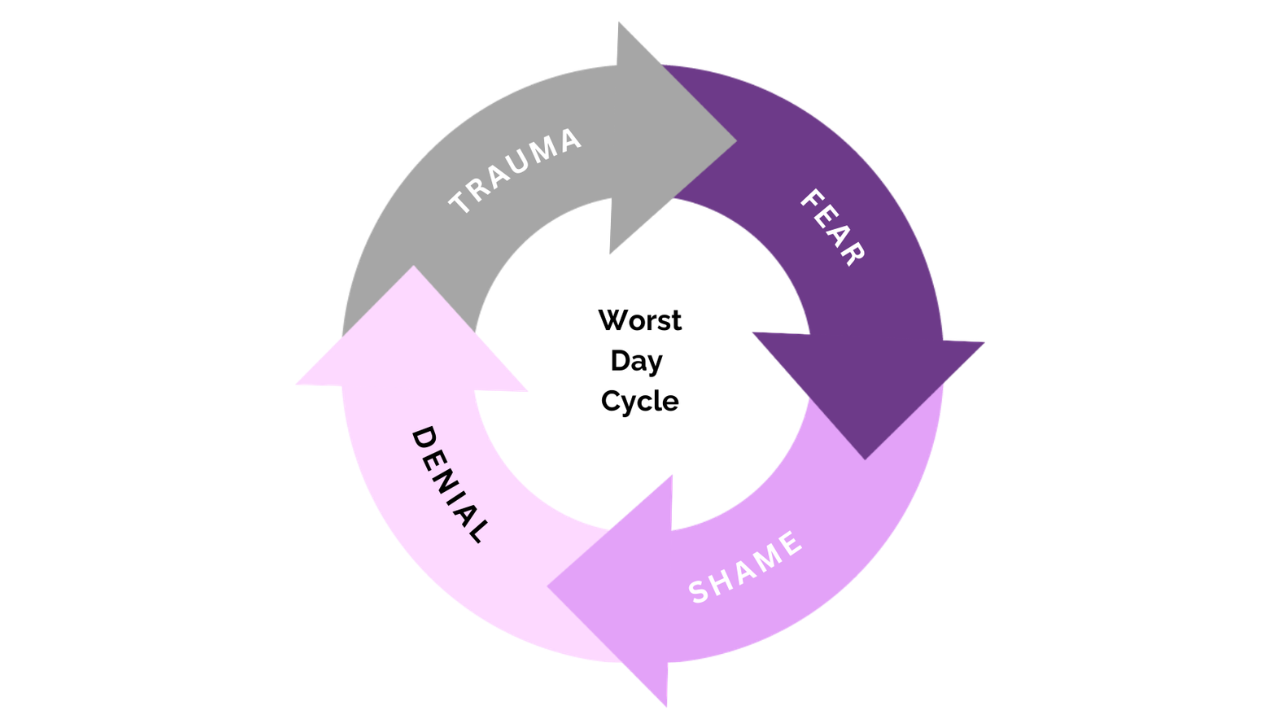
To understand why you keep mistaking addiction for passion, you have to understand the Worst Day Cycle™. This is the repeating emotional loop that was installed in childhood and drives nearly every pattern you cannot seem to break in adulthood.
The Worst Day Cycle™ has four stages: Trauma → Fear → Shame → Denial.
Trauma is any negative emotional experience in childhood that created painful meanings. It does not have to be dramatic abuse. It can be criticism, comparison, emotional neglect, inconsistency, conditional love, parentification, or simply growing up in an environment where your authentic self was not safe. These experiences create a massive chemical reaction in the brain and body.
Fear drives repetition. The brain conserves energy by repeating known patterns — it cannot tell right from wrong, only known versus unknown. Since seventy percent or more of childhood messaging is negative and shaming, the brain defaults to repeating painful patterns because painful is familiar, and familiar equals safe in the nervous system’s calculations.
Shame is where you lost your inherent worth. It is the moment the child concluded: “I am the problem. Something is fundamentally wrong with me. I am not enough.” Shame is not guilt — guilt says “I did something bad.” Shame says “I am bad.” And that shame identity becomes the engine that drives every addictive pursuit, because the addiction is always trying to fix, fill, or outrun the shame wound.
That’s you if you achieve obsessively to prove you are enough. That’s you if you people-please compulsively to earn love. That’s you if you pour yourself into work, relationships, or substances to avoid the feeling that something is missing at your core.
People remain in addictive patterns not because they want the pain, but because their bodies crave the chemical intensity of the familiar wound — and that craving overrides logic every single time.
Denial is the survival persona — the brilliant adaptation you created in childhood to survive the pain. It was genius when you were six years old. It is destroying your life at forty. Denial keeps the cycle spinning by preventing you from seeing the truth: that what you call passion is actually the survival persona chasing the chemical fix that temporarily numbs the shame wound.
How Your Survival Persona Hijacks Passion
There are three survival persona types, and each one has a specific way of turning addiction into something that looks and sounds exactly like passion.
The Falsely Empowered survival persona controls, dominates, achieves, and rages. This persona turns addiction into ambition. They build empires, crush goals, accumulate wealth and status — and they call it passion. But underneath the drive is terror. Terror of being seen as weak. Terror of being exposed as not enough. Terror of stopping — because stopping means sitting with the shame. That’s you if people call you driven but you feel empty at every milestone.
The Disempowered survival persona collapses, people-pleases, caretakes, and disappears. This persona turns addiction into devotion. They pour themselves into other people’s lives, other people’s problems, other people’s emotions — and they call it passion for helping. But underneath the giving is a desperate attempt to earn worth. That’s you if you give everything to everyone and there is nothing left for you. That’s you if your “passion” for caring for others is actually a survival strategy to avoid your own pain.
The Adapted Wounded Child oscillates between both — sometimes controlling, sometimes collapsing, always reacting from the emotional age where the original wound occurred. This persona creates chaos and calls it creativity, creates intensity and calls it aliveness, creates crisis and calls it purpose. That’s you if you swing between over-functioning and shutting down. That’s you if your life feels like an emotional roller coaster that you cannot get off.
Signs You Are Addicted, Not Passionate — By Life Area
The addiction pattern does not stay in one area of life. Because the emotional blueprint operates across every domain, the same trauma chemistry that drives your relationship patterns also drives your career patterns, your friendships, your health, and your family dynamics.
Family
You take on everyone’s emotional weight and call it being a good family member. You cannot set boundaries without guilt. You replay the same arguments from childhood with siblings, parents, or your own children. You overfunction to prevent the family from falling apart — and you call that dedication. That’s you if your family role was assigned in childhood and you have never questioned it.
Romantic Relationships
You are drawn to partners who are emotionally unavailable, inconsistent, or intense. When things are calm, you create conflict or lose interest. You confuse anxiety with attraction and relief with love. You chase people who match your childhood wound and call it chemistry. That’s you if every relationship follows the same painful pattern and you keep asking what is wrong with you.
Friendships
You are the one everyone calls when they need something. You over-give, over-listen, and over-accommodate — and you call it being a great friend. But you never let anyone see you struggling. You never ask for help. Friendships are performance, not connection. That’s you if your friendships feel one-sided but you cannot stop giving.
Work and Career
You work eighty-hour weeks and call it hustle culture. You cannot take a vacation without checking email. Your identity is fused with your job title and your output. When you are not producing, you feel worthless. The addiction is not to the work itself — it is to the chemical hit of achievement that temporarily quiets the shame voice that says you are not enough. That’s you if success never feels like enough and you are already dreading the moment the high fades.
Body and Health
You exercise obsessively and call it discipline. You restrict food and call it health. You push through pain, exhaustion, and illness because stopping feels like failure. Your body is a vehicle for the addiction, not a home you inhabit. That’s you if your body is running on cortisol and caffeine and you call it peak performance.
How the Emotional Authenticity Method™ Breaks the Addiction Loop
You cannot think your way out of addiction disguised as passion. Emotions are biochemical events. Thoughts originate from feelings — not the other way around. This is why willpower fails, why cognitive strategies alone do not create lasting change, and why you can know something intellectually and still be unable to stop the pattern. The Emotional Authenticity Method™ works because it addresses the body, not just the mind.
The Emotional Authenticity Method™ is a six-step process:
Step 1: Somatic Down-Regulation. Focus on what you can hear for fifteen to thirty seconds. If you are highly dysregulated, use titration — oscillating between the activation and the calm stimulus until your nervous system settles enough to proceed. This step interrupts the trauma chemistry hijack.
Step 2: What am I feeling right now? Use emotional granularity — expand your vocabulary beyond “bad” or “anxious” using the Feelings Wheel. Seventy percent of the population cannot name what they feel because they were taught to suppress their authentic emotional experience. Naming the feeling is the first act of reclaiming yourself.
Step 3: Where in my body do I feel it? All emotional trauma is stored physically. Every feeling resides in a specific area of your body. When you locate the sensation — the tightness in your chest, the knot in your stomach, the pressure in your throat — you are making contact with the stored wound that is driving the addictive pattern.
Step 4: What is my earliest memory of having this exact feeling? Trace the feeling back to its childhood origin. You will always arrive at a memory of a less-than-perfect event from childhood. That is the source being replayed in this moment. You are not addicted to the substance, the person, the achievement, or the behavior. You are addicted to the emotional chemical pattern that was installed when you were a child.
Step 5: Who would I be if I never had this thought or feeling again? What would be left over? This is the vision step — the bridge into the Authentic Self Cycle™. For the first time, you glimpse who you actually are underneath the survival persona and the addiction.
Step 6: Feelization. Sit in the feeling of the Authentic Self and make it strong. Create a new emotional chemical addiction to replace the old blueprint. Ask yourself: How would I respond to this situation from this feeling? What would I say? What would I do? Visualize and feel yourself operating from your Authentic Self. This is the emotional blueprint remapping and rewiring step — the moment you begin replacing the old chemical pattern with a new one rooted in truth instead of trauma.
The Authentic Self Cycle™: From Addiction to True Passion
The Authentic Self Cycle™ is the healing counterpart to the Worst Day Cycle™ — an identity restoration system with four stages: Truth → Responsibility → Healing → Forgiveness.
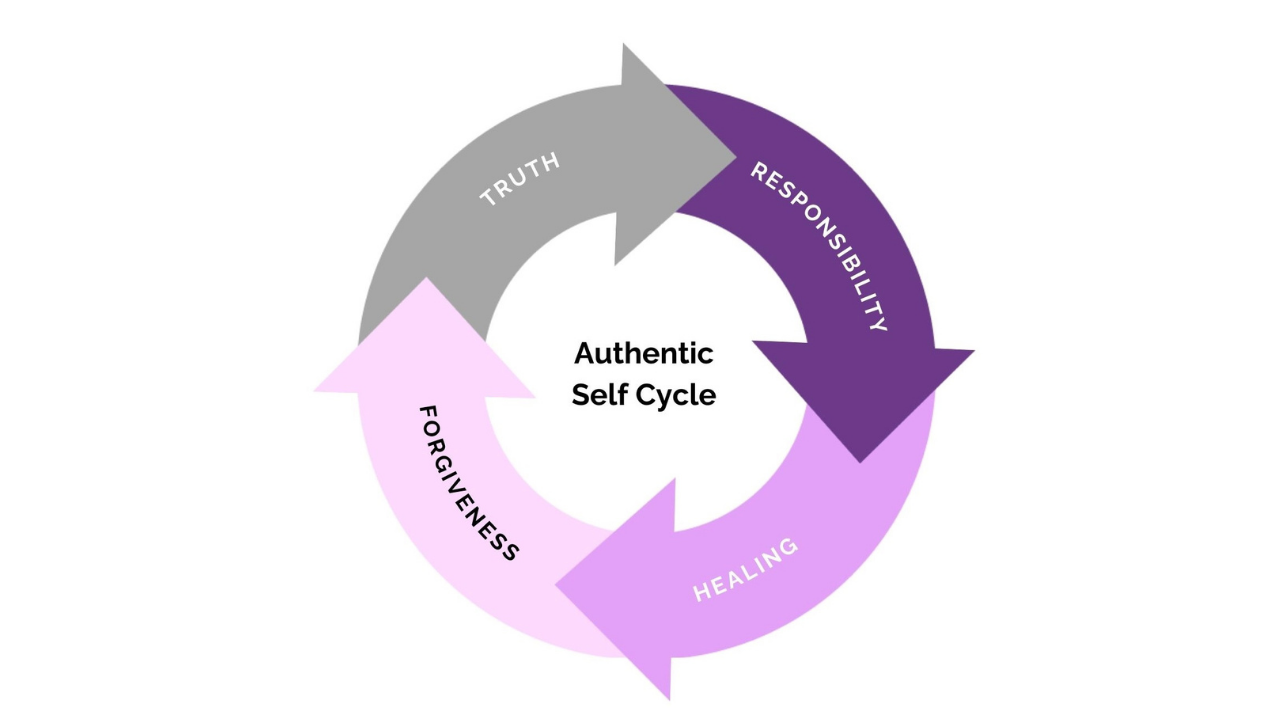
Truth means naming the blueprint, seeing clearly that “this is not about today.” When you chase a goal with desperation and call it passion, truth says: this chemical urgency was installed in childhood. I am repeating my worst day, not pursuing my best life.
Responsibility means owning your emotional reactions without blame. “My boss is not my parent. My partner is not my caregiver. My nervous system just thinks they are.” This is not about fault. It is about authorship — becoming the author of your emotional life instead of a character in a script written when you were six years old.
Healing means rewiring the emotional blueprint so that intensity is not the only state that feels real, so that stillness does not feel like death, so that passion can exist without the adrenaline crash of addiction underneath it. This is the work of the Emotional Authenticity Method™ — reworking the emotion until it becomes a new emotional chemical addiction that replaces the fear, shame, and denial response.
Forgiveness means releasing the inherited emotional blueprint and reclaiming your authentic self. Not forgiving the people who hurt you because they deserve it — forgiving because the alternative is staying chemically bonded to the wound forever. Forgiveness is freedom from the Worst Day Cycle™.
That’s you if you are tired of the cycle. That’s you if you know something deeper is driving the pattern. That’s you if you are finally ready to stop performing passion and start actually living it.
What Healthy Passion Actually Looks and Feels Like
When the addiction loop breaks and you begin living from the Authentic Self, passion transforms. It does not disappear — it changes form. Healthy passion is:
When addiction breaks and the Authentic Self leads, you do not lose your drive — you lose the desperation underneath it, and what remains is passion in its purest form.
Energizing instead of depleting. You finish a day of work on your passion and feel alive, not destroyed. Generous instead of consuming. Your passion enriches the people around you instead of demanding that they sacrifice for it. Sustainable instead of desperate. You can pause, rest, redirect, and return without an identity crisis. Process-oriented instead of outcome-dependent. The joy is in the doing, not just the achieving. Free instead of compulsive. You choose your passion. It does not choose you by hijacking your nervous system with childhood chemicals.
That’s you if you have never known what this feels like — because you have only ever known the addiction version. That’s you if “balance” sounds like a foreign concept because your system only knows all-or-nothing.
Passion gives and enriches. Addiction takes and impoverishes. You can devote your entire life to a passion, but if it is truly passion and not addiction, you will do so with freedom, joy, and a full expression of your truest self. In addiction, there is no joy, no freedom, no self — only the survival persona performing its role to outrun the shame.
Frequently Asked Questions
How do I know if my drive is passion or addiction?
Ask yourself one question: Am I happier during the process, or only at the outcome? If the process itself is filled with stress, anxiety, and suffering that you endure just to reach the finish line, and the high at the finish line lasts only moments before emptiness returns — that is addiction, not passion. Passion creates joy throughout the journey. Addiction only provides relief at the destination, and even that relief is temporary.
Can addiction disguised as passion show up in relationships?
Absolutely. This is one of the most common places it appears. When you confuse anxiety with attraction, when you chase emotionally unavailable partners and call it chemistry, when calm and stable relationships feel boring — that is trauma chemistry operating through your nervous system. Your body is not choosing love. It is choosing familiarity. And if familiarity was chaos, intensity, or enmeshment, that is what your system will interpret as passion.
Why does healthy passion feel boring at first?
Because your nervous system was wired for intensity, not stability. To a traumatized nervous system, consistent and safe feels like “no spark.” In reality, the body is detoxing from trauma highs. Healthy love is quiet. Trauma love is loud. As you rewire through the Emotional Authenticity Method™, you will begin to experience stability as deeply satisfying instead of threatening.
Can high achievers be addicted to success?
Yes — and this is one of the most invisible forms of addiction. The falsely empowered survival persona turns achievement into a shame management strategy. You do not achieve because you are passionate. You achieve because stopping means sitting with the shame wound that says you are not enough. The relentless pursuit of more — more money, more status, more recognition — is the addiction. The genuine passion for the work itself is buried underneath it.
How do I break the addiction cycle if I have been in it my whole life?
You break it by addressing the emotional blueprint, not the behavior. Willpower, discipline, and cognitive strategies alone will not rewire a nervous system pattern that has been running since childhood. The Emotional Authenticity Method™ works with the body and the stored emotion to trace the pattern back to its origin, dismantle the shame identity driving it, and create a new chemical pattern rooted in truth instead of trauma. This is not a quick fix — it is identity restoration.
What is the role of shame in addiction disguised as passion?
Shame is the engine. Every addictive pursuit — whether it is a substance, a relationship, a career, or a behavior — is ultimately trying to manage the shame wound. Shame says “I am not enough” and the addiction says “I can prove that I am.” But the proof never sticks because the shame was installed at a level deeper than logic. Healing the shame through emotional authenticity is the only way to stop the cycle permanently.
The Bottom Line
The difference between passion and addiction is not visible from the outside. Both can look like intensity, drive, commitment, and fire. But passion feeds your soul while addiction feeds on it. Passion creates connection while addiction creates isolation — even when you are surrounded by people. Passion leaves you more yourself. Addiction leaves you less.
If you have spent your life chasing the high and calling it passion — in your relationships, your career, your health, your family — the path forward is not more willpower or a better strategy. The path forward is understanding the childhood emotional blueprint that created the addiction, dismantling the survival persona that maintains it, and reconnecting to the authentic self that has been waiting underneath the performance your entire life.
You are not broken. You are programmed. And programming can be rewritten.
Recommended Reading
- In the Realm of Hungry Ghosts by Gabor Maté
- Facing Codependence by Pia Mellody
- Codependent No More by Melody Beattie
- The Gifts of Imperfection by Brené Brown
- When the Body Says No by Gabor Maté
- Your Journey To Success by Kenny Weiss, Lara Currie, and Elizabeth Smithson
Ready to Break the Cycle?
If this post described your life, the next step is not reading another article. It is doing the work. Kenny Weiss has created courses specifically designed to dismantle these patterns at their root:
- Emotional Blueprint Starter Course — Individual — $79
- Relationship Starter Course — Couples — $79
- Why We Can’t Stop Hurting Each Other — $479
- Why High Achievers Fail at Love — $479
- The Shutdown Avoidant Partner — $479
- Tier 1: Mapping the Blueprint — $1,379
Visit kennyweiss.net/life-changing-exercise to download the free Feelings Wheel and begin the Emotional Authenticity Method™ today.
Learn more about the signs of enmeshment, relationship insecurity, signs of high self-esteem, and negotiables and non-negotiables in codependence recovery.