Self-sabotage is the unconscious pattern of destroying your own success, relationships, health, and happiness — not because you’re weak, lazy, or broken, but because your childhood emotional blueprint taught your nervous system that safety lives in the familiar pain, not in the unfamiliar success. Self-sabotage is the collision between the Authentic Self trying to emerge and the shame-based survival persona fighting to maintain attachment to the only identity you’ve ever known. When you start to succeed — when love gets close, when the promotion comes, when the relationship deepens — your survival persona panics and pulls you back into the Worst Day Cycle™ because success threatens the only connection to your parents’ emotional system you’ve ever had.
™ (understanding), the Authentic Self Cycle™ (healing), and the Emotional Authenticity Method™ (daily practice).
Table of Contents
- Why You Keep Destroying What You Build
- Self-Sabotage Is Not Weakness — It’s a Survival Strategy
- The Worst Day Cycle™: The Four-Stage Engine of Self-Sabotage
- The Three Survival Personas That Drive Self-Sabotage
- Fear of Success: The Truth Nobody Wants to Hear
- How Self-Sabotage Shows Up Across Your Life
- The Authentic Self Cycle™: Breaking the Loop
- The Emotional Authenticity Method™: Your 6-Step Practice
- People Also Ask
- The Bottom Line
- Recommended Reading
Why You Keep Destroying What You Build
You’ve been here before. You’re making progress — real progress — and then something shifts. Your foot goes on the brake. You self-destruct. You say something cruel, you miss the deadline, you don’t show up, you pick a fight with the one person who actually gets you. And afterward, you can’t even explain why.
That’s you if you’re terrified of success, even though consciously you want it more than anything.
Here’s what most people get wrong: Self-sabotage isn’t a character flaw. It’s not laziness, cowardice, or some deep inadequacy you need to therapy away. Self-sabotage is actually brilliant. It’s your nervous system’s attempt to keep you safe.
In childhood, you learned that pain was predictable. You knew how to survive your parents’ anger, your caregiver’s withdrawal, the family chaos. That pain was familiar. Your nervous system became addicted to it because repetition equals safety in a child’s brain. You couldn’t change your parents, but you could control the pain by becoming predictable yourself.
Sound familiar?
Now, decades later, success arrives — the promotion, the healthy relationship, the body that finally feels good. But your nervous system doesn’t recognize success. Success is unknown territory. And unknown territory feels like death to a trauma-wired brain.
So your survival persona — the brilliant, protective part of you that kept you alive in a painful home — springs into action. It sabotages the success. It pulls you back into the pain you know. Because in the twisted logic of your childhood nervous system, the pain you know is safer than the success you don’t.
This isn’t broken. This is your superpower turned against you.
Self-Sabotage Is Not Weakness — It’s a Survival Strategy
Let me be clear: Your survival persona is not the enemy. It’s the part of you that survived an unsurvivable situation. It developed incredible skills — hypervigilance, people-pleasing, perfectionism, self-abandonment, control, dissociation — to keep you alive.
That’s the real story.
In childhood, those survival strategies were genius. They helped you navigate an unpredictable, potentially dangerous emotional landscape. You learned to read your parent’s mood before they entered the room. You developed an internal radar for danger. You became indispensable. You became invisible. You became whatever you needed to be to maintain attachment.
But here’s what nobody tells you: Those same strategies that saved your life in childhood are now destroying it in adulthood.
When you’re an adult in a healthy relationship with someone who actually loves you, your hypervigilance becomes anxiety. Your need to be indispensable becomes enmeshment. Your perfectionism becomes paralysis. Your self-abandonment becomes self-sabotage.
The power reclamation moment happens when you stop blaming yourself and start recognizing: Your survival persona isn’t broken. It’s outdated. It was built for a world that no longer exists. Your job now is to upgrade the software without destroying the hardware that kept you alive.
That’s the difference between shame and responsibility.
The Worst Day Cycle™: The Four-Stage Engine of Self-Sabotage
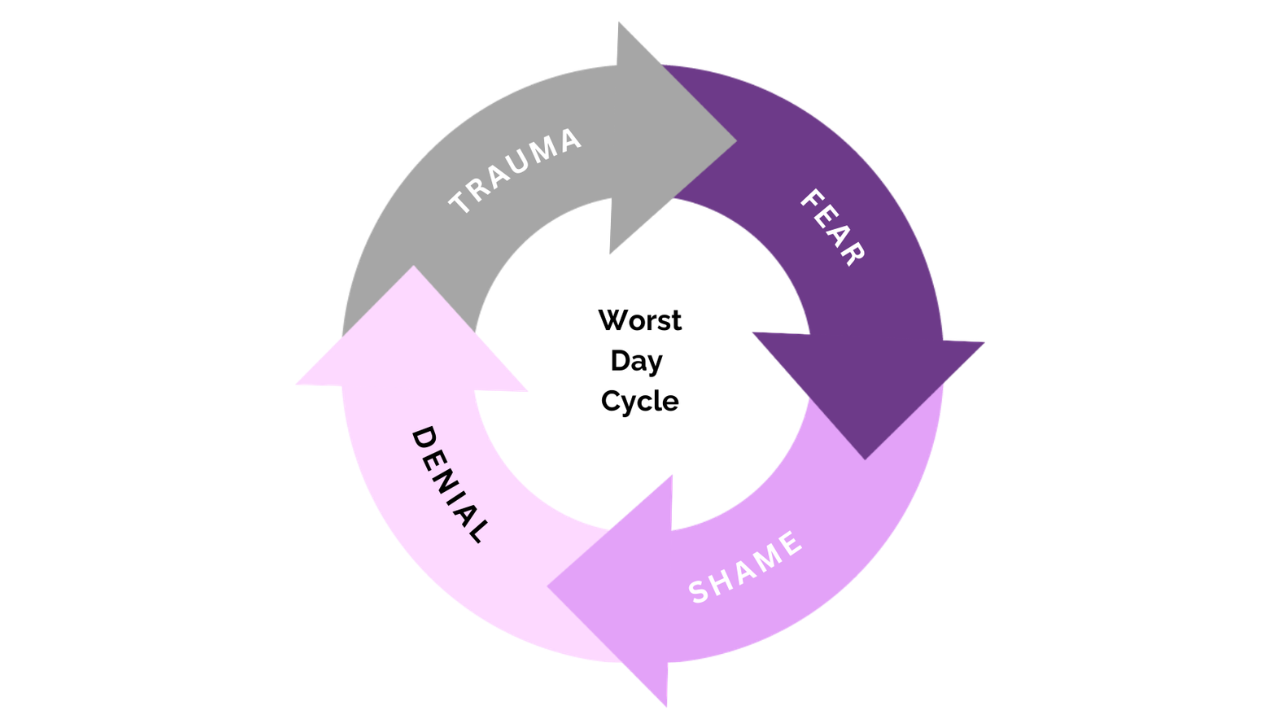
Self-sabotage doesn’t happen randomly. It follows a predictable four-stage pattern that I call the Worst Day Cycle™. Understanding this cycle is the foundation of everything. It’s why you keep repeating the same painful patterns, and it’s also the map to break free.
Stage 1: Trauma
Childhood trauma is any negative emotional experience that created painful meanings. It’s not about what happened — it’s about what your young brain concluded about yourself, others, and the world based on what happened.
When trauma hits, your hypothalamus generates a chemical cocktail: cortisol (stress), adrenaline (fight-or-flight), dopamine (reward), oxytocin misfires (false connection). Your young brain becomes addicted to these emotional states because they’re all you know. The pain is overwhelming, yes, but it’s also a gateway to your parent’s attention, your family’s focus, your nervous system’s intensity.
That’s the foundation of the entire cycle.
Stage 2: Fear
Fear drives repetition. Your brain’s primary job in childhood is safety. It doesn’t distinguish between right and wrong — it only recognizes known versus unknown. Since 70% of childhood messaging is negative (don’t, can’t, won’t, shouldn’t, wrong), your brain associates the known pain with safety.
The moment you start to leave that pain — to succeed, to be loved, to break the pattern — fear hijacks you. Your survival persona activates. It whispers: This is dangerous. Go back. Repeat what you know.
Sound familiar? That’s the voice of fear.
Stage 3: Shame
Shame is where you lost your inherent worth. It’s not guilt — guilt is “I did something bad.” Shame is “I am bad.” In this stage, you internalize the trauma. You believe your existence is the problem. Not your behavior, not your choices — you.
This is where self-sabotage gets its teeth. You unconsciously prove the shame-based narrative: “I don’t deserve success. I will screw it up. I am broken.” And then you do sabotage it, which reinforces the shame, which feeds the cycle.
Stage 4: Denial
Denial is the survival persona created to survive the pain. This persona is brilliant. It’s adaptive, protective, and ingenious. But it’s also the source of self-sabotage in adulthood. The denial stage is where you reinforce the survival strategy: “This is just who I am. I’m not good enough. I always mess things up. Everyone leaves me.”
That’s the story you tell yourself to avoid the pain of Stage 3.
The Three Survival Personas That Drive Self-Sabotage
Not all self-sabotage looks the same. Your survival persona shapes how you destroy what you build. There are three primary types, and most of us have a dominant one (though we can move between them depending on context).
The Falsely Empowered Survival Persona
This persona says: “I’m fine. I don’t need anyone. I’ll do it myself.” In childhood, you learned that vulnerability was dangerous, so you became hypercompetent, perfectionist, and controlling. You can move mountains. You can solve any problem. You never let anyone see you struggle.
Self-sabotage shows up as overcommitment, burnout, and sudden implosion. You push so hard that you crash. You don’t allow anyone close enough to support you, so when success demands collaboration or intimacy, you panic and self-destruct. That’s you if you’re terrified of being dependent on anyone.
The Disempowered Survival Persona
This persona says: “I can’t. Everyone else is smarter, stronger, more capable. Things always go wrong for me.” In childhood, you learned that your needs didn’t matter, so you became small, accommodating, and resigned to suffering. You don’t take action because action feels futile.
Self-sabotage shows up as procrastination, paralysis, and self-abandonment. You don’t even try because failing is already assumed. You abandon yourself before anyone else can. Sound familiar? That’s learned helplessness.
The Adapted Wound Child
This persona is the chameleon. It says: “I’ll be whatever you need me to be.” In childhood, you learned to read the room, match the energy, and become the person your caregiver needed. You developed an external emotional barometer. You’re intuitive, empathetic, and highly attuned to other people’s feelings.
Self-sabotage shows up as people-pleasing, enmeshment, and loss of self. You merge with others so completely that you disappear. When success means standing out, saying no, or owning your own power, you panic and sabotage it. That’s you if you feel like you don’t know who you are without another person to reflect.
Fear of Success: The Truth Nobody Wants to Hear
Let me say this plainly: You’re not afraid of failure. You’re afraid of success.
Failure is comfortable. Failure confirms what your shame already believes about you. Failure keeps you connected to your parents’ emotional system (disappointment, frustration, pity). Failure keeps you in the Worst Day Cycle™.
But success? Success threatens everything. Success says: “You’re capable. You’re worthy. You deserve good things.” Success would mean separating from the family narrative that you’re broken. Success would mean your parents were wrong about you. Success would mean you’d have to grieve all the years you wasted believing the lie.
That’s the fear nobody wants to name.
When your internal blueprint says “I am unworthy,” success creates cognitive dissonance. Your nervous system has to choose: Update the blueprint or reject the success. And updating the blueprint means confronting decades of pain, shame, and grief. Most people’s survival personas choose to sabotage the success instead.
This is why you can be intellectually committed to success and still self-destruct. This is why you can read all the self-help books, do all the therapy, set all the goals, and still end up alone, broke, or broken.
That’s you if you’ve sabotaged every relationship right when it got real.
The good news: Once you understand this, you can rewire it. But first, you have to stop being angry at yourself for the sabotage and get curious about what success is threatening.
How Self-Sabotage Shows Up Across Your Life
Self-sabotage isn’t one-dimensional. It shows up differently depending on which area of your life we’re looking at, but the root is always the same: your survival persona protecting you from success that threatens your childhood attachment.
Family
You get closer to a family member, start setting a boundary, and then abandon it. You try to heal the relationship with a parent, and when they show the tiniest bit of vulnerability back, you push them away. You’re caught between your need for connection and your survival persona’s need for control or distance. That’s the paradox of family sabotage.
Romantic Relationships
This is where self-sabotage does its most visible damage. You find someone healthy, someone who actually loves you, someone who doesn’t play games. And then, right when the relationship becomes real, you self-destruct. You cheat, you pick a fight, you withdraw, you become critical. You convince yourself they’re not right for you (even though they are) and leave them (even though they love you).
Check out this article on the signs of enmeshment to understand how your childhood attachment style is showing up in your romantic relationships right now.
That’s you if every relationship follows the same painful pattern.
Friendships
You develop a close friendship and then self-sabotage it by being needy, critical, or withdrawing. You share too much too fast or you guard yourself completely. You need your friends to prove their loyalty through endless accommodation, or you abandon the friendship before they can abandon you.
Work
The promotion is within reach and you suddenly miss a deadline. You’re building something that could change your life and you talk yourself out of it. You get close to success and your survival persona hijacks you — you say something inappropriate in a meeting, you don’t follow through, you quit right before the breakthrough.
This is especially true for high achievers in insecure relationships where your success threatens your partner’s emotional stability, so you unconsciously dial it back.
Body and Health
You lose weight and then sabotage it by binge eating. You commit to exercise and then get injured or get sick. You finally get healthy and then you start smoking again. Your body literally self-sabotages because your nervous system associates thinness or health with abandonment or attention you’re not prepared for.
Sound familiar?
The Authentic Self Cycle™: Breaking the Loop
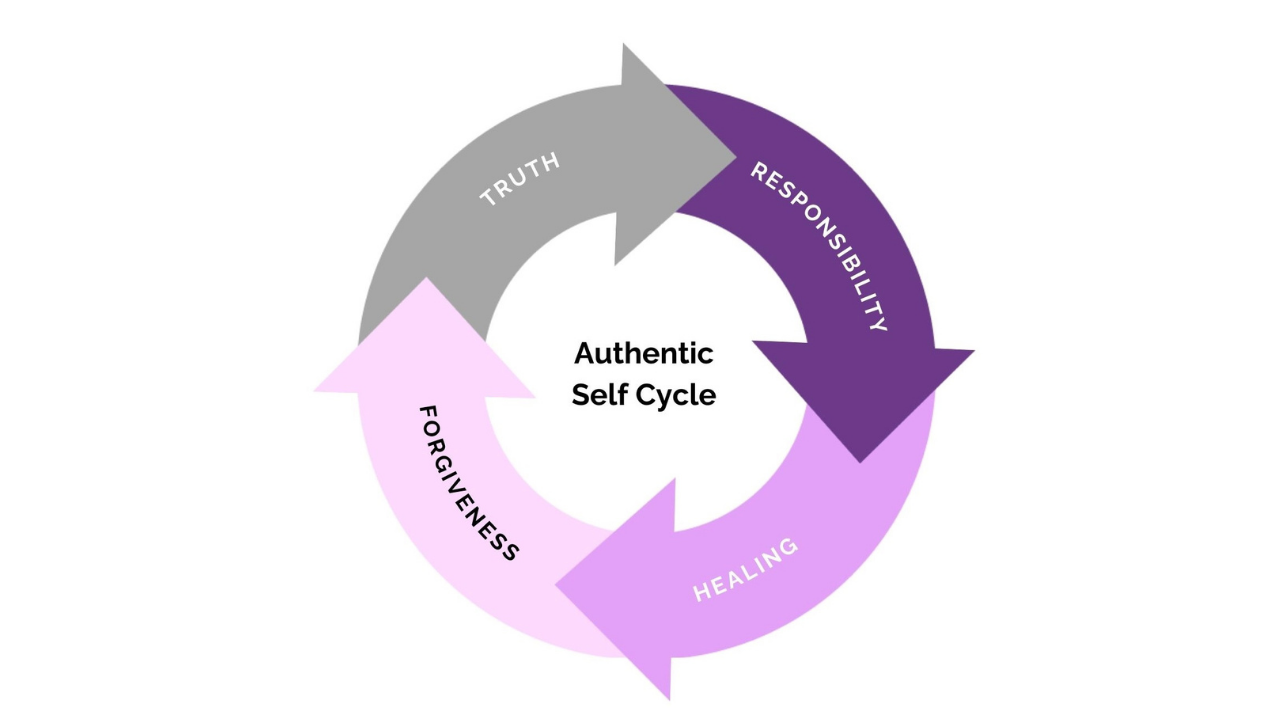
The Worst Day Cycle™ describes how you got trapped. The Authentic Self Cycle™ is how you get out.
This is not a one-time process. It’s not something you do in therapy and then you’re done. The Authentic Self Cycle™ is a practice you return to every single time your survival persona gets activated. Over time, the path becomes familiar. Your nervous system learns a new way home.
Stage 1: Truth
Name the blueprint. Get specific about what you’re actually afraid of. Not the surface fear (“I’m afraid I’ll fail”), but the deep fear (“I’m afraid if I succeed, my parents will feel threatened and abandon me”). This is where you separate the past from the present.
“This isn’t about today. My partner isn’t my parent. My nervous system just thinks they are.”
Stage 2: Responsibility
Own your emotional reactions without blame. You’re not bad for being triggered. You’re not broken for self-sabotaging. But you are responsible for your nervous system. “I can feel triggered and still choose not to abandon myself. I can feel afraid and still move toward the success.”
Stage 3: Healing
Rewire the emotional blueprint. This is the neurological work. You practice new responses. You stay in the discomfort of success instead of sabotaging it. You show up in the healthy relationship even when your trauma says to run. You rewire success from “dangerous” to “uncomfortable but not dangerous.”
Stage 4: Forgiveness
Release the inherited emotional blueprint and reclaim your Authentic Self. This creates new emotional chemical patterns. You’re no longer addicted to the old pain because you’ve created a new addiction to the Authentic Self — to peace, to belonging, to being enough.
The Emotional Authenticity Method™: Your 6-Step Practice
Understanding the cycles is powerful, but knowledge alone doesn’t change your nervous system. You need a daily practice. The Emotional Authenticity Method™ is a six-step process you can use every time your survival persona gets triggered and wants to sabotage your success.
Step 1: Somatic Down-Regulation
Your survival persona lives in your body. So we start there. When you’re activated, triggered, or about to sabotage, pause. For 15-30 seconds, focus on what you can hear. Just sound. Not sight, not thought — sound. If you’re highly dysregulated, use titration: very small amounts of regulation exposure until your nervous system settles.
This grounds you in the present moment.
Step 2: What Am I Feeling Right Now?
Use emotional granularity. Don’t just say “I’m upset.” Get specific. Are you angry, hurt, abandoned, rejected, ashamed, afraid? The Feelings Wheel is a powerful tool for this. The more precise you can be with your emotion, the more power you have over it.
Step 3: Where in My Body Do I Feel It?
All emotional trauma is stored physically. You might feel shame as a heaviness in your chest. Fear might be a constriction in your throat. Abandonment might be a hollow feeling in your stomach. Locate it. Don’t try to fix it yet. Just notice it.
Step 4: What Is My Earliest Memory of Having This Exact Feeling?
Trace it back. This feeling you’re having right now? You’ve had it before. Probably many times. When’s the first time you remember feeling this exact sensation in your body? That’s your origin wound. That’s the childhood moment that taught your nervous system this is dangerous.
That’s the connection between past and present.
Step 5: Who Would I Be If I Never Had This Thought or Feeling Again?
This is the vision step. This is the Authentic Self Cycle™ in action. What would be different? How would you show up? What would you do? This isn’t fantasy — it’s neurological rewiring. You’re training your nervous system to recognize a new possibility.
Step 6: Feelization — Sit in the Feeling of the Authentic Self and Make It Strong
This is where the magic happens. You don’t just think about the Authentic Self. You feel it. You sit in that feeling. You make it vivid, visceral, real. You’re creating a new emotional chemical addiction to replace the old blueprint. You’re training your body to recognize peace, belonging, and worthiness as home.
This is a practice you return to every single day. Some days you’ll move through all six steps in five minutes. Some days it’ll take an hour. Over time, your nervous system learns this path. The Authentic Self becomes familiar. Success becomes safe.
People Also Ask
Why do I keep self-sabotaging even when I know better?
Because knowledge lives in your neocortex (thinking brain), but self-sabotage lives in your limbic system and nervous system (feeling brain). You can intellectually know you deserve success, but your nervous system is still addicted to the chemical patterns of childhood pain. Breaking the pattern requires rewiring your nervous system, not just understanding it. That’s what the Emotional Authenticity Method™ does.
Is self-sabotage a sign of low self-esteem?
No. Self-sabotage is a sign that your nervous system is protecting you from something it perceives as dangerous. Low self-esteem is one symptom of that protection, but not the root cause. Check out what high self-esteem actually looks like and you’ll see that many self-sabotagers have high self-esteem in some areas and zero in others. The issue isn’t your self-worth — it’s your nervous system’s association between success and danger.
How do I stop self-sabotaging my relationships?
First, get honest about your Victim Position Paradox. Are you abandoning the relationship to avoid being abandoned? Are you pushing them away to maintain control? Are you becoming critical to prevent them from seeing the real you? Once you name the pattern, use the Emotional Authenticity Method™ every time you feel the urge to self-destruct. And read this on negotiables and non-negotiables to understand what boundaries actually look like in a healthy relationship.
Can self-sabotage be unconscious?
Absolutely. In fact, most self-sabotage is unconscious. You don’t wake up thinking, “Today I’m going to sabotage my success.” Your survival persona operates below conscious awareness. That’s why it’s so powerful and why it’s so hard to stop by willpower alone. You need to access the nervous system, not just the thinking brain.
What is the root cause of self-sabotage?
Childhood emotional trauma and the survival strategies you developed to survive it. Specifically, your nervous system became addicted to the chemical patterns of the Worst Day Cycle™ (trauma, fear, shame, denial) and learned to associate your parents’ emotional system with safety. Success threatens that attachment, so your survival persona sabotages it to keep you connected to the only safety you’ve ever known.
How long does it take to break self-sabotage patterns?
That depends on how deeply wired the pattern is and how consistently you practice. Some people shift in weeks. Most people need months or years of consistent practice with the Emotional Authenticity Method™. The key is consistency, not intensity. Daily practice rewires your nervous system faster than occasional deep work. Your nervous system learns through repetition — that’s how it got wired to self-sabotage in the first place.
The Bottom Line
Self-sabotage isn’t your fault. Your survival persona isn’t broken. Your nervous system isn’t damaged beyond repair. You’re not destined to repeat the painful patterns of your childhood forever.
But it does require you to do something different. It requires you to stop blaming yourself and start getting curious about what success is threatening. It requires you to move from shame (I am bad) to responsibility (I can rewire this). It requires daily practice with the Emotional Authenticity Method™ until the Authentic Self becomes as familiar as the survival persona.
That’s not weakness. That’s the bravest thing you can do.
Every time you choose to stay in a healthy relationship instead of sabotaging it, every time you move toward success even though your nervous system says it’s dangerous, every time you practice the Emotional Authenticity Method™ instead of abandoning yourself — you’re rewiring your nervous system. You’re creating new neural pathways. You’re training your body to recognize safety in success.
You’re reclaiming your Authentic Self.
The person you were meant to be before the pain taught you otherwise.
Recommended Reading
- Facing Codependence by Pia Mellody — The foundational work on codependence and how childhood patterns show up in adulthood.
- The Body Keeps the Score by Bessel van der Kolk — The neuroscience of trauma and why your body remembers even when your mind forgets.
- When the Body Says No by Gabor Maté — How self-abandonment and unprocessed emotion manifest as physical illness and self-sabotage.
- Codependent No More by Melody Beattie — The classic on detaching with love and reclaiming your own power.
- The Gifts of Imperfection by Brené Brown — How perfectionism and shame drive self-sabotage and what wholehearted living looks like instead.
Transform Your Relationship to Success
Understanding self-sabotage intellectually is one thing. Rewiring your nervous system so you can actually receive success is another. These courses will guide you through the complete journey:
- Emotional Blueprint Starter Course — Individual ($79) — The foundational course on your emotional blueprint and survival persona. Start here.
- Relationship Starter Course — Couples ($79) — How your survival persona shows up in romantic relationships and how to rewire it together.
- Why We Can’t Stop Hurting Each Other ($479) — The deep dive into the Victim Position Paradox and the Worst Day Cycle™ in relationships.
- Why High Achievers Fail at Love ($479) — Specifically for people who excel professionally but sabotage their intimate relationships.
- The Shutdown Avoidant Partner ($479) — For anyone struggling with emotional unavailability, fear of intimacy, or the Falsely Empowered persona.
- Tier 1: Mapping the Blueprint ($1,379) — The complete training in the Emotional Authenticity Method™. This is where the neurological rewiring happens.