The core truth: Pain is not the problem. Avoiding it is what creates the suffering. Most of us spend our entire lives running from the emotional pain of childhood trauma by creating survival personas, using addictions, and bouncing between denial rooms—not realizing that it’s the avoidance of pain that creates the pain. The moment you recognize that your avoidance technique causes more suffering than the pain you’re trying to avoid is the moment healing becomes possible.
That’s you if you’ve noticed that no matter how much you achieve, how many relationships you try, or how many self-help strategies you implement, you keep ending up in the same painful place. You’re not broken. Your nervous system is working exactly as it was designed to work in childhood—which is the problem.
This post reveals the hidden mechanism keeping you trapped in suffering and shows you the exact emotional healing process to break free.
Your brain learned to avoid emotional pain in childhood to survive. Today, that same avoidance creates more suffering than the original pain ever could. The Worst Day Cycle™ keeps you trapped. The Emotional Authenticity Method™ and Authentic Self Cycle™ rewire your emotional blueprint so you can heal by going through the pain, not around it. This is not about positive thinking—it’s about rewiring your nervous system chemistry.
Table of Contents
- What Is Emotional Pain Avoidance and Why Does It Cause More Suffering?
- How the Worst Day Cycle™ Explains Why You Avoid Emotional Pain
- How Your Survival Persona Keeps You Trapped in Avoidance
- The Labyrinth of Denial: Why You Can’t Find the Exit
- How Avoiding Emotional Pain Shows Up in Every Area of Your Life
- Why Positive Thinking and Coping Skills Can’t End Emotional Suffering
- How the Emotional Authenticity Method™ Breaks the Avoidance Pattern
- How the Authentic Self Cycle™ Replaces Suffering With Healing
- Frequently Asked Questions
- The Bottom Line
- Recommended Reading
What Is Emotional Pain Avoidance and Why Does It Cause More Suffering?
Emotional pain avoidance is any strategy—conscious or unconscious—you use to escape, numb, or deny painful feelings. It can be obvious (alcohol, food, scrolling, work obsession) or invisible (people-pleasing, perfectionism, spiritual bypassing, constant productivity).
The paradox is this: the harder you run from emotional pain, the more of your life energy gets consumed by the running itself. You’re not just suffering the original pain anymore. You’re suffering the consequences of the avoidance, plus the effort required to maintain the avoidance system, plus the shame of knowing something is wrong but not understanding why you can’t stop.
That’s the hidden bottom—the moment when the avoidance technique creates more pain than the feeling you were trying to escape.
Most people try to heal by thinking differently, using coping skills, or distancing from “toxic” people. But emotional pain avoidance isn’t a thinking problem. It’s a nervous system problem—a biochemical addiction your brain developed in childhood to survive.
When childhood trauma creates painful emotional meanings (I’m not lovable, I’m responsible for others’ feelings, safety is impossible), your brain generates a chemical cocktail of cortisol, adrenaline, and dopamine that gets stored in your nervous system. Your brain becomes addicted to these emotional states because they feel like safety and control—even though they’re actually fear and helplessness in disguise.
Decades later, your nervous system repeats these same patterns in every relationship, career decision, and health choice because repetition feels safe to the brain. The brain conserves energy by recycling known patterns. It can’t tell right from wrong—only known versus unknown.
This is why willpower doesn’t work. You can’t think your way out of a biochemical pattern.
How the Worst Day Cycle™ Explains Why You Avoid Emotional Pain
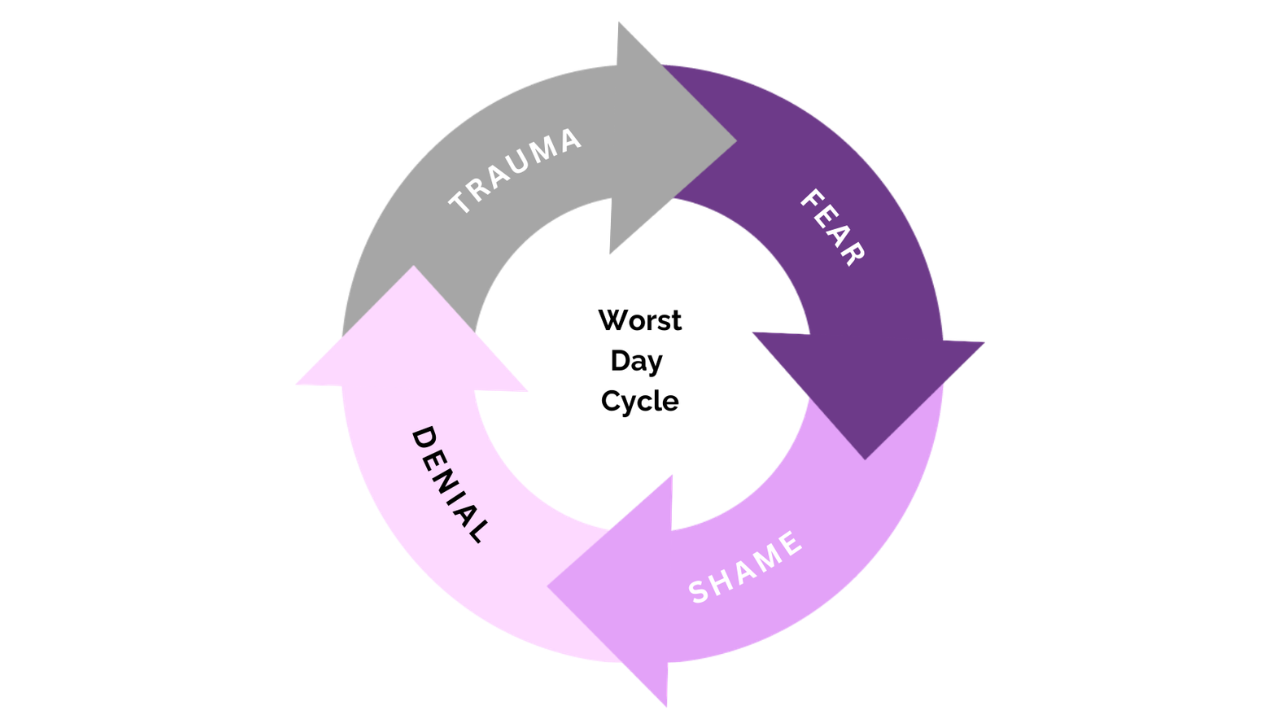
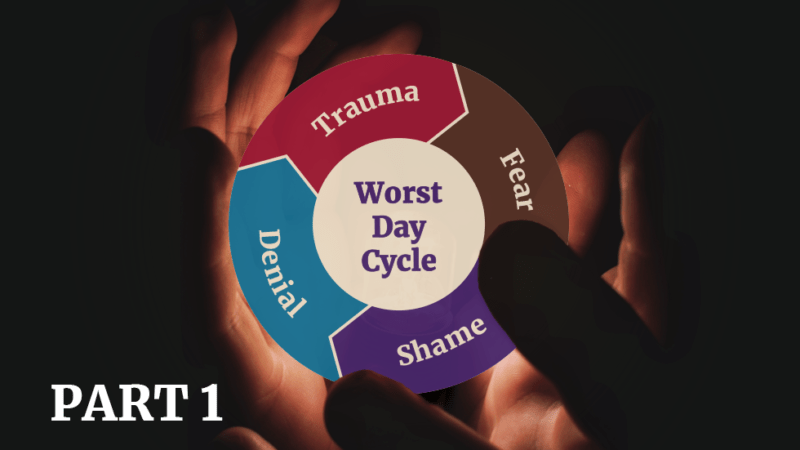
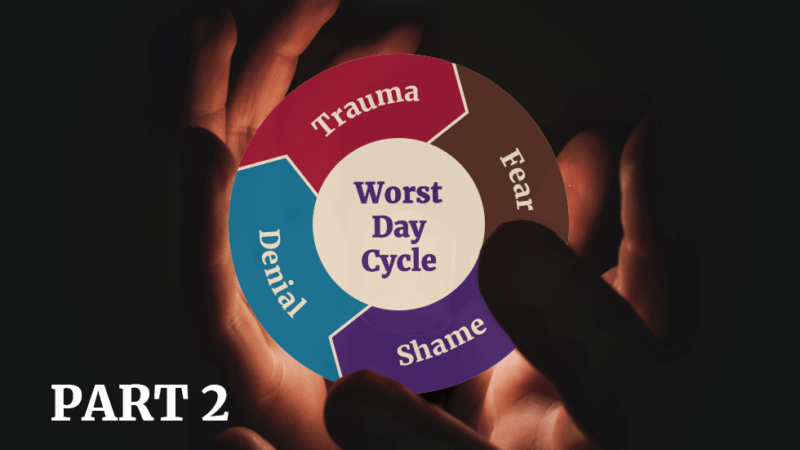
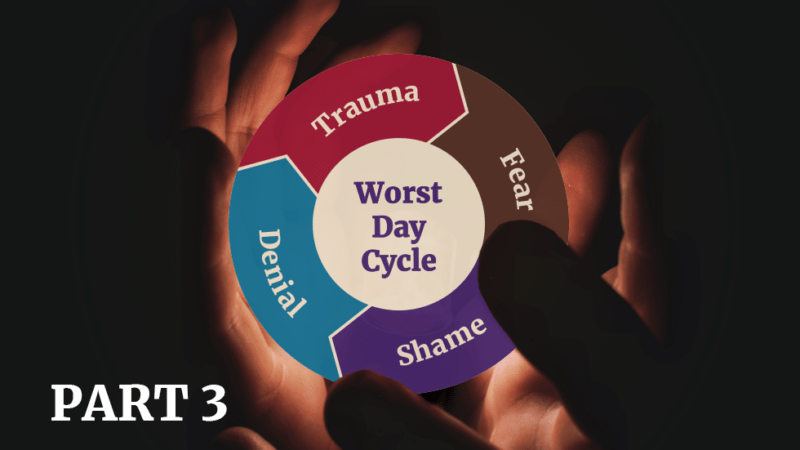
The Worst Day Cycle™ is the blueprint your nervous system learned in childhood. It moves you from Trauma → Fear → Shame → Denial, and then loops back to repeat.
Here’s how it works in real time:
Stage 1: Trauma (an event that creates painful emotional meaning)
You send a text to your partner. They don’t respond for two hours. Or your boss gives you critical feedback. Or your parent makes a comment about your appearance. The external event isn’t the trauma—the meaning your nervous system assigns to it is.
Stage 2: Fear (recognition that the painful emotional meaning has been triggered)
Your nervous system immediately activates: I’m being abandoned. I’m not good enough. I’m not safe. This isn’t rational—it’s biochemical. Your amygdala has registered danger based on a pattern learned decades ago. Your sympathetic nervous system floods with cortisol and adrenaline. You’re in fight-or-flight, even though there’s no actual physical threat.
Stage 3: Shame (the feeling that there’s something wrong with you for feeling afraid)
Why am I like this? Why do I always overreact? Why can’t I just be normal? You’re ashamed of the fear, which creates a second layer of pain on top of the original fear. Now you’re not just afraid—you’re afraid of being afraid.
Stage 4: Denial (the strategy to escape the shame of the fear)
This is where avoidance kicks in. You scroll. You eat. You work. You drink. You rage. You people-please. You numb. You dissociate. You do anything except feel the fear and shame that are alive in your nervous system. The avoidance strategy feels like relief in the moment—and that’s the trap. The relief reinforces the strategy. Your brain says, This works! Do it again next time.
And then the cycle repeats.
That’s you when you realize: the Worst Day Cycle isn’t a character flaw. It’s a nervous system pattern learned under threat, running on automatic, trying to protect you the only way it knows how.
How Your Survival Persona Keeps You Trapped in Avoidance
The survival persona is the self you created in childhood to navigate the emotional danger of your family system. It might be the high-achiever who never asks for help. The people-pleaser who absorbs everyone else’s emotional labor. The independent one who learned early that nobody was coming to rescue you. The invisible one who learned that staying small meant staying safe. The charmer who learned that making people laugh meant they wouldn’t get angry.
Your survival persona was brilliant. It protected you. It kept you alive. It helped you navigate an environment where your emotional needs weren’t being met and your safety wasn’t guaranteed.
The problem is that the survival persona is still running the show, decades later, in an environment where the original threat no longer exists.
The Victim Position Paradox is what keeps you trapped: Your survival persona believes that other people, circumstances, or your past are responsible for your pain. You’re waiting for them to change so that you can feel better. But you can’t wait forever, so you avoid the pain in the meantime. This avoidance keeps you from recognizing the truth: you’re responsible for rewiring your nervous system. The people in your life didn’t cause your blueprint—they triggered it. Your past didn’t cause your blueprint—it created it. But your nervous system is yours to rewire.
That’s when everything shifts: the moment you stop blaming external circumstances and start taking responsibility for your internal response.
The Labyrinth of Denial: Why You Can’t Find the Exit
Denial isn’t just about pretending something didn’t happen. It’s a sophisticated emotional architecture your nervous system built to survive impossible circumstances. In childhood, you couldn’t leave. You couldn’t fight. You couldn’t speak the truth. So your nervous system did the only thing it could do: it denied the truth hard enough to make the unbearable bearable.
That pain is too big. I’ll make myself numb instead.
That person hurt me. I’ll decide they didn’t mean to.
I’m terrified. I’ll reframe it as ambition instead.
Denial is the architecture of survival. And it’s impeccable. It’s airtight. It’s designed to keep the truth out at all costs.
Which is why you can’t just “think your way out” of it. Your rational mind knows the truth. But your nervous system is running a denial pattern that feels like survival itself. To let the truth in is to feel the full force of the original pain. Your nervous system says: I’d rather die than feel that. So it keeps denying.
This is the labyrinth. You’re looking for the exit, but every corridor leads back to the center, which is the pain you’re trying to escape.
The only way out is through.
How Avoiding Emotional Pain Shows Up in Every Area of Your Life
The specific avoidance strategy varies, but the pattern is universal:
In relationships: You stay in relationships that don’t serve you because leaving means feeling the abandonment pain. Or you leave relationships the moment they get close, to avoid being disappointed. Or you people-please so relentlessly that you lose yourself. Or you choose partners who are unavailable, so you get to stay in the familiar pain of longing without ever risking being truly known.
In your career: You chase achievement because producing value feels like proof that you deserve to exist. Or you sabotage success because success brings visibility and vulnerability. Or you stay in jobs that don’t align with your values because the familiar dissatisfaction feels safer than the risk of change.
In your health: You ignore your body’s signals until they become screams. Or you become obsessed with health and control, using wellness as a way to manage the terror of helplessness. Or you use substances, food, or sex to regulate your nervous system instead of learning to regulate it yourself.
In your money: You spend compulsively to soothe the anxiety of not-enough. Or you hoard money obsessively, unable to enjoy what you’ve earned because enjoyment feels like risk. Or you self-sabotage prosperity because deep down, you believe you don’t deserve it.
In your spirituality: You use spiritual concepts to bypass the emotional work—”everything happens for a reason,” “I should just let it go,” “I’m choosing to see the light” (while refusing to see the shadow). Or you use spirituality to further the denial: “I’ve forgiven them” (without ever actually feeling the anger you need to feel first).
The avoidance strategy is creative. It’s adaptive. It’s relentless. And it touches every area of your life.
That’s you when you finally see it: the pattern isn’t random. It’s not a character flaw. It’s the most intelligent adaptation your nervous system could make to an impossible situation. And now it’s the very thing keeping you trapped.
Why Positive Thinking and Coping Skills Can’t End Emotional Suffering
This is the hard truth that most self-help misses: Your nervous system doesn’t care what you think. It cares what it feels.
You can do all the positive affirmations you want. I am worthy. I am safe. I am enough. But if your nervous system learned in childhood that you’re not worthy, not safe, and not enough, the affirmations just create a split: your mind believes one thing while your body believes another. That split is called cognitive dissonance, and it creates more anxiety, not less.
You can learn all the coping skills. Breathing exercises. Journaling. Meditation. Progressive muscle relaxation. These are useful tools for managing the symptom (the anxiety, the shame), but they’re not addressing the cause (the nervous system blueprint that created the symptom in the first place).
Here’s the distinction: Coping skills help you survive. Healing helps you thrive.
Coping says: The pain is here. Let me manage it so I can function.
Healing says: The pain is here. Let me feel it, understand it, and rewire the blueprint that created it.
Most people spend their entire lives getting better at coping—and never actually healing. They’re just getting more sophisticated at avoidance.
How the Emotional Authenticity Method™ Breaks the Avoidance Pattern

The Emotional Authenticity Method™ is a six-step process for rewiring your emotional blueprint. Unlike coping skills (which help you manage the pain), this method helps you go through the pain and transform it.
Step 1: Name the Feeling (Go From Numb to Felt)
The first move out of avoidance is simple: feel the feeling. Not talk about it. Not think about it. Feel it.
The technique: When triggered, pause. Drop from your head to your body. Where do you feel this emotion? In your chest? Your throat? Your belly? Your legs? Don’t try to change it. Just locate it. Name it. This is fear. This is shame. This is rage. This is grief.
The moment you name a feeling, you’ve begun to separate from it. You’re no longer the anxiety—you’re the person observing the anxiety. This is the beginning of agency.
That’s you when you realize: I thought I couldn’t feel this, but I was just refusing to. The moment I actually let myself feel it, I discover I can survive it.
Step 2: Trace the Feeling to Its Origin (Go From Triggered to Aware)
The feeling isn’t about today. It’s about yesterday. Your nervous system learned a pattern decades ago, and it’s running it on repeat, mistaking the present for the past.
The technique: Once you’ve named the feeling, ask: When did I first feel this? Don’t analyze. Just allow. Sometimes you’ll get a specific memory. Sometimes you’ll get a sensation, a color, a sense of time or place. Sometimes you’ll get a knowing without a memory. All of these are valid. Your nervous system has the information even if your conscious mind doesn’t have the story.
That’s the moment when you recognize: This isn’t about my partner raising their voice. This is about my father. This isn’t about my boss’s feedback. This is about my mother’s constant criticism. I’m not actually in danger. My nervous system just thinks I am because of a pattern from 1994.
Step 3: Feel the Original Pain (Go From Numb to Alive)
This is where avoidance has kept you stuck. You’ve never actually felt the original pain fully. You felt enough to get the message (this is dangerous), but not enough to process it and move through it. So it’s been living in your nervous system, running your life, ever since.
The technique: Return to the origin memory or sensation. Let yourself feel what you weren’t allowed to feel then. The rage at the injustice. The terror at the helplessness. The grief at the loss. The shame that was never yours to carry. Stay with it. Don’t fix it. Don’t spiritually bypass it. Don’t reach for a coping skill. Just be with the feeling as long as it needs to be felt.
Your nervous system expects you to either fight it, flee from it, or freeze in it (the three trauma responses). What it doesn’t expect is for you to simply be present with it, breathing, alive, safe in this moment, while feeling what’s alive in your body. This is foreign to your system. This is healing.
Step 4: Recognize What’s True Now (Go From Past to Present)
Once you’ve felt the original pain fully, the next move is to orient to present reality.
The technique: From the feeling, ask: What’s true right now that’s different from then? Maybe you’re an adult now, capable of leaving. Maybe you have resources you didn’t have before. Maybe you understand now that their behavior was about them, not about your worth. Maybe you’re safe in a way you weren’t then. Let the somatic awareness land: I’m not that kid anymore. I have options now. I can actually survive this because I’m not actually in that situation anymore.
Step 5: Envision Your Authentic Response (Go From Reaction to Choice)
Your survival persona reacts automatically. Your Authentic Self responds consciously. This step is about choosing a different response based on who you actually are now, not who you had to be then.
The technique: From the vision of your Authentic Self (the person you would be if you weren’t running these survival patterns), ask: How would I respond to this situation from this feeling? What would I say? What would I do? Don’t reach for what’s “right” or “good.” Reach for what’s true—what aligns with your actual values and your actual capacity.
If you’re authentically angry at injustice, your Authentic Self might say so. If you’re authentically scared and need support, your Authentic Self might ask for it. If you’re authentically done with a situation, your Authentic Self might leave. The survival persona is constrained by old rules. The Authentic Self operates from freedom.
Step 6: Feelization (Go From Understanding to Embodiment)
Understanding is not healing. You can understand all of this intellectually and still be run by your survival patterns. Healing happens when the understanding moves from your head into your nervous system through feeling.
The technique: From the vision of your Authentic Self (Step 5), ask: How would I respond to this situation from this feeling? What would I say? What would I do? Then visualize it—not as fantasy, but as a somatic experience. Feel yourself operating from this new emotional foundation. Feel what’s different in your body. Feel the stability, the boundaries, the lack of reactivity. Feel the freedom.
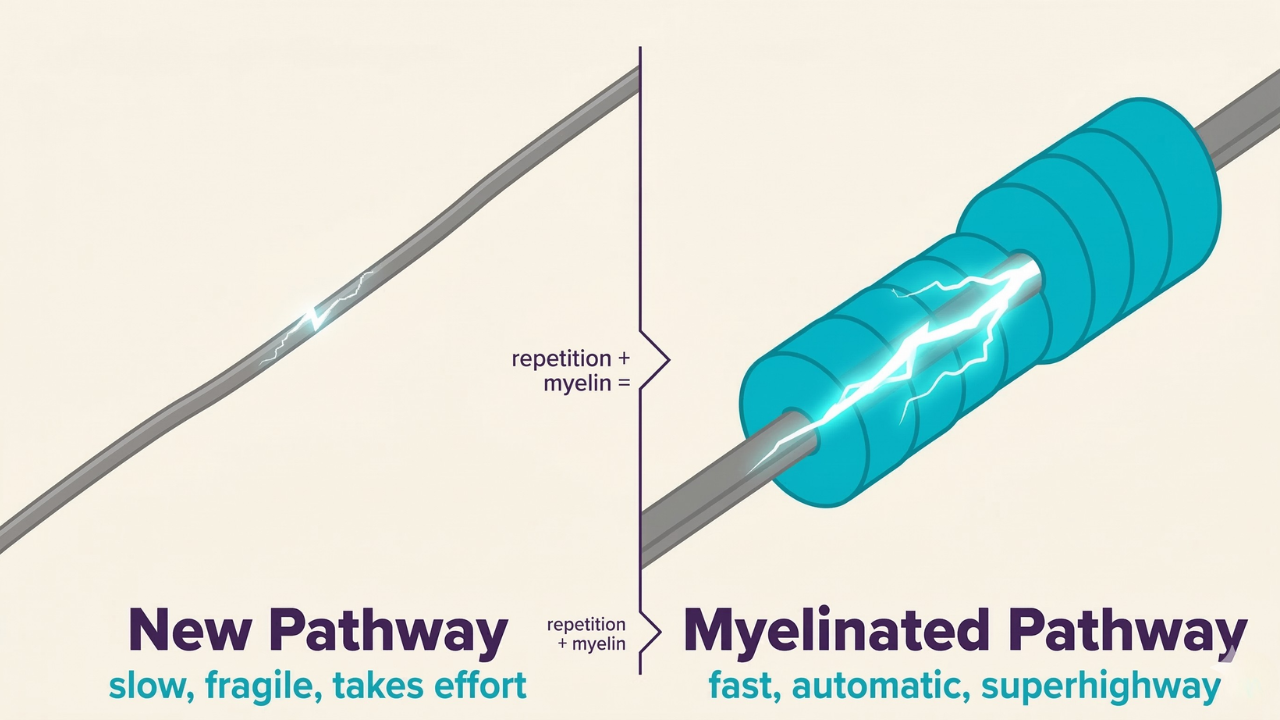
This is where you’re literally creating a new chemical pattern in your nervous system. Your brain doesn’t distinguish between a vividly imagined experience and a real one. When you feelingly inhabit the Authentic Self response, you’re building new myelin sheaths, new neural pathways, and a new emotional addiction to replace the old trauma pattern.
That’s you when you realize: I can’t just think my way into confidence. I have to feel myself as the confident person, let my nervous system taste that chemistry, and repeat it until it becomes more familiar than the old fear pattern.
Feelization is the final step because it’s the bridge between healing insight and behavioral change. You’ve gone through the pain, traced it to its origin, envisioned the opposite, and now you’re building a new emotional blueprint that feels as real and as automatic as the old one. This is actual healing.
How the Authentic Self Cycle™ Replaces Suffering With Healing
The Authentic Self Cycle™ is the long-term system for living from your healed emotional blueprint. Where the Worst Day Cycle™ moves you from Trauma → Fear → Shame → Denial, the Authentic Self Cycle™ moves you from Truth → Responsibility → Healing → Forgiveness. This is the new baseline for your nervous system.
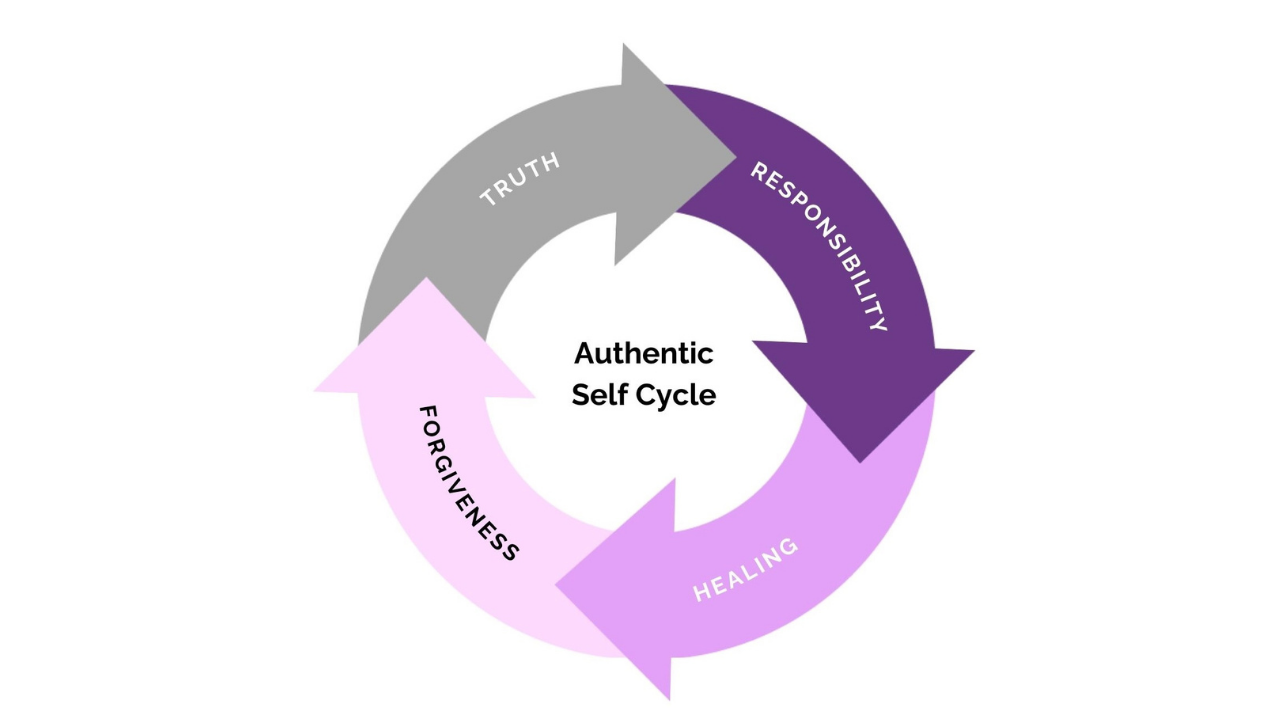
Stage 1: Truth (Name the Emotional Blueprint)
Truth is seeing clearly: this feeling isn’t about today—it’s about the emotional blueprint written in childhood. Your partner raised their voice (today’s event) and you spiraled into abandonment panic (yesterday’s blueprint). That’s truth. Not blame, not judgment—just clarity.
The practice: When triggered, pause and name it: This is my blueprint about abandonment. This is my pattern of shame. This is what my nervous system learned in my family of origin. The simple act of naming removes the charge. Your adult brain has now recognized what’s happening, and your nervous system can rest slightly—you’re not in actual danger.
Stage 2: Responsibility (Own Your Nervous System, Not the Event)
Responsibility doesn’t mean blame—it means ownership. That’s you when you realize: My partner isn’t my parent. My nervous system just thinks they are. I’m responsible for regulating my response to the trigger, not for controlling whether the trigger happens.
The practice: When triggered, take responsibility for your emotional reaction without blaming the other person: My fear of abandonment got triggered. That’s mine to regulate. Your behavior might have triggered it, but the reaction is my nervous system’s pattern, and it’s my job to work with it.
This is where the Victim Position Paradox resolves. You’re no longer the victim of your partner, your family, or your circumstances. You’re the person responsible for rewiring your nervous system. This shift from victim to author is where real power begins.
Stage 3: Healing (Rewire the Blueprint)
Healing is where you apply the Emotional Authenticity Method™ to the triggered blueprint. You go through the six steps, you go through the pain, you feelingly inhabit the Authentic Self response, and you build new neural pathways. This isn’t one-and-done. Healing is the practice you repeat every time the old pattern surfaces.
The deeper truth: Healing doesn’t mean the old blueprint disappears. It means the Authentic Self blueprint becomes more familiar, more automatic, more real than the trauma blueprint. Eventually, you’re choosing the Authentic Self response not because you’re trying to be good—because it’s genuinely what feels safest and most true to your actual self.
Stage 4: Forgiveness (Release the Inherited Pattern)
Forgiveness isn’t forgetting or condoning. It’s releasing the grip of the inherited emotional blueprint. It’s the moment you say: I inherited a nervous system shaped by my parents’ nervousness, my family’s patterns, my culture’s messages. That wasn’t my fault. Now it’s my responsibility, and I’m choosing to rewire it.
Forgiveness is for you—it’s the release of the rage, the blame, the demand that your past should have been different (even though you can’t change the past anyway). Holding unforgiveness is like drinking poison and expecting the person who hurt you to die. You’re just poisoning yourself further.
That’s what’s happening when you can finally feel compassion for your parent who yelled, your ex who left, your boss who criticized—not because they were right, but because they were operating from their own damaged nervous system. And you no longer need them to have been different in order for you to be okay.
The Authentic Self Cycle™ is the new home for your nervous system. It’s not a destination you reach and stay at—it’s a cycle you return to every time the old pattern surfaces. Over time, you spend more moments in this cycle and fewer in the Worst Day Cycle™. Eventually, the Authentic Self becomes your baseline, and the trauma pattern becomes the occasional visitor instead of your permanent resident.
Frequently Asked Questions
Does healing emotional pain avoidance mean I have to keep relationships with people who harmed me?
No. Healing your nervous system blueprint is separate from your relationship boundaries. You can completely rewire your emotional patterns and still choose not to have contact with someone who was harmful. In fact, once you heal your blueprint, you make clearer decisions about your relationships because you’re choosing from your Authentic Self instead of from your survival persona’s need to maintain connection at all costs.
How long does it take to actually change your emotional blueprint?
This is individual, but here’s what’s true: measurable emotional shifts can happen in weeks (in your reactivity, your clarity, your sense of possibility). Deeper nervous system rewiring takes months or years of consistent practice. The Emotional Authenticity Method™ is something you repeat every time the old pattern surfaces, and over time, the new pattern becomes more automatic. Think of it like building a muscle—you don’t exercise once and have the muscle forever. You practice consistently, and the muscle gets stronger and more available.
What if I don’t remember my childhood or the origin of my pattern?
The memory doesn’t have to be a specific event. Sometimes it’s a feeling, a atmosphere, a sense of danger, or a general knowing about what your family system was like. Your nervous system has the memory even if your conscious mind doesn’t. When you do the Emotional Authenticity Method™, the origin often surfaces naturally—sometimes in pieces, sometimes all at once. Trust the process.
Can I heal emotional avoidance patterns while still in the relationship that triggers them?
Yes. In fact, sometimes the relationship is the laboratory where you practice the new skills. When your nervous system is triggered, that’s when you have the opportunity to rewire. The person triggering you is showing you exactly where your blueprint needs attention. That said, some relationships are genuinely unsafe, and healing sometimes requires leaving. The Authentic Self Cycle™ helps you make that decision from clarity, not from survival panic.
Is emotional pain avoidance the same as coping with stress?
Not entirely. Healthy stress management is feeling the stress, using actual tools to regulate, and then returning to baseline. Emotional pain avoidance is the chronic refusal to feel specific emotions, which leads to building entire life structures (survival personas, addictions, relationships) around not feeling them. One is management; the other is denial masquerading as management.
What if I intellectually understand all of this but still feel stuck?
That’s the key distinction: understanding is step one. But your nervous system doesn’t change through understanding alone—it changes through repeated emotional experience. This is why Step 6 (Feelization) is so critical. You have to feel the new blueprint, let your body taste the new safety chemistry, and repeat it until it becomes more automatic than the old pattern. If you’re stuck at understanding, it means you haven’t yet done the somatic work of actually rewiring through feeling.
The Bottom Line: You Can Stop Running
The suffering you’re experiencing isn’t the original childhood pain. It’s the pain of running from it. Every avoidance strategy—the food, the work, the relationships, the perfectionism, the people-pleasing, the rage—is costing you more energy, more authenticity, and more life than simply going through the original pain ever would.
The Worst Day Cycle™ is the inherited blueprint. The Authentic Self Cycle™ is the chosen blueprint. The Emotional Authenticity Method™ is how you practice moving from one to the other.
Your survival persona protected you brilliantly in childhood. Thank it. Honor it. And then tell your nervous system the truth: you’re safe now. You don’t need to avoid anymore. You’re ready to feel, to heal, and to be genuinely, vulnerably, authentically yourself.
The exit from the labyrinth of denial isn’t escape. It’s integration. And the only way through is through.
Recommended Reading
- Melodie Beattie — Codependent No More (the classic on releasing avoidance-driven relationships)
- Gabor Maté — When the Body Says No (how suppressed emotions create physical illness)
- Mellody Hobson — Losing Love (understanding trauma bonding and why we choose familiar pain)
- Brené Brown — Dare to Lead (shame and vulnerability in creating authentic leadership and relationships)
- Peter Levine — Waking the Tiger (somatic trauma release and nervous system healing)
- Bessel van der Kolk — The Body Keeps the Score (how trauma lives in the body and why talk therapy alone isn’t enough)
- John Bowlby — A Secure Base (attachment theory and how childhood safety shapes adult relationships)
Ready to Stop Avoiding and Start Healing?
Understanding emotional pain avoidance intellectually is one thing. Rewiring your nervous system is another. If you’re ready to actually heal—not just understand—these courses will guide you through the exact process:
- Emotional Blueprint Starter Course — Individual ($79) — Foundation work on identifying your survival persona and beginning emotional authenticity practice
- Relationship Starter Course — Couples ($79) — How to practice the Authentic Self Cycle™ within your romantic relationship
- Why We Can’t Stop Hurting Each Other ($479) — Deep dive into the Worst Day Cycle™ and how trauma patterns play out in relationships
- Why High Achievers Fail at Love ($479) — For the falsely empowered persona: how drive and perfectionism sabotage the relationships you actually want
- The Shutdown Avoidant Partner ($479) — Understanding and healing dismissive attachment patterns
- Tier 1: Mapping the Blueprint ($1,379) — Comprehensive system for building your Authentic Self and rewiring your emotional blueprint
You don’t have to keep running. Your nervous system has been trying to protect you with the same strategies that now cause suffering. That protection is no longer necessary. You’re ready to feel, to heal, and to reclaim your authentic self.