Tag: burnout recovery

  • How to Heal Self-Abandonment: 3 Daily Practices for High Achievers

    How to Heal Self-Abandonment: 3 Daily Practices for High Achievers

    Self-abandonment is the act of chronically ignoring your own feelings, needs, and boundaries in order to maintain connection, approval, or safety. It is one of the most common — and most invisible — patterns in high achievers. If you grew up learning that your worth depended on what you produced, how you performed, or how little you needed, you learned to abandon yourself long before you had words for it. And that pattern didn’t stop in childhood. It followed you into your career, your relationships, your body, and the quiet moments you spend alone.

    That’s you — the one who can run a company but can’t sit still for five minutes without reaching for your phone.

    This isn’t a character flaw. It’s a survival strategy that was brilliant when you were a child — and it’s destroying you now.

    Self-abandonment isn’t a single wound you fix with one breakthrough. It’s a daily pattern of ignoring your feelings, needs, and limits — built in childhood trauma. Healing requires small, repeated moments of self-loyalty using the Emotional Authenticity Method™, not more willpower or bigger achievements.
    Emotional authenticity icon representing self-abandonment healing through feeling your feelings

    What Is Self-Abandonment?

    Self-abandonment is the chronic pattern of dismissing, suppressing, or overriding your own emotional needs in favor of someone else’s comfort, approval, or expectations. It’s not a single event — it’s a way of living. Every time you say yes when your body screams no, every time you swallow your feelings to keep the peace, every time you push through exhaustion because resting feels dangerous — that is self-abandonment.

    That’s you — saying “I’m fine” when you’re falling apart inside, because showing vulnerability was never safe.

    Self-abandonment is the foundation of codependence. It’s the invisible cost of being the “strong one,” the “reliable one,” the one everyone leans on. And it starts in childhood — when the emotional environment taught you that your feelings didn’t matter, your needs were a burden, and your value was measured by what you gave, not who you were.

    Self-abandonment is the predictable outcome of childhood emotional neglect — the brain learns that suppressing your authentic self is the price of survival, and it automates that pattern for life.

    Why Do High Achievers Self-Abandon?

    High achievers are the most common self-abandoners — and the least likely to recognize it. That’s because their self-abandonment looks like discipline. It looks like drive. It looks like success.

    That’s you — working 12-hour days and calling it passion when really it’s just the only way you know how to feel safe.

    Here’s what actually happened: as a child, you learned that love, safety, or approval were conditional. They depended on your performance. On how little you needed. On how much you produced. So your brain built a survival strategy — become impressive, become indispensable, become so good that no one can reject you.
    Survival persona icon showing how high achievers use performance to mask self-abandonment

    And it worked. You built the career. You got the accolades. You became the person everyone admires.

    But underneath all of it — a quiet emptiness. A void. A hollow feeling that creeps in when the noise stops.

    That’s the void — the emotional space that exists because you’ve been abandoning yourself for decades and no amount of achievement can fill it.

    The brain conserves energy by repeating known patterns. It can’t tell right from wrong — only known from unknown. Since 70%+ of childhood messaging is negative and shaming, adults repeat these painful patterns in relationships, career, hobbies, health — everything. Your achievement isn’t healing. It’s the most socially acceptable form of self-abandonment.

    High achievers self-abandon because their childhood trauma taught them that their worth equals their output — the brain became chemically addicted to the stress-performance-validation loop, making self-abandonment feel like ambition.

    How the Worst Day Cycle™ Drives Self-Abandonment

    Self-abandonment isn’t random. It follows a predictable neurochemical pattern called the Worst Day Cycle™. Understanding this cycle is the first step to breaking free from it.
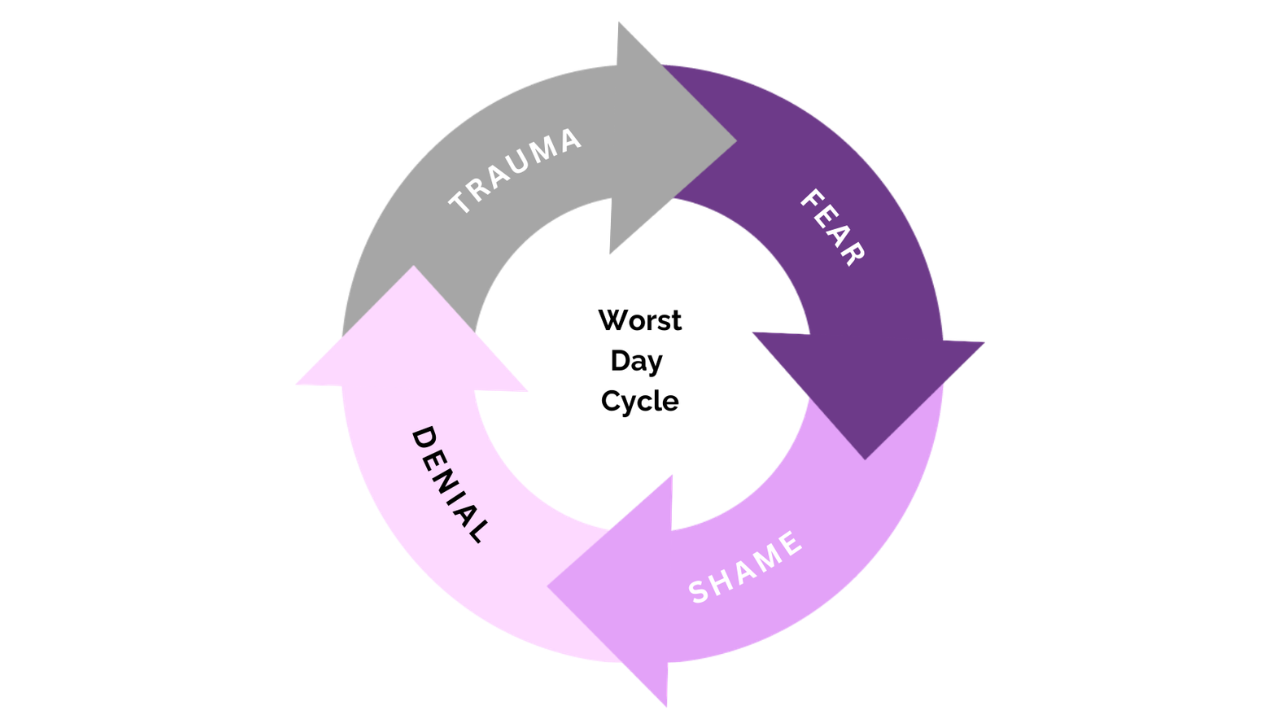
    Worst Day Cycle diagram showing trauma fear shame denial loop that drives self-abandonment

    The Worst Day Cycle™ has four stages: Trauma → Fear → Shame → Denial.

    Trauma: Any negative emotional experience in childhood that created painful meanings. It doesn’t have to be dramatic — it can be as subtle as a parent who was emotionally unavailable or a household where feelings were treated as weakness. These experiences create a massive chemical reaction in the brain and body. The hypothalamus generates chemical cocktails — cortisol, adrenaline, dopamine, oxytocin misfires — and the brain becomes addicted to these emotional states.

    That’s you — feeling most alive when you’re in crisis mode, because your nervous system was calibrated for chaos.

    Fear: Fear drives repetition. The brain thinks repetition equals safety. So you keep choosing the same relationships, the same work patterns, the same cycles of overgiving and burnout — not because you want to, but because your nervous system is terrified of the unknown.

    Shame: This is where you lost your inherent worth. “I am the problem.” Not “I made a mistake” — but “I AM the mistake.” This is the core wound underneath self-abandonment. You abandon yourself because deep down, you believe your authentic self isn’t worth keeping.

    That’s the shame talking — and it’s been running your life since before you could spell your own name.

    Denial: Denial is the survival persona you created to survive the pain. It was brilliant in childhood — absolutely necessary. But in adulthood, it sabotages everything. It keeps you performing instead of feeling. Producing instead of connecting. Running instead of resting.

    The Worst Day Cycle™ explains why self-abandonment feels automatic — your brain created a neurochemical loop in childhood that equates self-suppression with survival, and it repeats that loop thousands of times per day without your conscious awareness.

    What Are the Signs of Self-Abandonment?

    Self-abandonment is invisible because it disguises itself as virtue. It looks like being selfless, hardworking, flexible, and easygoing. But underneath those labels, your body is keeping score.

    That’s you — the person everyone describes as “so strong” while you’re silently drowning.

    Here are the signs that self-abandonment is running your life:

    You say yes when your body says no. You minimize your own feelings — “I shouldn’t be upset about this.” You consistently put others’ needs before your own, not out of generosity, but out of fear. You feel guilty for resting, for having needs, for taking up space. You numb out with food, scrolling, alcohol, work, or shopping when emotions get too big. You don’t know what you actually want — you only know what other people want from you. You feel responsible for other people’s emotions. You abandon your own plans the moment someone else has a preference.

    That’s you — knowing exactly what everyone else needs and having no idea what you need.
    Codependence icon showing the connection between self-abandonment and codependent patterns

    How Does Your Survival Persona Keep You Stuck in Self-Abandonment?

    Your survival persona is the identity you created in childhood to navigate an emotionally unsafe environment. It’s not who you are — it’s who you had to become. And it’s the engine that powers self-abandonment.

    There are three survival persona types:

    The Falsely Empowered: This persona controls, dominates, and rages. They look powerful on the outside, but their power comes from fear, not strength. They self-abandon by never allowing vulnerability — they perform strength instead of feeling anything real. They control others to avoid feeling out of control inside.

    That’s you — the CEO who can command a boardroom but can’t have a vulnerable conversation with your partner.
    Emotional fitness icon representing the work of healing survival persona patterns

    The Disempowered: This persona collapses, people-pleases, and disappears. They make themselves small to be safe. They self-abandon by making everyone else’s needs more important than their own — not out of love, but out of fear of abandonment. They believe that if they stop giving, they’ll be left.

    That’s you — the one who bends over backward for everyone and then wonders why you feel invisible.

    The Adapted Wounded Child: This persona oscillates between both — raging one moment, collapsing the next. They self-abandon by never having a stable sense of self. They flip between overperforming and shutting down, between control and submission, never landing in their authentic self.
    Adapted wounded child icon showing oscillation between falsely empowered and disempowered survival personas

    That’s you — the one who swings between “I don’t need anyone” and “please don’t leave me” and can’t figure out which one is real.

    Your survival persona is the most sophisticated form of self-abandonment because it replaces your authentic identity with a performance — and after decades, you can’t tell the difference between who you really are and who you had to become to survive.

    Why Can’t One Breakthrough Heal Self-Abandonment?

    High achievers love breakthroughs. The big realization. The life-changing seminar. The moment everything “clicks.” But here’s the truth no one tells you: you can’t heal a lifetime of self-abandonment with one breakthrough.

    That’s you — collecting insights like trophies and wondering why nothing actually changes.

    Here’s why breakthroughs fail: they target the thinking brain. They give you an intellectual understanding of your patterns. And for a few hours or days, you feel different. Hopeful. Clear.

    But self-abandonment doesn’t live in your thoughts. It lives in your nervous system. In your body. In the chemical patterns your brain has been running since childhood. And those patterns don’t care about your breakthrough. They respond to repetition, not realization.
    Trauma chemistry icon showing how childhood emotional patterns create neurochemical addiction

    Think of the second hand on a clock. It moves in tiny, almost insignificant ticks. But those ticks move the minute hand. The minutes move the hours. The hours change your entire day. Healing works the same way. It’s not dramatic. It’s repetitive. And it’s built on small moments where you choose not to abandon yourself.

    That’s the truth — you don’t need a bigger breakthrough. You need a smaller, more consistent practice.

    One breakthrough cannot heal self-abandonment because the pattern is stored in the body’s neurochemistry, not in the mind’s understanding — you cannot think your way out of a biochemical event that has been automated since childhood.

    How the Emotional Authenticity Method™ Rewires Self-Abandonment

    The Emotional Authenticity Method™ is the daily practice that actually rewires self-abandonment at the nervous system level. It works because it targets the body — where trauma lives — not just the mind.
    Emotional regulation icon representing the Emotional Authenticity Method for healing self-abandonment

    Here’s how it works:

    Step 1: Somatic Down-Regulation with optional Titration. Before you can process anything, you have to get your nervous system out of survival mode. This might mean deep breathing, grounding, or simply slowing down enough to feel your body. Titration means you go slowly — you don’t force yourself to feel everything at once.

    That’s you — learning that you don’t have to white-knuckle your way through healing.

    Step 2: What am I feeling? Most self-abandoners have no idea what they’re feeling. They’ve been disconnected from their emotions for so long that “fine” is their default answer. Using the Feelings Wheel, you develop emotional granularity — the ability to name specific emotions instead of lumping everything into “stressed” or “fine.”

    Step 3: Where in my body do I feel it? All emotional trauma is stored physically. Your chest tightens. Your stomach drops. Your jaw clenches. Locating the feeling in your body is how you move from intellectual understanding to somatic processing.

    Step 4: What is my earliest memory of this feeling? This is where the rewiring happens. You trace today’s reaction back to its childhood origin. You realize: this isn’t about today. My partner isn’t my parent. My nervous system just thinks they are.

    That’s the moment everything shifts — when you see that your reaction belongs to a five-year-old, not a forty-year-old.

    Step 5: Who would I be if I never had this feeling again? This is the vision step. It connects you to the Authentic Self Cycle™ and gives your nervous system a new destination — not more coping, but actual identity restoration.

    The Emotional Authenticity Method™ works because emotions are biochemical events — you cannot change emotional patterns through thoughts alone. Thoughts originate from feelings, not the other way around.

    3 Daily Practices That End Self-Abandonment

    These aren’t breakthroughs. They’re rewiring practices. Each one sends your nervous system a new message: “I’m not leaving you anymore.”

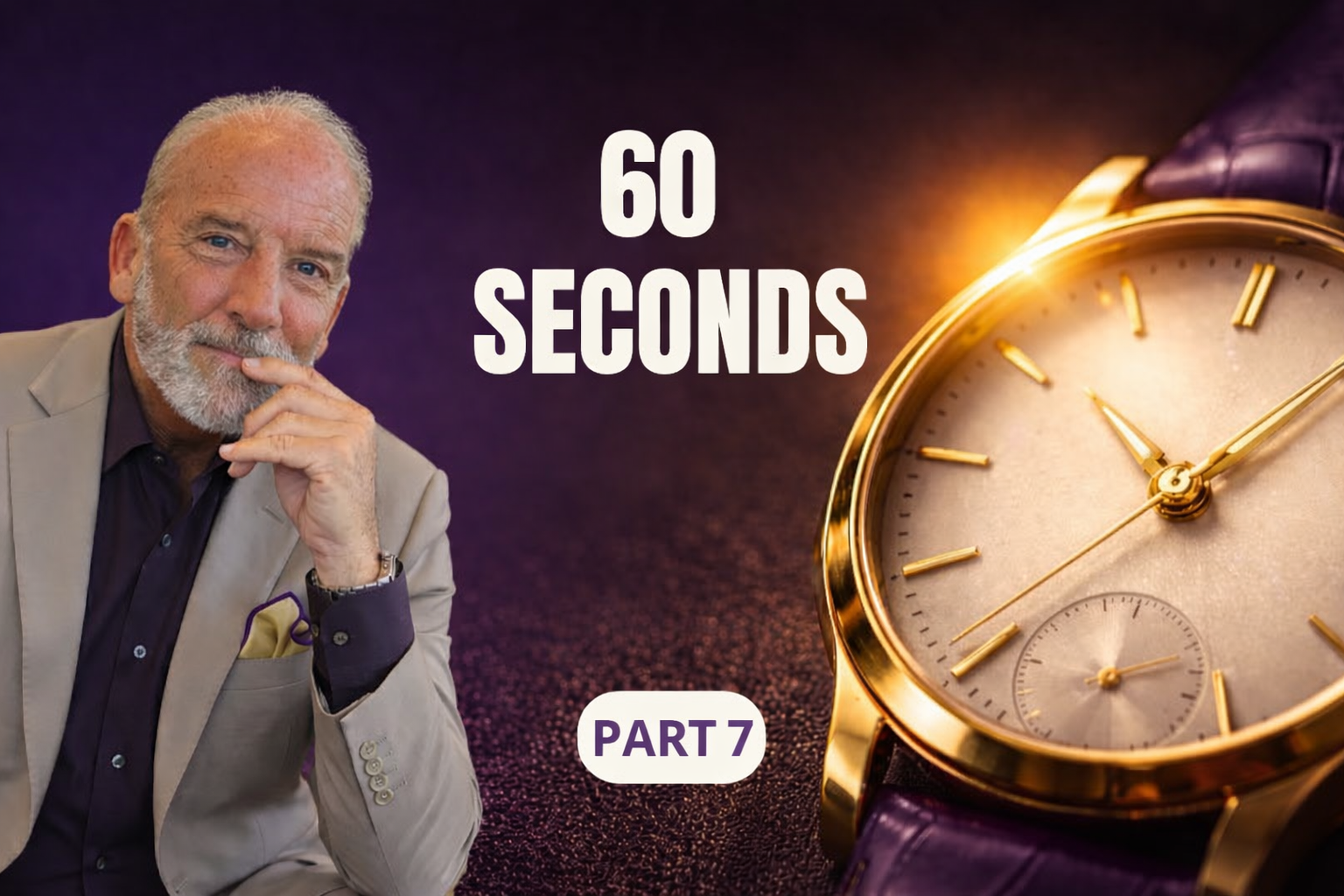
    Practice 1: The 60-Second Check-In. Most high achievers live from the neck up. They think their way through life. But every thought is driven by an emotion. So once a day — just once — pause for 60 seconds and ask: What am I feeling right now? What do I need in this moment? Not what should I feel. Not what do they need from me. Just you.

    That’s you — finally asking yourself the question nobody ever asked you as a child.

    You might notice anxiety, resentment, exhaustion, or numbness. And maybe what you need is water, a break, five minutes of silence, or permission to stop pushing. The goal isn’t perfection. The goal is emotional authenticity. Because the void grows when you never ask what you feel or need.

    Practice 2: The Micro-No. Many high achievers were trained to preserve connection by sacrificing themselves. The micro-no retrains your nervous system. Once a day, say no in a small way. Instead of “Yes, I’ll do it,” try “That doesn’t work for me right now.” Instead of responding immediately to every text, wait. Instead of staying three hours, stay one.

    That’s you — discovering that saying no doesn’t make people leave. It makes you arrive.

    Your body learned that saying no meant danger, rejection, disconnection. The micro-no teaches your body: “I can choose myself… and I’m still safe.” Every micro-no is one brick removed from the wall of self-abandonment.

    Practice 3: The Void Visit. This is the hardest one. Most people spend their lives avoiding silence. When it gets quiet, the void creeps in — that heavy, hollow, lonely feeling. Instead of running from it, visit it. Set a timer for 2 minutes, 1 minute, 30 seconds, or even 5 seconds — whatever you can tolerate. Sit still. No phone. No distraction. Just notice where you feel it in your body.

    That’s you — sitting with the part of yourself that’s been alone the longest, and finally saying: “I see you. And I’m not running.”

    The void isn’t punishment. It’s the part of you that’s been abandoned the longest. Visiting it is how you start rebuilding trust with yourself.
    Reparenting icon showing how daily practices rebuild self-trust and heal self-abandonment

    How the Authentic Self Cycle™ Replaces Self-Abandonment

    The Authentic Self Cycle™ is the healing counterpart to the Worst Day Cycle™. Where the Worst Day Cycle™ traps you in Trauma → Fear → Shame → Denial, the Authentic Self Cycle™ restores your identity through Truth → Responsibility → Healing → Forgiveness.
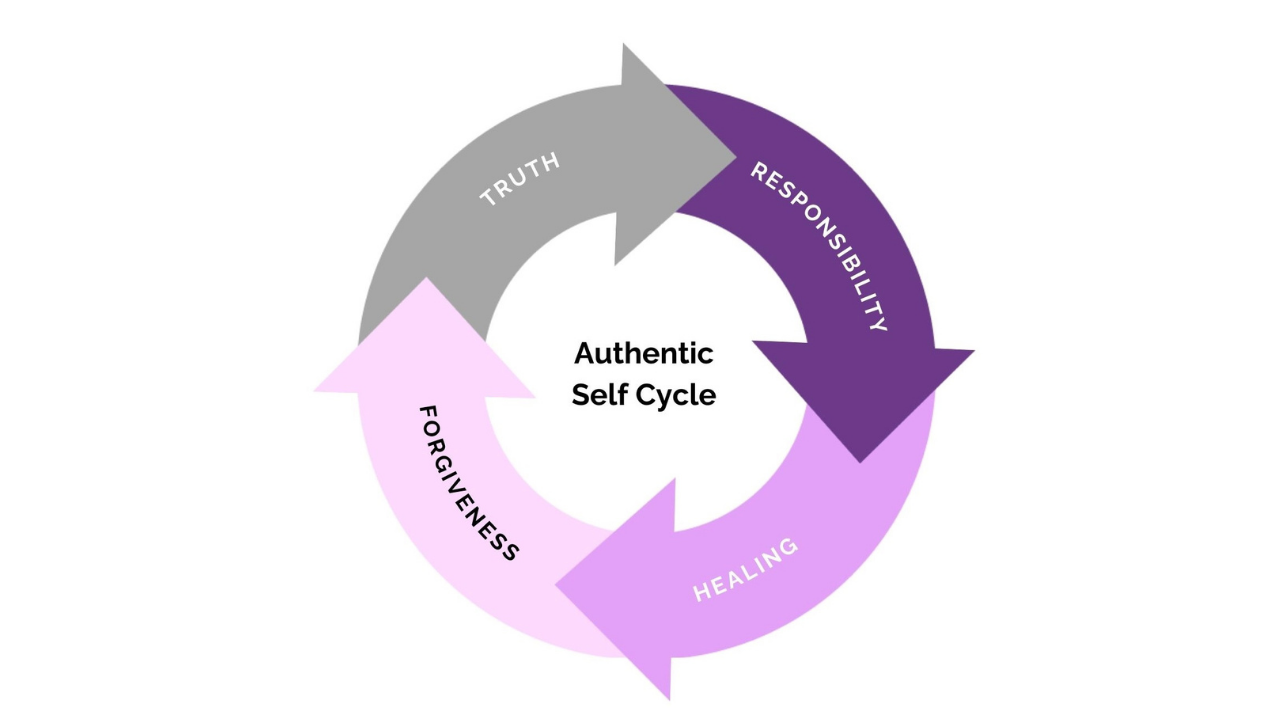
    Authentic Self Cycle diagram showing truth responsibility healing forgiveness as the path out of self-abandonment

    Truth: Name the blueprint. See that “this isn’t about today.” When your partner asks for space and your chest tightens, truth says: “This feeling is from childhood. My partner isn’t abandoning me — my nervous system just thinks they are.”

    That’s the first step out of self-abandonment — seeing the pattern instead of being trapped inside it.

    Responsibility: Own your emotional reactions without blame. “My partner isn’t my parent — my nervous system just thinks they are.” This isn’t about fault. It’s about taking back your power from a childhood that stole it.

    Healing: Rewire the emotional blueprint so conflict becomes uncomfortable but not dangerous, space isn’t abandonment, and intensity isn’t attack. This is where the three daily practices do their work — second by second, the clock ticks forward.

    Forgiveness: Release the inherited emotional blueprint and reclaim your authentic self. This creates a NEW emotional chemical pattern that replaces fear, shame, and denial with safety, worth, and connection.

    That’s you — not becoming someone new, but finally meeting who you always were underneath the survival persona.

    The Authentic Self Cycle™ is an identity restoration system — it doesn’t teach you to cope with self-abandonment, it replaces the neurochemical pattern that created it with a new blueprint built on truth, responsibility, and emotional authenticity.

    How Self-Abandonment Shows Up in Every Area of Your Life

    Family: You’re the peacekeeper. You manage everyone’s emotions. You swallow your reactions at holiday dinners. You feel responsible for your parents’ happiness — even now, as an adult. You over-function to keep the system running. And when you try to set a boundary, the guilt is so overwhelming that you cave.

    That’s you — still playing the role your family assigned you at age six.

    Romantic Relationships: You choose partners who need you more than they love you. You tolerate behavior that crosses your boundaries because leaving feels more terrifying than staying. You confuse intensity with intimacy. You abandon your needs to keep the relationship “safe” — and then feel resentful when your partner doesn’t read your mind.

    Sound familiar? The person who gives everything and then feels invisible?

    Friendships: You’re the friend everyone calls in a crisis but no one checks on. You listen for hours but never share your own struggles. You cancel your own plans when someone else needs you. You feel lonely even when surrounded by people because no one actually knows you — they know your survival persona.

    Work: You overdeliver. You say yes to every project. You check email at midnight. You take on other people’s responsibilities because if you don’t do it, no one will (or it won’t be good enough). Your worth is measured in productivity, and rest feels like laziness. You’ve been promoted for your self-abandonment — and rewarded for it.

    That’s you — getting promoted for the very pattern that’s destroying you.

    Body and Health: You ignore your body’s signals. You push through exhaustion, pain, hunger, and stress. You numb with food, alcohol, exercise, or scrolling. Your body has been trying to tell you something for years — but self-abandonment means you’ve stopped listening. Chronic pain, digestive issues, insomnia, and autoimmune conditions are often the body’s last resort when emotional signals have been ignored for decades.
    Emotional blueprint icon showing how childhood patterns create self-abandonment across all life areas

    Frequently Asked Questions About Self-Abandonment

    What is self-abandonment and how do I know if I’m doing it?

    Self-abandonment is the chronic pattern of ignoring your own feelings, needs, and boundaries to maintain connection or approval. You’re doing it if you consistently say yes when you mean no, if you don’t know what you actually want, if you feel guilty for resting, or if you make everyone else’s needs more important than your own. It usually originates in childhood emotional neglect and becomes so automatic that most people don’t realize they’re doing it.

    Can self-abandonment be healed without therapy?

    Self-abandonment can begin to heal with daily somatic practices like the Emotional Authenticity Method™ — but the depth of healing often depends on the depth of the original trauma. The three daily practices (60-Second Check-In, Micro-No, and Void Visit) create real neurological change. A skilled guide can accelerate the process, but the daily work is what creates lasting transformation.

    Why do high achievers struggle with self-abandonment more than others?

    High achievers learned in childhood that their worth was conditional on performance. Their self-abandonment got rewarded — with grades, promotions, praise, and success. So the pattern became invisible. They don’t see it as self-abandonment — they see it as discipline, drive, or work ethic. The Worst Day Cycle™ explains how childhood trauma creates a neurochemical addiction to the stress-performance-validation loop.

    What is the difference between self-care and healing self-abandonment?

    Self-care addresses symptoms — bubble baths, vacations, affirmations. Healing self-abandonment addresses the root cause — the childhood emotional blueprint that taught you to suppress your authentic self. You can practice self-care while still deeply self-abandoning. True healing means rewiring the nervous system’s relationship to your own feelings, needs, and worth using practices like the Emotional Authenticity Method™.

    How long does it take to stop self-abandoning?

    Self-abandonment patterns that have been running for 20, 30, or 40 years don’t reverse overnight. But noticeable shifts can happen within weeks of consistent daily practice. The key is repetition, not intensity. Small moments of self-loyalty — checking in with your feelings, saying a micro-no, sitting with the void — create cumulative neurological change. The Authentic Self Cycle™ provides the framework for long-term identity restoration.

    Is self-abandonment the same as codependency?

    Self-abandonment is the foundation of codependence. Codependence is the relational pattern that emerges when self-abandonment becomes your primary way of connecting with others. You abandon yourself to maintain attachment — giving too much, tolerating too much, and losing yourself in the process. Healing self-abandonment is the first step in healing codependence and building interdependence.

    The Bottom Line

    You don’t need a bigger breakthrough. You don’t need another seminar. You don’t need to try harder.

    You need to stop leaving yourself.

    Every 60-second check-in is a tiny act of self-loyalty. Every micro-no is a brick removed from the wall of self-abandonment. Every void visit is a message to the youngest part of you that says: “I see you. I’m here. And I’m not leaving.”

    Some days you’ll forget. Some days the survival persona will win. That doesn’t mean you failed — it means your brain is doing what it was trained to do. Healing is not about intensity. It’s about consistency. Tiny ticks of the clock. Truth. Responsibility. Healing. Over and over.

    That’s you — not the person who had the breakthrough. The person who showed up for themselves today. And tomorrow. And the day after that.

    The void doesn’t fill with achievement. It fills with presence. With honesty. With the willingness to finally stop running from yourself — and start running toward who you actually are.

    These books complement the frameworks in this article and can deepen your understanding of self-abandonment, codependence, and trauma recovery:

    Facing Codependence by Pia Mellody — the foundational text on how childhood trauma creates codependent patterns and self-abandonment.

    The Body Keeps the Score by Bessel van der Kolk — the science of how trauma lives in the body, not just the mind.

    When the Body Says No by Gabor Maté — how chronic self-abandonment manifests as physical illness and disease.

    Codependent No More by Melody Beattie — a practical guide to recognizing and healing codependent patterns.

    The Gifts of Imperfection by Brené Brown — how shame drives self-abandonment and how vulnerability is the path back to authenticity.

    Take the Next Step

    If you’re ready to stop self-abandoning and start building a life from your authentic self, Kenny Weiss offers courses designed for high achievers who are done performing and ready to heal:

    Emotional Blueprint Starter Course — Individual ($79) — Your personal roadmap to understanding the Worst Day Cycle™ and beginning the journey to your authentic self.

    Relationship Starter Course — Couples ($79) — For couples ready to break the cycle of reactivity and build interdependence.

    Why We Can’t Stop Hurting Each Other ($479) — Deep-dive into the Worst Day Cycle™ and how childhood trauma creates relationship pain.

    Why High Achievers Fail at Love ($479) — Built specifically for high achievers who have mastered their career but can’t figure out relationships.

    The Shutdown Avoidant Partner ($479) — Understanding avoidant attachment through the lens of trauma chemistry and survival personas.

    Tier 1: Mapping the Blueprint ($1,379) — The comprehensive program for learning and practicing the Emotional Authenticity Method™.

    Download the Feelings Wheel — the free tool used in Step 2 of the Emotional Authenticity Method™ to build emotional granularity.

    Explore more: The Signs of Enmeshment | 7 Signs of Relationship Insecurity | 7 Signs of High Self-Esteem | How to Determine Your Negotiables and Non-Negotiables | 10 Do’s and Don’ts for a Great Relationship
  • Why You Can’t Relax: The Nervous System Trap High Achievers Can’t Escape

    Why You Can’t Relax: The Nervous System Trap High Achievers Can’t Escape

    The inability to relax is not a personality trait or a lack of discipline — it is a neurochemical survival pattern built in childhood that keeps your nervous system locked in threat mode, making stillness feel dangerous even when you are completely safe. If you finally got the day off, the vacation, the quiet weekend — and your body responded with restlessness, guilt, anxiety, or an overwhelming urge to check your phone — you are not broken. Your nervous system is doing exactly what it was trained to do. And that training started long before your first job.

    That’s you — the one who can run a company but can’t sit on the couch for ten minutes without reaching for your laptop.

    This isn’t about discipline. It isn’t about gratitude. And it isn’t about “just learning to unwind.” It’s about a childhood emotional blueprint that wired your brain to equate stillness with danger — and until you address that blueprint, no vacation, meditation app, or productivity hack will ever let you truly rest.

    Emotional regulation icon showing why high achievers can't relax due to childhood nervous system patterns

    Why Can’t You Relax Even When Nothing Is Wrong?

    You finally got the break. No deadlines. No meetings. No one asking you for anything. You’ve been craving this for weeks. And then it happens — your body won’t cooperate. Your mind starts scanning for problems. Your chest tightens. Your leg bounces. You feel guilty for sitting still. So you grab your phone, open your laptop, start planning something, cleaning something, fixing something. Because doing nothing feels physically wrong.

    That’s you — craving rest with every cell in your body and then panicking the moment you actually get it.

    This isn’t a character flaw. It’s not that you “just like being busy.” Your nervous system is stuck in survival mode — and it has been since childhood. The brain has one job: keep you alive. It doesn’t care about your vision board or your work-life balance goals. It asks one question: “Am I safe right now?” And if your childhood taught it that stillness means danger — that calm means something bad is about to happen — then every quiet moment triggers an alarm.

    The inability to relax is the predictable result of a nervous system that was calibrated in childhood to treat stillness as a survival threat — the brain learned that hypervigilance and constant doing were the price of safety, and it automated that pattern for life.

    That’s you — the person whose body doesn’t know the difference between a Sunday afternoon and a childhood where quiet meant someone was about to explode.

    How Does Your Nervous System Keep You Stuck in Survival Mode?

    Your brain conserves energy by repeating known patterns. It can’t tell right from wrong — only known from unknown. If you grew up in an environment where being relaxed wasn’t safe, where having needs wasn’t welcomed, where love felt conditional, or where approval had to be earned — your nervous system learned something powerful: calm is dangerous and performance is safety.

    Trauma chemistry icon showing how childhood stress creates neurochemical addiction to urgency in high achievers who can't relax

    Since 70%+ of childhood messaging is negative and shaming, adults repeat these painful patterns in relationships, career, hobbies, health — everything. Your childhood created a massive chemical reaction in the brain and body. The hypothalamus generates chemical cocktails — cortisol, adrenaline, dopamine, oxytocin misfires — and the brain becomes addicted to these emotional states. So now, as an adult, even when your life looks stable and successful on the outside, your body still thinks it’s that kid trying not to get blindsided.

    That’s you — feeling most alive when you’re in crisis mode, because your nervous system was calibrated for chaos and quiet feels like the moment before the storm.

    That’s why when things go quiet, you don’t feel peace. You feel exposed. Your body has been running on stress hormones for so long that the absence of stress feels like something is wrong. The adrenaline, the cortisol, the rush of urgency — those stress chemicals are intense, but they’re familiar. And your brain loves familiar. It doesn’t know healthy from unhealthy. It only knows: “Have I survived this before?”

    That’s the trap — your brain keeps choosing urgency over peace, not because urgency is better, but because it’s the only thing your nervous system trusts.

    Your nervous system maintains survival mode because it became chemically addicted to the stress-performance-validation loop created in childhood — the brain treats the absence of stress as a threat signal, making genuine rest neurologically impossible without rewiring the original emotional blueprint.

    How the Worst Day Cycle™ Explains Why Calm Feels Dangerous

    The inability to relax isn’t random. It follows a predictable neurochemical pattern called the Worst Day Cycle™. Understanding this cycle is the first step to breaking free from the restlessness that runs your life.

    Worst Day Cycle diagram showing trauma fear shame denial loop that makes high achievers unable to relax

    The Worst Day Cycle™ has four stages: Trauma → Fear → Shame → Denial.

    Trauma: Any negative emotional experience in childhood that created painful meanings. It doesn’t have to be dramatic — it can be as subtle as a parent who was emotionally unavailable, a household where feelings were treated as weakness, or a caregiver whose love was conditional on performance. These experiences create a massive chemical reaction in the brain and body.

    That’s you — the one who grew up in a home where everything looked fine on the outside but your body was always bracing for impact.

    Fear: Fear drives repetition. The brain thinks repetition equals safety. So you keep choosing the same work patterns, the same relentless pace, the same cycles of overgiving and burnout — not because you want to, but because your nervous system is terrified of the unknown. Rest is unknown. Stillness is unknown. And to a trauma brain, unknown means dangerous.

    Shame: This is where you lost your inherent worth. “I am the problem.” Not “I made a mistake” — but “I AM the mistake.” This is the core wound underneath the inability to relax. You can’t rest because deep down, you believe your worth is conditional on your output. The moment you stop producing, the shame voice starts: “You’re lazy. You’re falling behind. You don’t deserve this.”

    That’s the shame talking — the voice that says you haven’t earned the right to sit down, and it’s been running your schedule since before you could spell your own name.

    Denial: Denial is the survival persona you created to survive the pain. It was brilliant in childhood — absolutely necessary. But in adulthood, it sabotages everything. It keeps you performing instead of feeling. Producing instead of resting. Running instead of being. You tell yourself: “I just have high standards.” “I’m wired this way.” “I’ll rest when I’m done.” But you’re never done — because done means feeling, and feeling means confronting the original wound.

    Emotional blueprint icon showing how childhood patterns make calm feel dangerous for high achievers

    The Worst Day Cycle™ reveals why you can’t relax — your brain created a neurochemical loop in childhood that equates stillness with danger and constant doing with survival, and it repeats that loop thousands of times per day without your conscious awareness.

    How Your Survival Persona Turns Rest Into a Threat

    Your survival persona is the identity you created in childhood to navigate an emotionally unsafe environment. It’s not who you are — it’s who you had to become. And it’s the engine that makes rest feel impossible.

    Survival persona icon showing how childhood identity adaptation prevents high achievers from relaxing

    There are three survival persona types:

    The Falsely Empowered: This persona controls, dominates, and rages. They can’t relax because relaxing means surrendering control — and control is the only thing that makes them feel safe. They fill every quiet moment with planning, strategizing, and managing. They look powerful on the outside, but their constant doing comes from fear, not strength.

    That’s you — the CEO who can command a boardroom but can’t sit through a movie without checking email, because sitting still feels like losing your grip on everything.

    The Disempowered: This persona collapses, people-pleases, and disappears. They can’t relax because resting means they’re not taking care of someone else — and if they’re not useful, they believe they’ll be abandoned. They fill every quiet moment with checking on others, anticipating needs, and staying available. Rest feels selfish. Stillness feels like the moment people will realize they don’t need you anymore.

    That’s you — the one who can’t take a vacation without bringing your laptop “just in case someone needs you,” because being needed is the only way you know how to matter.

    The Adapted Wounded Child: This persona oscillates between both — controlling one moment, collapsing the next. They can’t relax because they never have a stable sense of self. They swing between overperforming and shutting down, between filling every moment with activity and numbing out on the couch with their phone — but neither state is rest. It’s just two different forms of survival.

    Adapted wounded child icon showing oscillation between overperforming and numbing that prevents genuine rest

    That’s you — the one who swings between “I’ll sleep when I’m dead” and scrolling your phone for three hours in a fog, and neither one feels like actual rest.

    Your survival persona is the most sophisticated obstacle to genuine rest because it replaces your authentic relationship with your body with a performance — and after decades, you can’t tell the difference between productive rest and another form of self-abandonment.

    Why Are High Achievers Addicted to Urgency?

    When you live in survival mode long enough, your body gets hooked on the chemistry of it. Adrenaline. Cortisol. The rush of urgency. The “almost there” feeling. One more email. One more task. One more win. Those stress chemicals are intense — but they’re familiar. And your brain loves familiar.

    That’s you — the one who feels more comfortable in a crisis than on a beach, because chaos is the emotional weather you grew up in.

    Myelin and neural pathways icon showing how urgency addiction creates neurological grooves that prevent relaxation

    For many high achievers, productivity didn’t start as ambition. It started as adaptation. If you grew up in an environment where being relaxed wasn’t safe, where having needs wasn’t welcomed, where love felt conditional, or where approval had to be earned — your nervous system learned that calm is dangerous and performance is safety.

    So now, as an adult, you live in fight, flight, fawn, or freeze all day long — even when nothing bad is happening. Your body doesn’t know the difference between a real threat and a remembered one. Fight sounds like: “I’ll power through. I’ll outwork everyone.” Flight looks like constant busyness, over-scheduling, never sitting still. Fawn shows up as people-pleasing, over-giving, saying yes when you mean no. Freeze is numbing out — scrolling, zoning out, collapsing on the couch but not actually resting.

    That’s you — the one who collapses at 10pm and calls it rest, when really your body just ran out of cortisol and crashed into freeze mode.

    The void shows up loudest at night. After the launch. After the deadline. After everyone’s taken care of. When you finally sit down. That’s when the thoughts start racing: “What’s the point? Why do I feel alone? Why doesn’t any of this feel like enough?” Your survival system doesn’t celebrate your success. It panics in the quiet. Because it doesn’t know how to exist without scanning for what might go wrong.

    Sound familiar? The person who can’t enjoy a single evening without that hollow, restless, “something’s wrong” feeling creeping in?

    High achievers are addicted to urgency because their childhood trauma created a neurochemical dependency on stress hormones — the brain treats cortisol and adrenaline as evidence of safety through familiar repetition, making genuine rest feel like a withdrawal symptom rather than a reward.

    How the Inability to Relax Shows Up in Every Area of Your Life

    Family: You’re the one who plans every holiday, manages every conflict, and makes sure everyone else is comfortable. Even at family gatherings, you’re “on” — monitoring the room, smoothing over tension, handling logistics. You can’t sit and just be present with your family because your nervous system was trained to be the emotional manager of the household. And if you’re not managing, you feel useless.

    That’s you — still running the same emotional program your family assigned you at age six, even at the dinner table twenty years later.

    Romantic Relationships: You choose partners and then struggle to be present with them. You’re physically there but mentally elsewhere — planning, worrying, future-tripping. When your partner wants to just be together, doing nothing, you feel anxious. Intimacy requires presence, and presence requires your nervous system to feel safe. If it doesn’t, you stay in your head — and your partner feels it.

    Sound familiar? The partner who says “I love you” but can’t put the phone down, because being fully present with another human feels more vulnerable than running a business?

    Friendships: You’re the reliable one. The busy one. The one who’s hard to pin down. But your friends don’t know that your constant doing isn’t ambition — it’s a wall. If you slowed down enough to actually connect, they’d see the exhaustion, the loneliness, the person underneath the performance. And that feels terrifying.

    Work: You overdeliver. You say yes to every project. You check email at midnight. You take on other people’s responsibilities because if you don’t do it, no one will. Your worth is measured in productivity, and rest feels like laziness. You’ve been promoted for your inability to relax — and rewarded for it. The workplace celebrates your survival strategy. And every promotion makes it harder to stop.

    That’s you — getting promotions and praise for the very pattern that’s destroying your health, your relationships, and your connection to yourself.

    Body and Health: You push through exhaustion, pain, hunger, and stress. You ignore your body’s signals because stopping to listen feels dangerous. Chronic pain, digestive issues, insomnia, jaw clenching, shallow breathing — your body has been trying to get your attention for years. But your survival persona interprets body signals as weakness, not information. So you override them. Until your body forces you to stop.

    Emotional fitness icon representing the work of healing the nervous system so high achievers can finally rest

    How the Emotional Authenticity Method™ Teaches Your Body That Rest Is Safe

    The Emotional Authenticity Method™ is the daily practice that rewires your nervous system’s relationship with rest. It works because it targets the body — where the survival pattern lives — not just the mind.

    Emotional authenticity icon representing the method that teaches high achievers how to relax by rewiring the nervous system

    Step 1: Somatic Down-Regulation with optional Titration. Before you can process anything, you have to get your nervous system out of survival mode. This might mean deep breathing, grounding, or simply slowing down enough to feel your body. Titration means you go slowly — you don’t force yourself to feel everything at once. For someone who can’t relax, even 30 seconds of genuine stillness is a revolution.

    That’s you — learning that you don’t have to white-knuckle your way to calm. You just have to let your body experience safety in tiny doses.

    Step 2: What am I feeling? Most high achievers who can’t relax have no idea what they’re feeling. They’ve been disconnected from their emotions for so long that “stressed” is their default answer. Using the Feelings Wheel, you develop emotional granularity — the ability to name specific emotions instead of lumping everything into “stressed” or “fine.” When you can name the feeling underneath the restlessness — fear, guilt, shame, loneliness — the urgency begins to lose its grip.

    Step 3: Where in my body do I feel it? All emotional trauma is stored physically. The tight chest when you try to rest. The clenched jaw. The shallow breathing. The knot in your stomach. Locating the feeling in your body is how you move from intellectual understanding to somatic processing. Your inability to relax isn’t in your mind — it’s in your nervous system.

    Step 4: What is my earliest memory of this feeling? This is where the rewiring happens. You trace today’s restlessness back to its childhood origin. You realize: this isn’t about today. This isn’t laziness or a lack of discipline. My nervous system is replaying a childhood pattern where stillness meant danger. My partner isn’t my parent. My Sunday isn’t my childhood living room. My nervous system just thinks they are.

    That’s the moment everything shifts — when you see that your restlessness belongs to a seven-year-old who had to stay hypervigilant to survive, not a forty-year-old sitting on their own couch.

    Step 5: Who would I be if I never had this feeling again? This is the vision step. It connects you to the Authentic Self Cycle™ and gives your nervous system a new destination — not more coping, not “better relaxation techniques,” but actual identity restoration. Who would you be if rest felt safe? If you could sit in silence without guilt? If your worth wasn’t measured in productivity?

    The Emotional Authenticity Method™ works because emotions are biochemical events — you cannot change emotional patterns through thoughts alone. Thoughts originate from feelings, not the other way around. You can’t think your way to relaxation. You have to feel your way there.

    How the Authentic Self Cycle™ Replaces Survival Mode With Safety

    The Authentic Self Cycle™ is the healing counterpart to the Worst Day Cycle™. Where the Worst Day Cycle™ traps you in Trauma → Fear → Shame → Denial, the Authentic Self Cycle™ restores your identity through Truth → Responsibility → Healing → Forgiveness.

    Authentic Self Cycle diagram showing truth responsibility healing forgiveness pathway that replaces survival mode restlessness

    Truth: Name the blueprint. See that “this isn’t about today.” When you try to rest and your body floods with anxiety, truth says: “This feeling is from childhood. My couch isn’t a dangerous place — my nervous system just thinks it is because stillness was never safe growing up.”

    That’s the first step out of survival mode — seeing the pattern instead of being trapped inside it.

    Responsibility: Own your emotional reactions without blame. “My parents did the best they could with their own emotional blueprints — and the pattern they created in me is now mine to heal.” This isn’t about fault. It’s about taking back your power from a childhood that stole your ability to rest.

    Healing: Rewire the emotional blueprint so stillness becomes uncomfortable but not dangerous, rest isn’t laziness, and quiet isn’t the moment before the explosion. This is where the Emotional Authenticity Method™ does its daily work — second by second, like the ticks of a clock. The second hand moves in tiny, almost insignificant ticks. But those ticks move the minute hand. The minutes move the hours. Healing works the same way.

    Forgiveness: Release the inherited emotional blueprint and reclaim your authentic self. This creates a NEW emotional chemical pattern that replaces fear, shame, and denial with safety, worth, and connection. You don’t become someone new. You finally meet who you always were underneath the survival persona — someone who can achieve AND rest, produce AND be present, work AND feel worthy of stillness.

    That’s you — not the person who has to earn the right to sit down. The person who rests because they finally understand that their worth was never conditional on their output.

    Reparenting icon showing how the Authentic Self Cycle teaches the nervous system that rest is safe

    The Authentic Self Cycle™ is an identity restoration system — it doesn’t teach you relaxation techniques, it replaces the neurochemical pattern that made rest feel dangerous with a new blueprint built on truth, responsibility, and the understanding that your worth exists independent of your productivity.

    Why Willpower and Productivity Hacks Can’t Fix This

    You’ve probably tried everything. Morning routines. Meditation apps. Digital detoxes. Scheduled downtime. And maybe they worked — for a few hours. Maybe even a few days. But the restlessness always comes back. Because willpower targets the thinking brain. And your inability to relax doesn’t live in your thoughts. It lives in your nervous system.

    That’s you — the one who downloaded the meditation app, did it perfectly for a week, and then felt more anxious than before because sitting still surfaced feelings you’ve been running from for decades.

    You can’t out-optimize a survival pattern. You can’t hack your way to nervous system safety. The pattern was installed before you had language, before you had conscious memory, before you could make a choice about who to become. It was built into your body’s operating system. And it requires body-level rewiring to change — not another productivity framework.

    That’s the hardest truth for high achievers — you can’t achieve your way to rest. You can’t earn the right to relax. You have to feel your way to safety, and that means doing the one thing your survival persona was built to prevent: stopping.

    Frequently Asked Questions About Why You Can’t Relax

    Why can’t I relax even when nothing is wrong?

    Your inability to relax isn’t caused by current circumstances — it’s driven by a childhood emotional blueprint that trained your nervous system to treat stillness as a threat. The Worst Day Cycle™ explains how childhood trauma creates a neurochemical loop where the brain equates constant doing with safety. Your body doesn’t know the difference between a real threat and a remembered one, so it stays in survival mode even when you’re completely safe.

    Is the inability to relax a trauma response?

    Yes. For most high achievers, the inability to relax is a survival pattern that originated in childhood. If you grew up in an environment where love was conditional, feelings weren’t safe, or your worth depended on performance, your nervous system learned that stillness equals danger. This isn’t a personality trait — it’s an adaptation that was brilliant in childhood and sabotaging in adulthood.

    Why do high achievers feel guilty when they rest?

    Rest guilt comes from the shame stage of the Worst Day Cycle™. When your childhood blueprint taught you that your worth equals your output, resting triggers the core shame wound: “I am not enough unless I’m producing.” The guilt isn’t rational — it’s a neurochemical response from your survival persona, which believes that stopping means losing love, safety, or relevance.

    Can meditation help if you can’t relax?

    Meditation addresses symptoms — it can temporarily down-regulate your nervous system. But it doesn’t address the root cause: the childhood emotional blueprint that made stillness feel dangerous. The Emotional Authenticity Method™ goes deeper by tracing today’s restlessness to its childhood origin and rewiring the pattern at the nervous system level. Meditation manages the surface. Emotional authenticity heals the foundation.

    What is the difference between rest and freeze mode?

    Genuine rest involves a regulated nervous system that feels safe in stillness. Freeze mode is a survival response — your body collapses because it has exhausted its stress hormones, not because it feels safe. Scrolling your phone for three hours, zoning out on the couch, or sleeping twelve hours and waking up exhausted are freeze responses, not rest. The three survival persona types — falsely empowered, disempowered, and adapted wounded child — each have different freeze patterns that masquerade as relaxation.

    How long does it take to learn to genuinely relax?

    Nervous system patterns that have been running for 20, 30, or 40 years don’t reverse overnight. But noticeable shifts can happen within weeks of consistent daily practice with the Emotional Authenticity Method™. The key is repetition, not intensity. Small moments of genuine stillness — even 30 seconds — create cumulative neurological change. The Authentic Self Cycle™ provides the framework for long-term nervous system restoration.

    The Bottom Line

    Your inability to relax is not a personality trait. It is not weakness. It is not laziness. It is not proof you’re broken.

    It is proof you adapted to survive.

    Your nervous system simply never got the update that you’re not back there anymore. And because so many emotional patterns are formed between ages zero and seven — before you could even put words to them — this survival mode feels normal. It feels like “just who you are.”

    But it isn’t.

    You were not born incapable of rest. You were trained out of it. By a childhood that rewarded performance and punished stillness. By a nervous system that learned the only safe way to exist was to keep moving. By a survival persona that was brilliant at keeping you alive — and terrible at letting you live.

    That’s you — not the person who can’t relax. The person whose survival persona convinced them that rest is a privilege they haven’t earned yet. And that was never true.

    Healing doesn’t mean you stop achieving. It means you stop needing achievement to feel safe. It means rest becomes possible — not through willpower, but because your nervous system finally gets the message: you survived. You made it. You can put the armor down now.

    And once you begin to separate your survival persona from your authentic self, rest won’t feel like danger anymore. It will feel like home.

    These books complement the frameworks in this article and can deepen your understanding of why high achievers can’t relax:

    Facing Codependence by Pia Mellody — the foundational text on how childhood trauma creates the survival patterns that turn rest into a threat.

    The Body Keeps the Score by Bessel van der Kolk — the science of how trauma lives in the body and why your nervous system stays in survival mode decades after childhood ended.

    When the Body Says No by Gabor Maté — how chronic inability to rest manifests as physical illness and disease when the body’s signals are overridden for years.

    Codependent No More by Melody Beattie — a practical guide to recognizing when your inability to stop doing is actually codependent self-abandonment.

    The Gifts of Imperfection by Brené Brown — how shame drives performance-based identity and why vulnerability is the path back to genuine rest.

    Take the Next Step

    If you’re ready to teach your nervous system that rest is safe and stop running on survival mode, Kenny Weiss offers courses designed for high achievers who are done performing and ready to heal:

    Emotional Blueprint Starter Course — Individual ($79) — Your personal roadmap to understanding the Worst Day Cycle™ and beginning the journey from survival mode to genuine rest.

    Relationship Starter Course — Couples ($79) — For couples where one or both partners can’t slow down enough to be present in the relationship.

    Why We Can’t Stop Hurting Each Other ($479) — Deep-dive into the Worst Day Cycle™ and how childhood trauma creates the restlessness that destroys connection.

    Why High Achievers Fail at Love ($479) — Built specifically for high achievers who have mastered their career but can’t figure out how to be present in their relationships.

    The Shutdown Avoidant Partner ($479) — Understanding avoidant attachment through the lens of trauma chemistry and survival personas.

    Tier 1: Mapping the Blueprint ($1,379) — The comprehensive program for learning and practicing the Emotional Authenticity Method™.

    Download the Feelings Wheel — the free tool used in Step 2 of the Emotional Authenticity Method™ to build emotional granularity and finally name what’s underneath the restlessness.

    Explore more: The Signs of Enmeshment | 7 Signs of Relationship Insecurity | 7 Signs of High Self-Esteem | How to Determine Your Negotiables and Non-Negotiables | 10 Do’s and Don’ts for a Great Relationship

  • Shame Engine: Why Your Inner Critic Is a Trauma Response, Not Motivation

    Shame Engine: Why Your Inner Critic Is a Trauma Response, Not Motivation

    That critical voice telling you that you’re not good enough, not fast enough, not worthy of love or success? That’s not motivation. It’s not accountability. It’s your shame engine — and it’s been running since childhood.

    For years, you’ve believed that harsh inner critic was helping you. You thought the voice saying “You should be better” or “Why aren’t you further along?” was pushing you toward excellence. But here’s the truth: shame is never a pathway to sustainable success or healthy relationships. Shame is a survival mechanism your nervous system created when you were too young to have a choice. And like all survival mechanisms from childhood, it’s sabotaging your adult life.

    That’s you — the person grinding endlessly because you believe that if you just work hard enough, achieve enough, be perfect enough, people will finally see your worth.

    Table of Contents

    What Is the Shame Engine?

    The shame engine is the internal operating system your nervous system created to survive childhood pain. It’s not something you chose. It’s not something you “have wrong with you.” It’s a brilliant adaptation to an unbearable situation.

    But here’s the problem: the system that saved you in childhood is killing you in adulthood.

    The Emotional Authenticity system for healing the shame engine

    The shame engine operates through fear and shame. Fear tells you that if you stop working so hard, stop being perfect, stop managing everyone’s emotions, something catastrophic will happen. You’ll be abandoned. You’ll be exposed. You’ll prove that you’re actually worthless.

    Shame tells you that these fears are true — that you ARE the problem. Not your circumstances, not your upbringing, not the people who hurt you. You.

    That’s the voice that wakes you up at 3 AM obsessing over something you said two years ago.

    The shame engine is powered by your emotional blueprint — the unconscious rules about yourself, others, and the world that you absorbed before you could think critically. These rules were formed in response to childhood trauma (any negative emotional experience that created painful meanings about you). The shame engine then uses these rules to control your behavior through fear and shame, ensuring you never face whatever it is you’re protecting yourself from.

    How the Worst Day Cycle™ Creates the Shame Engine

    To understand the shame engine, you need to understand the Worst Day Cycle™ — the system that drives all self-sabotage.

    The Worst Day Cycle™ has four stages: Trauma → Fear → Shame → Denial.

    The Worst Day Cycle showing trauma, fear, shame, and denial stages

    Stage 1: Trauma (The Wound)

    Childhood trauma isn’t just abuse. It’s any negative emotional experience that created a painful meaning about you. Maybe your parent said, “Why are you so sensitive?” and you decided I’m broken. Maybe you came home excited about an achievement and got no response, so you learned My accomplishments don’t matter. Maybe you watched a parent’s rage and decided I need to control everything to stay safe.

    These moments create actual neurochemical changes in your developing brain. When you experience shame, fear, or abandonment in childhood, your brain releases a cocktail of stress hormones: cortisol floods your system, adrenaline spikes, and your brain becomes chemically addicted to these emotional states.

    How childhood trauma creates chemical addiction to fear and shame responses

    Stage 2: Fear (The Response)

    Your nervous system never forgets that wound. It learns to perceive threats everywhere — threats that look like the original pain. Now, as an adult, anything that resembles that childhood feeling triggers your threat detection system.

    A partner’s criticism triggers the same fear as a parent’s rejection. A setback at work triggers the same panic as parental disappointment. Space in a relationship triggers the same terror as childhood abandonment.

    That’s you — terrified of disappointing people because you learned that disappointment meant you were fundamentally unlovable.

    Fear drives repetition. Your brain conserves energy by repeating known patterns because it can’t tell the difference between safe and unsafe — only between known and unknown. Since 70%+ of childhood messaging is negative and shaming, your adult nervous system actually feels SAFER repeating these painful patterns in relationships, career, health, and hobbies than trying something new.

    Stage 3: Shame (The Collapse)

    Here’s where the shame engine fully activates. Instead of seeing the fear as your nervous system’s response to a childhood wound, you internalize it as truth about yourself.

    Shame is the belief: I AM the problem.

    Not “I made a mistake” (guilt — which is healthy). But “I am fundamentally broken, unworthy, unlovable.” That’s where you lose your inherent worth. That’s where the shame engine takes over.

    Stage 4: Denial (The Survival Persona)

    And then your nervous system does something brilliant to protect you: it creates a survival persona — a false identity designed to keep you safe from feeling that shame again.

    This survival persona is not lazy. It’s not selfish. It’s genius-level adaptation. But it’s also completely sabotaging your adult life.

    The Three Survival Personas and How Each Uses Shame

    Your survival persona is the “you” that emerged to survive childhood pain. There are three core types — and most people oscillate between them depending on the situation.

    The three survival personas: falsely empowered, disempowered, and adapted wounded child

    The Falsely Empowered Persona

    This person controls, dominates, and rages to avoid feeling helpless. The shame engine tells them: “If I’m in charge, if I win, if I’m perfect, people can’t hurt me or abandon me.”

    The falsely empowered persona is the high achiever, the perfectionist, the one who never asks for help. They’re driven by a deep terror of vulnerability and powerlessness. Work is their addiction, success is their medication, and failure is their nightmare.

    That’s you — the one who’d rather burn out than admit you’re exhausted, because admitting weakness feels like proof that you are fundamentally flawed.

    Their shame engine manifests as relentless self-criticism, rage when things don’t go perfectly, and deep loneliness despite external success. They’re terrified that if they slow down, everyone will see they’re a fraud.

    The Disempowered Persona

    This person collapses, people-pleases, and abandons themselves to avoid abandonment. The shame engine tells them: “If I make myself small, if I sacrifice myself, if I’m always available, people won’t leave me.”

    The disempowered persona believes their worth is conditional — based on what they do for others. They abandon their own needs, their own boundaries, their own voice. They become expert at managing other people’s emotions and completely blind to their own.

    Sound familiar — the feeling that you have to earn love through sacrifice, that saying no will cause abandonment, that your own needs are selfish?

    Their shame engine manifests as chronic resentment, depression, health issues from chronic stress, and relationships where they’re completely unvalued. They’re terrified that if they ask for anything, they’ll be seen as a burden.

    The Adapted Wounded Child

    This person oscillates between falsely empowered and disempowered depending on the context. One moment they’re raging and controlling, the next they’re collapsed and people-pleasing. They’re unpredictable even to themselves.

    The adapted wounded child survival persona oscillating between control and collapse

    The adapted wounded child learned that safety required constant vigilance. They had to be ready to control if someone got close, and ready to collapse if control failed. This person is exhausted by their own unpredictability.

    That’s you — the one who can’t understand why you blow up at your partner one moment and then become a doormat the next, wondering why you can’t just be consistent.

    All three survival personas use shame as a control mechanism. They tell you that if you step out of your survival role, if you become vulnerable, if you ask for what you need, you’ll be exposed, abandoned, or destroyed. The shame engine keeps you locked in this persona through fear and shame, ensuring you never risk the vulnerability that actual connection requires.

    How the Shame Engine Hijacks Every Area of Your Life

    The shame engine doesn’t just affect one area of your life. It’s a system that runs everything — because it’s your nervous system trying to keep you safe.

    In Family Relationships

    The shame engine keeps you enmeshed with the people who wounded you. You’re either trying to finally get their approval (falsely empowered) or you’re completely dependent on their validation (disempowered). You can’t set healthy boundaries because boundaries feel like abandonment.

    That’s the voice telling you that you should just accept the disrespect because “that’s just how they are,” or the one that says you’re selfish for wanting space from family.

    If you haven’t read about the signs of enmeshment, this is the core system running that dynamic.

    In Romantic Relationships

    The shame engine ensures you choose partners who trigger your childhood wounds. It keeps you in patterns where you’re either controlling and critical (falsely empowered) or accepting disrespect and abandonment (disempowered).

    You recreate the Worst Day Cycle™ with your partner over and over. They do something that triggers your fear, you shame yourself, you develop a coping strategy (control or collapse), and your partner reacts to your coping strategy, not the original issue.

    That’s you — unable to have a conversation about a legitimate need without either exploding or shutting down, wondering why your relationships never feel secure.

    Check out 7 signs of insecurity in relationships to see the shame engine in action in your romantic patterns.

    In Friendships

    The shame engine makes you either the friend who always has it together and secretly resents that others never check on you (falsely empowered), or the friend who abandons themselves completely and becomes bitter when others don’t reciprocate (disempowered).

    You don’t let people see you struggle. You don’t ask for support. And then you feel completely alone despite having many friends.

    That’s you — lonely in a room full of people, afraid that if you showed your real self, everyone would leave.

    In Your Career

    The falsely empowered shame engine shows up as burnout, perfectionism, and inability to delegate. The disempowered shame engine shows up as underearning, underselling yourself, and accepting terrible treatment from employers.

    Either way, you’re not working from your real motivation — you’re working from fear and shame. You’re proving something instead of creating something.

    Sound familiar — working 60+ hours a week because you believe that’s the only way you’re valuable, or staying in a job that pays you 30% less than your market value because you don’t think you deserve better?

    In Your Body and Health

    The shame engine creates disconnection from your body. You push through pain and exhaustion (falsely empowered) or you abandon self-care entirely (disempowered). Your body becomes something to fix, control, or ignore — never something to listen to.

    This disconnection keeps you from hearing the signals your nervous system is sending. You don’t know when you’re stressed until you’re burned out. You don’t know when you’re hungry until you’re starving. You don’t know when you need rest until you collapse.

    Emotional regulation as the foundation for body awareness and nervous system healing

    Why Positive Thinking Can’t Silence the Shame Engine

    Here’s what doesn’t work: affirmations. Willpower. Positive thinking. Cognitive reframing.

    You’ve probably already tried all of these. You’ve probably spent years telling yourself you’re worthy, you’re capable, you’re enough. And you probably still feel the shame.

    Here’s why: shame is not a thought — it’s a nervous system state. Your emotions are biochemical events, not intellectual ones. Thoughts originate from feelings, not the other way around. You cannot think your way out of a nervous system that’s still running the Worst Day Cycle™.

    When your nervous system is in fear, it doesn’t care what your mind says. It’s running on survival code written in childhood. That code says: “I need to either control everything or collapse completely. And if I don’t, I’ll be abandoned/destroyed/exposed.”

    Affirmations can’t reprogram that. Willpower can’t override that. Your conscious mind is no match for your nervous system’s survival patterns.

    That’s you — repeating “I am worthy” while your nervous system is screaming that you’re not, wondering why the affirmations aren’t working and then shaming yourself for not being “positive enough.”

    How the Emotional Authenticity Method™ Rewires the Shame Engine

    The only way to rewire the shame engine is to change your nervous system’s emotional blueprint. And that requires the Emotional Authenticity Method™ — a somatic, nervous-system-based approach that actually changes your neurochemistry.

    Here are the five steps:

    The five steps of the Emotional Authenticity Method for nervous system healing

    Step 1: Somatic Down-Regulation (With Optional Titration)

    Before you can do anything else, you need to get your nervous system below threat level. This isn’t meditation or deep breathing (though those can help). It’s about sending your body a signal that it’s safe enough to feel what you’re feeling.

    Somatic down-regulation might look like: movement (walking, dancing, shaking), breathwork, temperature changes (cold water on your face), bilateral stimulation (tapping alternating sides of your body), or safe touch.

    Titration is the practice of feeling a little bit of an emotion, getting regulated, then feeling a little bit more. You’re essentially teaching your nervous system that this feeling won’t destroy you — in manageable doses.

    That’s you — finally understanding why pushing through your feelings with willpower only makes things worse, and learning that sometimes “handling it” means pausing to calm your nervous system first.

    Step 2: What Am I Feeling? (Emotional Granularity)

    Most people respond to complex emotions by saying “I feel bad” or “I’m stressed.” Your nervous system needs more specificity to heal.

    Are you feeling shame, fear, grief, rage, loneliness, or something else? The Feelings Wheel is designed to help you develop emotional granularity — the ability to identify exactly what you’re experiencing beneath the surface.

    This matters because each emotion carries different information. Fear says “threat.” Shame says “I am the problem.” Grief says “I’ve lost something.” They require different responses.

    Sound familiar — naming a feeling and suddenly understanding what your nervous system has been trying to tell you, instead of just numbing it?

    Step 3: Where in My Body Do I Feel It?

    All emotional trauma is stored in your body. This is not metaphorical. Your nervous system holds the memory of every time you felt shame, fear, or abandonment in your tissues.

    When you feel an emotion, where does it live? In your chest? Your throat? Your stomach? Your limbs? The location matters because it’s where the nervous system is holding the pattern.

    As you learn to locate emotions in your body, you’re actually building the neural pathways that allow you to feel emotions instead of being controlled by them. You’re moving from “I AM anxious” to “I FEEL anxious in my chest” — and that difference is everything.

    Building myelin sheath through nervous system awareness for emotional healing

    Step 4: What Is My Earliest Memory of This Feeling?

    This is where the real magic happens. You’re going to trace this feeling back to its source — the original childhood moment when your nervous system learned this pattern.

    You might remember a specific moment. Or you might just get a sense of when you first learned that abandonment meant you were unlovable, or that vulnerability meant punishment, or that your needs would never be met.

    That’s you — suddenly understanding that your partner didn’t create this fear; your parent did. And your nervous system has just been replaying that pattern with every person you love.

    This step is where you shift from “Something is wrong with me” to “My nervous system learned something painful, and now it’s trying to protect me from that pain.” That compassion changes everything.

    Step 5: Who Would I Be If I Never Had This Feeling Again?

    This is the vision step — the place where you move from healing into building. You’re not trying to force yourself to feel different. You’re envisioning who you actually are when you’re not controlled by this fear or shame.

    What would you do? How would you show up? What would you create, ask for, risk? This isn’t about becoming someone new. It’s about accessing the authentic self that’s been hiding behind the survival persona.

    That’s the moment you realize: I could actually ask for what I need. I could actually leave. I could actually create. I could actually love myself.

    The Emotional Authenticity Method™ works because it speaks your nervous system’s language. It’s somatic, not intellectual. It honors the way emotions actually work — as biochemical patterns stored in your body. And it creates a new emotional chemical pattern (the Authentic Self Cycle™) that gradually replaces the fear/shame/denial pattern of the Worst Day Cycle™.

    How the Authentic Self Cycle™ Replaces Shame With Worth

    While the Worst Day Cycle™ is the system keeping you trapped in shame, the Authentic Self Cycle™ is the system that sets you free. It’s the healing counterpart — an identity restoration system with four stages: Truth → Responsibility → Healing → Forgiveness.

    The Authentic Self Cycle: Truth, Responsibility, Healing, and Forgiveness stages

    Stage 1: Truth (Name the Blueprint)

    Here’s where you stop blaming yourself and start seeing what actually happened. You name the blueprint — the unconscious rules about yourself and the world that you absorbed from childhood.

    “My parent’s criticism taught me that I’m never good enough.” “My parent’s unpredictability taught me that people can’t be trusted.” “My parent’s rejection taught me that my worth is conditional.”

    Truth is the moment you see: “This isn’t about today. This is about something my nervous system learned decades ago.”

    That’s you — realizing that you’re not actually defective, you’re just operating from an old emotional blueprint that made sense in childhood but is sabotaging everything now.

    Stage 2: Responsibility (Own Your Reactions Without Blame)

    Responsibility doesn’t mean blame. It means: “My partner isn’t my parent, but my nervous system thinks they are. And I need to own that.”

    This is where you stop making your partner, your boss, your friend responsible for your emotional regulation. You start recognizing: “I’m having a reaction to my blueprint, not to what they actually did.”

    Responsibility is the hardest stage because it means you can’t blame anyone else. But it’s also the most powerful, because it means you’re no longer a victim of your past — you’re the author of your future.

    Sound familiar — the relief of finally understanding that you can’t control anyone else, but you CAN rewire how you respond to them?

    Stage 3: Healing (Rewire the Emotional Blueprint)

    Once you’ve named the blueprint and owned your reactions, healing is about creating new neural pathways. It’s about teaching your nervous system that conflict can be uncomfortable without being dangerous, that space isn’t abandonment, that intensity isn’t attack.

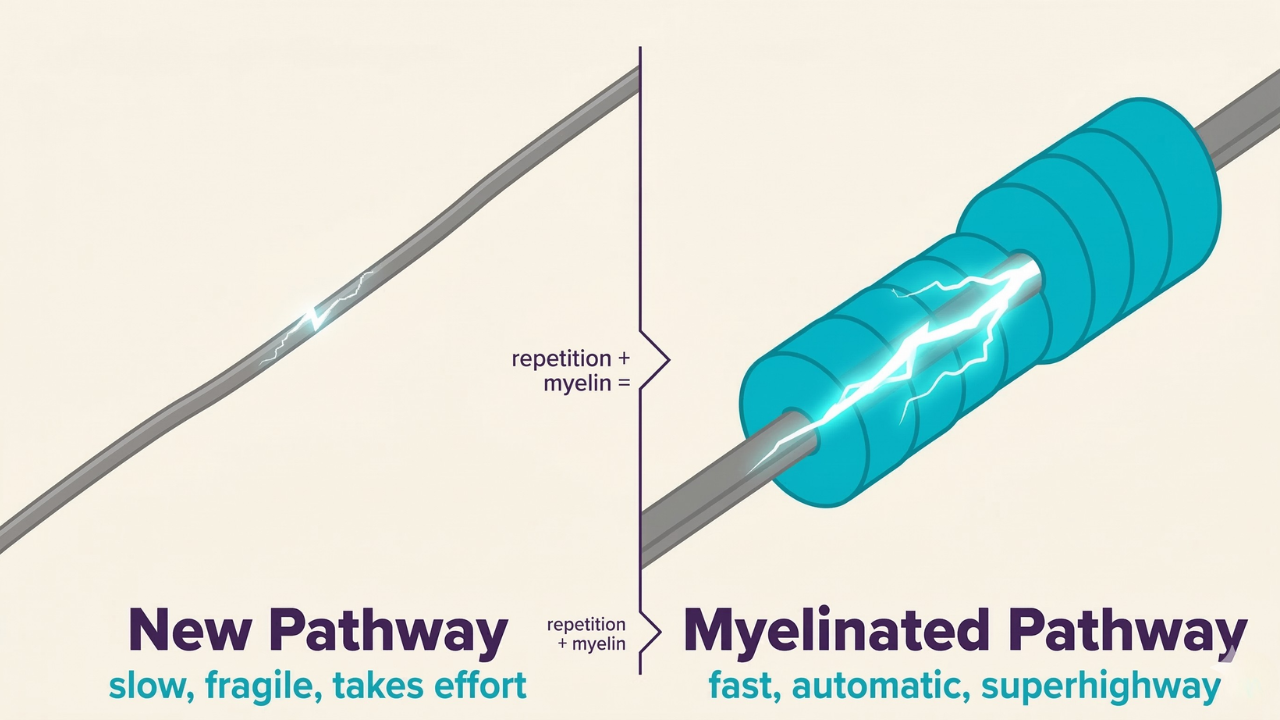
    This happens through repeated experiences of safety. Every time you feel an emotion without your survival persona taking over, you’re building new myelin. Every time you stay present in a difficult conversation, you’re rewiring your nervous system.

    This is where the Emotional Authenticity Method™ becomes essential — because you’re not just thinking differently, you’re training your nervous system to feel differently.

    Stage 4: Forgiveness (Release the Inherited Blueprint)

    Forgiveness doesn’t mean condoning what happened or saying the harm was okay. Forgiveness means releasing the inherited emotional blueprint — letting go of the rules you learned from your parents’ pain, their unmet needs, their survival strategies.

    You’re saying: “I understand why my parents created these rules. Their parents probably created them for the same reason. But I’m breaking the cycle. I’m not passing this to the next generation.”

    Forgiveness is reclaiming your inherent worth — the worth you had before anyone told you that you weren’t enough.

    That’s you — finally understanding that you were never the problem, and that the shame your parents carried was never actually yours to carry.

    The Authentic Self Cycle™ creates a new emotional chemical pattern that gradually replaces the fear/shame/denial pattern. As this new pattern strengthens, your survival persona becomes less necessary. You can access vulnerability without terror. You can set boundaries without rage. You can ask for what you need without shame. You’re not trying to force yourself to feel different — you’re building an actual new nervous system pattern.

    FAQ: People Also Ask

    Isn’t Some Shame Healthy? Don’t We Need That Inner Critic?

    No. There’s a difference between shame and healthy accountability. Guilt is healthy — it tells you that you did something against your values. “I hurt someone I care about, and I want to make it right.” That’s functional.

    Shame is different: “I am fundamentally broken and unworthy.” That’s the shame engine, and it never leads anywhere good.

    A healthy inner voice sounds like wisdom, not punishment. It sounds like someone who actually loves you — not like your critical parent.

    Can I Heal My Shame Engine Without Therapy?

    You can make progress on your own using the Emotional Authenticity Method™. But here’s the truth: your nervous system learned these patterns in relationship, so it heals most powerfully in relationship.

    Whether that’s therapy, coaching, group work, or a skilled partner who understands this system — having someone to witness and reflect your process accelerates healing dramatically. Your nervous system needs to feel safe enough to change, and that safety most powerfully comes through connection.

    How Long Does It Take to Rewire the Shame Engine?

    This depends on how long you’ve been running the Worst Day Cycle™ and how willing you are to do the work. Most people see shifts within weeks, but real neurological rewiring takes months and years.

    The good news: you don’t have to wait for complete healing to feel better. Within weeks, you’ll notice that your reactions are less automatic. Within months, you’ll notice that shame has less power. After a year of consistent work, your baseline nervous system state will be fundamentally different.

    What If My Shame Engine Is About Trauma That Wasn’t “That Bad”?

    Your trauma is valid regardless of how it compares to someone else’s. Your nervous system’s response to your experience is real, and the shame engine doesn’t discriminate based on severity.

    A child who was ignored experiences abandonment just as powerfully as a child who was abandoned. A child who was criticized experiences shame just as deeply as a child who was abused. Your nervous system doesn’t rate experiences on a scale of “bad enough” — it just learns the patterns.

    Can I Use This Method With High-Achievers and Ambitious People?

    Yes — in fact, many high achievers are desperate for this work. The falsely empowered survival persona creates tremendous external success and tremendous internal loneliness.

    Once they understand that shame is driving them, not motivation, they often become even more effective — because they’re working from their actual values and desires, not from fear and proving. Check out signs of high self-esteem to see what real motivation looks like.

    Is the Shame Engine Just Another Name for Codependency?

    Codependency is one expression of the shame engine, but not the only one. The shame engine drives all three survival personas — the falsely empowered controller, the disempowered people-pleaser, and the adapted wounded child who oscillates between both.

    If you want to explore codependency patterns specifically, read about negotiables and non-negotiables in codependence recovery.

    The Bottom Line

    That voice in your head telling you that you’re not good enough? It’s not your motivation. It’s not accountability. It’s your nervous system’s survival pattern — the shame engine running the Worst Day Cycle™.

    And here’s what no one tells you: you don’t have to believe it. You don’t have to obey it. You don’t have to let it run your life.

    The shame engine was brilliant in childhood — it helped you survive an impossible situation. But you’re not that child anymore. You have choices now. You have power now. You have worth now that has nothing to do with your performance.

    Your authentic self is still in there — the you that knows what you want, that sets boundaries without rage, that asks for what you need without shame, that creates from inspiration instead of fear.

    That person isn’t hiding because they don’t exist. They’re hiding because your survival persona is protecting them — trying to keep you safe from the pain of being seen, rejected, or abandoned.

    And that protection was necessary once. But it’s not anymore. You’re ready to step out of denial and into truth. You’re ready to move through the Authentic Self Cycle™. You’re ready to rewire the shame engine with the Emotional Authenticity Method™.

    Not through willpower. Not through positive thinking. But through actually changing your nervous system so that your authentic self becomes your default.

    That’s where real motivation lives. That’s where sustainable success lives. That’s where love lives. Not in the shame engine. In you.

    • Pia MellodyFacing Codependence (the foundational text on childhood trauma and codependence)
    • Melody BeattieCodependent No More (the foundation for understanding the disempowered persona)
    • Gabor MatéWhen the Body Says No (the neuroscience of emotional trauma)
    • Brené BrownDaring Greatly (shame resilience and vulnerability)
    • Bessel van der KolkThe Body Keeps the Score (trauma stored in the nervous system)
    • John BradshawHealing the Shame That Binds You (foundational work on toxic shame)
    • Susan DavidEmotional Agility (building emotional awareness without judgment)

    Start Your Healing Journey

    If you’re ready to rewire the shame engine and access your authentic self, these courses will guide you through the Emotional Authenticity Method™ and the Authentic Self Cycle™:

    You can also explore 10 dos and don’ts for a great relationship — a free resource for identifying your patterns in partnership.

    And don’t forget the Feelings Wheel exercise — one of the most powerful tools for building emotional granularity and rewiring your shame engine from the inside out.

  • Why High Achievers Chase Success: The Childhood Trauma Blueprint Behind the Void

    Why High Achievers Chase Success: The Childhood Trauma Blueprint Behind the Void

    The emotional blueprint from your childhood is running the show. Everything you’re achieving—the promotions, the money, the accolades—is an attempt to recreate the love, approval, and safety you never received as a kid. Your brain is addicted to the chemical states of your childhood trauma, and achievement is the drug. The Worst Day Cycle™ doesn’t care that you’re “successful” now. It’s still running the same neural pathways that taught you that your worth depends on what you *do*, not who you *are*. This post will show you why high achievers are actually chasing childhood, and how to break the loop.

    Your success isn’t about ambition—it’s about filling a void created in childhood. Your survival persona (likely falsely empowered) was designed to earn safety through achievement. Until you rewire your emotional blueprint using the Worst Day Cycle™ and Authentic Self Cycle™, you’ll keep chasing a childhood that has already passed.

    Table of Contents

    The Childhood Blueprint: How Achievement Became Your Survival Strategy

    When you were a kid, love was conditional. Or it was withheld. Or it came with strings attached that you had to figure out how to pull. Your parent needed you to be a certain way—smart, compliant, responsible, impressive, quiet, tough—and you learned that performing that role was the only way to get closeness, approval, or safety.

    So your brain did what brains do: it created a blueprint. An emotional blueprint that says, “If I achieve enough, I’ll finally get the love I deserve.” That’s you in every meeting, staying late, taking on one more project, proving yourself over and over.

    The problem isn’t your ambition. Ambition is fine. The problem is that achievement is medicating an unhealed wound from 30 years ago.

    Emotional blueprint from childhood trauma running your success drive

    Your childhood didn’t end when you turned 18. Your nervous system is still a kid. It’s still trying to win approval from a parent who may have never given it unconditionally. It’s still searching for the moment when you’ll finally feel safe—the moment when you’ve done enough, achieved enough, proven yourself enough.

    That moment doesn’t exist. Because achievement was never the real goal. Safety was. Love was. Belonging was. And none of those come from the corner office.

    That’s you, rationalizing one more deal, one more promotion, one more certification. Your survival persona took over a long time ago, and it’s still running the show.

    Why Achievement Feels Like Survival

    This isn’t weakness. This isn’t greed. This is neurology.

    When a kid experiences emotional trauma—whether that’s neglect, conditional love, pressure, shame, or chaos—the brain doesn’t label it as “bad parenting.” The brain labels it as “This is how survival works.” The hypothalamus releases a chemical cocktail: cortisol (stress), adrenaline (hypervigilance), dopamine misfires (seeking), and oxytocin misfires (false bonding).

    Your brain became *addicted* to these chemical states. Not in a weak way. In a survival way. Stress became familiar. Striving became home. The absence of pressure started to feel like death.

    So now, at 35 or 45 or 55, you *need* the next goal. You *need* the challenge. You *need* the pressure. Without it, you feel empty. Purposeless. Like you’re disappearing.

    Childhood trauma creates brain chemistry addiction to stress and achievement cycles

    That emptiness you feel when you’re not achieving? That’s not about the goal. That’s about the chemical state your brain lost. Your nervous system is jonesing for the dopamine hit of striving.

    The brain conserves energy by repeating known patterns. It can’t tell right from wrong—only known from unknown. Your childhood taught you that love comes from achievement. So your brain keeps running that pattern, over and over, hoping that *this time* it will work. That this success will finally fill the void.

    That’s the high-achiever’s trap. You’re not actually chasing the goal. You’re chasing the chemical state your childhood taught you was love.

    The Survival Persona: Your Falsely Empowered Self

    When you were a kid and your emotional needs weren’t met, you didn’t die. You adapted. You created a version of yourself that could survive the environment you were in. We call this your survival persona.

    If your parent was critical, controlling, or demanding, you likely developed what we call the falsely empowered survival persona. This version of you learned that:

    • Control = safety
    • Achievement = worth
    • Winning = survival
    • Vulnerability = weakness

    So you became driven. Competitive. Self-reliant to the point of isolation. You learned to outwork everyone, outsmart everyone, outachieve everyone. Because if you were the best, you couldn’t be rejected. If you were in control, you couldn’t be hurt.

    Survival persona types: falsely empowered, disempowered, and adapted wounded child response patterns

    There are three survival persona types. The falsely empowered one (controls, dominates, achieves). The disempowered one (collapses, people-pleases, disappears). And the adapted wounded child (oscillates between both, depending on context). All of them are brilliant survival strategies. All of them are sabotaging your adult relationships and happiness.

    Your survival persona kept you alive as a kid. It’s killing you as an adult.

    Because now, when your spouse asks for emotional intimacy, your falsely empowered persona turns it into a problem to solve or a threat to defend against. When your kid needs help, you turn it into a lesson about independence. When you feel vulnerable, you *immediately* pivot to achievement, to control, to the thing that kept you safe before.

    That’s you, saying yes to the promotion you don’t want, because saying no feels like admitting you’re not enough.

    Your survival persona isn’t your authentic self. It’s the version of you that your childhood *forced* you to become.

    The Worst Day Cycle™: How Childhood Runs Your Ambition

    The Worst Day Cycle™ has four stages, and it’s running in the background of every high achiever’s life. Understanding it is the difference between staying trapped and actually healing.

    Stage 1: Childhood Trauma (The Original Wound)

    Trauma isn’t always dramatic. It’s any negative emotional experience that created painful meanings about yourself, others, or the world. A parent who said you were “too sensitive.” A parent who only showed up when you performed. A parent who was emotionally absent, or emotionally unpredictable. A sibling who got more attention. A moment you felt publicly humiliated. A message that said, “Your worth depends on what you produce.”

    That’s trauma. And it created a belief: “I am the problem.” That’s shame.

    Stage 2: Fear (The Brain’s Protection Strategy)

    Once your brain learned that love was conditional on achievement, it became afraid. Afraid of rejection. Afraid of failure. Afraid of being “found out” as inadequate. So it developed a strategy: keep striving. If you never stop, you can never fail. If you never rest, you can never be abandoned.

    That’s you, unable to take a vacation without checking email. Unable to sit still without planning the next goal. Your brain is running a protection program that was designed for a scared kid, not a capable adult.

    Stage 3: Shame (The Void That Achievement Can Never Fill)

    This is where the void lives. Shame is the belief that “I am the problem.” Not “I made a mistake” (that’s guilt). But “There’s something fundamentally wrong with me.” That I’m not enough. Not smart enough, not lovable enough, not worthy of unconditional belonging.

    Achievement temporarily medicates shame. The promotion feels like proof that you’re okay. But the proof never lasts. Because shame isn’t about facts—it’s about a neural pathway that was carved into your brain when you were too small to defend yourself.

    Worst Day Cycle™ four stages: trauma, fear, shame, denial creating endless achievement loop

    That’s you, getting the promotion and feeling hollow 48 hours later. Reaching the goal and immediately seeing the next one. Your nervous system doesn’t care about the achievement. It cares about the chemical state. And shame is where the void lives.

    Stage 4: Denial (The Survival Persona Takes Control)

    The fourth stage is where your survival persona emerges. You don’t consciously think, “I’m going to deny my pain and create a falsely empowered self.” Your nervous system just does it. It’s brilliant. It’s adaptive. It’s devastating to your relationships and your internal peace.

    In this stage, you:

    • Deny that childhood still matters (self-deception)
    • Convince yourself that the next achievement will finally be enough
    • Numb yourself through busyness, work, and control
    • Push away anyone who asks you to be vulnerable

    Denial isn’t a character flaw. It’s how your nervous system kept you alive. The falsely empowered survival persona that emerged in denial was brilliant in childhood. It saved you. It protected you. It kept you safe.

    But now, that denial is running your adult life. And it’s running a loop: Trauma → Fear → Shame → Denial → Back to Fear. You keep chasing achievement because achievement is the only way your survival persona knows how to fill the void.

    That’s you, unable to rest because rest feels like dying. Unable to be vulnerable because vulnerability feels like weakness. Unable to be loved for who you are, only for what you do.

    7 Signs You’re Chasing Childhood, Not Success

    In Your Family Relationships

    Sign 1: You’re the fixer. When there’s a problem, you immediately take it on. You optimize, you solve, you control the outcome. You can’t relax until it’s fixed. That’s you, managing your parent’s retirement, solving your sibling’s problems, turning every family interaction into something you need to “handle.”

    That’s the falsely empowered survival persona. Your nervous system still believes that if you can just control enough, achieve enough, manage enough—then you’ll finally get the love you needed as a kid.

    Sign 2: You’re uncomfortable receiving care. Someone offers to help, and you immediately say no. Someone wants to take care of you, and you feel like you’re losing control. That’s because your childhood taught you that love meant earning it. Receiving it without earning it feels dangerous.

    Sound familiar? That’s shame. Your nervous system believes that if you’re not constantly producing, you’re worthless.

    In Your Romantic Relationships

    Sign 3: You choose partners who need to be “fixed.” Your partner is underachieving, emotionally unavailable, or struggling with something that you can solve. And you stay in the relationship as long as you have a project. Because being needed feels like being loved.

    That’s you, recreating the dynamic of your childhood where love was conditional on what you could provide.

    Sign 4: Emotional intimacy terrifies you. Your partner asks you to be vulnerable, and you either minimize (“I’m fine”) or pivot to problem-solving (“Here’s what we should do”). You can’t just *be* with your partner. You have to be performing, achieving, or managing.

    That’s your falsely empowered survival persona, convinced that vulnerability equals abandonment. If you see yourself in this, read about the 7 signs of relationship insecurity — you’ll recognize every one.

    In Your Friendships

    Sign 5: You’re the giver, not the receiver. You remember everyone’s birthday. You show up for everyone’s crisis. But when you need support, you withdraw. Because asking for help feels like admitting you’re not enough. Sound familiar? That’s the survival persona talking.

    That’s you, building relationships that are actually just extensions of the achievement game. Your friends like you for what you do for them, not who you are. So you keep proving yourself, over and over, wondering why you still feel alone.

    In Your Work Life

    Sign 6: You can’t stop even when you’re exhausted. Your body is screaming for rest. Your relationships are deteriorating. Your health is declining. But you keep pushing because stopping feels like dying. Because your worth is still built on what you produce.

    That’s not ambition. That’s an addiction to the chemical state of striving. Your nervous system is still a scared kid, convinced that if you ever stop, you’ll be abandoned or exposed as inadequate.

    Emotional fitness assessment: recognizing achievement addiction and survival persona patterns

    In Your Body and Health

    Sign 7: You’re numb or in constant pain. You’re disconnected from your body. You eat on autopilot. You exercise compulsively or not at all. You have chronic tension, headaches, or stomach issues. That’s because your nervous system is running a constant state of low-grade threat. Your body believes you’re still in danger.

    Emotional trauma is stored physically. Your nervous system can’t tell the difference between the criticism of your parent 30 years ago and the feedback from your boss today. Both feel like a threat to your survival.

    That’s you, jittery on coffee, unable to sleep, wondering why your body won’t cooperate with your mind’s plans.

    The Emotional Authenticity Method™: Breaking the Pattern

    You cannot think your way out of an emotional pattern. Your emotions aren’t thoughts. They’re biochemical events. Your thoughts originate from your feelings—not the other way around.

    This is crucial: willpower alone won’t break the Worst Day Cycle™. Mindset alone won’t do it. You need a method that works at the level where the pattern was created: the nervous system.

    The Emotional Authenticity Method™ is a five-step process that rewires your nervous system’s response to the old childhood patterns. Here’s how it works:

    Step 1: Somatic Down-Regulation (Get Out of Fight-or-Flight)

    Before you can think clearly, your nervous system has to feel safe. When you’re triggered—when you feel shame, fear, or the urge to achieve to fill the void—your brain is in fight-or-flight mode. Your prefrontal cortex (the thinking part) is offline.

    Somatic down-regulation means using your body to signal safety to your nervous system. Deep breathing. Cold water. Progressive muscle relaxation. Vagus nerve stimulation. You’re literally rewiring the chemical cascade that keeps you trapped in striving.

    Optional: Titration. If the emotion feels overwhelming, you can titrate—work with just a small piece of it at a time. Like turning down the volume on a speaker instead of yanking the plug. This prevents re-traumatization.

    That’s you, taking 60 seconds to breathe deeply instead of immediately jumping into the next task. Your nervous system starts to learn that you’re not in danger.

    Step 2: What Am I Feeling? (Emotional Granularity)

    Most high achievers are emotionally illiterate. You feel “stressed” or “fine”—but that’s just the surface. Under that, there’s shame, fear, loneliness, grief.

    This step is about naming the specific feeling. There’s a tool called the Feelings Wheel that shows you hundreds of feelings organized by emotion families. The Feelings Wheel is life-changing—when you can name a feeling with precision, your brain can process it.

    Instead of “I’m stressed,” you get to “I’m afraid I’m not enough and I’m ashamed that I need this achievement to feel okay about myself.”

    That specificity rewires your entire nervous system response.

    Step 3: Where in My Body Do I Feel It? (Somatic Awareness)

    All emotional trauma is stored physically. Your shame lives in your chest, your throat, your gut. Your fear lives in your shoulders, your jaw, your legs.

    This step is about locating the feeling in your body. Not thinking about it—feeling it. Sensing it. Where does the tightness live? Where does the heaviness sit? Where does the emptiness reside?

    When you can feel the feeling in your body, you can begin to release it. Your nervous system can process it. This is where the real healing begins.

    Emotional Authenticity Method™ five steps to rewire childhood emotional patterns

    Step 4: What Is My Earliest Memory of This Feeling? (Trace to Origin)

    This is where the magic happens. Your nervous system is telling you that you’re in danger *right now*. But you’re not. You’re 45 years old, successful, capable. Your nervous system is running an old file.

    This step asks: When did I first feel this feeling? What was the original situation? What did I decide about myself then?

    Maybe you’re feeling shame about not being enough in a work meeting. But when you trace it back, you find a memory of your parent saying, “You’ll never amount to anything.” Your nervous system isn’t reacting to today’s meeting. It’s reacting to that childhood message.

    Once you see it, everything changes. You can separate the old file from the present moment. You can tell your nervous system: “This isn’t 1989. I’m not a helpless kid. I’m safe now.”

    That’s you, seeing the connection between your relentless achievement drive and the message you got as a kid that you were never going to be enough.

    Step 5: Who Would I Be If I Never Had This Feeling Again? (Vision to Authentic Self)

    This is the bridge to the Authentic Self Cycle™. If you weren’t driven by shame, if you weren’t trying to fill this void through achievement—who would you actually be?

    What would you do for work? How would you show up in your relationships? What would you prioritize? How would you rest?

    This step isn’t about fantasy. It’s about vision. It’s about beginning to rewire toward your authentic self.

    The Authentic Self Cycle™: Healing the Blueprint

    The Worst Day Cycle™ is trauma repeating. The Authentic Self Cycle™ is healing emerging. These are the four stages of actual recovery:

    Stage 1: Truth (Name the Blueprint)

    You see clearly: “This isn’t about today. This is about my childhood. My parent’s criticism, my family’s conditional love, the message that my worth depends on achievement—that’s where this pattern comes from.”

    Truth isn’t about blame. It’s not about anger at your parents. It’s about seeing clearly. “This is my blueprint. I was taught this. It made sense then. It doesn’t serve me now.”

    That’s you, finally able to separate who you are from the survival persona you became.

    Stage 2: Responsibility (Own Your Reactions Without Blame)

    This is the hardest stage for high achievers because your falsely empowered survival persona sees responsibility as blame. But responsibility is actually freedom.

    Responsibility means: “My partner isn’t my parent. My nervous system just thinks they are. My boss’s feedback isn’t a threat to my survival. But my nervous system learned that any criticism equals shame and danger.”

    You’re not blaming yourself. You’re owning your emotional reactions. “This is my nervous system. This is my pattern. I’m responsible for rewiring it.”

    That’s you, stopping the blame game and actually starting to heal.

    Stage 3: Healing (Rewire the Blueprint)

    This is where the Emotional Authenticity Method™ lives. You’re rewiring your nervous system so that conflict becomes uncomfortable but not dangerous. Space becomes okay instead of abandonment. Intensity becomes feedback instead of attack.

    This isn’t fast. It’s not a breakthrough. It’s a clock metaphor: the second hand moves the minute hand. The minute hand moves the hour hand. Healing works the same way—through tiny, repeated moments where your nervous system learns something new.

    A moment where you rest and don’t feel guilty. A moment where you say no and don’t lose someone’s love. A moment where you fail and still feel worthy. These small moments, repeated thousands of times, rewire the neural pathways that trauma carved.

    Authentic Self Cycle™ healing stages: truth, responsibility, healing, forgiveness toward emotional authenticity

    This is where myelin comes in. Every time you repeat a new neural pathway—every time you choose authenticity over your survival persona—you strengthen that pathway’s myelin sheath. You’re literally rewiring your brain’s circuitry. Not overnight. But systematically. Over time.

    Stage 4: Forgiveness (Release the Inherited Blueprint)

    Forgiveness doesn’t mean your parent’s behavior was okay. It means you release the emotional blueprint you inherited. “I see what happened to you. I understand why you parented this way. I no longer need your emotional validation to feel okay about myself.”

    This is where you reclaim your authentic self. The version of you that isn’t performing, isn’t striving, isn’t trying to fill a void through achievement. The version that’s enough just by existing.

    That’s you, finally able to rest without guilt. Finally able to receive love without earning it. Finally able to be yourself instead of your survival persona.

    People Also Ask

    What if my parents actually did their best?

    They probably did. This isn’t about blame. Your parents were likely running their own Worst Day Cycle™, their own survival persona, their own unhealed trauma. Understanding that doesn’t erase what happened to you. It just means you get to break the cycle instead of passing it to your kids. Breaking inherited patterns is what real healing looks like.

    What if I’m successful? Doesn’t that mean I healed?

    No. Success and healing are completely different. You can be wildly successful and completely empty inside. You can have all the achievements and still be running the Worst Day Cycle™. True self-esteem comes from internal worth, not external achievement. Success is a symptom, not a solution.

    How long does it take to break this pattern?

    It depends on how deep the pattern runs and how committed you are to rewiring. But remember the clock metaphor: it’s not about one breakthrough moment. It’s about thousands of tiny moments where your nervous system learns something new. Months for some, years for others. The point isn’t speed. The point is consistency.

    What if I lose my ambition if I heal?

    This is the fear that keeps most high achievers trapped. But healing doesn’t mean losing ambition. It means your ambition comes from authenticity instead of trauma. You can still be driven. You just won’t be *compelled*. You’ll choose your goals from a place of alignment instead of filling a void. Many high-achievers discover that their authentic ambitions are actually different from what they thought they wanted.

    Can I do this alone, or do I need therapy?

    You can start the work yourself. The Emotional Authenticity Method™ is self-directed. But having a coach or therapist who understands trauma, survival personas, and the Worst Day Cycle™ accelerates everything. You’re rewiring neural pathways that have been in place for decades. Having expert guidance helps.

    What if my survival persona is actually helping me succeed?

    Your survival persona is sabotaging your relationships and your internal peace, even if it’s “helping” your career. Success at the expense of your closest relationships, your health, and your internal peace isn’t success. It’s a slow-motion car crash. The falsely empowered persona that got you here will keep you isolated, defended, and empty. Real success is being both accomplished and connected, driven and at peace.

    The Bottom Line

    You’re not chasing success. You’re chasing a different childhood. You’re trying to get from achievement what you never got from love. And no amount of promotions, accolades, or money will ever fill that void. Because the void isn’t about what you do. It’s about the message you got as a kid about who you are.

    Your survival persona—that falsely empowered, achievement-driven version of you—saved your life as a kid. It protected you. It kept you safe. It taught you how to survive in an environment that didn’t give you unconditional belonging.

    But that kid? That version of you that had to earn love through achievement? That version is exhausted. That version is empty. That version is lonely in a room full of people who admire you.

    The good news: you can heal this. You can rewire your emotional blueprint. You can break the Worst Day Cycle™ and step into the Authentic Self Cycle™. You can recover your authentic self—the version of you that doesn’t have to perform, doesn’t have to prove anything, doesn’t have to fill a void with achievement.

    But it requires you to do something your survival persona has spent decades resisting: get real about what’s actually happening. See the pattern. Feel the pain. And then—slowly, through tiny repeated moments—rewire it.

    The clock metaphor is everything: the second hand moves the minute hand. The minute hand moves the hour hand. Your healing works the same way. Not through dramatic breakthroughs. Through thousands of small moments where you choose authenticity over your survival persona. Where you rest instead of achieve. Where you receive instead of prove.

    That’s how you break free. Not by being harder. By being honest.

    Recommended Reading

    • Facing Codependence by Pia Mellody — Understanding the survival personas and how childhood trauma creates codependent patterns
    • The Body Keeps the Score by Bessel van der Kolk — How trauma is stored in your nervous system and why thinking alone doesn’t heal it
    • In the Realm of Hungry Ghosts by Gabor Maté — Understanding addiction, achievement, and the dopamine cycle of childhood trauma
    • Dare to Lead by Brené Brown — The vulnerability work that high achievers need to do
    • The Courage to be Disliked by Kishimi & Koga — Separating your authentic self from your survival persona

    Ready to Rewire Your Blueprint?

    Understanding the Worst Day Cycle™ and seeing your survival persona is the first step. Actually rewiring your emotional blueprint requires guided work.

    Here’s what we offer:

    • Emotional Blueprint Starter Course — Individual ($79) — For individuals ready to work alone with structure and frameworks
    • Relationship Starter Course — Couples ($79) — For partners who want to break the cycle together
    • Why We Can’t Stop Hurting Each Other ($479) — Deep dive into how childhood blueprints sabotage relationships
    • Why High Achievers Fail at Love ($479) — Specifically designed for the falsely empowered survival persona in relationships
    • The Shutdown Avoidant Partner ($479) — For when your survival persona shows up as emotional distance
    • Tier 1: Mapping the Blueprint ($1,379) — Complete certification-level mastery of the Emotional Authenticity Method™

    Start with whichever resonates most. The work begins where you are, not where you think you should be.

    See what real relationship health looks like when both partners are healed.

  • Your Success Is a Trauma Response: Why High Achievers Feel Empty

    Your Success Is a Trauma Response: Why High Achievers Feel Empty

    Your success is a trauma response — it is the survival persona’s most sophisticated strategy, built in childhood to earn love, prove worth, and avoid rejection, which is why no amount of achievement will ever fill the void inside. If you’ve hit every goal, built the career, became the person everyone depends on — and still feel a quiet emptiness underneath all of it — you’re not broken. You’re experiencing the predictable cost of running your entire adult life on a childhood survival blueprint that was never designed to make you happy. It was designed to keep you safe.

    That’s you — the one who can close a million-dollar deal but can’t sit still on a Sunday morning without reaching for your phone.

    This isn’t a lack of gratitude. It isn’t a character flaw. It’s the neurochemical evidence that your drive was never about ambition — it was about survival. And understanding that distinction is the first step toward building a life that actually feels as good as it looks.

    Emotional authenticity icon representing healing the trauma response behind high achiever success

    Why Is Your Success a Trauma Response?

    Most high achievers believe their success comes from ambition, talent, or discipline. And those things are real. But underneath them — driving them — is something most people never examine: a childhood emotional blueprint that wired your brain to equate performance with survival.

    That’s you — the one who built an empire because resting felt more dangerous than working yourself into the ground.

    Here’s what actually happened: as a child, you learned that love, safety, or approval were conditional. They depended on what you produced. On how little you needed. On how impressive you were. Maybe your parent only noticed you when you brought home straight A’s. Maybe the household was so chaotic that being the “responsible one” was the only way to feel safe. Maybe love showed up when you performed — and disappeared when you didn’t.

    So your brain did something brilliant: it built a survival strategy around achievement. Become impressive. Become indispensable. Become so successful that no one can reject you, abandon you, or see the shame underneath.

    That’s you — not chasing success because you love the work, but because your nervous system is terrified of what happens when you stop.

    Success as a trauma response is the predictable outcome of childhood emotional conditioning — the brain learned that performance equals safety and worth, then automated that pattern so thoroughly that most high achievers can’t distinguish between genuine ambition and survival-driven compulsion.

    Survival persona icon showing how high achievers use success as a trauma response to earn love and avoid rejection

    How the Worst Day Cycle™ Turns Trauma Into Achievement Addiction

    To understand why your success feels empty, you need to understand the neurochemical engine running underneath it. The Worst Day Cycle™ explains how childhood trauma creates an automated loop that drives achievement addiction — and why no amount of success can break it.

    Worst Day Cycle diagram showing trauma fear shame denial loop that drives success as a trauma response in high achievers

    The Worst Day Cycle™ has four stages: Trauma → Fear → Shame → Denial.

    Trauma: Any negative emotional experience in childhood that created painful meanings. It doesn’t have to be dramatic — it can be as subtle as a parent who was emotionally unavailable, a household where your feelings were treated as weakness, or a family system where love was earned through performance. These experiences create a massive chemical reaction in the brain and body. The hypothalamus generates chemical cocktails — cortisol, adrenaline, dopamine, oxytocin misfires — and the brain becomes addicted to these emotional states.

    That’s you — feeling most alive when you’re under pressure, because your nervous system was calibrated for high-stress performance in childhood and it’s been chasing that chemical cocktail ever since.

    Fear: Fear drives repetition. The brain conserves energy by repeating known patterns — it can’t tell right from wrong, only known from unknown. Since 70%+ of childhood messaging is negative and shaming, adults repeat these painful patterns in relationships, career, hobbies, health — everything. For high achievers, fear sounds like: “If I stop producing, I’ll lose everything. If I’m not impressive, I’m nothing.” So you keep achieving — not because you want to, but because your nervous system is terrified of what happens if you don’t.

    Shame: This is where you lost your inherent worth. “I am the problem.” Not “I made a mistake” — but “I AM the mistake.” This is the core wound underneath every high achiever’s drive. You don’t achieve because you’re confident. You achieve because deep down, you believe your authentic self isn’t enough — so you compensate with performance, production, and success. Every achievement is a temporary reprieve from the shame. And when the high fades, the shame comes flooding back.

    That’s the shame talking — the voice that says “I’ll finally feel okay when I hit the next goal.” But you’ve hit a hundred goals and the void is still there.

    Denial: Denial is the survival persona you created to survive the pain. It was brilliant in childhood — absolutely necessary. But in adulthood, it sabotages everything. For high achievers, the denial stage looks like calling your trauma response “ambition.” Calling your compulsion “passion.” Calling your inability to rest “discipline.” The survival persona is so convincing that most high achievers defend it with their lives — because admitting it’s a trauma response means feeling the shame underneath.

    Trauma chemistry icon showing how childhood creates neurochemical addiction to achievement and success in high achievers

    The Worst Day Cycle™ reveals why success feels empty — your brain created a neurochemical addiction to the stress-performance-validation loop in childhood, and each achievement produces a diminishing dopamine return while the underlying shame remains completely untouched.

    How Your Survival Persona Uses Success to Avoid Pain

    Your survival persona is the identity you created in childhood to navigate an emotionally unsafe environment. It’s not who you are — it’s who you had to become. And for high achievers, success is the survival persona’s most impressive disguise.

    There are three survival persona types, and each one uses success differently:

    The Falsely Empowered: This persona controls, dominates, and rages. They build empires. They command rooms. They look powerful, confident, and unstoppable. But their power comes from fear, not strength. They achieve to dominate — because losing control means feeling the vulnerability they’ve been running from since childhood. Their success is a fortress built to keep everyone out and the shame locked inside.

    That’s you — the one whose success looks like power but feels like a prison you can’t escape.

    Emotional fitness icon representing the work of moving from survival persona success to authentic fulfillment

    The Disempowered: This persona collapses, people-pleases, and disappears. They achieve through service — becoming indispensable, the person everyone leans on, the one who never says no. Their success comes from making themselves essential to others. They don’t build empires for power — they build them so no one can leave. Their worth is measured by how much they give, how much they sacrifice, how little they need.

    That’s you — the one who achieved everything by abandoning yourself, and now you don’t even know who you are underneath the giving.

    The Adapted Wounded Child: This persona oscillates between both — dominating one moment, collapsing the next. They might build a thriving business (falsely empowered) and then sabotage a relationship by people-pleasing until they disappear (disempowered). They swing between “I don’t need anyone” and “please don’t leave me.” Their success is inconsistent — brilliant periods followed by crashes, burnout, or self-sabotage — because they can never settle into a stable identity.

    Adapted wounded child icon showing oscillation between falsely empowered and disempowered survival personas in high achievers

    That’s you — the one who can crush it at work and then fall apart at home, swinging between superhuman and shutdown with no middle ground.

    Your survival persona weaponizes success — it uses achievement as emotional armor, keeping you performing at extraordinary levels while your authentic self stays buried under decades of shame, fear, and denial.

    How Success as a Trauma Response Shows Up in Every Area of Your Life

    Family: You’re the one who “made it.” The success story. The one everyone points to and says, “Look how well they turned out.” But underneath the pride is an invisible contract: your family’s validation depends on your performance. You can’t be struggling. You can’t be vulnerable. You can’t be human. If you showed them the emptiness underneath the success, the entire family narrative would collapse — and so would your place in it.

    That’s you — still performing for a family audience that assigned you the role of “the successful one” before you could choose it for yourself.

    Romantic Relationships: You choose partners who admire your success — but never truly see you. You attract people who love what you do, not who you are. When the relationship gets intimate — when they want the real you, not the impressive you — you pull away. Because the real you is the one your childhood taught you wasn’t enough. Your success becomes a wall between you and genuine connection.

    Sound familiar? The partner who has it all together on the outside but can’t let anyone past the surface?

    Friendships: Your friends know you as the successful one, the driven one, the one who always has their life together. But no one actually knows you. You share achievements, not feelings. You bond over ambition, not vulnerability. And when someone asks, “How are you really doing?” — your survival persona answers for you: “Great. Busy. Can’t complain.”

    That’s you — surrounded by people who admire you and not a single person who actually knows you.

    Work: This is where the trauma response looks most like a gift. You outperform everyone. You work longer, harder, smarter. You’re the first one in and the last one out. Your success is undeniable — and it’s destroying you. Because the fuel isn’t passion. It’s fear. Fear of being seen as ordinary. Fear of being exposed as “not enough.” Fear of what happens in the quiet when there’s no work to hide behind.

    That’s you — getting promoted for the very pattern that’s eating you alive.

    Body and Health: Your body has been keeping score. The chronic tension in your shoulders. The insomnia. The digestive issues. The unexplained fatigue that no amount of sleep fixes. The autoimmune conditions that appeared in your thirties or forties. Your body isn’t breaking down from success — it’s breaking down from decades of running on shame-fueled cortisol while pretending everything is fine.

    Emotional blueprint icon showing how childhood trauma creates success as a trauma response across all life areas

    Why Achieving More Will Never Fill the Void

    Every achievement gives you a temporary high. For a few hours or days, the shame quiets down. The void shrinks. You feel: “See? I’m enough. Look what I did. Now I matter.”

    That’s you — chasing the next goal not because you want it, but because the last one already stopped working.

    But because the achievement doesn’t touch the original emotional blueprint, the void returns. Every single time. And when it does, you set a bigger goal. Not because you’re greedy or ungrateful — because your nervous system is trying to outrun a wound that lives inside your own body.

    Here’s the neuroscience: each achievement triggers a dopamine release. But your brain adapts. It requires more stimulation to produce the same effect. So the goals get bigger. The hours get longer. The stakes get higher. And the void gets deeper. This is the same mechanism behind every addiction — and achievement addiction is one of the most socially rewarded addictions on the planet.

    Myelin and neural pathways icon showing how the brain automates achievement addiction through repetition

    That’s the trap — you’re not lazy for feeling empty. You’re experiencing the diminishing returns of a neurochemical strategy that was never designed to produce fulfillment.

    Achievement cannot fill the void because the void is not a lack of success — it is the absence of your authentic self, which was abandoned in childhood when your brain decided that who you are wasn’t enough and who you could perform as was the only path to survival.

    How the Emotional Authenticity Method™ Heals What Success Cannot

    The Emotional Authenticity Method™ is the daily practice that rewires the trauma response underneath your success. It works because it targets the body — where trauma lives — not the mind where your survival persona has been running the show.

    Emotional regulation icon representing the Emotional Authenticity Method for healing success as a trauma response

    Step 1: Somatic Down-Regulation with optional Titration. Before you can process anything, you have to get your nervous system out of survival mode. For high achievers, this is the hardest step — because your survival mode looks like productivity. Slowing down feels dangerous. But regulation is the doorway, not the destination. Titration means you go slowly — you don’t force yourself to feel everything at once.

    That’s you — learning that the most powerful thing you can do isn’t more work. It’s stopping long enough to feel what you’ve been running from.

    Step 2: What am I feeling? Most high achievers have two emotional settings: “fine” and “productive.” Using the Feelings Wheel, you develop emotional granularity — the ability to name specific emotions instead of lumping everything into “stressed” or “driven.” You might discover that underneath “motivated” is fear. Underneath “focused” is shame. Underneath “driven” is a five-year-old who believes rest equals rejection.

    Step 3: Where in my body do I feel it? All emotional trauma is stored physically. Your chest tightens before a presentation — not from performance anxiety, but from a childhood moment when being seen meant being judged. Your stomach drops when the calendar is empty — not from laziness, but from a nervous system that equates stillness with abandonment. Locating the feeling in your body is how you move from intellectual understanding to somatic processing.

    Step 4: What is my earliest memory of this feeling? This is where the rewiring happens. You trace today’s compulsive drive back to its childhood origin. You realize: this isn’t about the quarterly report. This isn’t about the promotion. My nervous system is replaying a childhood scene where my worth depended on my output. My boss isn’t my parent. My nervous system just thinks they are.

    That’s the moment the achievement treadmill starts to slow down — when you see that your forty-year-old ambition is being driven by a seven-year-old’s terror.

    Step 5: Who would I be if I never had this feeling again? This is the vision step. It connects you to the Authentic Self Cycle™ and gives your nervous system a new destination — not more achievement, not better performance, but actual identity restoration. For the first time, you get to imagine a life where you succeed because you choose to, not because you have to.

    The Emotional Authenticity Method™ works because emotions are biochemical events — you cannot change emotional patterns through thoughts alone. Thoughts originate from feelings, not the other way around. Your success was built on feelings of shame and fear, and no amount of thinking about success differently will change the biochemistry driving it.

    How the Authentic Self Cycle™ Replaces the Achievement Loop

    The Authentic Self Cycle™ is the healing counterpart to the Worst Day Cycle™. Where the Worst Day Cycle™ traps you in Trauma → Fear → Shame → Denial, the Authentic Self Cycle™ restores your identity through Truth → Responsibility → Healing → Forgiveness.

    Authentic Self Cycle diagram showing truth responsibility healing forgiveness as the path from trauma-driven success to authentic fulfillment

    Truth: Name the blueprint. See that “this isn’t about today.” When you can’t stop working even though your body is begging for rest, truth says: “This drive isn’t ambition — it’s a childhood survival strategy. I’m not pursuing success. I’m fleeing shame.” Truth is the moment you stop defending the survival persona and start seeing it clearly.

    That’s the first step off the achievement treadmill — seeing the pattern instead of being trapped inside it.

    Responsibility: Own your emotional reactions without blame. “My childhood wasn’t my fault — but my healing is my responsibility.” This isn’t about blaming your parents. It’s about taking back your power from a childhood that defined your worth by your output. Responsibility means choosing to heal even when it’s uncomfortable — even when every fiber of your survival persona screams to just work harder.

    Healing: Rewire the emotional blueprint so stillness becomes safe, rest isn’t laziness, and your worth isn’t measured by your productivity. This is where the Emotional Authenticity Method™ does its work — second by second, like the ticks of a clock. The second hand moves in tiny, almost insignificant ticks. But those ticks move the minute hand. The minutes move the hours. The hours change your entire day. Healing works the same way. It’s not dramatic. It’s repetitive. And it’s built on small moments where you choose presence over performance.

    Forgiveness: Release the inherited emotional blueprint and reclaim your authentic self. This creates a NEW emotional chemical pattern that replaces fear, shame, and denial with safety, worth, and genuine connection. Forgiveness isn’t about excusing what happened. It’s about releasing the blueprint that’s been running your life — and finally meeting who you actually are underneath the success.

    That’s you — not the high achiever running from shame. The human being underneath who’s been waiting decades for permission to just exist without performing.

    Reparenting icon showing how the Authentic Self Cycle replaces trauma-driven success with authentic fulfillment

    The Authentic Self Cycle™ is an identity restoration system — it doesn’t ask you to give up success, it replaces the neurochemical pattern that made success a survival requirement with a new blueprint where achievement becomes a choice, not a compulsion.

    What Fulfillment Actually Looks Like After Healing

    Fulfillment after healing doesn’t mean you stop achieving. It means you stop needing achievement to feel okay. The difference is seismic.

    That’s you — imagining a life where you work because you want to, not because you’ll collapse into shame if you stop.

    After healing the trauma response underneath your success, you can still build companies, close deals, and pursue ambitious goals. But the fuel changes. Instead of fear, shame, and denial driving your engine, you operate from clarity, purpose, and genuine desire. Rest stops feeling dangerous. Stillness stops feeling like failure. And the quiet moments — the ones that used to terrify you — become the moments where you actually feel alive.

    You can still be successful. But you won’t need success to prove you deserve to exist.

    That’s the difference nobody talks about — the difference between success that fills you and success that empties you is not what you achieve. It’s why you achieve it.

    Perfectly imperfect icon showing how healing allows high achievers to embrace authentic fulfillment beyond performance

    Frequently Asked Questions About Success and Trauma

    How do I know if my success is a trauma response?

    If your success comes with a persistent feeling of emptiness, if you can’t rest without guilt or anxiety, if you feel like you’re performing rather than living, or if achieving your goals brings relief rather than joy — your success may be driven by a childhood survival blueprint. The Worst Day Cycle™ explains how childhood trauma creates a neurochemical addiction to the stress-performance-validation loop that makes trauma-driven success feel identical to genuine ambition.

    Can you be successful and still have unhealed childhood trauma?

    Yes — and this is extremely common. In fact, unhealed childhood trauma is often the engine behind extraordinary success. The three survival persona types — falsely empowered, disempowered, and adapted wounded child — each create impressive external results while leaving the original emotional wound completely untouched. You can build an empire on shame. But you can’t build a life that feels good on shame.

    Why does success feel empty even when I’ve achieved everything I wanted?

    Success feels empty because achievement addresses the external world while the wound is internal. Each accomplishment triggers a temporary dopamine release that quiets the shame — but the brain adapts, requiring bigger achievements for the same relief. This is the same mechanism behind all addiction. The void isn’t a lack of success — it’s the absence of your authentic self, which was abandoned in childhood when performance became the price of love.

    What is the difference between healthy ambition and trauma-driven achievement?

    Healthy ambition comes from genuine desire and curiosity — you pursue goals because they align with your values and bring you fulfillment. Trauma-driven achievement comes from fear and shame — you pursue goals to escape feelings of worthlessness, to prove you deserve love, or to avoid the void that appears when you stop producing. The Emotional Authenticity Method™ helps you distinguish between the two by tracing your drive back to its emotional origin.

    How do I stop using success as a coping mechanism without losing my career?

    Healing doesn’t mean abandoning your career or giving up ambition. It means changing the fuel source. The Authentic Self Cycle™ replaces fear-driven performance with purpose-driven action. You can still achieve at the highest level — but from a place of choice rather than compulsion. Most high achievers find that their performance actually improves when they heal the trauma underneath, because they’re no longer burning energy managing shame while trying to produce results.

    Can the Emotional Authenticity Method™ help high achievers who feel burned out?

    Burnout in high achievers is rarely about workload — it’s about running on shame-fueled cortisol for decades until the body can no longer sustain the chemical demand. The Emotional Authenticity Method™ is a 5-step somatic practice that rewires the nervous system’s relationship to rest, worth, and productivity. By tracing burnout to its childhood origin and processing it at the body level, high achievers can rebuild their relationship with work from a foundation of authenticity rather than survival.

    The Bottom Line

    Your success isn’t the problem. It’s proof of how brilliant you are — how hard you worked to survive emotionally. You took a childhood wound and turned it into something the world admires. That’s extraordinary.

    But survival and fulfillment are not the same thing.

    You don’t need to blow up your life. You don’t need to quit your job. You don’t need to abandon ambition. You need to heal the wound underneath the ambition — the childhood blueprint that told you your worth equals your output.

    When that heals, you can still build. You can still create. You can still achieve extraordinary things. But you’ll do it because you choose to — not because your survival persona can’t imagine any other way to exist.

    That’s you — not the high achiever who needs another goal to feel okay. The human being underneath who’s finally ready to stop running and start living.

    The void doesn’t fill with achievement. It fills with truth. With presence. With the willingness to finally stop performing your life and start experiencing it.

    These books complement the frameworks in this article and deepen your understanding of how childhood trauma drives achievement addiction:

    Facing Codependence by Pia Mellody — the foundational text on how childhood trauma creates the survival patterns that drive compulsive achievement.

    The Body Keeps the Score by Bessel van der Kolk — the science of how trauma lives in the body, explaining why success can’t heal a wound that’s stored in your nervous system.

    When the Body Says No by Gabor Maté — how chronic stress from trauma-driven achievement manifests as physical illness, autoimmune conditions, and burnout.

    Codependent No More by Melody Beattie — a practical guide to recognizing when your drive to help, produce, and achieve is actually a codependent survival strategy.

    The Gifts of Imperfection by Brené Brown — how shame drives performance-based identity and why vulnerability is the path from survival to authenticity.

    Take the Next Step

    If you’re ready to heal the trauma response underneath your success and build a life that feels as good as it looks, Kenny Weiss offers courses designed for high achievers who are done performing and ready to live:

    Emotional Blueprint Starter Course — Individual ($79) — Your personal roadmap to understanding the Worst Day Cycle™ and seeing how your success connects to your childhood emotional blueprint.

    Relationship Starter Course — Couples ($79) — For couples ready to stop performing “healthy relationship” and start building genuine emotional connection.

    Why We Can’t Stop Hurting Each Other ($479) — Deep-dive into the Worst Day Cycle™ and how childhood trauma creates the patterns that drive both relationship pain and compulsive achievement.

    Why High Achievers Fail at Love ($479) — Built specifically for high achievers who’ve mastered success but can’t figure out why their relationships feel empty.

    The Shutdown Avoidant Partner ($479) — Understanding avoidant attachment through the lens of trauma chemistry and survival personas.

    Tier 1: Mapping the Blueprint ($1,379) — The comprehensive program for learning and practicing the Emotional Authenticity Method™.

    Download the Feelings Wheel — the free tool used in Step 2 of the Emotional Authenticity Method™ to develop the emotional granularity that achievement has been masking.

    Explore more: The Signs of Enmeshment | 7 Signs of Relationship Insecurity | 7 Signs of High Self-Esteem | How to Determine Your Negotiables and Non-Negotiables | 10 Do’s and Don’ts for a Great Relationship
  • How To Choose the Right Neurofeedback Clinician: 4 Keys Every Patient Should Know

    How To Choose the Right Neurofeedback Clinician: 4 Keys Every Patient Should Know

    Who should you seek out for neurofeedback training? There are four keys a person should be aware of when selecting a neurofeedback clinician.

    • Licensed Clinicians
    • Certified Clinicians
    • QEEG
    • Types of Neurofeedback
    • Conclusion

    In my last blog, I talked about why someone would consider training with Neurofeedback.

    This article will talk about what one should look for in a competent neurofeedback clinician. If you do not have time to read this entire blog, feel free to skip to the end.

    Licensed Clinician:

    The first criteria I would consider is seeing a licensed clinician. This can be a licensed professional counselor like myself, a licensed social worker. A licensed psychologist, or a licensed medical professional registered nurse, nurse practitioner, physician’s assistant.

    chiropractor, psychiatrist, a medical doctor (MD or DO), or a neurologist. Why?Each group will have training and experience in psychological and learning disorders.

    Neurofeedback is not only a training program. There are times when individuals may need to process their experiences. Especially those with a trauma background or PTSD.

    If you have a trauma history, I highly recommend seeing someone who specializes in complex PTSD. Some types of Neurofeedback can trigger painful memories as a part of the process.

    Now Neurofeedback can be extremely helpful in giving trauma victims relief and healing, minimizing triggers. Still, it depends on the individual, their history, and where they are in their therapeutic process.‌‌

    For example, I had a client with PTSD. He was a war veteran. After returning home, he became a police officer.

    When he entered my office the first time, I quickly learned that he was very hyper-vigilant.

    Initially, I could not acquire EEG from him because he reacted so strongly to the sound of footsteps in the lobby of Heart Matters outside of my neurofeedback office, even though the door was shut and locked.

    So we talked. I heard many of his horrible war experiences. I also learned about some of the awful experiences he went through as a police officer.

    He told me the primary impetus for his desire for treatment was his children. Several times his children came into his room while he was asleep.

    He awoke with a start, ready for a fight. He was terrified he was going to hurt his children.

    So we had him come after hours when no one else was in the office to acquire EEG. I could then do a QEEG assessment and set up a protocol for his neurofeedback training.

    Once, while he was training, he began to flood with memories of atrocities he saw while in the war. We stopped the training, and I gently debriefed him until he re-attached to the present.

    By the way, it was not the Neurofeedback that triggered these memories.

    We switched to another stimulus, and he continued training with little problem. I did recognize that he needed some out of neurofeedback therapy.

    So we had several sessions to help him process and de-escalate his trauma. He left our center a happy guy. Also no longer hyper-vigilant.

    Intrusive Memories

    He was no longer flooded or triggered with intrusive memories, and he felt safe in his skin. Can you see why it may be essential to have someone with my background for his treatment‌‌

    One crucial characteristic is the type of person you want as your clinician. Are they learners? What I mean by that is do they continue to pursue new knowledge. I am not a researcher, but I am a learner, and from the very beginning of my career, I continued to find something better to help my clients. There is no way to master the brain, but I will try. I am the type of person that has to understand how things work and how they fit together.

    So I have continued being mentored by the tops in this field. I continue to go to classes and seminars. I read studies and clinical information every day. Even listen to neuroscience podcasts while cycling. Why? I want results. We are constantly seeking to improve our neurofeedback practice at Heart Matters. I meet with my techs every week. We are doing neurofeedback training so we can heal, but also so we can learn directly from the process and have more empathy with our clients, and get better results.

    Certifications:

    In the neurofeedback field, there are two significant certifications. One is more basic, and the other is more advanced. The first one is called BCIA and is sponsored by the International Society of Neurofeedback Research (ISNR). BCIA certification requires, what I consider, a minimum of classwork and mentoring. The standards and education are more basic concepts. I chose not to get BCIA at the advice of two of my mentors and my educational background. However, this certification does guarantee that a provider does have some background and training in Neurofeedback.

    The second, more advanced certification is sponsored by the International QEEG Certification Board (IQCB). This certification has months of classwork and mentoring. Certificants have to exhibit mastery and a comprehensive understanding of EEG and quantitative analysis. The board exam is extensive. Those who pass all the requirements are designated as a QEEG-Diplomate (QEEG-D). Everyone that has this designation is also a confirmed licensed professional. There is also a designation for non-licensed professionals called a QEEG-Technician (QEEG-T). Individuals with QEEG-T do the exact requirements but are not licensed. They may be pursuing a license or still getting their education. Regardless, they are well prepared and well-trained professionals.

    I am now an executive member of the board. Part of my responsibilities is to review potential candidates’ backgrounds, coursework, exam, and mentoring. I approve of every candidate. I can say without question that these people are top-notch.

    QEEG

    QEEG stands for Quantitative Electroencephalogram. A clinician who uses QEEG is usually trained in brain phenotypes (locations and patterns for specific issues and symptoms) and brain networks and how they impact the clients’ symptoms. This is where the science is in training people with Neurofeedback.

    Unfortunately, some companies are great at marketing and poor at training and understanding brain circuitry. Most of these approaches, like NeuroOptimal, have a one size fits all strategy. As a result, their clinicians often don’t understand the brain nor how brain circuity works to create negative symptoms. This approach is going to help some people, but not most. I personally would discourage people from this type of brain training, not because it is dangerous, but because it will probably be a waste of money and time. Instead, I would look for a practitioner who has certification in QEEG and uses QEEG as an assessment tool for training the brain. I have had numerous people come in after doing this kind of training. They were not helped, felt disappointed, and were even skeptical of all Neurofeedback due to their bad experience.‌‌

    QEEG

    QEEG is what allows Neurofeedback to be specialized and individualized for the client’s unique brain and unique symptoms. Without it, the clinician is only guessing what needs to happen in training. That is not the approach I want for myself or my clients. I like the protocols to be specifically tailored for my client’s needs. For example, I am often referred young clients who have a diagnosis of ADHD.

    They are often diagnosed using a questionnaire that is based on symptoms. Sometimes they are diagnosed by a teacher because they struggle to stay focused in class or are disruptive. They are often sent to a doctor or psychiatrist and prescribed medication. In a QEEG, there are four patterns for ADHD. These patterns are called phenotypes. They are specific and indicate whether medication would be helpful or worsen the issue. If a child does not have this pattern, they mostly do not have ADHD. I often see children with an ADHD diagnosis that do not have ADHD.

    They may have an anxiety issue. We treat that with Neurofeedback, and they become rock stars in their classes. I had an adult patient who was convinced they had ADHD, and they happened to be a physician. They were on Adderall, which speeds up the brain because it is essentially speed. When I looked at their EEG and QEEG. I noticed two things. This is not a characteristic of ADHD. The second thing I noticed was a sleep problem.

    EEG

    The patient fell asleep during every EEG we acquired, whether her eyes were closed or open. I presented her EEGs to Jay Gunkelman. Jay has been an international expert on evaluating raw EEG for 60 years. He also owned and ran a sleep clinic for 15 years. He has seen thousands of sleep-disordered EEGs over his career. Without hearing a word from me about my patient, he determined she had a pretty severe sleep disorder. Jay has also been a consultant to neurologists and psychiatrists for most of his career. He advises them on appropriate medication for specific disorders. After his determination, he asked me about the patient. He not only confirmed my findings but was concerned about the medication they were on. He said the medication might help them stay awake initially during the day but eventually, it would become harmful to my patient, and interfere with their sleep.

    EEG

    The biggest problem is that the general public does not know the difference. The companies that practice without QEEG are often highly trained in sales techniques. I wish they were trained in QEEG and brain science. They have been trained to handle objections to questions like, “Do you use a QEEG?” There reply, “Well, we could, but that would raise the costs of your brain training. Would you rather spend your money on something designed to make you feel like something is wrong with you, or would you want to spend your money on training your brain?” I actually heard this response with my own ears. The fact is they most likely have no idea how to do a QEEG, and their price for brain training may be more than those who perform a QEEG assessment.‌‌

    Although there may be exceptions, stick with a clinician who uses QEEG to assess your brain.

    Types of Neurofeedback:

    There are multiple types of Neurofeedback that get excellent results.

    Traditional Surface Neurofeedback:

    There is traditional surface neurofeedback, which is where this industry began in the 60s and 70s. It is called surface because the emphasis is on the surface structures of the brain. The vast majority of neurofeedback practitioners do this type of Neurofeedback, and the good ones utilize QEEG. The particular focus of this type is to train brain rhythms. This place one or two electrodes on the patient’s scalp in specific locations and reward certain frequencies and inhibit others. They often use head maps to pick their locations but do not train using a normative database. This can be a very effective way to train the brain and has some benefits that other types of Neurofeedback do not have.‌‌

    swLORETA Z-Score Neurofeedback:

    I could do a blog on this alone. This is the type of training we mostly do at Heart Matters. The science is vast, and it is complex. The basic premise is location, location, location. In the 90s, technology advanced to the point that we could determine the sources of dysregulation down in the brain using EEG. That is a mouth full for sure. The basic principle is the surface sensors from a standard EEG cap can be used to triangulate locations down in the brain, much like your cell phone company can track your location by triangulating satellite signals in space. When these specific locations have issues, they disrupt the rhythms and the communication in the brain’s networks, and that causes symptoms like depression, anxiety, ADHD, and others.‌‌

    This type of training is called whole head (or brain) training because we can train multiple locations at once. The net effect is we can train more conditions with more specificity faster. Our average patient’s training is about a third of the average Traditional Surface neurofeedback sessions. We also are effective with conditions that surface neurofeedback is not.


    LORETA-Z

    LORETA Z-Score training also compares and trains our patients based on a normative database. The concept of training to a norm makes sense to me scientifically. For example, when we go to a doctor, and he tells us that we have high cholesterol, and we ask him how he knows, he simply states something like, “When we did your blood work, your cholesterol levels were above the norm.” He then may show you your metrics comparing your blood work to the norm. We do this as well with our Neurofeedback by using QEEG to assess our patient’s brain followed by training with Z-scores. . I have trained hundreds of people and have never seen a negative side effect. On the contrary, I have seen positive side effects, like an anxious kid who also quit wetting the bed.‌‌

    LORETA-Z

    I have heard the same salespeople ask, “Why would you train someone towards a norm when they are already exceptional?” They propose that normalizing a brain might remove someone’s giftedness. First, I have never seen this happen, nor have my mentors. A gifted artist does not lose their talent when their brain has been trained to reduce anxiety or depression. As one of my mentors stated, “When you learned to ride a bike, did you forget how to walk?” I have seen gifted people become more focused in their gifted areas after doing Z-Score training. I believe in the science behind Z-Score training because it is safer and reduces the chances of adverse side effects.


    Neurofeedback

    So there are various forms of neurofeedback training. They all have their advantages and disadvantages. There are things traditional surface neurofeedback can do to help you that swLORETA Z-Score can’t. There are things that swLORETA Z-Score can help you with that traditional surface neurofeedback can’t. swLORETA Neurofeedback helps faster than traditional. On the surface of things, traditional seems cheaper, but it probably isn’t because more sessions are needed over the course of treatment. I believe that swLORETA requires more extensive training and knowledge of the brain’s circuitry, which is why I continue weekly mentoring with Dr. Lubar, who knows it all. He was one of the first to do traditional surface neurofeedback, is a consummate scholar and practioner, and he now does swLORETA. There are also consummate scholars on the traditional side, which is why I study with Jay Gunkelman biweekly.

    Conclusion

    In conclusion, I believe the critical thing in seeking out a neurofeedback practitioner is to find a well-trained licensed clinician who has certification at least with the BCIA, but preferably QEEG-D, who utilizes QEEG assessments. But I think having a qualified practitioner is the main starting point. You may not have the choice of a clinician, such as myself, in your area who does swLORETA. Stay away from practitioners that do not require certification and do not use QEEGs.

    So what do you do when you don’t know? Feel free to send me an email. I probably won’t be able to treat you if you are not in Colorado Springs, but I can refer you to someone who is reputable in your area 9 times out of 10, or at least help you ask the right questions.

    About The Author Mike Pinkston:

    For nearly 40 years, Mike has been helping others heal from complex emotional, physical, and sexual trauma and abuse. He is also an expert in diagnosing and treating PTSD, Dissociative Disorders, as in multiple personalities, sex addiction, Love addiction, love avoidance, and Codependence.

    He is also an expert in parenting and marriage, and family structures. In addition, Mike has advanced certification in EMDR and clinical hypnosis. Mike also specializes in Neurofeedback training, a cutting-edge treatment for many emotional and psychological difficulties that regular talk therapy and medication can not find solutions for. Things like ADHD, Bipolar, Anxiety, depression, PTSD, Addiction, and much more.

    Finally, Mike has also spent over 25 years supervising and mentoring other clinicians.

    If you are looking for more information about Neurofeedback or want to contact Mike for an appointment, he can be reached at:

    mike@theheartmatters.org

    719-257-3488

    www.theheartmatters.org

    I am fortunate to have called Mike my counselor and now my friend and colleague. I am forever indebted for how he helped me save my life—so much of what I currently teach and continue to learn from Mike.

  • The Real Benefits of Neurofeedback: A 40-Year Clinician Explains What Brain Training Can Do

    The Real Benefits of Neurofeedback: A 40-Year Clinician Explains What Brain Training Can Do

    Let me begin with a part of my personal story as a clinician. I have been a clinician in the counseling field for a little over 40 years. In my practice, I have always worked with individuals with more complex issues, usually relating to emotional, physical, and sexual trauma. In addition, I have worked to find better tools to help heal people more effectively and more efficiently throughout my career in this article we will look at the benefits of Neurofeedback.

    So a person walks into my office with depression. In my opinion, depression is usually related to trauma or head injury. The idea that depression is a chemical imbalance came from a TV commercial. Regardless, my standard protocol when they came in for treatment was to send them to their doctor or a psychiatrist, and they would be put on anti-depressants- many for the rest of their lives. I won’t get into the problems of psychiatric medications, but I am not a fan. There are multiple side effects, and in recent studies, both longitudinal and re-testing the effectiveness, most drugs are no better than placebo except in very severe cases. I believe that Big Pharma has done a marvelous job marketing the medical community and the general population while skewing their studies and results.

    Devastating Story:

    So one day, a client walked in telling me a devastating story. But, as I listened, I noticed a real difference. I had previously worked with this person for years. They were exceptional at working on their issues, but this was not an everyday problem; however, they did so with balance, appropriateness, and moderation as they talked about this crisis. I was shocked by the story I heard, but I was more shocked by the change that had taken place in my client. So I asked them! “What happened to you?” The long and the short of it was they had begun treatment doing Neurofeedback. At that time, I had been a clinician for 30 years. I had no clue what they were even talking about. So I asked, “How, what, when, and where? (If you want to read more detail about this story, you can go back and read my first blog on Kenny’s website.)

    Well, that began a journey, and essentially, a new career for me. I learned that this process called Neurofeedback started in the sixties with a NASA scientist. I won’t go into the history here, but it was not a treatment. It was a type of brain training where individuals could learn to self-regulate and change their brains significantly that most no longer had their disorder. Furthermore, it did this without any adverse side effects. The training took from 3-6 months, and when most people finished, they were done….forever.

    This process was not a hoax without a scientific basis. In fact, it is an evidence-based treatment that was built on years of scientific study, and not just a few studies, but thousands. The studies weren’t from a remote individual like many options today, but from major universities like Harvard, Stanford, UCLA. It was a well-known and well-studied process in top universities in Europe and Russia.

    Education:

    So I jumped in with both feet. I found the best education. I found the best mentors, including Dr. Joel Lubar. Dr. Lubar was one of the individuals who started neurofeedback treatment at the University of Tennessee in the late sixties. I also got the highest level of certification possible and purchased the best equipment and software available. I maintained these standards from the first day until now. Ten years ago, I began treating people in my clinic at Heart Matters.

    Here is what I discovered. As the saying goes, the proof is in the pudding. I have seen a woman who couldn’t talk without stammering and stuttering speak seamlessly in 5 weeks of training. We didn’t do speech therapy. We trained her brain’s speech networks. She had been in this condition for seven years.

    I saw another person who experienced the loss of feeling in her left arm and hand due to a stroke twenty years previously. She couldn’t hold anything in her hand when she came in unless she looked at her hand. When she quit looking, she dropped whatever she was holding. When she left Heart Matters, she could hold onto whatever was in her hand because she could feel it, whether she looked or not.

    I would estimate that 95% of the people who have come into my office on medication for depression or anxiety leave training off medication and symptom-free. They become self-regulated over their moods.

    Bipolar:

    I have treated seven patients with bipolar. Of those seven, five have been symptom-free and off medication now for years. I used to say six, but one person had chosen to stay on medication, although he had been on meds for over a year when he came to me. Just before seeing us, he was averaging three psychotic episodes a week. He came to us from a mental hospital, and was symptom-free after ten training sessions with us and He has had no further symptoms since leaving us except memory issues from his medication.

    Furthermore, he has returned to work as an accountant without any interruption for the past three years. I have treated a multitude of people with PTSD successfully. Likewise, I have treated tic disorders successfully.

    T

    One area that we have had great success with is learning disorders like dyslexia and ADHD. I cannot tell you the number of people who come to us with an ADHD diagnosis who do not have ADHD. So one of the benefits of working with EEG is that we can see what is going on in an individual’s brain. ADHD is primarily caused by a slowing in the frontal lobes and the midline of the brain. Often people come in with this diagnosis after being put on medication to speed up the slow activity when they don’t have slow activity. These medications are akin to speed. It will sharpen focus for anyone, but there is also a high, which I do not think is good, especially for kids. Regardless, most people come into our clinic having an issue with anxiety. Their brains are not too slow. Their brains are too fast. Adding speed to this brain often creates several side effects like irritability and anger outbursts. An anxious brain lacks focus and concentration, so it is an honest mistake by those diagnosticians. The symptoms fit both categories, but the treatments are very different.

    Story of 9 Year Old Girl:

    I want to tell a story about a 9-year-old girl who came to see us at Heart Matters. She came in with a diagnosis of ADHD and ODD (Oppositional Defiant Disorder). We did our assessment called a QEEG. She did not have a slow brain nor a brain characteristic of ODD. Instead, she had a fast anxious brain and an auditory sequencing issue. The auditory sequencing problem caused her to hear delayed. Imagine this girl’s daily life in class. She is trying to pay attention and on the front row in her classroom. She is anxious because she doesn’t hear in real-time (although she doesn’t know it) and is afraid she will miss being called on by her teacher, and then she will be in trouble.

    This scenario plays out day after day. She and her teacher are frustrated. They send her to the doctor, who puts her on medication—the meds don’t help. Finally, her parents are at their wit’s end. They bring her to Heart Matters. We correctly assess her using QEEG. We begin brain training. Her anxiety is significantly reduced, her auditory condition is corrected and her dad calls me up and tells me she has just read a nine hundred-page book in two days. Does that sound like focus and concentration to you? She started the following year in a new class with a different teacher. The teacher thinks she’s a rock star!

    So here is the question. Since Neurofeedback is a process backed by 60 years of clinical science and research that is effective for most people to treat many psychological and learning disorders without side effects, and most people no longer need further treatment. Why wouldn’t you try it?

    I realize that many of you are not in my area in Colorado, and Neurofeedback, for the most part, requires in-person treatment (some providers can train with Neurofeedback remotely.) So what should you look for in a clinician as far as training and experience? I will answer these questions in the next blog segment.

    About The Author Mike Pinkston:

    For nearly 40 years, Mike has been helping others heal from complex emotional, physical, and sexual trauma and abuse. He is also an expert in diagnosing and treating PTSD, Dissociative Disorders, as in multiple personalities, sex addiction, Love addiction, love avoidance, and Codependence.

    He is also an expert in parenting and marriage, and family structures. Mike has advanced certification in EMDR and clinical hypnosis. Mike is also a leading expert in Neurofeedback training, a cutting-edge treatment for many emotional and psychological difficulties that regular talk therapy and medication can not find solutions for. Things like ADHD, Bipolar, Anxiety, depression, PTSD, Addiction, and much more.

    Finally, Mike has also spent over 25 years supervising and mentoring other clinicians.

    If you are looking for more information about Neurofeedback or want to contact Mike for an appointment, contact at:

    Mike@theheartmatters.org

    719-257-3488

    www.theheartmatters.org

    I am fortunate to have called Mike my counselor and now my friend and colleague and am forever indebted for how he helped me save my life.

    I am also the client Mike refers to in this article who walked into his office so drastically different which led him to become an expert in Neurofeedback.

  • Neurofeedback vs Medication and Therapy: How Brain Training Achieves What Traditional Treatment Cannot

    Neurofeedback vs Medication and Therapy: How Brain Training Achieves What Traditional Treatment Cannot

    I was reading in the preface of Sebern Fisher’s book Neurofeedback and the Treatment of Developmental Trauma: Calming the Fear Driven Brain comments made by her friend and mentor Bessel A. Van der Kolk, MD. Just a little background on me and Dr. Van der Kolk.

    I have been involved in the field of trauma almost from the beginning of my clinical career, which began over forty years ago. Before Dr. Van der Kolk had published books

    .I discovered papers he had written on PTSD and trauma resolution. The one that comes to mind is The compulsion to repeat the trauma: Re-enactment, revictimization, and masochism (1989). Dr. Van der Kolk may be the foremost expert in the world.

    on trauma, its effects, and its resolution. So it caught my eye that he was writing the Foreword to this humble clinician’s book. In the Foreword, he makes this comment:

    “Neurofeedback training has been shown to improve cognitive flexibility, creativity, athletic control, and inner awareness. I do not know of any other psychiatric treatment that can do this.” (Emphasis is by me).

    What astounds me about this statement is that Van der Kolk is a psychiatrist. I naturally assumed he would say that psychiatrists are trained to treat an individual’s disorders with medication.

    The context of this statement was describing peak performance for athletes using brain training with neurofeedback.

    However, the larger context was developmental trauma and how it handicaps its victims from interaction with the world and creates debilitating fear in its victims. He defines this all-encompassing fear as being

    “…usually the result of severe childhood abuse and neglect- otherwise known as developmental trauma- in which lack of synchronicity in the primary caregiver relationship leads to abnormal rhythms of the brain, mind, and body.”

    My astonishment subsided when I remembered reading in the early 1990s Van der Kolk encouraging his fellow professionals by saying,

    “don’t medicate your clients. Instead, learn and do EMDR.”

    This created vast waves of criticism from his peers. This was before he went to neurofeedback.

    For those who do not know what EMDR is, it stands for Eye Movement Desensitization and Reprocessing, and Dr. Francine Shapiro discovered it in the 1980s.

    I was working with a population of clients crushed by childhood trauma and was looking for any way to help them more effectively.

    I was amazed at how quickly these damaged individuals began to respond and become better equipped in their lives. It was faster and easier on them than the prevalent theories of trauma therapy of the day. It is now considered a standard and effective treatment for treating trauma.

    I’m getting off track, but suffice it to say, I have great respect for the courage of Dr. Van der Kolk for continuing to pursue different and effective modalities of treatment for those who have been harmed the most by life’s events.

    Effective treatment than EMDR

    In 1998 I was challenged to pray for even more effective treatment than EMDR for not only trauma-related disorders like PTSD, depression, and anxiety but for anyone who walked into my door.

    So I prayed every day for something better. Then about ten years ago, it walked into my door.

    A former client came to see me. I had known this individual for about ten years.

    He was an elite athlete but had suffered from childhood trauma. When he sat down, he began to unfold the story of great sadness and disappointment. What was different was how balanced and emotionally regulated he was. He was so different that I finally asked him why.

    He went on to tell me another story of meeting an individual on the golf course, a cart girl, who told him about neurofeedback. Since I knew where he played, I had an inkling of who that young woman was. He thought I was a psychic because I was correct. He went on to tell me that he went to the clinic where she was a neurofeedback tech and started the process.

    My only exposure to neurofeedback was that young lady’s experience years before. She just happened to be the daughter of a dear friend who was also a clinician.

    Psychotic Break

    When she was a teen, she had her first psychotic break. I had known her father since I was a teen, and I knew his brother suffered from the same issue- manic, psychotic breaks, then deep dark depression.

    I called my friend and asked him how his daughter was. He told me they sent her for neurofeedback treatments. She came back well, had never been on medications, and had never suffered a reoccurrence of the disorder.

    I was dumbstruck. I asked myself, “Is that even possible?” To make a long story short, I called the clinician who trained my client’s brain with LORETA Z-Score neurofeedback.

    I spent several hours with this remarkable clinician. I even had a neurofeedback session.

    Finally, I decided to go all in. Was it possible that this could be the answer to my prayer and longing for something better to help the people who walked into my office?

    I think after ten years of clinically treating people with neurofeedback, the answer is “yes.”

    One more piece of background about me.

    I am a clinician’s clinician. Although I do a ton of research, I am not a researcher. I have never published a study, although I have read thousands.

    I believe I am built to help others heal. Although I am interested in the theoretical, I am much more interested in what works to heal people and help them be transformed into the people they were meant to be. I believe that is who I am called to be.

    Before I began practicing neurofeedback, I saw my patients heal substantially. They were less depressed, less anxious, and more engaged in the present in their life’s pursuit.

    Their relationships, and their families. They were better parents, better employees, and better spouses; however, if they had depression, it was more likely than not that they would spend the rest of their lives on medication.

    I believe that psychiatric medication is a stop-gap treatment that may help individuals get back on the horse if they have fallen off. Still, it does not cure or resolve the underlying issues which are under treatment.

    Medication

    Sometimes, however, individuals temporarily need the help medication provides. Psychiatric medication is not like a cancer therapy that successfully treats cancer and allows people to return to their pre-cancer lives.

    Can you imagine being forty and being told you have cancer, and then being told you will have to be on chemotherapy for the next 30 years? Yet, this is often what patients with depression are expected to do.

    And that was what my patients also experienced when they came in with depression. I would send them off to a psychiatrist or doctor. They must tell medication and still be on it and probably, even more, ten years later.

    I would counsel them and help them heal, but they would still be assigned a life where they would take a pill in order to live their lives, often with side effects from those pills. That is until I began treating people with neurofeedback

    Neurofeedback.

    When I began treating my patients with neurofeedback, they came in with complaints, and after treatment, they no longer had those complaints.

    They left emotionally regulated. We taught them how to literally change their brains so that they could control how they felt, how they thought, and even how to regulate different issues in their bodies. As a result, their lives can change.

    I’ll give you some examples of the powerful transformations I have witnessed since I began treating clients with neurofeedback. I had one client who had been a talk therapy client for several years.

    He had been sexually abused as a child, and besides suffering from PTSD with horrendous intrusive memories, he also had been on antidepressants for about twenty years for dark depression.

    Even on medication, he would have periods of debilitating depression. I offered him the opportunity to try neurofeedback.

    Unfortunately, he had to move away for personal reasons and did not complete our protocol, but we stayed in contact. He would tell me that he has no depression.

    I can’t get out of bed depression, to short episodes of what he called low-grade depression and anxiety. Finally, he came back. After the subsequent ten sessions, he called me up and said,

    “It’s gone! I am not in depresion at all, and I have no anxiety!”

    We finished his training with another ten sessions to ensure the brain had learned to continue regulating itself. But, again, it has never come back, which is consistent with the longitudinal studies on neurofeedback.

    I will give you another example. We had a young woman come in who was on the autistic spectrum. She was a computer scientist and a wiz at her job.

    However, she suffered from acute anxiety and panic attacks. We treated her for these issues, and she improved dramatically.

    We had a significant software update that allowed us to see how 8000 connections and 450 different metrics in the brain were communicating.

    Since autism is partially due to poor connectivity between the left and right hemispheres (autistic people are very left hemispheric dominant, which makes them great at repetitive factual detail.

    But makes them poor at gathering new and novel information), I asked her if she wanted to train the autistic network and see if we could create a new dialogue in her brain between the right and left brains.

    She said, “yes”! What happened after five sessions were totally different for us both. She wrote me this text that said something like this.

    “I am so excited. I feel like a whole new wonderful world has opened up to me. Besides being even calmer internally, I can see, hear, and feel things I have never experienced before! This is amazing!”

    She wanted to write a case study on her experience and present it for publication. She has also decided to consider going back to school and seeking a degree in neuropsychology.

    In my initial paragraph, I quoted the most prominent researcher in the world of PTSD.

    “Neurofeedback training is able to improve cognitive flexibility, creativity, athletic control, and inner awareness. I do not know of any other psychiatric treatment that can do this.”

    I have been a clinician for over 40 years. It offers individuals a new lease on life- free of emotional turmoil, life-long medication with side effects.

    About The Author Mike Pinkston:

    Mike received his Master’s degree in 1980 from Denver Seminary and has done extensive post-graduate work. He was certified as a Licensed Professional Counselor in 1995 in the state of Texas and in Colorado in 1998.

    Most of his practice throughout the years has been centered on helping individuals through complex trauma issues- Including sexual trauma, violent mental, and physical abuse to sexual addiction and sexual criminal behavior.

    As a member of the Tarrant Counsel on Sexual Abuse.

    Mike chaired a multi-modal committee of doctors, lawyers, psychologists, psychiatrists, and child protective services to create a screening and treatment protocol adopted by the state of Texas for the treatment of adolescent sex offenders.

    But that is not all, Mike also has expertise in PTSD and Dissociative Disorders, Codependence, Love addiction and love avoidance, parenting, and marriage and family structures.

    He has advanced certification in EMDR and clinical hypnosis. Mike has also spent over 25 years supervising and mentoring other clinicians.

    Mike changed the emphasis

    In 2012, Mike changed the emphasis of his practice from clinical counseling to clinical neurofeedback.

    After seeing the great benefits of teaching individuals how to change their brain functioning to overcome psychological and learning disorders, he jumped into this field with both feet.

    He has trained extensively with the top leaders in this field including Dr. Joel Lubar, Dr. Robert Thatcher, Dr. John Demos, Dr. Stephen Stockdale, and Jay Gunkelman.

    His primary expertise is in the quantitative assessment of an individual’s brain activity (QEEG), and retraining the brain back into normalcy using LORETA Z-Score Neurofeedback.

    He is board certified by the International QEEG Certification Board as a QEEG-Diplomate and is now an executive member of the IQCB.

    He is also a member of other professional societies like the International Society of Neurofeedback Research (ISNR) and the Society for Brain Mapping and Therapeutics. He’s also mentors medical professionals, psychologists,  psychiatrists, and other clinicians in learning how to accurately assess patients using QEEG, and then applying the assessments to practical treatment using neurofeedback.

    If you are looking for more information about neurofeedback or want to contact Mike for an appointment, contact at:

    mike@theheartmatters.org

    719-257-3488

    www.theheartmatters.org

    I am fortunate to have called Mike my counselor, and now my friend and colleague. I’m forever indebted for how he helped me save my life.

    I am also the client Mike is referring to in this article who walked into his office so drastically different which led him to become an expert in neurofeedback.