
If you’ve ever felt an inexplicable magnetic pull toward someone who ultimately hurt you, you’re not alone. The attraction to narcissists isn’t random. It’s not a choice. It’s not a character flaw.
You do not end up with a narcissist unless you experience childhood trauma and you’re a codependent yourself. The narcissist-attracted person is drawn to these relationships because their brain is literally addicted to the emotional chemistry of their childhood trauma—and the narcissist’s behavior activates that exact same chemical cocktail.
This is why understanding the why behind your attraction is the first step toward breaking the cycle and reclaiming your authentic self.
Table of Contents
- Why You’re Attracted to Narcissists (The Science)
- Trauma Chemistry: The Addiction Nobody Talks About
- How to Recognize a Narcissist (6 Red Flags)
- The Worst Day Cycle™: Why You Keep Repeating the Pattern
- Your Survival Persona: The False Self That Attracts Them
- 7 Signs You’re Attracted to Narcissists (By Life Area)
- The Authentic Self Cycle™: Your Path to Healing
- The Emotional Authenticity Method™: 6 Steps to Rewire Your Blueprint
- The Victim Position Paradox: Why Healing Stalls
- People Also Ask (FAQ)
- The Bottom Line
Why You’re Attracted to Narcissists (The Science)
Imagine I put you in a room with 10,000 people. All but one of them would be genuinely healthy. And like radar, you’d come out and say: “Yeah, they’re all attractive, smart, nice, but there’s just something about this one.” You’d be drawn to it.
That’s not intuition. That’s not destiny. That’s your nervous system recognizing a familiar emotional pattern from your childhood.
That’s you experiencing the same abandonment, control, shame, or rage that you learned to survive as a child.
Attraction is based on a known experience. Your brain and body don’t know right from wrong. They only know known versus unknown. If your childhood was filled with unpredictability, control, shame, or emotional intensity, your adult nervous system mistakes those familiar patterns for safety—even though they’re destroying you.
The butterfly feeling in your stomach when you meet someone? That’s the red flag. That intense emotion your brain and body is generating is saying: “Oh my God, this person is going to let me relive my childhood trauma.” That’s attraction.
Not because you want to suffer. But because your emotional blueprint was written in pain—and your nervous system is addicted to the chemistry that recreates it.
Trauma Chemistry: The Addiction Nobody Talks About
When you experience childhood trauma—any negative emotional experience that created painful meanings about yourself, others, or the world—your hypothalamus doesn’t file it away as “something to avoid.” Instead, it generates a massive chemical cocktail.
Your brain releases cortisol (stress), adrenaline (panic), dopamine (addiction), and oxytocin (false bonding). This chemical cascade becomes your nervous system’s baseline. It becomes your normal.
Your brain becomes addicted to these emotional states.
Years later, when you meet someone who triggers that exact same chemical cascade—someone who is controlling, unpredictable, charming-then-cruel—your body doesn’t say “danger.” Your body says “home.” Because it’s the chemistry you know.
The narcissist uses words to hide their actions. They try to smooth things over by being kind and sweet with their words, making you doubt your perception of their behavior. It’s like a snake coming out from behind a sweet mask of love—and you’re dying a thousand paper cuts while they tell you how much they adore you.
The trauma bond isn’t love. It’s chemistry. It’s your nervous system confusing familiarity with safety. And the narcissist—whether they know it or not—is the perfect match for your unhealed childhood blueprint because they replicate the exact conditions that traumatized you in the first place.
This is why breaking the cycle requires more than willpower or better boundaries. It requires rewiring your emotional blueprint at the biochemical level.
How to Recognize a Narcissist (6 Red Flags)
A narcissist doesn’t have to be grandiose or obvious. Many are covert—charming in public, controlling behind closed doors.
Here are 6 signs you’re with a narcissist:
- Love-bombing followed by devaluation: They move fast, make you feel special, then slowly (or suddenly) criticize, withdraw, or make you feel inadequate.
- Your reality doesn’t match their story: You experienced something hurtful. They tell you it never happened. You doubt yourself. That’s you falling into denial.
- Their needs always come first: Your boundaries get smaller. Your voice gets quieter. Your desires become “selfish” and their demands become “reasonable.”
- You feel responsible for their emotions: If they’re upset, it’s your fault. If they’re angry, you caused it. You’re always managing their emotional temperature.
- They punish you for having healthy boundaries: When you say no, they withdraw affection, threaten to leave, or rage. You learn to collapse your own needs to keep the peace.
- You feel confused about what’s real: One moment they’re loving and attentive. The next they’re cold and cruel. You can’t predict which version of them will show up.
Sound familiar? This isn’t about finding the “right” narcissist or fixing them. It’s about understanding why you’re magnetically drawn to them in the first place.
And that answer lives in your childhood.
The Worst Day Cycle™: Why You Keep Repeating the Pattern
The Worst Day Cycle™ is a four-stage framework that explains how childhood trauma creates the attraction and keeps you trapped in it.
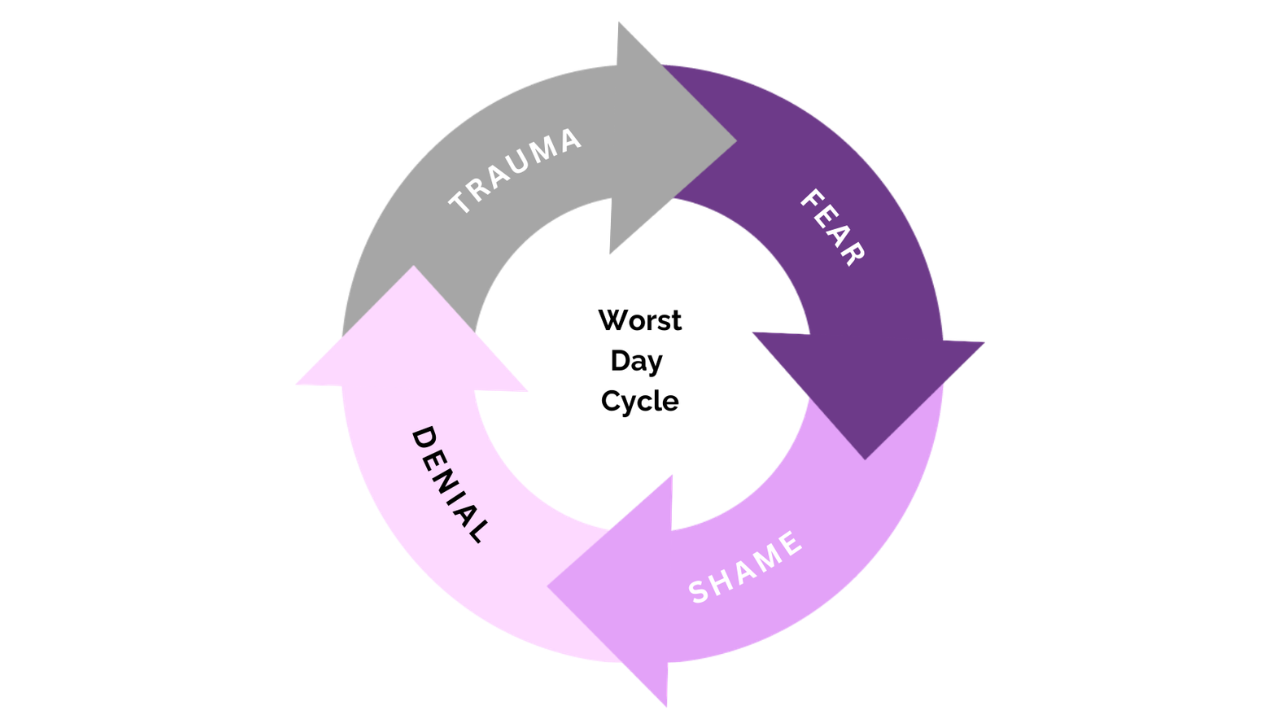
The Four Stages of the Worst Day Cycle™
Stage 1: Trauma
Any negative emotional experience in childhood that created painful meanings. A parent who raged. A parent who abandoned you emotionally. A parent who controlled everything. A parent who made you responsible for their feelings. A parent who shamed you for who you are.
Stage 2: Fear
Your brain responds to trauma by creating fear. But not rational fear. Chemical fear. Your hypothalamus floods your body with cortisol and adrenaline. Your nervous system learns: “This situation is dangerous. I need to survive it.” Fear drives repetition—your brain thinks repetition equals safety. If you learned to survive by people-pleasing, you’ll people-please in every relationship. If you learned to survive by controlling, you’ll try to control.
Stage 3: Shame
Shame is where you lost your inherent worth. Not your actions—you. “I am the problem. There’s something wrong with me. I’m not enough.” This is the deepest stage because it’s not about what happened to you. It’s about what you decided about yourself.
Stage 4: Denial
To survive the pain of trauma, fear, and shame, your brain creates a survival persona—a false self. This persona is brilliant in childhood. It keeps you alive. It makes sense of the chaos. But in adulthood, it sabotages you. Denial is the stage where you convince yourself the narcissist isn’t that bad, that you can fix them, that you’re overreacting. That’s you staying in the cycle.
The Worst Day Cycle™ repeats because your brain conserves energy by repeating known patterns. It can’t tell right from wrong. It only knows known versus unknown. Since 70%+ of your childhood messaging was negative or shaming, you unconsciously repeat these painful patterns in relationships, career, health, and every other life area.
That’s you being a codependent. Not because you’re weak or broken. But because your nervous system learned to survive by merging with chaos, abandonment, or control. And the narcissist is the perfect match because they replicate that exact chaos.
Your Survival Persona: The False Self That Attracts Them
To survive the Worst Day Cycle™, your brain creates a survival persona—a false identity designed to protect you from pain. There are three main types:
1. The Falsely Empowered Survival Persona
This persona controls, dominates, manages, and rages. If your childhood had an unpredictable parent, you learned: “If I can predict and control everything, I won’t get hurt.” As an adult, you try to control your partner, your kids, your environment. When they don’t comply, you rage or shame them into submission.
Sound like you? This is why you’re attracted to narcissists who are also falsely empowered. You’re both trying to control the relationship. You clash. You disconnect. But the intensity keeps you addicted.
2. The Disempowered Survival Persona
This persona collapses, people-pleases, and abandons their own needs. If your childhood had a narcissistic or controlling parent, you learned: “If I disappear, don’t take up space, and make myself small, maybe I’ll finally be loved.” As an adult, you say yes when you mean no. You sacrifice your needs. You make excuses for their behavior.
That’s you with the narcissist. They’re attracted to your willingness to be small because it makes them feel big. You’re attracted to their intensity because it’s the only time you feel less empty—even though it destroys you.
3. The Adapted Wounded Child Survival Persona
This persona oscillates between falsely empowered and disempowered. You’re controlling one moment, collapsed the next. You rage, then you apologize profusely. You set a boundary, then you dissolve it. That’s you trying to survive using both strategies because neither one actually worked.
All three survival personas attract narcissists. The falsely empowered clashes with them. The disempowered merges with them. The adapted wounded child does both—creating a relationship that feels like constant whiplash. The narcissist loves this because the chaos keeps you addicted to trying to fix it.
The first step toward healing is naming which survival persona you are. Not to shame yourself. But to understand why you’re attracted to this pattern and what needs to shift in your nervous system for the attraction to disappear.
7 Signs You’re Attracted to Narcissists (By Life Area)
The attraction to narcissists doesn’t show up the same way for everyone. Here’s how it manifests across different life areas:
In Your Family of Origin
One or both parents were narcissistic, controlling, unpredictable, or emotionally unavailable. You learned to survive by managing their emotions or becoming invisible. You still do this with them now. That’s you repeating the pattern with a partner who acts just like your parent.
In Romantic Relationships
You’re attracted to someone who love-bombs, then withdraws. You feel responsible for keeping the relationship stable. You minimize their bad behavior. You blame yourself for their anger. You stay longer than you know you should because the intensity feels like love. That’s the trauma bond.
In Friendships
You have one or two “best friends” who take much more than they give. They confide in you, crisis after crisis, but when you need support, they’re unavailable. You feel responsible for their wellbeing. You can’t set boundaries without feeling guilty. That’s you being codependent in friendship.
At Work
Your boss or a colleague is charismatic, ambitious, and charming—but also controlling, critical, and takes credit for your work. You work overtime to please them. You doubt your own competence. You stay in the job longer than you should because you think it’s your fault they’re difficult. That’s you extending your family trauma into your career.
In Your Body and Health
You ignore physical pain or illness because you were taught your needs weren’t important. You overexercise or undereat to maintain control. You stay in positions of chronic stress because it’s familiar. You self-harm or numb yourself with substances because your body learned pain was normal. That’s trauma living in your cells.
In Your Money and Resources
You give more than you receive. You bail people out financially. You stay in jobs that underpay you. You can’t ask for what you deserve. You believe asking for money or payment feels selfish. That’s you confusing self-abandonment with generosity.
In Your Spiritual or Personal Growth
You’re attracted to teachers, coaches, or spiritual leaders who seem enlightened but are actually controlling. They require your devotion. They punish questioning. They make you feel special, then make you feel small. That’s you extending your family trauma into your healing journey.
Do these resonate? The pattern isn’t random. It’s your nervous system trying to survive using the same strategies that kept you alive as a child. The narcissist isn’t the problem. Your unhealed emotional blueprint is.
The Authentic Self Cycle™: Your Path to Healing
If the Worst Day Cycle™ is how you got stuck, the Authentic Self Cycle™ is how you get unstuck. It’s the healing counterpart—an identity restoration system with four stages:
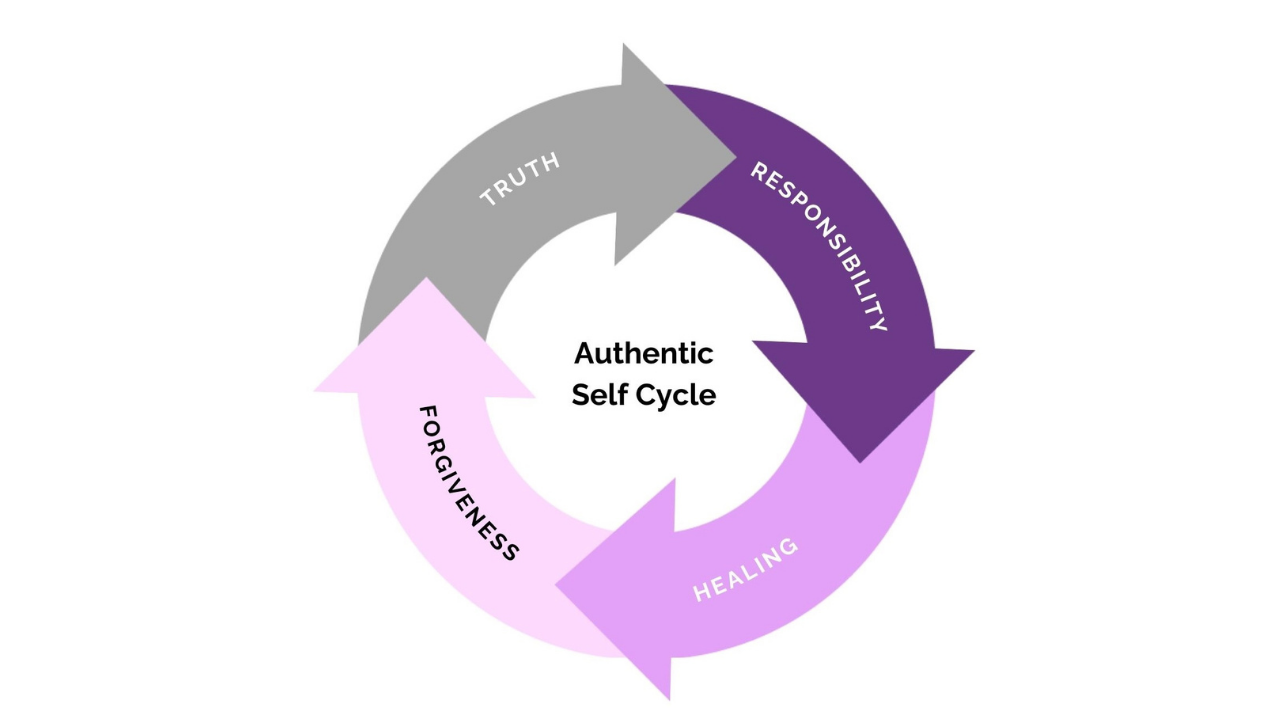
The Four Stages of the Authentic Self Cycle™
Stage 1: Truth
Name your emotional blueprint. See the pattern: “This isn’t about today. This is about what I learned to survive in childhood.” When your partner criticizes you, your nervous system goes into shame—not because they’re right, but because your parent criticized you the same way. Truth is naming this without judgment.
Stage 2: Responsibility
Own your emotional reactions without blame. “My partner isn’t my parent. My nervous system just thinks they are. I’m responsible for my own healing.” This isn’t about forgiving them or staying. It’s about recognizing that your nervous system is in charge, not your conscious mind. You can’t think your way out of a biochemical response.
Stage 3: Healing
Rewire your emotional blueprint using the Emotional Authenticity Method™ (see next section). The goal is to make conflict uncomfortable but not dangerous. Space isn’t abandonment. Intensity isn’t attack. Your nervous system learns new chemistry. That’s you building a new normal.
Stage 4: Forgiveness
Release the inherited emotional blueprint and reclaim your authentic self. This doesn’t mean forgiving the narcissist or your parent. It means releasing the grip their pain has on your present moment. You stop living to survive their chaos. You start living to honor your own truth. That’s you becoming free.
The Authentic Self Cycle™ creates a NEW emotional chemical pattern that replaces fear, shame, and denial. Your nervous system learns that safety comes from authenticity, not from controlling or collapsing. The attraction to narcissists disappears because you’re no longer addicted to the chemistry of your childhood trauma.
The Emotional Authenticity Method™: 6 Steps to Rewire Your Blueprint
The Emotional Authenticity Method™ is a six-step process designed to rewire your emotional blueprint at the biochemical level. The core principle: You cannot change emotional patterns through thoughts alone. Emotions are biochemical events. Thoughts originate from feelings.
Here’s how it works:
The Six Steps of the Emotional Authenticity Method™
Step 1: Somatic Down-Regulation
When your nervous system is activated (triggered by conflict, criticism, or perceived abandonment), you can’t think your way to healing. You have to calm your body first. Focus on what you can hear for 15–30 seconds. Listen to the ambient sounds around you. If you’re highly dysregulated, use titration: squeeze ice, splash cold water on your face, or engage your senses. The goal is to bring your nervous system down from fight/flight/freeze into a state where your prefrontal cortex can actually function.
Step 2: What Am I Feeling Right Now?
Most people say “I feel bad” or “I feel anxious.” That’s too vague. Your brain can’t rewire what it can’t name. Use emotional granularity. Expand your vocabulary beyond “bad.” Are you feeling abandoned? Disrespected? Invisible? Controlled? Betrayed? Use the Feelings Wheel (link below) to identify the exact emotion. That’s you developing emotional literacy.
Step 3: Where in My Body Do I Feel It?
Emotional trauma is stored physically. Abandonment might live in your chest as a crushing weight. Shame might live in your throat as a lump. Control might live in your stomach as tension. Locate the exact physical sensation and notice it without judging it. That’s you developing somatic awareness.
Step 4: What Is My Earliest Memory of Having This Exact Feeling?
Trace the feeling to its origin. When your partner withdrew, you felt abandoned. When did you first feel that way? Maybe your parent left for work and you didn’t understand they were coming back. Maybe a sibling got more attention than you. Maybe a parent died. Whatever it was, your nervous system has been trying to survive that moment ever since. That’s you finding the root.
Step 5: Who Would I Be If I Never Had This Thought or Feeling Again?
This is the vision step. Move beyond the past for a moment. If you weren’t controlled by abandonment fear, shame, or the need to control—who would you be? What would you do? How would you show up? What would you say? What kind of partner, parent, friend, or professional would you become? Hold this vision. That’s you imagining your Authentic Self.
Step 6: Feelization—Sit in the Feeling of Your Authentic Self and Make It Strong
This is the most critical step because it’s where the biochemical rewiring happens. Close your eyes and feel yourself in that Authentic Self vision. Don’t think about it. Feel it. What does confidence feel like in your body? What does boundaries feel like? What does self-love feel like? Create a strong emotional sensation in your body associated with your Authentic Self. Now, ask: “How would I respond to this situation from this feeling? What would I say? What would I do?” Visualize and FEEL yourself operating from your Authentic Self. Make it visceral. Make it real in your nervous system. This is the emotional blueprint remapping and rewiring step. You’re creating a new chemical addiction to replace the old one.
That’s the Emotional Authenticity Method™. Not once. Not twice. But repeatedly, over weeks and months, until your nervous system’s default is Authentic Self, not survival persona.
The breakthrough happens in Step 6. You cannot change an emotional pattern by understanding it intellectually. You change it by feeling something different in your body with such intensity and frequency that your nervous system adopts it as the new baseline. That’s Feelization.
Want to dive deeper into this work? Use the Feelings Wheel—a life-changing exercise to develop emotional granularity.
The Victim Position Paradox: Why Healing Stalls
Here’s something nobody tells you: There’s a reason healing from narcissistic abuse feels so hard, even when you know the framework.
The victim position is a societal construct meant to protect victims, but in reality it has created a paradoxical falsely empowered position that nearly guarantees the victim will reexperience their childhood victimization, leaving them disempowered.
What does this mean?
When you identify as a “victim of narcissistic abuse,” you get validation. You get sympathy. You get to talk about what happened to you. And that feels like progress because, finally, people believe you. Finally, it wasn’t your fault.
But here’s the trap: You get so much validation from the victim position that you don’t have to address the underlying childhood trauma and pain that created the attraction in the first place. You get to stay in the story: “I’m damaged because of what they did to me.” And that story is true. But it’s not the whole truth.
The whole truth is: “I was attracted to them because of my unhealed childhood. I stayed with them because of my survival persona. I’m responsible for healing this now.”
That’s the paradox. The victim position protects you from blame, but it also keeps you stuck in the role of victim. It keeps you disempowered. It keeps you waiting for someone else to fix it—for the narcissist to change, for the legal system to punish them, for therapy to make the pain go away.
Healing requires moving from the victim position into responsibility. Not blame. Responsibility. You can’t change what happened to you. But you can change how your nervous system responds to it. You can rewire your emotional blueprint. You can become someone the narcissist—and future narcissists—are no longer attracted to.
That’s where real healing begins.
People Also Ask (FAQ)
Q: Can a narcissist actually change?
Technically, yes. But practically, almost never. Change requires self-awareness, humility, and the willingness to experience shame—all things a narcissist’s survival persona is designed to avoid. If they do change, it’s because their cost of staying the same became higher than their fear of changing. This almost never happens in a romantic relationship where they’re getting their needs met through control and devaluation. Your job isn’t to change them. Your job is to heal yourself so you’re no longer attracted to them.
Q: How long does it take to stop being attracted to narcissists?
This depends on how deep your childhood trauma is and how committed you are to the Emotional Authenticity Method™. Some people see shifts in weeks. Others take months or years. The timeline isn’t about time—it’s about nervous system rewiring. Feelization creates new neural pathways. These pathways need to be strengthened repeatedly until they become your default. Most people report major shifts in 90 days of consistent practice. Full rewiring usually takes 12–18 months.