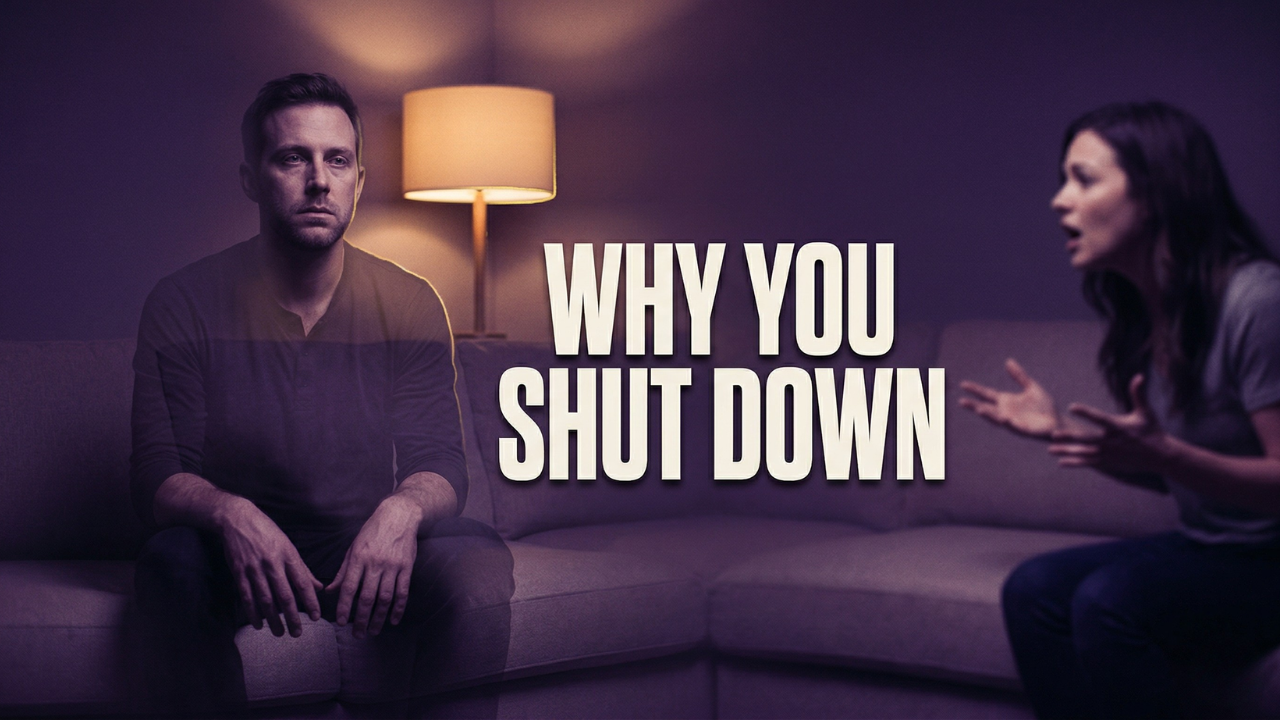
Picture the last argument you had. Maybe it was with your partner, your best friend, your parent. The conversation started — maybe it was about something small, maybe something big — and then it happened. Your mind went blank. Your chest started to tighten. Your throat closed. You lost words. You couldn’t think, couldn’t express, couldn’t respond. Maybe your fingers went numb. Maybe you felt foggy, distant, frozen. You were still sitting there, still physically present, but inside you were gone.
And the person across from you? They saw something completely different. They saw someone who doesn’t care. Someone who is stonewalling them. Someone who is being passive aggressive or emotionally punishing them with silence.
That’s you — the one who goes blank, numb, and distant the moment the conversation gets emotional.
But here is the truth that every therapist article, every “how to communicate better” blog post, and every well-meaning friend misses entirely: you are not shutting them out. You are shutting out the danger stored in your nervous system from childhood. Your body is not responding to your partner’s words right now. It is responding to an emotional blueprint that was installed before you could even speak — a blueprint that learned one devastating lesson: conflict means danger, and the only way to survive danger is to disappear.
Emotional shutdown during arguments is not avoidance — it is a survival persona activation where your nervous system replays childhood danger signals. Your body is responding to a historical threat, not the current conversation. And until you understand that — until you trace the freeze back to the blueprint that created it — no amount of deep breathing, communication tips, or couples worksheets will touch what is actually happening inside you.
What Happens in Your Body When You Shut Down During an Argument?
Before we talk about why this happens, let’s name exactly what it feels like — because if you experience emotional shutdown during conflict, you know this in your bones.
The argument starts. Maybe your partner raises their voice. Maybe it’s not even the volume — it’s the tone. A certain sigh. A specific facial expression. Something shifts in the room and your body registers it before your conscious mind does. And then:
Your throat closes. Your chest tightens. Your mind goes blank. You can’t find words. You can’t think clearly. You can’t access what you were just about to say. Maybe your fingers and toes start to go numb. Maybe your vision narrows. Maybe you feel like you’re watching the conversation from behind glass — you can see your partner’s mouth moving, but the words aren’t landing. You feel foggy. Distant. Frozen. Gone.
That’s you staring at the wall, knowing you should say something but physically unable to form the words.
This is not you choosing silence. This is not you punishing your partner. This is not you being passive aggressive or cold or uncaring. This is your nervous system activating its oldest, most primitive survival response: freeze.
When a child encounters overwhelming emotional experience, the body enters an involuntary response. Fight looks like anger, irritability, defensiveness. Flight looks like overthinking, perfectionism, workaholism. And freeze — freeze looks like shutdown, numbness, emotional paralysis, collapse. Going blank. Going silent. Going away while your body stays in the chair.
That’s you choosing silence not because you’re punishing anyone, but because your body literally cannot produce words.
Your nervous system learned that these states were necessary for survival. As an adult, the system activates the same states in situations that resemble the emotional danger of childhood — even when nothing dangerous is actually occurring. This is why you shut down during conflict, become anxious around intimacy, withdraw when seen, explode when overwhelmed, and collapse under emotional tension. Your nervous system is not responding to the present. It is responding to the unprocessed trauma stored in the past.
Why Do You Shut Down? The Childhood Blueprint Your Body Never Forgot
Here is what most people don’t realize: your nervous system doesn’t just react to what’s happening now. It reacts to anything that reminds it of what happened then.
A tone of voice. A facial expression. Silence. A certain phrase. If your father used to sigh and say “Are you kidding me?” when you made a mistake, and your partner lets out a similar sigh today, your body responds as if you’re still that kid about to be shamed, lectured, or rejected. Your adult mind is hearing your partner. Your body is hearing your past. And your survival system hits the brakes.
That’s you hearing your partner’s frustrated sigh and feeling your father’s disappointment all over again.
The way your body responds isn’t a character flaw. It’s not you failing in any way. It’s proof of how much you had to adapt to survive your childhood story. The problem is that your nervous system never got the update that you’re not back there anymore. It’s still reading your adult life through that childhood filter — because that’s how our brain and body works. Emotions are learned constructs that we learn in the first three to seven years of life, before you could ever even speak. Your emotional nervous system dysregulation probably happened between zero and three years old in almost all cases. So this just feels normal to you.
Think about your childhood. Did you have a parent who could be loving one moment and explosive or sarcastic or icy the next? Maybe you were praised for being the easy one. Maybe the quiet one, the responsible one. Maybe you learned that being low-maintenance and high-performing was how you earned love. Maybe you had to manage a parent’s moods — an addict, an alcoholic, a parent going through a divorce who made you a surrogate friend and spouse. Maybe instead of being enmeshed, you were ignored unless you did something exceptional or something wrong. Whatever it was, you learned that your needs, your desires, and your emotions were selfish, sinful, or shameful. So you learned to swallow them, smile, and shut down.
That’s you as a child, learning that silence was the only thing that didn’t make things worse.
Your childhood blueprint and your shame engine have kept your nervous system ping-ponging between fight, flight, fawn, and freeze for years. You grew up in an environment where being relaxed, being yourself, and having needs just wasn’t safe. So your body learned that calm is dangerous and stillness is dangerous. And if I let my guard down, I’ll get blindsided, rejected, or shamed. As an adult, your life can look safe to everyone on the outside. No one’s chasing you. You’re not in a war zone. But your nervous system still thinks you’re that kid in that house — just trying to anticipate everybody’s mood so you don’t get hurt.
Trauma turns the nervous system into a time machine. Every emotional trigger is the nervous system reliving a moment it never completed.
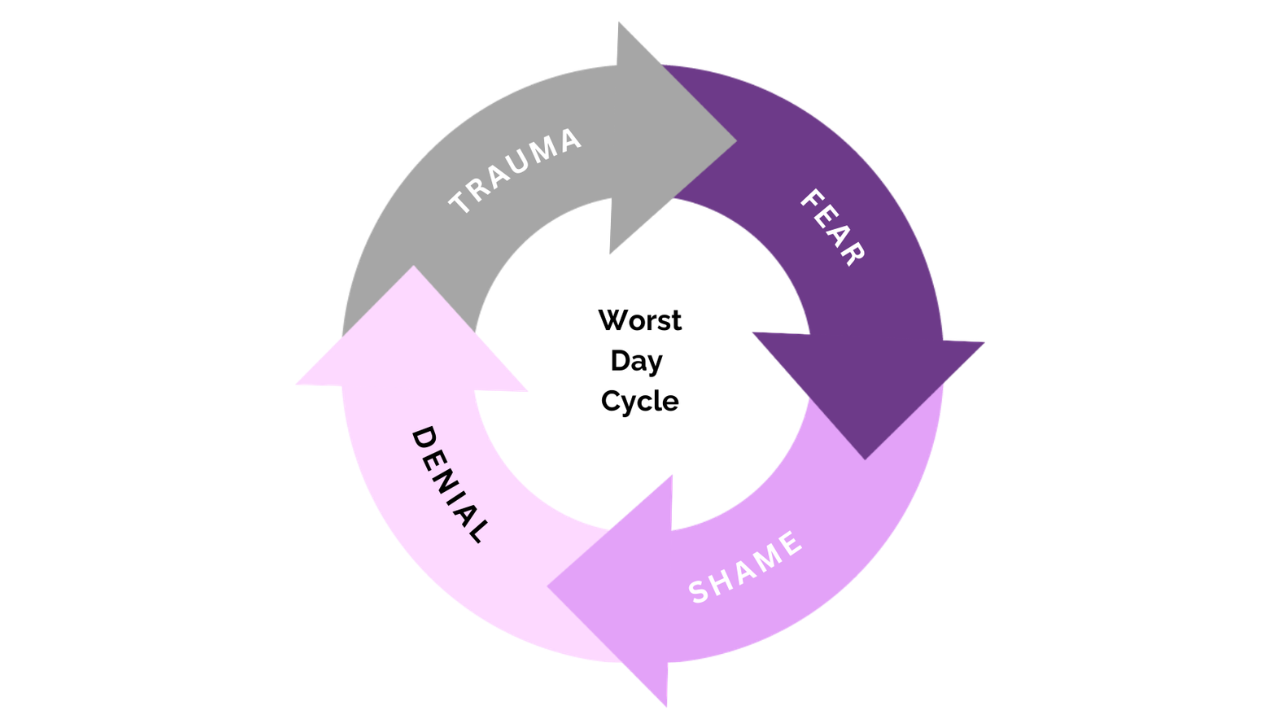
This is the Worst Day Cycle™ in action. Trauma creates fear. Fear creates shame — the conclusion that something is wrong with me. Shame creates denial — the survival persona that hides the wound. And denial keeps you locked in the same patterns decade after decade, shutting down in every argument, losing yourself in every conflict, replaying childhood danger in every relationship.
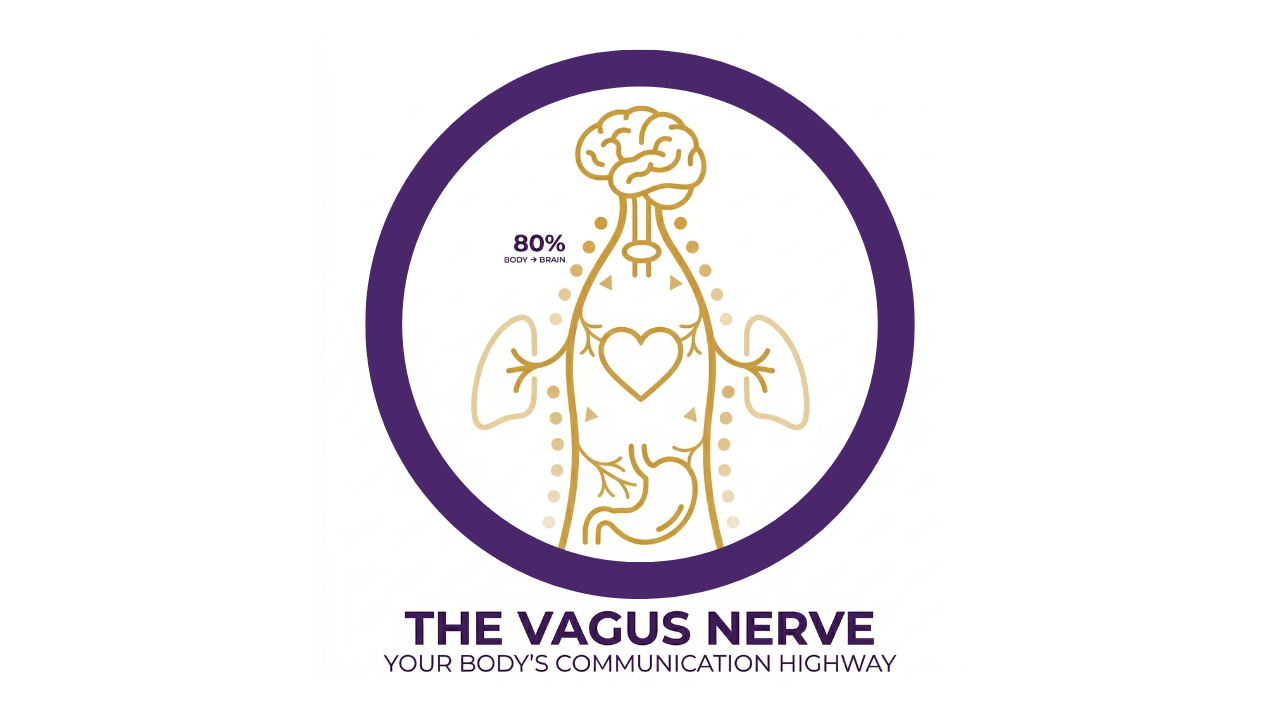
And here’s the part that changes everything: when you shut down in conflict, your adult self is not the one driving. Your wounded child — the one who was in the back seat — has just jumped forward and grabbed the wheel. And that child learned one belief, its only emotional definition that it learned to survive its environment: the only way I’m going to stay safe is if I’m quiet. And if I shut down, nobody can hurt me.
Don’t let anyone ever tell you that you shut down in conflict because you don’t care. The reason you shut down is because a long time ago your nervous system learned that conflict meant danger. Freezing for you is not about avoidance. It’s pure survival.
The Three Survival Personas That Drive Emotional Shutdown
Everyone who grew up in a less-than-nurturing environment developed what I call a survival persona — the identity you created as a child to stay safe, stay attached, and stay alive in your family system. This isn’t about blame. This isn’t about being broken or defective. You’re not broken. You’re just programmed. It was actually a brilliant strategy that the child in you picked up. But here’s the problem as adults: the same strategy that kept you safe in childhood is now destroying your relationships.
There are three survival persona types, and each one has a different relationship with shutdown during arguments:
The Falsely Empowered survival persona controls, dominates, rages, and intimidates to avoid vulnerability. When this persona encounters conflict, the shutdown looks different on the outside — it might look like explosive anger, sarcasm, or verbal dominance — but underneath is the same freeze. The falsely empowered person shuts down their vulnerability. They wall off the scared child inside and present the aggressive protector instead. They would rather blow up the conversation than risk being seen as weak or wounded.
The Disempowered survival persona collapses, people-pleases, loses self to avoid abandonment. This is the classic freeze responder. When conflict starts, the disempowered persona goes blank, goes quiet, goes small. They lose access to words. They lose access to their own needs. They agree just to end the tension, then feel resentful and invisible for days afterward. Their shutdown is the visible one — the silence that partners interpret as not caring.
That’s you apologizing after every fight — not because you were wrong, but because you froze and didn’t know what else to do.
The Adapted Wounded Child oscillates between falsely empowered and disempowered depending on the situation. One argument they explode. The next they go silent. One relationship they pursue and chase. The next they wall off and withdraw. Their nervous system never learned a consistent safe speed, so it ping-pongs between gas pedal and brake pedal — intensity and shutdown, pursuit and collapse.
That’s you wondering why you shut down with your partner but explode with your mother — or vice versa. Same wound, different survival strategy depending on who triggers it.
Remember: in the first seven years of life, you weren’t present and conscious enough to see what was happening. People think, “No, I’ve always been this way — I was born this way.” No, you weren’t. You weren’t conscious of all the different calculations you made based on your parents’ behaviors and imperfections where you went, “Okay, the only way to survive and get attachment is to become this survival persona.” And it’s all of us. Nobody is immune from this process. It’s part of being human.
Is Stonewalling a Trauma Response? Why Your Partner Thinks You Don’t Care
Let’s talk about what’s happening on the other side of your shutdown — because this is where the real damage occurs, and it’s not what you think.
In almost every relationship with unresolved childhood wounds, partners fall into one of two predictable roles: the pursuer, who moves toward connection when triggered, and the distancer, who moves away from connection when triggered. Both believe they are the injured one. Both believe the other person is the problem. Both are reacting from childhood shame, fear, and emotional meanings — not from the present moment.
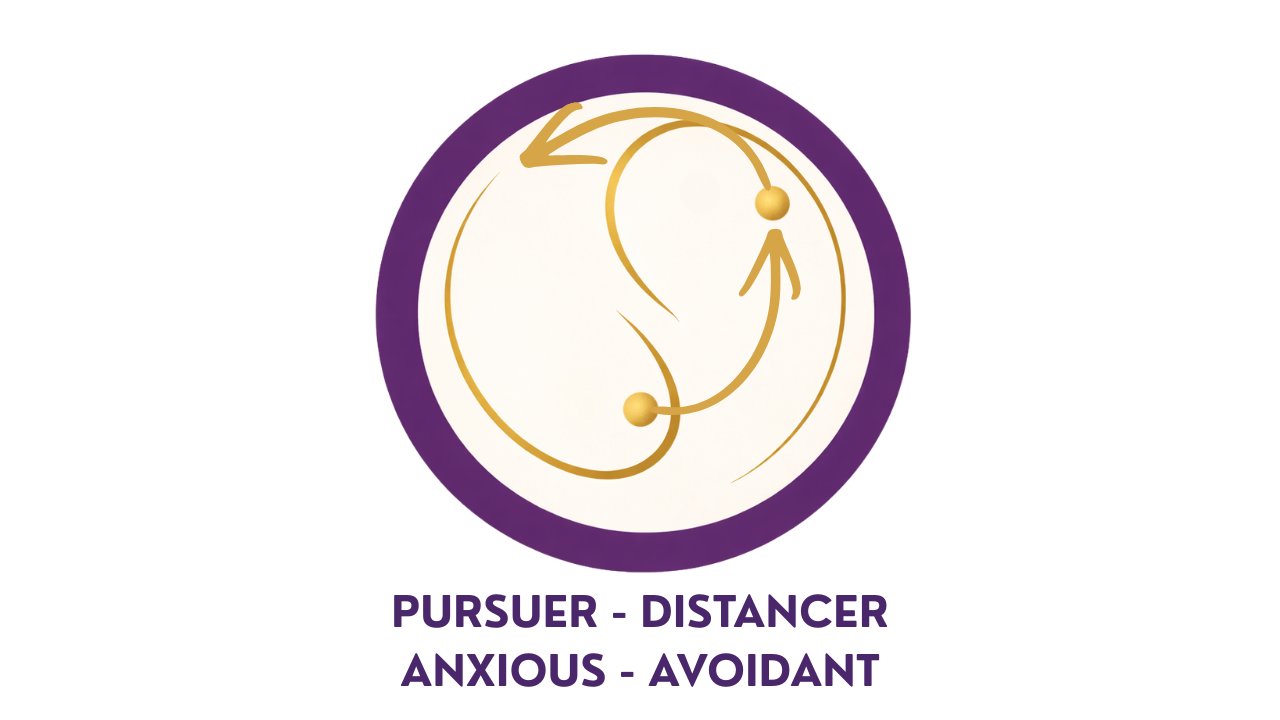
The pursuer’s childhood blueprint was shaped by inconsistent affection, emotional unpredictability, abandonment wounds. Their core belief sounds like: Connection will make this better. If I don’t fix this, I’ll lose them. Their withdrawal means I’m not enough. So they push harder — talking more, pursuing faster, demanding resolution.
The distancer’s blueprint was shaped by emotional enmeshment or intrusion, controlling caregivers, overwhelming conflict. Their core belief sounds like: Distance will make this better. If I stay, this will get worse. Their intensity means I’m unsafe. I will lose myself if I stay connected right now. So they shut down — going blank, going quiet, going numb.
That’s you — the one whose partner says “you never talk to me” while your body is screaming that talking feels like walking into a fire.
And here’s the devastating part: each partner’s survival strategy triggers the other’s deepest wound. Your shutdown — your stonewalling, your silence, your going blank — activates your partner’s fear of abandonment. Their pursuit — their intensity, their over-explaining, their demanding resolution — activates your fear of engulfment. Both escalate. Both feel victimized. Both feel misunderstood. And both believe the other side is impossible.
Most couples fight because their nervous system speeds don’t match — not because they don’t love each other, but because their nervous systems are trying to survive each other. Your emotional speed — fast or slow — was not chosen by you. It was imposed on you by the emotional environment of your childhood home. Your adult pacing is your childhood pacing on autopilot.
That’s you being told “you don’t care” when the truth is you care so much your body had to shut it all down to survive.
Think about a simple conversation that turns into a fight. “Why didn’t you call me?” — when what they really meant was “I missed you.” But the child inside you, when they hear that accusation, that tone, the way they came at you — the child inside you doesn’t hear their words. What you feel becomes: I messed up again. I can’t get anything right. I’m obviously not enough. Now you’re not even answering the question. You’re defending yourself against an old emotional wound. That’s why your conversations become fights. Both of you are doing it to each other. You’re never fighting emotionally about the present. You’re always emotionally fighting about the past.
Why Deep Breathing and Communication Tips Don’t Fix Emotional Shutdown
That’s you reading another article about “how to communicate better” and knowing it doesn’t touch what’s actually happening inside you.
Every therapist article on emotional shutdown says some version of the same thing: “Practice deep breathing. Take a break. Use ‘I’ statements. Set a timer and come back to the conversation when you’re calm.” These are not wrong. They are just catastrophically incomplete. They are putting a band-aid on a broken bone.
Here’s why: if you are not regulating your nervous system as a daily practice, you are already running at a 102-degree emotional temperature before any argument even starts. You’ve been carrying decades of unhealed childhood trauma. Your baseline thermostat is already overheated. So when something happens — your partner’s tone of voice, a missed text, a look across the room — it doesn’t push you from 98.6 to 110. It pushes you from 105 to 110. And 110 is emotional coma: shutdown, rage, collapse, dissociation, stonewalling, panic attacks.
This is why people say “I overreacted” or “it wasn’t that big a deal, why did I lose it?” They didn’t overreact. The math was against them before the trigger ever happened.
That’s you trying deep breathing during a fight and feeling absolutely nothing change.
Communication tips assume you have access to your prefrontal cortex — the part of the brain responsible for language, logic, empathy, and decision-making. But when your nervous system floods with trauma chemistry, your prefrontal cortex goes offline. Cortisol and adrenaline take over. You are operating entirely from your adapted wounded child. You cannot think clearly, cannot access empathy, cannot see the other person as separate from your childhood pain. No communication technique on earth works when the brain region responsible for communication has shut down.
That’s you replaying the argument in the car three hours later, finally knowing exactly what you wanted to say — because your prefrontal cortex came back online once the perceived danger passed.
And this is exactly why all the usual emotional regulation advice fails. The advice stays at the level of symptoms — managing the freeze after it happens. It never asks: Why is your thermostat set at 105 in the first place? What installed this default? What childhood experience taught your body that conflict equals danger? Until you answer those questions, you will keep shutting down. Not because you’re failing. Because the coping skills never reached the root.
The Emotional Authenticity Method™: From Freeze to Feeling
So what actually works? Not managing the shutdown. Tracing it back to the blueprint that created it — and building a completely new response from the inside out.
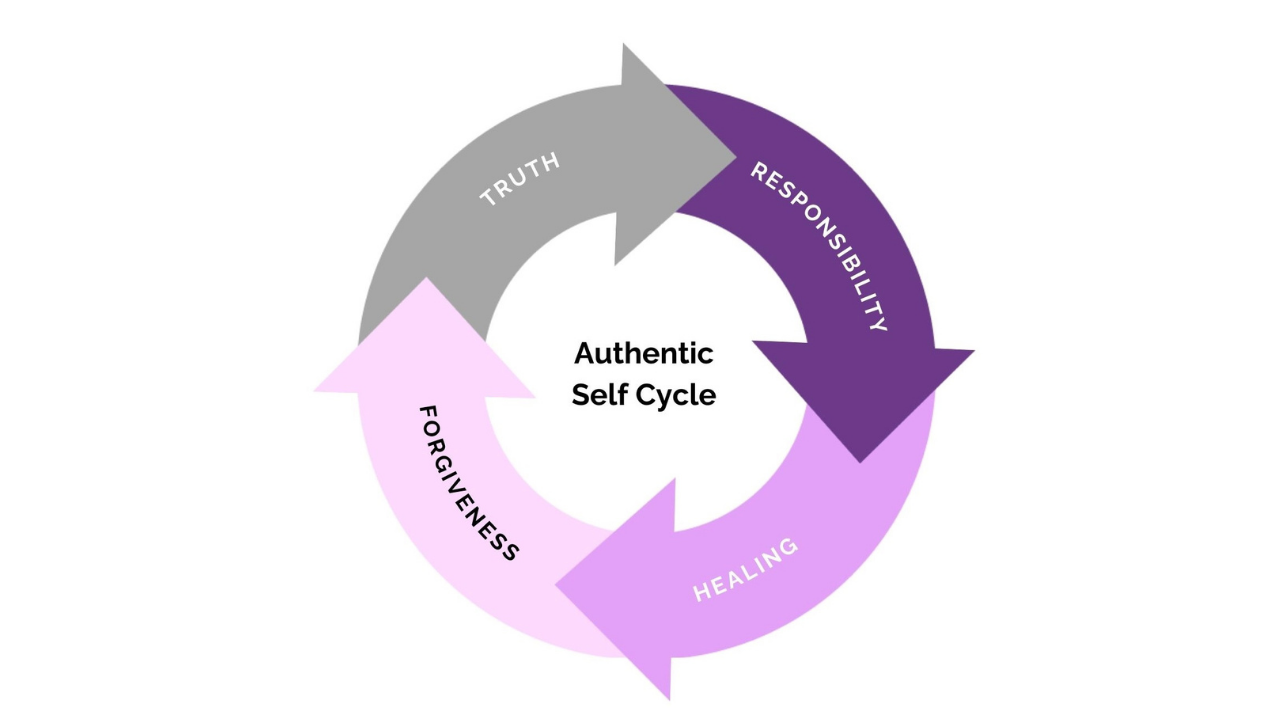
The path from freeze to feeling runs through three frameworks that work together: the Worst Day Cycle™ shows you the loop you’re trapped in (Trauma → Fear → Shame → Denial). The Authentic Self Cycle™ shows you the way out (Truth → Responsibility → Healing → Forgiveness). And the Emotional Authenticity Method™ is the six-step process that makes the shift real in your body — not just in your head.
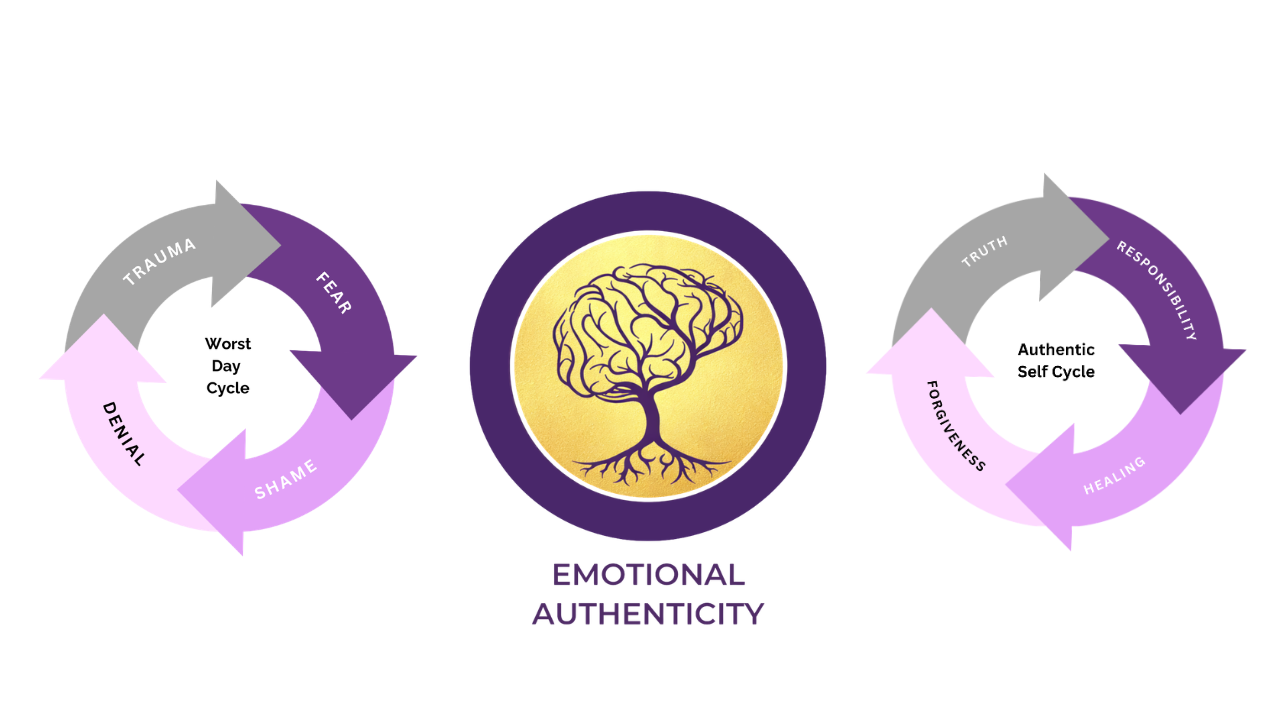
Here are the six steps of the Emotional Authenticity Method™:
Step 1: Somatic Down-Regulation. Stop everything and focus on what you can hear. Just listen. For a minimum of fifteen seconds — though thirty to sixty seconds is better. Listen to the hum of the refrigerator, the traffic outside, birds, the sound of your own breathing through your nose. This single act activates metacognition — the space between thought and feeling — and literally prevents the brain from thinking. The rumination stops. The emotional flooding pauses. And the prefrontal cortex comes back online. For people whose nervous system is so stuck that basic down-regulation alone is not enough, there is a deeper version called Titration: spend thirty to sixty seconds focusing on what you can hear, then deliberately bring the trigger back for thirty to sixty seconds, then ground again. Three to five cycles. Each cycle, the emotional charge shrinks.

Step 2: What am I feeling right now? Not “I’m fine.” Not “I don’t know.” Use emotional granularity — expand your vocabulary beyond “bad” or “anxious.” Are you terrified? Humiliated? Invisible? Powerless? Small? The more specific the word, the more the nervous system recognizes what is actually happening.
Step 3: Where in my body do I feel it? The throat closing. The chest collapsing. The heaviness in the stomach. The numbness in the hands. Emotion is not stored in the brain — it is stored in the body. Naming the body location reconnects you to the somatic experience your survival persona has been trying to block.
Step 4: What is my earliest memory of having this exact feeling? Not the earliest memory of the situation — the earliest memory of this specific feeling in this specific body location. This is the step that changes everything, because it traces the adult reaction back to its childhood origin. The moment you see the connection — “I’m not reacting to my partner, I’m reacting to the time my father went silent for three days when I upset him” — the spell begins to break.
Step 5: Who would I be if I never had this thought or feeling again? What would be left over? This is the question that reveals the Authentic Self underneath the survival persona. Without the freeze. Without the shame. Without the “I’m not enough.” What’s actually there?
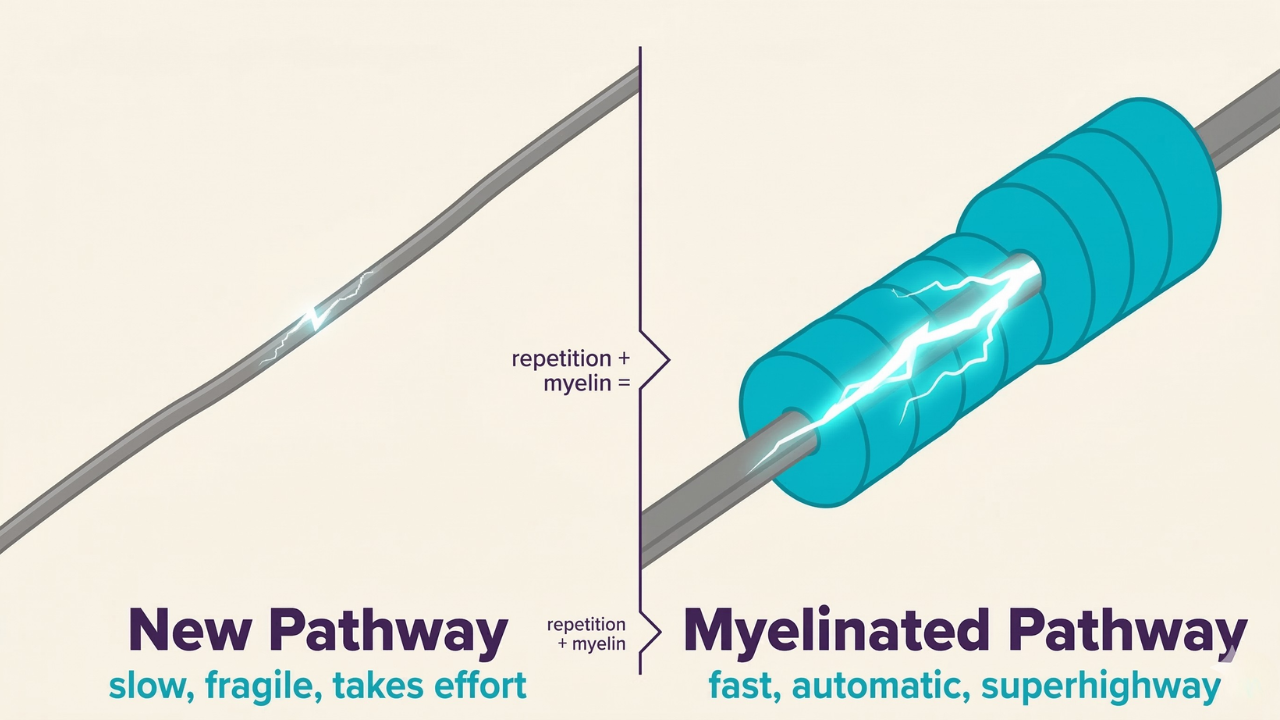
Step 6: Feelization. Sit in the feeling of the Authentic Self and make it strong. Create a new emotional chemical addiction to replace the old blueprint. Ask: How would I respond to this situation from this feeling? What would I say? What would I do? Visualize and feel yourself operating from your Authentic Self. This is the emotional blueprint remapping and rewiring step. This is where the neural pathway that has been firing for decades finally begins to weaken and a new one takes its place.
That’s you asking yourself: “Who would I be without this freeze?” — and for the first time, catching a glimpse of an answer.
Real-Life Signs Your Shutdown Is Running the Show
Emotional shutdown from childhood trauma doesn’t just show up in arguments. It runs silently through every area of your life. Here’s how to recognize it:
In romantic relationships: You go quiet during disagreements. You avoid “the talk” at all costs. You feel your body lock up when your partner expresses needs. You feel accused even when they’re asking a simple question. You shut down during intimacy — not just emotional, but physical. You agree to things you don’t want just to end the tension, then build resentment for weeks. Your partner says you’re “impossible to reach” or “emotionally unavailable.”
That’s you — the one who can write the most articulate text message about your feelings three hours after the fight but can’t say a single word during it.
In family relationships: You revert to your childhood role the moment you walk through your parents’ door. You feel ten years old at the dinner table. You can’t voice disagreement. You nod and smile while your stomach churns. You leave family gatherings feeling invisible, drained, or like you disappeared inside yourself.
In friendships: You avoid conflict so completely that friends don’t know your real opinions. You ghost rather than have a hard conversation. You feel overwhelmed when someone expresses anger toward you — even justified anger. You shut down when friends are having an intense discussion, even if it has nothing to do with you.
At work: You freeze in meetings when challenged. You can’t advocate for yourself during reviews. You avoid your boss when something goes wrong. You over-prepare for every interaction because the idea of being put on the spot triggers the same childhood terror of being unprepared for a parent’s mood.
In your body and health: Chronic muscle tension, especially in the jaw, shoulders, and chest. Digestive issues that spike around conflict. Headaches after emotional conversations. Exhaustion that isn’t physical — it’s the exhaustion of running a nervous system at 105 degrees every day. Blood pressure that won’t normalize no matter what you try — because the body is holding decades of unfelt emotion.
That’s you wondering if something is fundamentally broken in you because everyone else seems to be able to fight and still function.
Your Next Small Step
You don’t need to fix everything today. You don’t need to have a breakthrough in your next argument. You need one thing: to start listening.
Right now — wherever you are reading this — stop for fifteen seconds and focus only on what you can hear. The hum of your computer. The traffic outside. Your own breath. Just listen. Don’t analyze. Don’t think about the argument. Just hear.
That’s Step 1 of the Emotional Authenticity Method™. That simple fifteen seconds is the beginning of teaching your nervous system that it is safe to come down. It is the first crack in the freeze response. Not through force. Not through “trying harder to communicate.” Through the lived experience of showing your body that it doesn’t have to stay at 105 degrees.
Start there. Do it once an hour. Set an alarm. Listen to your feet hitting the floor when you walk. Feel the food in your mouth when you eat. Hear the birds outside your window. These are not luxuries. They are the aspirin for a nervous system that has been running a fever since childhood.
That’s you — not broken, not avoidant, not cold. Just programmed. And programming can be rewritten.
To take the next step toward understanding your emotional blueprint and beginning to rewire the patterns that drive your shutdown, start with Kenny Weiss’s free Feelings Wheel exercise — a practical tool to begin building the emotional vocabulary your childhood never gave you.
Go Deeper with Kenny’s Books
Your Journey To Success
If this article hit home, the book goes deeper.
Everything I write about on this site — the Worst Day Cycle™, your childhood emotional blueprint, why you keep repeating the same patterns no matter how hard you try — it all started with my first book, Your Journey To Success: How to Accept the Answers You Discover Along the Way.
This is the book readers call “the first time I found a roadmap I could actually understand and that seemed attainable.” It is the book that walks you through WHY your life hasn’t changed despite all the work you’ve done — and shows you, step by step, exactly how to break free. No fluff. No motivational hype. Just the truth about what was done to you, why it stuck, and what to do about it.
If you’ve read this far, you already know something needs to change. This book is where that change starts.
Get Your Journey To Success on Amazon →
Your Journey To Being Yourself
Ready to stop understanding the problem and start rewiring it?
The article you just read scratches the surface. My new book, Your Journey To Being Yourself: How to Overcome the Worst Day Cycle & Reclaim Your Authentic Self with Emotional Authenticity, gives you the complete system — the Worst Day Cycle™, the Authentic Self Cycle™, and the full Emotional Authenticity Method™ — all in one place, with the neuroscience behind every step.
This is the book readers call “a genius piece of art in mastering emotion and the art of healing.” It speaks directly to the person who feels stuck, overwhelmed, and confused by the same repeating patterns — the same arguments, the same relationship breakdowns, the same shame — and is done accepting surface-level answers. Every chapter combines powerful stories, clear steps, and practical tools that show you how to rewire your emotional patterns from the inside out.
You are not broken. You were programmed. And this book shows you exactly how to rewrite the program.
Get Your Journey To Being Yourself on Amazon →
Frequently Asked Questions
Why do I shut down during arguments instead of responding?
You shut down because your nervous system learned in childhood that conflict equals danger. The freeze response is an involuntary survival mechanism — not a conscious choice. When your body detects emotional cues that resemble your childhood environment (a certain tone, facial expression, or intensity level), it activates the same protective shutdown it used as a child. Your body is replaying a historical threat, not responding to the present conversation.
Is emotional shutdown the same as stonewalling?
Stonewalling is the behavioral description — the observable silence, withdrawal, or blank expression during conflict. Emotional shutdown is the internal experience driving that behavior — the nervous system flooding, the prefrontal cortex going offline, the freeze response activating. Most people accused of stonewalling are not choosing to withdraw. Their nervous system is enacting a childhood survival response that shuts down access to language, emotion, and connection simultaneously.
Is shutting down during arguments a sign of childhood trauma?
In the vast majority of cases, yes. Emotional shutdown during conflict is a dorsal vagal freeze response — the nervous system’s most primitive survival state. It develops in childhood when a child learns that expressing emotions leads to punishment, vulnerability leads to shame, or conflict leads to abandonment. The nervous system encodes this lesson as a permanent default, and it continues to activate in adult relationships whenever the body encounters emotional cues that resemble the original danger.
Can you stop shutting down during conflict?
Yes — but not through willpower, communication tips, or “trying harder.” You cannot override a nervous system response with a conscious decision. The path to breaking the freeze pattern involves tracing the shutdown back to its childhood origin through the Emotional Authenticity Method™, which accesses the emotional blueprint underneath the response. As you build new neural pathways through somatic down-regulation and emotional authenticity practice, the pause between trigger and reaction grows. That pause is where choice begins.
Why does emotional shutdown happen more with my partner than anyone else?
Primary romantic relationships activate your deepest attachment wounds because they most closely replicate the emotional dynamics of your original family. Your partner’s proximity, emotional significance, and intimacy trigger the same nervous system responses your parents once did. Your body associates primary relationship intimacy with whatever emotional experience dominated your childhood — and if that experience included danger, unpredictability, or emotional enmeshment, your nervous system will activate its protective shutdown in the exact relationship where you most want to stay connected.
How do I explain my shutdown to my partner?
Start with emotional transparency — revealing the wound beneath the reaction instead of defending the behavior. This sounds like: “When the conversation gets intense, my body goes into a freeze response that I can’t control. It’s not that I don’t care. My nervous system is reacting to something from my past, not to you. I need a moment to regulate — and I want to come back to this conversation when my brain is back online.” This kind of transparency — regulated, clear, owned, and vulnerable — creates empathy instead of accusation. It transforms the dynamic from two survival personas fighting each other into two adults building understanding.
What is the difference between emotional shutdown and emotional avoidance?
Emotional avoidance is a conscious strategy — choosing not to engage because you don’t want to deal with the discomfort. Emotional shutdown is an involuntary nervous system response — the body’s freeze state activating before the conscious mind has any say. Most people who experience shutdown would give anything to be able to respond in the moment. They replay the conversation for hours afterward, finally finding the words their body wouldn’t let them access during the conflict. That gap between wanting to respond and being physically unable to is the signature of a trauma-driven freeze response, not conscious avoidance.
The Bottom Line
You are not cold. You are not uncaring. You are not broken. You are not emotionally defective. You are not “bad at communication.” You are not avoiding your partner.
You are a human being whose nervous system was calibrated in childhood to read conflict as danger — and whose body is still faithfully executing the survival program it installed decades ago, before you had any say in the matter.
The freeze was brilliant. It kept you safe when you were small and the world was too big and too loud and too dangerous. It kept you attached to caregivers who might have abandoned you if you pushed back. It kept you alive.
But you are not that child anymore. And the survival persona that protected you then is now the thing standing between you and every real conversation, every genuine moment of intimacy, every relationship that could actually hold you.
That’s you — lying awake at 2am, composing the perfect response to an argument that ended six hours ago, wishing your body would let you say what your heart already knows.
The emotional child doesn’t need to be eliminated. They need to be held. And only the emotional adult can hold them. That work starts with one fifteen-second pause. One moment of listening. One crack in the wall your childhood built.
And from that crack, everything changes.
Recommended Reading
- The Body Keeps the Score by Bessel van der Kolk — The definitive text on how trauma is stored in the body and why body-based approaches are necessary for healing nervous system responses like freeze and shutdown.
- When the Body Says No by Gabor Maté — How suppressed emotions manifest as physical illness, chronic tension, and nervous system dysregulation — the exact process driving emotional shutdown.
- Complex PTSD: From Surviving to Thriving by Pete Walker — A practical guide to understanding the four trauma responses (fight, flight, freeze, fawn) and how they show up in adult relationships and conflict.
- How Emotions Are Made by Lisa Feldman Barrett — The neuroscience of how emotions are learned constructs shaped by early experience — exactly what creates the emotional blueprint behind your shutdown.
Take the Next Step with Greatness U
If this article described your life — if you recognized your freeze, your shutdown, your childhood blueprint in these words — here are the resources designed specifically for this work:
- Free Feelings Wheel — Start building the emotional vocabulary your childhood never gave you. This is the foundation of emotional granularity — Step 2 of the Emotional Authenticity Method™.
- Emotional Blueprint Starter Course — Individual — Map your personal emotional blueprint, identify your survival persona, and begin the six-step process of the Emotional Authenticity Method™.
- The Shutdown Avoidant Partner — If your partner is the one who shuts down — or if you are — this course breaks the pursuer-distancer cycle and builds the emotional transparency that transforms conflict into connection.
- Relationship Starter Course — Couples — For both partners to do the work together — understanding each other’s blueprints, survival personas, and nervous system speeds, and building the emotional safety that makes real communication possible.
- Why We Can’t Stop Hurting Each Other — Understand the full Worst Day Cycle™ driving your relationship patterns — from trauma to fear to shame to denial — and how the Authentic Self Cycle™ breaks it.