Mental health awareness is the ability to recognize that your emotional struggles are not character flaws, disorders to manage, or chemical imbalances to medicate — they are predictable outcomes of childhood emotional trauma that rewired your nervous system, and true healing requires emotional authenticity, not symptom management. If you’ve spent years in therapy, tried medication, practiced affirmations, and still feel stuck — you’re not broken. The system that was supposed to help you was never designed to address the root cause. It was designed to manage symptoms. And symptom management is the reason the mental health crisis keeps getting worse.
That’s you — the one who’s read every self-help book, tried every mindfulness app, and still can’t shake the feeling that something fundamental is missing.
The mental health industry has taught you to avoid pain, regulate symptoms, and think your way to wellness. But your emotional struggles aren’t happening in your thoughts. They’re happening in your nervous system — in the biochemical patterns your brain built when you were too young to have a choice. And until you address what’s actually happening in your body, no amount of awareness will set you free.
Traditional mental health awareness focuses on managing symptoms — but the real crisis is unhealed childhood trauma stored in your nervous system. The Worst Day Cycle™ explains how trauma, fear, shame, and denial create emotional patterns that no amount of positive thinking can break. The Emotional Authenticity Method™ rewires these patterns at the body level, and the Authentic Self Cycle™ restores your identity. You can’t think your way out of a biochemical event.
What Is Mental Health Awareness — And Why Isn’t It Working?
Mental health awareness is the recognition that emotional and psychological wellbeing matters — that anxiety, depression, burnout, and emotional pain deserve attention and care. And on the surface, that’s a good thing. The problem isn’t the awareness. The problem is what we’ve been taught to do with it.
That’s you — aware that you’re struggling, but every tool you’ve been given just teaches you to manage the struggle instead of heal it.
The traditional mental health model says: identify your symptoms, label your disorder, manage your reactions. Take medication to regulate your brain chemistry. Practice cognitive reframing to change your thoughts. Use mindfulness to stay present. Learn coping skills to get through the hard moments.
And none of it addresses why you’re struggling in the first place.
Mental health awareness without emotional authenticity is symptom management disguised as healing — it teaches you to label your pain and cope with it, but it never traces that pain to its childhood origin or rewires the nervous system pattern that created it.
Here’s what the data shows: despite decades of mental health awareness campaigns, rising therapy rates, and a multi-billion-dollar pharmaceutical industry, the mental health crisis is getting worse. Anxiety is up. Depression is up. Addiction is up. Obesity is up. Loneliness is up. Suicide rates are up. More people are aware of mental health than ever before — and more people are struggling than ever before.
That’s the paradox — we’ve never been more aware of mental health, and we’ve never been more mentally unwell. Because awareness without the right tools isn’t healing. It’s just watching yourself drown with better vocabulary.
The reason is simple: the mental health industry has been treating the wrong thing. It’s been treating symptoms — anxiety, depression, emotional dysregulation — as if they’re the problem. But they’re not the problem. They’re the evidence. The real problem is underneath: unhealed childhood trauma stored in your nervous system, running patterns that no amount of cognitive therapy, medication, or positive thinking can rewire.
What Is the Real Mental Health Crisis Nobody Talks About?
The real mental health crisis isn’t a lack of awareness. It’s a lack of emotional authenticity. Nearly 70% of adults have experienced at least one adverse childhood experience (ACE), and of those, 88% have experienced two or more. That’s not a mental health statistic — that’s a trauma statistic. And trauma doesn’t live in your thoughts. It lives in your body.
That’s you — told you have “anxiety” or “depression” when what you actually have is unprocessed childhood pain that your nervous system has been carrying for decades.
Childhood trauma isn’t just abuse. It’s any negative emotional experience that created painful meanings about yourself. A parent who was emotionally unavailable. A household where feelings were treated as weakness. A caregiver whose love was conditional on performance. An eye roll at the dinner table. A moment of being ignored when you needed connection. These seemingly small moments create massive chemical reactions in a developing brain — and the brain becomes addicted to those emotional states.
The simplest thing in childhood creates pain. An eye roll is trauma. Being picked up late from school is trauma. Watching your parents fight is trauma. Not because these events are catastrophic, but because a child’s nervous system doesn’t have the capacity to process the emotional meaning they create. So the brain stores it. The body holds it. And decades later, you’re calling it “anxiety” or “depression” when it’s really a five-year-old’s unprocessed fear that never had permission to be felt.
That’s the truth nobody tells you — your “mental health issues” are childhood emotions that were too big to feel then, and they’ve been running your adult life ever since.
The real mental health crisis is unhealed childhood trauma — the Adverse Childhood Experiences study proves that 70% of adults carry emotional wounds from childhood that manifest as anxiety, depression, addiction, obesity, and chronic illness, yet the mental health industry treats these as disorders instead of tracing them to their origin.
Up to 70% of adults don’t even feel. They’re not in touch with what’s happening inside them. They’ve been disconnected from their emotions since childhood — because feeling wasn’t safe. So they numb with food, alcohol, work, scrolling, shopping, or achievement. And then they go to therapy and try to think their way out of a problem that was never cognitive in the first place.
How the Worst Day Cycle™ Explains the Mental Health Crisis
To understand why traditional mental health awareness fails, you need to understand the Worst Day Cycle™ — the neurochemical pattern that runs underneath every emotional struggle you have.
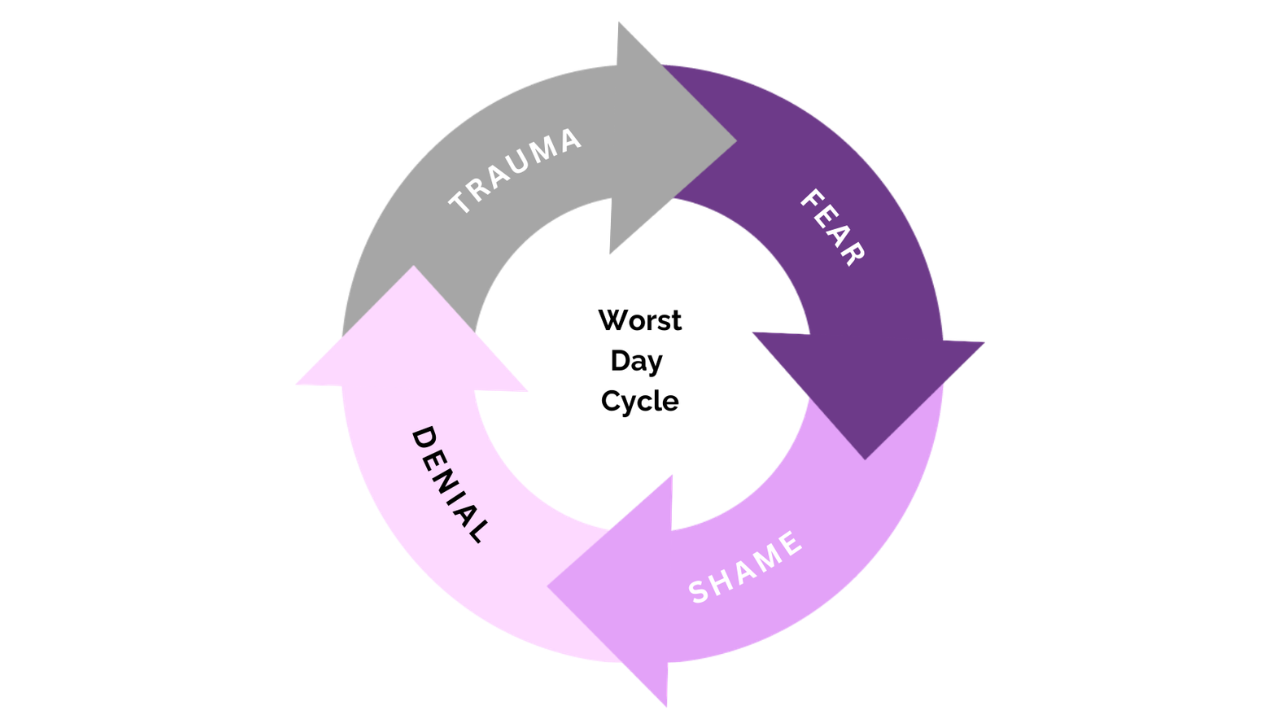
The Worst Day Cycle™ has four stages: Trauma → Fear → Shame → Denial.
Trauma: Any negative emotional experience in childhood that created painful meanings. These experiences create a massive chemical reaction in the brain and body. The hypothalamus generates chemical cocktails — cortisol, adrenaline, dopamine, oxytocin misfires — and the brain becomes addicted to these emotional states. This isn’t weakness. This is neurology. Your brain was designed to learn from emotional experience, and it learned that pain, fear, and shame are the normal operating states of life.
That’s you — feeling most alive when you’re in crisis mode, because your nervous system was calibrated for chaos in childhood and calm actually feels dangerous.
Fear: Fear drives repetition. The brain conserves energy by repeating known patterns — it can’t tell right from wrong, only known from unknown. Since 70%+ of childhood messaging is negative and shaming, adults repeat these painful patterns in relationships, career, hobbies, health — everything. Your brain doesn’t care that the pattern hurts. It cares that the pattern is familiar. And familiar means safe, even when it’s destroying you.
Shame: This is where you lost your inherent worth. “I am the problem.” Not “I made a mistake” — but “I AM the mistake.” This is the core wound underneath anxiety, depression, perfectionism, people-pleasing, and every other “mental health” label you’ve been given. Shame isn’t a symptom to manage. It’s a childhood belief that was carved into your nervous system before you could defend yourself.
That’s the shame talking — the voice that says “there’s something wrong with me” when really what happened is something wrong was done TO you, and your nervous system never had the chance to process it.
Denial: Denial is the survival persona you created to survive the pain. It was brilliant in childhood — absolutely necessary. But in adulthood, it sabotages everything. Denial keeps you from seeing the pattern. It keeps you medicating symptoms instead of healing roots. It keeps you in therapy for years, “working on yourself,” while the childhood blueprint runs unchanged underneath.
The Worst Day Cycle™ reveals why the mental health crisis keeps getting worse — traditional approaches address the cognitive symptoms of this neurochemical loop while leaving the childhood trauma, fear, shame, and denial pattern completely intact, ensuring the cycle repeats indefinitely.
How Do the Three Survival Personas Mask Mental Health Struggles?
Your survival persona is the identity you created in childhood to navigate an emotionally unsafe environment. It’s not who you are — it’s who you had to become. And it’s the reason your mental health struggles look different from someone else’s, even though the root cause is the same.
There are three survival persona types:
The Falsely Empowered: This persona controls, dominates, and rages. Their mental health struggles look like anger management issues, workaholism, perfectionism, and emotional unavailability. They don’t “look” like they have mental health problems — they look strong, successful, in control. But underneath, they’re running on fear and shame, terrified that if they slow down or show vulnerability, everything will collapse.
That’s you — the one everyone describes as “so strong” while you’re white-knuckling your way through life, terrified of being seen as weak.
The Disempowered: This persona collapses, people-pleases, and disappears. Their mental health struggles look like anxiety, depression, codependence, and chronic self-abandonment. They’re the ones most likely to seek help — but the help they receive usually teaches them to cope better, not heal the root. They learn better coping skills, better communication tools, better ways to manage their reactions. And they stay stuck.
That’s you — the one who’s been in therapy for years and can explain your patterns perfectly but still can’t stop repeating them.
The Adapted Wounded Child: This persona oscillates between both — controlling one moment, collapsing the next. Their mental health struggles look like mood swings, emotional instability, and relationship chaos. They’re often misdiagnosed because their symptoms change depending on context. They’re the perfectionist at work and the people-pleaser at home. The controller with friends and the collapsed one with their partner.
That’s you — the one who swings between “I’ve got this” and “I’m falling apart” and can’t figure out which one is real.
All three survival personas mask the same root cause — childhood emotional trauma that created a neurochemical pattern of fear, shame, and denial — but traditional mental health awareness treats each persona’s symptoms differently instead of addressing the shared origin underneath.
Why Can’t Positive Thinking and Affirmations Fix Mental Health?
Here’s what doesn’t work: affirmations. Positive thinking. Cognitive reframing. Willpower. Gratitude journals. Vision boards.
You’ve probably tried all of them. And you probably felt a temporary lift — a few hours, maybe a few days of feeling better. Then the old patterns came roaring back, and you blamed yourself for not being “positive enough” or “committed enough.”
That’s you — repeating “I am enough” in the mirror while your nervous system screams that you’re not, and then shaming yourself for not believing the affirmation.
Here’s why positive thinking fails: studies show that if you tell a depressed person to use affirmations, their depression actually gets worse. It has the opposite effect — because it’s a lie. Your nervous system knows it’s a lie. And when the conscious mind says one thing while the body feels another, the body always wins.
You cannot change emotional patterns through thoughts alone. Emotions are biochemical events. Thoughts originate from feelings, not the other way around. Your “negative thinking” isn’t causing your depression. Your depression — a biochemical state created by childhood trauma — is generating the negative thoughts. Trying to fix the thoughts without addressing the biochemistry is like trying to stop a fire by fanning away the smoke.
That’s the truth that changes everything — your thoughts don’t create your feelings. Your feelings create your thoughts. And those feelings were installed in childhood, before you could think critically about any of it.
This is why the mental health industry’s cognitive approach has hit a wall. Cognitive Behavioral Therapy, positive psychology, and mindfulness all operate at the thinking level. They assume that if you change your thoughts, you’ll change your feelings. But the neuroscience says the opposite: feelings come first. Thoughts follow. And the feelings driving your mental health struggles were learned in childhood, stored in your body, and automated by your nervous system. No amount of thinking can override that.
How Unhealed Trauma Shows Up in Every Area of Your Life
Family: You’re either enmeshed — managing everyone’s emotions, keeping the peace, sacrificing yourself to maintain connection — or you’re disconnected, showing up physically but emotionally checked out. You can’t set boundaries without guilt. You can’t disagree without panic. Holiday dinners feel like emotional minefields. And you keep wondering why your family relationships feel exactly like they did when you were a kid — because they’re running on the same emotional blueprint.
That’s you — still playing the role your family assigned you at age six, wondering why adulthood feels so much like childhood.
Romantic Relationships: You choose partners who trigger your childhood wounds. You confuse intensity with intimacy. You tolerate behavior that crosses your boundaries because leaving feels more terrifying than staying. You either control and criticize, or collapse and people-please. And every argument with your partner isn’t really about the dishes or the schedule — it’s about the five-year-old inside you who never felt safe.
Sound familiar? The person who knows exactly how to communicate “correctly” but still can’t stop the emotional spiral when conflict arises?
Friendships: You’re the friend everyone calls in a crisis but no one checks on. You listen for hours but never share your own struggles. You cancel your own plans when someone else needs you. You feel lonely even when surrounded by people — because no one actually knows you. They know your survival persona.
Work: You overdeliver, say yes to everything, check email at midnight, and measure your worth in productivity. Or you underperform, undersell yourself, and stay in jobs that don’t value you because your shame says you don’t deserve better. Either way, your career is being run by a childhood blueprint — not by your authentic ambitions.
That’s you — either burning out from overachieving or stuck in paralysis from undervaluing yourself, and neither one reflects who you actually are.
Body and Health: You eat to numb. You exercise compulsively or not at all. You ignore your body’s signals until they become impossible to ignore — chronic pain, digestive issues, insomnia, autoimmune conditions. The mental health industry calls these “comorbidities.” They’re not. They’re your body screaming what your mind won’t acknowledge: unhealed childhood trauma is stored physically, and it will find a way to get your attention.
How the Emotional Authenticity Method™ Heals What Mental Health Awareness Can’t
The Emotional Authenticity Method™ is what happens when you stop managing symptoms and start healing roots. It’s a daily practice that rewires your emotional blueprint at the nervous system level — where traditional mental health approaches can’t reach.
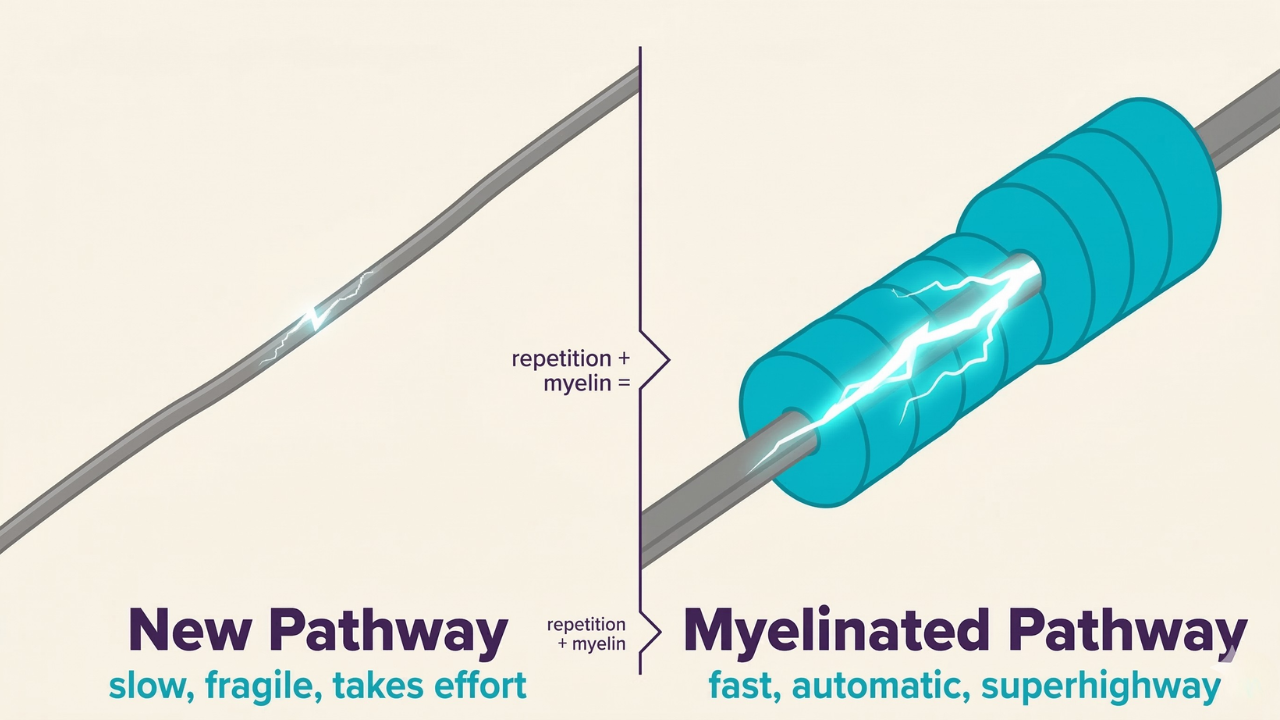
Step 1: Somatic Down-Regulation with optional Titration. Before you can process anything, you have to get your nervous system out of survival mode. Focus on what you can hear for 15 to 30 seconds. This isn’t meditation — it’s sending your body a signal that you’re safe enough to feel. If the emotion feels overwhelming, titration means you go slowly — you don’t force yourself to feel everything at once.
That’s you — learning that healing doesn’t mean forcing yourself through the pain. It means giving your nervous system permission to feel at a pace it can handle.
Step 2: What am I feeling? Most people answer “stressed” or “fine.” That’s not a feeling — that’s a defense. Using the Feelings Wheel, you develop emotional granularity — the ability to name specific emotions instead of lumping everything into vague categories. “I feel abandoned.” “I feel ashamed.” “I feel invisible.” That specificity changes everything, because your nervous system can process what it can name.
Step 3: Where in my body do I feel it? All emotional trauma is stored physically. Your chest tightens. Your stomach drops. Your jaw clenches. Your shoulders climb toward your ears. Locating the feeling in your body is how you move from intellectual understanding to somatic processing — because this is not a cognitive experience. Most of these wounds happened before the age of four, before you could put cognitive thoughts to any of it. It was an emotional experience.
Step 4: What is my earliest memory of having this exact feeling? This is where the rewiring happens. You trace today’s reaction back to its childhood origin. You start to see: this isn’t about today. My partner isn’t my parent. My boss isn’t my father. My nervous system just thinks they are. When you see the connection — between your adult reaction and your childhood wound — everything shifts.
That’s the moment that changes everything — when you realize your partner didn’t create this fear. Your parent did. And your nervous system has been replaying that pattern with every person you’ve ever loved.
Step 5: Who would I be if I never had this thought or feeling again? What would be left over? This is the vision step. It connects you to the Authentic Self Cycle™ and gives your nervous system a new destination — not more coping, not better symptom management, but actual identity restoration.
Step 6: Feelization. Sit in the feeling of the Authentic Self and make it strong. Create a new emotional chemical addiction to replace the old blueprint. Ask: how would I respond to this situation from this feeling? What would I say? What would I do? Visualize and FEEL yourself operating from your Authentic Self. This is the emotional blueprint remapping and rewiring step — you’re not just imagining a different life, you’re creating the neurochemical pathway that makes it real.
That’s you — not just understanding what healing looks like, but actually feeling it in your body and letting that feeling become your new normal.
The Emotional Authenticity Method™ works because emotions are biochemical events — you cannot change emotional patterns through thoughts alone. Thoughts originate from feelings, not the other way around. This is why cognitive approaches fail for trauma survivors and why emotional authenticity succeeds where mental health awareness alone cannot.
How the Authentic Self Cycle™ Replaces Symptom Management With Identity Restoration
The Authentic Self Cycle™ is the healing counterpart to the Worst Day Cycle™. Where the Worst Day Cycle™ traps you in Trauma → Fear → Shame → Denial, the Authentic Self Cycle™ restores your identity through Truth → Responsibility → Healing → Forgiveness.
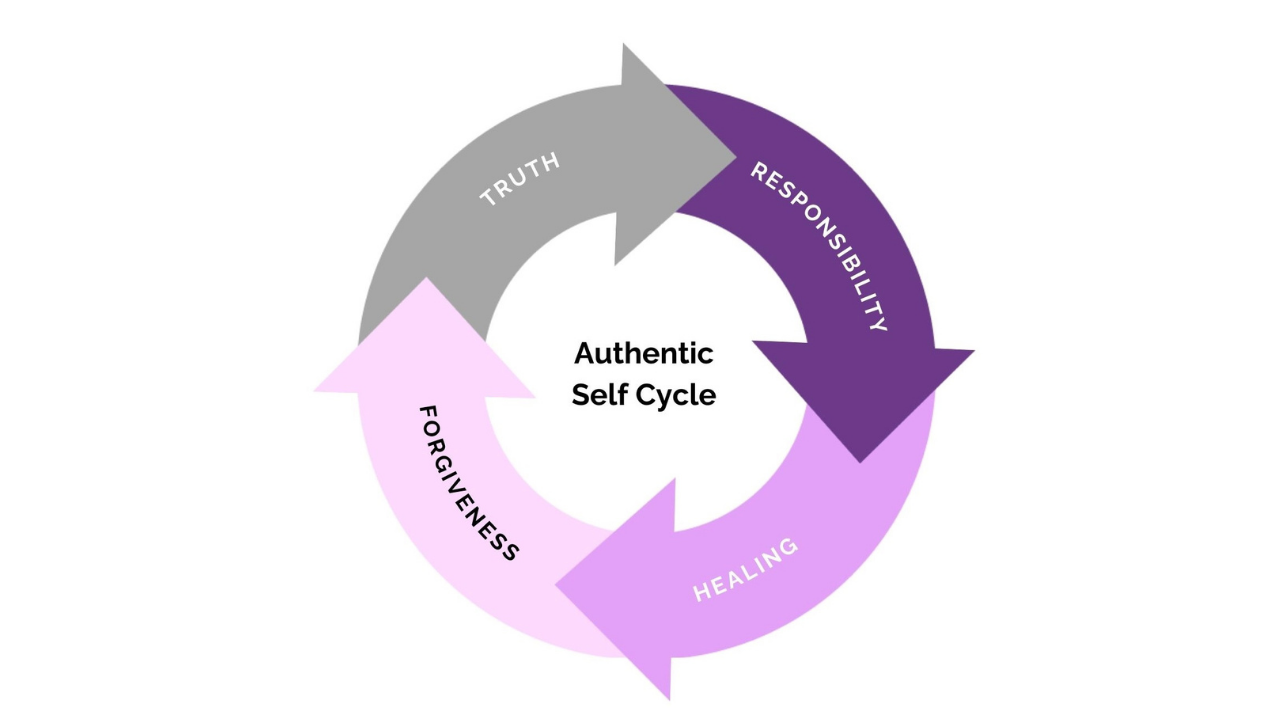
Truth: Name the blueprint. See that “this isn’t about today.” When anxiety spikes before a meeting, truth says: “This feeling is from childhood. My boss isn’t my critical parent — my nervous system just thinks they are.” Truth is the moment you stop calling it “anxiety” and start calling it what it is: a childhood emotional pattern that never got processed.
That’s the first step toward real mental health — seeing the pattern instead of being trapped inside it.
Responsibility: Own your emotional reactions without blame. “My partner isn’t my parent — my nervous system just thinks they are.” This isn’t about fault. It’s about taking back your power from a childhood that stole it. Responsibility means you stop waiting for someone else to fix your mental health and start doing the nervous system work yourself.
Healing: Rewire the emotional blueprint so conflict becomes uncomfortable but not dangerous, space isn’t abandonment, and intensity isn’t attack. This happens through repeated somatic experience — tiny moments where your nervous system learns something new. Like the second hand on a clock: each tick is almost imperceptible, but those ticks move the minute hand, and the minutes move the hours. Healing works the same way.
That’s the truth about healing — it’s not one dramatic breakthrough. It’s thousands of small moments where you choose emotional authenticity over your survival persona.
Forgiveness: Release the inherited emotional blueprint and reclaim your authentic self. This creates a NEW emotional chemical pattern that replaces fear, shame, and denial with safety, worth, and connection. Forgiveness doesn’t mean what happened was okay. It means you stop carrying the emotional blueprint your parents inherited from their parents. You break the cycle.
The Authentic Self Cycle™ is an identity restoration system — it doesn’t teach you to manage your mental health symptoms, it replaces the neurochemical pattern that created those symptoms with a new blueprint built on truth, responsibility, and emotional authenticity.
Frequently Asked Questions About Mental Health Awareness
What is mental health awareness and why isn’t it enough to heal?
Mental health awareness is the recognition that emotional and psychological wellbeing matters. It’s an important first step — but awareness alone doesn’t heal. Traditional mental health awareness focuses on identifying symptoms (anxiety, depression, emotional dysregulation) and managing them through medication, therapy, or coping strategies. It doesn’t trace those symptoms to their childhood origin or rewire the nervous system pattern that created them. The Worst Day Cycle™ explains how childhood trauma creates automated emotional patterns that no amount of cognitive awareness can break.
Why does the mental health crisis keep getting worse despite increased awareness?
The mental health crisis worsens because the dominant approach treats symptoms instead of root causes. Nearly 70% of adults carry unhealed childhood trauma that manifests as anxiety, depression, addiction, and chronic illness. Traditional approaches use medication to alter brain chemistry and cognitive therapy to change thoughts — but childhood trauma is stored in the body as a neurochemical pattern, not as a thought. Until we address the emotional blueprint created in childhood, symptom management will continue to fail at the population level.
Can childhood trauma really cause anxiety and depression in adults?
Yes — and the science is overwhelming. The Adverse Childhood Experiences (ACE) study, replicated worldwide, shows that childhood emotional trauma creates lasting neurochemical changes that manifest as anxiety, depression, addiction, obesity, and chronic disease in adulthood. Trauma isn’t just abuse — it includes emotional neglect, conditional love, parental criticism, and any experience that created painful meanings about yourself. The brain becomes addicted to the stress hormones produced during these events, repeating the pattern in adulthood.
What is the difference between mental health awareness and emotional authenticity?
Mental health awareness teaches you to recognize and manage emotional symptoms. Emotional authenticity teaches you to tell the truth about what you feel, trace it to its childhood origin, locate it in your body, and allow your nervous system to process what was never safe to process as a child. The Emotional Authenticity Method™ is a 6-step somatic practice that rewires the emotional blueprint at the nervous system level — where cognitive approaches can’t reach.
Why do affirmations and positive thinking make depression worse?
Studies show that affirmations worsen depression because they create a conflict between what the conscious mind says and what the nervous system knows to be true. When you tell yourself “I am enough” but your body carries decades of childhood shame saying you’re not, the nervous system registers the affirmation as a lie — and the shame intensifies. Emotions are biochemical events, not thoughts. You cannot override a neurochemical pattern with a positive statement. Healing requires somatic processing, not cognitive reframing.
How long does it take to heal from childhood trauma using the Emotional Authenticity Method™?
Patterns that have been running for 20, 30, or 40 years don’t reverse overnight. But noticeable shifts can happen within weeks of consistent daily practice. The key is repetition, not intensity — like the second hand on a clock, each small moment of emotional truth moves the larger pattern. The Emotional Authenticity Method™ and Authentic Self Cycle™ provide the framework for long-term identity restoration. Most people see meaningful shifts within months, and deep neurological rewiring over one to two years of committed practice.
The Bottom Line
The mental health crisis isn’t a crisis of awareness. It’s a crisis of approach.
We’ve been taught to manage symptoms when we should be healing roots. We’ve been taught to think our way out of feelings when feelings come first and thoughts follow. We’ve been taught that awareness is enough when awareness without the right tools is just watching yourself suffer with better vocabulary.
The real solution isn’t more awareness. It’s emotional authenticity — the willingness to feel what you actually feel, trace it to where it started, and allow your nervous system to process what it never had permission to process as a child.
Every person struggling with “mental health” is carrying an unhealed childhood wound. Every anxiety spike is a five-year-old’s fear. Every depressive episode is a child’s grief. Every addiction is a nervous system trying to numb pain it was never taught to feel.
That’s you — not someone with a mental health disorder. Someone with an unhealed childhood that’s been waiting decades for permission to finally feel the truth.
The solution isn’t pills. It’s not positive thinking. It’s not more coping skills. The solution is learning Emotional Authenticity — giving yourself the knowledge, skills, and tools to navigate pain instead of running from it. Because for every person who has ever truly healed, the turning point wasn’t when the pain stopped. It was when they finally had permission to feel it.
All the problems in the world — the addiction, the obesity, the illness, the relationship destruction, the political and social unrest — are just broken children repeating the pain from their past, demanding the world accommodate their survival persona. That’s it. And the solution is the same for all of it: give the child inside you permission to heal the pain from their past.
That’s you — not broken. Not disordered. Not lacking awareness. Just carrying a childhood wound that deserves to finally be felt, processed, and released.
That’s where real mental health begins. Not in your head. In your body. In your truth. In your willingness to stop managing and start healing.
Recommended Reading
These books complement the frameworks in this article and deepen your understanding of why traditional mental health approaches fall short:
Facing Codependence by Pia Mellody — the foundational text on how childhood trauma creates the survival patterns that mental health awareness labels as disorders but doesn’t heal.
The Body Keeps the Score by Bessel van der Kolk — the science of how trauma lives in the body, not the mind, explaining why cognitive approaches have limits.
When the Body Says No by Gabor Maté — how chronic emotional suppression manifests as physical illness, addiction, and the very symptoms the mental health industry tries to medicate.
Codependent No More by Melody Beattie — a practical guide to recognizing when mental health management becomes emotional overfunction.
The Gifts of Imperfection by Brené Brown — how shame drives the survival persona and why vulnerability is the path beyond symptom management to authentic healing.
Take the Next Step
If you’re ready to move beyond mental health awareness and into emotional authenticity, Kenny Weiss offers courses designed for people who are done managing symptoms and ready to heal roots:
Emotional Blueprint Starter Course — Individual ($79) — Your personal roadmap to understanding the Worst Day Cycle™ and beginning the shift from symptom management to nervous system healing.
Relationship Starter Course — Couples ($79) — For couples ready to stop managing conflict and start healing the childhood blueprints driving it.
Why We Can’t Stop Hurting Each Other ($479) — Deep-dive into the Worst Day Cycle™ and how childhood trauma creates the relationship patterns that traditional therapy manages but can’t resolve.
Why High Achievers Fail at Love ($479) — Built for high achievers who’ve mastered mental health awareness but can’t figure out why they still feel empty.
The Shutdown Avoidant Partner ($479) — Understanding avoidant attachment through the lens of trauma chemistry and survival personas.
Tier 1: Mapping the Blueprint ($1,379) — The comprehensive program for learning and practicing the Emotional Authenticity Method™.
Download the Feelings Wheel — the free tool used in Step 2 of the Emotional Authenticity Method™ to build emotional granularity beyond surface-level mental health awareness.
Explore more: The Signs of Enmeshment | 7 Signs of Relationship Insecurity | 7 Signs of High Self-Esteem | How to Determine Your Negotiables and Non-Negotiables | 10 Do’s and Don’ts for a Great Relationship