
That voice in your head that tells you you’re not good enough? It’s not actually your authentic self criticizing you. It’s a survival persona—a protective mechanism your nervous system created in childhood to help you survive emotionally painful experiences. And the most damaging thing about your inner critic isn’t the harsh words; it’s that you believe them because they’re rooted in shame—the core belief that you are fundamentally broken.
Here’s the truth that changes everything: Your inner critic is not the voice of truth or improvement. It’s the voice of a terrified, ashamed child survival persona speaking to protect you the only way it learned how. Most people spend decades trying to argue with, ignore, or silence this voice through willpower and positive thinking. But willpower doesn’t work because shame isn’t a thought problem—it’s an emotional and biochemical pattern rooted in childhood trauma.
Sound familiar? You’ll sabotage opportunities, undermine relationships, or collapse into perfectionism because your nervous system doesn’t feel safe. Your inner critic isn’t broken; it’s doing exactly what it was designed to do. But what worked in childhood now works against you.
The path to silencing your inner critic isn’t through thought replacement or self-help affirmations. It’s through understanding the three frameworks that rewire your emotional blueprint: the Worst Day Cycle™, the Authentic Self Cycle™, and the Emotional Authenticity Method™.
Table of Contents
- What Is Your Inner Critic (Really)?
- The Worst Day Cycle™: How Shame Becomes Your Inner Voice
- Three Survival Persona Types That Drive Self-Sabotage
- Your Emotional Blueprint: The Root of the Inner Critic
- The Authentic Self Cycle™: Breaking the Pattern
- The Emotional Authenticity Method™: Five Steps to Rewire Your Nervous System
- What Your Inner Critic Sounds Like by Life Area
- Frequently Asked Questions
- The Bottom Line
- Recommended Reading
What Is Your Inner Critic (Really)?
Most people describe their inner critic as a voice that attacks them: “You’re not good enough. You’re going to fail. Everyone’s judging you. You don’t deserve this.” They assume this voice comes from low self-esteem or perfectionism or anxiety disorder.
That’s only half true.
Your inner critic is actually a survival persona—a protective identity your nervous system created to help you survive emotional pain in childhood. When you experienced rejection, abandonment, shaming, or invalidation as a child, your developing brain and nervous system didn’t just process the experience cognitively. It created a complete emotional and biochemical blueprint: a pattern of fear, shame, and coping behaviors designed to prevent that pain from happening again.
That’s you when you immediately apologize before anyone even criticized you. That’s you when you sabotage a relationship right when it’s getting close. That’s you when you drive yourself to exhaustion trying to prove your worth.
Your survival persona isn’t weak or broken. It’s brilliant—but it’s operating from childhood rules in an adult world.
The inner critic voice comes from three specific places:
- Direct internalization of parental voices: You literally absorbed your parents’ shame-based messaging and made it your own internal voice.
- Shame about your natural emotional needs: When your childhood environment made you feel ashamed for needing, wanting, or feeling, you turned that shame inward.
- Fear-based self-protection: Your survival persona learned that self-criticism was safer than waiting for others to criticize you. If you attack yourself first, you control the narrative.
The problem: this mechanism worked perfectly in childhood. It helped you survive. But in adulthood, that same protective voice keeps you small, isolated, and unable to access your authentic self.
The Worst Day Cycle™: How Shame Becomes Your Inner Voice
To understand your inner critic, you need to understand the emotional blueprint that created it. That’s where the Worst Day Cycle™ comes in.
The Worst Day Cycle™ is a four-stage pattern that explains how childhood trauma creates adult self-sabotage: Trauma → Fear → Shame → Denial. This isn’t just a theory—it’s a neurobiological reality rooted in how your brain and nervous system respond to emotional pain.
Stage 1: Trauma (The Original Pain)
Trauma in this framework means any emotionally painful experience in childhood that created a painful meaning about yourself, others, or the world. It doesn’t have to be abuse. It could be:
- A parent who was emotionally unavailable or dismissive
- Shaming messages about your body, emotions, or natural needs
- Feeling responsible for a parent’s emotional state
- Being compared to a sibling or held to impossible standards
- Rejection from peers or authority figures
- Abandonment, whether physical or emotional
The trauma itself wasn’t just a thought or memory. It created a massive neurochemical reaction: your hypothalamus flooded your system with cortisol (stress), adrenaline (fight/flight), dopamine dysregulation (reward confusion), and oxytocin misfires (attachment disruption). Your developing nervous system registered this as dangerous.
Stage 2: Fear (The Protective Response)
Fear is your nervous system’s way of trying to keep you safe. After the painful experience, your brain learned a simple equation: That situation = pain. Repeat that situation = more pain. Avoid that situation = safety.
The problem: your brain can’t tell right from wrong. It only knows known vs. unknown. Since your brain is wired to conserve energy, it repeats known patterns—even painful ones—because repetition equals predictability, and predictability feels safer than the unknown.
That’s you when you stay in a relationship that hurts because at least you know what to expect. That’s you when you choose a job that pays well but crushes your spirit because uncertainty feels too risky.
Your inner critic becomes the voice of fear—a constant warning system designed to prevent you from repeating the original pain.
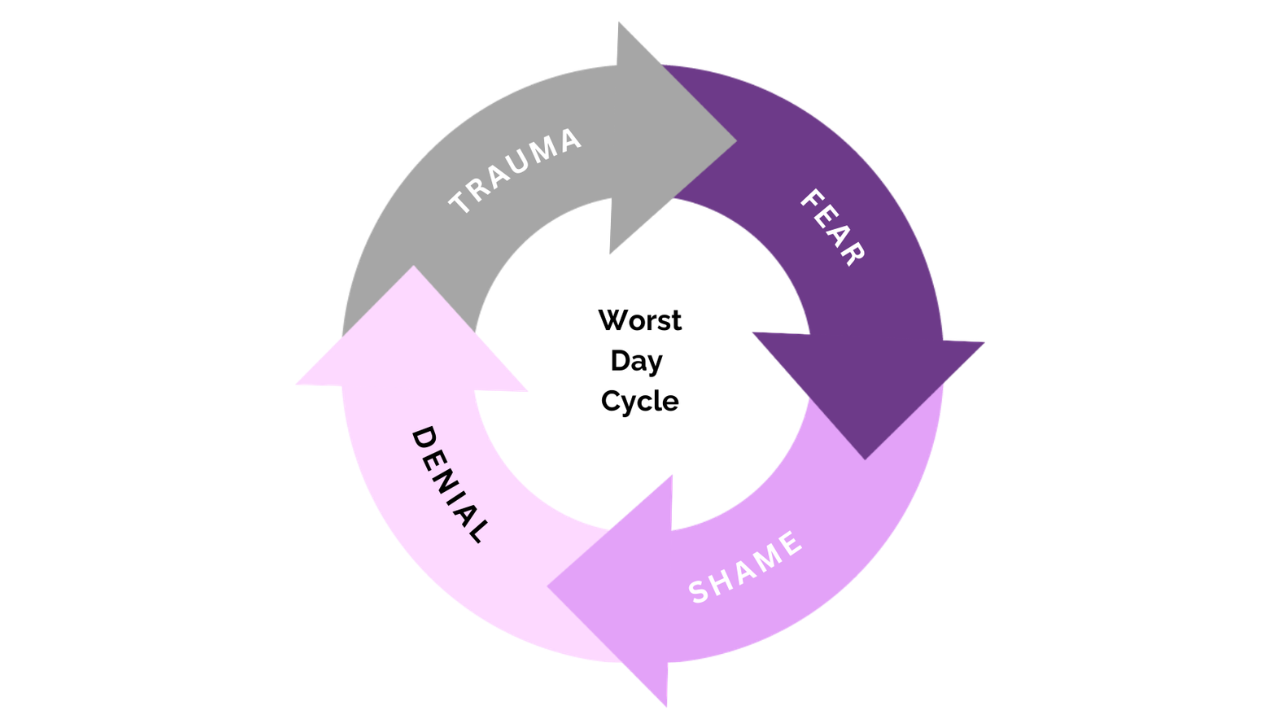
Stage 3: Shame (Where You Lost Your Worth)
Shame is where the inner critic becomes lethal. Fear says, “That situation is dangerous.” Shame says, “You are the problem.”
Research shows that over 70% of childhood messaging is negative and shaming. Parents rarely say, “I love you unconditionally.” They say, “Why can’t you be more like your sister?” or “You’re so sensitive” or “Stop crying or I’ll give you something to cry about.”
Shame is the internalized belief that you are fundamentally broken, unlovable, or not good enough. It’s different from guilt (which is about what you did) or embarrassment (which is about how others perceive you). Shame is about who you are.
This is where your inner critic gets teeth. It’s not just warning you about danger; it’s confirming what you’ve believed about yourself since childhood: “I am the problem. My needs are too much. I don’t deserve this. I should be ashamed.”
Stage 4: Denial (The Survival Persona)
Denial is your nervous system’s final attempt to make the pain bearable. When you can’t process the original trauma or acknowledge the fear or tolerate the shame, your psyche creates a survival persona—an identity that either fights back, collapses, or oscillates between both.
That’s you when you become a perfectionist and never admit mistakes. That’s you when you people-please until you resent everyone. That’s you when you swing between dominating situations and disappearing.
This survival persona feels like you, but it’s actually a protective mask. And your inner critic is the voice of that mask, telling you it needs to keep working, keep protecting, keep fighting, to keep you safe.
Three Survival Persona Types That Drive Self-Sabotage
Not everyone’s inner critic sounds the same. Your inner critic’s voice, intensity, and message depend on which survival persona your nervous system created. Understanding which one you are is the first step to changing the pattern.

The Falsely Empowered Survival Persona
The falsely empowered persona responds to childhood trauma by taking control, dominating, and never showing vulnerability. This is the high-achiever, the perfectionist, the control freak, the rage responder, or the charismatic narcissist.
Their inner critic sounds like: “You need to control everything or chaos will destroy you. Your needs don’t matter; only performance matters. Never let anyone see you struggle. Domination is safety.”
In childhood, this person learned that vulnerability = destruction. So they built an identity around being strong, competent, and in control. The problem: this persona can never rest, never admit failure, never ask for help, and burns out constantly.
That’s you when you work 80 hours a week and feel guilty for taking a vacation. That’s you when you explode at minor mistakes because control slipping feels like death.
The Disempowered Survival Persona
The disempowered persona responds to childhood trauma by collapsing, people-pleasing, and prioritizing others’ needs over their own. This is the martyr, the fixer, the caretaker, the invisible person, or the chronic accommodator.
Their inner critic sounds like: “Your needs are selfish. You should be grateful for whatever scraps you get. Don’t bother people. Make yourself smaller so you don’t burden anyone.”
In childhood, this person learned that their emotions were inconvenient, their needs were too much, or their presence was conditional on being useful to others. So they built an identity around self-sacrifice. The problem: resentment builds, anger implodes, and they become invisible even to people who love them.
That’s you when you say yes to everything and then resent everyone. That’s you when you know what you want but suppress it to keep the peace.
The Adapted Wounded Child Survival Persona
The adapted wounded child oscillates between falsely empowered and disempowered states, creating a whiplash pattern of controlling and collapsing. This is often the most confusing survival persona because the person seems to have multiple personalities—sometimes confident and dominating, sometimes anxious and people-pleasing.
Their inner critic sounds like: “You have to be strong, but you’re also a failure. Push harder, but you’re not good enough. Control the situation, but give up because it’s hopeless.”
In childhood, this person experienced inconsistent or unpredictable emotional environments. One day their parent was loving; the next day they were raging. So this person learned to watch carefully, adapt their persona moment-to-moment, and never trust their own sense of what’s okay.
That’s you when you’re confident in a meeting and then spiral with self-doubt the moment someone disagrees. That’s you when you pursue someone intensely and then ghost them.

The key insight: all three survival personas are brilliant adaptations to an environment that wasn’t safe enough for your authentic self to exist. Your inner critic’s voice is the voice of whichever persona you created. It’s not the voice of truth; it’s the voice of protection.
Your Emotional Blueprint: The Root of the Inner Critic
Why can’t you just think your way past your inner critic?
Because emotions aren’t thoughts. They’re biochemical events.
Here’s what most self-help misses: your brain is an energy-conserving organ. When you experience something as emotionally significant—painful or pleasurable—your nervous system encodes it at the deepest level. It creates a neural pathway through repeated activation. Every time you feel fear, shame, or the need to control, that pathway fires. And every time it fires, the myelin sheath around that neural pathway gets thicker, making the pattern stronger and faster to activate.
This is why your inner critic feels automatic. It’s not that you’re choosing to believe it. Your nervous system has been practicing these shame and fear patterns for 20, 30, 40 years. The pathway is superhighway-thick.
Your emotional blueprint is the set of core beliefs, fears, and coping patterns that were encoded in your nervous system during childhood and are now running automatically in your adult life.
When you experience a triggering situation—rejection, criticism, intimacy, success—your nervous system doesn’t evaluate it rationally. It pattern-matches it to your childhood experience and activates the entire emotional blueprint: the fear, the shame, the survival persona response.
That’s you when your partner says, “We need to talk,” and you immediately feel like you’re in trouble with a parent. That’s you when you get praised and dismiss it because you don’t believe it.
Your inner critic isn’t actually criticizing you. It’s your emotional blueprint defending itself.
The breakthrough: you can’t rewire your emotional blueprint by thinking differently. You have to rewire it through feeling differently, which changes your nervous system’s biochemistry.
The Authentic Self Cycle™: Breaking the Pattern
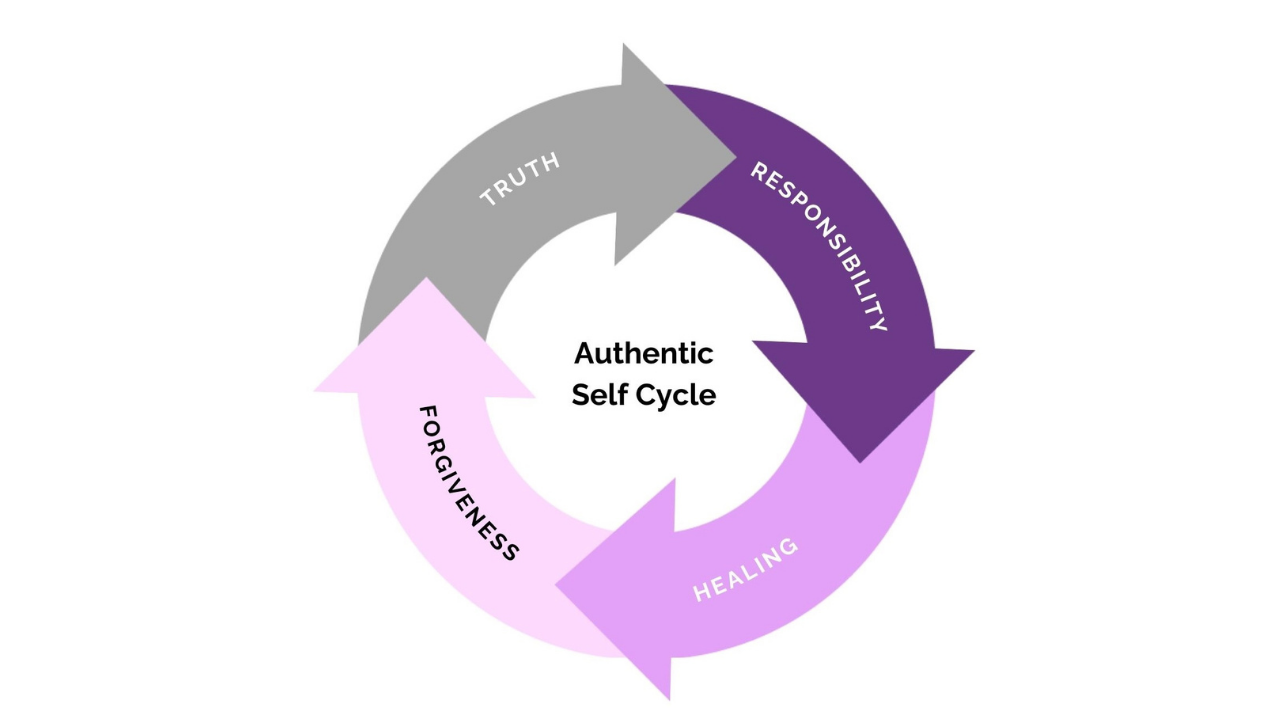
The opposite of the Worst Day Cycle™ is the Authentic Self Cycle™—a four-stage pattern that rewires your emotional blueprint and reclaims your authentic self: Truth → Responsibility → Healing → Forgiveness.
The Authentic Self Cycle™ is an identity restoration system that reverses the damage of the Worst Day Cycle™ by creating a new emotional and biochemical pattern.
Stage 1: Truth (Name the Blueprint)
Truth means naming the actual pattern. Not intellectualizing it or understanding it—actually naming it: “This fear isn’t about today. This is my parents’ voice. This shame isn’t mine to carry. This survival persona was created to protect me.”
Truth is the first step because as long as you think the inner critic is telling the truth about you, you’re locked in denial. You have to see it: “This isn’t about today. This is about a six-year-old who was shamed for crying.”
Stage 2: Responsibility (Own Your Nervous System)
Responsibility doesn’t mean blame. It means owning that your nervous system is running childhood patterns. When your partner says something innocent and you feel attacked, that’s not their fault or your fault—it’s that your nervous system is pattern-matching them to a parent.
That’s you when you recognize: “My partner isn’t my parent. My nervous system just thinks they are because of my blueprint.”
Responsibility is where you stop outsourcing your feelings to others and start recognizing your nervous system as the actual issue.
Stage 3: Healing (Rewire the Pattern)
Healing is where the actual rewiring happens. This is where you teach your nervous system that conflict isn’t danger, space isn’t abandonment, intensity isn’t attack, and you’re safe being your authentic self.
Healing isn’t intellectual—it’s somatic. Your nervous system learns through experience, not through insight. This is where the Emotional Authenticity Method™ becomes critical.
Stage 4: Forgiveness (Release and Reclaim)
Forgiveness is releasing the inherited emotional blueprint. Not forgiving your parents so they feel better—forgiving so you feel better. Releasing the belief that their emotional state is your responsibility. Releasing the blueprint they passed down to you.
Forgiveness is when your inner critic finally quiets down because you’ve created a new emotional reality where you don’t need the protection anymore.
The Emotional Authenticity Method™: Five Steps to Rewire Your Nervous System
This is where theory becomes action. The Emotional Authenticity Method™ is Kenny’s five-step process for actually changing your emotional patterns—the process that silences your inner critic by rewiring your nervous system at the source.
The Emotional Authenticity Method™ is a somatic five-step process designed to move you from shame-based survival patterns to authentic emotional truth by changing your nervous system’s biochemistry. It’s based on one core principle: You cannot change emotional patterns through thoughts alone. Emotions are biochemical events. Thoughts originate from feelings.
Step 1: Somatic Down-Regulation (With Optional Titration)
Before you can change anything, your nervous system needs to feel safe. If you’re in a heightened state of fear or shame, your rational brain isn’t available. You’re locked in survival mode.
Down-regulation means bringing your nervous system back to baseline through somatic techniques: deep breathing, body scanning, cold water exposure, movement, or sound. Optional titration means exposing yourself to a small dose of the trigger and then down-regulating, gradually increasing your nervous system’s capacity to handle the trigger without going into full survival mode.
That’s you when you take five deep breaths before a difficult conversation instead of exploding. That’s you when you notice tightness in your chest and pause to regulate before reacting.
Step 2: What Am I Feeling? (Emotional Granularity)
Most people live in a binary emotional state: I feel bad or I feel good. Your inner critic thrives in this vagueness because you can’t rewire what you can’t name.
Emotional granularity means identifying the specific feeling with precision. Use the Feelings Wheel to expand your emotional vocabulary beyond “stressed” or “angry.” Are you feeling shame, fear, loneliness, resentment, unworthiness, abandonment, powerlessness?
When you name the specific feeling, you activate the left hemisphere of your brain (language, logic) and begin to de-escalate the right hemisphere (emotion, survival). The simple act of naming is healing.

Step 3: Where in My Body Do I Feel It? (Somatic Location)
All emotional trauma is stored physically. Your nervous system doesn’t store memories in your brain—it stores them in your body’s tissues, fascia, and nervous system pathways.
When you feel shame, you might feel it as a contraction in your chest, a heaviness in your stomach, or a burning in your face. When you feel fear, you might feel it as tension in your shoulders, tightness in your throat, or a flutter in your heart.
By locating the feeling in your body, you’re completing the loop between emotion and physiology. This is what allows actual change to happen. You’re not just thinking about the pattern; you’re feeling where it lives in your body and beginning to release it.
Step 4: What Is My Earliest Memory of This Feeling? (Trace to Origin)
This is where the blueprint becomes visible. When you trace a current feeling back to its earliest memory, you see the connection between your childhood wound and your adult pattern.
That’s you when you realize your current partner’s tone of voice matches your parent’s dismissive tone, and suddenly the intensity of your reaction makes sense. That’s you when you trace your perfectionism back to a parent who never said “I’m proud of you.”
Tracing to origin doesn’t mean reliving the trauma. It means seeing the connection clearly: “This feeling isn’t really about today. This is my nervous system recognizing a pattern from 1987.”
Step 5: Who Would I Be If I Never Had This Feeling Again? (Vision Step)
This is the crucial step that most therapy and self-help misses. You don’t just process the old pattern; you envision the new one.
Imagine yourself completely free of this shame, fear, or self-sabotage. What would you do differently? How would you show up in relationships, work, or your body? What would become possible? This isn’t visualization or positive thinking—it’s creating a new neural pathway, a new emotional blueprint, a new version of yourself.
Your nervous system learns through experience and imagination equally. When you clearly envision the version of you that’s free, you’re beginning to wire that possibility into your nervous system. This vision step connects you directly to the Authentic Self Cycle™ and the healing process.
What Your Inner Critic Sounds Like by Life Area
Your inner critic doesn’t speak in a vacuum. Its voice changes depending on which life area triggers your survival persona most intensely. Understanding where your inner critic is loudest helps you trace back to the original wound.
Your Inner Critic in Family Relationships
That’s you when you’re still trying to earn your parent’s approval 20 years later. That’s you when you default to your childhood role (the peacemaker, the scapegoat, the golden child) every time you’re with family.
Family inner critic beliefs: “I’m still not good enough. I have to earn love. My needs come last. My emotions are inconvenient. I’m responsible for everyone’s happiness.”
Your family is where your blueprint was written. So your inner critic is often loudest there, repeating the exact patterns of your childhood.
Your Inner Critic in Romantic Relationships
That’s you when you abandon a relationship before you can be abandoned. That’s you when you people-please until you resent your partner. That’s you when you sabotage intimacy the moment it feels real.
Romantic inner critic beliefs: “I’m not worthy of real love. If they really knew me, they’d leave. I need to be perfect to keep this. Love equals pain. Vulnerability equals destruction.”
Romantic relationships activate your deepest fears about abandonment, unworthiness, and whether you deserve to be loved for who you actually are. Your survival persona takes over to protect you from the original wound.
Your Inner Critic in Friendships
That’s you when you’re always the listener but never share what’s really happening. That’s you when you abandon friends before you feel like you might be a burden. That’s you when you’re friendly but never genuinely known.
Friendship inner critic beliefs: “I’m too much. I’m not enough. People would leave if they really knew me. I’m just the person who helps others.”
Friendships activate fears about whether you’re likeable for yourself or just useful. Your inner critic keeps you safe by keeping you invisible.
Your Inner Critic at Work
That’s you when you work 60 hours and still feel like you’re failing. That’s you when you dismiss praise because you don’t believe it. That’s you when you can’t ask for a promotion, a raise, or help.
Work inner critic beliefs: “Your worth is determined by your output. You have to prove yourself constantly. One mistake means you’re a failure. You don’t deserve success.”
Work activates your need to control and achieve to prove your worth. Your inner critic becomes a relentless productivity machine that never lets you rest.
Your Inner Critic About Your Body and Health
That’s you when you punish yourself through exercise or restriction. That’s you when you feel shame about your body that makes intimacy impossible. That’s you when you ignore health issues because you “don’t deserve” care.
Body inner critic beliefs: “Your body is wrong. You should be ashamed. You’re not allowed to take up space. Your body’s needs are selfish.”
Your body holds every emotional blueprint you created. Shame about your body is often shame about your feelings, your needs, your very existence.
Frequently Asked Questions: People Also Ask
Can you silence your inner critic completely?
No—and you don’t want to. Your inner critic is actually trying to protect you. The goal isn’t elimination; it’s transformation. When you rewire your emotional blueprint through the Emotional Authenticity Method™, your inner critic quiets down because it no longer needs to protect you. It transforms from shame-based attack into wise internal guidance that actually serves you.
Why doesn’t positive thinking work to silence the inner critic?
Because your nervous system doesn’t believe positive thoughts that contradict your emotional blueprint. If your blueprint says “you’re unworthy” and you try to convince yourself “I’m worthy,” your nervous system registers the contradiction and goes into confusion. Your emotions are biochemical—they’re encoded at the deepest level of your nervous system. Thoughts originate from feelings, not the other way around. You have to rewire the feeling first.
How long does it take to silence your inner critic?
The timeline depends on how deeply encoded your blueprint is and how consistently you practice the Emotional Authenticity Method™. Some people notice shifts in weeks. Others take months or years. The key is consistency, not speed. Your nervous system learns through repetition. Every time you practice the five-step method instead of defaulting to your survival persona, you’re thickening a new neural pathway.
Is my inner critic my perfectionism or my anxiety?
Your inner critic is the voice underneath both perfectionism and anxiety. Perfectionism and anxiety are survival persona responses to the shame and fear at the core of your blueprint. The inner critic is the voice that drives those responses. When you silence the inner critic by rewiring your blueprint, perfectionism and anxiety naturally decrease because they’re no longer being fueled.
Can you silence your inner critic if your parents were actually critical?
Absolutely. In fact, that’s even more reason to do this work. When you had a parent who was actually critical, shame becomes deeply encoded because the external criticism confirmed your internal sense of unworthiness. The healing work is about releasing that internalized parental voice and creating a new internal voice rooted in truth and self-compassion, not shame.
What’s the difference between the inner critic and the ego?
Your ego is your sense of self—necessary and important. Your inner critic is a specific voice within your psyche that attacks, shames, and controls through fear. The inner critic is part of your survival persona. The ego can be healthy or unhealthy. A healthy ego has a quiet sense of internal confidence rooted in your authentic self. An unhealthy ego is loud, defensive, and rooted in your survival persona’s need to protect through control or collapse.
The Bottom Line: Your Inner Critic Is Not the Voice of Truth
The voice in your head that tells you you’re not good enough, that you’re going to fail, that you should be ashamed—that’s not truth. That’s not wisdom. That’s not a part of you that’s trying to help you succeed.
That’s a survival persona created by a nervous system that was trying to survive a childhood that wasn’t safe enough for your authentic self to exist.
And here’s what changes everything: your survival persona isn’t permanent. Your emotional blueprint isn’t fixed. Your nervous system can be rewired.
When you understand the Worst Day Cycle™—how trauma, fear, shame, and denial create your inner critic—you can finally see the pattern clearly. When you recognize which survival persona you created, you stop blaming yourself for the voice and start recognizing it as a brilliant but outdated adaptation.
When you use the Emotional Authenticity Method™ to rewire your nervous system through five somatic steps, you’re not just changing your thoughts. You’re changing your biochemistry. You’re creating new neural pathways. You’re encoding a new emotional blueprint.
And when you move through the Authentic Self Cycle™—truth, responsibility, healing, forgiveness—you don’t just silence the inner critic. You reclaim the authentic self that’s been underneath the noise all along.
Your inner critic served a purpose. It kept you alive when you were small and vulnerable. But you’re not that child anymore. And your nervous system is ready to learn something new: that you’re safe. That you’re worthy. That you belong exactly as you are.
That’s the voice worth listening to.
Recommended Reading
If you want to go deeper into the science of emotional blueprints, trauma, and healing, these resources by leading researchers and practitioners are essential:
- “Facing Codependence” by Mellody Beattie — The classic framework for understanding how childhood experiences shape your relational patterns and survival personas.
- “The Body Keeps the Score” by Bessel van der Kolk — The most comprehensive research on how trauma is stored in your nervous system and body, and why thoughts alone can’t heal it.
- “When the Body Says No” by Gabor Maté — How emotional denial and shame literally create chronic illness, and why emotional authenticity is health.
- “Daring Greatly” by Brené Brown — The research-backed exploration of shame, vulnerability, and what it actually takes to silence the inner critic and reclaim your authentic self.
- “Codependent No More” by Melody Beattie — The practical guide to recognizing when your survival persona is running your life and how to establish emotional boundaries.
- “The Myth of Normal” by Gabor Maté — A deep dive into how Western culture encodes shame and fear, and why your inner critic is a cultural problem, not just a personal one.
Take the Next Step: Learn to Rewire Your Emotional Blueprint
Understanding your inner critic is the first step. But understanding isn’t enough—your nervous system needs practice, repetition, and guided experience to actually change.
That’s why Kenny created courses specifically designed to rewire your emotional blueprint using the frameworks and methods in this post:
- Emotional Blueprint Starter Course — Individual ($79) — A foundational course to understand your survival persona, emotional blueprint, and how to begin rewiring your nervous system on your own.
- Relationship Starter Course — Couples ($79) — For people in relationships who want to understand how both partners’ blueprints collide and how to rewire together.
- Why High Achievers Fail at Love ($479) — A deep-dive course specifically for falsely empowered personas who are burning out in work and relationships.
- The Shutdown Avoidant Partner ($479) — A comprehensive course for understanding and healing the avoidant attachment and adapted wounded child survival persona patterns.
- Why We Can’t Stop Hurting Each Other ($479) — For couples whose survival personas are in constant conflict and who want to create real intimacy.
- Tier 1: Mapping the Blueprint ($1,379) — Kenny’s most comprehensive training on the Emotional Authenticity Method™ with daily guided practices to rewire your nervous system.
Ready to silence your inner critic? Start with the Feelings Wheel exercise—a free tool that teaches emotional granularity and begins the rewiring process immediately. Use it whenever you notice your inner critic speaking, and watch how naming the specific feeling creates immediate calm in your nervous system.
Internal Links for Further Learning
- Learn more about enmeshment and how it relates to your inner critic
- Explore seven signs of insecurity in relationships driven by your emotional blueprint
- Discover what genuine self-esteem actually looks like when your inner critic is rewired
- Understand negotiables vs. non-negotiables in your boundaries
- Learn the dos and don’ts for building healthy relationships from an authentic place