
Boundary guilt is that crushing feeling you get when you say “no” to someone, ask for what you need, or create distance from people who drain you. It’s the voice that says you’re selfish, unloving, or cruel — even though you’re setting the healthiest limits of your life. This guilt isn’t about today. It’s not about the person asking something of you. Boundary guilt is a biochemical echo of childhood trauma, stored in your nervous system, that activates whenever you try to protect yourself emotionally. It’s the survival persona you developed to survive in an environment where your needs weren’t allowed to matter.
That’s you right now, isn’t it? You set a boundary and immediately feel like a terrible person.
Boundary guilt comes from the Worst Day Cycle™ — a repeating pattern of childhood trauma, fear, shame, and denial that your survival persona uses to keep you bonded and obligated. Positive affirmations don’t touch it because guilt is biochemical, not a belief problem. The Emotional Authenticity Method™ dissolves guilt by rewiring your nervous system, and the Authentic Self Cycle™ replaces it with actual self-loyalty.
Table of Contents
- What Is Boundary Guilt and Why Does It Feel So Overwhelming?
- How the Worst Day Cycle™ Creates Boundary Guilt
- How Does Your Survival Persona Use Guilt to Keep You From Setting Boundaries?
- How Does Boundary Guilt Show Up in Every Area of Your Life?
- Why Can’t Positive Affirmations or Willpower Remove Boundary Guilt?
- How the Emotional Authenticity Method™ Dissolves Boundary Guilt
- How the Authentic Self Cycle™ Replaces Guilt With Self-Loyalty
- Frequently Asked Questions About Boundary Guilt
- The Bottom Line
- Recommended Reading
What Is Boundary Guilt and Why Does It Feel So Overwhelming?
You’re not broken. You’re not selfish. You’re not a bad person for wanting to set boundaries. What you are is a person with a nervous system that learned, very early, that your needs were dangerous — to others, to the family system, to yourself. When you try to set a boundary now, that nervous system floods with chemicals: cortisol, adrenaline, sometimes even oxytocin misfires that create false loyalty bonds.
Sound familiar? You say no to a family member and suddenly you’re paralyzed by guilt.
Boundary guilt feels overwhelming because it’s not a conscious thought — it’s a full-body, biochemical panic response inherited from your childhood emotional blueprint. Your brain is literally telling you that protecting yourself is a threat to your survival. And the worst part? That guilt gets stronger when you actually follow through on the boundary. That’s when shame kicks in: “I am a terrible person for disappointing them.”
The guilt usually shows up as:
- Physical chest tightness or gut heaviness after you set a boundary
- Obsessive replaying of the conversation (hours, days, sometimes weeks)
- Sudden urges to call and apologize or “explain” your boundary
- Shame narratives: “You’re cruel,” “You’re heartless,” “You only think about yourself”
- Abandonment anxiety: “They’ll leave you if you keep this boundary up”
- Compulsive people-pleasing to “make up for” the boundary
That’s you — abandoning the boundary just to make the guilt stop, even though you know the boundary was right.
This is the moment when most people cave. They abandon their boundary to escape the guilt. And the nervous system learns: “Good. You stayed bonded. You stayed safe.”
But you’re here because you’re tired of that pattern.
How the Worst Day Cycle™ Creates Boundary Guilt
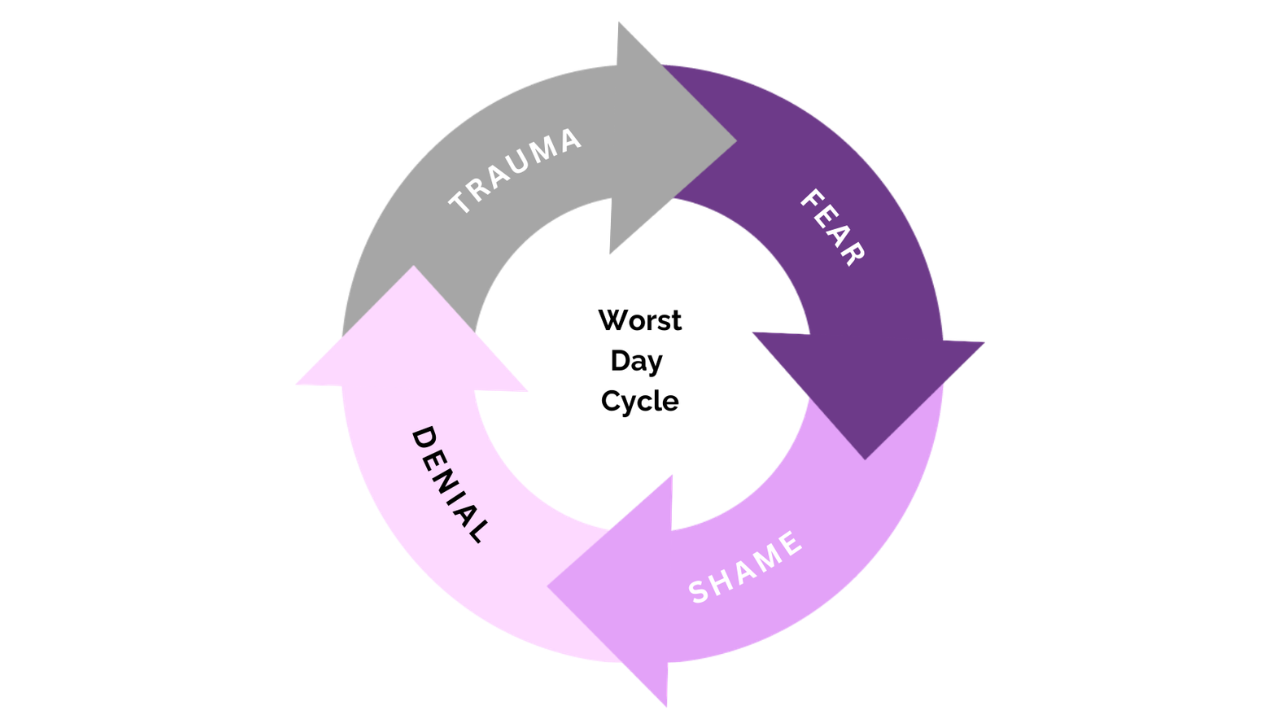
Let me introduce you to the Worst Day Cycle™ — the emotional pattern that’s been running your life and your boundaries since childhood.
The Worst Day Cycle™ has four stages: Trauma → Fear → Shame → Denial.
Stage One: Trauma (any negative emotional experience that created painful meanings)
Childhood trauma isn’t always dramatic. It doesn’t have to be abuse, abandonment, or betrayal — though all of those absolutely count. Trauma is any negative emotional experience that your developing brain encoded as “truth about the world” or “truth about me.” Maybe your parent said, “Your needs are too much.” Maybe they withdrew emotionally when you wanted something. Maybe they said you were selfish for having boundaries. When a young nervous system experiences emotional pain repeatedly, the brain creates chemical memories of that pain and the brain becomes addicted to the associated emotional states because familiarity feels like safety.
That’s the trap.
Stage Two: Fear (the brain’s prediction of danger)
Once the trauma blueprint is set, your brain goes into prediction mode. The hypothalamus, that tiny almond-shaped structure at the base of your brain, is constantly scanning for signals that the trauma might happen again. Every time you consider setting a boundary, your brain predicts: “If I protect myself, they’ll leave me” or “If I say no, they’ll be angry” or “If I have needs, I’ll be abandoned.” This is why your anxiety spikes before you even say the boundary out loud. Your nervous system is running a fear prediction from age six.
Stage Three: Shame (the core belief that you are the problem)
The brain tries to solve the fear through shame. If the problem is “them,” the brain is helpless. But if the problem is “you” — if YOU are wrong, selfish, too needy, too sensitive — then you have control. You can fix yourself. So shame says: “The reason they can’t accept my boundaries is because I’m asking for the wrong things.” Shame is where you lost your inherent worth. It’s where you decided you don’t deserve to have needs that matter.
And that’s where boundary guilt lives.
Stage Four: Denial (the survival persona created to survive the shame)
Denial isn’t lying to yourself about obvious facts. Denial is self-deception — unconscious strategies your nervous system created to help you survive an environment where your authentic self wasn’t allowed. The survival persona steps in as a brilliant adaptation. If you can’t be yourself and survive, you become someone else. You become the person they need. The person who doesn’t have needs. The person who earns love through people-pleasing, performance, or control. This persona is genius in childhood. It keeps you bonded to the people you depend on for food and shelter. But in adulthood? It destroys relationships, career, health, and self-respect.
The cycle repeats:
Trauma blueprint (abandonment, criticism) → Fear (If I set a boundary, they’ll leave) → Shame (I’m selfish and unlovable) → Denial (My survival persona takes over and abandons myself to keep them close) → Repeat
And every time you try to set a boundary, you’re fighting all four stages at once. That’s why it feels so overwhelming.
How Does Your Survival Persona Use Guilt to Keep You From Setting Boundaries?
Your survival persona is not your enemy. It saved your life. It’s the part of you that learned how to get love, approval, and safety in an environment where your authentic self wasn’t allowed. But survival personas are built on denial. They require you to abandon yourself to keep others close. And boundary guilt is their primary tool.
There are three main survival persona types. You might use all three at different times, or you might have a dominant one.
The Falsely Empowered
This persona uses control, dominance, rage, or dismissal to feel safe. They grew up in environments where showing vulnerability was dangerous, so they learned: “If I control the situation (and the people in it), I can’t be hurt.” The falsely empowered survival persona says things like: “I don’t need anyone,” “Emotions are weakness,” “Other people’s feelings aren’t my problem.” But underneath all that control is terror. Terror that if they let anyone close, they’ll be abandoned or exploited.
That’s you — the one who never asks for help, never shows weakness, and then rages when someone crosses a line you never communicated.
When the falsely empowered tries to set a boundary, guilt shows up as: “Am I being too harsh? Am I hurting their feelings? Maybe I should just handle this myself and not burden them with my needs.” They ragequit, then immediately feel guilty for the rage.
The Disempowered
This persona learned that your needs don’t matter, but love is available if you disappear into the other person. They grew up with messages like: “Don’t be difficult,” “Other people’s feelings matter more than yours,” “Your job is to make them happy.” The disempowered survival persona people-pleases, over-accommodates, and sacrifices their own wellbeing constantly. They say yes to everything and then resent everyone.
That’s you — saying yes even though you want to say no, then hating them for asking.
When the disempowered tries to set a boundary, guilt floods in immediately: “What if they’re upset with me? What if they think I’m selfish? What if I lose them?” So they soften the boundary, apologize for having needs, and end up abandoning themselves again.
The Adapted Wounded Child
This persona oscillates between the falsely empowered and disempowered. One moment they’re raging at someone for not respecting their boundaries, the next moment they’re abandoning themselves to keep the peace. They never find stable ground. The adapted wounded child survival persona is exhausting because it’s caught between two equally painful survival strategies, never able to access authentic self-expression.
With boundaries, the adapted wounded child does this: Set a boundary while activated and raging (falsely empowered), then immediately spiral into guilt and collapse (disempowered), then apologize, then explode again when they feel unseen. The relationship becomes a chaotic pattern of rupture and repair.
That’s the core lie all three personas tell you: “If you have needs, you’ll be abandoned or punished.”
And boundary guilt is the survival persona’s way of keeping you believing that lie.
How Does Boundary Guilt Show Up in Every Area of Your Life?
Boundary guilt doesn’t live in one place. It’s a system-wide infection that affects every relationship you have — with family, romantic partners, friends, colleagues, and even yourself.
Family (The Original Guilt Programming)
This is where the blueprint was created. You feel guilty when you don’t visit enough, call enough, show up enough. You feel guilty for having different values, different politics, different life choices. That’s where it all started. You absorbed the message: “Your job is to manage this family’s emotions, and if anyone is unhappy, it’s because you’re not doing enough.” Setting boundaries with family triggers the original trauma because these are the people who taught you that you don’t deserve to have needs.
Romantic Relationships (The Enmeshment Trap)
In romantic relationships, boundary guilt becomes “I shouldn’t need space,” “Asking for what I want is controlling,” “A good partner just knows what I need without me having to ask.” You stay in situations that harm you because leaving would be “selfish.” You accept emotional, physical, or financial abuse because you believe: “I caused this by not being patient enough, sexy enough, understanding enough.” (See: The Signs of Enmeshment for deeper exploration.)
Friendships (The Guilt-Soaked Obligation)
You say yes to every plan even though you’re exhausted. You listen to hours of venting from friends who never ask how you are. You feel guilty taking time for yourself. That guilt right there — that’s the message: “Your needs for solitude, alone time, or friendships that feel good matter less than their needs for your presence.” So you exhaust yourself maintaining friendships that are one-directional.
Work (The “Yes” Trap)
You take on projects you don’t want. You work nights and weekends. You don’t ask for raises or promotions because asking feels selfish. You absorb your boss’s stress and bad moods. Boundary guilt at work shows up as “I should be grateful for this job,” “Asking for what I want makes me difficult,” “I shouldn’t prioritize my health over deadlines.” You sacrifice your career potential and your body’s wellbeing on the altar of “being a team player.”
Body and Health (The Ultimate Betrayal)
This is the most dangerous place boundary guilt shows up. You ignore your body’s signals: exhaustion, pain, illness. You skip meals to be available. You have sex you don’t want because saying no feels selfish. That’s you — literally abandoning your body because your survival persona says your body’s needs don’t matter. And your body knows. It responds with chronic pain, autoimmune disorders, digestive issues, and depression. Your body is screaming: “I don’t matter in this system. My signals are being ignored.”
The pattern is identical across all five areas: You abandon yourself to keep others close. Boundary guilt keeps that abandonment in place.
Why Can’t Positive Affirmations or Willpower Remove Boundary Guilt?
You’ve tried the affirmations. “I am worthy.” “My needs matter.” “I deserve to have boundaries.” And for about five minutes, you feel better. Then you get a text from your family member asking why you haven’t called, and all the affirmations evaporate. Why?
Because boundary guilt is not a belief problem. It’s a biochemical problem. Your thoughts originate from your feelings, not the other way around. Willpower and positive affirmations are conscious-level tools trying to override a nervous-system-level survival program. That’s like trying to stop a hurricane with a positive attitude.
Here’s what actually happens when you set a boundary:
Your nervous system floods with chemicals: cortisol (fear), adrenaline (fight-or-flight), sometimes oxytocin misfires (false loyalty bonds that make you want to abandon your boundary to restore connection). This is happening in your body, below conscious awareness. Your brain then generates thoughts to match the chemical state: “You’re selfish,” “They’re suffering because of you,” “You should take it back.” The affirmations are trying to convince you not to feel what your entire body is feeling. That’s not healing. That’s dissociation.
Sound familiar? You repeat “I am worthy” and then one text message from your mother undoes all of it. That’s the affirmations failing because you can’t think your way out of a feeling.
You can’t willpower your way out of a nervous system response that was designed to keep you alive. The survival persona created boundary guilt specifically because it works. Every time you feel guilty and abandon your boundary, your nervous system gets reinforced: “Good. You stayed safe. You stayed bonded.” The pattern gets stronger, not weaker.
This is why traditional therapy — talking about your boundaries, cognitive restructuring, rational thought challenges — helps your conscious mind understand the pattern but doesn’t resolve the nervous system’s activation. Actual healing requires rewiring the nervous system’s response at the level where guilt originates: the emotional and somatic level.
How the Emotional Authenticity Method™ Dissolves Boundary Guilt
The Emotional Authenticity Method™ is a five-step somatic and emotional process designed to rewire your nervous system response to boundaries — and to guilt itself. Unlike cognitive approaches, this method works directly with the body and emotional system where guilt originates.
The Emotional Authenticity Method™ operates from this core principle: You cannot change emotional patterns through thoughts alone. Emotions are biochemical events. The body must be included in healing.
Step One: Somatic Down-Regulation (with optional Titration)
Before you can access the deeper work, your nervous system needs to come down from activation. That’s you — trying to process the guilt while your body is in full fight-or-flight. You can’t heal from a state of panic. This means: breathwork, cold water on your face, progressive muscle relaxation, bilateral stimulation (tapping alternating knees), grounding (feet on earth), or any modality that signals safety to your nervous system. For some people, this takes two minutes. For others with heavy trauma loads, this is a longer process called “titration” — approaching the activation slowly so you don’t retraumatize yourself.
Step Two: What Am I Feeling? (Emotional Granularity via the Feelings Wheel)
“Guilty” is too vague. The nervous system is actually firing multiple emotions at once: shame, fear, abandonment anxiety, sometimes even rage underneath. Using the Feelings Wheel, you get specific: “I’m feeling shame about being selfish, fear about abandonment, and rage underneath that I’m not allowed to have.” This granularity is crucial because different emotions require different healing interventions.
Step Three: Where in My Body Do I Feel It?
All emotional trauma is stored in the body. Guilt doesn’t live in your thoughts. It lives in your chest tightness, your gut heaviness, your throat constriction, your jaw clench. By bringing conscious awareness to where you feel guilt, you’re creating a somatic bridge — you’re telling your nervous system, “I see this. I’m safe enough to notice this now.” This awareness itself begins to de-activate the pattern.
Step Four: What Is My Earliest Memory of This Feeling?
This is the bridge to the Worst Day Cycle™. That’s the moment you connect the guilt you’re feeling today to the trauma blueprint from childhood. You realize: “Oh. This guilt is age six. This is the message my parent gave me when I had needs.” The nervous system goes through a profound shift when it understands: “This threat isn’t from today. It’s an old program.” The fear often drops significantly once you see this clearly.
Step Five: Who Would I Be If I Never Had This Feeling Again?
This is the vision step — the bridge to the Authentic Self Cycle™. You’re not trying to convince yourself you’re worthy (affirmation). You’re asking your nervous system to imagine a different identity: What would you do? Who would you be? How would you move through the world? What boundaries would you keep? This vision step activates the Authentic Self Cycle™ and begins rewriting the emotional blueprint.
The Emotional Authenticity Method™ takes 15-30 minutes per session. You repeat it every time boundary guilt activates. Over time — usually within 8-12 weeks of consistent practice — the nervous system’s response to boundary guilt diminishes significantly. The activation gets quieter.
How the Authentic Self Cycle™ Replaces Guilt With Self-Loyalty
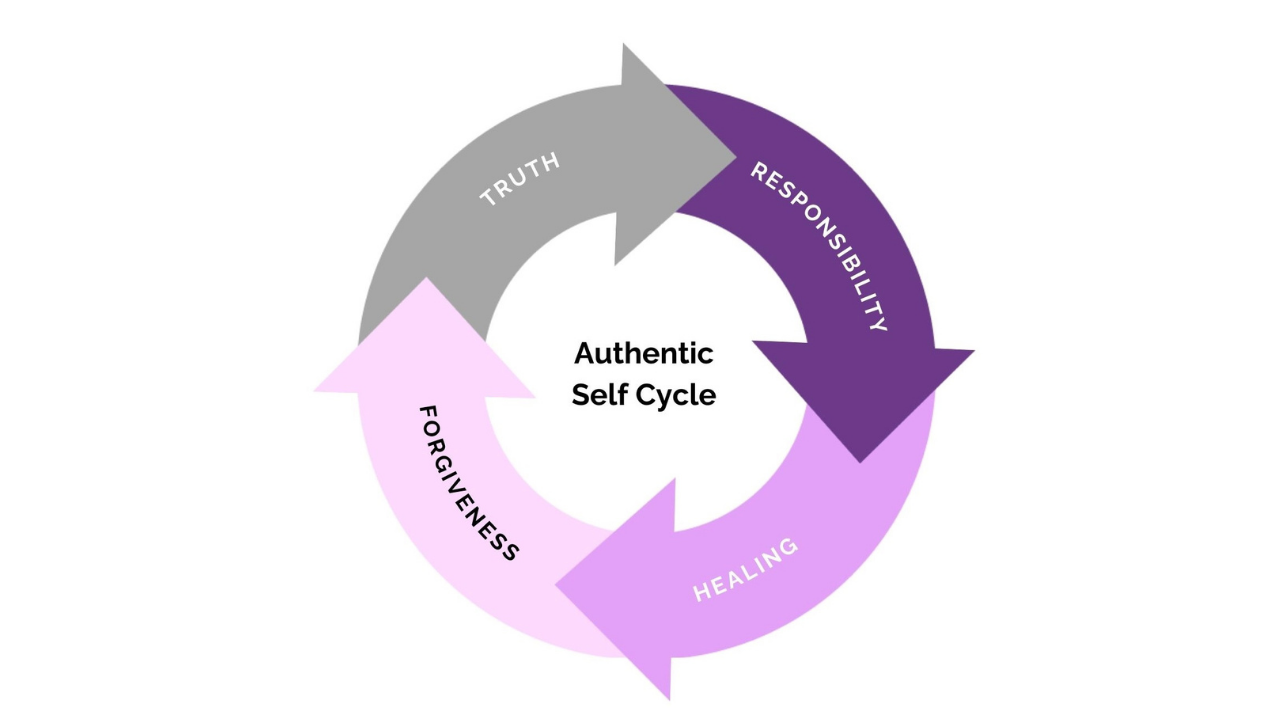
The Worst Day Cycle™ is the problem. The Authentic Self Cycle™ is the solution. It’s the emotional healing counterpart — a four-stage identity restoration system that replaces fear, shame, and denial with truth, responsibility, healing, and genuine self-loyalty.
Stage One: Truth (Name the Blueprint, Not Today)
Truth is the moment you consciously separate the childhood trauma blueprint from the current situation. Your nervous system is telling you: “They’re leaving you because you set a boundary.” But the truth is: “I’m responding to an age-six trauma blueprint where my parent left me when I had needs. This person today may actually respect my boundary.” Truth doesn’t mean positive thinking. It means clear seeing: This isn’t about today. This is about then.
Stage Two: Responsibility (Own Your Reaction Without Blame)
Responsibility is not blame. It’s clarity about your own emotional activation. “My partner isn’t my parent. My nervous system just thinks they are. I’m responsible for regulating my nervous system, not for managing their emotions.” This is radically different from guilt, which says, “I caused their pain.” Responsibility says, “I’m accountable for my healing and my nervous system’s response. They’re responsible for their own emotional response.”
That shift right there changes everything.
Stage Three: Healing (Rewire the Blueprint)
Healing happens through the Emotional Authenticity Method™ — rewiring your nervous system so conflict becomes uncomfortable but not dangerous, space isn’t abandonment, and intensity isn’t attack. This is where you reclaim the authentic self your survival persona covered up. You begin to access your own values, your own desires, your own boundaries that come from truth, not fear.
Stage Four: Forgiveness (Release the Inherited Blueprint)
That’s you — finally taking your power back from a childhood that stole it.
Forgiveness isn’t about the people who hurt you. It’s about releasing the blueprint they gave you. Forgiveness is the moment you decide: “This emotional pattern stops with me. I’m not passing it to my kids, my partner, my friends, or my future self.” This is where you reclaim your authentic self — the person you would have been if you’d never had that trauma blueprint.
The Authentic Self Cycle™ creates a new emotional chemical pattern. Instead of cortisol, adrenaline, and shame, your nervous system begins producing oxytocin (genuine safety), serotonin (hope), and dopamine (motivation). You literally rewire your brain chemistry. And when you set a boundary from this place? There’s no guilt. There’s clarity. There’s self-loyalty.
Frequently Asked Questions About Boundary Guilt
1. Does boundary guilt mean I’m actually being selfish?
No. Guilt is a biochemical response, not accurate feedback about your character. You can feel guilty while doing something completely healthy and necessary. Selfishness is a consistent pattern of prioritizing your needs at others’ expense. Setting boundaries is the opposite — it’s protecting your capacity to show up authentically in relationships. If you’re chronically abandoning yourself, you’re actually the one being self-abandoning, not selfish.
2. Will my relationships survive if I keep my boundaries?
The relationships built on your self-abandonment? Some won’t survive. And that’s the point. Those relationships required you to betray yourself to maintain them. Healthy relationships actually strengthen when you have boundaries because you’re being authentic and you’re modeling self-respect. Secure partners will respect your boundaries even if they’re initially disappointed.
3. Is boundary guilt worse in certain relationships?
Yes. Family boundaries trigger the deepest guilt because the trauma blueprint originated there. Enmeshed relationships create maximum guilt because the other person’s emotional regulation has been your job since childhood. Romantic relationships with insecure partners also trigger severe guilt because they may punish your boundaries through withdrawal or rage.
4. How long does it take to stop feeling guilty about boundaries?
It depends on your nervous system’s trauma load and how consistently you practice the Emotional Authenticity Method™. Most people notice significant shifts within 6-8 weeks of regular work. Full integration usually takes 12-16 weeks. The goal isn’t zero guilt — it’s guilt that lasts three minutes instead of three days, and guilt you can move through without abandoning your boundary.
5. What if the other person actually is upset about my boundary?
They might be. That’s their emotional experience to manage, not yours to fix. Your job is not to make them happy — your job is to be authentic and protect your wellbeing. Trying to set a boundary without causing anyone discomfort is impossible, which is why boundary guilt exists in the first place. You’re choosing between their temporary discomfort and your permanent self-abandonment. Choose yourself.
6. Is boundary guilt a sign I’m doing the boundary wrong?
Not necessarily. Guilt can show up even when you’re setting a boundary with perfect communication and timing. The guilt is about the nervous system’s trauma response, not about the boundary’s “rightness.” That said, clear, respectful boundary communication does help. But don’t use the other person’s emotional response as proof you shouldn’t have the boundary.
The Bottom Line
Boundary guilt is real. Your nervous system isn’t making it up. But that guilt is an inherited program, not current truth. You didn’t create it, and you don’t have to keep running it.
The person you are now can be loyal to yourself. You can set boundaries and feel solid in that decision. You can disappoint people and know it doesn’t make you a bad person. You can have needs and know they matter. This isn’t naive optimism. This is nervous system healing. This is the Authentic Self Cycle™ replacing the Worst Day Cycle™.
That’s you — not the guilty, people-pleasing version. The real you underneath the survival persona.
Your authentic self — the one who was alive before the survival persona took over — that person knows exactly what boundaries you need. That person isn’t selfish. That person is clear. That person is free.
The Emotional Authenticity Method™ will get you there. But you have to be willing to feel the guilt while you rewire your nervous system. You have to let the activation happen, sit with it, and teach your body: “This boundary is safe. I am safe. I can handle their disappointment and keep my boundary.”
You can do this. Your nervous system can heal. Your boundary guilt can dissolve.
Recommended Reading
- Melody Beattie — “Codependent No More” (the foundational text on boundaries and self-abandonment)
- Gabor Maté — “When the Body Says No” (how unprocessed emotion becomes illness)
- Brené Brown — “Dare to Lead” (shame and guilt in relationships and leadership)
- Stephen Porges — “The Polyvagal Theory” (how the nervous system detects safety and danger)
- Bessel van der Kolk — “The Body Keeps the Score” (trauma stored in the body and nervous system)
- John Bradshaw — “Homecoming” (reparenting and reclaiming your authentic self)
Take the Next Step in Your Healing
Understanding boundary guilt is the first step. Rewiring your nervous system is the work. Here are the courses designed to guide you through the Emotional Authenticity Method™ and the Authentic Self Cycle™:
Emotional Blueprint Starter Course — Individual
Learn the foundations of emotional authenticity and begin rewiring your nervous system on your own timeline.
$79
Relationship Starter Course — Couples
Bring this work into your romantic relationship. Learn how to set boundaries without guilt while deepening emotional intimacy.
$79
Why We Can’t Stop Hurting Each Other
A deep dive into how the Worst Day Cycle™ shows up in relationships and how the Authentic Self Cycle™ heals rupture patterns.
$479
Why High Achievers Fail at Love
For driven, accomplished people whose survival personas are based on performance. Rewire your nervous system to allow authentic connection.
$479
The Shutdown Avoidant Partner
Understand how avoidant nervous systems use boundaries as a form of denial. Learn to move from defensive boundaries to authentic ones.
$479
Tier 1: Mapping the Blueprint
The complete, comprehensive system: Emotional Authenticity Method™, Authentic Self Cycle™, and 12 weeks of guided nervous system rewiring.
$1,379
Use this free tool to build emotional awareness:
The Feelings Wheel — the foundation of the Emotional Authenticity Method™ Step Two. Access the complete exercise here.
Explore More on Boundaries, Authenticity, and Healing
- The Signs of Enmeshment: How Healthy Boundaries Become a Foreign Language
- 7 Signs of Insecurity in Relationships and What Your Nervous System Actually Needs
- Signs of High Self-Esteem: The Difference Between Arrogance and Authentic Confidence
- Negotiables and Non-Negotiables: The Boundary Framework That Changes Everything
- 10 Dos and Don’ts for a Great Relationship: Boundaries That Build, Not Barrier