
Self-love is not something you achieve through affirmations, spa days, or positive thinking — it is the restoration of your authentic self after childhood trauma taught you that who you really are isn’t enough. If you’ve spent years trying to love yourself — reading books, repeating mantras, posting quotes — and you still feel that quiet emptiness underneath, you’re not failing at self-love. You’re trying to solve a nervous system problem with a thinking brain solution. And that will never work.
That’s you — the one who can tell everyone else they’re worthy while secretly believing you’re the exception.
Self-love isn’t a decision you make. It’s a biochemical state your nervous system either allows or blocks — and if your childhood taught you that your authentic self wasn’t safe, your brain will block self-love no matter how hard you try to think your way into it.
What Is Self-Love and Why Can’t You Force It?
Self-love is the ability to honor your own feelings, needs, and boundaries without guilt, shame, or the need for external validation. It is not a feeling you generate — it is the natural state of a nervous system that was never taught to hate itself. Children are born with inherent worth. No baby arrives believing they’re not enough. Self-love is your default setting. Childhood trauma overwrites it.
That’s you — born whole, taught you were broken, and now spending your adult life trying to fix what was never actually damaged.
Here’s what most self-help gets wrong: they treat self-love as something you build from scratch. But you don’t build self-love. You restore it. You remove the layers of shame, fear, and denial that buried it. Underneath the survival persona you’ve been wearing for decades, your authentic self is still there — still whole, still worthy, still waiting.
Self-love is not a skill you develop or a mindset you adopt — it is the natural state of a nervous system that has been freed from the childhood shame blueprint that taught you your authentic self wasn’t safe enough to exist.
Why Do Affirmations and Positive Thinking Fail for Self-Love?
You’ve tried the mirror affirmations. “I am worthy.” “I am enough.” “I love myself.” And for a few minutes, maybe even a few hours, something shifts. Then your boss criticizes your work, your partner pulls away, or you catch yourself in the mirror on a bad day — and every affirmation evaporates like it never existed.
That’s you — repeating “I am enough” while your entire body screams that you’re not.
This is not a willpower problem. This is a biology problem. Your emotions are biochemical events. They are generated by the hypothalamus, which produces chemical cocktails — cortisol, adrenaline, dopamine, oxytocin misfires — based on patterns it learned in childhood. These chemicals create feelings. Those feelings generate thoughts. Those thoughts drive behavior.
The sequence is: feeling → thought → action. Not the other way around. Affirmations try to change the thought to change the feeling. But the feeling came first. The thought is just the brain’s way of explaining the chemical state it’s already in. You can’t talk yourself into self-love any more than you can talk yourself out of a fever.
That’s the trap — every self-love book tells you to change your thoughts, but your thoughts originate from feelings, and your feelings originate from a childhood blueprint you can’t think your way out of.
Affirmations fail for self-love because they target the conscious mind while shame operates at the neurochemical level — you cannot override a biochemical event with a positive thought, which is why millions of people repeat “I am worthy” daily and still feel fundamentally unlovable.
How the Worst Day Cycle™ Destroys Self-Love in Childhood
To understand why you struggle with self-love, you need to understand the pattern that stole it from you. The Worst Day Cycle™ is the neurochemical loop your brain built in childhood to survive emotional pain — and it’s been running your self-worth ever since.
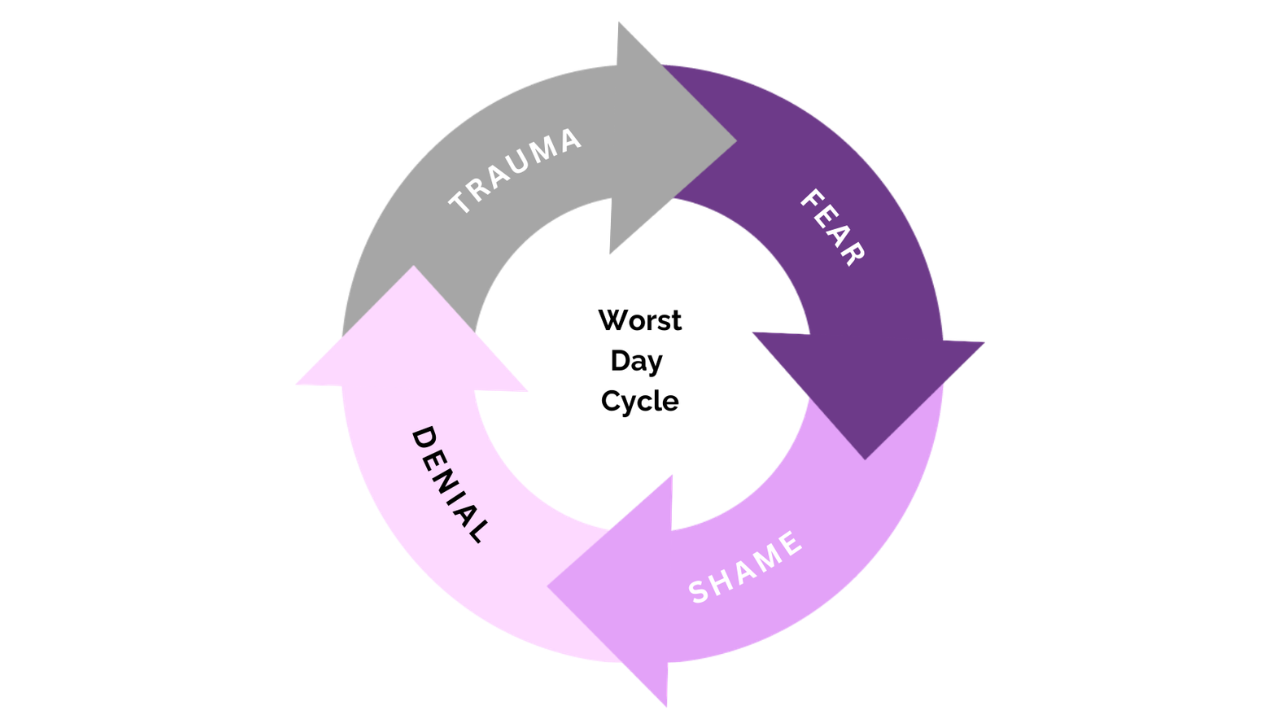
The Worst Day Cycle™ has four stages: Trauma → Fear → Shame → Denial.
Trauma: Any negative emotional experience in childhood that created painful meanings. It doesn’t have to be dramatic — a parent who was emotionally unavailable, a household where your feelings were treated as weakness, a caregiver whose love was conditional on your performance. These experiences create a massive chemical reaction in the brain and body. The hypothalamus generates chemical cocktails — cortisol, adrenaline, dopamine, oxytocin misfires — and the brain becomes addicted to these emotional states.
That’s you — feeling most alive when you’re in chaos, because your nervous system was calibrated for pain in childhood and calm actually feels dangerous.
Fear: Fear drives repetition. The brain conserves energy by repeating known patterns — it can’t tell right from wrong, only known from unknown. Since 70%+ of childhood messaging is negative and shaming, adults repeat these painful patterns in relationships, career, hobbies, health — everything. Fear says: “If I try to love myself, something bad will happen. If I stop performing, they’ll leave.”
Shame: This is where you lost your inherent worth. “I am the problem.” Not “I made a mistake” — but “I AM the mistake.” Shame is the core wound underneath every struggle with self-love. It’s the moment in childhood when you concluded: my authentic self isn’t enough. My real feelings aren’t welcome. Who I actually am is the reason people hurt me.
That’s the shame talking — and it’s been whispering “you’re not enough” so long you think it’s your own voice.
Denial: Denial is the survival persona created to survive the pain. It was brilliant in childhood — absolutely necessary for survival. But in adulthood, it sabotages everything. The survival persona says: “Don’t feel. Don’t need. Don’t be real. Just perform.” And self-love becomes impossible because the person trying to love themselves isn’t their authentic self — it’s the survival persona trying to love a performance.
The Worst Day Cycle™ explains why self-love feels impossible — your childhood trauma created a neurochemical addiction to shame, and your brain repeats the “I’m not enough” pattern thousands of times per day because repetition feels safer than the unknown territory of actually accepting yourself.
How Does Your Survival Persona Block Self-Love?
Your survival persona is the identity your brain built in childhood to earn love, stay safe, and maintain connection in an emotionally unpredictable environment. It’s not who you are — it’s who you had to become. And it is the single biggest barrier to self-love because you can’t love yourself when you don’t know who “yourself” actually is.
There are three survival persona types:
The Falsely Empowered: This persona controls, dominates, and rages. They look powerful on the outside, but their power comes from fear, not self-love. They “love themselves” through achievement, status, and control — but it’s a performance. Underneath the confidence is terror. They can’t be vulnerable because vulnerability was never safe. They confuse self-importance with self-love.
That’s you — the one who posts about self-love on social media while privately hating who you see in the mirror.
The Disempowered: This persona collapses, people-pleases, and disappears. They try to love themselves by making everyone else love them first. They believe: “If enough people approve of me, maybe I’ll finally feel worthy.” They abandon their own needs, boundaries, and desires to earn approval — and then wonder why they feel empty. They confuse being needed with being loved.
That’s you — bending over backward for everyone else and then wondering why you can’t do the same for yourself.
The Adapted Wounded Child: This persona oscillates between both — raging one moment, collapsing the next. They swing between “I don’t need anyone” and “please don’t leave me.” They try to love themselves through intensity — dramatic gestures, extreme self-improvement, obsessive self-help consumption — but never land in genuine self-acceptance because their sense of self is unstable.
That’s you — buying every self-love book, doing every workshop, and still feeling like something fundamental is missing.
As Kenny Weiss teaches from direct clinical work: “Self-sabotage is the collision between the authentic self and the shame-based survival persona. When we start to succeed, our adapted wounded child and shame-based survival persona pops up and says no. Because if you live in your authentic self, the survival persona loses its connection to mom and dad — the connection it was built to preserve.”
Your survival persona blocks self-love because it replaced your authentic identity with a performance — and after decades, you can’t tell the difference between who you really are and who you had to become, which means the “self” you’re trying to love isn’t actually you.
How Does a Lack of Self-Love Show Up in Every Area of Your Life?
A lack of self-love doesn’t stay in one area. It infects everything — your relationships, your career, your friendships, your health, and your relationship with your own body.
Family: You’re still performing for approval. You manage your parents’ emotions. You silence yourself at family gatherings. You feel responsible for everyone else’s happiness and guilty for having your own needs. You replay childhood dynamics — the good child, the peacekeeper, the invisible one — because the survival persona your family assigned you is still running.
That’s you — forty years old and still trying to earn love from parents who never taught you that love doesn’t require earning.
Romantic Relationships: You choose partners who confirm your shame. You tolerate behavior that violates your values because being alone feels more terrifying than being mistreated. You confuse intensity with intimacy and butterflies with love — when actually that “chemistry” is your nervous system recognizing a familiar trauma pattern from childhood. You abandon yourself to keep the relationship “safe.”
Sound familiar? That butterfly feeling isn’t love — it’s your brain saying “this person matches my childhood pain.”
Friendships: You’re the friend everyone calls but no one checks on. You listen for hours but never share your own struggles. You cancel your own plans when someone else needs you. You feel lonely even when surrounded by people because no one actually knows you — they know your survival persona.
Work: You overdeliver. You say yes to everything. You work through lunch, through weekends, through illness. You measure your worth in productivity and your value in output. You’ve been promoted for your self-abandonment — and the promotion didn’t fill the void. You’re terrified of being “found out” because deep down, shame says you don’t deserve your success.
That’s you — achieving everything and feeling nothing, because achievement was always the survival persona’s strategy, never your authentic self’s desire.
Body and Health: You ignore your body’s signals. You push through exhaustion, pain, and stress. You numb with food, alcohol, scrolling, or shopping. You exercise to punish your body rather than honor it. Chronic pain, digestive issues, insomnia, and autoimmune conditions are often the body’s last resort when emotional signals have been ignored for decades. Your body has been trying to tell you something — but self-love requires listening, and listening requires feeling, and feeling is exactly what the survival persona was built to prevent.
How the Emotional Authenticity Method™ Restores Self-Love
The Emotional Authenticity Method™ is the daily practice that restores self-love at the nervous system level — not by convincing you that you’re worthy, but by rewiring the emotional blueprint that told you you’re not.
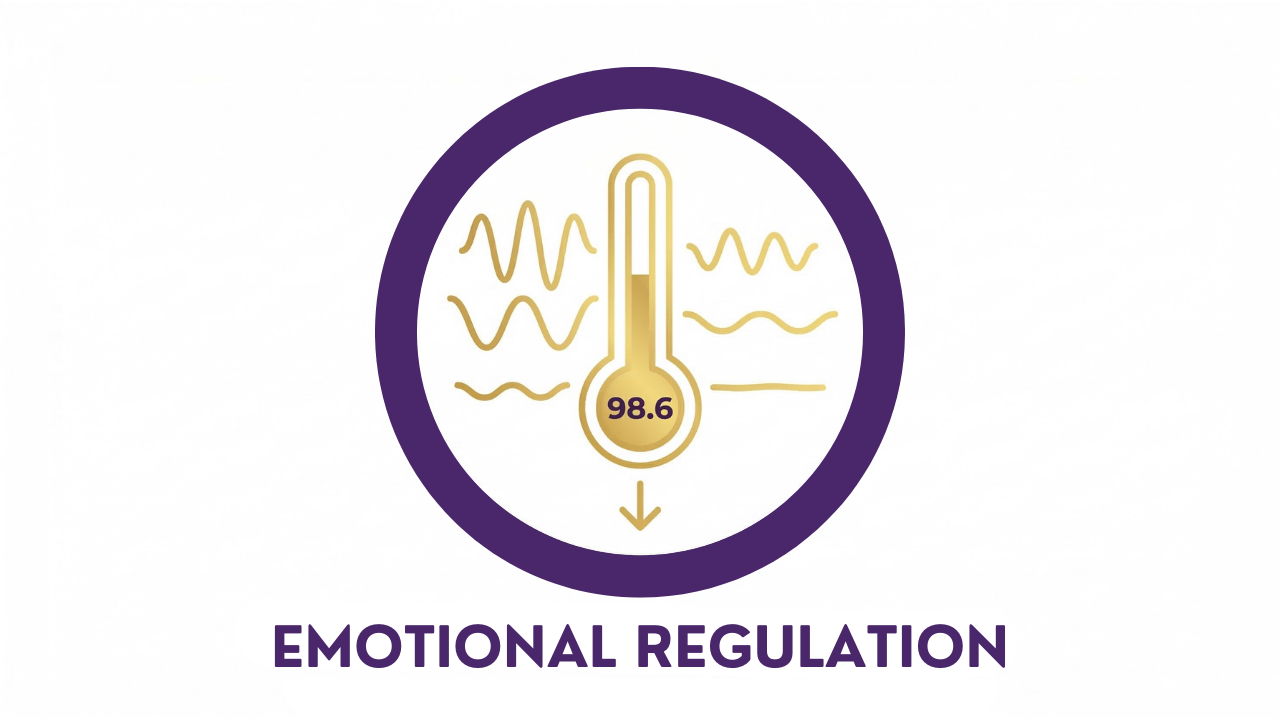
Here are the six steps:
Step 1: Somatic Down-Regulation (with optional Titration). Before you can access self-love, your nervous system needs to come out of survival mode. Focus on what you can hear for 15-30 seconds. This simple grounding exercise signals safety to your nervous system. For people with heavy trauma loads, titration — approaching the activation slowly — prevents retraumatization.
That’s you — learning that you can’t heal from a state of panic, and that slowing down isn’t weakness, it’s wisdom.
Step 2: What am I feeling right now? Most people who struggle with self-love have no idea what they’re actually feeling. “Fine” is their default answer. Using the Feelings Wheel, you develop emotional granularity — the ability to name specific emotions instead of lumping everything into “stressed” or “fine.” You might discover that underneath “I don’t love myself” lives grief, abandonment, rage, or terror.
Step 3: Where in my body do I feel it? All emotional trauma is stored physically. Your chest tightens. Your stomach drops. Your throat constricts. Locating the feeling in your body is how you move from intellectual understanding to somatic processing. Self-love lives in the body, not the mind.
Step 4: What is my earliest memory of having this exact feeling? This is where the rewiring begins. You trace today’s “I’m not enough” back to its childhood origin. You realize: this belief isn’t mine. It was given to me. My parent’s inability to love me wasn’t proof that I’m unlovable — it was proof that they were running their own Worst Day Cycle™.
That’s the moment everything shifts — when you see that the voice saying “you’re not enough” belongs to a wounded five-year-old, not to truth.
Step 5: Who would I be if I never had this thought or feeling again? What would be left over? This is the vision step — the bridge to the Authentic Self Cycle™. You’re not trying to convince yourself you’re worthy. You’re asking your nervous system to imagine a different identity. What would you do if you actually loved yourself? How would you move through the world? What would you say no to? What would you finally say yes to?
Step 6: Feelization — Sit in the feeling of the Authentic Self and make it strong. This is the emotional blueprint remapping and rewiring step. Ask: how would I respond to this situation from this feeling? What would I say? What would I do? Visualize and FEEL yourself operating from your Authentic Self. Create a new emotional chemical addiction to replace the old shame blueprint. This isn’t visualization — it’s feelization. You’re not picturing a better life. You’re practicing the emotional state that creates one.
That’s you — not reading about self-love. Feeling it. In your body. For the first time.
The Emotional Authenticity Method™ works because emotions are biochemical events — you cannot change emotional patterns through thoughts alone. Thoughts originate from feelings, not the other way around. Self-love is restored when the nervous system learns a new chemical pattern, not when the mind learns a new affirmation.
How the Authentic Self Cycle™ Replaces Shame With Self-Worth
The Authentic Self Cycle™ is the healing counterpart to the Worst Day Cycle™. Where the Worst Day Cycle™ traps you in Trauma → Fear → Shame → Denial, the Authentic Self Cycle™ restores your identity through Truth → Responsibility → Healing → Forgiveness.
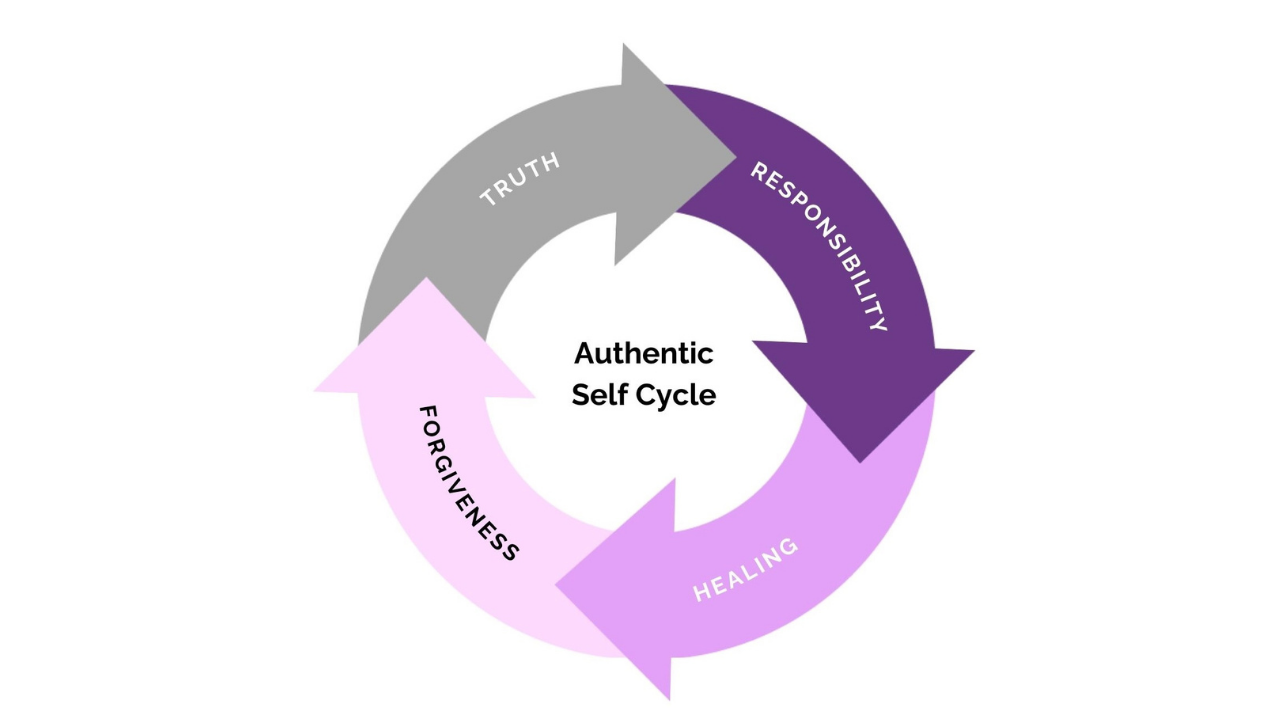
Truth: Name the blueprint. See that “this isn’t about today.” When you look in the mirror and feel disgust, truth says: “This feeling is from childhood. My parent’s inability to affirm me wasn’t because I’m unworthy — their shame blueprint made it impossible.” Truth doesn’t mean positive thinking. It means clear seeing.
That’s the first step toward self-love — seeing the lie instead of believing it.
Responsibility: Own your emotional reactions without blame. “My partner isn’t my parent — my nervous system just thinks they are.” This isn’t about fault. It’s about taking back your power from a childhood that stole it. Self-love requires you to stop waiting for someone else to give you the worth your parents couldn’t.
Healing: Rewire the emotional blueprint so conflict becomes uncomfortable but not dangerous, space isn’t abandonment, and intensity isn’t attack. As Kenny teaches: “Most people look at healing as trying to get the hour hand to move. But what makes the hour hand move? The second hand moves first. What’s the smallest thing you can do in this moment? One second of effort toward something new — and the survival persona’s grip breaks.” Healing is repetition, not revelation.
Forgiveness: Release the inherited emotional blueprint and reclaim your authentic self. This creates a NEW emotional chemical pattern that replaces fear, shame, and denial with safety, worth, and connection. Forgiveness isn’t about excusing what happened. As Kenny teaches: “Forgiveness is where the adult just consistently shows up and replaces the child at the wheel. It says, ‘Hey kids, love you, but back seat. I’m driving now.’” This is where self-love stops being something you try to do and becomes who you are.
That’s you — not becoming someone new. Finally meeting who you always were underneath the survival persona.
The Authentic Self Cycle™ is an identity restoration system — it doesn’t teach you to love yourself from the outside in, it removes the shame blueprint that made self-love impossible and reveals the inherent worth that was always there.
Why Self-Sabotage Is the Collision Between Your Authentic Self and Shame
Every time you get close to genuine self-love, something pulls you back. You start a healthy habit and quit. You set a boundary and then apologize. You have a breakthrough and then spiral. This isn’t coincidence. This is the survival persona fighting for its life.
That’s you — three days into a new self-love practice and suddenly convinced it’s stupid and won’t work.
Here’s what’s actually happening: self-sabotage is the collision between the authentic self and the shame-based survival persona. When you start to succeed at self-love — when you start to actually feel worthy — the survival persona panics. Because if you live in your authentic self, the survival persona loses its connection to mom and dad. And if you actually succeed, it means the survival persona side was always wrong. Nobody wants to admit at 20, 40, or 60 years old that they’ve been living through a survival persona instead of as themselves.
Kenny Weiss teaches: “Nobody is ever afraid to fail because in the moment you choose not to do something, you’ve chosen failure — and you’re totally comfortable with it. What we’re actually afraid of is success. Because if you succeed, the survival persona says you’re going to lose connection with mom and dad.”
That’s the deepest truth about self-love — you’re not afraid of failing to love yourself. You’re afraid of succeeding, because self-love means the survival persona dies.
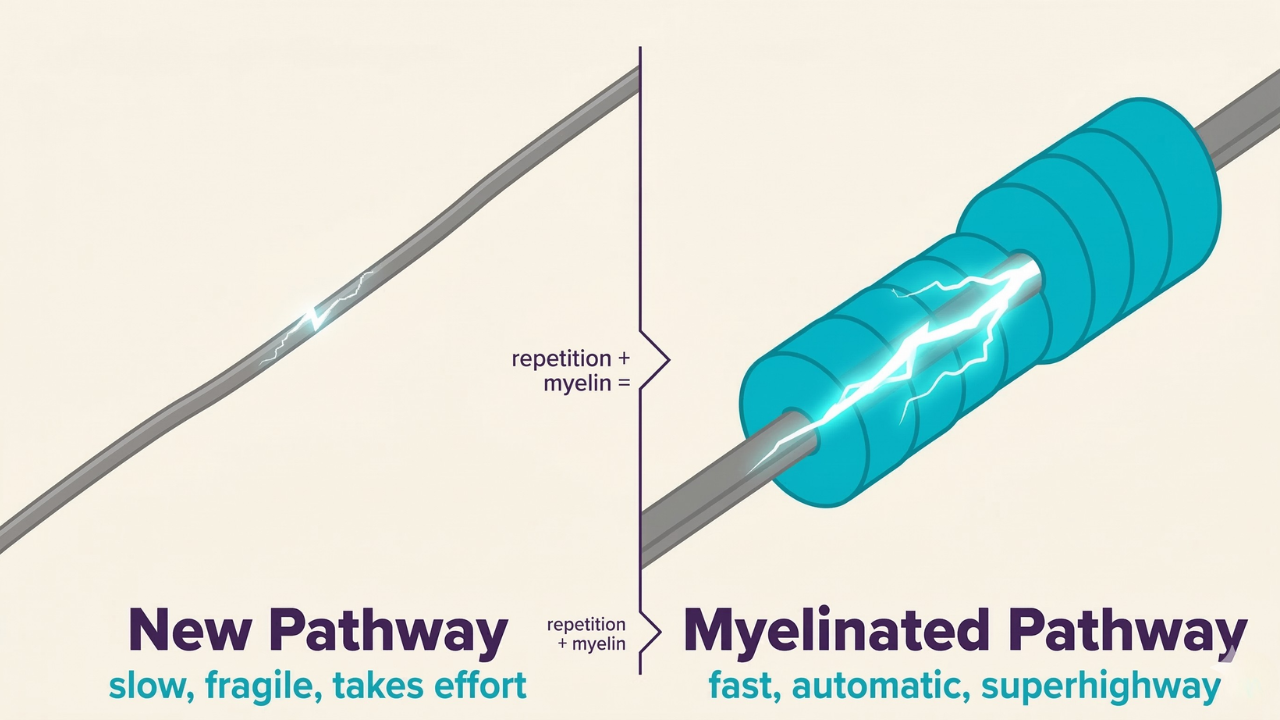
The solution isn’t bigger breakthroughs or more dramatic self-help. The solution is micro-steps. Like the second hand on a clock — each small tick is almost insignificant, but those ticks move the minute hand, the minutes move the hours, and the hours change your entire day. One second of effort toward your authentic self, and the survival persona’s grip breaks.
Frequently Asked Questions About Self-Love
Why can’t I love myself no matter how hard I try?
You can’t love yourself through effort because self-love isn’t a skill — it’s a state your nervous system either allows or blocks. If your childhood taught you that your authentic self wasn’t safe, your brain created a shame blueprint that actively prevents self-acceptance. The Worst Day Cycle™ — trauma, fear, shame, denial — runs this pattern automatically. Affirmations and willpower target the conscious mind, but shame operates at the neurochemical level. The Emotional Authenticity Method™ works because it targets the body where shame actually lives.
Is self-love the same as self-esteem?
Self-esteem is often performance-based — “I feel good about myself when I achieve.” Self-love is unconditional — “I am worthy regardless of what I produce.” Many high achievers have high self-esteem and zero self-love. They feel valuable when they’re performing but empty when they stop. True self-love comes from restoring your authentic self through the Authentic Self Cycle™ — truth, responsibility, healing, forgiveness — not from collecting more achievements.
Can childhood trauma really prevent self-love in adulthood?
Yes. Research shows that 70%+ of childhood messaging is negative and shaming. When a child’s developing nervous system absorbs these messages, the brain creates neurochemical patterns that repeat shame on autopilot. The hypothalamus generates chemical cocktails that the brain becomes addicted to — cortisol, adrenaline, and misfired oxytocin. These chemicals create the feeling of “not enough” thousands of times per day. The brain can’t tell right from wrong, only known from unknown. Since shame is known, the brain repeats it.
What is the fastest way to start building self-love?
Start with your morals, values, needs, wants, negotiables, and non-negotiables. Write them down for every area of your life — relationships, career, health, friendships. Most people have never done this. Then notice where you’re violating your own values to keep someone else comfortable. Every time you honor a value, you send your nervous system a message: “I matter.” Combine this with the Emotional Authenticity Method™ — even 5 minutes a day — and the shift begins.
How long does it take to develop genuine self-love?
Self-love patterns don’t reverse overnight. But noticeable shifts can happen within weeks of consistent daily practice. The key is repetition, not intensity. Like the second hand on a clock — each small moment of self-loyalty moves the larger pattern. The Authentic Self Cycle™ provides the framework for long-term identity restoration. Most people notice significant changes within 8-12 weeks of daily work with the Emotional Authenticity Method™.
What’s the difference between self-love and narcissism?
Narcissism is the falsely empowered survival persona pretending to love itself. Genuine self-love is quiet, grounded, and doesn’t need external validation. The narcissist performs self-love through dominance, control, and superiority — but underneath is terror and shame. Shame strips us of our inherent value and worth and our authentic power. Both the narcissist and the people-pleaser are running the same shame engine — one hides behind dominance, the other behind niceness. Neither has genuine self-love because both are operating from a survival persona, not their authentic self.
The Bottom Line
You don’t need another affirmation. You don’t need another self-help book. You don’t need to try harder to love yourself.
You need to meet yourself.
The authentic you — the one who existed before the survival persona took over — that person doesn’t need to be taught self-love. That person IS self-love. Your only job is to remove the shame blueprint that buried them.
Some days you’ll forget. Some days the survival persona will win. That doesn’t mean you failed — it means your brain is doing what it was trained to do. Healing isn’t about intensity. It’s about consistency. One small tick of the clock. One moment of emotional truth. One second of choosing your authentic self over the survival persona.
That’s you — not the person who finally “learned” self-love. The person who finally stopped performing and let themselves be seen. By themselves. For the first time.
The void doesn’t fill with achievement, approval, or affirmation. It fills with truth. With feeling. With the willingness to finally stop running from yourself — and start running toward who you actually are.
That’s self-love. And it was always yours.
Recommended Reading
These books complement the frameworks in this article and can deepen your understanding of self-love, shame, and trauma recovery:
Facing Codependence by Pia Mellody — the foundational text on how childhood trauma creates the shame patterns that destroy self-love.
The Body Keeps the Score by Bessel van der Kolk — the science of how trauma lives in the body and why cognitive approaches alone can’t restore self-worth.
When the Body Says No by Gabor Maté — how chronic self-abandonment and suppressed emotions manifest as physical illness.
Codependent No More by Melody Beattie — a practical guide to recognizing codependent patterns that block genuine self-love.
The Gifts of Imperfection by Brené Brown — how shame drives perfectionism and why vulnerability is the doorway to self-acceptance.
Take the Next Step
If you’re ready to stop performing self-love and start actually experiencing it, Kenny Weiss offers courses designed for people who are done with surface-level self-help and ready to heal at the nervous system level:
Emotional Blueprint Starter Course — Individual ($79) — Your personal roadmap to understanding the Worst Day Cycle™ and beginning the journey to your authentic self.
Relationship Starter Course — Couples ($79) — For couples ready to break the cycle of reactivity and build interdependence.
Why We Can’t Stop Hurting Each Other ($479) — Deep-dive into the Worst Day Cycle™ and how childhood trauma creates relationship pain.
Why High Achievers Fail at Love ($479) — Built specifically for high achievers who have mastered their career but can’t figure out relationships.
The Shutdown Avoidant Partner ($479) — Understanding avoidant attachment through the lens of trauma chemistry and survival personas.
Tier 1: Mapping the Blueprint ($1,379) — The comprehensive program for learning and practicing the Emotional Authenticity Method™.
Download the Feelings Wheel — the free tool used in Step 2 of the Emotional Authenticity Method™ to build emotional granularity.
Explore more: The Signs of Enmeshment | 7 Signs of Relationship Insecurity | 7 Signs of High Self-Esteem | How to Determine Your Negotiables and Non-Negotiables | 10 Do’s and Don’ts for a Great Relationship