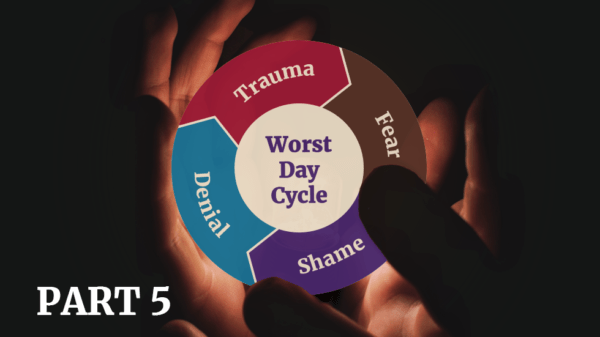
Denial is the fourth and final stage of the Worst Day Cycle™ — the unconscious self-deception system your brain built in childhood to protect you from unbearable emotional pain, and it is the single greatest barrier to healing because it guarantees the cycle repeats. If you’ve spent your life insisting “my childhood wasn’t that bad,” minimizing your pain, or wondering why you keep ending up in the same painful patterns despite years of therapy, you’re not lazy or broken. You’re experiencing the most sophisticated survival strategy the human brain can create — and it’s running your life without your permission.
That’s you — the one who can see everyone else’s patterns clearly but can’t see your own.
Denial isn’t lying. It’s not stupidity. It’s the brilliant emotional architecture your nervous system built when you were a child who had no other option. And understanding how it works is the most important step you will ever take toward reclaiming your authentic self.
you created in childhood to protect yourself from shame. It’s not conscious lying — it’s an automated self-deception system that minimizes your pain, normalizes dysfunction, and keeps you performing instead of feeling. The Worst Day Cycle™ explains how denial locks you into repeating painful patterns. The Emotional Authenticity Method™ (6 steps including Feelization) and the Authentic Self Cycle™ provide the path to confronting denial and reclaiming who you actually are.
What Is Denial in the Worst Day Cycle™?
Denial is not what most people think it is. It’s not stubbornness. It’s not ignorance. It’s not choosing to look away from the truth. Denial is the survival persona you created in childhood to survive the unbearable pain of shame — an automated self-deception system that minimizes, normalizes, and protects you from facing the emotional reality of what happened to you.
That’s you — the person who says “I’ve dealt with my childhood” while your body, your relationships, and your choices tell a completely different story.
Self-deception and denial is the single greatest killer on the planet today. It’s not a virus. It’s not guns. It’s not any of the external threats we spend billions fighting. It’s this invisible internal mechanism that nobody talks about because the very nature of denial is to deny its own existence.
In childhood, denial was genius. You couldn’t leave. You couldn’t fight back. You couldn’t speak the truth about what was happening in your family system. So your nervous system did the only thing it could do — it denied the truth hard enough to make the unbearable bearable. It minimized: “It wasn’t that bad.” It normalized: “All families are like this.” It suppressed: “I don’t remember much of my childhood.” It rationalized: “They did the best they could.”
That’s the brilliance of denial — it kept a helpless child attached to the people they needed to survive.
But the survival persona you created as a child becomes the prison you live in as an adult. Denial boomerangs back against you because you don’t realize you’re operating from your wounded child self. You keep choosing people who retraumatize you. You keep reenacting childhood patterns trying to “finally win.” You expect partners, friends, bosses, or even your own children to be the rescuing parent you never had.
Denial makes you believe you’re an adult — when emotionally, you’re still the child who needed saving. Denial is the final stage of the Worst Day Cycle™ — the stage that guarantees the cycle repeats until you confront the truth and reclaim your authentic self.
How Does Denial and Self-Deception Actually Operate?
Denial operates through three primary mechanisms, all of which begin in childhood and run automatically in adulthood. Understanding these mechanisms is essential because becoming an expert in your own denial and self-deception is the single most important skill you need to learn if you want to overcome the Worst Day Cycle™.
Mechanism 1: False Attachment Protection. As a species, we must attach to another human being or we will die. Because our parents are perfectly imperfect and human, they hurt us. To attach and survive, we create a survival persona. We had no choice — our life depended on it. The role of the survival persona is to minimize, suppress, repress, condone, justify, and deny that our parents hurt us. We create this self-deception to forge attachment with them. We subconsciously fear that if we accepted the truth, we would lose their attachment and die.
That’s you — still protecting the image of your parents at age 40, 50, or 60 because your nervous system still believes the truth would kill the connection.
Even if you’re aware of your parents’ imperfections, a false attachment seems better than no attachment. That furthers your resistance to admitting how they hurt you. Your inability to live in truth affects every single adult decision for the rest of your life until addressed.
Mechanism 2: Blame Projection. We blame, judge, and criticize other people, places, and things so that we don’t have to admit the part that our shame-based survival persona played in setting up our own patterns in adult life. There is an added benefit to our self-deception — it shields us from having to face that we created a survival persona and therefore, we don’t know who we really are.
Sound familiar? Pointing at your partner’s flaws so you don’t have to look at why you chose them in the first place.
Mechanism 3: Brain Design Reinforcement. The left hemisphere of the brain becomes myopic and shuts out truth unless it confirms its current belief. The emotional right hemisphere’s ability to include context and diverse options makes for a more complete and precise intellectual thought and decision. In short, the more emotionally developed a person is, the better their thoughts and decisions. But the left hemisphere doesn’t want to hear what it takes to be reality. It blindly pushes on, always along the same track.
That’s the neurological trap — your brain is literally designed to reinforce the self-deception that keeps you stuck.
The combination of the Worst Day Cycle™, societal beliefs, and the brain’s design creates a formidable adversary to reclaiming your authentic self, accepting your perfect imperfections, and achieving your personal potential.
How the Worst Day Cycle™ Creates and Sustains Denial
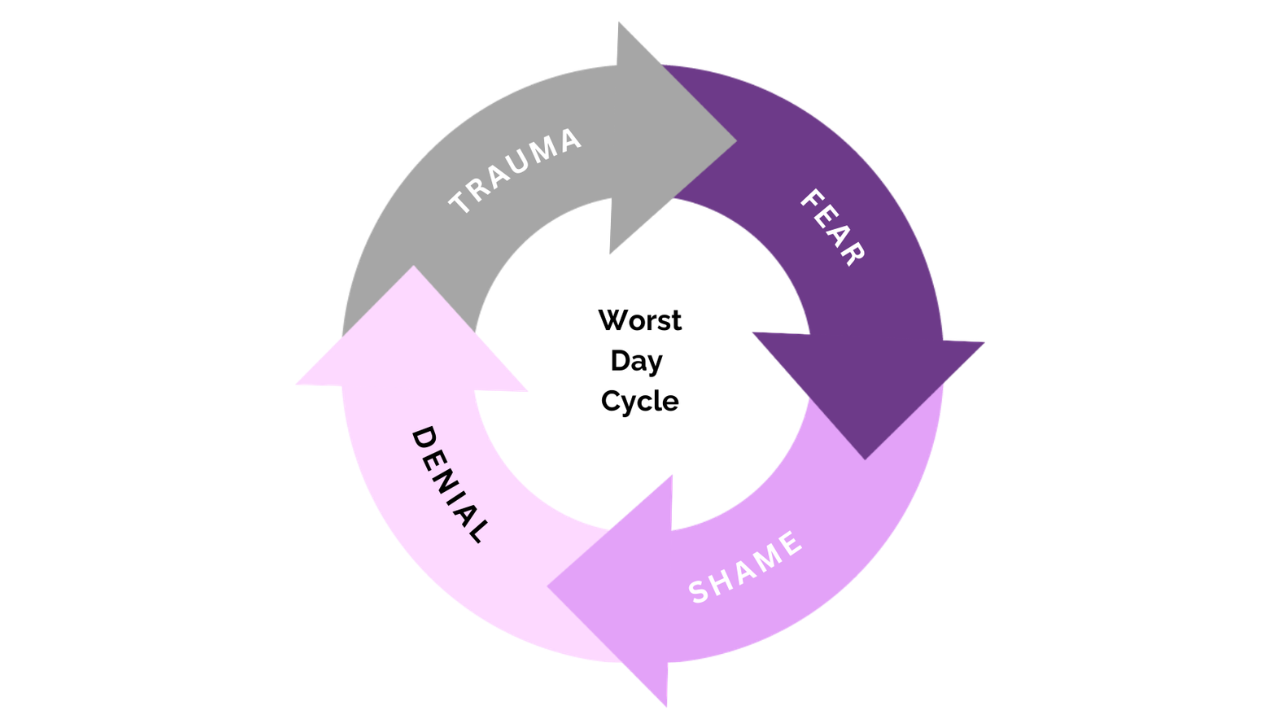
The Worst Day Cycle™ has four stages: Trauma → Fear → Shame → Denial. Denial is the final stage — and it’s the stage that locks the entire cycle into permanent repetition.
Trauma: Any negative emotional experience in childhood that created painful meanings. It doesn’t have to be dramatic — it can be as subtle as a parent who was emotionally unavailable, a household where feelings were treated as weakness, or love that was conditional on performance. These experiences create a massive chemical reaction in the brain and body. The hypothalamus generates chemical cocktails — cortisol, adrenaline, dopamine, oxytocin misfires — and the brain becomes addicted to these emotional states.
That’s you — feeling most alive when you’re in crisis mode, because your nervous system was calibrated for chaos in childhood.
Fear: Fear drives repetition. The brain conserves energy by repeating known patterns — it can’t tell right from wrong, only known from unknown. Since 70%+ of childhood messaging is negative and shaming, adults repeat these painful patterns in relationships, career, hobbies, health — everything. Fear says: “Don’t change. Don’t look. Stay where you are. At least this pain is familiar.”
Shame: This is where you lost your inherent worth. “I am the problem.” Not “I made a mistake” — but “I AM the mistake.” Shame creates the core wound underneath all denial. You deny the truth because facing it means facing the shame — and the shame feels like annihilation.
That’s the shame talking — the voice that says “if people really knew me, they’d leave.”
Denial: Denial is the survival persona created to survive the pain of shame. It was brilliant in childhood — absolutely necessary. But in adulthood, it sabotages everything. The goal of denial is to keep the focus on managing the symptoms, keeping you in the survival persona, and preventing you from actually feeling the emotional weight from the original trauma and facing the emotional blueprint that was written in childhood.
Denial can sound like: “My childhood wasn’t that bad.” “I’ve already dealt with all that.” “Other people had it worse.” “This is just how relationships are.” “If I could just stop being so sensitive, this would all be fine.” “I just have to try harder, be calmer, be more patient.” Whatever it may be, every form of denial keeps you from feeling what actually needs to be felt.
That’s you — collecting new strategies, reading more books, attending more workshops, and never actually sitting with the feeling underneath all of it.
Denial guarantees the Worst Day Cycle™ repeats because it prevents you from ever reaching the root cause — the childhood emotional blueprint that created your survival persona in the first place.
How Your Survival Persona Uses Denial to Keep You Trapped
Your survival persona is the identity you created in childhood to navigate an emotionally unsafe environment. It’s not who you are — it’s who you had to become. And denial is the engine that keeps the survival persona running.
There are three survival persona types, and each uses denial differently:
The Falsely Empowered: This persona controls, dominates, and rages. They deny vulnerability. They deny need. They deny that their control is driven by terror. The falsely empowered survival persona’s denial sounds like: “I don’t need anyone.” “Emotions are weakness.” “I’ve got this handled.” Their denial keeps them performing strength instead of feeling anything real.
That’s you — the one who built an empire but can’t have a vulnerable conversation with your partner without shutting down or exploding.
The Disempowered: This persona collapses, people-pleases, and disappears. They deny their own worth. They deny their own anger. They deny that their constant giving is actually fear-driven, not love-driven. The disempowered survival persona’s denial sounds like: “I’m fine, really.” “Their needs are more important.” “I don’t mind — I like helping.” Their denial keeps them invisible and self-abandoning.
That’s you — the one who gives everything to everyone and then wonders why you feel invisible and resentful.
The Adapted Wounded Child: This persona oscillates between both — raging one moment, collapsing the next. They deny having a stable sense of self. They flip between overperforming and shutting down, between control and submission, never landing in their authentic self. Their denial sounds like: “I’m working on it” while nothing actually changes.
That’s you — swinging between “I don’t need anyone” and “please don’t leave me” and calling both of them your “real self.”
Here is the deeper truth about the survival persona and denial: when you start to succeed and your authentic self begins emerging, the survival persona activates shame to pull you back. The conflict is this — you’re starting to do better, starting to feel good, and then the shame-based persona says: “Wait. If you live in your authentic self, the connection with Mom and Dad is gone.” The other half of the fear: “If I actually succeed, it means the survival persona was always wrong. Who wants to admit at my age that I’ve lived my life as an imposter?”
That’s the reason self-sabotage exists — your survival persona would rather destroy your success than face the truth about who you’ve been performing as your entire life.
Your survival persona uses denial as a shield against the most terrifying truth of all: you don’t know who you really are underneath the performance — and facing that unknown feels more dangerous than repeating every painful pattern you’ve ever known.
How Denial and Self-Deception Show Up in Every Area of Your Life
Denial doesn’t stay in one lane. It’s a system-wide operating system that touches every area of your existence.
Family: You defend your parents’ behavior. “They did the best they could.” “My childhood was normal.” You replay holiday dinners where you were criticized, dismissed, or emotionally abandoned — and you call it “family being family.” You feel anxious before family gatherings but can’t name why. You minimize the impact of childhood emotional neglect because “other people had it worse.”
That’s you — still protecting the family narrative at the expense of your own truth.
Romantic Relationships: You choose partners who recreate your childhood emotional environment. You stay in relationships where your needs are dismissed because it feels “normal.” You blame yourself when they can’t love you the way you need. You deny that you chose this person because your nervous system recognized the familiar pain — and familiar pain feels like home.
Sound familiar? Choosing the same type of partner over and over and insisting “this time it’s different.”
Friendships: You surround yourself with people who confirm your survival persona. If you’re falsely empowered, your friends admire your strength and never challenge you. If you’re disempowered, your friends lean on you constantly and never ask how you’re doing. You deny that your friendships are one-directional because admitting it would mean facing loneliness — and loneliness triggers the childhood abandonment wound.
Work: You call workaholism “ambition.” You deny that your drive is fueled by shame — the belief that if you stop producing, you stop being worthy of existence. You tolerate toxic work environments because confrontation feels dangerous. You deny that your career is another survival persona performing worth instead of experiencing it.
That’s you — being promoted for the very denial pattern that’s destroying your health, your relationships, and your connection to yourself.
Body and Health: You ignore your body’s signals. Chronic pain, digestive issues, insomnia, autoimmune conditions — your body has been screaming the truth your denial won’t let you hear. You medicate symptoms instead of addressing roots. You push through exhaustion because rest feels like failure. Your body keeps the score even when your denial refuses to read it.
Why Traditional Therapy Can’t Break Through Denial
Here’s what most therapy gets wrong about denial: it tries to think its way through a feeling problem. Cognitive-behavioral therapy attempts to restructure your thoughts. Talk therapy gives you insight. Both are valuable — but neither touches the neurochemical pattern that denial is protecting.
That’s the gap — you can understand your denial intellectually and still be completely run by it.
Think of it like watching a 3D movie without the glasses. You’ve heard about relationships and careers and what it is to be human — you’re watching life, which is a 3D movie with all these different aspects to it. But since you don’t have the glasses, everything’s a bit fuzzy. The colors don’t line up, and you can’t make out everything exactly. But since you’ve heard about what life looks like, you can kind of piece together what’s happening. None of it’s clear. None of it makes total sense.
Learning about the Worst Day Cycle™, the Authentic Self Cycle™, and Emotional Authenticity — that’s the glasses. All of a sudden, you see everything clearly for the first time. It all makes sense. Shame and denial keep us from seeing the world truly the way it is. The confrontation puts the glasses on, and the glasses are truth, responsibility, healing, and forgiveness.
You cannot change emotional patterns through thoughts alone. Emotions are biochemical events. Thoughts originate from feelings, not the other way around. This is why cognitive approaches hit a ceiling with denial — they’re trying to use the thinking brain to override a survival program that runs below conscious awareness, in the body, in the nervous system, in the chemical patterns your brain has been repeating since childhood.
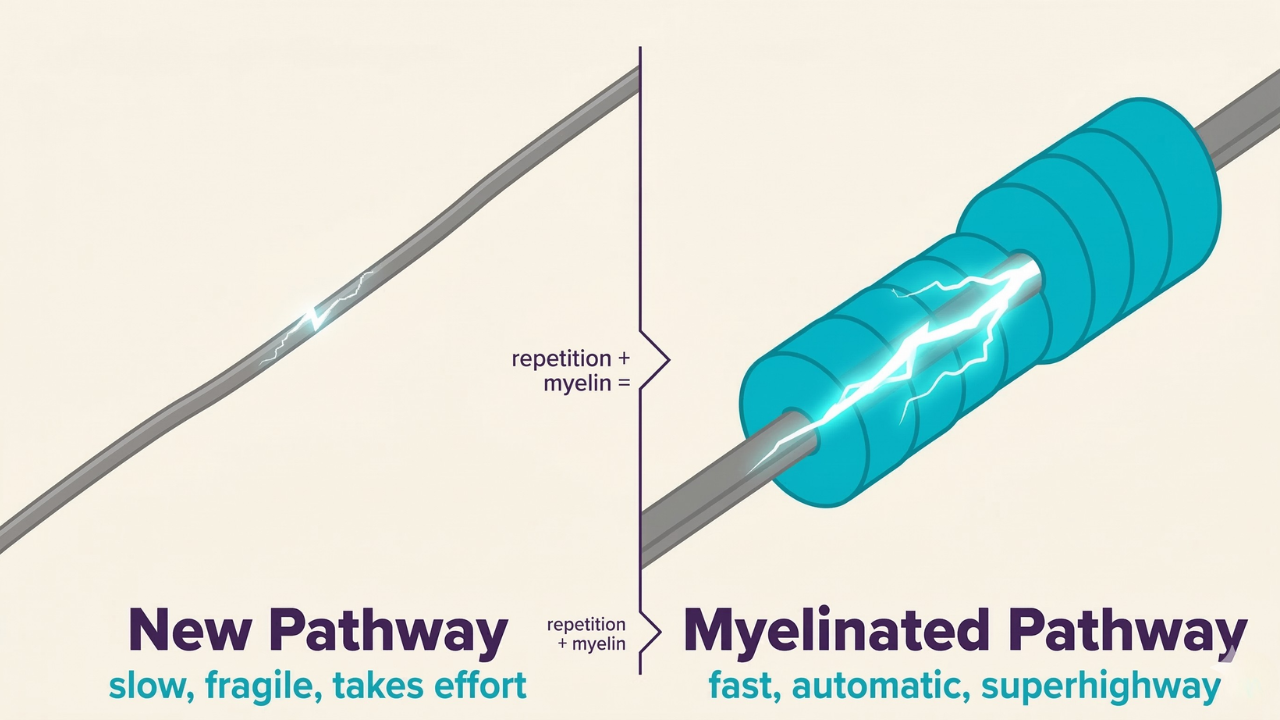
Traditional therapy fails to break through denial because denial is a somatic and neurochemical pattern, not a cognitive one — it requires body-level, emotion-level intervention to rewire the survival program that has been running automatically since childhood.
How the Emotional Authenticity Method™ Confronts Denial
The Emotional Authenticity Method™ is a six-step somatic and emotional process that goes where denial doesn’t want you to go — into the body, into the feeling, into the childhood origin of the pattern. This is the daily practice that actually rewires denial at the nervous system level.
Step 1: Somatic Down-Regulation (focus on what you can hear for 15-30 seconds; titration if highly dysregulated). Before you can confront denial, your nervous system needs to come down from activation. When denial is challenged, your body goes into survival mode — heart racing, chest tight, mind foggy. Down-regulation creates the safety your nervous system needs to let the truth in. For highly activated states, titration means going slowly — approaching the feeling in small doses so you don’t overwhelm your system.
That’s you — learning that you don’t have to face everything at once. You can titrate the truth.
Step 2: What am I feeling right now? Most people in denial can’t answer this question. They’ve been disconnected from their emotions for so long that “fine” or “stressed” is the best they can offer. Using the Feelings Wheel, you develop emotional granularity — the ability to name specific emotions instead of lumping everything into one vague category. “I’m not just stressed — I’m ashamed, I’m terrified, and underneath that, I’m grieving.”
Step 3: Where in my body do I feel it? All emotional trauma is stored physically. Your chest tightens. Your stomach drops. Your jaw clenches. Your shoulders climb toward your ears. Locating the feeling in your body is how you move from intellectual understanding to somatic truth. This is where denial starts to crack — your body can’t lie the way your mind can.
That’s the moment denial starts to dissolve — when your body tells the truth your mind has been hiding.
Step 4: What is my earliest memory of having this exact feeling? This is where you trace today’s reaction back to its childhood origin. You realize: “This isn’t about today. My partner isn’t my parent. My boss isn’t my father. My nervous system just thinks they are.” This step confronts denial directly because it connects the adult pattern to the childhood blueprint. You can no longer deny that your childhood affects your present — the evidence is in your body.
Step 5: Who would I be if I never had this thought or feeling again? What would be left over? This is the vision step. It connects you to the Authentic Self Cycle™ and gives your nervous system a new destination. Not more denial. Not better coping. Actual identity restoration. You begin to see who you are underneath the survival persona — and that vision becomes the motivation to keep confronting denial.
Step 6: Feelization — Sit in the feeling of the Authentic Self and make it strong. Create a new emotional chemical addiction to replace the old blueprint. Ask: How would I respond to this situation from this feeling? What would I say? What would I do? Visualize and FEEL yourself operating from your Authentic Self. This is the emotional blueprint remapping and rewiring step. Your brain doesn’t distinguish between a vividly felt experience and a lived one. When you feelingly inhabit the Authentic Self, you’re building new myelin sheaths, new neural pathways, and a new emotional addiction to replace the old denial pattern.
That’s when everything changes — not when you understand denial, but when you feel who you are without it.
The Emotional Authenticity Method™ confronts denial by working at the somatic level where denial actually lives — you cannot think your way out of denial because denial is a biochemical survival pattern, not a cognitive choice.
How the Authentic Self Cycle™ Replaces Denial With Truth
The Authentic Self Cycle™ is the healing counterpart to the Worst Day Cycle™. Where the Worst Day Cycle™ traps you in Trauma → Fear → Shame → Denial, the Authentic Self Cycle™ restores your identity through Truth → Responsibility → Healing → Forgiveness.
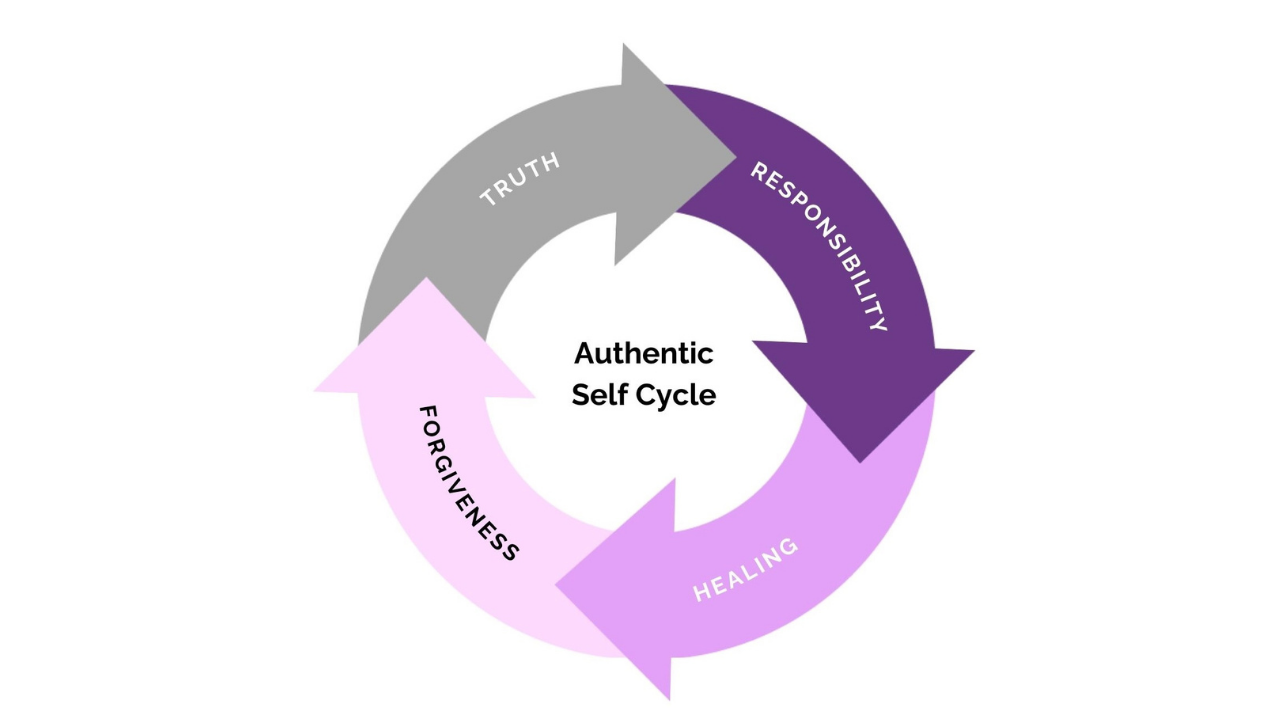
Truth: Name the blueprint. See that “this isn’t about today.” When your colleague gives you critical feedback and your chest tightens, truth says: “This feeling is from childhood. My colleague isn’t my critical parent — my nervous system just thinks they are.” Truth is the direct opposite of denial. It doesn’t minimize. It doesn’t normalize. It says: “This is what happened. This is how it affected me. This is the pattern it created.”
That’s the first step out of denial — seeing the pattern instead of being trapped inside it.
Responsibility: Own your emotional reactions without blame. “My partner isn’t my parent — my nervous system just thinks they are. I’m responsible for regulating my nervous system, not for controlling whether triggers happen.” This is radically different from denial, which says: “It’s their fault I feel this way.” Responsibility says: “I’m accountable for my healing and my nervous system’s response.”
That’s the shift that changes everything — from “they did this to me” to “I inherited a blueprint and I’m choosing to rewire it.”
Healing: Rewire the emotional blueprint so conflict becomes uncomfortable but not dangerous, space isn’t abandonment, and intensity isn’t attack. This is where the Emotional Authenticity Method™ does its work — second by second, like the ticks of a clock. The second hand moves in tiny, almost insignificant ticks. But those ticks move the minute hand. The minutes move the hours. Healing works the same way.
Forgiveness: Release the inherited emotional blueprint and reclaim your authentic self. Forgiveness isn’t about the people who hurt you. It’s about releasing the blueprint they gave you. This creates a NEW emotional chemical pattern that replaces fear, shame, and denial with safety, worth, and connection. You don’t become someone new. You finally meet who you always were underneath the survival persona.
That’s you — not the denial-protected performance. The real you underneath all of it.
The Authentic Self Cycle™ is an identity restoration system — it doesn’t teach you to manage denial, it replaces the neurochemical pattern that created denial with a new blueprint built on truth, responsibility, healing, and forgiveness.
Frequently Asked Questions About Denial and Self-Deception
What is denial in the context of childhood trauma and the Worst Day Cycle™?
Denial is the fourth stage of the Worst Day Cycle™ — the survival persona your brain created in childhood to protect you from the unbearable pain of shame. It’s not conscious lying or stubbornness. It’s an automated self-deception system that minimizes, normalizes, and rationalizes your childhood experience so you could maintain attachment with your caregivers. In adulthood, this same denial system prevents you from seeing the patterns that keep you stuck in painful relationships, careers, and health choices.
How do I know if I’m in denial about my childhood trauma?
If you insist your childhood “wasn’t that bad” while your adult life is marked by repeating painful patterns — relationship dysfunction, workaholism, people-pleasing, chronic emptiness, or emotional shutdown — you’re likely in denial. Other signs include difficulty accepting compliments, defensive reactions to feedback, minimizing your own needs, and believing “other people had it worse.” The Worst Day Cycle™ explains how 70%+ of childhood messaging is negative and shaming, yet most adults deny this impacted them.
Why is denial considered the most dangerous stage of the Worst Day Cycle™?
Denial is the most dangerous stage because it’s the stage that locks the entire cycle into permanent repetition. Without denial, you would feel the shame, trace it to its childhood origin, and begin healing. But denial prevents you from ever reaching the root cause. It keeps you managing symptoms — through coping skills, therapy, positive thinking, or medication — without ever addressing the childhood emotional blueprint that created the pattern. Denial guarantees the Worst Day Cycle™ repeats.
Can you break through denial on your own or do you need professional help?
You can begin confronting denial with the Emotional Authenticity Method™ — a six-step somatic practice that includes down-regulation, emotional naming, body awareness, childhood tracing, vision work, and Feelization. Consistent daily practice creates measurable shifts within weeks. However, the depth of healing often depends on the depth of the original trauma. A skilled guide can accelerate the process by holding a mirror to denial patterns you genuinely cannot see on your own — because the nature of denial is to hide from itself.
What is the relationship between denial and the three survival persona types?
Each survival persona type uses denial differently. The falsely empowered persona denies vulnerability and need, using control and performance as shields. The disempowered persona denies their own worth and anger, using people-pleasing as a shield. The adapted wounded child oscillates between both, denying they have a stable identity at all. All three survival persona types were created in childhood as denial strategies — brilliant adaptations to emotionally unsafe environments that now sabotage adult relationships, health, and self-worth.
How long does it take to move from denial to emotional authenticity?
The shift from denial to emotional authenticity is not a single breakthrough — it’s a daily practice of confronting the survival persona through the Emotional Authenticity Method™. Most people notice significant shifts in self-awareness within weeks of consistent practice. Deeper patterns — especially those involving family-of-origin denial — can take months of consistent work. The Authentic Self Cycle™ (Truth → Responsibility → Healing → Forgiveness) provides the long-term framework for sustained identity restoration beyond the denial system.
The Bottom Line
Denial kept you alive. It was the most brilliant adaptation your childhood brain could create. It protected you when nothing else could. And it has been running your life — your relationships, your career, your health, your sense of self — ever since.
But you’re here now. You’re reading this. And that means something inside you — your authentic self — is pushing against the denial. It’s asking to be seen. It’s asking for the truth.
The truth is: your childhood affected you more than you’ve been willing to admit. The truth is: your survival persona is not who you are. The truth is: the patterns you keep repeating are not character flaws — they’re the Worst Day Cycle™ running on automatic, sustained by denial.
That’s you — not the survival persona who has it all figured out. The real you underneath, who has been waiting decades to finally be met with truth instead of more denial.
Confronting denial is terrifying. It means admitting that the life you built may have been built by a survival persona, not your authentic self. It means grieving the years spent in self-deception. It means sitting with shame that has been avoided since childhood.
But on the other side of that confrontation is freedom. On the other side is who you actually are — not the performance, not the people-pleasing, not the control, not the collapse. The authentic, perfectly imperfect human being who deserves to live in truth.
The glasses are available. The 3D movie of your life can come into focus. But you have to be willing to put the glasses on — and see what denial has been hiding.
Recommended Reading
These books complement the frameworks in this article and can deepen your understanding of denial, self-deception, and the path to emotional authenticity:
Facing Codependence by Pia Mellody — the foundational text on how childhood trauma creates the survival patterns that denial maintains.
The Body Keeps the Score by Bessel van der Kolk — the science of how trauma lives in the body, explaining why cognitive approaches alone can’t break through denial.
When the Body Says No by Gabor Maté — how chronic denial and emotional suppression manifest as physical illness and disease.
Codependent No More by Melody Beattie — a practical guide to recognizing codependent denial patterns and beginning the journey to authenticity.
The Gifts of Imperfection by Brené Brown — how shame drives denial and why vulnerability is the path back to your authentic self.
The Master and His Emissary by Iain McGilchrist — the neuroscience of how the left and right brain hemispheres contribute to self-deception and denial.
Take the Next Step
If you’re ready to confront denial and begin reclaiming your authentic self, Kenny Weiss offers courses designed for people who are done managing symptoms and ready to heal the root cause:
Emotional Blueprint Starter Course — Individual ($79) — Your personal roadmap to understanding the Worst Day Cycle™ and identifying your denial patterns.
Relationship Starter Course — Couples ($79) — For couples ready to see how denial sabotages relationships and build authentic connection instead.
Why We Can’t Stop Hurting Each Other ($479) — Deep-dive into the Worst Day Cycle™ and how denial keeps painful relationship patterns repeating.
Why High Achievers Fail at Love ($479) — Built specifically for the falsely empowered survival persona whose denial looks like strength and ambition.
The Shutdown Avoidant Partner ($479) — Understanding avoidant attachment through the lens of denial, trauma chemistry, and survival personas.
Tier 1: Mapping the Blueprint ($1,379) — The comprehensive program for learning the Emotional Authenticity Method™ and beginning the journey from denial to truth.
Download the Feelings Wheel — the free tool used in Step 2 of the Emotional Authenticity Method™ to build emotional granularity beyond the fog of denial.
Explore more: The Signs of Enmeshment | 7 Signs of Relationship Insecurity | 7 Signs of High Self-Esteem | How to Determine Your Negotiables and Non-Negotiables | 10 Do’s and Don’ts for a Great Relationship