Attachment wounds don’t just happen at birth. They happen every time a parent dismisses your feelings, every time your need for closeness was met with coldness or control, every time you learned that safety meant staying small and disconnected. A lack of attachment—or what we more accurately call “insecure attachment” rooted in childhood emotional abandonment—leaves you unable to trust, unable to rest in a relationship, unable to believe you’re lovable as you are. You learned early: other people aren’t safe. And now, decades later, that blueprint still runs the show.
The good news? Attachment wounds are not destiny. They’re patterns—learned responses written into your nervous system and your emotional chemistry. And patterns can be rewritten.
Attachment wounds are unmet emotional needs in childhood that create a neural blueprint where the brain perceives intimacy as dangerous, dependency as weakness, or closeness as suffocation. This blueprint drives reactive behaviors—withdrawal, hypervigilance, people-pleasing, or control—that repeat in adult relationships and create the very disconnection that was originally feared.
Table of Contents
- What Is an Attachment Wound?
- The Neuroscience Behind Detachment
- The Worst Day Cycle™: How Wounds Repeat
- Three Survival Persona Types
- Seven Signs You Have an Attachment Wound
- The Authentic Self Cycle™: Breaking Free
- The Emotional Authenticity Method™: Five Steps to Healing
- Reparenting: Becoming Your Own Secure Base
- FAQ: People Also Ask
- The Bottom Line
What Is an Attachment Wound?
An attachment wound isn’t about whether your parents loved you. It’s about whether you felt safe depending on them. It’s about whether your emotional needs were honored or dismissed. It’s about whether the adults in your life taught you that closeness was safe—or dangerous.
That’s you if you grew up with: a parent who was emotionally unavailable (physically present, emotionally absent); a parent who responded to your pain with judgment or coldness; a parent who made your feelings about them (“You’re making me upset”); a parent who was enmeshed and you became their emotional support; a parent who controlled you through shame or silent treatment.
The wound creates a blueprint in your nervous system: Closeness = pain. Needing people = weakness. Trust = vulnerability = destruction.
That’s the thing about attachment wounds—they look different from person to person. For some, it becomes a fierce independence: “I don’t need anyone.” For others, it becomes a desperate clinging: “Don’t leave me, even though I push you away.” For most, it’s both—oscillating between cold distance and frantic pursuit.
Sound familiar? That oscillation is your attachment wound trying to solve the original problem—the broken safety system—with the only tools childhood gave you.
The Neuroscience Behind Detachment: Why Your Brain Chose Distance
Your brain is not broken. It’s brilliant. It learned that distance equals survival.
When you experience emotional abandonment or intrusion in childhood, your nervous system goes into a state of threat. The hypothalamus—your brain’s chemical factory—floods your body with cortisol, adrenaline, and dopamine. These chemicals create a powerful feedback loop: fear → shame → disconnection → fear again. Over time, your brain literally becomes addicted to these chemical states because they’re “known” and known feels safe.
The brain also conserves energy by repeating established neural pathways. It can’t tell right from wrong—it can only tell known from unknown. Since 70%+ of childhood messaging is negative and shaming, your adult brain repeats these patterns in relationships, career, body, finances—everywhere.
That’s you if you notice: You distance when someone gets close. You sabotage relationships when they’re finally safe. You attract partners who are emotionally unavailable (because it’s familiar). You can’t receive love without questioning it.
Childhood attachment wounds create a persistent neurochemical loop where fear-based thinking and shame become the default setting of the nervous system. The brain treats closeness and vulnerability as threat signals, activating the same survival chemistry that protected you in childhood but now prevents you from experiencing secure attachment in adulthood.
The Worst Day Cycle™: How Attachment Wounds Repeat
The Worst Day Cycle™ is not a punishment. It’s a blueprint. It’s how your childhood emotional logic still runs your adult life.
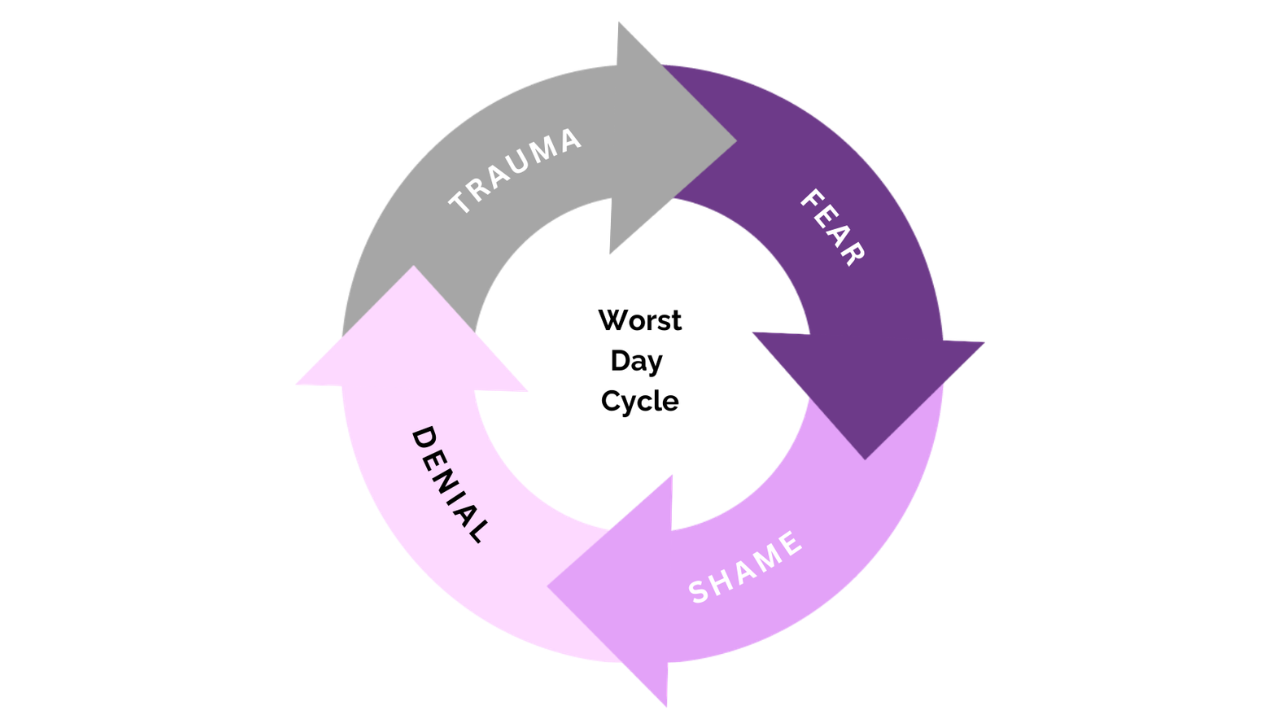
The Worst Day Cycle™ has four stages: Trauma, Fear, Shame, and Denial. Understanding this cycle is the first step to breaking it.
Stage 1: Trauma (The Original Blueprint)
Trauma isn’t always big. It’s any negative emotional experience that created a painful meaning about yourself or the world. For you, it might be: a parent who never asked how your day was, a parent whose mood swings you learned to manage, a parent who said “I’m disappointed in you” instead of “I’m concerned about this choice,” a parent who was more comfortable with your silence than your truth.
That’s the original wound—the moment your brain learned that your emotional needs weren’t welcome. Your nervous system encoded this as: I am alone. I cannot depend on others. My needs are a burden.
Stage 2: Fear (The Vigilance)
Fear is the secondary chemical reaction. Now, in adulthood, anytime someone gets close—a partner leans in, a friend shares vulnerability, a boss gives feedback—your amygdala fires. Your nervous system runs a microsecond scan: Is this a threat? Is this going to hurt me?
Because your childhood taught you that closeness = pain, your nervous system defaults to YES. Fear floods in. Your body tenses. Your thoughts race: They’re going to leave. They don’t really care. I need to get out first. I need to protect myself.
Sound familiar? That hypervigilance in relationships is Stage 2 of your Worst Day Cycle™.
Stage 3: Shame (The Broken Core)
Fear is about what might happen. Shame is about who you are. Shame is where you decided: I am the problem. I am unlovable. I am too much / not enough. I am broken.
In Stage 3, your attachment wound tells you that the reason you can’t have close relationships is not because of what happened to you—it’s because of who you are. Your distance isn’t a protective strategy; it’s proof that you’re incapable of connection. Your inability to trust isn’t a response to abandonment; it’s proof that you’re fundamentally flawed.
That’s the lie that shame tells. And you believe it because it’s been 30 years of evidence—relationships failing, distance growing, proof accumulating.
Stage 4: Denial (The Survival Persona)
Denial is brilliant and sabotaging. Denial is your survival persona—the version of you that learned how to survive childhood by being small, distant, independent, controlled, numb, or hypervigilant.
In Stage 4, instead of feeling the unbearable truth (“My parent wasn’t emotionally available and that broke my ability to trust”), you deny it and create a story: “I don’t need people anyway. Relationships are pointless. I’m better off alone. Love is for other people.”
Or: “I’m fine. Nothing’s wrong. I can fix this relationship if I just work harder, give more, manage their emotions better.”
The denial feels like protection. It lets you not feel the original pain. But denial also keeps you trapped in the cycle because you never actually see or challenge the blueprint—you just keep repeating it.
The Worst Day Cycle™ demonstrates how childhood attachment trauma creates a four-stage loop: an original wounding (trauma) triggers nervous system protection (fear), which activates a core belief of unworthiness (shame), which prompts a defensive identity (denial/survival persona). This cycle repeats in adult relationships until the underlying blueprint is consciously identified and rewired.
Then the cycle repeats. Your partner leans in for intimacy, fear fires, shame activates, you deny and withdraw, the relationship destabilizes, you have your “proof” that closeness doesn’t work—and the cycle confirms itself. Again. And again.
Three Survival Persona Types: Which One Are You?
Your survival persona is not your real self. It’s the version of you that childhood built to survive emotional pain. Understanding your persona is like understanding the character you’ve been playing for decades—and realizing that the character’s strategies don’t work in relationships between equals.
The Falsely Empowered Persona
The falsely empowered persona responded to emotional abandonment by taking control. If you lived with a parent who was unavailable or chaotic, you learned early: If I control the situation, I control the pain.
That’s you if: You manage everyone’s emotions in relationships. You’re the planner, the problem-solver, the one who knows what everyone needs. You move toward conflict aggressively—anger feels more powerful than fear. You rage when you feel abandoned because anger is strength and hurt is weakness. You can’t ask for help without feeling weak. You’re driven, achieving, outwardly confident—but underneath is a terror of dependency.
The falsely empowered persona looks strong. But the strength is a mask for deep fear. And in intimate relationships, it pushes people away because there’s no room for your partner to have power, agency, or voice.
The Disempowered Persona
The disempowered persona responded to emotional abandonment by collapsing. If you lived with a parent who was enmeshed or needed you emotionally, you learned: If I make myself small and manage their emotions, maybe I’ll be safe. Maybe I’ll be loved.
That’s you if: You become a people-pleaser in relationships. You silence your own needs to keep the peace. You ask permission for your own life. You feel guilty when your partner is disappointed, even when the disappointment isn’t about you. You apologize for taking up space. You’re drawn to people who need you to fix them. You stay in relationships long past the point of respect because leaving feels selfish or cruel.
The disempowered persona looks selfless. But the selflessness is a strategy for survival—a desperate attempt to earn love by erasing yourself.
The Adapted Wounded Child Persona
The adapted wounded child oscillates between falsely empowered and disempowered. You move between control and collapse, dominance and submission, rage and tears, independence and desperate clinging.
That’s you if: Your relationships feel chaotic—you’re hot and cold, near and far, giving and withdrawn. You can be controlling one moment and codependent the next. People describe you as “intense” or “hard to predict.” You swing between “I don’t need anyone” and “Why won’t you save me?” You push people away and then punish them for leaving.
The adapted wounded child is the survival persona that couldn’t choose between control and surrender—so it became both.
Sound familiar? Your persona isn’t a character flaw. It’s evidence of brilliance—your childhood self survived what was actually unsafe. The work now is recognizing that the strategies that protected you then are harming you now.
Seven Signs You Have an Attachment Wound
In Family Relationships
You notice: Contact with your family of origin triggers intense emotions—anger, numbness, or desperate people-pleasing. You still feel like a child around your parents, even though you’re an adult. You can’t set boundaries without guilt or rage. You’re still managing a parent’s emotions or you’ve completely cut them off. You either over-share or share nothing—there’s no middle ground of appropriate vulnerability.
In Romantic Relationships
You notice: You’re drawn to emotionally unavailable partners (because that’s familiar). Or you’re so needy that partners feel suffocated. Or you oscillate between both—pursuing then fleeing. You can’t receive compliments or affection without doubting them. You catastrophize small conflicts. You test your partner’s commitment by pushing them away or creating drama. You stay in relationships despite disrespect because the abandonment fear is stronger than the self-respect fear.
That’s you if you read the 7 signs of insecurity in relationships and recognized yourself in all of them.
In Friendships
You notice: You have acquaintances but no real intimate friendships. Or you’re intensely attached to one friend and abandoned when they don’t reciprocate the same intensity. You don’t ask for support because asking feels like burden. You’re the giver, never the receiver. You ghost friendships when they get too real or you sense any rejection. You’re afraid of being boring or unlovable if you show your real self.
In Work
You notice: You seek approval from authority figures in compulsive ways—overworking, seeking validation, or being unable to take feedback. Or you rebel against authority because control triggers your need to resist. You’re uncomfortable being led or being led by others—you need to be the expert. You can’t collaborate without feeling threatened. You struggle to ask for what you need, so your work becomes invisible or undervalued.
In Your Body and Health
You notice: You disconnect from physical sensations—you don’t notice hunger, exhaustion, or pain until it’s extreme. Or you’re hyperaware of every physical sensation and interpret it as danger. You use food, substances, sex, or exercise to numb emotions or feel alive. You struggle to maintain consistent self-care because you don’t feel like you deserve it. You have chronic tension, digestive issues, or immune problems that medical doctors can’t explain—they’re rooted in your nervous system’s chronic stress state.
In Your Money and Resources
You notice: You give money away compulsively (disempowered persona) or you hoard it obsessively (falsely empowered persona). You can’t ask for a raise without crushing shame or aggressive entitlement. You sabotage financial success because you don’t feel worthy of abundance. You’re either financially enmeshed with family or completely cut off.
In Your Spiritual or Personal Practice
You notice: You use spirituality to escape (“I’m detached and that’s enlightenment”) or you use it as another performance (being the “best” meditator, the “most” conscious). You can’t access genuine connection to faith, body, or authentic desire because you’re disconnected from yourself. Or you’re rigidly attached to a belief system that keeps you small and obedient.
Attachment wounds manifest across all life domains—as avoidance in intimate relationships, over-functioning in work and family, emotional numbing or hypervigilance in the body, and defensive relationship patterns with authority or peers. The pervasiveness of these signs indicates the wound is not situational but embedded in the nervous system itself.
The Authentic Self Cycle™: Breaking Free from Your Attachment Blueprint
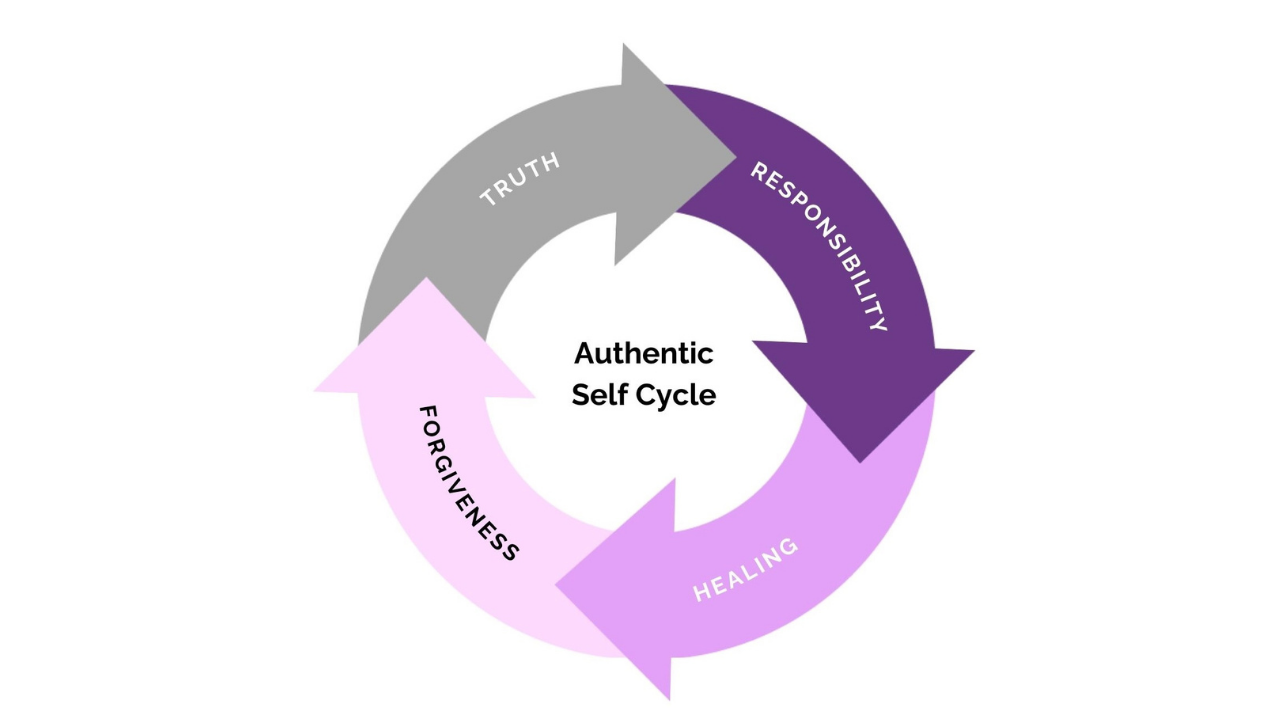
The Worst Day Cycle™ is how you got stuck. The Authentic Self Cycle™ is how you get free. This is the opposite spiral—the upward cycle that rewires your nervous system and your core beliefs about attachment and safety.
The Authentic Self Cycle™ has four stages: Truth, Responsibility, Healing, and Forgiveness.
Stage 1: Truth (See the Blueprint)
Truth means naming what happened. Not forgiving it yet. Not understanding why your parents did it. Just naming: My parent was emotionally unavailable. My parent made my feelings about them. My parent made me responsible for their emotions. My parent chose control over connection.
That’s you if you’re willing to stop defending your parents and start seeing clearly. Truth is the first step because you cannot change what you cannot see.
When you speak Truth, your nervous system gets a message: This is not about today. This is about what happened then. I’m safe now. This simple act—naming what actually happened—begins to separate the past from the present.
Stage 2: Responsibility (Own Your Reactions)
Responsibility does NOT mean blame. It means: My partner isn’t my parent. My nervous system just thinks they are. I am responsible for rewiring my nervous system.
In Stage 2, you own that your reaction to your partner’s distance isn’t about their abandonment—it’s about your childhood. Your rage when they don’t anticipate your needs isn’t about their failure—it’s about your blueprint. Your desperate people-pleasing isn’t about their worth—it’s about your survival strategy.
That’s the breakthrough moment. When you realize: I’ve been treating my partner like my parent. I’ve been trying to get them to be the available, attuned, loving parent I never had. And they can never be that, because they’re not that person.
Responsibility is the moment you stop blaming your partner for not healing your attachment wound and start owning that only you can rewire your nervous system.
Stage 3: Healing (Rewire the Blueprint)
Healing means your nervous system learns: Closeness is safe. Space is not abandonment. Conflict is not attack. Intensity is not danger.
This is where the real work happens. Your nervous system has 30+ years of evidence that closeness = pain. Healing means accumulating new evidence that closeness = safety. This takes time. It happens through repeated experiences of being close without being harmed, of having conflict without being destroyed, of needing someone without being rejected.
Healing also means practicing the Emotional Authenticity Method™ (we’ll get to that soon). It means rewiring your survival persona so that vulnerability isn’t weakness and independence isn’t strength—both are just honest expressions of your current need.
Stage 4: Forgiveness (Release the Blueprint)
Forgiveness is not saying what happened was okay. It’s not even saying you forgive your parents. Forgiveness in the Authentic Self Cycle™ means: I release the blueprint I inherited. I reclaim my authentic self. I stop letting this wound define my capacity for love.
Forgiveness is the moment you realize: I am not my parents’ mistakes. I am not my childhood. I am the adult who gets to choose what happens next.
And that’s the freedom. That’s when your nervous system gets the message: The past is the past. I’m not living there anymore.
The Authentic Self Cycle™ reverses the neurochemical loop of attachment wounds by first identifying the original blueprint (Truth), then separating past from present (Responsibility), then accumulating new nervous system evidence through repeated safe experiences (Healing), and finally releasing the inherited pattern (Forgiveness). This creates a new emotional chemistry rooted in genuine safety rather than survival.
The Emotional Authenticity Method™: Five Steps to Rewire Your Nervous System
Here’s the truth nobody tells you about attachment wounds: You cannot think your way out of them. You cannot meditate them away. You cannot understand them into healing.
Why? Because emotions are not thoughts. Emotions are biochemical events. Your attachment wound isn’t stored in your rational mind—it’s stored in your nervous system. And the nervous system doesn’t speak the language of logic. It speaks the language of somatic experience.
The Emotional Authenticity Method™ is a five-step process that rewires your nervous system from the inside out. This is where you stop managing emotions and start authentically feeling them.
Step 1: Somatic Down-Regulation (Nervous System Reset)
Before you can feel anything authentically, your nervous system has to feel safe enough to feel. If you’re in fight/flight/freeze mode, your body is protecting you—not healing you.
Somatic down-regulation means: Box breathing (4 counts in, 4 counts hold, 4 counts out, 4 counts hold). Cold water on your face (triggers the dive reflex). Grounding (name 5 things you see, 4 you can touch, 3 you hear, 2 you smell, 1 you taste). Bilateral stimulation (walking, tapping alternately on your knees).
Optional: Titration. If the emotion feels too big, titrate it—feel 20% of the feeling for a few seconds, then pause. Feel 40%, pause. Feel 60%. This teaches your nervous system that you can feel difficult emotions without being destroyed by them.
Sound familiar? That’s your nervous system learning that it’s safe to be present with what you actually feel.
Step 2: What Am I Feeling? (The Feelings Wheel)
Most people with attachment wounds have a limited emotional vocabulary. You feel “bad” or “fine.” You don’t distinguish between anger and hurt, fear and shame, loneliness and rejection.
The Feelings Wheel teaches you the nuance. Is what you’re feeling rage or frustration? Despair or disappointment? Jealousy or fear? Resentment or grief? The specificity matters because each emotion tells a different story and points to a different need.
Use the Feelings Wheel here. This is a life-changing exercise.
Step 3: Where In My Body Do I Feel It?
Emotions are not abstract. They live in your body. Shame tightens your chest. Fear lives in your stomach. Grief sits in your throat. Anger radiates from your solar plexus.
In this step, you locate the feeling. Close your eyes. Where do you notice this emotion in your body? Is it tight or loose? Hot or cold? Pulsing or static? Does it have a shape or color?
This step is crucial because it breaks the habit of intellectualizing emotions. You’re teaching your body that you see it. You’re teaching your nervous system that feelings are normal and locatable, not overwhelming and all-consuming.
Step 4: What Is My Earliest Memory of This Feeling?
This is where the attachment wound becomes visible. When you feel this specific emotion now—this shame, this loneliness, this rage—your nervous system often isn’t responding to your current situation. It’s responding to an old one.
Ask yourself: When did I feel this way before? Where am I? How old am I? Who is there? What is the original painful meaning I made from this experience?
You might discover: This rage I feel when my partner doesn’t answer my texts is the same rage I felt when my parent ignored me. This shame I feel when someone disagrees with me is the same shame I felt when my parent said I was wrong. This panic I feel when someone gets close is the same panic I felt when my parent was enmeshed.
That’s you if you realize: I’m not actually reacting to today. I’m reacting to then.
Step 5: Who Would I Be If I Never Had This Feeling Again?
This is the vision step. Not toxic positivity. Not spiritual bypassing. Just honest imagination: If this emotional pattern—this fear, this shame, this protective rage—was healed, who would you actually be?
How would you show up in relationships? What would you risk? What would you ask for? How would you move through the world? What would become possible?
This step matters because it clarifies the vision you’re moving toward. You’re not healing your attachment wound to be “better.” You’re healing it to be free. To be authentic. To finally live as yourself.
The Emotional Authenticity Method™ bypasses cognitive resistance by addressing emotions as somatic experiences rather than thoughts. By sequencing nervous system regulation, precise emotional identification, body location, origin memory, and authentic vision, the method rewires the attachment blueprint at the neurochemical level where it actually lives.
Reparenting: Becoming Your Own Secure Base
You cannot change what happened to you. But you can become the parent you needed.
Reparenting is the practice of internally providing what your attachment figures couldn’t. It’s not denying what happened. It’s not spiritual bypassing. It’s actively rewiring your nervous system by becoming the attuned, responsive, emotionally available presence that your childhood self never had.
What does reparenting actually look like?
When you feel shame: Instead of your parent’s voice (“You’re broken”), your reparenting voice says: “I see you’re hurting. This makes sense given what happened. You’re not broken. You’re human and you’re learning.”
When you feel fear of abandonment: Instead of your parent’s withdrawal, you practice staying present with yourself. You breathe. You say: “I’m here. I’m not leaving you. We’re going to figure this out together.”
When you feel unheard: Instead of your parent’s dismissal, you practice listening to yourself. You journal. You check in with your own needs. You say: “Your feelings matter. Your voice matters. I hear you.”
When you feel unsafe: Instead of your parent’s coldness, you practice self-soothing. Cold water. Movement. Your own hand on your chest. You say: “You’re safe now. That was then. This is now.”
Sound familiar? That’s the internal work of reparenting—literally becoming the secure base that your nervous system never experienced.
And here’s what’s wild: When you reparent yourself, you stop needing your partner to be your parent. You stop testing them with abandonment. You stop demanding they fix what only you can heal. You finally have room to actually love them.
FAQ: People Also Ask
Can attachment wounds be healed without therapy?
Therapy can accelerate healing, especially trauma-informed therapy (EMDR, somatic experiencing, Internal Family Systems). But many people heal attachment wounds through self-directed practice using frameworks like the ones in this article, journaling, reparenting, and the Emotional Authenticity Method™. The key is consistency and willingness to feel what you’ve been avoiding. Many people find the combination of self-directed work + courses + community more effective than therapy alone.
How long does it take to heal an attachment wound?
It depends on the depth of the wound and your consistency with the work. Most people notice shifts in 3-6 months. Genuine rewiring typically takes 12-24 months of consistent practice. Your brain and nervous system need repeated experiences of safety to update the blueprint. There’s no fast-track. But there is a real path forward.
What’s the difference between attachment wounds and attachment styles?
Attachment styles (secure, anxious, avoidant, disorganized) describe your behavioral patterns in relationships. Attachment wounds are the underlying blueprint—the unmet emotional needs that created those patterns. Healing attachment wounds changes your attachment style. You can move from anxious or avoidant toward earned security.
Can I heal my attachment wounds if my parents won’t acknowledge what they did?
Yes. This is actually the most common scenario. Your parents may never understand the impact of what happened. You don’t need their acknowledgment to heal. You need your own. The Authentic Self Cycle™ works regardless of whether your parents ever take responsibility. You’re not healing for them. You’re healing for you.
Is reparenting the same as self-love?
Self-love is often too vague—it can mean anything from positive affirmations to toxic self-centeredness. Reparenting is specific: It’s actively being the attuned, responsive, emotionally available parent to your own nervous system. It’s the behavioral practice that creates genuine safety in your body. So reparenting is how you practice real self-love.
Will healing my attachment wound guarantee my relationship works out?
Healing your attachment wound changes you. You become more secure, more authentic, more capable of genuine intimacy. Some relationships deepen when you heal. Some end because they were based on your wound patterns. Some relationships can’t handle your growth. The guarantee is not about your relationship—it’s about you: You will finally be free to choose relationships based on health, not on healing your childhood.
Understanding the Neuroscience: Myelin and Neural Pathways
Your attachment wound isn’t just in your mind. It’s written into the myelin sheaths around your neurons—the insulation that allows electrical signals to fire faster and more efficiently through your neural pathways.
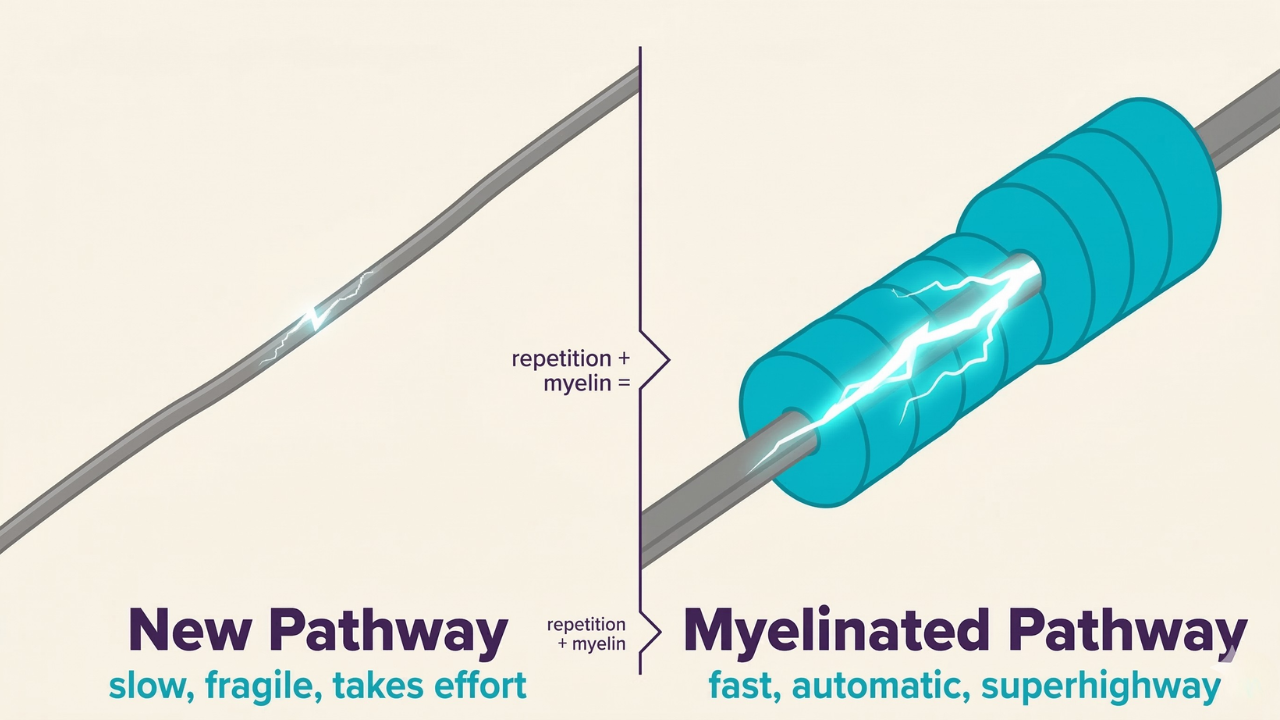
Every time you repeat an emotional pattern—every time you withdraw when your partner gets close, every time you rage when you feel abandoned, every time you people-please to avoid conflict—you’re adding myelin to that pathway. You’re making that pattern faster, more automatic, more “true.”
But here’s the good news: Myelin isn’t permanent. Neuroscience has proven that the brain rewires throughout life (neuroplasticity). When you practice new patterns—when you stay present instead of withdraw, when you set a boundary instead of rage, when you ask for what you need instead of disappear—you’re building myelin on new pathways.
It takes repetition. It takes time. But it’s genuinely possible to rewire your nervous system and literally change the architecture of your brain.
Neuroplasticity research demonstrates that repeated emotional experiences build myelin insulation around activated neural pathways, making trauma responses automatic and reflexive. Conscious practice of alternative responses builds competing pathways, eventually creating new default patterns. This neurobiological process means attachment wounds can be genuinely rewired through consistent behavioral and somatic practice.
The Relationship Between Attachment Wounds and Codependence
Many people with attachment wounds also develop codependent patterns—making other people’s emotions their responsibility, losing themselves in relationships, unable to set boundaries.
But they’re not the same thing. An attachment wound is: I learned that closeness is dangerous. Codependence is: I learned that my worth comes from managing other people. An attachment wound might push you away. Codependence pulls you in and never lets go.
That’s the thing about these patterns—they often show up together. If you want to heal both, read about negotiables and non-negotiables in codependence recovery. And check out the signs of enmeshment to see if that’s part of your story.
The same frameworks work for both. The Worst Day Cycle™, the Authentic Self Cycle™, and the Emotional Authenticity Method™ address codependence and attachment wounds together—they’re often branches of the same tree.
Building Secure Attachment in Adult Relationships
So here’s what nobody tells you: You can’t heal your attachment wounds alone in therapy or self-reflection. You have to heal them in relationships.
Your attachment wound was created in relationships (with your parents). It’s activated in relationships (with your partner, your friends). And it can only be genuinely healed in relationships—with people who stay when you’re scared, who don’t punish you for having needs, who prove through their consistency that closeness is actually safe.
This doesn’t mean your partner should be your therapist. It means: The more you practice emotional authenticity with your partner (the five-step method), the more you reparent yourself, the more you use the Authentic Self Cycle™ to separate past from present—the more your nervous system updates its beliefs about attachment and safety.
And your partner, witnessing this, also gets to experience you differently. They get to experience you as someone who can be close without controlling, who can be vulnerable without collapsing, who can love them without needing them to be your parent.
That’s earned security. That’s what healing actually looks like.
Want to learn how to create this with your partner? Read about 10 dos and don’ts for a great relationship. The framework there assumes you’re already doing your personal work—and now you’re learning how to bring your authentic self into the relationship.
How High Achievers Get Trapped in Attachment Wounds
There’s a specific pattern: High achievers with attachment wounds. The falsely empowered persona becomes a driver—you achieve, accomplish, excel, control everything. Outwardly successful. Inwardly terrified.
Because what you’re actually doing is trying to achieve your way to worthiness. Trying to prove that you’re not the unlovable, broken child your parents made you feel like. And no amount of achievement ever fills that gap.
And then your intimate relationships suffer because you can’t turn off the achievement drive—you’re still trying to control, win, be the best. Your partner becomes another project to optimize instead of a person to connect with.
If this is you, there’s something specific you need to understand about why high achievers fail at love. Real self-esteem isn’t about achievement. It’s about knowing you’re worthy exactly as you are. That’s the shift that changes everything.
The Bottom Line: You Are Not Your Wound
An attachment wound tells you: I cannot be close. I cannot be known. I cannot be loved. It tells you this so convincingly that you believe it’s the truth about who you are.
But it’s not. It’s the truth about what happened to you. It’s the brilliant protective strategy your childhood self created. It’s the neural pathway your brain repeated ten thousand times until it felt like destiny.
But it’s not destiny. It’s a pattern. And patterns can change.
Your authentic self—the you that exists beneath the wound, beyond the survival persona—is capable of genuine intimacy. Is capable of receiving love. Is capable of being known and staying present. That self has been waiting for you to finally see that you’re safe enough now to come home.
That’s the work. Not fixing the wound. But remembering that the wound was never the whole story about you. It was just the story you had to tell yourself to survive.
And now? Now you get to tell a different story. You get to write your own ending. And it starts the moment you decide you’re willing to feel what you’ve been avoiding, to challenge what you’ve been believing, and to reparent the part of you that never got to be a child.
You’ve already survived the worst. Everything from here is actually living.
Recommended Reading for Deep Dives
- Mellody, Pia. Facing Codependence. Find your core wounds and attachment patterns in clear, practical language.
- Maté, Gabor. The Myth of Normal. Understand how childhood disconnection becomes chronic disease and why the nervous system matters more than the mind.
- Beattie, Melody. Codependent No More. A practical guide to releasing what you cannot control, especially other people.
- Brown, Brené. Dare to Lead. How to practice genuine vulnerability and authenticity in relationships and leadership.
- van der Kolk, Bessel. The Body Keeps the Score. The neuroscience of trauma and why somatic work matters more than talk therapy alone.
Ready to Go Deeper? Your Next Steps
Understanding your attachment wound is the first step. But understanding isn’t healing. Healing requires practice, community, and frameworks that actually work.
Here are your options:
Start with Self-Discovery
Emotional Blueprint Starter Course — Individual ($79) — A guided course that maps your specific emotional blueprint, identifies your survival persona, and shows you exactly where your attachment wounds are operating. This is where most people start. You’ll understand yourself in ways you’ve never understood yourself before.
If You’re in a Relationship
Relationship Starter Course — Couples ($79) — Learn how your attachment wound meets your partner’s attachment wound, where you’re recreating childhood dynamics, and the specific practices that heal relationships from the inside out.
Why We Can’t Stop Hurting Each Other ($479) — A deep-dive course on the exact mechanics of how attachment wounds sabotage relationships and the step-by-step process to break the cycle. For couples serious about transformation.
If You’re a High Achiever Struggling with Love
Why High Achievers Fail at Love ($479) — Specifically designed for driven people who excel at work but can’t figure out relationships. Understand why achievement can’t fill the attachment wound and what actually can.
If Your Partner Is Avoidant
The Shutdown Avoidant Partner ($479) — If you’re dealing with someone whose attachment wound makes them run—or someone who won’t even acknowledge there’s a problem—this course teaches you how to stop chasing, how to set boundaries, and whether the relationship is actually healable.
For Complete Transformation
Tier 1: Mapping the Blueprint ($1,379) — The most comprehensive program, teaching you to rewire your entire nervous system. This is where you learn to practice the Emotional Authenticity Method™ with mastery, understand your emotional blueprint at every level, and build genuine security from the inside out. Six weeks of video content, worksheets, and guided practices.
Start with Emotional Blueprint Starter Course — Individual if you want clarity. Choose Relationship Starter Course — Couples if you’re in a relationship. Choose one of the specialized courses if you have a specific dynamic to understand. Commit to Tier 1: Mapping the Blueprint if you’re ready to truly transform.
Your attachment wound shaped your whole life. But it doesn’t have to shape your future. Not anymore.