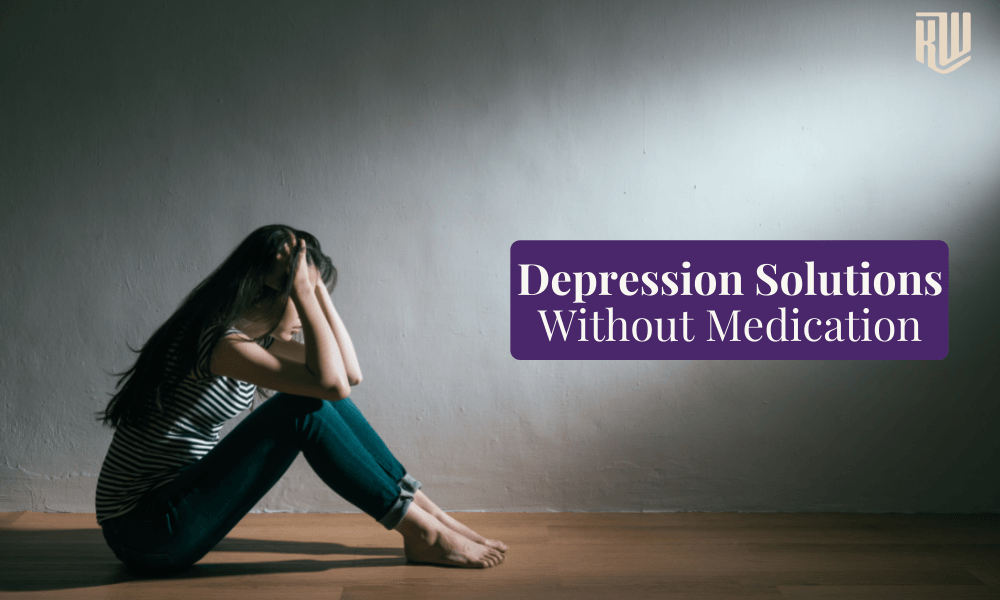
Depression isn’t a chemical imbalance that requires medication — it’s a trauma response your body learned in childhood to protect you from emotional pain. When you experience trauma, abandonment, or rejection as a child, your nervous system creates neural patterns that feel like depression in adulthood: numbness, hopelessness, exhaustion. These aren’t symptoms of a broken brain. They’re evidence of a brilliant system that adapted to survive. The good news? That same adaptive system can be rewired through emotional authenticity and trauma processing, without pills.
Why Depression Isn’t About Brain Chemistry
For decades, we’ve been told depression is a serotonin deficiency. Take an SSRI, balance your brain chemicals, and you’ll feel better. But the research doesn’t hold up. Studies show antidepressants work no better than placebo for mild-to-moderate depression. And they don’t address the root cause.
That’s you if you’ve tried medication and felt like something was still missing.
Depression is the nervous system’s adaptive response to chronic emotional pain in childhood. When a child experiences repeated rejection, abandonment, abuse, or emotional neglect, their developing brain creates a survival pattern: if I stop feeling, I stop hurting. This pattern becomes hardwired in the body—in the vagus nerve, the receptor sites at the cellular level, the neural pathways that light up when threat is perceived.
Medication doesn’t rewire these patterns. It mutes them. You still carry the nervous system dysregulation, the shame, the fear. You’re just numb to it. And the moment you stop the pills, the pattern returns—often stronger.
Sound familiar? That feeling of being stuck in the same loop even though you’re medicated?
The Trauma Signal Your Body Is Sending
Your depression isn’t a malfunction. It’s a message. Your body is saying: “I learned how to survive by shutting down. I learned that my feelings weren’t safe. I learned to disappear to avoid pain.”
That’s brilliant adaptation. As a child, it kept you safe. As an adult, it keeps you trapped.
The body’s stress response system—the sympathetic nervous system—is designed for acute threats: a predator, a fire, a car accident. For 10 minutes of terror, it saves your life. But when you grow up in an environment where emotional pain is constant and inescapable, your nervous system stays switched on for years. Decades, even.
That’s the depression you feel when you wake up at 3 AM with dread for no reason.
Your body is still protecting you from a threat that no longer exists. The child you were needed that protection. The adult you are needs something different: activation, choice, emotional truth.
Understanding the Worst Day Cycle™
The Worst Day Cycle™ is the neurochemical pattern that creates depression. It has four stages, and if you’ve ever felt truly depressed, you’ve lived this cycle hundreds of times.
Stage 1: The Trigger (Trauma Activation)
Something happens. A partner doesn’t text back. A boss gives you critical feedback. A memory surfaces. Your nervous system registers this as the same threat you faced in childhood. Your amygdala—the brain’s threat detector—fires.
That’s you when you interpret your partner’s silence as abandonment because your parent ignored you for days when they were angry.
Stage 2: Fear and Hypervigilance
Your body floods with cortisol and adrenaline. Your heart races. You become hypervigilant—scanning for danger, looking for proof that your fear is justified. Your prefrontal cortex (the thinking brain) goes offline. You’re now in survival mode.
This is where most people medicate. They take a pill hoping to skip stages 3 and 4. But the cycle completes anyway, just slower and less consciously.
Stage 3: Shame and Self-Blame
As the fear peaks, something shifts. You can’t stay in terror forever. Your mind turns the fear inward. “I’m broken. I’m overreacting. I’m too sensitive. What’s wrong with me?” Shame floods in. This is the crash—the moment the nervous system says: “I can’t handle this. I have to shut down.”
That’s the shame that makes you not want to leave the house, not want to reach out, not want to be seen.
Stage 4: Denial and Dissociation
To escape the unbearable feelings of shame and fear, your nervous system dissociates. You go numb. You don’t remember the cycle happened. You feel nothing. And nothing feels safer than pain.
This numb stage is what we call depression. It’s not your natural state. It’s a dissociative response to unbearable feelings.
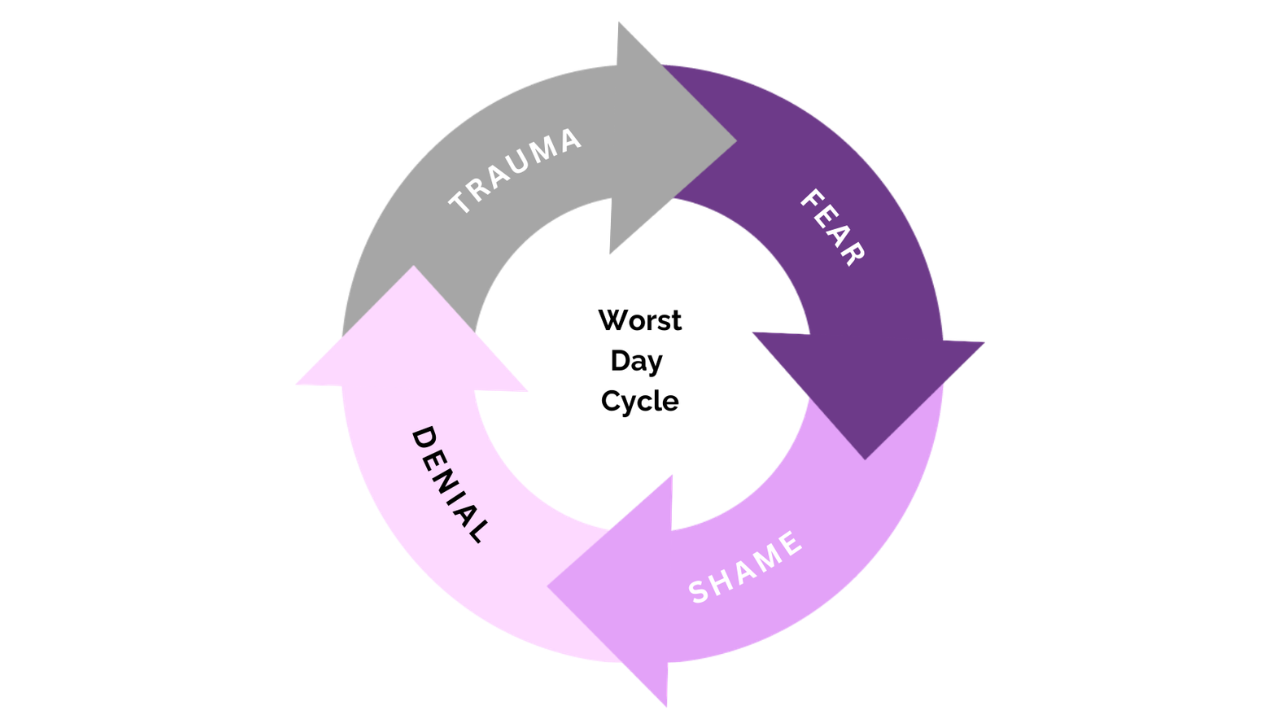
The Worst Day Cycle™ is Trauma (amygdala activation and nervous system dysregulation) → Fear (hypervigilance and threat scanning) → Shame (internalized fear and self-blame) → Denial (dissociation and numbness). This cycle repeats until you break the pattern at the nervous system level, which requires emotional authenticity work, not medication.
Most depression treatment stops here. Therapists talk about the cycle. Psychiatrists prescribe pills to flatten it. But neither addresses the core mechanism: the survival persona that’s preventing you from moving through the cycle consciously.
The Three Survival Personas That Keep Depression Locked In
When you survived childhood trauma, your personality adapted. You created what I call a survival persona—a false version of yourself designed to keep you safe and keep others happy.
There are three main survival personas. Almost everyone with depression operates from at least one of them.

The Falsely Empowered Persona
This is the person who learned early: “If I take care of everyone else, I’ll be safe. If I’m the strong one, I won’t be abandoned. If I’m perfect, I’ll finally be loved.”
You’re driven. Productive. High-achieving. You get things done. But internally, you’re running on fumes. You’re exhausted from proving your worth. You dismiss your own needs as weakness. You can’t ask for help because asking for help means you’re failing.
That’s you when you’re burned out but can’t admit it because admitting it means you’re not good enough.
The falsely empowered persona creates depression through relentless self-criticism and the impossible standard of being perfect for others.
The Disempowered Persona
This is the person who learned: “I can’t do anything right. I’m broken. I’m the problem. I might as well give up.” You’ve internalized the blame. You believe the narrative: you’re too much, not enough, fundamentally defective.
You don’t try because trying means risking failure, and failure confirms what you already believe about yourself. You isolate. You ruminate. You sabotage good things because you don’t believe you deserve them.
That’s the depression that whispers: “What’s the point? You’ll just mess it up anyway.”
The disempowered persona is the most obviously depressed of the three. It matches our cultural image of depression perfectly.
The Adapted Wounded Child Persona
This is the person who learned: “I’ll be small, invisible, and compliant. If I don’t have needs, I can’t be hurt. If I’m flexible, I can’t be rejected.” You’re the peacekeeper. The people-pleaser. You read the room obsessively. You shift your personality based on who you’re with.

You have no clear identity. You’re a mirror, reflecting back what people need from you. This feels like depression because there’s no one home—no real you underneath all the adaptation.
That’s you when you realize you don’t actually know what you want because you’ve spent your whole life wanting what others want.
The adapted wounded child creates depression through chronic enmeshment and the slow disappearance of self.
Most people have a blend of all three personas, activated in different relationships and contexts. To heal depression, you need to recognize which persona is active, understand what trauma created it, and then begin the process of reclaiming your authentic self.
Where Depression Shows Up: Five Life Areas
Depression doesn’t just feel like sadness. It shows up in your behavior, your relationships, your body, your work. Here’s where to look.
Family: The Pattern of Invisibility or Conflict
In your family of origin, depression often shows up as you either being the invisible peacekeeper or the identified problem. You either fade into the background or you’re blamed for everything that goes wrong. Either way, your authentic needs never get met.
That’s you when you go home and immediately become the version of yourself your family expects, and you feel your authentic self shrink away.
Romantic Relationships: Abandonment Anxiety or Emotional Withdrawal
Depression in romantic relationships shows up as either desperate clinging (if you have an abandonment wound) or cold withdrawal (if you have a rejection wound). You either chase intimacy and feel rejected, or you sabotage it before it gets too close. You rarely feel secure.
That’s the anxiety that wakes you up at 3 AM wondering if your partner is going to leave you, or the numbness that makes you not care either way.
Friendships: Isolation or Enmeshment
Your friendships either feel surface-level and lonely, or they’re so fused that you’ve lost your boundaries. You either don’t let people in, or you let them in too much and lose yourself. Depression whispers that you don’t deserve real friendship, so you don’t invest.
Sound familiar? Feeling alone in a room full of people because no one really knows you?
Work: Perfectionism or Apathy
At work, depression shows up as either compulsive overwork (proving your worth) or complete apathy (why bother). You either burn out from trying too hard or feel numb and unmotivated. There’s no middle ground where you’re engaged and energized.
That’s you when you’re checking boxes but not actually present, or when you’re driving yourself into the ground to prove you matter.
Body and Health: Numbness or Hypervigilance
Depression disconnects you from your body. You either don’t notice physical signals (hunger, pain, pleasure, fatigue) or you’re hypervigilant to every ache and pain. You might struggle with sleep, appetite, or chronic pain that no doctor can explain. Your body is trying to tell you something, and depression is the static that drowns out the signal.
That’s the exhaustion that sleep doesn’t fix, or the pain that moves around your body looking for a home.
The Emotional Authenticity Method™: Your Daily Healing Practice
Here’s the truth: you can’t think your way out of depression. Antidepressants can’t medicate it away. You can only move through it by feeling it, understanding it, and integrating it into your nervous system at the somatic level.
The Emotional Authenticity Method™ is a five-step daily practice that moves you from dissociation (denial) back into feeling (authenticity).

The Emotional Authenticity Method™ comprises five steps: Somatic Down-Regulation (calming the nervous system through breath and body awareness), What Am I Feeling? (naming emotions without judgment), Where in My Body? (locating the sensation), Earliest Memory? (tracing the emotion back to its origin in childhood), and Who Would I Be? (imagining your authentic self without the survival persona). This five-step daily practice rewires the nervous system’s response to fear and shame, breaking the Worst Day Cycle™ at the cellular level.
Step 1: Somatic Down-Regulation
Before you can think or feel clearly, your nervous system has to be calm enough to access your prefrontal cortex. When you’re in fight-flight-freeze, your amygdala is running the show. You’re not in a place to process anything except survival.
Somatic down-regulation is simple: box breathing, progressive muscle relaxation, cold water on your face, vigorous movement, or slow, intentional stretching. The goal is to signal to your body: “The threat has passed. We’re safe now.”
That’s you when you take five minutes before responding to the text message that triggered you, instead of sending a response you’ll regret.
Step 2: What Am I Feeling?
Once your nervous system is regulated, ask yourself: “What am I actually feeling?” Not what should I feel. Not what will make others comfortable. What are you actually experiencing?
Use the Feelings Wheel. There are probably 60+ emotion words on it, and most of us cycle through the same 3-4 (fine, okay, sad, angry). The more precise you can be with the emotion, the more information you unlock.
Are you feeling abandoned? Powerless? Unseen? Unworthy? These are not the same as “sad,” and the specificity matters.
That’s you when you realize what you thought was sadness was actually rage, and suddenly everything makes sense.
Step 3: Where in My Body?
Emotions are not abstract. They live in your body. Fear lives in your chest. Shame lives in your face and throat. Grief lives in your gut. Anger lives in your jaw and fists.
Where in your body are you feeling this emotion right now? Don’t think about where it “should” be. Feel where it actually is. What’s the sensation? Heaviness? Tightness? Burning? Numbness?
This step brings you fully into the present moment and out of your thinking mind. Your nervous system can’t stay in dissociation when you’re fully present in your body.
Sound familiar? That moment when you stop thinking about your feelings and start actually feeling them, and everything shifts?
Step 4: Earliest Memory?
Now ask: “When is the first time I felt this feeling in my body?” Not the most recent trigger. The original time. The prototype of this feeling in your nervous system.
You might remember a specific moment from childhood: your parent’s face when they were angry, the silence after they left the room, the feeling of being completely alone. Or you might just sense a feeling—terror, rejection, invisibility—without a specific memory. Both are valid.
This step connects your present-day depression to its roots in childhood trauma. It transforms the feeling from “something’s wrong with me” to “my nervous system learned something in childhood that still runs today.”
That’s the moment when you realize your anxiety about your partner isn’t really about your partner—it’s about your parent, and suddenly you can actually separate the two.
Step 5: Who Would I Be?
Finally, ask: “Who would I be without this survival persona? What would I want if I wasn’t afraid? What would I choose if I wasn’t ashamed?”
This is the authentic self beneath the depression. This is the person you were before trauma asked you to disappear. This is who you’re becoming as you do this work.
You don’t need to know the answer fully. Just begin to ask the question. Just begin to imagine what you might be without all the protection.
That’s you when you feel the first whisper of aliveness—the sense that there’s someone real under all the numbness.
The Authentic Self Cycle™: Restoring Your Real Identity
Once you start moving through the Emotional Authenticity Method™, you encounter something that might feel dangerous: the real you. The authentic self beneath the survival persona. This is where many people get stuck. The authentic self feels vulnerable, unfamiliar, even terrifying.
The Authentic Self Cycle™ is the framework for integrating this real self back into your life and identity.

The Authentic Self Cycle™ is a four-stage integration process: Truth (acknowledging what actually happened in your childhood, without minimizing or exaggerating), Responsibility (claiming ownership of your healing as an adult, separate from your childhood caretaker’s failures), Healing (processing trauma at the nervous system level through emotional authenticity), and Forgiveness (releasing the grip of the past on your present, not for the person who harmed you, but for your own freedom). This cycle restores your genuine identity and ends the depression that comes from living as a survival persona.
Stage 1: Truth
Depression thrives in denial. Your survival persona is built on the lie: “What happened wasn’t that bad. I’m overreacting. It was my fault. They did the best they could.”
The first stage of the Authentic Self Cycle™ is telling the truth about what happened. Not the sanitized version. Not the version that protects your parents’ feelings. The actual truth about what you experienced.
That’s you when you finally admit: “My parent was emotionally absent” or “They were physically there but completely unavailable” or “They used me to manage their emotions.”
This is where people resist. Admitting the truth means admitting you didn’t deserve what happened. You weren’t bad. You weren’t the problem. It wasn’t your fault. And that truth is actually harder to live with than the blame, because blame at least gave you control.
Stage 2: Responsibility
Here’s where people get confused. Responsibility doesn’t mean: “It was actually my fault for being too sensitive.” It means: “As an adult, the healing of my nervous system is my responsibility, not theirs.”
Your parent couldn’t give you what they didn’t have. That’s sad. That’s tragic. That’s not your fault. But as an adult, you can’t wait for them to heal you. You can’t keep hoping they’ll finally give you the emotional attunement you needed. You have to become your own secure base.
That’s you when you stop waiting for permission or apology and start doing the work yourself.
This is where depression often shifts. You stop blaming yourself and you stop waiting to be rescued. You get your power back.
Stage 3: Healing
With truth acknowledged and responsibility claimed, you can actually heal. This is the emotional authenticity work. This is the nervous system rewiring. This is where the depression begins to lift because you’re not fighting against your own survival mechanism anymore—you’re working with it.
Healing isn’t linear. You don’t do the five steps of the Emotional Authenticity Method™ once and you’re done. You do them daily, for months, for years, as new triggers emerge and new layers of the pattern become conscious.
Sound familiar? The feeling that you’re going in circles, but each spiral takes you deeper and you understand more?
Stage 4: Forgiveness
Forgiveness doesn’t mean: “What you did was okay.” It means: “I’m releasing the grip this has on me.” Forgiveness is not for them. It’s for you. It’s the moment when the past stops running your present.
You might forgive your parent. You might forgive yourself. You might forgive the version of you that had to survive by shutting down. Forgiveness is the moment depression finally loses its anchor, because you’ve moved from victim (it happened to me) through fighter (I’m going to fix this) to integrator (this happened, and I survived, and I’m whole).

First Steps You Can Take Today
You don’t need to overhaul your entire life or drop thousands of dollars on therapy to start healing depression. You can begin today, right now, with these concrete steps.
1. Download the Feelings Wheel
Go to kennyweiss.net/life-changing-exercise and download the Feelings Wheel. Print it out. Put it on your fridge. When you notice you’re numb or “just okay,” pull out the wheel and ask yourself: “What’s one of these feelings that’s actually here?”
Precision with emotion is precision with healing. The more specific you can be, the more you can process.
2. Start the Emotional Authenticity Method™ Daily
Tomorrow morning, before you do anything else, spend 10 minutes on the five steps. Somatic down-regulation (3 minutes). What am I feeling? (2 minutes). Where in my body? (2 minutes). Earliest memory? (2 minutes). Who would I be? (1 minute).
That’s you when you notice that depression starts to lift not when you think differently, but when you feel differently.
3. Identify Your Survival Persona
Which one are you? Falsely empowered, disempowered, or adapted wounded child? If you’re not sure, ask someone who knows you well: “When I’m stressed, what do I do? Do I take over, shut down, or disappear?”
Naming your survival persona is the first step to stepping outside of it.
4. Read Gabor Maté
Pick up When the Body Says No or The Myth of Normal. Maté’s research on how childhood trauma gets stored in the body will change how you understand your depression. You’re not broken. You’re brilliant. You adapted to survive.
5. Explore Your Enmeshment Patterns
Depression is often rooted in enmeshment—the loss of self in relationship to caretakers or partners. Read about the signs of enmeshment and identify where you’ve fused with others’ emotions, needs, and identities.
People Also Ask
Can depression really heal without medication?
Yes, if it’s rooted in trauma and survival adaptation, which most depression is. Medication can reduce symptoms temporarily, but it doesn’t address the nervous system dysregulation that creates the depression. Healing requires nervous system rewiring through emotional authenticity work, which medication actually prevents by suppressing the feeling you need to move through. That said, if you’re currently on medication, don’t stop without medical supervision. The work is about whether long-term healing requires pills, and for most people with trauma-rooted depression, it doesn’t.
What if I’ve been diagnosed with clinical depression?
Clinical depression is a legitimate nervous system state. The question isn’t whether it’s real—it absolutely is. The question is whether the cause is brain chemistry or trauma and adaptation. If you can trace your depression back to childhood emotional pain, abandonment, abuse, or neglect, then the root is trauma, not a chemical deficiency. The treatment should address the root.
How long does it take to heal depression with this method?
Nervous system patterns typically take 6-18 months to begin rewiring significantly. Some people feel shifts within weeks. Some take years. The timeline depends on how deeply the trauma is encoded, how long you’ve lived in the survival persona, and how consistently you do the work. Depression is not a quick fix, whether you’re medicating or processing. But the difference is that with emotional authenticity work, you’re actually addressing the root, not just managing symptoms.
What if I have trauma but no depression?
Not all trauma manifests as depression. Some people dissociate into hyperactivity, perfectionism, or addiction. Some develop anxiety instead. Some develop chronic physical illness. The nervous system adapts in many ways. But if you have a survival persona and unprocessed childhood pain, depression is often lurking beneath the surface, waiting for a big enough trigger to activate.
Can I do this work alone, or do I need a therapist?
You can begin alone with the Emotional Authenticity Method™ and the frameworks in this post. But trauma is relational—it happens in relationship, and healing also happens best in relationship. A skilled trauma-informed therapist, coach, or somatic practitioner can help you move through the process faster and deeper. The tools here are real. But having a witness to your process accelerates everything.
Is this the same as acceptance and commitment therapy or cognitive behavioral therapy?
No. ACT and CBT focus on changing thoughts and building coping strategies. This work is about somatic processing and nervous system rewiring. You’re not trying to think your way out of depression. You’re feeling your way through it. You’re not building better coping mechanisms. You’re processing the trauma so you don’t need coping mechanisms. The approaches are fundamentally different in both theory and practice.
The Bottom Line
Depression isn’t a defect in your brain chemistry. It’s evidence that your nervous system is still protecting you from a pain you experienced in childhood. That protection kept you alive. It made sense at the time. But it’s costing you your life now.
The path forward isn’t medication. It’s truth. It’s feeling. It’s moving through the Worst Day Cycle™ consciously instead of being moved through it unconsciously. It’s practicing emotional authenticity daily until your nervous system believes that it’s safe to feel again. It’s rebuilding your authentic self through the Authentic Self Cycle™ until you remember who you actually are beneath all the protection.
This work is hard. Harder than taking a pill. But it’s also real. And real healing is the only kind that lasts.
You don’t have to stay numb. You don’t have to choose between depression and medication. There’s a third way: the authentic way. Your nervous system is waiting for you to find it.
Recommended Reading
These books will deepen your understanding of how trauma creates depression and how to heal it:
- Mellody, P., Miller, A., & Miller, J. L. (1989). Facing Codependence. This is the foundational text on how childhood abandonment creates adult relational patterns and depression. Mellody’s framework on how children adapt to emotionally unavailable parents is essential reading.
- Maté, G. (2003). When the Body Says No. Maté connects childhood stress and emotional suppression to physical illness and depression. His research on the mind-body connection will change how you understand your symptoms.
- Beattie, M. (1989). Beyond Codependency. This book addresses the internal shame work that’s essential for healing depression rooted in childhood emotional neglect.
- Brown, B. (2015). Daring Greatly. Brown’s research on vulnerability and shame is crucial for understanding why depression feels safer than authenticity, and how to rewire that response.
Transform Your Life: Courses That Work
The frameworks in this post are powerful. But they’re exponentially more powerful when you have guidance, accountability, and a community of people doing the same work.
These courses walk you through the process step by step:
- Emotional Blueprint Starter Course — Individual — $79
A self-guided introduction to the Emotional Authenticity Method™ and the Worst Day Cycle™. Start here if you want to begin the work on your own timeline. - Relationship Starter Course — Couples — $79
If your depression shows up in your romantic relationship, this course walks you through how to use emotional authenticity to repair ruptures and build real intimacy with your partner. - Why We Can’t Stop Hurting Each Other — $479
A deep dive into how survival personas create relationship conflict, how the Worst Day Cycle™ repeats in partnership, and how the Authentic Self Cycle™ creates real healing. This course is for people ready to do serious work. - Why High Achievers Fail at Love — $479
Specifically designed for the falsely empowered persona. If you’re burning out trying to prove your worth while your relationships crumble, this course addresses the exact pattern keeping you trapped. - The Shutdown Avoidant Partner — $479
If you or your partner has an avoidant attachment style rooted in rejection or abandonment trauma, this course explains why the pattern exists and how to break it through emotional authenticity. - Tier 1: Mapping the Blueprint — $1,379
The comprehensive deep-dive program. Six weeks, daily practices, live group sessions, personalized feedback. This is where real transformation happens. This is the work that changes your life.
Related Articles You’ll Want to Read
- The Signs of Enmeshment: How to Know If You’ve Lost Your Self
- Insecurity in Relationships: 7 Signs and How to Heal Them
- Signs of High Self-Esteem: How to Know If You’re Actually Secure
- Negotiables and Non-Negotiables: The Codependence Recovery Framework
- 10 Do’s and Don’ts for a Great Relationship
A Final Word
Depression has told you a lie: that you’re broken, that you can’t heal, that the best you can do is numb it down. That’s not true. You’re not broken. You’re brilliant. You adapted to survive. And now you can adapt again—this time toward aliveness, toward authenticity, toward the real you underneath all the protection.
The Worst Day Cycle™ can be broken. The survival persona can be released. The authentic self can be reclaimed. And depression—the symptom of all that unexpressed, unprocessed pain—can finally lift.
The question isn’t whether you can heal without medication. The question is whether you’re ready to feel what you’ve been running from, face the truth of what happened, and reclaim yourself in the process. That’s harder than pills. But it’s real. And it’s yours.