Redefining success means shifting from shame-driven achievement to authentic self-worth. If you’ve accomplished everything you set out to do — yet still feel empty, exhausted, and disconnected — your success was built on a childhood emotional blueprint designed for survival, not fulfillment. The Worst Day Cycle™ explains why high achievers chase external validation while abandoning themselves, and the Emotional Authenticity Method™ provides the path back to wholeness.
Success that’s built on self-abandonment will never feel like success inside your body. High achievers who feel empty aren’t broken — they’re living from a survival persona created in childhood. Redefining success means rewiring your emotional blueprint through the Authentic Self Cycle™, not chasing more achievements.
Table of Contents
- What Does Redefining Success Actually Mean?
- Why Do High Achievers Feel Empty Despite Success?
- How Your Childhood Emotional Blueprint Created Your Definition of Success
- How the Worst Day Cycle™ Drives Achievement Addiction
- The Three Survival Persona Types That Fuel Empty Success
- Signs Your Success Is Actually Survival — By Life Area
- How the Emotional Authenticity Method™ Rewires Success
- The Authentic Self Cycle™: Redefining Success From the Inside Out
- A Simple Exercise to Redefine Your Success
- Frequently Asked Questions About Redefining Success
- The Bottom Line
- Recommended Reading
What Does Redefining Success Actually Mean?
Redefining success is the process of dismantling your childhood-programmed definition of worth — one built on performance, people-pleasing, and shame — and replacing it with an internal measure of self-loyalty, emotional honesty, and authentic connection.
That’s you if you’ve hit every goal you set and still feel like something is missing.
Most people think redefining success means lowering their standards or giving up ambition. It doesn’t. It means you stop using achievement as a shield against shame and start building a life that actually includes you — not just your output, your usefulness, and your image.
That’s the difference between surviving and actually living.
Redefining success requires what Kenny Weiss calls emotional authenticity — the willingness to tell the truth about what you feel, trace it to its origin, and make choices from your authentic self rather than your survival persona.
Why Do High Achievers Feel Empty Despite Success?
High achievers feel empty because their success was built on a foundation of self-abandonment. Every promotion, every achievement, every win was unconsciously designed to answer one question: “Am I enough yet?”
That’s you if you’ve ever hit a massive goal and felt nothing — or worse, felt the pressure to immediately chase the next one.
When your worth is tied to external metrics — income, titles, praise, productivity — your nervous system never relaxes. Because those metrics can disappear. And if they disappear, who are you?
The emptiness high achievers feel is not ingratitude, weakness, or a character flaw. It’s the natural consequence of building your entire identity on performance while the real you — the one with feelings, needs, and pain — was left outside in the cold.
That’s you if the quiet moments are the hardest — when there’s nothing to do, no one to impress, and the void just sits there.
You chase more. Achieve more. Prove more. But the void grows. Not because you’re broken — because your current definition of success doesn’t even include you.
How Your Childhood Emotional Blueprint Created Your Definition of Success
Your definition of success was written long before you ever chose it. It was shaped by your childhood emotional blueprint — the environment where you learned how to be loved, how to avoid shame, how to stay safe, and who you had to be to belong.
That’s you if success quietly became: “I never drop the ball,” “I’m always the strong one,” “I don’t need help,” or “I outwork everyone.”
Childhood trauma — any negative emotional experience that created painful meanings about yourself — causes a massive chemical reaction in the brain and body. The hypothalamus generates chemical cocktails of cortisol, adrenaline, and misfired oxytocin. The brain becomes addicted to these emotional states because it conserves energy by repeating known patterns. It can’t tell right from wrong — only known versus unknown.
Since 70%+ of childhood messaging is negative and shaming, adults repeat these painful patterns in relationships, career, hobbies, health — everything. Look closer at your rules for success. Every one of them is about avoiding shame. Not about enjoying your life. Not about feeling at home inside yourself. Not about peace. Just protection.
That’s you if you know logically that you’re successful, but your body doesn’t believe it.
Sound familiar? That’s not success. That’s survival dressed up as ambition.
How the Worst Day Cycle™ Drives Achievement Addiction
The Worst Day Cycle™ is the four-stage pattern that explains why high achievers stay trapped in empty success: Trauma → Fear → Shame → Denial.
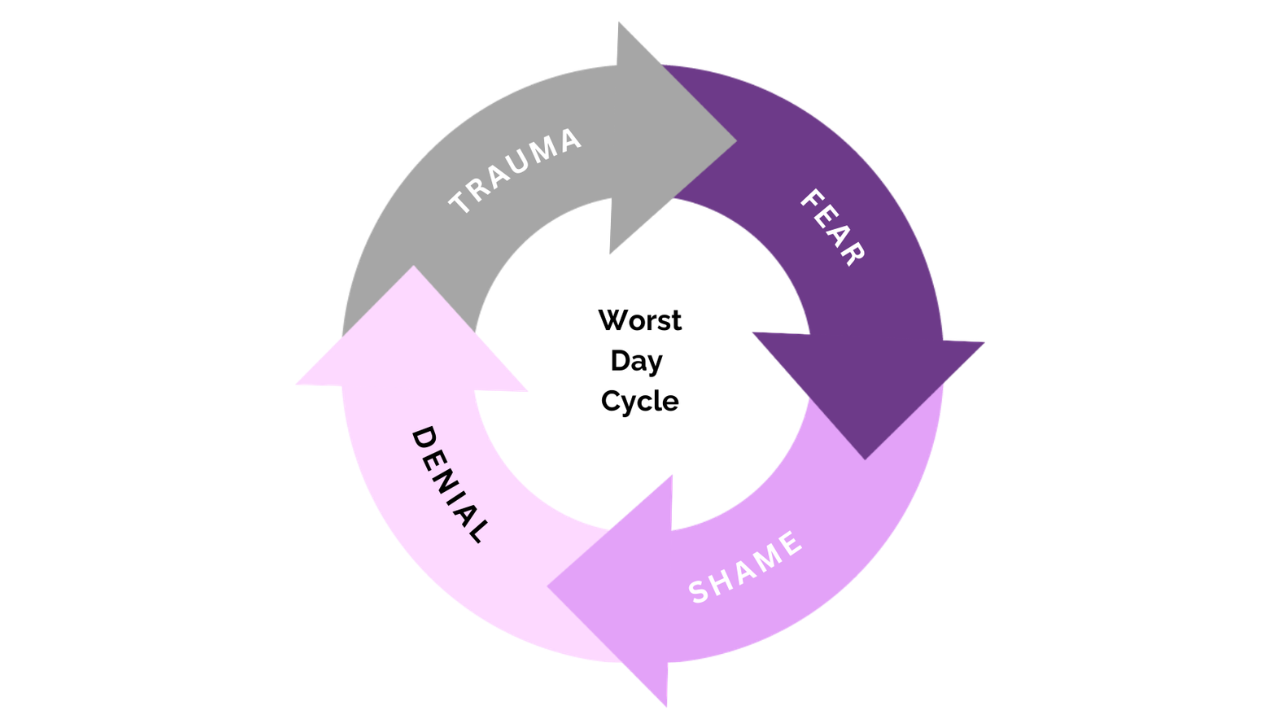
Trauma is any childhood experience that created the meaning “I am the problem.” Fear drives repetition — the brain thinks repetition equals safety. Shame is where you lost your inherent worth and started believing you had to earn it through performance. Denial is the survival persona you created to survive the pain — brilliant in childhood, sabotaging in adulthood.
That’s you if your drive to succeed feels less like passion and more like something you can’t turn off — even when you’re exhausted, sick, or burning out.
Achievement addiction is the Worst Day Cycle™ in action. You work harder not because you love the work, but because slowing down triggers the same shame you felt as a child. Your brain learned: “If I’m not producing, I’m worthless.” So you keep producing. And the void keeps growing.
That’s the cycle. And you can’t think your way out of it — because the cycle is biochemical, not intellectual.
The Three Survival Persona Types That Fuel Empty Success
The denial stage of the Worst Day Cycle™ creates a survival persona — a version of you that was designed to protect you from pain. There are three types, and understanding yours is the first step toward redefining success on your own terms.
The Falsely Empowered Survival Persona controls, dominates, and rages. This person redefines success as being untouchable — the one who never needs anyone, never shows weakness, and runs everything. Their success looks impressive but is built on walls, not foundations.
That’s you if people describe you as “intimidating” or “intense” and you secretly feel alone at the top.
The Disempowered Survival Persona collapses, people-pleases, and over-gives. This person redefines success as being needed — the one everyone relies on, the fixer, the caretaker. Their success is measured by how much they sacrifice for others while abandoning themselves.
That’s you if you feel resentful about how much you give but can’t stop giving.
The Adapted Wounded Child oscillates between both — controlling in some situations, collapsing in others. This person’s definition of success changes depending on who they’re with, creating an exhausting cycle of performance that never feels stable.
That’s you if you feel like a completely different person depending on whether you’re at work, with your partner, or alone.
Signs Your Success Is Actually Survival — By Life Area
Family: You’re the “strong one” everyone depends on. You manage everyone’s emotions. You dread holidays. You feel guilty when you set boundaries with parents or siblings. Your family role was assigned in childhood and you’ve never questioned it.
That’s you if family gatherings leave you drained for days.
Romantic Relationships: You attract partners who need fixing. You lose yourself in relationships. You confuse intensity with intimacy. When things get calm, you feel anxious — like something must be wrong. Your partner isn’t your parent, but your nervous system thinks they are.
That’s you if peaceful relationships feel boring and chaotic ones feel “real.”
Friendships: You’re the listener, never the one who shares. You keep people at arm’s length. You have many acquaintances but few people who actually know you. You cancel plans when you’re overwhelmed but never tell anyone why.
That’s you if you feel lonely in a room full of people who say they love you.
Work: You can’t stop. You tie your identity to your job title. Criticism feels like a personal attack. You overwork to avoid the quiet. Your inbox is your security blanket. Vacation feels more stressful than the office.
That’s you if your body only relaxes when you’re producing.
Body and Health: You ignore physical signals. You push through exhaustion. You use exercise as punishment, not care. You eat to numb or restrict to control. Your body is a machine, not a home.
That’s you if you treat your body like it owes you something instead of like it’s carrying you.
How the Emotional Authenticity Method™ Rewires Success
The Emotional Authenticity Method™ is the five-step process that moves you from survival-based success to authentic success. You cannot change emotional patterns through thoughts alone — emotions are biochemical events, and thoughts originate from feelings.
Step 1: Somatic Down-Regulation with optional Titration. Before you can think clearly, your nervous system needs to calm. This means pausing, breathing, and allowing your body to come out of fight-or-flight before making decisions about success, work, or relationships.
Step 2: What am I feeling? Use the Feelings Wheel to develop emotional granularity. Most high achievers can only identify “fine,” “stressed,” or “frustrated.” Real healing requires naming the actual emotion — abandoned, ashamed, terrified, invisible.
That’s you if someone asks how you feel and you answer with what you think.
Step 3: Where in my body do I feel it? All emotional trauma is stored physically. The tightness in your chest. The knot in your stomach. The tension in your jaw. Your body has been keeping score even when your mind checked out.
Step 4: What is my earliest memory of this feeling? This is the question that changes everything. Suddenly you realize you’re not just stressed about this moment — you’re reliving something older. Your nervous system is reacting to your past, not your present.
That’s you if your reactions feel bigger than the situation warrants — and you can’t figure out why.
Step 5: Who would I be if I never had this feeling again? This is the vision step that connects directly to the Authentic Self Cycle™. It moves you from pain to possibility, from survival to choice.
The Authentic Self Cycle™: Redefining Success From the Inside Out
The Authentic Self Cycle™ is the healing counterpart to the Worst Day Cycle™. Its four stages — Truth → Responsibility → Healing → Forgiveness — create an identity restoration system that replaces shame-driven success with authentic self-worth.
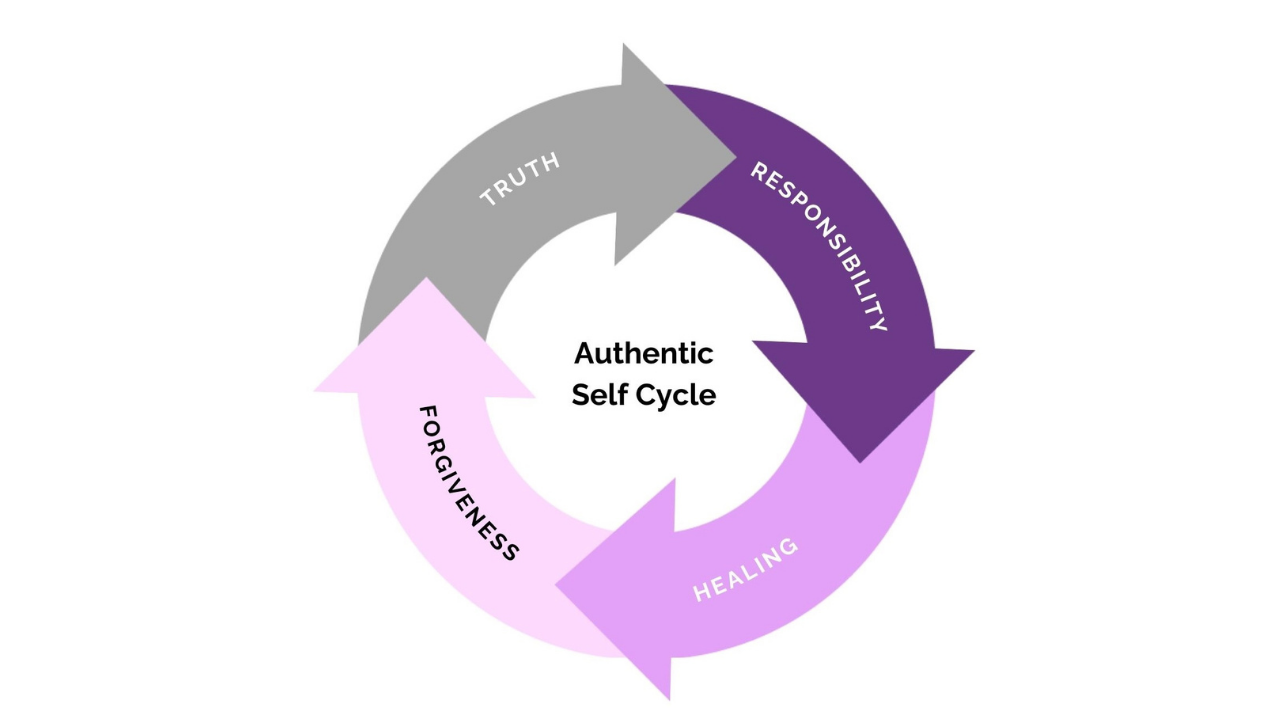
Truth: Name the blueprint. See “this isn’t about today.” Your drive to overwork isn’t ambition — it’s a childhood survival pattern running on autopilot.
Responsibility: Own your emotional reactions without blame. “My partner isn’t my parent. My nervous system just thinks they are.” “My boss isn’t my critical father. My body just responds that way.”
That’s you if you know your reactions don’t match the situation but you can’t stop them.
Healing: Rewire the emotional blueprint so conflict becomes uncomfortable but not dangerous, rest becomes possible without guilt, and success becomes something you enjoy rather than something you survive.
Forgiveness: Release the inherited emotional blueprint and reclaim your authentic self. This creates a NEW emotional chemical pattern that replaces fear, shame, and denial with truth, responsibility, and self-loyalty.
The old model says: “I’ll be lovable when I achieve enough.” The new model says: “I achieve because I’m already lovable.” That’s the shift that changes everything.
A Simple Exercise to Redefine Your Success
Take a few minutes and answer these three questions honestly:
1. According to your current unspoken rules, how do you know you’re successful? Be honest. Is it when nobody is mad at you? When you close the deal? When you don’t need help? When you outwork everyone? Write the real rules.
That’s you if you’ve never consciously chosen your definition of success — it was handed to you.
2. What has this definition cost you? Sleep? Joy? Health? Relationships? Presence with your kids? Peace in your body? Tell the truth.
3. If your authentic self defined success, what would it include? Maybe: “I can rest without guilt.” “I don’t have to sacrifice my body.” “I can be honest without shame.” “I have time for what matters.” “I can sit still for 60 seconds and not crawl out of my skin.”
That’s not weakness. That’s integration. That’s redefining success.
Frequently Asked Questions About Redefining Success
What does it mean to redefine success as a high achiever?
Redefining success means dismantling the shame-based, performance-driven definition of worth you learned in childhood and replacing it with internal metrics — emotional honesty, self-loyalty, the ability to rest without guilt, and knowing your worth isn’t tied to your output. It doesn’t mean lowering your standards. It means your standards finally include you.
Why do successful people still feel empty inside?
Because their success was built on self-abandonment. The Worst Day Cycle™ explains this: childhood trauma creates shame, shame drives fear, and fear drives relentless achievement as a way to outrun the pain. The void grows because no amount of external validation can replace the internal worth that was lost in childhood.
How is emotional authenticity different from emotional intelligence?
Emotional intelligence teaches you to manage emotions — regulate yourself so you can function. Emotional authenticity teaches you to tell the truth about them — trace your reactions to their childhood origin, feel them fully, and let them reshape your choices. One manages symptoms. The other heals roots.
What is the survival persona and how does it affect success?
The survival persona is the version of you created in childhood to protect you from pain. There are three types: the Falsely Empowered (controls and dominates), the Disempowered (collapses and people-pleases), and the Adapted Wounded Child (oscillates between both). Each type creates a different flavor of “success” that ultimately feels empty because it’s driven by shame rather than authentic choice.
Can you be ambitious and emotionally authentic at the same time?
Absolutely. Redefining success isn’t about giving up ambition — it’s about achieving from wholeness instead of woundedness. When you achieve from your authentic self rather than your survival persona, success actually feels fulfilling instead of like a hamster wheel you can’t escape.
What is the first step to redefining success?
The first step is truth — specifically, Step 1 of the Emotional Authenticity Method™: somatic down-regulation. Pause. Breathe. Let your nervous system calm. Then ask: “What am I actually feeling right now?” Most high achievers haven’t asked themselves that question in years. That one pause is the beginning of a completely different relationship with success.
The Bottom Line
The void isn’t proof that you’re broken. It’s proof that you’ve been strong for too long — and strength without authenticity eventually collapses into emptiness.
You built the mansion — the career, the reputation, the life. But you’ve been living outside of it. Like a Labrador puppy chained outside a $10 million house. You are lovable. Worthy. Valuable. But you haven’t let yourself inside.
That’s you if you’re reading this and your chest just got tight. That tightness is the truth your body has been holding.
Redefining success doesn’t mean burning your life down. It means you stop burning yourself down. You let yourself inside. You stop measuring your worth by your output and start measuring it by your honesty, your boundaries, and your willingness to stay connected to yourself while you achieve.
You’ve spent long enough building a life that doesn’t feel like yours. Maybe it’s time to build one that does.
That’s not weakness. That’s the bravest thing you’ll ever do.
Recommended Reading
For deeper exploration of the patterns behind empty success and the path to authentic self-worth, these books complement the work of redefining success through emotional authenticity:
Facing Codependence by Pia Mellody — The foundational work on how childhood trauma creates the survival patterns that drive self-abandonment in adulthood.
The Myth of Normal by Gabor Maté — A groundbreaking look at how trauma shapes our biology, our relationships, and our definitions of “normal” success.
Codependent No More by Melody Beattie — The classic guide to recognizing and releasing the people-pleasing patterns that masquerade as strength.
The Gifts of Imperfection by Brené Brown — Essential reading on letting go of who you think you’re supposed to be and embracing who you actually are.
Your Surviving Self by Kenny Weiss — The complete guide to the Worst Day Cycle™, the Authentic Self Cycle™, and reclaiming your authentic identity.
Ready to Redefine Your Success?
If this post described your life, you don’t need another achievement. You need a new relationship with yourself. Kenny Weiss offers courses designed specifically for high achievers who are ready to stop surviving and start living:
Download the Free Feelings Wheel — The first tool in the Emotional Authenticity Method™.
Emotional Blueprint Starter Course — Individual ($79) — Your personal roadmap to understanding your Worst Day Cycle™ and starting the Authentic Self Cycle™.
Relationship Starter Course — Couples ($79) — See how both partners’ survival personas create conflict and learn to build authentic connection.
Why High Achievers Fail at Love ($479) — The deep-dive course for driven people whose success hasn’t translated to fulfilling relationships.
The Shutdown Avoidant Partner ($479) — Understand why you or your partner shuts down emotionally and how to rebuild trust.
Tier 1: Mapping the Blueprint ($1,379) — Kenny’s most comprehensive program for rewiring your emotional blueprint and reclaiming your authentic self.
Related: The Signs of Enmeshment | 7 Signs of Relationship Insecurity | 7 Signs of High Self-Esteem | How to Determine Your Negotiables and Non-Negotiables | 10 Do’s and Don’ts For a Great Relationship