Category: Mindset

  • How To Stop Feeling Powerless

    How To Stop Feeling Powerless

    Hello and welcome back! Today we’re talking about how to conquer powerlessness.

    I’ll be talking about what creates the feeling of powerlessness, the two forms of powerless, and the solution, so you have the knowledge, skills, and tools to conquer powerlessness and have the safety in your life we all deserve. This topic comes from a loyal follower, Kim. If you’re a faithful watcher and reader, please get in touch with me about ideas – all of this is meant to help you.

    Let’s get started with where powerlessness originates? Life. Let’s face it. The process of life is overwhelming. There is so much to learn and navigate, from figuring out how to be a parent to relationships to careers. We all go to school for decades to gain knowledge and skills, yet at the heart of powerlessness is a lack of knowledge. If we don’t have that knowledge, we don’t know what to do. That’s an overwhelming powerless position we are all in. That’s why I’m always saying there is one solution to these problems: become an expert. Gain the knowledge to develop a skill that evolves into a tool that operates in your life to conquer the problem.

    Powerlessness is just a fact of life, but where do we learn the deeper essences of it? Childhood. Parenting. Let’s face it: everyone’s human and perfectly imperfect. We have all experienced less-than-loving moments in our childhood.

    Client Childhood

    A client was once telling me her childhood was great. She got in touch with me because she’s dating men that abandon her. One man forced her out of the car in a snowstorm – she had to walk home. I dug into her childhood: she was raised by a single mother. She said she was abandoned by her mother and raised by her loving aunts. I was struck. Do you see what she said? “I was abandoned by my mother BUT…” There’s the minimization. We justify and condone it. We suppress and repress. She is picking men that let her relive the dynamic of her childhood. Did her mother consciously choose to abandon her?

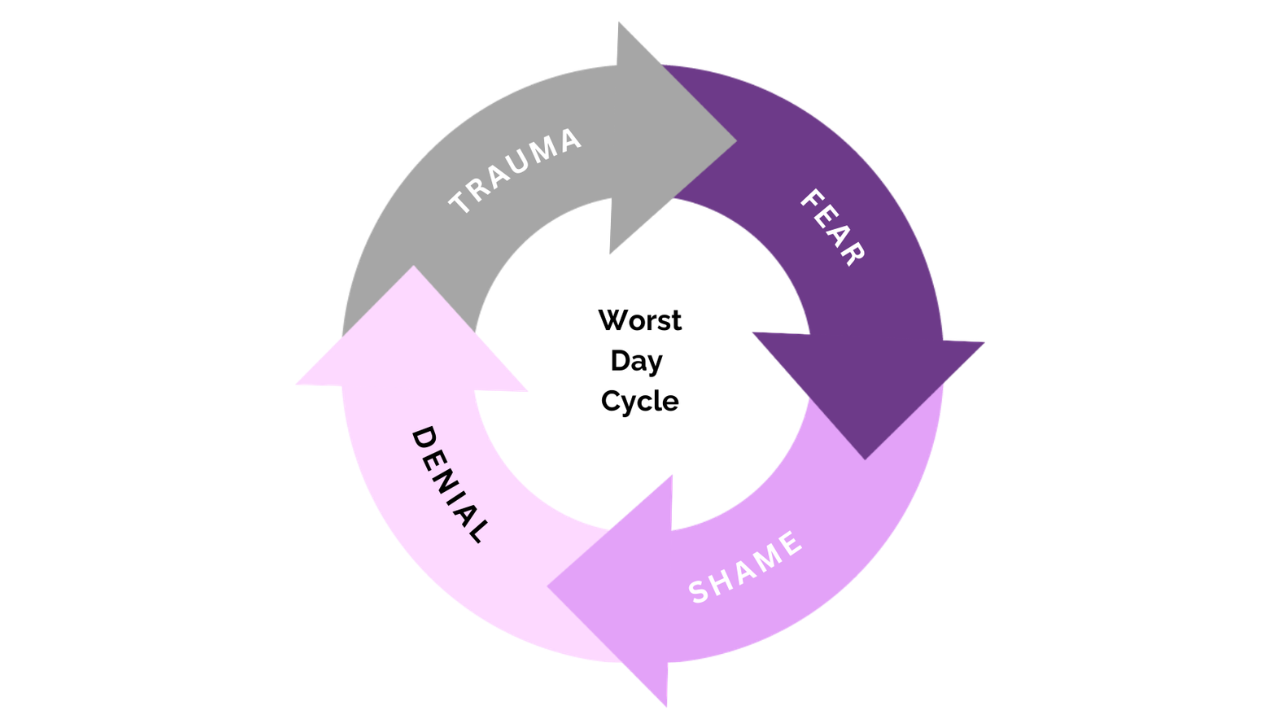
    Of course not; she had no choice but to go to work. This is what I mean – we are all perfectly imperfect. Her mother had to put food on the table, but her absence left her child feeling abandoned. While my client was telling me of her relationships, she was actually describing her childhood. She just didn’t know it. That’s why she keeps picking those men. This happens to all of us – it’s called The Worst Day Cycle. We all must get over denial and into the truth that we all experienced less-than-nurturing moments in childhood, and they are all replaying in our lives until we heal them.

    My Experience

    I experienced this myself. When I was 10, I woke up in the middle of the night to use the bathroom. I found my mom passed out naked on the toilet. It’s the day I discovered she was an alcoholic. I was horrifically powerless. I spent my teenage years throwing out alcohol, trying to control her drinking. If you’ve lived with an addict, you know this doesn’t work. On the other side, my father always had to be right. He would argue and gaslight me. It was his defense mechanism from his less than loving childhood. It made me totally powerless when I had no way to challenge him. He would make rules and then change them so he could never be wrong – I was utterly powerless. Childhood is the ultimate birthplace of powerlessness – if you look, you will see your current powerlessness is precisely like your childhood.

    There’s another aspect of parenting most people don’t consider. Throughout childhood, all we are told is “no.” What do we have to do in those moments? We have to agree. Almost all the time, they’re telling us good things! Wishing to protect us, but they’re like my father many times – they don’t want to be wrong. We learn that if we ever say “no,” we’re bad. This has devastating consequences.

    If you want to dig deeper, check out my book Your Journey To Success, where I go into the power of saying no more deeply.

    We have two forms of powerlessness: The first happens when we focus on what we can’t control rather than what we can. The second form of powerlessness is the inability to say “no.”

    To solve the first example, the first thing to do is:

    1. Get a piece of paper.
    2. On one side, put what you can control.
    3. On the other, put what you can’t control. You may want to have separate papers for each topic.
    4. List out everything.

    There are millions of things we have no control over. Yet, we keep trying to control them, which is our problem. Do you see what you can control? Ourselves. Our thoughts, feelings, and actions. That’s it. So we create a list to see what sort of things we can see, think, and feel to regain power. There are a million things. Meditate, go on a walk, participate in hobbies that bring joy, work on something that fills your soul. Here’s why: when we get in the powerlessness of what we can’t control, we go look at the list of what we can control. We should constantly be reminding ourselves what we do have control over and take action. To stop replaying what we can’t do, focus on what we can control at that exact moment.

    Learning Process

    When I was learning about this process, I was going through a divorce. My ex was a narcissist and stealing all the money, so naturally, I was worried. My counselor said one phrase: what can you control? I replied, “the credit cards and the business.” I made a plan with what I could control. I opened up new accounts and moved everything over. I took control of anything that was mine. I focused on what I can control. I stopped playing the victim and saying there’s nothing I can do. That’s just not true! It’s all a choice. The second I shifted, my feeling changed, and I became empowered. I saw ideas and solutions and executed them with my behaviors. Powerlessness is gone. Everything turned around. My business was saved.

    There’s one aspect to the “what I can and can’t control” that takes a tremendous amount of patience. Sometimes when we’re doing everything right and the problem isn’t going away – that means there’s a life experience waiting for us, and there’s nothing we can do until that happens.

    30 Years Spent of Powerless

    I’ll give you an example: I have spent 30 years working on myself. The majority started 17 years ago when I met my mentor. Over ten years, I saw him probably seven years straight. I was working my tail off, but I couldn’t get out of all the pain. My life was better, but there was some pain I hadn’t healed. During this time, my second wife and I got engaged – my counselor was also a pastor. I asked him if he’d marry us. He said he’d think about it and get back to me. My fiancé at the time was seeing his wife, who was also an expert in this – we were learning the same tools and language, helping our relationship. The following week he says he thought about it and thinks my fiancé and I have a lot of pain to work through, but he’d do it.

    Initial Thoughts

    My initial thought was that he’s exercising boundaries and letting us fix it ourselves. Instead, he’s appropriately codependent-guarded. What I didn’t realize (and I don’t think he did either) as if it hadn’t been for my second marriage and nearly killing myself, I would have never figured all this out and found peace and freedom. I needed to break myself so severely for me to get peace finally. The divorce was so desperately nasty it made me stop controlling things. I was hyper-vigilant as a kid, trying to figure everything out before it happened. That level of control was killing me.

    I had done all the recovery work but never given that piece up. Being suicidal made me realize I would die if I didn’t give it up. The following two years were spiritual unloading. I saw all the answers. If you’re doing all this and it’s not working out, you may have a life experience waiting for you. Sit back in your chair and let it come. Focus on what you can control, then let it come.

    Solution two is: saying “no.” I’m going to give you a couple of magic phrases, and by the end, while, you’ll see they work every time and put an end to people-pleasing.

    The first thing to do when a request comes in for anything is say,

    “Let me think about it, and I’ll get back to you.”

    You don’t have to say yes right away – you owe them nothing. It’s your life and decision, so buy yourself some time. Then you have time to work through the process. Now you ask yourself three critical questions:

    1- Will I ever keep score that I did this for them?

    2- Will I ever throw it in their face that I did this for them?

    3- Will I ever have any resentment that I did this for them?

    They all mean the same thing, but each person has their way of expressing it – so one of these will work for you. These feelings of resentment are from childhood. We are stuffed with resentment, keeping score and throwing it in their face from childhood. If we ask ourselves these questions and decide we would never do these things – we can say yes. And do it freely – we won’t feel powerless.

    If you’ve gone through the process and recognize you may hold whatever it is against them, you use magic phrase number two,

    “I’ve thought about it, and it just doesn’t work for me.”

    Isn’t that beautiful? How do you feel when someone says no to you? You feel attacked because of childhood – you felt attacked back then, and it’s the same thing now. If you use this phrase, the other person isn’t attacked because you make it about yourself. No matter what they say, they can’t talk you out of it – which is a prevalent defense when someone says “no.” If someone asks you, “why not?” or “what does that mean?” you can simply keep repeating the phrase. While, It’s magic! I don’t care what they throw at you – keep repeating it. They’re not your mother or father. Even if they are, you’re an adult now. You get to make your own decisions and simply say, “it just doesn’t work for me.” You don’t owe them an explanation unless you want to give it.

    Can you feel how powerful that is? It’s not condescending or rude, and it has nothing to do with the person making the request. For instance, If you say yes, you will resent them, which will create a block to intimacy, and you will be the only one to blame. Realizing that is power, love, and kindness. That is why I always say, “No” is the most loving thing you can speak to someone.

    Your solutions to feeling powerless are ways to help you overcome it and live in the empowered state we all deserve. Kim, thank you for a beautiful question. If you want to learn about something, send it to me.

    As I always say:

    Enjoy The Journey! ??

    CLICK THE IMAGE TO LEARN MORE

    Are You Ready to Break The Chains of Fear and Achieve Your Dreams?


    Fear is a natural human emotion. But it doesn’t have to hold you back from achieving what you want in life. You can learn how to use it as fuel for success, rather than letting it keep you stuck in place.

    This class will teach you everything about fear that no one else will tell you – including how to conquer any type of anxiety or fear quickly and easily with the right tools.

    It also includes new perspectives on anger, rejection, and self-sabotage that will transform your life forever!

    You deserve the best possible version of yourself – one who lives without fear or self-sabotage holding them back from their potential!

    Let me show you how to take control of your emotions and start living an empowered life today! I’m here for you every step of the way


    Sign up now for this empowering master class so we can help make your dreams come true!

    The sooner we start the journey together, the sooner your dreams will become reality!

    How To Break The Chains Of Fear And Achieve Your Dreams


  • 7 Steps For Balance And Stability In Your Life

    7 Steps For Balance And Stability In Your Life

    We all have moments in our lives where we feel unbalanced – so today, I’m sharing the seven steps to get the balance back in your life. I’m also going to discuss the science behind why I’ve chosen these steps, so make sure to read to the end.

    The first question to ask is: what is a lack of balance? This awareness leads right into step 1.

    Steps

    1. Go to my website and get the Feelings Wheel – I provide a free download. Over the next several days, use it to keep track of your feelings. I suggest stopping five times a day and asking yourself what you are feeling. Sensitive, trusting, indignant, etc. Whatever it is, you may be feeling? The first step in this process is to become aware and to do that. We must track what we feel.
    2. Ask yourself where in your body you feel this feeling? Is it your neck, shoulders, chest, or stomach? Make a note of that.
    3. Ask yourself what happened just before you felt unbalanced. If you’ve felt it for a while, what happened a day or two before that? If it’s just this moment, what triggered it? Make a note of that.
    4. Ask yourself how do you respond once you start feeling unbalanced. Ask yourself five questions: Did I sabotage myself? Did I get needy or manipulative? Did I do the opposite, shut down and run away? What coping skill did I use to help medicate this unbalance away (work, relationships, etc.)? Make a note of what’s positive and negative.

    Steps

    1. Ask yourself when your earliest recollection was of having this feeling of unbalance? You’ll draw not only on the feelings you categorized but also where you feel it in your body. Once you see the earliest instance, you will see the repetition, triggers, and common responses.
    2. Ask yourself how you are repeating this thought and feeling? Now you can see how the imbalance has shown up repeatedly in your life. More importantly, you have just discovered something I call The Worst Day Cycle. We all repeat the pain from the past until we heal it.
    3. Now that you’ve gained awareness become an expert in healing the feelings of imbalance that have plagued us all for days, years, and decades.

    Now I’m going to dive into the science of why learning this process is so important.

    Our subconscious is formed in childhood, and it is made up of the most intensely emotional experiences we have. Modern science shows that 70% of all messages we received in childhood (whether from family, friends, teachers, coaches, etc.) are negative, disempowering, and self-sabotaging. These experiences create an emotional chemical addiction in our brain and body. Add in what we have all been taught about emotions? Don’t have them, don’t talk about them, don’t deal with them. Now you can begin to see why you repeatedly feel unbalanced emotionally.

    It becomes even more evident when we acknowledge how the brain works.

    Because it takes tremendous energy for our brain to do anything, it is constantly seeking to conserve energy. Its solution is to repeat what it already “knows” by reliving what has been placed in the subconscious. Our brain repeating what it knows is a problem because remember what has been placed in the subconscious? The most emotional experiences we have from childhood– 70% of which were negative, disempowering, and self-sabotaging. If you have pursued CBT, thinking positive, or any thought-based solution and haven’t achieved much success, now you know why. To bring balance into our lives, trying to change our thoughts won’t help. Modern science shows almost every thought we have starts with a feeling. We need Emotional Authenticity.

    Negative Childhood Experiences

    Finally, because of our negative childhood experiences and the brain’s design, studies show that we are not present in 95% of our daily lives as an adult. Daily our thoughts, feelings, and behaviors are just the subconscious patterns our brain learned in childhood. We think we are in the moment and making decisions, but we’re not. Our brain is inherently biased to repeat the same negative, disempowering, and self-sabotaging messages we received as a child. We all are completely unaware that our pain from our childhood is still running our adult lives.

    Now you can see the value of the seven questions I gave you. They bring science to life and prove to ourselves why we have repeated the same negative, thoughts feelings, and behaviors our whole life. As adults, all of us are reliving and replaying the painful moments from our childhood. We are all stuck in The Worst Day Cycle.

    Emotions

    Sadly, because we have consistently downplayed emotions and the impact of our childhood, most are completely unaware that they are stuck in pain from the past. This lack of teaching and awareness has us all living a life out of balance.

    The solution is to become an expert in healing the pain from the past. The first step is to create a new emotional and chemical addiction in our brain and body to replace what was implanted in our subconscious. Our brains need a new “known.”

    If you want the entire process, I lay out how to achieve this awareness, shift and heal those feelings and create a new “known” in the subconscious brain in my book, Your Journey To Success, and my online courses.

    Enjoy The Journey� ?

    Are you feeling stuck?

    Is your life just not working out the way you hoped?


    You’ve come to the right place.

    The Greatness University is a safe space for you to get back on track and achieve your dreams by offering online masterclasses that provide you with the knowledge, skills, and tools to become the greatest version of yourself!

    Through developing Emotional Authenticity, you will accept your perfect imperfections and attain self-love! Break the chains of fear, put an end to people-pleasing, and say no with ease! Break free from toxic relationships by learning to set and negotiate healthy boundaries and create the lasting love and connection you deserve.

    You deserve to be happy and have a life where you feel safe enough to show up as your authentic self.

    And we know that it takes courage – but we also know that it’s worth every single step on this journey.

    You deserve a life free from toxic people, pain, and frustration. It doesn’t matter if you’re just starting out or have already walked a long way down this path – our courses will help you take the next step in your journey to the greatest version of yourself. Join us today!


    It’s YOUR turn to be Great!

    Enjoy The Journey!

    Greatness U
    Guiding You To Be The Greatest Version of Yourself!


  • How To Stop Holding Yourself Back

    How To Stop Holding Yourself Back

    Hello and welcome back to the journey! Today I’m sharing with you how to stop holding yourself back. To do this, I’m going to explain the three main ways we hold ourselves back, then give you five solutions to turn that around and allow yourself to reach your full potential.

    How we hold ourselves back:

    1. Fear of success. I know that sounds crazy! We think it’s because we’re scared to fail. I write about this in my book: no one on this planet has ever been afraid to fail. It’s not humanly possible. Think about it – in every area of your life, you know exactly what to do for your relationships, career, etc. You lay in bed and think about these things, knowing your life will get better if you do them. But what happens? A feeling comes up, and you say you don’t feel like doing it. Right there, we’ve all chosen failure. We are scared to death of confronting that feeling because we’d succeed. I wrote about the whole process in my book, the science behind it, and the cycle that creates it. If you want to get deeper, I encourage you to pick that up.
    2. We get too much benefit from holding ourselves back. When our relationship breaks, when we lose a career, or when we are struggling financially: all we have to do is post on social media, and 300 people say, “You poor thing! I can’t believe this is happening to you.” All those people are offering solutions. I get attention and power by holding myself back, which gives me freedom because they want to fix the problem more than I do. We don’t have to be responsible for our life. Others become more invested in fixing the problem than we are! Attention, power, freedom, no responsibility. I go into much more detail in my video, The Ten Surprising Benefits of a Broken Heart. I encourage you to check that out.

    How we hold ourselves back:

    1. Learned helplessness. This trait was discovered by accident in a laboratory doing experiments on dogs. There was a flood, and the dogs got trapped in their kennels. When the water rose, it got up to their chin. If you or I were in a situation like that, we’d try to escape. The dogs couldn’t. So when the water went back down, and people went in to open the kennel doors, the dogs wouldn’t leave. They had collapsed and given in to the futility of not being able to do anything. That’s what most people who are holding themselves back do: they don’t see the point. They think they’ll never be successful, make money, have someone love them, whatever it may be. They have collapsed and are stuck in learned helplessness like those poor dogs. That’s the essence of the worst day cycle. If this is you, you are stuck from trauma that’s never been healed. If you want to know more about recovering from the worst day cycle, watch my video How to Stop Self Sabotage: Conquer the Worst Day Cycle.

    Now let’s get on with the solutions:

    1. Make a choice (I’M DONE!). We have to make the choice that we are done holding ourselves back. While it sounds simple, we don’t act on it because choices are motivated by feelings, not thoughts. We can tell ourselves all day, but we have to feel it. Remember what stopped us from having success? A feeling. It’s the same thing here: learned helplessness. We have a patterned feeling that’s draining us. We have to…
    2. Create a substantial emotional shift. Depending on your personality type, I will give you several possibilities of what might motivate you and create that dynamic shift for you to change.
    3. Ask yourself, “How much has it cost me?” Make a list with categories: financially, relationally, emotionally, spiritually, professionally, intellectually—every area of your life. You could start with monetary amounts but work up to other emotional aspects like a broken heart or lost relationships. When I did it, I discovered millions of lost dollars, low productivity, careers taken beneath my skill level, divorces, emotional consequences, the list goes on. The costs were astronomical. We have to have an emotional shift that recognizes the cost of staying stuck is more significant than the payoff we are currently getting. Totaling it up will bring us into reality and see that the benefits don’t outweigh the costs.

    Solutions

    1. Future cast the cost. Ask yourself: one month, six months, 12 months, and five years from now. How high will the cost be then? How much will the cost be years from now? And even worse: now that you know the solution, could you live with the burden of knowing you could’ve ended it and chose not to? Feel that cost. That’s huge and overwhelming. Maybe you aren’t motivated that way, so flip it to the opposite. Ask yourself, what if you could never feel all the painful feeling of being stuck again. If the feeling wasn’t even possible: what thoughts and feelings are left over? Can you feel that? You feel lighter. You’re no longer carrying the weight of those costs. You’re free of it. You feel strong, sexy, safe. Can you feel that emotional shift if you choose to do the work?
    2. Ask yourself what the smallest thing you can do to move you towards the solution. Some days for me, it was literally just getting out of bed. Some days it was taking a shower. I knew it was the best I could do that day, and it gave me a sense of moving forward. Change isn’t this big thing. It happens in little moments.

    One of the little ways we can motivate ourselves to change and get out of that learned helplessness is titration.

    Here’s my suggestion:

    1. As you’re sitting in the pain of holding yourself back, flip to that feeling of wondering who you would be without it. You’ll feel a sense of relief.
    2. Spend 30 seconds in the pain, then 30 seconds in the freedom of no longer holding yourself back. You can do that by taking action or by dropping those thoughts and feelings.
    3. Keep bouncing between the two, pulling yourself in and out of the cage.

    You’re slowly titrating yourself. Finally, you’re getting a taste of it. The pain will start to feel lighter and smaller. The good will feel stronger and more prominent. This taps into James Clear’s Atomic Habits. He talks about the way change happens is through small, 1% changes. The cumulative effect of that makes us become something new and allows us to achieve what we want.

    There are your solutions – I hope this helped you. And as always:

    Enjoy The Journey! ??

    Are You Ready to Break The Chains of Fear and Achieve Your Dreams?


    Fear is a natural human emotion. But it doesn’t have to hold you back from achieving what you want in life. Instead, you can learn how to use it as fuel for success rather than letting it keep you stuck in place.

    This class will teach you everything about fear that no one else will tell you – including how to conquer any anxiety or fear quickly and easily with the right tools.

    It also includes new perspectives on anger, rejection, and self-sabotage that will transform your life forever!

    You deserve the best possible version of yourself – one who lives without fear or self-sabotage holding them back from their potential!

    Let me show you how to take control of your emotions and start living an empowered life today! I’m here for you every step of the way.


    Sign up now for this empowering master class so we can help make your dreams come true!

    The sooner we start the journey together, the sooner your dreams will become a reality!

  • What To Do if You Feel Like You Are Not Enough

    What To Do if You Feel Like You Are Not Enough

    We all have those moments where we just don’t feel like we are enough. Today I want to share a three-step process I’ve found to help many people, including myself, overcome that feeling.

    The first step is straightforward:

    just give yourself some grace! Life is tough. We are all perfectly imperfect – we can only do what we know. When we know better, we can do better. Let’s be honest:

    None of us take a class on being in a relationship, being a parent, or loving ourselves. We may get a lesson here or there from a friend or family member, but we need true focus.

    You can’t be blamed for doing something you weren’t even aware of.

    Example

    A perfect example of this is a story I wrote about in my book, Your Journey to Success. A girl who cut my hair for a long time knew what I did for work.

    Sometimes she’d tell me about her latest situation with the man she was seeing, going on about how awful it was or how it wasn’t working out. At one point, she asked what I thought – the first time she opened the door to some feedback. I told her I found it fascinating that none of us learn about codependence, love addiction, love avoidance, etc.

    Yet, we all go into a relationship with the expectation that everyone knows about these things and knows what we want! I said I found it fascinating that our hair, no matter how bad it gets butchered, always grows back on its own.

    But the government won’t allow anyone near it unless they have a license. Yet, we don’t learn a single thing about relationship dynamics or how to be a parent and expect everyone will do it right.

    I’m not advocating the government demand we take classes on these topics:

    it’s just a reality check. We demand a license for hair but not parenting, something that fundamentally shapes our lives.

    When I tell this story, many people get defensive, claiming they know what they’re doing. That’s shocking to me: that there’s so much unwillingness to accept this fact! It doesn’t make us bad that we don’t know these things.

    But it shows the level of shame, fear, and denial we have about learning to navigate them. So that’s the first step: give yourself grace.

    Then, if you want to, you can learn more about these dynamics to help your relationships. It’s up to you – it’s your choice if you want to keep repeating the same pain.

    Step two deals with affirmations and accomplishments. One thing I don’t hear people talk about, which is key to making these work, is we have to feel affirmations.

    Thoughts don’t change us – feelings do. Belief is when your feelings and thoughts line up. This is how you truly believe in yourself.

    We’ve all experienced when we’re going into a big event (whether that be a job, a test, a presentation) and you just feel that it’s going to go well.

    Thoughts and feelings

    Our thoughts and feelings line up, and it goes great! We’ve also all had the converse experience: where we feel dread and sickness before something big.

    No matter how hard we try, it doesn’t seem to make a difference. We arrive in a bad mood and leave with a worse one.. We need to shift how we feel and accomplish Emotional Authenticity to achieve the success we all want.

    Thoughts don’t change us. Emotions do.

    Here’s the way to do affirmations and accomplishments:

    every day, wake up first thing in the morning and write down three things you love about yourself. The key is you have to feel them.

    This may be embarrassing, but I wake up every morning, look down, and say I love my feet!My feet are stunning. Yes, I do! I appreciate that about myself and enjoy expressing it.

    What do you love about yourself?

    Create that feeling and sit in that feeling. That’s the most powerful step: not thinking, not writing, but feeling. Now, there will be many aspects about yourself where you’re just not quite there.

    Me, I played pro sports and always had a great body. I remember what my body used to look like.

    so I can’t look in front of a mirror now and say I love my body.

    With the things you don’t quite feel perfectly confident in, switch to “I’m willing.” I say I’m willing to like my body. This will get us out of shame and the sense of holding ourselves back.

    It will move us in the direction of self-love and acceptance.

    Make sure all the topics you’re using for affirmations center on every aspect of yourself, the way you look, your personality, the type of parent or friend you are, the type of person you are in your career, etc.

    Accomplishments are a little different.

    At the end of each day, just write down three things you accomplished. Most of us spend the night lying in bed, lamenting about how we got nothing done.

    The truth is we’ve accomplished so much more than we give ourselves credit for. A student in my Greatness University keeps a sheet of paper with her all day and writes everything down:

    things as “small” as going to the bathroom or drinking a glass of water. She acknowledges every single little thing she does.

    If you feel like you’re not enough, I encourage you to do what this student does.

    Start noticing and giving yourself approval and affirmation for all you accomplish.

    The final step is called titration.

    If we don’t feel like we’re enough, we are really stuck in complex PTSD, meaning old trauma feelings get in the way. We need to learn to vacillate in and out of that.

    My suggestion is you sit in that feeling of “I’m not enough” for 30 seconds and focus on where you feel it in your body. Then, for 30 seconds, ask yourself.

    “What if I switched out of this? Just a little bit in the other direction. What does that feel like?”.

    Notice that in your body. Keep alternating between the two, and you’ll notice that the feeling of “I’m not enough” will lighten, and the feeling that you are enough will grow.

    This will help you learn to get out of the PTSD state of feeling that you’re not enough.

    I hope these three tips help you. If you think it could help you or others, please share or leave a comment to let me know your feelings.

    I also suggest you pick up You Can Heal Your Life by Louise L. Hay. To me, it’s the single best book that’s been written on how to love yourself. You’ll feel how much she cares.

    If you pick up this book, I suggest switching out her use of the word “think” for “feel,” as I believe this process to be a feeling process.

    As always, keep Enjoying The Journey!??

    If you are looking for the knowledge, skills, and tools to achieve Emotional Authenticity and the ability to love your perfect imperfections, I have developed these two masterclasses for you!

    CLICK THE IMAGE TO LEARN MORE
    CLICK THE IMAGE TO LEARN MORE
  • How To Turn Any Insult Into a Blessing

    How To Turn Any Insult Into a Blessing

    In this day and age, it seems like there are more insults than ever flying around. But what if I told you there is a way to turn them into blessings? What if instead of getting angry at the person who insulted you or feeling bad about yourself for being so sensitive, you could turn their words into deeper self-love? Even better, the solution will end the strife and create deeper empathy and connection for you both!

    I know that sounds impossible, but I will show you a foolproof way that works every time.

    The first thing to recognize: whenever we’re insulting somebody, there’s always denial and projection at the core of our insult. Let me explain how denial and projection work: whenever we judge, blame, criticize, or hate anyone and anything, all we are ever doing is talking about ourselves. A piece of ourselves we are not aware of, and ultimately we haven’t forgiven.

    It may be true that this other person is doing something we disapprove of, but the only reason we can see it in them is that same perfect imperfection is operating in us as well.

    It happens in one of two ways: directly or indirectly.

    Discovering how we are directly caught in our denial and projecting that onto others is very simple to uncover. What if I said to you, “I can’t stand men who wear bright-colored suits and decorate their house in all these bright colors”? Who am I describing? Myself! Look at my videos, see how I dress and decorate. Sometimes when we criticize others, we’re directly doing it to ourselves. Unless our denial is severe, that’s easy for us to see.

    Discovering how we are indirectly caught in denial and projection is more challenging to see and requires a bit of self-discovery and practice.

    I’m going to give you the secret and tell you about the day I discovered the indirect. I’ve always had this frustration with the way people drive: merging on the highway to slow, people in the left lane going too slow, and various other ways people don’t abide by the rules of the road. I would scream, exclaiming others’ stupidity. One day I was at a light and found myself yelling at this truck in front of me,

    “Why won’t you go? I hate stupid drivers!”

    I paused to remind myself that the screaming, judging, criticizing, and blaming I was doing were really about me. But I was confused and thought out loud,

    “This can’t be about me. I would never do what he is doing?”

    That is when the secret finally came to me. I reminded myself that modern neuroscience now shows that the old paradigm is wrong. We don’t actually become what we think. Instead, we feel before we think in almost every instance, and therefore, we all become our emotions.

    I then pondered

    “What am I feeling, and what emotional words am I using to communicate what is inside me?”

    Specifically, I asked myself,

    “What is the emotional content of the words I am using to judge, blame and criticize him?”

    It was “I hate stupid drivers.” Do you see it? “Stupid.”

    Maybe you don’t know my life story, so here is some insight into how I discovered my indirect denial and projection. I have struggled with multiple addictions, married two narcissistic women, one of which was physically and verbally abusive, played two professional sports I never wanted to play, filed bankruptcy, and at one point nearly took my life.

    As the awareness hit, I felt this blow deep in my stomach when I recognized,

    I’m literally the dumbest person I’ve ever met. Look at all of those stupid decisions. No wonder I can’t stand the way people drive. I have no clue how to drive my own life!”

    I was never aware that I was using the way other people drive to scream back at me until that moment. Nor was I aware that I was begging myself to do even deeper work to heal my pain. But, most importantly, I was desperate to send myself the message that I am not stupid, just perfectly imperfect, and I must learn to forgive myself.

    I am happy to share that now, I rarely notice if a person doesn’t follow the rules of the road. By healing the pain from the past and forgiving myself, I’m done with shaming and inflicting pain upon myself.

    I want you to have this same freedom, so now I want to show you:

    The 5 Steps To Turn An Insult Into a Blessing.

    1- Everything we judge, blame, hate, or criticize is an attempt to help ourselves, see, admit, and heal the pain from our past and forgive our perfect imperfections.

    2-Look for the emotional content. Focus on the emotional words you are using to criticize the person, place, or thing? You may not be doing the exact thing, but the emotional words allow you to see what you are doing.

    3- Look for the metaphor. In my case the way others drove was a metaphor for my life decisions. I couldn’t “drive” my own life.

    4- Once the awareness arrives, recognize you are trying to communicate to yourself how passionate you are about healing the pain from your past and you are imploring yourself to put a plan in place to achieve that recovery.

    5- Give yourself grace and forgiveness. We are all perfectly imperfect, and as a society, we have never been taught how to be a parent, have a relationship, or been given these essential life skills. Our parents were not taught either. Life and relationship skills are the least taught and, therefore, most deficient in us all. None of us can be blamed for doing the best we could with the information we have been given. If we do step four, we can change that because as we know more, we can do more.

    But, that is only half of the process. What about when someone insults us? How Kenny, do we turn that into a blessing? I am so happy you asked. To show you that, I’m going to share a comment I received on Facebook on one of my videos about a year ago. The watcher said the following:

    “You are an esoteric, egocentric con man trying to convince yourself that you are something other than a garden variety personality, coupled with an average wit. Unfortunately, those you would most like to convince of your worth are the ones that most easily recognize how basic you are.”

    And here was my reply:

    “I would agree that yes, I can be egocentric. It’s something I’m always working on. You’re also correct that, unfortunately, I do have an average wit. My older brother is much funnier than I am, and I’ve always been jealous of that. I also think it’s true that I was quite the con man, especially when I was younger. It was just the best I could do. I didn’t have any self-esteem, so everything had to be a con. I know that I’m very thankful that you see so much of me. It’s always a tremendous gift when somebody invests their valuable time in seeing all of me.”

    Why did I choose to respond this way? For one, I felt defensive which let’s me know the commenter is correct. I do struggle with my ego, and I do wish I had a better wit. So I owned my perfect imperfections! It is no different than saying I have blue eyes and the sun rises in the east. Healing the pain from the past and forgiving ourselves allows us to hear the truth from others. As I always say,

    “When we learn to forgive our perfect imperfections, they can’t hurt us with them anymore.”

    I chose not to respond to this portion of his comment, “those you would most like to convince of your worth are the ones that most easily recognize how basic you are.” Because for me, it did not ring true. I know that because I did not feel defensive about it, I felt nothing. So, that means one of two things. It is not accurate, or as I progress on my healing journey, I will become aware that he was correct. But, since it is not valid for me at this point in my journey, I just allowed him to have his reality.

    While the commentator correctly saw imperfections in me, his authentic self is desperate for someone to make him aware of the five steps to turn an insult into a blessing so he could finally not only hear but heal and forgive himself. To understand how the insulter is trying to communicate to himself, just flip the “you” into an “I”.;

    I am an esoteric, egocentric con man trying to convince you that I am something other than a garden variety personality, coupled with an average wit. Unfortunately, those I would most like to convince of my worth are the ones that most easily recognize how basic I am.”

    What is the lifelong quest of the human being? Connection, authenticity, and vulnerability. This man could not have been more authentic and vulnerable, and all he is missing is a society that advocates teaching us basic life skills. That is the blessing. Insults, criticism, blame, and hatred of any person, place, or thing is each individual’s attempt to share the deepest darkest, most heartbroken, and perfectly imperfect part of themselves.

    3 Steps To Never Miss The Blessing.

    1. Own your side of the street- Look for defensiveness and allow yourself to accept truth.
    2. Turn it around.
    3. Empathize and appreciate.

    What the commentator said about me had truth! At first, I was upset – of course, I was, I am human and because of my ego problems, in moments I am insecure. But when we get that defensive reaction, it is a sign of denial which means we are trying to hide from the truth. So I paused, asked myself what was true, and forgave myself for being perfectly imperfect in those areas. His so-called insult gave me the blessing of loving and forgiving myself more. So how could I be even remotely upset at him? Remember, when we shout at others, we’re really screaming at ourselves – and when others scream at us, they’re doing the same.

    This gets to step 3: empathize and appreciate. When people insult, they share a deep, dark, perfectly imperfect part of themselves they’ve never healed or forgiven. This man isn’t these things – those thoughts were placed in him as a child, and he’s carried them his whole life. My heart breaks for him! He doesn’t even know that’s how he sees himself. He’s in tremendous pain, and I wouldn’t wish that on anyone.

    Can you now see the blessing that insults provide us all? Either a person is seeing our perfect imperfections which allow us to heal and forgive ourselves more deeply or the insulter is expressing their unhealed pain and being incredibly vulnerable with us. Connection and intimacy are now possible for us both.

    Imagine if both political parties and activists on all sides were aware that while there may be a fault on the other side, the perfect imperfection they are most desperate to change resides in themselves? Imagine if in a relationship, both parties knew this as well?

    Enjoy The Journey!

    Learn more here:

    If you are looking to gain self-love and self-forgiveness so that you can turn any insult into a blessing, I have developed this masterclass just for you!

    CLICK THE IMAGE TO LEARN MORE

    If you want to gain Emotional Authenticity so that your thoughts are not filled with painful emotions, I have created this masterclass for you!

    CLICK THE IMAGE TO LEARN MORE
  • 10 Empowering Questions To Ask Yourself

    10 Empowering Questions To Ask Yourself

    Welcome back to the Heal The Hurt Podcast! Are you sick and tired of feeling sad, frozen, stuck, and powerless all the time? I’m going to help you put an end to that today. I’ll give you 10 empowering questions to ask yourself to turn to when you’re feeling sad or powerless – it can help turn the feelings around.

    10 Questions

    Before I get into the 10 questions, I want to share why we sometimes feel disempowered: where does it come from? When we’re in that place where we can’t find an answer for anything, we are stuck focusing on what we can’t control rather than what we can control. Maybe it’s your relationship, job, or kids. But we can’t control what other people think, feel, and do. There’s so much to life we don’t have a solution to because it’s out of our control. When we switch out of thinking about people, places, and things we have no control over and flip our thinking to focus on ourselves and what we can control: we shift out of disempowerment. That’s what these 10 questions will accomplish: focusing on what you can control.

    What causes this habit? Partially how our brains developed: our environment millions of years ago was full of scarcity and fear, so we were trained to be afraid constantly. As a result, our brain was always conditioned to see the negative first. The good news: we’ve shown with neuroplasticity that we can remove this from a species. We don’t have to stay stuck in negative bias: it’s the basis of my book Your Journey to Success. Of course not. But we can work, and there is hope.

    Disempowerment

    What keeps the disempowerment going is our childhood. Think of all the times you were asked and forced to do things that went against your own inclinations and desires. Many of those things our parents did were good for us, but many times our parents, because of their own disempowerment, pass on the habits to us. If your mother or father grew up with an addiction in their household, and thus a precondition to be afraid, it may have been projected onto you with helicopter parenting. That takes our inherent power away to explore the world and make perfectly imperfect decisions. This is why you see kids go off to college and start making poor decisions: they were never allowed to make and recover from basic mistakes. So again, protection is good, but there’s a way to protect with boundaries.

    I use the metaphor of a backcountry two-lane rain for this protection dilemma. The centerline is double yellow; you aren’t supposed to cross it. As an infant, the mom and dad are the two yellow lines, and the child is allowed to explore in the small space between. It’s appropriate to be highly involved at that point. As the child grows, our role is to move those lines to the white lines on the side of the road by the shoulder. We allow them to explore, cross that double line and make a mistake.

    Consequences

    We want them to bruise a knee or suffer the consequences of a poor grade: they’re minor mistakes, and they can learn and navigate getting back on their side of the road. Parents who disempower their child stay as the yellow lines, constantly hypervigilant. When we over-protect and strip our children of power, they end up suffering more than if you had let them make mistakes. Into early adulthood, the soft shoulder should open, and the parents are the fence farther away.

    The children are making bigger decisions and mistakes. In general, the consequences are things they can recover from, so they learn and don’t make more serious mistakes in adulthood. We remain the fence to protect them from life or death situations. For instance, at this point, we don’t tell them how to get out of a situation – we are advisors and ask them how they will.

    Let’s get into the 10 questions to turn things around.

    The goal of these is to create a massive emotional shift: we become what we feel, not what we think.

    1. What can I control? Make two lists: one of what you can completely control and one of what you can’t. This is a living document – you will discover more things in the future. For example, when you’re in a depressed state, you’ll have this list to go to.
    2. I’m excited for me to find a way to _____. Fill in the blank. When we’re powerless, we see all the problems and how things won’t work. You may not have the answer with this method, but you’re excited about something to cross your path. One morning I remembered this question and told myself I was excited. Excited about the project and about solving the problem. That day I almost immediately found the answer I needed – when we are disempowered, the solution comes right by us, and we don’t see it. When we’re empowered, we see it.
    3. What can I start saying no to? When we are powerless, we allow behavior and things that don’t work for us. We may be trying to be nice and help others, but we often don’t have the reserves. We get stuck in people-pleasing and guilt, but it robs us of our inherent power. If you feel guilty, resentful, and inclination to keep score, or want to throw it in the other’s face: you’ve been saying yes to things you need to say no to.

    Next Questions

    1. What brings me joy? This popped up the other day for me. I felt disempowered and went shopping at Bed Bath and Beyond to stroll and get myself moving.  It’s the little things in life that bring us joy. For me, it’s lying in the sun, going on walks, and buying hangers. There’s always something in life that brings us joy. What is it for you? Make a list! This is an empowering perspective: nurturing ourselves and meeting our needs and wants.
    2. What do I love the most about myself? This can be tough for some people but really think about it. Aren’t you a great friend? Maybe it’s your spirituality, your career, your eyes, your nose, your smile. There’s always something about us that we really love. This creates an emotional shift, moving us out of the disempowered position and into truth. We are all lovable and perfectly imperfect. We all have many wonderful things about us that we often don’t give ourselves credit for. So start looking in your life and making a list.
    3. What is my best skill? What do I do really, really well? There’s something each of us is really good at, whether that’s an activity, career, parenting, willingness to learn, communication, pursuits of growth, etc.

    Next Questions

    1. What is something I’ve always dreamed of doing? We see all the things we can’t do. But we all have dreams. While, Many times we lose sight of them – but think of how good it feels to dream. You’ll start looking for solutions in the empowered position. What have you always wanted to pursue? Start focusing on that. Sit and dream. Change the way you feel.
    2. What skill do I need to learn to achieve that dream? Maybe you want a dream marriage or a great friendship or to play the piano. What skills do you need to learn these things? The best way to achieve what we can control is to develop new skills. While this first requires knowledge, and then we turn that knowledge into a skill, then our skill becomes a tool. Then your tool can help you achieve your dream.
    3. What’s the smallest step I can take today? Even the dream may feel overwhelming! So stop focusing on what you can control: maybe the smallest step you do today is Googling. Read one article. You’ve already started the journey and living in what you can control. The greatest chemically-producing way to shift the way we feel is to learn. It’s the single greatest way we feel self-esteem: learning and education. It will really shift you out of the disempowered position into a sense of achievement.

    Next Questions

    1. From Byron Katie, a brilliant woman: What if I never had this disempowered feeling ever again? Think about when you felt disempowered: what would be leftover if you could never feel that again? You’d feel light, strong, safe, joy, happy. Byron reevaluates bad experiences and how most people say they never want to experience something bad that happened to them ever again. Many successful people say they never want their kids to experience the suffering they did, yet the suffering created the success! The more kids suffer, the more successful they become. This question gets rid of the residue of disempowerment. Our authentic soul is behind this question. Those feelings and moments are always temporary – they lead us to solutions and aren’t bad. When we choose no longer to see them as a disempowering problem, while, that’s when we see our authentic self and greatness to achieve anything and everything we want.

    There are your 10 commandments. I hope this helped you – please share if you feel it would help others. As always,

    Enjoy The Journey!

    Kenny Weiss

    If you would like to break the chains of fear and achieve your dreams, I created this masterclass just for you. CHECK IT OUT!


  • “CLINK”…Another Quarter In The Bucket!

    “CLINK”…Another Quarter In The Bucket!

    Sometimes the fact that I specialize in helping people overcome fear can be a curse. The old “ignorance is bliss” doesn’t apply. Having awareness means you tend to run headfirst into your own perfect imperfections.

    It was recently a typical morning with the usual people trying to merge or change lanes going slower than the pace of traffic. The quintessential “defensive driver,” who, because of their fear, is more often than naught the cause of the accident. Dammit, where is ignorance when you need it?

    Let me explain.

    See while I might be right about defensive drivers, I also know about judgment. Whenever we judge someone, it is because, in some area of our life.

    we feel inadequate and imperfect. It is a piece of ourselves we don’t want to acknowledge or heal. For example, on this day, I was trying to get to an appointment on time.

    For me, being late is a sign of disrespect, so it really triggers fear in me.

    But, instead of facing that fear, I became enraged that my view on how others should drive (you should accelerate past the trouble, not slow down, it can’t hurt you if it is behind you) isn’t the same as those I am writing about.

    The potent mix of powerlessness and inadequacy coalesced into a rage that exploded as I heard myself hurling obscenities as another “defensive driver” nearly hit me.

    Here is the positive side of what I do. When I start acting in extremes, especially anger, I know the issue is within me and NOT the other person.

    Anger is always a smokescreen for fear. It is basically the fight portion of “fight, flight or freeze.” Fear is where the truth lies, and it is what we hide and defend the most.

    Whenever fear is awakened, we are either feeling the fear of rejection or inadequacy; in other words, we don’t believe we have the knowledge, skills, or tools to achieve something or the fear of powerlessness.

    In this case, since I can’t get them to do what I want, I might be late. I feel powerless and inadequate to change it!

    Instantly I started asking myself new questions. Why is this bugging me? Why am I letting these strangers have so much control over how I feel?

    What am I getting out of that? Why is such a small thing affecting me so intensely? That was the question that stuck.

    Immediately I saw a picture of a bucket hanging by a rope. With each small instance of anger (fear), I was basically throwing a quarter in that bucket instead of dealing with it.

    It’s a bucket we all carry, one in which we throw tiny deposits of fear in, until one day, like Niagara Falls, it cascades down upon us.

    The confrontation we avoid, CLINK!

    The phone call we don’t want to make, CLINK!

    The chocolate we sneak that sabotages our diet, CLINK!

    The drinks we have at night, CLINK!

    The tv show we watch instead of talking with our kids. CLINK!

    The feeling we try not to feel, CLINK!

    The “I can break my morals and values this one-time” CLINK!

    Like forgetting something on a grocery list. Big deal, we say, “I’ll get it next time.”

    CLINK, another quarter in the bucket!

    The next thing you know, we’re screaming and yelling at the traffic, our spouse, our kids…..We know we shouldn’t be shouting, we know that we shouldn’t be so upset, but we can’t help ourselves.

    WE HAVE TO SCREAM; WE HAVE TO YELL; WE HAVE TO GET IT OUT. WHY CAN” T I STOP MYSELF,”

    we think. The more we yell, the angrier we get at ourselves! None of this makes sense.

    “WHY AM I SO UPSET, THIS IS INSANE!” This is too big of a price to pay for such a small thing.

    WHAT THE HELL JUST HAPPENED?

    The accumulation of all of those “Clinks” has snapped the rope. The bucket now hurtling down upon me. I am in a shower with 40 different heads in the walls, floor, and ceiling.

    Everywhere I turn, I come face to face with all of that fear. Like trying to take a sip from a firehose, I am blown wide open. Each droplet became a symbol of my anger and frustration for ignoring the fear I didn’t want to face. I may be screaming at them, but in reality, I am yelling at myself.

    When the torrent ceases, I slump gutted and exhausted—my insides floating down the drain.

    Who knows now when it started? When did I first say,

    “I’ll get it next time!” CLINK!