Category: Emotional Regulation

  • How to Heal Attachment Wounds: Rewire Your Emotional Blueprint | Kenny Weiss

    How to Heal Attachment Wounds: Rewire Your Emotional Blueprint | Kenny Weiss

    Attachment wounds don’t just happen at birth. They happen every time a parent dismisses your feelings, every time your need for closeness was met with coldness or control, every time you learned that safety meant staying small and disconnected. A lack of attachment—or what we more accurately call “insecure attachment” rooted in childhood emotional abandonment—leaves you unable to trust, unable to rest in a relationship, unable to believe you’re lovable as you are. You learned early: other people aren’t safe. And now, decades later, that blueprint still runs the show.

    The good news? Attachment wounds are not destiny. They’re patterns—learned responses written into your nervous system and your emotional chemistry. And patterns can be rewritten.

    Attachment wounds are unmet emotional needs in childhood that create a neural blueprint where the brain perceives intimacy as dangerous, dependency as weakness, or closeness as suffocation. This blueprint drives reactive behaviors—withdrawal, hypervigilance, people-pleasing, or control—that repeat in adult relationships and create the very disconnection that was originally feared.

    Table of Contents

    What Is an Attachment Wound?

    An attachment wound isn’t about whether your parents loved you. It’s about whether you felt safe depending on them. It’s about whether your emotional needs were honored or dismissed. It’s about whether the adults in your life taught you that closeness was safe—or dangerous.

    That’s you if you grew up with: a parent who was emotionally unavailable (physically present, emotionally absent); a parent who responded to your pain with judgment or coldness; a parent who made your feelings about them (“You’re making me upset”); a parent who was enmeshed and you became their emotional support; a parent who controlled you through shame or silent treatment.
    Enmeshment: emotional boundary confusion and emotional parentification in childhood

    The wound creates a blueprint in your nervous system: Closeness = pain. Needing people = weakness. Trust = vulnerability = destruction.

    That’s the thing about attachment wounds—they look different from person to person. For some, it becomes a fierce independence: “I don’t need anyone.” For others, it becomes a desperate clinging: “Don’t leave me, even though I push you away.” For most, it’s both—oscillating between cold distance and frantic pursuit.

    Sound familiar? That oscillation is your attachment wound trying to solve the original problem—the broken safety system—with the only tools childhood gave you.

    The Neuroscience Behind Detachment: Why Your Brain Chose Distance

    Your brain is not broken. It’s brilliant. It learned that distance equals survival.

    When you experience emotional abandonment or intrusion in childhood, your nervous system goes into a state of threat. The hypothalamus—your brain’s chemical factory—floods your body with cortisol, adrenaline, and dopamine. These chemicals create a powerful feedback loop: fear → shame → disconnection → fear again. Over time, your brain literally becomes addicted to these chemical states because they’re “known” and known feels safe.
    Trauma chemistry: cortisol and adrenaline feedback loops created by childhood attachment wounds

    The brain also conserves energy by repeating established neural pathways. It can’t tell right from wrong—it can only tell known from unknown. Since 70%+ of childhood messaging is negative and shaming, your adult brain repeats these patterns in relationships, career, body, finances—everywhere.

    That’s you if you notice: You distance when someone gets close. You sabotage relationships when they’re finally safe. You attract partners who are emotionally unavailable (because it’s familiar). You can’t receive love without questioning it.

    Childhood attachment wounds create a persistent neurochemical loop where fear-based thinking and shame become the default setting of the nervous system. The brain treats closeness and vulnerability as threat signals, activating the same survival chemistry that protected you in childhood but now prevents you from experiencing secure attachment in adulthood.
    Emotional regulation and nervous system reset: nervous system healing from attachment trauma

    The Worst Day Cycle™: How Attachment Wounds Repeat

    The Worst Day Cycle™ is not a punishment. It’s a blueprint. It’s how your childhood emotional logic still runs your adult life.

    The Worst Day Cycle™ has four stages: Trauma, Fear, Shame, and Denial. Understanding this cycle is the first step to breaking it.

    Stage 1: Trauma (The Original Blueprint)

    Trauma isn’t always big. It’s any negative emotional experience that created a painful meaning about yourself or the world. For you, it might be: a parent who never asked how your day was, a parent whose mood swings you learned to manage, a parent who said “I’m disappointed in you” instead of “I’m concerned about this choice,” a parent who was more comfortable with your silence than your truth.

    That’s the original wound—the moment your brain learned that your emotional needs weren’t welcome. Your nervous system encoded this as: I am alone. I cannot depend on others. My needs are a burden.

    Stage 2: Fear (The Vigilance)

    Fear is the secondary chemical reaction. Now, in adulthood, anytime someone gets close—a partner leans in, a friend shares vulnerability, a boss gives feedback—your amygdala fires. Your nervous system runs a microsecond scan: Is this a threat? Is this going to hurt me?

    Because your childhood taught you that closeness = pain, your nervous system defaults to YES. Fear floods in. Your body tenses. Your thoughts race: They’re going to leave. They don’t really care. I need to get out first. I need to protect myself.

    Sound familiar? That hypervigilance in relationships is Stage 2 of your Worst Day Cycle™.

    Stage 3: Shame (The Broken Core)

    Fear is about what might happen. Shame is about who you are. Shame is where you decided: I am the problem. I am unlovable. I am too much / not enough. I am broken.

    In Stage 3, your attachment wound tells you that the reason you can’t have close relationships is not because of what happened to you—it’s because of who you are. Your distance isn’t a protective strategy; it’s proof that you’re incapable of connection. Your inability to trust isn’t a response to abandonment; it’s proof that you’re fundamentally flawed.

    That’s the lie that shame tells. And you believe it because it’s been 30 years of evidence—relationships failing, distance growing, proof accumulating.
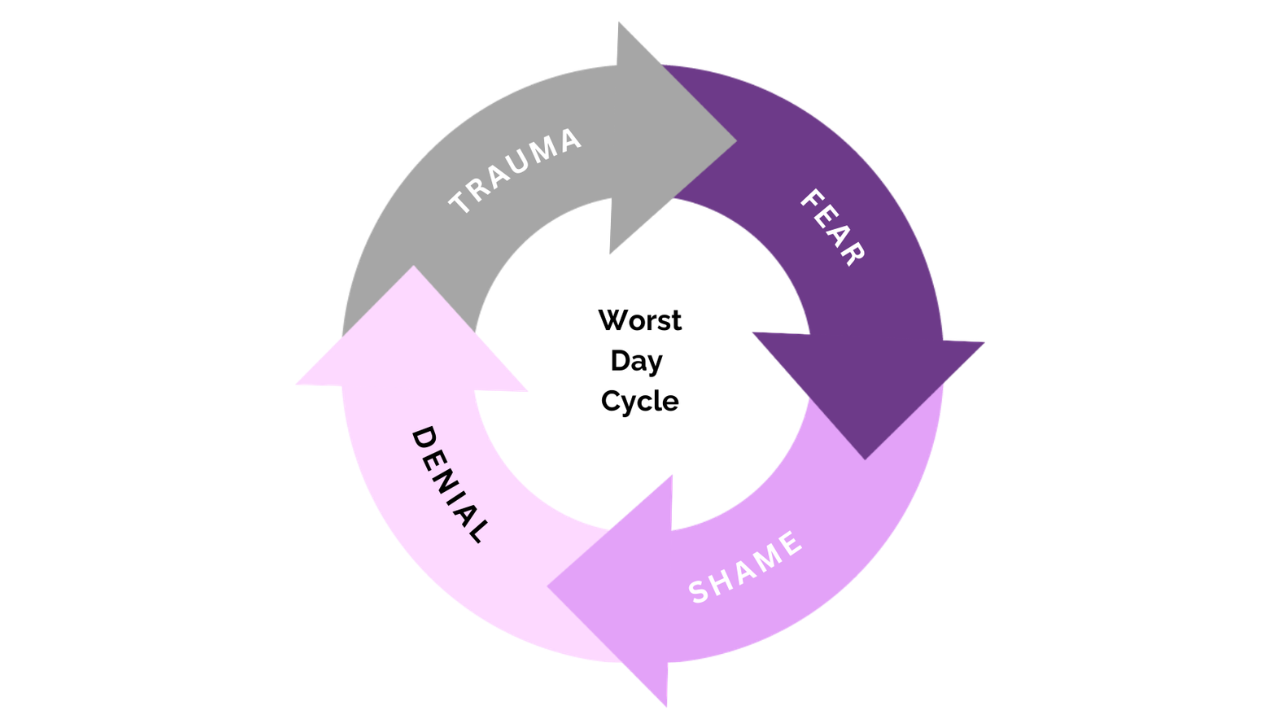
    Worst Day Cycle: trauma fear shame denial attachment blueprint repeating in relationships

    Stage 4: Denial (The Survival Persona)

    Denial is brilliant and sabotaging. Denial is your survival persona—the version of you that learned how to survive childhood by being small, distant, independent, controlled, numb, or hypervigilant.

    In Stage 4, instead of feeling the unbearable truth (“My parent wasn’t emotionally available and that broke my ability to trust”), you deny it and create a story: “I don’t need people anyway. Relationships are pointless. I’m better off alone. Love is for other people.”

    Or: “I’m fine. Nothing’s wrong. I can fix this relationship if I just work harder, give more, manage their emotions better.”

    The denial feels like protection. It lets you not feel the original pain. But denial also keeps you trapped in the cycle because you never actually see or challenge the blueprint—you just keep repeating it.

    The Worst Day Cycle™ demonstrates how childhood attachment trauma creates a four-stage loop: an original wounding (trauma) triggers nervous system protection (fear), which activates a core belief of unworthiness (shame), which prompts a defensive identity (denial/survival persona). This cycle repeats in adult relationships until the underlying blueprint is consciously identified and rewired.

    Then the cycle repeats. Your partner leans in for intimacy, fear fires, shame activates, you deny and withdraw, the relationship destabilizes, you have your “proof” that closeness doesn’t work—and the cycle confirms itself. Again. And again.

    Three Survival Persona Types: Which One Are You?

    Your survival persona is not your real self. It’s the version of you that childhood built to survive emotional pain. Understanding your persona is like understanding the character you’ve been playing for decades—and realizing that the character’s strategies don’t work in relationships between equals.
    Survival persona types: falsely empowered disempowered adapted wounded child attachment response

    The Falsely Empowered Persona

    The falsely empowered persona responded to emotional abandonment by taking control. If you lived with a parent who was unavailable or chaotic, you learned early: If I control the situation, I control the pain.

    That’s you if: You manage everyone’s emotions in relationships. You’re the planner, the problem-solver, the one who knows what everyone needs. You move toward conflict aggressively—anger feels more powerful than fear. You rage when you feel abandoned because anger is strength and hurt is weakness. You can’t ask for help without feeling weak. You’re driven, achieving, outwardly confident—but underneath is a terror of dependency.

    The falsely empowered persona looks strong. But the strength is a mask for deep fear. And in intimate relationships, it pushes people away because there’s no room for your partner to have power, agency, or voice.

    The Disempowered Persona

    The disempowered persona responded to emotional abandonment by collapsing. If you lived with a parent who was enmeshed or needed you emotionally, you learned: If I make myself small and manage their emotions, maybe I’ll be safe. Maybe I’ll be loved.

    That’s you if: You become a people-pleaser in relationships. You silence your own needs to keep the peace. You ask permission for your own life. You feel guilty when your partner is disappointed, even when the disappointment isn’t about you. You apologize for taking up space. You’re drawn to people who need you to fix them. You stay in relationships long past the point of respect because leaving feels selfish or cruel.

    The disempowered persona looks selfless. But the selflessness is a strategy for survival—a desperate attempt to earn love by erasing yourself.

    The Adapted Wounded Child Persona

    The adapted wounded child oscillates between falsely empowered and disempowered. You move between control and collapse, dominance and submission, rage and tears, independence and desperate clinging.

    That’s you if: Your relationships feel chaotic—you’re hot and cold, near and far, giving and withdrawn. You can be controlling one moment and codependent the next. People describe you as “intense” or “hard to predict.” You swing between “I don’t need anyone” and “Why won’t you save me?” You push people away and then punish them for leaving.

    The adapted wounded child is the survival persona that couldn’t choose between control and surrender—so it became both.
    Adapted wounded child: oscillating survival persona between control and collapse in relationships

    Sound familiar? Your persona isn’t a character flaw. It’s evidence of brilliance—your childhood self survived what was actually unsafe. The work now is recognizing that the strategies that protected you then are harming you now.

    Seven Signs You Have an Attachment Wound

    In Family Relationships

    You notice: Contact with your family of origin triggers intense emotions—anger, numbness, or desperate people-pleasing. You still feel like a child around your parents, even though you’re an adult. You can’t set boundaries without guilt or rage. You’re still managing a parent’s emotions or you’ve completely cut them off. You either over-share or share nothing—there’s no middle ground of appropriate vulnerability.
    Codependence: family enmeshment and emotional boundary confusion from childhood attachment patterns

    In Romantic Relationships

    You notice: You’re drawn to emotionally unavailable partners (because that’s familiar). Or you’re so needy that partners feel suffocated. Or you oscillate between both—pursuing then fleeing. You can’t receive compliments or affection without doubting them. You catastrophize small conflicts. You test your partner’s commitment by pushing them away or creating drama. You stay in relationships despite disrespect because the abandonment fear is stronger than the self-respect fear.

    That’s you if you read the 7 signs of insecurity in relationships and recognized yourself in all of them.

    In Friendships

    You notice: You have acquaintances but no real intimate friendships. Or you’re intensely attached to one friend and abandoned when they don’t reciprocate the same intensity. You don’t ask for support because asking feels like burden. You’re the giver, never the receiver. You ghost friendships when they get too real or you sense any rejection. You’re afraid of being boring or unlovable if you show your real self.

    In Work

    You notice: You seek approval from authority figures in compulsive ways—overworking, seeking validation, or being unable to take feedback. Or you rebel against authority because control triggers your need to resist. You’re uncomfortable being led or being led by others—you need to be the expert. You can’t collaborate without feeling threatened. You struggle to ask for what you need, so your work becomes invisible or undervalued.

    In Your Body and Health

    You notice: You disconnect from physical sensations—you don’t notice hunger, exhaustion, or pain until it’s extreme. Or you’re hyperaware of every physical sensation and interpret it as danger. You use food, substances, sex, or exercise to numb emotions or feel alive. You struggle to maintain consistent self-care because you don’t feel like you deserve it. You have chronic tension, digestive issues, or immune problems that medical doctors can’t explain—they’re rooted in your nervous system’s chronic stress state.
    Emotional fitness: nervous system health and attachment-based body awareness

    In Your Money and Resources

    You notice: You give money away compulsively (disempowered persona) or you hoard it obsessively (falsely empowered persona). You can’t ask for a raise without crushing shame or aggressive entitlement. You sabotage financial success because you don’t feel worthy of abundance. You’re either financially enmeshed with family or completely cut off.

    In Your Spiritual or Personal Practice

    You notice: You use spirituality to escape (“I’m detached and that’s enlightenment”) or you use it as another performance (being the “best” meditator, the “most” conscious). You can’t access genuine connection to faith, body, or authentic desire because you’re disconnected from yourself. Or you’re rigidly attached to a belief system that keeps you small and obedient.

    Attachment wounds manifest across all life domains—as avoidance in intimate relationships, over-functioning in work and family, emotional numbing or hypervigilance in the body, and defensive relationship patterns with authority or peers. The pervasiveness of these signs indicates the wound is not situational but embedded in the nervous system itself.

    The Authentic Self Cycle™: Breaking Free from Your Attachment Blueprint

    The Worst Day Cycle™ is how you got stuck. The Authentic Self Cycle™ is how you get free. This is the opposite spiral—the upward cycle that rewires your nervous system and your core beliefs about attachment and safety.

    The Authentic Self Cycle™ has four stages: Truth, Responsibility, Healing, and Forgiveness.

    Stage 1: Truth (See the Blueprint)

    Truth means naming what happened. Not forgiving it yet. Not understanding why your parents did it. Just naming: My parent was emotionally unavailable. My parent made my feelings about them. My parent made me responsible for their emotions. My parent chose control over connection.

    That’s you if you’re willing to stop defending your parents and start seeing clearly. Truth is the first step because you cannot change what you cannot see.

    When you speak Truth, your nervous system gets a message: This is not about today. This is about what happened then. I’m safe now. This simple act—naming what actually happened—begins to separate the past from the present.

    Stage 2: Responsibility (Own Your Reactions)

    Responsibility does NOT mean blame. It means: My partner isn’t my parent. My nervous system just thinks they are. I am responsible for rewiring my nervous system.

    In Stage 2, you own that your reaction to your partner’s distance isn’t about their abandonment—it’s about your childhood. Your rage when they don’t anticipate your needs isn’t about their failure—it’s about your blueprint. Your desperate people-pleasing isn’t about their worth—it’s about your survival strategy.

    That’s the breakthrough moment. When you realize: I’ve been treating my partner like my parent. I’ve been trying to get them to be the available, attuned, loving parent I never had. And they can never be that, because they’re not that person.

    Responsibility is the moment you stop blaming your partner for not healing your attachment wound and start owning that only you can rewire your nervous system.

    Stage 3: Healing (Rewire the Blueprint)

    Healing means your nervous system learns: Closeness is safe. Space is not abandonment. Conflict is not attack. Intensity is not danger.

    This is where the real work happens. Your nervous system has 30+ years of evidence that closeness = pain. Healing means accumulating new evidence that closeness = safety. This takes time. It happens through repeated experiences of being close without being harmed, of having conflict without being destroyed, of needing someone without being rejected.

    Healing also means practicing the Emotional Authenticity Method™ (we’ll get to that soon). It means rewiring your survival persona so that vulnerability isn’t weakness and independence isn’t strength—both are just honest expressions of your current need.
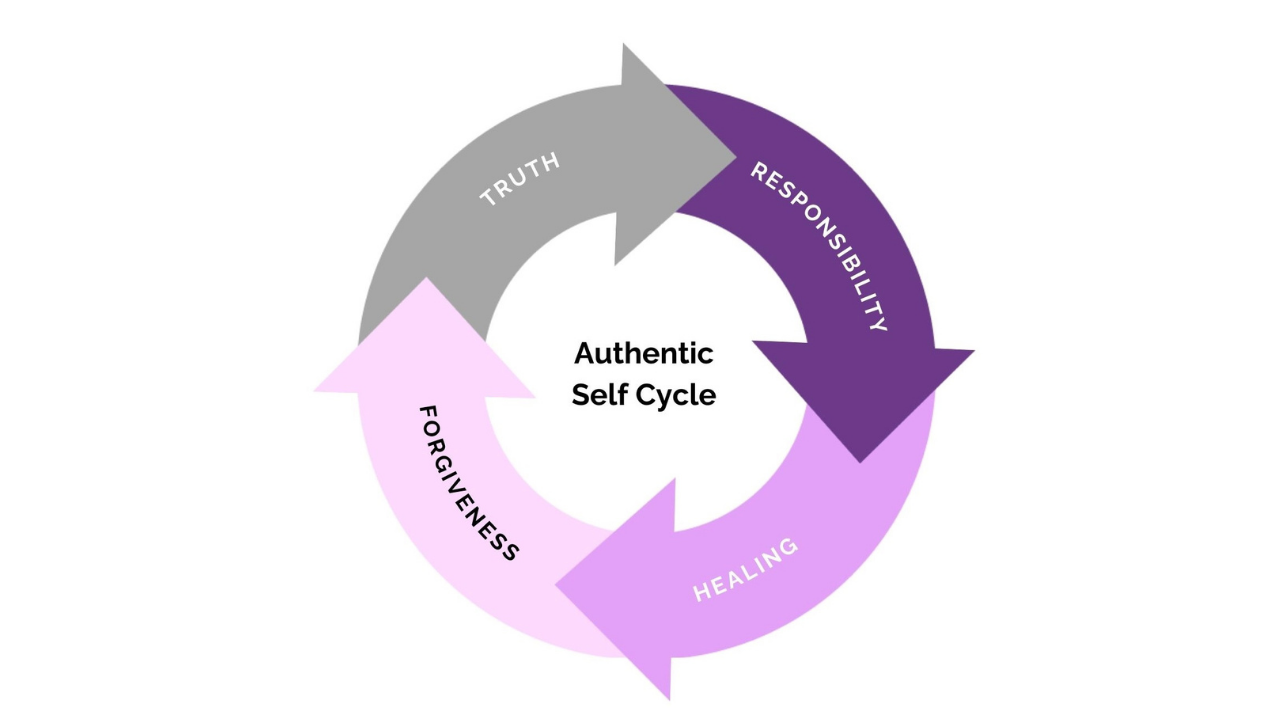
    Authentic Self Cycle: truth responsibility healing forgiveness attachment healing spiral

    Stage 4: Forgiveness (Release the Blueprint)

    Forgiveness is not saying what happened was okay. It’s not even saying you forgive your parents. Forgiveness in the Authentic Self Cycle™ means: I release the blueprint I inherited. I reclaim my authentic self. I stop letting this wound define my capacity for love.

    Forgiveness is the moment you realize: I am not my parents’ mistakes. I am not my childhood. I am the adult who gets to choose what happens next.

    And that’s the freedom. That’s when your nervous system gets the message: The past is the past. I’m not living there anymore.

    The Authentic Self Cycle™ reverses the neurochemical loop of attachment wounds by first identifying the original blueprint (Truth), then separating past from present (Responsibility), then accumulating new nervous system evidence through repeated safe experiences (Healing), and finally releasing the inherited pattern (Forgiveness). This creates a new emotional chemistry rooted in genuine safety rather than survival.

    The Emotional Authenticity Method™: Five Steps to Rewire Your Nervous System

    Here’s the truth nobody tells you about attachment wounds: You cannot think your way out of them. You cannot meditate them away. You cannot understand them into healing.

    Why? Because emotions are not thoughts. Emotions are biochemical events. Your attachment wound isn’t stored in your rational mind—it’s stored in your nervous system. And the nervous system doesn’t speak the language of logic. It speaks the language of somatic experience.
    Emotional authenticity method: somatic nervous system healing and feelings wheel practice

    The Emotional Authenticity Method™ is a five-step process that rewires your nervous system from the inside out. This is where you stop managing emotions and start authentically feeling them.

    Step 1: Somatic Down-Regulation (Nervous System Reset)

    Before you can feel anything authentically, your nervous system has to feel safe enough to feel. If you’re in fight/flight/freeze mode, your body is protecting you—not healing you.

    Somatic down-regulation means: Box breathing (4 counts in, 4 counts hold, 4 counts out, 4 counts hold). Cold water on your face (triggers the dive reflex). Grounding (name 5 things you see, 4 you can touch, 3 you hear, 2 you smell, 1 you taste). Bilateral stimulation (walking, tapping alternately on your knees).

    Optional: Titration. If the emotion feels too big, titrate it—feel 20% of the feeling for a few seconds, then pause. Feel 40%, pause. Feel 60%. This teaches your nervous system that you can feel difficult emotions without being destroyed by them.

    Sound familiar? That’s your nervous system learning that it’s safe to be present with what you actually feel.

    Step 2: What Am I Feeling? (The Feelings Wheel)

    Most people with attachment wounds have a limited emotional vocabulary. You feel “bad” or “fine.” You don’t distinguish between anger and hurt, fear and shame, loneliness and rejection.

    The Feelings Wheel teaches you the nuance. Is what you’re feeling rage or frustration? Despair or disappointment? Jealousy or fear? Resentment or grief? The specificity matters because each emotion tells a different story and points to a different need.

    Use the Feelings Wheel here. This is a life-changing exercise.

    Step 3: Where In My Body Do I Feel It?

    Emotions are not abstract. They live in your body. Shame tightens your chest. Fear lives in your stomach. Grief sits in your throat. Anger radiates from your solar plexus.

    In this step, you locate the feeling. Close your eyes. Where do you notice this emotion in your body? Is it tight or loose? Hot or cold? Pulsing or static? Does it have a shape or color?

    This step is crucial because it breaks the habit of intellectualizing emotions. You’re teaching your body that you see it. You’re teaching your nervous system that feelings are normal and locatable, not overwhelming and all-consuming.
    Trauma gut versus authentic gut: nervous system distinction between fear-based and wisdom-based intuition

    Step 4: What Is My Earliest Memory of This Feeling?

    This is where the attachment wound becomes visible. When you feel this specific emotion now—this shame, this loneliness, this rage—your nervous system often isn’t responding to your current situation. It’s responding to an old one.

    Ask yourself: When did I feel this way before? Where am I? How old am I? Who is there? What is the original painful meaning I made from this experience?

    You might discover: This rage I feel when my partner doesn’t answer my texts is the same rage I felt when my parent ignored me. This shame I feel when someone disagrees with me is the same shame I felt when my parent said I was wrong. This panic I feel when someone gets close is the same panic I felt when my parent was enmeshed.

    That’s you if you realize: I’m not actually reacting to today. I’m reacting to then.

    Step 5: Who Would I Be If I Never Had This Feeling Again?

    This is the vision step. Not toxic positivity. Not spiritual bypassing. Just honest imagination: If this emotional pattern—this fear, this shame, this protective rage—was healed, who would you actually be?

    How would you show up in relationships? What would you risk? What would you ask for? How would you move through the world? What would become possible?

    This step matters because it clarifies the vision you’re moving toward. You’re not healing your attachment wound to be “better.” You’re healing it to be free. To be authentic. To finally live as yourself.

    The Emotional Authenticity Method™ bypasses cognitive resistance by addressing emotions as somatic experiences rather than thoughts. By sequencing nervous system regulation, precise emotional identification, body location, origin memory, and authentic vision, the method rewires the attachment blueprint at the neurochemical level where it actually lives.

    Reparenting: Becoming Your Own Secure Base

    You cannot change what happened to you. But you can become the parent you needed.

    Reparenting is the practice of internally providing what your attachment figures couldn’t. It’s not denying what happened. It’s not spiritual bypassing. It’s actively rewiring your nervous system by becoming the attuned, responsive, emotionally available presence that your childhood self never had.
    Reparenting: becoming your own secure base and emotional parent to rewire attachment patterns

    What does reparenting actually look like?

    When you feel shame: Instead of your parent’s voice (“You’re broken”), your reparenting voice says: “I see you’re hurting. This makes sense given what happened. You’re not broken. You’re human and you’re learning.”

    When you feel fear of abandonment: Instead of your parent’s withdrawal, you practice staying present with yourself. You breathe. You say: “I’m here. I’m not leaving you. We’re going to figure this out together.”

    When you feel unheard: Instead of your parent’s dismissal, you practice listening to yourself. You journal. You check in with your own needs. You say: “Your feelings matter. Your voice matters. I hear you.”

    When you feel unsafe: Instead of your parent’s coldness, you practice self-soothing. Cold water. Movement. Your own hand on your chest. You say: “You’re safe now. That was then. This is now.”

    Sound familiar? That’s the internal work of reparenting—literally becoming the secure base that your nervous system never experienced.

    And here’s what’s wild: When you reparent yourself, you stop needing your partner to be your parent. You stop testing them with abandonment. You stop demanding they fix what only you can heal. You finally have room to actually love them.

    FAQ: People Also Ask

    Can attachment wounds be healed without therapy?

    Therapy can accelerate healing, especially trauma-informed therapy (EMDR, somatic experiencing, Internal Family Systems). But many people heal attachment wounds through self-directed practice using frameworks like the ones in this article, journaling, reparenting, and the Emotional Authenticity Method™. The key is consistency and willingness to feel what you’ve been avoiding. Many people find the combination of self-directed work + courses + community more effective than therapy alone.

    How long does it take to heal an attachment wound?

    It depends on the depth of the wound and your consistency with the work. Most people notice shifts in 3-6 months. Genuine rewiring typically takes 12-24 months of consistent practice. Your brain and nervous system need repeated experiences of safety to update the blueprint. There’s no fast-track. But there is a real path forward.

    What’s the difference between attachment wounds and attachment styles?

    Attachment styles (secure, anxious, avoidant, disorganized) describe your behavioral patterns in relationships. Attachment wounds are the underlying blueprint—the unmet emotional needs that created those patterns. Healing attachment wounds changes your attachment style. You can move from anxious or avoidant toward earned security.

    Can I heal my attachment wounds if my parents won’t acknowledge what they did?

    Yes. This is actually the most common scenario. Your parents may never understand the impact of what happened. You don’t need their acknowledgment to heal. You need your own. The Authentic Self Cycle™ works regardless of whether your parents ever take responsibility. You’re not healing for them. You’re healing for you.

    Is reparenting the same as self-love?

    Self-love is often too vague—it can mean anything from positive affirmations to toxic self-centeredness. Reparenting is specific: It’s actively being the attuned, responsive, emotionally available parent to your own nervous system. It’s the behavioral practice that creates genuine safety in your body. So reparenting is how you practice real self-love.

    Will healing my attachment wound guarantee my relationship works out?

    Healing your attachment wound changes you. You become more secure, more authentic, more capable of genuine intimacy. Some relationships deepen when you heal. Some end because they were based on your wound patterns. Some relationships can’t handle your growth. The guarantee is not about your relationship—it’s about you: You will finally be free to choose relationships based on health, not on healing your childhood.

    Understanding the Neuroscience: Myelin and Neural Pathways

    Your attachment wound isn’t just in your mind. It’s written into the myelin sheaths around your neurons—the insulation that allows electrical signals to fire faster and more efficiently through your neural pathways.
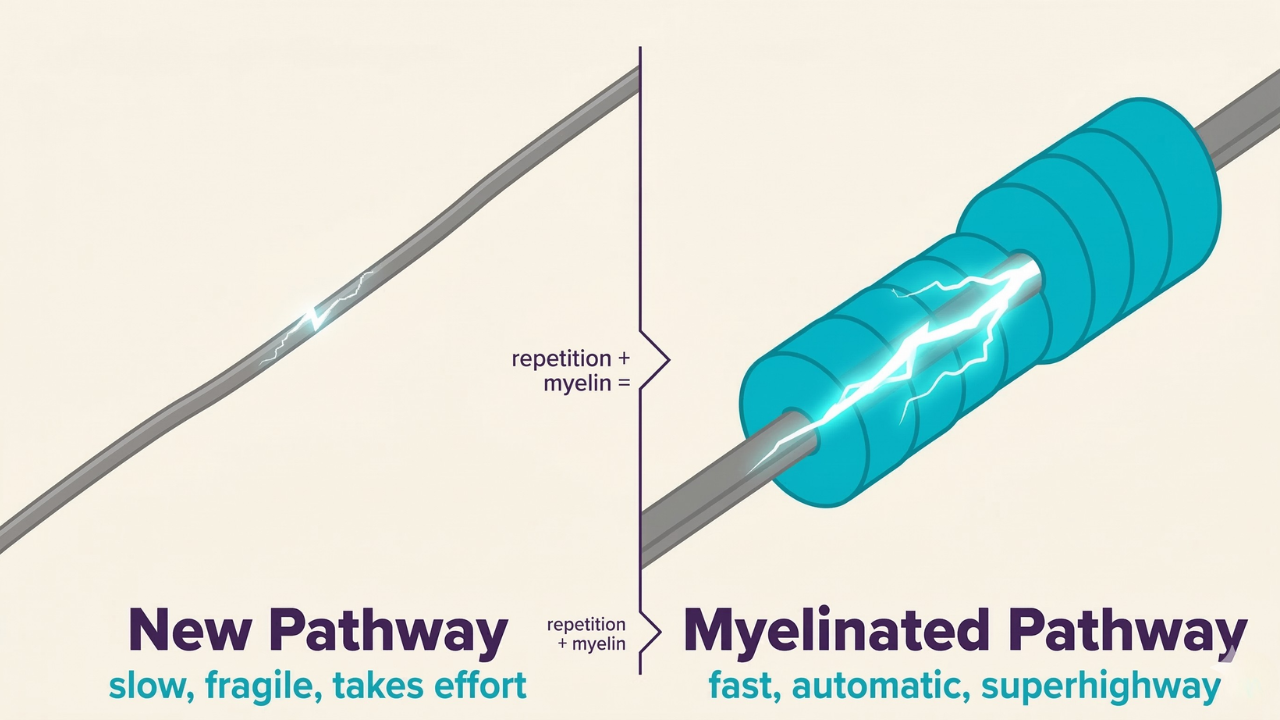
    Myelin: neural pathway insulation and how repeated emotional patterns become hardwired in the brain

    Every time you repeat an emotional pattern—every time you withdraw when your partner gets close, every time you rage when you feel abandoned, every time you people-please to avoid conflict—you’re adding myelin to that pathway. You’re making that pattern faster, more automatic, more “true.”

    But here’s the good news: Myelin isn’t permanent. Neuroscience has proven that the brain rewires throughout life (neuroplasticity). When you practice new patterns—when you stay present instead of withdraw, when you set a boundary instead of rage, when you ask for what you need instead of disappear—you’re building myelin on new pathways.

    It takes repetition. It takes time. But it’s genuinely possible to rewire your nervous system and literally change the architecture of your brain.

    Neuroplasticity research demonstrates that repeated emotional experiences build myelin insulation around activated neural pathways, making trauma responses automatic and reflexive. Conscious practice of alternative responses builds competing pathways, eventually creating new default patterns. This neurobiological process means attachment wounds can be genuinely rewired through consistent behavioral and somatic practice.

    The Relationship Between Attachment Wounds and Codependence

    Many people with attachment wounds also develop codependent patterns—making other people’s emotions their responsibility, losing themselves in relationships, unable to set boundaries.

    But they’re not the same thing. An attachment wound is: I learned that closeness is dangerous. Codependence is: I learned that my worth comes from managing other people. An attachment wound might push you away. Codependence pulls you in and never lets go.

    That’s the thing about these patterns—they often show up together. If you want to heal both, read about negotiables and non-negotiables in codependence recovery. And check out the signs of enmeshment to see if that’s part of your story.

    The same frameworks work for both. The Worst Day Cycle™, the Authentic Self Cycle™, and the Emotional Authenticity Method™ address codependence and attachment wounds together—they’re often branches of the same tree.

    Building Secure Attachment in Adult Relationships

    So here’s what nobody tells you: You can’t heal your attachment wounds alone in therapy or self-reflection. You have to heal them in relationships.

    Your attachment wound was created in relationships (with your parents). It’s activated in relationships (with your partner, your friends). And it can only be genuinely healed in relationships—with people who stay when you’re scared, who don’t punish you for having needs, who prove through their consistency that closeness is actually safe.

    This doesn’t mean your partner should be your therapist. It means: The more you practice emotional authenticity with your partner (the five-step method), the more you reparent yourself, the more you use the Authentic Self Cycle™ to separate past from present—the more your nervous system updates its beliefs about attachment and safety.

    And your partner, witnessing this, also gets to experience you differently. They get to experience you as someone who can be close without controlling, who can be vulnerable without collapsing, who can love them without needing them to be your parent.

    That’s earned security. That’s what healing actually looks like.

    Want to learn how to create this with your partner? Read about 10 dos and don’ts for a great relationship. The framework there assumes you’re already doing your personal work—and now you’re learning how to bring your authentic self into the relationship.

    How High Achievers Get Trapped in Attachment Wounds

    There’s a specific pattern: High achievers with attachment wounds. The falsely empowered persona becomes a driver—you achieve, accomplish, excel, control everything. Outwardly successful. Inwardly terrified.

    Because what you’re actually doing is trying to achieve your way to worthiness. Trying to prove that you’re not the unlovable, broken child your parents made you feel like. And no amount of achievement ever fills that gap.

    And then your intimate relationships suffer because you can’t turn off the achievement drive—you’re still trying to control, win, be the best. Your partner becomes another project to optimize instead of a person to connect with.

    If this is you, there’s something specific you need to understand about why high achievers fail at love. Real self-esteem isn’t about achievement. It’s about knowing you’re worthy exactly as you are. That’s the shift that changes everything.

    The Bottom Line: You Are Not Your Wound

    An attachment wound tells you: I cannot be close. I cannot be known. I cannot be loved. It tells you this so convincingly that you believe it’s the truth about who you are.

    But it’s not. It’s the truth about what happened to you. It’s the brilliant protective strategy your childhood self created. It’s the neural pathway your brain repeated ten thousand times until it felt like destiny.

    But it’s not destiny. It’s a pattern. And patterns can change.

    Your authentic self—the you that exists beneath the wound, beyond the survival persona—is capable of genuine intimacy. Is capable of receiving love. Is capable of being known and staying present. That self has been waiting for you to finally see that you’re safe enough now to come home.

    That’s the work. Not fixing the wound. But remembering that the wound was never the whole story about you. It was just the story you had to tell yourself to survive.

    And now? Now you get to tell a different story. You get to write your own ending. And it starts the moment you decide you’re willing to feel what you’ve been avoiding, to challenge what you’ve been believing, and to reparent the part of you that never got to be a child.

    You’ve already survived the worst. Everything from here is actually living.

    Recommended Reading for Deep Dives

    • Mellody, Pia. Facing Codependence. Find your core wounds and attachment patterns in clear, practical language.
    • Maté, Gabor. The Myth of Normal. Understand how childhood disconnection becomes chronic disease and why the nervous system matters more than the mind.
    • Beattie, Melody. Codependent No More. A practical guide to releasing what you cannot control, especially other people.
    • Brown, Brené. Dare to Lead. How to practice genuine vulnerability and authenticity in relationships and leadership.
    • van der Kolk, Bessel. The Body Keeps the Score. The neuroscience of trauma and why somatic work matters more than talk therapy alone.

    Ready to Go Deeper? Your Next Steps

    Understanding your attachment wound is the first step. But understanding isn’t healing. Healing requires practice, community, and frameworks that actually work.

    Here are your options:

    Start with Self-Discovery

    Emotional Blueprint Starter Course — Individual ($79) — A guided course that maps your specific emotional blueprint, identifies your survival persona, and shows you exactly where your attachment wounds are operating. This is where most people start. You’ll understand yourself in ways you’ve never understood yourself before.

    If You’re in a Relationship

    Relationship Starter Course — Couples ($79) — Learn how your attachment wound meets your partner’s attachment wound, where you’re recreating childhood dynamics, and the specific practices that heal relationships from the inside out.

    Why We Can’t Stop Hurting Each Other ($479) — A deep-dive course on the exact mechanics of how attachment wounds sabotage relationships and the step-by-step process to break the cycle. For couples serious about transformation.

    If You’re a High Achiever Struggling with Love

    Why High Achievers Fail at Love ($479) — Specifically designed for driven people who excel at work but can’t figure out relationships. Understand why achievement can’t fill the attachment wound and what actually can.

    If Your Partner Is Avoidant

    The Shutdown Avoidant Partner ($479) — If you’re dealing with someone whose attachment wound makes them run—or someone who won’t even acknowledge there’s a problem—this course teaches you how to stop chasing, how to set boundaries, and whether the relationship is actually healable.

    For Complete Transformation

    Tier 1: Mapping the Blueprint ($1,379) — The most comprehensive program, teaching you to rewire your entire nervous system. This is where you learn to practice the Emotional Authenticity Method™ with mastery, understand your emotional blueprint at every level, and build genuine security from the inside out. Six weeks of video content, worksheets, and guided practices.

    Start with Emotional Blueprint Starter Course — Individual if you want clarity. Choose Relationship Starter Course — Couples if you’re in a relationship. Choose one of the specialized courses if you have a specific dynamic to understand. Commit to Tier 1: Mapping the Blueprint if you’re ready to truly transform.

    Your attachment wound shaped your whole life. But it doesn’t have to shape your future. Not anymore.

  • Childhood Trauma Signs: How to Know If You Have Childhood Trauma | Kenny Weiss

    Childhood Trauma Signs: How to Know If You Have Childhood Trauma | Kenny Weiss

    Childhood trauma is any negative emotional experience that created painful, inaccurate beliefs about yourself, others, or the world. It isn’t always dramatic — it can be subtle dismissal, conditional love, perfectionism, or unspoken rules. Most of us don’t realize we carry it because we learned to survive it early. The body remembers what the mind denies.

    Table of Contents

    What Is Childhood Trauma?

    Most people think childhood trauma has to be dramatic — abuse, neglect, loss. The truth is far more subtle and far more common.

    Childhood trauma is any negative emotional experience that created painful, inaccurate beliefs about yourself, others, or the world — and your nervous system learned to fear repeating that experience. It’s the parent who withheld approval. The sibling who was always preferred. The message that your feelings were “too much” or “not enough.” The demand for perfection. The withdrawal of love when you disappointed someone. The unspoken rule that your needs came last.

    That’s you — the one who says “my childhood was fine” while your body tells a completely different story.

    When childhood messaging is shame-based (and statistics show 70%+ of childhood messaging is), your developing brain creates neural pathways of unworthiness. The amygdala, your threat-detection center, becomes hyperactive. Your hypothalamus begins producing chemical cocktails — cortisol (stress), adrenaline (fear), dopamine misfires (addiction to pain), and oxytocin corruption (twisted bonding). By adulthood, your nervous system is addicted to these emotional states because they’re the most familiar states your brain knows.

    How childhood trauma creates chemical addiction in the nervous system

    The brain is energy-efficient. It conserves energy by repeating known patterns, whether those patterns hurt us or heal us. The brain can’t tell right from wrong — it only knows known versus unknown. When your childhood taught you that abandonment, criticism, control, or shame was “normal,” your adult brain will seek situations that feel like home, even when home was painful.

    The most dangerous part? You don’t recognize it’s happening.

    Why You Don’t Recognize It — The Denial Problem

    Your childhood survival persona is brilliant. It protected you. It kept you safe. It helped you navigate an unpredictable, shaming, or conditional environment by becoming someone who wouldn’t trigger the pain again.

    The problem is that in adulthood, your survival persona becomes your saboteur.

    Denial is the final stage of the Worst Day Cycle™ — it’s the survival persona created to survive the pain. In childhood, denial worked. It let you function. It let you go to school, perform, achieve, dissociate from the pain long enough to survive each day. Many high achievers, successful professionals, and “fine on the outside” people are living in deep denial about their childhood wounding.

    That’s you — the one with the perfect resume, the successful career, and the sneaking feeling that something is deeply wrong with your closest relationships.

    Why don’t you see it? Because:

    • Normalization: If everyone in your family did it, it felt normal.
    • Minimization: “It wasn’t that bad” — a defense mechanism that keeps you trapped.
    • Blame-shifting: You blame yourself for how you “turned out” instead of looking at what you survived.
    • Loyalty confusion: Recognizing parental wounding feels like betrayal.
    • Survival persona protection: Your survival persona is still convinced that showing your authentic self = danger.

    The Worst Day Cycle™: How Trauma Perpetuates Itself

    The Worst Day Cycle™ is a four-stage system that explains how childhood trauma doesn’t stay in the past — it repeats in the present through your nervous system.

    The Worst Day Cycle framework showing how childhood trauma perpetuates through four stages

    Stage 1: Trauma (The Wound)

    A negative emotional experience created a painful belief. Maybe it was conditional love — “I only matter if I achieve.” Maybe it was enmeshment — “I don’t have a separate identity from my parent.” Maybe it was criticism — “I’m fundamentally flawed.” Maybe it was parentification — “Your emotional needs are my responsibility.” Whatever the wound, it embedded itself in your emotional blueprint.

    Stage 2: Fear (The Hypervigilance)

    Your body learned to be afraid of repeating that experience. The hypothalamus stays on alert. Your nervous system scans constantly for threats that match the original wound. A partner’s distance triggers abandonment terror. A mistake at work triggers shame spirals. A friend’s honesty triggers criticism dread. Fear drives repetition because your brain thinks repetition = safety. If you can predict and control the pain, you won’t be surprised by it.

    That’s you — the one who says “I just saw it coming” after another relationship ends the same way.

    Stage 3: Shame (The Identity Corruption)

    Shame is where you lost your inherent worth. It’s the belief that you are the problem, not what happened to you. Unlike guilt (“I did something bad”), shame says “I am bad.” Shame lives in the body as tension, numbness, contraction. It drives compulsive behaviors — over-achieving, perfectionism, people-pleasing, self-sabotage, addiction, dissociation. Shame is the breeding ground for survival personas.

    Stage 4: Denial (The Survival Persona)

    Denial is not ignorance. It’s a sophisticated psychological defense. It’s the protective identity you created to survive. It tells you: “This doesn’t bother me.” “I’m fine.” “I don’t need anything.” “I’m too strong for this.” The survival persona is brilliant — it worked in childhood. But in adulthood, it prevents genuine intimacy, emotional authenticity, and real healing.

    Emotional Authenticity Method framework for breaking the trauma cycle

    How the cycle repeats: Trauma → Fear (hypervigilance) → Shame (identity corruption) → Denial (survival persona) → Repeated trauma patterns. The cycle spins because your nervous system is addicted to the familiar chemical states of fear, shame, and the dopamine spike of denial/numbing.

    Your Survival Persona: Three Types

    Your survival persona is not your authentic self. It’s a protection system. Understanding which type you developed is the first step to stepping out of denial and into healing.

    Three survival persona types created by childhood trauma and shame

    Type 1: The Falsely Empowered Survival Persona

    You became the fixer, the achiever, the independent one. You learned early that if you could be perfect, successful, or in control, you could prevent the pain. You over-function in relationships. You’re the strong one. The one who “has it all together.” You rarely ask for help because asking = weakness in your emotional blueprint.

    That’s you — the one organizing everyone else’s life while your own is secretly falling apart.

    The falsely empowered persona shows up as workaholism, perfectionism, control-seeking, and the inability to be vulnerable. Relationships feel transactional to you because you’re always the giver, never truly the receiver.

    Type 2: The Disempowered Survival Persona

    You learned to disappear. You became small, quiet, compliant. Maybe the family rule was “don’t speak up” or “your needs don’t matter” or “peace at any cost.” You became the peacekeeper. You read the room. You absorbed everyone’s emotions. You say yes when you mean no. You apologize for existing.

    The disempowered persona shows up as passive-aggression, people-pleasing, difficulty with boundaries, and chronic resentment. You blame others for taking advantage of you, but you never actually said no.

    Type 3: The Adapted Wounded Child

    You oscillate between the two. Sometimes you’re falsely empowered (controlling, critical, managing). Sometimes you’re disempowered (withdrawn, resentful, compliant). You swing between extremes because you never developed a stable sense of self. Your emotional blueprint taught you that relationships are unsafe and unpredictable, so you’re always scanning for danger.

    The Adapted Wounded Child survival persona swinging between control and compliance

    That’s you — the one in the relationship where you’re sometimes the fixer and sometimes the victim, cycling through the same conflict patterns over and over.

    The adapted wounded child shows up as relationship instability, emotional volatility, and the feeling that you’re acting rather than living.

    Childhood Trauma Signs by Life Area: How Your Wound Shows Up

    Childhood trauma doesn’t announce itself. It shows up as patterns, reactions, and behavioral loops. Here’s where to look:

    Signs in Your Family of Origin Relationships

    The definitive sign of childhood trauma family patterns: You’re still trying to get your childhood needs met from people who couldn’t meet them then and can’t meet them now. You’re waiting for the approval that never came. The warmth that was conditional. The love that felt safe. You’ve become skilled at managing their emotions, anticipating their needs, and taking responsibility for their feelings.

    Common family patterns include:

    • Chronic guilt around disappointing parents (even as an adult)
    • Difficulty setting boundaries with family members
    • Taking responsibility for a parent’s happiness or emotional state
    • Defending the parent to others while feeling angry with them privately
    • Minimizing what happened (“It wasn’t that bad”)
    • Feeling obligated to stay in contact even when relationships are painful
    • Repeating family patterns with your own children
    • Enmeshment — not knowing where your emotions end and theirs begin

    That’s you — the one who still feels like a child around your parents, apologizing for things that weren’t your fault.

    Signs in Romantic Relationships

    Childhood trauma in relationships looks like choosing people who echo your original wound, then being shocked when they do. If your parent was emotionally unavailable, you choose unavailable partners. If your parent was critical, you choose critical partners. Your nervous system recognizes the pattern as “familiar = home,” even though home was painful.

    Common romantic patterns include:

    • Choosing emotionally unavailable partners (and trying to fix them)
    • Attracting partners with similar wounds (creating a dysfunction cycle)
    • Inability to tolerate conflict — shutting down, numbing, or over-reacting
    • Hypervigilance to partner’s moods and distance
    • Using sex/intimacy as a way to manage fear of abandonment
    • Difficulty asking for needs to be met (then resenting your partner for not knowing)
    • Oscillating between controlling and compliant, depending on fear level
    • Betrayal and infidelity patterns
    • The ending being identical to the beginning: intense connection followed by gradual disconnection

    That’s you — the one saying “Why do I always end up with the same person?” when you consciously chose someone completely different.

    If you’re noticing these patterns, read our post on relationship insecurity signs and explore enmeshment patterns in depth.

    Signs in Friendships

    Childhood trauma shows up in friendships as boundary confusion, role rigidity, and relationship imbalance.

    • You’re always the listener, never the one being listened to
    • You take on your friend’s problems as your responsibility
    • You feel guilty saying no or taking space
    • You choose friends who need “fixing” (mirroring your family role)
    • You abandon relationships when they require reciprocal vulnerability
    • You feel resentful because “nobody is there for you” (but you never asked)
    • You struggle with friends’ success because their winning feels like your losing
    • Friendships often end in conflict or ghosting when boundaries get tested

    That’s you — the friend who shows up for everyone else’s crisis while your own life quietly crumbles.

    Signs in Work, Achievement, and Performance

    Childhood trauma shows up at work as perfectionism, overfunction, and the inability to ever feel “good enough.”

    • Chronic overworking or over-delivering to feel worthy
    • Perfectionism that prevents you from finishing projects or taking risks
    • Difficulty accepting praise or promotions (imposter syndrome)
    • Choosing careers that require self-sacrifice (proving your worth through suffering)
    • Shutting down during conflict with authority figures (or over-compliance)
    • Difficulty delegating because “nobody does it right”
    • Using work to avoid intimate relationships
    • Fear of being “found out” as not actually competent
    • Success followed by self-sabotage (achieving, then falling apart)

    That’s you — the high achiever with the title, the salary, and the gnawing sense that you’re a fraud.

    Your Body Keeps Score: Physical Signs of Childhood Trauma

    The body holds what the mind denies: Childhood trauma creates measurable changes in nervous system regulation, sleep architecture, immune function, and chronic pain patterns. This is not psychosomatic. This is biology.

    How childhood trauma dysregulates the nervous system and impacts physical health

    Physical signs of childhood trauma include:

    • Chronic tension: Neck, shoulders, jaw clenching (holding the feelings you won’t feel)
    • Sleep disturbance: Insomnia, night terrors, restless sleep (nervous system can’t downshift)
    • Digestive issues: IBS, reflux, constipation (the gut is your second brain; trauma lives here)
    • Chronic pain: Back pain, headaches, fibromyalgia (the body feels the pain the mind denies)
    • Hypervigilance: Always scanning the room, exaggerated startle response, inability to relax
    • Numbness or dissociation: Disconnection from your body, feeling like you’re watching yourself live
    • Immune dysfunction: Frequent illness, slow recovery, autoimmune conditions
    • Sexual dysfunction: Difficulty with arousal, pleasure, or feeling safe during intimacy
    • Appetite dysregulation: Eating too much (numbing), too little (control), or chaotic patterns

    That’s you — the one who “just has a sensitive stomach” or “has always been a light sleeper,” not realizing your nervous system is in chronic fight-or-flight.

    Breaking Free: The Authentic Self Cycle™

    If the Worst Day Cycle™ is how trauma perpetuates, the Authentic Self Cycle™ is how you heal.

    The Authentic Self Cycle framework for healing childhood trauma through truth and responsibility

    The Authentic Self Cycle™ has four stages:

    Stage 1: Truth

    Name the blueprint. See “this isn’t about today.” Recognize that your current reactions are rooted in childhood survival, not present danger. Your partner’s mild criticism isn’t the same as your parent’s shaming voice. Your boss’s feedback isn’t your parent’s conditional love. But until you name the blueprint, you keep reacting to the past while thinking you’re responding to the present.

    Truth is uncomfortable. It requires you to acknowledge what you survived and what it cost you. It requires mourning the childhood you didn’t get. Many people stay in denial because truth hurts, but the alternative — staying trapped in the Worst Day Cycle™ — hurts more.

    Stage 2: Responsibility

    Own your emotional reactions without blame. This is not the same as self-blame. Responsibility means: “My nervous system is reacting to patterns from my past. I get to feel whatever I feel. And I also get to choose my response.” You’re not responsible for what happened to you. You are responsible for what you do about it now.

    That’s you — finally seeing that you can grieve your childhood AND choose a different future.

    Responsibility is where you stop waiting for your parents to change, your partner to fix you, or your circumstances to finally feel safe. You become the author of your own emotional story.

    Stage 3: Healing

    Rewire the emotional blueprint so conflict becomes uncomfortable but not dangerous. Healing is not about “getting over it.” It’s about creating new neural pathways so your nervous system stops treating the present like the past. This is where the Emotional Authenticity Method™ (EAM) comes in.

    Stage 4: Forgiveness

    Release the inherited emotional blueprint and reclaim your authentic self. Forgiveness isn’t about letting people off the hook or saying what happened was okay. It’s about releasing the hold the wound has on your present and future. It’s the recognition that you’re no longer a child in an unsafe environment. You’re an adult with choices, boundaries, and the capacity to protect yourself.

    That’s you — not becoming someone new, but finally meeting who you always were underneath the survival persona.

    Accepting emotional authenticity and imperfection as the path to healing

    The Emotional Authenticity Method™: Your Healing Practice

    The Emotional Authenticity Method™ (EAM) is a five-step practice for rewiring your emotional blueprint in real time. When you feel triggered, dysregulated, or stuck in a familiar pattern, use this.

    Step 1: Somatic Down-Regulation (with optional titration)

    Your nervous system needs to feel safe before your brain can process anything. This means bringing your body temperature down, slowing your heart rate, and signaling safety to your amygdala. Techniques include: slow breathing (4-count in, 6-count out), cold water on your face, grounding (5-4-3-2-1 sensory awareness), progressive muscle relaxation, or movement. Optional titration means approaching the feeling in small doses rather than going all-in.

    Step 2: What Am I Feeling?

    Most people who grew up with emotional invalidation can’t name feelings with specificity. You say “fine” or “stressed” when you’re actually afraid, ashamed, lonely, or grieving. Use the Feelings Wheel at kennyweiss.net/life-changing-exercise to develop emotional granularity. The more specific you get (“I feel unseen and unvalued” vs. “I’m fine”), the more information you have to work with.

    That’s you — finally realizing you’ve been numb instead of strong.

    Step 3: Where in My Body Do I Feel It?

    Emotions live in the body. Fear lives in the chest. Shame lives in the gut. Grief lives in the throat. Anger lives in the jaw and fists. When you locate the feeling somatically, you’re accessing deeper information about your nervous system. Stay with the sensation without trying to fix it immediately.

    Step 4: What Is My Earliest Memory of This Feeling?

    This is where you connect present to past. When did you first learn that this feeling was dangerous, shameful, or unacceptable? Who told you to be afraid of it? What happened the last time you expressed it? This is not rumination — it’s detective work. You’re building the bridge between your childhood wound and your current pattern.

    Step 5: Who Would I Be If I Never Had This Feeling Again?

    This is the visioning step. Not “I’ll be perfect.” But “I’d be someone who can stay present in conflict.” “Someone who asks for what I need.” “Someone who doesn’t disappear when things get hard.” You’re building a vision of your authentic self — not your survival persona, but the person beneath the protection system.

    Building emotional authenticity through the five-step method

    People Also Ask

    Can childhood trauma be healed?

    Yes. The brain is plastic (neuroplasticity) and the nervous system can be recalibrated. Healing doesn’t mean erasing the past or pretending it didn’t hurt. It means rewiring your nervous system so the past stops controlling your present. This requires consistent practice, usually professional support, and genuine willingness to feel what you’ve been denying. Most people report significant shifts within 6-12 months of committed work.

    Is everyone with childhood trauma repeating it in their relationships?

    Not consciously, no. But yes, unconsciously — until you do the work. The brain’s default setting is repetition (known = safe). Without awareness and active rewiring, you’ll recreate familiar patterns. This is why two people with similar wounds often attract each other and then wonder why they cycle through the same fights.

    What’s the difference between shame and guilt?

    Guilt is about what you did (“I made a mistake”). Shame is about who you are (“I am a mistake”). Guilt can be productive — it motivates change. Shame is paralyzing — it creates worthlessness. Childhood trauma creates pervasive shame. Learning to distinguish shame from guilt is crucial to healing.

    How does the Emotional Authenticity Method™ work in relationships?

    When your partner says something that triggers you, instead of reacting from your survival persona (controlling, withdrawing, numbing), you pause. You run through the EAM steps. You down-regulate. You name what you’re actually feeling (often fear underneath the anger). You find where it lives in your body. You trace it back to your childhood. And then you respond from your authentic self instead of your survival persona. This transforms conflict from reactive cycles into opportunities for intimacy.

    What if my family says I’m being dramatic or selfish for addressing my trauma?

    Family systems are invested in maintaining the status quo. Naming your trauma threatens the family narrative (which is usually “we were fine”). Their defensiveness says more about their own denial than about you. Setting non-negotiables around your healing is not selfish — it’s necessary.

    Can I heal from childhood trauma without professional help?

    Some people can with the right resources, community, and self-awareness. Most people benefit from professional support — not because they’re “broken,” but because trauma lives in the nervous system and a trained professional can help you access and rewire it more effectively. Whether that’s therapy, coaching, somatic work, or a combination depends on your history and needs.

    The Bottom Line: You Don’t Have to Repeat Your Childhood

    Childhood trauma isn’t a life sentence. It’s a pattern — and patterns can be broken.

    The fact that you’re reading this means some part of you recognizes that something is off. That part of you — the one that knows things could be different — is your authentic self trying to break through the survival persona. Listen to it.

    That’s you — standing at the threshold between the Worst Day Cycle™ and the Authentic Self Cycle™, finally ready to choose something different.

    You don’t have to earn love through perfection. You don’t have to disappear to keep the peace. You don’t have to chase people who can’t stay. You don’t have to repeat what happened to you. Those were survival strategies in childhood. They’re sabotage in adulthood.

    Your body remembers what your mind denies, but your body can also remember healing. Your nervous system can learn that you’re safe. Your emotional blueprint can be rewritten. Your authentic self can emerge. It takes time. It takes courage. It takes support. But it’s possible.

    You deserve emotional authenticity. You deserve reciprocal relationships. You deserve to feel at home in your own body and your own life.

    • Mellody BeattieCodependent No More and The Language of Letting Go
    • Gabor MatéWhen the Body Says No and Scattered Minds
    • Bessel van der KolkThe Body Keeps the Score
    • Brené BrownDare to Lead and The Gifts of Imperfection
    • Pete WalkerComplex PTSD: From Surviving to Thriving
    • Sue JohnsonHold Me Tight (for relationship patterns)

    Get Started Today

    Recognizing childhood trauma is the first step. Healing requires action.

    If you’re ready to move from survival to authenticity, we have courses designed specifically for this work:

    • Emotional Blueprint Starter Course — Individual ($79) — Start here to map your emotional blueprint and understand your survival persona.
    • Relationship Starter Course — Couples ($79) — If you’re in a romantic relationship and want to stop repeating cycles.
    • Tier 1: Mapping the Blueprint ($1,379) — Deep dive into the EAM™, your frameworks, and real-time rewiring practices.
    • Why High Achievers Fail at Love ($479) — Specifically for falsely empowered personas who are successful everywhere except intimacy.
    • The Shutdown Avoidant Partner ($479) — If you find yourself attracting emotionally unavailable partners.
    • Why We Can’t Stop Hurting Each Other ($479) — For couples cycling through the same conflict patterns.

    You can also start with a free tool: the Feelings Wheel at kennyweiss.net/life-changing-exercise. Spend time with it this week. Develop emotional granularity. Notice where your survival persona shows up. And remember: That’s you — finally ready to write a different story.

  • Mental Health Awareness: Why Traditional Approaches Fail and What Actually Works | Kenny Weiss

    Mental Health Awareness: Why Traditional Approaches Fail and What Actually Works | Kenny Weiss

    Mental health awareness is the ability to recognize that your emotional struggles are not character flaws, disorders to manage, or chemical imbalances to medicate — they are predictable outcomes of childhood emotional trauma that rewired your nervous system, and true healing requires emotional authenticity, not symptom management. If you’ve spent years in therapy, tried medication, practiced affirmations, and still feel stuck — you’re not broken. The system that was supposed to help you was never designed to address the root cause. It was designed to manage symptoms. And symptom management is the reason the mental health crisis keeps getting worse.

    That’s you — the one who’s read every self-help book, tried every mindfulness app, and still can’t shake the feeling that something fundamental is missing.

    The mental health industry has taught you to avoid pain, regulate symptoms, and think your way to wellness. But your emotional struggles aren’t happening in your thoughts. They’re happening in your nervous system — in the biochemical patterns your brain built when you were too young to have a choice. And until you address what’s actually happening in your body, no amount of awareness will set you free.

    Traditional mental health awareness focuses on managing symptoms — but the real crisis is unhealed childhood trauma stored in your nervous system. The Worst Day Cycle™ explains how trauma, fear, shame, and denial create emotional patterns that no amount of positive thinking can break. The Emotional Authenticity Method™ rewires these patterns at the body level, and the Authentic Self Cycle™ restores your identity. You can’t think your way out of a biochemical event.

    Emotional authenticity icon representing true mental health awareness beyond symptom management

    What Is Mental Health Awareness — And Why Isn’t It Working?

    Mental health awareness is the recognition that emotional and psychological wellbeing matters — that anxiety, depression, burnout, and emotional pain deserve attention and care. And on the surface, that’s a good thing. The problem isn’t the awareness. The problem is what we’ve been taught to do with it.

    That’s you — aware that you’re struggling, but every tool you’ve been given just teaches you to manage the struggle instead of heal it.

    The traditional mental health model says: identify your symptoms, label your disorder, manage your reactions. Take medication to regulate your brain chemistry. Practice cognitive reframing to change your thoughts. Use mindfulness to stay present. Learn coping skills to get through the hard moments.

    And none of it addresses why you’re struggling in the first place.

    Mental health awareness without emotional authenticity is symptom management disguised as healing — it teaches you to label your pain and cope with it, but it never traces that pain to its childhood origin or rewires the nervous system pattern that created it.

    Emotional regulation icon showing the limits of traditional mental health approaches

    Here’s what the data shows: despite decades of mental health awareness campaigns, rising therapy rates, and a multi-billion-dollar pharmaceutical industry, the mental health crisis is getting worse. Anxiety is up. Depression is up. Addiction is up. Obesity is up. Loneliness is up. Suicide rates are up. More people are aware of mental health than ever before — and more people are struggling than ever before.

    That’s the paradox — we’ve never been more aware of mental health, and we’ve never been more mentally unwell. Because awareness without the right tools isn’t healing. It’s just watching yourself drown with better vocabulary.

    The reason is simple: the mental health industry has been treating the wrong thing. It’s been treating symptoms — anxiety, depression, emotional dysregulation — as if they’re the problem. But they’re not the problem. They’re the evidence. The real problem is underneath: unhealed childhood trauma stored in your nervous system, running patterns that no amount of cognitive therapy, medication, or positive thinking can rewire.

    What Is the Real Mental Health Crisis Nobody Talks About?

    The real mental health crisis isn’t a lack of awareness. It’s a lack of emotional authenticity. Nearly 70% of adults have experienced at least one adverse childhood experience (ACE), and of those, 88% have experienced two or more. That’s not a mental health statistic — that’s a trauma statistic. And trauma doesn’t live in your thoughts. It lives in your body.

    That’s you — told you have “anxiety” or “depression” when what you actually have is unprocessed childhood pain that your nervous system has been carrying for decades.

    Emotional blueprint icon showing how childhood trauma creates the real mental health crisis

    Childhood trauma isn’t just abuse. It’s any negative emotional experience that created painful meanings about yourself. A parent who was emotionally unavailable. A household where feelings were treated as weakness. A caregiver whose love was conditional on performance. An eye roll at the dinner table. A moment of being ignored when you needed connection. These seemingly small moments create massive chemical reactions in a developing brain — and the brain becomes addicted to those emotional states.

    The simplest thing in childhood creates pain. An eye roll is trauma. Being picked up late from school is trauma. Watching your parents fight is trauma. Not because these events are catastrophic, but because a child’s nervous system doesn’t have the capacity to process the emotional meaning they create. So the brain stores it. The body holds it. And decades later, you’re calling it “anxiety” or “depression” when it’s really a five-year-old’s unprocessed fear that never had permission to be felt.

    That’s the truth nobody tells you — your “mental health issues” are childhood emotions that were too big to feel then, and they’ve been running your adult life ever since.

    The real mental health crisis is unhealed childhood trauma — the Adverse Childhood Experiences study proves that 70% of adults carry emotional wounds from childhood that manifest as anxiety, depression, addiction, obesity, and chronic illness, yet the mental health industry treats these as disorders instead of tracing them to their origin.

    Up to 70% of adults don’t even feel. They’re not in touch with what’s happening inside them. They’ve been disconnected from their emotions since childhood — because feeling wasn’t safe. So they numb with food, alcohol, work, scrolling, shopping, or achievement. And then they go to therapy and try to think their way out of a problem that was never cognitive in the first place.

    Trauma chemistry icon showing how childhood creates neurochemical patterns underlying mental health struggles

    How the Worst Day Cycle™ Explains the Mental Health Crisis

    To understand why traditional mental health awareness fails, you need to understand the Worst Day Cycle™ — the neurochemical pattern that runs underneath every emotional struggle you have.

    Worst Day Cycle diagram showing trauma fear shame denial loop behind the mental health crisis

    The Worst Day Cycle™ has four stages: Trauma → Fear → Shame → Denial.

    Trauma: Any negative emotional experience in childhood that created painful meanings. These experiences create a massive chemical reaction in the brain and body. The hypothalamus generates chemical cocktails — cortisol, adrenaline, dopamine, oxytocin misfires — and the brain becomes addicted to these emotional states. This isn’t weakness. This is neurology. Your brain was designed to learn from emotional experience, and it learned that pain, fear, and shame are the normal operating states of life.

    That’s you — feeling most alive when you’re in crisis mode, because your nervous system was calibrated for chaos in childhood and calm actually feels dangerous.

    Fear: Fear drives repetition. The brain conserves energy by repeating known patterns — it can’t tell right from wrong, only known from unknown. Since 70%+ of childhood messaging is negative and shaming, adults repeat these painful patterns in relationships, career, hobbies, health — everything. Your brain doesn’t care that the pattern hurts. It cares that the pattern is familiar. And familiar means safe, even when it’s destroying you.

    Shame: This is where you lost your inherent worth. “I am the problem.” Not “I made a mistake” — but “I AM the mistake.” This is the core wound underneath anxiety, depression, perfectionism, people-pleasing, and every other “mental health” label you’ve been given. Shame isn’t a symptom to manage. It’s a childhood belief that was carved into your nervous system before you could defend yourself.

    That’s the shame talking — the voice that says “there’s something wrong with me” when really what happened is something wrong was done TO you, and your nervous system never had the chance to process it.

    Denial: Denial is the survival persona you created to survive the pain. It was brilliant in childhood — absolutely necessary. But in adulthood, it sabotages everything. Denial keeps you from seeing the pattern. It keeps you medicating symptoms instead of healing roots. It keeps you in therapy for years, “working on yourself,” while the childhood blueprint runs unchanged underneath.

    The Worst Day Cycle™ reveals why the mental health crisis keeps getting worse — traditional approaches address the cognitive symptoms of this neurochemical loop while leaving the childhood trauma, fear, shame, and denial pattern completely intact, ensuring the cycle repeats indefinitely.

    How Do the Three Survival Personas Mask Mental Health Struggles?

    Your survival persona is the identity you created in childhood to navigate an emotionally unsafe environment. It’s not who you are — it’s who you had to become. And it’s the reason your mental health struggles look different from someone else’s, even though the root cause is the same.

    Survival persona icon showing three types that mask mental health struggles

    There are three survival persona types:

    The Falsely Empowered: This persona controls, dominates, and rages. Their mental health struggles look like anger management issues, workaholism, perfectionism, and emotional unavailability. They don’t “look” like they have mental health problems — they look strong, successful, in control. But underneath, they’re running on fear and shame, terrified that if they slow down or show vulnerability, everything will collapse.

    That’s you — the one everyone describes as “so strong” while you’re white-knuckling your way through life, terrified of being seen as weak.

    The Disempowered: This persona collapses, people-pleases, and disappears. Their mental health struggles look like anxiety, depression, codependence, and chronic self-abandonment. They’re the ones most likely to seek help — but the help they receive usually teaches them to cope better, not heal the root. They learn better coping skills, better communication tools, better ways to manage their reactions. And they stay stuck.

    That’s you — the one who’s been in therapy for years and can explain your patterns perfectly but still can’t stop repeating them.

    The Adapted Wounded Child: This persona oscillates between both — controlling one moment, collapsing the next. Their mental health struggles look like mood swings, emotional instability, and relationship chaos. They’re often misdiagnosed because their symptoms change depending on context. They’re the perfectionist at work and the people-pleaser at home. The controller with friends and the collapsed one with their partner.

    Adapted wounded child icon showing oscillation between falsely empowered and disempowered mental health patterns

    That’s you — the one who swings between “I’ve got this” and “I’m falling apart” and can’t figure out which one is real.

    All three survival personas mask the same root cause — childhood emotional trauma that created a neurochemical pattern of fear, shame, and denial — but traditional mental health awareness treats each persona’s symptoms differently instead of addressing the shared origin underneath.

    Why Can’t Positive Thinking and Affirmations Fix Mental Health?

    Here’s what doesn’t work: affirmations. Positive thinking. Cognitive reframing. Willpower. Gratitude journals. Vision boards.

    You’ve probably tried all of them. And you probably felt a temporary lift — a few hours, maybe a few days of feeling better. Then the old patterns came roaring back, and you blamed yourself for not being “positive enough” or “committed enough.”

    That’s you — repeating “I am enough” in the mirror while your nervous system screams that you’re not, and then shaming yourself for not believing the affirmation.

    Here’s why positive thinking fails: studies show that if you tell a depressed person to use affirmations, their depression actually gets worse. It has the opposite effect — because it’s a lie. Your nervous system knows it’s a lie. And when the conscious mind says one thing while the body feels another, the body always wins.

    Metacognition icon showing why positive thinking fails for real mental health healing

    You cannot change emotional patterns through thoughts alone. Emotions are biochemical events. Thoughts originate from feelings, not the other way around. Your “negative thinking” isn’t causing your depression. Your depression — a biochemical state created by childhood trauma — is generating the negative thoughts. Trying to fix the thoughts without addressing the biochemistry is like trying to stop a fire by fanning away the smoke.

    That’s the truth that changes everything — your thoughts don’t create your feelings. Your feelings create your thoughts. And those feelings were installed in childhood, before you could think critically about any of it.

    This is why the mental health industry’s cognitive approach has hit a wall. Cognitive Behavioral Therapy, positive psychology, and mindfulness all operate at the thinking level. They assume that if you change your thoughts, you’ll change your feelings. But the neuroscience says the opposite: feelings come first. Thoughts follow. And the feelings driving your mental health struggles were learned in childhood, stored in your body, and automated by your nervous system. No amount of thinking can override that.

    How Unhealed Trauma Shows Up in Every Area of Your Life

    Family: You’re either enmeshed — managing everyone’s emotions, keeping the peace, sacrificing yourself to maintain connection — or you’re disconnected, showing up physically but emotionally checked out. You can’t set boundaries without guilt. You can’t disagree without panic. Holiday dinners feel like emotional minefields. And you keep wondering why your family relationships feel exactly like they did when you were a kid — because they’re running on the same emotional blueprint.

    That’s you — still playing the role your family assigned you at age six, wondering why adulthood feels so much like childhood.

    Romantic Relationships: You choose partners who trigger your childhood wounds. You confuse intensity with intimacy. You tolerate behavior that crosses your boundaries because leaving feels more terrifying than staying. You either control and criticize, or collapse and people-please. And every argument with your partner isn’t really about the dishes or the schedule — it’s about the five-year-old inside you who never felt safe.

    Sound familiar? The person who knows exactly how to communicate “correctly” but still can’t stop the emotional spiral when conflict arises?

    Friendships: You’re the friend everyone calls in a crisis but no one checks on. You listen for hours but never share your own struggles. You cancel your own plans when someone else needs you. You feel lonely even when surrounded by people — because no one actually knows you. They know your survival persona.

    Work: You overdeliver, say yes to everything, check email at midnight, and measure your worth in productivity. Or you underperform, undersell yourself, and stay in jobs that don’t value you because your shame says you don’t deserve better. Either way, your career is being run by a childhood blueprint — not by your authentic ambitions.

    That’s you — either burning out from overachieving or stuck in paralysis from undervaluing yourself, and neither one reflects who you actually are.

    Body and Health: You eat to numb. You exercise compulsively or not at all. You ignore your body’s signals until they become impossible to ignore — chronic pain, digestive issues, insomnia, autoimmune conditions. The mental health industry calls these “comorbidities.” They’re not. They’re your body screaming what your mind won’t acknowledge: unhealed childhood trauma is stored physically, and it will find a way to get your attention.

    Emotional fitness icon representing whole-life mental health awareness through emotional authenticity

    How the Emotional Authenticity Method™ Heals What Mental Health Awareness Can’t

    The Emotional Authenticity Method™ is what happens when you stop managing symptoms and start healing roots. It’s a daily practice that rewires your emotional blueprint at the nervous system level — where traditional mental health approaches can’t reach.

    Myelin and neural pathways icon showing how the Emotional Authenticity Method rewires the brain for lasting mental health

    Step 1: Somatic Down-Regulation with optional Titration. Before you can process anything, you have to get your nervous system out of survival mode. Focus on what you can hear for 15 to 30 seconds. This isn’t meditation — it’s sending your body a signal that you’re safe enough to feel. If the emotion feels overwhelming, titration means you go slowly — you don’t force yourself to feel everything at once.

    That’s you — learning that healing doesn’t mean forcing yourself through the pain. It means giving your nervous system permission to feel at a pace it can handle.

    Step 2: What am I feeling? Most people answer “stressed” or “fine.” That’s not a feeling — that’s a defense. Using the Feelings Wheel, you develop emotional granularity — the ability to name specific emotions instead of lumping everything into vague categories. “I feel abandoned.” “I feel ashamed.” “I feel invisible.” That specificity changes everything, because your nervous system can process what it can name.

    Step 3: Where in my body do I feel it? All emotional trauma is stored physically. Your chest tightens. Your stomach drops. Your jaw clenches. Your shoulders climb toward your ears. Locating the feeling in your body is how you move from intellectual understanding to somatic processing — because this is not a cognitive experience. Most of these wounds happened before the age of four, before you could put cognitive thoughts to any of it. It was an emotional experience.

    Step 4: What is my earliest memory of having this exact feeling? This is where the rewiring happens. You trace today’s reaction back to its childhood origin. You start to see: this isn’t about today. My partner isn’t my parent. My boss isn’t my father. My nervous system just thinks they are. When you see the connection — between your adult reaction and your childhood wound — everything shifts.

    That’s the moment that changes everything — when you realize your partner didn’t create this fear. Your parent did. And your nervous system has been replaying that pattern with every person you’ve ever loved.

    Step 5: Who would I be if I never had this thought or feeling again? What would be left over? This is the vision step. It connects you to the Authentic Self Cycle™ and gives your nervous system a new destination — not more coping, not better symptom management, but actual identity restoration.

    Step 6: Feelization. Sit in the feeling of the Authentic Self and make it strong. Create a new emotional chemical addiction to replace the old blueprint. Ask: how would I respond to this situation from this feeling? What would I say? What would I do? Visualize and FEEL yourself operating from your Authentic Self. This is the emotional blueprint remapping and rewiring step — you’re not just imagining a different life, you’re creating the neurochemical pathway that makes it real.

    That’s you — not just understanding what healing looks like, but actually feeling it in your body and letting that feeling become your new normal.

    The Emotional Authenticity Method™ works because emotions are biochemical events — you cannot change emotional patterns through thoughts alone. Thoughts originate from feelings, not the other way around. This is why cognitive approaches fail for trauma survivors and why emotional authenticity succeeds where mental health awareness alone cannot.

    Reparenting icon showing how the Emotional Authenticity Method restores what childhood took away

    How the Authentic Self Cycle™ Replaces Symptom Management With Identity Restoration

    The Authentic Self Cycle™ is the healing counterpart to the Worst Day Cycle™. Where the Worst Day Cycle™ traps you in Trauma → Fear → Shame → Denial, the Authentic Self Cycle™ restores your identity through Truth → Responsibility → Healing → Forgiveness.

    Authentic Self Cycle diagram showing truth responsibility healing forgiveness as the real path to mental health

    Truth: Name the blueprint. See that “this isn’t about today.” When anxiety spikes before a meeting, truth says: “This feeling is from childhood. My boss isn’t my critical parent — my nervous system just thinks they are.” Truth is the moment you stop calling it “anxiety” and start calling it what it is: a childhood emotional pattern that never got processed.

    That’s the first step toward real mental health — seeing the pattern instead of being trapped inside it.

    Responsibility: Own your emotional reactions without blame. “My partner isn’t my parent — my nervous system just thinks they are.” This isn’t about fault. It’s about taking back your power from a childhood that stole it. Responsibility means you stop waiting for someone else to fix your mental health and start doing the nervous system work yourself.

    Healing: Rewire the emotional blueprint so conflict becomes uncomfortable but not dangerous, space isn’t abandonment, and intensity isn’t attack. This happens through repeated somatic experience — tiny moments where your nervous system learns something new. Like the second hand on a clock: each tick is almost imperceptible, but those ticks move the minute hand, and the minutes move the hours. Healing works the same way.

    That’s the truth about healing — it’s not one dramatic breakthrough. It’s thousands of small moments where you choose emotional authenticity over your survival persona.

    Forgiveness: Release the inherited emotional blueprint and reclaim your authentic self. This creates a NEW emotional chemical pattern that replaces fear, shame, and denial with safety, worth, and connection. Forgiveness doesn’t mean what happened was okay. It means you stop carrying the emotional blueprint your parents inherited from their parents. You break the cycle.

    The Authentic Self Cycle™ is an identity restoration system — it doesn’t teach you to manage your mental health symptoms, it replaces the neurochemical pattern that created those symptoms with a new blueprint built on truth, responsibility, and emotional authenticity.

    Frequently Asked Questions About Mental Health Awareness

    What is mental health awareness and why isn’t it enough to heal?

    Mental health awareness is the recognition that emotional and psychological wellbeing matters. It’s an important first step — but awareness alone doesn’t heal. Traditional mental health awareness focuses on identifying symptoms (anxiety, depression, emotional dysregulation) and managing them through medication, therapy, or coping strategies. It doesn’t trace those symptoms to their childhood origin or rewire the nervous system pattern that created them. The Worst Day Cycle™ explains how childhood trauma creates automated emotional patterns that no amount of cognitive awareness can break.

    Why does the mental health crisis keep getting worse despite increased awareness?

    The mental health crisis worsens because the dominant approach treats symptoms instead of root causes. Nearly 70% of adults carry unhealed childhood trauma that manifests as anxiety, depression, addiction, and chronic illness. Traditional approaches use medication to alter brain chemistry and cognitive therapy to change thoughts — but childhood trauma is stored in the body as a neurochemical pattern, not as a thought. Until we address the emotional blueprint created in childhood, symptom management will continue to fail at the population level.

    Can childhood trauma really cause anxiety and depression in adults?

    Yes — and the science is overwhelming. The Adverse Childhood Experiences (ACE) study, replicated worldwide, shows that childhood emotional trauma creates lasting neurochemical changes that manifest as anxiety, depression, addiction, obesity, and chronic disease in adulthood. Trauma isn’t just abuse — it includes emotional neglect, conditional love, parental criticism, and any experience that created painful meanings about yourself. The brain becomes addicted to the stress hormones produced during these events, repeating the pattern in adulthood.

    What is the difference between mental health awareness and emotional authenticity?

    Mental health awareness teaches you to recognize and manage emotional symptoms. Emotional authenticity teaches you to tell the truth about what you feel, trace it to its childhood origin, locate it in your body, and allow your nervous system to process what was never safe to process as a child. The Emotional Authenticity Method™ is a 6-step somatic practice that rewires the emotional blueprint at the nervous system level — where cognitive approaches can’t reach.

    Why do affirmations and positive thinking make depression worse?

    Studies show that affirmations worsen depression because they create a conflict between what the conscious mind says and what the nervous system knows to be true. When you tell yourself “I am enough” but your body carries decades of childhood shame saying you’re not, the nervous system registers the affirmation as a lie — and the shame intensifies. Emotions are biochemical events, not thoughts. You cannot override a neurochemical pattern with a positive statement. Healing requires somatic processing, not cognitive reframing.

    How long does it take to heal from childhood trauma using the Emotional Authenticity Method™?

    Patterns that have been running for 20, 30, or 40 years don’t reverse overnight. But noticeable shifts can happen within weeks of consistent daily practice. The key is repetition, not intensity — like the second hand on a clock, each small moment of emotional truth moves the larger pattern. The Emotional Authenticity Method™ and Authentic Self Cycle™ provide the framework for long-term identity restoration. Most people see meaningful shifts within months, and deep neurological rewiring over one to two years of committed practice.

    The Bottom Line

    The mental health crisis isn’t a crisis of awareness. It’s a crisis of approach.

    We’ve been taught to manage symptoms when we should be healing roots. We’ve been taught to think our way out of feelings when feelings come first and thoughts follow. We’ve been taught that awareness is enough when awareness without the right tools is just watching yourself suffer with better vocabulary.

    The real solution isn’t more awareness. It’s emotional authenticity — the willingness to feel what you actually feel, trace it to where it started, and allow your nervous system to process what it never had permission to process as a child.

    Every person struggling with “mental health” is carrying an unhealed childhood wound. Every anxiety spike is a five-year-old’s fear. Every depressive episode is a child’s grief. Every addiction is a nervous system trying to numb pain it was never taught to feel.

    That’s you — not someone with a mental health disorder. Someone with an unhealed childhood that’s been waiting decades for permission to finally feel the truth.

    The solution isn’t pills. It’s not positive thinking. It’s not more coping skills. The solution is learning Emotional Authenticity — giving yourself the knowledge, skills, and tools to navigate pain instead of running from it. Because for every person who has ever truly healed, the turning point wasn’t when the pain stopped. It was when they finally had permission to feel it.

    All the problems in the world — the addiction, the obesity, the illness, the relationship destruction, the political and social unrest — are just broken children repeating the pain from their past, demanding the world accommodate their survival persona. That’s it. And the solution is the same for all of it: give the child inside you permission to heal the pain from their past.

    That’s you — not broken. Not disordered. Not lacking awareness. Just carrying a childhood wound that deserves to finally be felt, processed, and released.

    That’s where real mental health begins. Not in your head. In your body. In your truth. In your willingness to stop managing and start healing.

    These books complement the frameworks in this article and deepen your understanding of why traditional mental health approaches fall short:

    Facing Codependence by Pia Mellody — the foundational text on how childhood trauma creates the survival patterns that mental health awareness labels as disorders but doesn’t heal.

    The Body Keeps the Score by Bessel van der Kolk — the science of how trauma lives in the body, not the mind, explaining why cognitive approaches have limits.

    When the Body Says No by Gabor Maté — how chronic emotional suppression manifests as physical illness, addiction, and the very symptoms the mental health industry tries to medicate.

    Codependent No More by Melody Beattie — a practical guide to recognizing when mental health management becomes emotional overfunction.

    The Gifts of Imperfection by Brené Brown — how shame drives the survival persona and why vulnerability is the path beyond symptom management to authentic healing.

    Take the Next Step

    If you’re ready to move beyond mental health awareness and into emotional authenticity, Kenny Weiss offers courses designed for people who are done managing symptoms and ready to heal roots:

    Emotional Blueprint Starter Course — Individual ($79) — Your personal roadmap to understanding the Worst Day Cycle™ and beginning the shift from symptom management to nervous system healing.

    Relationship Starter Course — Couples ($79) — For couples ready to stop managing conflict and start healing the childhood blueprints driving it.

    Why We Can’t Stop Hurting Each Other ($479) — Deep-dive into the Worst Day Cycle™ and how childhood trauma creates the relationship patterns that traditional therapy manages but can’t resolve.

    Why High Achievers Fail at Love ($479) — Built for high achievers who’ve mastered mental health awareness but can’t figure out why they still feel empty.

    The Shutdown Avoidant Partner ($479) — Understanding avoidant attachment through the lens of trauma chemistry and survival personas.

    Tier 1: Mapping the Blueprint ($1,379) — The comprehensive program for learning and practicing the Emotional Authenticity Method™.

    Download the Feelings Wheel — the free tool used in Step 2 of the Emotional Authenticity Method™ to build emotional granularity beyond surface-level mental health awareness.

    Explore more: The Signs of Enmeshment | 7 Signs of Relationship Insecurity | 7 Signs of High Self-Esteem | How to Determine Your Negotiables and Non-Negotiables | 10 Do’s and Don’ts for a Great Relationship

  • How to Forgive Yourself: Break Free from Childhood Shame

    How to Forgive Yourself: Break Free from Childhood Shame

    Self-forgiveness is the Forgiveness stage of the Authentic Self Cycle™ — the moment you release the inherited emotional blueprint and reclaim your authentic identity, not because you’re “letting yourself off the hook,” but because you finally understand the trauma that created the shame in the first place. If you can’t forgive yourself, you’re not weak or broken. You’re caught in the shame stage of the Worst Day Cycle™ — a neurobiological loop that began with childhood trauma and became your default operating system.

    Most people think self-forgiveness comes from willpower, therapy, or enough self-help books. But if that’s what worked, you’d be done by now. The real issue is that your emotional blueprint — the deeply ingrained beliefs about your worth, safety, and belonging — was written by people who weren’t emotionally healthy themselves. You inherited their wounds, and now you’re blaming yourself for their damage.

    That’s you — caught between knowing better and feeling worse.

    ’t forgive yourself because childhood trauma installed the belief “I am the problem.” Self-forgiveness requires moving through the Authentic Self Cycle™ (Truth → Responsibility → Healing → Forgiveness), not just thinking positive thoughts. Your inability to forgive yourself is a survival persona protecting you from deeper pain — and it’s time to retire it.

    Table of Contents

    Trauma chemistry icon showing how childhood shame creates neurochemical patterns blocking self-forgiveness

    Why You Can’t Forgive Yourself: It’s Not a Character Flaw

    You’ve probably told yourself a thousand times: “I just need to let this go.” You’ve tried journaling, meditation, therapy, and that podcast about self-compassion. And yet — you still wake up at 3 a.m. replaying that mistake. You still feel the heat in your chest when you remember. You still can’t look yourself in the eye without feeling like a fraud.

    Sound familiar? That feeling that no matter what you do, you’re still not enough? That’s not motivation. That’s trauma. And trauma doesn’t respond to willpower — it responds to understanding.

    When you were a kid, someone made you feel fundamentally wrong. Maybe it was explicit: “You’re so stupid.” “You ruined everything.” Or maybe it was subtler: the disappointed look, the silent treatment, the way they flinched when you made a mistake. Your developing brain had one job: survive. So it learned that you were the problem. If you were the problem, then you could control your safety by being better, doing more, staying smaller.

    The inability to self-forgive stems from a core belief installed in childhood: “I AM the problem.” This belief lives in your nervous system, not your rational mind, which is why positive thinking and self-talk often fail to create lasting change in self-forgiveness.

    That’s you — still carrying shame that was never yours to carry.

    How the Worst Day Cycle™ Blocks Self-Forgiveness

    Your emotional blueprint is like your brain’s operating system. When you were young, it was literally life-saving. But now it’s keeping you trapped in a loop of shame and self-punishment. This is the Worst Day Cycle™, and it has four stages: Trauma → Fear → Shame → Denial.

    Worst Day Cycle diagram showing trauma fear shame denial loop that blocks self-forgiveness

    Trauma: Childhood trauma is any negative emotional experience that created painful meanings about who you are. The hypothalamus generates chemical cocktails — cortisol, adrenaline, dopamine, oxytocin misfires — and the brain becomes addicted to these emotional states. This chemical imprint becomes your baseline.

    Fear: The brain conserves energy by repeating known patterns. It can’t tell right from wrong — only known from unknown. Since 70%+ of childhood messaging is negative and shaming, your adult brain keeps recreating scenarios that feel emotionally familiar. Fear drives this repetition because the brain thinks repetition equals safety.

    That’s the pattern — feeling like you’re destined to repeat the same mistakes with different people. You’re not broken. Your nervous system is operating from a traumatic blueprint.

    Shame: This is where you crossed from “I made a mistake” to “I AM a mistake.” Shame is where you lost your inherent worth. This is the critical stage for self-forgiveness because shame fuses your identity with your actions. You can’t forgive yourself because forgiveness requires seeing yourself as separate from your mistakes — and shame won’t let you.

    Denial: Denial is the survival persona you created to survive unbearable pain. Brilliant in childhood — absolutely necessary. But in adulthood, it sabotages your relationships, career, and ability to forgive yourself. You can’t forgive what you won’t acknowledge.

    The Worst Day Cycle™ explains why self-forgiveness feels impossible — your brain created a neurochemical loop in childhood that equates self-punishment with safety, and it repeats that loop thousands of times per day without conscious awareness.

    That’s you — working hard on yourself while secretly believing nothing will actually change. Denial isn’t laziness. It’s a protection mechanism that’s keeping you stuck.

    Your Survival Persona: The Mask That’s Blocking Self-Forgiveness

    When the world wasn’t safe, you created a persona — a version of yourself that could survive. This wasn’t weakness. It was genius. But now that persona is running your adult life, and it’s the primary barrier to self-forgiveness.

    Survival persona icon showing three types that block self-forgiveness

    The Falsely Empowered: The high-achiever, the perfectionist. They controls, dominates, and rages. Love was conditional — you got attention by being exceptional. They can’t forgive themselves because forgiveness requires acknowledging weakness, and weakness means abandonment.

    That’s you — getting promoted while your marriage collapses, winning at work while losing at home.

    The Disempowered: This persona collapses, people-pleases, and disappears. They’re already flooded with self-blame. They think everything is their fault. Forgiveness feels like permission to hurt people — which terrifies them.

    That’s the pattern — apologizing for things that aren’t your fault, because taking blame feels like the only way to prevent abandonment.

    The Adapted Wounded Child: The chameleon who oscillates between both — raging one moment, collapsing the next. They learned to read the room and become whatever was needed. The barrier to self-forgiveness? They don’t have a stable self to forgive. They’re a collection of masks.

    Survival personas are adaptive identities developed in childhood to navigate unsafe emotional environments — they persist in adulthood as barriers to self-forgiveness because they prioritize protection over authenticity.

    Sound familiar? One of these personas is running your life right now.

    Codependence icon showing how survival personas drive self-blame patterns in relationships

    The Authentic Self Cycle™: Your Path to Real Self-Forgiveness

    Real forgiveness requires moving through a different cycle. Not the Worst Day Cycle™. The Authentic Self Cycle™: Truth → Responsibility → Healing → Forgiveness.

    Authentic Self Cycle diagram showing truth responsibility healing forgiveness as the path to self-forgiveness

    Truth: Name the blueprint. See that “this isn’t about today.” Truth means seeing what actually happened — separating what was done TO you from what you did. “My parent was emotionally unavailable” is truth. “That’s why I feel unlovable” is connecting the dots. Truth is uncomfortable because it means some of this was installed before you had a choice.

    That’s you — finally understanding that the voice in your head isn’t your intuition, it’s your parent’s voice.

    Responsibility: Own your emotional reactions without blame. Not the pseudo-responsibility of shame (“I’m broken and I deserve this”), but authentic responsibility: “I inherited this pattern. My partner isn’t my parent — my nervous system just thinks they are. How I respond now is my choice.” That’s not punishment. That’s power.

    Healing: Rewire the emotional blueprint so conflict becomes uncomfortable but not dangerous, space isn’t abandonment, and intensity isn’t attack. This is where the Emotional Authenticity Method™ does its work — second by second, like the ticks of a clock. Healing is somatic, not just cognitive.

    Forgiveness: Release the inherited emotional blueprint and reclaim your authentic self. This creates a NEW emotional chemical pattern that replaces fear, shame, and denial with safety, worth, and connection. You’re not white-knuckling self-compassion. You’re indifferent to that old shame because you’ve built a new identity that isn’t based on being “the problem.”

    That’s you — not becoming someone new, but finally meeting who you always were underneath the survival persona.

    The Authentic Self Cycle™ is an identity restoration system — it doesn’t teach you to cope with self-blame, it replaces the neurochemical pattern that created it with a new blueprint built on truth, responsibility, and emotional authenticity.

    The Emotional Authenticity Method™: 5 Steps to Release Shame and Forgive Yourself

    Understanding the cycles is crucial, but you need a practical method to do the work. The Emotional Authenticity Method™ is a five-step somatic process that moves you from shame to self-forgiveness.

    Emotional Authenticity Method icon for healing shame and self-forgiveness through somatic practice

    Step 1: Somatic Down-Regulation with optional Titration. Before you can forgive yourself, your nervous system has to know it’s safe. When you’re triggered, your body is flooded with cortisol and adrenaline. Your prefrontal cortex goes offline. You can’t think, reason, or forgive anything. Step 1 brings your nervous system back to baseline — deep breathing, grounding, or simply slowing down. Titration means going slowly — you don’t force yourself to feel everything at once.

    That’s you — noticing that after you breathe for 30 seconds, the panic starts to loosen its grip.

    Step 2: What am I feeling? Most people stuck in shame say “I feel bad” or “I feel like a failure.” That’s not emotional granularity — that’s a judgment disguised as a feeling. Using the Feelings Wheel, you get specific: “I feel ashamed AND angry at myself AND afraid I’ll never change.” Once you name the actual feelings, you separate them from the shame story.

    Step 3: Where in my body do I feel it? All emotional trauma is stored physically. Your chest tightens. Your stomach drops. Your jaw clenches. Locating the feeling somatically creates a bridge between your nervous system and conscious awareness.

    That’s the moment — when you realize the shame isn’t just a thought. It’s a physical sensation that’s been running you.

    Step 4: What is my earliest memory of this feeling? Your shame in the present almost never started in the present. Trace it back to its childhood origin. You realize: this isn’t about today. My partner isn’t my parent. My nervous system just thinks they are. This separates “this is my fault” from “this is the blueprint I inherited.”

    Step 5: Who would I be if I never had this feeling again? This is the vision step. It connects you to the Authentic Self Cycle™ and gives your nervous system a new destination — not more coping, but actual identity restoration. What if this particular shame was gone? How would you walk? What would you say? Who would you become?

    The Emotional Authenticity Method™ works because emotions are biochemical events — you cannot change emotional patterns through thoughts alone. Thoughts originate from feelings, not the other way around.

    That’s you — moving from “I can’t forgive myself” to “I’m beginning to see that I was wounded, not damaged.”

    Reparenting icon showing the process of rebuilding self-trust through self-forgiveness

    How Self-Forgiveness Struggles Show Up in Every Area of Your Life

    Family: You’re the peacekeeper. You manage everyone’s emotions. You swallow your reactions at holiday dinners. You feel responsible for your parents’ happiness — even now, as an adult. When you try to set a boundary, the guilt is so overwhelming you cave. Understanding the signs of enmeshment can help you see where your identity blurs with your family’s.

    That’s you — still playing the role your family assigned you at age six, and blaming yourself every time you try to step out of it.

    Romantic Relationships: You choose partners who need you more than they love you. You tolerate behavior that crosses your boundaries because leaving feels more terrifying than staying. You confuse intensity with intimacy. Then you blame yourself for everything that goes wrong. Recognizing the signs of relationship insecurity helps you see these are wounds, not character flaws.

    Sound familiar? The partner who gives everything and then punishes themselves for not giving enough?

    Friendships: You’re the friend everyone calls in a crisis but no one checks on. You show up, sacrifice, over-give. When your friend fails to reciprocate, you feel devastated — and blame yourself. Or the opposite: you sabotage friendships because you’re sure they’ll leave, so you leave first.

    That’s you — feeling responsible for making every friendship work, as if their distance is evidence you’re unlovable.

    Work: You overdeliver. You say yes to everything. You check email at midnight. You’ve been promoted for your self-punishment — and rewarded for it. Imposter syndrome isn’t about incompetence. It’s about shame. Understanding the signs of high self-esteem helps you see what healthy professional confidence actually looks like.

    That’s you — getting praised and dismissing it, succeeding and feeling terrified someone will discover you’re a fraud.

    Perfectly imperfect icon showing self-acceptance as the foundation of self-forgiveness

    Body and Health: Shame lives in the body. When you can’t forgive yourself, your body holds onto the trauma — chronic tension, held breath, numbing. Chronic pain, digestive issues, insomnia, and autoimmune conditions are often the body’s last resort when emotional signals have been ignored for decades.

    That’s you — fighting with your body instead of befriending it.

    Emotional blueprint icon showing how childhood patterns create self-forgiveness struggles across all life areas

    Frequently Asked Questions About Self-Forgiveness

    How do I actually forgive myself if what I did was really wrong?

    Self-forgiveness isn’t about denying responsibility. It’s about separating the action from your inherent worth. You can own what you did AND be inherently valuable. True self-forgiveness includes making amends, taking responsibility, and committing to different behavior — but it doesn’t require self-hatred to prove you’re sorry.

    Is self-forgiveness the same as self-compassion?

    Self-compassion is acknowledging pain. Self-forgiveness is releasing shame about the pain. You can be compassionate with yourself without forgiving yourself. Self-forgiveness requires truth about what happened, responsibility for your role, and the conscious choice to release the grip shame has on your identity through the Authentic Self Cycle™.

    What if I forgive myself but nothing changes?

    If you’ve “forgiven yourself” but nothing shifted, you probably haven’t actually moved through the Authentic Self Cycle™ yet. You’ve just intellectually decided to stop blaming yourself, which is different from rewiring the nervous system that holds the shame. Real forgiveness creates internal change first — you feel lighter, sleep better, stop sabotaging.

    How long does self-forgiveness take?

    Self-forgiveness isn’t a one-time event. It’s a practice. The timeline depends on how deep the wound is and how much healing work you do. But each time you practice the Emotional Authenticity Method™, you’re rewiring your nervous system. The loops get smaller. The shame loses its grip. Eventually, what you couldn’t forgive becomes a memory of healing, not a wound.

    What if the person I hurt won’t forgive me?

    Self-forgiveness doesn’t require other people’s permission. Have you taken responsibility? Made amends when possible? Committed to different behavior? If yes, their forgiveness is a gift you might receive, but it’s not required for your self-forgiveness to be valid. Sometimes the people we hurt are carrying their own wounds. That’s their journey. Self-forgiveness is yours.

    If I forgive myself, won’t I just keep repeating the same mistakes?

    The belief that forgiveness equals permission to hurt is the core fear that keeps people in shame. In reality, shame doesn’t create accountability — it creates repetition because you’re stuck in the Worst Day Cycle™. When you move into forgiveness through the Authentic Self Cycle™, you’re building new neural pathways, new beliefs, new choices. You’re less likely to repeat because you’re operating from wholeness, not from wound.

    The Bottom Line

    Self-forgiveness isn’t a luxury. It’s a necessity for everyone who inherited shame from childhood. It’s not a character flaw that you can’t let things go. It’s a neural pattern that was installed before you could consent, and it’s still running your life.

    The good news? Neural patterns can be rewired. Shame can be released. The authentic self — the part of you that existed before the shame — is still in there. Waiting.

    That belief doesn’t come from affirmations. It comes from moving through the Authentic Self Cycle™: naming the truth of your emotional blueprint, taking responsibility for your adult responses, actively healing your nervous system, and choosing to release the inherited shame. That’s real forgiveness. That’s liberation.

    That’s you — not the person who made the mistake. The person who finally stopped punishing themselves for it.

    You don’t need more shame. You don’t need more punishment. You need the truth about what happened to you. You need tools that work at the nervous system level. And you need to know that every single time you choose self-forgiveness over self-punishment, you’re building a new neural pathway. You’re becoming free.

    That’s you — becoming free, one forgiveness at a time.

    These books deepen your understanding of self-forgiveness, shame, and trauma recovery:

    Facing Codependence by Pia Mellody — the foundational text on how childhood trauma creates codependent patterns and self-punishment cycles.

    The Body Keeps the Score by Bessel van der Kolk — the science of how trauma lives in the body, not just the mind, and why self-forgiveness requires somatic work.

    When the Body Says No by Gabor Maté — how chronic self-punishment manifests as physical illness and disease.

    Codependent No More by Melody Beattie — a practical guide to recognizing how codependence keeps you trapped in shame.

    The Gifts of Imperfection by Brené Brown — how shame drives self-punishment and how vulnerability is the path back to self-forgiveness.

    Take the Next Step

    Understanding self-forgiveness intellectually is one thing. Rewiring your nervous system is another. These courses help you move through the Authentic Self Cycle™ and release the shame running your life:

    Emotional Blueprint Starter Course — Individual ($79) — Your personal roadmap to understanding your emotional blueprint, survival persona, and path to authenticity.

    Relationship Starter Course — Couples ($79) — For couples ready to break the cycle of reactivity and build interdependence.

    Why We Can’t Stop Hurting Each Other ($479) — Deep-dive into how unhealed shame cycles through relationships.

    Why High Achievers Fail at Love ($479) — For high achievers who’ve mastered their career but can’t figure out self-forgiveness in relationships.

    The Shutdown Avoidant Partner ($479) — Understanding emotional withdrawal through the lens of trauma chemistry and survival personas.

    Tier 1: Mapping the Blueprint ($1,379) — The comprehensive program for the Emotional Authenticity Method™.

    Download the Feelings Wheel — the free tool used in Step 2 of the Emotional Authenticity Method™ to build emotional granularity.

    Explore more: The Signs of Enmeshment | 7 Signs of Relationship Insecurity | 7 Signs of High Self-Esteem | How to Determine Your Negotiables and Non-Negotiables | 10 Do’s and Don’ts for a Great Relationship

  • How To Not Feel Guilty After Setting Boundaries

    How To Not Feel Guilty After Setting Boundaries

    Boundary guilt is that crushing feeling you get when you say “no” to someone, ask for what you need, or create distance from people who drain you. It’s the voice that says you’re selfish, unloving, or cruel — even though you’re setting the healthiest limits of your life. This guilt isn’t about today. It’s not about the person asking something of you. Boundary guilt is a biochemical echo of childhood trauma, stored in your nervous system, that activates whenever you try to protect yourself emotionally. It’s the survival persona you developed to survive in an environment where your needs weren’t allowed to matter.

    That’s you right now, isn’t it? You set a boundary and immediately feel like a terrible person.

    Boundary guilt comes from the Worst Day Cycle™ — a repeating pattern of childhood trauma, fear, shame, and denial that your survival persona uses to keep you bonded and obligated. Positive affirmations don’t touch it because guilt is biochemical, not a belief problem. The Emotional Authenticity Method™ dissolves guilt by rewiring your nervous system, and the Authentic Self Cycle™ replaces it with actual self-loyalty.

    Table of Contents

    Emotional Authenticity Method for boundary guilt and nervous system healing

    What Is Boundary Guilt and Why Does It Feel So Overwhelming?

    You’re not broken. You’re not selfish. You’re not a bad person for wanting to set boundaries. What you are is a person with a nervous system that learned, very early, that your needs were dangerous — to others, to the family system, to yourself. When you try to set a boundary now, that nervous system floods with chemicals: cortisol, adrenaline, sometimes even oxytocin misfires that create false loyalty bonds.

    Sound familiar? You say no to a family member and suddenly you’re paralyzed by guilt.

    Boundary guilt feels overwhelming because it’s not a conscious thought — it’s a full-body, biochemical panic response inherited from your childhood emotional blueprint. Your brain is literally telling you that protecting yourself is a threat to your survival. And the worst part? That guilt gets stronger when you actually follow through on the boundary. That’s when shame kicks in: “I am a terrible person for disappointing them.”

    The guilt usually shows up as:

    • Physical chest tightness or gut heaviness after you set a boundary
    • Obsessive replaying of the conversation (hours, days, sometimes weeks)
    • Sudden urges to call and apologize or “explain” your boundary
    • Shame narratives: “You’re cruel,” “You’re heartless,” “You only think about yourself”
    • Abandonment anxiety: “They’ll leave you if you keep this boundary up”
    • Compulsive people-pleasing to “make up for” the boundary

    That’s you — abandoning the boundary just to make the guilt stop, even though you know the boundary was right.

    This is the moment when most people cave. They abandon their boundary to escape the guilt. And the nervous system learns: “Good. You stayed bonded. You stayed safe.”

    But you’re here because you’re tired of that pattern.

    How the Worst Day Cycle™ Creates Boundary Guilt

    Worst Day Cycle showing trauma, fear, shame, and denial patterns in relationships

    Let me introduce you to the Worst Day Cycle™ — the emotional pattern that’s been running your life and your boundaries since childhood.

    The Worst Day Cycle™ has four stages: Trauma → Fear → Shame → Denial.

    Stage One: Trauma (any negative emotional experience that created painful meanings)

    Childhood trauma isn’t always dramatic. It doesn’t have to be abuse, abandonment, or betrayal — though all of those absolutely count. Trauma is any negative emotional experience that your developing brain encoded as “truth about the world” or “truth about me.” Maybe your parent said, “Your needs are too much.” Maybe they withdrew emotionally when you wanted something. Maybe they said you were selfish for having boundaries. When a young nervous system experiences emotional pain repeatedly, the brain creates chemical memories of that pain and the brain becomes addicted to the associated emotional states because familiarity feels like safety.

    That’s the trap.

    Stage Two: Fear (the brain’s prediction of danger)

    Once the trauma blueprint is set, your brain goes into prediction mode. The hypothalamus, that tiny almond-shaped structure at the base of your brain, is constantly scanning for signals that the trauma might happen again. Every time you consider setting a boundary, your brain predicts: “If I protect myself, they’ll leave me” or “If I say no, they’ll be angry” or “If I have needs, I’ll be abandoned.” This is why your anxiety spikes before you even say the boundary out loud. Your nervous system is running a fear prediction from age six.

    Stage Three: Shame (the core belief that you are the problem)

    The brain tries to solve the fear through shame. If the problem is “them,” the brain is helpless. But if the problem is “you” — if YOU are wrong, selfish, too needy, too sensitive — then you have control. You can fix yourself. So shame says: “The reason they can’t accept my boundaries is because I’m asking for the wrong things.” Shame is where you lost your inherent worth. It’s where you decided you don’t deserve to have needs that matter.

    And that’s where boundary guilt lives.

    Stage Four: Denial (the survival persona created to survive the shame)

    Denial isn’t lying to yourself about obvious facts. Denial is self-deception — unconscious strategies your nervous system created to help you survive an environment where your authentic self wasn’t allowed. The survival persona steps in as a brilliant adaptation. If you can’t be yourself and survive, you become someone else. You become the person they need. The person who doesn’t have needs. The person who earns love through people-pleasing, performance, or control. This persona is genius in childhood. It keeps you bonded to the people you depend on for food and shelter. But in adulthood? It destroys relationships, career, health, and self-respect.

    The cycle repeats:

    Trauma blueprint (abandonment, criticism) → Fear (If I set a boundary, they’ll leave) → Shame (I’m selfish and unlovable) → Denial (My survival persona takes over and abandons myself to keep them close) → Repeat

    And every time you try to set a boundary, you’re fighting all four stages at once. That’s why it feels so overwhelming.

    How Does Your Survival Persona Use Guilt to Keep You From Setting Boundaries?

    Three survival persona types: falsely empowered, disempowered, adapted wounded child

    Your survival persona is not your enemy. It saved your life. It’s the part of you that learned how to get love, approval, and safety in an environment where your authentic self wasn’t allowed. But survival personas are built on denial. They require you to abandon yourself to keep others close. And boundary guilt is their primary tool.

    There are three main survival persona types. You might use all three at different times, or you might have a dominant one.

    The Falsely Empowered

    This persona uses control, dominance, rage, or dismissal to feel safe. They grew up in environments where showing vulnerability was dangerous, so they learned: “If I control the situation (and the people in it), I can’t be hurt.” The falsely empowered survival persona says things like: “I don’t need anyone,” “Emotions are weakness,” “Other people’s feelings aren’t my problem.” But underneath all that control is terror. Terror that if they let anyone close, they’ll be abandoned or exploited.

    That’s you — the one who never asks for help, never shows weakness, and then rages when someone crosses a line you never communicated.

    When the falsely empowered tries to set a boundary, guilt shows up as: “Am I being too harsh? Am I hurting their feelings? Maybe I should just handle this myself and not burden them with my needs.” They ragequit, then immediately feel guilty for the rage.

    The Disempowered

    This persona learned that your needs don’t matter, but love is available if you disappear into the other person. They grew up with messages like: “Don’t be difficult,” “Other people’s feelings matter more than yours,” “Your job is to make them happy.” The disempowered survival persona people-pleases, over-accommodates, and sacrifices their own wellbeing constantly. They say yes to everything and then resent everyone.

    That’s you — saying yes even though you want to say no, then hating them for asking.

    When the disempowered tries to set a boundary, guilt floods in immediately: “What if they’re upset with me? What if they think I’m selfish? What if I lose them?” So they soften the boundary, apologize for having needs, and end up abandoning themselves again.

    The Adapted Wounded Child

    This persona oscillates between the falsely empowered and disempowered. One moment they’re raging at someone for not respecting their boundaries, the next moment they’re abandoning themselves to keep the peace. They never find stable ground. The adapted wounded child survival persona is exhausting because it’s caught between two equally painful survival strategies, never able to access authentic self-expression.

    With boundaries, the adapted wounded child does this: Set a boundary while activated and raging (falsely empowered), then immediately spiral into guilt and collapse (disempowered), then apologize, then explode again when they feel unseen. The relationship becomes a chaotic pattern of rupture and repair.

    That’s the core lie all three personas tell you: “If you have needs, you’ll be abandoned or punished.”

    And boundary guilt is the survival persona’s way of keeping you believing that lie.

    How Does Boundary Guilt Show Up in Every Area of Your Life?

    Codependence patterns across family, relationships, friendships, work, and health

    Boundary guilt doesn’t live in one place. It’s a system-wide infection that affects every relationship you have — with family, romantic partners, friends, colleagues, and even yourself.

    Family (The Original Guilt Programming)

    This is where the blueprint was created. You feel guilty when you don’t visit enough, call enough, show up enough. You feel guilty for having different values, different politics, different life choices. That’s where it all started. You absorbed the message: “Your job is to manage this family’s emotions, and if anyone is unhappy, it’s because you’re not doing enough.” Setting boundaries with family triggers the original trauma because these are the people who taught you that you don’t deserve to have needs.

    Romantic Relationships (The Enmeshment Trap)

    In romantic relationships, boundary guilt becomes “I shouldn’t need space,” “Asking for what I want is controlling,” “A good partner just knows what I need without me having to ask.” You stay in situations that harm you because leaving would be “selfish.” You accept emotional, physical, or financial abuse because you believe: “I caused this by not being patient enough, sexy enough, understanding enough.” (See: The Signs of Enmeshment for deeper exploration.)

    Friendships (The Guilt-Soaked Obligation)

    You say yes to every plan even though you’re exhausted. You listen to hours of venting from friends who never ask how you are. You feel guilty taking time for yourself. That guilt right there — that’s the message: “Your needs for solitude, alone time, or friendships that feel good matter less than their needs for your presence.” So you exhaust yourself maintaining friendships that are one-directional.

    Work (The “Yes” Trap)

    You take on projects you don’t want. You work nights and weekends. You don’t ask for raises or promotions because asking feels selfish. You absorb your boss’s stress and bad moods. Boundary guilt at work shows up as “I should be grateful for this job,” “Asking for what I want makes me difficult,” “I shouldn’t prioritize my health over deadlines.” You sacrifice your career potential and your body’s wellbeing on the altar of “being a team player.”

    Body and Health (The Ultimate Betrayal)

    This is the most dangerous place boundary guilt shows up. You ignore your body’s signals: exhaustion, pain, illness. You skip meals to be available. You have sex you don’t want because saying no feels selfish. That’s you — literally abandoning your body because your survival persona says your body’s needs don’t matter. And your body knows. It responds with chronic pain, autoimmune disorders, digestive issues, and depression. Your body is screaming: “I don’t matter in this system. My signals are being ignored.”

    The pattern is identical across all five areas: You abandon yourself to keep others close. Boundary guilt keeps that abandonment in place.

    Why Can’t Positive Affirmations or Willpower Remove Boundary Guilt?

    Nervous system regulation and emotional authenticity replacing toxic guilt patterns

    You’ve tried the affirmations. “I am worthy.” “My needs matter.” “I deserve to have boundaries.” And for about five minutes, you feel better. Then you get a text from your family member asking why you haven’t called, and all the affirmations evaporate. Why?

    Because boundary guilt is not a belief problem. It’s a biochemical problem. Your thoughts originate from your feelings, not the other way around. Willpower and positive affirmations are conscious-level tools trying to override a nervous-system-level survival program. That’s like trying to stop a hurricane with a positive attitude.

    Here’s what actually happens when you set a boundary:

    Your nervous system floods with chemicals: cortisol (fear), adrenaline (fight-or-flight), sometimes oxytocin misfires (false loyalty bonds that make you want to abandon your boundary to restore connection). This is happening in your body, below conscious awareness. Your brain then generates thoughts to match the chemical state: “You’re selfish,” “They’re suffering because of you,” “You should take it back.” The affirmations are trying to convince you not to feel what your entire body is feeling. That’s not healing. That’s dissociation.

    Sound familiar? You repeat “I am worthy” and then one text message from your mother undoes all of it. That’s the affirmations failing because you can’t think your way out of a feeling.

    You can’t willpower your way out of a nervous system response that was designed to keep you alive. The survival persona created boundary guilt specifically because it works. Every time you feel guilty and abandon your boundary, your nervous system gets reinforced: “Good. You stayed safe. You stayed bonded.” The pattern gets stronger, not weaker.

    This is why traditional therapy — talking about your boundaries, cognitive restructuring, rational thought challenges — helps your conscious mind understand the pattern but doesn’t resolve the nervous system’s activation. Actual healing requires rewiring the nervous system’s response at the level where guilt originates: the emotional and somatic level.

    How the Emotional Authenticity Method™ Dissolves Boundary Guilt

    Emotional blueprint rewiring through somatic awareness and emotional authenticity

    The Emotional Authenticity Method™ is a five-step somatic and emotional process designed to rewire your nervous system response to boundaries — and to guilt itself. Unlike cognitive approaches, this method works directly with the body and emotional system where guilt originates.

    The Emotional Authenticity Method™ operates from this core principle: You cannot change emotional patterns through thoughts alone. Emotions are biochemical events. The body must be included in healing.

    Step One: Somatic Down-Regulation (with optional Titration)

    Before you can access the deeper work, your nervous system needs to come down from activation. That’s you — trying to process the guilt while your body is in full fight-or-flight. You can’t heal from a state of panic. This means: breathwork, cold water on your face, progressive muscle relaxation, bilateral stimulation (tapping alternating knees), grounding (feet on earth), or any modality that signals safety to your nervous system. For some people, this takes two minutes. For others with heavy trauma loads, this is a longer process called “titration” — approaching the activation slowly so you don’t retraumatize yourself.

    Step Two: What Am I Feeling? (Emotional Granularity via the Feelings Wheel)

    “Guilty” is too vague. The nervous system is actually firing multiple emotions at once: shame, fear, abandonment anxiety, sometimes even rage underneath. Using the Feelings Wheel, you get specific: “I’m feeling shame about being selfish, fear about abandonment, and rage underneath that I’m not allowed to have.” This granularity is crucial because different emotions require different healing interventions.

    Step Three: Where in My Body Do I Feel It?

    All emotional trauma is stored in the body. Guilt doesn’t live in your thoughts. It lives in your chest tightness, your gut heaviness, your throat constriction, your jaw clench. By bringing conscious awareness to where you feel guilt, you’re creating a somatic bridge — you’re telling your nervous system, “I see this. I’m safe enough to notice this now.” This awareness itself begins to de-activate the pattern.

    Step Four: What Is My Earliest Memory of This Feeling?

    This is the bridge to the Worst Day Cycle™. That’s the moment you connect the guilt you’re feeling today to the trauma blueprint from childhood. You realize: “Oh. This guilt is age six. This is the message my parent gave me when I had needs.” The nervous system goes through a profound shift when it understands: “This threat isn’t from today. It’s an old program.” The fear often drops significantly once you see this clearly.

    Step Five: Who Would I Be If I Never Had This Feeling Again?

    This is the vision step — the bridge to the Authentic Self Cycle™. You’re not trying to convince yourself you’re worthy (affirmation). You’re asking your nervous system to imagine a different identity: What would you do? Who would you be? How would you move through the world? What boundaries would you keep? This vision step activates the Authentic Self Cycle™ and begins rewriting the emotional blueprint.

    The Emotional Authenticity Method™ takes 15-30 minutes per session. You repeat it every time boundary guilt activates. Over time — usually within 8-12 weeks of consistent practice — the nervous system’s response to boundary guilt diminishes significantly. The activation gets quieter.

    How the Authentic Self Cycle™ Replaces Guilt With Self-Loyalty

    Authentic Self Cycle replacing shame and denial with truth, responsibility, healing, and forgiveness

    The Worst Day Cycle™ is the problem. The Authentic Self Cycle™ is the solution. It’s the emotional healing counterpart — a four-stage identity restoration system that replaces fear, shame, and denial with truth, responsibility, healing, and genuine self-loyalty.

    Stage One: Truth (Name the Blueprint, Not Today)

    Truth is the moment you consciously separate the childhood trauma blueprint from the current situation. Your nervous system is telling you: “They’re leaving you because you set a boundary.” But the truth is: “I’m responding to an age-six trauma blueprint where my parent left me when I had needs. This person today may actually respect my boundary.” Truth doesn’t mean positive thinking. It means clear seeing: This isn’t about today. This is about then.

    Stage Two: Responsibility (Own Your Reaction Without Blame)

    Responsibility is not blame. It’s clarity about your own emotional activation. “My partner isn’t my parent. My nervous system just thinks they are. I’m responsible for regulating my nervous system, not for managing their emotions.” This is radically different from guilt, which says, “I caused their pain.” Responsibility says, “I’m accountable for my healing and my nervous system’s response. They’re responsible for their own emotional response.”

    That shift right there changes everything.

    Stage Three: Healing (Rewire the Blueprint)

    Healing happens through the Emotional Authenticity Method™ — rewiring your nervous system so conflict becomes uncomfortable but not dangerous, space isn’t abandonment, and intensity isn’t attack. This is where you reclaim the authentic self your survival persona covered up. You begin to access your own values, your own desires, your own boundaries that come from truth, not fear.

    Stage Four: Forgiveness (Release the Inherited Blueprint)

    That’s you — finally taking your power back from a childhood that stole it.

    Forgiveness isn’t about the people who hurt you. It’s about releasing the blueprint they gave you. Forgiveness is the moment you decide: “This emotional pattern stops with me. I’m not passing it to my kids, my partner, my friends, or my future self.” This is where you reclaim your authentic self — the person you would have been if you’d never had that trauma blueprint.

    The Authentic Self Cycle™ creates a new emotional chemical pattern. Instead of cortisol, adrenaline, and shame, your nervous system begins producing oxytocin (genuine safety), serotonin (hope), and dopamine (motivation). You literally rewire your brain chemistry. And when you set a boundary from this place? There’s no guilt. There’s clarity. There’s self-loyalty.

    Frequently Asked Questions About Boundary Guilt

    1. Does boundary guilt mean I’m actually being selfish?

    No. Guilt is a biochemical response, not accurate feedback about your character. You can feel guilty while doing something completely healthy and necessary. Selfishness is a consistent pattern of prioritizing your needs at others’ expense. Setting boundaries is the opposite — it’s protecting your capacity to show up authentically in relationships. If you’re chronically abandoning yourself, you’re actually the one being self-abandoning, not selfish.

    2. Will my relationships survive if I keep my boundaries?

    The relationships built on your self-abandonment? Some won’t survive. And that’s the point. Those relationships required you to betray yourself to maintain them. Healthy relationships actually strengthen when you have boundaries because you’re being authentic and you’re modeling self-respect. Secure partners will respect your boundaries even if they’re initially disappointed.

    3. Is boundary guilt worse in certain relationships?

    Yes. Family boundaries trigger the deepest guilt because the trauma blueprint originated there. Enmeshed relationships create maximum guilt because the other person’s emotional regulation has been your job since childhood. Romantic relationships with insecure partners also trigger severe guilt because they may punish your boundaries through withdrawal or rage.

    4. How long does it take to stop feeling guilty about boundaries?

    It depends on your nervous system’s trauma load and how consistently you practice the Emotional Authenticity Method™. Most people notice significant shifts within 6-8 weeks of regular work. Full integration usually takes 12-16 weeks. The goal isn’t zero guilt — it’s guilt that lasts three minutes instead of three days, and guilt you can move through without abandoning your boundary.

    5. What if the other person actually is upset about my boundary?

    They might be. That’s their emotional experience to manage, not yours to fix. Your job is not to make them happy — your job is to be authentic and protect your wellbeing. Trying to set a boundary without causing anyone discomfort is impossible, which is why boundary guilt exists in the first place. You’re choosing between their temporary discomfort and your permanent self-abandonment. Choose yourself.

    6. Is boundary guilt a sign I’m doing the boundary wrong?

    Not necessarily. Guilt can show up even when you’re setting a boundary with perfect communication and timing. The guilt is about the nervous system’s trauma response, not about the boundary’s “rightness.” That said, clear, respectful boundary communication does help. But don’t use the other person’s emotional response as proof you shouldn’t have the boundary.

    The Bottom Line

    Boundary guilt is real. Your nervous system isn’t making it up. But that guilt is an inherited program, not current truth. You didn’t create it, and you don’t have to keep running it.

    The person you are now can be loyal to yourself. You can set boundaries and feel solid in that decision. You can disappoint people and know it doesn’t make you a bad person. You can have needs and know they matter. This isn’t naive optimism. This is nervous system healing. This is the Authentic Self Cycle™ replacing the Worst Day Cycle™.

    That’s you — not the guilty, people-pleasing version. The real you underneath the survival persona.

    Your authentic self — the one who was alive before the survival persona took over — that person knows exactly what boundaries you need. That person isn’t selfish. That person is clear. That person is free.

    The Emotional Authenticity Method™ will get you there. But you have to be willing to feel the guilt while you rewire your nervous system. You have to let the activation happen, sit with it, and teach your body: “This boundary is safe. I am safe. I can handle their disappointment and keep my boundary.”

    You can do this. Your nervous system can heal. Your boundary guilt can dissolve.

    • Melody Beattie — “Codependent No More” (the foundational text on boundaries and self-abandonment)
    • Gabor Maté — “When the Body Says No” (how unprocessed emotion becomes illness)
    • Brené Brown — “Dare to Lead” (shame and guilt in relationships and leadership)
    • Stephen Porges — “The Polyvagal Theory” (how the nervous system detects safety and danger)
    • Bessel van der Kolk — “The Body Keeps the Score” (trauma stored in the body and nervous system)
    • John Bradshaw — “Homecoming” (reparenting and reclaiming your authentic self)

    Take the Next Step in Your Healing

    Understanding boundary guilt is the first step. Rewiring your nervous system is the work. Here are the courses designed to guide you through the Emotional Authenticity Method™ and the Authentic Self Cycle™:

    Emotional Blueprint Starter Course — Individual
    Learn the foundations of emotional authenticity and begin rewiring your nervous system on your own timeline.
    $79

    Relationship Starter Course — Couples
    Bring this work into your romantic relationship. Learn how to set boundaries without guilt while deepening emotional intimacy.
    $79

    Why We Can’t Stop Hurting Each Other
    A deep dive into how the Worst Day Cycle™ shows up in relationships and how the Authentic Self Cycle™ heals rupture patterns.
    $479

    Why High Achievers Fail at Love
    For driven, accomplished people whose survival personas are based on performance. Rewire your nervous system to allow authentic connection.
    $479

    The Shutdown Avoidant Partner
    Understand how avoidant nervous systems use boundaries as a form of denial. Learn to move from defensive boundaries to authentic ones.
    $479

    Tier 1: Mapping the Blueprint
    The complete, comprehensive system: Emotional Authenticity Method™, Authentic Self Cycle™, and 12 weeks of guided nervous system rewiring.
    $1,379

    Use this free tool to build emotional awareness:
    The Feelings Wheel — the foundation of the Emotional Authenticity Method™ Step Two. Access the complete exercise here.

    Explore More on Boundaries, Authenticity, and Healing

  • How to Heal Toxic Shame: 7 Steps to Reclaim Your Self-Worth

    How to Heal Toxic Shame: 7 Steps to Reclaim Your Self-Worth

    Toxic shame is the internalized belief that you — not your behavior, but your very self — are fundamentally broken, defective, and unworthy of love. It is not guilt, which says “I did something wrong.” Toxic shame says “I AM something wrong.” This core wound originates in childhood trauma — any negative emotional experience that created painful meanings about who you are — and it becomes the invisible engine driving self-sabotage, codependence, perfectionism, and the void that no amount of achievement can fill.

    That’s you — the one who can list every mistake you’ve ever made but can’t name a single thing you love about yourself without feeling like a fraud.

    Toxic shame isn’t a character flaw. It’s a neurochemical pattern your brain built in childhood to survive an emotionally unsafe environment. And the seven steps in this article will show you how to heal it — not by thinking differently, but by rewiring the emotional blueprint that created it.

    Emotional authenticity icon representing the path to healing toxic shame through feeling your feelings

    What Is Toxic Shame and How Is It Different From Guilt?

    Toxic shame and guilt sound similar, but they operate in completely different ways inside your nervous system. Understanding the difference is the first step toward healing.

    Guilt is healthy. Guilt says: “I did something that doesn’t align with my values, and I want to make it right.” Guilt is external — it’s about a behavior, a choice, an action. Guilt keeps your sense of self intact. You made a mistake. You are not a mistake.

    Toxic shame is the opposite. Toxic shame says: “I AM the mistake. I am fundamentally broken. There is something wrong with me at my core.” It’s not about what you did — it’s about who you believe you are. And that belief was installed in childhood, long before you had the cognitive ability to question it.

    That’s you — the one who can’t make a simple mistake without your entire identity collapsing, because somewhere deep inside, every mistake confirms what you’ve always believed: you’re not enough.

    Here’s how toxic shame gets installed: as a child, your perfectly imperfect parents couldn’t always separate YOU from your BEHAVIOR. Instead of saying “your choice was imperfect,” the message you received — through words, tone, withdrawal, or silence — was “YOU are defective.” A child’s brain can’t distinguish between “I did something bad” and “I am bad.” So the brain made the only conclusion available: I am the problem.

    Toxic shame is the internalized belief that your very self is defective — installed in childhood when your developing brain couldn’t distinguish between imperfect behavior and an imperfect identity, creating a core wound that drives every pattern of self-sabotage, people-pleasing, and perfectionism in your adult life.

    Emotional blueprint icon showing how childhood shame creates the core wound driving adult self-sabotage

    How Does the Worst Day Cycle™ Create Toxic Shame?

    Toxic shame doesn’t exist in isolation. It’s one stage of a larger neurochemical pattern called the Worst Day Cycle™ — and understanding this cycle is essential to breaking free from it.

    Worst Day Cycle diagram showing trauma fear shame denial loop that creates and perpetuates toxic shame

    The Worst Day Cycle™ has four stages: Trauma → Fear → Shame → Denial.

    Trauma: Any negative emotional experience in childhood that created painful meanings about you. It doesn’t have to be dramatic — it can be a parent who was emotionally unavailable, a household where feelings were treated as weakness, a caregiver whose love was conditional on performance, or a moment when you were told “stop crying” or “you’re too sensitive.” These experiences create a massive chemical reaction in the brain and body. The hypothalamus generates chemical cocktails — cortisol, adrenaline, dopamine, oxytocin misfires — and the brain becomes addicted to these emotional states.

    That’s you — still carrying the weight of a moment that lasted ten seconds when you were six years old, because your nervous system never processed it.

    Fear: Fear drives repetition. The brain conserves energy by repeating known patterns — it can’t tell right from wrong, only known from unknown. Since 70%+ of childhood messaging is negative and shaming, adults repeat these painful patterns in relationships, career, hobbies, health — everything. Your brain thinks repetition equals safety. So you keep choosing partners who confirm your shame, jobs that recreate the pressure, and situations that trigger the same wound — not because you’re broken, but because your nervous system is terrified of the unknown.

    Shame: This is where you lost your inherent worth. “I am the problem.” Not “I made a mistake” — but “I AM the mistake.” This is the core wound underneath every pattern of self-sabotage, codependence, and perfectionism. Toxic shame tells you that your authentic self isn’t worth keeping — that the only way to be safe is to perform, produce, and prove your worth through external validation.

    That’s the shame talking — the voice that wakes you at 3 AM replaying a conversation from two years ago, because deep down you believe every interaction is evidence of your defectiveness.

    Denial: Denial is the survival persona you created to survive the pain. It was brilliant in childhood — absolutely necessary. But in adulthood, it sabotages everything. Your survival persona is the mask you wear to avoid feeling the shame. Some people perform strength. Some people perform smallness. Some swing between both. But all of them are running from the same core wound.

    Trauma chemistry icon showing how childhood shame creates neurochemical addiction patterns in the brain

    The Worst Day Cycle™ explains why toxic shame feels permanent — your brain created a neurochemical loop in childhood that equates your identity with defectiveness, and it repeats that loop thousands of times per day without your conscious awareness, making shame feel like truth rather than a pattern.

    How Do the Three Survival Personas Express Toxic Shame?

    Your survival persona is the identity you created in childhood to navigate an emotionally unsafe environment. It’s not who you are — it’s who you had to become. And it’s the way toxic shame expresses itself in your adult life.

    Survival persona icon showing the three types of shame-driven identities created in childhood

    There are three survival persona types:

    The Falsely Empowered: This persona controls, dominates, and rages. Their toxic shame says: “If I’m perfect, if I’m powerful, if I’m in control, no one can see how broken I really am.” They run from shame by performing strength. They’re the perfectionist, the workaholic, the person who never asks for help. Their shame manifests as relentless self-criticism disguised as “high standards,” rage when things go wrong, and deep loneliness underneath external success.

    That’s you — the one who’d rather burn out than admit you’re struggling, because admitting weakness feels like proving the shame is true.

    The Disempowered: This persona collapses, people-pleases, and disappears. Their toxic shame says: “If I make myself small enough, if I sacrifice everything, if I’m always available, maybe people won’t leave me.” They run from shame by making themselves invisible. Their shame manifests as chronic resentment, depression, health issues from self-abandonment, and relationships where they’re completely unvalued.

    Sound familiar? The person who gives everything to everyone else and then wonders why they feel invisible, worthless, and empty?

    The Adapted Wounded Child: This persona oscillates between both — raging one moment, collapsing the next. They swing between “I don’t need anyone” and “please don’t leave me.” Their shame manifests as unpredictability, emotional exhaustion, and the feeling that they don’t know who they really are underneath all the switching.

    Adapted wounded child icon showing oscillation between falsely empowered and disempowered survival personas driven by toxic shame

    That’s you — the one who can’t understand why you explode at your partner one moment and become a doormat the next, wondering which version of you is the real one.

    All three survival personas are brilliant childhood adaptations to toxic shame — they protected you from feeling the full weight of “I am defective” by giving you a role to perform, but in adulthood, the performance itself becomes the prison.

    How Does Toxic Shame Show Up in Every Area of Your Life?

    Family: You’re still playing the role your family assigned you at age six. You manage everyone’s emotions at holiday dinners. You swallow your needs to keep the peace. You feel responsible for your parents’ happiness — even now, as an adult. When you try to set a boundary, the guilt is so overwhelming that you cave. That guilt isn’t really guilt — it’s toxic shame telling you that having needs makes you selfish, ungrateful, or bad.

    That’s you — the one who can’t say “no” to your mother without feeling like you’ve committed a crime against humanity.

    Romantic Relationships: You choose partners who confirm your toxic shame. You tolerate behavior that crosses every boundary because leaving feels more terrifying than staying. You confuse intensity with intimacy. You abandon your needs to keep the relationship “safe” — and then feel resentful when your partner doesn’t read your mind. Or you control, criticize, and rage to keep yourself from ever being vulnerable enough to be hurt.

    That’s you — either the one who gives everything and gets nothing, or the one who demands everything and gives nothing. Both patterns are shame driving the wheel.

    Friendships: You’re the friend everyone calls in a crisis but no one checks on. You listen for hours but never share your own struggles. You feel lonely even when surrounded by people because no one actually knows you — they know your survival persona. Your toxic shame convinced you that if anyone saw the real you, they’d leave.

    Work: The falsely empowered shame engine shows up as burnout, perfectionism, and inability to delegate. The disempowered shame engine shows up as underearning, underselling yourself, and accepting terrible treatment. Either way, you’re not working from authentic motivation — you’re working from shame. You’re proving something instead of creating something.

    Sound familiar? Working 60+ hours a week because you believe that’s the only way you’re valuable — or staying in a job that pays you 30% less than your worth because you don’t think you deserve better?

    Body and Health: You push through exhaustion, pain, hunger, and stress. You numb with food, alcohol, exercise, or scrolling. Your body has been trying to tell you something for years — chronic pain, digestive issues, insomnia, autoimmune conditions — but toxic shame taught you to ignore your body’s signals. Your body became something to fix, control, or override — never something to listen to.

    Emotional regulation icon showing how healing toxic shame requires listening to your body's signals

    Why Can’t Positive Thinking or Affirmations Heal Toxic Shame?

    You’ve probably already tried affirmations. You’ve stood in front of the mirror and said “I am worthy.” You’ve read the books. You’ve done the gratitude journals. And you probably still feel the shame.

    Here’s why: toxic shame is not a thought — it’s a nervous system state. Emotions are biochemical events, not intellectual ones. Thoughts originate from feelings, not the other way around. You cannot think your way out of a biochemical pattern that has been running since childhood.

    That’s you — repeating “I am enough” while your nervous system screams that you’re not, and then shaming yourself for not being “positive enough” to make the affirmations work.

    When your nervous system is locked in the shame state, it doesn’t care what your conscious mind says. It’s running survival code written when you were four years old. That code says: “I am defective. I must perform to earn love. If I stop performing, I will be abandoned.” Affirmations can’t reprogram that. Willpower can’t override that. Your conscious mind is no match for your nervous system’s survival patterns.

    Positive thinking fails for toxic shame because shame lives in the body’s neurochemistry, not in the mind’s narrative — you cannot affirm your way out of a biochemical event that was automated in childhood and reinforced through decades of repetition.

    Myelin and neural pathways icon showing why toxic shame requires neurological rewiring not just positive thinking

    What Are the 7 Steps to Heal Toxic Shame?

    These seven steps work because they address toxic shame where it actually lives — in your nervous system, your body, and your emotional blueprint — not just in your thoughts.

    Step 1: Recognize the Difference Between Shame and Guilt. Before you can heal toxic shame, you have to see it for what it is. Every time you catch yourself saying “I’m so stupid” or “I’m such an idiot” or “I’m the worst,” stop. That’s shame talking — not reality. Guilt says “my choice was imperfect.” Shame says “I am defective.” Start noticing the difference. This awareness alone begins to loosen shame’s grip.

    That’s you — finally hearing the voice that’s been narrating your life since childhood and realizing: that’s not my voice. That’s my shame.

    Step 2: Trace the Shame to Its Childhood Origin. Toxic shame didn’t start with you. It was inherited — passed down from your perfectly imperfect parents, who inherited it from theirs. Ask yourself: when is the first time I felt this feeling? Not today’s version — the original version. The moment your developing brain decided “I am the problem.” Your partner isn’t your parent. Your boss isn’t your father. Your nervous system just thinks they are.

    That’s the moment everything shifts — when you see that your shame belongs to a five-year-old, not a forty-year-old.

    Step 3: Learn the Worst Day Cycle™ and Identify Your Survival Persona. Once you see the origin, map the pattern. Which stage of the Worst Day Cycle™ are you most stuck in — trauma, fear, shame, or denial? Which survival persona do you default to — falsely empowered, disempowered, or adapted wounded child? Naming the pattern is the beginning of freedom from it.

    Step 4: Develop Emotional Granularity Using the Feelings Wheel. Most people living in toxic shame have two emotional settings: “fine” and “not fine.” That’s not enough information for your nervous system to heal. Using the Feelings Wheel, practice naming the specific emotion underneath the shame. Is it grief? Terror? Abandonment? Rage? Loneliness? Each emotion carries different information and requires a different response.

    Sound familiar? — going through life saying “I’m fine” when you’re actually drowning, because toxic shame taught you that having feelings makes you a burden?

    Step 5: Practice the Emotional Authenticity Method™ Daily. This is the core practice that actually rewires toxic shame at the nervous system level. The five steps — somatic down-regulation, naming the feeling, locating it in your body, tracing it to childhood, and envisioning who you’d be without it — create the neurological change that thoughts alone cannot produce. This is where healing actually happens.

    Emotional fitness icon representing the daily practice required to heal toxic shame through the Emotional Authenticity Method

    Step 6: Develop Your Own Morals, Values, Needs, and Non-Negotiables. Toxic shame erased your sense of self. You were raised to meet your parents’ morals and values, needs and wants — and were never given permission to discover your own. That’s why 99% of people can’t quickly list their morals, values, negotiables and non-negotiables. Reclaiming these isn’t selfish — it’s the foundation of identity restoration.

    That’s you — knowing exactly what everyone else needs and having absolutely no idea what you need, because toxic shame taught you that your needs don’t matter.

    Step 7: Forgive Yourself — You Were Never the Problem. Forgiveness doesn’t mean condoning what happened. It means releasing the inherited emotional blueprint. Your parents placed their unhealed pain, their shame, and their survival personas on you — not because they were evil, but because they were doing the best they could with their own unhealed wounds. You are not defective. You never were. You are perfectly imperfect — pure worth, born into a world that didn’t know how to honor it.

    That’s you — finally understanding that you were never the problem. The shame was never yours to carry. And today, for the first time, you have a choice to put it down.

    These seven steps work because they address toxic shame at every level — cognitive awareness, somatic processing, emotional granularity, and identity restoration — creating cumulative neurological change that replaces the shame blueprint with one built on inherent worth.

    How Does the Emotional Authenticity Method™ Rewire Toxic Shame?

    The Emotional Authenticity Method™ is the daily practice that rewires toxic shame at the nervous system level — where it actually lives. It works because it targets the body, not just the mind.

    Step 1: Somatic Down-Regulation with optional Titration. Before you can process shame, you have to get your nervous system below threat level. This might mean deep breathing, grounding, movement, or simply slowing down enough to feel your body. Titration means you go slowly — you don’t force yourself to feel everything at once. You feel a little, regulate, feel a little more.

    That’s you — learning that you don’t have to white-knuckle your way through healing. You can go slowly. Your nervous system needs permission to feel safe first.

    Step 2: What am I feeling? Most people stuck in toxic shame have been disconnected from their emotions for so long that “fine” is their default answer. Using the Feelings Wheel, you develop emotional granularity — the ability to name specific emotions instead of lumping everything into “stressed” or “fine” or “bad.”

    Step 3: Where in my body do I feel it? All emotional trauma is stored physically. Your chest tightens. Your stomach drops. Your jaw clenches. Your shoulders climb toward your ears. Locating the feeling in your body is how you move from intellectual understanding to somatic processing — from “I know I have shame” to “I feel the shame in my chest, and it’s heavy, and it’s been there since I was four.”

    Step 4: What is my earliest memory of this feeling? This is where the magic happens. You trace today’s shame reaction back to its childhood origin. You realize: this isn’t about today. This feeling was installed decades ago. My partner’s criticism isn’t my parent’s rejection — my nervous system just thinks it is.

    That’s the moment toxic shame starts to lose its power — when you see it as a pattern, not a truth.

    Step 5: Who would I be if I never had this feeling again? This is the vision step. It connects you to the Authentic Self Cycle™ and gives your nervous system a new destination — not more coping, not better management, but actual identity restoration. Who are you without the shame? What would you create, ask for, risk, love?

    The Emotional Authenticity Method™ works because emotions are biochemical events — you cannot change emotional patterns through thoughts alone. Thoughts originate from feelings, not the other way around. By processing shame somatically, you create a new neurochemical pattern that gradually replaces the old one.

    Reparenting icon showing how the Emotional Authenticity Method helps you become the parent you never had

    How Does the Authentic Self Cycle™ Replace Shame With Worth?

    The Authentic Self Cycle™ is the healing counterpart to the Worst Day Cycle™. Where the Worst Day Cycle™ traps you in Trauma → Fear → Shame → Denial, the Authentic Self Cycle™ restores your identity through Truth → Responsibility → Healing → Forgiveness.

    Authentic Self Cycle diagram showing truth responsibility healing forgiveness as the path from toxic shame to inherent worth

    Truth: Name the blueprint. See that “this isn’t about today.” When your partner gives you feedback and your stomach drops, truth says: “This feeling is from childhood. My partner isn’t my critical parent — my nervous system just thinks they are.” Truth is the moment you stop believing shame’s narrative and start seeing the pattern.

    That’s the first step out of toxic shame — seeing it as a pattern instead of being trapped inside it.

    Responsibility: Own your emotional reactions without blame. “My partner isn’t my parent — my nervous system just thinks they are.” This isn’t about fault. It’s about taking back your power from a childhood that stole it. Responsibility says: I can’t control what happened to me, but I can own how I respond to it now.

    Healing: Rewire the emotional blueprint so conflict becomes uncomfortable but not dangerous, space isn’t abandonment, and intensity isn’t attack. This happens through repeated somatic practice — second by second, like the ticks of a clock. The second hand moves in tiny, almost insignificant ticks. But those ticks move the minute hand. The minutes move the hours. Healing works the same way.

    Forgiveness: Release the inherited emotional blueprint and reclaim your authentic self. This creates a NEW emotional chemical pattern that replaces fear, shame, and denial with safety, worth, and connection. You don’t become someone new. You finally meet who you always were underneath the survival persona.

    That’s you — not becoming someone different. Becoming who you always were before toxic shame told you that person wasn’t worth keeping.

    The Authentic Self Cycle™ is an identity restoration system — it doesn’t teach you to cope with toxic shame, it replaces the neurochemical pattern that created it with a new blueprint built on truth, responsibility, and the inherent worth you were born with.

    Frequently Asked Questions About Toxic Shame

    What is toxic shame and how is it different from healthy shame?

    Toxic shame is the internalized belief that you — as a person — are fundamentally defective and unworthy. It says “I AM the problem.” Healthy shame doesn’t exist in Kenny Weiss’s framework — what people call “healthy shame” is actually guilt, which says “I DID something that doesn’t align with my values.” Guilt keeps your identity intact. Toxic shame destroys it. The distinction matters because guilt motivates change while toxic shame paralyzes you in a cycle of self-punishment.

    What causes toxic shame in childhood?

    Toxic shame is caused by any childhood experience where a child’s developing brain couldn’t separate their behavior from their identity. When a parent says “you’re bad” instead of “your choice was imperfect,” the child internalizes: “I AM defective.” This can come from overt abuse, but more commonly it comes from emotional neglect, conditional love, dismissive parenting, or households where feelings were treated as weakness. The Worst Day Cycle™ shows how these experiences create neurochemical patterns that automate shame throughout adulthood.

    Can toxic shame be healed without therapy?

    You can begin healing toxic shame with daily somatic practices like the Emotional Authenticity Method™. The seven steps in this article provide a framework for real neurological change. However, because toxic shame was created in relationship — through your childhood attachment experiences — it often heals most powerfully in relationship. A skilled guide, coach, or therapist can accelerate the process by providing the safe attachment your nervous system needs to risk vulnerability.

    How long does it take to heal toxic shame?

    Toxic shame patterns that have been running for 20, 30, or 40 years don’t reverse overnight. But noticeable shifts can happen within weeks of consistent daily practice using the Emotional Authenticity Method™. The key is repetition, not intensity. Like the second hand on a clock, each small moment of emotional truth moves the larger pattern. The Authentic Self Cycle™ provides the framework for long-term identity restoration.

    Why do affirmations and positive thinking fail to heal toxic shame?

    Affirmations target the thinking brain, but toxic shame lives in the nervous system as a biochemical pattern. Emotions are biochemical events — thoughts originate from feelings, not the other way around. You cannot think your way out of a nervous system state that was automated in childhood. The Emotional Authenticity Method™ works because it addresses the body — where trauma is actually stored — creating new neurochemical patterns through somatic processing rather than cognitive override.

    Is toxic shame the same as low self-esteem?

    Low self-esteem is a symptom of toxic shame, not the cause. Toxic shame is the core wound — the belief that “I AM defective.” Low self-esteem is one of the many ways that wound expresses itself. You can build high self-esteem temporarily through achievement and validation, but if the underlying toxic shame remains, the self-esteem collapses every time you make a mistake. True self-esteem comes from healing the shame wound and reconnecting with your inherent worth.

    The Bottom Line

    You are not defective. You never were.

    That voice in your head — the one that says you’re not enough, not worthy, not lovable — that’s not your voice. That’s your toxic shame. It was installed by perfectly imperfect parents who were carrying their own unhealed shame, passed down from their parents, and theirs before them.

    You didn’t choose it. You couldn’t have prevented it. And you are not to blame for it.

    But today — right now — you have something you didn’t have as a child: a choice. You can choose to see the pattern. You can choose to trace it to its origin. You can choose to feel what you’ve been running from. You can choose to rewire the blueprint, one small moment at a time.

    That’s you — not the defective person your shame told you that you were. The perfectly imperfect human being who survived something painful, built a brilliant survival strategy to cope with it, and is now brave enough to let that strategy go.

    Healing toxic shame isn’t about becoming someone new. It’s about meeting who you always were — underneath the survival persona, underneath the performance, underneath the decades of “I’m fine.” That person has been waiting for you. And they’re worth meeting.

    The void doesn’t fill with achievement. It fills with truth. With feeling. With the willingness to finally stop running from yourself — and start running toward who you actually are.

    Perfectly imperfect icon reminding you that inherent worth exists beneath toxic shame

    These books complement the frameworks in this article and deepen your understanding of toxic shame and its healing:

    Facing Codependence by Pia Mellody — the foundational text on how childhood trauma creates shame-based identity and codependent patterns.

    Healing the Shame That Binds You by John Bradshaw — the original work on toxic shame and how it becomes internalized as identity.

    The Body Keeps the Score by Bessel van der Kolk — the science of how trauma and shame live in the body, not just the mind.

    When the Body Says No by Gabor Maté — how chronic shame and emotional suppression manifest as physical illness.

    Codependent No More by Melody Beattie — a practical guide to recognizing and healing the codependent patterns that toxic shame creates.

    The Gifts of Imperfection by Brené Brown — how shame drives performance-based identity and why vulnerability is the path back to worth.

    Take the Next Step

    If you’re ready to heal toxic shame and reclaim the inherent worth you were born with, Kenny Weiss offers courses designed to guide you through the Emotional Authenticity Method™ and the Authentic Self Cycle™:

    Emotional Blueprint Starter Course — Individual ($79) — Your personal roadmap to understanding the Worst Day Cycle™ and identifying your survival persona.

    Relationship Starter Course — Couples ($79) — For couples ready to see how toxic shame drives conflict and build interdependence instead.

    Why We Can’t Stop Hurting Each Other ($479) — Deep-dive into the Worst Day Cycle™ and how childhood shame creates relationship pain.

    Why High Achievers Fail at Love ($479) — Built for the falsely empowered survival persona who uses achievement to outrun toxic shame.

    The Shutdown Avoidant Partner ($479) — Understanding avoidant attachment through the lens of trauma chemistry and survival personas.

    Tier 1: Mapping the Blueprint ($1,379) — The comprehensive program for learning and practicing the Emotional Authenticity Method™.

    Download the Feelings Wheel — the free tool used in Step 2 of the Emotional Authenticity Method™ to build emotional granularity and move beyond “I’m fine.”

    Explore more: The Signs of Enmeshment | 7 Signs of Relationship Insecurity | 7 Signs of High Self-Esteem | How to Determine Your Negotiables and Non-Negotiables | 10 Do’s and Don’ts for a Great Relationship

  • Toxic Shame and the Survival Persona: How Childhood Shame Creates Your Protective Identity

    Toxic Shame and the Survival Persona: How Childhood Shame Creates Your Protective Identity

    Toxic shame isn’t just feeling bad about yourself—it’s the devastating belief that you ARE the problem. This core wound, formed in childhood trauma, splits your personality into a “survival persona” that kept you safe back then but now sabotages your relationships, career, and health. In this article, you’ll learn exactly how toxic shame creates these three distinct survival personas, why willpower and affirmations fail to fix it, and the precise steps to reclaim your authentic self.

    Toxic shame develops from childhood trauma when you internalize the message “I am bad/unlovable/wrong.” Your brain creates a survival persona (one of three types) to protect you from that pain. This persona works brilliantly for a traumatized child but catastrophically fails in adult relationships, work, and health. The Emotional Authenticity Method™ and Authentic Self Cycle™ rewire your emotional blueprint so you can release this protective mask and become whole.

    What Is Toxic Shame? (And Why You Might Not Know You Have It)

    Toxic shame is different from regular guilt. Guilt says “I did something bad.” Toxic shame says “I AM bad.” It’s the core belief that you are fundamentally flawed, unlovable, or defective—and that belief was installed in your nervous system before you were old enough to question it.

    That’s you… if you’ve always felt like there’s something wrong with you that everyone else just doesn’t see yet.

    Childhood trauma creates a chemical cascade in the brain that becomes your emotional blueprint

    Unlike acute shame (which you feel and then move on from), toxic shame is chronic. It’s baked into your neurobiology. Your nervous system genuinely believes you are the problem—and it runs this belief 24/7, whether you’re consciously aware of it or not.

    Here’s the thing: Toxic shame doesn’t feel like shame. It feels like truth. It feels like “just knowing” you’re not enough, not worthy, too much, not enough of the right thing. It’s the whisper that says “if people really knew you, they’d leave.” It’s the underlying current beneath everything you do.

    That’s you… if you’re always waiting for the other shoe to drop, even when things are going well.

    The Anatomy of Toxic Shame

    Toxic shame has specific markers. You might experience:

    • A feeling of being “found out” — terrified that people will discover who you really are
    • Chronic self-consciousness — always aware of how you’re being perceived
    • Perfectionism or rebellious chaos — trying to prove you’re either perfect or beyond the rules
    • Deep isolation — feeling like you have to handle everything alone
    • Hypersensitivity to criticism — criticism feels like proof of what you already believe about yourself
    • Difficulty receiving compliments — deflecting kindness because you don’t believe it
    • Compulsive self-judgment — narrating every “mistake” you make

    That’s you… if someone compliments you and your first instinct is to argue with them or minimize what they said.

    How Childhood Trauma Creates Your Emotional Blueprint

    Here’s what most people don’t understand: Your childhood wasn’t neutral. Every negative message you received didn’t just pass through you like wind. It got encoded into your nervous system as THE TRUTH about who you are, who other people are, and how the world works.

    That’s you… if you’re repeating patterns you swore you’d never repeat—the same fights with partners, the same conflicts at work, the same health issues—and you have no idea why you can’t just stop.

    Your emotional blueprint was written in childhood trauma and is now running your adult life

    Research shows that 70% or more of childhood messaging is negative, shaming, or critical. Your parents (usually doing the best they could with what they had) said things like:

    • “What’s wrong with you?”
    • “You should be ashamed of yourself.”
    • “You’re too much / not enough.”
    • “If you were a better kid, I wouldn’t have to…”
    • “You always ruin everything.”
    • “Nobody’s going to love you if you keep acting like that.”

    Your brain, which is literally designed to survive, took these messages and created a story: “I am the problem. There’s something fundamentally wrong with me.” This isn’t a thought—it’s a neural pathway. A belief. An identity.

    Citation: Childhood emotional experiences create lasting neural patterns through a process called “emotional encoding.” When a child experiences repeated trauma or shaming messages paired with fear and pain, the amygdala (emotional processing center) and hypothalamus (stress response center) create deep neurochemical associations. The child’s developing brain conserves cognitive energy by automating these patterns, making them feel automatic and “true” in adulthood, even when circumstances have completely changed.

    That’s you… if you find yourself reacting to your adult partner like they’re your parent, or to your boss like they’re your critical father, even though you rationally know they’re different people.

    The Chemical Cascade of Childhood Trauma

    When a child experiences trauma (any negative emotional experience that creates painful meanings), the hypothalamus releases a chemical cocktail: cortisol (the stress hormone), adrenaline (the fight/flight chemical), dopamine (often dysregulated in trauma), and misfiring oxytocin (the connection chemical, now twisted with fear).

    Your brain becomes chemically addicted to these emotional states because they become associated with survival. Your nervous system literally can’t tell right from wrong—it only knows familiar versus unfamiliar. And since the painful patterns are familiar, the brain perceives them as safe.

    That’s you… if you feel more comfortable in conflict or crisis than in peace and calm—like something’s missing when things are actually going okay.

    The Three Survival Persona Types (And Which One Are You?)

    When a child is drowning in shame, the psyche does something brilliant: it creates a survival persona—a protective identity that helps the child endure the unbearable. This persona was never meant to be permanent. It was a lifesaving invention. But then the child grows up, and the persona stays in the driver’s seat, sabotaging every relationship, career move, and attempt at intimacy.

    Survival personas protect children from shame but sabotage adults in relationships and careers

    That’s you… if you’ve ever caught yourself acting in a way that doesn’t feel like the real you, but you can’t seem to stop.

    There are three primary survival persona types:

    The Falsely Empowered Persona

    This persona says “I won’t be vulnerable or controlled.” In childhood, this kid learned that love comes with pain, so they decided to never need anyone. They became the controller, the executor, the one who dominates situations and relationships.

    Adults with this persona tend to:

    • Control their partners, friends, or team members
    • Rage when they don’t get their way
    • Present as confident but live in fear of being exposed as a fraud
    • Achieve a lot externally but feel empty inside
    • Have intense, short-lived relationships that blow up
    • Struggle with true intimacy because vulnerability feels dangerous

    That’s you… if people describe you as intimidating, or if you’ve noticed that the more successful you become, the more alone you feel.

    The Disempowered Persona

    This persona says “I won’t take up space or have needs.” In childhood, this kid learned that their feelings were too much, too loud, or not valued. They became the people-pleaser, the one who collapses, the one who disappears into what everyone else needs.

    Adults with this persona tend to:

    • Say yes to everything even when they’re drowning
    • Lose track of what they actually want or need
    • Feel resentful because nobody asks them what they need
    • Get depressed or anxious easily
    • Attract partners or friends who take advantage of their generosity
    • Feel like victims of everyone else’s demands

    That’s you… if you’ve realized you don’t even know what you want anymore, or if people describe you as “always there for everyone.”

    The Adapted Wounded Child Persona

    This persona oscillates. Sometimes it’s Falsely Empowered (controlling, raging), sometimes it’s Disempowered (collapsing, people-pleasing). These folks flip between the two depending on stress levels, relationship dynamics, or nervous system state.

    The Adapted Wounded Child oscillates between control and collapse, creating chaos in relationships

    Adults with this persona tend to:

    • Have intense, chaotic relationships where things go from great to terrible unpredictably
    • Feel confused about who they actually are
    • Have inconsistent career trajectories (great success followed by burnout)
    • Experience extreme mood swings
    • Feel desperate for connection but sabotage it when it gets close
    • Have a hard time setting boundaries (or setting them too rigidly)

    That’s you… if your friends say “I never know which version of you I’m going to get,” or if your relationships feel like a roller coaster.

    The Worst Day Cycle™: How Shame Becomes Your Default

    The Worst Day Cycle™ (WDC) explains exactly how childhood trauma keeps you locked in patterns that no amount of willpower can break.

    The Worst Day Cycle demonstrates how trauma, fear, shame, and denial create repeating patterns

    The WDC has four stages:

    Stage 1: Trauma

    Childhood trauma (any negative emotional experience that created painful meanings about yourself, relationships, or safety). This isn’t just “big” trauma—it includes emotional neglect, criticism, parentification, enmeshment, abandonment, or conditional love.

    That’s you… if you minimize your childhood pain because “it wasn’t that bad” compared to other people’s stories.

    Stage 2: Fear

    The trauma creates fear, and the brain becomes addicted to fear-based chemistry. Fear is the brain’s way of saying “This is how you survive.” Your nervous system gets locked into hypervigilance—always scanning for danger, always ready to protect you.

    That’s you… if you’re exhausted even when nothing’s wrong, or if you find yourself bracing for impact in situations that should feel safe.

    Stage 3: Shame

    Over time, fear becomes internalized as shame. “I’m afraid” becomes “I’m the problem.” Shame is where you lost your inherent worth. It’s the belief that something is fundamentally, unfixably wrong with you.

    That’s you… if you feel like an imposter, like you don’t deserve good things, or like you’re broken.

    Stage 4: Denial (The Survival Persona)

    Shame is unbearable, so the psyche creates a survival persona—a protective identity that denies the pain underneath. This persona becomes your default way of being in the world.

    That’s you… if your survival persona feels like who you are, not like something you’re doing.

    Here’s the critical part: The survival persona was brilliant in childhood. It kept you safe. It helped you survive unbearable circumstances. But now you’re an adult in an adult situation, and the survival persona is running your life like you’re still six years old and your parent is still threatening to leave.

    Citation: The Worst Day Cycle™ represents a neurobiological feedback loop where childhood trauma becomes encoded in the amygdala and creates automatized threat-detection patterns. Fear-based responses become the nervous system’s default because the brain prioritizes familiar patterns over accuracy. The survival persona (what some call the “protective self”) is a dissociative adaptation that allowed the child to function despite overwhelming pain, but in adulthood, these same protective mechanisms prevent genuine connection, emotional healing, and authentic self-expression.

    How Your Survival Persona Shows Up in Every Area of Your Life

    Toxic shame and your survival persona don’t just affect one area. They contaminate everything. Here’s how:

    In Romantic Relationships

    Your survival persona is running the show. If you’re Falsely Empowered, you might control your partner or rage when they want independence. You keep them at arm’s length because intimacy feels dangerous. If you’re Disempowered, you might lose yourself entirely in the relationship, becoming whoever your partner needs you to be. You accept treatment you wouldn’t accept from anyone else. If you’re Adapted Wounded Child, you cycle between closeness and distance, creating chaos and confusion.

    That’s you… if your relationships always seem to follow the same painful pattern, no matter who the partner is.

    Internal Link: If you’re struggling with enmeshment or codependency patterns, read The Signs of Enmeshment for deeper insight into how your survival persona shows up in your closest relationships.

    In Friendships

    Your survival persona determines the friendships you attract and how you show up in them. The Falsely Empowered person often has surface-level friendships and struggles with true vulnerability. The Disempowered person may have friendships where they give constantly and receive rarely. The Adapted Wounded Child oscillates between being the hero and the victim.

    That’s you… if your friendships feel one-sided, or if you can’t remember the last time you asked a friend for help.

    In Your Career

    Shame shows up as the imposter syndrome that makes you work twice as hard for half the recognition. It shows up as the tendency to either overextend yourself (proving your worth) or sabotage your success (because you don’t deserve it). It shows up as difficulty with authority figures or as struggling to set boundaries with your team.

    That’s you… if you’ve achieved significant success but feel like a fraud, or if you self-sabotage right when things are about to break through.

    In Your Health and Body

    Chronic shame creates chronic stress, which becomes chronic inflammation, which becomes chronic illness. Your survival persona may manifest as eating disorders, addiction, or compulsive behaviors—using food, alcohol, sex, work, or other substances to numb the pain. Or it may manifest as hyper-awareness of your body, perfectionist exercise routines, or complete disconnection from your body.

    That’s you… if you use substances, food, or behaviors to manage difficult emotions, or if you’ve noticed that your health seems to decline during high-stress periods.

    In Your Family of Origin

    If you grew up in a shame-based family, your survival persona might mean you either repeat the cycle with your own children or overcorrect and fail to set any boundaries at all. You might oscillate between enabling family dysfunction and distancing yourself entirely.

    That’s you… if you feel insecure even with your own family, or if you’re terrified of becoming your parent.

    Why Positive Thinking and Affirmations Can’t Heal Toxic Shame

    Here’s what doesn’t work: “You are enough” affirmations.

    Why? Because you don’t actually believe them. Your nervous system doesn’t believe them. Affirmations are like putting a new bumper sticker on a car that’s fundamentally broken. They might feel good for five minutes, but they don’t change the underlying blueprint.

    That’s you… if you’ve tried all the affirmations, journaling, vision boards, and meditation—and you still feel broken underneath.

    The Emotional Authenticity Method rewires your emotional blueprint at the nervous system level

    The reason affirmations fail is neurobiology. Your nervous system is literally running an old operating system. When you try to override it with positive thinking, the nervous system perceives positive thoughts as lies. This creates what psychologists call “cognitive dissonance”—the discomfort of holding two conflicting beliefs. Your nervous system resolves this by rejecting the new belief and strengthening the old one.

    You need to rewire the blueprint itself. And that requires understanding and working with your nervous system, not against it.

    Citation: Positive affirmations without nervous system regulation fail because they attempt to override limbic system encoding through cortical processing. The amygdala (emotional processing center) and neural pathways that store trauma memories operate below conscious awareness and cannot be contradicted by rational thought alone. Genuine healing requires somatic (body-based) processing, emotional integration, and nervous system recalibration—not cognitive reframing alone. This is why willpower-based approaches to healing shame are neurobiologically ineffective.

    The Emotional Authenticity Method™: Five Steps to Release the Pain

    The Emotional Authenticity Method™ (EAM) is a five-step process that works at the nervous system level, not just the thinking level.

    Reparenting yourself through the Emotional Authenticity Method to heal toxic shame and reclaim your authentic self

    Step 1: Somatic Down-Regulation with Optional Titration

    Before you can think clearly, your nervous system needs to feel safe. This means bringing your body down from hypervigilance. You might use breathwork, movement, progressive muscle relaxation, or cold water immersion. Titration means doing this gently—just enough to calm the nervous system, not so much that you dissociate or go numb.

    That’s you… if you’ve tried to “talk” your way out of anxiety and found that thinking harder just made it worse.

    Step 2: What Am I Feeling? (Emotional Granularity via the Feelings Wheel)

    Most people experiencing toxic shame collapse all their emotions into “bad,” “broken,” or “wrong.” The Feelings Wheel helps you get specific. Are you angry? Scared? Lonely? Sad? Disappointed? Getting specific is neurobiology—the more precise you are about what you’re feeling, the more your cortex (thinking brain) can engage, and the less your amygdala (panic center) hijacks you.

    That’s you… if someone asks “How are you feeling?” and you draw a blank or say “fine” even when you’re clearly struggling.

    Access the Feelings Wheel and other life-changing exercises to develop emotional granularity and start rewiring your emotional blueprint today.

    Step 3: Where in My Body Do I Feel It?

    Emotions aren’t just thoughts—they’re sensations. The shame might be in your throat (constriction), your chest (heaviness), your stomach (knot), or your limbs (paralysis). When you locate the emotion in your body, you’re creating a bridge between your thinking brain and your feeling/sensing brain. This integration is where real healing happens.

    That’s you… if you get criticized and immediately feel like you can’t breathe, or if fear shows up as a knot in your stomach.

    Step 4: What Is My Earliest Memory of This Feeling?

    Here’s where the magic happens. This feeling—this exact sensation and emotion—likely shows up in your current life because it’s familiar from childhood. By connecting the dots between the past and present, you create what’s called “narrative integration.” Your cortex (thinking brain) realizes “Oh. I’m not actually in danger right now. This is a memory.” This realization, held in your body, begins to rewire the emergency system.

    That’s you… if you suddenly understand why your partner’s tone reminds you of your critical parent, even though they’re saying something kind.

    Step 5: Who Would I Be If I Never Had This Feeling Again?

    This is the vision question. Not “Who do I want to be?” (which can feel fake), but “Who would I be if this particular pain wasn’t driving my choices?” This opens up possibility. It lets your nervous system practice being something other than afraid, ashamed, or defended.

    That’s you… if you’ve never really imagined a life where you don’t feel broken, unworthy, or like you’re one mistake away from being abandoned.

    The Authentic Self Cycle™: From Survival to Wholeness

    While the Worst Day Cycle™ shows you how you got stuck, the Authentic Self Cycle™ (ASC) is the healing counterpart—the identity restoration system that leads you out.

    The Authentic Self Cycle is the healing counterpart to the Worst Day Cycle, restoring your authentic identity

    The ASC has four stages:

    Stage 1: Truth

    Name the blueprint. See that “this isn’t about today.” You’re not broken because of what happened yesterday or this morning—you’re responding from an old operating system. The truth is that the survival persona was a brilliant invention by a child who was trying to survive an impossible situation. The truth is that you internalized shame messages that were never about you.

    That’s you… if recognizing the blueprint for the first time feels like you’ve suddenly put on glasses and the world comes into focus.

    Stage 2: Responsibility

    Own your emotional reactions without blame. This is the critical step that separates accountability from shame. “My partner isn’t my parent, but my nervous system just thinks they are” is responsibility. It’s not “Your fault your partner triggered you,” and it’s not “You’re a bad partner for reacting.” It’s “My reaction makes sense given my blueprint, and I’m responsible for rewiring it.”

    That’s you… if you find yourself defending your survival persona instead of taking ownership for how it affects other people.

    Stage 3: Healing

    Rewire the emotional blueprint so conflict becomes uncomfortable but not dangerous. You’re literally teaching your nervous system that it’s safe to be vulnerable, that disagreements don’t mean abandonment, that your authentic self won’t be abandoned for existing. This is where the Emotional Authenticity Method™ comes in—the somatic, body-based work that changes your nervous system, not just your thoughts.

    That’s you… if you’re starting to notice that situations that used to trigger a full panic response now just feel uncomfortable—which means you’re rewiring.

    Stage 4: Forgiveness

    Release the inherited emotional blueprint and reclaim your authentic self. This isn’t about forgiving the people who hurt you (though that may happen). It’s about forgiving yourself for the ways you’ve had to protect yourself. It’s about releasing the grip of the survival persona and stepping into a life where you don’t have to work so hard to be lovable—you already are.

    That’s you… if you’re starting to imagine a life where you don’t have to prove your worth, manage other people’s emotions, or perform to deserve love.

    Citation: The Authentic Self Cycle™ represents a neuroscience-informed healing pathway that moves from cognitive awareness (truth-naming) through nervous system responsibility to somatic integration (healing through rewiring) and finally to identity restoration (forgiveness and reclamation). This progression aligns with modern trauma treatment protocols that integrate cognitive, somatic, and relational processing. The cycle works because it addresses all three levels: the story (truth), the body (responsibility and healing), and the identity (forgiveness and wholeness).

    People Also Ask (FAQ)

    Is toxic shame the same as low self-esteem?

    No. Low self-esteem is thinking “I’m not doing things well.” Toxic shame is believing “I AM not well—I’m fundamentally broken.” Low self-esteem responds to achievement and affirmation. Toxic shame persists even when you’re objectively successful because it’s not about your performance—it’s about your perceived worth as a human being.

    Can you have a high-achieving career and still have toxic shame?

    Absolutely. In fact, high achievers often use achievement to try to outrun or overcome their shame. They climb the ladder, get the promotion, make the money—and then find themselves depressed and isolated at the top because the external success never healed the internal wound. Their survival persona (usually the Falsely Empowered type) is actually their shame, dressed up.

    If my survival persona kept me safe as a child, is it bad?

    No, it’s not bad—it was brilliant. But brilliant then doesn’t mean wise now. Your survival persona was a lifesaving adaptation. The problem is that it’s still in charge, making adult decisions based on childhood logic. It’s like trying to navigate modern relationships using a map drawn by a six-year-old. The map was perfectly appropriate at the time. It’s just outdated now.

    Can the Emotional Authenticity Method™ work if my trauma is really severe?

    Yes, but often with professional support. The EAM works at the nervous system level and can be profound for anyone, but severe trauma often requires a trained therapist or coach to guide the process safely. The five steps work, but they work faster and deeper when you have someone who understands complex trauma holding space for you.

    How long does it take to rewire your emotional blueprint?

    Rewiring happens gradually. Some people notice shifts within days (the nervous system can learn quickly). Some changes take weeks or months. Deep identity shifts often take 6-18 months of consistent practice. The timeline depends on how deeply encoded the blueprint is, how much support you have, and how consistently you practice. But here’s the thing: you don’t have to wait until you’re “fixed” to start feeling better. Relief often comes in the first few weeks as your nervous system begins to recognize that it’s safe.

    What if my survival persona is all I know? Who am I without it?

    That’s the question, isn’t it? And it’s terrifying. But here’s what people discover: underneath the survival persona is your authentic self—the part of you that existed before the shame, before the fear. You don’t have to invent a new person. You just have to remember who you were before you learned to protect yourself. The authentic self isn’t an achievement—it’s a return home.

    The Bottom Line

    Toxic shame created your survival persona as a lifesaving adaptation to childhood trauma. That survival persona kept you safe, and for that, it deserves gratitude. But it’s still treating you like you’re six years old, traumatized, and in danger.

    You’re not. You’re an adult with the capacity to feel, to choose, to connect authentically. You don’t have to prove your worth. You don’t have to control everything or disappear or oscillate between the two. You don’t have to spend your life in the Worst Day Cycle™.

    The Emotional Authenticity Method™ gives you the neurobiological tools to rewire your emotional blueprint. The Authentic Self Cycle™ shows you the path from survival to wholeness. And your authentic self—the part of you that’s whole, lovable, and genuinely you—is waiting on the other side of this healing.

    It’s time to come home to yourself.

    Recommended Reading

    • Mellody, P. (1992). Facing Codependence — The foundational framework for understanding how childhood trauma creates adult relational patterns.
    • Maté, G. (2003). When the Body Says No — How suppressed emotions and shame become illness; the body-mind connection explained.
    • Beattie, M. (1989). Beyond Codependency — Moving from codependent patterns toward authentic self.
    • Brown, B. (2012). Daring Greatly — The power of vulnerability and how shame disconnects us from connection.
    • Van der Kolk, B. (2014). The Body Keeps the Score — How trauma is stored in the nervous system and why traditional talk therapy often isn’t enough.

    Start Your Healing Journey Today

    Ready to move from survival to authenticity?

    Start with our foundational courses designed to rewire your emotional blueprint and reclaim your authentic self:

    Each course includes video modules, workbooks, and the proven frameworks that have helped thousands reclaim their authentic selves.

    Internal Navigation

    Codependence icon showing how toxic shame creates codependent relationship patterns

    Explore more on related topics:
    Negotiables and Non-Negotiables in Codependence Recovery — Setting boundaries from your authentic self
    Signs of High Self-Esteem — What genuine confidence looks like beyond the survival persona
    10 Dos and Don’ts for a Great Relationship — Applying these principles to partnership

  • Why Avoiding Emotional Pain Causes More Suffering

    Why Avoiding Emotional Pain Causes More Suffering

    The core truth: Pain is not the problem. Avoiding it is what creates the suffering. Most of us spend our entire lives running from the emotional pain of childhood trauma by creating survival personas, using addictions, and bouncing between denial rooms—not realizing that it’s the avoidance of pain that creates the pain. The moment you recognize that your avoidance technique causes more suffering than the pain you’re trying to avoid is the moment healing becomes possible.

    That’s you if you’ve noticed that no matter how much you achieve, how many relationships you try, or how many self-help strategies you implement, you keep ending up in the same painful place. You’re not broken. Your nervous system is working exactly as it was designed to work in childhood—which is the problem.

    This post reveals the hidden mechanism keeping you trapped in suffering and shows you the exact emotional healing process to break free.


    Your brain learned to avoid emotional pain in childhood to survive. Today, that same avoidance creates more suffering than the original pain ever could. The Worst Day Cycle™ keeps you trapped. The Emotional Authenticity Method™ and Authentic Self Cycle™ rewire your emotional blueprint so you can heal by going through the pain, not around it. This is not about positive thinking—it’s about rewiring your nervous system chemistry.


    Table of Contents


    What Is Emotional Pain Avoidance and Why Does It Cause More Suffering?

    Emotional pain avoidance is any strategy—conscious or unconscious—you use to escape, numb, or deny painful feelings. It can be obvious (alcohol, food, scrolling, work obsession) or invisible (people-pleasing, perfectionism, spiritual bypassing, constant productivity).

    The paradox is this: the harder you run from emotional pain, the more of your life energy gets consumed by the running itself. You’re not just suffering the original pain anymore. You’re suffering the consequences of the avoidance, plus the effort required to maintain the avoidance system, plus the shame of knowing something is wrong but not understanding why you can’t stop.

    That’s the hidden bottom—the moment when the avoidance technique creates more pain than the feeling you were trying to escape.

    brain chemistry trauma cortisol adrenaline emotional pain cascade

    Most people try to heal by thinking differently, using coping skills, or distancing from “toxic” people. But emotional pain avoidance isn’t a thinking problem. It’s a nervous system problem—a biochemical addiction your brain developed in childhood to survive.

    When childhood trauma creates painful emotional meanings (I’m not lovable, I’m responsible for others’ feelings, safety is impossible), your brain generates a chemical cocktail of cortisol, adrenaline, and dopamine that gets stored in your nervous system. Your brain becomes addicted to these emotional states because they feel like safety and control—even though they’re actually fear and helplessness in disguise.

    Decades later, your nervous system repeats these same patterns in every relationship, career decision, and health choice because repetition feels safe to the brain. The brain conserves energy by recycling known patterns. It can’t tell right from wrong—only known versus unknown.

    This is why willpower doesn’t work. You can’t think your way out of a biochemical pattern.


    How the Worst Day Cycle™ Explains Why You Avoid Emotional Pain

    trauma response cycle shame avoidance denial emotional blueprint

    The Worst Day Cycle™ is the blueprint your nervous system learned in childhood. It moves you from Trauma → Fear → Shame → Denial, and then loops back to repeat.

    Here’s how it works in real time:

    Stage 1: Trauma (an event that creates painful emotional meaning)
    You send a text to your partner. They don’t respond for two hours. Or your boss gives you critical feedback. Or your parent makes a comment about your appearance. The external event isn’t the trauma—the meaning your nervous system assigns to it is.

    Stage 2: Fear (recognition that the painful emotional meaning has been triggered)
    Your nervous system immediately activates: I’m being abandoned. I’m not good enough. I’m not safe. This isn’t rational—it’s biochemical. Your amygdala has registered danger based on a pattern learned decades ago. Your sympathetic nervous system floods with cortisol and adrenaline. You’re in fight-or-flight, even though there’s no actual physical threat.

    Stage 3: Shame (the feeling that there’s something wrong with you for feeling afraid)
    Why am I like this? Why do I always overreact? Why can’t I just be normal? You’re ashamed of the fear, which creates a second layer of pain on top of the original fear. Now you’re not just afraid—you’re afraid of being afraid.

    Stage 4: Denial (the strategy to escape the shame of the fear)
    This is where avoidance kicks in. You scroll. You eat. You work. You drink. You rage. You people-please. You numb. You dissociate. You do anything except feel the fear and shame that are alive in your nervous system. The avoidance strategy feels like relief in the moment—and that’s the trap. The relief reinforces the strategy. Your brain says, This works! Do it again next time.

    And then the cycle repeats.

    That’s you when you realize: the Worst Day Cycle isn’t a character flaw. It’s a nervous system pattern learned under threat, running on automatic, trying to protect you the only way it knows how.


    How Your Survival Persona Keeps You Trapped in Avoidance

    The survival persona is the self you created in childhood to navigate the emotional danger of your family system. It might be the high-achiever who never asks for help. The people-pleaser who absorbs everyone else’s emotional labor. The independent one who learned early that nobody was coming to rescue you. The invisible one who learned that staying small meant staying safe. The charmer who learned that making people laugh meant they wouldn’t get angry.

    Your survival persona was brilliant. It protected you. It kept you alive. It helped you navigate an environment where your emotional needs weren’t being met and your safety wasn’t guaranteed.

    The problem is that the survival persona is still running the show, decades later, in an environment where the original threat no longer exists.

    The Victim Position Paradox is what keeps you trapped: Your survival persona believes that other people, circumstances, or your past are responsible for your pain. You’re waiting for them to change so that you can feel better. But you can’t wait forever, so you avoid the pain in the meantime. This avoidance keeps you from recognizing the truth: you’re responsible for rewiring your nervous system. The people in your life didn’t cause your blueprint—they triggered it. Your past didn’t cause your blueprint—it created it. But your nervous system is yours to rewire.

    That’s when everything shifts: the moment you stop blaming external circumstances and start taking responsibility for your internal response.


    The Labyrinth of Denial: Why You Can’t Find the Exit

    Denial isn’t just about pretending something didn’t happen. It’s a sophisticated emotional architecture your nervous system built to survive impossible circumstances. In childhood, you couldn’t leave. You couldn’t fight. You couldn’t speak the truth. So your nervous system did the only thing it could do: it denied the truth hard enough to make the unbearable bearable.

    That pain is too big. I’ll make myself numb instead.

    That person hurt me. I’ll decide they didn’t mean to.

    I’m terrified. I’ll reframe it as ambition instead.

    Denial is the architecture of survival. And it’s impeccable. It’s airtight. It’s designed to keep the truth out at all costs.

    Which is why you can’t just “think your way out” of it. Your rational mind knows the truth. But your nervous system is running a denial pattern that feels like survival itself. To let the truth in is to feel the full force of the original pain. Your nervous system says: I’d rather die than feel that. So it keeps denying.

    This is the labyrinth. You’re looking for the exit, but every corridor leads back to the center, which is the pain you’re trying to escape.

    The only way out is through.


    How Avoiding Emotional Pain Shows Up in Every Area of Your Life

    The specific avoidance strategy varies, but the pattern is universal:

    In relationships: You stay in relationships that don’t serve you because leaving means feeling the abandonment pain. Or you leave relationships the moment they get close, to avoid being disappointed. Or you people-please so relentlessly that you lose yourself. Or you choose partners who are unavailable, so you get to stay in the familiar pain of longing without ever risking being truly known.

    In your career: You chase achievement because producing value feels like proof that you deserve to exist. Or you sabotage success because success brings visibility and vulnerability. Or you stay in jobs that don’t align with your values because the familiar dissatisfaction feels safer than the risk of change.

    In your health: You ignore your body’s signals until they become screams. Or you become obsessed with health and control, using wellness as a way to manage the terror of helplessness. Or you use substances, food, or sex to regulate your nervous system instead of learning to regulate it yourself.

    In your money: You spend compulsively to soothe the anxiety of not-enough. Or you hoard money obsessively, unable to enjoy what you’ve earned because enjoyment feels like risk. Or you self-sabotage prosperity because deep down, you believe you don’t deserve it.

    In your spirituality: You use spiritual concepts to bypass the emotional work—”everything happens for a reason,” “I should just let it go,” “I’m choosing to see the light” (while refusing to see the shadow). Or you use spirituality to further the denial: “I’ve forgiven them” (without ever actually feeling the anger you need to feel first).

    The avoidance strategy is creative. It’s adaptive. It’s relentless. And it touches every area of your life.

    That’s you when you finally see it: the pattern isn’t random. It’s not a character flaw. It’s the most intelligent adaptation your nervous system could make to an impossible situation. And now it’s the very thing keeping you trapped.


    Why Positive Thinking and Coping Skills Can’t End Emotional Suffering

    This is the hard truth that most self-help misses: Your nervous system doesn’t care what you think. It cares what it feels.

    You can do all the positive affirmations you want. I am worthy. I am safe. I am enough. But if your nervous system learned in childhood that you’re not worthy, not safe, and not enough, the affirmations just create a split: your mind believes one thing while your body believes another. That split is called cognitive dissonance, and it creates more anxiety, not less.

    You can learn all the coping skills. Breathing exercises. Journaling. Meditation. Progressive muscle relaxation. These are useful tools for managing the symptom (the anxiety, the shame), but they’re not addressing the cause (the nervous system blueprint that created the symptom in the first place).

    Here’s the distinction: Coping skills help you survive. Healing helps you thrive.

    Coping says: The pain is here. Let me manage it so I can function.

    Healing says: The pain is here. Let me feel it, understand it, and rewire the blueprint that created it.

    Most people spend their entire lives getting better at coping—and never actually healing. They’re just getting more sophisticated at avoidance.


    How the Emotional Authenticity Method™ Breaks the Avoidance Pattern

    emotional authenticity method 6 steps emotional healing process

    The Emotional Authenticity Method™ is a six-step process for rewiring your emotional blueprint. Unlike coping skills (which help you manage the pain), this method helps you go through the pain and transform it.

    Step 1: Name the Feeling (Go From Numb to Felt)

    The first move out of avoidance is simple: feel the feeling. Not talk about it. Not think about it. Feel it.

    The technique: When triggered, pause. Drop from your head to your body. Where do you feel this emotion? In your chest? Your throat? Your belly? Your legs? Don’t try to change it. Just locate it. Name it. This is fear. This is shame. This is rage. This is grief.

    The moment you name a feeling, you’ve begun to separate from it. You’re no longer the anxiety—you’re the person observing the anxiety. This is the beginning of agency.

    That’s you when you realize: I thought I couldn’t feel this, but I was just refusing to. The moment I actually let myself feel it, I discover I can survive it.

    Step 2: Trace the Feeling to Its Origin (Go From Triggered to Aware)

    The feeling isn’t about today. It’s about yesterday. Your nervous system learned a pattern decades ago, and it’s running it on repeat, mistaking the present for the past.

    The technique: Once you’ve named the feeling, ask: When did I first feel this? Don’t analyze. Just allow. Sometimes you’ll get a specific memory. Sometimes you’ll get a sensation, a color, a sense of time or place. Sometimes you’ll get a knowing without a memory. All of these are valid. Your nervous system has the information even if your conscious mind doesn’t have the story.

    That’s the moment when you recognize: This isn’t about my partner raising their voice. This is about my father. This isn’t about my boss’s feedback. This is about my mother’s constant criticism. I’m not actually in danger. My nervous system just thinks I am because of a pattern from 1994.

    Step 3: Feel the Original Pain (Go From Numb to Alive)

    This is where avoidance has kept you stuck. You’ve never actually felt the original pain fully. You felt enough to get the message (this is dangerous), but not enough to process it and move through it. So it’s been living in your nervous system, running your life, ever since.

    The technique: Return to the origin memory or sensation. Let yourself feel what you weren’t allowed to feel then. The rage at the injustice. The terror at the helplessness. The grief at the loss. The shame that was never yours to carry. Stay with it. Don’t fix it. Don’t spiritually bypass it. Don’t reach for a coping skill. Just be with the feeling as long as it needs to be felt.

    Your nervous system expects you to either fight it, flee from it, or freeze in it (the three trauma responses). What it doesn’t expect is for you to simply be present with it, breathing, alive, safe in this moment, while feeling what’s alive in your body. This is foreign to your system. This is healing.

    Step 4: Recognize What’s True Now (Go From Past to Present)

    Once you’ve felt the original pain fully, the next move is to orient to present reality.

    The technique: From the feeling, ask: What’s true right now that’s different from then? Maybe you’re an adult now, capable of leaving. Maybe you have resources you didn’t have before. Maybe you understand now that their behavior was about them, not about your worth. Maybe you’re safe in a way you weren’t then. Let the somatic awareness land: I’m not that kid anymore. I have options now. I can actually survive this because I’m not actually in that situation anymore.

    Step 5: Envision Your Authentic Response (Go From Reaction to Choice)

    Your survival persona reacts automatically. Your Authentic Self responds consciously. This step is about choosing a different response based on who you actually are now, not who you had to be then.

    The technique: From the vision of your Authentic Self (the person you would be if you weren’t running these survival patterns), ask: How would I respond to this situation from this feeling? What would I say? What would I do? Don’t reach for what’s “right” or “good.” Reach for what’s true—what aligns with your actual values and your actual capacity.

    If you’re authentically angry at injustice, your Authentic Self might say so. If you’re authentically scared and need support, your Authentic Self might ask for it. If you’re authentically done with a situation, your Authentic Self might leave. The survival persona is constrained by old rules. The Authentic Self operates from freedom.

    Step 6: Feelization (Go From Understanding to Embodiment)

    Understanding is not healing. You can understand all of this intellectually and still be run by your survival patterns. Healing happens when the understanding moves from your head into your nervous system through feeling.

    The technique: From the vision of your Authentic Self (Step 5), ask: How would I respond to this situation from this feeling? What would I say? What would I do? Then visualize it—not as fantasy, but as a somatic experience. Feel yourself operating from this new emotional foundation. Feel what’s different in your body. Feel the stability, the boundaries, the lack of reactivity. Feel the freedom.

    This is where you’re literally creating a new chemical pattern in your nervous system. Your brain doesn’t distinguish between a vividly imagined experience and a real one. When you feelingly inhabit the Authentic Self response, you’re building new myelin sheaths, new neural pathways, and a new emotional addiction to replace the old trauma pattern.

    That’s you when you realize: I can’t just think my way into confidence. I have to feel myself as the confident person, let my nervous system taste that chemistry, and repeat it until it becomes more familiar than the old fear pattern.

    Feelization is the final step because it’s the bridge between healing insight and behavioral change. You’ve gone through the pain, traced it to its origin, envisioned the opposite, and now you’re building a new emotional blueprint that feels as real and as automatic as the old one. This is actual healing.

    emotional blueprint remapping feelization rewiring nervous system trauma


    How the Authentic Self Cycle™ Replaces Suffering With Healing

    The Authentic Self Cycle™ is the long-term system for living from your healed emotional blueprint. Where the Worst Day Cycle™ moves you from Trauma → Fear → Shame → Denial, the Authentic Self Cycle™ moves you from Truth → Responsibility → Healing → Forgiveness. This is the new baseline for your nervous system.

    Authentic Self Cycle truth responsibility healing forgiveness emotional blueprint

    Stage 1: Truth (Name the Emotional Blueprint)

    Truth is seeing clearly: this feeling isn’t about today—it’s about the emotional blueprint written in childhood. Your partner raised their voice (today’s event) and you spiraled into abandonment panic (yesterday’s blueprint). That’s truth. Not blame, not judgment—just clarity.

    The practice: When triggered, pause and name it: This is my blueprint about abandonment. This is my pattern of shame. This is what my nervous system learned in my family of origin. The simple act of naming removes the charge. Your adult brain has now recognized what’s happening, and your nervous system can rest slightly—you’re not in actual danger.

    Stage 2: Responsibility (Own Your Nervous System, Not the Event)

    Responsibility doesn’t mean blame—it means ownership. That’s you when you realize: My partner isn’t my parent. My nervous system just thinks they are. I’m responsible for regulating my response to the trigger, not for controlling whether the trigger happens.

    The practice: When triggered, take responsibility for your emotional reaction without blaming the other person: My fear of abandonment got triggered. That’s mine to regulate. Your behavior might have triggered it, but the reaction is my nervous system’s pattern, and it’s my job to work with it.

    This is where the Victim Position Paradox resolves. You’re no longer the victim of your partner, your family, or your circumstances. You’re the person responsible for rewiring your nervous system. This shift from victim to author is where real power begins.

    Stage 3: Healing (Rewire the Blueprint)

    Healing is where you apply the Emotional Authenticity Method™ to the triggered blueprint. You go through the six steps, you go through the pain, you feelingly inhabit the Authentic Self response, and you build new neural pathways. This isn’t one-and-done. Healing is the practice you repeat every time the old pattern surfaces.

    The deeper truth: Healing doesn’t mean the old blueprint disappears. It means the Authentic Self blueprint becomes more familiar, more automatic, more real than the trauma blueprint. Eventually, you’re choosing the Authentic Self response not because you’re trying to be good—because it’s genuinely what feels safest and most true to your actual self.

    Stage 4: Forgiveness (Release the Inherited Pattern)

    Forgiveness isn’t forgetting or condoning. It’s releasing the grip of the inherited emotional blueprint. It’s the moment you say: I inherited a nervous system shaped by my parents’ nervousness, my family’s patterns, my culture’s messages. That wasn’t my fault. Now it’s my responsibility, and I’m choosing to rewire it.

    Forgiveness is for you—it’s the release of the rage, the blame, the demand that your past should have been different (even though you can’t change the past anyway). Holding unforgiveness is like drinking poison and expecting the person who hurt you to die. You’re just poisoning yourself further.

    That’s what’s happening when you can finally feel compassion for your parent who yelled, your ex who left, your boss who criticized—not because they were right, but because they were operating from their own damaged nervous system. And you no longer need them to have been different in order for you to be okay.

    reparenting yourself healing childhood wounds adult responsibility

    The Authentic Self Cycle™ is the new home for your nervous system. It’s not a destination you reach and stay at—it’s a cycle you return to every time the old pattern surfaces. Over time, you spend more moments in this cycle and fewer in the Worst Day Cycle™. Eventually, the Authentic Self becomes your baseline, and the trauma pattern becomes the occasional visitor instead of your permanent resident.


    Frequently Asked Questions

    Does healing emotional pain avoidance mean I have to keep relationships with people who harmed me?

    No. Healing your nervous system blueprint is separate from your relationship boundaries. You can completely rewire your emotional patterns and still choose not to have contact with someone who was harmful. In fact, once you heal your blueprint, you make clearer decisions about your relationships because you’re choosing from your Authentic Self instead of from your survival persona’s need to maintain connection at all costs.

    How long does it take to actually change your emotional blueprint?

    This is individual, but here’s what’s true: measurable emotional shifts can happen in weeks (in your reactivity, your clarity, your sense of possibility). Deeper nervous system rewiring takes months or years of consistent practice. The Emotional Authenticity Method™ is something you repeat every time the old pattern surfaces, and over time, the new pattern becomes more automatic. Think of it like building a muscle—you don’t exercise once and have the muscle forever. You practice consistently, and the muscle gets stronger and more available.

    What if I don’t remember my childhood or the origin of my pattern?

    The memory doesn’t have to be a specific event. Sometimes it’s a feeling, a atmosphere, a sense of danger, or a general knowing about what your family system was like. Your nervous system has the memory even if your conscious mind doesn’t. When you do the Emotional Authenticity Method™, the origin often surfaces naturally—sometimes in pieces, sometimes all at once. Trust the process.

    Can I heal emotional avoidance patterns while still in the relationship that triggers them?

    Yes. In fact, sometimes the relationship is the laboratory where you practice the new skills. When your nervous system is triggered, that’s when you have the opportunity to rewire. The person triggering you is showing you exactly where your blueprint needs attention. That said, some relationships are genuinely unsafe, and healing sometimes requires leaving. The Authentic Self Cycle™ helps you make that decision from clarity, not from survival panic.

    Is emotional pain avoidance the same as coping with stress?

    Not entirely. Healthy stress management is feeling the stress, using actual tools to regulate, and then returning to baseline. Emotional pain avoidance is the chronic refusal to feel specific emotions, which leads to building entire life structures (survival personas, addictions, relationships) around not feeling them. One is management; the other is denial masquerading as management.

    What if I intellectually understand all of this but still feel stuck?

    That’s the key distinction: understanding is step one. But your nervous system doesn’t change through understanding alone—it changes through repeated emotional experience. This is why Step 6 (Feelization) is so critical. You have to feel the new blueprint, let your body taste the new safety chemistry, and repeat it until it becomes more automatic than the old pattern. If you’re stuck at understanding, it means you haven’t yet done the somatic work of actually rewiring through feeling.

    metacognition awareness observing thoughts without believing them

    The Bottom Line: You Can Stop Running

    The suffering you’re experiencing isn’t the original childhood pain. It’s the pain of running from it. Every avoidance strategy—the food, the work, the relationships, the perfectionism, the people-pleasing, the rage—is costing you more energy, more authenticity, and more life than simply going through the original pain ever would.

    The Worst Day Cycle™ is the inherited blueprint. The Authentic Self Cycle™ is the chosen blueprint. The Emotional Authenticity Method™ is how you practice moving from one to the other.

    Your survival persona protected you brilliantly in childhood. Thank it. Honor it. And then tell your nervous system the truth: you’re safe now. You don’t need to avoid anymore. You’re ready to feel, to heal, and to be genuinely, vulnerably, authentically yourself.

    The exit from the labyrinth of denial isn’t escape. It’s integration. And the only way through is through.


    • Melodie BeattieCodependent No More (the classic on releasing avoidance-driven relationships)
    • Gabor MatéWhen the Body Says No (how suppressed emotions create physical illness)
    • Mellody HobsonLosing Love (understanding trauma bonding and why we choose familiar pain)
    • Brené BrownDare to Lead (shame and vulnerability in creating authentic leadership and relationships)
    • Peter LevineWaking the Tiger (somatic trauma release and nervous system healing)
    • Bessel van der KolkThe Body Keeps the Score (how trauma lives in the body and why talk therapy alone isn’t enough)
    • John BowlbyA Secure Base (attachment theory and how childhood safety shapes adult relationships)

    Ready to Stop Avoiding and Start Healing?

    Understanding emotional pain avoidance intellectually is one thing. Rewiring your nervous system is another. If you’re ready to actually heal—not just understand—these courses will guide you through the exact process:

    You don’t have to keep running. Your nervous system has been trying to protect you with the same strategies that now cause suffering. That protection is no longer necessary. You’re ready to feel, to heal, and to reclaim your authentic self.


  • How to Silence Your Inner Critic: Why Shame Is the Real Voice Inside Your Head

    How to Silence Your Inner Critic: Why Shame Is the Real Voice Inside Your Head

    That voice in your head that tells you you’re not good enough? It’s not actually your authentic self criticizing you. It’s a survival persona—a protective mechanism your nervous system created in childhood to help you survive emotionally painful experiences. And the most damaging thing about your inner critic isn’t the harsh words; it’s that you believe them because they’re rooted in shame—the core belief that you are fundamentally broken.

    Here’s the truth that changes everything: Your inner critic is not the voice of truth or improvement. It’s the voice of a terrified, ashamed child survival persona speaking to protect you the only way it learned how. Most people spend decades trying to argue with, ignore, or silence this voice through willpower and positive thinking. But willpower doesn’t work because shame isn’t a thought problem—it’s an emotional and biochemical pattern rooted in childhood trauma.

    Sound familiar? You’ll sabotage opportunities, undermine relationships, or collapse into perfectionism because your nervous system doesn’t feel safe. Your inner critic isn’t broken; it’s doing exactly what it was designed to do. But what worked in childhood now works against you.

    The path to silencing your inner critic isn’t through thought replacement or self-help affirmations. It’s through understanding the three frameworks that rewire your emotional blueprint: the Worst Day Cycle™, the Authentic Self Cycle™, and the Emotional Authenticity Method™.

    Table of Contents

    1. What Is Your Inner Critic (Really)?
    2. The Worst Day Cycle™: How Shame Becomes Your Inner Voice
    3. Three Survival Persona Types That Drive Self-Sabotage
    4. Your Emotional Blueprint: The Root of the Inner Critic
    5. The Authentic Self Cycle™: Breaking the Pattern
    6. The Emotional Authenticity Method™: Five Steps to Rewire Your Nervous System
    7. What Your Inner Critic Sounds Like by Life Area
    8. Frequently Asked Questions
    9. The Bottom Line
    10. Recommended Reading

    What Is Your Inner Critic (Really)?

    Most people describe their inner critic as a voice that attacks them: “You’re not good enough. You’re going to fail. Everyone’s judging you. You don’t deserve this.” They assume this voice comes from low self-esteem or perfectionism or anxiety disorder.

    That’s only half true.

    Your inner critic is actually a survival persona—a protective identity your nervous system created to help you survive emotional pain in childhood. When you experienced rejection, abandonment, shaming, or invalidation as a child, your developing brain and nervous system didn’t just process the experience cognitively. It created a complete emotional and biochemical blueprint: a pattern of fear, shame, and coping behaviors designed to prevent that pain from happening again.

    That’s you when you immediately apologize before anyone even criticized you. That’s you when you sabotage a relationship right when it’s getting close. That’s you when you drive yourself to exhaustion trying to prove your worth.

    Your survival persona isn’t weak or broken. It’s brilliant—but it’s operating from childhood rules in an adult world.

    survival persona graphic explaining how childhood trauma creates protective identity patterns

    The inner critic voice comes from three specific places:

    1. Direct internalization of parental voices: You literally absorbed your parents’ shame-based messaging and made it your own internal voice.
    2. Shame about your natural emotional needs: When your childhood environment made you feel ashamed for needing, wanting, or feeling, you turned that shame inward.
    3. Fear-based self-protection: Your survival persona learned that self-criticism was safer than waiting for others to criticize you. If you attack yourself first, you control the narrative.

    The problem: this mechanism worked perfectly in childhood. It helped you survive. But in adulthood, that same protective voice keeps you small, isolated, and unable to access your authentic self.

    The Worst Day Cycle™: How Shame Becomes Your Inner Voice

    To understand your inner critic, you need to understand the emotional blueprint that created it. That’s where the Worst Day Cycle™ comes in.

    The Worst Day Cycle™ is a four-stage pattern that explains how childhood trauma creates adult self-sabotage: Trauma → Fear → Shame → Denial. This isn’t just a theory—it’s a neurobiological reality rooted in how your brain and nervous system respond to emotional pain.

    Stage 1: Trauma (The Original Pain)

    Trauma in this framework means any emotionally painful experience in childhood that created a painful meaning about yourself, others, or the world. It doesn’t have to be abuse. It could be:

    • A parent who was emotionally unavailable or dismissive
    • Shaming messages about your body, emotions, or natural needs
    • Feeling responsible for a parent’s emotional state
    • Being compared to a sibling or held to impossible standards
    • Rejection from peers or authority figures
    • Abandonment, whether physical or emotional

    The trauma itself wasn’t just a thought or memory. It created a massive neurochemical reaction: your hypothalamus flooded your system with cortisol (stress), adrenaline (fight/flight), dopamine dysregulation (reward confusion), and oxytocin misfires (attachment disruption). Your developing nervous system registered this as dangerous.

    Stage 2: Fear (The Protective Response)

    Fear is your nervous system’s way of trying to keep you safe. After the painful experience, your brain learned a simple equation: That situation = pain. Repeat that situation = more pain. Avoid that situation = safety.

    The problem: your brain can’t tell right from wrong. It only knows known vs. unknown. Since your brain is wired to conserve energy, it repeats known patterns—even painful ones—because repetition equals predictability, and predictability feels safer than the unknown.

    That’s you when you stay in a relationship that hurts because at least you know what to expect. That’s you when you choose a job that pays well but crushes your spirit because uncertainty feels too risky.

    Your inner critic becomes the voice of fear—a constant warning system designed to prevent you from repeating the original pain.

    worst day cycle diagram showing trauma fear shame denial pattern progression

    Stage 3: Shame (Where You Lost Your Worth)

    Shame is where the inner critic becomes lethal. Fear says, “That situation is dangerous.” Shame says, “You are the problem.”

    Research shows that over 70% of childhood messaging is negative and shaming. Parents rarely say, “I love you unconditionally.” They say, “Why can’t you be more like your sister?” or “You’re so sensitive” or “Stop crying or I’ll give you something to cry about.”

    Shame is the internalized belief that you are fundamentally broken, unlovable, or not good enough. It’s different from guilt (which is about what you did) or embarrassment (which is about how others perceive you). Shame is about who you are.

    This is where your inner critic gets teeth. It’s not just warning you about danger; it’s confirming what you’ve believed about yourself since childhood: “I am the problem. My needs are too much. I don’t deserve this. I should be ashamed.”

    Stage 4: Denial (The Survival Persona)

    Denial is your nervous system’s final attempt to make the pain bearable. When you can’t process the original trauma or acknowledge the fear or tolerate the shame, your psyche creates a survival persona—an identity that either fights back, collapses, or oscillates between both.

    That’s you when you become a perfectionist and never admit mistakes. That’s you when you people-please until you resent everyone. That’s you when you swing between dominating situations and disappearing.

    This survival persona feels like you, but it’s actually a protective mask. And your inner critic is the voice of that mask, telling you it needs to keep working, keep protecting, keep fighting, to keep you safe.

    Three Survival Persona Types That Drive Self-Sabotage

    Not everyone’s inner critic sounds the same. Your inner critic’s voice, intensity, and message depend on which survival persona your nervous system created. Understanding which one you are is the first step to changing the pattern.

    adapted wounded child survival persona showing oscillation between falsely empowered and disempowered states

    The Falsely Empowered Survival Persona

    The falsely empowered persona responds to childhood trauma by taking control, dominating, and never showing vulnerability. This is the high-achiever, the perfectionist, the control freak, the rage responder, or the charismatic narcissist.

    Their inner critic sounds like: “You need to control everything or chaos will destroy you. Your needs don’t matter; only performance matters. Never let anyone see you struggle. Domination is safety.”

    In childhood, this person learned that vulnerability = destruction. So they built an identity around being strong, competent, and in control. The problem: this persona can never rest, never admit failure, never ask for help, and burns out constantly.

    That’s you when you work 80 hours a week and feel guilty for taking a vacation. That’s you when you explode at minor mistakes because control slipping feels like death.

    The Disempowered Survival Persona

    The disempowered persona responds to childhood trauma by collapsing, people-pleasing, and prioritizing others’ needs over their own. This is the martyr, the fixer, the caretaker, the invisible person, or the chronic accommodator.

    Their inner critic sounds like: “Your needs are selfish. You should be grateful for whatever scraps you get. Don’t bother people. Make yourself smaller so you don’t burden anyone.”

    In childhood, this person learned that their emotions were inconvenient, their needs were too much, or their presence was conditional on being useful to others. So they built an identity around self-sacrifice. The problem: resentment builds, anger implodes, and they become invisible even to people who love them.

    That’s you when you say yes to everything and then resent everyone. That’s you when you know what you want but suppress it to keep the peace.

    The Adapted Wounded Child Survival Persona

    The adapted wounded child oscillates between falsely empowered and disempowered states, creating a whiplash pattern of controlling and collapsing. This is often the most confusing survival persona because the person seems to have multiple personalities—sometimes confident and dominating, sometimes anxious and people-pleasing.

    Their inner critic sounds like: “You have to be strong, but you’re also a failure. Push harder, but you’re not good enough. Control the situation, but give up because it’s hopeless.”

    In childhood, this person experienced inconsistent or unpredictable emotional environments. One day their parent was loving; the next day they were raging. So this person learned to watch carefully, adapt their persona moment-to-moment, and never trust their own sense of what’s okay.

    That’s you when you’re confident in a meeting and then spiral with self-doubt the moment someone disagrees. That’s you when you pursue someone intensely and then ghost them.

    emotional blueprint diagram showing how childhood experiences create adult emotional patterns

    The key insight: all three survival personas are brilliant adaptations to an environment that wasn’t safe enough for your authentic self to exist. Your inner critic’s voice is the voice of whichever persona you created. It’s not the voice of truth; it’s the voice of protection.

    Your Emotional Blueprint: The Root of the Inner Critic

    Why can’t you just think your way past your inner critic?

    Because emotions aren’t thoughts. They’re biochemical events.

    Here’s what most self-help misses: your brain is an energy-conserving organ. When you experience something as emotionally significant—painful or pleasurable—your nervous system encodes it at the deepest level. It creates a neural pathway through repeated activation. Every time you feel fear, shame, or the need to control, that pathway fires. And every time it fires, the myelin sheath around that neural pathway gets thicker, making the pattern stronger and faster to activate.

    This is why your inner critic feels automatic. It’s not that you’re choosing to believe it. Your nervous system has been practicing these shame and fear patterns for 20, 30, 40 years. The pathway is superhighway-thick.

    Your emotional blueprint is the set of core beliefs, fears, and coping patterns that were encoded in your nervous system during childhood and are now running automatically in your adult life.

    When you experience a triggering situation—rejection, criticism, intimacy, success—your nervous system doesn’t evaluate it rationally. It pattern-matches it to your childhood experience and activates the entire emotional blueprint: the fear, the shame, the survival persona response.

    That’s you when your partner says, “We need to talk,” and you immediately feel like you’re in trouble with a parent. That’s you when you get praised and dismiss it because you don’t believe it.

    Your inner critic isn’t actually criticizing you. It’s your emotional blueprint defending itself.

    trauma gut versus authentic gut showing nervous system responses to triggering situations

    The breakthrough: you can’t rewire your emotional blueprint by thinking differently. You have to rewire it through feeling differently, which changes your nervous system’s biochemistry.

    The Authentic Self Cycle™: Breaking the Pattern

    The opposite of the Worst Day Cycle™ is the Authentic Self Cycle™—a four-stage pattern that rewires your emotional blueprint and reclaims your authentic self: Truth → Responsibility → Healing → Forgiveness.

    The Authentic Self Cycle™ is an identity restoration system that reverses the damage of the Worst Day Cycle™ by creating a new emotional and biochemical pattern.

    Stage 1: Truth (Name the Blueprint)

    Truth means naming the actual pattern. Not intellectualizing it or understanding it—actually naming it: “This fear isn’t about today. This is my parents’ voice. This shame isn’t mine to carry. This survival persona was created to protect me.”

    Truth is the first step because as long as you think the inner critic is telling the truth about you, you’re locked in denial. You have to see it: “This isn’t about today. This is about a six-year-old who was shamed for crying.”

    Stage 2: Responsibility (Own Your Nervous System)

    Responsibility doesn’t mean blame. It means owning that your nervous system is running childhood patterns. When your partner says something innocent and you feel attacked, that’s not their fault or your fault—it’s that your nervous system is pattern-matching them to a parent.

    That’s you when you recognize: “My partner isn’t my parent. My nervous system just thinks they are because of my blueprint.”

    Responsibility is where you stop outsourcing your feelings to others and start recognizing your nervous system as the actual issue.

    Stage 3: Healing (Rewire the Pattern)

    Healing is where the actual rewiring happens. This is where you teach your nervous system that conflict isn’t danger, space isn’t abandonment, intensity isn’t attack, and you’re safe being your authentic self.

    Healing isn’t intellectual—it’s somatic. Your nervous system learns through experience, not through insight. This is where the Emotional Authenticity Method™ becomes critical.

    Stage 4: Forgiveness (Release and Reclaim)

    Forgiveness is releasing the inherited emotional blueprint. Not forgiving your parents so they feel better—forgiving so you feel better. Releasing the belief that their emotional state is your responsibility. Releasing the blueprint they passed down to you.

    Forgiveness is when your inner critic finally quiets down because you’ve created a new emotional reality where you don’t need the protection anymore.

    authentic self cycle showing truth responsibility healing forgiveness stages of emotional recovery

    The Emotional Authenticity Method™: Five Steps to Rewire Your Nervous System

    This is where theory becomes action. The Emotional Authenticity Method™ is Kenny’s five-step process for actually changing your emotional patterns—the process that silences your inner critic by rewiring your nervous system at the source.

    The Emotional Authenticity Method™ is a somatic five-step process designed to move you from shame-based survival patterns to authentic emotional truth by changing your nervous system’s biochemistry. It’s based on one core principle: You cannot change emotional patterns through thoughts alone. Emotions are biochemical events. Thoughts originate from feelings.

    Step 1: Somatic Down-Regulation (With Optional Titration)

    Before you can change anything, your nervous system needs to feel safe. If you’re in a heightened state of fear or shame, your rational brain isn’t available. You’re locked in survival mode.

    Down-regulation means bringing your nervous system back to baseline through somatic techniques: deep breathing, body scanning, cold water exposure, movement, or sound. Optional titration means exposing yourself to a small dose of the trigger and then down-regulating, gradually increasing your nervous system’s capacity to handle the trigger without going into full survival mode.

    That’s you when you take five deep breaths before a difficult conversation instead of exploding. That’s you when you notice tightness in your chest and pause to regulate before reacting.

    Step 2: What Am I Feeling? (Emotional Granularity)

    Most people live in a binary emotional state: I feel bad or I feel good. Your inner critic thrives in this vagueness because you can’t rewire what you can’t name.

    Emotional granularity means identifying the specific feeling with precision. Use the Feelings Wheel to expand your emotional vocabulary beyond “stressed” or “angry.” Are you feeling shame, fear, loneliness, resentment, unworthiness, abandonment, powerlessness?

    When you name the specific feeling, you activate the left hemisphere of your brain (language, logic) and begin to de-escalate the right hemisphere (emotion, survival). The simple act of naming is healing.

    emotional authenticity method showing five steps to silence inner critic through nervous system rewiring

    Step 3: Where in My Body Do I Feel It? (Somatic Location)

    All emotional trauma is stored physically. Your nervous system doesn’t store memories in your brain—it stores them in your body’s tissues, fascia, and nervous system pathways.

    When you feel shame, you might feel it as a contraction in your chest, a heaviness in your stomach, or a burning in your face. When you feel fear, you might feel it as tension in your shoulders, tightness in your throat, or a flutter in your heart.

    By locating the feeling in your body, you’re completing the loop between emotion and physiology. This is what allows actual change to happen. You’re not just thinking about the pattern; you’re feeling where it lives in your body and beginning to release it.

    Step 4: What Is My Earliest Memory of This Feeling? (Trace to Origin)

    This is where the blueprint becomes visible. When you trace a current feeling back to its earliest memory, you see the connection between your childhood wound and your adult pattern.

    That’s you when you realize your current partner’s tone of voice matches your parent’s dismissive tone, and suddenly the intensity of your reaction makes sense. That’s you when you trace your perfectionism back to a parent who never said “I’m proud of you.”

    Tracing to origin doesn’t mean reliving the trauma. It means seeing the connection clearly: “This feeling isn’t really about today. This is my nervous system recognizing a pattern from 1987.”

    Step 5: Who Would I Be If I Never Had This Feeling Again? (Vision Step)

    This is the crucial step that most therapy and self-help misses. You don’t just process the old pattern; you envision the new one.

    Imagine yourself completely free of this shame, fear, or self-sabotage. What would you do differently? How would you show up in relationships, work, or your body? What would become possible? This isn’t visualization or positive thinking—it’s creating a new neural pathway, a new emotional blueprint, a new version of yourself.

    Your nervous system learns through experience and imagination equally. When you clearly envision the version of you that’s free, you’re beginning to wire that possibility into your nervous system. This vision step connects you directly to the Authentic Self Cycle™ and the healing process.

    emotional regulation nervous system response showing down regulation and up regulation capacity

    What Your Inner Critic Sounds Like by Life Area

    Your inner critic doesn’t speak in a vacuum. Its voice changes depending on which life area triggers your survival persona most intensely. Understanding where your inner critic is loudest helps you trace back to the original wound.

    Your Inner Critic in Family Relationships

    That’s you when you’re still trying to earn your parent’s approval 20 years later. That’s you when you default to your childhood role (the peacemaker, the scapegoat, the golden child) every time you’re with family.

    Family inner critic beliefs: “I’m still not good enough. I have to earn love. My needs come last. My emotions are inconvenient. I’m responsible for everyone’s happiness.”

    Your family is where your blueprint was written. So your inner critic is often loudest there, repeating the exact patterns of your childhood.

    Your Inner Critic in Romantic Relationships

    That’s you when you abandon a relationship before you can be abandoned. That’s you when you people-please until you resent your partner. That’s you when you sabotage intimacy the moment it feels real.

    Romantic inner critic beliefs: “I’m not worthy of real love. If they really knew me, they’d leave. I need to be perfect to keep this. Love equals pain. Vulnerability equals destruction.”

    Romantic relationships activate your deepest fears about abandonment, unworthiness, and whether you deserve to be loved for who you actually are. Your survival persona takes over to protect you from the original wound.

    Your Inner Critic in Friendships

    That’s you when you’re always the listener but never share what’s really happening. That’s you when you abandon friends before you feel like you might be a burden. That’s you when you’re friendly but never genuinely known.

    Friendship inner critic beliefs: “I’m too much. I’m not enough. People would leave if they really knew me. I’m just the person who helps others.”

    Friendships activate fears about whether you’re likeable for yourself or just useful. Your inner critic keeps you safe by keeping you invisible.

    Your Inner Critic at Work

    That’s you when you work 60 hours and still feel like you’re failing. That’s you when you dismiss praise because you don’t believe it. That’s you when you can’t ask for a promotion, a raise, or help.

    Work inner critic beliefs: “Your worth is determined by your output. You have to prove yourself constantly. One mistake means you’re a failure. You don’t deserve success.”

    Work activates your need to control and achieve to prove your worth. Your inner critic becomes a relentless productivity machine that never lets you rest.

    Your Inner Critic About Your Body and Health

    That’s you when you punish yourself through exercise or restriction. That’s you when you feel shame about your body that makes intimacy impossible. That’s you when you ignore health issues because you “don’t deserve” care.

    Body inner critic beliefs: “Your body is wrong. You should be ashamed. You’re not allowed to take up space. Your body’s needs are selfish.”

    Your body holds every emotional blueprint you created. Shame about your body is often shame about your feelings, your needs, your very existence.

    trauma chemistry showing how childhood experiences create nervous system biochemistry patterns

    Frequently Asked Questions: People Also Ask

    Can you silence your inner critic completely?

    No—and you don’t want to. Your inner critic is actually trying to protect you. The goal isn’t elimination; it’s transformation. When you rewire your emotional blueprint through the Emotional Authenticity Method™, your inner critic quiets down because it no longer needs to protect you. It transforms from shame-based attack into wise internal guidance that actually serves you.

    Why doesn’t positive thinking work to silence the inner critic?

    Because your nervous system doesn’t believe positive thoughts that contradict your emotional blueprint. If your blueprint says “you’re unworthy” and you try to convince yourself “I’m worthy,” your nervous system registers the contradiction and goes into confusion. Your emotions are biochemical—they’re encoded at the deepest level of your nervous system. Thoughts originate from feelings, not the other way around. You have to rewire the feeling first.

    How long does it take to silence your inner critic?

    The timeline depends on how deeply encoded your blueprint is and how consistently you practice the Emotional Authenticity Method™. Some people notice shifts in weeks. Others take months or years. The key is consistency, not speed. Your nervous system learns through repetition. Every time you practice the five-step method instead of defaulting to your survival persona, you’re thickening a new neural pathway.

    Is my inner critic my perfectionism or my anxiety?

    Your inner critic is the voice underneath both perfectionism and anxiety. Perfectionism and anxiety are survival persona responses to the shame and fear at the core of your blueprint. The inner critic is the voice that drives those responses. When you silence the inner critic by rewiring your blueprint, perfectionism and anxiety naturally decrease because they’re no longer being fueled.

    Can you silence your inner critic if your parents were actually critical?

    Absolutely. In fact, that’s even more reason to do this work. When you had a parent who was actually critical, shame becomes deeply encoded because the external criticism confirmed your internal sense of unworthiness. The healing work is about releasing that internalized parental voice and creating a new internal voice rooted in truth and self-compassion, not shame.

    What’s the difference between the inner critic and the ego?

    Your ego is your sense of self—necessary and important. Your inner critic is a specific voice within your psyche that attacks, shames, and controls through fear. The inner critic is part of your survival persona. The ego can be healthy or unhealthy. A healthy ego has a quiet sense of internal confidence rooted in your authentic self. An unhealthy ego is loud, defensive, and rooted in your survival persona’s need to protect through control or collapse.

    The Bottom Line: Your Inner Critic Is Not the Voice of Truth

    The voice in your head that tells you you’re not good enough, that you’re going to fail, that you should be ashamed—that’s not truth. That’s not wisdom. That’s not a part of you that’s trying to help you succeed.

    That’s a survival persona created by a nervous system that was trying to survive a childhood that wasn’t safe enough for your authentic self to exist.

    And here’s what changes everything: your survival persona isn’t permanent. Your emotional blueprint isn’t fixed. Your nervous system can be rewired.

    When you understand the Worst Day Cycle™—how trauma, fear, shame, and denial create your inner critic—you can finally see the pattern clearly. When you recognize which survival persona you created, you stop blaming yourself for the voice and start recognizing it as a brilliant but outdated adaptation.

    When you use the Emotional Authenticity Method™ to rewire your nervous system through five somatic steps, you’re not just changing your thoughts. You’re changing your biochemistry. You’re creating new neural pathways. You’re encoding a new emotional blueprint.

    And when you move through the Authentic Self Cycle™—truth, responsibility, healing, forgiveness—you don’t just silence the inner critic. You reclaim the authentic self that’s been underneath the noise all along.

    Your inner critic served a purpose. It kept you alive when you were small and vulnerable. But you’re not that child anymore. And your nervous system is ready to learn something new: that you’re safe. That you’re worthy. That you belong exactly as you are.

    That’s the voice worth listening to.

    emotional fitness showing capacity for authentic emotional expression and nervous system resilience

    Recommended Reading

    If you want to go deeper into the science of emotional blueprints, trauma, and healing, these resources by leading researchers and practitioners are essential:

    • “Facing Codependence” by Mellody Beattie — The classic framework for understanding how childhood experiences shape your relational patterns and survival personas.
    • “The Body Keeps the Score” by Bessel van der Kolk — The most comprehensive research on how trauma is stored in your nervous system and body, and why thoughts alone can’t heal it.
    • “When the Body Says No” by Gabor Maté — How emotional denial and shame literally create chronic illness, and why emotional authenticity is health.
    • “Daring Greatly” by Brené Brown — The research-backed exploration of shame, vulnerability, and what it actually takes to silence the inner critic and reclaim your authentic self.
    • “Codependent No More” by Melody Beattie — The practical guide to recognizing when your survival persona is running your life and how to establish emotional boundaries.
    • “The Myth of Normal” by Gabor Maté — A deep dive into how Western culture encodes shame and fear, and why your inner critic is a cultural problem, not just a personal one.

    Take the Next Step: Learn to Rewire Your Emotional Blueprint

    Understanding your inner critic is the first step. But understanding isn’t enough—your nervous system needs practice, repetition, and guided experience to actually change.

    That’s why Kenny created courses specifically designed to rewire your emotional blueprint using the frameworks and methods in this post:

    Ready to silence your inner critic? Start with the Feelings Wheel exercise—a free tool that teaches emotional granularity and begins the rewiring process immediately. Use it whenever you notice your inner critic speaking, and watch how naming the specific feeling creates immediate calm in your nervous system.

    Internal Links for Further Learning


  • What Causes Self-Deception? How Childhood Denial Becomes Your Adult Identity

    What Causes Self-Deception? How Childhood Denial Becomes Your Adult Identity

    Self-deception is the unconscious survival mechanism created in childhood that causes you to deny, minimize, justify, and rationalize painful truths about your family, your relationships, and yourself — it is the fourth stage of the Worst Day Cycle™ and the engine that keeps every other emotional pattern locked in place. If you’ve ever said “my childhood was fine” while your body tells a different story, or stayed in a relationship you know is destroying you while insisting it will get better, or defended someone who hurt you because admitting the truth feels worse than the pain — that’s self-deception. And it’s not your fault. It’s a brilliant strategy your child self invented to survive an impossible situation.

    That’s you — the one who can see everyone else’s patterns but can’t see your own. The one who knows something is off but can’t name it. The one who’s been running from a truth that your body has been screaming for decades.

    Table of Contents

    1. What Is Self-Deception?
    2. Why We Self-Deceive: The Childhood Origins of Denial
    3. The Survival Persona: Your Childhood Solution
    4. How the Worst Day Cycle™ Powers Self-Deception
    5. The Three Types of Survival Personas That Deny Reality
    6. Signs of Self-Deception Across Your Life
    7. Why Self-Deception Is So Hard to Break
    8. The Authentic Self Cycle™: Your Path Out
    9. The Emotional Authenticity Method™ in Action
    10. Your Healing Journey: From Denial to Truth
    11. Frequently Asked Questions
    12. The Bottom Line

    What Is Self-Deception?

    Self-deception is the fourth stage of the Worst Day Cycle™—the survival mechanism your childhood self created to deny the truth of your parents’ imperfections, their emotional unavailability, their rage, their neglect, or their own unhealed trauma. It’s the voice that says, “Everything’s fine,” even when your gut knows it isn’t. It’s the internal narrative that justifies, minimizes, rationalizes, and represses what you actually experienced.

    Self-deception isn’t a character flaw. It’s a brilliant childhood strategy. And that’s the problem: it was brilliant when you were small and dependent, but it’s sabotaging you now.

    Self-deception operates through a survival persona—a false identity your child self created to protect yourself from the unbearable truth that your parents were imperfect, that they couldn’t meet your needs, or that their love was conditional. This denial took three forms depending on your nervous system response: falsely empowered (the controller), disempowered (the people-pleaser), or adapted wounded child (the oscillator between both).

    Survival persona types: falsely empowered, disempowered, adapted wounded child illustration

    That’s you if you’ve ever said “my childhood was fine” despite growing up with an emotionally distant parent, or defended someone who hurt you, or stayed stuck in a pattern you swore you’d never repeat.

    Why We Self-Deceive: The Childhood Origins of Denial

    Your child brain faced an impossible choice. Your parents—your survival, your source of food, shelter, and the earliest mirror of who you are—were imperfect. They were angry, unavailable, critical, controlling, or trapped in their own trauma. But you couldn’t acknowledge this truth because it meant three things your nervous system couldn’t tolerate:

    1. Attachment loss: If I face who my parent really is, I’ll lose connection. Subconsciously, your child brain made the equation: truth = abandonment.
    2. Existential threat: Without my parent’s approval and protection, I won’t survive.
    3. Identity collapse: If my parent is the problem, then I was wrong to trust them, and I’ve been betrayed by the one being I needed most.

    So your child self made a deal: “I will deny what I see. I will condone, justify, repress, and suppress the truth. I will become whatever my parent needs me to become. I will make it my fault so at least the world makes sense.”

    This is why most people say, “Oh, my childhood was fine”—because they’ve gone into massive denial to survive.

    “In childhood we have to deny the truth. We have to immediately deny our parents’ perfect imperfections. We condone, justify, repress, suppress. That’s why most people say ‘oh my childhood was fine’ — because they’ve gone into massive denial.”

    Emotional blueprint illustration showing how childhood trauma creates denial patterns in adulthood

    That’s you if you find yourself defending a parent who hurt you, or minimizing your own experience by saying “it wasn’t that bad,” or feeling ashamed to admit your childhood was painful.

    The Survival Persona: Your Childhood Solution

    Your survival persona is the identity your child self created to deny reality and survive. It’s not a character defect—it’s a child’s brilliant adaptation to an impossible situation. The problem is you’re still using it.

    The survival persona is the identity your brain built in childhood to earn love, maintain attachment, and survive emotional chaos — it was brilliant at age seven but is now the hidden engine behind self-deception, relationship failure, and emotional emptiness in adults.

    Think of it this way: your survival persona is a child’s finger painting trying to paint an adult mural. It worked when you were small. The rules were simple. You needed to manage your parent’s moods, earn their approval, or stay small and unnoticed. Your nervous system learned these survival strategies and they became automated—they became who you think you are.

    But as an adult, those same strategies that kept you safe now keep you stuck. The child who had to be perfect is now burned out. The child who had to be invisible is now lonely. The child who had to be strong is now isolated. The survival persona believes something powerful: “If I let go, I disappear. If I change, I lose everything. Healing is death—because healing is the death of the survival persona.”

    That’s you if you’ve achieved success but feel empty, or if you can’t receive love even when it’s offered, or if you sabotage good things because something inside says you don’t deserve them.

    How the Worst Day Cycle™ Powers Self-Deception

    The Worst Day Cycle™ has four stages: Trauma → Fear → Shame → Denial. Self-deception is the final stage—the survival mechanism that protects you from facing the earlier three.

    Trauma: Any childhood emotional experience that created painful meanings. Not necessarily abuse—it could be an emotionally distant parent, a sibling who got more attention, a parent’s unhealed trauma bleeding into the home, inconsistent love, or conditional affection. The child brain interprets these experiences and creates meaning: “I’m not enough. I’m too much. I’m invisible. I’m responsible for my parent’s feelings.”

    Fear: The hypothalamus in your brainstem responds to this trauma by generating chemical cocktails—cortisol, adrenaline, dopamine, oxytocin misfires. Your nervous system becomes addicted to these patterns because they’re known, and the brain thinks known = safe. Your brain conserves energy by repeating known patterns. It can’t tell right from wrong; it only knows familiar vs. unfamiliar.

    Shame: The moment you internalize the message that YOU are the problem. Not your parents’ behavior—you. Your core identity becomes “I am the problem. I am fundamentally wrong. I am unlovable.” Shame is where you lost access to your authentic self.

    Denial: The survival persona steps in and creates a false narrative. “My parents did the best they could.” “I shouldn’t have been so sensitive.” “I deserved it.” “That never happened.” “It wasn’t that bad.” Denial protects you from the unbearable grief of admitting your parents were imperfect and you were hurt by people you needed to love unconditionally.

    Worst Day Cycle diagram showing trauma, fear, shame, and denial stages

    Self-deception is a neurochemical survival strategy created in childhood when the brain learned to deny painful truths about caregivers in order to maintain attachment — it automates denial so thoroughly that the adult genuinely cannot see the pattern without intervention.

    This cycle is why you repeat the same relationship patterns, sabotage your success, stay in situations that hurt you, and can’t seem to change even though you desperately want to. Your nervous system is running a program it learned in childhood, and denial keeps you from seeing the pattern clearly enough to interrupt it.

    That’s you if you’ve said, “I know I’m repeating my parents’ patterns, but I can’t help it,” or if you stay in situations that hurt you because admitting how much they hurt would be too much to bear.

    The Three Types of Survival Personas That Deny Reality

    The Falsely Empowered Persona: “I’m In Control”

    This survival persona responds to childhood trauma by seizing control. If your parent was unpredictable, rageful, or emotionally unsafe, your nervous system learned to scan for threats and manage them aggressively. You became the controller—hyper-responsible, driven to dominate situations, rageful when things go wrong, unable to receive help or vulnerability.

    The denial here is: “If I stay in control, I’ll never be hurt again. If I’m the strongest, the smartest, the most successful, I’ll finally be safe.” The survival persona believes that success, achievement, and dominance equal worth. Self-deception takes the form of minimizing others, staying isolated at the top, or rationalizing aggressive or controlling behavior as “just being responsible.”

    That’s you if you’re a high achiever who feels lonely at the top, or if you find yourself controlling your partner or children, or if you rage when you lose.

    The Disempowered Persona: “I’m Not Enough”

    This survival persona responds to childhood trauma by collapsing into smallness. If your parent was critical, demanding, or made you responsible for their emotions, your nervous system learned: “If I’m small and compliant, I’ll be safe. If I disappear, they’ll stop attacking.” You became the people-pleaser, the caretaker, the one who abandons your own needs to manage everyone else’s.

    The denial here is: “If I just love them harder, if I just do more, if I just become who they need me to become, they’ll finally love me.” The survival persona believes that self-abandonment equals love. Self-deception takes the form of staying in relationships that hurt, minimizing your own needs, or telling yourself that suffering means you’re good or noble.

    That’s you if you attract narcissists or emotionally unavailable partners, or if you feel guilty when you set a boundary, or if you believe your own needs are selfish.

    The Adapted Wounded Child: The Oscillator

    This survival persona swings between falsely empowered and disempowered. One moment you’re raging and controlling; the next you’re collapsing into people-pleasing. One moment you’re confident; the next you’re certain you’re worthless. You might be the Controller at work and the People-Pleaser at home. This internal oscillation creates chaos and confusion.

    The denial here is: “I’m just complicated. People are just too much. I just need to find the right balance.” The survival persona hides the fact that you’re terrified—of connection, of abandonment, of being fully seen. Self-deception takes the form of explaining away your contradictions, staying in relationships that keep you oscillating, or dismissing your own emotional needs as “too much.”

    Adapted wounded child oscillating between falsely empowered and disempowered personas illustration

    That’s you if people say you’re “hard to read,” or if you don’t know which version of yourself will show up in relationships, or if you feel like you have multiple personalities depending on the situation.

    Signs of Self-Deception Across Your Life

    Self-deception shows up differently depending on which area of your life we’re looking at. Here’s how to recognize it:

    Family Relationships

    • You defend a parent who hurt you, even to yourself
    • You minimize or reframe childhood abuse as “just how they were”
    • You stay enmeshed with family members who don’t respect your boundaries
    • You feel responsible for your parent’s emotional wellbeing
    • You believe your parent did the best they could, even with evidence they didn’t
    • You’re unclear about what you actually feel versus what you think you should feel

    That’s you if you’ve defended a family member to friends, then gone home and cried about how they treated you.

    Romantic Relationships

    • You stay with partners who are emotionally unavailable, like your opposite-gender parent
    • You convince yourself that crumbs of attention mean they love you
    • You believe you can change them if you just love them enough
    • You ignore red flags because you’re invested in a narrative that isn’t true
    • You sabotage good relationships because something feels “wrong” about being loved
    • You attract partners who activate your childhood trauma, then deny the pattern

    Learn more about this pattern in our post on insecurity in relationships.

    That’s you if you stay with someone because “they have potential,” or if you tell yourself that a partner who hurt you “didn’t mean it,” or if you accept behavior you’d never tolerate from a friend.

    Friendships

    • You befriend people who consistently disrespect or use you
    • You believe you’re responsible for managing friends’ emotions
    • You minimize how badly you’re being treated to keep the friendship
    • You don’t have friendships where you feel fully safe being yourself
    • You deny that certain friendships are one-sided or draining
    • You believe you’re the problem if a friendship isn’t working

    That’s you if you have friends who consistently cancel on you, and you tell yourself “they’re just busy” rather than admitting they don’t prioritize you.

    Work & Career

    • You work in environments where you’re underpaid, overworked, or disrespected
    • You deny that your boss is manipulative, and blame yourself for not meeting their demands
    • You can’t receive recognition or compliments about your work
    • You sabotage promotions or success opportunities
    • You believe if you just work harder, finally you’ll be enough
    • You’re disconnected from what you actually want, pursuing what you think you should want

    Explore more about self-worth and deserving good things in our post on signs of high self-esteem.

    That’s you if you’ve stayed in a job that was killing you because you believed you weren’t skilled enough to leave, or if you can’t accept a compliment about your work without immediately finding fault.

    Body & Health

    • You ignore symptoms because you don’t deserve to take care of yourself
    • You tell yourself you’re fine when you’re actually struggling with anxiety, depression, or chronic pain
    • You deny that stress is affecting your health
    • You sabotage weight loss or fitness efforts because you don’t believe you deserve to feel good
    • You numb physical or emotional pain through substances, food, or compulsions
    • You believe your body is wrong or needs to change before you can accept yourself

    That’s you if you’ve ignored a health concern for months, then been shocked when a doctor says it’s serious, or if you can’t rest even when you’re exhausted because you feel like you don’t deserve it.

    Why Self-Deception Is So Hard to Break

    Here’s the brutal truth: your survival persona doesn’t want to change. It believes change is death.

    “The survival persona believes: ‘If I let go, I disappear.’ ‘If I change, I lose everything.’ It believes healing is death — because healing is the death of the survival persona. And that is why it resists.”

    Your nervous system has been running the same program for decades. Every cell in your body has myelin—insulation around neural pathways—that’s been reinforced through repetition. Your survival persona is hardwired. Breaking denial requires you to:

    1. Face unbearable grief: The realization that your parents were imperfect, that you were hurt by the people you needed most, and that some of what happened to you was genuinely unfair.
    2. Release a false identity: The person you’ve believed you are—the strong one, the responsible one, the unneedy one, the perfect one—wasn’t real. It was armor.
    3. Admit you’ve been an imposter: You’ve lived your life as someone you’re not. That’s a profound loss to grieve.
    4. Face abandonment fears: Your subconscious believes that if you stop performing this identity, you’ll be abandoned or discovered as a fraud.
    “What happens in childhood because we need attachment is we become whatever our parents need us to become. Our greatest fear is if I face this, subconsciously they make up that means I’ll lose connection with Mom and Dad. The second thing is I’ve lived my life as an imposter — who wants to admit that?”

    This is why denial is so powerful. It’s not weakness; it’s a survival strategy that made perfect sense when you needed it. The work isn’t to shame yourself for using it—it’s to recognize it’s no longer serving you and gently, with compassion, choose something different.

    Brain chemistry of trauma and denial showing stress hormones and neural pathways

    The Authentic Self Cycle™: Your Path Out of Denial

    The Authentic Self Cycle™ is the healing counterpart to the Worst Day Cycle™. Where the WDC says Truth → Fear → Shame → Denial, the ASC rewires your system through Truth → Responsibility → Healing → Forgiveness.

    Stage 1: Truth

    Truth means naming your emotional blueprint—the painful meanings your child brain created about yourself, your worth, and what’s possible. It means looking at your actual childhood without the denial, the minimization, or the rationalizations. It means seeing clearly: “This actually happened. It actually hurt. I was actually a child who couldn’t protect myself.”

    This isn’t about blaming your parents. It’s about separating their behavior from your worth. Their imperfection doesn’t define you. Their inability to love you the way you needed doesn’t mean you’re unlovable—it means they were limited.

    That’s you when you first allow yourself to say out loud: “My parent actually hurt me,” without immediately defending them or minimizing it.

    Stage 2: Responsibility

    Responsibility means owning your emotional reactions without blame. It means recognizing: “I have been choosing this survival persona. I have been choosing denial. I have been staying in situations that hurt. I created the patterns that are keeping me stuck.”

    This isn’t shame. Shame says “I am bad.” Responsibility says “I made choices based on incomplete information, and I can choose differently now.” You’re not responsible for what happened to you in childhood. You ARE responsible for what you do about it now.

    That’s you when you stop blaming your parents or your partner or your circumstances and start asking yourself: “What am I not seeing? How am I participating in my own pain?”

    Stage 3: Healing

    Healing means rewiring your emotional blueprint so that conflict becomes uncomfortable but no longer dangerous. In childhood, conflict meant potential abandonment or attack. Your nervous system still believes this. Healing means creating new neural pathways where you can disagree with someone and stay emotionally safe. Where you can face hard truths and not fall apart. Where your worth isn’t dependent on being perfect.

    This is where the Emotional Authenticity Method™ comes in—a six-step process to rewire your emotional responses and create a new chemical addiction to the feelings of your authentic self instead of your trauma.

    Authentic Self Cycle showing four stages of healing from denial and trauma

    Stage 4: Forgiveness

    Forgiveness means releasing the inherited emotional blueprint and reclaiming your authentic self. It means forgiving yourself for the survival strategies that made sense at the time. It means forgiving your parents not because what they did was okay, but because holding onto rage is like drinking poison and expecting them to die.

    Forgiveness isn’t about reconciliation. It’s about freedom. It’s about no longer letting their imperfection or your childhood trauma run your adult life.

    That’s you when you can talk about your parents’ flaws without rage, when you can acknowledge your pain without letting it define you, when you can move forward without carrying their burden.

    The Emotional Authenticity Method™ in Action

    The Emotional Authenticity Method™ is a six-step process to break denial and rewire your emotional blueprint. Here’s how it works:

    Step 1: Somatic Down-Regulation

    When you’re triggered, your nervous system is flooded. Your survival persona takes over. Before you can access truth or make new choices, you have to calm your body. Focus on what you can hear for 15-30 seconds. If you’re highly dysregulated, use titration—alternate between the trigger and something calming.

    This step takes you out of fight-or-flight and into your prefrontal cortex where you can actually think clearly.

    Step 2: What Am I Feeling Right Now?

    Use emotional granularity. Don’t just say “bad.” Are you angry? Scared? Ashamed? Disappointed? Lonely? Use the Feelings Wheel to expand your emotional vocabulary. Precision matters because different emotions point to different childhood wounds.

    Step 3: Where in My Body Do I Feel It?

    Emotions aren’t just in your brain—they’re in your body. Where do you feel this feeling? Your chest? Your stomach? Your throat? Your legs? Noticing the somatic location helps you access the nervous system directly.

    Step 4: What Is My Earliest Memory of Having This Exact Feeling?

    This is where you connect current pain to childhood pain. Your nervous system is reacting to today’s trigger as if it’s yesterday’s trauma. By finding the original wound, you can see the pattern clearly. You can say: “Oh, this isn’t actually about my partner’s comment. This is about my parent’s critical voice. I’m a child again, desperate to be good enough.”

    Step 5: Who Would I Be If I Never Had This Thought or Feeling Again?

    This is the vision of your authentic self. Not the falsely empowered controller. Not the disempowered people-pleaser. The real you. What would be possible if you weren’t running this old program? How would you show up in relationships? How would you live?

    Step 6: Feelization

    Sit in the feeling of your authentic self and make it strong. Don’t just visualize it—FEEL it. Feel what it’s like to be grounded, worthy, seen, able to say no, able to receive love. Your nervous system is addicted to the feelings of your trauma. Feelization creates a new addiction—to the neurochemical state of your authentic self.

    Emotional Authenticity Method six-step process illustration

    That’s you when you can name what you’re feeling, trace it to childhood, and then consciously choose a different response in the moment—when your behavior comes from your authentic self instead of your survival persona.

    Your Healing Journey: From Denial to Truth

    Breaking denial isn’t one moment. It’s a thousand small moments where you choose to see more clearly, to feel more deeply, to be more honest with yourself.

    It starts small. You notice yourself defending someone who hurt you. You pause. You ask: “Why am I doing this?” You realize you’re protecting them to protect yourself—because if they’re bad, then your childhood was bad, and that’s too much pain to feel.

    Then you try something different. You let yourself feel angry at someone you’ve always forgiven. It’s terrifying. But something shifts. You’re no longer a powerless child. You can hold them accountable and survive.

    Then you recognize a pattern. You realize you’ve recreated your childhood in your marriage. That your boss is just like your parent. That your best friend takes and takes and never gives. And this time, instead of denying it, you name it. You get help. You set boundaries. You leave situations that hurt.

    This is what happens when you move from denial to truth. Not overnight. Not without grief. But gradually, you become more authentically yourself. Less defended. More capable of real connection. More free.

    “Self-deception is a brilliant childhood strategy. The child creates a survival persona to deny the truth of their parents’ imperfections because their life depends on it. The problem is they’re still doing it as an adult.”

    Emotional regulation and self-awareness development illustration

    That’s you in the middle of the healing journey—not fully there, but willing. Scared but honest. Grieving but also hopeful.

    Three Metaphors That Illuminate Self-Deception

    Sometimes the clearest understanding comes not from analysis, but from image and story. These three metaphors from the Emotional Authenticity work cut to the heart of why self-deception happens and what healing looks like.

    The Child Finger Painting Trying to Paint an Adult Mural

    Your survival persona is a child’s response to a child’s world. It made sense when you were small and dependent. But you’re not small anymore. The rules have changed. The skill sets have changed. Yet you’re still operating with a child’s toolkit.

    A child’s finger painting is beautiful and deserves love. But ask that child to paint an adult mural and it won’t work. Not because the child is bad or wrong, but because the tool doesn’t fit the task. That’s your survival persona in your adult relationships, career, and life. It can’t do what you’re asking of it. And the denial is the voice that says, “Actually, this is fine. This is working great.”

    The Pain Buffet Table

    The shame you carry isn’t yours. You’re sitting at your parents’ pain buffet table, eating their emotional pain, their unmet needs, their untreated trauma. They didn’t have choices about what got served. They inherited it from their parents. But somewhere, the line stops.

    Denial says: “This is my pain. I deserve this. I should carry this.” Truth says: “This is inherited. It’s not mine to carry. I can put it down.”

    Healing is choosing to stop eating from that buffet table and creating your own kitchen where you serve yourself nourishment instead of poison.

    The Three Voices and the Microphone

    When you’re triggered, three voices operate at once. The Child Voice is panicked: “I’m going to be abandoned. I’m not safe.” The Shame Voice attacks who you are: “You’re pathetic. You don’t deserve this. You’re too much.” The Adult Voice is calm and grounded: “This is hard, and I can handle it. This is about them, not me. I’m safe.”

    Denial is when the Child Voice and Shame Voice grab the microphone and convince you they’re telling the truth. Your survival persona sides with them and says, “Hide. Deny. Perform. Make it disappear.”

    Healing is learning to recognize all three voices, give the microphone to your Adult Voice, and let it speak the truth that counters the lies your trauma taught you.

    That’s you when you start noticing which voice is running the show, and you’re consciously choosing to let the grounded, adult part of you lead instead of the panicked, shamed child.

    The Victim Position Paradox and Self-Deception

    Here’s something most denial work misses: as long as you’re stuck in the Victim Position Paradox, you can’t break denial effectively.

    The Victim Position Paradox is the invisible agreement you made in childhood: “If I stay in this role, if I don’t change, if I keep suffering, then I have an excuse for not pursuing my dreams. I have an explanation for my pain. I’m not responsible.”

    There’s a secondary gain to staying in denial. Denial allows you to stay a victim—and victims have an excuse. Their suffering makes sense. They can’t be blamed for their circumstances because they’re too hurt, too damaged, too broken.

    But at some point, you have to choose. Do you want to be right about how broken you are? Or do you want to be free?

    You can’t be both. Breaking denial means moving out of the victim role and into ownership. It means saying: “I was a victim of my childhood. AND I am responsible for my adulthood. Both are true.”

    This is why denial is so seductive. It lets you off the hook. It says, “You’re a victim; you can’t help it; it’s not your fault.” Healing says, “What happened to you wasn’t your fault. AND your response to what happened is now your responsibility.”

    The Authentic Self Cycle™ is an identity restoration system that replaces the Worst Day Cycle™ by moving through Truth, Responsibility, Healing, and Forgiveness — creating a new neurochemical pattern that replaces fear, shame, and denial with safety, worth, and authentic connection.

    That’s you when you stop asking “why did this happen to me?” and start asking “what am I going to do about this?”—when you move from victim to survivor to thriver.

    Frequently Asked Questions: Your Self-Deception Questions Answered

    Is self-deception the same as lying to myself?

    Not exactly. Lying is conscious—you know the truth and choose to deny it. Self-deception is unconscious—your nervous system has literally repressed, suppressed, or reframed the truth so thoroughly that you genuinely don’t see it. You’re not intentionally lying. Your survival persona has automated denial to protect you from unbearable pain. That’s why it’s so hard to break—you’re not lying; you’re defending.

    How do I know if I’m in denial about something?

    Pay attention to three signals: First, you’re defending someone or a situation to others and to yourself. Second, your gut feels one way but your story says another. Third, you keep repeating the same pattern even though you swear you won’t. If the evidence doesn’t match your narrative, denial is running the show.

    Can I heal from self-deception without therapy?

    Self-awareness and the frameworks in this post can create movement. But denial is powerful, and your nervous system is expert at protecting you from what it thinks will destroy you. Working with a therapist or coach who understands trauma, attachment, and the survival persona accelerates the process significantly. You can hire professional support without it meaning you’re broken—it means you’re serious about freedom.

    What if breaking my denial means losing my relationship or my family?

    This is the real fear underneath denial. Your subconscious believes that if you stop performing this identity, if you speak your truth, if you set boundaries, you’ll be abandoned. Sometimes that fear is based in reality—some people will reject you for becoming authentic. But staying in denial guarantees losing yourself. And relationships built on denial aren’t real relationships; they’re transactions where you exchange your authenticity for their approval. Real intimacy requires truth. If someone leaves because you got healthier, they were never going to stay anyway.

    How long does it take to stop self-deceiving?

    Breaking a lifetime of denial isn’t a linear process. You’ll have breakthroughs followed by old patterns resurfacing. You’ll see something clearly one day and slip back into denial the next. But with consistent work using tools like the Emotional Authenticity Method™, most people report significant shifts in 3-6 months. Real integration takes longer—usually 1-2 years to feel like you’re operating from your authentic self most of the time. The key is consistency and self-compassion, not perfection.

    Is there shame in realizing I’ve been self-deceiving my whole life?

    There can be. But remember: self-deception was a brilliant survival strategy. Your child brain created it to save your life. Honor that. At the same time, recognize that as an adult, you have choice. You don’t have to keep using it. Grief is healthy here—grief for the lost years, for the patterns, for the person you could have been. But shame? That’s just your old voice trying to keep you small. Your authentic self knows better.

    The Bottom Line: Your Real Self Is Waiting

    Self-deception is a survival mechanism your child self created to protect you from unbearable truth. It was genius. It kept you connected to your parents. It helped you survive impossible situations. But as an adult, it’s costing you authenticity, freedom, and real connection. Your survival persona—whether falsely empowered, disempowered, or oscillating between both—isn’t who you are. It’s armor you no longer need to wear.

    The path out isn’t through more denial or more shame. It’s through truth. Through recognizing that your parents’ imperfections don’t define your worth. Through owning your choices without blame. Through rewiring your nervous system so that vulnerability isn’t dangerous and conflict isn’t fatal. Through creating a new chemical addiction to the feelings of your authentic self.

    This is possible for you. Not because healing is easy—it’s not. But because your authentic self is still in there, waiting. The real you. The one who doesn’t need to control or collapse or perform. The one who can feel, grieve, rage, laugh, and love from a place of truth.

    Your parents couldn’t give you the perfect childhood. They couldn’t give you perfect love. But you can give yourself something more valuable than perfection: you can give yourself truth. You can stop denying. You can become who you actually are.

    That’s the work. That’s the freedom waiting for you on the other side of denial.

    Reparenting and emotional healing self-compassion illustration

    What to Do Right Now: Your Next Steps

    You’ve read this post. You see yourself in it. Here’s what to do:

    1. Complete the Feelings Wheel exercise. Expand your emotional granularity. Start noticing which feelings are actually running your behavior. This single practice changes everything.
    2. Identify your survival persona type. Are you falsely empowered, disempowered, or oscillating? Write down specific examples of how this persona shows up. Name it. See it clearly.
    3. Trace one pattern to childhood. Pick one situation where you’re self-deceiving. Use Step 4 of the Emotional Authenticity Method™ to find your earliest memory of this exact feeling. Write it down. This is where the pattern started.
    4. Consider a course or coaching. Self-awareness is the first step. But rewiring happens through structured work and often through one-on-one or group support. The courses below are designed specifically for this.

    Recommended Courses for Breaking Denial and Healing

    Transform Your Relationship With Truth

    Self-deception doesn’t happen in isolation—it shapes every relationship and life area. These courses are designed to help you move from denial to authentic living:

    Emotional Blueprint Starter Course — Individual™

    Discover your emotional blueprint and begin rewiring it. Learn the foundations of the Authentic Self Cycle™ and start using the Emotional Authenticity Method™.

    $79

    Relationship Starter Course — Couples™

    See how denial shows up in partnerships. Learn to break the Worst Day Cycle™ with your partner and build intimacy based on truth.

    $79

    Why We Can’t Stop Hurting Each Other

    Deep dive into the neurobiology of attachment, trauma, and how self-deception keeps you repeating painful patterns. Understand the science behind your survival persona.

    $479

    Why High Achievers Fail at Love

    For the falsely empowered survival persona: Understand why success hasn’t translated to intimacy, and how to break the control-and-distance pattern.

    $479

    The Shutdown Avoidant Partner

    For those attracted to emotionally unavailable partners: See the Victim Position Paradox clearly and break the pattern of seeking unavailable love.

    $479

    Tier 1: Mapping the Blueprint

    The most comprehensive program. Learn all six steps of the Emotional Authenticity Method™ in depth, with daily practices, group work, and transformation.

    $1,379

    Ready to move from denial to truth? Start with the Emotional Blueprint Starter Course — Individual™ or go deeper with Tier 1: Mapping the Blueprint. Each course includes video training, worksheets, and lifetime access.

    Recommended Reading: Masters of the Healing Field

    These authors and teachers have deeply influenced the frameworks in this post:

    • Mellody BeattieCodependent No More and The Language of Letting Go. The foundational work on self-abandonment and recovery.
    • Gabor MatéWhen the Body Says No and Scattered Minds. Essential neurobiology of trauma and stress.
    • Bessel van der KolkThe Body Keeps the Score. The neuroscience of how trauma lives in your nervous system and how to heal it.
    • Brené BrownDare to Lead and The Gifts of Imperfection. Vulnerability as strength and shame resilience.
    • John BradshawHomecoming: Reclaiming and Championing Your Inner Child. The foundational work on reparenting your wounded child.
    • Harriet LernerWhy Won’t You Apologize?. The psychology of apology and the denial that prevents healing in relationships.

    Deep work on self-deception and denial requires reading that challenges you. These books are investments in understanding yourself at the deepest level.

    Related Articles: Continue Your Healing Journey

    You’ll deepen your understanding with these companion posts: