Are you constantly afraid that you’re going to lose your relationship? In today’s Best Day Blog article, I will help you by sharing seven characteristics of a person who lives in that constant fear of loss and the seven solutions to stop feeling so fearful.
These characteristics have been coined many different things: relationship insecurity and anxious attachment style. Clinically, this person would be called a love addict – don’t worry about the threatening name. If you have a favorite food, drink, or anything else, they have the same addictive mechanisms. Don’t shame yourself.
A big reason we all struggle is our inability to call things what they are. Instead, recognize that living in truth and reality are requirements for creating a healthy relationship.
What are the seven characteristics of a love addict?
Overthinking. This occurs when we replay conversations, look at texts, and decipher every little nuance. The critical distinction is that the thoughts are obsessive and always about figuring out the other person.
Catastrophe thinking. This is often triggered when there is a communication gap. Even the slightest pause in texting or talking triggers the love addict to project fear that the relationship is over, their partner is angry with them, or something is wrong.
Needing constant reassurance. I struggled with this – I learned it from my mother. It was common for our family to be at dinner talking about politics or some other topic, and my mom would suddenly blurt out, “How do I look in this dress?
Bringing the past into the current relationship. Love addicts’ internal fear creates an obsessive need to keep themselves safe. One of the ways they attempt to stay safe is by comparing the past to the present. For instance, you might constantly compare things your current boyfriend does to what your last boyfriend did. Unfortunately, this attempt to avoid pain makes it impossible to be present, and being so hypervigilant can lead to the end of the relationship.
Give too much time, attention, and power to the other person. The love addicts’ desperate need to avoid abandonment creates a disempowering abandonment of themselves. They do this by over-emphasizing their partner’s strengths and elevating them to fantasy. The addict makes their partner’s life more valuable than their own. They give up their interests, space, and desires. There is far too much attention on their partner and not enough on themselves. They effectively make them their higher power.
Snooping. Love addicts will feel the need and even demand to check their partner’s phone or email and look at their partner’s social media too much. They will want to keep tabs on who they are with and where their partner is going. In addition, they are on constant alert for the possibility that they are being replaced.
The inability to feel whole or happy outside of a relationship. Love addicts will feel empty, sad, and depressed if alone and often enter new relationships, even destructive ones, to avoid being alone.
What are seven solutions for love addiction?
Face our self-deception and acknowledge the truth. The love addict needs to get into reality that their expectations are addictive. Our desire for unlimited positive regard and our demand for so much time and attention from the other person is excessive. We have to recognize that how we define love is distorted, and we have recovery work to do ourselves.
Do the three “Gets.” The following three steps come from Al-anon and are called the three “gets.’ Step one is to get off their back. Our constant wondering what they’re doing, our need for continuous attention, overthinking all of their thoughts and actions, and snooping is evidence that we are “on their back” and paying too much attention to their life and not our own.
Get out of their way. The addict needs to stop trying to dictate or correct how their partner lives their life. Let them be who they want to be. Don’t try to change them or get them to meet our needs. They’re okay the way they are. It’s not our place to critique, judge, and tell them who to be.
Get on with your own life. Instead of putting all your time and attention into them, put it into yourself! Learn to meet your needs yourself, get back to living your own life, and pursue the hobbies, friendships, and interests you gave up when the relationship began.
Self-esteem work. For the love addict, their internal sense of security now is based on their partner or the object of their pursuit. Therefore, they must start developing the belief that they have inherent value at all times and not only when they are in a relationship.
Develop boundaries. Addicts struggle to contain how much they share about themselves. So here is a suggestion. I want you to think of gas pedals. If your partner shares a little bit, join them, going about 8-10 MPH. Maybe try to advance to 12-13 MPH, but if they back off, you back off. Here’s how you know when you’re doing this right: you should feel like you’re cold, mean, selfish, and disinterested. You should feel uncomfortable because you’re used to the gas pedal being pushed to the floor. When you feel this new discomfort, you’ll know you’re no longer acting addictively or anxious. Now you’re behaving moderately. You’ll get used to it in no time, and things will improve.
Work with an expert. Childhood abandonment created the addiction. Therefore, working with a specialist is necessary to overcome it. I encourage you to pick up Pia Mellody’s Facing Love Addiction and Facing Codependence to learn about all of this. Beverly Engle’s The Emotionally Abusive Relationship is also great. The addict must get into reality about how abandoned they were in childhood. Those three books are central to those who suffer from love addiction.
Remember, the person struggling with love addiction is not bad or weak. They are in pain and doing their best not to feel that pain. Addictively pursuing someone is the only way they currently know how to alleviate that pain. Sadly, if left untreated, it creates more of the pain they desperately try to avoid. But there is hope. If we develop a plan to heal the underlying pain, we can find the authentic love we crave and deserve.
This Best Day Blog article and accompanying video is an analysis of the happenings that took place in the Netflix docu-series Bad Vegan – Fame. Fraud. Fugitives.
In this article, I will be discussing what created the attraction between the ‘meat suit’. Otherwise known as Anthony Strangis, and the bad vegan, Sarma Melngailis. Having this information will allow you to protect yourself from falling for a ‘meat suit’ yourself! Throughout the article I’ll be sharing lots of helpful resources so that you can gain the knowledge, skills, and tools that you need so that you don’t ever fall prey to a situation like this.
What creates a ‘meat suit’ and what creates the vegan who is attracted to them?
For those who haven’t yet watched the documentary, the ‘meat suit’ is what Strangis calls his human form, his vessel. He believes he is a ‘non-human’ and that his body is simply here as a physical representation of himself – his meat suit. I will refer to him as the ‘meat suit’ from here on out.
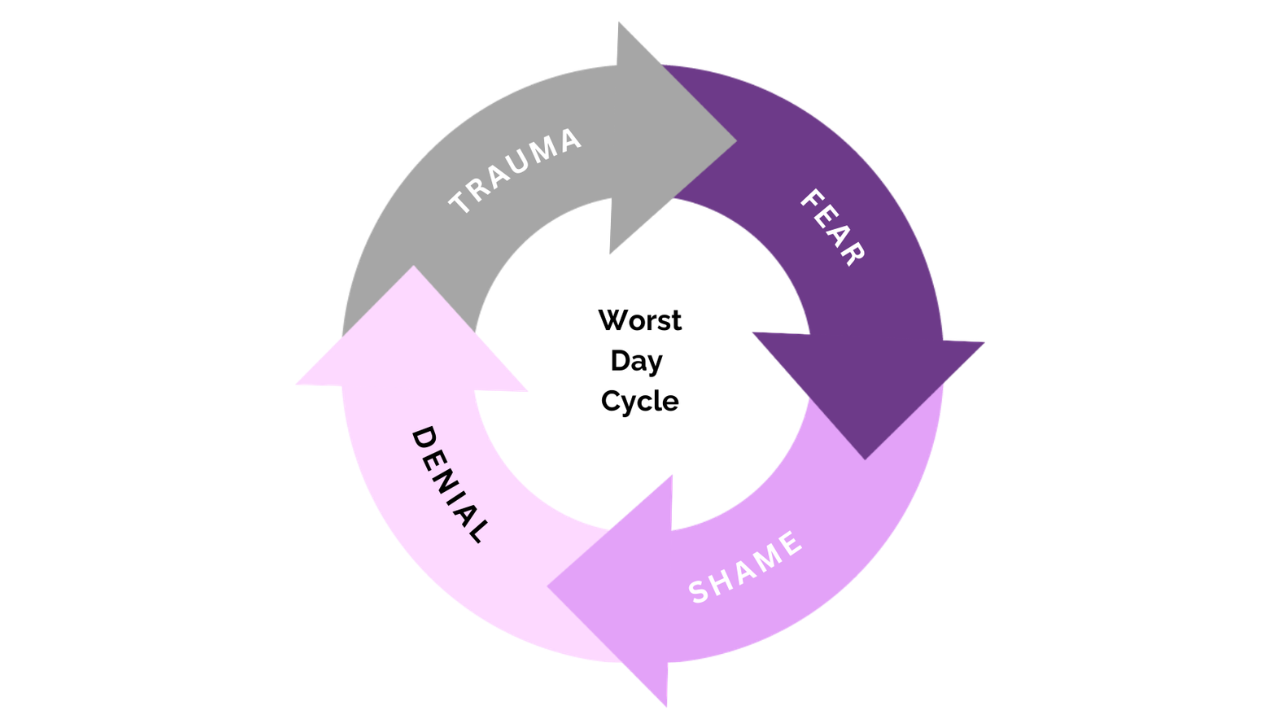
What created the personality of the meat suit, though? Well, it is something I call The Worst Day Cycle. The Worst Day Cycle explains how we end up in relationships like these. Furthermore, it explains how we fall short in reaching our potential. If you would like to learn the full process and how it is operating in your life because yes, it is operating in all of our lives, I discuss it at length in my book ‘Your Journey to Success’. Your cycle may not be as extreme as what was portrayed in Bad Vegan, but everybody on this planet is caught living in The Worst Day Cycle.
What is the Worst Day Cycle (WDC)?
On my YouTube channel, I have a 5-part video series which takes you through the WDC called ‘Reclaim Your Authentic Self By Becoming Trauma Informed. You will find that series within my WDC playlist.
The WDC consists of four parts, trauma, fear, shame and denial. This might be hard to swallow but every single one of us experiences trauma in childhood – this is unavoidable. For the Meat Suit in Bad Vegan he experienced significant neglect and abandonment from his father who often took him gambling when he was a child. He and his mother were also held hostage and he watched as his father held a gun to her head. While many of us do not experience this level of trauma. We do experience emotional injuries from our perfectly imperfect caregivers.
Worst Day Cycle
For Sarma the ‘Bad Vegan’, she experienced her parents divorcing at 9 years old which is a difficult experience for anyone to go through and her sister, with all best intention, took on a protective role for her, often talking for Sarma and becoming her voice – this is also what happened in the relationship with Anthony – he became her voice. Sarma ended up playing the prisoner just as she had as a child and therefore subconsciously looked for this in her partners. Someone who could talk for her and ‘protect’ her – the trauma cycle repeats.
Many people don’t realize that they’ve experienced trauma in their childhoods. They believe they are completely recovered from it, but most often this isn’t the case. My video ‘The Wounded Inner Child’ will help you to understand more about this. When you are living in denial and not accepting that your childhood was less than perfect. You can’t recover or prevent similar events like those that took place in ‘Bad Vegan’ from happening.
Worst Day Cycle
When we go through these emotional and traumatic experiences our brain actually becomes emotionally addicted to the explosion of fear chemicals and hormones that are released – we become addicted to the trauma – my video on ‘The Tinder Swindler’ goes into this phenomena in some depth. Because we have been conditioned to minimize and suppress our fears, we are all stuck in it. We’ve never been taught the Emotional Authenticity Method I teach to cope with these difficult emotional life experiences.
There is a great deal of work in science, medicine and society that has taken place around emotions because we now know that, actually, emotions do run our lives – not our intellect. Emotions come first – every thought we have starts with a feeling, and because we haven’t developed the Emotional Authenticity that we need, our brains automatically replay the unhealed emotions from the past when we experience new things or things that subconsciously trigger the same feelings we experienced as children.
The Third Stage
The third stage of the cycle is shame. As a child we must physically and emotionally connect to another human being to survive. Therefore when our parents are imperfect and create emotional injuries inside of us. We adapt and create a false persona to fit in. It is a survival mechanism to protect ourselves. Because it happens so young, we believe it is the real “us”. This loss of the authentic self creates a power vacuum. Shame is ultimately a power dynamic. We use this deep shame core as adults to regain our power. How do we do that? By choosing hobbies, friends, careers and relationships that mirror the injuries of our childhood. We do this because even though we have been hurt, who is responsible for the hurt? Ourselves, we CHOSE, this person place or thing. The overwhelming truth that we are responsible for our self-victimization send us into denial.
About Denial
Denial is the single greatest killer on the planet today. He is the main reason you don’t have the relationship, career or life you want. This is exactly what Sarma was caught in – the shame and denial portions of the cycle. She kept going back, choosing to re-victimize herself (shame) by denying the abuse and lies that were right in front of her. Not because she is a bad person but because as a society we don’t teach about The Worst Day Cycle or how to attain Emotional Authenticity.
To dive deeper into how denial is the single greatest killer on the planet today, I really recommend checking out my ‘Self-Deception/Denial’ playlist on YouTube so you can learn how your denial is affecting your life and begin the healing journey.
The Worst Day Cycle is incredibly powerful. People often think that these sorts of experiences can only happen to people who aren’t smart or are defective in some way, but Sarma was a very clever woman. It happens to all of us. Many people find this very difficult to accept – that even the ‘victim’ could be responsible for bad things happening to them, but learning to accept responsibility for this is the only way to heal. Sarma wanted money, she wanted her dog to be saved and she made the choice to stay. She did these things because of The Worst Day Cycle and her lack of Emotional Authenticity.
Resources and links to help you
We must become an expert in the worst day cycle and how trauma, fear, shame and denial operate in our lives. My book ‘Your Journey to Success’ goes through this in detail.
If you would like to start your healing journey then sign up to my free masterclass ‘Your Journey to Emotional Authenticity.’ Learning my Emotional Authenticity method does not take long and you will see very quickly how much better your life becomes and when you have the knowledge, skills, and tools, how easy it is to avoid being eaten by a meat suit!
Are you looking for more solutions? Pick the one that suits your needs best!
Do you ever feel like your partner is manipulating you? In today’s article, I will be sharing five different manipulative tactics people use in relationships. With this new understanding, you can protect yourself from manipulators.
1- They take advantage of your fairness
A perfect example of this is in a divorce where a couple tries to split things 50/50. When one side starts bringing up something that you ‘owe’ them because of X, Y, or Z, the person trying to be fair gets taken advantage of. They use that sense of fairness against you. Then, of course, they deny doing any such thing.
2- They deny and project
This looks like them explaining away their lies and deception as necessary. They will downplay what they said and say it’s “no big deal.” They might even flat out deny that what they’re doing or what they did is wrong. In the end, you start to question what actually happened – everything is now on you.
3- They will try to separate you from your family
This can happen in many ways. It can be overt, like saying, “I don’t like your family, and we’re not spending time over there.” Or they might try to convince you that your family is wrong for you. So you end up being placed in a position where you have to choose between a relationship with this person or seeing your family. If it’s not overt suggestions, it will be hints and dismissive messages.
4- They remove your skepticism
When you feel like you can’t ask them a question or bring up a topic you’re struggling with within the relationship, and you’re met with anger or derision, they remove your ability to be openly skeptical. You feel attacked for even considering needing or wanting something from them. It could be as simple as enjoying a hug or spending more time with them. And you feel this sense of impending trouble if you try. As a result, you have to walk on eggshells and can’t express yourself.
5- They play nice
They end up doing a lot for you regardless of whether or not they want to. They eventually start throwing back in your face everything they do for you and try to use that as leverage for you to do things for them. “I did X for you. Why can’t you do Y for me?” They keep score which is very codependent, manipulative, and the antithesis of unconditional love.
What is the solution?
At the heart of all this, there’s an attraction to this manipulative person. The parent who used conditional love creates the attraction as an adult. The direct or indirect messages were that we have to fit into this box, and we are no longer a part of the family if we don’t. That original abandonment is why we fall for the manipulations as an adult.
Being manipulated in a relationship is hurtful and confusing. However, on the positive side, it only requires gaining some new skills and tools to end the pain.
Are you looking for more solutions? Pick the one that suits your needs best!
Did you know that many people confuse a subtype of codependency with Narcissist?
It is critically important to know the difference between the two because you can save a relationship with a codependent, but you can’t keep a relationship with a narcissist.
What’s creating this confusion?
Why do people get codependency and narcissism mixed up? Well, first simple answer is the internet.
When you view informative content on any platform, you’re only getting a snapshot of the whole truth. No one would be receptive to content spanning ten or twelve hours – our attention spans aren’t that long! We prefer content that is short and to the point. It’s impossible to cover all of the subtleties and intricacies of a dynamic in such a short amount of time or a passing post on social media.
People watch several videos or view content and become self-professed experts on the content, not realizing that there is so much to it that they have missed. They then pass this incomplete information along, leading to a lack of clarity and misunderstanding of the distinctions. It actually requires a lot of invested time and effort to become an expert in something.
So, even this content that I will share will not give you a complete picture of the differences between codependency and narcissism. Still, it will provide you with a basic understanding that you can explore and, if you like, delve deeper.
The second reason is the lack of understanding in regards to codependence. Sadly, most professionals only know or speak about the typical disempowered, needy, type we are all familiar with. Many are not aware of Pia Mellody’s work which shows that in fact, there is not only the standard disempowered, but also it’s polar opposite, the falsely empowered. To learn more about this relatively unknown side of codependence I suggest you pick up her book, Facing Codependence and subscribe to my Youtube channel. I have several videos on my Codependence playlist which will provide you the complete understanding of Codependence.
What is a narcissist?
According to the DSM, for someone to be considered a narcissist, they must have at least five of the following nine characteristics:
A grandiose sense of self-importance. They exaggerate their talents and achievements to seem superior.
A preoccupation with fantasies of unlimited power, success, brilliance, beauty, or ideal love.
A belief that they are special or unique can only be understood by or associated with people or institutions with high statuses.
Requirements of excessive admiration; attempts to attract others and be their focus of attention.
A sense of entitlement such as unreasonable expectations of favorable treatment or automatic compliance with their expectations.
Exploits others to achieve their own ends; relationships are largely superficial and exist for their own self-esteem.
A lack of empathy with an unwillingness to recognize or identify with the feelings of others.
Envious of others or believes others are envious of them.
Arrogant, haughty attitudes or behaviors.
If someone has at least five of these characteristics without any external factors such as addictions, alcohol, or drugs, they may be a narcissist. In addition, these traits must be relatively stable and consistent across time and situations – they don’t just have moments of these characteristics that come and go.
Falsely empowered codependent?
This subtype of codependence is often mistaken for narcissism. In some ways, they look exactly the same, but not in all ways, and the critical part is the stability of these traits across situations.
Most people teach codependence as one overarching concept, leaving people with the impression that codependent people are whiny, spineless, and weak. That’s the disempowered side of the dynamic. The other side is linked to some of the most successful people on the planet. This is not to say that some successful and powerful people are not narcissistic, but what we celebrate as a successful person in our society is often actually a falsely empowered codependent.
This subtype of codependent is arrogant, grandiose, invulnerable, anti-dependent, a perfectionist, walled-off, and controlling. This is the CEO, lawyer, banker, finance type, social media star, and actor. These people rely on grandiosity, admiration, entitlement and demand the attention of others to succeed in their career, social status, or achievements. Can you see how this could be mistaken for narcissism?
Falsely Empowered Codependents
Falsely empowered codependents minimize and deny their own feelings, seeing them as weaknesses; they lack empathy for others’ emotions. This is because they are so invested in achieving what is called ‘outside pursuits’ such as their career, they can only focus on themselves and their achievement. They need approval and validation just like a narcissist and persistently label, judge, and criticize others. They might use sex, money, intellect, and charm or gifts to manipulate, control, and have power over others. Or they might be indifferent, authoritative, or enraged as a means to control people.
This type of codependent will try to control and shape others’ thoughts, feelings, and actions. They will avoid emotional, physical, intellectual, and sexual intimacy to keep control and distance. Illness, addiction, and outside hobbies or interests will be used to avoid reality. This subtype believes they have everything together and don’t have any issues; any perceived problems are because of other people. These codependents are also created by their childhood trauma. Unfortunately, they will likely say that their childhood and parents were perfect; there were no problems growing up.
However, despite how similar this is to narcissism, some differences set them apart.
The difference between narcissism and falsely empowered codependence
Although falsely empowered codependents will rarely admit their mistake, they are aware they have made a mistake. They will rarely cooperate, negotiate, or discuss a problem, but they are usually aware that they can avoid the problem. On the other hand, the narcissist thinks that they are faultless and that you are the crazy one for seeing any kind of fault with them.
Similarly, the codependent will feel superior to others to hide their shame while the narcissist lacks that awareness. The codependent might be aware that they need help but will never ask for it, and they will be resistant to professional help.
Something commonly found in the falsely empowered codependent is addiction. That doesn’t just mean alcohol, drugs, gambling, or other typically ‘addictive’ things. It can be an addiction to food or working out, for example, or other more ‘acceptable’ things; it doesn’t have to be an addiction to illicit things. With a narcissist, addiction is not always the present. These traits are almost always present in narcissism, while the falsely empowered codependent almost always has an addiction present, which is partially to blame for the behavior. While it is true that some narcissists do have addictions, the narcissist’s primary addiction, usually, is themselves. In many cases they don’t need an outside substance. Finally, they are not present enough in themselves to observe their dysregulation while a falsely empowered codependent is.
So, the three main distinctions between the narcissist and the falsely empowered codependent are awareness, addiction, and consistency.
Three Main Distinctions
The falsely empowered codependent may not admit their dysfunction, but they are aware of it, while the narcissist is entirely oblivious. You may as well be speaking a different language. The codependent almost always has an addiction, while the narcissist sometimes does. And all of the personality traits discussed above that show up in narcissism are consistent across time and situations. One narcissistic moment at one point does not mean a person is a narcissist.
Take Phoenix, Arizona, and Denver, Colorado as comparisons. Phoenix is a desert – it’s always hot, the skies are usually blue, clouds rarely form, or rain falls; it’s unchanging like a narcissist with only occasional dips. On the other hand, Denver has multiple seasons with long winters that seem almost endless, but they do end. This is an example of consistency differences. You can think of the narcissists as Phoenix and the falsely empowered codependent as Denver. One’s behavior is constant, while the other has seasons.
So, when people watch a fifteen-minute video and become an ‘expert,’ they’re missing out on the inconsistencies of narcissistic traits found in the codependent. Instead, they mistake falsely empowered codependence as narcissism.
Seek Professional Help
This is why it is so important to seek professional help when dealing with these dynamics. Then, when you start to discover the subtleties truly, you’ll realize the difference between the two, which could be the key to saving your relationships.
If you are not ready to do that, you can go to my Youtube channel, you will find the Codependent and Narcissism playlists. In my opinion, it is critical to understand codependence because it is so prevalent in daily life and relationships. People underestimate how vital codependence recovery is to navigate anything.Gaining the knowledge, skills, and tools to overcome codependence might save a relationship. To get more help with setting boundaries and healing from Codependence, take advantage of my FREE downloads here: http://kennyweiss.net/resources/
Are you looking for more solutions? Pick the one that suits your needs best!
Today we’re talking about how to fight fair and save your relationship.
We’re covering three main topics: reality arguments (the source of every fight).
The basic ground rules for a fight, and a detailed confrontational model that will literally save your relationship. You will learn to love fighting – it will give you deep intimacy and connection.
As a bonus, I put all of this together in a free pamphlet on my website. Be sure to check that out. You’ll want a guide to follow, and this lays it out simply and easily.
I want to help you develop intimacy and save your relationship. So many are falling apart because we’ve never been taught how to fight. Let’s change that.
We have to start with the reality argument – this destroys all relationships. A reality argument is based on me having a view of the world that’s different from yours.
What gets couples in trouble is demanding the other person accept their reality. If I hold up a Coke can and ask if you want a sip of water, you’d think I was crazy. Think about the fights you’ve had with your partner.
what have they been about?
You see a Coke can, and they see water, different realities. We can never change a person’s reality, and our desire to change the other person’s reality is about us, not them.
Each person has different views, memories, and interpretations of what’s been said and done. When we demand the other side accept our reality. That’s the problem.
The other person doesn’t have to accept our reality; they get to keep their own. When I demand you see the world, as I see it, I’ve lost containment, and I am now exercising something called negative control.
In addition, we have just made that person our higher power. We have given our personal power to them, and they now own us because our well-being is predicated on them accepting our reality.
I know you’re sitting there thinking,
“But it’s the truth; they have to see the truth!” I would agree with you completely. It’s true to you. But, they have their own truth. When we demand someone to accept our reality, it means they can demand that of us.
Flip the table. If someone demanded that of you, you wouldn’t accept it.
So how do we resolve having different realities?
First, both sides need to layout their morals, values, needs, wants, negotiable’s and non-negotiable in every area of their lives. Basically, sharing how each of you views the world.
Then, listen and see if your realities line up on these topics – see if it’s negotiable. Finally, with this new information, we get to decide if their reality goes against our morals, values, needs, wants, negotiable’s, and non-negotiable’s.
If they do, we may want to think about leaving the relationship.
You may go through these exercises and realize you and your partner have a lot in common – it’s just your recollection of events that don’t line up.
This is where we move to the second phase: the ground rules for the speaker and listener in a disagreement. This is the first step in turning the fights from confrontation into connection.
Using these ground rules will help us break free from the prison of the reality argument and start creating intimacy and connection.
You’ll find that when you use this process. After that, fights aren’t so scary.
1- The first ground rule for the person speaking is to moderate their emotions. So many times, we go into these arguments with our emotions on fire. It’s our responsibility to contain ourselves.
2- When we share any aspect of what we’re talking about, we commit no shaming, accusing, blaming, judging, yelling, screaming, or giving the other person advice.
3- Our goal isn’t to be right or to change their reality but to be known. We want someone to know who we are: that’s the goal as a speaker.
4- We never tell them what they should think or feel. Doing so would create a real argument. They get to think and feel what they want.
5- We never try to guess their emotions or read their minds. We want to refrain from making judgments about their actions or habits. Instead, we need to gather more information to understand what they’re really thinking or feeling.
6- The sixth step is critical: no one ever makes us feel anything – we always have the choice about what we feel about something.
A comment could make you laugh one day and make you really upset the next. We decide how to think and feel about something.
It’s critical to recognize whenever we say “you made me feel,” we aren’t taking responsibility for ourselves. We are demanding the other person take responsibility for us, and that’s not their job – that’s codependence. Love cannot exist with codependence.
7- We always use “I” statements.
The Seven ground rules for listening are:
1- We never interrupt, and we don’t take their blame. When someone loses containment, they may blame. We never take that on. Don’t accept it as truth, just as their feelings. Don’t interrupt to correct them. Listen to know them, not to be right or wrong.
2-We are responsible for our feelings and the words we are using. We need boundaries to achieve this. We also need boundaries to know if we should take a break from the conversation.
3- We listen to learn about the other person’s reality and view, not to form a defense. Defense is the first act of war. Instead, listen to learn about them.
4- If we’re ever unsure about their reality, ask for information. It’s our job to gather that information and clarity. Always try to do this in four sentences or less. Don’t try to sneak in your thoughts and feelings.
5- Own the truth. If the information they’re sharing is true, own it immediately. Remember, our goal as the listener is to learn more about them and take ownership of our side of the street.
6- If what they’re sharing is not your reality, detach yourself from the emotions. Listen without judgment and accept their reality is different. Don’t try to change it. You’re learning about your partner.
7- If necessary, after you’ve done the first six steps, negotiate a solution.
Now let’s move on to the confrontation model. I’m going to warn you: initially this will feel very uncomfortable, dry, and clinical. But, I can not express how important it is to learn and stick with.
As I shared in my book, my second marriage died the day we stopped using this process. We had used this confrontation model throughout our relationship, and our relationship was incredible.
One day we disagreed about something and were using the confrontation model.
My wife at the time was cooking at the stove while we were discussing a disagreement, and she turned to me and said, “Kenny, could you just stop all this and just tell me what you really think and feel.
Quit being so boundaries.” I’ll never forget it: I looked up at the popcorn texture on the ceiling and thought, “Don’t do it. She’s just scared.
You need to be strong for both of us.” Then I heard that too familiar voice, telling me that if I really loved her.
I am supposed to give her what she wants. Sadly, that is a harmful codependent message we have all been taught, and it is not loving, kind, or authentic.
I gave in to that destructive messaging and dropped my boundaries, spewing all my thoughts, feelings, and accusations. I went against all I laid out above. That one little yes where I gave myself away slowly crept in and killed our marriage.
It has been my experience that this same dynamic is at the heart of every relationship difficulty. Using the confrontation model will save your relationship – every couple I have worked with that uses this process has a flourishing relationship.
The first step in the confrontation model is to share what you observed: just facts, no blame. Use “I” statements and avoid judging statements.
Second, share how you chose to make yourself feel about what you observe.
Third, ask for more information.
Fourth, request a change by saying, “would you be willing.”
Next, celebrate their no. Our goal is to make a request, not to get what we want. It’s not their responsibility to meet our needs and wants. We celebrate when they say no because we recognize it frees us and is loving.
Think about how most relationships end? Each person exclaims how they did A, B, and C for the other person and never received X. That means both parties said yes to things they wanted to say no to. They were manipulating and bribing their partner to get what they want. That is why the most loving thing we can hear our partner say is no.
Some of those “no’s” may go against your morals and values, so step six is to share what you’ve decided to do for yourself about the situation.
Step seven: we meet the need ourselves. Before we confront, we have a backup plan in place if our partner refuses to meet the change or request we make.
Again, it is wonderful when our partner’s needs and wants match ours, but it is always our responsibility to meet them ourselves.
How would this look in practice? I’ll give an example: a common fight is about intimacy.
Here’s how you’d start: you’d request to have a discussion about the intimacy in the relationship and ask if it’s something you could schedule. You negotiate a time. Say you’ve both negotiated, shown up, and are present for the conversation.
Here’s how the conversation would go:
“It’s been my observation that, over the last three months.when I’ve tried to be intimate, I recollect that I hear no. About that, I make myself feel sad, rejected, insignificant, ugly, unwanted. So I was wondering if you’d be willing to give me more information as to why we’re not intimate.”
Do you notice that there were no “you” statements, only a sharing of my reality and a request for information.
They may have said something like,
“What do you mean? We were intimate two weeks ago.”
Obviously, they didn’t use the confrontation model. If they had, the response would’ve been,
“I really appreciate you sharing. What I think I hear you saying is over the last three months.
you have no recollection of us being intimate at all. About that, you feel sad, rejected, unwanted, ugly, and a couple of other feelings that I can’t recall. Do I hear you correctly?”
The model is to give back what we heard and show that we’ve listened. They would then follow with,
“You asked for more information. Are you ready to hear that right now?”
You would say yes, and they would say something like,
“My recollection is, two weeks ago, when we went over to Bob and Suzy’s for their dinner party,
we both had a drink or two, and I remember coming home and us doing A, B, C that led to intimacy. Do you have any recollection of that happening at all?”
Do you see the difference in that? The former reply was defensive, and the speaker would’ve never felt cared about or heard.
Instead, the listener made sure to empathize with them and see if they heard the other person correctly and shared their reality maturely and moderately.
Let’s say neither could agree on the reality. Then the speaker could request a change.
I’ve heard that our realities aren’t the same. I’ve recently realised that I require more intimacy in our relationship. I was wondering whether you’d be willing to commit to weekly intimacy. Does that suit you?”
Let’s assume the other person says no, coming back with making sure they heard them right, but saying it doesn’t work and once a month is enough intimacy for them.
Then the speaker says they have to go off and think about it and let them know what they decide – they’ll see if it can fit their needs and wants.
The example I gave is tough to meet the need ourselves – we all deserve physical intimacy. Therefore, it could create a problem for some people, and they may have to consider the relationship as a whole.
I hope this helped you – I again urge you to print out the free PDF for you and your partner.
I guarantee that if you get past the uncomfortableness, it becomes very normal and connecting and will save your relationship, and that is ultimately what I want for you.
Do you feel like people are always taking and never giving back to you? Have you ever felt guilty for setting boundaries with someone who doesn’t respect them? Are these codependent patterns robbing you of the relationship you crave?
If so, this course is for you. It will teach how to set healthy boundaries in every situation and overcome the guilt or fear that comes with it.
Setting boundaries is one of the most important things we can do for ourselves. It’s not selfish. It’s self-care!
When we don’t set healthy boundaries, we end up feeling drained and resentful and our relationships are filled with codependency.
But when we take care of ourselves by setting limits on what others can do or say to us, our relationships improve, and so does our mental health.
You deserve a life where you feel safe and loved – let this course show you how to conquer codependence and break the fear of setting boundaries.
It doesn’t matter if you’re dealing with difficult family members, friends, partners, or co-workers – this course will teach you how to handle any difficult situation with grace and confidence.
And it also includes real-life examples, so you know exactly what works in different situations!
Get started on your journey to your best life today by signing up for our online masterclass,
If you’re recovering from Codependency and are searching for a way to improve your relationships, finances, or general mental health recovery.
It’s vital that You:
Understand your morals and values
Ask for your needs and wants
Determine your negotiable’s and non-negotiable’s
Recovery from Codependency is not easy, but it is possible. In today’s article, we will cover the first step, understanding our personal morals and values.
What is the difference between a moral and a value?
A value is our deepest belief about what is right and what is wrong. Our values guide our decisions. On the other hand, a moral is our thoughts about those core values.
Whether they are good or bad. Once we decide something is good or bad, it becomes our moral.
Examples:
One value could be honesty. If a person puts a high value on honesty, they may believe that stealing is morally wrong. However, a person who values honesty less may believe that theft is morally right or okay in certain situations.
Another value could be professional success. If a person puts a high value on professional success, they may believe that working eighty hours a week is morally good.
However, a person who values professional success less may believe that working eighty hours a week is morally wrong. These people may value something like relationships more highly.
Your values shape what you see as moral, which is why your morals will be different from someone else’s . your values may not align precisely with those around you.
While you may think you know what yours are in the grand scheme of things.
Have you ever actually sat down and considered them in-depth?
When we begin defining our morals and values, we discover they are usually based on our parents’ or society’s views rather than independently determined ones.
Taking a moment to consider your ideals allows you to evaluate why your life may not be where you want it to be.
Look at your life story.
Are the relationships in your past healthy and positive?
Or are they filled with chaos and unhappiness? Are your finances where you want them to be? How about your health? Your career?
If any of these things are causing you stress, unhappiness, or worry, this is proof that your current morals and values are not working.
you don’t have a North Star guiding your path.
However, if you’re ready to discover your morals and values, you need to ask yourself seven questions:
Is my current set of principles and values assisting or hindering me?
Are my principles and values influenced by power?
Are my morals and values based on the desire for reward or the avoidance of punishment (particularly from my parents)?
Do my beliefs and values stem from a sense of duty?
Are my beliefs and values based on conformity and acceptance seeking?
Am I willing to face punishment or rejection, casting off duty and conformity, to claim my own beliefs?
What would my morals and values be if I thought for myself and pursued the greater good?
Why does this matter in codependency recovery?
Answering these seven questions helps us determine where we are in our recovery journey and how our morals and values may be hindering our success. Famed psychologist Lawrence Kohlberg developed a three-level theory on moral development that helps inform these questions.
Level 1: Preconventional Morality
This type of morality generally occurs between the ages of three and seven when we think only of what will benefit us. So we look for power, and we do what we can to avoid punishment. This is the fundamental essence of a child.
If we seek power and are afraid of punishment, we live in the past and pre-conventional morality.
Level 2: Conventional Morality
From the ages of eight to thirteen, we see morals as a duty and a way to seek approval. A significant marker of a codependent is their desire to conform and do everything for others.
Their esteem comes from outside sources. If we are only doing things for praise and to fit in with society’s values.
we become stuck in codependence.
Everyone has some level of conforming tendencies – nobody is immune – which is why this is a ‘conventional’ type of morality.
Level 3: Post-conventional Morality
Only 10-15% of people will ever achieve true post-conventional morality, meaning they will reach adult maturity. This research-backed statistic proves that most of us are stuck in Codependency.
Unfortunately, this Codependency is very prevalent in our society; it is responsible for nearly all social unrest, trouble within our relationships, finances, and health.
For the minority that does manage to make it to this third level, it means they are willing to cast off duty and conformity.
They are ready to take unpopular stances and have unpopular beliefs (even if it means punishment and rejection) because it is the right thing to do and is for the greater good.
What can we take from this?
Codependents and most of society are stuck in level one or two of Kohlberg’s theory. And that’s why their lives are in disarray.
If you have the morals of a child, those are the same morals you learned from your parents, not ones you formed from your own set of values as you grew.
People with the morals of a child are not ready to take an unpopular stance. They’re afraid of punishment and rejection.
Because they are unaware of the three levels of morality, most people may think they are pursuing the greater good when they aren’t. Instead.
They seek power, achievement, and reward while avoiding punishment, which only serves to keep them in that first or second level.
Those seven questions are essential in defining our morals and values because they help us identify where we are in our moral development.
Therefore, becoming aware of your position is the first step in determining morals and values, which will help direct you towards the life you want to lead.
If you would like to learn more, check out the video:
Are you in a relationship with a man or woman who shuts down emotionally and avoids intimacy and connection? Would you like to know if you can save the relationship? That’s what we’re talking about in today’s article.
First, I will be breaking down what causes a love avoidant, what’s going on inside them, and finally, how to save it – is it even possible?
Before we start, I want to clarify that love avoidance is a spectrum. All of us have moments where we avoid love, but in this article.
I will discuss those further out on the spectrum. In all my years of research, Pia Mellody is, in my belief, the foremost expert on codependence, love addiction, and love avoidance.
I believe so strongly I earnestly tell people that her books should be required reading before anyone goes on a date. If her understanding of relationship dynamics were common knowledge,
I believe the divorce epidemic would be profoundly reduced.
She defines the characteristics of a love avoidant as:
1- Evading intimacy within the relationship by creating intensity in activities (usually addictions) outside the relationship.
2- Avoid being known in the relationship in order to protect themselves from engulfment and control by the other person
3- Avoid intimate contact with their partners, using a variety of processes I call “distancing techniques.” (1)
What causes love avoidance
What causes love avoidance is sad and heartbreaking: they were most likely made to parent someone, typically an actual parent or sibling, emotionally and or physically.
Or, they may have been smothered, used, controlled, or manipulated to become an adult too soon. Divorced parents of the avoidant are common and in the aftermath.
The mom or dad makes the child a surrogate spouse or best friend using the child to comfort themselves emotionally. This was my experience.
While my parents never divorced, my mom was an alcoholic who enmeshed me, made me her surrogate spouse, and covertly sexually abused me, while my father used me to unload his anger.
In short, the avoidant’s childhood was stripped from them because they were required to sacrifice their emotional well-being for others’ benefit.
What is going on inside the avoidant?
Internally the avoidant is rarely in touch with themselves because they are so consumed with their addiction to their work, gambling, alcohol, porn, food, shopping, virtually any addiction will do.
If not an addiction, there is always something more important than the relationship, an animal, a hobby, or kids.
The avoidant needs something to be addictive or important because they feel alive only in their outside pursuits.
Relationships in their childhood came at a severe cost, so, ultimately, as Pia Mellody points out, they don’t want to be known because it means to be smothered, suffocated, and abandoned for them.
Is it possible to save the relationship?
Unfortunately, it isn’t easy to save a relationship with a love avoidant. Here’s why: do you see what it requires from them? To participate, they would have to get help to heal their childhood pain, and help requires vulnerability and intimacy.
In their life experience, intimacy looks like engulfment, control, manipulation, and suffocation.
Therefore, it is infrequent for an avoidant to pursue counseling or coaching because it would require them to face what they fear most, being vulnerable.
That is why it is fair to say that the love avoidant is never in the relationship – they can’t be.
Being in a relationship means being vulnerable. So they guard their vulnerability by walking out of the room, avoiding deep discussions and arguments. All attempts to create connection are a trigger for them to run.
Complicating matters more is that as a child, to survive, they detached from their feelings and created a falsely empowered reality that they are fine.
So they wouldn’t have to feel the pain of how they were used and thus abandoned. In addition, being relied upon by an adult leaves a child with a sense of false power.
This false reality and sense of power mean most are not even aware that they are in pain, and many will accuse you of being overly emotional. If you ask them to seek help, they are so disconnected from the truth.
They honestly can’t see or feel that they have a problem. Unless you are the one in a million, who has found an avoidant who’s actually willing to get help.
The chances of creating the relationship you crave are minimal.
This leaves you with a decision to make: are you willing to stay in the relationship and accept that all you’re going to get are scraps? If you are, that’s the only way to “save” it. To achieve that, you have to be willing to drop everything you’ve complained about. It would be best if you relinquished nearly all of your expectations and accept that your needs and wants won’t be met.
Tips for those who decide to stay.
If you decide to stay, here are a few things that might make it a little better: stop chasing them, stop asking for intimacy. Ignore and “abandon” them.
I know that sounds cruel, but remember, their childhood smothering and the requirement to meet others’ needs emotionally created excruciating abandonment.
No one was there to care for them. But since they are disconnected from reality and believe that they are fine, they are not aware of their subconscious abandonment fear.
When you start pursuing your own life and meet your needs and wants yourself, subconsciously, they will feel abandoned, and they will chase you but don’t be fooled.
The second you start opening up, they’ll run again. Find that middle space where they don’t run and realize you can never fully trust that they will be intimate.
You must remind yourself that avoidants will rarely join you consistently in that shared relationship space without recovery.
Unfortunately, there is a cost to this approach. When you feel like you are acting just like them, cold, distant, and detached from the relationship.
you will know you are doing it correctly. That’s what you’ll have to settle for.
If you can live with that, that’s how you “save” the relationship.
I know this is heartbreaking to recognize what your partner has been through. I’m not condoning their behavior.
It’s about understanding what causes them to behave the way they do and seeing that there is very little we can do about it in many cases.
On the positive side, knowing these truths empowers us to advocate for ourselves, and the best way to love another is to make decisions that express love towards ourselves. Furthermore, you can now make an informed decision as to how you want to proceed.
Are You Tired of Being in an Emotionally Toxic Relationship?
You’re not alone. Millions of people are stuck in codependent relationships that make them feel bad about themselves, and they don’t know how to break free. We’ve all been there.
Or maybe you find yourself always attracted to someone who is not good for you, and the cycle starts again.
But it doesn’t have to be this way! There is hope! We will help you find your way out of the darkness and into the light.
If you are single, you deserve better than being stuck in a cycle of narcissistic abuse or neglect. You deserve love and kindness! Don’t let another day go by where someone else controls your happiness or self-worth.
Take control today with this course and start living life on your terms again! Save yourself from heartache and take back control over your life with this course now!
If you have a partner, it’s time to take back control of your life and start learning how to save and resurrect a toxic, broken, codependent relationship.
Fill it with love, safety, affection, kindness, understanding intimacy, and mutual connection. Start living the romantic life you deserve by breaking free from your toxic codependent relationship patterns today.
It doesn’t have to be like this forever – we want to show you how it could be different for you now.
All it takes is one step at a time…and we’ll walk with you every step of the way on your journey to the loving relationship you deserve.
The sooner you take action, the sooner your life will get back on track. Join our community and learn how to heal yourself from codependence so that you can find happiness again.
You are worth it!
Sign up NOW!
How To Break Free From Toxic Relationship Patterns
Welcome back! In today’s article, I will share what I believe are the 10 steps both personality types should take to heal from codependence. If you are unsure which type you are, go back and watch my video on the two types.
One is the classic disempowered: this is what we typically think of when we think of codependence. They try to take care of everyone. Few people recognize the polar opposite type: the falsely empowered codependent. This is a typically successful person, but the grandiose and anti-dependent personality is hiding codependence. Neither side is in reality: each is stuck in a child-like state. Recovery is recognizing this is what we’re doing and getting into reality.
Alice Miller has a great quote in The Drama of the Gifted Child about the need for us to get into reality,
“Both the disempowered and the falsely empowered person completely deny their childhood reality by living as though the availability of the parents can still be salvaged. The falsely empowered person does this through the illusion of achievement and the disempowered through their constant fear of losing love. Neither can accept the truth that this loss or absence of love has already happened in the past and that no effort whatsoever can change this fact” (I’ve switched out the terms she uses for “disempowered” and “falsely empowered” for clarity).
This highlights the stumbling block for all of us in codependence. However, the ship has sailed, and we must do the work now as adults.
Let’s get into the 10 steps for getting back into reality. For the disempowered:
Self-esteem. They really struggle with the sense of self because they think doing for others elevates their sense of self when it really does the opposite. If you want to get into more details on this, I suggest you watch my video How to Build Self Confidence – it is great for laying out the steps to achieve self-love.
Stop shaming themselves. They spend a lot of time in guilt and shame, especially when doing things for themselves. They must heal from this – I suggest another video of mine called How to Heal Shame.
Start asking for and meeting their own needs and wants. They feel guilt and shame when asking for anything.
Start taking care of themselves first. They were trained the only way to survive and get mom and dad’s attention was to give themselves away. They need to ask themselves who they are and what they truly like. Stop focusing outside. Start focusing internally.
Learn to share what they really think and feel. Inside they’re boiling with anger, but they don’t voice it. Instead, they may be passive-aggressive or expect others to mind-read. It’s not their fault – they learned to suppress their anger in childhood.
Take responsibility for their thoughts, feelings, and actions. We always have a choice, but codependence puts the responsibility on others, saying, “you made me…” This phrase demonstrates a person is not in reality and is stuck in a child-like state.
Get into reality.
They don’t realize their “niceness” is not truly nice – it’s actually manipulation. The proof is in the hidden anger and resentment. Because they give themselves away, they have interpersonal issues and keep track of everything. They’re doing it as a form of barter, and they’re hoping for the same in return. In dealing with their rage and resentment, they need to face the facts. It is time for them to accept the fact that taking care of others is a form of self-absorption. They’re abandoning themselves just like they were abandoned in childhood.
Practice the three Gets of AL-ANON. Get off their back, get out of their way, get on with their life. On their back, means they notice everything in other people’s life. It’s none of their business, and others can live how they want, so they must get off their back and out of the way. They must get on with their own life by meeting their wants and needs and getting into reality.
Say no. They tend to say yes to everything – they couldn’t say no in childhood. They need to rebuild esteem, so they feel worthy enough to say no.
Set boundaries. The best place to learn is Pia Mellody’s Facing Codependence. Everyone should read this book to learn what healthy boundaries are.
For the falsely empowered:
Self-esteem. They think they have self-esteem because they’ve achieved so much. So they use achievements and material things to cover up a lack of self-esteem.
Ask for and get support. They are anti-dependent and do everything on their own. They must open up, be vulnerable, and realize it’s not a weakness.
Take responsibility for their thoughts, feelings, and actions, just like above.
Stop saying no to gain power over someone. They won’t argue for fear of losing power, and they won’t spend time with you, etc. They need to address how they use this as a power mechanism.
Be more vulnerable and transparent. They don’t authentically share their thoughts and feelings to hide their unhealed pain.
Address their avoidance mechanisms. They’ll use work, kids, addictions, and activities to avoid themselves and others.
Stop giving advice.
This is another power mechanism they employ.
Stop the controlling. They’ll demean their partner by saying they want too much – they will use judgment, blame, and criticism to attain more power.
Get into reality, just like the disempowered. First, it’s challenging for them to admit they’ve been through childhood trauma. Next, they must realize their outside accomplishments are an attempt to fill an inner hole. Many athletes, actors, and politicians are looking for money to validate themselves and avoid the past’s pain. Finally, they must accept they have a problem. This will likely be the hardest step – it’s tough for this side to accept they have an issue.
Seek professional help. The detachment from reality is much more severe because they have been convinced their achievements prove well adjusted.
There are the 10 steps for both sides of the codependent dynamic to conquer their codependence. I suggest you check out the links I’ve included for a deeper dive into the recovery process.
Or…
If you are ready to dive right now, you can learn how to conquer codependence in my new masterclass.
Welcome back! Today I’m talking about the fascinating polarity of the two codependent personality types. Codependence can be characterized as living on one end of two extremes.
The typical “disempowered” that we commonly identify with on one extreme and the “falsely empowered” on the other.
The falsely empowered is not very well known or recognized that’s the side I want to dig into.
It is important because our society holds this person up as the ideal .When they are just as dysfunctional as the disempowered. We’re missing out on developing healthy and connected relationships without this information.
Before getting into the specifics of the falsely empowered codependent.
I want to share what I believe to be the six common characteristics the two types share:
Childhood trauma. In my video What Causes Codependence. I point out how anyone struggling with codependence has been through abusive less-than-nurturing parenting. I know that’s hard to hear, but we in society are out of reality about how deeply our childhoods affect us.
That’s why I choose, along with Pia Mellody, to call it abusive. We tend to have a limited perception of what abuse looks like, and we miss out on the bigger picture.
I’m not blaming the parents – we can’t do what we don’t know. But we have to admit this abuse happens and thus creates codependence.
The perfect imperfections of our parents weren’t intended to be unloving, but they were harmful .we all experience this. Our parents aren’t bad people, nor are we.
With a more realistic understanding, we can break through this together. Check out my other video on this childhood trauma topic for more details.
Damaged self-esteem.
The disempowered have little or no self-esteem while the falsely empowered have false esteem, looking for it outside of themselves – this is known as “other” esteem.
Inability to take care of their needs and wants. The disempowered can be too needy, dependent, and demanding.
The falsely empowered are anti-dependent, needless, and wantless, which is still codependence.
Dysfunctional boundaries. The disempowered have no boundaries while the falsely empowered have walls for boundaries .
it’s again on polar opposite sides.
An inability to express and own their reality. They both struggle with this immensely.
The disempowered will see themselves as unselfish and kind.
When in fact, they are manipulative.
They’re out of reality that their niceness can set up an abusive and manipulative dynamic.
it allows the other’s dysfunction to operate and thus enables it. You’ll see this in “empaths” – they are hyper-codependents that have no boundaries.
A true empath empathizes but isn’t affected by other’s emotions. I’m not saying they aren’t kind and loving . They just aren’t in reality about what they are genuinely doing.
For the falsely empowered, they don’t see themselves clearly, but they think they do. They believe they are always right and don’t need help.
They think nothing is wrong with them, that their childhood was wonderful. They’re out of reality in that they’re shut down and defensive.
They see it as signs of strength, believing that showing emotions is weak. Neither can see the abuse in their childhood or how their behavior is hurtful and abusive towards others.
They both think they’re living in reality but aren’t.
Inability to express their reality moderately. They both live in extremes and chaos. The disempowered get over-involved: this is an inability to navigate reality.
They take care of others and sacrifice their own needs. They distort their view of helping others and can’t express their thoughts and feelings moderately.
They’re hyper-emotional when they express themselves. For the falsely empowered, they are completely detached and emotionless.
They can’t share they were hurt because they are so detached from the hurt and the relationship. Pia does a great job pointing out how the typical arrogant, grandiose, vulnerable, anti-dependent, perfectionist overachiever has been branded as a healthy adult: they’re really severely codependent.
The view of a codependent shouldn’t always be a weak and spineless person – there is also the falsely empowered codependent putting up a wall.
Realizing this can significantly help the disempowered – they know they’re the same as the grandiose person and don’t feel negatively towards themselves.
Many people can have traits of both disempowered and falsely empowered
I am an example! I inadvertently put other writers down by celebrating Pia: that’s my grandiosity and codependence. On the other side, sometimes I sign off a show with low esteem, quietly asking people to share.
We are all battling these things. Part of the recovery journey starts on one side and swings to the other – I do this all the time! I try to work on how I communicate my thoughts and ideas to be less grandiose or condescending.
I, like all of us, went through severely abusive and less-than-nurturing parenting.
But this doesn’t mean we don’t also go through nurturing, loving, beautiful moments as a child. We all experience the perfect and imperfect.
That’s healthy and moderate. My parent’s perfections left me with fantastic memories. Mostly of Christmas with beautiful lights, presents, and my dad happy and not detached.
It was the one time a year I got to spend with my father perfectly attuned – parents will do this all the time. I just want us to get into reality about the imperfect and perfect moments. I’m asking that we consider both sides do exist, and both are equally OK – the perfections and imperfections.
Let’s get into the falsely empowered a little more. Those disempowered will feel far less bad when they see the closed-off successful person is no different from themselves.
The falsely empowered will:
Seek “other” esteem through career and social status. This is the primary mechanism – everything in American is about to achieve, achieve, achieve.
The most successful people are the most broken. They are driven by a shame core of feeling less than. Yet it’s expressed as better than. Career, social status, social media likes drive their value. The disempowered does this by doing for others. See how similar they are?
Rarely know what they’re feeling. They’re most often blank and detached. They can’t feel, and they can’t communicate their feelings.
See feelings as a weakness while they minimize their own.
The typical male CEO will say he doesn’t bring feelings into the board room.
This is a lack of understanding of how the brain and body work together. Every thought we have starts with a feeling! We’re starting to turn women into this, which is devasting .
we are asking them to forget their inherent gift.
We’re beginning to see many more women falsely empowered and men disempowered in an attempt to bring equality – it’s hurting both sides.
Use isolation, anger, or humor to hide their feelings.
Lack empathy and interest in other’s feelings. This is one reason why falsely empowered, and disempowered people are drawn to each other. It is a continuation of their childhood experience that created their mutual codependence.
Not ask for or accept help. Sometimes they may not even mention when something terrible happened – to do so would create connection, and they fear connection.
They hide from and mask their emotional pain. I struggled with this – expressing physical pain was difficult. If I came home hurt and my ex-wife asked what happened.
I would immediately get angry. Sometimes I would be completely detached from physical pain, which brings in an important point.
Our spectrum of codependence is physical, emotional, spiritual, and intellectual. We can be emotionally on one side and physically on another.
Label, judge and criticize others persistently. I do this all the time! You can see it in my videos. The reason I get haughty and think I’m better than others.
It is because I couldn’t persuade my father to hear and embrace the truth about our situation.
I need to be able to back up my claims. As a result of my own sense of inadequacy and insignificance. I seek external affirmation.
Be indifferent, authoritative, or use rage to control.
Rarely admit their mistakes and must be right all the time. You see this in CEOs – part of their gift is that they are headstrong! But it comes with detriments.
Try to control and shape other’s thoughts. If you’re disempowered, you’ve been through this.
Use sex, money, intellect, charm, and gifts to manipulate, control, and have power over other people. This trait has strong connections with narcissism.
Avoid emotional, physical, and intellectual intimacy to keep control and distance. They may be too busy working, taking care of the kids, with their hobbies. We think it makes them strong and powerful, but it’s avoidance.
Use illness or addiction to avoid real intimacy and connection. Almost all illness and disease is brought on by the environment which is your emotional condition.
People don’t think they make themselves sick . it’s because we have a lack of understanding. Western medicine only gives us 50% of what we should know.
Decades of research and proof say you cannot separate the body and mind regarding illness and disease.
So it’s not a question as to whether our emotions make us sick – it has been proven.
Deny childhood trauma. The falsely empowered see their childhood as perfect – no ones is.
Be resistant to or will rarely seek help. That’s the grandiose position that they have to be right. Many falsely empowered likely would’ve stopped reading at this point.
It’s too confronting. Healthy adults can take information from all sides and navigate their emotional reactions to it.
The biggest stumbling block for both is their denial. Neither are in reality of the damage from their childhood and therefore can’t see and admit who they really are.
But they both think they know who they are. Both sides lack compassion for themselves and self-esteem. They abandon themselves at the extremes.
I hope this helps you separate the two polarities of codependence and shines a light on the rarely discussed falsely empowered. For genuine connection and intimacy to form in a relationship, it will require us to understand the impact of our perfectly imperfect childhoods and heal the codependence that resulted.
Hello and welcome! Today I’m breaking down what causes codependency. To start, I’m going to share a passage straight from Pia Mellody’s Facing Codependence.
I believe the way she’s explained the causes of codependence is so critical for every person. After reading her explanation, I believe you can immediately determine if these conditions are operating in your own life.
“Where does the disease come from?
I have come to believe that the dysfunctional, less-than-nurturing, abusive family systems create children who become codependent adults.
Our cultures’ inherent belief that a certain kind of parenting is normal contributes to the difficulty of facing codependence. But a closer examination of normal parenting techniques reveals that they include certain aspects and practices .
That actually tend to impair the growth and development of the child and lead to the development of codependence. In reality, what we tend to call normal parenting very often isn’t healthy for the child’s development.
It is less than nurturing or abusive parenting. For example, many people think that the range of normal parenting includes hitting the child with a hand or a belt, slapping a child across the face.
Screaming at a child, calling a child names, having the child sleep with them, or being nude in front of a child who is older than the age of three or four.
Figure out a way to deal with life situations
Or they think it’s acceptable to require small children to figure out a way to deal with life situations and problems themselves. rather than providing a concrete set of rules for social conduct and some basic problem solving techniques.
Some parents also neglect to teach basic hygiene such as bathing, daily grooming, the use of deodorants, dental care, removing dirt, stains, and body odor from clothes.
And how to keep them mended, expecting the children to somehow know these things on their own. Some parents think that if children are not given rigid rules and swift, severe punishment for breaking them.
The children will become juvenile delinquents, teen unwed mothers, or drug addicts. Some parents, after making a mistake such as punishing a child in error because the full facts were not clear at the time of the punishment. They would never apologize to the child for the mistake.
undermine the parent’s authority
Such parents conceive that an apology would be seen as showing weakness that might undermine the parent’s authority. Some parents believe perhaps unconsciously that children’s thoughts and feelings have little validity because the children are immature and need training.
These parents respond to a child’s thoughts and feelings by saying, “You shouldn’t feel that way or I don’t care if you don’t want to go to bed. You’re going because it’s good for you,” and believe they are training the child in a functional way.
Still, other parents swing to the opposite extreme and overprotect their children, not making the children face the consequences of their own abusive and dysfunctional behavior.
Such parents are often very intimate with their children, using them for confidants and sharing secrets beyond the children’s level of development.
This, too is abusive.
Many of us who were raised in homes where this kind of behavior was common grew up in the delusion that what happened to us was normal and appropriate.
Our caregivers encouraged us to believe that our problems as adults arose because we didn’t respond appropriately to what happened to us.
And many of us arrived in adulthood filled with baffling feelings and with the distorted way of looking at the world and what happened in our family of origin.
We got the idea that the way our families behaved toward us was correct and our caregivers were good.
This meant by unconscious deduction that since we weren’t happy or comfortable in our adult life with some things that went on or things that went on as a child.we were somehow not good.
Also, we apparently couldn’t please our parents by being what we were naturally. This delusion that the abuse was normal and we were wrong locks us into the disease of codependence with no way out.”
I know many of you will shy away from the word “abuse.” You may recognize your parents have done many of these behaviors, thinking their actions were not wrong.
That’s the delusion of denial. We are massively undereducated on what healthy parenting is. That said, we aren’t blaming the parents.
As we know better, we can do better. We are only just discovering how abusive these things are.
No one likes the term “abusive.” The following quote is from another page out of Pia’s book, and I think it’s compelling.
“In my work with patients at the Meadows, I had come to know that the term abuse is much broader than most people think.
It includes more than the overt physical beatings, injuries, and sexual incest or molestation we commonly associate with the term.
Abuse also takes emotional, intellectual, and spiritual forms. In fact, when I talk about abuse. I now include any experience in childhood from birth to the age of 17 that was less than nurturing.”
I agree, and here’s why: look at the trail of tears in our adult lives.
The addictions and the divorces are all borne from how we were treated as children. That’s the result of less-than-nurturing parenting.
I broke down essential points for you to see if it happened in your childhood and if you suffer from codependence:
if there was yelling, hitting, nudity beyond the age of three, sleeping with the child beyond the age of three.
A lack of rules and structure, too many rules and structure, invalidating a child’s thoughts and feelings, blaming a child for the parent’s feelings, making a child responsible for keeping the parent comfortable.
Making a child the best friend, making a child the confidant, spoiling a child, making a child act beyond their age and development, never apologizing to the child, abandonment, divorce, addiction, mental and physical illness, neglect (physical, emotional, intellectual), being raised by others besides the parents.
This list is exhaustive and could go on. Remember: so many of these things aren’t conscious and are just the cost of being a parent!
There’s a hesitancy in us to hearing these truths.
Instead of getting defensive, we should accept them and learn. Defensiveness is a sign of a lack of compassion for ourselves – we don’t want to admit we went through this. But we must.
I believe that every one of us has experienced less-than-nurturing and abusive parenting. We all have grown up codependently.
People don’t want to see it this way and blame me for pointing out the truth. There’s a bind where we want to protect our parents.
This bind is not loving to ourselves or our parents. When we are in deception, love cannot exist.
But here’s the beauty: do you see how it brings us all together? This is an inclusionary process and statement to recognize. Life is tough; parenting is overwhelming.
So let’s stop this false protection that’s killing us and robbing us of truth and connection. We see the virus of shame exploding in society, but it kills the virus the second you bring it to light.
That’s how we heal and create intimacy!
The belief we walk out of childhood without abuse shows we’re in denial. We have to accept we are all codependent and should talk about it. Then, we can drop the shame and have compassion for our parents. It is OK to be perfectly imperfect.
If you want to learn more, check out my video breaking down the two different personality types in codependence.