In today’s Best Day Blog and accompanying video, I will help you transform the emotional misery of toxic shame into Emotional Authenticity by bringing awareness as to how toxic shame creates the false self.
Toxic shame is an internal separation from ourselves. It’s where the false self is born, and it is the third stage of The Worst Day Cycle.
How is Toxic Shame Created?
It starts with our parents. Not because they were bad people, but because all parents are perfectly imperfect and human. Because of this, parents can communicate with their children in a way that creates toxic shame by not being able to differentiate between the child doing something imperfectly or being something imperfect. As such, we grow up believing that if we make a mistake, we as a person are the mistake.
Toxic Shame Creates ‘doers,’ not ‘be-ers
Toxic shame makes us ‘doers’ and not ‘be-ers’ because we inadvertently learn that who we are ‘being’ is bad, rather than just being that what we were doing was imperfect. Therefore the doing becomes a false self. We only know how to ‘do’ because to ‘be’ us was a mistake.
We must learn to just ‘be’ because underneath the ‘doing’ resides the anger and rage, and it wants to come out. When we can be, the rage is released, and healing occurs.
Shame expert John Bradshaw describes it this way:
‘Toxic shame is a rupture of the authentic self that necessitates developing a false self. With a false self, intimacy is impossible. In toxic shame, the self becomes an object of its own contempt, an object that can’t be trusted. A toxically shamed person is divided within himself and must create a false self cover-up to hide his sense of being flawed and defective. You cannot offer yourself to another person if you do not know who you really are. A shame-based person will guard against exposing his inner self to others, but more significantly, he will guard against exposing himself to himself.’
Toxic Shame leads to Codependency.
The second sign of toxic shame is codependency. Most toxic shame is given to us when we are much too young to be aware of it before age 3. It’s not just what our parents did to us. It’s also what our parents didn’t do when they weren’t emotionally available. Often, when our parents couldn’t provide what we needed at the time we needed it, we were left feeling an emotion – sadness, pain, anger – and this is where codependence is formed. Our parents taught us to believe that others make us feel a certain way. In reality, no one can make us feel anything. We are always in control of how we feel and can make a choice.
Additionally, our parents do not teach us how to discover our morals, values, needs, wants, negotiables, and non-negotiables. Instead, they require us to adopt theirs.
Because of this, we are all chameleon-like in our adult lives, taking on the traits of others and being dependent on them to define who we are.
Toxic Shame Creates Self-abandonment
When we become a chameleon, we lose who we are. One of the main ways we abandon ourselves is through toxic relationships. Toxic relationships happen because we experience these sorts of relationships in our childhood – we all remake the relationships we see in childhood because we are stuck in toxic shame.
Another way we self-abandon is through addiction. Work, food, alcohol, drugs, pot, pills, sex, porn, gambling, shopping, tv, social media, sugar – they all have their core in shame. Many addictions have now been normalized in society – alcohol and overeating are two of the most common.
Toxic Shame Creates Blame
We cannot take responsibility and, therefore, we blame instead. We blame how we feel on others – ‘You made me think, feel or do…’, which often happens in relationships. We also blame ourselves a lot for the shame. Phrases indicating toxic shame are ‘should’ and ‘could’ – ‘I should have known’ or ‘I could have done this instead.’ This simply isn’t true – in every moment, you are doing the best you can with the knowledge you have, and as you gain more knowledge, you can make different decisions – you are not to blame.
When you blame yourself, that is the child within you hearing your parent’s voice saying, ‘You could/should have done better. You are to blame!’. Please recognize that this is your inner child’s voice. Listen to it, and release the blame.
Toxic Shame Requires Secrecy
We hide who we are. Brene Brown talks about this and likens shame to how a virus grows. When you put a disease or virus in a petri dish, put it in the dark, and it consumes the dish. However, when you bring it back into the light, it dissolves – the light heals it. This is the same with your shame – keeping it in the dark, it grows and multiplies behind a layer of secrecy. But, if you can bring it to the light and share how you feel, you can heal.
We even hide our genuine emotions by labeling them with other emotions – we call fear, anger, we call fear stress! Fear is always one of three things: the fear of rejection, inadequacy, or powerlessness. So, whenever you see someone who is angry, you see one of those three fears coming through them.
Many of us also simply feel numb – in fact, studies show that up to 70% of people don’t know what they feel and recall feelings of numbness. This numb feeling is simply a dissociation method because we cannot begin to deal with what we truly feel, so we’ve checked out and left our bodies.
When we are in our toxic shame, we cannot be in relationships because we always show up as the toxic shame-based self rather than our authentic self.
Solutions to Toxic Shame
This isn’t a quick solution. However, the following will help:
My book ‘Your Journey to Success’ will introduce you to The Worst Day Cycle and how to heal from it so you can start living as your authentic self.
Go to my YouTube channel and visit my Worst Day Cycle playlist. Look for five videos titled Reclaim your authentic self by becoming trauma-informed. In particular, video four talks explicitly about shame.
Also, I have a video called ‘7 Steps to Heal Toxic Shame on my YouTube channel, which will go even more in-depth into this topic. As well as this, I have a codependence recovery playlist that will help you to discover your morals and values, needs and wants, and negotiables and non-negotiables.
I would also encourage you to sign up for my free masterclass, which will give you the basics of turning emotional misery into Emotional Authenticity. It’s called ‘Your Journey to Emotional Authenticity’ and is available at www.thegreatnessu.com.
Toxic shame is the underlying sense of feeling worthless. As parents, we are human and inherently, perfectly imperfect. Therefore, as children, we were all shamed. For some, those moments are few. For others, they are pervasive. Some individuals will carry this shame throughout life as a state of being rather than related to a specific event. For example, someone who gets angry will see themselves as an angry person rather than being mad at certain circumstances or events. In these cases, this person has lost their authentic self and has become the false shame-based self.
If you would like to see an example of how easily shame is placed on us as children, make sure also to check out the video ‘What is Toxic Shame’ on my YouTube channel. In the video, I show you photographic examples of myself as a child and how my mother’s emotional condition created shame in me as an infant. Remember, as children, we mirror our parents’ emotional condition and effectively become whatever it is our parents are feeling. Parenting isn’t words – effective parenting is predicated on the parent’s emotional availability.
Toxic shaming happens throughout our upbringings. Through seemingly innocuous split-second emotional moments, like giving brief, disdainful glances or exasperated replies. If the shame remained an episodic event, this would be less harmful, but this shame is almost always continuous. The child then internalizes it, and it becomes who they are. The problem is that, as a culture, we still downplay the need for education and taking responsibility for developing Emotional Authenticity. The result of not being taught how to deal with this shame or how to master our emotions has most people living in a state of sadness, shame, and depression.
What is at the heart of toxic shame?
Most of us become parents somewhere between the ages of 16-30. We are still trying to complete our maturation process, make sense of our imperfect childhoods, and figure out our life direction and careers. These are tremendously big questions and require intense emotional investment in ourselves to figure out. Even parenting experts or older, more settled adults who understand the dynamics and the dangers of certain behaviors will not get parenting right because it is an overwhelming responsibility. Therefore, it is only natural that we won’t be entirely emotionally available to our children. This emotional abandonment is at the heart of toxic shame.
The helicopter parent who emotionally smothers and enmeshes with their child is one way. This is a parent who uses their child to feed their emotional needs, which sucks the emotional life out of the child. Instead of creating an emotional connection with another adult, these parents need their children to need them and to give them what’s missing in their emotional lives. This is a severely toxically shamed parent who is now doing the same to their child. You often see this with single parents or couples who are not close. The child becomes the surrogate spouse.
Another way parents implant toxic shame into a child is through overly structured parenting. The child is not allowed to be a child and is ‘parentified.’ They cannot make mistakes or show perfect imperfections. If they do, the parents send the message that they are defective rather than the behavior needing adjustment.
What is the other end of the spectrum?
This could either be no structure at home or the parent who effectively counts the days until the child is old enough to look after themselves, telling them to ‘Grow up!’
The following example is difficult to mention, but it needs to be raised—children who are raised by nannies or daycare centers experience emotional abandonment. The child becomes confused about who to attach with, causing shame because they experience repeated abandonment. It would be expected to feel I am saying that if you have to place your child in daycare, I am implying you are a bad parent. However, single-parent homes and having to put children in daycare are just a current fact of life. It is a survival choice. That does not make a parent bad. However, every choice has consequences, and as parents, we owe our children to take ownership that our life choices created situations that emotionally abandoned our children. Denying these facts only increases shame.
In my experience, the most damaging parent is the one who refuses to own and admit that they were imperfect and denies that they imparted some shame on their child—placing themselves in a perfectionist, God-like position is the most abusive form of shame a parent can impart.
A word of caution. For those stuck in the belief that your childhood was perfect and that nothing from your childhood affects you to this day, you are deep in denial of the shame you experienced. (stage 4 of The Worst Day Cycle) This happens in homes where the parents so shamed a child that they are not allowed to experience truth. The child’s soul is sacrificed to glorify the parent. As an adult, admitting their parent’s imperfections would be equivalent to blasphemy and speaking against the diety!
What it is like to experience toxic shame
As author John Bradshaw puts it,
‘When we are exposed without any way to protect ourselves, we feel the pain of shame. If we are continually overexposed, shame becomes toxic. The self becomes an object of its own contempt, an object that can’t be trusted. Shame is internalized when one is abandoned. Abandonment is the precise term to describe how one loses one’s authentic self and ceases to exist psychologically. Children cannot know who they are without reflective mirrors. Mirroring is done by one’s primary caregivers and is crucial in the first years of life. Abandonment includes the loss of mirroring. Parents who are shut down emotionally cannot mirror and affirm their children’s emotions.
If our caretakers have a wounded inner child, their neediness will prevent them from meeting their own children’s needs. Instead, they will either be angry at their child’s neediness or will try to get their own needs met by making their child an extension of themselves. When a child’s feelings are repressed, especially the feelings of anger and hurt, a person grows up to be an adult with an angry, hurt child inside of him. This hurt child inside of them will spontaneously contaminate that person’s adult behavior.’
This is the essence of the worst day cycle-we repeat the behavior we have always known and go on to contaminate others repeatedly.
24 Characteristics of Toxic Shame
To help you identify the signs of toxic shame, below is a list of 24 feelings or experiences you may have had or be going through now:
1. Secrecy – fear of exposure, going into hiding
2. Feeling used, treated with little or no respect
3. Feeling like you have little impact
4. Worried about what others think of you
5. Feeling like others take advantage of you
6. Wanting to have the last word
7. Not sharing your thoughts or feelings to avoid embarrassment
8. Being afraid to look, act or sound inappropriate or stupid
9. Being a perfectionist
10. Feeling like an outsider or that you are different or left out
11. Feeling suspicious or like you can’t trust others
12. Not wanting to be the center of attention, wallflower, shy, trying to hide, or withdraw
13. Feeling that you can’t be your true self
14. Losing your identity
15. Feelings of regret
16. Anger, both toward yourself and others
17. Self-loathing, or that you are stupid, a failure, a bad person, a fraud, selfish, not enough, you don’t matter, defective, unlovable, shouldn’t have been born
18. Worry and fear
19. Poor relationships/relationship instability and violence
20. Addiction
21. Can’t say no to yourself or others
22. Triggered and have significant reactions to anything that feels disapproving, critical, judging, or rejecting
23. No ability to set boundaries, or you have excessive guilt for setting them
Healthy shame allows for mistakes. It sees them as a gift and our best teachers. Healthy shame has grace, self-forgiveness, and acceptance of our humanity. Healthy shame recognizes when help is needed and that there are limitations to the healing that one can do. It’s creative, and rather than trying to cancel people that trigger us, someone with healthy shame learns about other views.
So, what are the solutions to healing toxic shame? It has been my experience that until we become experts in The Worst Day Cycle and Emotional Authenticity and develop the knowledge, skills, and tools to conquer our trauma, fear, shame, and denial, we will experience topic shame our entire lives.
Suffering is a natural part of life but it doesn’t have to be your entire life. In today’s Best Day Blog article, I’ll share three ways that can help you avoid suffering so you can live a happier, more fulfilling life!
Step 1- Acceptance
When it comes to suffering the first step is to accept it! The journey of life is a journey of learning how to get better at handling our suffering. Therefore, complete acceptance is the first key to overcoming it. Accepting that we’re codependent, we attract narcissists, we medicate with pills, food, pot, relationships, whatever it may be, but committing to no longer shaming ourselves for being perfectly imperfect is the first key step. Drop the ‘shoulds’ and ‘coulds.’ ‘I should stop eating too much,’ ‘I should exercise more’ etc. What if, for now, you just accepted that this is how you are and release the pressure and shame for a moment? The truth of the matter is at this moment you are doing the best you can. If you were really capable of doing more you would. Learn to accept the level of perfect imperfection you are currently operating in.
Underneath, you may not be completely ok with it, but it has not risen to a level where you are ready to make a change. Until that starts to shift and becomes more weighted the other way, learn to accept yourself for where you are in your journey.
Step 2- Stop Avoiding
The second step is to consciously admit that for a period of time we can all be somewhat comfortable living in a way that doesn’t align with our morals and values. The things we do that go against our moral compass and leave us feeling less than loving inside – the overeating, the addiction, the bad relationships – are being used as a tool to avoid what’s underneath. We do these because we fear pursuing the change will cause more suffering than the negative act we are using to cover up our pain.
The biggest realization I had, and that you can have too, is that it’s the avoidance of pain that creates the pain. This links in with my 5 stages of grief, the first 3 stages of which many people will live their entire lives are shock and denial, bargaining, and then anger. Many will ruminate in the first three stages in order to avoid the final two steps, depression and acceptance.
This is where the true pain lies and this is where the suffering is. We use the bad habits and addictions in order to avoid the suffering that is in step 4, but everything we are using to cope is, in fact, creating more of it.
If you feel as though facing the depression and the trauma is too much, you may be projecting onto the depression the idea of it being ‘too big.’ This is normal but it is not true. Sadly, the only way we discover that it is false is by committing to face it. Once we do, that is when we understand the concept of the avoidance of pain creates the pain.
Step 3- Go right at the suffering?
Go right at the heart of the suffering.
When we go towards the pain we discover that often, it’s not as painful as we thought it would be. The amount of joy that can be found in the suffering, once we’ve worked through it, is much, much more than ever could be found in the avoidance. Often, underlying our avoidance is how scared we are to love ourselves – that’s our greatest fear. A poem by Maryanne Williamson explains this better than anything I’ve ever heard, here is an excerpt from her poem:
Our deepest fear is not that we are inadequate. Our deepest fear is that we are powerful beyond measure. It is our light, not our darkness that most frightens us. We ask ourselves who am I to be brilliant gorgeous talented and fabulous? Actually who are you not to be all of those things you’re playing small does not serve the world. There is nothing enlightening about shrinking so that other people won’t feel unsure around you. We were born to make manifest the greatness that is within all of us. It is not in just some of us, it is in everyone. As we let our own light shine we consciously give other people permission to do the same. As we are liberated from our own fear, our presence automatically liberates others.
That is petrifying! To end suffering we have to accept how great we are. That is the journey of life – to make manifest the greatness that lies inside all of us. To admit and acknowledge that we are powerful beings with the capability to change our lives and others’ lives can feel like a lot of responsibility, but when we can learn to understand and appreciate this, we can learn to end the suffering.
it is human to make mistakes. But for many of us, we get caught belittling and demeaning ourselves internally for these perfect imperfections. Yet, being able to admit and accept them is part of the healing journey. So, in today’s Best Day Blog article, I will help you move from emotional misery to Emotional Authenticity.
To achieve this we will look back on how you categorized your memories with messages that you were somehow bad, broken, or not good enough. We will use the ‘3 R’s’ and the ‘3 C’s’ to help help you see them for what they really were – perfectly imperfect moments in your life.
The 3 R’s
They are: remove, remedy, and recognize.
Remove the mantras.
When we have an inner critic, we have specific mantras that we say to ourselves repeatedly – things like ‘What were you thinking?’ ‘Why did I do that?’ These are self-shaming and victimizing mantras and phrases that we belittle ourselves with. These are things that we have learned from our parents – more so, they are usually things that your parents have said to you when growing up – ‘You’re smarter than that!’, ‘Don’t be stupid!’. Perhaps you’ve not been aware of these at all before, so if you have become entirely detached from this, then I recommend, for the next week, every time you make a mistake, pay attention to what you say to yourself and write down the phrase or mantra that runs through your mind. There will be around 3-5 that they use all the time for most. These mantras have become what they believe is their truth about themselves and how they are.
Remedy the problem.
Once you’ve made your list of mantras, it’s time to give them back – to give the pain back – to your parents. Not because you want them to feel pain, but because it was never yours to carry. Spend some time thinking about which mantras you have created from an inner knowing. For example, I always knew my father would not be able to have an open and frank discussion with me, so, if I was upset, my mantra became ‘What’s the point?’
So when I find myself thinking, ‘what’s the point?’ I give the pain back by saying something like, ‘I love you, Dad. I know you were doing the best you could, but this is your pain, and I will not carry it for you anymore. I’m sad you were never taught or allowed to heal your pain, but this is not my responsibility. It is yours, so I give it back to you.’
Recognize yourself.
Now that you’ve cleared away the emotional misery from the past, it’s time to replace it and bring in our authentic selves. The way we do this is by recognizing ourselves. I suggest creating gratitude and accomplishment lists. Express gratitude for everything great in your life AND everything about who you are. If you feel like there isn’t anything you like about yourself, here is a tip, even the act of undertaking this work, is commendable! Be grateful that you’re trying and add this to your list.
If you feel there is nothing to be grateful for, particularly about yourself, take a moment to pause. This is not true. That is a mantra you are using that needs to be given back. First, recognize this fact and give it back to whoever gave it to you. Then, ask, ‘If I was never to think or feel this mantra again, what would I recognize and be grateful for?’. Try listing 3 of these each day.
The 3 C’s
They are: confirm your with, connect with your abilities and clarity.
Confirm your worth.
When we get shamed, we get sent a message that we do not have worth and that our needs and wants don’t matter. Make a list of your needs and wants, and think about the times you asked for your needs and wants but were rebuffed. Then, put a plan in place to give yourself these things and confirm your worth to yourself – whatever makes you feel worthy, do it.
Connect with your abilities.
When a child is shamed or belittled, as well as suppressing their needs and wants, they also learn that it’s not ok to pursue their abilities – this is part of The Worst Day Cycle which causes us to suppress who we are to survive. Think back – can you remember when your parents shouted at you when you wanted their attention? Do you see you attempted to express your needs and wants? The yelling made it clear, that your needs and wants are a problem for them. As such, you start to learn not to ask for your needs and wants, which leads to an inability to connect with your abilities.
So, now you have your gratitude and accomplishments written down and understand your needs and wants, you can start to put a plan in place to reconnect with yourself and your abilities. Pick one small thing you can do each day to reconnect with yourself, and you will start to understand your needs and wants more and more. This is all about taking small steps to begin re-loving yourself.
Clarity.
Learn about The Worst Day Cycle – I write about it in my book ‘Your Journey to Success’ because we have to know what causes the inner critic, where it came from, why we have it and how to stop it and turn it around. This book will provide clarity on The Worst Day Cycle, and the only way to gain clarity is to gain knowledge! If you’re not sure about the book just yet, I have many videos on my YouTube channel that will help you understand more. In addition, my 5-part series, called ‘Reclaim Your Authentic Self by Becoming Trauma-Informed,’ will take you through aspects of The Worst Day Cycle and clarify the who, what, why, when, and how of the inner critic.
Ultimately, letting go of our inner critic is all about converting the emotional misery of the past into Emotional Authenticity in the present. When we put a plan in place and become experts, we regain ourselves and our lives. If you are struggling to accomplish this and want to learn the entire process of Emotional Authenticity, this will show you how. The Complete Emotional Authenticity Method
While there are many reasons we can’t see our self-deception, I will focus on two primary reasons that very few people will ever mention in today’s Best Day Blog article. The fact that so few ever say these are, in part, why it makes it so hard for us to see how we are lying to ourselves.
The two reasons we lie to ourselves
As with most everything in our lives, we learn self-deception as a child. We don’t want to admit our parents are perfectly imperfect as children. For example, it’s natural for a child to feel terrified when parents are late. So, we will make excuses or minimize, justify, or condone their tardiness to calm our fears. Spanking is another example. Many people believe that this type of punishment ‘toughened them up,’ but if their adult boss told them they needed to be spanked, they would rightfully argue that it is entirely unacceptable. So, why would it be ok to slap or spank a defenseless child? Children cannot intellectually or emotionally properly comprehend why it’s happening, let alone stop it. However, we’ve deceived ourselves into thinking that physical abuse is good and healthy parenting.
All of the excuses that people use that make spanking ok are self-deception. The phrases ‘I deserved it!’, ‘It made me stronger, ‘I was being naughty, so it had to happen!’ – all of it is self-deception. Janet Jackson spoke of this when talking about her childhood in an interview, how she was beaten but ‘always deserved it,’ saying that it kept her in line and made her who she is today. Her self-deception led to her making choices such as being physically exposed on national television in a stunt with Justin Timberlake. When people say things like ‘it was never something we didn’t deserve’ as Janet did, it is a clear example of a child using self-deception to survive and make sense of something senseless.
The second factor in facing our self-deception is society and religion. While this isn’t an article to disparage religion, it is here to help you on your journey, and part of that might be asking, ‘what is a primary message in religion’? First, ‘God, the Father, is always right.’ Even for agnostics or atheists, this communicates that your father is always right, which isn’t true. All fathers are human and make mistakes. Secondly, within society, the message to always respect your mother and father is often portrayed at a very young age. These are powerful messages that condemn us to be ‘being bad’ if we question our parent’s imperfections and humanness at all. These messages force us into self-deception as a way to survive.
Another trope that coincides with the imperative not to question our parent’s imperfections is to ‘not speak ill of the dead.’ So, if our parents have passed and we are looking to do inner work to heal our childhood injuries, it will be difficult, with this thinking, to correctly assign responsibility. By not speaking ill of the dead, we are repressing the healing that we deserve, which robs us of the life we deserve.
Interestingly, there is no shame in society in being angry at our partner, our siblings, or our boss, but to feel anger towards our parents is frowned upon. It is seen as disrespectful and treasonous, which, again, causes us to lie about what we are feeling. However, to grow and heal, we must learn to honestly express the repressed anger we feel for having to maintain the “God-like” status of our perfectly imperfect parents.
How do we get back into reality?
If we still don’t think that our parents had any effect on our lives and we believe that we’re not in denial or self-deception, then the following three questions will bring clarity, truth, and reality.
One
Did you ever say ‘I will/would never do that to my kids? Are there aspects of your childhood that you would not want to repeat with your children? If so, write them down – these instances are the doorway to discovering the injuries you have repressed and denied to protect your parent’s God-like status at your expense
Two
Have you made a conscious or subconscious attempt to do any aspect of parenting differently than your parents did? This question is a little bit deeper, and, having read this article, you might notice you have made some changes to the way you, yourself, parent. Again, this could be conscious or subconscious, but it will help you realize why you have made these choices to parent in a different way.
Three
Are you feeling anger or guilt at the prospect of admitting your parents made mistakes that left wounds in you? Is that guilt keeping you from realizing that you made adjustments as a parent? Finally, are you feeling the same feelings about your parenting? In my experience, an adult who lives in truth and reality can see themselves in those three questions.
Remember, this is not about belittling or blaming our parents. Even parents who have actively studied how to be better will make mistakes that leave wounds. Your parents were perfect; they clothed you, put a roof over your head, helped you with your homework, and did many beautiful things. But they were also imperfect; they did get angry, maybe hit you, and at times rejected you when they were too busy to play with you. However, the perfect and the imperfect can live in conjunction with each other, and the acceptance of that truth is love.
Are you constantly afraid that you’re going to lose your relationship? In today’s Best Day Blog article, I will help you by sharing seven characteristics of a person who lives in that constant fear of loss and the seven solutions to stop feeling so fearful.
These characteristics have been coined many different things: relationship insecurity and anxious attachment style. Clinically, this person would be called a love addict – don’t worry about the threatening name. If you have a favorite food, drink, or anything else, they have the same addictive mechanisms. Don’t shame yourself.
A big reason we all struggle is our inability to call things what they are. Instead, recognize that living in truth and reality are requirements for creating a healthy relationship.
What are the seven characteristics of a love addict?
Overthinking. This occurs when we replay conversations, look at texts, and decipher every little nuance. The critical distinction is that the thoughts are obsessive and always about figuring out the other person.
Catastrophe thinking. This is often triggered when there is a communication gap. Even the slightest pause in texting or talking triggers the love addict to project fear that the relationship is over, their partner is angry with them, or something is wrong.
Needing constant reassurance. I struggled with this – I learned it from my mother. It was common for our family to be at dinner talking about politics or some other topic, and my mom would suddenly blurt out, “How do I look in this dress?
Bringing the past into the current relationship. Love addicts’ internal fear creates an obsessive need to keep themselves safe. One of the ways they attempt to stay safe is by comparing the past to the present. For instance, you might constantly compare things your current boyfriend does to what your last boyfriend did. Unfortunately, this attempt to avoid pain makes it impossible to be present, and being so hypervigilant can lead to the end of the relationship.
Give too much time, attention, and power to the other person. The love addicts’ desperate need to avoid abandonment creates a disempowering abandonment of themselves. They do this by over-emphasizing their partner’s strengths and elevating them to fantasy. The addict makes their partner’s life more valuable than their own. They give up their interests, space, and desires. There is far too much attention on their partner and not enough on themselves. They effectively make them their higher power.
Snooping. Love addicts will feel the need and even demand to check their partner’s phone or email and look at their partner’s social media too much. They will want to keep tabs on who they are with and where their partner is going. In addition, they are on constant alert for the possibility that they are being replaced.
The inability to feel whole or happy outside of a relationship. Love addicts will feel empty, sad, and depressed if alone and often enter new relationships, even destructive ones, to avoid being alone.
What are seven solutions for love addiction?
Face our self-deception and acknowledge the truth. The love addict needs to get into reality that their expectations are addictive. Our desire for unlimited positive regard and our demand for so much time and attention from the other person is excessive. We have to recognize that how we define love is distorted, and we have recovery work to do ourselves.
Do the three “Gets.” The following three steps come from Al-anon and are called the three “gets.’ Step one is to get off their back. Our constant wondering what they’re doing, our need for continuous attention, overthinking all of their thoughts and actions, and snooping is evidence that we are “on their back” and paying too much attention to their life and not our own.
Get out of their way. The addict needs to stop trying to dictate or correct how their partner lives their life. Let them be who they want to be. Don’t try to change them or get them to meet our needs. They’re okay the way they are. It’s not our place to critique, judge, and tell them who to be.
Get on with your own life. Instead of putting all your time and attention into them, put it into yourself! Learn to meet your needs yourself, get back to living your own life, and pursue the hobbies, friendships, and interests you gave up when the relationship began.
Self-esteem work. For the love addict, their internal sense of security now is based on their partner or the object of their pursuit. Therefore, they must start developing the belief that they have inherent value at all times and not only when they are in a relationship.
Develop boundaries. Addicts struggle to contain how much they share about themselves. So here is a suggestion. I want you to think of gas pedals. If your partner shares a little bit, join them, going about 8-10 MPH. Maybe try to advance to 12-13 MPH, but if they back off, you back off. Here’s how you know when you’re doing this right: you should feel like you’re cold, mean, selfish, and disinterested. You should feel uncomfortable because you’re used to the gas pedal being pushed to the floor. When you feel this new discomfort, you’ll know you’re no longer acting addictively or anxious. Now you’re behaving moderately. You’ll get used to it in no time, and things will improve.
Work with an expert. Childhood abandonment created the addiction. Therefore, working with a specialist is necessary to overcome it. I encourage you to pick up Pia Mellody’s Facing Love Addiction and Facing Codependence to learn about all of this. Beverly Engle’s The Emotionally Abusive Relationship is also great. The addict must get into reality about how abandoned they were in childhood. Those three books are central to those who suffer from love addiction.
Remember, the person struggling with love addiction is not bad or weak. They are in pain and doing their best not to feel that pain. Addictively pursuing someone is the only way they currently know how to alleviate that pain. Sadly, if left untreated, it creates more of the pain they desperately try to avoid. But there is hope. If we develop a plan to heal the underlying pain, we can find the authentic love we crave and deserve.
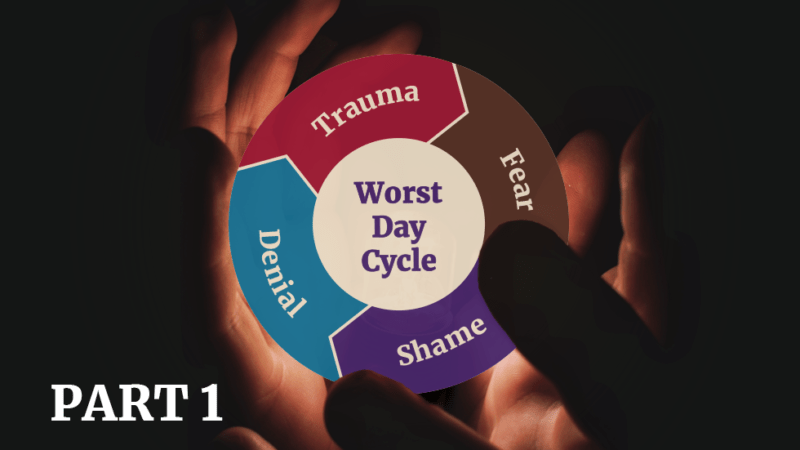
For centuries society has stigmatized, and science has incorrectly downplayed the importance of Emotional Authenticity. But unfortunately, these factors have resulted in humans developing an emotionally self-destructive survival process to absorb the childhood injuries we all experience from perfectly imperfect caregivers. I call this process The Worst Day Cycle.
What Creates The Worst Day Cycle?
For humans to survive, we must form physical and emotional bonds with other humans. Unfortunately, because of a lack of education about how to do this lovingly and that we are human and will make mistakes, we all experience emotional pain and injuries from our caregivers. Since science and society have held us back from evolving emotionally, the best we can do as a child in those moments is to relinquish our inherent power and authentic self. As a result, we develop a shame-based false persona to survive the emotional injuries we experience from our perfectly imperfect caregivers to forge a necessary connection.
The overwhelming emotional experience of childhood injury, loss of inherent power, and adoption of a false persona create a fear-based traumatic emotional chemical addiction in the brain and body of each child. This emotional addiction becomes a mostly subconscious shame-based compulsion to replay the unhealed childhood injuries. The result is that each adult’s relationship/s, career/s, and health outcome/s will mirror the original childhood emotional injury they have yet to heal. The individual does this to regain their lost power (they are now in control of doing it to themselves) and to let them know they need to heal the pain from the past so they can reclaim their authentic self. Sadly, the individual will deny their part because both society nor science have not made them aware of the role they are playing in creating their emotional misery.
In doing so, the individual reclaims their authentic self by healing the pain from the past and discovering the ability to forgive their caregivers and themselves. The end result is the creation of a new self-empowering emotional chemical addiction that embraces those perfect imperfections. The resulting wisdom allows individuals to reach their full potential and operate in their destiny. Most importantly, even if their caregivers never participate in the healing, the individual achieves a deep connection and acceptance toward them. You can learn how The Worst Day Cycle is replaying in your life and how to overcome it here: Your Journey To Success!
Loving your perfect imperfections is a three-step process, and unfortunately, the first one is the most difficult!
Step One: Heal Your Self-Deception
Step one is to admit we have imperfections! We must become experts in our self-deception and how we deny and hide our imperfections from ourselves and others. We all carry shame and pain from our past, and many people can find this very difficult to admit. Studies show that we lie to ourselves 10-200 times daily. What keeps us from the life we want is our inability to acknowledge that our upbringing was not as perfect as we like to think it was. To be human is to be fallible; therefore, parents are not always to blame. I believe that nearly every parent does what they feel is kind and loving. But, because society and science have not taught us Emotional Authenticity, parents are unaware that no matter how great they are as a parent, they will leave wounds in their children.
Most people believe placing any responsibility on our parents is unacceptable or disrespectful. That makes this a complicated truth to accept. Due to underlying shame and fear, any thought of challenging a parent will activate the inner child, who will be fearful of getting in trouble or losing their parents’ love. That is in part how we developed the false persona as a child. Our inability to accept that our parents injured us and left wounds that we replay throughout our adult lives against ourselves is self-deceptive.
My own struggle with denial
It’s an ongoing process to be able to face up to our self-deception. Recently I had to own up to a part of myself I had denied. Years ago, when I was going through a divorce, I lived in an apartment with a pool. My daughters just loved for me to swim underwater with them on my back. The problem was that no one had taught me about The Worst Day Cycle or Emotional Authenticity, so routinely, I would come up with excuses not to play this enjoyable game with them. Even worse, the reason was that I did not want to mess up my hair.
Why did I make it about my hair and other excuses? Well, because of my father. My father was beaten as a child and had four kids by the age of twenty-two. He went straight from being beaten by his father to becoming a dad himself. So, he had no idea how to connect with his children. How could he? I remember asking my dad to hang out with me. I’d watch his whole body tense up. He was unable to bring himself to connect. That unhealed pain transferred to me.
When my children wanted to connect, I embodied what I saw my father do. I relived what I was taught and what I experienced. Not because my father was bad but because my father was in pain. No one had taught him about The Worst Day Cycle or how to achieve Emotional Authenticity, so he was just surviving. That is true for us all. We are all just replaying the pain from the past and surviving.
Step Two: Learn to Forgive Yourself
Unfortunately, as a child, we are too underdeveloped to deal with our parent’s perfect imperfections. So, we developed responses that worked at the moment but were self-destructive long term. To overcome this, we will want to put a plan in place to accept our self-destructive perfect imperfections.
The first step is to stop beating ourselves when we notice ourselves talking and feeling pessimistic towards ourselves. We then replace them with new mantras. For example, ‘I am doing the best I can. I did the best I could with the information I had at the time. As I know better, I can do better, or as I know more, I can do more.’
This is why becoming an expert in conquering The Worst Day Cycle will help you see how you have been repeating the same behavior since childhood, and it is time to forgive yourself.
Step Three: Learn to love your perfect imperfections.
Laugh at them, love them! My hair is a perfect example of being able to accept, laugh, and love our imperfections. I often get disparaging comments that I should just shave it off because it’s barely there. I’m aware I have some mild dysmorphia. When I look in the mirror, I see tons of hair. But I am brought out of denial and into reality when I see a photo. Then, I realize I have very little, and their comments are entirely accurate. Dropping out of denial and self-deception allows me to laugh whenever I get negative comments.
That is the peace we get from Emotional Authenticity. When we are in reality, we can hear comments about our perfect imperfections. When I accept I am human and imperfect, I’m led to new ways to solve problems. This propels me out of the victim role by taking responsibility.
Initial steps to Emotional Authenticity
To help you start this journey, I have a masterclass, ‘Your Journey to Emotional Authenticity,’ and it’s completely FREE! This masterclass is at www.thegreatnessu.com. Additionally, I have created an excellent workbook, ‘How to keep our boundaries.” This is a simple cheat sheet to help you address your perfect imperfections. You can download this for free here: Resources.
Start your healing journey today by embracing Emotional Authenticity so you can learn to love and accept your perfect imperfections!
Are you looking for more solutions? Pick the one that suits your needs best!
Are you confused as to why people ghost you? It’s so common these days, and it leaves us feeling hurt, angry, and perplexed when we can’t figure out why. In today’s Best Day Blog article and the accompanying video, I will help you end that hurt and frustration by explaining why people ghost you, how you attracted a ghoster and what you can do to protect your mental health going forward.
What created the “Ghoster?”
Two things create the people who ghost you. The internet and the underlying emotional feelings within the people who ghost you. The internet has altered the communication landscape drastically. It thrives on separation – messages, emails, text messages. Since only 7% of all communication is words, texting and email are virtually not even communication. Even worse, If you call a person, they tend to be shocked. It may result in you being categorized as weird, threatening, or dysfunctional? Therefore the internet is creating a society that is horrifically underdeveloped emotionally. People can no longer communicate, and most are afraid of intimacy and connection. Think about the extreme rise in the viewing of pornography. This keeps us detached from reality and separates us from intimacy. Unfortunately, society now primarily pursues relationships through screens and not in person.
Perfectly Imperfect Parenting
The nature of being human is to admit that we all make mistakes and therefore we were all raised by perfectly imperfect parents who left emotional wounds in us. These traumatic moments sever attachment, and since we are a child, we are powerless to fix them. This fills the people who ghost with high levels of fear. It might be a fear of confrontation, sharing their needs and wants, or being vulnerable and intimate?
Some people who ghost are aware of their attachment issues and powerlessness but don’t know how to overcome them? Others are aware and consciously choose to ghost you. Regardless, being ghosted is very cruel – to spend time creating a relationship and connection and then, boom, it’s severed with no explanation is a massive abandonment. There are ghosters who do it once and are gone forever, and those who come in and out of your life, repeatedly leaving with no explanation. For someone to do this is abusive, there is no sugar coating this.
Why do people Ghost?
People who ghost will have experienced powerlessness and a lack of attachment as a child. To avoid feeling powerless and out of control as an adult, people who ghost use denial, detachment, and dissociation. To the ghoster, these feel like control and power because they allow them not to feel the pain from the past. Therefore, people who ghost have unhealed emotional pain from the past.
This type of trauma and abandonment causes the people who ghost to put up their defenses, deny what happened, and dissociate from the reality of their childhood. Therefore, it’s tough for them to admit that they might be faulty, deficient, or perfectly imperfect as adults?
Why We Attract People WHo Ghost?.
Many don’t realize that both the people who ghost and the ones attracted to them are part of the problem? On the positive side, that means those attracted to them can create their own solution. First, we have to ask ourselves, ‘what are the benefits of attracting people who ghost?’ You’ll likely say ‘none,’ but there is a reason that you are attracting them into your life. So instead of blaming them and saying they’re the problem, try flipping it and look back at yourself and think of all the ways you benefit?
Some of the benefits for attracting people who ghost:
You don’t have to commit to them
Low drama
Low intensity
Lots of freedom
No accountability for your actions
The first step to attracting people who do not ghost is to get out of denial and into reality of all the.subconscious benefits the person who ghosts brings us. In many ways, you’re having your cake and eating it too because you have the attention, anticipation, and excitement of meeting the people who ghost while still living your life with freedom and no commitment – you subconsciously love it!
However, one of the most significant unconscious benefits is that both the people who ghost and the ones attracted to them treat the other as a light switch. In moments of sadness or loneliness, they switch the light on and reach out for some connection, but as soon as they get what they need, they switch the light off again, making excuses. The truth is, you have to be responsible for yourself and recognize what attracted you to the people who ghost you?
What are you afraid of?
Ultimately, what are both sides afraid of – connection and intimacy. Because of the unhealed pain from the past, both consciously or subconsciously recognize that they are fearful of a relationship. Depending on how deep the pain is, it might ultimately take professional help to conquer these inner fears. It’s challenging to do this alone because the individual is too close to it, and they won’t see themselves. Additionally, the fear of intimacy, abandonment, and powerlessness they experienced as a child blocks their ability to get help. Often they’ll come up with excuses that keep them in denial. For example, convincing themselves with arguments that’ It’s too expensive,’ or ‘I don’t have enough time!’
The solution
If you’ve recognized yourself as a person who ghosts or know that you’re always attracting people who ghost, the best solution is to work with a professional. We all need a guide to show us what we cannot see in ourselves.
If you’re unsure about one-on-one work, then my Complete Emotional Authenticity Method for only $47 a month is perfect. It walks you through healing from your childhood pain, shows you how to go from fearful to fearless, creates intimacy and connection, overcomes codependency, and much more.
Here are more solutions? Pick the one that suits your needs best!
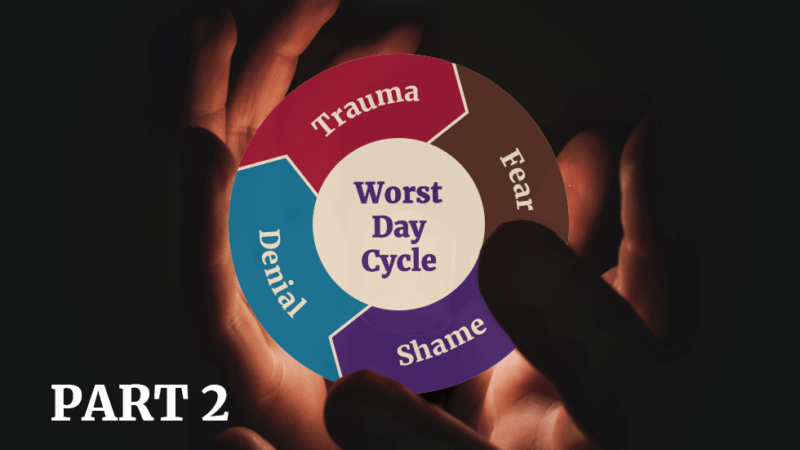
Today’s Best Day Blog article is here to help you on your journey to healing from the past, gain Emotional Authenticity, and love and accept your perfect imperfections. This is part two of my 5-part series about how to heal The Worst Day Cycle, and here I’m going to share the 7 things we need to know about stage 1 of the cycle, trauma:
1: Knowing what trauma is
So, let’s start with the definition. Most people would define trauma as only those events that are very severe, like physical or sexual abuse. However, I have concluded that trauma is any life event that creates a harmful or hurtful emotional experience. I have concluded this because of what happens to us when we have negative emotional experiences. Even the slightest emotional injury creates a very damaging response to the individual, regardless of race, gender, or socioeconomic status. Those responses create lifelong negative consequences that impact a person’s relationships, careers, hobbies, friendships, families, and health. Most of society has minimized this fact to our great detriment. I would like to change that.
2: What happens to us during trauma
As Bessel van der Kolk, a leading expert on trauma, says, ‘Trauma produces a recalibration of the brain’s alarm system, an increase in stress hormone activity, and alterations in the system that filters relevant information from irrelevant.‘ This is the fight or flight system. For example, The brain’s alarm system or fight or flight response activates when we experience something new, For example, a possible new definition for trauma? Our brain and body are repeatedly having a chemical reaction to even the slightest emotional event.
Any stressful or fearful event actually changes the physical makeup of who we are. This is why I define them as traumatic because they alter us. And the more we experience them, the more the brain and body degrade.
Peter Levine, another powerhouse in this field of expertise, says
‘Trauma becomes inscribed as deep impressions carved into the body, brain, and mind, as well as in psyche and soul. It is critical to appreciate just how trauma becomes riveted in the body’s instinctive reactions to a perceived threat; how it becomes fixated in certain emotions, particularly those of fear, terror, and rage, as well as in habitual affective mood states such as depression, and loss of vital energy; and finally, how it plays out in various self-destructive and repetitive behaviors.‘
This is part of what led me to The Worst Day Cycle – because when we experience adverse emotional events, it leaves a deep imprint on all of us, which our brain and bodies get stuck repeating. The critical distinction I am making about trauma is that you can’t grade it. Contrary to what the majority of people believe, all trauma is bad.
3: What creates it?
The most significant source of all of our trauma is our childhood. Unfortunately, none of us leave childhood unscathed. The Adverse Childhood Experience Study (ACE) shows that two-thirds of us have experienced childhood trauma. Sadly, our culture promotes toxic levels of denial around this truth. Many people find it difficult to admit our caregivers hurt us, and we wound our own children. Because we lack Emotional Authenticity, it induces trauma to recognize these truths.
In addition to the ACE study, MRI studies of pregnant women found that stress during pregnancy literally changes the DNA makeup of the child instantly. Pregnancy is an emotionally overwhelming experience and responsibility. Studies show that maternal stress, depression, and exposure to partner violence affect infants before they’re even born. The experience of birth, going from the warmth and safety of the womb, into a world with noise, light, and sound is emotionally traumatic.
Parents are not to blame
The primary way we experience trauma is through parenting, and many people can find this difficult to accept because it can insinuate that I am blaming our parents. As I always say, this isn’t about blame, and it is about responsibility. We are all human. Therefore, we all make mistakes. That means that logically, all of us will be hurtful not by choice but by the nature of being human.
Blame says, ‘You did something that you could’ve done differently, so you are at fault.’ But responsibility says – ‘Yes, I played a part in this but not deliberately. My intent was pure. But I recognize that I was perfectly imperfect because of the lack of information and teaching, and there were consequences, and because I love my child, I accept those consequences.’ Loving your child is taking responsibility for your part in what your child is going through in their adult lives. The most hurtful parents are those who shun any responsibility and place all the blame and burden on the child – importantly, even those parents are not doing this maliciously. They are simply stuck in their unhealed childhood trauma and haven’t gained the Emotional Authenticity to be able to see it.
Gabor Mate, another expert in parenting dynamics, addiction, authentic self, and Emotional Authenticity, says
‘ Of all environments, the one that most profoundly shapes the human personality is the invisible one: the emotional atmosphere in which the child lives during the critical early years of brain development.‘ This timeframe is pre-birth to 7 years old, which means the emotional environment we provide as parents is crucial to our children’s outcomes, so we are responsible but not to blame.
Bruce Lipton, who is a cell biologist and expert in this field, says
‘Young children carefully observe their environment and download the fundamental behaviors, and feelings, of their parents directly into their subconscious memory. As a result, their parents’ behavior and feelings become “hardwired.” into the subconscious mind, those behaviors, and feelings control our biology for the rest of our lives, or at least until we make the effort to reprogram them.’
This is The Worst Day Cycle! We become our parents. Their feelings become the child’s feelings. If the parent is not healing, the child can’t heal because they become hardwired from whatever the parent’s emotional condition is. This is why most of us are simply replaying our lives unconsciously, making the same mistakes, thinking the same thoughts, and experiencing the same things because we have not made an effort to heal the pain from the past.
Parenting experts Foster Cline and Jim Faye, who created the world-renown parenting style of “parenting With Love & Logic say,
‘Whenever we order our children to “Shut up!” “Stop arguing!” or “Turn off the television!” we’re sending a message that slashes into their self-concept. when we give children orders, we are saying: “You don’t take suggestions.” “You can’t figure out the answer for yourself.” “You have to be told what to do by a voice outside your head.”
When we tell our kids what to do, we are telling them we think they are incapable or stupid. We say we know better, you don’t know what you’re doing, and I don’t believe in you. To expect your child to then be able to go out into the world confidently, believing they can do things on their own, is unreasonable.
Now, reflect on your own life – are you a people pleaser? Do you know your own needs and wants? Do you have a strong sense of self? If not, that is trauma! You were stripped of the ability to think for yourself. Told what to do. Unable to make your own decisions. But, rather than being a ‘big,’ dramatic event that caused trauma, it was the simple day-to-day normal parenting, and this is exactly what I am here to share and shed light on – that trauma is happening all the time and everywhere because, as a society, we do not teach Emotional Authenticity.
4: What It leads to – Illness and Disease
The ACE studies show that dysfunction in childhood plays a significant role in chronic diseases, such as heart disease, cancer, stroke, and diabetes – the most common causes of death and disability in the United States. Our emotional trauma history primarily determines our health! Study after study has shown that nearly every illness and disease has an emotional element. The CDC estimates the number to be between 85 and 95%.
This is why the most effective treatment for many conditions is Emotional Authenticity and learning how to heal emotional trauma. Unfortunately, medical schools are run and funded by the pharmaceutical industry in today’s society. They have a vested interest in our doctors only learning biology and only prescribing medications. Our doctors don’t even take a single class on emotions or trauma or their profound direct correlation to illness and disease. As a result, our doctors are woefully under-educated on the entire illness and disease model.
5: How Do You Know If You Experienced Trauma
There are four questions that I’ve devised that will help you to determine if you’ve experienced trauma in your childhood and will also show if you’re stuck in The Worst Day Cycle.
1- As a child, whenever you felt sad, angry, or scared by anything your parents said or did, you could not discuss it with them. The fantastic Gabor Mate’ gets credit for this question.
2- You have kept secret any thoughts, feelings, beliefs, or behaviors from your parents because you fear their disapproval, judgment, or rejection. The fear of rejection, abuse, or abandonment is too strong to be fully authentic, and the trauma bond between parents and children is too strong to admit perfect imperfections.
3- You can’t sit with your parents and openly discuss their perfectly imperfect parenting? Even worse, you’re afraid to mention the subject? If you’re a parent reading this, you might be finding it very difficult to accept responsibility, but this is simply because, as a child yourself, you were stripped of your own voice, and the child inside of you is fearful of facing up to your own parents. To accept what is being said in this article is a threat to the whole emotional upbringing of your childhood – the one that said you must keep your parents happy and keep secret your own trauma, pain, and sadness to get their love and protection.
4- You excuse, minimize or justify your parent’s perfectly imperfect parenting of you. Did your parents hot it yell at you? Do you find yourself defending the behavior by saying it was tough love? It was good for you? It made you strong and tough, or even worse, you deserved it? Minimizing our parent’s behaviors makes it more likely that we will condone the poor behaviors of toxic people like narcissists. You will overlook the behavior in the same way you did as a child. There is a direct, irrefutable connection between the two. Your adult relationship struggles and dysfunctions directly correlate to the care or lack of care you experienced as a child.
6: Why do we have to heal it?
Alice Miller, the Swiss psychologist, explains it well when she says,
‘We cannot really love if we are forbidden to know our truth, the truth about our parents and caregivers as well as about ourselves. We can only try to behave as if we were loving. But this hypocritical behavior is the opposite of love. It is confusing and deceptive, and it produces helpless rage in the deceived person. So, whether it is ourselves or our parents who avoid this mourning it means that we remain at our core the one who is unloved, for we have to dislike everything in ourselves that is not wonderful, good, and clever. Thus we perpetuate the loneliness of childhood: We despise our weakness, helplessness, uncertainty—in short, the perfectly imperfect child in ourselves, our parents, our children, and in others.’
Being forbidden to live in truth is at the core of The Worst Day Cycle. This creates the inability to have Emotional Authenticity, which is why trauma is so significant – because it starts everything. The ability to not blame our parents but hold them responsible is what truth can offer. When we can speak openly about the pain from the past we will then behave and love authentically.
This false love causes people to be in unhealthy relationships. For example, narcissists, because it creates dual deception and manipulation. On one side, the narcissist is being manipulative and most often knows what they are doing is unkind. But the person with the narcissist is also manipulating. They are so desperate for some form of attention and a feeling of love. They use blame and victimhood to gain control and power.
We’re all doing the best we can, and no one is to blame. The goal is to take responsibility for these actions in our lives. That is when healing can begin.
7: The Worst Day Cycle
All we ever do is recreate our trauma – in every aspect of our life – this is The Worst Day Cycle
As Dr. Joe Dispenza says, because of the chemical release that happens when we experience trauma in childhood
‘We choose to remain in the same circumstances because we have become addicted to the emotional state they produce and the chemicals that arouse that state of being.‘ This happens when we go through trauma – it creates an emotional chemical addiction that creates a cycle.
Bessel van der Kolk says
‘Scared animals return home, regardless of whether a home is safe or frightening. Somehow the very event that caused them so much pain had also become their sole source of meaning. They felt fully alive only when they were revisiting their traumatic past’. This is everybody! This is why gallops polls have shown 93% of people on this planet are unhappy because everybody is simply living The Worst Day Cycle day in and day out. To recover, we must become trauma-informed. Doing so brings us into reality on the parenting we had, and the parenting we give as caregivers.
The next step in our journey to healing The Worst Day Cycle is to discover how the chemicals of trauma create the addictive fear response. In the meantime, here are some resources to help you begin the Emotional Authenticity healing journey.
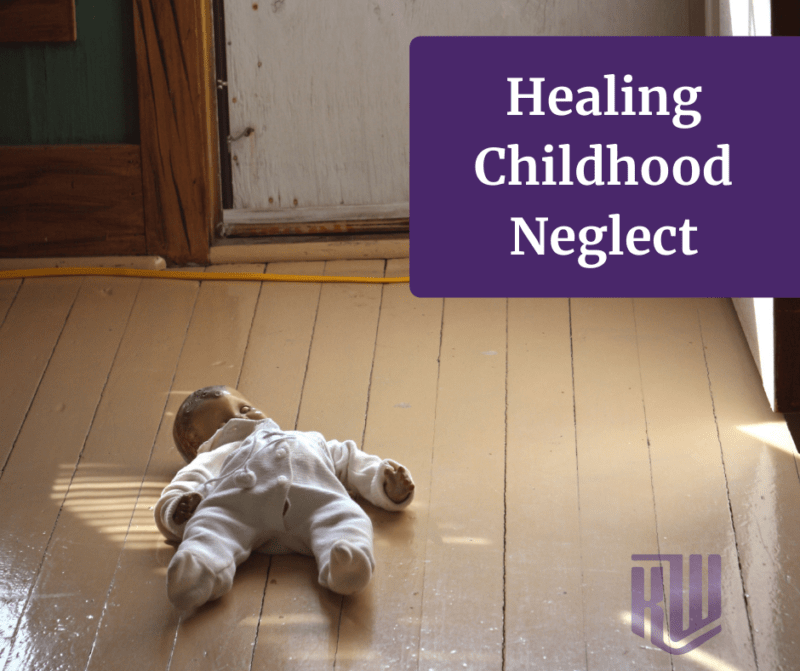
Childhood emotional neglect is experienced as a lack of care, concern, or response to your feelings as a child. It can feel as though your parents:
1- Didn’t notice that you had feelings
2- Didn’t take the time to acknowledge them
3- Or even shamed you for having them.
As an adult,
we then carry this trauma through our interactions and shame ourselves for experiencing feelings. or might ignore them altogether. This can lead to health and relationship problems and an inability to recognize or process emotions properly.
It’s not always malicious or intentional and to some level, we’ve all experienced it. It’s useful to remember that parents are perfectly imperfect people with obligations, responsibilities, and, often, not a lot of free time.
And so through trying to multitask or look after a sibling or keep the house clean, they may not have been present for your feelings.
sort of unintentional neglect
This sort of unintentional neglect isn’t always recognizable until later in life and I certainly only realized in my adult life that I too have experienced this as a child.
A memorable instance was from a time I was unable to discuss with my parents how something my mother had done had affected me.
In this particular example, my mother, who was an alcoholic, had deeply embarrassed me and my family at an important meal and for me, it was a very difficult situation to process.
While my father was able to speak about this with other adult members of the family, if I tried to share how I felt about it I was shut down – the topic was off-limits. This is a primary way that emotional neglect is experienced – the inability to speak about certain topics.
However, there are ways that you can heal this sort of emotional neglect from childhood and in this article, we’ll look at 7 ways that you can do just that.
#1 – Discover and validate your needs and wants
When you can’t talk about certain things, you don’t know or understand your needs and wants.
With my specific experience, I wasn’t allowed to say to my Dad ‘I don’t want to go because Mom will be embarrassing’ – my feeling unsure or unhappy had no bearing on the outcome of the situation.
Experiences like this can lead us to feel that our voice and our feelings are insignificant, and can mean we will learn to never ask for what we want or need as an adult.
In moments of emotional neglect as a child, you often have to give away your self-care. Again, this is you not having a choice of what to do or how to spend your time .
It is all decided for you. To heal from this sort of neglect, self-care that does not include others is a priority. Often, self-care suggestions can include activities that involve others .
chatting with friends, organizing holidays, etc. – but by doing this you are once again relying on someone else to ultimately provide your needs for you.
To heal emotional neglect, doing daily self-care will help to nurture and bring you joy from within. This says to your mind ‘I am worthy.
I want or need this and I will provide it for myself’. It doesn’t matter how small the act of self-care is, as long as it’s something that ‘fills your tank’ and brings you joy each day.
#3 Don’t assume, gather information
As a child we’re not able to voice our feelings, so instead of talking through what we think is happening with our parents or others, we make assumptions in our minds.
This means that as an adult if, for example, your partner is doing something that you’re unsure about, you may not ask them about it.
Instead, as you did as a child, you might make up scenarios and assumptions in your mind that could be incorrect.
Remember, adults in your life now are all dealing with the same pain from the past and many are trying, like you, to heal. When we assume something.
Instead of assuming, ask! Stop and say ‘Can I have some clarity – what did you mean by this, why did you do this.
Pause and try to steer clear of making up what you assume they mean – gather information and ask for clarity.
#4 Make requests for care and love
When you are shut down when asking for love and affection as a child, you’ll carry this on through to adulthood. This experience can lead many to think ‘What’s the point in asking?’.
This shaming or dismissal of your feelings can mean you’ll find that you’re not able to voice what your emotional needs and wants are in adulthood, especially with someone you are very close with.
So, try this with people who you’re not as close to first, because if you start asking these requests from those closest to you and get rejected, you’ll wind up feeling even worse.
By requesting for your wants and needs to mete someone who’s not as close to you. It’s less likely to be as painful if they can not meet them.
It will feel less like a rejection that comes from the place of your trauma. Then, work your way up to those closer and closer to you.
#5 Learn to say no
As a child, you’re not often able to say no to things your parents want you to do. Which means in adult life it can be very difficult for you to feel as though you have permission to say no to things that don’t serve you.
For example, being with an emotionally or physically abusive spouse can be due to an inability to say no to things you don’t want in your life .
you will often tend to put people in your life in an authoritative position. It’s why many people with emotional neglect issues can end up with narcissists.
Remember, it doesn’t make you weak to be unable to stand up for yourself- as you learn more, you can do more to heal and more to stand up for yourself.
If you have grown up in this sort of environment, it’s not easy to stand up for yourself and it’s not something to blame yourself for.
When we are taught the message that we shouldn’t feel, we stuff rage down. Being embarrassed by my mother, for example – and having no one to talk to about this.
Being unable to share my feelings with my father or talk them through was a suppression of my feelings and neglect of my emotions.
Rage was not something I was able to express as a child, and this is often the case in many families that haven’t learned how to work through their own traumas.
Learning to let the rage out through physical acts – hitting a punching bag, shouting, allowing yourself to feel angry. And learning that it is ok for you to feel this way when you need to will help you to heal from this neglect.
#7 Learn to grieve
Learn to feel sadness. There are likely to have been many experiences of grief and sadness in your life that you may be holding on to.
Giving yourself permission to feel this is important for your growth.
To heal this, it can help to learn to re-parent yourself. Talk, journal, or meditate on how you feel and say to yourself the things you wish someone had said to you when you were younger.
It’s not possible to recover from childhood emotional neglect without dealing with the emotional pain and sadness .
you cannot keep suppressing these feelings, even though they’re difficult to work through – take time and go easy on yourself as you journey through this.
If you would like to learn more about childhood emotional neglect here are some videos to help you: