The falsely empowered survival persona—a trauma response created through childhood pain—is frequently mistaken for narcissism because both patterns involve control, dominance, and apparent lack of empathy. However, codependents and narcissists differ fundamentally in three ways: self-awareness (codependents have it; narcissists don’t), behavioral consistency (narcissists show the same traits everywhere; codependents shift by context), and addiction (codependents almost always have one; narcissists rarely do). This distinction matters enormously because you can heal a relationship with a codependent—you cannot with a true narcissist.
Table of Contents
- The Survival Persona Problem: Why Codependents Look Like Narcissists
- Difference #1: Awareness (The Fatal Gap)
- Difference #2: Consistency (Context Is Everything)
- Difference #3: Addiction Patterns
- Understanding the Frameworks: WDC, EAM, ASC
- The Three Survival Personas Explained
- Signs by Life Area: Where to Look
- The Path Forward: Healing vs. Leaving
- People Also Ask
- The Bottom Line
The Survival Persona Problem: Why Codependents Look Like Narcissists
You’re sitting across from your partner. They’re angry, controlling, dismissing your feelings, demanding compliance. They talk over you. They minimize your pain. They gaslight you about what happened. You think: This is a narcissist. This is incurable. I need to leave.
But what if you’re wrong? Not about the pain—that’s real. Not about the need for change—that’s urgent. But about the diagnosis?
The problem is that the falsely empowered survival persona—a trauma-driven identity created to survive childhood pain—behaves almost identically to narcissism on the surface. Both involve:
- Control and dominance strategies
- Anger and rage as communication tools
- Dismissal of your emotional experience
- Apparent lack of empathy or remorse
- Accusations that you’re the “crazy one”
- Refusal to take responsibility
That’s you sitting there wondering if they’re broken beyond repair.
The difference is this: codependents created their survival persona because they had to. Narcissists created theirs and have no idea it’s a persona at all. That gap—one word: awareness—changes everything about whether healing is possible.
Difference #1: Awareness (The Fatal Gap)
Here’s where the road splits.
A codependent—even a falsely empowered one—has moments where they know something is wrong. In a quiet moment, when they’re not triggered, when the shame has quieted down enough, they can see: I do that. I dominate conversations. I cut people off when they disagree. I punish people for leaving. I panic when I’m alone.
They might not admit it to you. They might get defensive when you point it out. But somewhere inside, they know.
A narcissist? They have no such moment. Their brain genuinely does not generate the signal “this is a pattern I created.” They see themselves as the victim, the target, the one being wronged. Even when confronted with evidence, their nervous system goes into protection mode—not shame-and-denial like a codependent, but pure refusal to register the information at all.
That’s the difference between “I know I do this and it terrifies me” and “I have no idea what you’re talking about and you’re crazy for suggesting it.”
In a couple where one partner is falsely empowered codependent, that moment of awareness—even if buried—is the seed everything grows from. That person can heal. They can change. The relationship can be saved. A narcissist cannot have what they cannot see.
The question to ask yourself: When your partner is calm, can they admit anything about their impact? Or is every single conflict rewritten as your fault?
Difference #2: Consistency (Context Is Everything)
Pay attention to this: Where does your partner show up as “the problem”?
A falsely empowered codependent is like a shape-shifter. They rage at you, but they’re warm with their friends. They’re controlling at home, but they’re the peacekeeper at work. They’re dismissive with you, but they panic if their child is upset with them. They have no awareness that these are different people—but they are. The falsely empowered survival persona is context-dependent.
That’s the codependent: brutal in intimate relationships, sometimes fine everywhere else.
A narcissist? They’re consistent. The same tactics work everywhere because they see the world through the same lens everywhere: me vs. them, superior vs. inferior, using vs. being used. They dominate boardrooms, control friend groups, manipulate family, isolate romantic partners. The behavior doesn’t shift by context because the internal narrative doesn’t shift. It’s all the same story in their head: they’re exceptional, others are beneath them or conspiring against them, and anyone who disagrees is wrong.

Ask yourself: Is your partner consistently abusive everywhere they go, or just with you? Do people outside the relationship seem confused when you describe their behavior? Does your partner seem different to you than they do to the world?
If the answer is “yes, they’re different with me than with others,” you’re likely dealing with a codependent survival persona. If the answer is “no, everyone who gets close to them experiences the same thing,” you’re likely dealing with narcissism.
That’s the split that changes what you do next.
Difference #3: Addiction Patterns
Codependents are addicted to emotional states. This is not a judgment. This is how trauma works in the nervous system.
When you experience childhood trauma, your brain’s hypothalamus creates a chemical cocktail: cortisol, adrenaline, dopamine misfires, oxytocin dysregulation. The brain becomes addicted to these states because they’re familiar. Familiar feels safe, even when familiar is painful. So the falsely empowered codependent gets triggered, their nervous system releases the familiar chemical cascade, and on a neurobiological level they feel more like themselves than they do during peace.
This is why they create drama. Why they pick fights over small things. Why they sabotage good moments. Why they can’t sit with quiet contentment. The brain is literally searching for the chemical state it was trained to expect.
That’s you watching them blow up the relationship for no reason, then watching them panic when you leave.
Codependents almost always have substance or behavioral addictions too: alcohol, drugs, sex, gambling, work, exercise, shopping. These are secondary addiction attempts—the brain trying to regulate with something other than relationship drama. A falsely empowered codependent might drink heavily, have compulsive sexual behavior, or be a workaholic. These addictions are painful for them. They feel shame about them.
A narcissist? They rarely have substance addiction. Why would they? Their behavior already regulates their nervous system perfectly. The control, the dominance, the manipulation—these are their drug. They’re getting the exact neurochemical high they need from the relationships themselves. They don’t need alcohol to feel powerful; power feels like power. They don’t need sex addiction; they have a steady supply of narcissistic supply (attention, admiration, obedience) from their relationships.
Narcissists are clean because they’re already getting what they need. Codependents are addicted because they’re trying to feel anything other than the pain their nervous system is literally wired to expect.
That’s the addiction divide.
Understanding the Frameworks: WDC, EAM, ASC
Understanding the difference between codependence and narcissism requires understanding how trauma actually shapes human behavior. This is where the three core frameworks come in.
The Worst Day Cycle™ (WDC): How Trauma Becomes Your Operating System
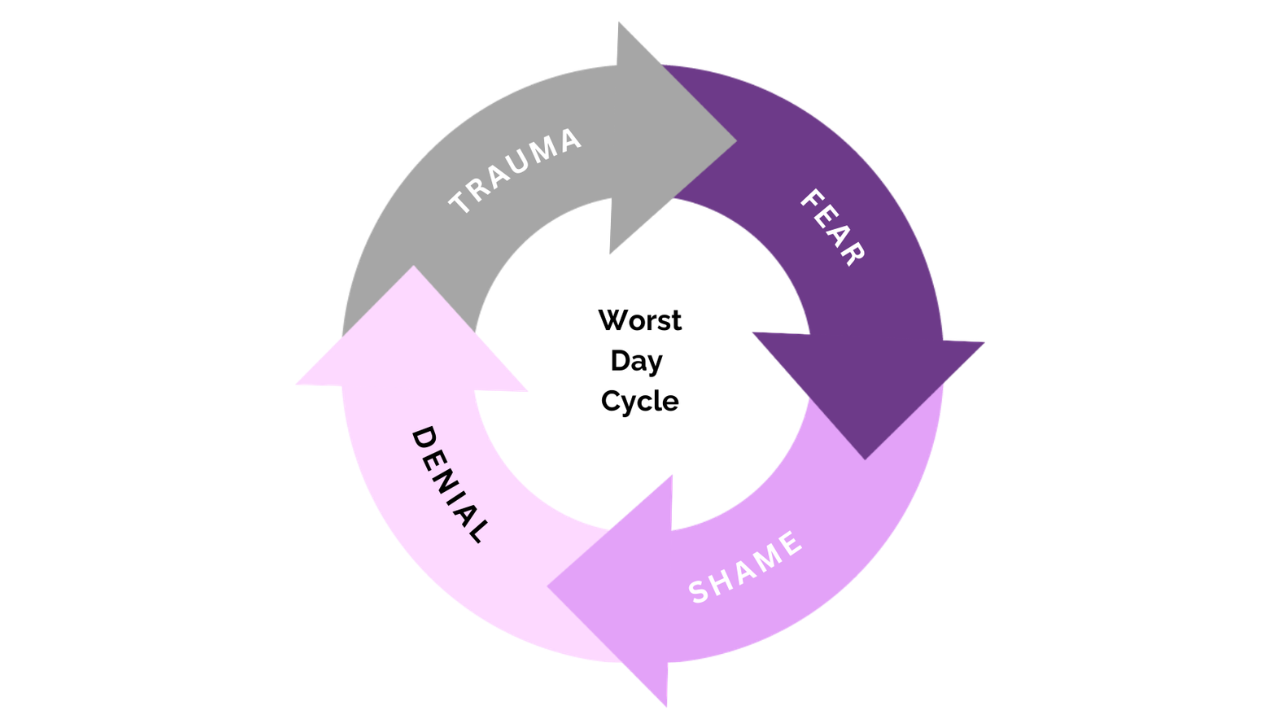
The Worst Day Cycle™ has four stages: Trauma → Fear → Shame → Denial.
It starts with childhood trauma. Not necessarily dramatic trauma—it could be criticism, neglect, chaos, disappointment, betrayal, anger, or simply growing up with a parent who was emotionally unavailable. Any negative emotional experience that created painful meanings about yourself: I’m not enough. I’m bad. I’m unlovable. The world is unsafe. Love means pain.
That trauma creates a chemical reaction in your brain. The hypothalamus floods your system with a chemical cocktail designed for survival: cortisol, adrenaline, dopamine, oxytocin misfires. Your brain becomes addicted to these states because they’re familiar, and the brain’s primary goal is not happiness—it’s consistency. Known is safe, even when known is painful.
Fear is the next stage. Your nervous system is terrified of losing the familiar, so it hypervigilates. It looks for signs of danger. It predicts abandonment, rejection, humiliation. This fear becomes the engine of repetition. The brain thinks: If I repeat the pattern, I can master it. If I repeat it, I can finally get it right. So you repeat it. In relationships, in career, in hobbies, in health—everywhere.
Shame is where you lose your inherent worth. You move from “that happened to me” to “I am the problem.” This is the deepest pain. At this stage, roughly 70% of childhood messaging is negative and shaming, so you believe it. I am unlovable. I am broken. I am too much or not enough.
Finally, Denial—the survival persona. This is the identity you create to survive the pain. For some, it’s the falsely empowered persona: I’ll control everything so no one can hurt me. I’ll dominate before I’m dominated. I’ll be powerful. For others, it’s the disempowered persona: I’ll collapse, people-please, disappear, give my power away. For still others, it’s the adapted wounded child: I’ll oscillate between both, depending on the context.
That’s the Worst Day Cycle—the pattern that looks like narcissism but is actually severe codependence.
The Authentic Self Cycle™ (ASC): The Path Out
The Authentic Self Cycle™ is the healing counterpart to the WDC. It also has four stages: Truth → Responsibility → Healing → Forgiveness.
Truth is the first step: name the blueprint. See the pattern clearly without judgment. This isn’t about today. This is about 1985. My nervous system is responding to my father’s criticism, not my partner’s comment. You’re not blaming your parents—you’re understanding the origin of the pattern.
Responsibility is owning your emotional reactions without blame. My partner isn’t my parent. My nervous system just thinks they are. I’m responsible for my healing. This is not the same as shame. Shame says, “I’m broken.” Responsibility says, “I have a nervous system that needs help, and I’m the only one who can help it.”
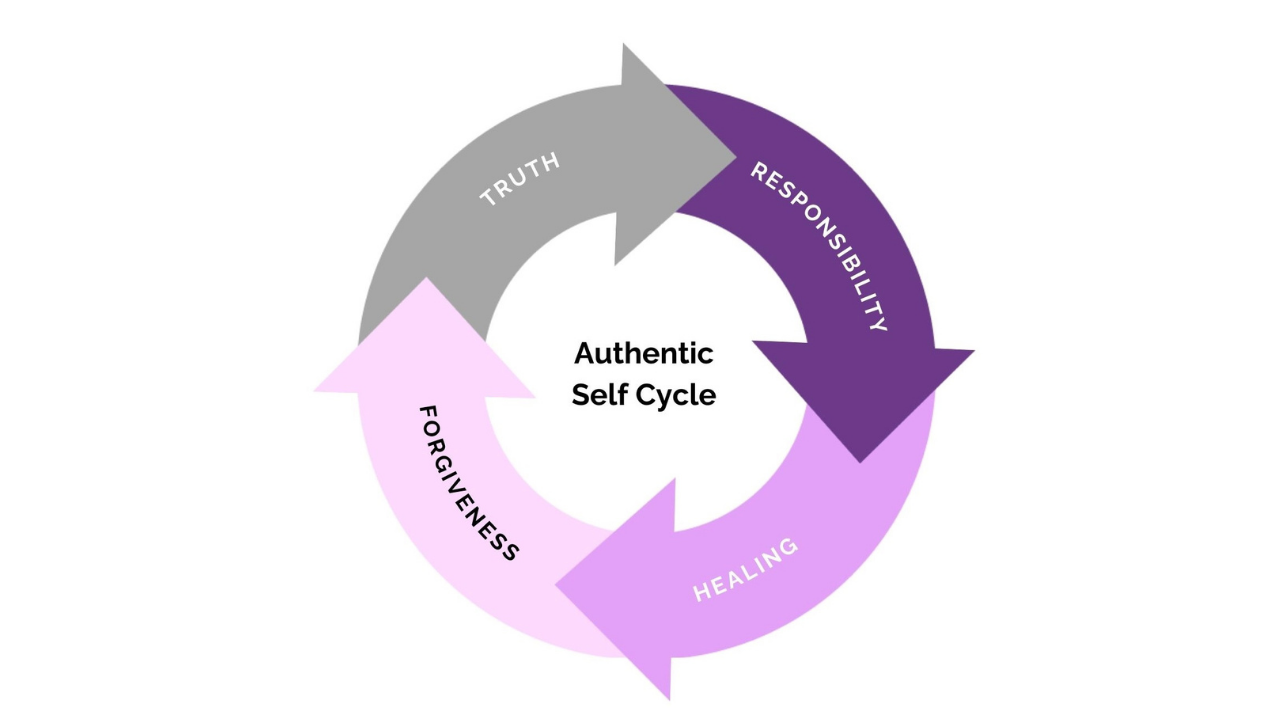
Healing is rewiring the emotional blueprint. This is somatic work, not just thinking about it. You’re creating new neural pathways, new emotional associations. Conflict becomes uncomfortable but not dangerous. Space isn’t abandonment. Intensity isn’t attack. Your body learns to trust.
Forgiveness is releasing the inherited emotional blueprint and reclaiming your authentic self. Not forgetting what happened. Not excusing it. But releasing the grip it has on your present moment.
That’s the ASC—what becomes possible when someone can see their pattern and decide to change it.
The Emotional Authenticity Method™ (EAM): The 5-Step Process
The Emotional Authenticity Method™ is the tool you use to move from the Worst Day Cycle to the Authentic Self Cycle. It’s a five-step somatic process:
Step 1: Somatic Down-Regulation (Optional Titration)
You’re triggered. Your nervous system is flooded. You cannot think clearly because all your blood is in your brainstem, not your prefrontal cortex. You need to regulate first. This might be 4-7-8 breathing, cold water on your face, movement, sound, or touch. Titration means micro-doses—just enough to bring your window of tolerance back into range, not to numb out entirely.
Step 2: What Am I Feeling?
Not thinking. Feeling. This requires emotional granularity. Not “bad”—sad? Angry? Afraid? Ashamed? Abandoned? Use the Feelings Wheel at kennyweiss.net/life-changing-exercise/ to find the exact word. Specificity matters because different emotions require different responses.
Step 3: Where in My Body Do I Feel It?
All emotional trauma is stored in the body. Your nervous system doesn’t file memories as narratives; it stores them as sensations. You might feel sadness in your chest, anger in your jaw, shame in your stomach, fear in your throat. Locating the sensation in your body is how you access the original trauma, not just the thought about the trauma.
Step 4: What Is My Earliest Memory of This Feeling?
Follow the sensation backward. When did you first feel this in your body? Was it with your father? Your mother? A teacher? A friend? The moment you access the original imprint, the present-moment trigger loses its charge. Your nervous system realizes: I’m not actually in danger right now. I’m remembering danger.
Step 5: Who Would I Be If I Never Had This Feeling Again?
This is the vision step. Move into the Authentic Self Cycle. Imagine your life, your relationships, your career, your body if this particular emotional pattern no longer ran you. What becomes possible? This step activates your brain’s future-orientation and creates a new chemical pattern that starts replacing the old one.
You cannot change emotional patterns through thoughts alone. Emotions are biochemical events. Thoughts originate from feelings. The EAM works because it addresses the actual neurobiology of trauma.
The Three Survival Personas Explained
The survival persona is not your real self. It’s an identity you created—brilliantly, at the time—to survive pain you couldn’t process. There are three primary types, and understanding which one your partner has (and which one you have) changes everything about how you approach the relationship.
The Falsely Empowered Survival Persona
This is the person who looks like a narcissist but isn’t one. They control, dominate, rage, and appear incapable of empathy. But underneath is terror. Terror of being powerless, abandoned, humiliated, or controlled. So they took the other side: I will never be powerless. I will control everything. I will be the one who dominates.
In childhood, this often happened to kids who grew up with an aggressive, controlling, or chaotic parent. They learned: Softness gets hurt. Vulnerability gets exploited. Empathy gets taken advantage of. So I’ll be hard. I’ll be strong. I’ll never let anyone do that to me again.
That’s the falsely empowered codependent—and they can heal if they develop awareness.
The Disempowered Survival Persona
This is the opposite response. Instead of controlling, they collapse. They people-please, give their power away, and become invisible. In childhood, they learned: If I make myself small enough, maybe no one will hurt me. If I give them what they want, maybe they’ll love me. If I disappear, I can’t be rejected.
The disempowered persona is often easier on their partners—until resentment builds. Then the person explodes, which surprises everyone because they “seemed so fine.” The disempowered codependent is suffering in silence, building rage, until the dam breaks.
That’s the codependent who doesn’t look like the problem until one day they do.
The Adapted Wounded Child
This is the shape-shifter. They oscillate between falsely empowered and disempowered depending on context, trigger, or who they’re with. One moment they’re dominating; the next they’re collapsing. One moment they’re rageful; the next they’re begging for forgiveness. This creates massive confusion for their partner because the person seems to have no consistency.
In childhood, this usually happened to kids who grew up with unpredictable parents—one moment nurturing, the next abusive. So they learned to read the room constantly, to shift their response, to become whoever they needed to be to survive that moment. As adults, they’re still doing that—but now it’s creating chaos.
That’s the adapted wounded child—the person whose internal experience is as chaotic as their external relationships.
Signs by Life Area: Where to Look
So how do you tell the difference between a falsely empowered codependent and a narcissist in real life? Look for these signs across different life areas.
Family Relationships
Falsely Empowered Codependent: They might be controlling with you but anxious with their parents. They might rage at you but panic if their mother is disappointed. They might dominate conversations with you but become small with their family of origin. The survival persona is context-dependent.
Narcissist: They maintain the same dynamic everywhere. Controlling with parents, controlling with you. Superior with family, superior with you. No shift. No context-dependence.
Romantic Relationships
Falsely Empowered Codependent: They create chaos, but they panic when you leave. They rage, but in quiet moments they feel remorse. They’re controlling, but there are moments where they can see it. They’re addicted to the emotional intensity—both the fighting and the making up.
Narcissist: They create chaos, and they’re completely unbothered if you leave (they’ll just find new supply). They don’t feel remorse; they feel annoyed that you’re upset. They’re not controlling out of fear; they’re controlling out of entitlement. When you leave, they either replace you immediately or pursue you with rage—but there’s no genuine fear of loss, just fury at being left.
Friendships
Falsely Empowered Codependent: They might be funny, engaged, and genuinely present with friends. Their friends might be shocked when you describe the behavior at home because that’s not the person they know. The survival persona is situational.
Narcissist: They maintain the same hierarchy dynamic with friends. They’re often the “most interesting” person in the group, they bring things back to themselves, they subtly undermine people’s self-esteem. Friends might notice patterns of them leaving relationships abruptly or having strange dynamics, but the behavior is consistent.
Work
Falsely Empowered Codependent: They might be a great colleague, a good manager, even someone people admire professionally—while creating hell at home. Or vice versa. The survival persona compartmentalizes.
That’s when you hear, “I don’t understand. At work, he’s so professional. So kind. This doesn’t match what you’re describing.”
Narcissist: The narcissism shows up at work too, just in different ways. They might be charming to authority, but they subtly undermine peers. They might take credit for others’ work. They might create chaos and then disappear. The underlying belief—I’m superior, you’re inferior—is consistent everywhere.
Body and Health
Falsely Empowered Codependent: They often have a substance addiction (alcohol, drugs), behavioral addiction (sex, gambling, shopping), or compulsive behavior (overexercising, overworking). These are attempts to regulate their nervous system outside of relationships. They feel shame about these behaviors.
Narcissist: They rarely have substance addiction because their behavior already regulates them. They might have behavioral addictions (sex, shopping, status-seeking), but these are extensions of their narcissism, not attempts to escape it. They don’t feel shame; they feel entitled.
The Path Forward: Healing vs. Leaving
The reason this distinction matters is simple: you can heal a relationship with a codependent. You cannot heal a relationship with a narcissist.
If your partner is a falsely empowered codependent (someone who looks like a narcissist but has moments of awareness, shifts by context, and probably has an addiction), healing is possible. Not easy. Not quick. But possible.
What Healing Requires
First, your partner must become willing to see the pattern. Not because you’re right and they’re wrong—that framing just triggers more defensiveness. But because they’re tired of the chaos. Because they’re tired of sabotaging good moments. Because they’re ready to understand why they do this.
Second, they have to be willing to do somatic work. Not just think about their pattern. Feel it. Locate it in their body. Trace it back to childhood. Do the Emotional Authenticity Method. Rewire their nervous system. This is the Emotional Authenticity Method™ (EAM) in action.
Third, they have to stay committed through the discomfort. Early in healing, everything feels worse before it gets better. The nervous system is learning new pathways. The brain is trying to find the old chemical pattern and can’t. This feels destabilizing. Most people quit here.
That’s you watching your partner panic and wonder if they’re “breaking” when actually they’re healing.
If they can do those three things, the relationship can transform. Not back to what it was—you’re building something new. But forward to something healthier.
What Healing Doesn’t Require
Healing doesn’t require you to stay in an unsafe environment while they figure it out. You can set boundaries. You can leave. You can insist on couples therapy. You can make your continued presence conditional on their willingness to do the work. That’s your job.
Your job is not to fix them. Your job is not to manage their emotional process. Your job is to protect yourself and, if you choose, to create space for them to heal alongside you.
That’s the falsely empowered codependent relationship: painful, but potentially repairable.
With a Narcissist
With a true narcissist, there is no awareness to access. There is no moment of Oh, I do that. There is only: You’re crazy for suggesting I do that. There is no pattern to see because their brain genuinely doesn’t register impact on others as real.
You cannot heal what won’t be named. You cannot save what has no interest in being saved. The only healthy path is usually clear boundaries or leaving.
But if you’re sitting there wondering Is it codependence or narcissism?—the fact that you’re wondering suggests it might be codependence. Narcissists leave no doubt.
People Also Ask
Can a codependent become a narcissist?
No. A codependent is someone running the Worst Day Cycle™ with shame at the core: I am the problem. A narcissist is someone for whom shame never developed properly. They never internalized the idea that they could be wrong. A codependent might behave narcissistically (controlling, raging, dismissing), but they’re a falsely empowered codependent, not a narcissist. The internal experience is completely different.
What if my codependent partner refuses to acknowledge the pattern?
Then you’re at the boundary. You cannot force awareness. You cannot shame someone into seeing themselves. What you can do is stop participating in the cycle. Stop arguing when they gaslight. Stop explaining yourself. Stop trying to prove you’re right. Set consequences: “When you speak to me that way, I need space.” “If this continues, I need to look at whether this relationship works for me.” Sometimes a person only develops awareness when the relationship is actually at risk.
Is it possible both partners are codependent?
Absolutely. And when both are, it’s explosive. One person is falsely empowered, one is disempowered (or one oscillates and the other is stuck in one). You get alternating victim/perpetrator dynamics. One person pursues, one withdraws. The relationship becomes a dance of trying to regulate each other’s nervous systems—which never works because you’re both dysregulated. This is one of the most painful relationship dynamics because both people are right: I am injured. I am reacting from pain. I need help. And both are wrong: My partner is the problem. The problem is the unhealed pattern in the dyad.
How do I know if I’m codependent?
Some signs: You try to control your partner’s behavior to manage your own anxiety. You people-please to avoid abandonment. You have a substance or behavioral addiction. You feel responsible for your partner’s emotions. You override your own needs to keep the peace. You panic when someone is upset with you. You abandon yourself to stay in relationships. You don’t know what you actually want separate from what others want. True self-esteem feels foreign to you. If any of these resonate, exploring codependence might be valuable—even if your partner isn’t struggling with it.
Can couples therapy help if one partner is codependent?
Yes—but only if the codependent partner is willing to own their part. If they go to couples therapy only to defend themselves or make you look crazy, therapy becomes a tool for manipulation. But if they go to understand their pattern, to learn the Emotional Authenticity Method™, to access the Authentic Self Cycle™—then couples therapy can be transformative. Choose a therapist who understands codependence and nervous system healing, not just communication skills.
What does recovery look like?
Recovery doesn’t mean your partner becomes perfect or that you never fight again. It means: You can disagree without someone shutting down. You can have space without it meaning abandonment. You can be vulnerable without it being weaponized. You can see each other’s impact and care about it. You can repair conflict. You can build something genuinely safe. But this requires both people willing to do the work—not just you.
The Bottom Line
You’re exhausted. You’re wondering if this relationship is redeemable or if you’re wasting your life. You’re asking: Are they a codependent or a narcissist? And does that answer change what I do?
Yes. It changes everything.
If they’re a falsely empowered codependent—if they have moments of awareness, if they’re different in different contexts, if they probably have an addiction—then they’re operating from the Worst Day Cycle™. They’re terrified of abandonment underneath the control. They can heal. They can see their impact. They can choose the Authentic Self Cycle™. The relationship can transform.
If they’re a narcissist—if they show zero awareness, if they’re consistent everywhere, if they have no shame—then they’re not running a trauma cycle. They’re running a different blueprint entirely. You cannot save that. You can only protect yourself.
But here’s what I want you to know: Even if you’re married to a falsely empowered codependent—even if they can theoretically heal—you do not have to wait for them to figure it out.
Your boundary matters. Your safety matters. Your healing matters independent of whether they decide to heal. You can set conditions: “I need you to see a therapist. I need you to do the Emotional Authenticity Method. I need you to access the Authentic Self Cycle. If you’re willing, I’m willing to do this work alongside you.”
And if they’re not willing? Then you have your answer. Not about whether they’re a narcissist, but about whether they’re willing to fight for the relationship. That’s the question that matters most.
You deserve someone who will. You deserve safety, clarity, and genuine intimacy. Whether that’s with this person depends on whether they’re willing to do the work. Your job is to stop trying to fix them and start insisting they fix themselves—or you walk.
That’s not cruel. That’s self-respect.
Recommended Reading
- Melody Beattie — Codependent No More (the foundational text)
- Melody Beattie — The New Codependency (updated understanding)
- Pia Mellody — Facing Codependence (core wounds and boundaries)
- Gabor Maté — When the Body Says No (trauma and nervous system)
- Brené Brown — Daring Greatly (shame and vulnerability)
- Harville Hendrix — Getting the Love You Want (couples healing)
- John Gottman — The Seven Principles for Making Marriage Work (the science)
Learn the Tools: Recommended Courses
Start with foundational understanding:
- Emotional Blueprint Starter Course — Individual — $79
Understand your own codependence, survival persona, and emotional blueprint. Essential before trying to fix the relationship. - Relationship Starter Course — Couples — $79
Map your relationship dynamics, understand where you’re both triggered, and see what’s actually possible.
Move into deeper healing:
- Tier 1: Mapping the Blueprint — $1,379
Learn the Emotional Authenticity Method™ step-by-step with video training, worksheets, and weekly coaching calls. This is where real change happens. - Why We Can’t Stop Hurting Each Other — $479
Understand your nervous system, your partner’s nervous system, and how two wounded people create cycles. Includes frameworks for breaking them.
Specific to your relationship pattern:
- Why High Achievers Fail at Love — $479
If your partner is falsely empowered and high-functioning in career, this explains the pattern. - The Shutdown Avoidant Partner — $479
If your codependent partner is disempowered and withdrawn, this is the course.
One More Thing
You’re probably in pain right now. You’re probably wondering if you’re crazy, if you’re asking too much, if you should just accept the way things are. You’re not. You’re not asking too much. And if your partner won’t do the work, that’s information—not a failure on your part.
Take the Feelings Wheel exercise and locate exactly what you’re experiencing. Use the Emotional Authenticity Method™ to trace it back. Do the somatic work. Heal yourself first. Then you’ll have the clarity to see what’s actually possible in this relationship.
Your healing does not depend on their willingness to heal. But your boundaries might save both of you.